
Empowered, Impactful & Rewarding Nonprofit Board
TA
Published · 33 slides · 0 views

1 / 1

Description
Empowered, Impactful Rewarding Nonprofit Board Service Avanti D. Bakane Sufyan Sohel 2 Board Training Objectives Provide background on nonprofit boards; Examine common nonprofit board pitfalls; Review nonprofit board fiduciary duties;
Related Topics
Share
Embed code
Download this presentation From Below
"Empowered, Impactful & Rewarding Nonprofit Board" is the property of its rightful owner. Permission is granted to download and print the materials on this website for personal, non-commercial use only, and to display it on your personal computer provided you do not modify the materials and that you retain all copyright notices contained in the materials. By downloading content from our website, you accept the terms of this agreement.
Presentation Transcript
01
Empowered, Impactful & Rewarding
Nonprofit Board Service Avanti D. Bakane Sufyan Sohel<br>
Nonprofit Board Service Avanti D. Bakane Sufyan Sohel<br>
02
2 Board Training Objectives Provide background on nonprofit boards;
Examine common nonprofit board pitfalls;
Review nonprofit board fiduciary duties;
Discuss board roles and responsibilities;
Consider benefits of board service; and
Q&A Session<br>
Examine common nonprofit board pitfalls;
Review nonprofit board fiduciary duties;
Discuss board roles and responsibilities;
Consider benefits of board service; and
Q&A Session<br>
03
3 Why do Non Profits have Boards? Board of Directors Purpose
Governance
Protect the public’s and stakeholder’s interest
Carry out fiduciary responsibilities
Comply with legal and contractual requirements
Develop and monitor policies
Hold the CEO accountable
Support
Assist the organization to achieve its mission and goals by supporting the CEO
Ensure the organization has adequate resources
Lend special skills
Share contacts
Act as ambassadors<br>
04
4 Background on Nonprofit Boards The purpose of the nonprofit board is to govern the organization in order to:
Protect the public’s “assets”
Ensure the organization accomplishes its mission
Board work depends on stage in life cycle, typically includes:
Governance, strategy, fundraising
Partnering with staff (if any) to do aspects of the work of the organization, as needed<br>
Protect the public’s “assets”
Ensure the organization accomplishes its mission
Board work depends on stage in life cycle, typically includes:
Governance, strategy, fundraising
Partnering with staff (if any) to do aspects of the work of the organization, as needed<br>
05
5 Background on Nonprofit Boards Illinois law requires at least three members of the board (directors)
Board members should not be compensated for board service
Boards should be comprised of a majority of independent directors (not family, employees or business partners)
Officers of the board fulfill specialized roles, which should be described in the bylaws
Chair or President
Vice President (optional)
Secretary
Treasurer<br>
06
6 Common Nonprofit Board Pitfalls Top 5 Mistakes Boards Make:
Failing to Understand Fiduciary Duties
Failing to Provide Effective Oversight (or Providing Deference to EC/Chair/Founder/ED)
Micromanaging Staff
Operating with Outdated, Inconsistent, Non-Compliant Governing Documents
Failure to Recruit Directors without Due Care and without Cultivating Board Diversity<br>
07
7 Common Nonprofit Board Pitfalls Personal Liability can be found when:
Loans to directors
Excess Benefits transactions (paying more than FMV)
Payroll Taxes
Distribution of Assets if insolvent
Personal Guarantees
Actions taken not in Good Faith or not in the best interests of the organization
Director Protections from Personal Liability
Business Judgment Rule
Immunity Statutes
Indemnification<br>
08
8 Questions to ask: Why does our organization exist?
What are our core values and philosophy?
What are our core competencies - how are we unique?
What benefit to the community do we offer?
The Board is ultimately responsible for adherence to legal Standards and ethical norms.
Remember the Duties…
Care
Loyalty
Obedience<br>
What are our core values and philosophy?
What are our core competencies - how are we unique?
What benefit to the community do we offer?
The Board is ultimately responsible for adherence to legal Standards and ethical norms.
Remember the Duties…
Care
Loyalty
Obedience<br>
09
9 Nonprofit Board Fiduciary Duties Duty of Care
The duty to make informed decisions in the best interest of the organization.
The standard is that of a person acting with the ordinary care and prudence used in the same circumstances.
Exercise good business judgment.<br>
The duty to make informed decisions in the best interest of the organization.
The standard is that of a person acting with the ordinary care and prudence used in the same circumstances.
Exercise good business judgment.<br>
10
10 Nonprofit Board Fiduciary Duties Duty of Loyalty
Act in good faith in the best interest of the organization with honesty and fairness
Always put the interest of the organization before self-interest
Most Conflicts of Interest arise from a breach of the duty of loyalty
Duty of Obedience
Duty to remain focused and faithful to the organization’s mission
Requires directors to understand and assure compliance with laws that impact the organization
Requires understanding and following organization’s governing documents<br>
11
11 Nonprofit Board Fiduciary Duties Fiduciary duties are legal obligations of each director
Compliance is not difficult
The standard is not perfection but that of reasonably prudent person
Read the material you receive
Know the mission
Follow the bylaws
Participate in meetings
Voice dissent if you do not agree with something
Know when to hire a professional<br>
Compliance is not difficult
The standard is not perfection but that of reasonably prudent person
Read the material you receive
Know the mission
Follow the bylaws
Participate in meetings
Voice dissent if you do not agree with something
Know when to hire a professional<br>
12
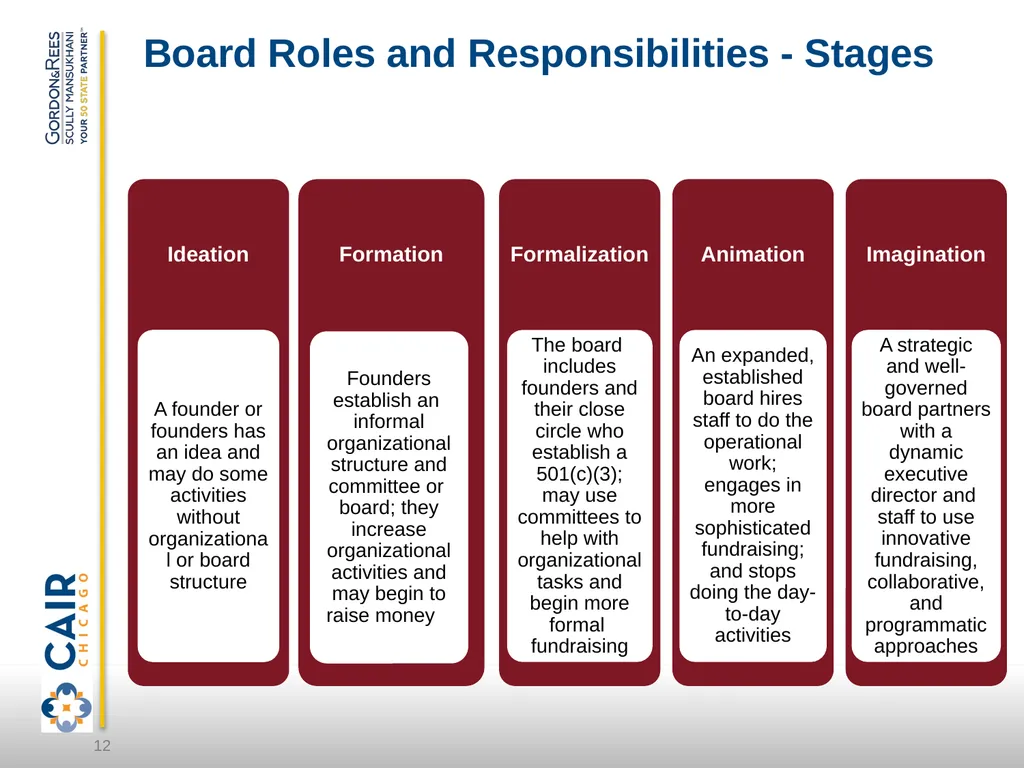
12 Board Roles and Responsibilities - Stages<br>
13
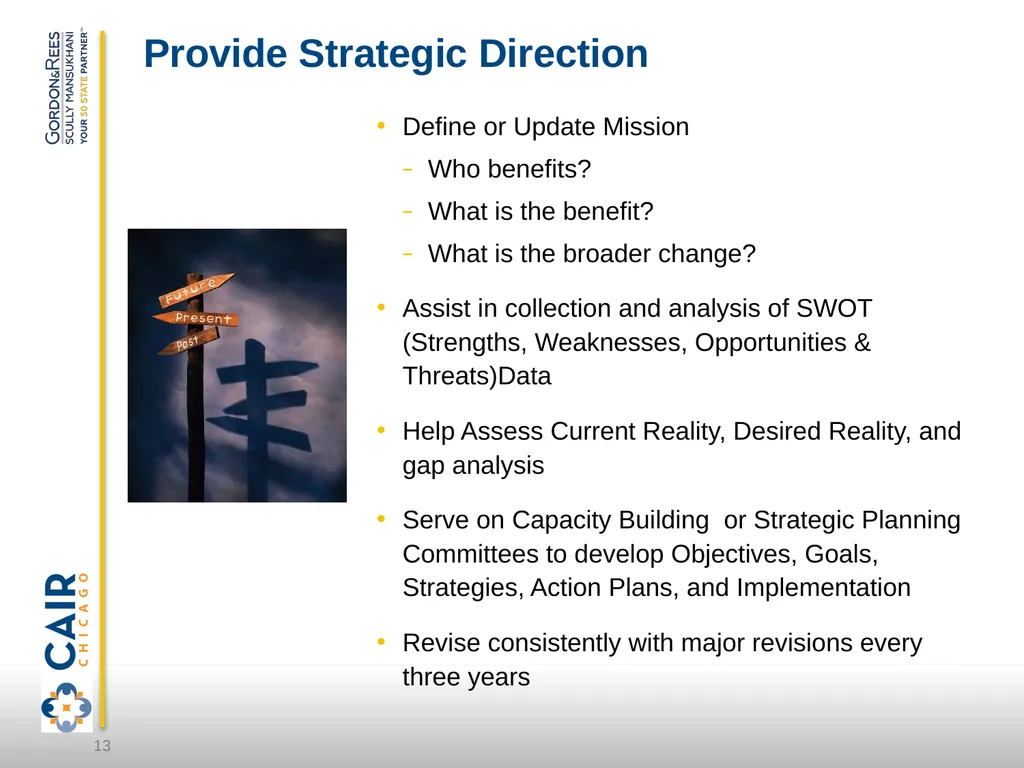
13 Provide Strategic Direction Define or Update Mission
Who benefits?
What is the benefit?
What is the broader change?
Assist in collection and analysis of SWOT (Strengths, Weaknesses, Opportunities & Threats)Data
Help Assess Current Reality, Desired Reality, and gap analysis
Serve on Capacity Building or Strategic Planning Committees to develop Objectives, Goals, Strategies, Action Plans, and Implementation
Revise consistently with major revisions every three years<br>
14
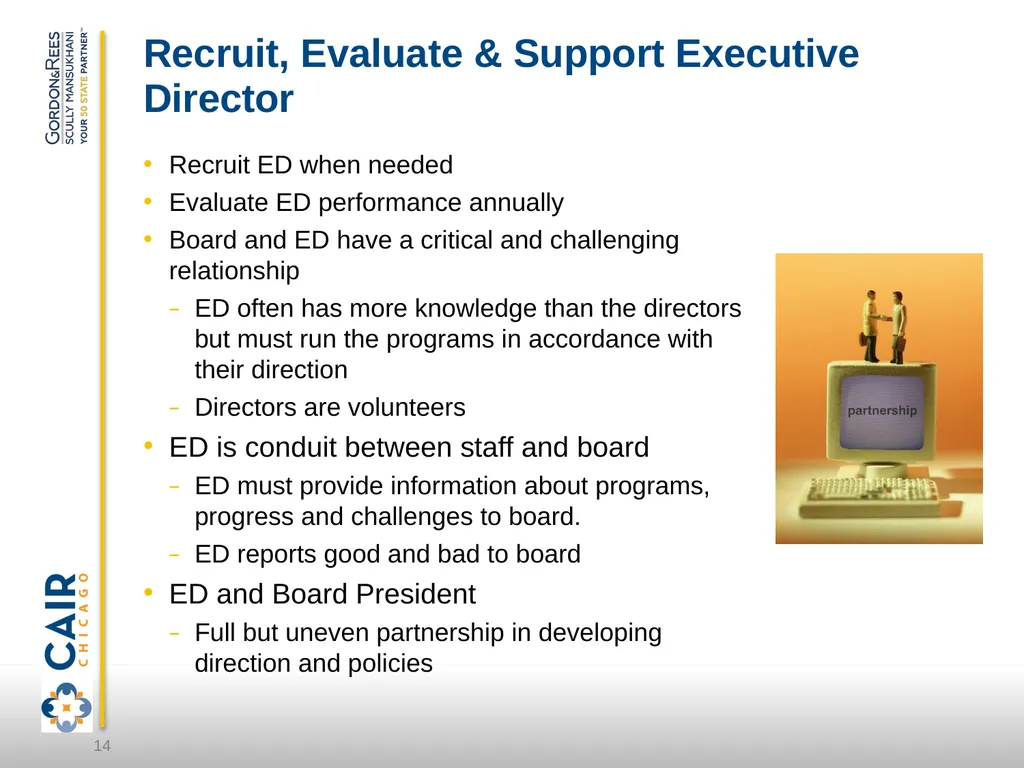
14 Recruit, Evaluate & Support Executive Director Recruit ED when needed
Evaluate ED performance annually
Board and ED have a critical and challenging relationship
ED often has more knowledge than the directors but must run the programs in accordance with their direction
Directors are volunteers
ED is conduit between staff and board
ED must provide information about programs, progress and challenges to board.
ED reports good and bad to board
ED and Board President
Full but uneven partnership in developing direction and policies<br>
15
15 Board member relationship with staff… Board member micromanagement of staff can lead to conflict and confusion regarding roles and responsibilities:
A board member requests staff to enroll their child in a program without following protocol.
Board members regularly edit basic communications and documents when this is part of the staff’s job description.
Focusing board meetings and decision making on tasks and activities that are the responsibility of staff.<br>
16
16 Monitor Programs Determine high level programmatic approach
Who programs are designed to serve
What programs should do for that population
How much programs should cost
Strategic positioning
Request and review program summaries/dashboard
Program Outcomes
Program Income
Program Costs
Cost/Successful Output
Learn program success stories<br>
Who programs are designed to serve
What programs should do for that population
How much programs should cost
Strategic positioning
Request and review program summaries/dashboard
Program Outcomes
Program Income
Program Costs
Cost/Successful Output
Learn program success stories<br>
17
17 Fundraise Personal financial contributions
Every board member should make a donation of some size
Board may have a requirement:
Pre-determined amount
Percentage of personal income
Percentage of organizational budget
Collective goal based on need
Give-or-get policy
Top 3
Annual campaign: board and staff partnership
Fund Raising Realities Every Board Member Must Face: A 1-Hour Crash Course on Raising Major Gifts for Nonprofit Organizations, David Lansdowne, Emerson & Church, 2007
Funder relations: board and staff partnership
Special Events
Others?<br>
18
18 Manage Finances Manage overall financial approach
Understand Financial Statements
Statement of Financial Position (balance sheet, assets to liabilities)
Statement of Activities (operations budget, revenue to expenses)
Cash Flow
Budget comparisons, YTD, etc.
Participate in Budgeting Process and Approve Annual Budget
Ensure Adequate Financial Controls<br>
19
19 Develop and Organize the Board Develop the Board through Recruitment and Orientation:
Provide candidates for board recruitment
Help with board orientation
Assist in planning board training
Participate in board self-assessments and interviews
Support initiatives to improve governance
Develop board member expectations list
Bring suggestions for improvements<br>
Provide candidates for board recruitment
Help with board orientation
Assist in planning board training
Participate in board self-assessments and interviews
Support initiatives to improve governance
Develop board member expectations list
Bring suggestions for improvements<br>
20
20 Develop and Organize the Board Organize the Board through Efficient Board Meetings
Information Flow
Provide critical information to board at least 5 days prior to meeting
Packet includes: agenda (consent agenda if used), reports, minutes, committee reports, financial statements, budget comparison.
Responsibility for Successful Board Meetings
President and ED work together, equally responsible
Set Agenda, Follow Agenda
Encourage Open Discussion, all viewpoints respected
Expect that each Director is prepared for the meeting
See www.thelawproject.org > Resources > Nonprofit Resources, “Introduction to Nonprofit Board Meetings” Handbook<br>
21
21 Cultivate Relationships The staff can work with the board to develop a public relations and collaborations strategy to hone messaging for and develop relationships with:
Nonprofits providing similar services;
Nonprofits providing different services to the same clients;
Government, schools, businesses, and religious institutions;
Funders, donors, and sponsors;
Parent organizations and affiliates;
Media;
Community leaders;
Others?<br>
Nonprofits providing similar services;
Nonprofits providing different services to the same clients;
Government, schools, businesses, and religious institutions;
Funders, donors, and sponsors;
Parent organizations and affiliates;
Media;
Community leaders;
Others?<br>
22
22 Manage Risk There are several areas that can leave an organization exposed to risk, including:
Organization and Governance,
Intellectual Property and Information Technology,
Human Resources,
Exempt Status,
Real Property,
Personal Property, and
Required filings<br>
Organization and Governance,
Intellectual Property and Information Technology,
Human Resources,
Exempt Status,
Real Property,
Personal Property, and
Required filings<br>
23
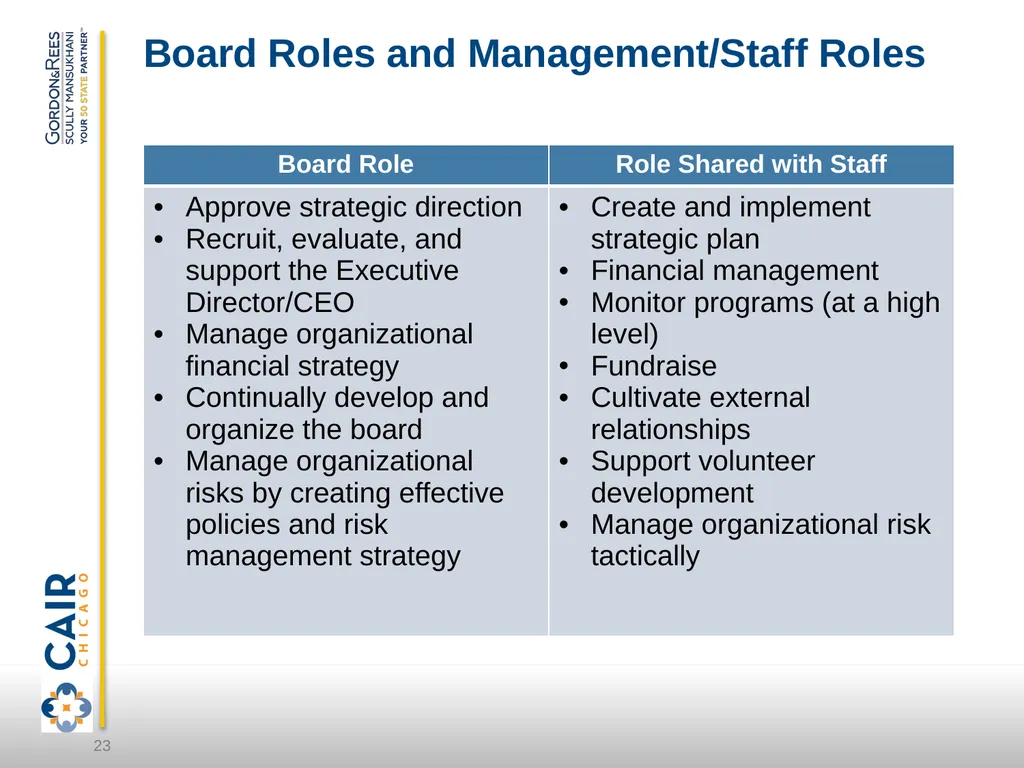
23 Board Roles and Management/Staff Roles<br>
24
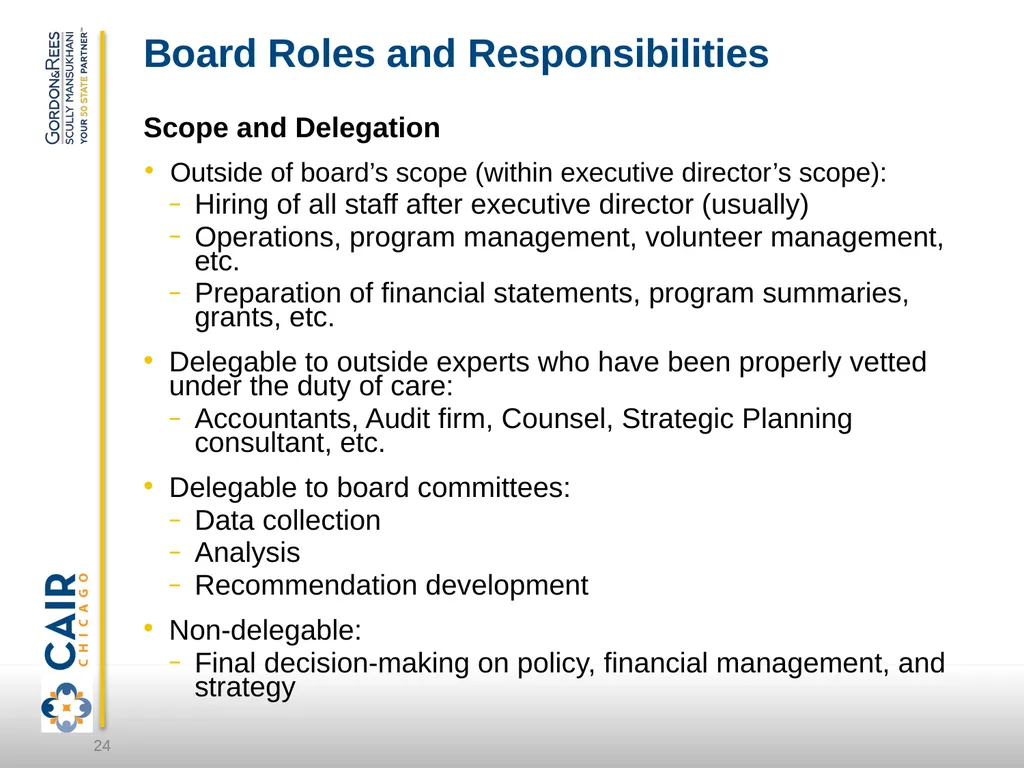
24 Board Roles and Responsibilities Scope and Delegation
Outside of board’s scope (within executive director’s scope):
Hiring of all staff after executive director (usually)
Operations, program management, volunteer management, etc.
Preparation of financial statements, program summaries, grants, etc.
Delegable to outside experts who have been properly vetted under the duty of care:
Accountants, Audit firm, Counsel, Strategic Planning consultant, etc.
Delegable to board committees:
Data collection
Analysis
Recommendation development
Non-delegable:
Final decision-making on policy, financial management, and strategy<br>
25
25 Benefits of Nonprofit Board Services Scope and Delegation
Relationship and network development
Professional branding
Contribution of strengths for social good and satisfaction
Mitigation or development of areas of weakness
Level of comfort with high level, ethical decision-making
Important skills practice:
Emotional intelligence
Strategic planning
Financial analysis
Sales
Others?<br>
26
26 You are the organization.. The Board should [be able to] clearly articulate the organization's mission, accomplishments, and goals to the public and garner support from the community.
In 30 seconds or less can you answer:
Why is your work so important?
What is unique about what you do?
Why are you passionate about it?<br>
In 30 seconds or less can you answer:
Why is your work so important?
What is unique about what you do?
Why are you passionate about it?<br>
27
27 Be the Ambassador: Make an annual financial contribution to the organization
Nail down your “elevator speech”
Take advantage of learning and training opportunities
Keep the organization at the forefront of your mind
Listen for opportunities and make connections (follow-through)
Be present at events
Share your personal experience and motivations
Open doors and create opportunities for the organization to promote its mission and impact to potential donors<br>
28
28 The 10 Basic Board Roles & Responsibilities 1. Determine Mission and Purpose, and Advocate for Them
2. Select the Chief Executive
3. Support and Evaluate the Chief Executive
4. Ensure Effective Planning
5. Monitor and Strengthen Programs and Services
6. Ensure Adequate Financial Resources
7. Protect Assets and Provide Proper Financial Oversight
8. Build a Competent Board
9. Ensure Legal and Ethical Integrity
10. Enhance the Organization’s Public Standing<br>
29
Q & A Session Questions? 29<br>
30
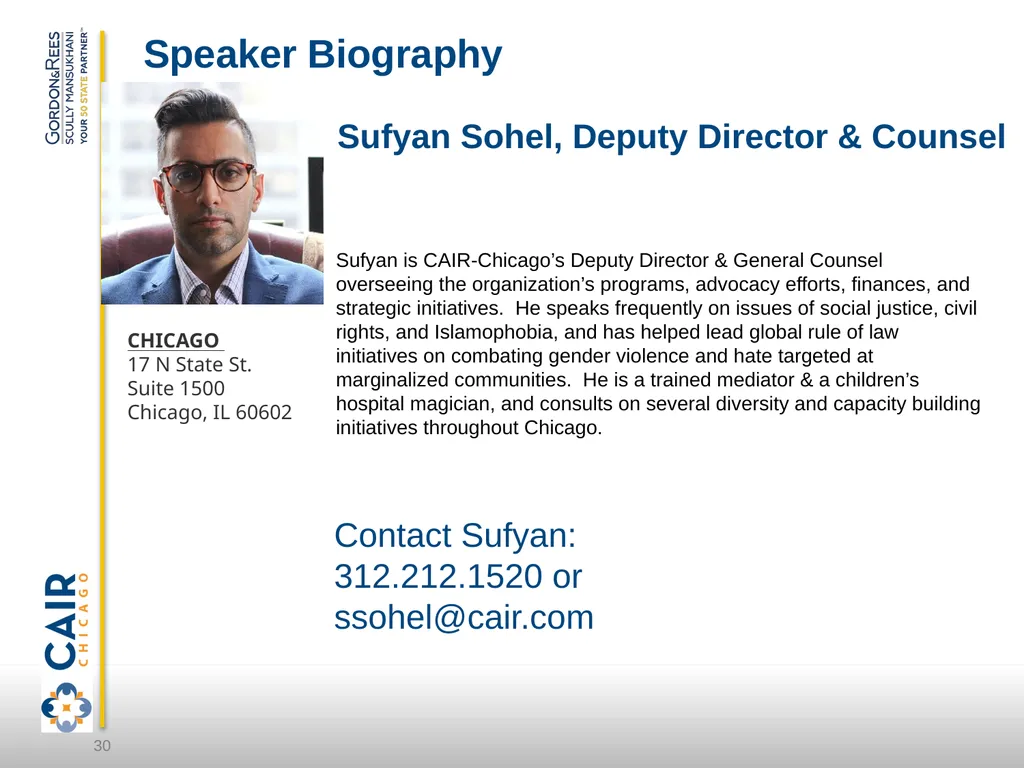
Speaker Biography 30 Sufyan Sohel, Deputy Director & Counsel Sufyan is CAIR-Chicago’s Deputy Director & General Counsel overseeing the organization’s programs, advocacy efforts, finances, and strategic initiatives. He speaks frequently on issues of social justice, civil rights, and Islamophobia, and has helped lead global rule of law initiatives on combating gender violence and hate targeted at marginalized communities. He is a trained mediator & a children’s hospital magician, and consults on several diversity and capacity building initiatives throughout Chicago. Contact Sufyan:
312.212.1520 or
ssohel@cair.com Chicago 17 N State St. Suite 1500
Chicago, IL 60602<br>
312.212.1520 or
ssohel@cair.com Chicago 17 N State St. Suite 1500
Chicago, IL 60602<br>
31
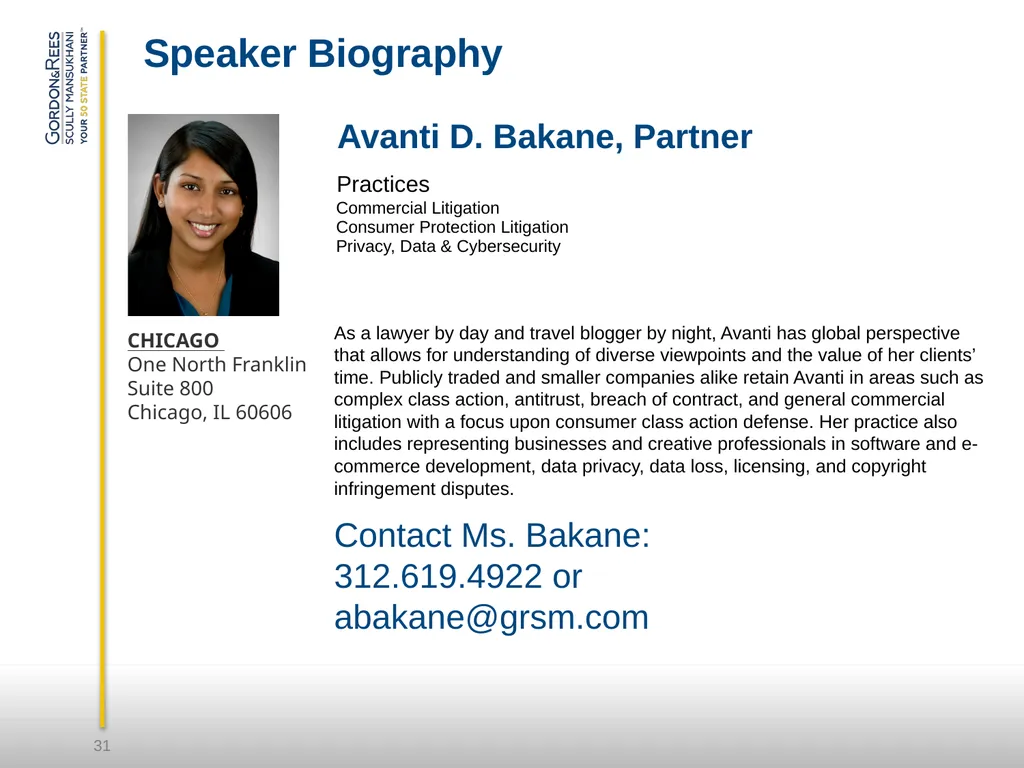
Speaker Biography 31 Avanti D. Bakane, Partner Practices As a lawyer by day and travel blogger by night, Avanti has global perspective that allows for understanding of diverse viewpoints and the value of her clients’ time. Publicly traded and smaller companies alike retain Avanti in areas such as complex class action, antitrust, breach of contract, and general commercial litigation with a focus upon consumer class action defense. Her practice also includes representing businesses and creative professionals in software and e-commerce development, data privacy, data loss, licensing, and copyright infringement disputes. Contact Ms. Bakane:
312.619.4922 or
abakane@grsm.com Chicago One North Franklin Suite 800
Chicago, IL 60606<br>
312.619.4922 or
abakane@grsm.com Chicago One North Franklin Suite 800
Chicago, IL 60606<br>
32
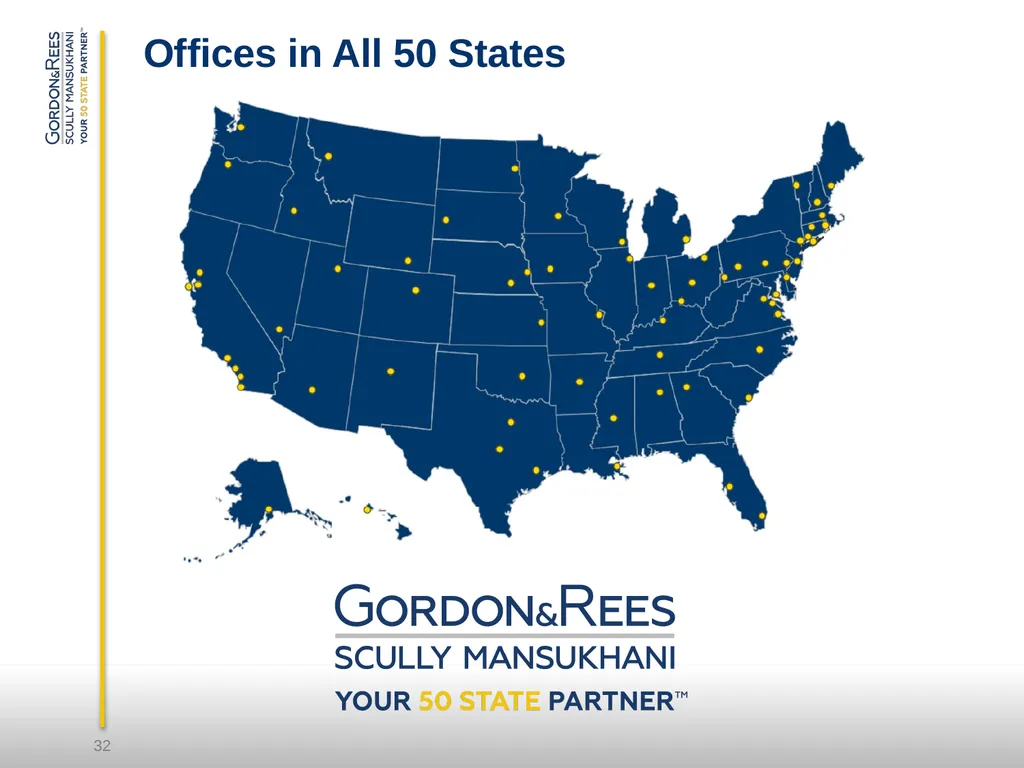
32 Offices in All 50 States<br>