
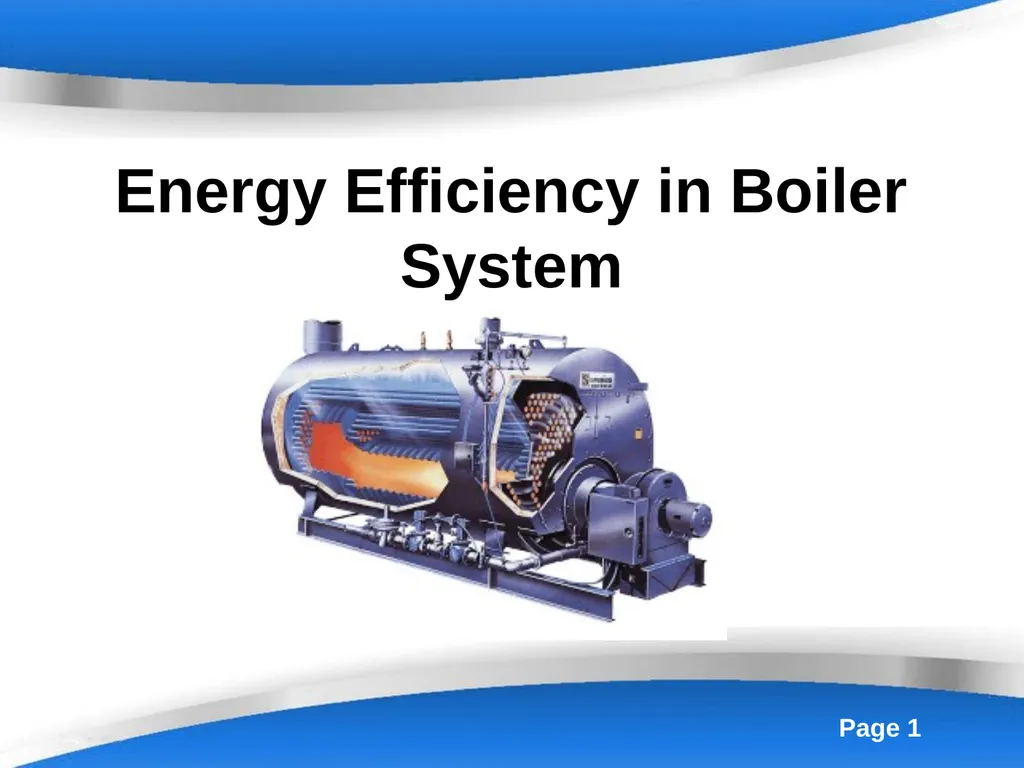
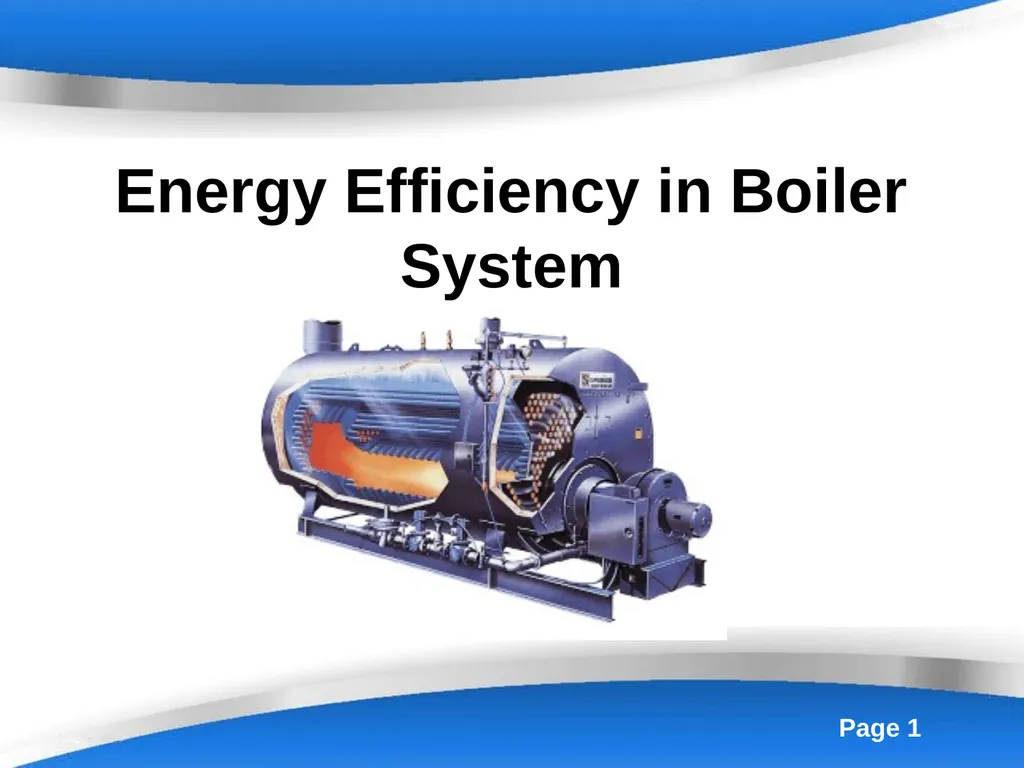
Energy Efficiency in Boiler System Boilers
NS
Published · 55 slides · 0 views
1 / 1

Description
Energy Efficiency in Boiler System Boilers Pressure vessel for producing steam or hot water Steam boilers are able to burn fossil fuels like oil, gas, and coal A major portion of energy (fuel) in a facility is accounted for by boiler plant
Related Topics
Share
Embed code
Download this presentation From Below
"Energy Efficiency in Boiler System Boilers" is the property of its rightful owner. Permission is granted to download and print the materials on this website for personal, non-commercial use only, and to display it on your personal computer provided you do not modify the materials and that you retain all copyright notices contained in the materials. By downloading content from our website, you accept the terms of this agreement.
Presentation Transcript
01
Energy Efficiency in Boiler System<br>
02
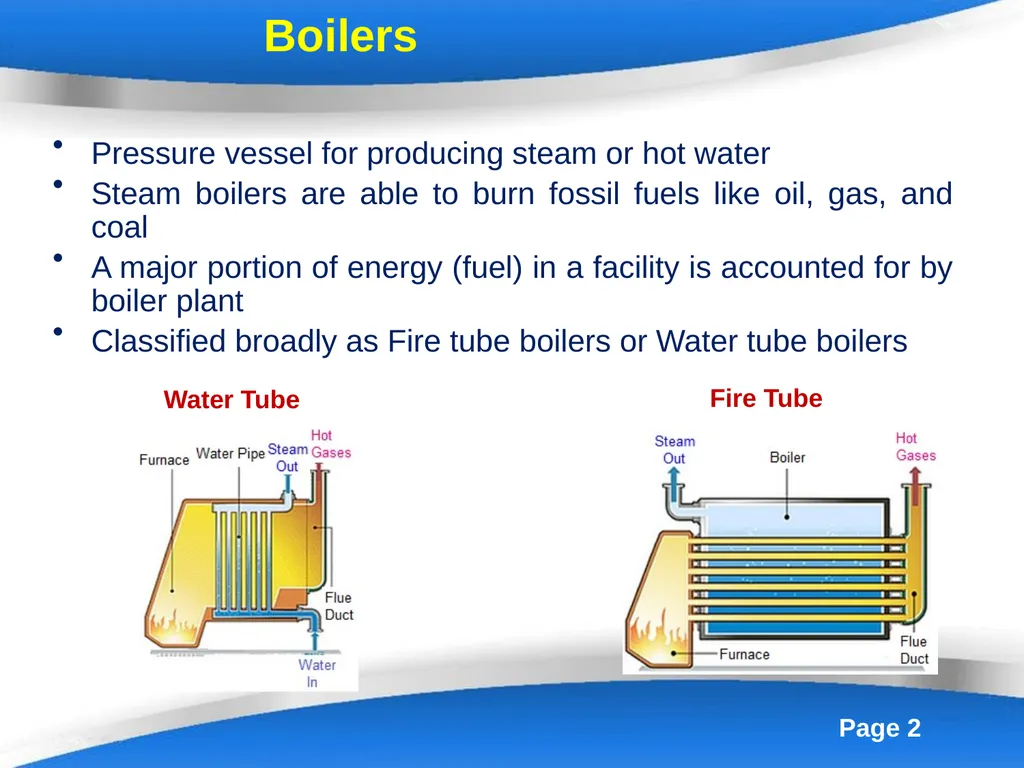
Boilers Pressure vessel for producing steam or hot water
Steam boilers are able to burn fossil fuels like oil, gas, and coal
A major portion of energy (fuel) in a facility is accounted for by boiler plant
Classified broadly as Fire tube boilers or Water tube boilers Water Tube Fire Tube<br>
Steam boilers are able to burn fossil fuels like oil, gas, and coal
A major portion of energy (fuel) in a facility is accounted for by boiler plant
Classified broadly as Fire tube boilers or Water tube boilers Water Tube Fire Tube<br>
03
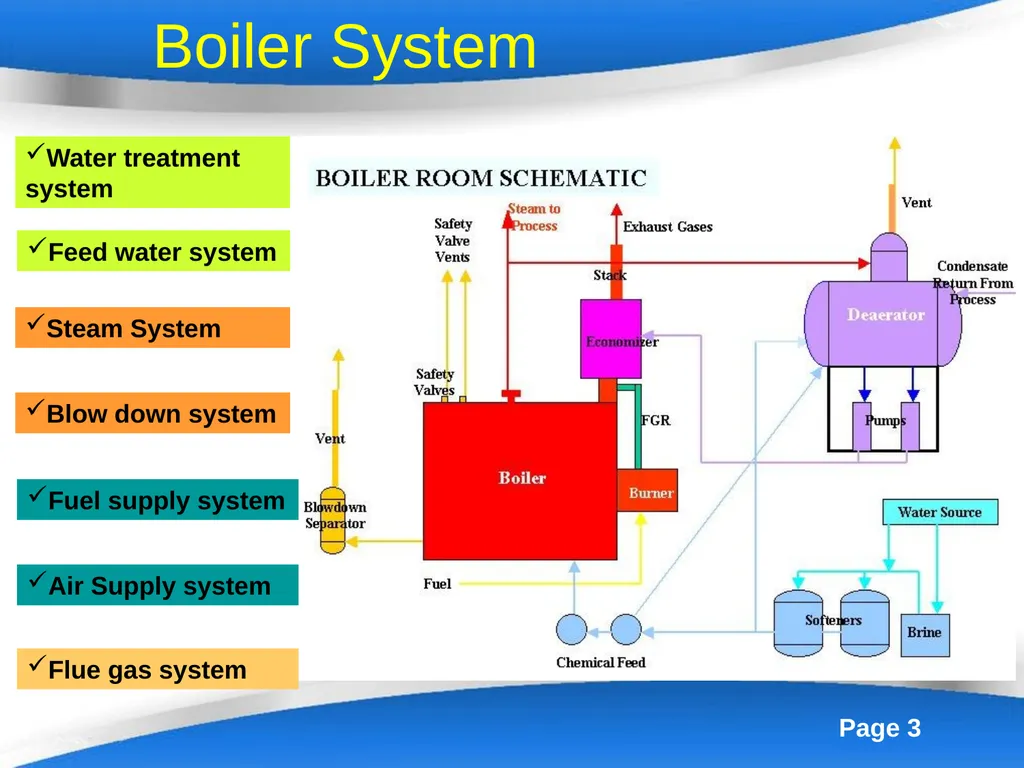
Flue gas system Water treatment system Feed water system Steam System Blow down system Fuel supply system Air Supply system Boiler System<br>
04
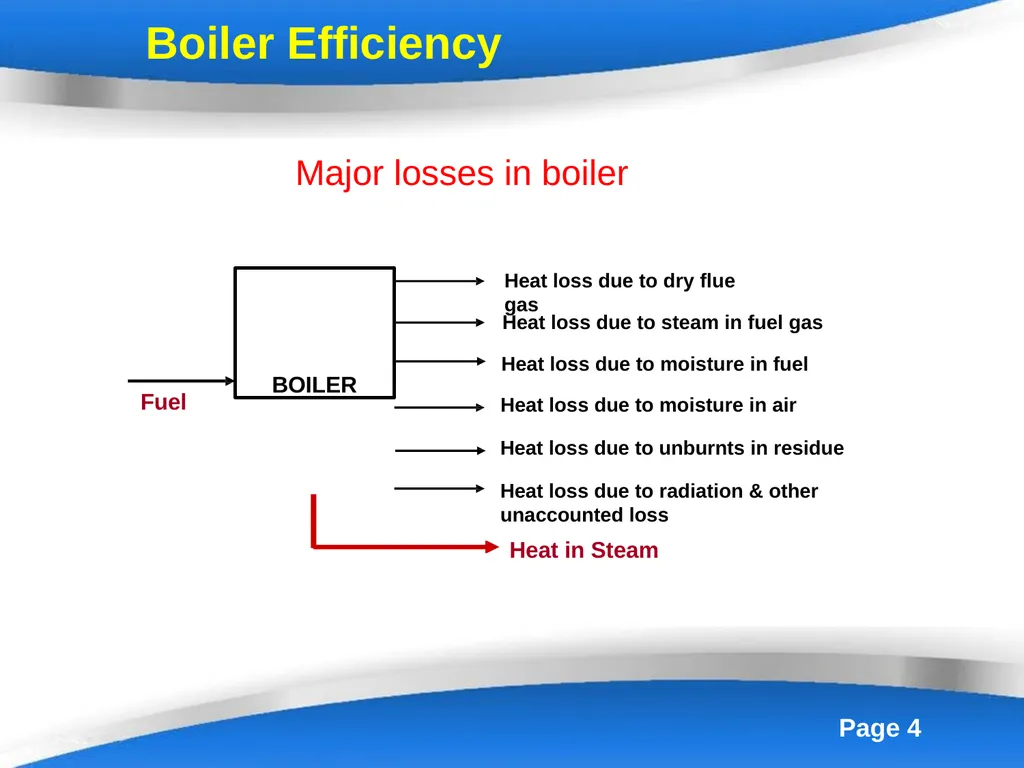
Boiler Efficiency Major losses in boiler Heat in Steam BOILER Heat loss due to dry flue gas Heat loss due to steam in fuel gas Heat loss due to moisture in fuel Heat loss due to unburnts in residue Heat loss due to moisture in air Heat loss due to radiation & other unaccounted loss Fuel<br>
05
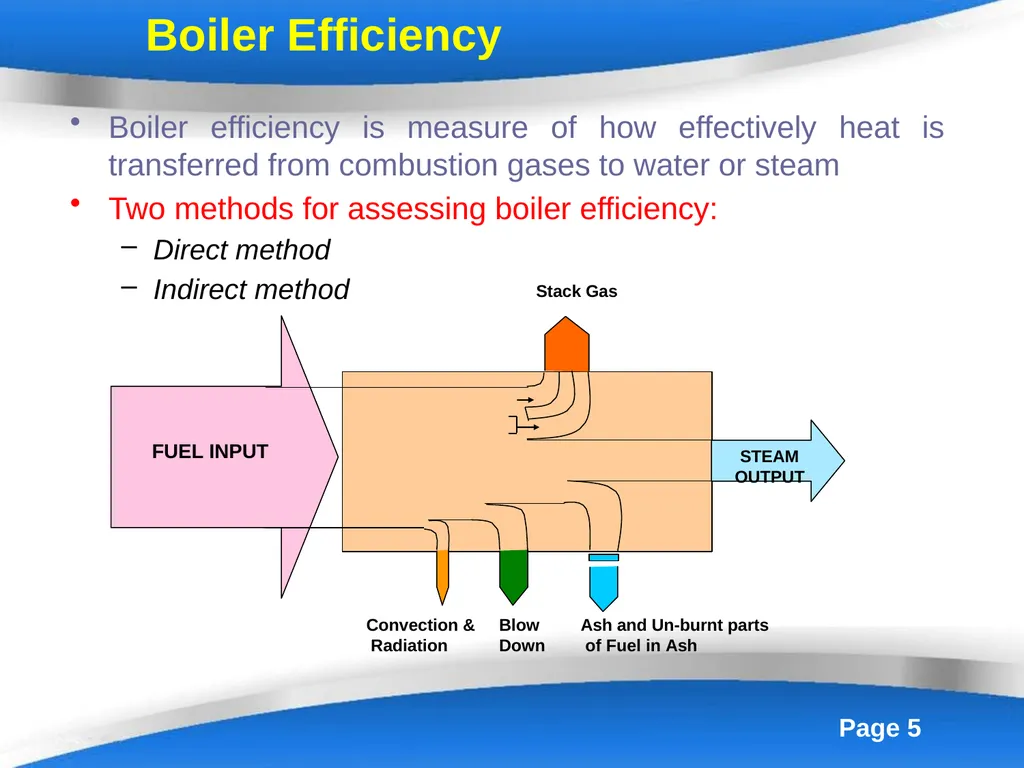
Boiler Efficiency Boiler efficiency is measure of how effectively heat is transferred from combustion gases to water or steam
Two methods for assessing boiler efficiency:
Direct method
Indirect method FUEL INPUT STEAM OUTPUT Ash and Un-burnt parts of Fuel in Ash Blow Down Convection & Radiation Stack Gas<br>
Two methods for assessing boiler efficiency:
Direct method
Indirect method FUEL INPUT STEAM OUTPUT Ash and Un-burnt parts of Fuel in Ash Blow Down Convection & Radiation Stack Gas<br>
06
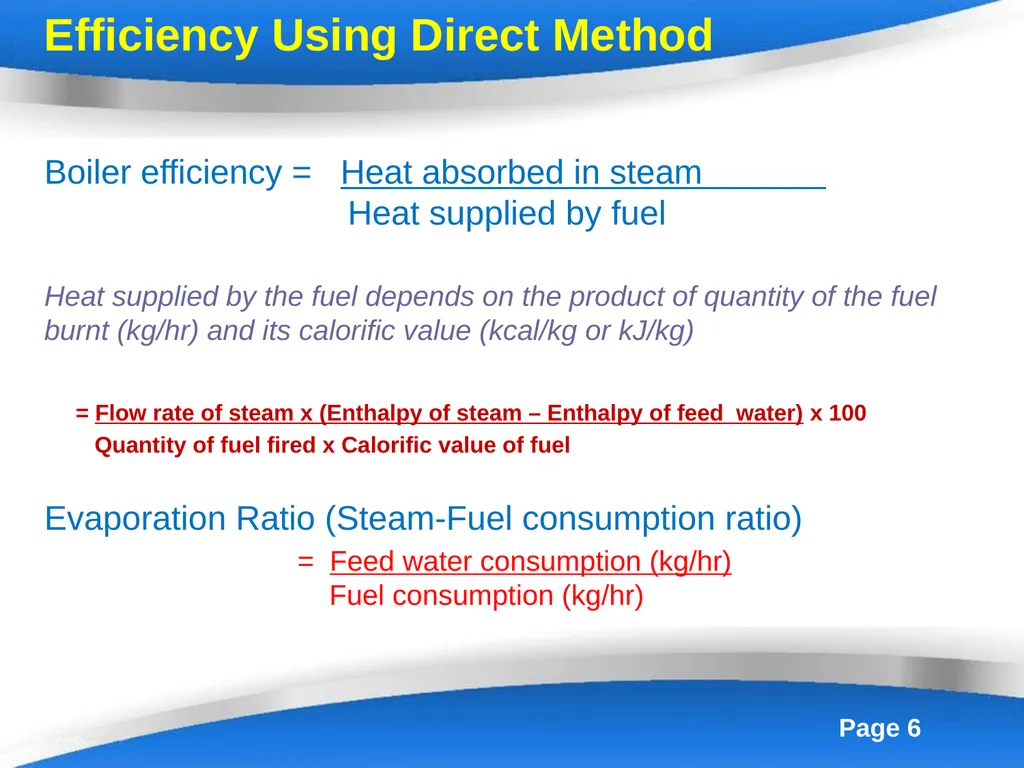
Efficiency Using Direct Method Boiler efficiency = Heat absorbed in steam
Heat supplied by fuel
Heat supplied by the fuel depends on the product of quantity of the fuel burnt (kg/hr) and its calorific value (kcal/kg or kJ/kg)
= Flow rate of steam x (Enthalpy of steam – Enthalpy of feed water) x 100
Quantity of fuel fired x Calorific value of fuel
Evaporation Ratio (Steam-Fuel consumption ratio)
= Feed water consumption (kg/hr)
Fuel consumption (kg/hr)<br>
Heat supplied by fuel
Heat supplied by the fuel depends on the product of quantity of the fuel burnt (kg/hr) and its calorific value (kcal/kg or kJ/kg)
= Flow rate of steam x (Enthalpy of steam – Enthalpy of feed water) x 100
Quantity of fuel fired x Calorific value of fuel
Evaporation Ratio (Steam-Fuel consumption ratio)
= Feed water consumption (kg/hr)
Fuel consumption (kg/hr)<br>
07
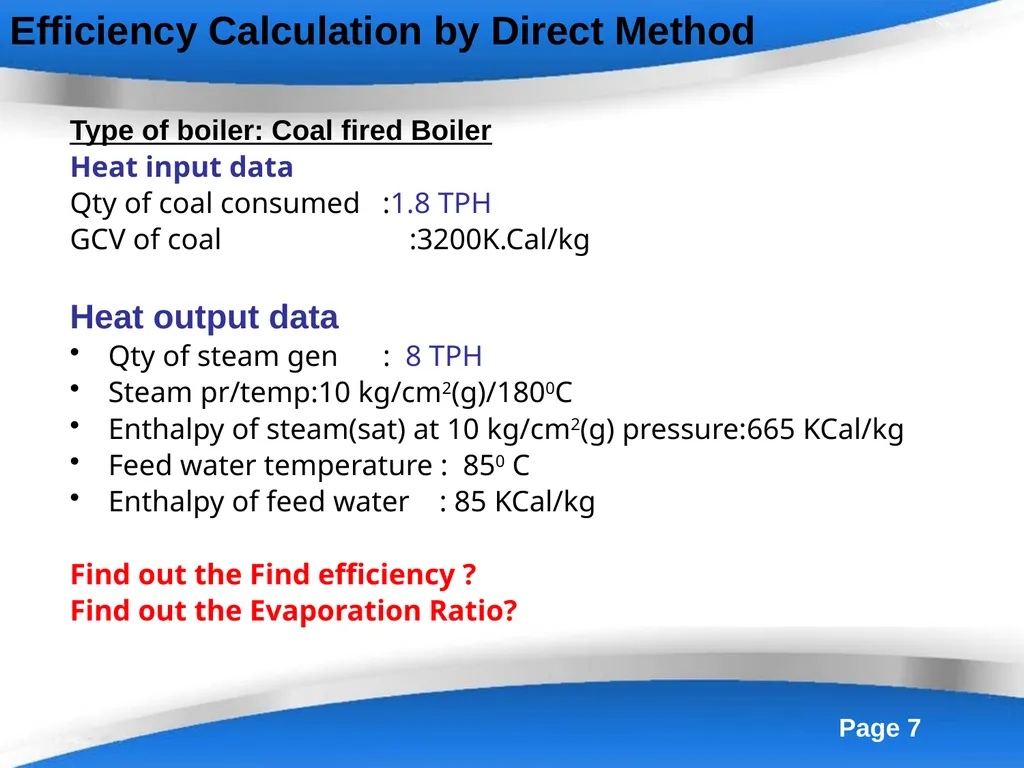
Type of boiler: Coal fired Boiler
Heat input data
Qty of coal consumed :1.8 TPH
GCV of coal :3200K.Cal/kg
Heat output data
Qty of steam gen : 8 TPH
Steam pr/temp:10 kg/cm2(g)/1800C
Enthalpy of steam(sat) at 10 kg/cm2(g) pressure:665 KCal/kg
Feed water temperature : 850 C
Enthalpy of feed water : 85 KCal/kg
Find out the Find efficiency ?
Find out the Evaporation Ratio? Efficiency Calculation by Direct Method<br>
Heat input data
Qty of coal consumed :1.8 TPH
GCV of coal :3200K.Cal/kg
Heat output data
Qty of steam gen : 8 TPH
Steam pr/temp:10 kg/cm2(g)/1800C
Enthalpy of steam(sat) at 10 kg/cm2(g) pressure:665 KCal/kg
Feed water temperature : 850 C
Enthalpy of feed water : 85 KCal/kg
Find out the Find efficiency ?
Find out the Evaporation Ratio? Efficiency Calculation by Direct Method<br>
08
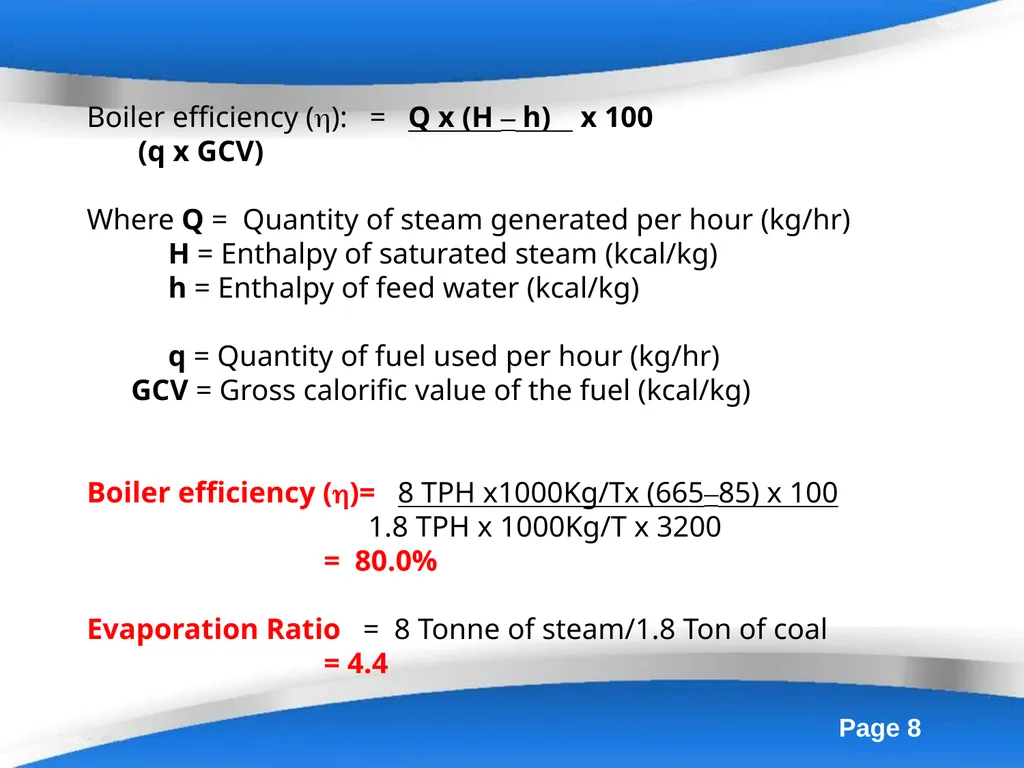
Boiler efficiency (): = Q x (H – h) x 100
(q x GCV)
Where Q = Quantity of steam generated per hour (kg/hr)
H = Enthalpy of saturated steam (kcal/kg)
h = Enthalpy of feed water (kcal/kg)
q = Quantity of fuel used per hour (kg/hr)
GCV = Gross calorific value of the fuel (kcal/kg)
Boiler efficiency ()= 8 TPH x1000Kg/Tx (665–85) x 100
1.8 TPH x 1000Kg/T x 3200
= 80.0%
Evaporation Ratio = 8 Tonne of steam/1.8 Ton of coal
= 4.4<br>
(q x GCV)
Where Q = Quantity of steam generated per hour (kg/hr)
H = Enthalpy of saturated steam (kcal/kg)
h = Enthalpy of feed water (kcal/kg)
q = Quantity of fuel used per hour (kg/hr)
GCV = Gross calorific value of the fuel (kcal/kg)
Boiler efficiency ()= 8 TPH x1000Kg/Tx (665–85) x 100
1.8 TPH x 1000Kg/T x 3200
= 80.0%
Evaporation Ratio = 8 Tonne of steam/1.8 Ton of coal
= 4.4<br>
09
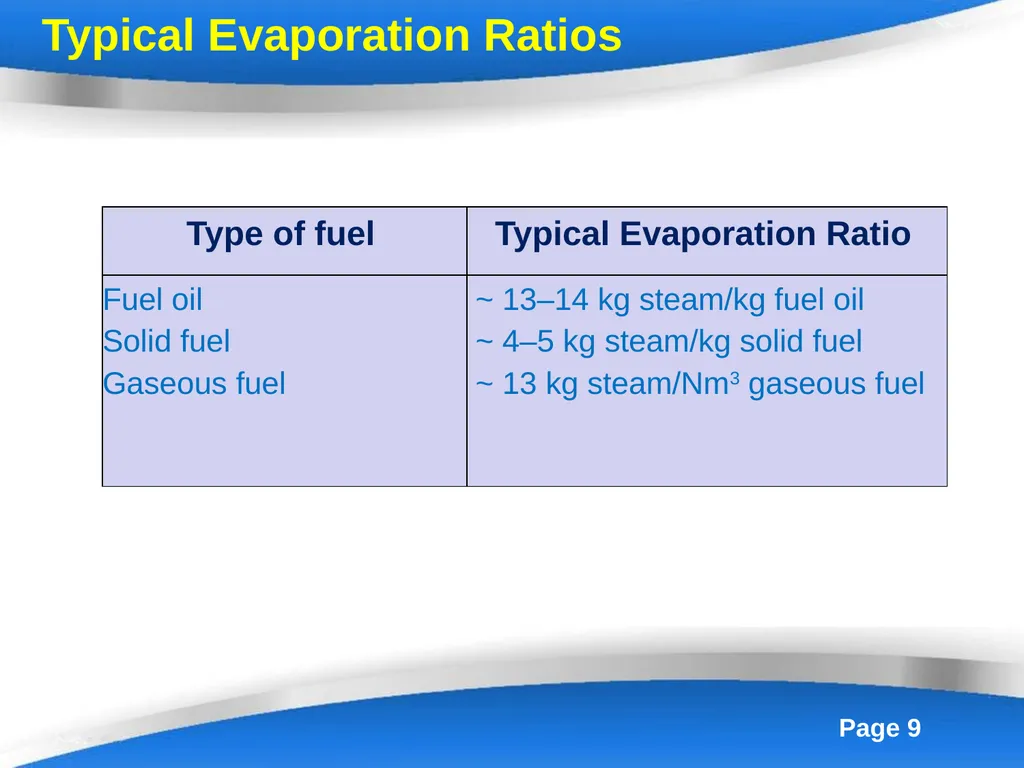
Typical Evaporation Ratios<br>
10
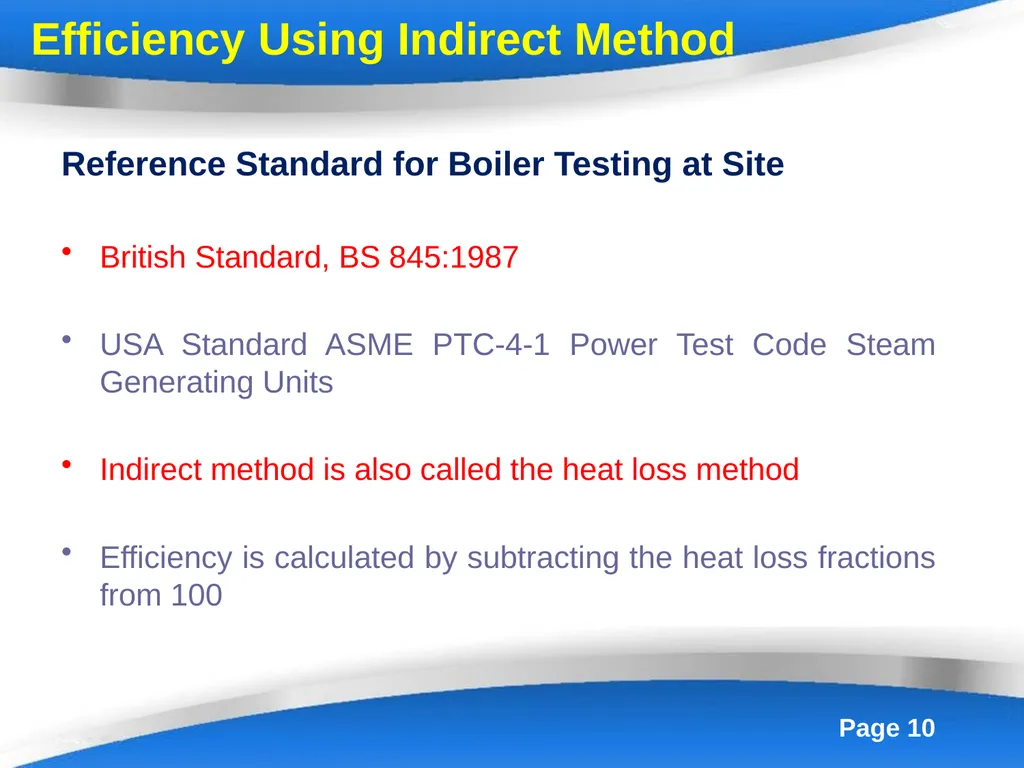
Efficiency Using Indirect Method Reference Standard for Boiler Testing at Site
British Standard, BS 845:1987
USA Standard ASME PTC-4-1 Power Test Code Steam Generating Units
Indirect method is also called the heat loss method
Efficiency is calculated by subtracting the heat loss fractions from 100<br>
British Standard, BS 845:1987
USA Standard ASME PTC-4-1 Power Test Code Steam Generating Units
Indirect method is also called the heat loss method
Efficiency is calculated by subtracting the heat loss fractions from 100<br>
11
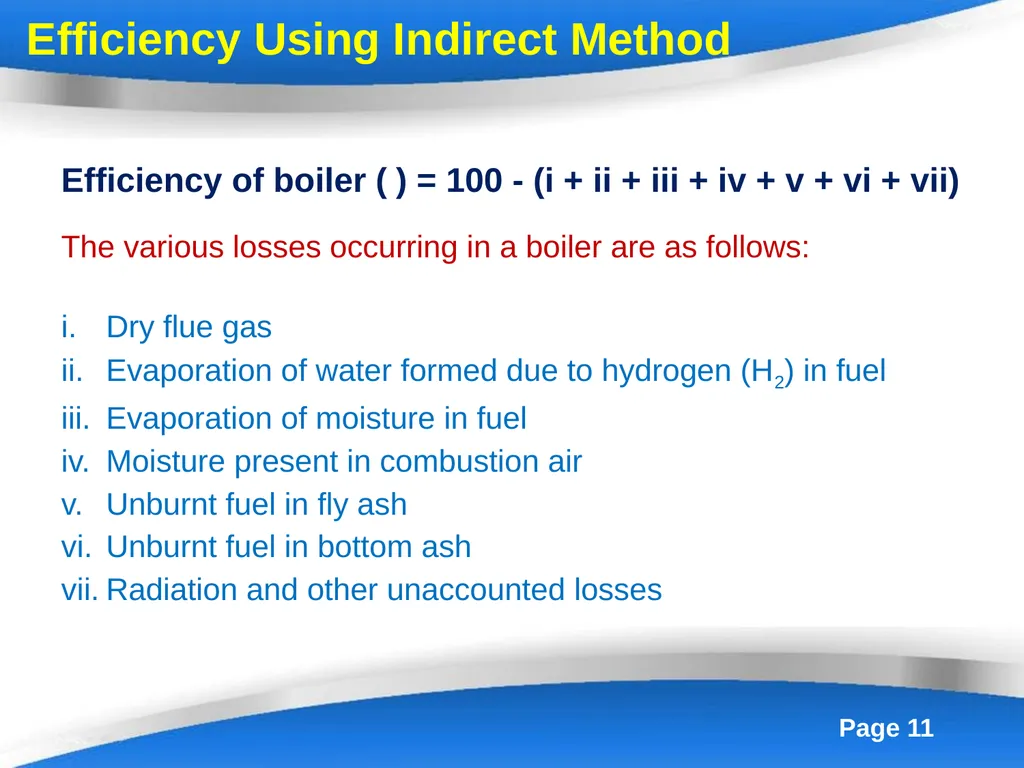
Efficiency Using Indirect Method Efficiency of boiler () = 100 - (i + ii + iii + iv + v + vi + vii)
The various losses occurring in a boiler are as follows:
Dry flue gas
Evaporation of water formed due to hydrogen (H2) in fuel
Evaporation of moisture in fuel
Moisture present in combustion air
Unburnt fuel in fly ash
Unburnt fuel in bottom ash
Radiation and other unaccounted losses<br>
The various losses occurring in a boiler are as follows:
Dry flue gas
Evaporation of water formed due to hydrogen (H2) in fuel
Evaporation of moisture in fuel
Moisture present in combustion air
Unburnt fuel in fly ash
Unburnt fuel in bottom ash
Radiation and other unaccounted losses<br>
12
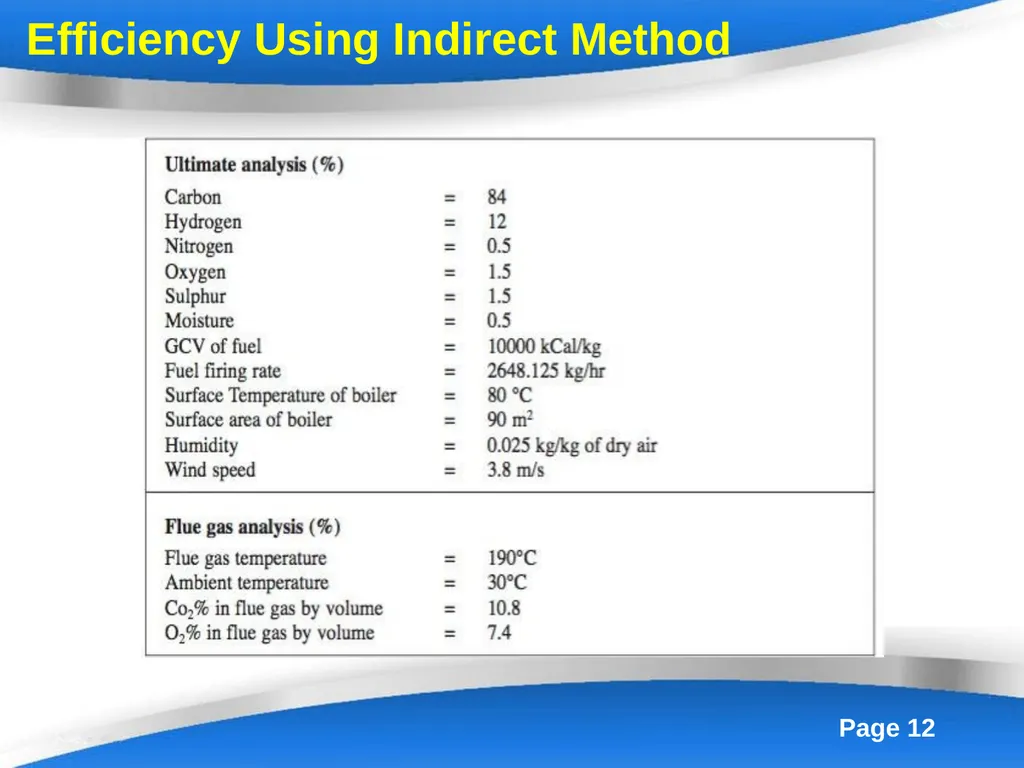
Efficiency Using Indirect Method<br>
13
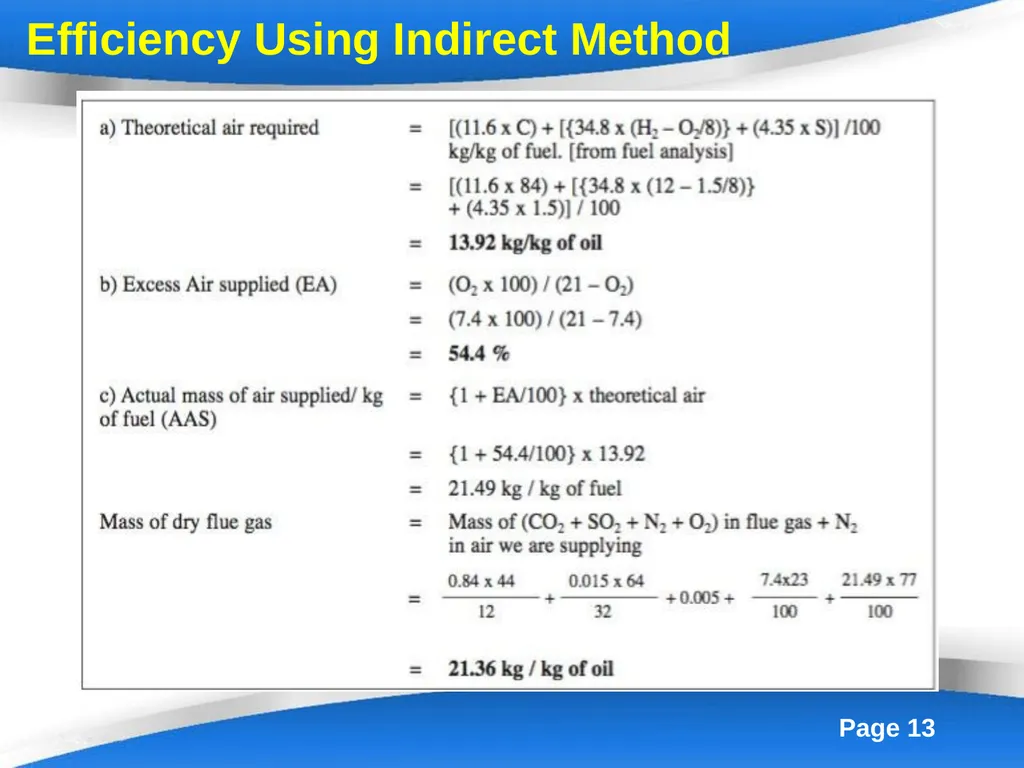
Efficiency Using Indirect Method<br>
14
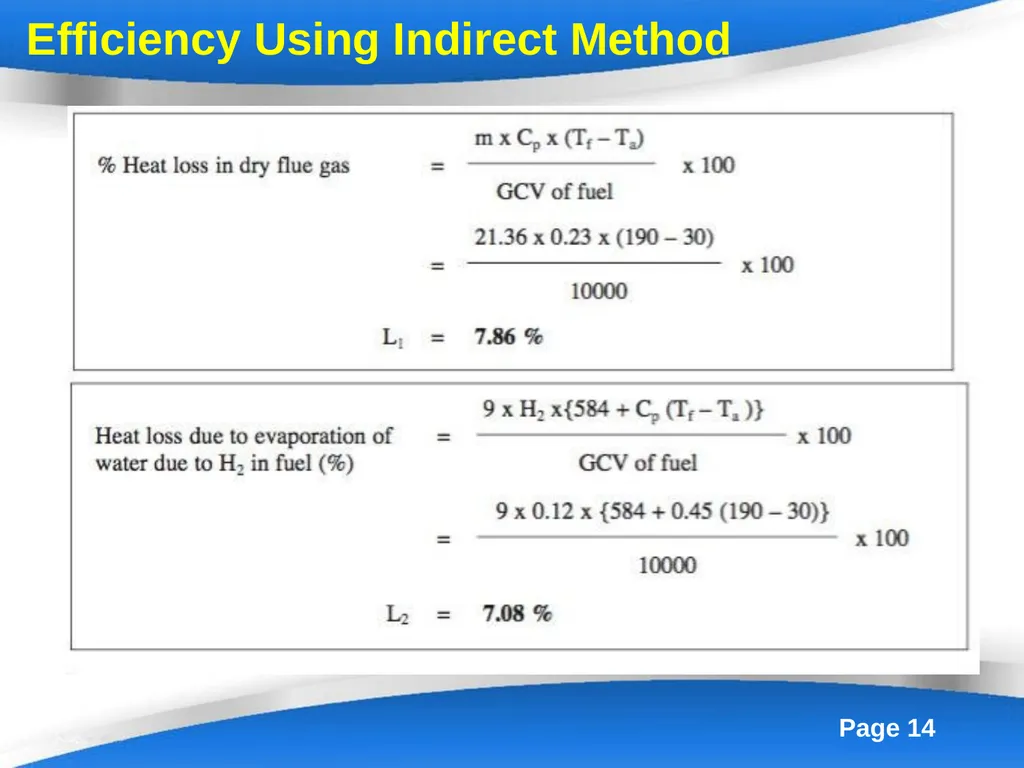
Efficiency Using Indirect Method<br>
15
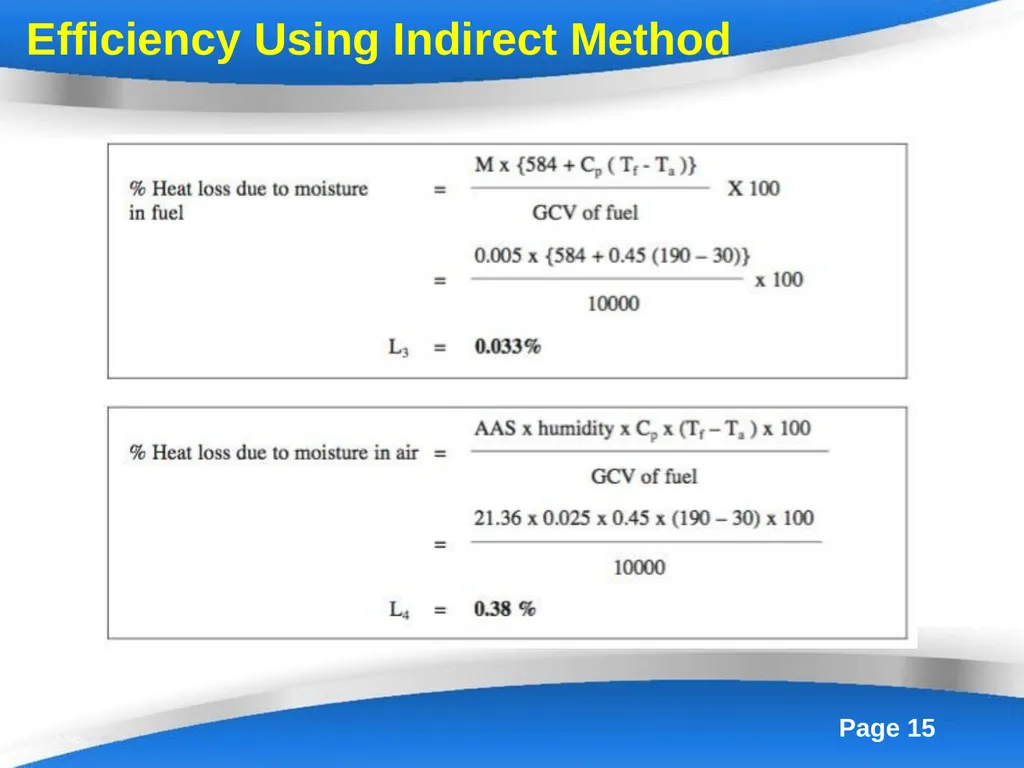
Efficiency Using Indirect Method<br>
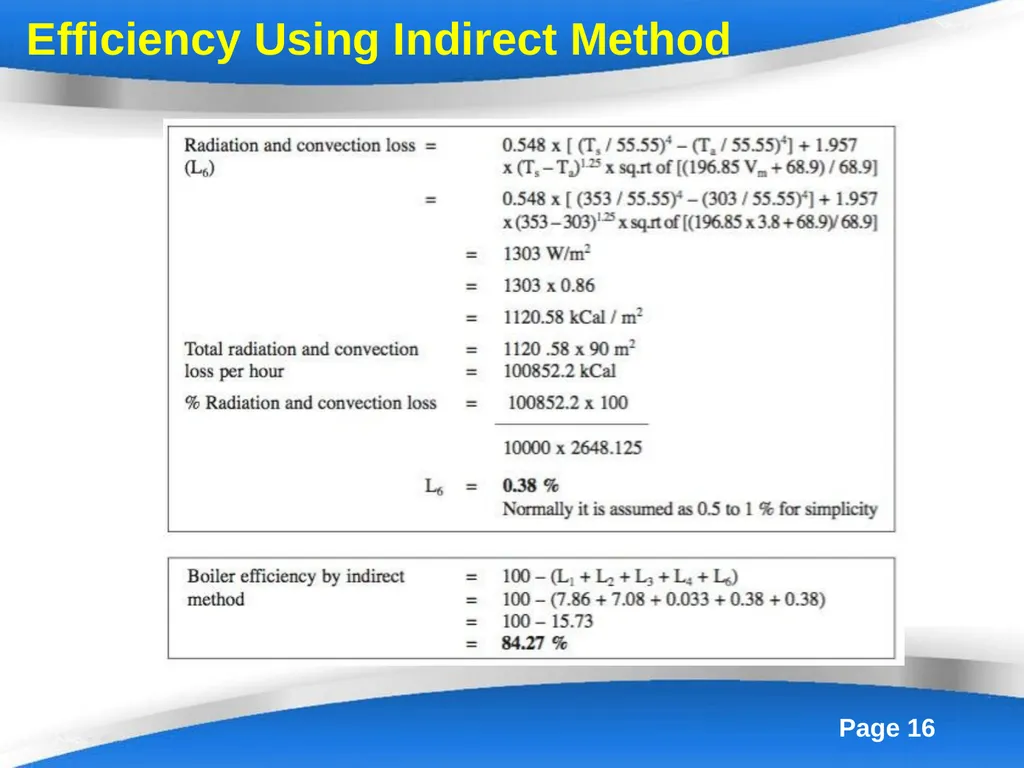
16
Efficiency Using Indirect Method<br>
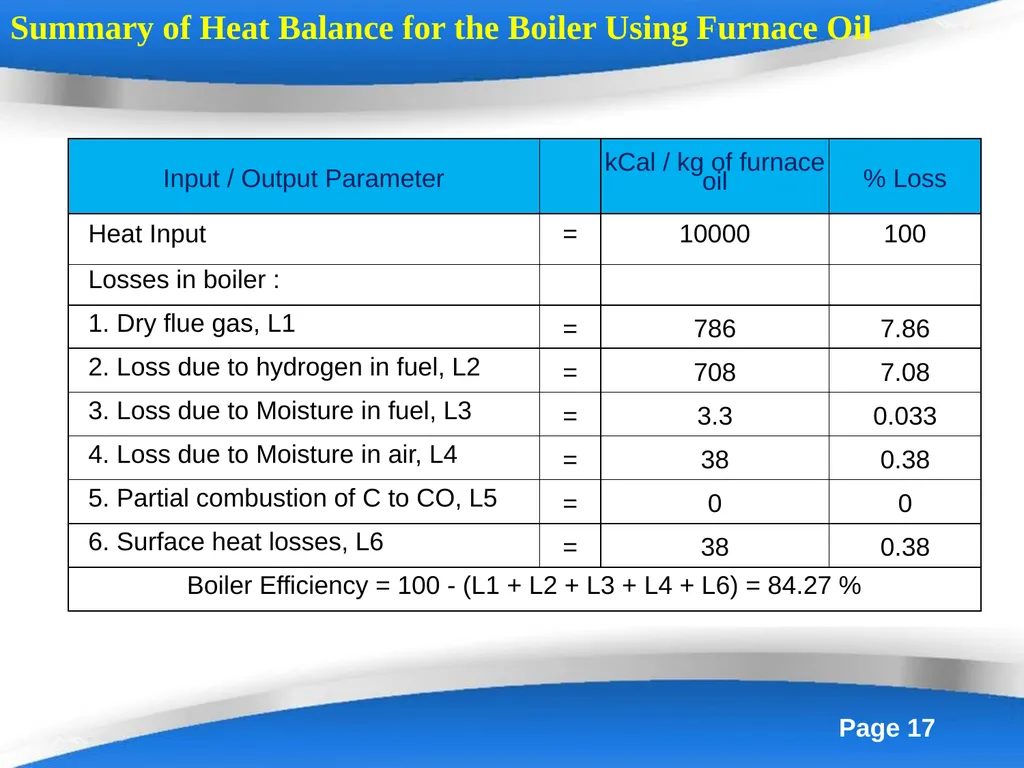
17
Summary of Heat Balance for the Boiler Using Furnace Oil<br>
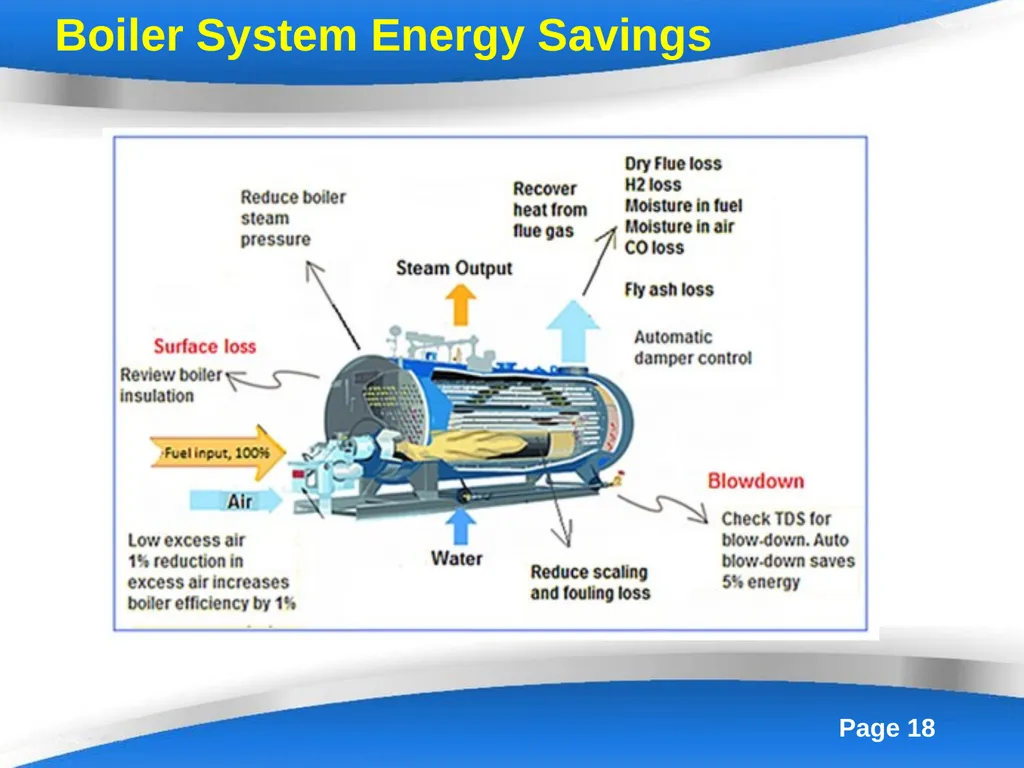
18
Boiler System Energy Savings<br>
19
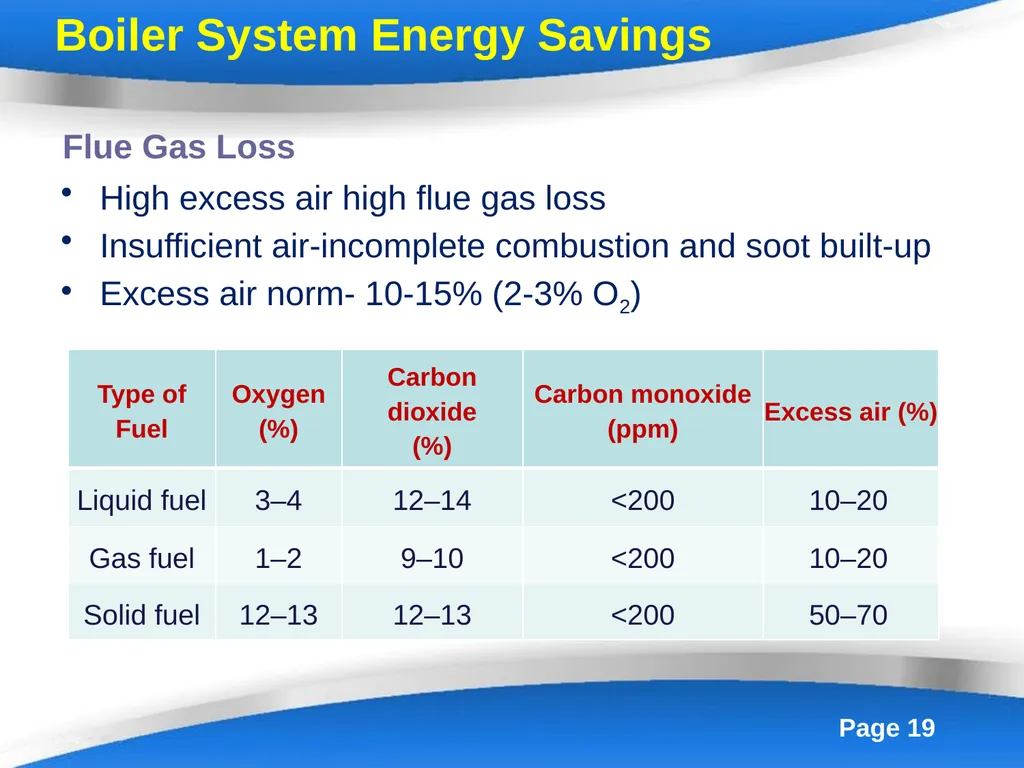
Flue Gas Loss High excess air high flue gas loss
Insufficient air-incomplete combustion and soot built-up
Excess air norm- 10-15% (2-3% O2) Boiler System Energy Savings<br>
Insufficient air-incomplete combustion and soot built-up
Excess air norm- 10-15% (2-3% O2) Boiler System Energy Savings<br>
20
Reduce Stack Temperature Stack temperatures greater than 200°C indicates potential for recovery of waste heat.
It also indicate the scaling of heat transfer/recovery equipment and hence the urgency of taking an early shut down for water / flue side cleaning. 22o C reduction in flue gas temperature increases boiler efficiency by 1%<br>
It also indicate the scaling of heat transfer/recovery equipment and hence the urgency of taking an early shut down for water / flue side cleaning. 22o C reduction in flue gas temperature increases boiler efficiency by 1%<br>
21
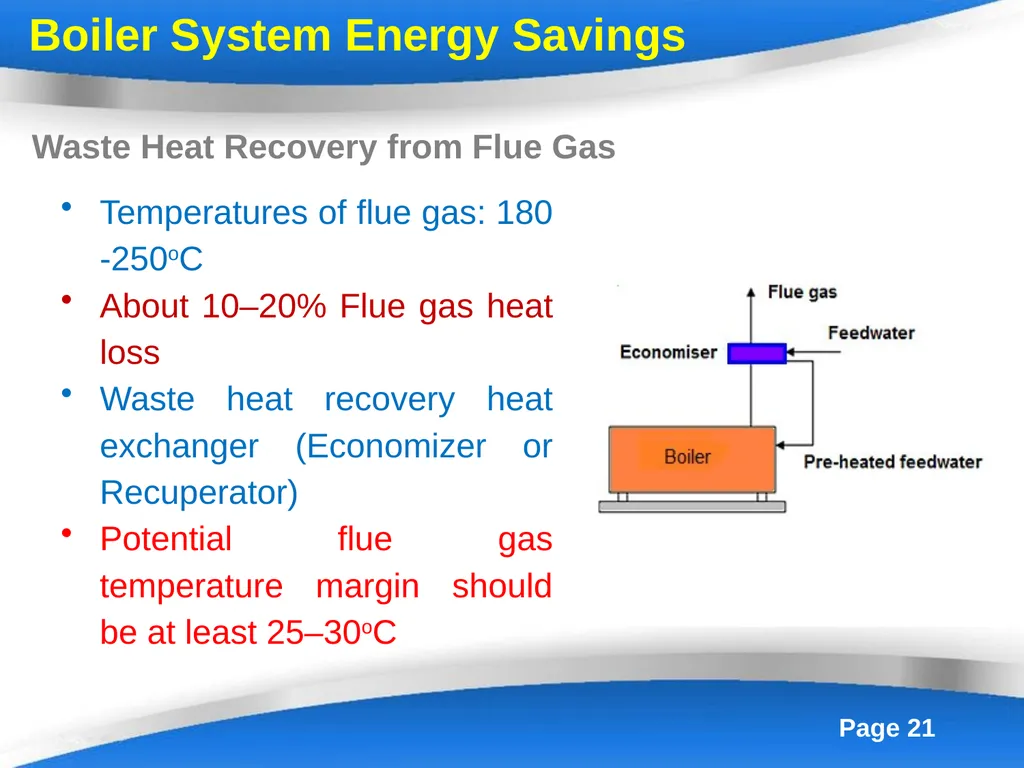
Waste Heat Recovery from Flue Gas Temperatures of flue gas: 180 -250oC
About 10–20% Flue gas heat loss
Waste heat recovery heat exchanger (Economizer or Recuperator)
Potential flue gas temperature margin should be at least 25–30oC Boiler System Energy Savings<br>
About 10–20% Flue gas heat loss
Waste heat recovery heat exchanger (Economizer or Recuperator)
Potential flue gas temperature margin should be at least 25–30oC Boiler System Energy Savings<br>
22
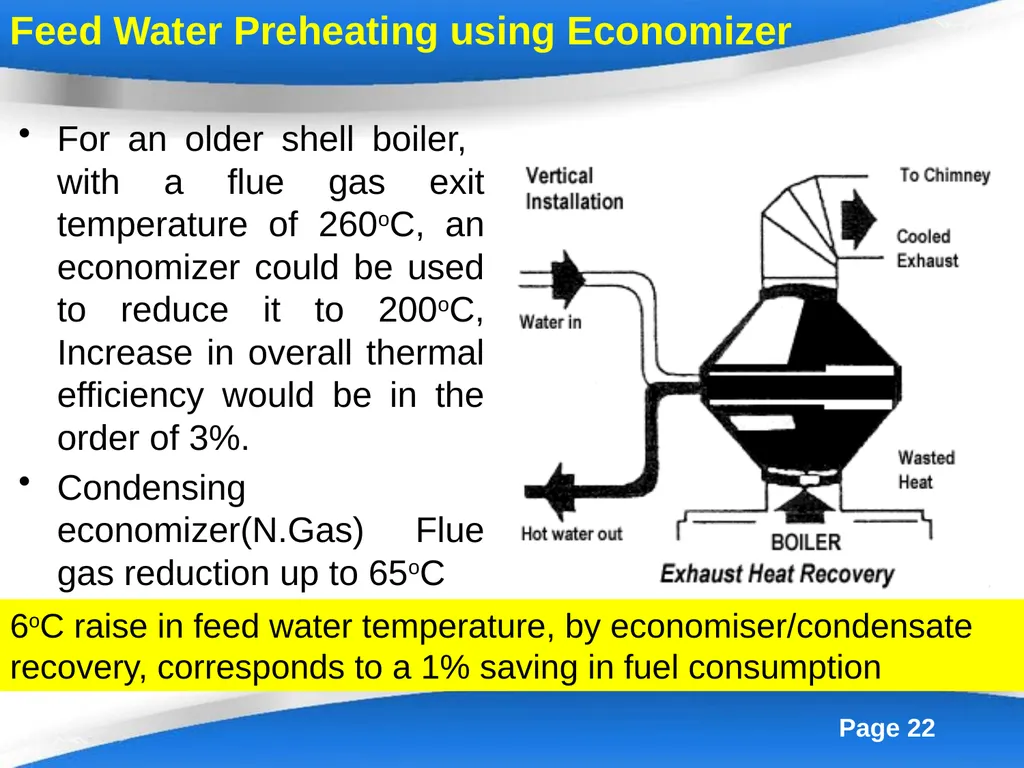
Feed Water Preheating using Economizer For an older shell boiler, with a flue gas exit temperature of 260oC, an economizer could be used to reduce it to 200oC, Increase in overall thermal efficiency would be in the order of 3%.
Condensing economizer(N.Gas) Flue gas reduction up to 65oC 6oC raise in feed water temperature, by economiser/condensate recovery, corresponds to a 1% saving in fuel consumption<br>
Condensing economizer(N.Gas) Flue gas reduction up to 65oC 6oC raise in feed water temperature, by economiser/condensate recovery, corresponds to a 1% saving in fuel consumption<br>
23
Combustion Air Preheating Combustion air preheating is an alternative to feedwater heating.
In order to improve thermal efficiency by 1%, the combustion air temperature must be raised by 20 oC.<br>
In order to improve thermal efficiency by 1%, the combustion air temperature must be raised by 20 oC.<br>
24
Incomplete combustion can arise from a shortage of air or surplus of fuel or poor distribution of fuel.
In the case of oil and gas fired systems, CO or smoke with normal or high excess air indicates burner system problems.
Example: Poor mixing of fuel and air at the burner. Poor oil fires can result from improper viscosity, worn tips, carbonization on tips and deterioration of diffusers.
With coal firing: Loss occurs as grit carry-over or carbon-in-ash (2% loss). Incomplete Combustion<br>
In the case of oil and gas fired systems, CO or smoke with normal or high excess air indicates burner system problems.
Example: Poor mixing of fuel and air at the burner. Poor oil fires can result from improper viscosity, worn tips, carbonization on tips and deterioration of diffusers.
With coal firing: Loss occurs as grit carry-over or carbon-in-ash (2% loss). Incomplete Combustion<br>
25
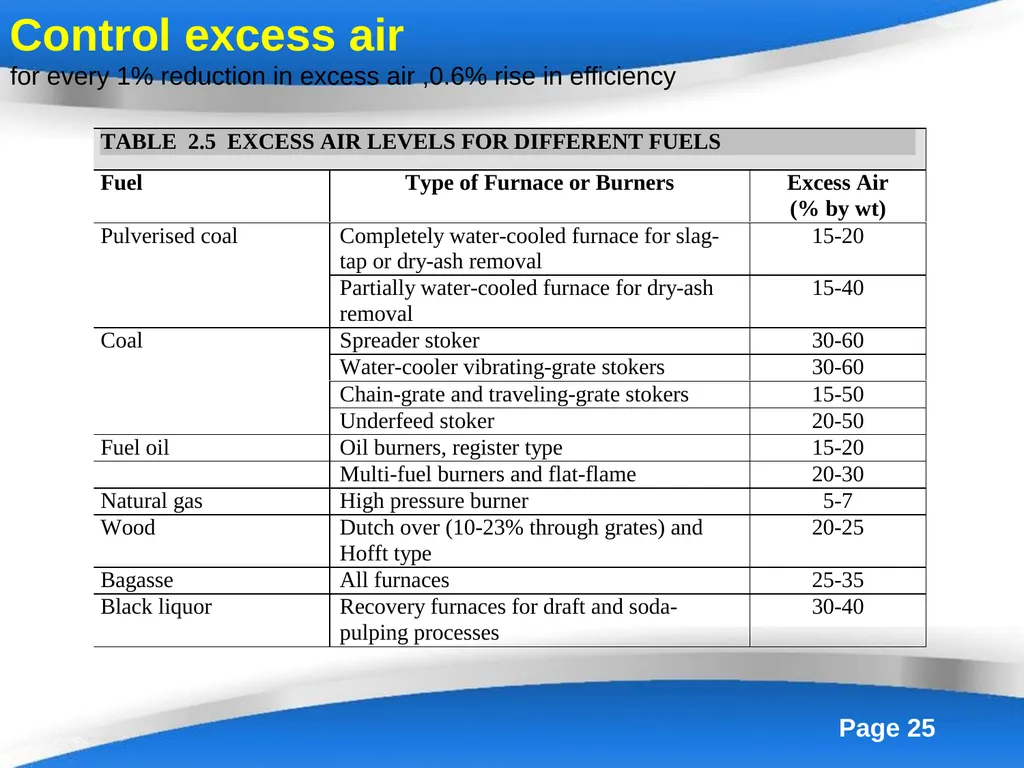
Control excess air
for every 1% reduction in excess air ,0.6% rise in efficiency<br>
26
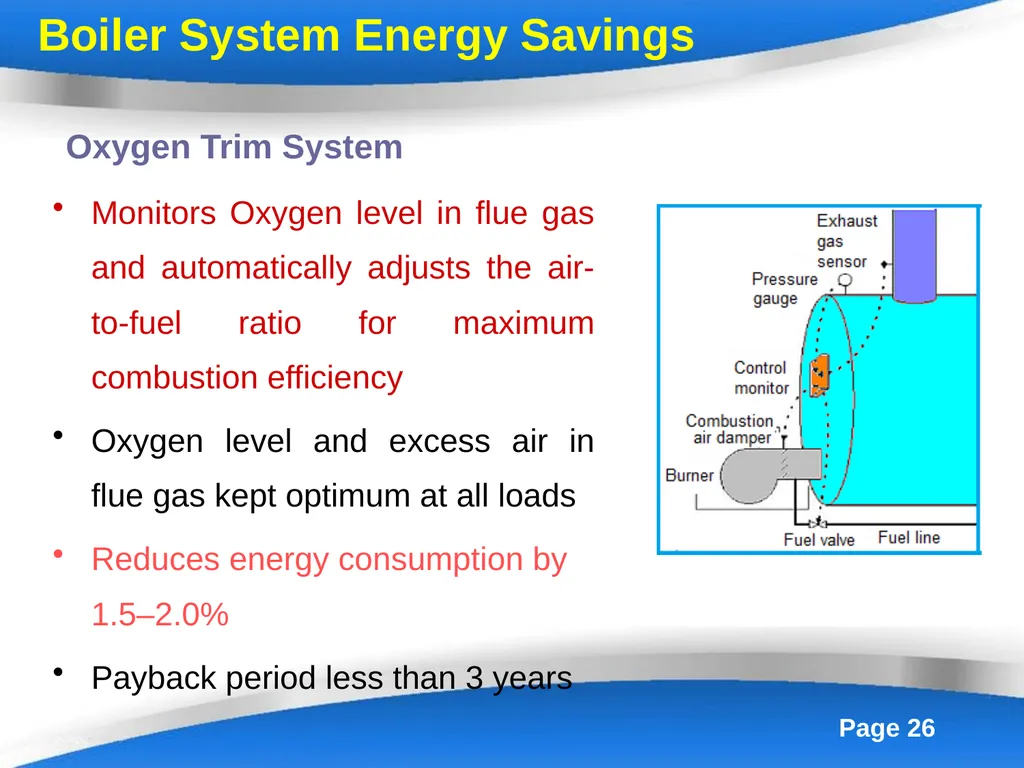
Oxygen Trim System Monitors Oxygen level in flue gas and automatically adjusts the air-to-fuel ratio for maximum combustion efficiency
Oxygen level and excess air in flue gas kept optimum at all loads
Reduces energy consumption by 1.5–2.0%
Payback period less than 3 years Boiler System Energy Savings<br>
Oxygen level and excess air in flue gas kept optimum at all loads
Reduces energy consumption by 1.5–2.0%
Payback period less than 3 years Boiler System Energy Savings<br>
27
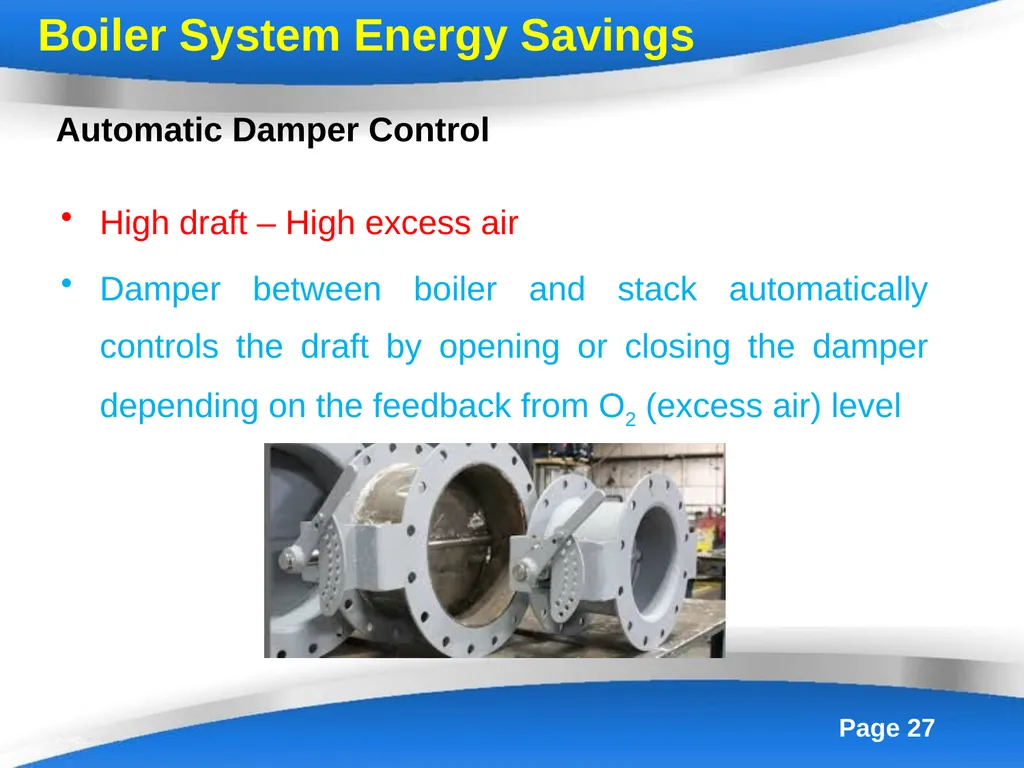
Automatic Damper Control High draft – High excess air
Damper between boiler and stack automatically controls the draft by opening or closing the damper depending on the feedback from O2 (excess air) level Boiler System Energy Savings<br>
Damper between boiler and stack automatically controls the draft by opening or closing the damper depending on the feedback from O2 (excess air) level Boiler System Energy Savings<br>
28
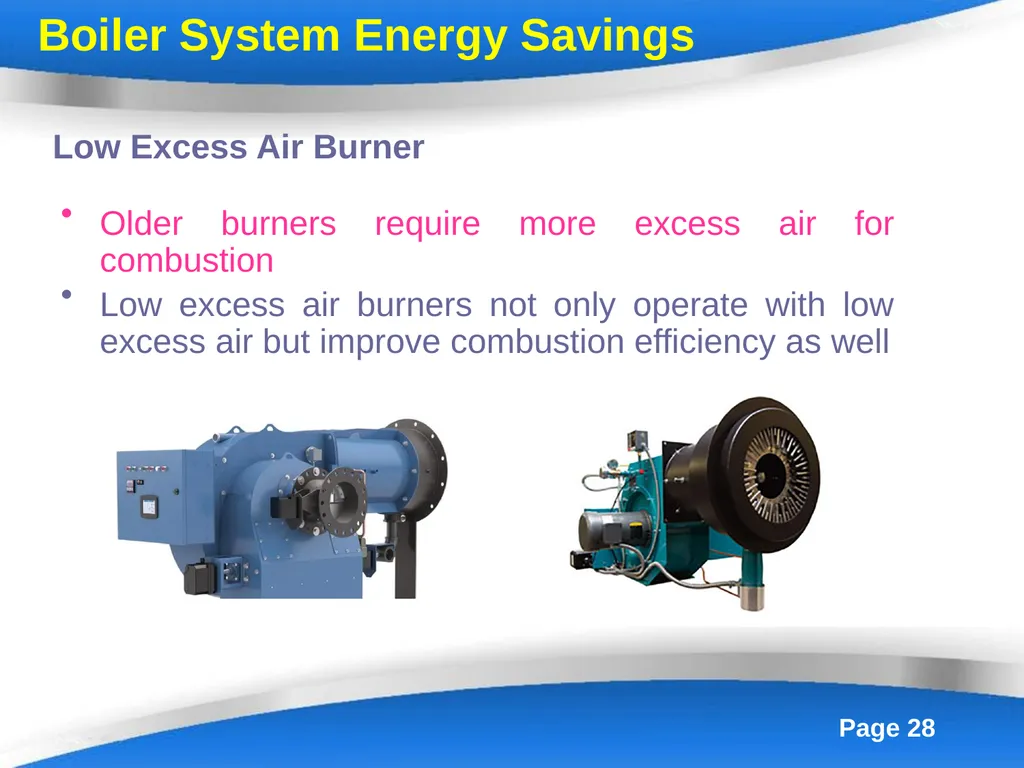
Low Excess Air Burner Older burners require more excess air for combustion
Low excess air burners not only operate with low excess air but improve combustion efficiency as well Boiler System Energy Savings<br>
Low excess air burners not only operate with low excess air but improve combustion efficiency as well Boiler System Energy Savings<br>
29
Blowdown Blowdown is a discharge of water at steam temperature to remove sludge and solids from boiler
Conductivity, silica, chlorides concentrations, alkalinity indicate presence of dissolved salts and other contaminants in boiler water
Blowdown water has to be replaced by an equivalent amount of feed water
Boiler blowdown (%) = Feed water TDS x % Makeup water
Maximum Permissible TDS in Boiler water
Blowdown rate is set proportional to makeup water flow or automated (probe provides feedback to a controller operating a modulating blowdown valve) Boiler System Energy Savings<br>
Conductivity, silica, chlorides concentrations, alkalinity indicate presence of dissolved salts and other contaminants in boiler water
Blowdown water has to be replaced by an equivalent amount of feed water
Boiler blowdown (%) = Feed water TDS x % Makeup water
Maximum Permissible TDS in Boiler water
Blowdown rate is set proportional to makeup water flow or automated (probe provides feedback to a controller operating a modulating blowdown valve) Boiler System Energy Savings<br>
30
Efficiency Improvement - Up to 2 percentage points.
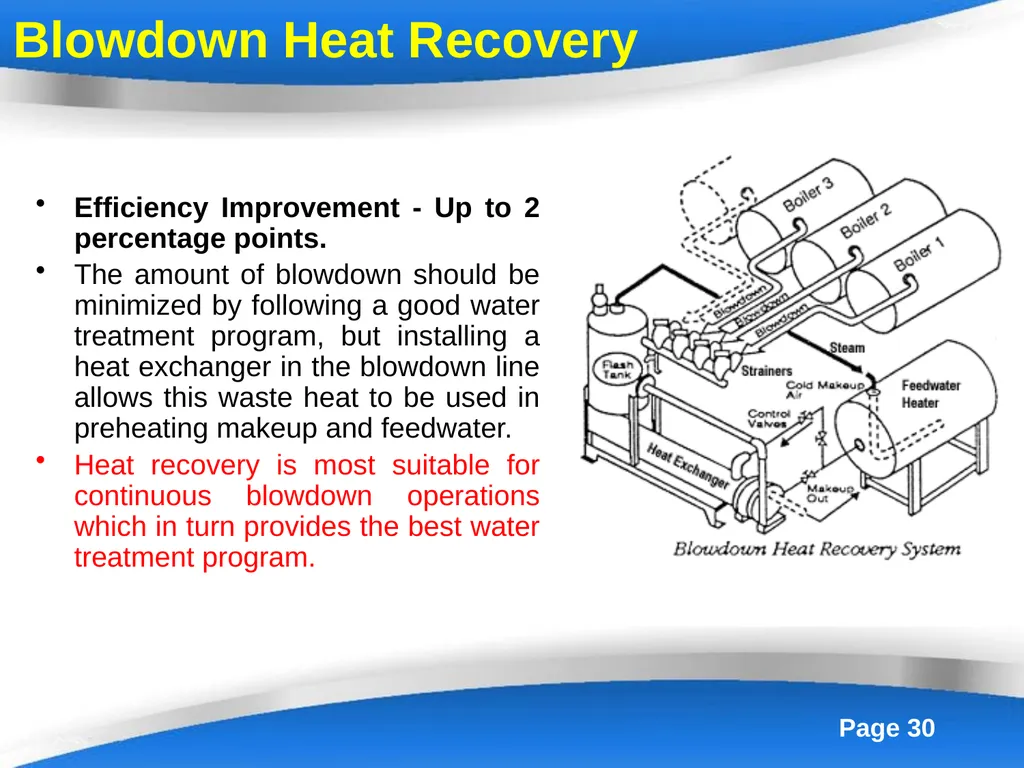
The amount of blowdown should be minimized by following a good water treatment program, but installing a heat exchanger in the blowdown line allows this waste heat to be used in preheating makeup and feedwater.
Heat recovery is most suitable for continuous blowdown operations which in turn provides the best water treatment program. Blowdown Heat Recovery<br>
The amount of blowdown should be minimized by following a good water treatment program, but installing a heat exchanger in the blowdown line allows this waste heat to be used in preheating makeup and feedwater.
Heat recovery is most suitable for continuous blowdown operations which in turn provides the best water treatment program. Blowdown Heat Recovery<br>
31
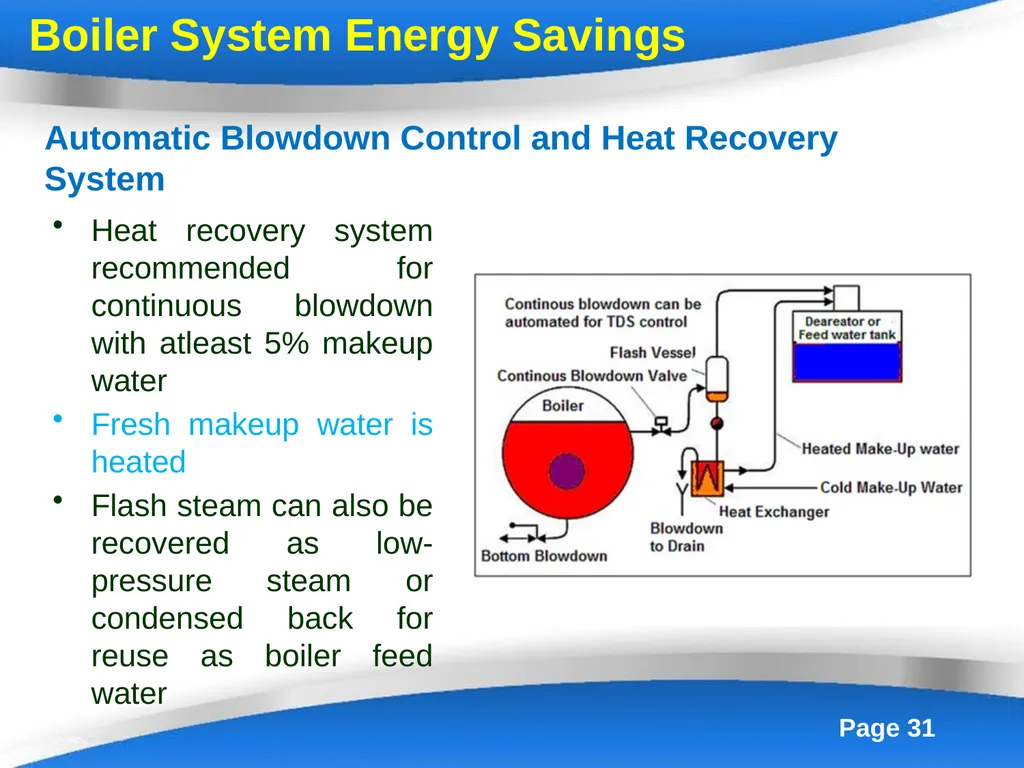
Automatic Blowdown Control and Heat Recovery System Heat recovery system recommended for continuous blowdown with atleast 5% makeup water
Fresh makeup water is heated
Flash steam can also be recovered as low-pressure steam or condensed back for reuse as boiler feed water Boiler System Energy Savings<br>
Fresh makeup water is heated
Flash steam can also be recovered as low-pressure steam or condensed back for reuse as boiler feed water Boiler System Energy Savings<br>
32
Fouling or scaling- Water side
Act as insulators and reduces heat transfer resulting in higher flue gas temperature
Higher flue gas temperatures at constant steam demand and excess air level
Water treatment has to be improved- Improve water softening and maintaining lower total dissolved solids (TDS) through injecting chemicals into boiler feed water and adopting proper boiler blowdown Soot- Fire side
Act as insulators and reduce heat transfer resulting in higher flue gas temperature
Burner is defective or air supply is insufficient.
Surfaces should be cleaned of soot periodically
Repair the burner and fine-tune the combustion system. Boiler System Energy Savings<br>
Act as insulators and reduces heat transfer resulting in higher flue gas temperature
Higher flue gas temperatures at constant steam demand and excess air level
Water treatment has to be improved- Improve water softening and maintaining lower total dissolved solids (TDS) through injecting chemicals into boiler feed water and adopting proper boiler blowdown Soot- Fire side
Act as insulators and reduce heat transfer resulting in higher flue gas temperature
Burner is defective or air supply is insufficient.
Surfaces should be cleaned of soot periodically
Repair the burner and fine-tune the combustion system. Boiler System Energy Savings<br>
33
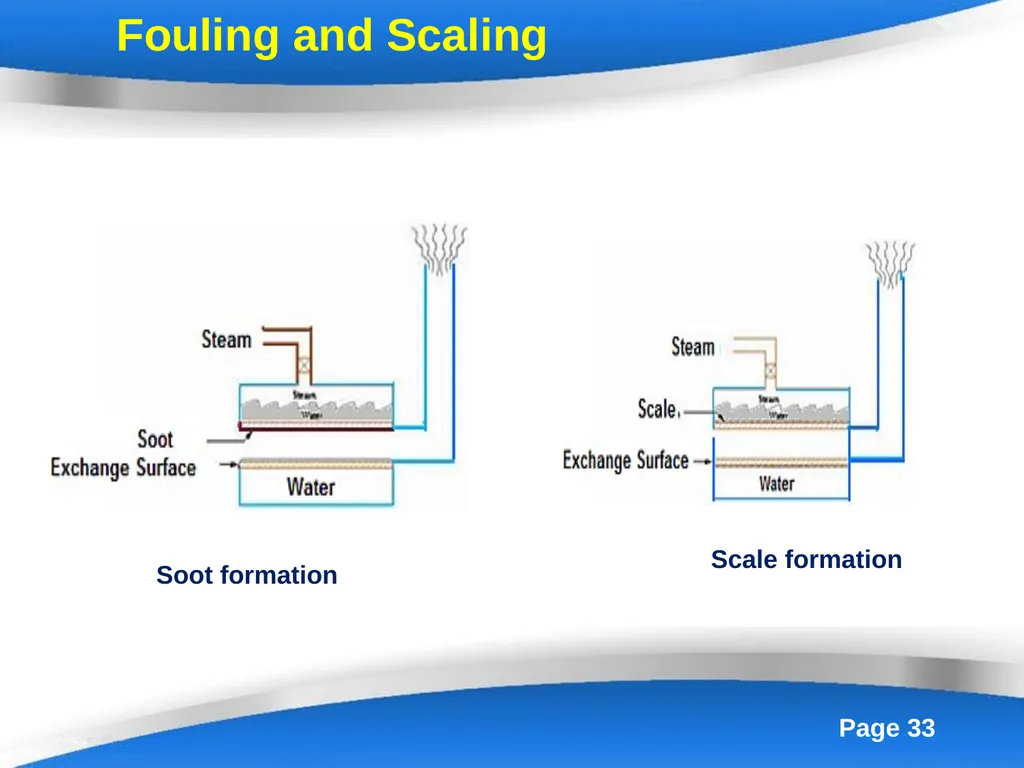
Fouling and Scaling Soot formation Scale formation<br>
34
Lower steam pressure gives a lower saturated steam temperature and without stack heat recovery, a similar reduction in the temperature of the flue gas temperature results. Potential 1 to 2% improvement.
Steam is generated at pressures normally dictated by the highest pressure / temperature requirements for a particular process. In some cases, the process does not operate all the time, and there are periods when the boiler pressure could be reduced.
Adverse effects, such as an increase in water carryover from the boiler owing to pressure reduction, may negate any potential saving.
Pressure should be reduced in stages, and no more than a 20 percent reduction should be considered. Reduction of Boiler Steam Pressure<br>
Steam is generated at pressures normally dictated by the highest pressure / temperature requirements for a particular process. In some cases, the process does not operate all the time, and there are periods when the boiler pressure could be reduced.
Adverse effects, such as an increase in water carryover from the boiler owing to pressure reduction, may negate any potential saving.
Pressure should be reduced in stages, and no more than a 20 percent reduction should be considered. Reduction of Boiler Steam Pressure<br>
35
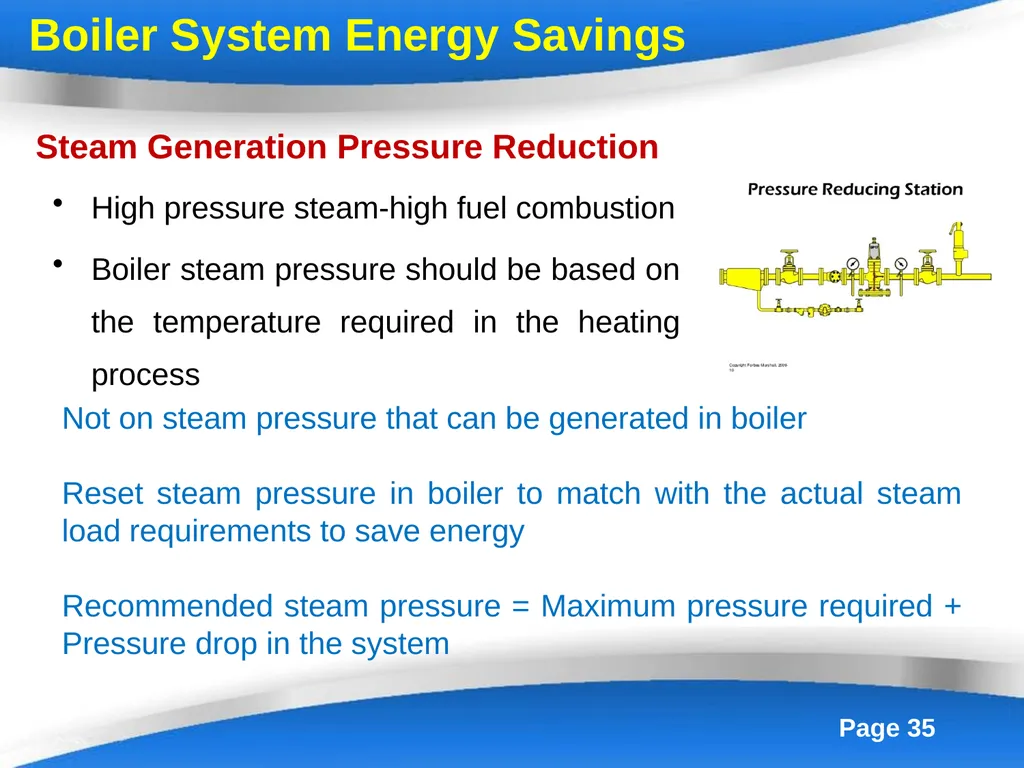
Steam Generation Pressure Reduction High pressure steam-high fuel combustion
Boiler steam pressure should be based on the temperature required in the heating process Boiler System Energy Savings Not on steam pressure that can be generated in boiler
Reset steam pressure in boiler to match with the actual steam load requirements to save energy
Recommended steam pressure = Maximum pressure required + Pressure drop in the system<br>
Boiler steam pressure should be based on the temperature required in the heating process Boiler System Energy Savings Not on steam pressure that can be generated in boiler
Reset steam pressure in boiler to match with the actual steam load requirements to save energy
Recommended steam pressure = Maximum pressure required + Pressure drop in the system<br>
36
Benefits of Low-pressure Steam Latent heat for condensing steam is higher at lower pressure
Steam dryness ratio will increase resulting in increase in energy in steam
Steam loss from pipes will be lower at lower steam pressure
Heat loss at boiler surface and steam distribution system will be less at lower steam pressure
Blowdown loss will be less at lower steam pressure
Fuel consumption will be lower for the same amount of steam generation Boiler System Energy Savings<br>
Steam dryness ratio will increase resulting in increase in energy in steam
Steam loss from pipes will be lower at lower steam pressure
Heat loss at boiler surface and steam distribution system will be less at lower steam pressure
Blowdown loss will be less at lower steam pressure
Fuel consumption will be lower for the same amount of steam generation Boiler System Energy Savings<br>
37
Generally, combustion air control is effected by throttling dampers fitted at forced and induced draft fans.
Though dampers are simple means of control, they lack accuracy, giving poor control characteristics at the top and bottom of the operating range.
If the load characteristic of the boiler is variable, the possibility of replacing the dampers by a VSD should be evaluated. Variable Speed Control for Fans, Blowers and Pumps<br>
Though dampers are simple means of control, they lack accuracy, giving poor control characteristics at the top and bottom of the operating range.
If the load characteristic of the boiler is variable, the possibility of replacing the dampers by a VSD should be evaluated. Variable Speed Control for Fans, Blowers and Pumps<br>
38
Retrofitting Boiler with VFD Boiler Fan at Constant Speed
Best for boiler operating at constant steam load
For part load --damper control air flow to match with steam load
Damper create resistance in air flow-Fan power increases Boiler Fan at VFD
Best for boiler operating at varying steam load or low load for longer time
Fan power (air flow rate)3 Boiler System Energy Savings<br>
Best for boiler operating at constant steam load
For part load --damper control air flow to match with steam load
Damper create resistance in air flow-Fan power increases Boiler Fan at VFD
Best for boiler operating at varying steam load or low load for longer time
Fan power (air flow rate)3 Boiler System Energy Savings<br>
39
As the load falls, so does the value of the mass flow rate of the flue gases through the tubes. This reduction in flow rate for the same heat transfer area, reduced the exit flue gas temperatures by a small extent, reducing the sensible heat loss.
Below half load, most combustion appliances need more excess air to burn the fuel completely and increases the sensible heat loss.
Operation of boiler below 25% should be avoided
Optimum efficiency occurs at 65-85% of full loads Effect of Boiler Loading on Efficiency<br>
Below half load, most combustion appliances need more excess air to burn the fuel completely and increases the sensible heat loss.
Operation of boiler below 25% should be avoided
Optimum efficiency occurs at 65-85% of full loads Effect of Boiler Loading on Efficiency<br>
40
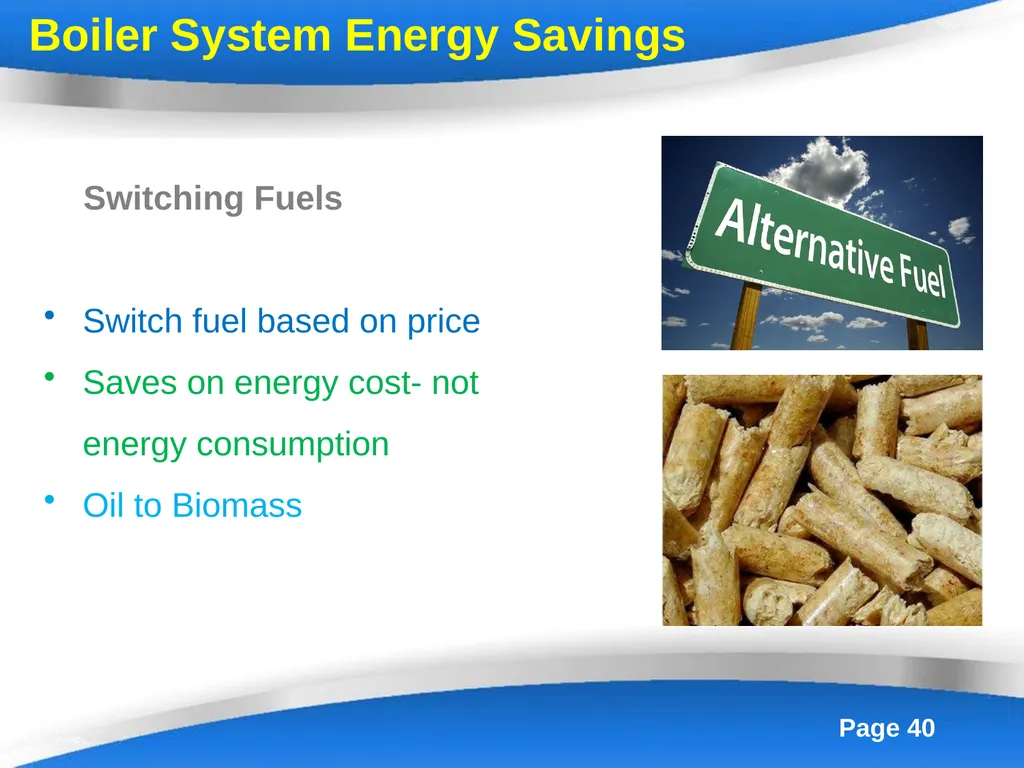
Switching Fuels Switch fuel based on price
Saves on energy cost- not energy consumption
Oil to Biomass Boiler System Energy Savings<br>
Saves on energy cost- not energy consumption
Oil to Biomass Boiler System Energy Savings<br>
41
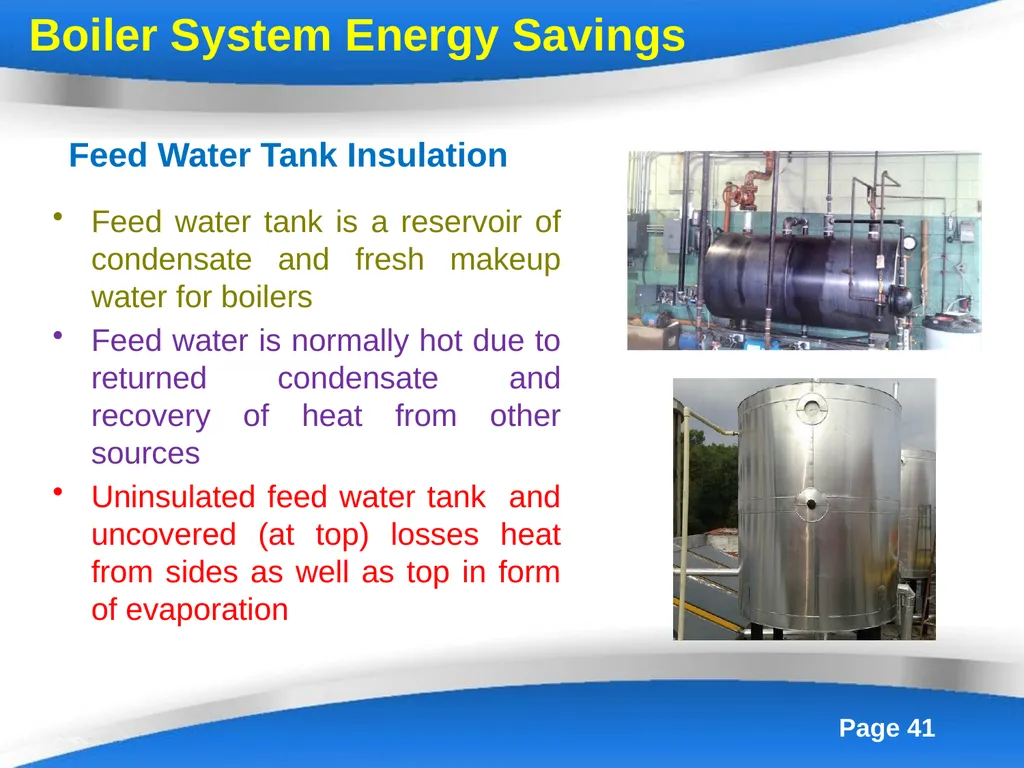
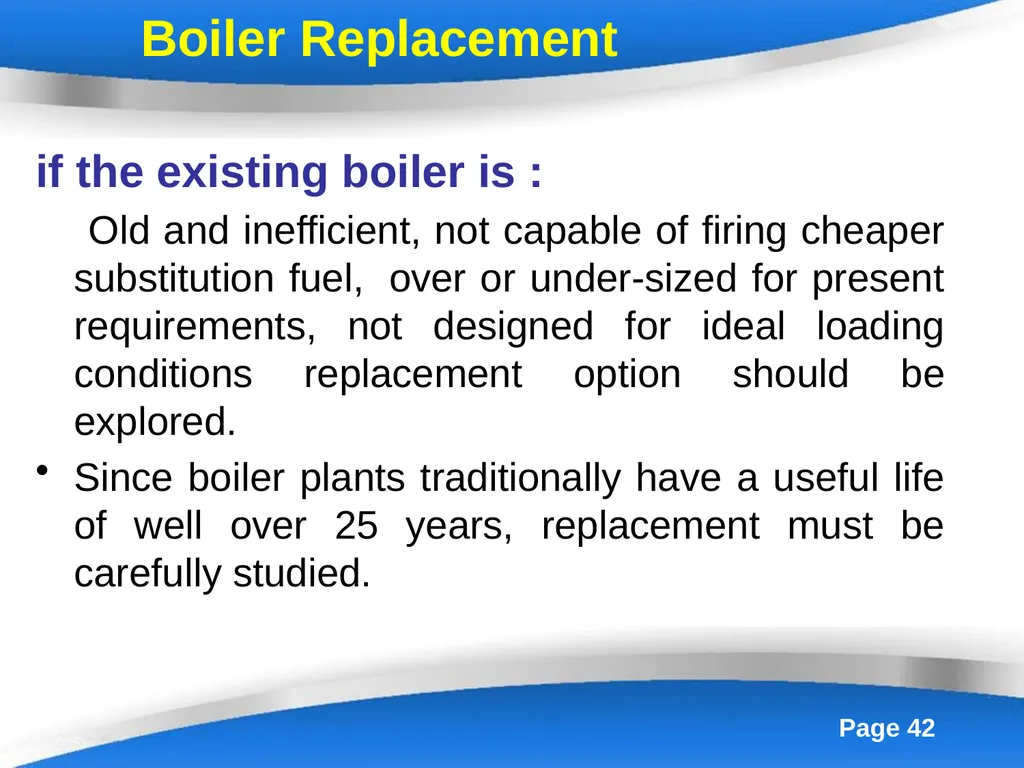
Feed Water Tank Insulation Feed water tank is a reservoir of condensate and fresh makeup water for boilers
Feed water is normally hot due to returned condensate and recovery of heat from other sources
Uninsulated feed water tank and uncovered (at top) losses heat from sides as well as top in form of evaporation Boiler System Energy Savings<br>
Feed water is normally hot due to returned condensate and recovery of heat from other sources
Uninsulated feed water tank and uncovered (at top) losses heat from sides as well as top in form of evaporation Boiler System Energy Savings<br>
42
if the existing boiler is :
Old and inefficient, not capable of firing cheaper substitution fuel, over or under-sized for present requirements, not designed for ideal loading conditions replacement option should be explored.
Since boiler plants traditionally have a useful life of well over 25 years, replacement must be carefully studied. Boiler Replacement<br>
Old and inefficient, not capable of firing cheaper substitution fuel, over or under-sized for present requirements, not designed for ideal loading conditions replacement option should be explored.
Since boiler plants traditionally have a useful life of well over 25 years, replacement must be carefully studied. Boiler Replacement<br>
43
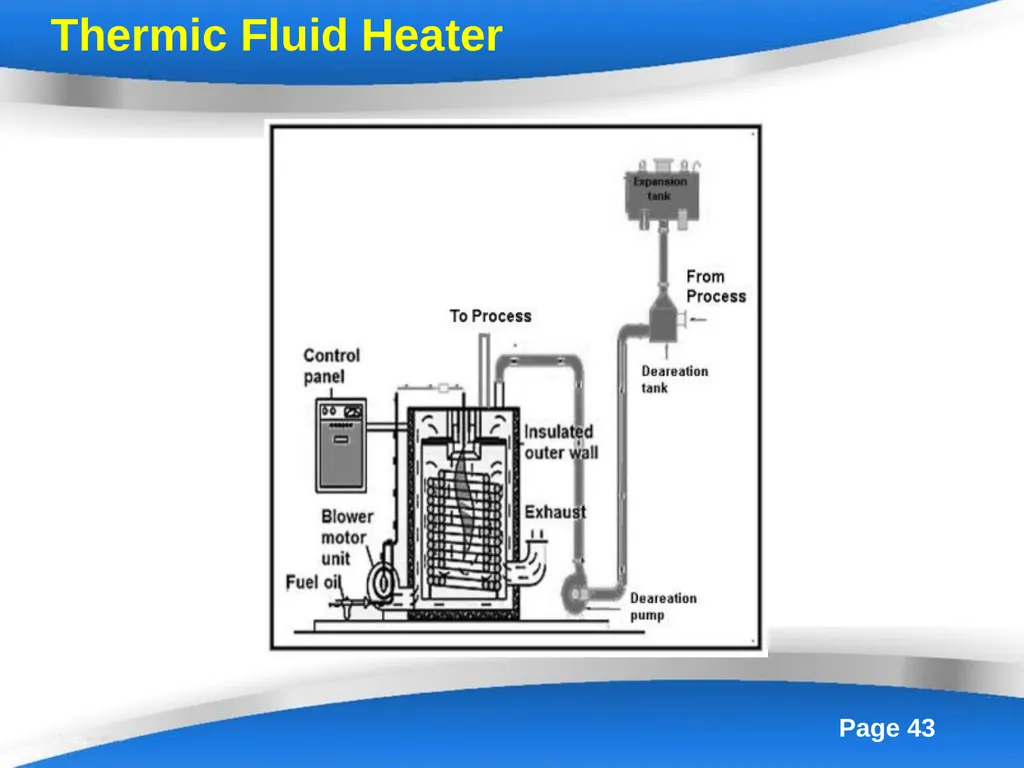
Thermic Fluid Heater<br>
44
Energy Auditing Approach Data and Information
Collect boiler details: type, rated steam pressure, temperature, and steam capacity.
Collect feed water pump details: type, no. of stages, flow, and pressure.
Record allowable TDS in boiler.
Collect FD/ID fan flow, pressure, motor rating, kW.
Collect burner details: type, rated temperature, pressure, turndown ratio.
Collect supply and return thermic fluid temperature.
Assess thermic fluid loads (temperature, flow).<br>
Collect boiler details: type, rated steam pressure, temperature, and steam capacity.
Collect feed water pump details: type, no. of stages, flow, and pressure.
Record allowable TDS in boiler.
Collect FD/ID fan flow, pressure, motor rating, kW.
Collect burner details: type, rated temperature, pressure, turndown ratio.
Collect supply and return thermic fluid temperature.
Assess thermic fluid loads (temperature, flow).<br>
45
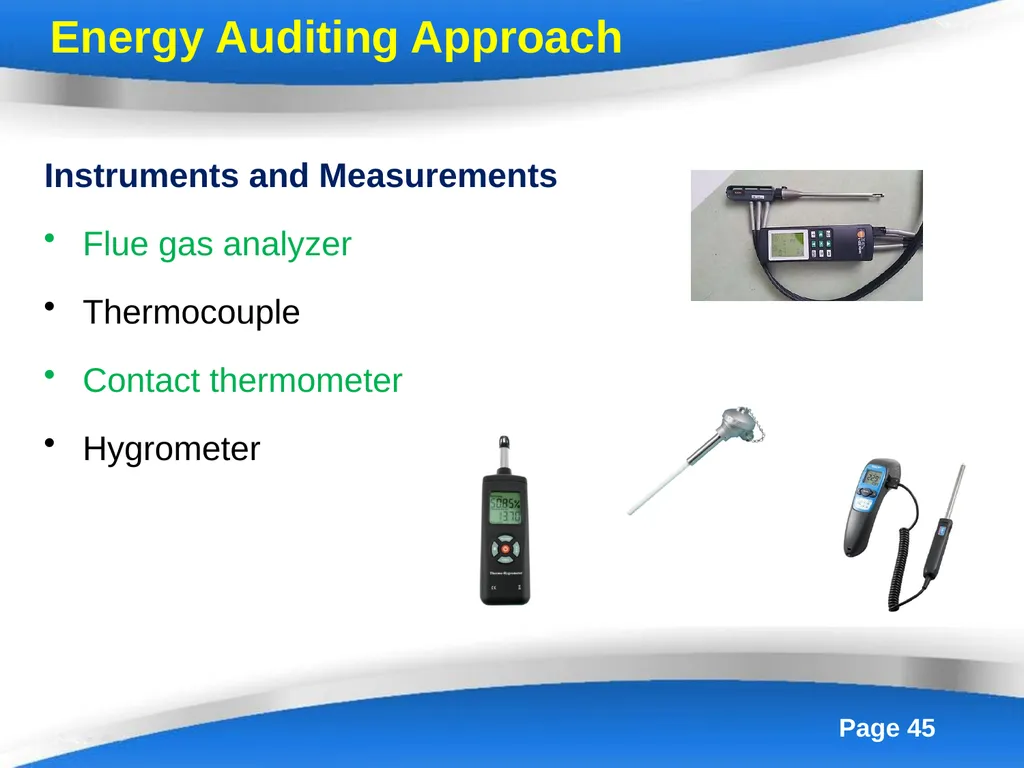
Instruments and Measurements
Flue gas analyzer
Thermocouple
Contact thermometer
Hygrometer Energy Auditing Approach<br>
Flue gas analyzer
Thermocouple
Contact thermometer
Hygrometer Energy Auditing Approach<br>
46
Field Audit
Examine the boiler/thermic fluid log book.
Review operating steam/thermic fluid pressure.
Review operating steam temperature and thermic fluid temperatures.
Review steam production records.
Measure steam/thermic fluid flows through meters. Steam flow can be indirectly through feed water meter or from level measurements in overhead tank.
Review fuel consumption records and check fuel (oil) consumption by measuring difference in fuel oil tank level.
Measure gas measurement through gas meter.
Review make-up water records. Energy Auditing Approach<br>
Examine the boiler/thermic fluid log book.
Review operating steam/thermic fluid pressure.
Review operating steam temperature and thermic fluid temperatures.
Review steam production records.
Measure steam/thermic fluid flows through meters. Steam flow can be indirectly through feed water meter or from level measurements in overhead tank.
Review fuel consumption records and check fuel (oil) consumption by measuring difference in fuel oil tank level.
Measure gas measurement through gas meter.
Review make-up water records. Energy Auditing Approach<br>
47
Check condensate return, quantity, and temperature.
Measure feed water temperature.
Measure O2, CO2 percent in exhaust flue gas, CO level in ppm.
Measure oil pre-heat temperature and pressure.
Review Allowable TDS in boiler and TDS in blowdown.
Measure O2 level before and after heat recovery equipment like economizer, air pre-heater.
Check insulation of feed water tank (measure surface temperature and calculate heat losses).
Prepare schematic of water treatment system.
Review feed water and make-up water testing procedures. Energy Auditing Approach Field Audit<br>
Measure feed water temperature.
Measure O2, CO2 percent in exhaust flue gas, CO level in ppm.
Measure oil pre-heat temperature and pressure.
Review Allowable TDS in boiler and TDS in blowdown.
Measure O2 level before and after heat recovery equipment like economizer, air pre-heater.
Check insulation of feed water tank (measure surface temperature and calculate heat losses).
Prepare schematic of water treatment system.
Review feed water and make-up water testing procedures. Energy Auditing Approach Field Audit<br>
48
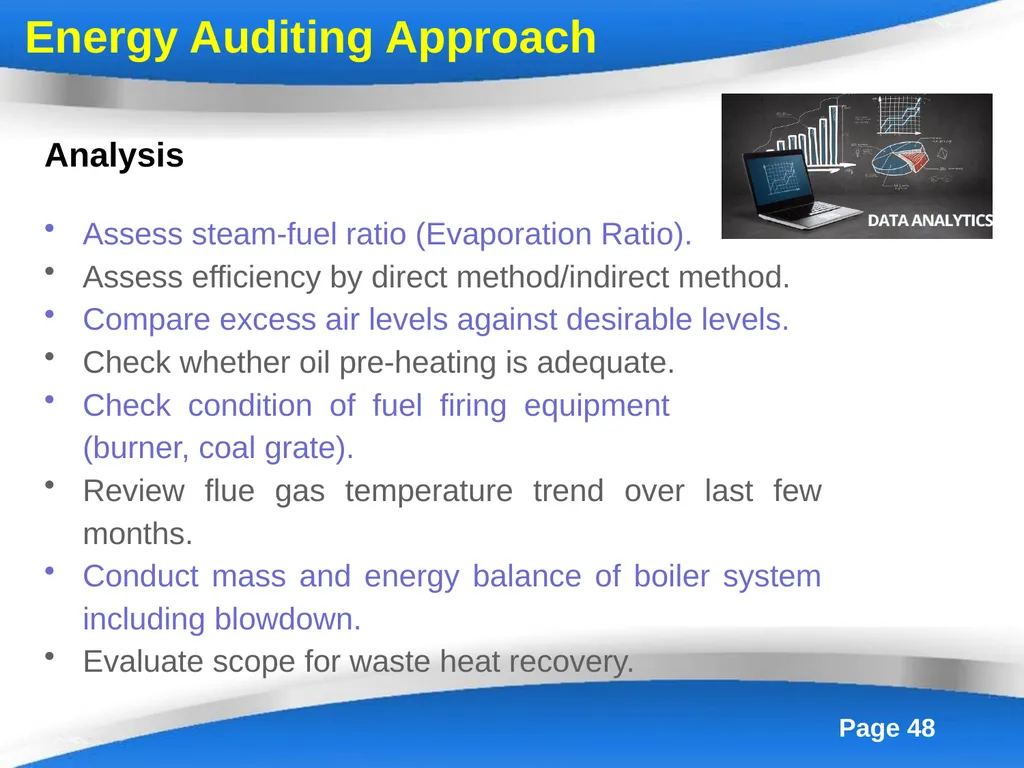
Analysis
Assess steam-fuel ratio (Evaporation Ratio).
Assess efficiency by direct method/indirect method.
Compare excess air levels against desirable levels.
Check whether oil pre-heating is adequate.
Check condition of fuel firing equipment (burner, coal grate).
Review flue gas temperature trend over last few months.
Conduct mass and energy balance of boiler system including blowdown.
Evaluate scope for waste heat recovery. Energy Auditing Approach<br>
Assess steam-fuel ratio (Evaporation Ratio).
Assess efficiency by direct method/indirect method.
Compare excess air levels against desirable levels.
Check whether oil pre-heating is adequate.
Check condition of fuel firing equipment (burner, coal grate).
Review flue gas temperature trend over last few months.
Conduct mass and energy balance of boiler system including blowdown.
Evaluate scope for waste heat recovery. Energy Auditing Approach<br>
49
Operational and Housekeeping Measures
Optimize excess air.
Higher excess air increases flue gas quantity and stack loss. It also reduces flame temperature, radiation heat transfer, and heat transfer to heating surfaces. Lower excess air may result in incomplete combustion which leads to formation of CO in flue gas. The maximum permissible CO level is 1%.
Reduce thermic fluid outlet temperature
If temperature difference between thermic fluid outlet temperature and the medium being heated is quite high, it may be possible to reduce the outlet temperature after conducting field trials. This will also reduce stack loss as well as radiation loss from the thermic fluid heater circuit. Thermic Fluid Heaters ENCON Opportunities<br>
Optimize excess air.
Higher excess air increases flue gas quantity and stack loss. It also reduces flame temperature, radiation heat transfer, and heat transfer to heating surfaces. Lower excess air may result in incomplete combustion which leads to formation of CO in flue gas. The maximum permissible CO level is 1%.
Reduce thermic fluid outlet temperature
If temperature difference between thermic fluid outlet temperature and the medium being heated is quite high, it may be possible to reduce the outlet temperature after conducting field trials. This will also reduce stack loss as well as radiation loss from the thermic fluid heater circuit. Thermic Fluid Heaters ENCON Opportunities<br>
50
Low Cost Measures
Optimize burner nozzle size. If the thermic fluid heater operates at low fire for long period in a cycle rather than high fire, the efficiency of heater will be lower. In such cases, it is better to improve overall energy efficiency by changing the nozzle size so that heater output matches with the system load.
Optimize the flow of thermal oil for multiple process heating applications: when a single thermic fluid heater is used to provide heat to many processes or systems, it is important to supply correct quantity of thermal oil to each process by controlling the mass flow rate of thermic fluid using auto-control valves.
Upgrading the condition of insulation of thermic fluid heater and distribution pipelines.
Check for and remove redundant lines and valves in distribution lines to reduce distribution losses. ENCON Opportunities Thermic Fluid Heaters<br>
Optimize burner nozzle size. If the thermic fluid heater operates at low fire for long period in a cycle rather than high fire, the efficiency of heater will be lower. In such cases, it is better to improve overall energy efficiency by changing the nozzle size so that heater output matches with the system load.
Optimize the flow of thermal oil for multiple process heating applications: when a single thermic fluid heater is used to provide heat to many processes or systems, it is important to supply correct quantity of thermal oil to each process by controlling the mass flow rate of thermic fluid using auto-control valves.
Upgrading the condition of insulation of thermic fluid heater and distribution pipelines.
Check for and remove redundant lines and valves in distribution lines to reduce distribution losses. ENCON Opportunities Thermic Fluid Heaters<br>
51
Retrofit Measures
Replacement of inefficient and old thermic fluid heaters: Older models have efficiencies of lower than 50% under low and high fire as against over 80% under low and high fire for recent models.
Switch over to new fuel preferably renewable type like biomass. ENCON Opportunities Thermic Fluid Heaters<br>
Replacement of inefficient and old thermic fluid heaters: Older models have efficiencies of lower than 50% under low and high fire as against over 80% under low and high fire for recent models.
Switch over to new fuel preferably renewable type like biomass. ENCON Opportunities Thermic Fluid Heaters<br>
52
CASE STUDIES<br>
53
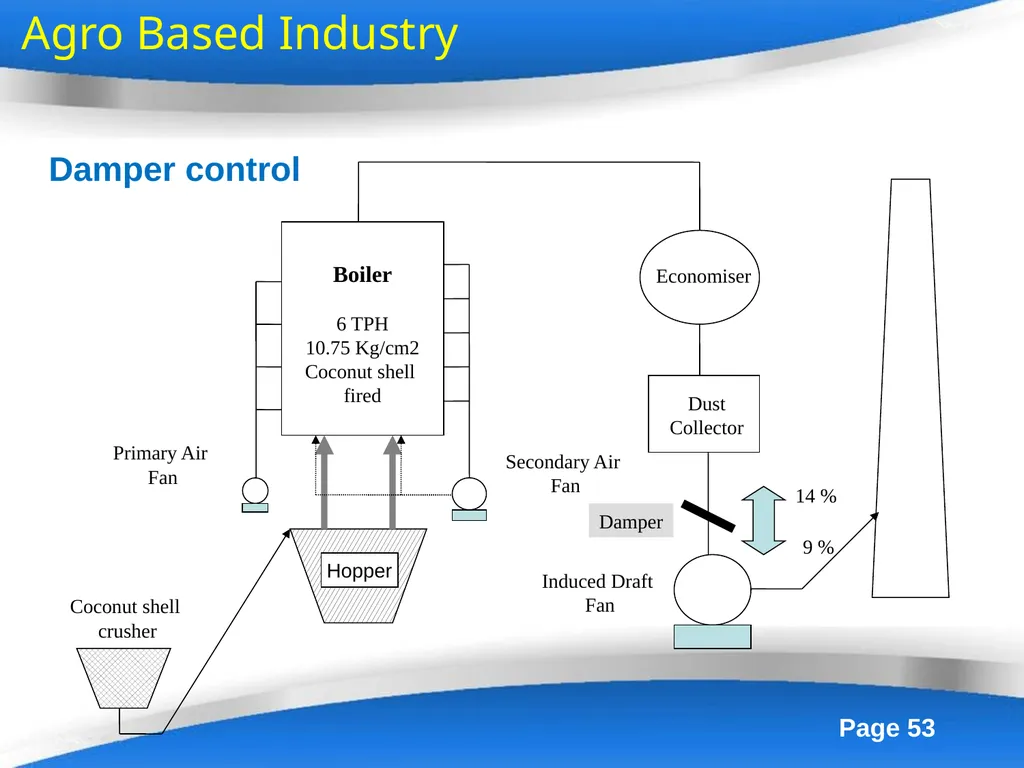
Damper control Boiler
6 TPH
10.75 Kg/cm2
Coconut shell
fired Hopper Coconut shell
crusher Economiser Dust
Collector Primary Air
Fan Secondary Air
Fan Induced Draft
Fan Damper 14 % 9 % Agro Based Industry<br>
6 TPH
10.75 Kg/cm2
Coconut shell
fired Hopper Coconut shell
crusher Economiser Dust
Collector Primary Air
Fan Secondary Air
Fan Induced Draft
Fan Damper 14 % 9 % Agro Based Industry<br>
54
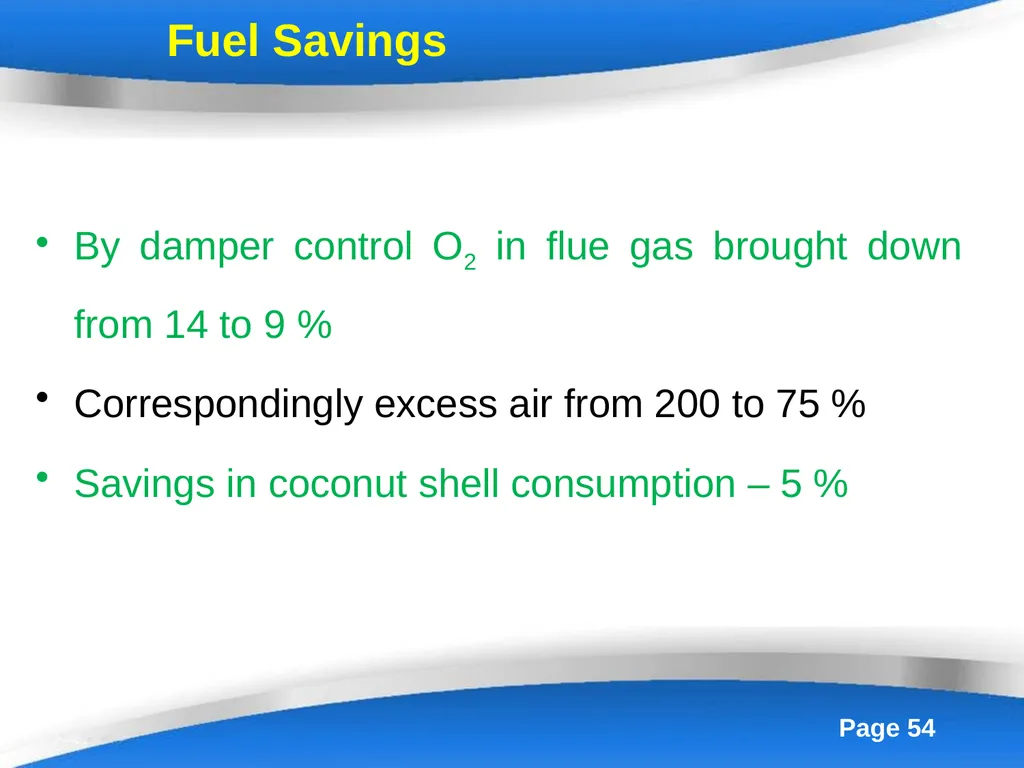
Fuel Savings By damper control O2 in flue gas brought down from 14 to 9 %
Correspondingly excess air from 200 to 75 %
Savings in coconut shell consumption – 5 %<br>
Correspondingly excess air from 200 to 75 %
Savings in coconut shell consumption – 5 %<br>
55
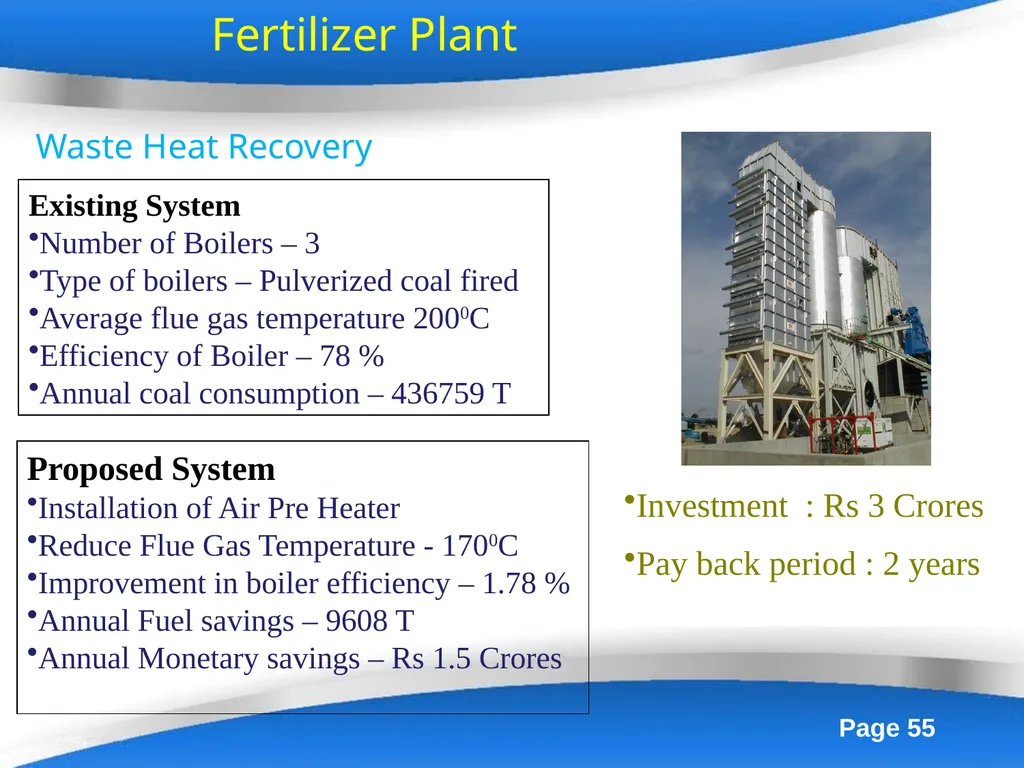
Fertilizer Plant Waste Heat Recovery Existing System
Number of Boilers – 3
Type of boilers – Pulverized coal fired
Average flue gas temperature 2000C
Efficiency of Boiler – 78 %
Annual coal consumption – 436759 T Proposed System
Installation of Air Pre Heater
Reduce Flue Gas Temperature - 1700C
Improvement in boiler efficiency – 1.78 %
Annual Fuel savings – 9608 T
Annual Monetary savings – Rs 1.5 Crores Investment : Rs 3 Crores
Pay back period : 2 years<br>
Number of Boilers – 3
Type of boilers – Pulverized coal fired
Average flue gas temperature 2000C
Efficiency of Boiler – 78 %
Annual coal consumption – 436759 T Proposed System
Installation of Air Pre Heater
Reduce Flue Gas Temperature - 1700C
Improvement in boiler efficiency – 1.78 %
Annual Fuel savings – 9608 T
Annual Monetary savings – Rs 1.5 Crores Investment : Rs 3 Crores
Pay back period : 2 years<br>