
Engaging Students in Blackboard Discussions
A
Published · 44 slides · 0 views
1 / 1




Description
Engaging Students in Blackboard Discussions Engaging Students in Blackboard Discussions Microphone Muted Chat Panel Todays Presenters: LeAnn Krosnick, Sr. Instructional Designer Sarah Rutland, QA ManagerSr. Instructional Designer 3 X 3
Related Topics
Share
Embed code
Download this presentation From Below
"Engaging Students in Blackboard Discussions" is the property of its rightful owner. Permission is granted to download and print the materials on this website for personal, non-commercial use only, and to display it on your personal computer provided you do not modify the materials and that you retain all copyright notices contained in the materials. By downloading content from our website, you accept the terms of this agreement.
Presentation Transcript
01
Engaging Students in Blackboard Discussions<br>
02
Engaging Students in Blackboard Discussions Microphone Muted
Chat Panel
Today’s Presenters:
LeAnn Krosnick, Sr. Instructional Designer
Sarah Rutland, QA Manager/Sr. Instructional Designer<br>
Chat Panel
Today’s Presenters:
LeAnn Krosnick, Sr. Instructional Designer
Sarah Rutland, QA Manager/Sr. Instructional Designer<br>
03
3 X 3 Discussion Tips
6 Effective Discussion Strategies
7 Tips for Managing Discussions Engaging Students in Blackboard Discussions Content used by permission from Dr. Lisa Kidder & Mark Cooper presentation: Breaking the Humdrum of “Post Once & Reply to 2”, Idaho State University<br>
6 Effective Discussion Strategies
7 Tips for Managing Discussions Engaging Students in Blackboard Discussions Content used by permission from Dr. Lisa Kidder & Mark Cooper presentation: Breaking the Humdrum of “Post Once & Reply to 2”, Idaho State University<br>
04
3 x 3 Discussion Tips Starting Strong with Communication<br>
05
I agree, I like riding bikes too. I especially liked the part where you said you liked riding bikes! I like riding bikes! If this looks familiar…<br>
06
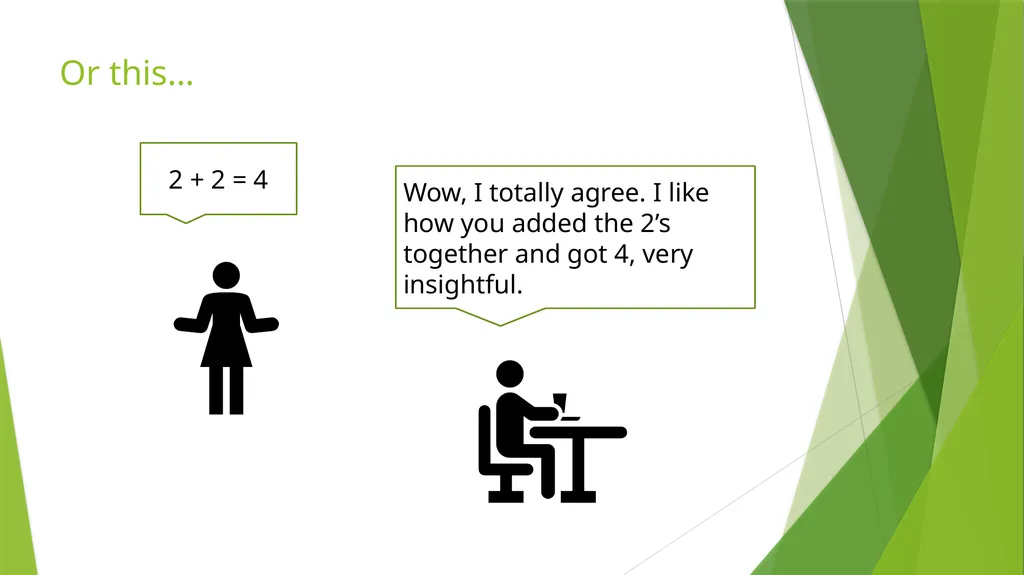
Wow, I totally agree. I like how you added the 2’s together and got 4, very insightful. 2 + 2 = 4 Or this…<br>
07
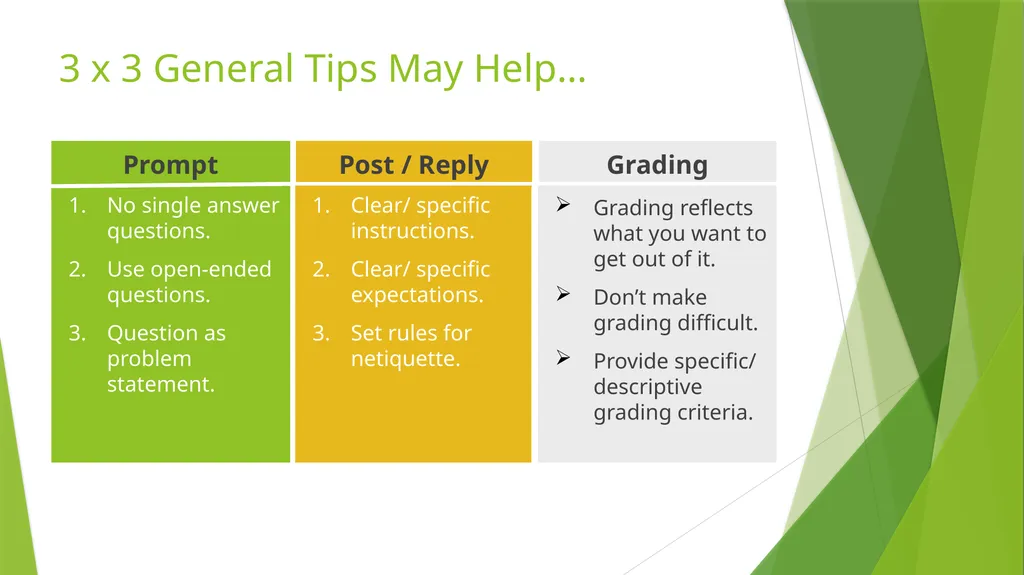
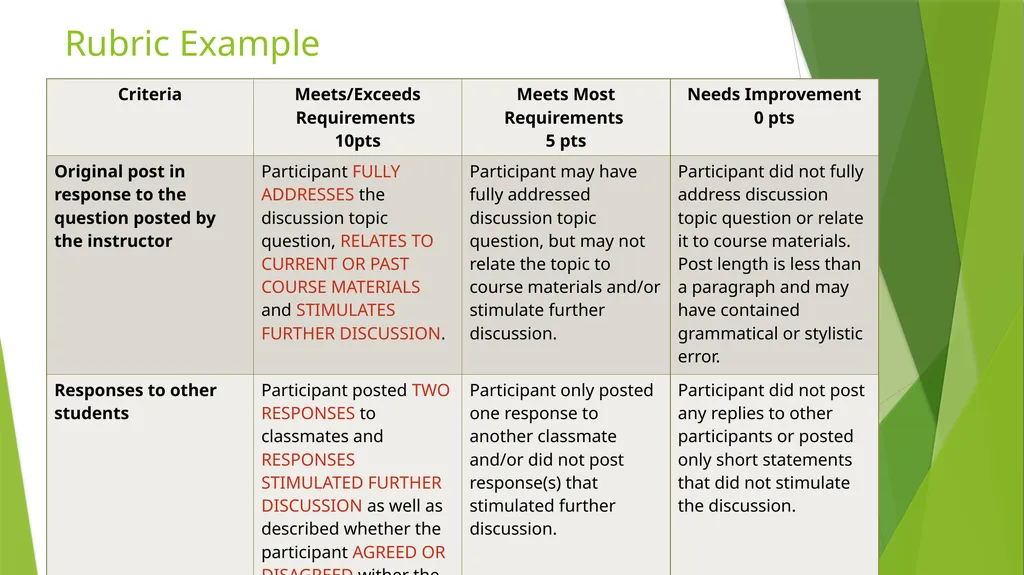
3 x 3 General Tips May Help… Prompt Post / Reply Grading No single answer questions.
Use open-ended questions.
Question as problem statement. Clear/ specific instructions.
Clear/ specific expectations.
Set rules for netiquette. Grading reflects what you want to get out of it.
Don’t make grading difficult.
Provide specific/ descriptive grading criteria.<br>
Use open-ended questions.
Question as problem statement. Clear/ specific instructions.
Clear/ specific expectations.
Set rules for netiquette. Grading reflects what you want to get out of it.
Don’t make grading difficult.
Provide specific/ descriptive grading criteria.<br>
08
Rubric Example<br>
09
6 Effective Discussion Strategies Starting Strong with Communication<br>
10
1. Case Study Starting Strong with Communication<br>
11
Requires learners to read a “real-life” case and answer, discuss, or argue open-ended questions or develop solutions with accompanying data to analyze. Case Study Reflection journaling would work well as an activity in any academic discipline. Description<br>
12
A major advantage of teaching with case studies is that the learners actively engage in problem-solving and analysis.
This develops skills in
problem-solving
analytical skills (quantitative and/or qualitative)
decision making
coping with ambiguities Case Study Purpose<br>
This develops skills in
problem-solving
analytical skills (quantitative and/or qualitative)
decision making
coping with ambiguities Case Study Purpose<br>
13
Case Study Reflection journaling would work well as an activity in any academic discipline. Usage Case studies work well in settings where there are “real-world” situations to explore and apply learning. Case studies work well in many academic disciplines.
Case studies can be done individually or in small groups so that the learners can brainstorm solutions and share the workload.<br>
Case studies can be done individually or in small groups so that the learners can brainstorm solutions and share the workload.<br>
14
Carefully read the Social Work Case Study and answer the questions in the discussion forum. Refer to Social Work: Policy and Legal Frameworks.
Discussion Questions:
What are you thinking? What is worrying you?
What is the first thing you are going to do or say?
How do you ensure that Vicky is kept safe and still respect her wishes and feelings? Do you have any right to intervene?
Where/from whom could you seek help?
What next? Case Study Example<br>
Discussion Questions:
What are you thinking? What is worrying you?
What is the first thing you are going to do or say?
How do you ensure that Vicky is kept safe and still respect her wishes and feelings? Do you have any right to intervene?
Where/from whom could you seek help?
What next? Case Study Example<br>
15
2. Debate Starting Strong with Communication<br>
16
A debate online can be set up between two or more groups or “teams” to argue a subject that is open for discussion. Debate Reflection journaling would work well as an activity in any academic discipline. Description<br>
17
Debates work well to practice skills in critical thinking and is very effective in actively engaging students.
Encourage student engagement and reasoning to support:
Leadership roles
Interpretation of literature
Theory
Ethical considerations Debate Purpose Problem solving
Current events
Political action
Changes within a discipline<br>
Encourage student engagement and reasoning to support:
Leadership roles
Interpretation of literature
Theory
Ethical considerations Debate Purpose Problem solving
Current events
Political action
Changes within a discipline<br>
18
Debate Usage Debate works well in many academic disciplines, such as
Political Science
Business/Economics
Engineering
Health/Medicine Law
History
Theology<br>
Political Science
Business/Economics
Engineering
Health/Medicine Law
History
Theology<br>
19
Debate Example Topic: “Is Affirmative Action necessary to create diversity in Higher Ed institutions?” Arguments For:
Equality and opportunity
Overcomes prejudice
Changes negative perceptions of university life
Increases the number of minorities Arguments Against:
Achievements should be earned, not given
Affirmative action can create social tensions
Affirmative action will not work
Reduced appreciation for easy opportunities<br>
Equality and opportunity
Overcomes prejudice
Changes negative perceptions of university life
Increases the number of minorities Arguments Against:
Achievements should be earned, not given
Affirmative action can create social tensions
Affirmative action will not work
Reduced appreciation for easy opportunities<br>
20
3. Student Facilitation<br>
21
In a Student Facilitation discussion, the learners take on the role of “instructor” to provide feedback for posted responses. Student Facilitation Reflection journaling would work well as an activity in any academic discipline. Description<br>
22
Student Facilitation Purpose Student Facilitation discussions provide learners an opportunity to do a peer review.
It can be set up so the learner/facilitator gets feedback from the instructor on their own responses before learners review their peers
All learners practice the material, and by the end of the course, all learners have an opportunity to provide feedback to their peers.<br>
It can be set up so the learner/facilitator gets feedback from the instructor on their own responses before learners review their peers
All learners practice the material, and by the end of the course, all learners have an opportunity to provide feedback to their peers.<br>
23
Student Facilitation Reflection journaling would work well as an activity in any academic discipline. Usage Student Facilitation works well when learners need to solve problem sets for practice. Student Facilitation work work well in many academic disciplines, particularly:
Math/Statistics
Chemistry
Computer Science<br>
Math/Statistics
Chemistry
Computer Science<br>
24
Student Facilitation Example Learner/Facilitator selects one of the designated problem sets and submits solution to the instructor ahead of time. All other students post their solutions, and the student facilitator provides feedback.<br>
25
4. Challenge Questions<br>
26
Challenge Questions are mini case studies, presenting a short scenario and asking “how would you handle this situation?” Think of a “drill” exercise.
The instructor sets up the forum by posing the question. Learners reply with a solution. Learners can also comment on the replies of their classmates. Challenge Questions Description<br>
The instructor sets up the forum by posing the question. Learners reply with a solution. Learners can also comment on the replies of their classmates. Challenge Questions Description<br>
27
Challenge Questions Purpose Challenge Question discussions present a scenario based on a situation learners could encounter in the “real world”
and develops skills in:
thinking “on the fly”
problem-solving
decision making
rationalizing decisions<br>
and develops skills in:
thinking “on the fly”
problem-solving
decision making
rationalizing decisions<br>
28
Challenge Questions Reflection journaling would work well as an activity in any academic discipline. Usage Challenge Questions are similar to case studies where this exercise explores and applies knowledge/skill to “real-world” situations, but in smaller/”micro” situations. Challenge Question discussions work well in many academic disciplines, such as
Law
Health Medicine
Social Work
Psychology
Engineering<br>
Law
Health Medicine
Social Work
Psychology
Engineering<br>
29
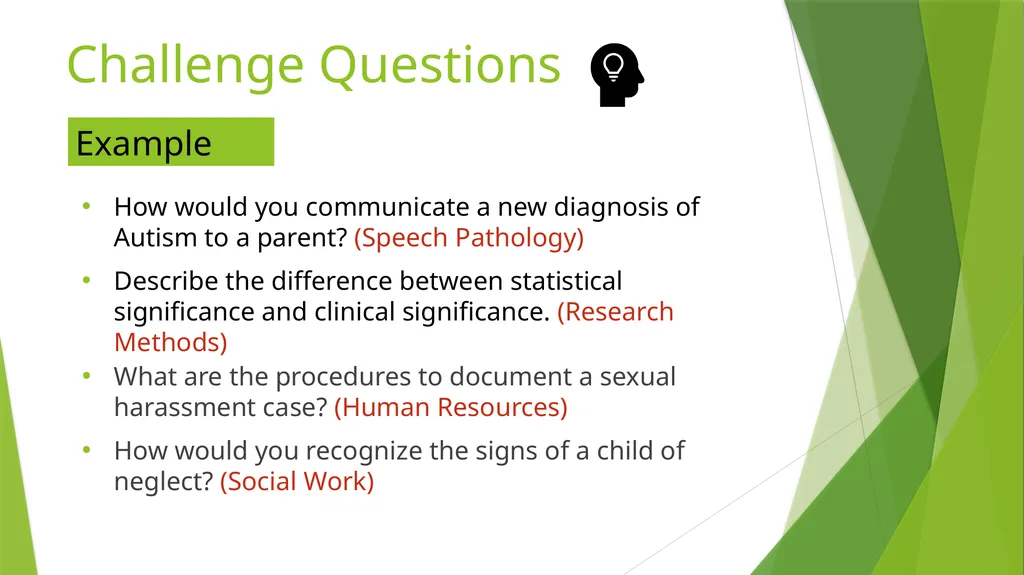
Challenge Questions Example How would you communicate a new diagnosis of Autism to a parent? (Speech Pathology)
Describe the difference between statistical significance and clinical significance. (Research Methods) What are the procedures to document a sexual harassment case? (Human Resources)
How would you recognize the signs of a child of neglect? (Social Work)<br>
Describe the difference between statistical significance and clinical significance. (Research Methods) What are the procedures to document a sexual harassment case? (Human Resources)
How would you recognize the signs of a child of neglect? (Social Work)<br>
30
5. In the News<br>
31
“In the News” discussions use examples from the media that present a statistic. Learners describe the limitations of taking statistics at face-value. In the News Description<br>
32
In the News Purpose “In the News” helps learners to:
develop their critical thinking
make real world connections
see the authenticity of your content<br>
develop their critical thinking
make real world connections
see the authenticity of your content<br>
33
In the News Reflection journaling would work well as an activity in any academic discipline. Usage “In the News” discussions focus on evaluating the credibility of statistical assertions.
(This could be expanded beyond statistics.) “In the News” discussions work well in many disciplines where statistics (past or present) get reported to or from news media outlets, such as:
Math
Health/Medicine
Political Science<br>
(This could be expanded beyond statistics.) “In the News” discussions work well in many disciplines where statistics (past or present) get reported to or from news media outlets, such as:
Math
Health/Medicine
Political Science<br>
34
In the News Example During your time in this course, pay attention to the statistical information presented in the media.
Share a link to an article, or story. Describe the limitations of the presented statistics and/or what follow up questions you would want to ask to clarify the presented statistics.<br>
Share a link to an article, or story. Describe the limitations of the presented statistics and/or what follow up questions you would want to ask to clarify the presented statistics.<br>
35
6. Video Analysis<br>
36
Video Analysis is a forum that incorporates multimedia with an emphasis on identifying key features or aspects that were presented in the media. Video Analysis Description<br>
37
Video Analysis Purpose Video Analysis discussions help learners to see examples presented in multimedia and then identify key features or apply what they have learned to the situation.
It is best used when learners need to practice a task.
Video Analysis (as with many discussion types) can be used as a formative assessment to check learner comprehension of ability to perform a task.<br>
It is best used when learners need to practice a task.
Video Analysis (as with many discussion types) can be used as a formative assessment to check learner comprehension of ability to perform a task.<br>
38
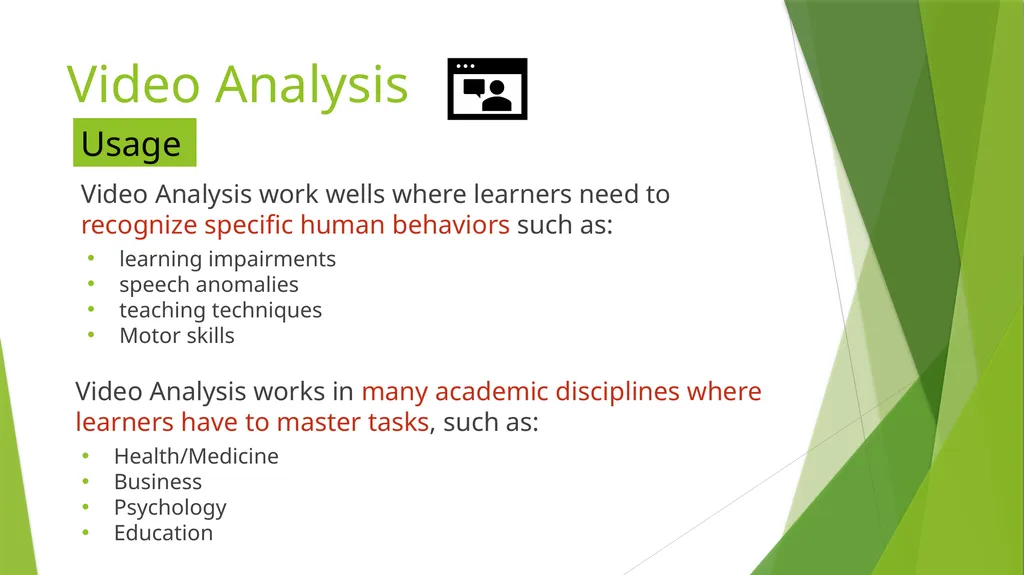
Video Analysis Usage Video Analysis work wells where learners need to recognize specific human behaviors such as:
learning impairments
speech anomalies
teaching techniques
Motor skills Video Analysis works in many academic disciplines where learners have to master tasks, such as:
Health/Medicine
Business
Psychology
Education<br>
learning impairments
speech anomalies
teaching techniques
Motor skills Video Analysis works in many academic disciplines where learners have to master tasks, such as:
Health/Medicine
Business
Psychology
Education<br>
39
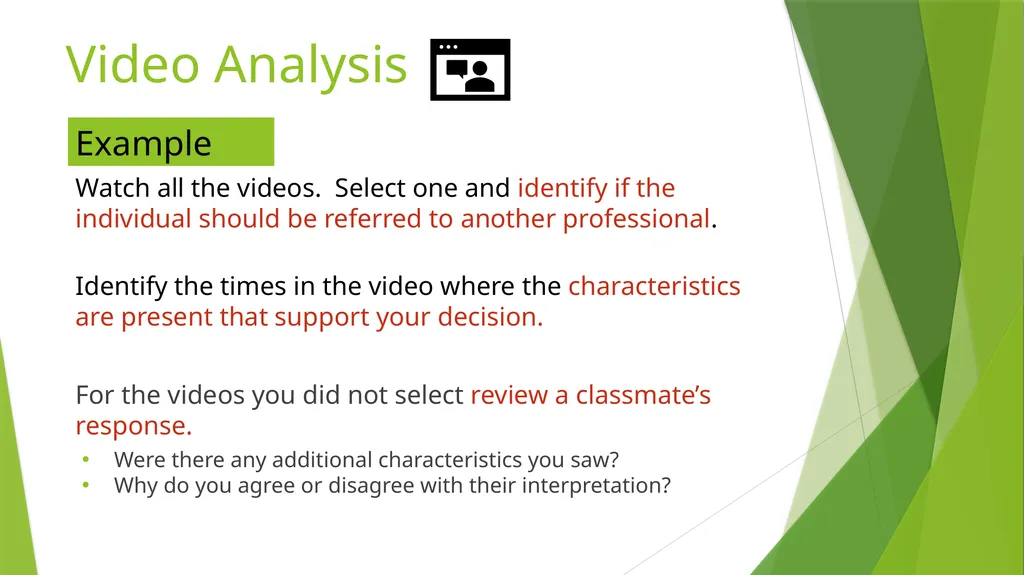
Video Analysis Example Watch all the videos. Select one and identify if the individual should be referred to another professional.
Identify the times in the video where the characteristics are present that support your decision. For the videos you did not select review a classmate’s response.
Were there any additional characteristics you saw?
Why do you agree or disagree with their interpretation?<br>
Identify the times in the video where the characteristics are present that support your decision. For the videos you did not select review a classmate’s response.
Were there any additional characteristics you saw?
Why do you agree or disagree with their interpretation?<br>
40
7 Tips for Managing Discussions Content used by permission from Aaron Johnson, Excellent Online Teaching: Effective Strategies for a Successful Semester Online (2013).<br>
41
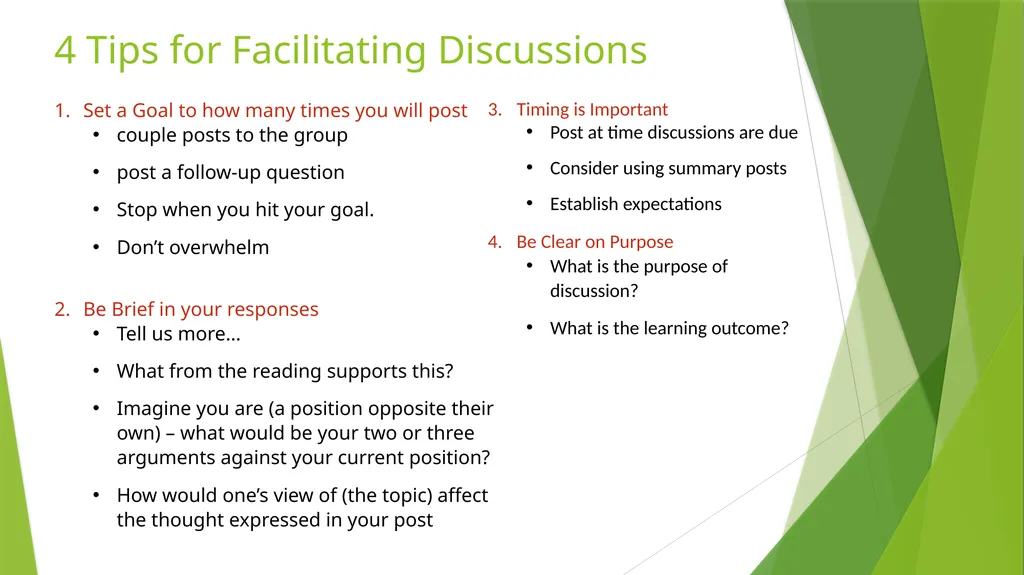
Set a Goal to how many times you will post
couple posts to the group
post a follow-up question
Stop when you hit your goal.
Don’t overwhelm
Be Brief in your responses
Tell us more…
What from the reading supports this?
Imagine you are (a position opposite their own) – what would be your two or three arguments against your current position?
How would one’s view of (the topic) affect the thought expressed in your post Timing is Important
Post at time discussions are due
Consider using summary posts
Establish expectations
Be Clear on Purpose
What is the purpose of discussion?
What is the learning outcome? 4 Tips for Facilitating Discussions<br>
couple posts to the group
post a follow-up question
Stop when you hit your goal.
Don’t overwhelm
Be Brief in your responses
Tell us more…
What from the reading supports this?
Imagine you are (a position opposite their own) – what would be your two or three arguments against your current position?
How would one’s view of (the topic) affect the thought expressed in your post Timing is Important
Post at time discussions are due
Consider using summary posts
Establish expectations
Be Clear on Purpose
What is the purpose of discussion?
What is the learning outcome? 4 Tips for Facilitating Discussions<br>
42
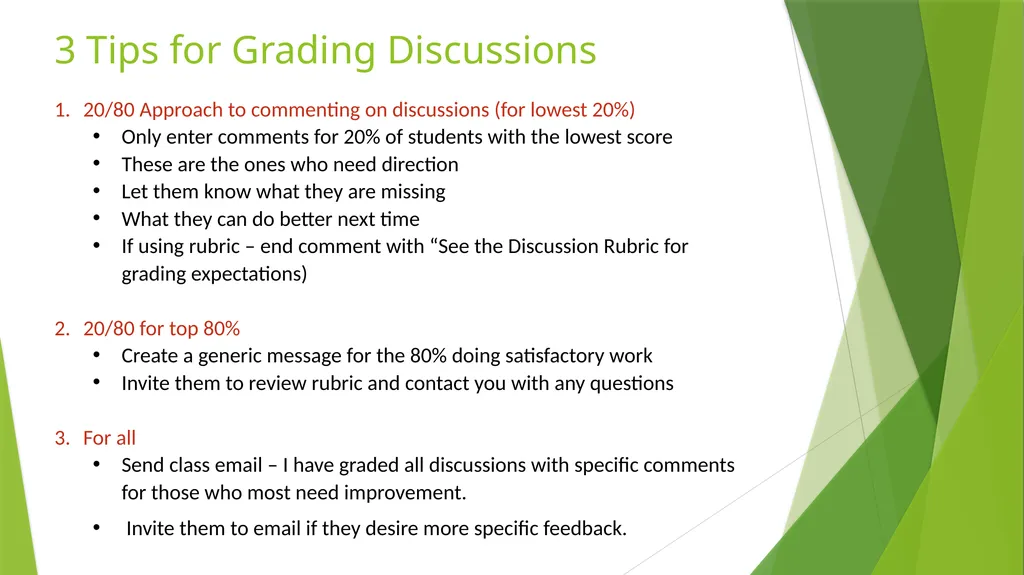
3 Tips for Grading Discussions 20/80 Approach to commenting on discussions (for lowest 20%)
Only enter comments for 20% of students with the lowest score
These are the ones who need direction
Let them know what they are missing
What they can do better next time
If using rubric – end comment with “See the Discussion Rubric for grading expectations)
20/80 for top 80%
Create a generic message for the 80% doing satisfactory work
Invite them to review rubric and contact you with any questions
For all
Send class email – I have graded all discussions with specific comments for those who most need improvement.
Invite them to email if they desire more specific feedback.<br>
Only enter comments for 20% of students with the lowest score
These are the ones who need direction
Let them know what they are missing
What they can do better next time
If using rubric – end comment with “See the Discussion Rubric for grading expectations)
20/80 for top 80%
Create a generic message for the 80% doing satisfactory work
Invite them to review rubric and contact you with any questions
For all
Send class email – I have graded all discussions with specific comments for those who most need improvement.
Invite them to email if they desire more specific feedback.<br>
43
Discussion Q & A<br>