
Engineering and Cybersecurity Hongyi Wu, PhD
Description: Engineering and Cybersecurity Hongyi Wu, PhD Director, Center for Cybersecurity Education and Research Old Dominion University Norfolk, VA Engineering and Cybersecurity After completing this module, students will be able to: Discuss the
Related Topics
Download Presentation
"Engineering and Cybersecurity Hongyi Wu, PhD" is the property of its rightful owner. Permission is granted to download and print the materials on this website for personal, non-commercial use only, and to display it on your personal computer provided you do not modify the materials and that you retain all copyright notices contained in the materials. By downloading content from our website, you accept the terms of this agreement.
Presentation Transcript
slide1. Engineering and Cybersecurity Hongyi Wu, PhD
Director, Center for Cybersecurity Education and Research Old Dominion University
Norfolk, VA<br>
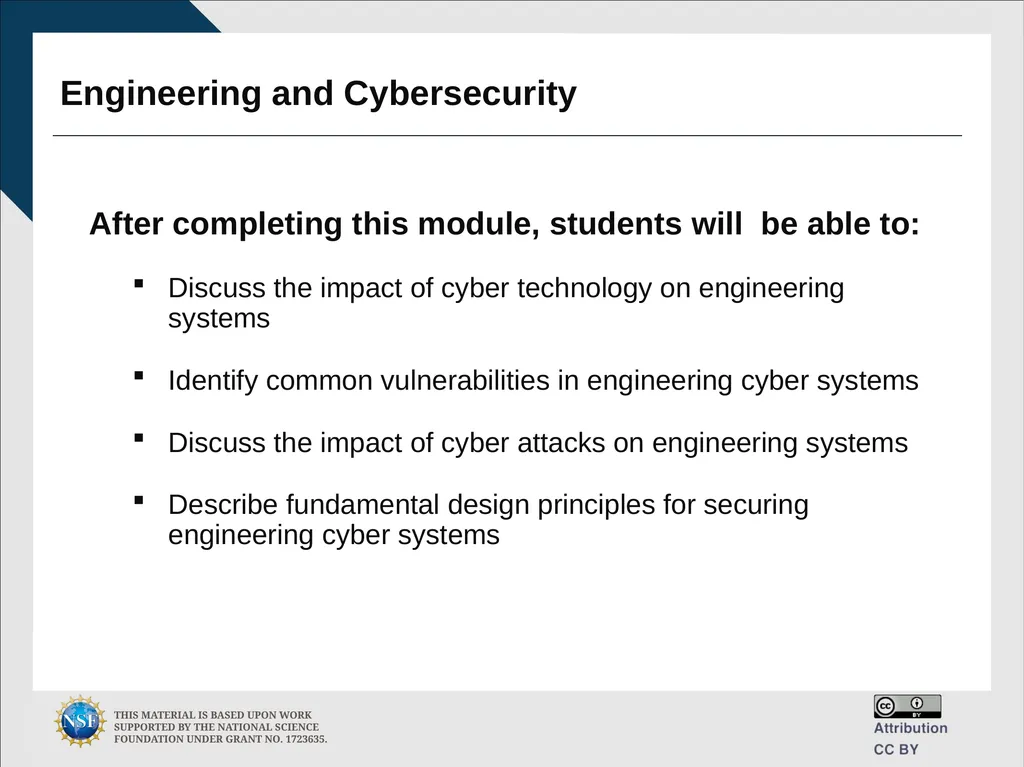
slide2. Engineering and Cybersecurity After completing this module, students will be able to:
Discuss the impact of cyber technology on engineering systems
Identify common vulnerabilities in engineering cyber systems
Discuss the impact of cyber attacks on engineering systems
Describe fundamental design principles for securing engineering cyber systems<br>
slide3. cyber technologies in engineering systems<br>
slide4. Industrial Cyber Systems Industry 4.0: a rapid transformation of industry
the virtual world of information technology, the physical world of machines, and the Internet have become one
Benefits
Improved machine intelligence
More automated processes and real-time self-monitoring
Optimized performance and improved flexibility and speed
Enabling more individualized products
Efficient and scalable production<br>
slide5. SCADA vs. DCS Supervisory control and data acquisition (SCADA) System: a system of software and hardware elements that allows industrial organizations to:
Monitor, collect, process and log data in real-time
Control industrial processes at local or remote sites
Interact with sensors and actuators through human-machine interface (HMI)
https://youtu.be/QvdUnFzTcnY DCS ("Distributed Control Systems”): providing sophisticated analog (e.g. loop) control capability
https://electrical-engineering-portal.com/scada-dcs-plc-rtu-smart-instrument SCADA and DCS started As separate systems but have grown together<br>
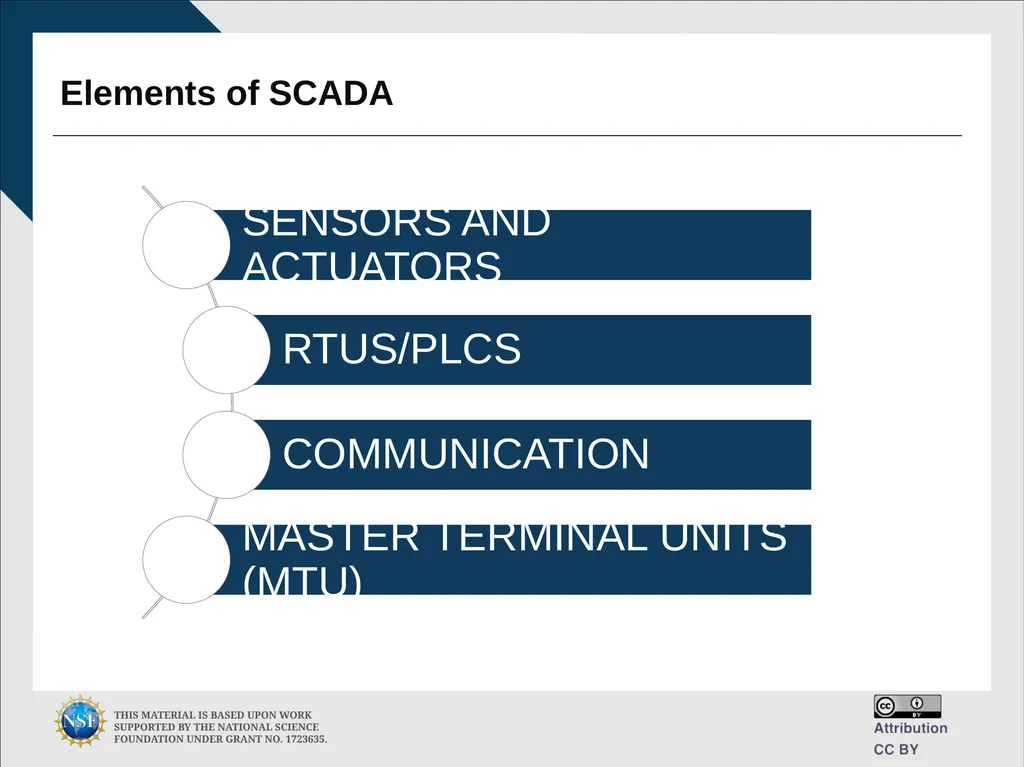
slide6. Elements of SCADA<br>
slide7. Sensors Types of sensors:
Pressure sensors, differential pressure sensors
Water level sensors, depth sensors, flow meters
Temperature sensors
Light sensors
Humidity sensors
Wind speed sensors
Sand sensors
Distance sensors<br>
slide8. Actuators Types of actuators:
Valves
Pumps
Motors
Air compressors and blowers;
Mixers
Other machinery Types of alarms:
Good alarms
Critical failure alarms<br>
slide9. RTU RTU – “Remote Terminal Unit” or “Remote Telemetry Units”
A standalone data acquisition and control unit
An electronic device with intelligent microprocessor
Request the field devices (e.g., sensors) for information
Control intelligent electronic device (IEDs)
Data/event logging and alarm handling
Individual RTU expandability: typically up to 200 analog and digital points<br>
slide10. PLC PLC – Programmable Logic Controller
Industrial digital computer that replaced traditional relays
Used to implement SCADA RTU
Control manufacturing processes: assembly lines, smart devices
Ease of programming and fault diagnosis
Communication compatibilities
Takes actions based on inputs
https://youtu.be/qeBAz_XXUWs
https://youtu.be/4EQtCSrKjLs<br>
slide11. PLC References PLC Training Simulator
http://www.thelearningpit.com/plc/psim/psim.html
i-TRiLOGI
http://www.triplc.com/trilogi.htm
EasyPLC
http://www.nirtec.com/ Ref: http://www.rtaautomation.com/iec61131-3/ http://www.dogwoodvalleypress.com/uploads/excerpts/03192005214421.pdf<br>
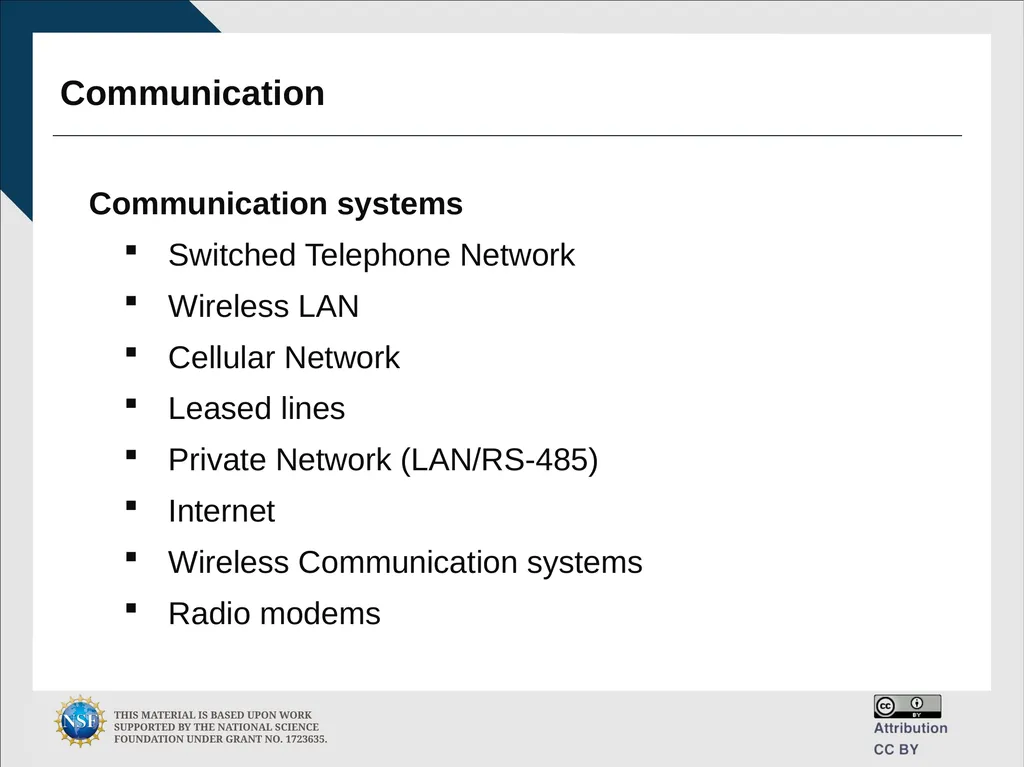
slide12. Communication Communication systems
Switched Telephone Network
Wireless LAN
Cellular Network
Leased lines
Private Network (LAN/RS-485)
Internet
Wireless Communication systems
Radio modems<br>
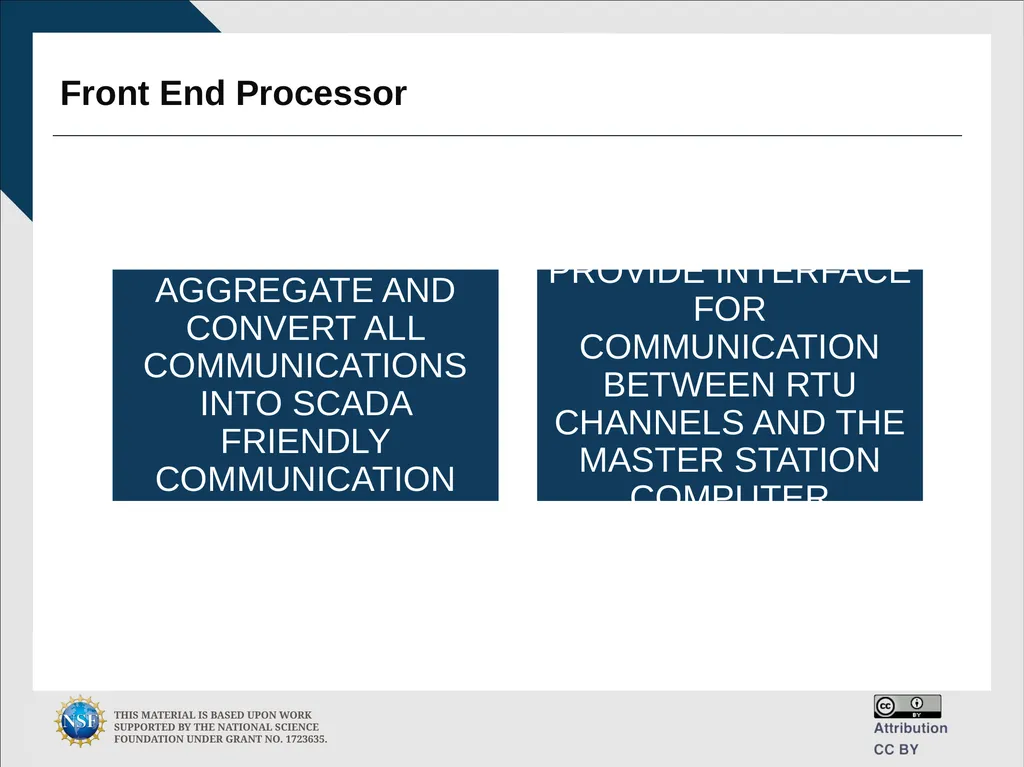
slide13. Front End Processor<br>
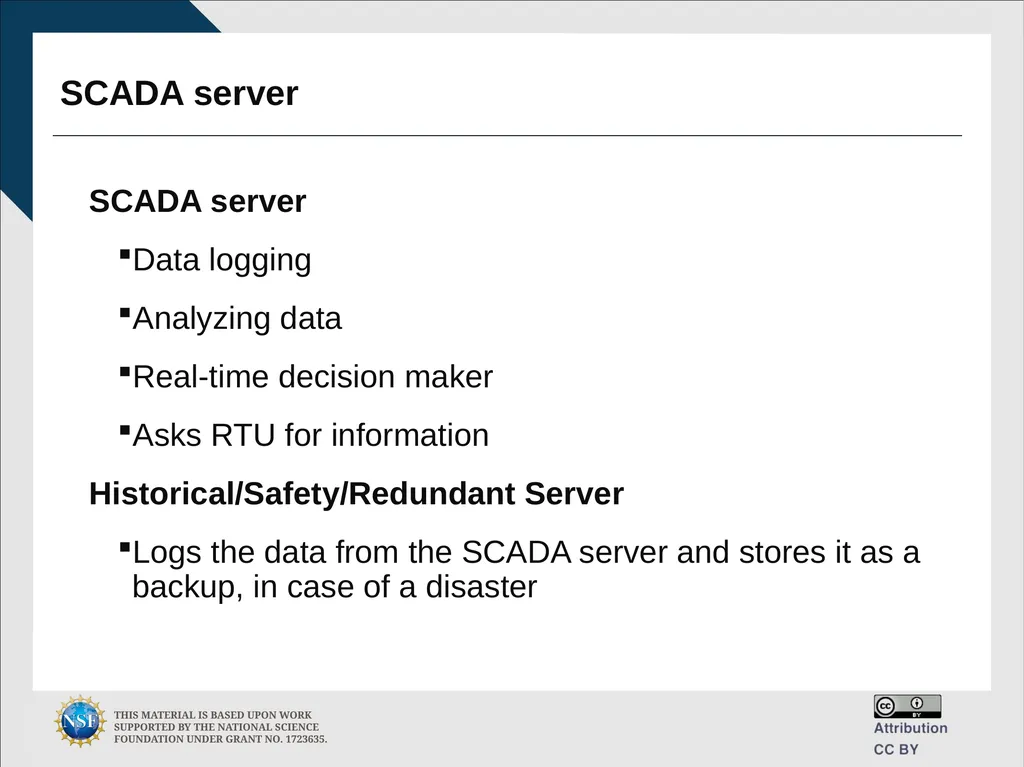
slide14. SCADA server SCADA server
Data logging
Analyzing data
Real-time decision maker
Asks RTU for information
Historical/Safety/Redundant Server
Logs the data from the SCADA server and stores it as a backup, in case of a disaster<br>
slide15. Cyber Vulnerabilities in Engineering Systems<br>
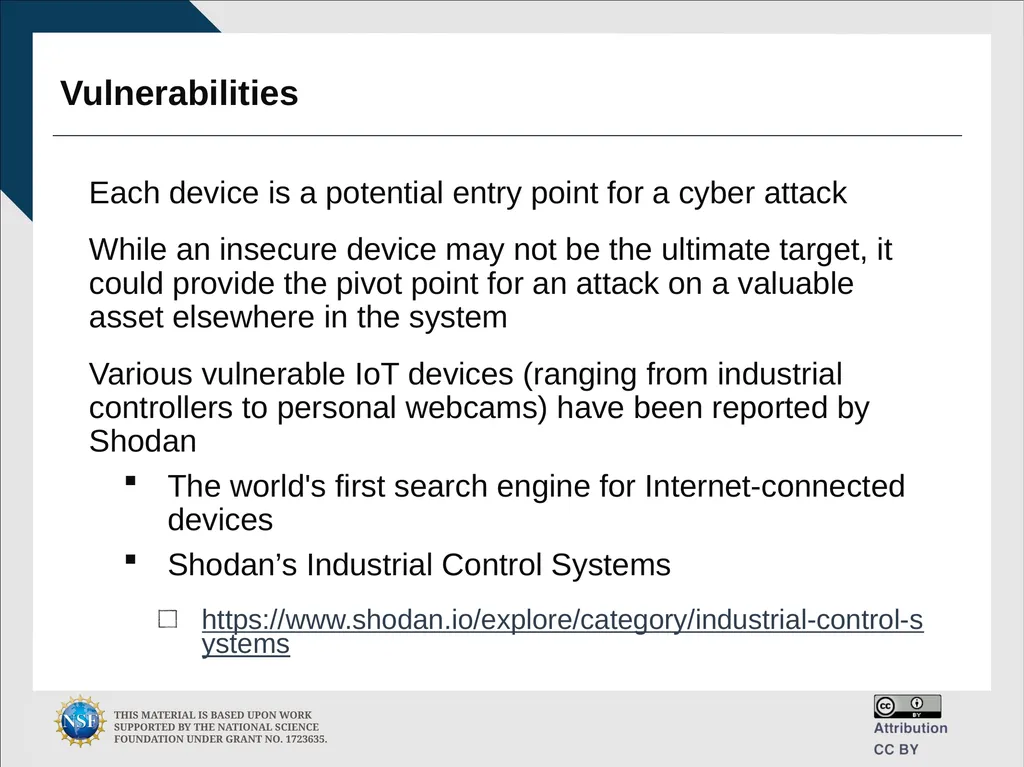
slide16. Vulnerabilities Each device is a potential entry point for a cyber attack
While an insecure device may not be the ultimate target, it could provide the pivot point for an attack on a valuable asset elsewhere in the system
Various vulnerable IoT devices (ranging from industrial controllers to personal webcams) have been reported by Shodan
The world's first search engine for Internet-connected devices
Shodan’s Industrial Control Systems
https://www.shodan.io/explore/category/industrial-control-systems<br>
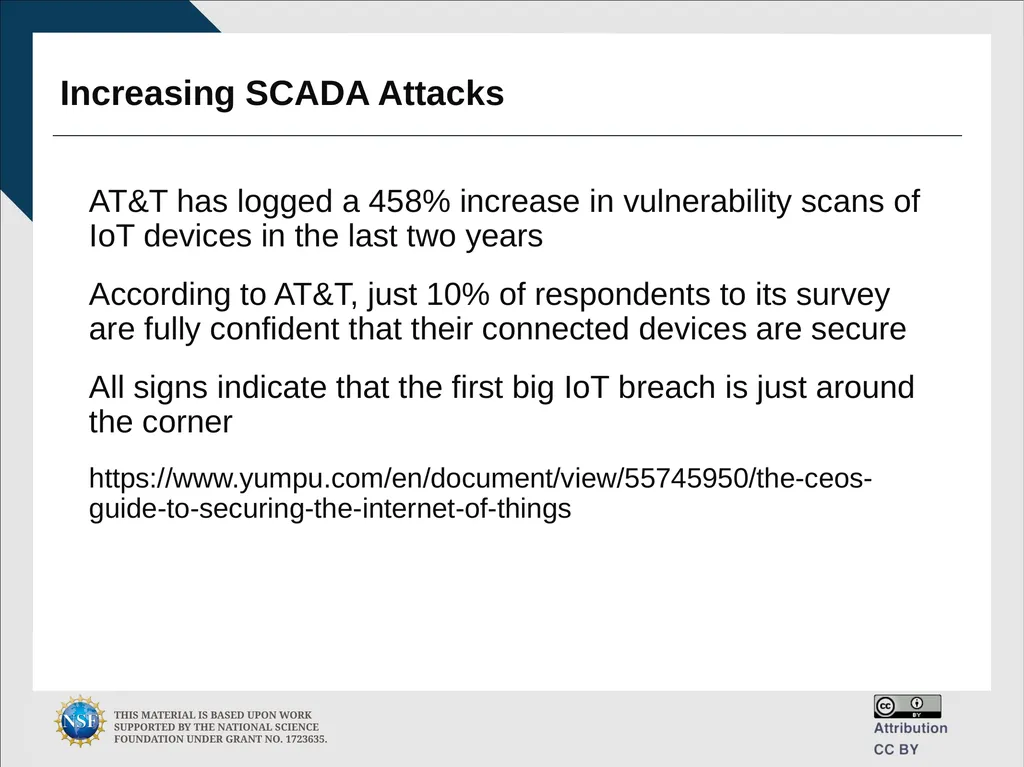
slide17. Increasing SCADA Attacks AT&T has logged a 458% increase in vulnerability scans of IoT devices in the last two years
According to AT&T, just 10% of respondents to its survey are fully confident that their connected devices are secure
All signs indicate that the first big IoT breach is just around the corner
https://www.yumpu.com/en/document/view/55745950/the-ceos-guide-to-securing-the-internet-of-things<br>
slide18. Cyber Attacks Examples in Engineering Systems Discussion on well known cyber attacks
(5 minutes)<br>
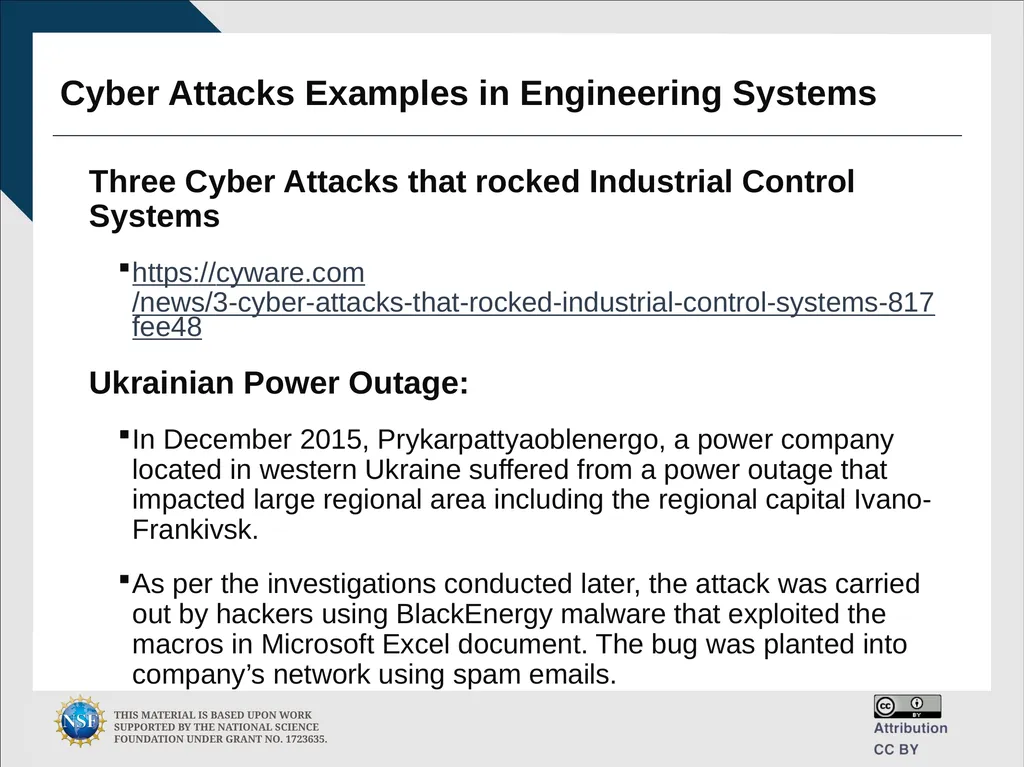
slide19. Cyber Attacks Examples in Engineering Systems Three Cyber Attacks that rocked Industrial Control Systems
https://cyware.com/news/3-cyber-attacks-that-rocked-industrial-control-systems-817fee48
Ukrainian Power Outage:
In December 2015, Prykarpattyaoblenergo, a power company located in western Ukraine suffered from a power outage that impacted large regional area including the regional capital Ivano-Frankivsk.
As per the investigations conducted later, the attack was carried out by hackers using BlackEnergy malware that exploited the macros in Microsoft Excel document. The bug was planted into company’s network using spam emails.<br>
slide20. Cyber Attacks Examples in Engineering Systems New York Dam attack:
On 03/24/2016, an Iranian hacker was publicly accused by the officials of Department of Justice.
The Justice Department claimed Iran had attacked U.S. infrastructure online, by infiltrating the computerized controls of a New York Dam, heralding a new way of war on American soil.
Hackers broke into the command and control system of the dam in 2013, apparently through a cellular modem.
This signals the desire of some foreign nations to infect, and operate, US infrastructure.
Although the attack happened in 2013, it was only in 2016 that the cyber-attack was affirmed and attributed to the hackers in Iran.<br>
slide21. Cyber Attacks Examples in Engineering Systems Operation Ghoul:
In August 2016, Kaspersky Labs unearthed a spear phishing campaign that was targeting industrial organizations in the Middle eastern countries. The series of attack under this spear phishing campaign were given the title “Operation Ghoul”.
The attack started with an email that appeared to be coming from a bank in UAE. It was a phishing email that was faking the credentials of the Emirate NBD bank.
The email was loaded with an infected attachment that contained HawkEye; a malware that would collect personal information through keystrokes, clipboard data etc.
As per Kaspersky Labs, at least 130 organizations were impacted by Operation Ghoul. The spread of targeted countries was from India to Spain.<br>
slide22. Security vulnerabilities Weak physical protection
Weak devices with limited computational power
Some devices might be antique
Remote devices are hard to upgrade
Challenge in password and key management
All traffic is on just one port
Few firewall options
Security for engineering cyber system is typically five to ten years behind<br>
slide23. Security Vulnerability (I) Engineering cyber systems are often physically distributed over large areas, making physical security a challenge
Discussion on easy access of various engineering cyber systems
Distributed power supple systems
Water supply systems
Transportation systems
Agriculture systems 23<br>
slide24. Security Vulnerability (II) Industrial cyber devices with embedded controllers tend to have limited computational power
Protocols tend to be simple
Many sensor and control data are still transmitted in plaintext
Extremely limited protection against a variety of attacks such as spoofing, replay, and denial of service 24<br>
slide25. Security Vulnerability (III) Industrial plants tend to be in long life cycle
Ten to twenty year project lives are common
Much longer than a typical personal computer (including smartphones) and enterprise computing devices (such as servers and workstations)
The industrial instruments may become virtual antiques by the time the facility is finally decommissioned
Difficult to patch or upgrade industrial devices in the way of maintaining our personal or office computers
Leaving opportunities to exploit vulnerabilities over time 25<br>
slide26. Security Vulnerability (IV) Many industrial devices use simple and shared passwords
The simple devices and the need for quick access and control
“Do you know the password to turn off the irrigation system? I forgot mine …”
Passwords are often the same for different devices
Large volume of devices
Very difficult to manage different passwords for different devices
Passwords for devices are not changed very often (if at all), even when operators have changed
Accountability is poor 26<br>
slide27. Security Vulnerability (IV) Discuss poor password
What password are strong
Test the strength of your password
kaspersky password check:
https://www.kaspersky.com/blog/password-check/ 27<br>
slide28. Security Vulnerability (IV) Advanced authentication methods
Simple static passwords
Two-factor authentication
Digital certificates
Biometrics
Providing the ability for users to authenticate an device and managing multiple users of a single device
Authentication in engineering cyber systems often are machine-to-machine based without any human intervention<br>
slide29. Security Vulnerability (V) ‘MISCONCEPTION: “The industrial cyber system resides on a physically separate, standalone network.” -- Understanding SCADA System Security Vulnerabilities ‘Most SCADA systems were originally built before and often separate from other corporate networks. As a result, IT managers typically operate on the assumption that these systems cannot be accessed through corporate networks or from remote access points. Unfortunately, this belief is usually fallacious.’
“Because SCADA devices with embedded controllers tend to have limited computational power, and were historically connected via low speed serial lines, SCADA protocols tend to be quite simple, with little or no protection against spoofing, replay attacks, or a variety of denial of service attacks” 29<br>
slide30. Security Vulnerability (VI) Ransomware:
Common Ransomware – Accidentally downloaded to an engineering workstation and spreads to rest of system
Targeted Ransomware – Spear-phishing seeds a Remote Access Trojan (RAT) on an IT network, which is used to deliberately spread ransomware through an industrial system
Zero-Day Ransomware – Ransomware incorporating a zero-day Windows exploit spreads through IT/OT firewalls 30<br>
slide31. Security Vulnerability (VII) Network security in engineering cyber system is challenging due to a wider range of protocols, standards, and device capabilities
Wifi — IEEE 802.11, IEEE 802.11 ah
Zigbee and Bluetooth Low Energy
WirelessHART
Z-Wave
RFID
LTE-A
LoRaWAN<br>
slide32. Security Vulnerability (VIII) Few firewall options
SCADA-protocol aware firewall choices are very limited
Critical control traffic may be impacted by accidental congestion and malicious attacks in a best effort network
Discuss example “Slammer worm crashed Ohio nuke plant network” 32<br>
slide33. Security and Privacy The good news is the underlying cybersecurity principles are well established
Much of what’s being faced in the engineering cyber world has already been well understood in the enterprise IT world
The fundamental challenge lies in how to implement them cost-effectively on resource-constrained and weakly protected IoT devices and make them scalable to a large number of IoT endpoints 33<br>
slide34. Exercise 1 Read the article entitled “Electric Grid Security and Resilience: Establishing a Baseline for Adversarial Threats”, https://www.energy.gov/sites/prod/files/2017/01/f34/Electric%20Grid%20Security%20and%20Resilience--Establishing%20a%20Baseline%20for%20Adversarial%20Threats.pdf
Questions: What are the major treats and risks in electrical grid systems?<br>
slide35. security design principles for engineering systems<br>
slide36. Information Security Fascination with keeping information secure
Need for protecting data is more pronounced than ever in the information era
Techniques for data protection
Cryptography: process of designing systems to do this
Cryptanalysis: deals with breaking such systems
Cryptology: all-inclusive term for the study of communication over nonsecure channels, and related problems<br>
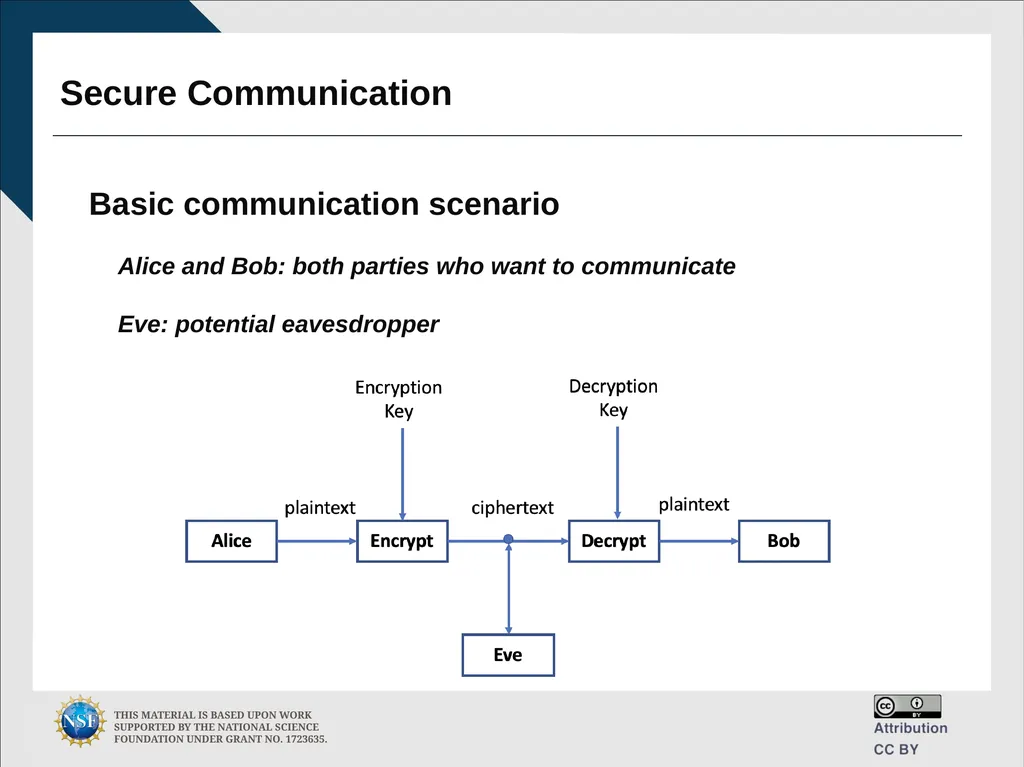
slide37. Secure Communication Basic communication scenario
Alice and Bob: both parties who want to communicate
Eve: potential eavesdropper<br>
slide38. Secure Communication Alice wants to send a message, called the plaintext, to Bob
She encrypts it using a method prearranged with Bob
Usually, the encryption method is assumed to be known to Eve; what keeps the message secret is a key
Bob receives the encrypted message, called the ciphertcxt
He changes it back to the plaintext using a decryption key<br>
slide39. Secure Communication Eve could have one of the following goals:
Read the message.
Find the key and thus read all messages encrypted with that key.
Corrupt Alice’s message into another message in such a way that Bob will think Alice sent the altered message.
Masquerade as Alice, and thus communicate with Bob even though Bob believes he is communicating with Alice.
Passive attack: (1) and (2) — Oscar
Active attack: (3) and (4) — Mallory
We'll generally use only Eve, and assume she is as bad as the situation allows.<br>
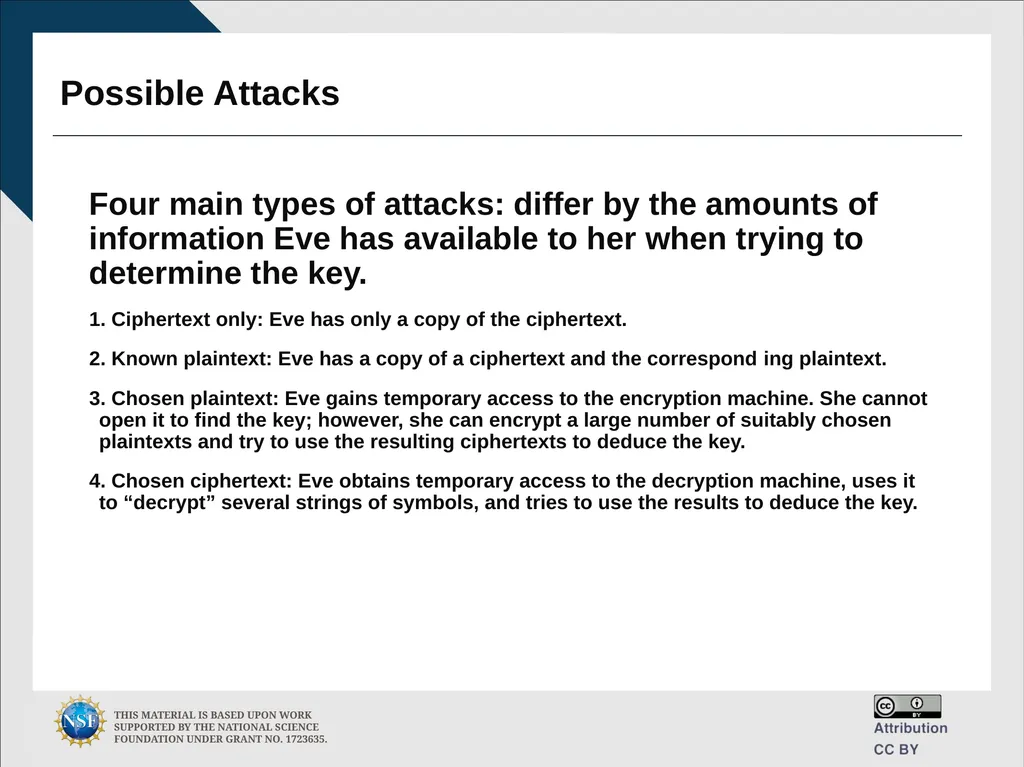
slide40. Possible Attacks Four main types of attacks: differ by the amounts of information Eve has available to her when trying to determine the key.
Ciphertext only: Eve has only a copy of the ciphertext.
Known plaintext: Eve has a copy of a ciphertext and the correspond ing plaintext.
Chosen plaintext: Eve gains temporary access to the encryption machine. She cannot open it to find the key; however, she can encrypt a large number of suitably chosen plaintexts and try to use the resulting ciphertexts to deduce the key.
Chosen ciphertext: Eve obtains temporary access to the decryption machine, uses it to “decrypt” several strings of symbols, and tries to use the results to deduce the key.<br>
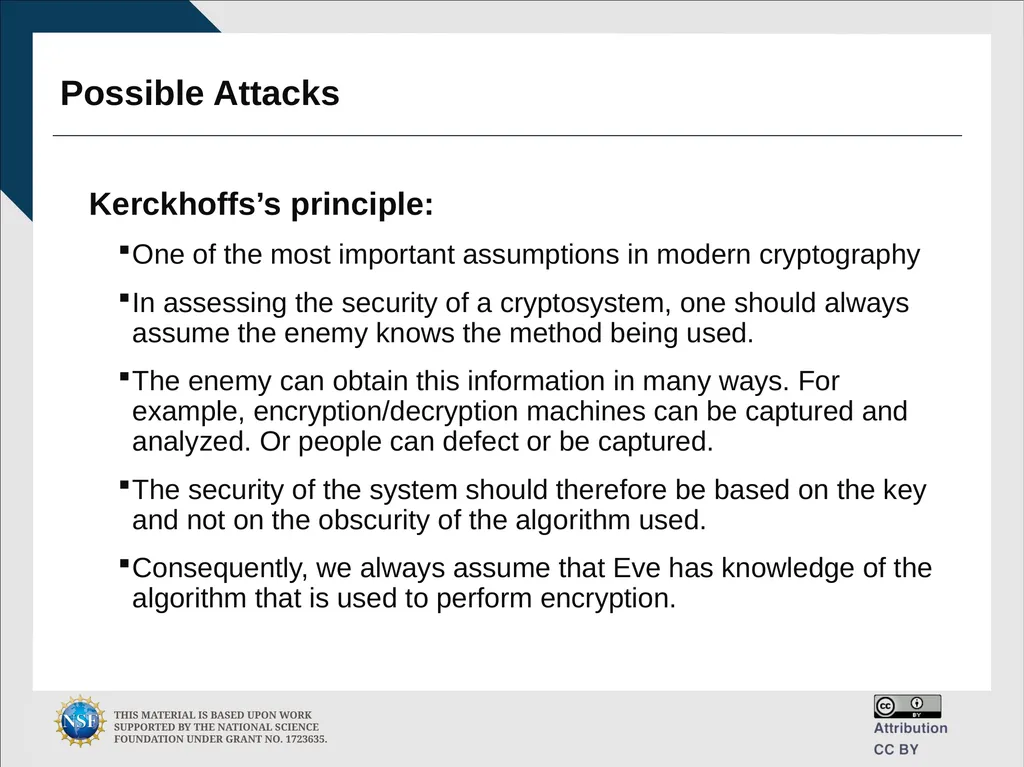
slide41. Possible Attacks Kerckhoffs’s principle:
One of the most important assumptions in modern cryptography
In assessing the security of a cryptosystem, one should always assume the enemy knows the method being used.
The enemy can obtain this information in many ways. For example, encryption/decryption machines can be captured and analyzed. Or people can defect or be captured.
The security of the system should therefore be based on the key and not on the obscurity of the algorithm used.
Consequently, we always assume that Eve has knowledge of the algorithm that is used to perform encryption.<br>
slide42. Encryption Algorithms Symmetric key algorithms:
Encryption/decryption keys known to both Alice and Bob, and are often the same
All of the classical (pre-1970) cryptosystems are symmetric, as are the more recent Data Encryption Standard (DES) and Advanced Encryption Standard (AES).<br>
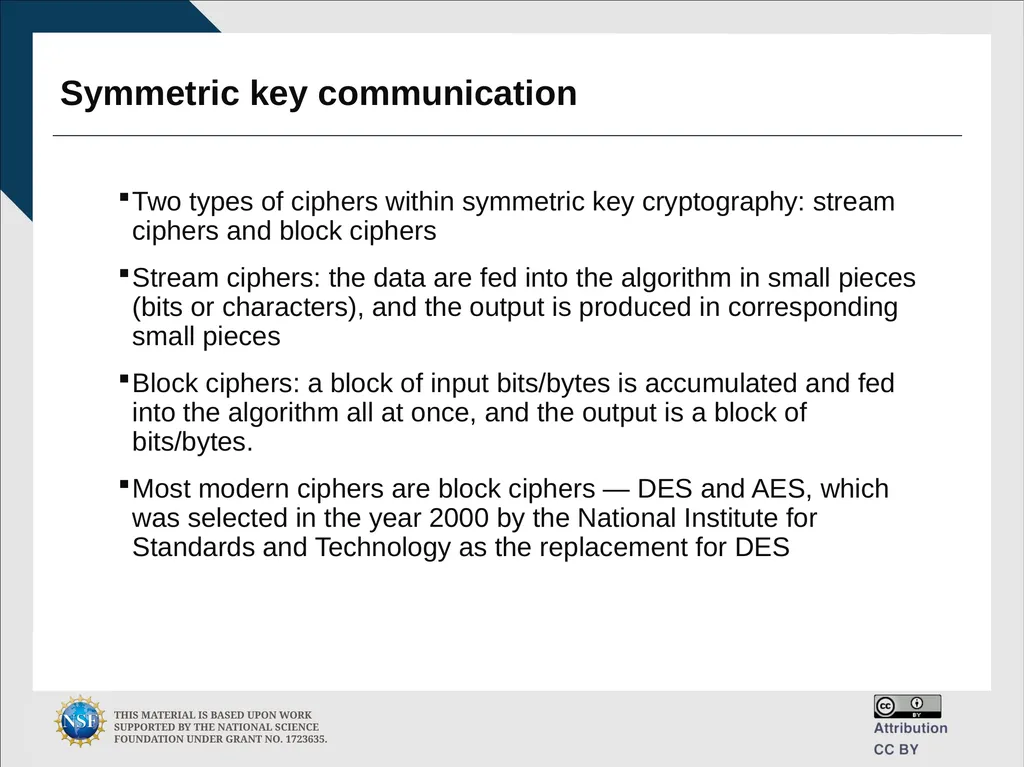
slide43. Symmetric key communication Two types of ciphers within symmetric key cryptography: stream ciphers and block ciphers
Stream ciphers: the data are fed into the algorithm in small pieces (bits or characters), and the output is produced in corresponding small pieces
Block ciphers: a block of input bits/bytes is accumulated and fed into the algorithm all at once, and the output is a block of bits/bytes.
Most modern ciphers are block ciphers — DES and AES, which was selected in the year 2000 by the National Institute for Standards and Technology as the replacement for DES<br>
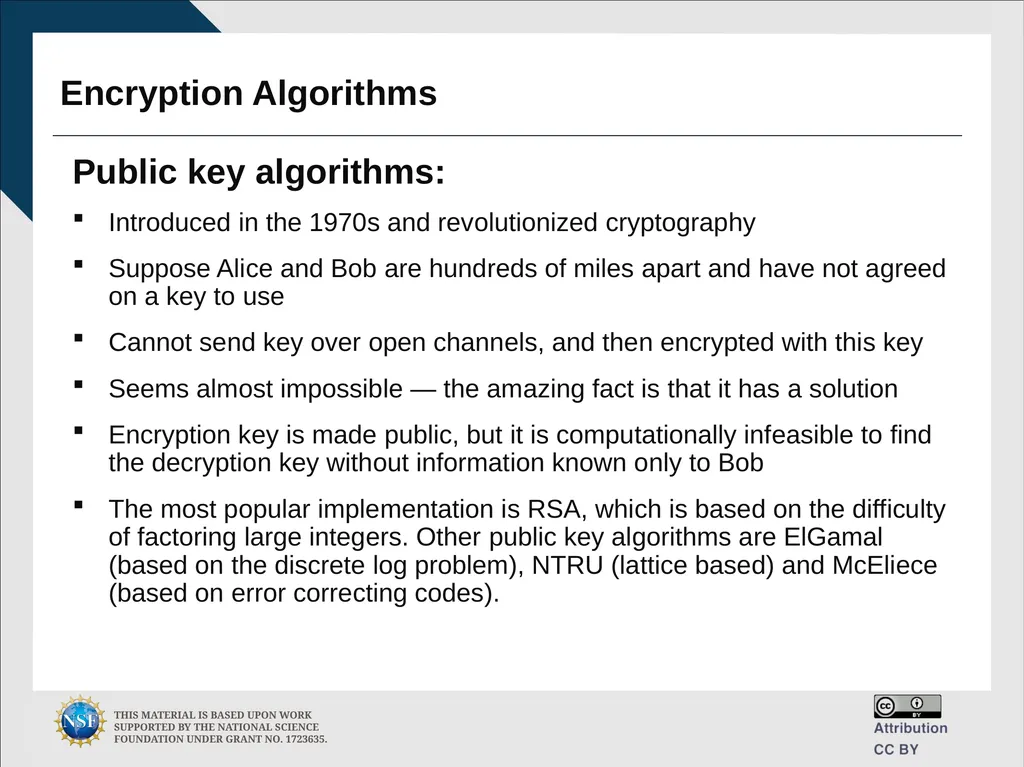
slide44. Encryption Algorithms Public key algorithms:
Introduced in the 1970s and revolutionized cryptography
Suppose Alice and Bob are hundreds of miles apart and have not agreed on a key to use
Cannot send key over open channels, and then encrypted with this key
Seems almost impossible — the amazing fact is that it has a solution
Encryption key is made public, but it is computationally infeasible to find the decryption key without information known only to Bob
The most popular implementation is RSA, which is based on the difficulty of factoring large integers. Other public key algorithms are ElGamal (based on the discrete log problem), NTRU (lattice based) and McEliece (based on error correcting codes).<br>
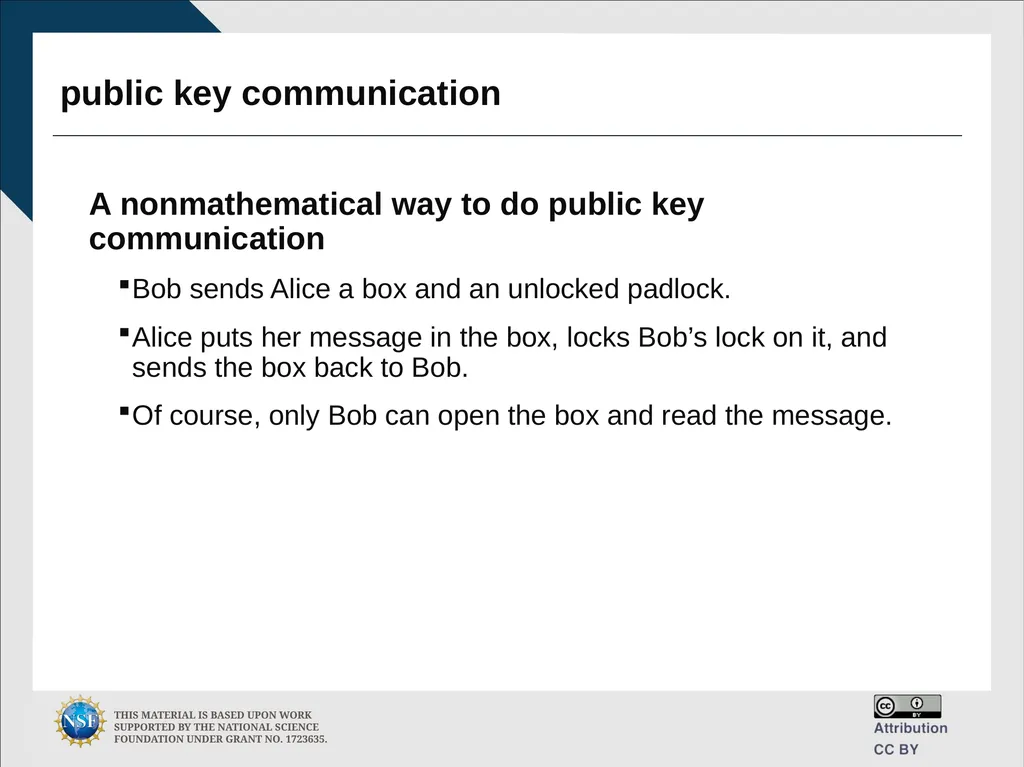
slide45. public key communication A nonmathematical way to do public key communication
Bob sends Alice a box and an unlocked padlock.
Alice puts her message in the box, locks Bob’s lock on it, and sends the box back to Bob.
Of course, only Bob can open the box and read the message.<br>
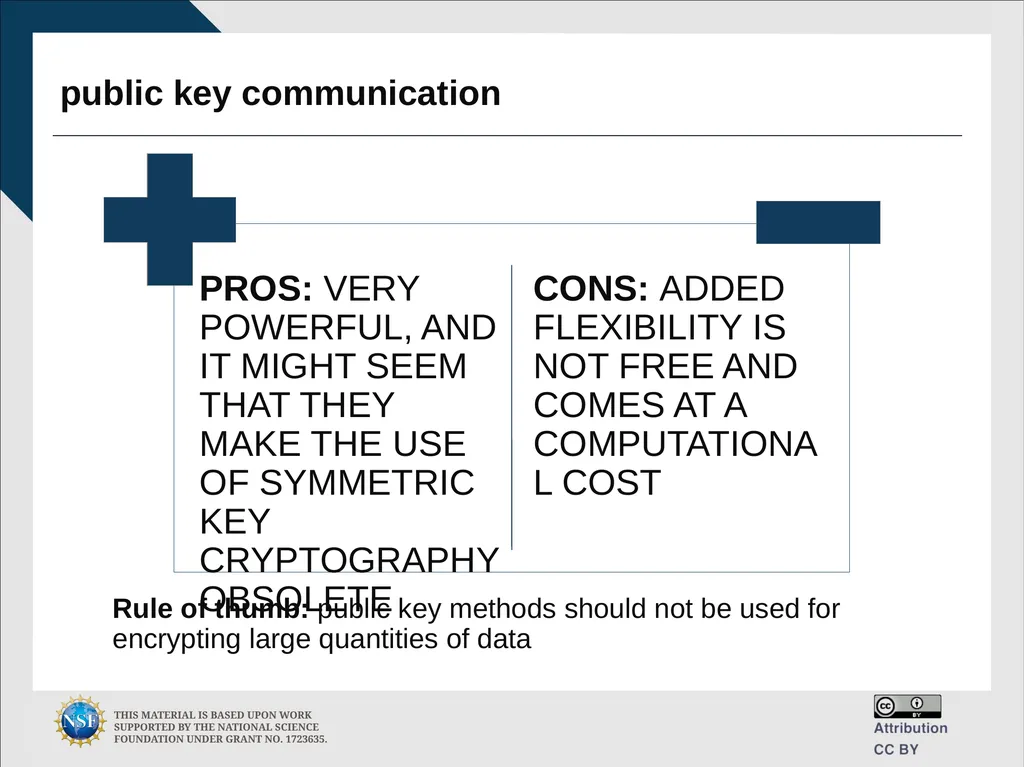
slide46. public key communication Rule of thumb: public key methods should not be used for encrypting large quantities of data<br>
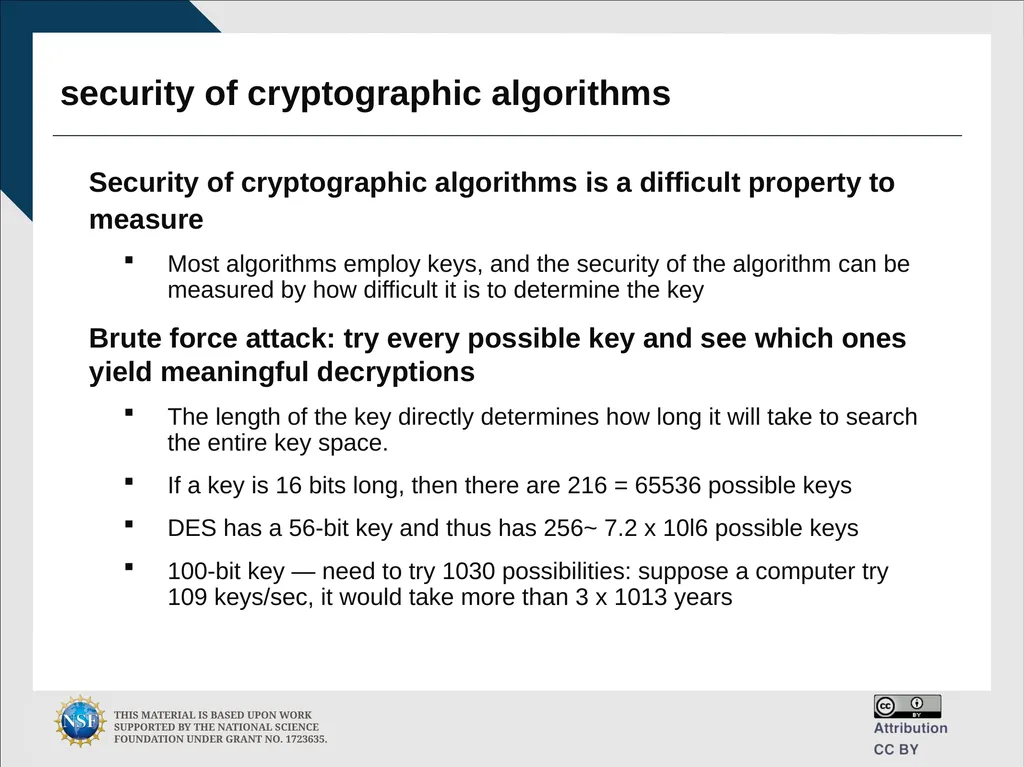
slide47. security of cryptographic algorithms Security of cryptographic algorithms is a difficult property to measure
Most algorithms employ keys, and the security of the algorithm can be measured by how difficult it is to determine the key
Brute force attack: try every possible key and see which ones yield meaningful decryptions
The length of the key directly determines how long it will take to search the entire key space.
If a key is 16 bits long, then there are 216 = 65536 possible keys
DES has a 56-bit key and thus has 256~ 7.2 x 10l6 possible keys
100-bit key — need to try 1030 possibilities: suppose a computer try 109 keys/sec, it would take more than 3 x 10¹³ years<br>
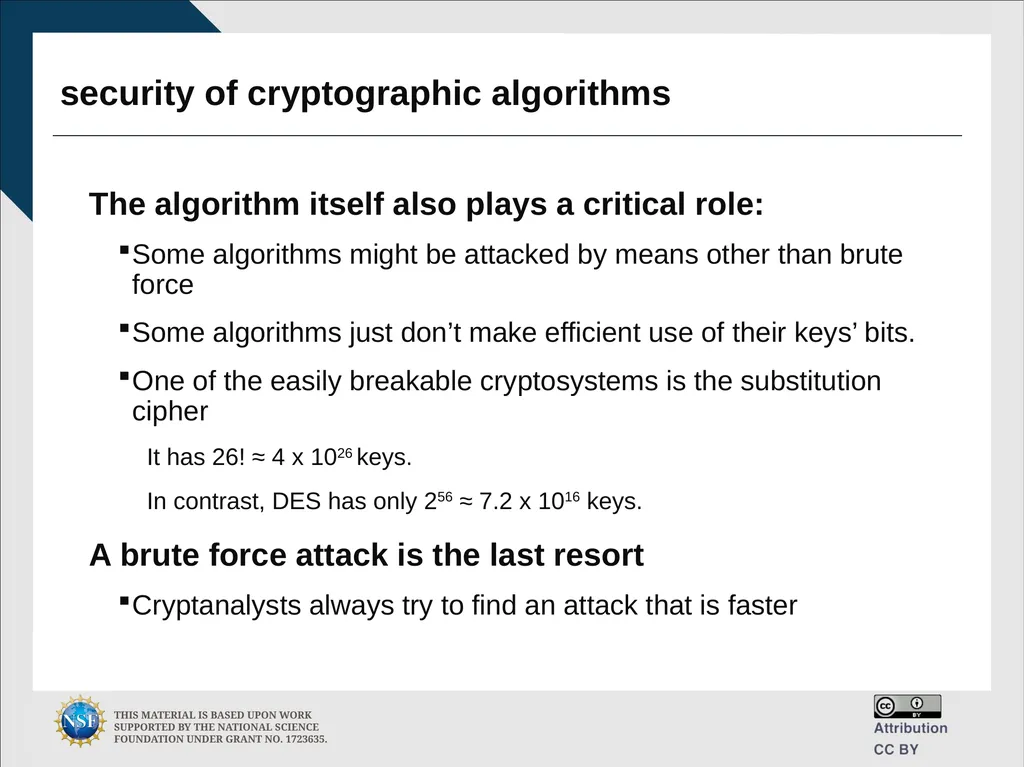
slide48. security of cryptographic algorithms The algorithm itself also plays a critical role:
Some algorithms might be attacked by means other than brute force
Some algorithms just don’t make efficient use of their keys’ bits.
One of the easily breakable cryptosystems is the substitution cipher
It has 26! ≈ 4 x 1026 keys.
In contrast, DES has only 256 ≈ 7.2 x 10¹⁶ keys.
A brute force attack is the last resort
Cryptanalysts always try to find an attack that is faster<br>
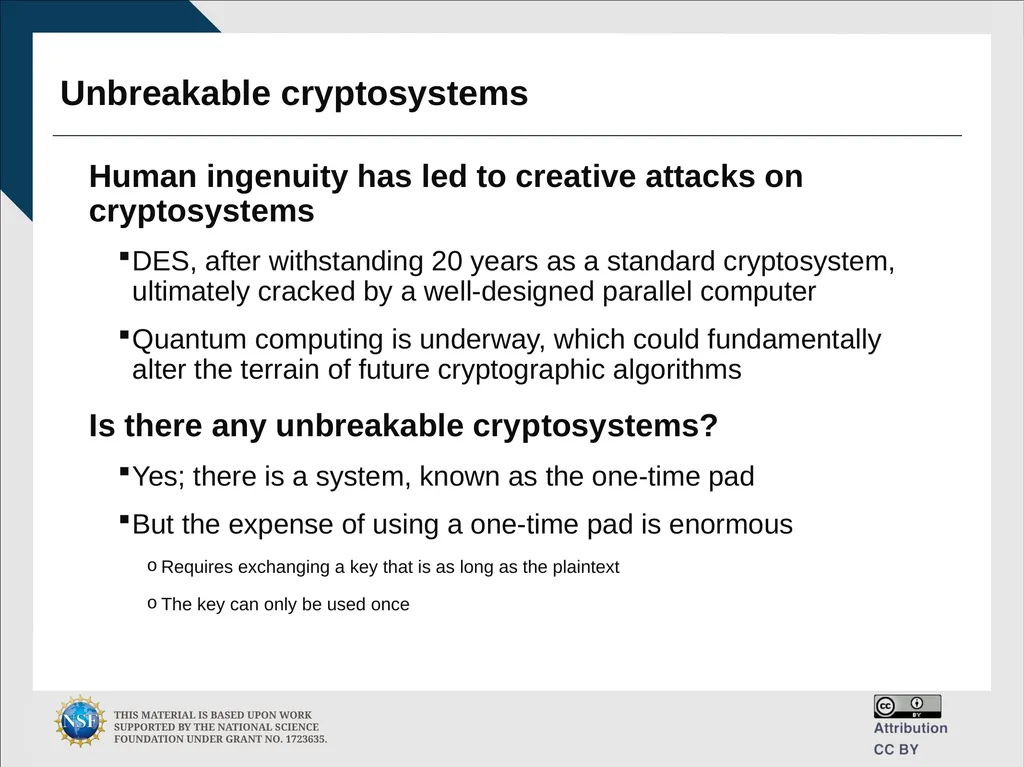
slide49. Unbreakable cryptosystems Human ingenuity has led to creative attacks on cryptosystems
DES, after withstanding 20 years as a standard cryptosystem, ultimately cracked by a well-designed parallel computer
Quantum computing is underway, which could fundamentally alter the terrain of future cryptographic algorithms
Is there any unbreakable cryptosystems?
Yes; there is a system, known as the one-time pad
But the expense of using a one-time pad is enormous
Requires exchanging a key that is as long as the plaintext
The key can only be used once<br>
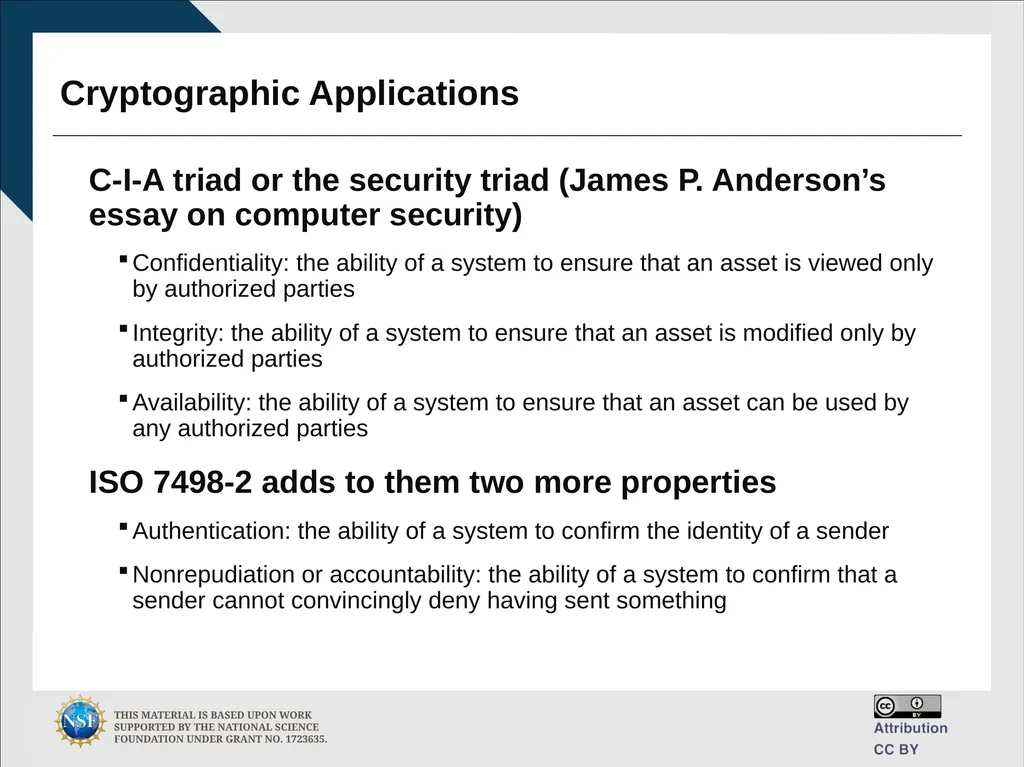
slide50. Cryptographic Applications C-I-A triad or the security triad (James P. Anderson’s essay on computer security)
Confidentiality: the ability of a system to ensure that an asset is viewed only by authorized parties
Integrity: the ability of a system to ensure that an asset is modified only by authorized parties
Availability: the ability of a system to ensure that an asset can be used by any authorized parties
ISO 7498-2 adds to them two more properties
Authentication: the ability of a system to confirm the identity of a sender
Nonrepudiation or accountability: the ability of a system to confirm that a sender cannot convincingly deny having sent something<br>
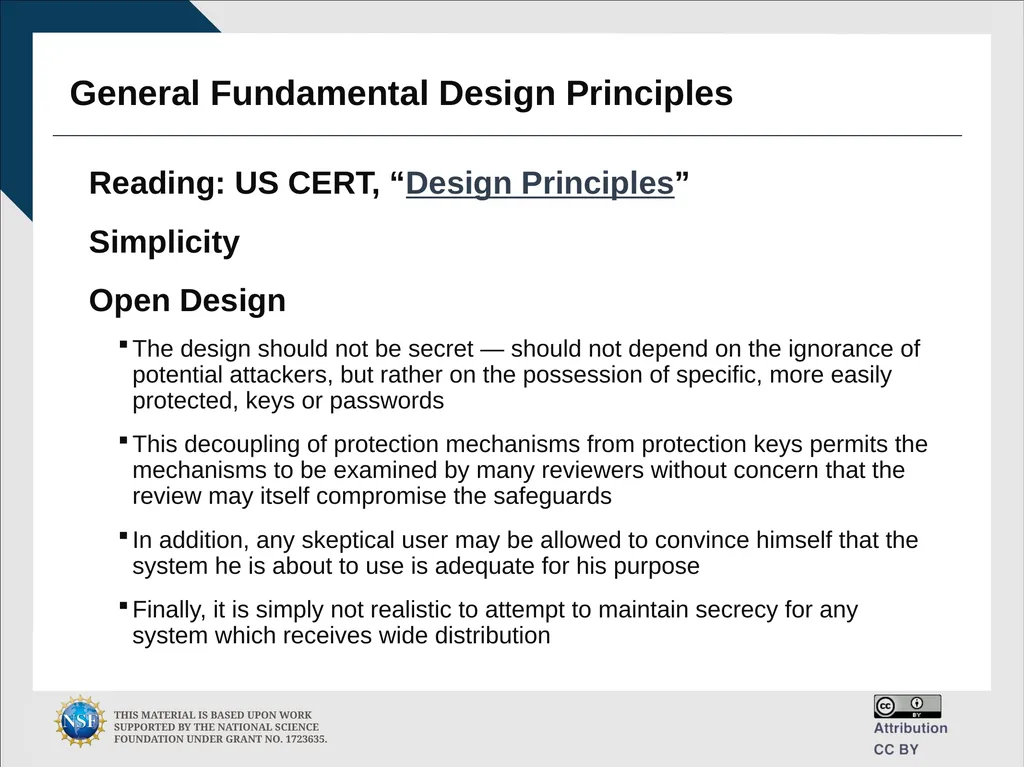
slide51. General Fundamental Design Principles Reading: US CERT, “Design Principles”
Simplicity
Open Design
The design should not be secret — should not depend on the ignorance of potential attackers, but rather on the possession of specific, more easily protected, keys or passwords
This decoupling of protection mechanisms from protection keys permits the mechanisms to be examined by many reviewers without concern that the review may itself compromise the safeguards
In addition, any skeptical user may be allowed to convince himself that the system he is about to use is adequate for his purpose
Finally, it is simply not realistic to attempt to maintain secrecy for any system which receives wide distribution<br>
slide52. General Fundamental Design Principles Design for Iteration
Assume you will make errors
Because the designer must assume that the design itself will contain flaws, the designer must be prepared to iterate the design
When a security hole is discovered, the designer must review the assumptions, if necessary adjust them, and repair the design
When a designer discovers an error in the system, the designer must reiterate the whole design and implementation process<br>
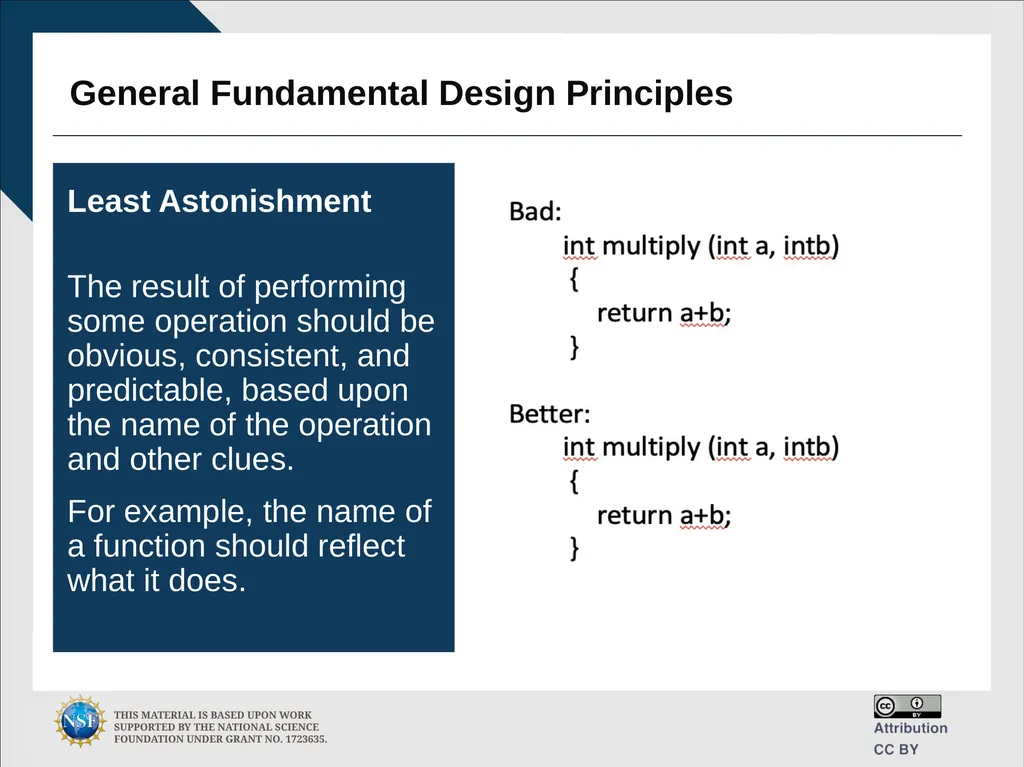
slide53. General Fundamental Design Principles Least Astonishment
The result of performing some operation should be obvious, consistent, and predictable, based upon the name of the operation and other clues.
For example, the name of a function should reflect what it does.<br>
slide54. Security Design Principles Minimize Secrets:
Because they probably won’t remain secret for long
Complete Mediation:
Check every operation for authenticity, integrity, and authorization
Fail-safe default:
Most users won’t change them, so set defaults to do something safe
Example: default passwords
Least privilege principle:
Every module must be able to access only the information and resources that are necessary for its legitimate purpose<br>
slide55. Security Design Principles Economy of mechanism:
Security mechanisms should be as simple as possible
The less there is, the more likely you will get it right
Example: in-class discussion<br>
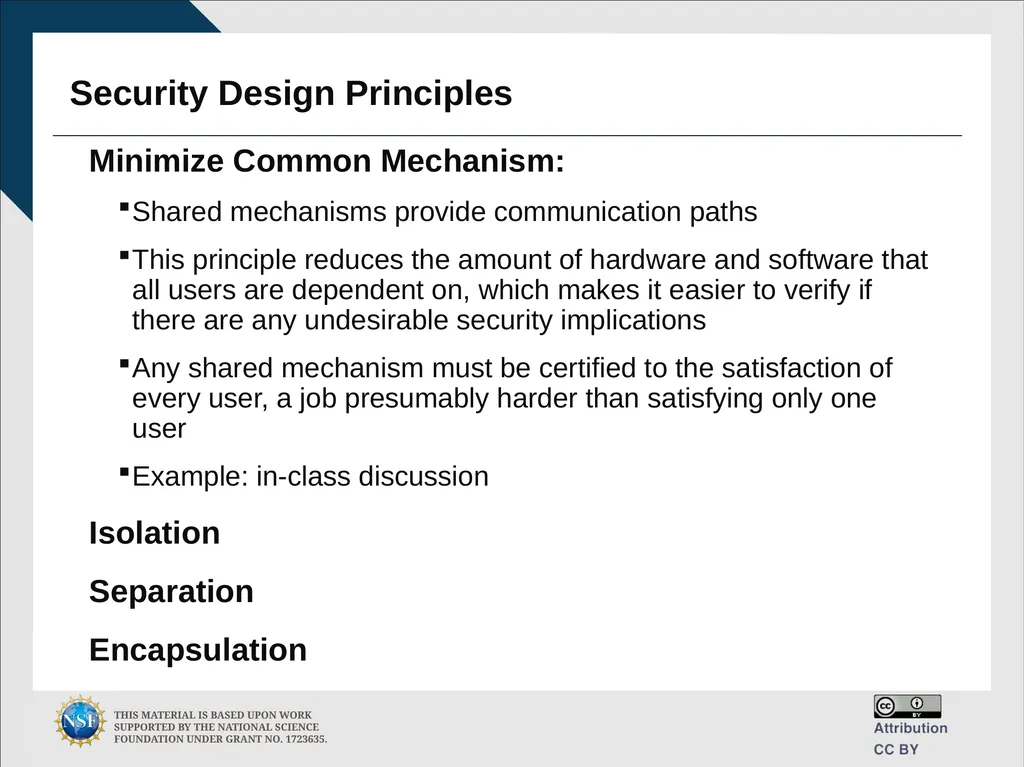
slide56. Security Design Principles Minimize Common Mechanism:
Shared mechanisms provide communication paths
This principle reduces the amount of hardware and software that all users are dependent on, which makes it easier to verify if there are any undesirable security implications
Any shared mechanism must be certified to the satisfaction of every user, a job presumably harder than satisfying only one user
Example: in-class discussion
Isolation
Separation
Encapsulation<br>
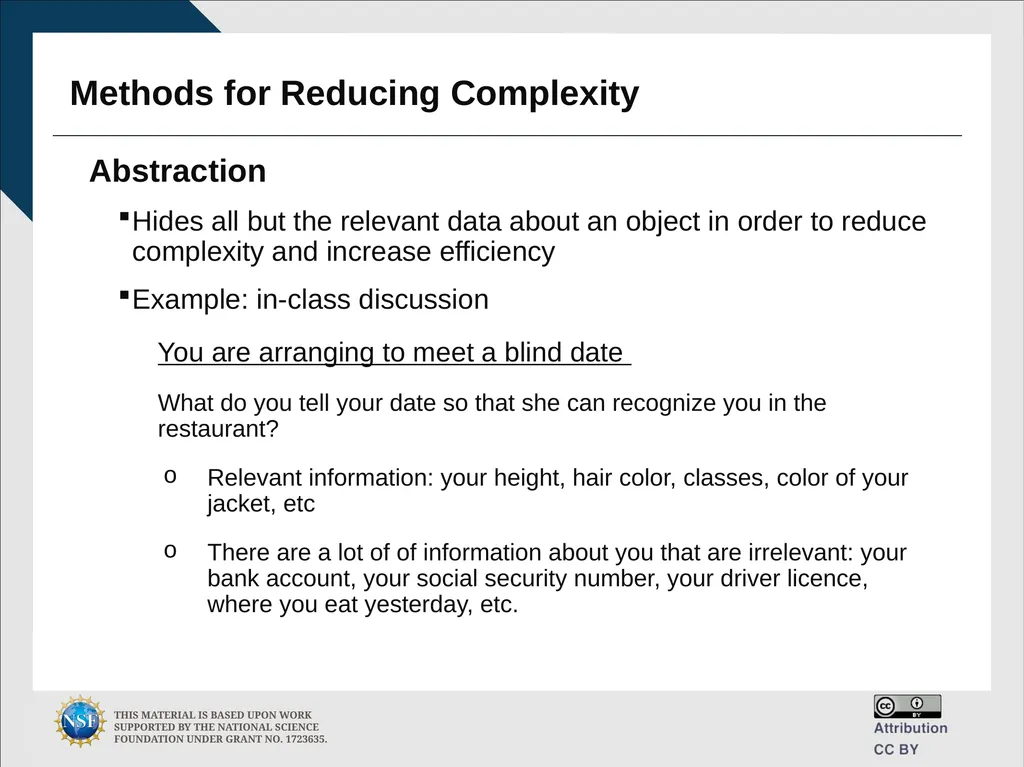
slide57. Methods for Reducing Complexity Abstraction
Hides all but the relevant data about an object in order to reduce complexity and increase efficiency
Example: in-class discussion
You are arranging to meet a blind date
What do you tell your date so that she can recognize you in the restaurant?
Relevant information: your height, hair color, classes, color of your jacket, etc
There are a lot of of information about you that are irrelevant: your bank account, your social security number, your driver licence, where you eat yesterday, etc.<br>
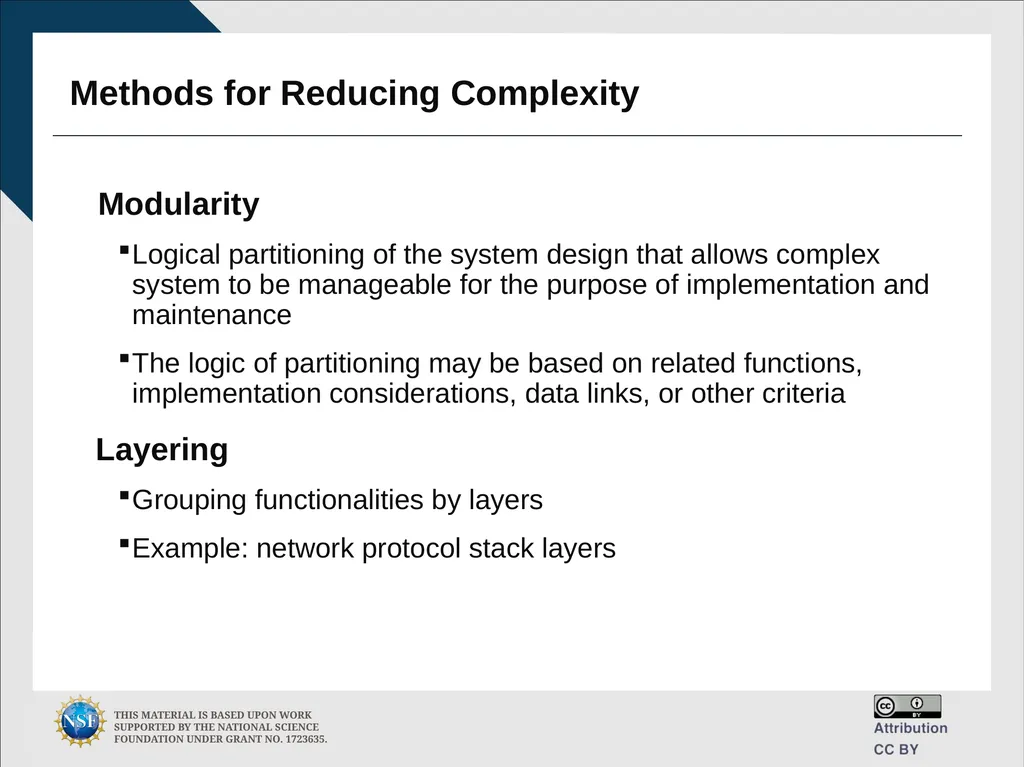
slide58. Methods for Reducing Complexity Modularity
Logical partitioning of the system design that allows complex system to be manageable for the purpose of implementation and maintenance
The logic of partitioning may be based on related functions, implementation considerations, data links, or other criteria
Layering
Grouping functionalities by layers
Example: network protocol stack layers<br>
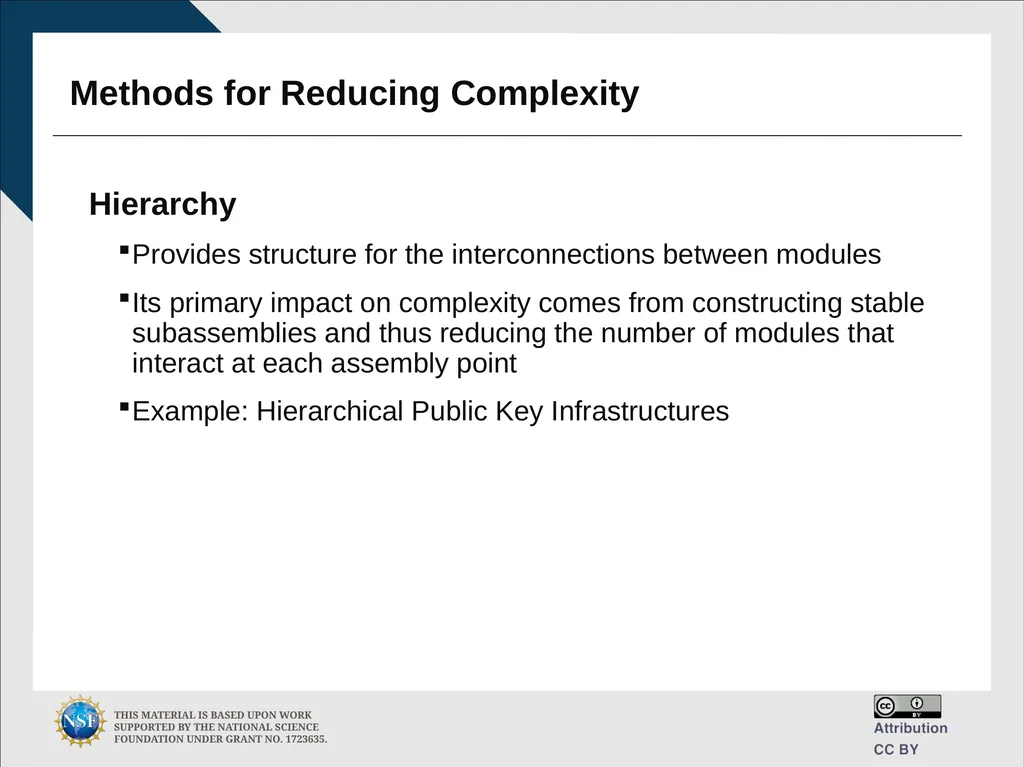
slide59. Methods for Reducing Complexity Hierarchy
Provides structure for the interconnections between modules
Its primary impact on complexity comes from constructing stable subassemblies and thus reducing the number of modules that interact at each assembly point
Example: Hierarchical Public Key Infrastructures<br>
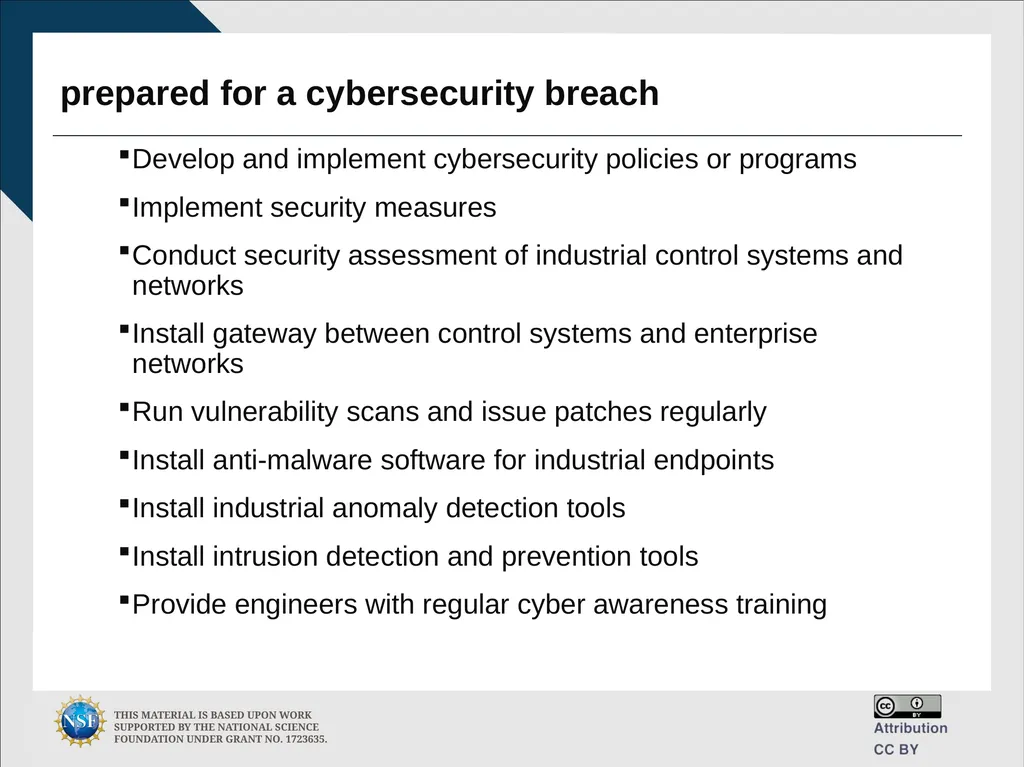
slide60. prepared for a cybersecurity breach Develop and implement cybersecurity policies or programs
Implement security measures
Conduct security assessment of industrial control systems and networks
Install gateway between control systems and enterprise networks
Run vulnerability scans and issue patches regularly
Install anti-malware software for industrial endpoints
Install industrial anomaly detection tools
Install intrusion detection and prevention tools
Provide engineers with regular cyber awareness training<br>
slide61. Exercise 2 Read the article entitled “The State of Industrial Cybersecurity 2017,” https://go.kaspersky.com/rs/802-IJN-240/images/ICS%20WHITE%20PAPER.pdf Questions:
What are the major treats and risks in industrial cyber systems?
What can we do to mitigate the risks in engineering cyber systems?<br>
Director, Center for Cybersecurity Education and Research Old Dominion University
Norfolk, VA<br>
slide2. Engineering and Cybersecurity After completing this module, students will be able to:
Discuss the impact of cyber technology on engineering systems
Identify common vulnerabilities in engineering cyber systems
Discuss the impact of cyber attacks on engineering systems
Describe fundamental design principles for securing engineering cyber systems<br>
slide3. cyber technologies in engineering systems<br>
slide4. Industrial Cyber Systems Industry 4.0: a rapid transformation of industry
the virtual world of information technology, the physical world of machines, and the Internet have become one
Benefits
Improved machine intelligence
More automated processes and real-time self-monitoring
Optimized performance and improved flexibility and speed
Enabling more individualized products
Efficient and scalable production<br>
slide5. SCADA vs. DCS Supervisory control and data acquisition (SCADA) System: a system of software and hardware elements that allows industrial organizations to:
Monitor, collect, process and log data in real-time
Control industrial processes at local or remote sites
Interact with sensors and actuators through human-machine interface (HMI)
https://youtu.be/QvdUnFzTcnY DCS ("Distributed Control Systems”): providing sophisticated analog (e.g. loop) control capability
https://electrical-engineering-portal.com/scada-dcs-plc-rtu-smart-instrument SCADA and DCS started As separate systems but have grown together<br>
slide6. Elements of SCADA<br>
slide7. Sensors Types of sensors:
Pressure sensors, differential pressure sensors
Water level sensors, depth sensors, flow meters
Temperature sensors
Light sensors
Humidity sensors
Wind speed sensors
Sand sensors
Distance sensors<br>
slide8. Actuators Types of actuators:
Valves
Pumps
Motors
Air compressors and blowers;
Mixers
Other machinery Types of alarms:
Good alarms
Critical failure alarms<br>
slide9. RTU RTU – “Remote Terminal Unit” or “Remote Telemetry Units”
A standalone data acquisition and control unit
An electronic device with intelligent microprocessor
Request the field devices (e.g., sensors) for information
Control intelligent electronic device (IEDs)
Data/event logging and alarm handling
Individual RTU expandability: typically up to 200 analog and digital points<br>
slide10. PLC PLC – Programmable Logic Controller
Industrial digital computer that replaced traditional relays
Used to implement SCADA RTU
Control manufacturing processes: assembly lines, smart devices
Ease of programming and fault diagnosis
Communication compatibilities
Takes actions based on inputs
https://youtu.be/qeBAz_XXUWs
https://youtu.be/4EQtCSrKjLs<br>
slide11. PLC References PLC Training Simulator
http://www.thelearningpit.com/plc/psim/psim.html
i-TRiLOGI
http://www.triplc.com/trilogi.htm
EasyPLC
http://www.nirtec.com/ Ref: http://www.rtaautomation.com/iec61131-3/ http://www.dogwoodvalleypress.com/uploads/excerpts/03192005214421.pdf<br>
slide12. Communication Communication systems
Switched Telephone Network
Wireless LAN
Cellular Network
Leased lines
Private Network (LAN/RS-485)
Internet
Wireless Communication systems
Radio modems<br>
slide13. Front End Processor<br>
slide14. SCADA server SCADA server
Data logging
Analyzing data
Real-time decision maker
Asks RTU for information
Historical/Safety/Redundant Server
Logs the data from the SCADA server and stores it as a backup, in case of a disaster<br>
slide15. Cyber Vulnerabilities in Engineering Systems<br>
slide16. Vulnerabilities Each device is a potential entry point for a cyber attack
While an insecure device may not be the ultimate target, it could provide the pivot point for an attack on a valuable asset elsewhere in the system
Various vulnerable IoT devices (ranging from industrial controllers to personal webcams) have been reported by Shodan
The world's first search engine for Internet-connected devices
Shodan’s Industrial Control Systems
https://www.shodan.io/explore/category/industrial-control-systems<br>
slide17. Increasing SCADA Attacks AT&T has logged a 458% increase in vulnerability scans of IoT devices in the last two years
According to AT&T, just 10% of respondents to its survey are fully confident that their connected devices are secure
All signs indicate that the first big IoT breach is just around the corner
https://www.yumpu.com/en/document/view/55745950/the-ceos-guide-to-securing-the-internet-of-things<br>
slide18. Cyber Attacks Examples in Engineering Systems Discussion on well known cyber attacks
(5 minutes)<br>
slide19. Cyber Attacks Examples in Engineering Systems Three Cyber Attacks that rocked Industrial Control Systems
https://cyware.com/news/3-cyber-attacks-that-rocked-industrial-control-systems-817fee48
Ukrainian Power Outage:
In December 2015, Prykarpattyaoblenergo, a power company located in western Ukraine suffered from a power outage that impacted large regional area including the regional capital Ivano-Frankivsk.
As per the investigations conducted later, the attack was carried out by hackers using BlackEnergy malware that exploited the macros in Microsoft Excel document. The bug was planted into company’s network using spam emails.<br>
slide20. Cyber Attacks Examples in Engineering Systems New York Dam attack:
On 03/24/2016, an Iranian hacker was publicly accused by the officials of Department of Justice.
The Justice Department claimed Iran had attacked U.S. infrastructure online, by infiltrating the computerized controls of a New York Dam, heralding a new way of war on American soil.
Hackers broke into the command and control system of the dam in 2013, apparently through a cellular modem.
This signals the desire of some foreign nations to infect, and operate, US infrastructure.
Although the attack happened in 2013, it was only in 2016 that the cyber-attack was affirmed and attributed to the hackers in Iran.<br>
slide21. Cyber Attacks Examples in Engineering Systems Operation Ghoul:
In August 2016, Kaspersky Labs unearthed a spear phishing campaign that was targeting industrial organizations in the Middle eastern countries. The series of attack under this spear phishing campaign were given the title “Operation Ghoul”.
The attack started with an email that appeared to be coming from a bank in UAE. It was a phishing email that was faking the credentials of the Emirate NBD bank.
The email was loaded with an infected attachment that contained HawkEye; a malware that would collect personal information through keystrokes, clipboard data etc.
As per Kaspersky Labs, at least 130 organizations were impacted by Operation Ghoul. The spread of targeted countries was from India to Spain.<br>
slide22. Security vulnerabilities Weak physical protection
Weak devices with limited computational power
Some devices might be antique
Remote devices are hard to upgrade
Challenge in password and key management
All traffic is on just one port
Few firewall options
Security for engineering cyber system is typically five to ten years behind<br>
slide23. Security Vulnerability (I) Engineering cyber systems are often physically distributed over large areas, making physical security a challenge
Discussion on easy access of various engineering cyber systems
Distributed power supple systems
Water supply systems
Transportation systems
Agriculture systems 23<br>
slide24. Security Vulnerability (II) Industrial cyber devices with embedded controllers tend to have limited computational power
Protocols tend to be simple
Many sensor and control data are still transmitted in plaintext
Extremely limited protection against a variety of attacks such as spoofing, replay, and denial of service 24<br>
slide25. Security Vulnerability (III) Industrial plants tend to be in long life cycle
Ten to twenty year project lives are common
Much longer than a typical personal computer (including smartphones) and enterprise computing devices (such as servers and workstations)
The industrial instruments may become virtual antiques by the time the facility is finally decommissioned
Difficult to patch or upgrade industrial devices in the way of maintaining our personal or office computers
Leaving opportunities to exploit vulnerabilities over time 25<br>
slide26. Security Vulnerability (IV) Many industrial devices use simple and shared passwords
The simple devices and the need for quick access and control
“Do you know the password to turn off the irrigation system? I forgot mine …”
Passwords are often the same for different devices
Large volume of devices
Very difficult to manage different passwords for different devices
Passwords for devices are not changed very often (if at all), even when operators have changed
Accountability is poor 26<br>
slide27. Security Vulnerability (IV) Discuss poor password
What password are strong
Test the strength of your password
kaspersky password check:
https://www.kaspersky.com/blog/password-check/ 27<br>
slide28. Security Vulnerability (IV) Advanced authentication methods
Simple static passwords
Two-factor authentication
Digital certificates
Biometrics
Providing the ability for users to authenticate an device and managing multiple users of a single device
Authentication in engineering cyber systems often are machine-to-machine based without any human intervention<br>
slide29. Security Vulnerability (V) ‘MISCONCEPTION: “The industrial cyber system resides on a physically separate, standalone network.” -- Understanding SCADA System Security Vulnerabilities ‘Most SCADA systems were originally built before and often separate from other corporate networks. As a result, IT managers typically operate on the assumption that these systems cannot be accessed through corporate networks or from remote access points. Unfortunately, this belief is usually fallacious.’
“Because SCADA devices with embedded controllers tend to have limited computational power, and were historically connected via low speed serial lines, SCADA protocols tend to be quite simple, with little or no protection against spoofing, replay attacks, or a variety of denial of service attacks” 29<br>
slide30. Security Vulnerability (VI) Ransomware:
Common Ransomware – Accidentally downloaded to an engineering workstation and spreads to rest of system
Targeted Ransomware – Spear-phishing seeds a Remote Access Trojan (RAT) on an IT network, which is used to deliberately spread ransomware through an industrial system
Zero-Day Ransomware – Ransomware incorporating a zero-day Windows exploit spreads through IT/OT firewalls 30<br>
slide31. Security Vulnerability (VII) Network security in engineering cyber system is challenging due to a wider range of protocols, standards, and device capabilities
Wifi — IEEE 802.11, IEEE 802.11 ah
Zigbee and Bluetooth Low Energy
WirelessHART
Z-Wave
RFID
LTE-A
LoRaWAN<br>
slide32. Security Vulnerability (VIII) Few firewall options
SCADA-protocol aware firewall choices are very limited
Critical control traffic may be impacted by accidental congestion and malicious attacks in a best effort network
Discuss example “Slammer worm crashed Ohio nuke plant network” 32<br>
slide33. Security and Privacy The good news is the underlying cybersecurity principles are well established
Much of what’s being faced in the engineering cyber world has already been well understood in the enterprise IT world
The fundamental challenge lies in how to implement them cost-effectively on resource-constrained and weakly protected IoT devices and make them scalable to a large number of IoT endpoints 33<br>
slide34. Exercise 1 Read the article entitled “Electric Grid Security and Resilience: Establishing a Baseline for Adversarial Threats”, https://www.energy.gov/sites/prod/files/2017/01/f34/Electric%20Grid%20Security%20and%20Resilience--Establishing%20a%20Baseline%20for%20Adversarial%20Threats.pdf
Questions: What are the major treats and risks in electrical grid systems?<br>
slide35. security design principles for engineering systems<br>
slide36. Information Security Fascination with keeping information secure
Need for protecting data is more pronounced than ever in the information era
Techniques for data protection
Cryptography: process of designing systems to do this
Cryptanalysis: deals with breaking such systems
Cryptology: all-inclusive term for the study of communication over nonsecure channels, and related problems<br>
slide37. Secure Communication Basic communication scenario
Alice and Bob: both parties who want to communicate
Eve: potential eavesdropper<br>
slide38. Secure Communication Alice wants to send a message, called the plaintext, to Bob
She encrypts it using a method prearranged with Bob
Usually, the encryption method is assumed to be known to Eve; what keeps the message secret is a key
Bob receives the encrypted message, called the ciphertcxt
He changes it back to the plaintext using a decryption key<br>
slide39. Secure Communication Eve could have one of the following goals:
Read the message.
Find the key and thus read all messages encrypted with that key.
Corrupt Alice’s message into another message in such a way that Bob will think Alice sent the altered message.
Masquerade as Alice, and thus communicate with Bob even though Bob believes he is communicating with Alice.
Passive attack: (1) and (2) — Oscar
Active attack: (3) and (4) — Mallory
We'll generally use only Eve, and assume she is as bad as the situation allows.<br>
slide40. Possible Attacks Four main types of attacks: differ by the amounts of information Eve has available to her when trying to determine the key.
Ciphertext only: Eve has only a copy of the ciphertext.
Known plaintext: Eve has a copy of a ciphertext and the correspond ing plaintext.
Chosen plaintext: Eve gains temporary access to the encryption machine. She cannot open it to find the key; however, she can encrypt a large number of suitably chosen plaintexts and try to use the resulting ciphertexts to deduce the key.
Chosen ciphertext: Eve obtains temporary access to the decryption machine, uses it to “decrypt” several strings of symbols, and tries to use the results to deduce the key.<br>
slide41. Possible Attacks Kerckhoffs’s principle:
One of the most important assumptions in modern cryptography
In assessing the security of a cryptosystem, one should always assume the enemy knows the method being used.
The enemy can obtain this information in many ways. For example, encryption/decryption machines can be captured and analyzed. Or people can defect or be captured.
The security of the system should therefore be based on the key and not on the obscurity of the algorithm used.
Consequently, we always assume that Eve has knowledge of the algorithm that is used to perform encryption.<br>
slide42. Encryption Algorithms Symmetric key algorithms:
Encryption/decryption keys known to both Alice and Bob, and are often the same
All of the classical (pre-1970) cryptosystems are symmetric, as are the more recent Data Encryption Standard (DES) and Advanced Encryption Standard (AES).<br>
slide43. Symmetric key communication Two types of ciphers within symmetric key cryptography: stream ciphers and block ciphers
Stream ciphers: the data are fed into the algorithm in small pieces (bits or characters), and the output is produced in corresponding small pieces
Block ciphers: a block of input bits/bytes is accumulated and fed into the algorithm all at once, and the output is a block of bits/bytes.
Most modern ciphers are block ciphers — DES and AES, which was selected in the year 2000 by the National Institute for Standards and Technology as the replacement for DES<br>
slide44. Encryption Algorithms Public key algorithms:
Introduced in the 1970s and revolutionized cryptography
Suppose Alice and Bob are hundreds of miles apart and have not agreed on a key to use
Cannot send key over open channels, and then encrypted with this key
Seems almost impossible — the amazing fact is that it has a solution
Encryption key is made public, but it is computationally infeasible to find the decryption key without information known only to Bob
The most popular implementation is RSA, which is based on the difficulty of factoring large integers. Other public key algorithms are ElGamal (based on the discrete log problem), NTRU (lattice based) and McEliece (based on error correcting codes).<br>
slide45. public key communication A nonmathematical way to do public key communication
Bob sends Alice a box and an unlocked padlock.
Alice puts her message in the box, locks Bob’s lock on it, and sends the box back to Bob.
Of course, only Bob can open the box and read the message.<br>
slide46. public key communication Rule of thumb: public key methods should not be used for encrypting large quantities of data<br>
slide47. security of cryptographic algorithms Security of cryptographic algorithms is a difficult property to measure
Most algorithms employ keys, and the security of the algorithm can be measured by how difficult it is to determine the key
Brute force attack: try every possible key and see which ones yield meaningful decryptions
The length of the key directly determines how long it will take to search the entire key space.
If a key is 16 bits long, then there are 216 = 65536 possible keys
DES has a 56-bit key and thus has 256~ 7.2 x 10l6 possible keys
100-bit key — need to try 1030 possibilities: suppose a computer try 109 keys/sec, it would take more than 3 x 10¹³ years<br>
slide48. security of cryptographic algorithms The algorithm itself also plays a critical role:
Some algorithms might be attacked by means other than brute force
Some algorithms just don’t make efficient use of their keys’ bits.
One of the easily breakable cryptosystems is the substitution cipher
It has 26! ≈ 4 x 1026 keys.
In contrast, DES has only 256 ≈ 7.2 x 10¹⁶ keys.
A brute force attack is the last resort
Cryptanalysts always try to find an attack that is faster<br>
slide49. Unbreakable cryptosystems Human ingenuity has led to creative attacks on cryptosystems
DES, after withstanding 20 years as a standard cryptosystem, ultimately cracked by a well-designed parallel computer
Quantum computing is underway, which could fundamentally alter the terrain of future cryptographic algorithms
Is there any unbreakable cryptosystems?
Yes; there is a system, known as the one-time pad
But the expense of using a one-time pad is enormous
Requires exchanging a key that is as long as the plaintext
The key can only be used once<br>
slide50. Cryptographic Applications C-I-A triad or the security triad (James P. Anderson’s essay on computer security)
Confidentiality: the ability of a system to ensure that an asset is viewed only by authorized parties
Integrity: the ability of a system to ensure that an asset is modified only by authorized parties
Availability: the ability of a system to ensure that an asset can be used by any authorized parties
ISO 7498-2 adds to them two more properties
Authentication: the ability of a system to confirm the identity of a sender
Nonrepudiation or accountability: the ability of a system to confirm that a sender cannot convincingly deny having sent something<br>
slide51. General Fundamental Design Principles Reading: US CERT, “Design Principles”
Simplicity
Open Design
The design should not be secret — should not depend on the ignorance of potential attackers, but rather on the possession of specific, more easily protected, keys or passwords
This decoupling of protection mechanisms from protection keys permits the mechanisms to be examined by many reviewers without concern that the review may itself compromise the safeguards
In addition, any skeptical user may be allowed to convince himself that the system he is about to use is adequate for his purpose
Finally, it is simply not realistic to attempt to maintain secrecy for any system which receives wide distribution<br>
slide52. General Fundamental Design Principles Design for Iteration
Assume you will make errors
Because the designer must assume that the design itself will contain flaws, the designer must be prepared to iterate the design
When a security hole is discovered, the designer must review the assumptions, if necessary adjust them, and repair the design
When a designer discovers an error in the system, the designer must reiterate the whole design and implementation process<br>
slide53. General Fundamental Design Principles Least Astonishment
The result of performing some operation should be obvious, consistent, and predictable, based upon the name of the operation and other clues.
For example, the name of a function should reflect what it does.<br>
slide54. Security Design Principles Minimize Secrets:
Because they probably won’t remain secret for long
Complete Mediation:
Check every operation for authenticity, integrity, and authorization
Fail-safe default:
Most users won’t change them, so set defaults to do something safe
Example: default passwords
Least privilege principle:
Every module must be able to access only the information and resources that are necessary for its legitimate purpose<br>
slide55. Security Design Principles Economy of mechanism:
Security mechanisms should be as simple as possible
The less there is, the more likely you will get it right
Example: in-class discussion<br>
slide56. Security Design Principles Minimize Common Mechanism:
Shared mechanisms provide communication paths
This principle reduces the amount of hardware and software that all users are dependent on, which makes it easier to verify if there are any undesirable security implications
Any shared mechanism must be certified to the satisfaction of every user, a job presumably harder than satisfying only one user
Example: in-class discussion
Isolation
Separation
Encapsulation<br>
slide57. Methods for Reducing Complexity Abstraction
Hides all but the relevant data about an object in order to reduce complexity and increase efficiency
Example: in-class discussion
You are arranging to meet a blind date
What do you tell your date so that she can recognize you in the restaurant?
Relevant information: your height, hair color, classes, color of your jacket, etc
There are a lot of of information about you that are irrelevant: your bank account, your social security number, your driver licence, where you eat yesterday, etc.<br>
slide58. Methods for Reducing Complexity Modularity
Logical partitioning of the system design that allows complex system to be manageable for the purpose of implementation and maintenance
The logic of partitioning may be based on related functions, implementation considerations, data links, or other criteria
Layering
Grouping functionalities by layers
Example: network protocol stack layers<br>
slide59. Methods for Reducing Complexity Hierarchy
Provides structure for the interconnections between modules
Its primary impact on complexity comes from constructing stable subassemblies and thus reducing the number of modules that interact at each assembly point
Example: Hierarchical Public Key Infrastructures<br>
slide60. prepared for a cybersecurity breach Develop and implement cybersecurity policies or programs
Implement security measures
Conduct security assessment of industrial control systems and networks
Install gateway between control systems and enterprise networks
Run vulnerability scans and issue patches regularly
Install anti-malware software for industrial endpoints
Install industrial anomaly detection tools
Install intrusion detection and prevention tools
Provide engineers with regular cyber awareness training<br>
slide61. Exercise 2 Read the article entitled “The State of Industrial Cybersecurity 2017,” https://go.kaspersky.com/rs/802-IJN-240/images/ICS%20WHITE%20PAPER.pdf Questions:
What are the major treats and risks in industrial cyber systems?
What can we do to mitigate the risks in engineering cyber systems?<br>