
ENTRENCHING INTEGRITY IN PROCUREMENT PROCESS OF




Description: ENTRENCHING INTEGRITY IN PROCUREMENT PROCESS OF NIGERIAN TERTIARY INSTITUTIONS BEING A PAPER PRESENTED BY DR ANTHONY ONYECHI ONYILIMBA DEPUTY COMMISSIONER (PROCUREMENT) INDEPENDENT CORRUPT PRACTICES AND OTHER RELATED OFFENCES COMMISSION AT
Related Topics
Download Presentation
"ENTRENCHING INTEGRITY IN PROCUREMENT PROCESS OF" is the property of its rightful owner. Permission is granted to download and print the materials on this website for personal, non-commercial use only, and to display it on your personal computer provided you do not modify the materials and that you retain all copyright notices contained in the materials. By downloading content from our website, you accept the terms of this agreement.
Presentation Transcript
slide1. ENTRENCHING INTEGRITY IN PROCUREMENT PROCESS OF NIGERIAN TERTIARY INSTITUTIONS
BEING A PAPER PRESENTED
BY
DR ANTHONY ONYECHI ONYILIMBA
DEPUTY COMMISSIONER (PROCUREMENT)
INDEPENDENT CORRUPT PRACTICES AND OTHER RELATED OFFENCES COMMISSION
AT
A 2 DAY WORKSHOP FOR THE MANAGEMENT OFFICIALS IN TERTIARY INSTITUTIONS IN NIGERIA.
ORGANIZED BY
ANTI-CORRUPTION ACADEMY OF NIGERIA (ACAN)
AN INSTITUTION OF ICPC, ABUJA.
DATE:10TH JULY,2015
VENUE: AUDITORIUM, ICPC HEADQUARTERS , ABUJA.<br>
slide2. 2 May I on behalf of the chairman , members and staff of the Independent Corrupt Practices And Other Related Offences commission (ICPC),express my appreciation of the efforts of the Anti-Corruption Academy of Nigeria(ACAN) in organizing this workshop which the main theme is “ Academic and Procurement Integrity Workshop for Tertiary Institutions”.
It is also a great pleasure and honour for me to be given the opportunity to deliver this paper on “ Entrenching Integrity In Procurement Process For Management Officials In Nigerian Tertiary Institutions” to this august gathering.
In addressing this topic which is expected to be practical oriented, highly interactive and incorporating field experiences, it would be beneficial to state briefly what Public Sector procurement is all about, its reforms and the importance of applying Integrity in Public Sector procurement. INTRODUCTION<br>
slide3. INTRODUCTION (Cont’d) What is Procurement?
Procurement simply means acquisition of goods, works and services. Public Sector procurement is the process by which government contracts infrastructure, supplies and contracts professional services.
It is at the heart of delivering public services. It also involves the management of large amounts of money and is the largest single cause of allegations of corruption and government inefficiency. Procurement is therefore central to expenditure management.
Sound public procurement policies and practices are among the essential elements of good governance. Good practices reduce cost and produce timely results, by ensuring the efficient and effective utilization of resources and value for money, while poor practices lead to waste and delays. 3<br>
slide4. 4 INTRODUCTION (Cont’d) Therefore, in line with the principles of good governance, accountability and transparency in government business, government has set up certain procedures to be followed, criteria that must be fulfilled, steps to be taken and conditions that must be met before public funds could be released from the Treasury for payment to contractors. These set of criteria, steps or conditions are the Due Process.
By Due Process, Government is stressing that there must be strict compliance with the provisions of the Public Procurement Act 2007, Financial Regulations and relevant extant circulars in the award of contract.<br>
slide5. 5 INTRODUCTION (Cont’d) WHAT IS INTEGRITY AND WHY IS IT NECESSARY TO APPLY INTEGRITY IN PROCUREMENT PROCESS?
Integrity simply means doing what is right, obeying the laid-down rules, adhering to ethics of one’s profession.
You practice integrity when the discharge of your duties is governed by the principles of honesty, accountability, transparency, fairness and equity. Therefore the quantum of sound moral behaviour built on self discipline, probity, accountability, transparency, fairness and equity is called Integrity.
The reality of lack of National Integrity and development of culture of corruption in our National Institutions must be tackled more holistically than hitherto, because corruption robs Democracy of its dividends. Action must replace rhetoric and mere sentiments.
Integrity has to take root in the hearts of most Nigerians and corruption must be shunned for the country to progress and attain a sustainable development.
By the time more and more people and institutions embrace integrity in the practice of their professions and trades, there would not be a hiding place for the corrupt and that would lead to the eradication of Corruption.<br>
slide6. 6 INTRODUCTION (Cont’d) Integrity demands for instance, that in a situation where a conflict of interest exists, such that an Officer who is a member of Ad-hoc Committee on Bids Evaluation, possesses direct or indirect relationship with a Bidder, Supplier or Contractor, that is inherently unethical or that may be implied or construed to be, or make possible personal gain due to the person’s ability to influence dealings which give a pecuniary or other advantage to a contractor, such an Officer has to indicate and decline from serving in the Committee.<br>
slide7. 7 WHAT OCCASSIONED THE WORKSHOP? Sequel to the National Conference on Transparency, Accountability and Ethical Values in tertiary Institutions For Sustainable Development, jointly convened by ICPC ,TETFUND and the Office of the Special Adviser to the President on Ethics and Values at Ladi Kwali Conferene Centre, Sheraton Hotel and Towers, Abuja on 20th and 21st May,2014; which was occasioned by the findings of the pilot ICPC/NUC University System Study and Review (USSR); where it was discovered among others that lack of probity, transparency and accountability in tertiary institutions is greatly hindering the progress and development of the institutions and the country at large, even with the intervention of TETFUND.
The conference agreed that the findings of the USSR should be applicable to other Tertiary Institutions including Polytechnics and Colleges of Education. The conference further decided that the ICPC should take steps to conduct management level training for the leadership of Nigeria Tertiary Institutions in the key areas of infractions identified in the USSR report.<br>
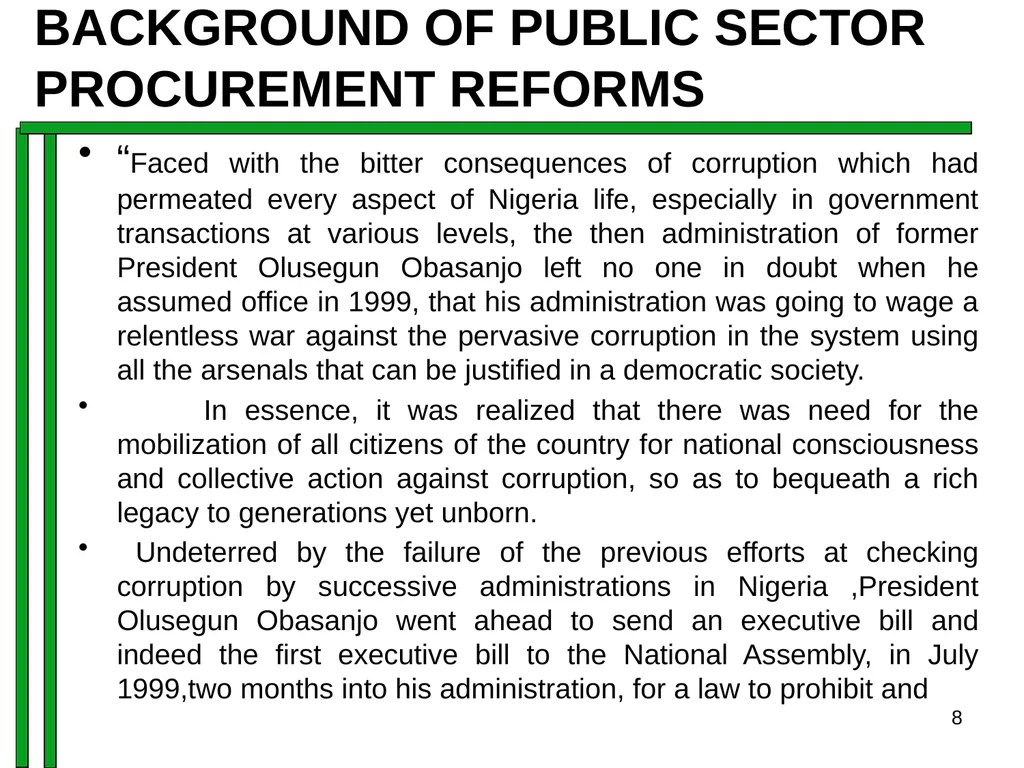
slide8. 8 BACKGROUND OF PUBLIC SECTOR PROCUREMENT REFORMS “Faced with the bitter consequences of corruption which had permeated every aspect of Nigeria life, especially in government transactions at various levels, the then administration of former President Olusegun Obasanjo left no one in doubt when he assumed office in 1999, that his administration was going to wage a relentless war against the pervasive corruption in the system using all the arsenals that can be justified in a democratic society.
In essence, it was realized that there was need for the mobilization of all citizens of the country for national consciousness and collective action against corruption, so as to bequeath a rich legacy to generations yet unborn.
Undeterred by the failure of the previous efforts at checking corruption by successive administrations in Nigeria ,President Olusegun Obasanjo went ahead to send an executive bill and indeed the first executive bill to the National Assembly, in July 1999,two months into his administration, for a law to prohibit and<br>
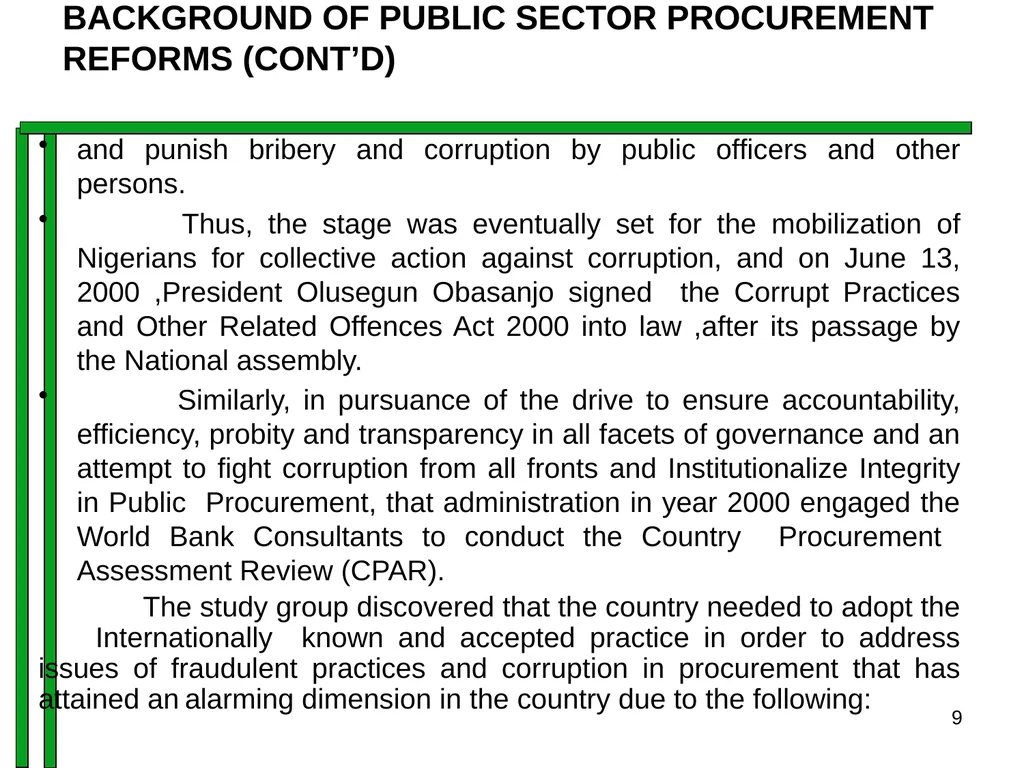
slide9. 9 and punish bribery and corruption by public officers and other persons.
Thus, the stage was eventually set for the mobilization of Nigerians for collective action against corruption, and on June 13, 2000 ,President Olusegun Obasanjo signed the Corrupt Practices and Other Related Offences Act 2000 into law ,after its passage by the National assembly.
Similarly, in pursuance of the drive to ensure accountability, efficiency, probity and transparency in all facets of governance and an attempt to fight corruption from all fronts and Institutionalize Integrity in Public Procurement, that administration in year 2000 engaged the World Bank Consultants to conduct the Country Procurement Assessment Review (CPAR).
The study group discovered that the country needed to adopt the Internationally known and accepted practice in order to address issues of fraudulent practices and corruption in procurement that has attained an alarming dimension in the country due to the following: BACKGROUND OF PUBLIC SECTOR PROCUREMENT REFORMS (CONT’D)<br>
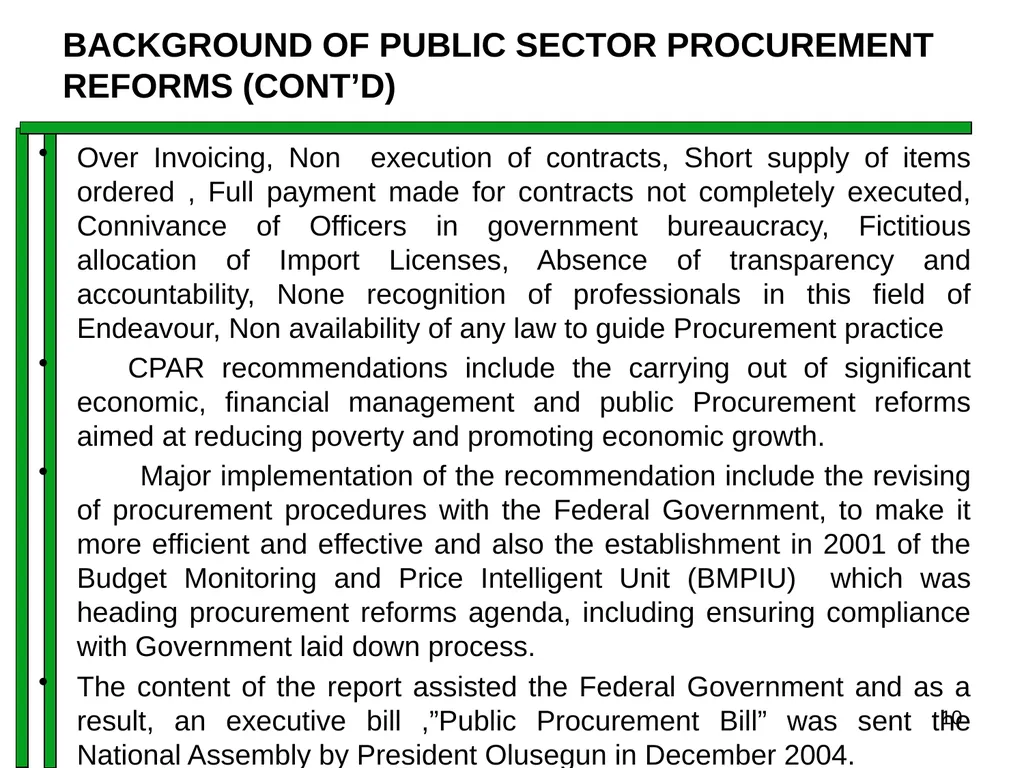
slide10. 10 Over Invoicing, Non execution of contracts, Short supply of items ordered , Full payment made for contracts not completely executed, Connivance of Officers in government bureaucracy, Fictitious allocation of Import Licenses, Absence of transparency and accountability, None recognition of professionals in this field of Endeavour, Non availability of any law to guide Procurement practice
CPAR recommendations include the carrying out of significant economic, financial management and public Procurement reforms aimed at reducing poverty and promoting economic growth.
Major implementation of the recommendation include the revising of procurement procedures with the Federal Government, to make it more efficient and effective and also the establishment in 2001 of the Budget Monitoring and Price Intelligent Unit (BMPIU) which was heading procurement reforms agenda, including ensuring compliance with Government laid down process.
The content of the report assisted the Federal Government and as a result, an executive bill ,”Public Procurement Bill” was sent the National Assembly by President Olusegun in December 2004. BACKGROUND OF PUBLIC SECTOR PROCUREMENT REFORMS (CONT’D)<br>
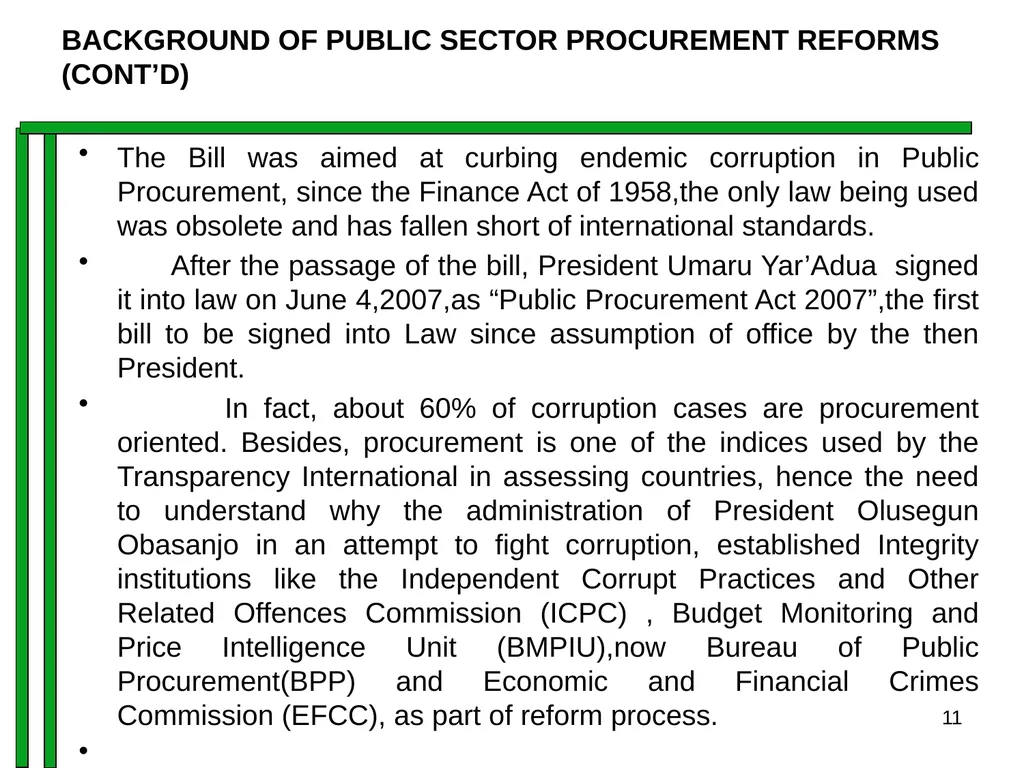
slide11. 11 The Bill was aimed at curbing endemic corruption in Public Procurement, since the Finance Act of 1958,the only law being used was obsolete and has fallen short of international standards.
After the passage of the bill, President Umaru Yar’Adua signed it into law on June 4,2007,as “Public Procurement Act 2007”,the first bill to be signed into Law since assumption of office by the then President.
In fact, about 60% of corruption cases are procurement oriented. Besides, procurement is one of the indices used by the Transparency International in assessing countries, hence the need to understand why the administration of President Olusegun Obasanjo in an attempt to fight corruption, established Integrity institutions like the Independent Corrupt Practices and Other Related Offences Commission (ICPC) , Budget Monitoring and Price Intelligence Unit (BMPIU),now Bureau of Public Procurement(BPP) and Economic and Financial Crimes Commission (EFCC), as part of reform process. BACKGROUND OF PUBLIC SECTOR PROCUREMENT REFORMS (CONT’D)<br>
slide12. 12 The scope of the application of the provisions of the Public procurement Act include all procurement of goods, works and services carried out by the Federal Government of Nigeria and all procurement entities;
all entities outside the foregoing description which derive at least 35% of the funds appropriated or proposed to be appropriated for any type of procurement from the Federation share of Consolidated Revenue Fund.
The Federal Government is by no means stating that the State and Local Governments must adopt the Public Procurement Act lime, hook and sinker ,because there is Fiscal Federalism in Nigeria ,which makes the three tiers of governments almost autonomous ,but to ensure that through moral suasion the other tiers of Governments should ensure judicious use of the Nation’s scarce resources and are therefore encouraged to adopt the Public Procurement Act, which would reduce Corruption in Public Procurement through Openness, Competition ,Accountability and ensure value for money spent. SCOPE OF APPLICATION OF THE ACT<br>
slide13. 13 This is the initiation of the process of effecting procurement up to award of a procurement contract.
There are nine essential steps in Public procurement. They include:
i. Efficient procurement plan driven by needs Assessment ii. Appropriation iii. Advertisement iv. Transparent Pre-qualification v. Bid Submission vi. Bid Opening vii. Bid Evaluation- Technical & Financial viii. Tender Board/Federal Executive Council(FEC) Approval ix. Contract Execution
Advertisement: This is the major step in ensuring that any public procurement system derives the benefit of effectiveness, efficiency and value-for-money. Equal access to information by all possible participants in the market of public contracts is fundamental to a free and fair competition. This explains why the advertisement requirement is very important for passing the Due Process Compliance rule for openness and provision of level playing field for fair competition through an Open Tender. A procuring entity is responsible for advertising directly; all invitations for pre-qualification or invitations to tender for goods, works and services. PROCUREMENT PROCESS<br>
slide14. 14 It is noteworthy to state that effort should always be made to ensure that the tender documents , engineering Drawings and Bill of Quantities are ready before advertisement, so as to avoid delay in issuing Tender Documents to the interested and competent Contractors or to the pre- qualified Contractors.
Tender Document and Drawings are usually prepared by experts or consultants in a case where there is no capacity.
The advertisement for open competitive bidding must be placed on the notice Board, any official website of the procuring entity, at least two National Newspapers and a procurement journal, not less than six weeks before the deadline for bids submission for goods and works and not less than 30days for services. As for the Federal Government organizations, advertisement is to be published in the Federal Tenders Journal, a new publication of the Federal Government, which carries only adverts of contract opportunities of the Federal Government of Nigeria. It is available at News-stands in every State of the Federation for purchase at a very affordable cost of N200 to all interested individuals and firms.
For International Competitive Bidding, the invitation for bids must also be advertized in an internationally recognized publication. PROCUREMENT PROCESS (CONT’D)<br>
slide15. 15 The standard format for the advert invitation should consist of the following basic information:
The name and address of the procuring Entity
Brief description of the objectives of the procurement and technical specifications of the project
The summary of the required qualifications criteria and category of contractors expected to bid
Date by which documents must be returned
Place and time for the documents to be returned including labeling of documents
Place and time of Tender Opening
Any contract above N100m for Goods and Services and more that N1Billion for Works require advertisement calling for pre-qualification of contractors, which must be placed in at least two National Newspapers and the Federal Tenders Journal.
It is noteworthy to state that any contract up to N2.5m should be advertised. PROCUREMENT PROCESS (CONT’D)<br>
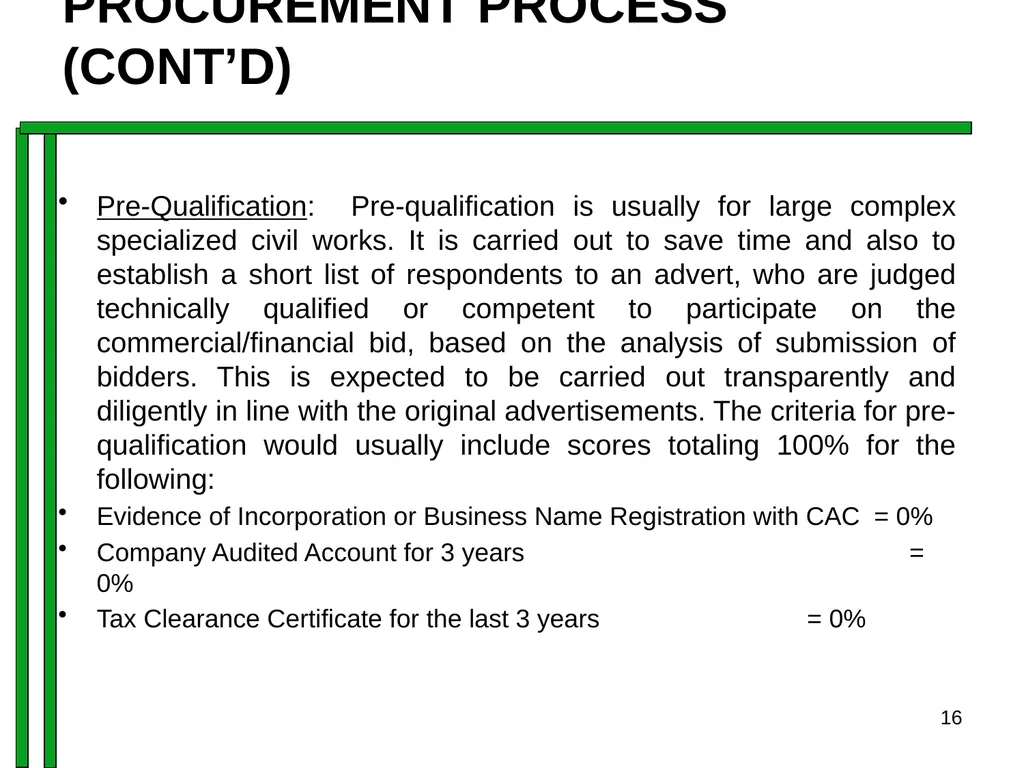
slide16. 16 Pre-Qualification: Pre-qualification is usually for large complex specialized civil works. It is carried out to save time and also to establish a short list of respondents to an advert, who are judged technically qualified or competent to participate on the commercial/financial bid, based on the analysis of submission of bidders. This is expected to be carried out transparently and diligently in line with the original advertisements. The criteria for pre-qualification would usually include scores totaling 100% for the following:
Evidence of Incorporation or Business Name Registration with CAC = 0%
Company Audited Account for 3 years = 0%
Tax Clearance Certificate for the last 3 years = 0% PROCUREMENT PROCESS (CONT’D)<br>
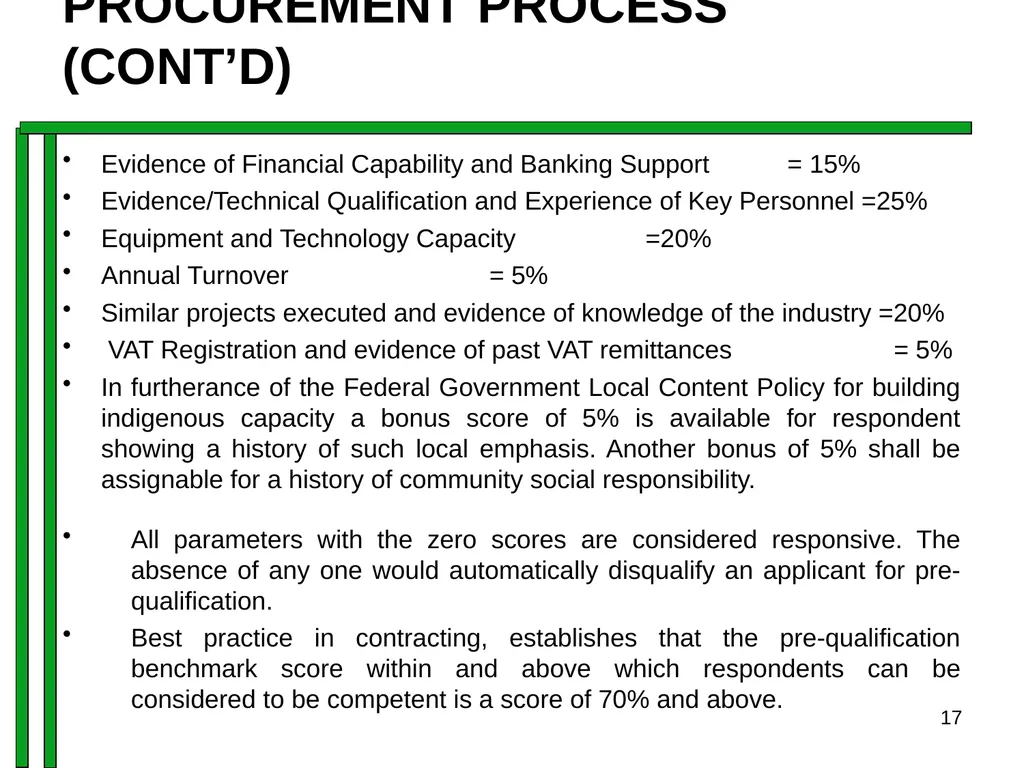
slide17. 17 Evidence of Financial Capability and Banking Support = 15%
Evidence/Technical Qualification and Experience of Key Personnel =25%
Equipment and Technology Capacity =20%
Annual Turnover = 5%
Similar projects executed and evidence of knowledge of the industry =20%
VAT Registration and evidence of past VAT remittances = 5%
In furtherance of the Federal Government Local Content Policy for building indigenous capacity a bonus score of 5% is available for respondent showing a history of such local emphasis. Another bonus of 5% shall be assignable for a history of community social responsibility.
All parameters with the zero scores are considered responsive. The absence of any one would automatically disqualify an applicant for pre-qualification.
Best practice in contracting, establishes that the pre-qualification benchmark score within and above which respondents can be considered to be competent is a score of 70% and above. PROCUREMENT PROCESS (CONT’D)<br>
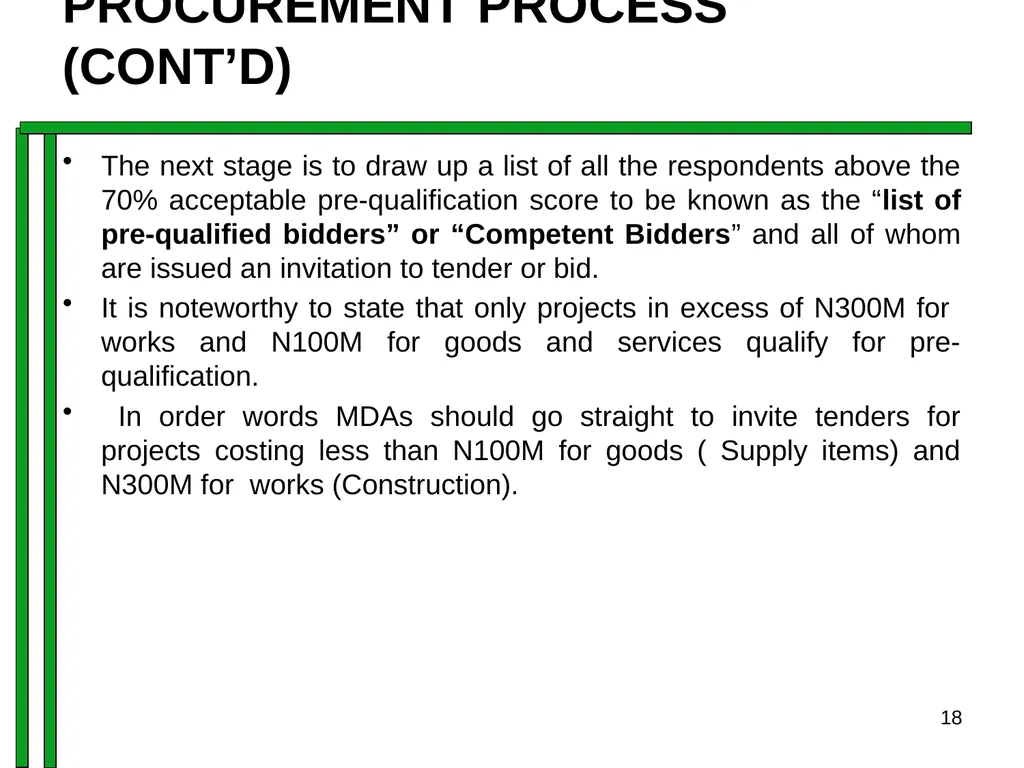
slide18. 18 The next stage is to draw up a list of all the respondents above the 70% acceptable pre-qualification score to be known as the “list of pre-qualified bidders” or “Competent Bidders” and all of whom are issued an invitation to tender or bid.
It is noteworthy to state that only projects in excess of N300M for works and N100M for goods and services qualify for pre-qualification.
In order words MDAs should go straight to invite tenders for projects costing less than N100M for goods ( Supply items) and N300M for works (Construction). PROCUREMENT PROCESS (CONT’D)<br>
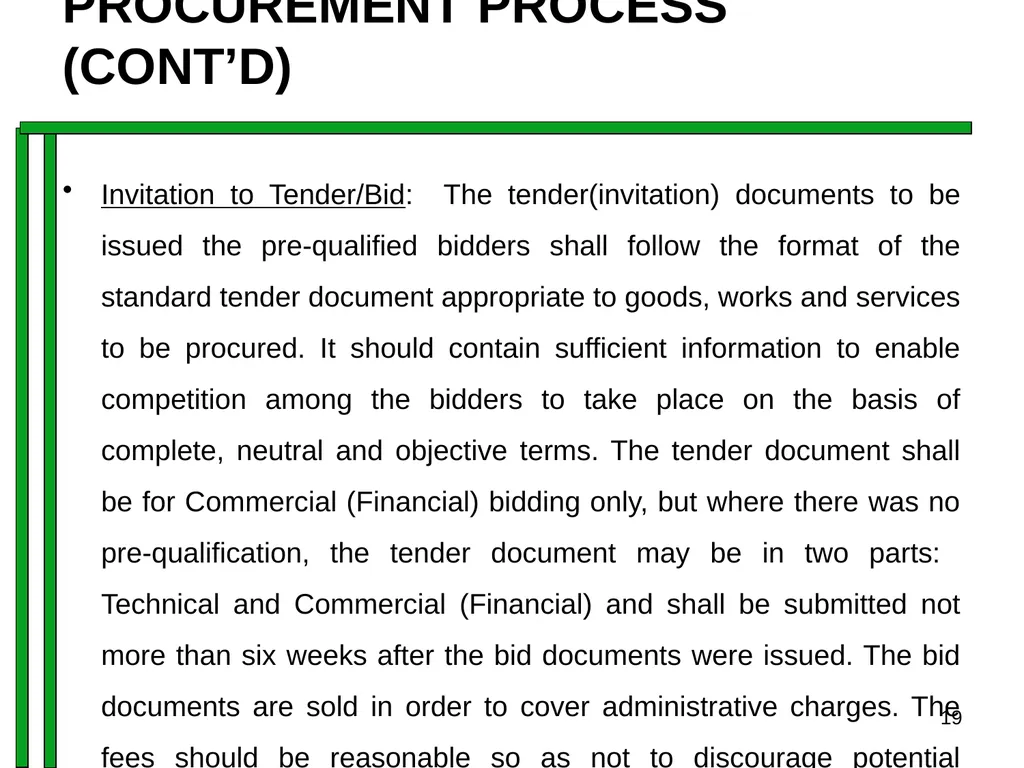
slide19. 19 Invitation to Tender/Bid: The tender(invitation) documents to be issued the pre-qualified bidders shall follow the format of the standard tender document appropriate to goods, works and services to be procured. It should contain sufficient information to enable competition among the bidders to take place on the basis of complete, neutral and objective terms. The tender document shall be for Commercial (Financial) bidding only, but where there was no pre-qualification, the tender document may be in two parts: Technical and Commercial (Financial) and shall be submitted not more than six weeks after the bid documents were issued. The bid documents are sold in order to cover administrative charges. The fees should be reasonable so as not to discourage potential bidders. PROCUREMENT PROCESS (CONT’D)<br>
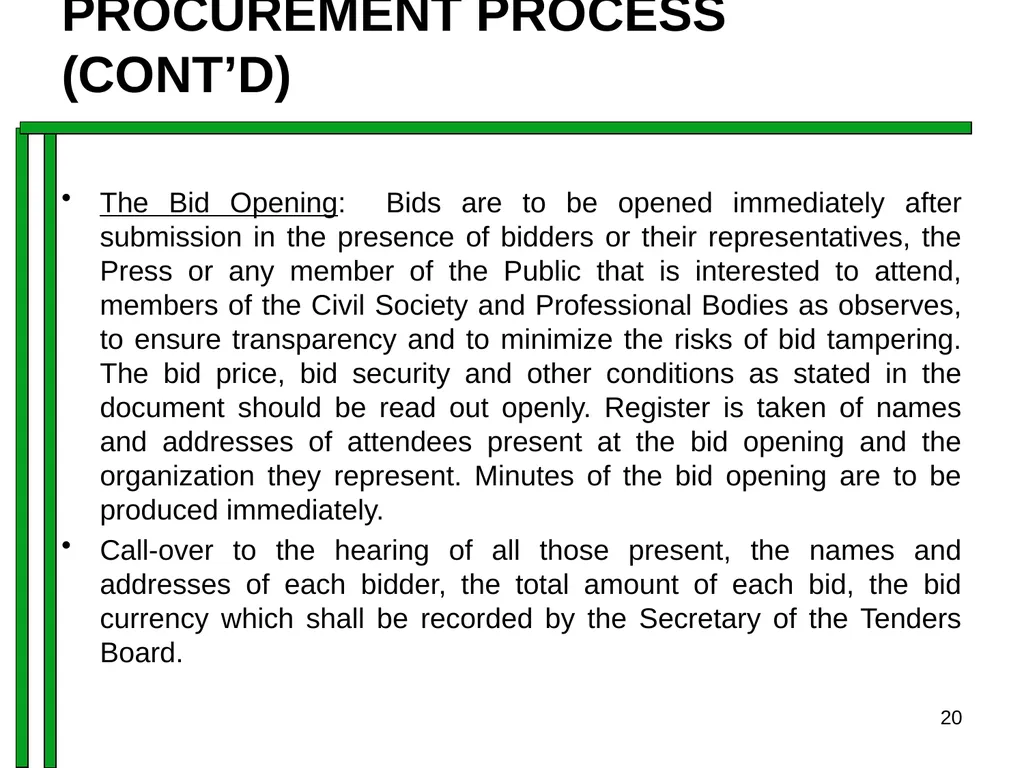
slide20. PROCUREMENT PROCESS (CONT’D) The Bid Opening: Bids are to be opened immediately after submission in the presence of bidders or their representatives, the Press or any member of the Public that is interested to attend, members of the Civil Society and Professional Bodies as observes, to ensure transparency and to minimize the risks of bid tampering. The bid price, bid security and other conditions as stated in the document should be read out openly. Register is taken of names and addresses of attendees present at the bid opening and the organization they represent. Minutes of the bid opening are to be produced immediately.
Call-over to the hearing of all those present, the names and addresses of each bidder, the total amount of each bid, the bid currency which shall be recorded by the Secretary of the Tenders Board. 20<br>
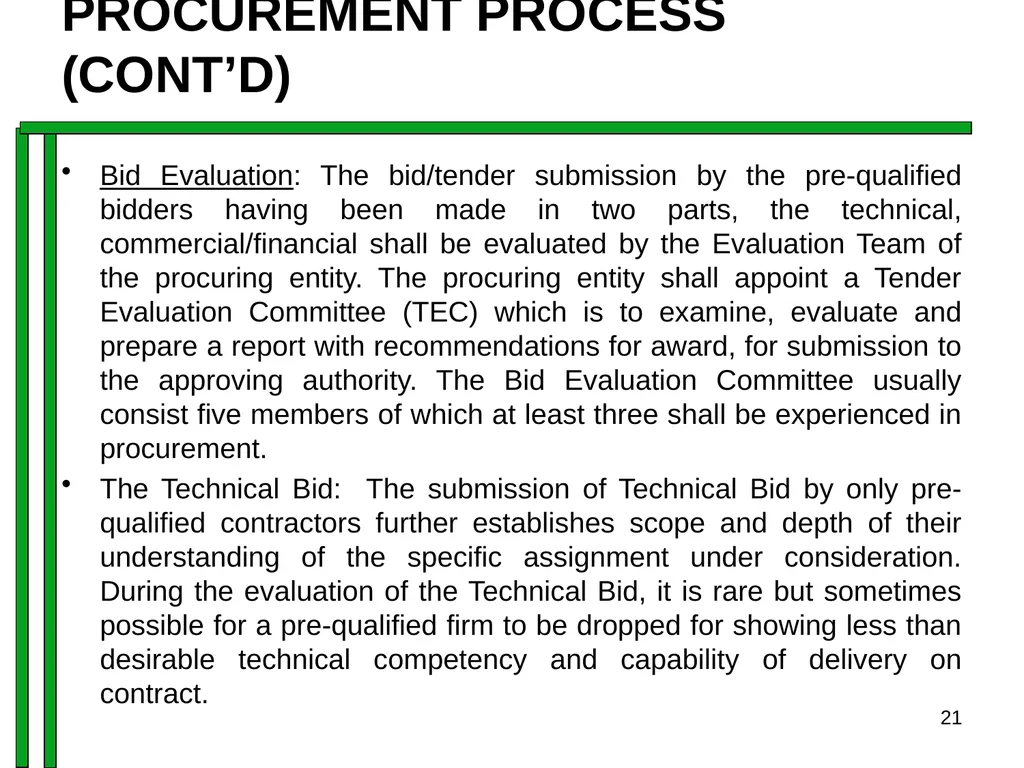
slide21. PROCUREMENT PROCESS (CONT’D) Bid Evaluation: The bid/tender submission by the pre-qualified bidders having been made in two parts, the technical, commercial/financial shall be evaluated by the Evaluation Team of the procuring entity. The procuring entity shall appoint a Tender Evaluation Committee (TEC) which is to examine, evaluate and prepare a report with recommendations for award, for submission to the approving authority. The Bid Evaluation Committee usually consist five members of which at least three shall be experienced in procurement.
The Technical Bid: The submission of Technical Bid by only pre-qualified contractors further establishes scope and depth of their understanding of the specific assignment under consideration. During the evaluation of the Technical Bid, it is rare but sometimes possible for a pre-qualified firm to be dropped for showing less than desirable technical competency and capability of delivery on contract. 21<br>
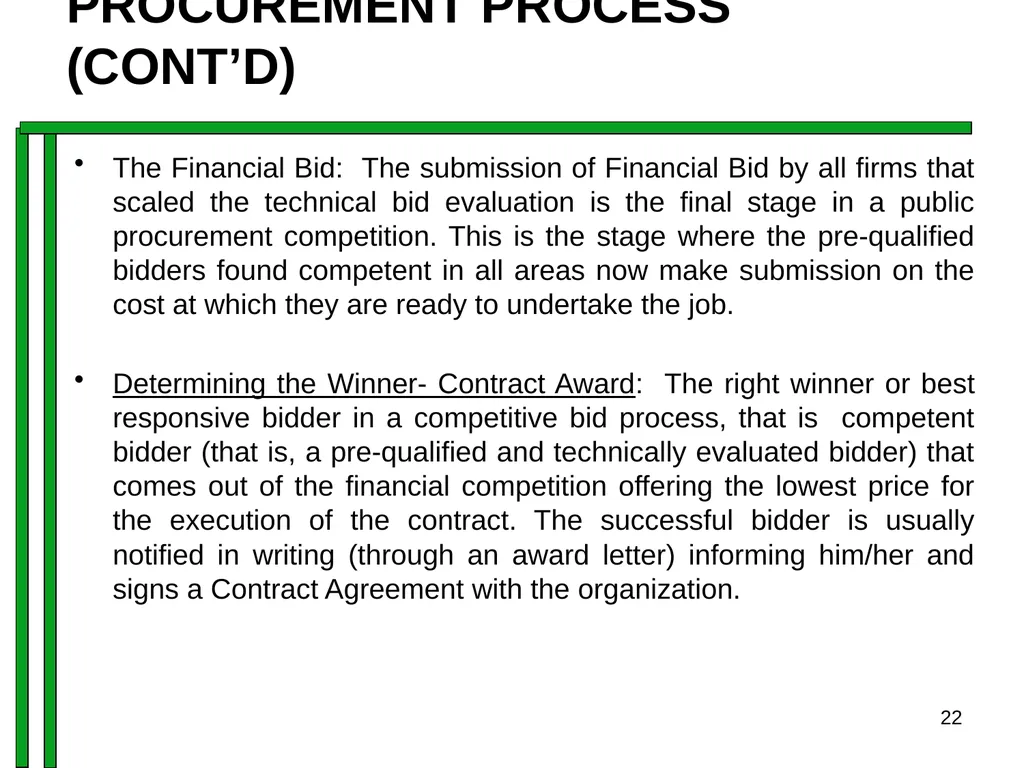
slide22. PROCUREMENT PROCESS (CONT’D) The Financial Bid: The submission of Financial Bid by all firms that scaled the technical bid evaluation is the final stage in a public procurement competition. This is the stage where the pre-qualified bidders found competent in all areas now make submission on the cost at which they are ready to undertake the job.
Determining the Winner- Contract Award: The right winner or best responsive bidder in a competitive bid process, that is competent bidder (that is, a pre-qualified and technically evaluated bidder) that comes out of the financial competition offering the lowest price for the execution of the contract. The successful bidder is usually notified in writing (through an award letter) informing him/her and signs a Contract Agreement with the organization. 22<br>
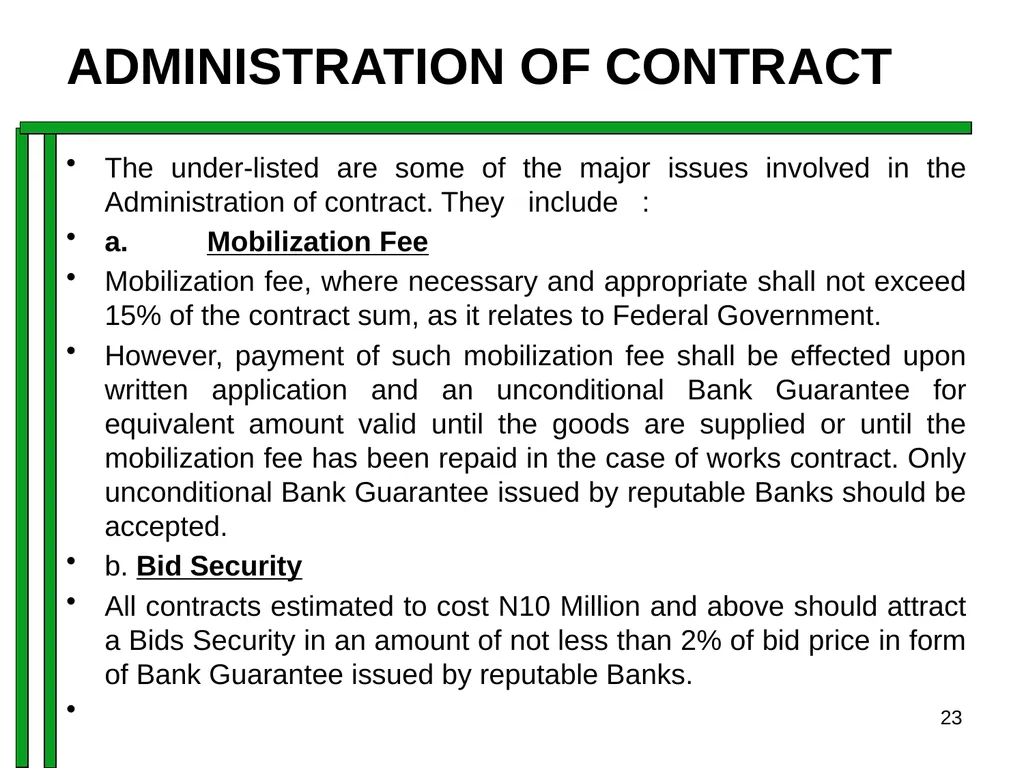
slide23. The under-listed are some of the major issues involved in the Administration of contract. They include :
a. Mobilization Fee
Mobilization fee, where necessary and appropriate shall not exceed 15% of the contract sum, as it relates to Federal Government.
However, payment of such mobilization fee shall be effected upon written application and an unconditional Bank Guarantee for equivalent amount valid until the goods are supplied or until the mobilization fee has been repaid in the case of works contract. Only unconditional Bank Guarantee issued by reputable Banks should be accepted.
b. Bid Security
All contracts estimated to cost N10 Million and above should attract a Bids Security in an amount of not less than 2% of bid price in form of Bank Guarantee issued by reputable Banks. 23 ADMINISTRATION OF CONTRACT<br>
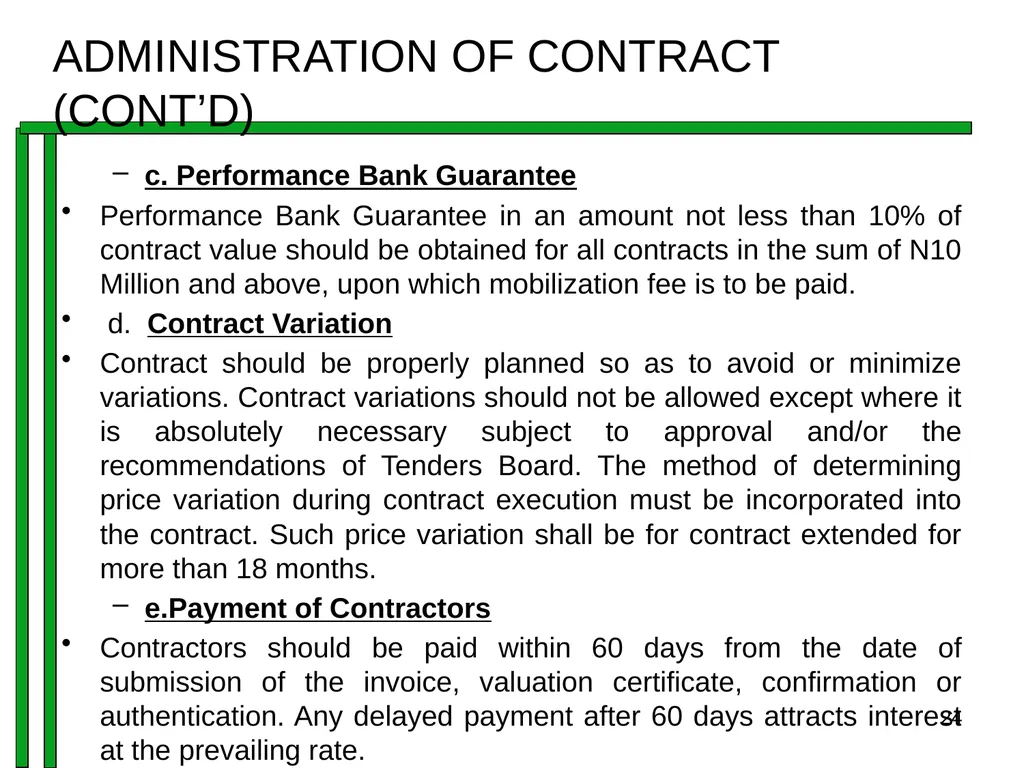
slide24. ADMINISTRATION OF CONTRACT (CONT’D) c. Performance Bank Guarantee
Performance Bank Guarantee in an amount not less than 10% of contract value should be obtained for all contracts in the sum of N10 Million and above, upon which mobilization fee is to be paid.
d. Contract Variation
Contract should be properly planned so as to avoid or minimize variations. Contract variations should not be allowed except where it is absolutely necessary subject to approval and/or the recommendations of Tenders Board. The method of determining price variation during contract execution must be incorporated into the contract. Such price variation shall be for contract extended for more than 18 months.
e.Payment of Contractors
Contractors should be paid within 60 days from the date of submission of the invoice, valuation certificate, confirmation or authentication. Any delayed payment after 60 days attracts interest at the prevailing rate. 24<br>
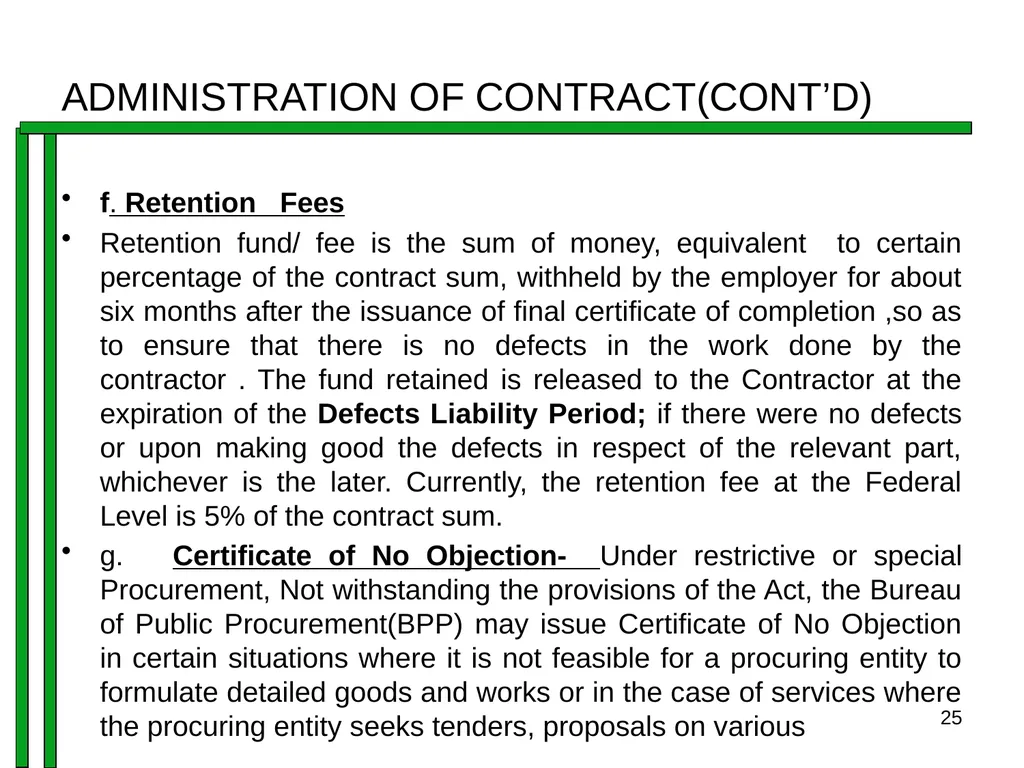
slide25. ADMINISTRATION OF CONTRACT(CONT’D) f. Retention Fees
Retention fund/ fee is the sum of money, equivalent to certain percentage of the contract sum, withheld by the employer for about six months after the issuance of final certificate of completion ,so as to ensure that there is no defects in the work done by the contractor . The fund retained is released to the Contractor at the expiration of the Defects Liability Period; if there were no defects or upon making good the defects in respect of the relevant part, whichever is the later. Currently, the retention fee at the Federal Level is 5% of the contract sum.
g. Certificate of No Objection- Under restrictive or special Procurement, Not withstanding the provisions of the Act, the Bureau of Public Procurement(BPP) may issue Certificate of No Objection in certain situations where it is not feasible for a procuring entity to formulate detailed goods and works or in the case of services where the procuring entity seeks tenders, proposals on various 25<br>
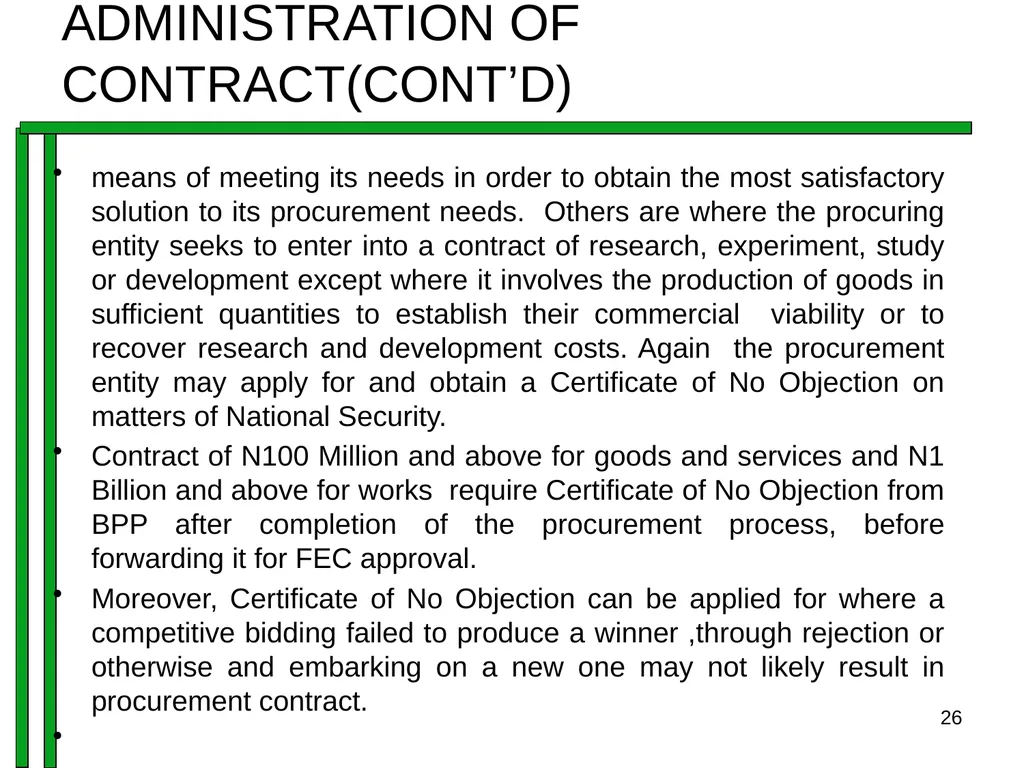
slide26. ADMINISTRATION OF CONTRACT(CONT’D) means of meeting its needs in order to obtain the most satisfactory solution to its procurement needs. Others are where the procuring entity seeks to enter into a contract of research, experiment, study or development except where it involves the production of goods in sufficient quantities to establish their commercial viability or to recover research and development costs. Again the procurement entity may apply for and obtain a Certificate of No Objection on matters of National Security.
Contract of N100 Million and above for goods and services and N1 Billion and above for works require Certificate of No Objection from BPP after completion of the procurement process, before forwarding it for FEC approval.
Moreover, Certificate of No Objection can be applied for where a competitive bidding failed to produce a winner ,through rejection or otherwise and embarking on a new one may not likely result in procurement contract. 26<br>
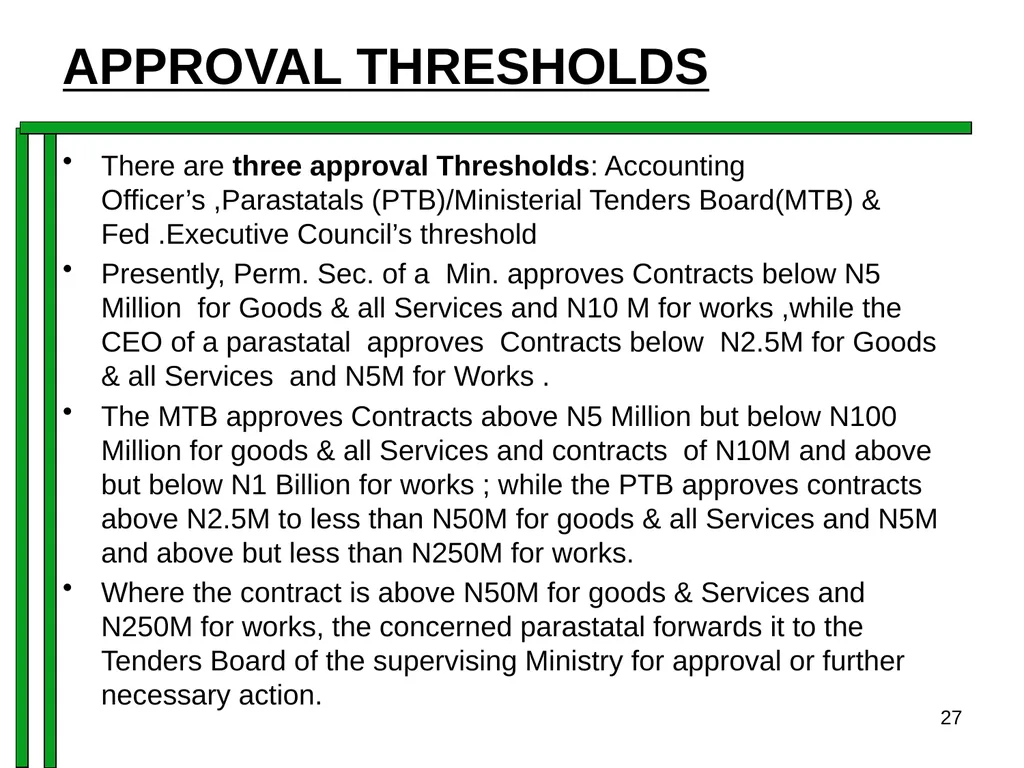
slide27. 27 There are three approval Thresholds: Accounting Officer’s ,Parastatals (PTB)/Ministerial Tenders Board(MTB) & Fed .Executive Council’s threshold
Presently, Perm. Sec. of a Min. approves Contracts below N5 Million for Goods & all Services and N10 M for works ,while the CEO of a parastatal approves Contracts below N2.5M for Goods & all Services and N5M for Works .
The MTB approves Contracts above N5 Million but below N100 Million for goods & all Services and contracts of N10M and above but below N1 Billion for works ; while the PTB approves contracts above N2.5M to less than N50M for goods & all Services and N5M and above but less than N250M for works.
Where the contract is above N50M for goods & Services and N250M for works, the concerned parastatal forwards it to the Tenders Board of the supervising Ministry for approval or further necessary action. APPROVAL THRESHOLDS<br>
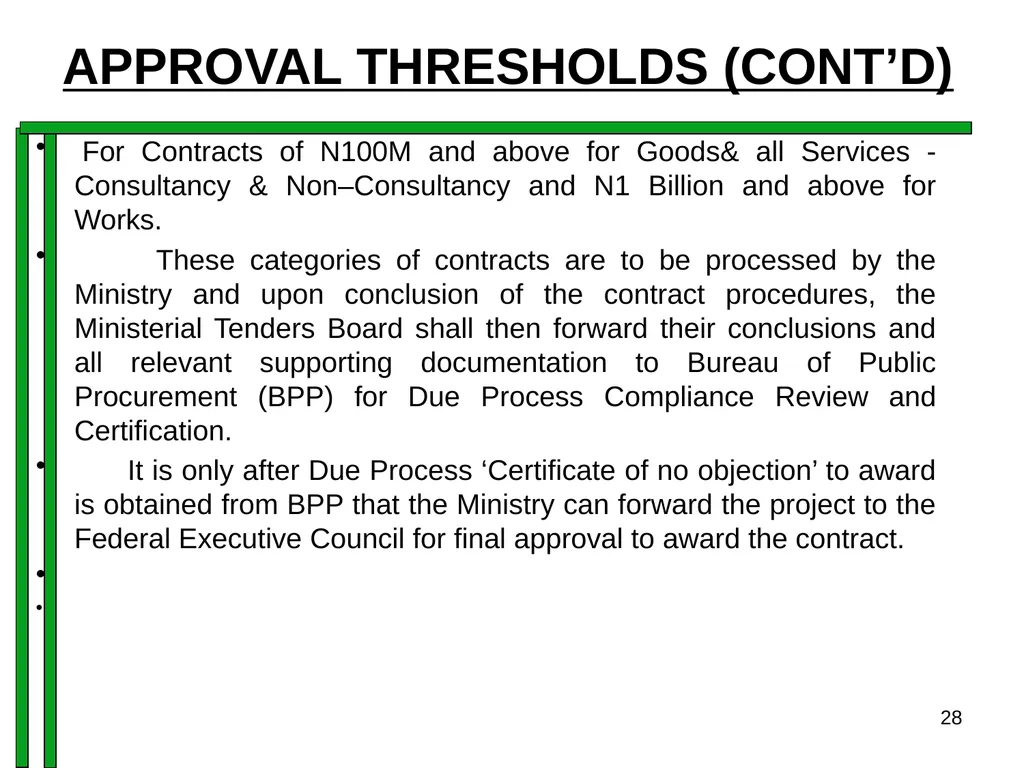
slide28. 28 For Contracts of N100M and above for Goods& all Services -Consultancy & Non–Consultancy and N1 Billion and above for Works.
These categories of contracts are to be processed by the Ministry and upon conclusion of the contract procedures, the Ministerial Tenders Board shall then forward their conclusions and all relevant supporting documentation to Bureau of Public Procurement (BPP) for Due Process Compliance Review and Certification.
It is only after Due Process ‘Certificate of no objection’ to award is obtained from BPP that the Ministry can forward the project to the Federal Executive Council for final approval to award the contract. APPROVAL THRESHOLDS (CONT’D)<br>
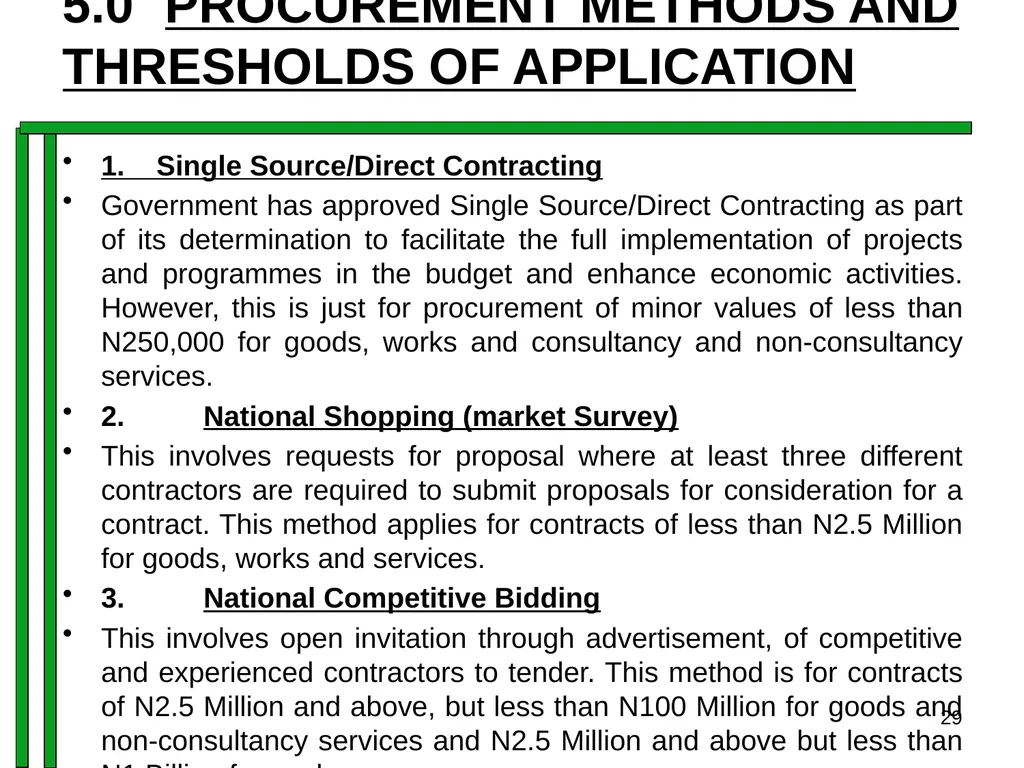
slide29. 29 1. Single Source/Direct Contracting
Government has approved Single Source/Direct Contracting as part of its determination to facilitate the full implementation of projects and programmes in the budget and enhance economic activities. However, this is just for procurement of minor values of less than N250,000 for goods, works and consultancy and non-consultancy services.
2. National Shopping (market Survey)
This involves requests for proposal where at least three different contractors are required to submit proposals for consideration for a contract. This method applies for contracts of less than N2.5 Million for goods, works and services.
3. National Competitive Bidding
This involves open invitation through advertisement, of competitive and experienced contractors to tender. This method is for contracts of N2.5 Million and above, but less than N100 Million for goods and non-consultancy services and N2.5 Million and above but less than N1 Billion for works. 5.0 PROCUREMENT METHODS AND THRESHOLDS OF APPLICATION<br>
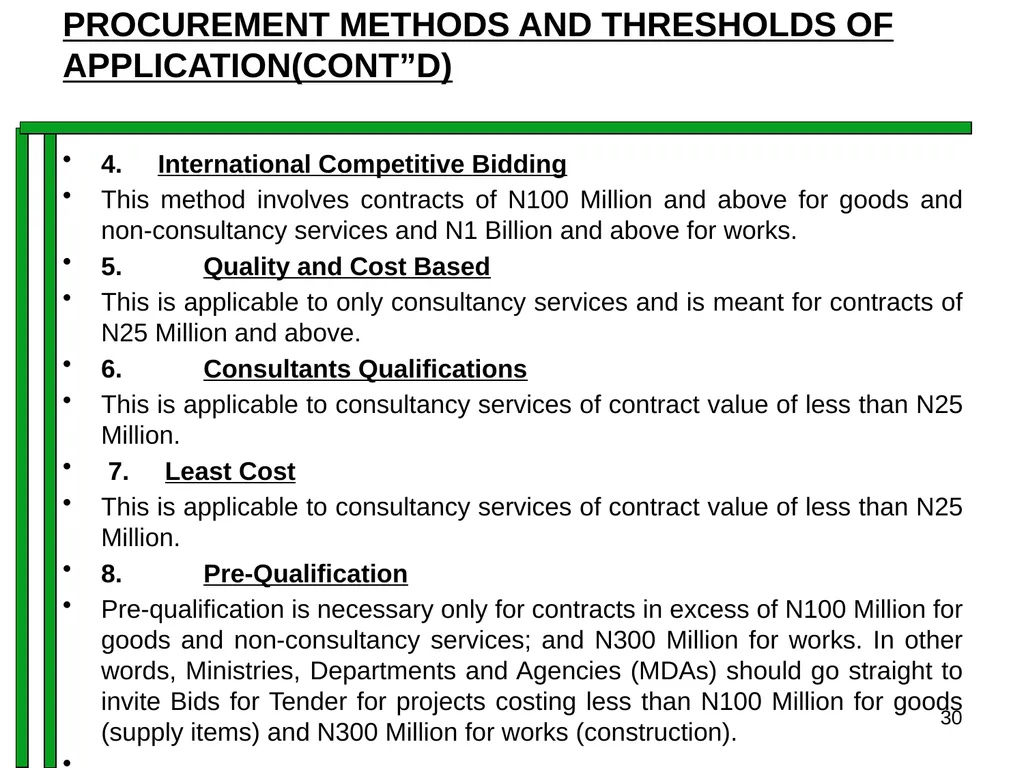
slide30. 30 4. International Competitive Bidding
This method involves contracts of N100 Million and above for goods and non-consultancy services and N1 Billion and above for works.
5. Quality and Cost Based
This is applicable to only consultancy services and is meant for contracts of N25 Million and above.
6. Consultants Qualifications
This is applicable to consultancy services of contract value of less than N25 Million.
7. Least Cost
This is applicable to consultancy services of contract value of less than N25 Million.
8. Pre-Qualification
Pre-qualification is necessary only for contracts in excess of N100 Million for goods and non-consultancy services; and N300 Million for works. In other words, Ministries, Departments and Agencies (MDAs) should go straight to invite Bids for Tender for projects costing less than N100 Million for goods (supply items) and N300 Million for works (construction). PROCUREMENT METHODS AND THRESHOLDS OF APPLICATION(CONT”D)<br>
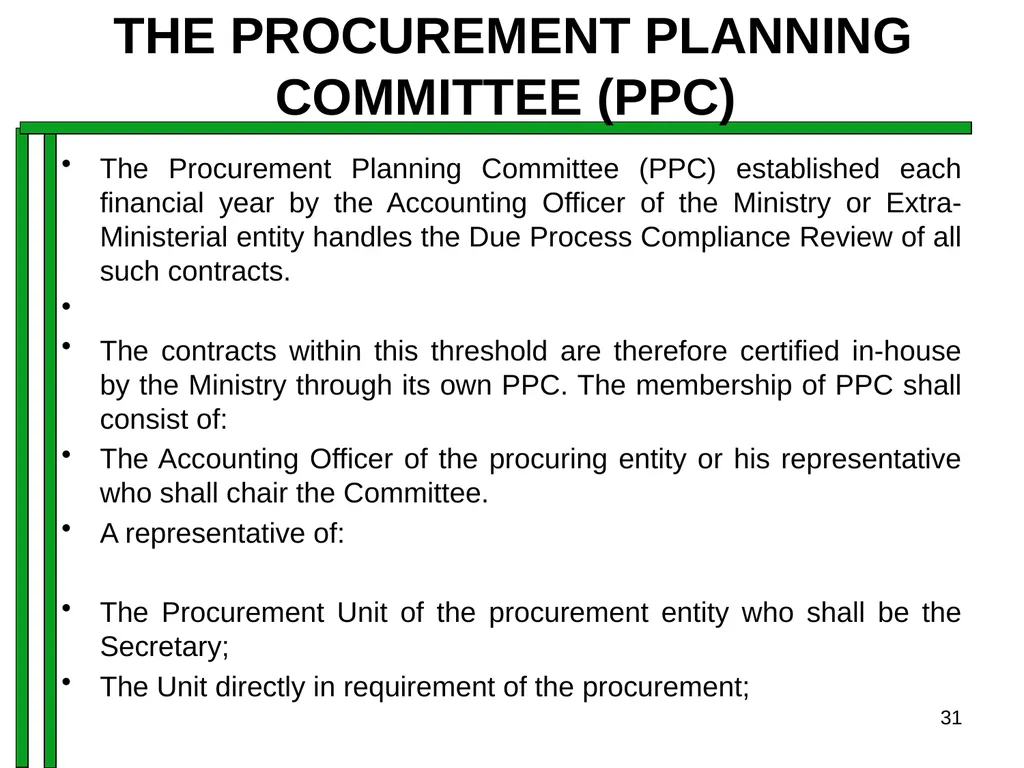
slide31. 31 The Procurement Planning Committee (PPC) established each financial year by the Accounting Officer of the Ministry or Extra-Ministerial entity handles the Due Process Compliance Review of all such contracts.
The contracts within this threshold are therefore certified in-house by the Ministry through its own PPC. The membership of PPC shall consist of:
The Accounting Officer of the procuring entity or his representative who shall chair the Committee.
A representative of:
The Procurement Unit of the procurement entity who shall be the Secretary;
The Unit directly in requirement of the procurement; THE PROCUREMENT PLANNING COMMITTEE (PPC)<br>
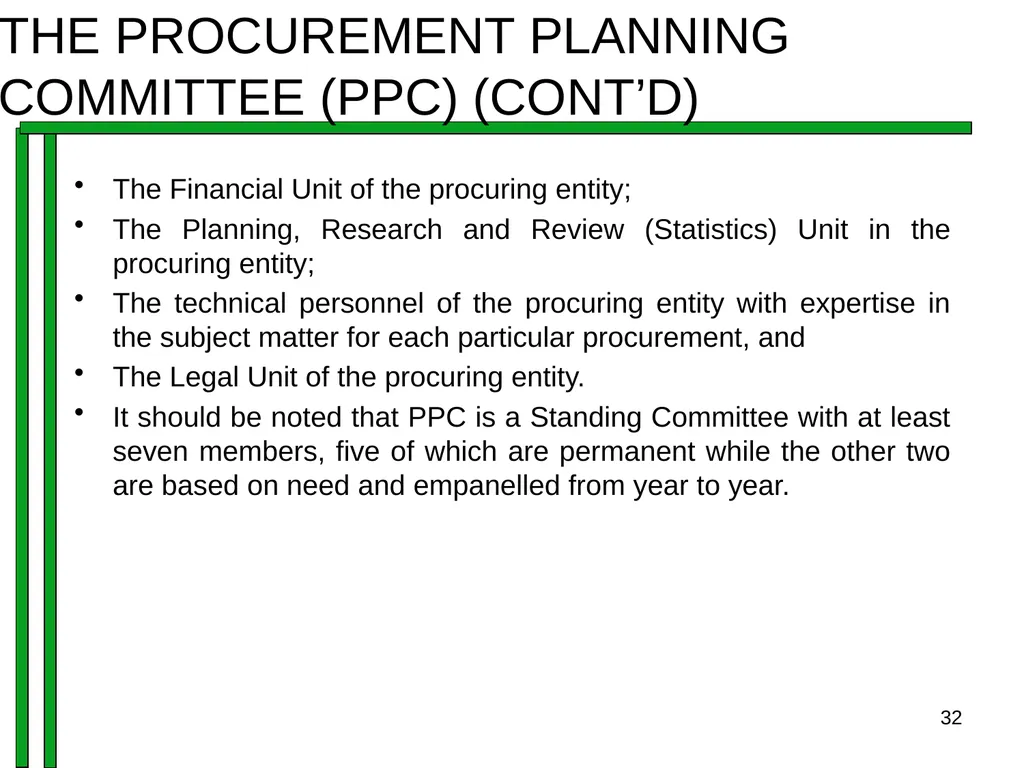
slide32. 32 The Financial Unit of the procuring entity;
The Planning, Research and Review (Statistics) Unit in the procuring entity;
The technical personnel of the procuring entity with expertise in the subject matter for each particular procurement, and
The Legal Unit of the procuring entity.
It should be noted that PPC is a Standing Committee with at least seven members, five of which are permanent while the other two are based on need and empanelled from year to year. THE PROCUREMENT PLANNING COMMITTEE (PPC) (CONT’D)<br>
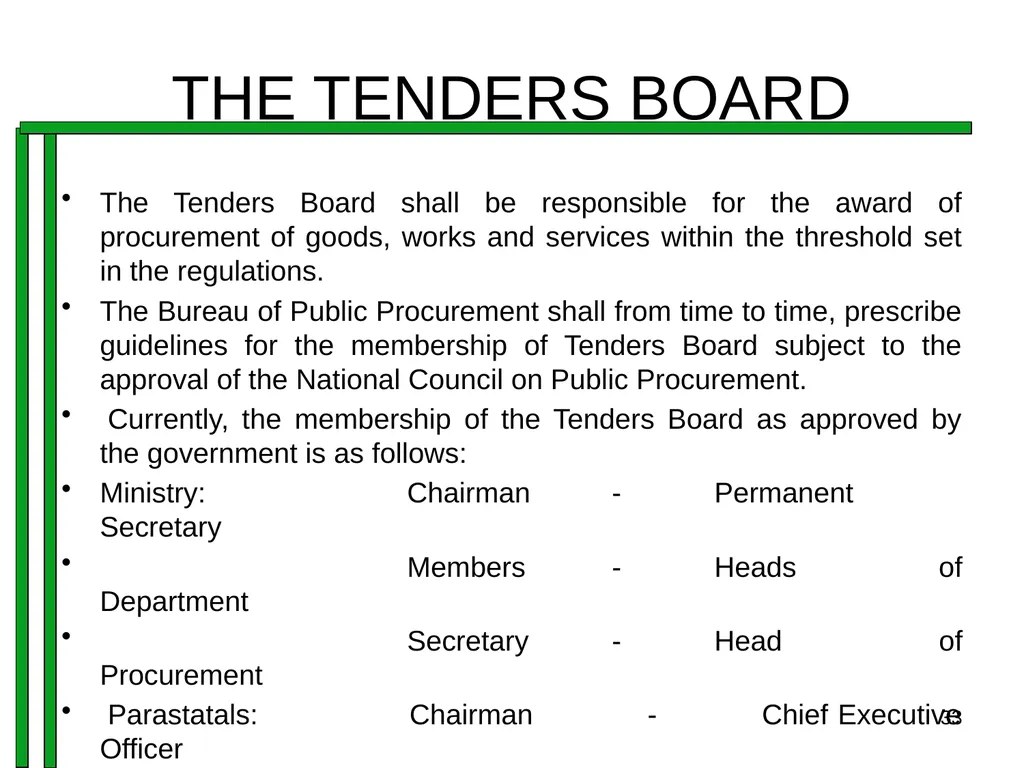
slide33. THE TENDERS BOARD The Tenders Board shall be responsible for the award of procurement of goods, works and services within the threshold set in the regulations.
The Bureau of Public Procurement shall from time to time, prescribe guidelines for the membership of Tenders Board subject to the approval of the National Council on Public Procurement.
Currently, the membership of the Tenders Board as approved by the government is as follows:
Ministry: Chairman - Permanent Secretary
Members - Heads of Department
Secretary - Head of Procurement
Parastatals: Chairman - Chief Executive Officer
Members - Heads of Departments
Secretary - Head of Procurement 33<br>
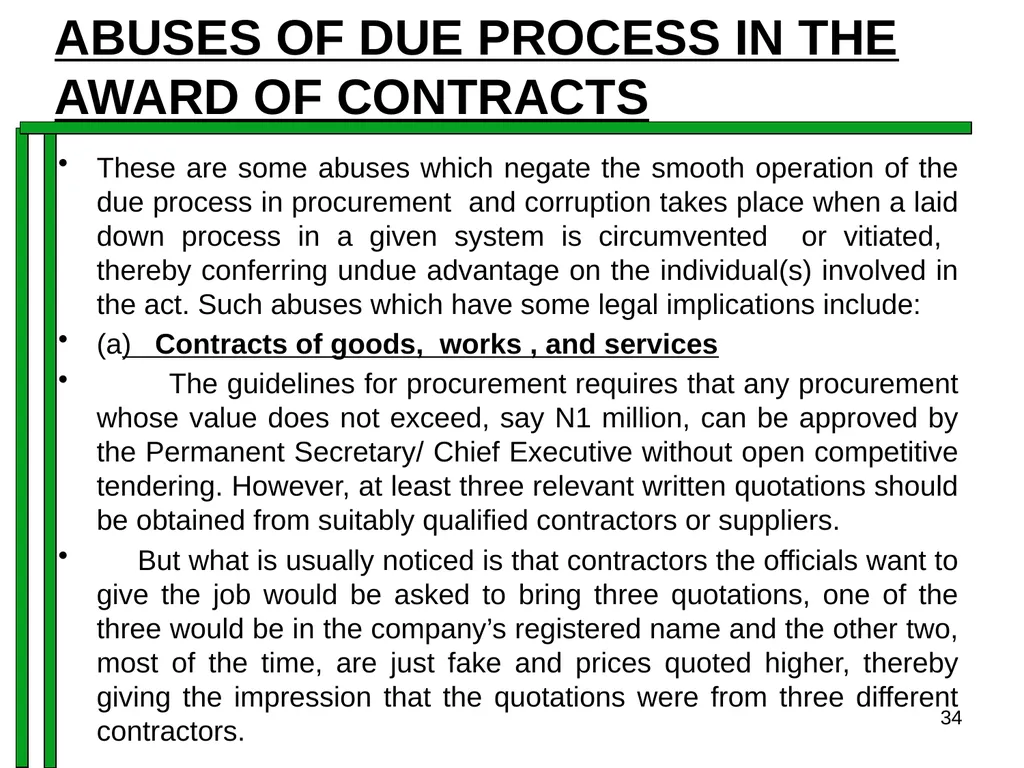
slide34. 34 These are some abuses which negate the smooth operation of the due process in procurement and corruption takes place when a laid down process in a given system is circumvented or vitiated, thereby conferring undue advantage on the individual(s) involved in the act. Such abuses which have some legal implications include:
(a) Contracts of goods, works , and services
The guidelines for procurement requires that any procurement whose value does not exceed, say N1 million, can be approved by the Permanent Secretary/ Chief Executive without open competitive tendering. However, at least three relevant written quotations should be obtained from suitably qualified contractors or suppliers.
But what is usually noticed is that contractors the officials want to give the job would be asked to bring three quotations, one of the three would be in the company’s registered name and the other two, most of the time, are just fake and prices quoted higher, thereby giving the impression that the quotations were from three different contractors. ABUSES OF DUE PROCESS IN THE AWARD OF CONTRACTS<br>
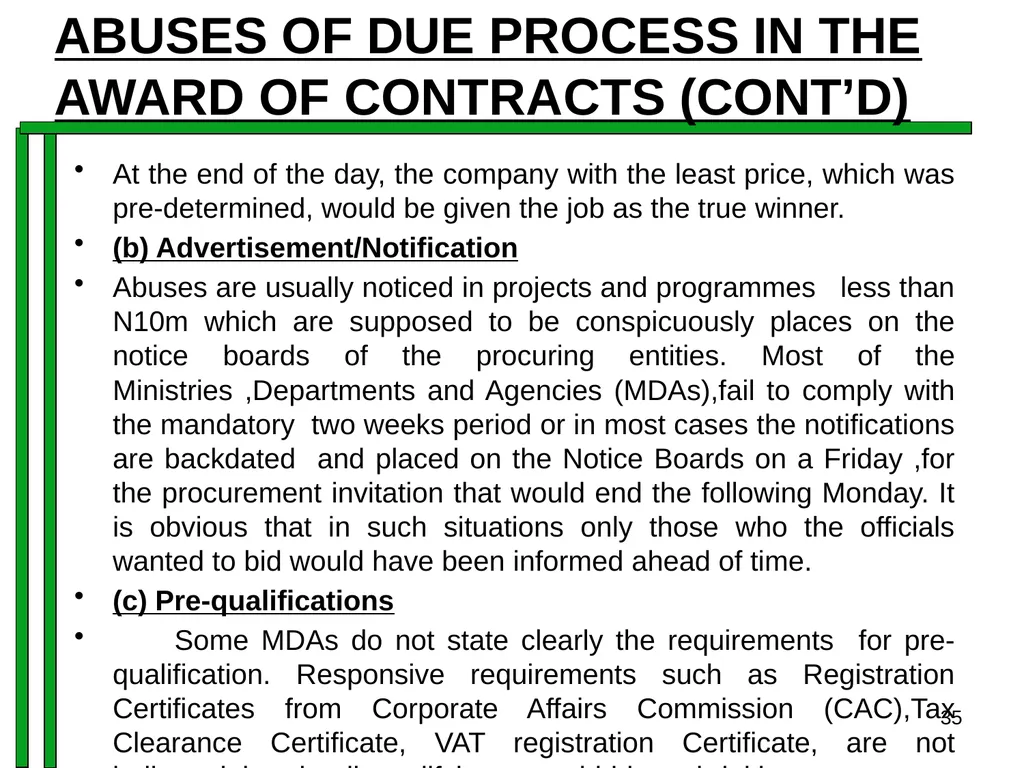
slide35. 35 At the end of the day, the company with the least price, which was pre-determined, would be given the job as the true winner.
(b) Advertisement/Notification
Abuses are usually noticed in projects and programmes less than N10m which are supposed to be conspicuously places on the notice boards of the procuring entities. Most of the Ministries ,Departments and Agencies (MDAs),fail to comply with the mandatory two weeks period or in most cases the notifications are backdated and placed on the Notice Boards on a Friday ,for the procurement invitation that would end the following Monday. It is obvious that in such situations only those who the officials wanted to bid would have been informed ahead of time.
(c) Pre-qualifications
Some MDAs do not state clearly the requirements for pre-qualification. Responsive requirements such as Registration Certificates from Corporate Affairs Commission (CAC),Tax Clearance Certificate, VAT registration Certificate, are not indicated thereby disqualifying some bidders ab-initio. ABUSES OF DUE PROCESS IN THE AWARD OF CONTRACTS (CONT’D)<br>
slide36. 36 (d) Bids Opening
Some MDAs often times open the bids received months after close of submission , which gives room for manipulation of all kinds. It is mandatory for bids to be opened immediately after close of submission in the presence of the representatives of the tenderers and other interested public.
(e) Bid Evaluation
It has been established that greater abuse of the process occurs at the stage of bids evaluation. When the transparent process is in favour of a company not considered favourable by the MDA ,other criteria are factored to disqualify the best responsive bid.
(f) Tender Splitting
It is a serious offence for any officer to deliberately split contracts of goods, works and services in order to circumvent the provision of the procurement guidelines. It has been noticed that some MDAs do engage in such illegal practice and such breach of the rules is subject to disciplinary action. ABUSES OF DUE PROCESS IN THE AWARD OF CONTRACTS(CONT’D)<br>
slide37. ABUSES OF DUE PROCESS IN THE AWARD OF CONTRACTS (CONT’D) Virement
This refers to a transfer of savings on one or more sub-heads to meet expenditure on another sub –head.
The authority for virement approval is vested in the hands of the Minister of Finance, who can authorize re-allocation between sub-heads, provided he/she is satisfied that sound reasons exist for additional expenditure.
Such approval which is not automatic is usually conveyed by a Virement Warrant, with a proviso that the additional expenditure comes from the head of the estimates concerned and that the re-allocation is not for the provision of a new service that was not appropriated for or from Overhead to Capital or vice versa. 37<br>
slide38. But some times we witness transfer of money from one vote to another in the MDAs without aproval.
It is therefore obvious from the above that any official who vires without authority has committed a criminal offence punishable under the Law. 38<br>
slide39. It is necessary to emphasize that enforcing the due process in the Award of Contracts will lead to fairness, competition, cost effectiveness, accountability and transparency. There is need for officials saddled with the responsibility of procurement to discharge their duties with high sense of responsibility, honesty and due diligence.
Indeed, we all have a duty to support the entrench integrity in procurement process by restoring the culture of transparency, accountability, competition, merit and value for money in the procurement of goods, works and services in the public sector.
It is our duty to raise alarm when we notice lack of integrity or any deviation in the procedures for procurement.
It is our hope that the participants will go back to their respective schedules better informed on the need to ensure 39 CONCLUSION<br>
slide40. CONCLUSION (CONT’D) transparency, probity, accountability, openness and competition in public procurement and all government transactions. This will curb wastages, eradicate corruption and block the leakages in the public treasury, which will eventually lead to overall economic development through better standard of living, improved educational standards and more importantly; embracing integrity in the practice of our professions, so as to realize Nigeria’s dream of becoming one of the top twenty economies in the world by the year 2020.
On behalf of the Commission, I wish you God’s guidance.
Thank you for listening. 40<br>
slide41. 41<br>
slide42. 42<br>
slide43. 43<br>
slide2. 2 May I on behalf of the chairman , members and staff of the Independent Corrupt Practices And Other Related Offences commission (ICPC),express my appreciation of the efforts of the Anti-Corruption Academy of Nigeria(ACAN) in organizing this workshop which the main theme is “ Academic and Procurement Integrity Workshop for Tertiary Institutions”.
It is also a great pleasure and honour for me to be given the opportunity to deliver this paper on “ Entrenching Integrity In Procurement Process For Management Officials In Nigerian Tertiary Institutions” to this august gathering.
In addressing this topic which is expected to be practical oriented, highly interactive and incorporating field experiences, it would be beneficial to state briefly what Public Sector procurement is all about, its reforms and the importance of applying Integrity in Public Sector procurement. INTRODUCTION<br>
slide3. INTRODUCTION (Cont’d) What is Procurement?
Procurement simply means acquisition of goods, works and services. Public Sector procurement is the process by which government contracts infrastructure, supplies and contracts professional services.
It is at the heart of delivering public services. It also involves the management of large amounts of money and is the largest single cause of allegations of corruption and government inefficiency. Procurement is therefore central to expenditure management.
Sound public procurement policies and practices are among the essential elements of good governance. Good practices reduce cost and produce timely results, by ensuring the efficient and effective utilization of resources and value for money, while poor practices lead to waste and delays. 3<br>
slide4. 4 INTRODUCTION (Cont’d) Therefore, in line with the principles of good governance, accountability and transparency in government business, government has set up certain procedures to be followed, criteria that must be fulfilled, steps to be taken and conditions that must be met before public funds could be released from the Treasury for payment to contractors. These set of criteria, steps or conditions are the Due Process.
By Due Process, Government is stressing that there must be strict compliance with the provisions of the Public Procurement Act 2007, Financial Regulations and relevant extant circulars in the award of contract.<br>
slide5. 5 INTRODUCTION (Cont’d) WHAT IS INTEGRITY AND WHY IS IT NECESSARY TO APPLY INTEGRITY IN PROCUREMENT PROCESS?
Integrity simply means doing what is right, obeying the laid-down rules, adhering to ethics of one’s profession.
You practice integrity when the discharge of your duties is governed by the principles of honesty, accountability, transparency, fairness and equity. Therefore the quantum of sound moral behaviour built on self discipline, probity, accountability, transparency, fairness and equity is called Integrity.
The reality of lack of National Integrity and development of culture of corruption in our National Institutions must be tackled more holistically than hitherto, because corruption robs Democracy of its dividends. Action must replace rhetoric and mere sentiments.
Integrity has to take root in the hearts of most Nigerians and corruption must be shunned for the country to progress and attain a sustainable development.
By the time more and more people and institutions embrace integrity in the practice of their professions and trades, there would not be a hiding place for the corrupt and that would lead to the eradication of Corruption.<br>
slide6. 6 INTRODUCTION (Cont’d) Integrity demands for instance, that in a situation where a conflict of interest exists, such that an Officer who is a member of Ad-hoc Committee on Bids Evaluation, possesses direct or indirect relationship with a Bidder, Supplier or Contractor, that is inherently unethical or that may be implied or construed to be, or make possible personal gain due to the person’s ability to influence dealings which give a pecuniary or other advantage to a contractor, such an Officer has to indicate and decline from serving in the Committee.<br>
slide7. 7 WHAT OCCASSIONED THE WORKSHOP? Sequel to the National Conference on Transparency, Accountability and Ethical Values in tertiary Institutions For Sustainable Development, jointly convened by ICPC ,TETFUND and the Office of the Special Adviser to the President on Ethics and Values at Ladi Kwali Conferene Centre, Sheraton Hotel and Towers, Abuja on 20th and 21st May,2014; which was occasioned by the findings of the pilot ICPC/NUC University System Study and Review (USSR); where it was discovered among others that lack of probity, transparency and accountability in tertiary institutions is greatly hindering the progress and development of the institutions and the country at large, even with the intervention of TETFUND.
The conference agreed that the findings of the USSR should be applicable to other Tertiary Institutions including Polytechnics and Colleges of Education. The conference further decided that the ICPC should take steps to conduct management level training for the leadership of Nigeria Tertiary Institutions in the key areas of infractions identified in the USSR report.<br>
slide8. 8 BACKGROUND OF PUBLIC SECTOR PROCUREMENT REFORMS “Faced with the bitter consequences of corruption which had permeated every aspect of Nigeria life, especially in government transactions at various levels, the then administration of former President Olusegun Obasanjo left no one in doubt when he assumed office in 1999, that his administration was going to wage a relentless war against the pervasive corruption in the system using all the arsenals that can be justified in a democratic society.
In essence, it was realized that there was need for the mobilization of all citizens of the country for national consciousness and collective action against corruption, so as to bequeath a rich legacy to generations yet unborn.
Undeterred by the failure of the previous efforts at checking corruption by successive administrations in Nigeria ,President Olusegun Obasanjo went ahead to send an executive bill and indeed the first executive bill to the National Assembly, in July 1999,two months into his administration, for a law to prohibit and<br>
slide9. 9 and punish bribery and corruption by public officers and other persons.
Thus, the stage was eventually set for the mobilization of Nigerians for collective action against corruption, and on June 13, 2000 ,President Olusegun Obasanjo signed the Corrupt Practices and Other Related Offences Act 2000 into law ,after its passage by the National assembly.
Similarly, in pursuance of the drive to ensure accountability, efficiency, probity and transparency in all facets of governance and an attempt to fight corruption from all fronts and Institutionalize Integrity in Public Procurement, that administration in year 2000 engaged the World Bank Consultants to conduct the Country Procurement Assessment Review (CPAR).
The study group discovered that the country needed to adopt the Internationally known and accepted practice in order to address issues of fraudulent practices and corruption in procurement that has attained an alarming dimension in the country due to the following: BACKGROUND OF PUBLIC SECTOR PROCUREMENT REFORMS (CONT’D)<br>
slide10. 10 Over Invoicing, Non execution of contracts, Short supply of items ordered , Full payment made for contracts not completely executed, Connivance of Officers in government bureaucracy, Fictitious allocation of Import Licenses, Absence of transparency and accountability, None recognition of professionals in this field of Endeavour, Non availability of any law to guide Procurement practice
CPAR recommendations include the carrying out of significant economic, financial management and public Procurement reforms aimed at reducing poverty and promoting economic growth.
Major implementation of the recommendation include the revising of procurement procedures with the Federal Government, to make it more efficient and effective and also the establishment in 2001 of the Budget Monitoring and Price Intelligent Unit (BMPIU) which was heading procurement reforms agenda, including ensuring compliance with Government laid down process.
The content of the report assisted the Federal Government and as a result, an executive bill ,”Public Procurement Bill” was sent the National Assembly by President Olusegun in December 2004. BACKGROUND OF PUBLIC SECTOR PROCUREMENT REFORMS (CONT’D)<br>
slide11. 11 The Bill was aimed at curbing endemic corruption in Public Procurement, since the Finance Act of 1958,the only law being used was obsolete and has fallen short of international standards.
After the passage of the bill, President Umaru Yar’Adua signed it into law on June 4,2007,as “Public Procurement Act 2007”,the first bill to be signed into Law since assumption of office by the then President.
In fact, about 60% of corruption cases are procurement oriented. Besides, procurement is one of the indices used by the Transparency International in assessing countries, hence the need to understand why the administration of President Olusegun Obasanjo in an attempt to fight corruption, established Integrity institutions like the Independent Corrupt Practices and Other Related Offences Commission (ICPC) , Budget Monitoring and Price Intelligence Unit (BMPIU),now Bureau of Public Procurement(BPP) and Economic and Financial Crimes Commission (EFCC), as part of reform process. BACKGROUND OF PUBLIC SECTOR PROCUREMENT REFORMS (CONT’D)<br>
slide12. 12 The scope of the application of the provisions of the Public procurement Act include all procurement of goods, works and services carried out by the Federal Government of Nigeria and all procurement entities;
all entities outside the foregoing description which derive at least 35% of the funds appropriated or proposed to be appropriated for any type of procurement from the Federation share of Consolidated Revenue Fund.
The Federal Government is by no means stating that the State and Local Governments must adopt the Public Procurement Act lime, hook and sinker ,because there is Fiscal Federalism in Nigeria ,which makes the three tiers of governments almost autonomous ,but to ensure that through moral suasion the other tiers of Governments should ensure judicious use of the Nation’s scarce resources and are therefore encouraged to adopt the Public Procurement Act, which would reduce Corruption in Public Procurement through Openness, Competition ,Accountability and ensure value for money spent. SCOPE OF APPLICATION OF THE ACT<br>
slide13. 13 This is the initiation of the process of effecting procurement up to award of a procurement contract.
There are nine essential steps in Public procurement. They include:
i. Efficient procurement plan driven by needs Assessment ii. Appropriation iii. Advertisement iv. Transparent Pre-qualification v. Bid Submission vi. Bid Opening vii. Bid Evaluation- Technical & Financial viii. Tender Board/Federal Executive Council(FEC) Approval ix. Contract Execution
Advertisement: This is the major step in ensuring that any public procurement system derives the benefit of effectiveness, efficiency and value-for-money. Equal access to information by all possible participants in the market of public contracts is fundamental to a free and fair competition. This explains why the advertisement requirement is very important for passing the Due Process Compliance rule for openness and provision of level playing field for fair competition through an Open Tender. A procuring entity is responsible for advertising directly; all invitations for pre-qualification or invitations to tender for goods, works and services. PROCUREMENT PROCESS<br>
slide14. 14 It is noteworthy to state that effort should always be made to ensure that the tender documents , engineering Drawings and Bill of Quantities are ready before advertisement, so as to avoid delay in issuing Tender Documents to the interested and competent Contractors or to the pre- qualified Contractors.
Tender Document and Drawings are usually prepared by experts or consultants in a case where there is no capacity.
The advertisement for open competitive bidding must be placed on the notice Board, any official website of the procuring entity, at least two National Newspapers and a procurement journal, not less than six weeks before the deadline for bids submission for goods and works and not less than 30days for services. As for the Federal Government organizations, advertisement is to be published in the Federal Tenders Journal, a new publication of the Federal Government, which carries only adverts of contract opportunities of the Federal Government of Nigeria. It is available at News-stands in every State of the Federation for purchase at a very affordable cost of N200 to all interested individuals and firms.
For International Competitive Bidding, the invitation for bids must also be advertized in an internationally recognized publication. PROCUREMENT PROCESS (CONT’D)<br>
slide15. 15 The standard format for the advert invitation should consist of the following basic information:
The name and address of the procuring Entity
Brief description of the objectives of the procurement and technical specifications of the project
The summary of the required qualifications criteria and category of contractors expected to bid
Date by which documents must be returned
Place and time for the documents to be returned including labeling of documents
Place and time of Tender Opening
Any contract above N100m for Goods and Services and more that N1Billion for Works require advertisement calling for pre-qualification of contractors, which must be placed in at least two National Newspapers and the Federal Tenders Journal.
It is noteworthy to state that any contract up to N2.5m should be advertised. PROCUREMENT PROCESS (CONT’D)<br>
slide16. 16 Pre-Qualification: Pre-qualification is usually for large complex specialized civil works. It is carried out to save time and also to establish a short list of respondents to an advert, who are judged technically qualified or competent to participate on the commercial/financial bid, based on the analysis of submission of bidders. This is expected to be carried out transparently and diligently in line with the original advertisements. The criteria for pre-qualification would usually include scores totaling 100% for the following:
Evidence of Incorporation or Business Name Registration with CAC = 0%
Company Audited Account for 3 years = 0%
Tax Clearance Certificate for the last 3 years = 0% PROCUREMENT PROCESS (CONT’D)<br>
slide17. 17 Evidence of Financial Capability and Banking Support = 15%
Evidence/Technical Qualification and Experience of Key Personnel =25%
Equipment and Technology Capacity =20%
Annual Turnover = 5%
Similar projects executed and evidence of knowledge of the industry =20%
VAT Registration and evidence of past VAT remittances = 5%
In furtherance of the Federal Government Local Content Policy for building indigenous capacity a bonus score of 5% is available for respondent showing a history of such local emphasis. Another bonus of 5% shall be assignable for a history of community social responsibility.
All parameters with the zero scores are considered responsive. The absence of any one would automatically disqualify an applicant for pre-qualification.
Best practice in contracting, establishes that the pre-qualification benchmark score within and above which respondents can be considered to be competent is a score of 70% and above. PROCUREMENT PROCESS (CONT’D)<br>
slide18. 18 The next stage is to draw up a list of all the respondents above the 70% acceptable pre-qualification score to be known as the “list of pre-qualified bidders” or “Competent Bidders” and all of whom are issued an invitation to tender or bid.
It is noteworthy to state that only projects in excess of N300M for works and N100M for goods and services qualify for pre-qualification.
In order words MDAs should go straight to invite tenders for projects costing less than N100M for goods ( Supply items) and N300M for works (Construction). PROCUREMENT PROCESS (CONT’D)<br>
slide19. 19 Invitation to Tender/Bid: The tender(invitation) documents to be issued the pre-qualified bidders shall follow the format of the standard tender document appropriate to goods, works and services to be procured. It should contain sufficient information to enable competition among the bidders to take place on the basis of complete, neutral and objective terms. The tender document shall be for Commercial (Financial) bidding only, but where there was no pre-qualification, the tender document may be in two parts: Technical and Commercial (Financial) and shall be submitted not more than six weeks after the bid documents were issued. The bid documents are sold in order to cover administrative charges. The fees should be reasonable so as not to discourage potential bidders. PROCUREMENT PROCESS (CONT’D)<br>
slide20. PROCUREMENT PROCESS (CONT’D) The Bid Opening: Bids are to be opened immediately after submission in the presence of bidders or their representatives, the Press or any member of the Public that is interested to attend, members of the Civil Society and Professional Bodies as observes, to ensure transparency and to minimize the risks of bid tampering. The bid price, bid security and other conditions as stated in the document should be read out openly. Register is taken of names and addresses of attendees present at the bid opening and the organization they represent. Minutes of the bid opening are to be produced immediately.
Call-over to the hearing of all those present, the names and addresses of each bidder, the total amount of each bid, the bid currency which shall be recorded by the Secretary of the Tenders Board. 20<br>
slide21. PROCUREMENT PROCESS (CONT’D) Bid Evaluation: The bid/tender submission by the pre-qualified bidders having been made in two parts, the technical, commercial/financial shall be evaluated by the Evaluation Team of the procuring entity. The procuring entity shall appoint a Tender Evaluation Committee (TEC) which is to examine, evaluate and prepare a report with recommendations for award, for submission to the approving authority. The Bid Evaluation Committee usually consist five members of which at least three shall be experienced in procurement.
The Technical Bid: The submission of Technical Bid by only pre-qualified contractors further establishes scope and depth of their understanding of the specific assignment under consideration. During the evaluation of the Technical Bid, it is rare but sometimes possible for a pre-qualified firm to be dropped for showing less than desirable technical competency and capability of delivery on contract. 21<br>
slide22. PROCUREMENT PROCESS (CONT’D) The Financial Bid: The submission of Financial Bid by all firms that scaled the technical bid evaluation is the final stage in a public procurement competition. This is the stage where the pre-qualified bidders found competent in all areas now make submission on the cost at which they are ready to undertake the job.
Determining the Winner- Contract Award: The right winner or best responsive bidder in a competitive bid process, that is competent bidder (that is, a pre-qualified and technically evaluated bidder) that comes out of the financial competition offering the lowest price for the execution of the contract. The successful bidder is usually notified in writing (through an award letter) informing him/her and signs a Contract Agreement with the organization. 22<br>
slide23. The under-listed are some of the major issues involved in the Administration of contract. They include :
a. Mobilization Fee
Mobilization fee, where necessary and appropriate shall not exceed 15% of the contract sum, as it relates to Federal Government.
However, payment of such mobilization fee shall be effected upon written application and an unconditional Bank Guarantee for equivalent amount valid until the goods are supplied or until the mobilization fee has been repaid in the case of works contract. Only unconditional Bank Guarantee issued by reputable Banks should be accepted.
b. Bid Security
All contracts estimated to cost N10 Million and above should attract a Bids Security in an amount of not less than 2% of bid price in form of Bank Guarantee issued by reputable Banks. 23 ADMINISTRATION OF CONTRACT<br>
slide24. ADMINISTRATION OF CONTRACT (CONT’D) c. Performance Bank Guarantee
Performance Bank Guarantee in an amount not less than 10% of contract value should be obtained for all contracts in the sum of N10 Million and above, upon which mobilization fee is to be paid.
d. Contract Variation
Contract should be properly planned so as to avoid or minimize variations. Contract variations should not be allowed except where it is absolutely necessary subject to approval and/or the recommendations of Tenders Board. The method of determining price variation during contract execution must be incorporated into the contract. Such price variation shall be for contract extended for more than 18 months.
e.Payment of Contractors
Contractors should be paid within 60 days from the date of submission of the invoice, valuation certificate, confirmation or authentication. Any delayed payment after 60 days attracts interest at the prevailing rate. 24<br>
slide25. ADMINISTRATION OF CONTRACT(CONT’D) f. Retention Fees
Retention fund/ fee is the sum of money, equivalent to certain percentage of the contract sum, withheld by the employer for about six months after the issuance of final certificate of completion ,so as to ensure that there is no defects in the work done by the contractor . The fund retained is released to the Contractor at the expiration of the Defects Liability Period; if there were no defects or upon making good the defects in respect of the relevant part, whichever is the later. Currently, the retention fee at the Federal Level is 5% of the contract sum.
g. Certificate of No Objection- Under restrictive or special Procurement, Not withstanding the provisions of the Act, the Bureau of Public Procurement(BPP) may issue Certificate of No Objection in certain situations where it is not feasible for a procuring entity to formulate detailed goods and works or in the case of services where the procuring entity seeks tenders, proposals on various 25<br>
slide26. ADMINISTRATION OF CONTRACT(CONT’D) means of meeting its needs in order to obtain the most satisfactory solution to its procurement needs. Others are where the procuring entity seeks to enter into a contract of research, experiment, study or development except where it involves the production of goods in sufficient quantities to establish their commercial viability or to recover research and development costs. Again the procurement entity may apply for and obtain a Certificate of No Objection on matters of National Security.
Contract of N100 Million and above for goods and services and N1 Billion and above for works require Certificate of No Objection from BPP after completion of the procurement process, before forwarding it for FEC approval.
Moreover, Certificate of No Objection can be applied for where a competitive bidding failed to produce a winner ,through rejection or otherwise and embarking on a new one may not likely result in procurement contract. 26<br>
slide27. 27 There are three approval Thresholds: Accounting Officer’s ,Parastatals (PTB)/Ministerial Tenders Board(MTB) & Fed .Executive Council’s threshold
Presently, Perm. Sec. of a Min. approves Contracts below N5 Million for Goods & all Services and N10 M for works ,while the CEO of a parastatal approves Contracts below N2.5M for Goods & all Services and N5M for Works .
The MTB approves Contracts above N5 Million but below N100 Million for goods & all Services and contracts of N10M and above but below N1 Billion for works ; while the PTB approves contracts above N2.5M to less than N50M for goods & all Services and N5M and above but less than N250M for works.
Where the contract is above N50M for goods & Services and N250M for works, the concerned parastatal forwards it to the Tenders Board of the supervising Ministry for approval or further necessary action. APPROVAL THRESHOLDS<br>
slide28. 28 For Contracts of N100M and above for Goods& all Services -Consultancy & Non–Consultancy and N1 Billion and above for Works.
These categories of contracts are to be processed by the Ministry and upon conclusion of the contract procedures, the Ministerial Tenders Board shall then forward their conclusions and all relevant supporting documentation to Bureau of Public Procurement (BPP) for Due Process Compliance Review and Certification.
It is only after Due Process ‘Certificate of no objection’ to award is obtained from BPP that the Ministry can forward the project to the Federal Executive Council for final approval to award the contract. APPROVAL THRESHOLDS (CONT’D)<br>
slide29. 29 1. Single Source/Direct Contracting
Government has approved Single Source/Direct Contracting as part of its determination to facilitate the full implementation of projects and programmes in the budget and enhance economic activities. However, this is just for procurement of minor values of less than N250,000 for goods, works and consultancy and non-consultancy services.
2. National Shopping (market Survey)
This involves requests for proposal where at least three different contractors are required to submit proposals for consideration for a contract. This method applies for contracts of less than N2.5 Million for goods, works and services.
3. National Competitive Bidding
This involves open invitation through advertisement, of competitive and experienced contractors to tender. This method is for contracts of N2.5 Million and above, but less than N100 Million for goods and non-consultancy services and N2.5 Million and above but less than N1 Billion for works. 5.0 PROCUREMENT METHODS AND THRESHOLDS OF APPLICATION<br>
slide30. 30 4. International Competitive Bidding
This method involves contracts of N100 Million and above for goods and non-consultancy services and N1 Billion and above for works.
5. Quality and Cost Based
This is applicable to only consultancy services and is meant for contracts of N25 Million and above.
6. Consultants Qualifications
This is applicable to consultancy services of contract value of less than N25 Million.
7. Least Cost
This is applicable to consultancy services of contract value of less than N25 Million.
8. Pre-Qualification
Pre-qualification is necessary only for contracts in excess of N100 Million for goods and non-consultancy services; and N300 Million for works. In other words, Ministries, Departments and Agencies (MDAs) should go straight to invite Bids for Tender for projects costing less than N100 Million for goods (supply items) and N300 Million for works (construction). PROCUREMENT METHODS AND THRESHOLDS OF APPLICATION(CONT”D)<br>
slide31. 31 The Procurement Planning Committee (PPC) established each financial year by the Accounting Officer of the Ministry or Extra-Ministerial entity handles the Due Process Compliance Review of all such contracts.
The contracts within this threshold are therefore certified in-house by the Ministry through its own PPC. The membership of PPC shall consist of:
The Accounting Officer of the procuring entity or his representative who shall chair the Committee.
A representative of:
The Procurement Unit of the procurement entity who shall be the Secretary;
The Unit directly in requirement of the procurement; THE PROCUREMENT PLANNING COMMITTEE (PPC)<br>
slide32. 32 The Financial Unit of the procuring entity;
The Planning, Research and Review (Statistics) Unit in the procuring entity;
The technical personnel of the procuring entity with expertise in the subject matter for each particular procurement, and
The Legal Unit of the procuring entity.
It should be noted that PPC is a Standing Committee with at least seven members, five of which are permanent while the other two are based on need and empanelled from year to year. THE PROCUREMENT PLANNING COMMITTEE (PPC) (CONT’D)<br>
slide33. THE TENDERS BOARD The Tenders Board shall be responsible for the award of procurement of goods, works and services within the threshold set in the regulations.
The Bureau of Public Procurement shall from time to time, prescribe guidelines for the membership of Tenders Board subject to the approval of the National Council on Public Procurement.
Currently, the membership of the Tenders Board as approved by the government is as follows:
Ministry: Chairman - Permanent Secretary
Members - Heads of Department
Secretary - Head of Procurement
Parastatals: Chairman - Chief Executive Officer
Members - Heads of Departments
Secretary - Head of Procurement 33<br>
slide34. 34 These are some abuses which negate the smooth operation of the due process in procurement and corruption takes place when a laid down process in a given system is circumvented or vitiated, thereby conferring undue advantage on the individual(s) involved in the act. Such abuses which have some legal implications include:
(a) Contracts of goods, works , and services
The guidelines for procurement requires that any procurement whose value does not exceed, say N1 million, can be approved by the Permanent Secretary/ Chief Executive without open competitive tendering. However, at least three relevant written quotations should be obtained from suitably qualified contractors or suppliers.
But what is usually noticed is that contractors the officials want to give the job would be asked to bring three quotations, one of the three would be in the company’s registered name and the other two, most of the time, are just fake and prices quoted higher, thereby giving the impression that the quotations were from three different contractors. ABUSES OF DUE PROCESS IN THE AWARD OF CONTRACTS<br>
slide35. 35 At the end of the day, the company with the least price, which was pre-determined, would be given the job as the true winner.
(b) Advertisement/Notification
Abuses are usually noticed in projects and programmes less than N10m which are supposed to be conspicuously places on the notice boards of the procuring entities. Most of the Ministries ,Departments and Agencies (MDAs),fail to comply with the mandatory two weeks period or in most cases the notifications are backdated and placed on the Notice Boards on a Friday ,for the procurement invitation that would end the following Monday. It is obvious that in such situations only those who the officials wanted to bid would have been informed ahead of time.
(c) Pre-qualifications
Some MDAs do not state clearly the requirements for pre-qualification. Responsive requirements such as Registration Certificates from Corporate Affairs Commission (CAC),Tax Clearance Certificate, VAT registration Certificate, are not indicated thereby disqualifying some bidders ab-initio. ABUSES OF DUE PROCESS IN THE AWARD OF CONTRACTS (CONT’D)<br>
slide36. 36 (d) Bids Opening
Some MDAs often times open the bids received months after close of submission , which gives room for manipulation of all kinds. It is mandatory for bids to be opened immediately after close of submission in the presence of the representatives of the tenderers and other interested public.
(e) Bid Evaluation
It has been established that greater abuse of the process occurs at the stage of bids evaluation. When the transparent process is in favour of a company not considered favourable by the MDA ,other criteria are factored to disqualify the best responsive bid.
(f) Tender Splitting
It is a serious offence for any officer to deliberately split contracts of goods, works and services in order to circumvent the provision of the procurement guidelines. It has been noticed that some MDAs do engage in such illegal practice and such breach of the rules is subject to disciplinary action. ABUSES OF DUE PROCESS IN THE AWARD OF CONTRACTS(CONT’D)<br>
slide37. ABUSES OF DUE PROCESS IN THE AWARD OF CONTRACTS (CONT’D) Virement
This refers to a transfer of savings on one or more sub-heads to meet expenditure on another sub –head.
The authority for virement approval is vested in the hands of the Minister of Finance, who can authorize re-allocation between sub-heads, provided he/she is satisfied that sound reasons exist for additional expenditure.
Such approval which is not automatic is usually conveyed by a Virement Warrant, with a proviso that the additional expenditure comes from the head of the estimates concerned and that the re-allocation is not for the provision of a new service that was not appropriated for or from Overhead to Capital or vice versa. 37<br>
slide38. But some times we witness transfer of money from one vote to another in the MDAs without aproval.
It is therefore obvious from the above that any official who vires without authority has committed a criminal offence punishable under the Law. 38<br>
slide39. It is necessary to emphasize that enforcing the due process in the Award of Contracts will lead to fairness, competition, cost effectiveness, accountability and transparency. There is need for officials saddled with the responsibility of procurement to discharge their duties with high sense of responsibility, honesty and due diligence.
Indeed, we all have a duty to support the entrench integrity in procurement process by restoring the culture of transparency, accountability, competition, merit and value for money in the procurement of goods, works and services in the public sector.
It is our duty to raise alarm when we notice lack of integrity or any deviation in the procedures for procurement.
It is our hope that the participants will go back to their respective schedules better informed on the need to ensure 39 CONCLUSION<br>
slide40. CONCLUSION (CONT’D) transparency, probity, accountability, openness and competition in public procurement and all government transactions. This will curb wastages, eradicate corruption and block the leakages in the public treasury, which will eventually lead to overall economic development through better standard of living, improved educational standards and more importantly; embracing integrity in the practice of our professions, so as to realize Nigeria’s dream of becoming one of the top twenty economies in the world by the year 2020.
On behalf of the Commission, I wish you God’s guidance.
Thank you for listening. 40<br>
slide41. 41<br>
slide42. 42<br>
slide43. 43<br>