
Entrepreneur Local Learning Centers Seminar 15:

















Description: Entrepreneur Local Learning Centers Seminar 15: WHOM DO I NEED TO PAY? A business has financial obligations just as we do as individuals. Here are some important expenses to keep in mind: Loans You will have to repay the money previously
Related Topics
Download Presentation
"Entrepreneur Local Learning Centers Seminar 15:" is the property of its rightful owner. Permission is granted to download and print the materials on this website for personal, non-commercial use only, and to display it on your personal computer provided you do not modify the materials and that you retain all copyright notices contained in the materials. By downloading content from our website, you accept the terms of this agreement.
Presentation Transcript
slide1. Entrepreneur
Local Learning Centers<br>
slide2. Seminar 15: WHOM DO I NEED TO PAY? A business has financial obligations just as we do as individuals.
Here are some important expenses to keep in mind:<br>
slide3. Loans You will have to repay the money previously borrowed from a lender according to the loan terms and conditions.
Typically, the loans are periodically repaid including principal and interest.
Common types of loans include auto loans, mortgages, credit card charges, businesss loans and other debts to a financial institution or organisation like KRG.<br>
slide4. Vendors, Suppliers (Bills And Invoices) You need to pay your suppliers in due time to keep a good relation with them. Not doing so will damage your reputation and could result in late payment charges and shortage in supplies. Agree with a system for resolving any payment disputes. Prompt payment could result in better deals from the seller.<br>
slide5. Hydro-Quebec It is difficult to imagine our life without electricity. Make sure you pay Hydro if you don’t want this to become a reality. Pro Tip: You normally have 21 days after receiving a bill to make the payment.<br>
slide6. Municipal Tax The municipal tax pays for services offered to the residents and businesses established in the municipality.<br>
slide7. Sales Taxes Collected You are considered as small suppliers if you do not exceed $30,000 of sales for the last year and do not have to collect sales taxes in this case.
If your sales are higher than $30,000 for the last four quarters, you have to register for GST and QST and start collecting it on taxable supplies.
Any amount of GST or QST you collect is considered to be held in trust for the government.<br>
slide8. Overhead Expenses Overhead includes accounting fees, advertising, insurance, interest, legal fees, labour burden, rent, repairs, telephone bills, travel expenditures, and other utilities.<br>
slide9. Employees As an employer, you have to pay wages to your employees.
You have to produce a regular pay period for the deposits and issue a pay sheet to your employees.<br>
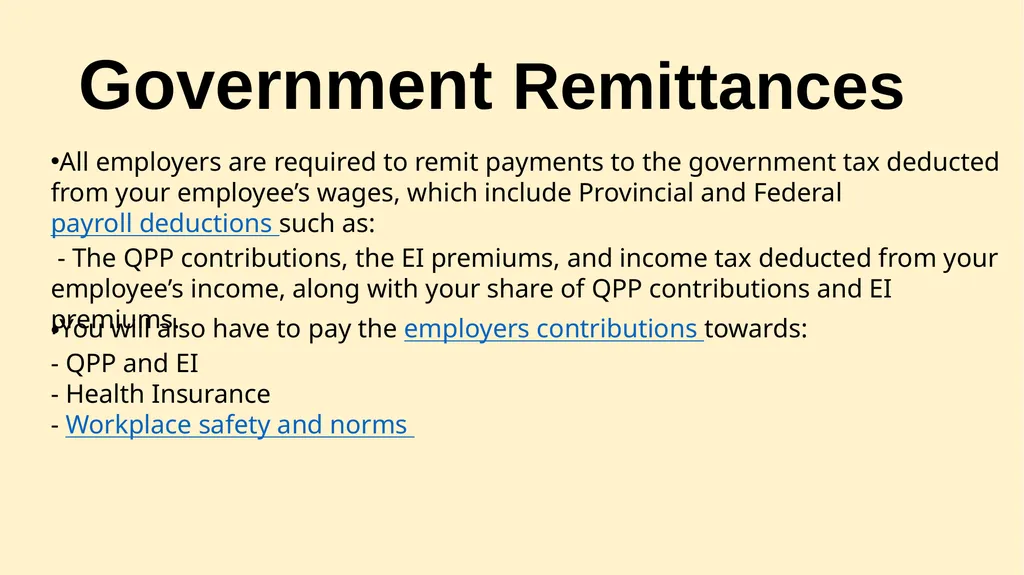
slide10. Government Remittances All employers are required to remit payments to the government tax deducted from your employee’s wages, which include Provincial and Federal payroll deductions such as:
- The QPP contributions, the EI premiums, and income tax deducted from your employee’s income, along with your share of QPP contributions and EI premiums. You will also have to pay the employers contributions towards:
- QPP and EI
- Health Insurance
- Workplace safety and norms<br>
slide11. Myself Last, but not the least, yourself! When doing financial projections, do not forget your salary to reflect reality.<br>
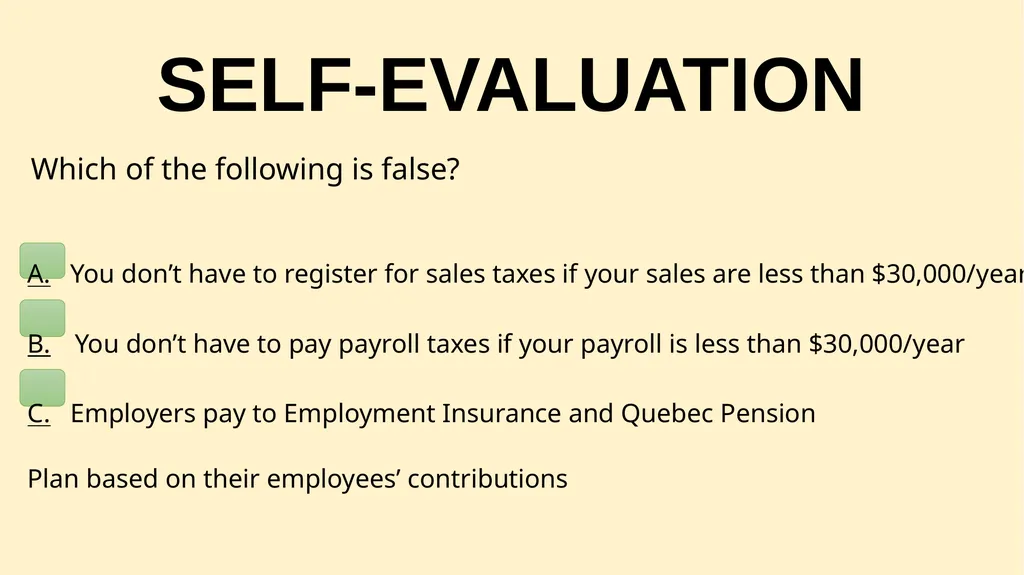
slide12. SELF-EVALUATION Which of the following is false? A. You don’t have to register for sales taxes if your sales are less than $30,000/year
B. You don’t have to pay payroll taxes if your payroll is less than $30,000/year
C. Employers pay to Employment Insurance and Quebec Pension Plan based on their employees’ contributions<br>
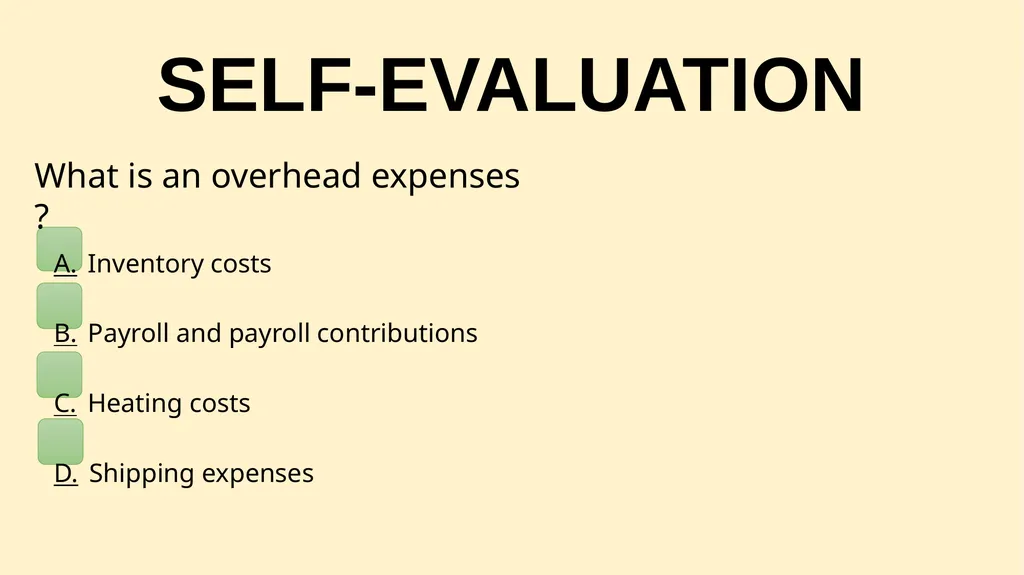
slide13. SELF-EVALUATION What is an overhead expenses? A. Inventory costs
B. Payroll and payroll contributions
C. Heating costs
D. Shipping expenses<br>
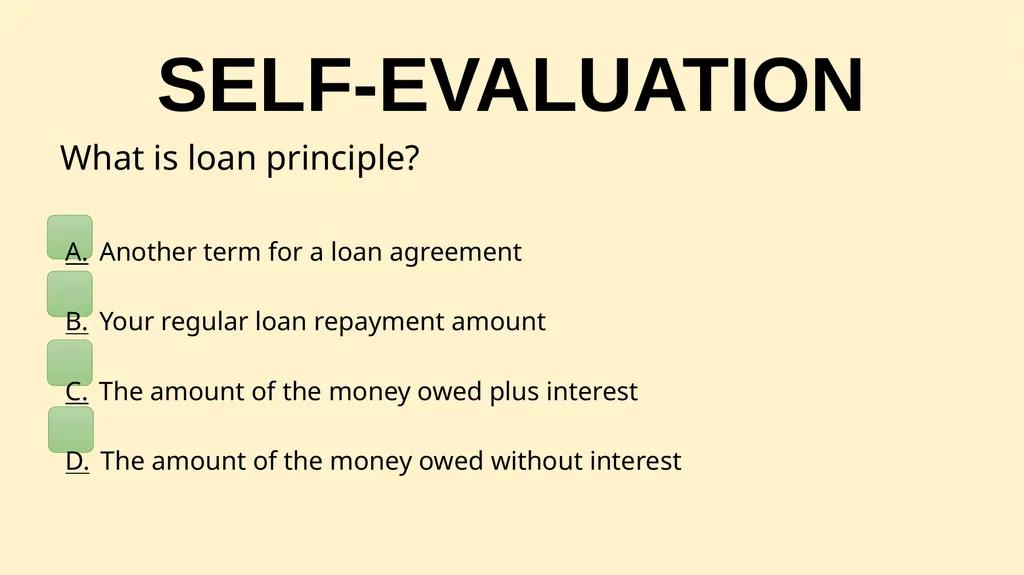
slide14. SELF-EVALUATION What is loan principle? A. Another term for a loan agreement
B. Your regular loan repayment amount
C. The amount of the money owed plus interest
D. The amount of the money owed without interest<br>
slide15. TRUE OR FALSE I always pay myself first, it is a question of surviving.<br>
slide16. TRUE OR FALSE If I pay my entire bill on time, I will always have a good credit score.<br>
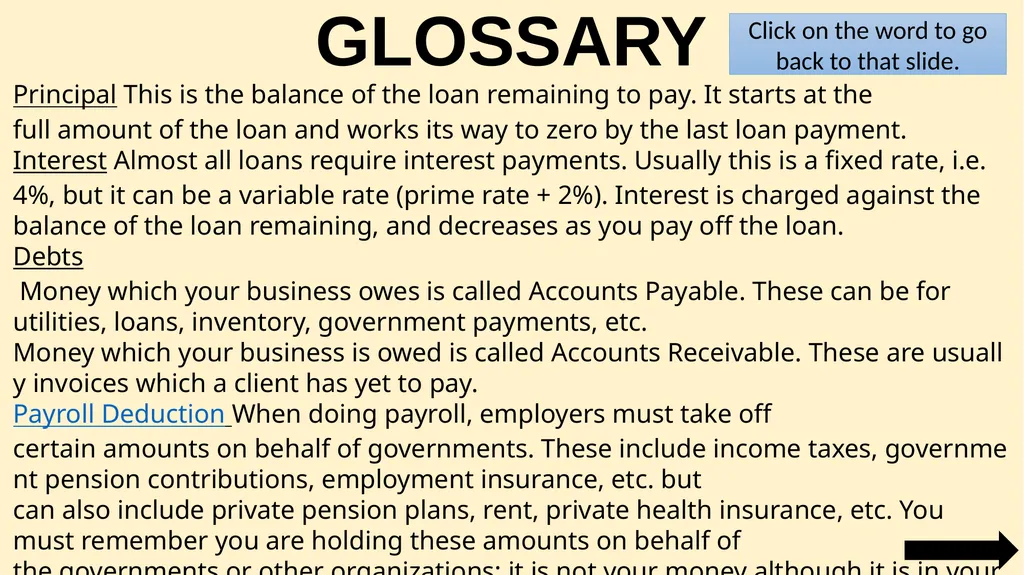
slide17. GLOSSARY Principal This is the balance of the loan remaining to pay. It starts at the full amount of the loan and works its way to zero by the last loan payment.
Interest Almost all loans require interest payments. Usually this is a fixed rate, i.e. 4%, but it can be a variable rate (prime rate + 2%). Interest is charged against the balance of the loan remaining, and decreases as you pay off the loan.
Debts Money which your business owes is called Accounts Payable. These can be for utilities, loans, inventory, government payments, etc. Money which your business is owed is called Accounts Receivable. These are usually invoices which a client has yet to pay.
Payroll Deduction When doing payroll, employers must take off certain amounts on behalf of governments. These include income taxes, government pension contributions, employment insurance, etc. but can also include private pension plans, rent, private health insurance, etc. You must remember you are holding these amounts on behalf of the governments or other organizations: it is not your money although it is in your bank account. You will have to pay these amounts regularly, often on a monthly basis. Click on the word to go back to that slide.<br>
slide18. Employer’s Contribution As an employer, you will also have to send to the government what is known as the employer’s contribution. Sometimes these are amounts based on how much you have deducted from all your employees (employment insurance, government pension plans). Other contributions, such as to the Quebec Health Insurance Plan, are a percentage of your total payroll. You should make sure these amounts are in your bank account so that when you send in your monthly remittance, you have enough to cover these debts. Workplace Safety and Norms There is another type of employer’s contribution businesses in Quebec have to pay. This is to the Commission des normes, de l'équité, de la santé et de la sécurité du travail or CNESST. This organization covers a variety of functions – it insures workers for work-related accidents, it maintains minimum wage standards, it mediates disputes between employers and employees for things such as statutory holiday payments and vacation pay, and a number of other issues involving the workplace. You will periodically receive a request for payment from CNESST, and how you will make the calculation. Then you pay the amount in the CNESST box on your regular Revenue Quebec remittances.<br>
slide19. Congratulations, you have completed this module! The next Module will be: Social Financing<br>
slide20. Congratulations, you are correct! Click here to continue.<br>
slide21. Sorry. Please try again. Click here to try again.<br>
slide22. Sorry. Please try again. Click here to try again.<br>
slide23. Congratulations, you are correct! Click here to continue.<br>
slide24. Sorry. Please try again. Click here to try again.<br>
slide25. Sorry. Please try again. Click here to try again.<br>
slide26. Sorry. Please try again. Click here to try again.<br>
slide27. Congratulations, you are correct! Click here to continue.<br>
slide28. Sorry. Please try again. Click here to try again.<br>
slide29. Sorry. Please try again. Click here to try again.<br>
slide30. Sorry. Please try again. Click here to try again.<br>
slide31. Congratulations, you are correct! Click here to continue.<br>
slide32. Sorry. Please try again. Click here to try again.<br>
slide33. Congratulations, you are correct! Click here to continue.<br>
slide34. Sorry. Please try again. Click here to try again.<br>
slide2. Seminar 15: WHOM DO I NEED TO PAY? A business has financial obligations just as we do as individuals.
Here are some important expenses to keep in mind:<br>
slide3. Loans You will have to repay the money previously borrowed from a lender according to the loan terms and conditions.
Typically, the loans are periodically repaid including principal and interest.
Common types of loans include auto loans, mortgages, credit card charges, businesss loans and other debts to a financial institution or organisation like KRG.<br>
slide4. Vendors, Suppliers (Bills And Invoices) You need to pay your suppliers in due time to keep a good relation with them. Not doing so will damage your reputation and could result in late payment charges and shortage in supplies. Agree with a system for resolving any payment disputes. Prompt payment could result in better deals from the seller.<br>
slide5. Hydro-Quebec It is difficult to imagine our life without electricity. Make sure you pay Hydro if you don’t want this to become a reality. Pro Tip: You normally have 21 days after receiving a bill to make the payment.<br>
slide6. Municipal Tax The municipal tax pays for services offered to the residents and businesses established in the municipality.<br>
slide7. Sales Taxes Collected You are considered as small suppliers if you do not exceed $30,000 of sales for the last year and do not have to collect sales taxes in this case.
If your sales are higher than $30,000 for the last four quarters, you have to register for GST and QST and start collecting it on taxable supplies.
Any amount of GST or QST you collect is considered to be held in trust for the government.<br>
slide8. Overhead Expenses Overhead includes accounting fees, advertising, insurance, interest, legal fees, labour burden, rent, repairs, telephone bills, travel expenditures, and other utilities.<br>
slide9. Employees As an employer, you have to pay wages to your employees.
You have to produce a regular pay period for the deposits and issue a pay sheet to your employees.<br>
slide10. Government Remittances All employers are required to remit payments to the government tax deducted from your employee’s wages, which include Provincial and Federal payroll deductions such as:
- The QPP contributions, the EI premiums, and income tax deducted from your employee’s income, along with your share of QPP contributions and EI premiums. You will also have to pay the employers contributions towards:
- QPP and EI
- Health Insurance
- Workplace safety and norms<br>
slide11. Myself Last, but not the least, yourself! When doing financial projections, do not forget your salary to reflect reality.<br>
slide12. SELF-EVALUATION Which of the following is false? A. You don’t have to register for sales taxes if your sales are less than $30,000/year
B. You don’t have to pay payroll taxes if your payroll is less than $30,000/year
C. Employers pay to Employment Insurance and Quebec Pension Plan based on their employees’ contributions<br>
slide13. SELF-EVALUATION What is an overhead expenses? A. Inventory costs
B. Payroll and payroll contributions
C. Heating costs
D. Shipping expenses<br>
slide14. SELF-EVALUATION What is loan principle? A. Another term for a loan agreement
B. Your regular loan repayment amount
C. The amount of the money owed plus interest
D. The amount of the money owed without interest<br>
slide15. TRUE OR FALSE I always pay myself first, it is a question of surviving.<br>
slide16. TRUE OR FALSE If I pay my entire bill on time, I will always have a good credit score.<br>
slide17. GLOSSARY Principal This is the balance of the loan remaining to pay. It starts at the full amount of the loan and works its way to zero by the last loan payment.
Interest Almost all loans require interest payments. Usually this is a fixed rate, i.e. 4%, but it can be a variable rate (prime rate + 2%). Interest is charged against the balance of the loan remaining, and decreases as you pay off the loan.
Debts Money which your business owes is called Accounts Payable. These can be for utilities, loans, inventory, government payments, etc. Money which your business is owed is called Accounts Receivable. These are usually invoices which a client has yet to pay.
Payroll Deduction When doing payroll, employers must take off certain amounts on behalf of governments. These include income taxes, government pension contributions, employment insurance, etc. but can also include private pension plans, rent, private health insurance, etc. You must remember you are holding these amounts on behalf of the governments or other organizations: it is not your money although it is in your bank account. You will have to pay these amounts regularly, often on a monthly basis. Click on the word to go back to that slide.<br>
slide18. Employer’s Contribution As an employer, you will also have to send to the government what is known as the employer’s contribution. Sometimes these are amounts based on how much you have deducted from all your employees (employment insurance, government pension plans). Other contributions, such as to the Quebec Health Insurance Plan, are a percentage of your total payroll. You should make sure these amounts are in your bank account so that when you send in your monthly remittance, you have enough to cover these debts. Workplace Safety and Norms There is another type of employer’s contribution businesses in Quebec have to pay. This is to the Commission des normes, de l'équité, de la santé et de la sécurité du travail or CNESST. This organization covers a variety of functions – it insures workers for work-related accidents, it maintains minimum wage standards, it mediates disputes between employers and employees for things such as statutory holiday payments and vacation pay, and a number of other issues involving the workplace. You will periodically receive a request for payment from CNESST, and how you will make the calculation. Then you pay the amount in the CNESST box on your regular Revenue Quebec remittances.<br>
slide19. Congratulations, you have completed this module! The next Module will be: Social Financing<br>
slide20. Congratulations, you are correct! Click here to continue.<br>
slide21. Sorry. Please try again. Click here to try again.<br>
slide22. Sorry. Please try again. Click here to try again.<br>
slide23. Congratulations, you are correct! Click here to continue.<br>
slide24. Sorry. Please try again. Click here to try again.<br>
slide25. Sorry. Please try again. Click here to try again.<br>
slide26. Sorry. Please try again. Click here to try again.<br>
slide27. Congratulations, you are correct! Click here to continue.<br>
slide28. Sorry. Please try again. Click here to try again.<br>
slide29. Sorry. Please try again. Click here to try again.<br>
slide30. Sorry. Please try again. Click here to try again.<br>
slide31. Congratulations, you are correct! Click here to continue.<br>
slide32. Sorry. Please try again. Click here to try again.<br>
slide33. Congratulations, you are correct! Click here to continue.<br>
slide34. Sorry. Please try again. Click here to try again.<br>