
Entrepreneurship Market Analysis (Project
MY
Published · 30 slides · 0 views

1 / 1

Description
Entrepreneurship Market Analysis (Project Formulation) Project Formulation Feasibility analysis Techno Economic analysis (Market demand analysis include) Project Design Network analysis Input analysis Financial analysis Social
Related Topics
Share
Embed code
Download this presentation From Below
"Entrepreneurship Market Analysis (Project" is the property of its rightful owner. Permission is granted to download and print the materials on this website for personal, non-commercial use only, and to display it on your personal computer provided you do not modify the materials and that you retain all copyright notices contained in the materials. By downloading content from our website, you accept the terms of this agreement.
Presentation Transcript
01
Entrepreneurship Market Analysis
(Project Formulation)<br>
(Project Formulation)<br>
02
Project Formulation Feasibility analysis
Techno – Economic analysis (Market demand analysis include)
Project Design & Network analysis
Input analysis
Financial analysis
Social Cost-Benefit analysis
Pre-investment analysis<br>
Techno – Economic analysis (Market demand analysis include)
Project Design & Network analysis
Input analysis
Financial analysis
Social Cost-Benefit analysis
Pre-investment analysis<br>
03
Market Demand Analysis Analysis of market Demand:
Market and demand analysis is concerned with two broad issues
What is likely aggregate demand for the product / service?
What share of the market will the proposed project enjoy?<br>
Market and demand analysis is concerned with two broad issues
What is likely aggregate demand for the product / service?
What share of the market will the proposed project enjoy?<br>
04
Market Demand Analysis Factors to be considered for getting the answers for the above:
Patterns of consumption growth
Income and price elasticity of demand
Composition of the market
Nature of competition
Availability of substitutes
Distribution channels
It establishes whether the project is technically feasible or not and whether it offers a basis for the estimation of costs.<br>
Patterns of consumption growth
Income and price elasticity of demand
Composition of the market
Nature of competition
Availability of substitutes
Distribution channels
It establishes whether the project is technically feasible or not and whether it offers a basis for the estimation of costs.<br>
05
Steps in market analysis: Situation analysis and specification of objectives:
Talk to customers, competitors, middlemen and others
For carrying out market survey spell out the objectives clearly
Questionnaire can help gathering the information in a way relevant for forecasting the demand<br>
Talk to customers, competitors, middlemen and others
For carrying out market survey spell out the objectives clearly
Questionnaire can help gathering the information in a way relevant for forecasting the demand<br>
06
Steps in market analysis: Collection of secondary inputs:
Secondary information is the one which was gathered in some other context and is available readily for the present consideration
Primary information is the one, which is collected for the first time to meet the specific purpose on hand.
Secondary information forms the basis and starting point for the market and demand analysis.
General sources of secondary information:<br>
Secondary information is the one which was gathered in some other context and is available readily for the present consideration
Primary information is the one, which is collected for the first time to meet the specific purpose on hand.
Secondary information forms the basis and starting point for the market and demand analysis.
General sources of secondary information:<br>
07
Steps in market analysis: Collection of secondary inputs:
Censes of India, National sample survey reports, Plan reports, India year book, Statistical year book, Economic survey, Guide lines to industries, Annual survey of industries, Publications of advertising agencies, Monthly bulletin of RBI, etc.
Annual reports of association of Indian automobile manufacturers
Journals of industry associations.
The relevance, reliability, accuracy are to be carefully studied in the information available in the secondary information.<br>
Censes of India, National sample survey reports, Plan reports, India year book, Statistical year book, Economic survey, Guide lines to industries, Annual survey of industries, Publications of advertising agencies, Monthly bulletin of RBI, etc.
Annual reports of association of Indian automobile manufacturers
Journals of industry associations.
The relevance, reliability, accuracy are to be carefully studied in the information available in the secondary information.<br>
08
Conduct of market survey: Secondary information may not provide a comprehensive basis often thus necessitating gathering primary information through market survey.
Census survey: Entire population is covered. It is suitable for intermediate goods, investment goods - where the number is less.
Sample survey: A sample of the population is contacted or observed. Inferences are made on the basis of the information gathered from the sample.<br>
Census survey: Entire population is covered. It is suitable for intermediate goods, investment goods - where the number is less.
Sample survey: A sample of the population is contacted or observed. Inferences are made on the basis of the information gathered from the sample.<br>
09
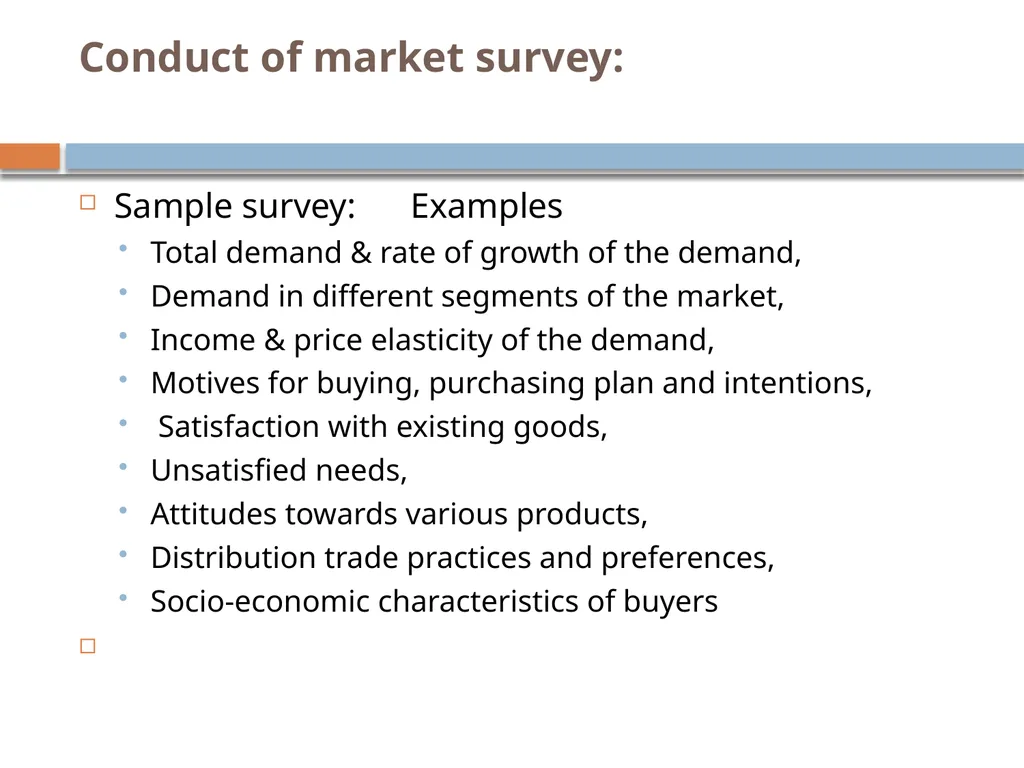
Conduct of market survey: Sample survey: Examples
Total demand & rate of growth of the demand,
Demand in different segments of the market,
Income & price elasticity of the demand,
Motives for buying, purchasing plan and intentions,
Satisfaction with existing goods,
Unsatisfied needs,
Attitudes towards various products,
Distribution trade practices and preferences,
Socio-economic characteristics of buyers<br>
Total demand & rate of growth of the demand,
Demand in different segments of the market,
Income & price elasticity of the demand,
Motives for buying, purchasing plan and intentions,
Satisfaction with existing goods,
Unsatisfied needs,
Attitudes towards various products,
Distribution trade practices and preferences,
Socio-economic characteristics of buyers<br>
10
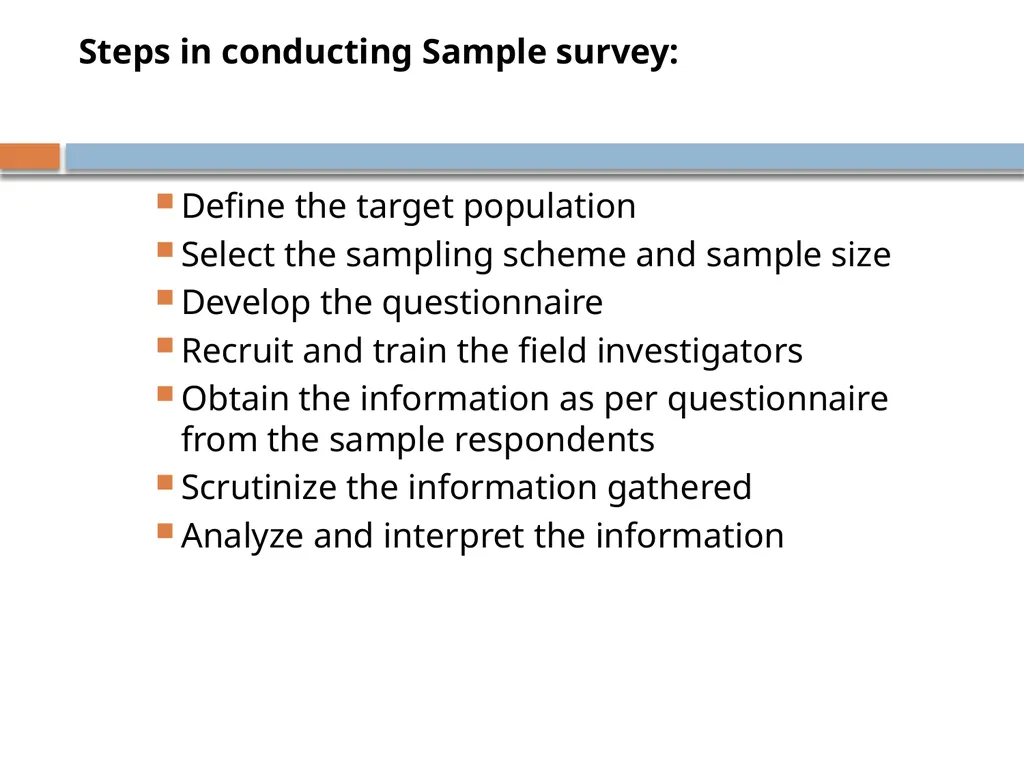
Steps in conducting Sample survey: Define the target population
Select the sampling scheme and sample size
Develop the questionnaire
Recruit and train the field investigators
Obtain the information as per questionnaire from the sample respondents
Scrutinize the information gathered
Analyze and interpret the information<br>
Select the sampling scheme and sample size
Develop the questionnaire
Recruit and train the field investigators
Obtain the information as per questionnaire from the sample respondents
Scrutinize the information gathered
Analyze and interpret the information<br>
11
Companies use market demand analysis to understand how much consumer demand exists for a product or service.
This analysis helps management determine if they can successfully enter a market and generate enough profits to advance their business operations.<br>
This analysis helps management determine if they can successfully enter a market and generate enough profits to advance their business operations.<br>
12
Market & Demand Analysis In most cases, the first step in project analysis is to estimate the potential size of the market for the product proposed to be manufactured and get an idea about the market share that is likely to be captured.
Given the importance of market and demand analysis, it should be carried out in an orderly and systematic manner.<br>
Given the importance of market and demand analysis, it should be carried out in an orderly and systematic manner.<br>
13
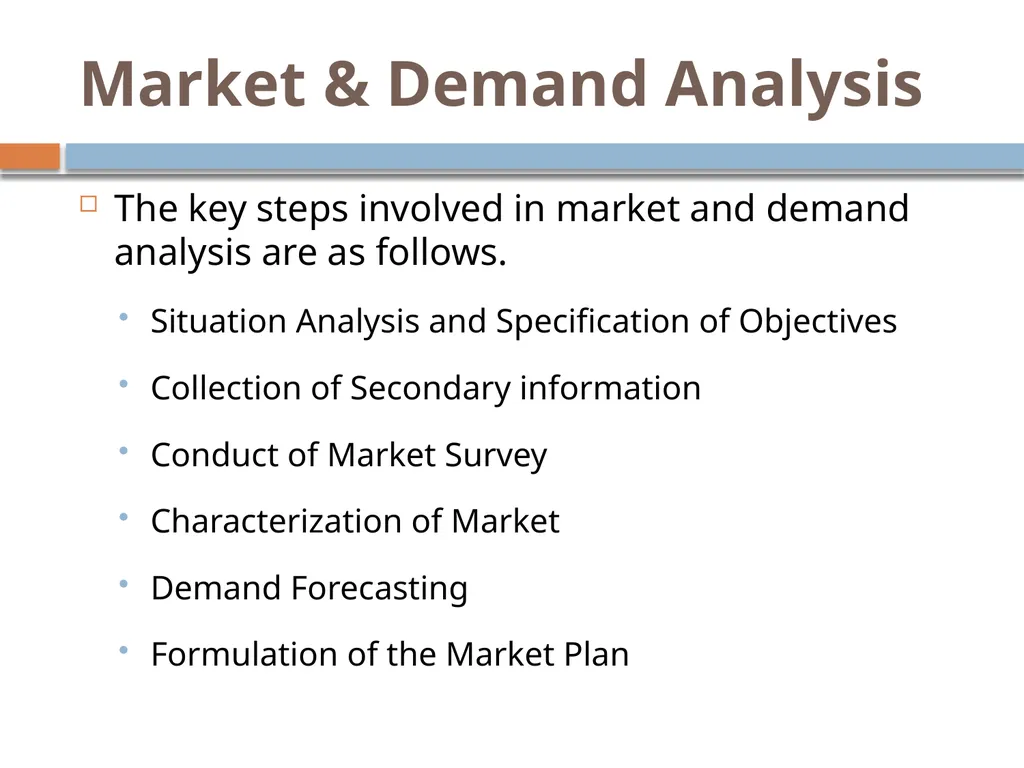
Market & Demand Analysis The key steps involved in market and demand analysis are as follows.
Situation Analysis and Specification of Objectives
Collection of Secondary information
Conduct of Market Survey
Characterization of Market
Demand Forecasting
Formulation of the Market Plan<br>
Situation Analysis and Specification of Objectives
Collection of Secondary information
Conduct of Market Survey
Characterization of Market
Demand Forecasting
Formulation of the Market Plan<br>
14
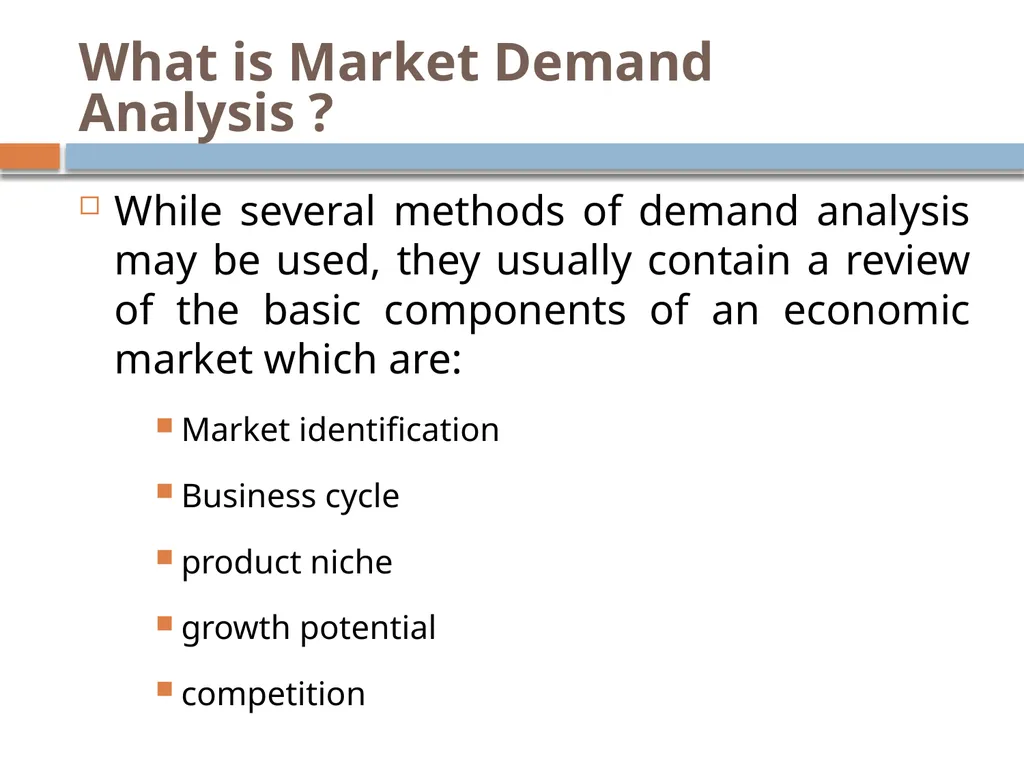
What is Market Demand Analysis ? While several methods of demand analysis may be used, they usually contain a review of the basic components of an economic market which are:
Market identification
Business cycle
product niche
growth potential
competition<br>
Market identification
Business cycle
product niche
growth potential
competition<br>
15
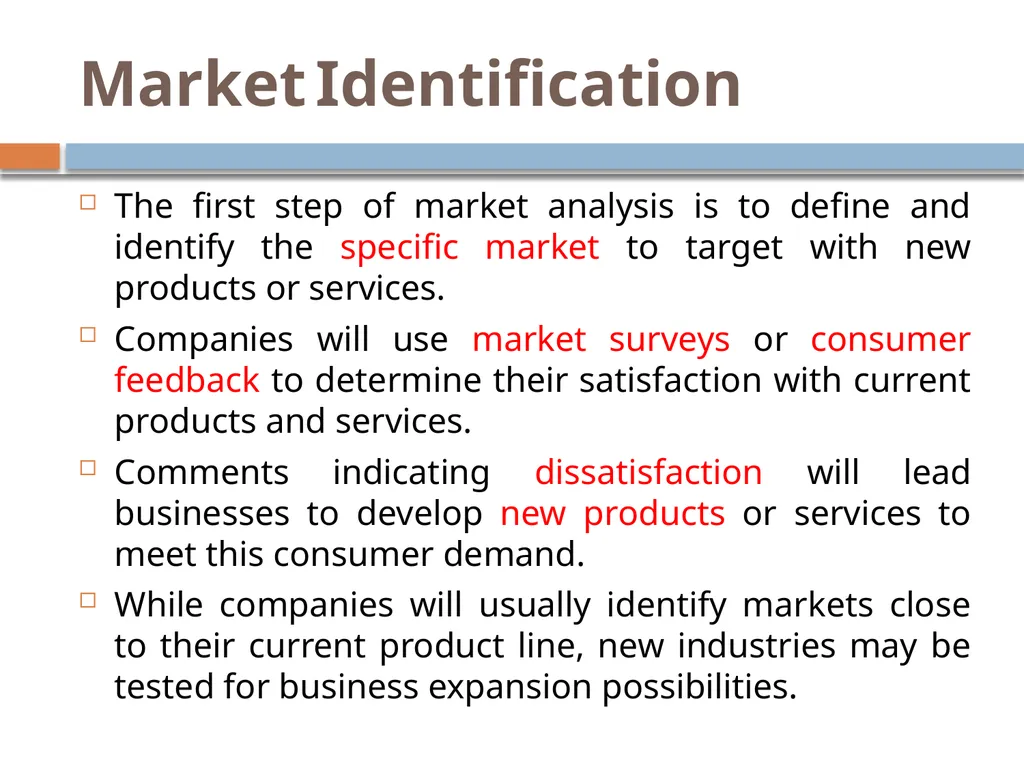
Market Identification The first step of market analysis is to define and identify the specific market to target with new products or services.
Companies will use market surveys or consumer feedback to determine their satisfaction with current products and services.
Comments indicating dissatisfaction will lead businesses to develop new products or services to meet this consumer demand.
While companies will usually identify markets close to their current product line, new industries may be tested for business expansion possibilities.<br>
Companies will use market surveys or consumer feedback to determine their satisfaction with current products and services.
Comments indicating dissatisfaction will lead businesses to develop new products or services to meet this consumer demand.
While companies will usually identify markets close to their current product line, new industries may be tested for business expansion possibilities.<br>
16
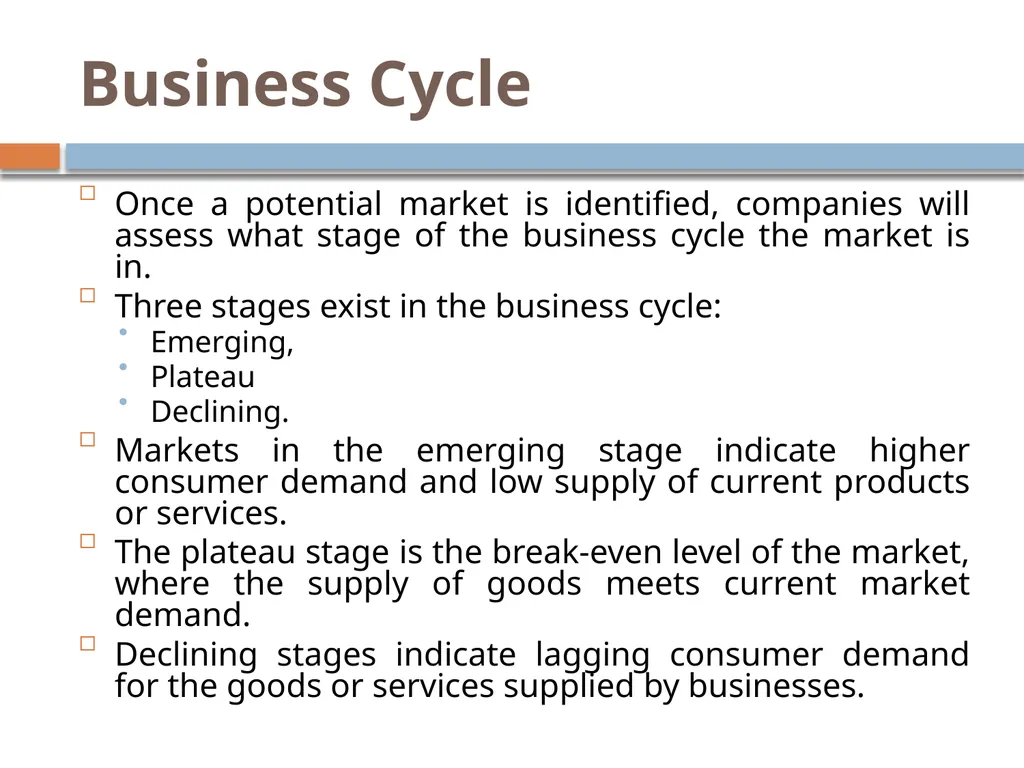
Business Cycle Once a potential market is identified, companies will assess what stage of the business cycle the market is in.
Three stages exist in the business cycle:
Emerging,
Plateau
Declining.
Markets in the emerging stage indicate higher consumer demand and low supply of current products or services.
The plateau stage is the break-even level of the market, where the supply of goods meets current market demand.
Declining stages indicate lagging consumer demand for the goods or services supplied by businesses.<br>
Three stages exist in the business cycle:
Emerging,
Plateau
Declining.
Markets in the emerging stage indicate higher consumer demand and low supply of current products or services.
The plateau stage is the break-even level of the market, where the supply of goods meets current market demand.
Declining stages indicate lagging consumer demand for the goods or services supplied by businesses.<br>
17
Product Niche Once markets and business cycles are reviewed, companies will develop a product that meets a specific niche in the market.
Products must be differentiated from others in the market so they meet a specific need of consumer demand, creating higher demand for their product or service.
Many companies will conduct tests in sample markets to determine which of their potential product styles is most preferred by consumers.
Companies will also develop their goods so that competitors cannot easily duplicate their product.<br>
Products must be differentiated from others in the market so they meet a specific need of consumer demand, creating higher demand for their product or service.
Many companies will conduct tests in sample markets to determine which of their potential product styles is most preferred by consumers.
Companies will also develop their goods so that competitors cannot easily duplicate their product.<br>
18
Growth Potential While every market has an initial level of consumer demand, specialized products or goods can create a sense of usefulness, which will increase demand.
Examples of specialized products are iPods or iPhones, which entered the personal electronics market and increased demand through their perceived usefulness by consumers.
This type of demand quickly increases the demand for current markets, allowing companies to increase profits through new consumer demand.<br>
Examples of specialized products are iPods or iPhones, which entered the personal electronics market and increased demand through their perceived usefulness by consumers.
This type of demand quickly increases the demand for current markets, allowing companies to increase profits through new consumer demand.<br>
19
Competition An important factor of market analysis is determining the number of competitors and their current market share.
Markets in the emerging stage of the business cycle tend to have fewer competitors, meaning a higher profit margin may be earned by companies.
Once a market becomes saturated with competing companies and products, fewer profits are achieved and companies will begin to lose money.
As markets enter the declining business cycle, companies will conduct a new market analysis to find more profitable markets.<br>
Markets in the emerging stage of the business cycle tend to have fewer competitors, meaning a higher profit margin may be earned by companies.
Once a market becomes saturated with competing companies and products, fewer profits are achieved and companies will begin to lose money.
As markets enter the declining business cycle, companies will conduct a new market analysis to find more profitable markets.<br>
20
Market Planning A marketing plan usually has the following components
Current marketing situation
Where is your organisation now?
Who are your customer groups? What are their needs and requirements? How large and diverse are they?
What kinds of products and services do you currently provide?
How do you reach your customer groupings?
Do you have any competition?
What factor/s in your environment has an effect on your organisation?<br>
Current marketing situation
Where is your organisation now?
Who are your customer groups? What are their needs and requirements? How large and diverse are they?
What kinds of products and services do you currently provide?
How do you reach your customer groupings?
Do you have any competition?
What factor/s in your environment has an effect on your organisation?<br>
21
Market Planning Opportunity and issue analysis (S.W.O.T. analysis). This identifies key issues and opportunities for your organisation and it comprises an analysis of your internal operations
Strengths
Weaknesses
Also those external factors, which effect your organisation
Opportunities
Threats<br>
Strengths
Weaknesses
Also those external factors, which effect your organisation
Opportunities
Threats<br>
22
Market Planning Objectives. Having identified the key issues affecting your organisation you can make some decisions about future objectives. These guide the development of strategies and action plans.
Objectives should meet certain criteria e.g. financial, and marketing which will be customer focused.
They should be clearly stated, measurable and listed in order of importance
They should be attainable and consistent with your organisation's culture.<br>
Objectives should meet certain criteria e.g. financial, and marketing which will be customer focused.
They should be clearly stated, measurable and listed in order of importance
They should be attainable and consistent with your organisation's culture.<br>
23
Market Planning Marketing strategy. This is the game plan that needs to be implemented to achieve the objectives. It addresses the following:
Whom are you now targeting?
What do you want your position to be in terms of new product/service delivery?
Do you want to change your organisation profile and will you need to rebrand your organisation?
Will you change the way you promote and advertise yourself?
Will there be any changes in how you reach your customer groupings?
Any changes in staff?
Is there a need for more research?<br>
Whom are you now targeting?
What do you want your position to be in terms of new product/service delivery?
Do you want to change your organisation profile and will you need to rebrand your organisation?
Will you change the way you promote and advertise yourself?
Will there be any changes in how you reach your customer groupings?
Any changes in staff?
Is there a need for more research?<br>
24
Market Planning Action program. This describes:What will be done
When will it be done?
Who will do it?
How much will it cost<br>
When will it be done?
Who will do it?
How much will it cost<br>
25
Market Planning Budget and controls. The Budget is essentially a cash flow statement and profit/loss statement to support the marketing plan
Control mechanisms and procedures should be established to monitor the progress of the plan to determine if anything needs changing. It would include a contingency plan in case something adverse should happen.<br>
Control mechanisms and procedures should be established to monitor the progress of the plan to determine if anything needs changing. It would include a contingency plan in case something adverse should happen.<br>
26
Demand Forecasting After gathering information about various aspects of the market and demand from primary and secondary sources.
An attempt may be made to estimate future demand.
These may classified in three categories as shown
Qualitative Methods
Time series projection Methods
Causal Methods
Jury of executive opinion Method
Chain ratio Method
Consumption level Method<br>
An attempt may be made to estimate future demand.
These may classified in three categories as shown
Qualitative Methods
Time series projection Methods
Causal Methods
Jury of executive opinion Method
Chain ratio Method
Consumption level Method<br>
27
Market Characterisation Based on the information gathered from secondary sources and through the market survey, the market for the product or service to be offered may be described in terms of the following:
Effective demand on the past and present
Breakdown of demand
Price
Methods of distribution and sales promotion
Consumers
Supply of competition
Government Policy<br>
Effective demand on the past and present
Breakdown of demand
Price
Methods of distribution and sales promotion
Consumers
Supply of competition
Government Policy<br>
28
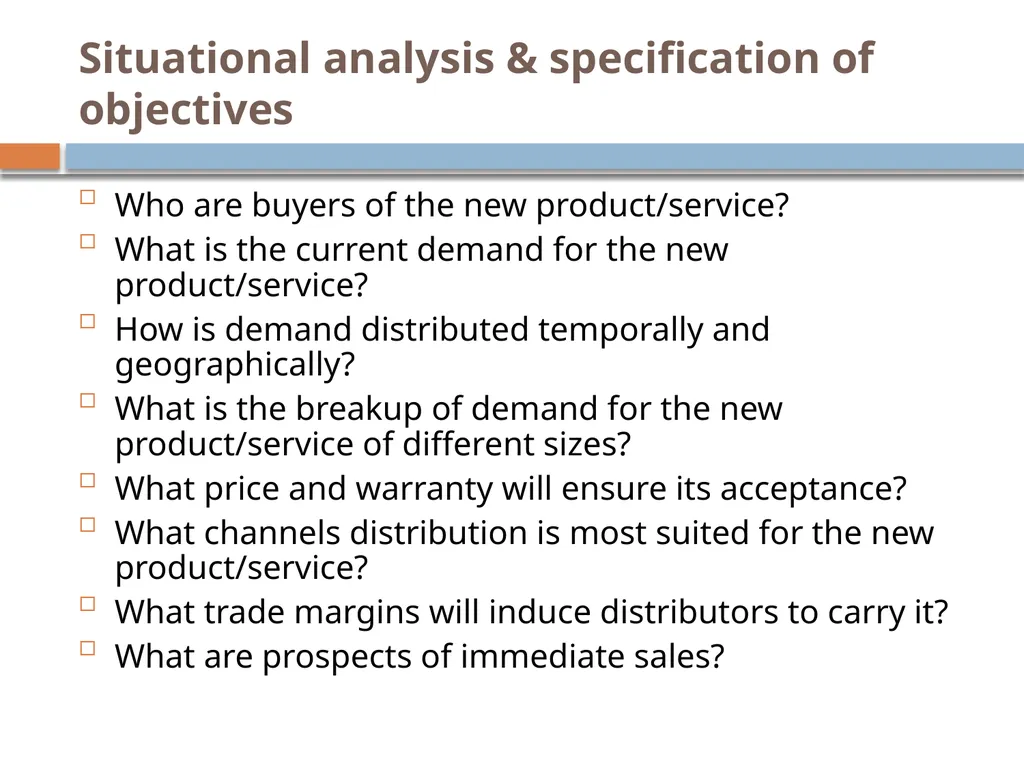
Situational analysis & specification of objectives In order to get a feel of the relationship between the product and its market, the project analyst may informally talk to customers’ competitors, middlemen and other in the industry.
Where and how to market the new product/service the objectives of the market and demand analysis in this case may be to answer the questions.<br>
Where and how to market the new product/service the objectives of the market and demand analysis in this case may be to answer the questions.<br>
29
Situational analysis & specification of objectives Who are buyers of the new product/service?
What is the current demand for the new product/service?
How is demand distributed temporally and geographically?
What is the breakup of demand for the new product/service of different sizes?
What price and warranty will ensure its acceptance?
What channels distribution is most suited for the new product/service?
What trade margins will induce distributors to carry it?
What are prospects of immediate sales?<br>
What is the current demand for the new product/service?
How is demand distributed temporally and geographically?
What is the breakup of demand for the new product/service of different sizes?
What price and warranty will ensure its acceptance?
What channels distribution is most suited for the new product/service?
What trade margins will induce distributors to carry it?
What are prospects of immediate sales?<br>