
Entrepreneurship: Successfully Launching New


Description: Entrepreneurship: Successfully Launching New Ventures Sixth Edition, Global Edition Chapter 2 Recognizing Opportunities and Generating Ideas Learning Objectives 2.1 Explain the difference between opportunities and ideas. 2.2 Describe the
Related Topics
Download Presentation
"Entrepreneurship: Successfully Launching New" is the property of its rightful owner. Permission is granted to download and print the materials on this website for personal, non-commercial use only, and to display it on your personal computer provided you do not modify the materials and that you retain all copyright notices contained in the materials. By downloading content from our website, you accept the terms of this agreement.
Presentation Transcript
slide1. Entrepreneurship: Successfully Launching New Ventures Sixth Edition, Global Edition Chapter 2 Recognizing Opportunities and Generating Ideas<br>
slide2. Learning Objectives 2.1 Explain the difference between opportunities and ideas.
2.2 Describe the three general approaches entrepreneurs use to identify opportunities.
2.3 Discuss the personal characteristics of entrepreneurs that contribute to their ability to recognize business opportunities.
2.4 Identify and describe techniques entrepreneurs use to generate ideas.<br>
slide3. What is an Opportunity? (1 of 2) Opportunity Defined
An opportunity is a favorable set of circumstances that creates a need for a new product, service, or business.<br>
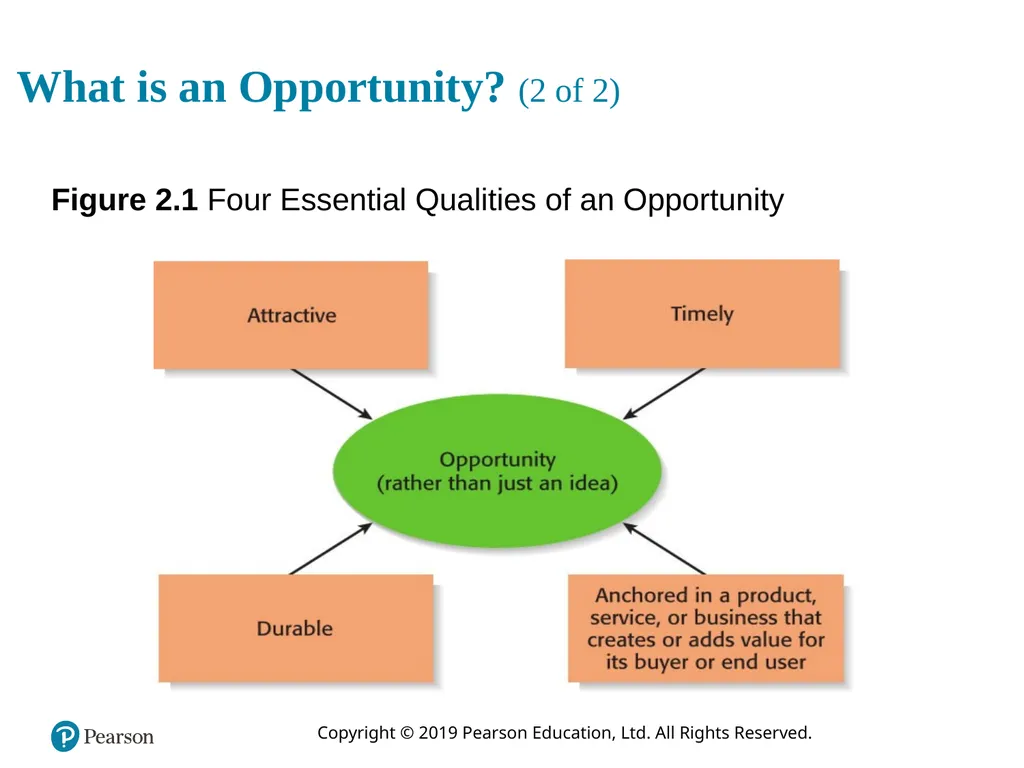
slide4. What is an Opportunity? (2 of 2) Figure 2.1 Four Essential Qualities of an Opportunity<br>
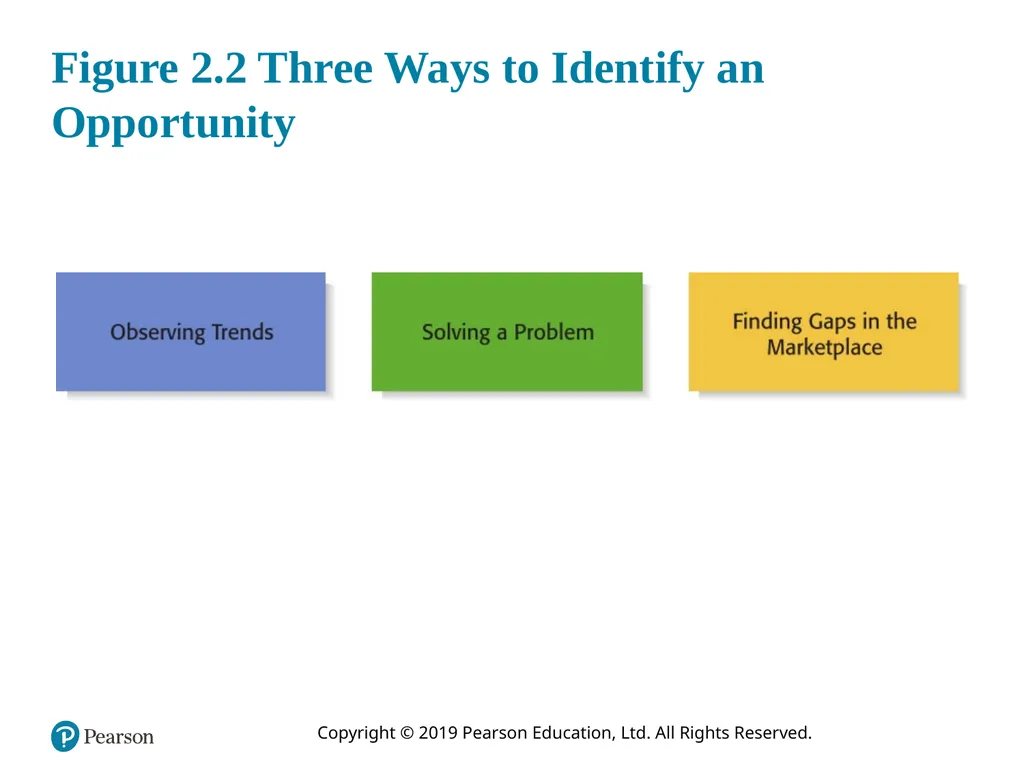
slide5. Figure 2.2 Three Ways to Identify an Opportunity<br>
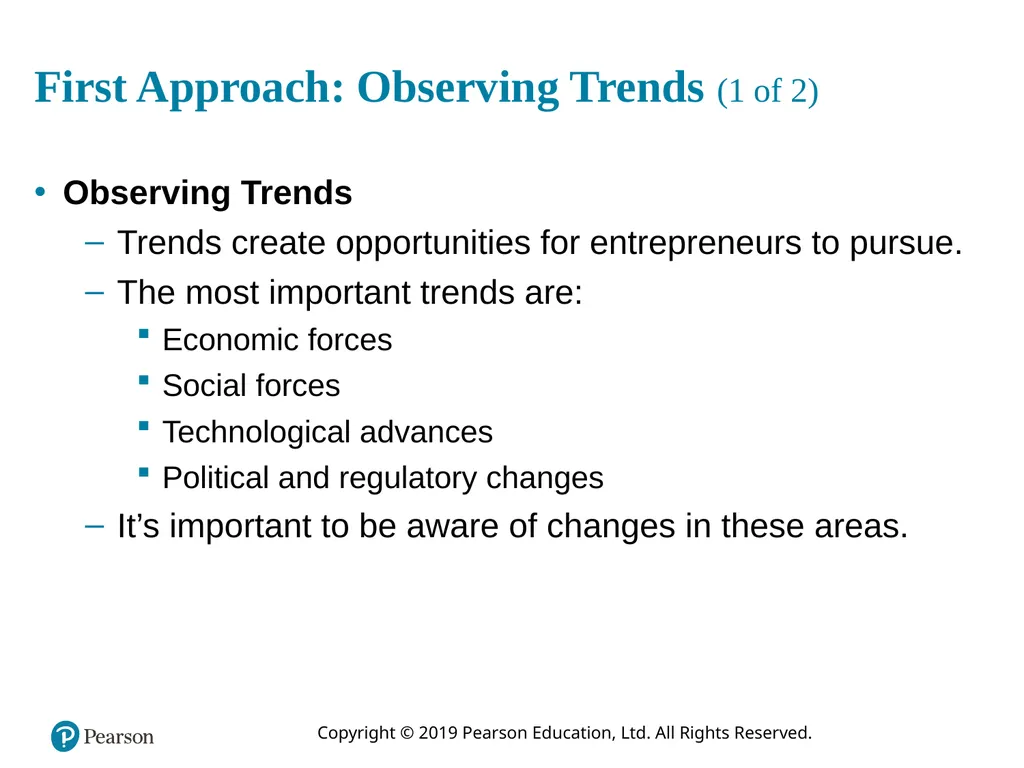
slide6. First Approach: Observing Trends (1 of 2) Observing Trends
Trends create opportunities for entrepreneurs to pursue.
The most important trends are:
Economic forces
Social forces
Technological advances
Political and regulatory changes
It’s important to be aware of changes in these areas.<br>
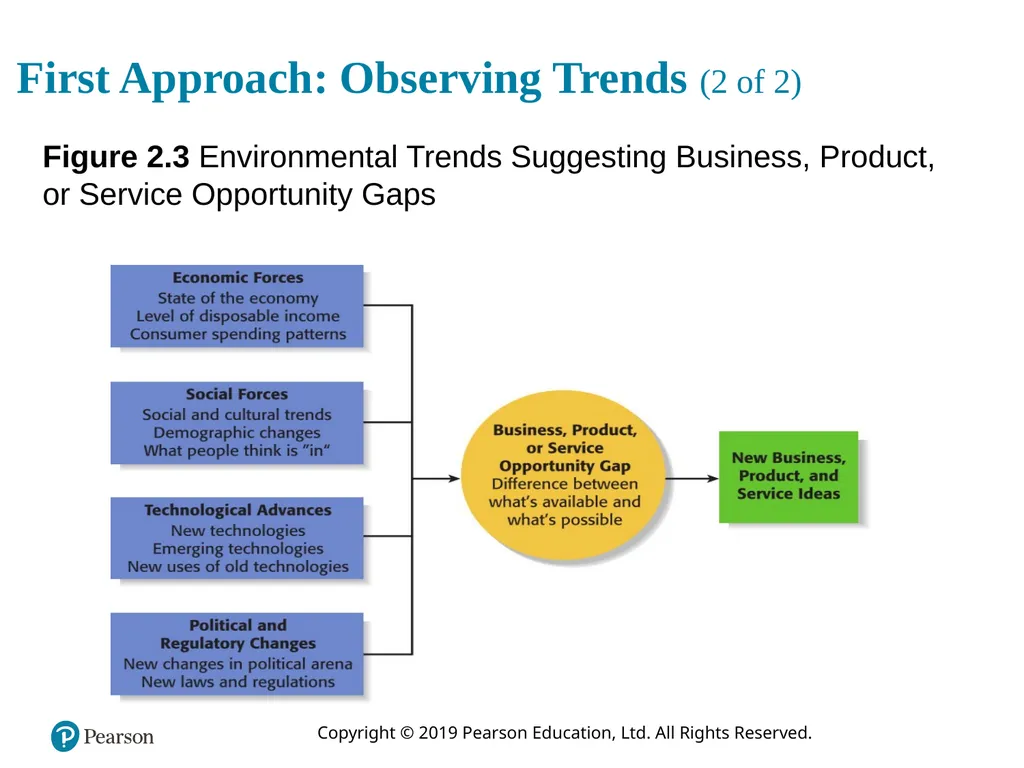
slide7. First Approach: Observing Trends (2 of 2) Figure 2.3 Environmental Trends Suggesting Business, Product, or Service Opportunity Gaps<br>
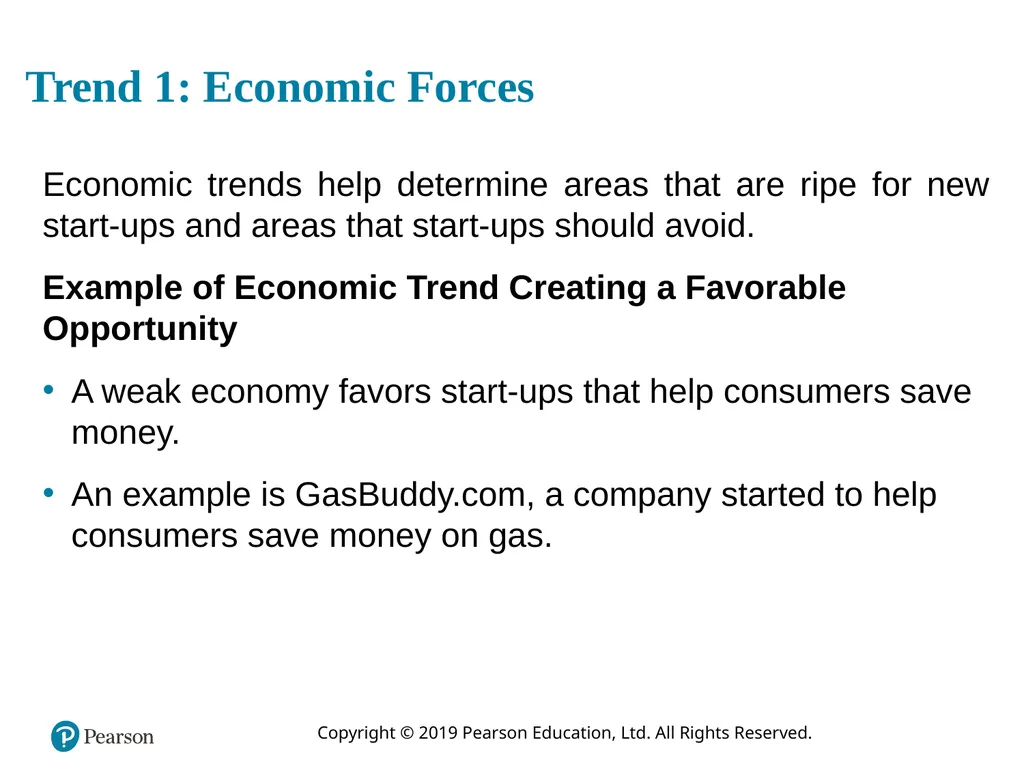
slide8. Trend 1: Economic Forces Economic trends help determine areas that are ripe for new start-ups and areas that start-ups should avoid.
Example of Economic Trend Creating a Favorable Opportunity
A weak economy favors start-ups that help consumers save money.
An example is GasBuddy.com, a company started to help consumers save money on gas.<br>
slide9. Trend 2: Social Forces Social trends alter how people and businesses behave and set their priorities. These trends provide opportunities for new businesses to accommodate the changes.
Examples of Social Trends
Aging of the population.
The increasing diversity of the population.
Millennials entering the workforce.
Growth in the use of mobile devices.
An increasing focus on health and wellness.<br>
slide10. Trend 3: Technological Advances (1 of 2) Advances in technology frequently create business opportunities.
Examples of Entire Industries that Have Been Created as the Result of Technological Advances
Computer industry
Internet
Biotechnology
Digital photography<br>
slide11. Trend 3: Technological Advances (2 of 2) Once a technology is created, products often emerge to advance it.
Example: Rokit Boost
An example is Rokit Boost, a high-end mobile accessories company that makes smartphone cases, headphones, portable USB device chargers, and Bluetooth speakers. Rokit Boost wouldn’t exist if it weren’t for the advent of the smartphone.<br>
slide12. Trend 4: Political Action and Regulatory Changes (1 of 2) Political and regulatory changes also provide the basis for opportunities.
General Example
This happened with the passage of the Affordable Care Act in 2010. The provisions of the act yielded opportunities for entrepreneurs to launch electronic records start-ups, apps to help patients monitor their medication, and similar companies.<br>
slide13. Trend 4: Political Action and Regulatory Changes (2 of 2) Political change also engenders new business and product opportunities. For example, global political instability and the threat of terrorism have resulted in many firms becoming more security-conscious.
Specific Example
Evolv Technology is a start-up that has assembled a multidisciplinary team of experts to identify, invent, and apply new technologies to meet current terrorism-related threats.<br>
slide14. Second Approach: Solving a Problem (1 of 2) Solving a Problem
Sometimes identifying opportunities simply involves noticing a problem and finding a way to solve it.
These problems can be pinpointed through observing trends and through more simple means, such as intuition, serendipity, or chance.
Many companies have been started by people who have experienced a problem in their own lives, and then realized that the solution to the problem represented a business opportunity.<br>
slide15. Second Approach: Solving a Problem (2 of 2) Specific Example
Sometimes people aren’t able to access energy to recharge their smartphones for a period of time. A number of companies have solved this problem in innovative ways. An example is the $70 Eton BoostTurbin 2000, which is a device that weighs less than four ounces. It combines a battery with a hand crank that provides enough power to fully charge a typical smartphone.<br>
slide16. Third Approach: Finding Gaps in the Marketplace (1 of 2) Gaps in the Marketplace
A third approach to identifying opportunities is to find a gap in the marketplace.
A gap in the marketplace is often created when a product or service is needed by a specific group of people but doesn’t represent a large enough market to be of interest to mainstream retailers or manufacturers.<br>
slide17. Third Approach: Finding Gaps in the Marketplace (2 of 2) Product gaps in the marketplace represent potentially viable business opportunities.
Specific Example
Tish Cirovolo realized there were no guitars on the market made specifically for females. To fill this gap, she started Daisy Rock Guitars, a company that makes guitars just for women and girls. Daisy Rock guitars are stylish, come in feminine colors, and incorporate design features that accommodate a woman’s smaller hand and build.<br>
slide18. Personal Characteristics of the Entrepreneur Characteristics that tend to make some people better at recognizing opportunities than others
Prior Industry Experience
Cognitive Factors
Social Networks
Creativity<br>
slide19. Prior Industry Experience (1 of 2) Prior Industry Experience
Studies have shown that prior experience in an industry helps an entrepreneur recognize business opportunities.
By working in an industry, an individual may spot a market niche that is underserved.
It is also possible that by working in an industry, an individual builds a network of social contacts who provide insights that lead to recognizing new opportunities.<br>
slide20. Prior Industry Experience (2 of 2) Prior Industry Experience
It is also important to note that anecdotal evidence suggests that people outside an industry can sometimes enter it with a new set of eyes, and as a result innovate in ways that people with prior experience might find difficult.
For example, Elon Musk, the founder of Tesla, had no prior experience in the auto industry.
Debbie Fields, the founder of Mrs. Fields Cookies, had no prior experience in the food industry.<br>
slide21. Cognitive Factors Cognitive Factors
Studies have shown that opportunity recognition may be an innate skill or cognitive process.
Some people believe that entrepreneurs have a “sixth sense” that allows them to see opportunities that others miss.
This “sixth sense” is called entrepreneurial alertness, which is formally defined as the ability to notice things without engaging in deliberate search.<br>
slide22. Social Networks (1 of 3) Social Networks
The extent and depth of an individual’s social network affects opportunity recognition.
People who build a substantial network of social and professional contacts will be exposed to more opportunities and ideas than people with sparse networks.
Research results suggest that between 40% and 50% of people who start a business got their idea via a social contact.
Strong-Tie Vs. Weak-Tie Relationships
All of us have relationships with other people that are called “ties.” (See next slide.)<br>
slide23. Social Networks (2 of 3) Nature of Strong-Tie Vs. Weak-Tie Relationships
Strong-tie relationships are characterized by frequent interaction and form between coworkers, friends, and spouses.
Weak-tie relationships are characterized by infrequent interaction and form between casual acquaintances.
Result
It is more likely that an entrepreneur will get new business ideas through weak-tie rather than strong-tie relationships. (See next slide.)<br>
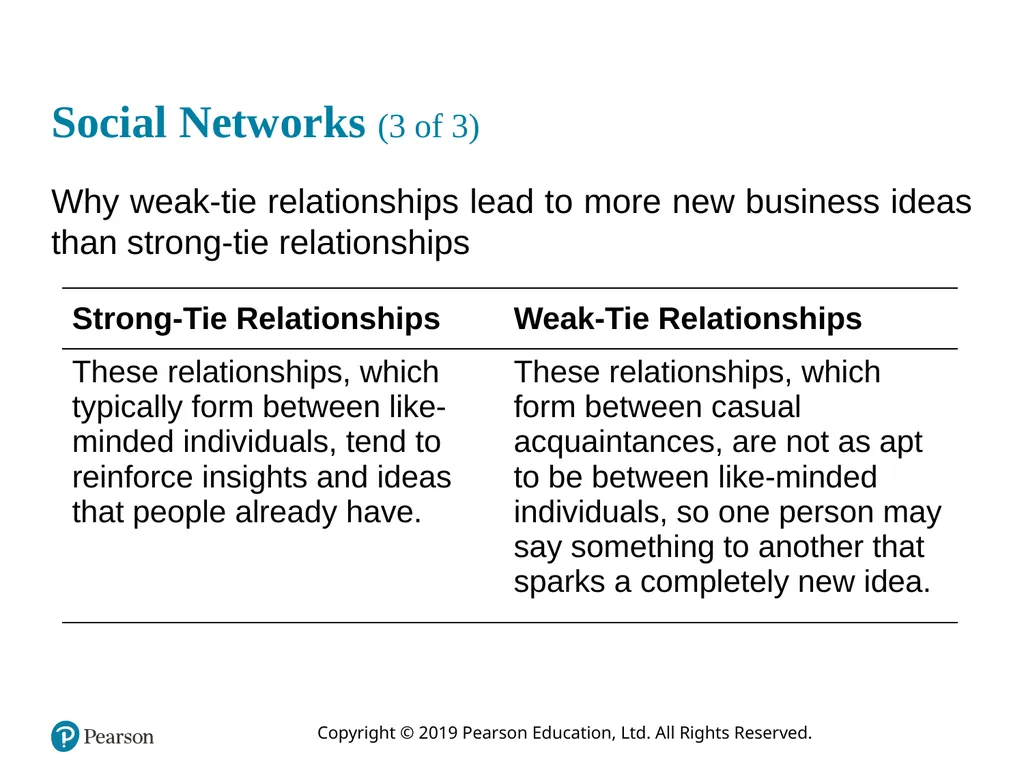
slide24. Social Networks (3 of 3) Why weak-tie relationships lead to more new business ideas than strong-tie relationships<br>
slide25. Creativity (1 of 2) Creativity
Creativity is the process of generating a novel or useful idea.
Opportunity recognition may be, at least in part, a creative process.
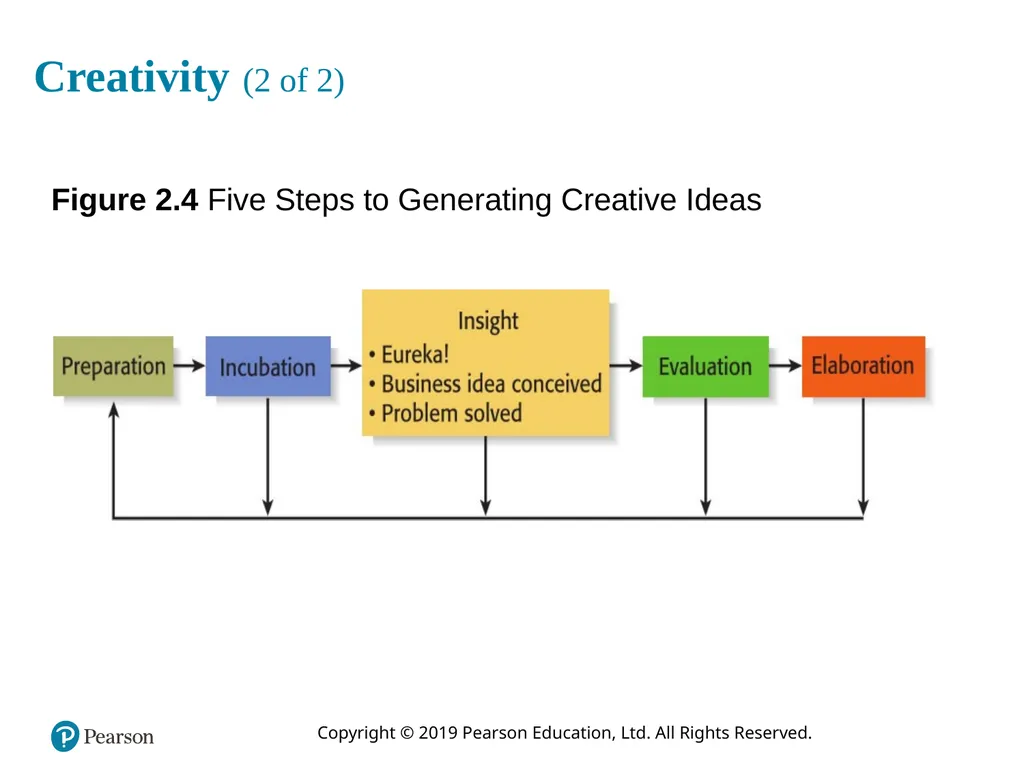
For an individual, the creative process can be broken down into five stages, as shown on the next slide.<br>
slide26. Creativity (2 of 2) Figure 2.4 Five Steps to Generating Creative Ideas<br>
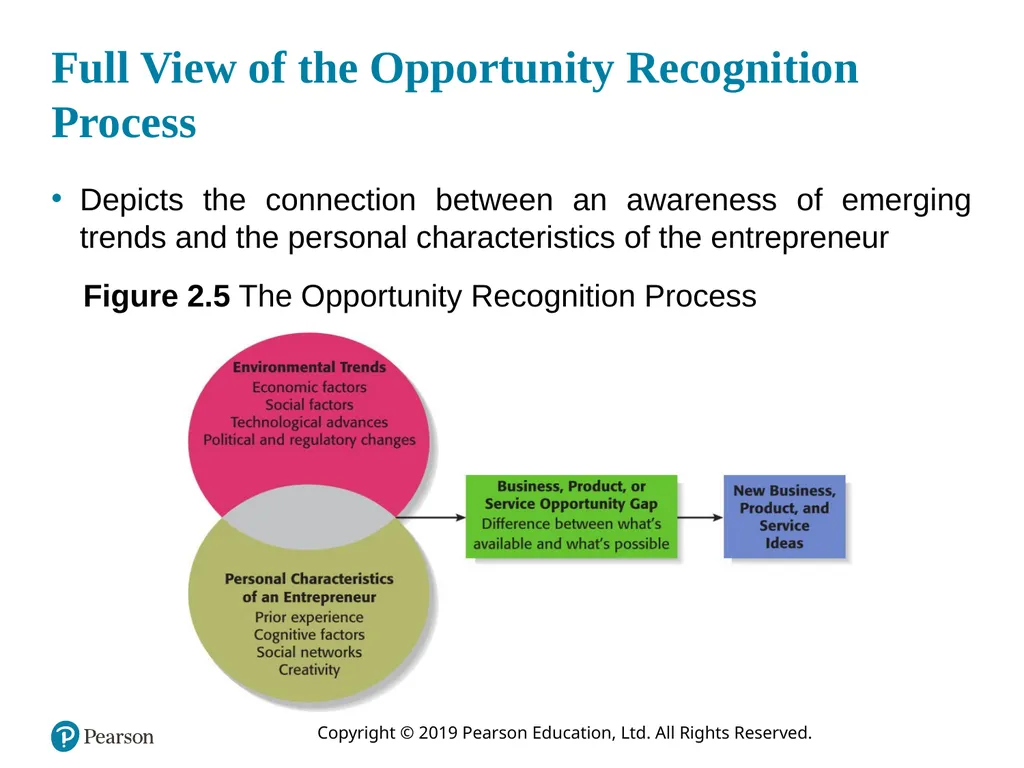
slide27. Full View of the Opportunity Recognition Process Depicts the connection between an awareness of emerging trends and the personal characteristics of the entrepreneur
Figure 2.5 The Opportunity Recognition Process<br>
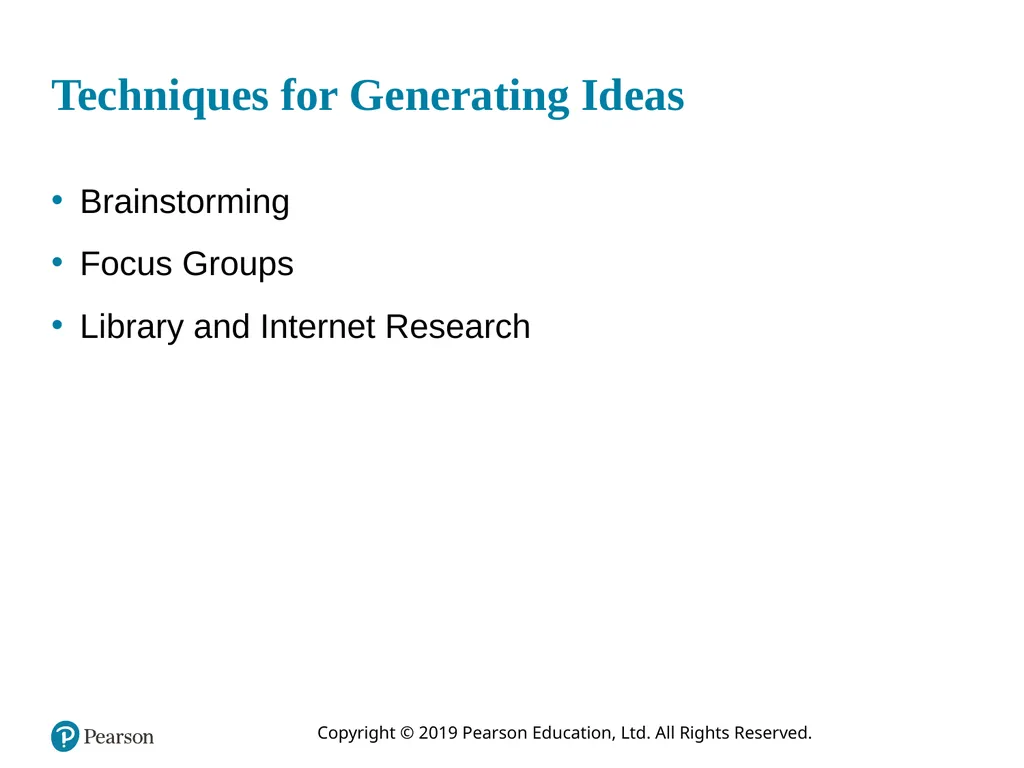
slide28. Techniques for Generating Ideas Brainstorming
Focus Groups
Library and Internet Research<br>
slide29. Brainstorming Brainstorming
Is the process of generating several ideas about a specific topic.
A brainstorming “session” typically involves a group of people, and should be targeted to a specific topic.
Rules for a brainstorming session:
No criticism.
Freewheeling is encouraged.
The session should move quickly.
Leap-frogging is encouraged.<br>
slide30. Focus Groups Focus Group
Focus groups involve a group of people who are familiar with a topic, are brought together to respond to questions, and who are able to shed light on an issue through the give-and-take nature of group discussions.
They work best as a follow-up to brainstorming, when the general idea for a business has been formulated but further refinement of the idea is needed.<br>
slide31. Library and Internet Research (1 of 3) Library Research
Libraries are an often underutilized source of information for generating new business ideas.
The best approach is to talk to a reference librarian, who can point out useful resources, such as industry-specific magazines, trade journals, and industry reports.
Simply browsing through several issues of a trade journal or an industry report on a topic can spark new ideas.<br>
slide32. Library and Internet Research (2 of 3) Large public and university libraries typically have access to search engines and industry reports that would cost thousands of dollars to access on your own.
Examples of Useful Search Engines and Industry Reports
BizMiner
ProQuest
IBISWorld
Mintel
LexisNexis Academic<br>
slide33. Library and Internet Research (3 of 3) Internet Research
If you are starting from scratch, simply typing “new business ideas” into a search engine will produce links to newspaper and magazine articles about the “hottest” and “latest” new business ideas.
If you have a specific topic in mind, setting up Google mail alerts will provide you with links to a constant stream of newspaper articles, blog posts, and news releases about the topic.
Targeted searches are also useful.<br>
slide34. Other Techniques Customer Advisory Boards
Some companies set up customer advisory boards that meet regularly to discuss needs, wants, and problems that may lead to new ideas.
Day-In-The-Life Research
A type of anthropological research, where the employees of a company spend a day with a customer.<br>
slide35. The End<br>
slide2. Learning Objectives 2.1 Explain the difference between opportunities and ideas.
2.2 Describe the three general approaches entrepreneurs use to identify opportunities.
2.3 Discuss the personal characteristics of entrepreneurs that contribute to their ability to recognize business opportunities.
2.4 Identify and describe techniques entrepreneurs use to generate ideas.<br>
slide3. What is an Opportunity? (1 of 2) Opportunity Defined
An opportunity is a favorable set of circumstances that creates a need for a new product, service, or business.<br>
slide4. What is an Opportunity? (2 of 2) Figure 2.1 Four Essential Qualities of an Opportunity<br>
slide5. Figure 2.2 Three Ways to Identify an Opportunity<br>
slide6. First Approach: Observing Trends (1 of 2) Observing Trends
Trends create opportunities for entrepreneurs to pursue.
The most important trends are:
Economic forces
Social forces
Technological advances
Political and regulatory changes
It’s important to be aware of changes in these areas.<br>
slide7. First Approach: Observing Trends (2 of 2) Figure 2.3 Environmental Trends Suggesting Business, Product, or Service Opportunity Gaps<br>
slide8. Trend 1: Economic Forces Economic trends help determine areas that are ripe for new start-ups and areas that start-ups should avoid.
Example of Economic Trend Creating a Favorable Opportunity
A weak economy favors start-ups that help consumers save money.
An example is GasBuddy.com, a company started to help consumers save money on gas.<br>
slide9. Trend 2: Social Forces Social trends alter how people and businesses behave and set their priorities. These trends provide opportunities for new businesses to accommodate the changes.
Examples of Social Trends
Aging of the population.
The increasing diversity of the population.
Millennials entering the workforce.
Growth in the use of mobile devices.
An increasing focus on health and wellness.<br>
slide10. Trend 3: Technological Advances (1 of 2) Advances in technology frequently create business opportunities.
Examples of Entire Industries that Have Been Created as the Result of Technological Advances
Computer industry
Internet
Biotechnology
Digital photography<br>
slide11. Trend 3: Technological Advances (2 of 2) Once a technology is created, products often emerge to advance it.
Example: Rokit Boost
An example is Rokit Boost, a high-end mobile accessories company that makes smartphone cases, headphones, portable USB device chargers, and Bluetooth speakers. Rokit Boost wouldn’t exist if it weren’t for the advent of the smartphone.<br>
slide12. Trend 4: Political Action and Regulatory Changes (1 of 2) Political and regulatory changes also provide the basis for opportunities.
General Example
This happened with the passage of the Affordable Care Act in 2010. The provisions of the act yielded opportunities for entrepreneurs to launch electronic records start-ups, apps to help patients monitor their medication, and similar companies.<br>
slide13. Trend 4: Political Action and Regulatory Changes (2 of 2) Political change also engenders new business and product opportunities. For example, global political instability and the threat of terrorism have resulted in many firms becoming more security-conscious.
Specific Example
Evolv Technology is a start-up that has assembled a multidisciplinary team of experts to identify, invent, and apply new technologies to meet current terrorism-related threats.<br>
slide14. Second Approach: Solving a Problem (1 of 2) Solving a Problem
Sometimes identifying opportunities simply involves noticing a problem and finding a way to solve it.
These problems can be pinpointed through observing trends and through more simple means, such as intuition, serendipity, or chance.
Many companies have been started by people who have experienced a problem in their own lives, and then realized that the solution to the problem represented a business opportunity.<br>
slide15. Second Approach: Solving a Problem (2 of 2) Specific Example
Sometimes people aren’t able to access energy to recharge their smartphones for a period of time. A number of companies have solved this problem in innovative ways. An example is the $70 Eton BoostTurbin 2000, which is a device that weighs less than four ounces. It combines a battery with a hand crank that provides enough power to fully charge a typical smartphone.<br>
slide16. Third Approach: Finding Gaps in the Marketplace (1 of 2) Gaps in the Marketplace
A third approach to identifying opportunities is to find a gap in the marketplace.
A gap in the marketplace is often created when a product or service is needed by a specific group of people but doesn’t represent a large enough market to be of interest to mainstream retailers or manufacturers.<br>
slide17. Third Approach: Finding Gaps in the Marketplace (2 of 2) Product gaps in the marketplace represent potentially viable business opportunities.
Specific Example
Tish Cirovolo realized there were no guitars on the market made specifically for females. To fill this gap, she started Daisy Rock Guitars, a company that makes guitars just for women and girls. Daisy Rock guitars are stylish, come in feminine colors, and incorporate design features that accommodate a woman’s smaller hand and build.<br>
slide18. Personal Characteristics of the Entrepreneur Characteristics that tend to make some people better at recognizing opportunities than others
Prior Industry Experience
Cognitive Factors
Social Networks
Creativity<br>
slide19. Prior Industry Experience (1 of 2) Prior Industry Experience
Studies have shown that prior experience in an industry helps an entrepreneur recognize business opportunities.
By working in an industry, an individual may spot a market niche that is underserved.
It is also possible that by working in an industry, an individual builds a network of social contacts who provide insights that lead to recognizing new opportunities.<br>
slide20. Prior Industry Experience (2 of 2) Prior Industry Experience
It is also important to note that anecdotal evidence suggests that people outside an industry can sometimes enter it with a new set of eyes, and as a result innovate in ways that people with prior experience might find difficult.
For example, Elon Musk, the founder of Tesla, had no prior experience in the auto industry.
Debbie Fields, the founder of Mrs. Fields Cookies, had no prior experience in the food industry.<br>
slide21. Cognitive Factors Cognitive Factors
Studies have shown that opportunity recognition may be an innate skill or cognitive process.
Some people believe that entrepreneurs have a “sixth sense” that allows them to see opportunities that others miss.
This “sixth sense” is called entrepreneurial alertness, which is formally defined as the ability to notice things without engaging in deliberate search.<br>
slide22. Social Networks (1 of 3) Social Networks
The extent and depth of an individual’s social network affects opportunity recognition.
People who build a substantial network of social and professional contacts will be exposed to more opportunities and ideas than people with sparse networks.
Research results suggest that between 40% and 50% of people who start a business got their idea via a social contact.
Strong-Tie Vs. Weak-Tie Relationships
All of us have relationships with other people that are called “ties.” (See next slide.)<br>
slide23. Social Networks (2 of 3) Nature of Strong-Tie Vs. Weak-Tie Relationships
Strong-tie relationships are characterized by frequent interaction and form between coworkers, friends, and spouses.
Weak-tie relationships are characterized by infrequent interaction and form between casual acquaintances.
Result
It is more likely that an entrepreneur will get new business ideas through weak-tie rather than strong-tie relationships. (See next slide.)<br>
slide24. Social Networks (3 of 3) Why weak-tie relationships lead to more new business ideas than strong-tie relationships<br>
slide25. Creativity (1 of 2) Creativity
Creativity is the process of generating a novel or useful idea.
Opportunity recognition may be, at least in part, a creative process.
For an individual, the creative process can be broken down into five stages, as shown on the next slide.<br>
slide26. Creativity (2 of 2) Figure 2.4 Five Steps to Generating Creative Ideas<br>
slide27. Full View of the Opportunity Recognition Process Depicts the connection between an awareness of emerging trends and the personal characteristics of the entrepreneur
Figure 2.5 The Opportunity Recognition Process<br>
slide28. Techniques for Generating Ideas Brainstorming
Focus Groups
Library and Internet Research<br>
slide29. Brainstorming Brainstorming
Is the process of generating several ideas about a specific topic.
A brainstorming “session” typically involves a group of people, and should be targeted to a specific topic.
Rules for a brainstorming session:
No criticism.
Freewheeling is encouraged.
The session should move quickly.
Leap-frogging is encouraged.<br>
slide30. Focus Groups Focus Group
Focus groups involve a group of people who are familiar with a topic, are brought together to respond to questions, and who are able to shed light on an issue through the give-and-take nature of group discussions.
They work best as a follow-up to brainstorming, when the general idea for a business has been formulated but further refinement of the idea is needed.<br>
slide31. Library and Internet Research (1 of 3) Library Research
Libraries are an often underutilized source of information for generating new business ideas.
The best approach is to talk to a reference librarian, who can point out useful resources, such as industry-specific magazines, trade journals, and industry reports.
Simply browsing through several issues of a trade journal or an industry report on a topic can spark new ideas.<br>
slide32. Library and Internet Research (2 of 3) Large public and university libraries typically have access to search engines and industry reports that would cost thousands of dollars to access on your own.
Examples of Useful Search Engines and Industry Reports
BizMiner
ProQuest
IBISWorld
Mintel
LexisNexis Academic<br>
slide33. Library and Internet Research (3 of 3) Internet Research
If you are starting from scratch, simply typing “new business ideas” into a search engine will produce links to newspaper and magazine articles about the “hottest” and “latest” new business ideas.
If you have a specific topic in mind, setting up Google mail alerts will provide you with links to a constant stream of newspaper articles, blog posts, and news releases about the topic.
Targeted searches are also useful.<br>
slide34. Other Techniques Customer Advisory Boards
Some companies set up customer advisory boards that meet regularly to discuss needs, wants, and problems that may lead to new ideas.
Day-In-The-Life Research
A type of anthropological research, where the employees of a company spend a day with a customer.<br>
slide35. The End<br>