02
Prepare, plan, practice Make goals clear and precise;
The PIO group should have a mission statement that is understood and frequently referred to;
Example:
“To manage, through actions, policies, and messages, the human behavioral aspects of emergency preparedness, response and recovery.”<br>
04
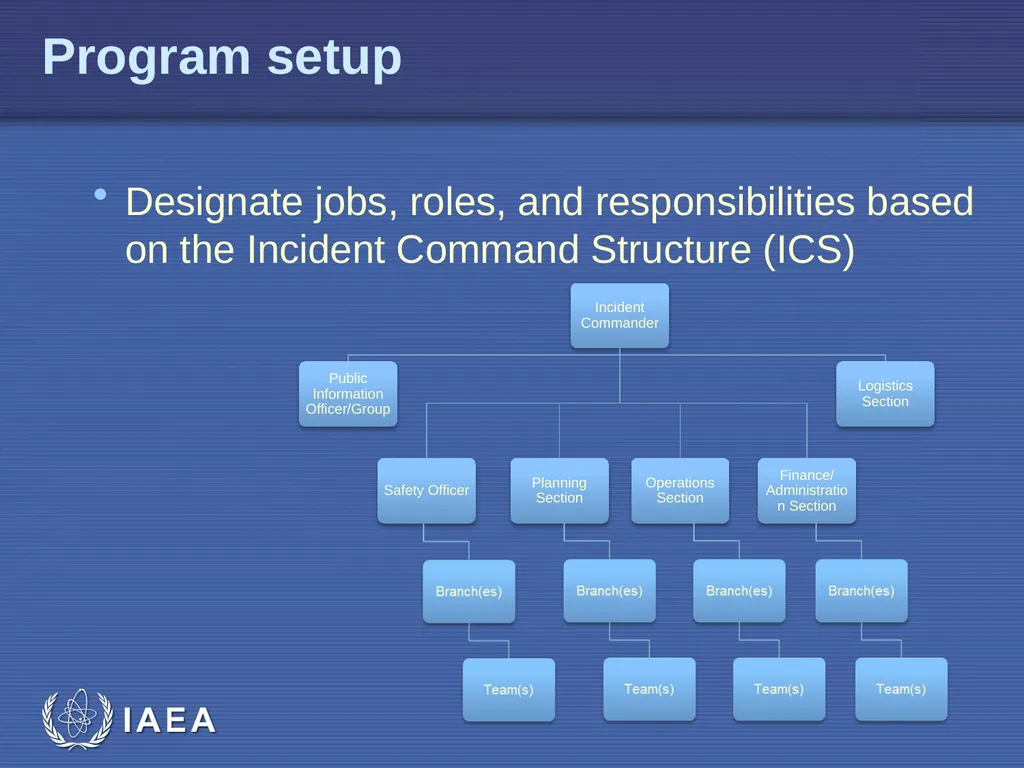
Program setup Establish internal organizational process for getting messages approved during an emergency;
Provide for needed resources (space, equipment, communications lines, personnel);
Establish agreements with other organizations on coordination of information release.<br>
05
Program setup List of contacts (addresses, office and mobile phones, including after-hours numbers, emails, etc.) for:
Media (including blogs and online sites);
Stakeholders (NGOs, industry, etc.);
Contacts at other organizations that will be part of the emergency response (including international);
Other key public and political officials;
Members of your own team.<br>
06
Public communications activities The PIO is responsible for delivering public information activities;
Some states and organizations may already have groups responsible for public information;
Such groups could be used to fulfill the PIO function during a radiation emergency.<br>
07
Public communications activities Strategic planning–to develop a strategy for communicating during the emergency;
Media Relations—to manage relations with the media;
Media Monitoring—to monitor effectiveness of media relations and accuracy of reporting;
New Media—to maintain emergency specific website.<br>
08
Public Communications Activities Liaison and Coordination—to coordinate information/messages and release of information;
Public Relations—to provide information to the public;
Internal Communications—to keep responders and employees informed about what is being said to the media.<br>
09
Program setup Identify potential ways to contact various audiences. Become familiar with how to use these channels so in the event of emergency you are prepared to use them immediately;
Where possible, establish these channels (an emergency site on your organization’s home page, links to social media, emergency alert systems to reach the public’s radios or cell phones.<br>
10
Organization and planning The PIO structure should also include liaison officers– PIO staff who are assigned to sit in on meetings and discussions in the Planning and Operations Sections;
The PIO will also need access to technical experts, so at least one expert will need to be assigned as an advisor to the PIO;
The designated spokesperson or spokespersons will also report and work within the PIO structure.<br>
11
Phases of Emergency Management Preparedness
Response
Recovery
Planning for public communications is necessary for all potential emergencies in all three phases.<br>
12
Basic steps List all potential emergencies;
For each emergency, identify the goals of your risk communication plan;
For each emergency, develop a resource of basic information about such an emergency.<br>
13
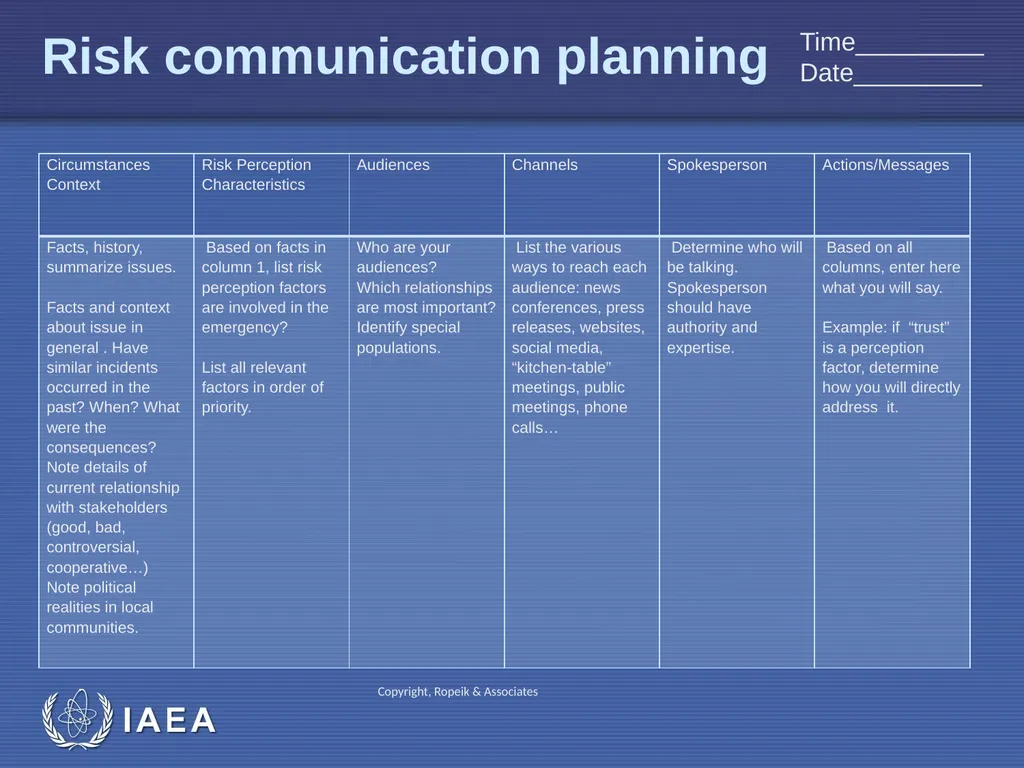
Copyright, Ropeik & Associates Time_________
Date_________ Risk communication planning<br>
14
Column 1: Circumstances, context List basic facts about the emergency;
Enter facts about the issue in general, including its context and history.<br>
15
Column 2: Risk Perception Characteristics Based on the facts in Column 1, list the psychological factors, like trust, control, or uncertainty that might be involved in the emergency;
List all the emotional factors that might be involved, but prioritize them based on their importance;
Trust is always key.<br>
16
Column 3: Audiences Who do you want to reach?
Identify special at-risk populations;
Some of the risk perception factors in Column 2 will apply to certain audiences more than others. 3<br>
17
Column 4: Channels List the various ways to reach each audience:
News conferences, press releases, radio announcements…
Postings to web sites or social media sites;
One-on-one “kitchen table” meetings in people’s homes (take on different forms in preparation and recovery stages);
Public meetings (preparation, recovery stages).<br>
18
Column 5: Spokesperson Designate the spokesperson(s) who will be most trusted by the audiences affected;
Information should always be delivered in plain language, even if the spokesperson has technical expertise.<br>
19
Column 6: Actions, Messages Based on details from the other columns, enter what you plan to do and what messages you will deliver;
Risk communication is how you act not just how you speak;
Refer to the other columns to effectively fill in this one.<br>
20
Risk communication planning process chart Use the chart for all three stages of risk communication;
Use as many pages as necessary;
Note the time and date on each page;
Fill in new pages as circumstances change;
These charts become a playbook for each plan, a record of the process to refer to as events unfold and later for determining lessons learned.<br>
21
Prepare information materials Topic specific fact sheets;
Answers to common questions from the public;
Answers to questions from the news media;
Resources to quickly distribute to the media (including video and audio).<br>
22
Other basic steps to prepare Create and strengthen relationships with key partners (news media, public health authorities…);
Develop actions and messages for each potential emergency based on the chart, keep organized and available for reference;
Research what the public wants to know and address public concerns;
Test your messages.<br>
23
Practice Risk communication plans should be an integral part of any exercise;
Exercises should be designed to test the challenges of managing public behavior during a theoretical event;
Senior managers and spokespeople should practice delivering key messages;<br>
24
Summary Set explicit goals and a clear sense of mission and purpose;
Prepare in advance: create an infrastructure, job assignments and procedures;
Prepare materials, equipment, contact information, messages, for potential emergencies;
Message preparation is a process that requires careful thinking about other elements first;
Practice risk communication in exercises.<br>