
EQUIPMENT LEASING & FINANCE: A Dynamic, Global




Description: EQUIPMENT LEASING FINANCE: A Dynamic, Global Industry ORGANIZATION NAME Experience (What Ive enjoyed about this industry): Academic Career Path: Primary Job Function: Fun Fact About Me: 2 Personal Quote Your Name Your Title
Related Topics
Download Presentation
"EQUIPMENT LEASING & FINANCE: A Dynamic, Global" is the property of its rightful owner. Permission is granted to download and print the materials on this website for personal, non-commercial use only, and to display it on your personal computer provided you do not modify the materials and that you retain all copyright notices contained in the materials. By downloading content from our website, you accept the terms of this agreement.
Presentation Transcript
slide1. EQUIPMENT LEASING & FINANCE:
A Dynamic, Global Industry<br>
slide2. [ORGANIZATION NAME] Experience (What I’ve enjoyed about this industry):
Academic & Career Path:
Primary Job Function:
Fun Fact About Me: 2 “Personal Quote” [Your Name] [Your Title]<br>
slide3. INDUSTRY OVERVIEW 3 1.<br>
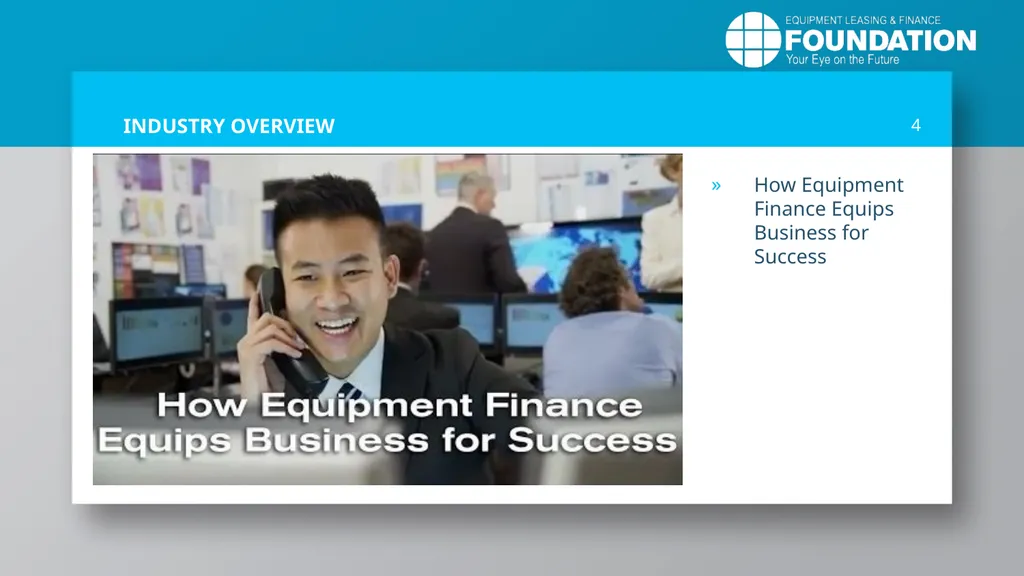
slide4. INDUSTRY OVERVIEW How Equipment Finance Equips Business for Success 4<br>
slide5. INDUSTRY OVERVIEW Most businesses require equipment in order to operate and grow and, for most businesses, equipment financing is a key acquisition strategy.
Each year, an estimated $1.8 trillion is invested by U.S. businesses, nonprofits and government agencies in plant, equipment and software.
Over 50%, or nearly $1 trillion of that investment, was financed through loans, leases and lines of credit. 5<br>
slide6. Equipment Finance Industry Size in 2019<br>
slide7. Equipment finance (lease or loan) is often a key component of a company’s balance sheet. INDUSTRY OVERVIEW Used in conjunction with equity, senior bank debt, and other debt instruments, it is one of the most important ways for businesses to manage their balance sheet. 7<br>
slide8. SECURED LENDING & LEASE FINANCING A loan is a financing agreement that allows a business to acquire, use, and own equipment.
A loan may require a down payment or a pledge of other assets for collateral. Under a loan financing, the borrower remains the owner of the equipment for tax and accounting purposes.
A lease allows a company to acquire and use equipment while conserving its cash flow and lines of credit.
Leasing also provides a new source of credit with the added benefit of being able to expense your lease payments in most instances. Leasing also can protect against equipment obsolescence when upgrades are included in a lease contract or the equipment is returned to the lessor at the end of the lease term. 8<br>
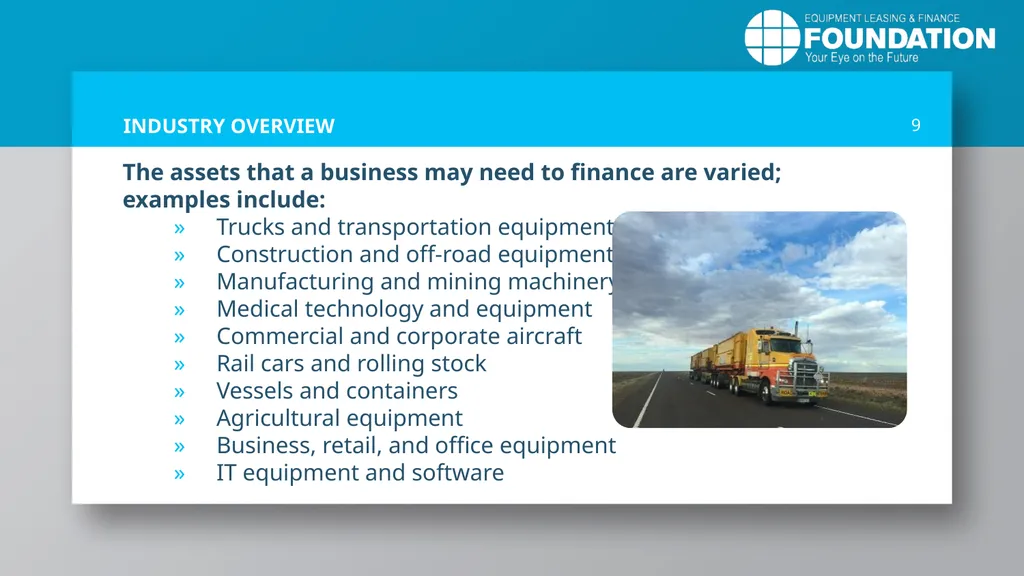
slide9. INDUSTRY OVERVIEW The assets that a business may need to finance are varied; examples include:
Trucks and transportation equipment
Construction and off-road equipment
Manufacturing and mining machinery
Medical technology and equipment
Commercial and corporate aircraft
Rail cars and rolling stock
Vessels and containers
Agricultural equipment
Business, retail, and office equipment
IT equipment and software 9<br>
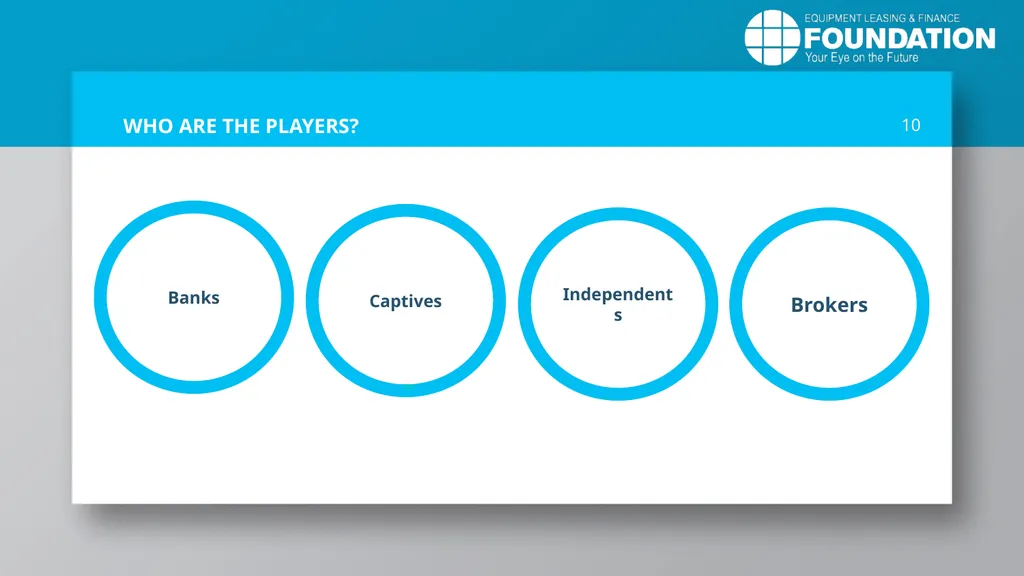
slide10. WHO ARE THE PLAYERS? Banks 10 Independents Captives Brokers<br>
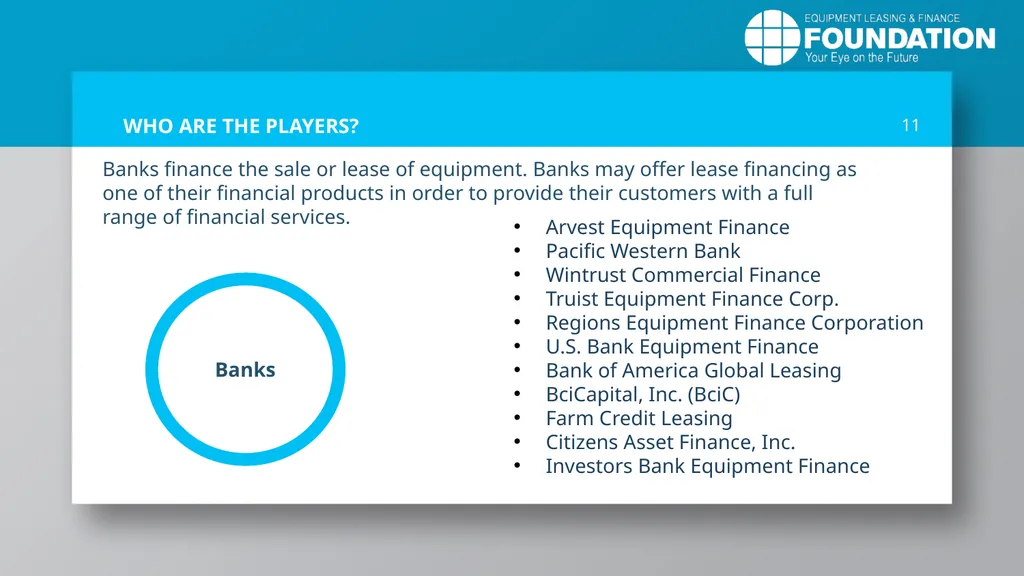
slide11. WHO ARE THE PLAYERS? 11 Banks Banks finance the sale or lease of equipment. Banks may offer lease financing as one of their financial products in order to provide their customers with a full range of financial services. Arvest Equipment Finance
Pacific Western Bank
Wintrust Commercial Finance
Truist Equipment Finance Corp.
Regions Equipment Finance Corporation
U.S. Bank Equipment Finance
Bank of America Global Leasing
BciCapital, Inc. (BciC)
Farm Credit Leasing
Citizens Asset Finance, Inc.
Investors Bank Equipment Finance<br>
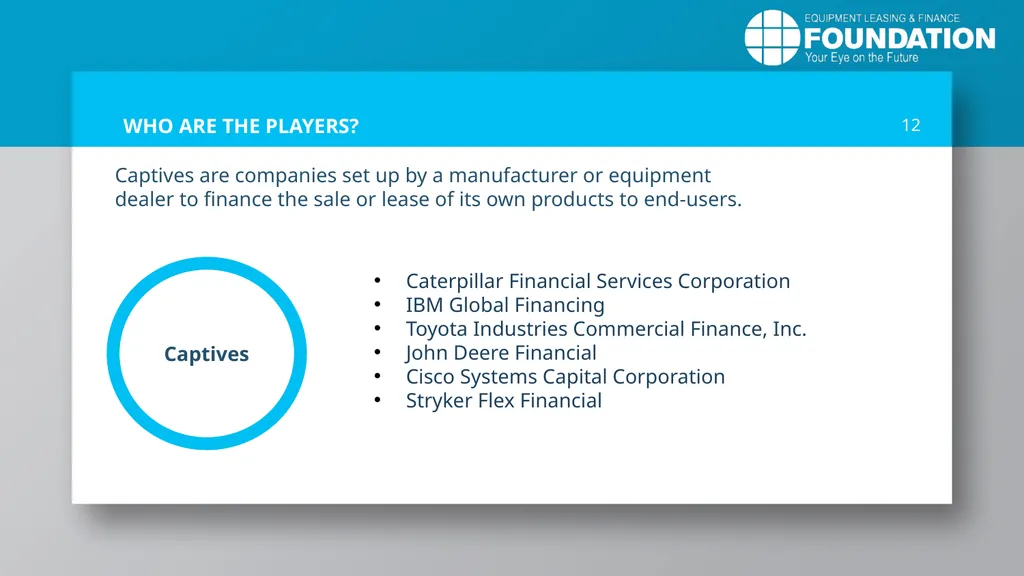
slide12. WHO ARE THE PLAYERS? 12 Captives Captives are companies set up by a manufacturer or equipment dealer to finance the sale or lease of its own products to end-users. Caterpillar Financial Services Corporation
IBM Global Financing
Toyota Industries Commercial Finance, Inc.
John Deere Financial
Cisco Systems Capital Corporation
Stryker Flex Financial<br>
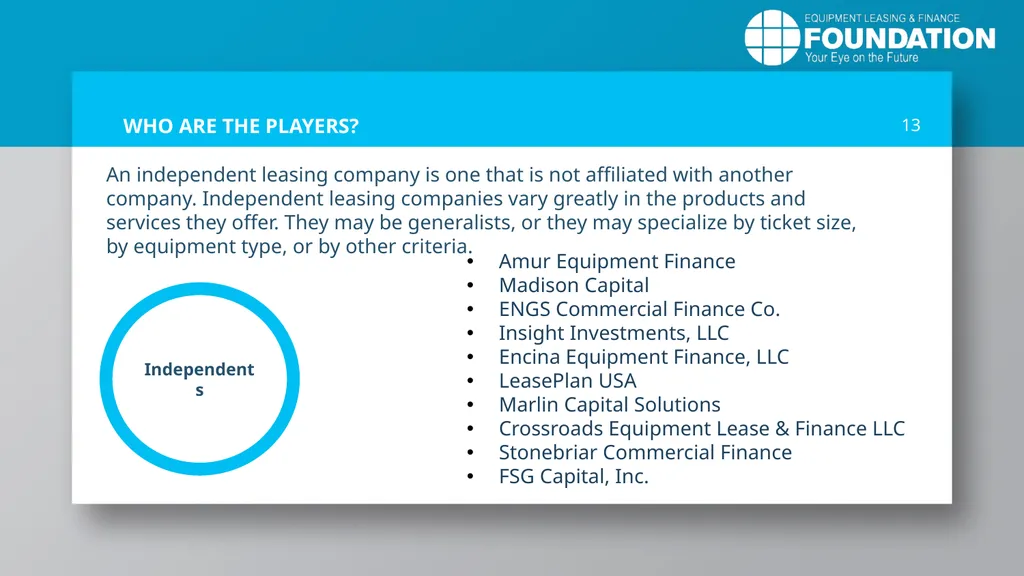
slide13. WHO ARE THE PLAYERS? 13 Independents An independent leasing company is one that is not affiliated with another company. Independent leasing companies vary greatly in the products and services they offer. They may be generalists, or they may specialize by ticket size, by equipment type, or by other criteria. Amur Equipment Finance
Madison Capital
ENGS Commercial Finance Co.
Insight Investments, LLC
Encina Equipment Finance, LLC
LeasePlan USA
Marlin Capital Solutions
Crossroads Equipment Lease & Finance LLC
Stonebriar Commercial Finance
FSG Capital, Inc.<br>
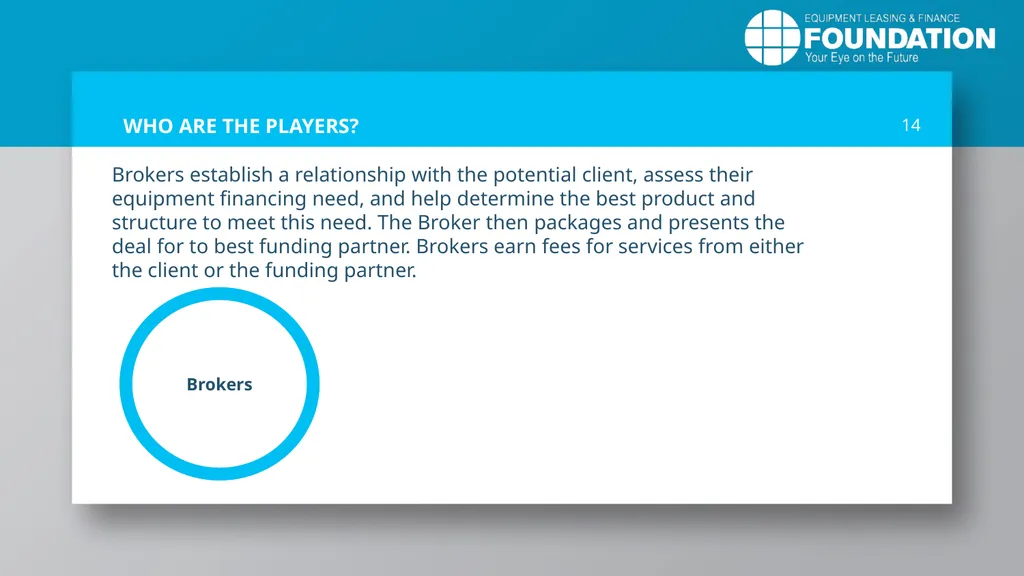
slide14. WHO ARE THE PLAYERS? 14 Brokers Brokers establish a relationship with the potential client, assess their equipment financing need, and help determine the best product and structure to meet this need. The Broker then packages and presents the deal for to best funding partner. Brokers earn fees for services from either the client or the funding partner.<br>
slide15. INDUSTRY OVERVIEW Entrepreneurs are prevalent and many have had successful exits.
First American acquired by City National Bank
McCue acquired by NetSol
Capital Stream acquired by HCL Entrepreneurs have started successful leasing companies.
Allegiant
Boston Financial
Great America 15 Entrepreneurs have started successful software and consulting firms.
The Alta Group
Alfa
Solifi
Ivory Consulting<br>
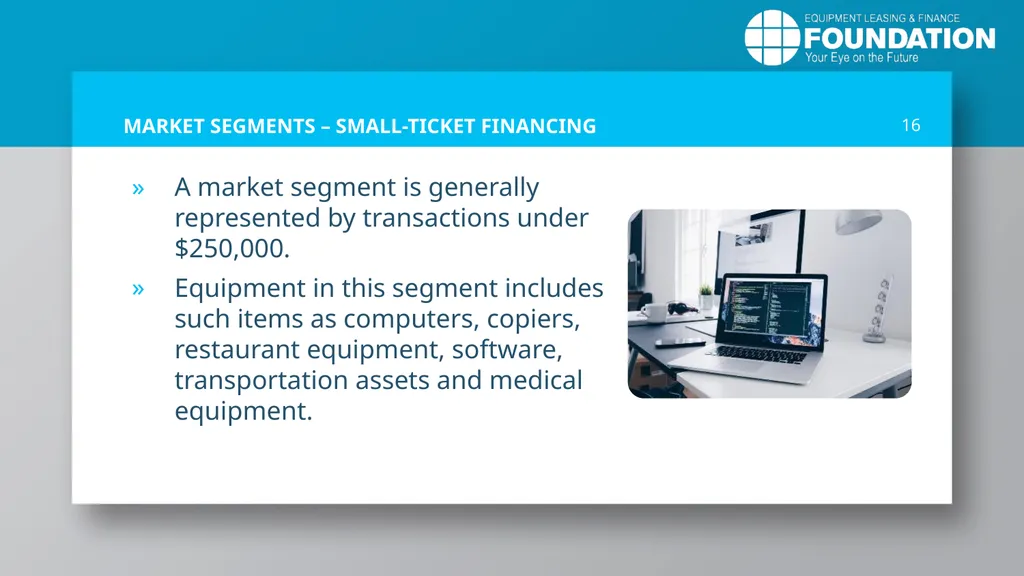
slide16. MARKET SEGMENTS – SMALL-TICKET FINANCING A market segment is generally represented by transactions under $250,000.
Equipment in this segment includes such items as computers, copiers, restaurant equipment, software, transportation assets and medical equipment. 16<br>
slide17. MARKET SEGMENTS – MIDDLE MARKET FINANCING A market segment generally represented by transactions between $250,000 and $5,000,000.
Equipment in this segment includes construction equipment, larger medical equipment, trucks and trailers, manufacturing equipment, computers and software, solar equipment, and virtually any other equipment type. 17<br>
slide18. MARKET SEGMENTS – BIG-TICKET/LARGE-TICKET FINANCING A market segment generally represented by financing that usually exceeds $5,000,000.
Equipment financed in this segment includes energy projects, railroad equipment, commercial and corporate jets, vessels, other transportation equipment, and large mining, oil and gas exploration. 18<br>
slide19. WHY EQUIPMENT FINANCE? 19 2.<br>
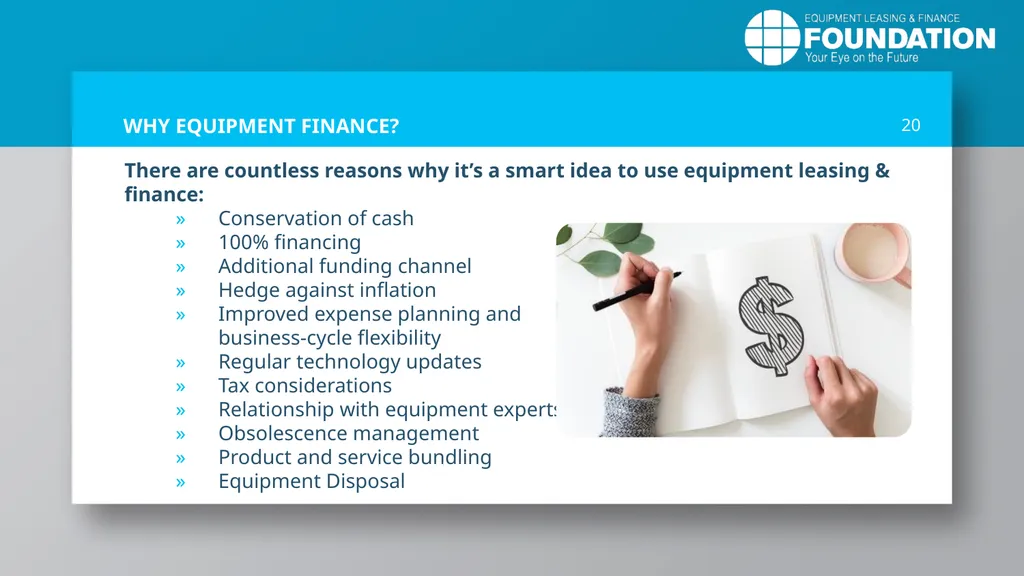
slide20. WHY EQUIPMENT FINANCE? There are countless reasons why it’s a smart idea to use equipment leasing & finance:
Conservation of cash
100% financing
Additional funding channel
Hedge against inflation
Improved expense planning and business-cycle flexibility
Regular technology updates
Tax considerations
Relationship with equipment experts
Obsolescence management
Product and service bundling
Equipment Disposal 20<br>
slide21. Income Tax
Which party can use 100% Bonus Depreciation?
30% interest limitation? BENEFITS OF EQUIPMENT FINANCE Cash Flow
Conserve cash for acquisitions
Match payments to seasonality
Sale/lease back to generate cash
Lowest monthly payment with minimal outlay 21<br>
slide22. Balance Sheet
Alternative or additional source to bank financing
Comply with key ratios from lenders
Measured for performance by ROA/ROE BENEFITS OF EQUIPMENT FINANCE Equipment
Transfer ownership risk to Lessor
Better manage obsolescence risk
Reduce cash requirements during life of equipment 22<br>
slide23. CAPITAL MARKETS 23 3.<br>
slide24. CAPITAL MARKETS Capital markets activity plays an important role in the equipment finance industry.
Capital markets activity is any type of external funding required to operate an equipment leasing company. 24<br>
slide25. EQUIPMENT-BASED ASSET SECURITIZATION Asset securitization allows for “wholesale institutional” type funding by pooling a number of individual loans with diverse characteristics in terms of geography, customer concentration, asset type, and industry diversity.
Classes of bonds are issued with varying degrees of risk (A,B,C); higher risk means higher rates, and are often times rated by S&P, Moody’s, and Fitch to increase potential pool of buyers.
Payments on underlying loans provide cash flow to service bond payments. The issuer absorbs a first loss position, and excess cash is built up during term providing added protection to the bond holder. 25<br>
slide26. SYNDICATIONS Syndications: Participations of financial institutions in a sale and/or assignment of all or part of an underlying lease or loan transaction.
Larger equipment financing companies maintain a buy and sell desk. Large equipment leases or loans may require a syndication strategy to meet the customer’s needs and bank’s credit requirements. Example: ABC Bank Lessor originated an $80 million lease for 1,800 railcars. They approve a “hold position” of $40 million for this client; syndicate $40 million to third party investors.
Customer Benefits: Deal with a single lessor, negotiate 1 set of docs; and 1 servicer.
Benefits to Syndicator: Manage credit exposure, earn fee income, retain client relationship.
Allocation: Investor is allocated specific assets tied to the same lease. If financing is for one large asset that can’t be divided (a large aircraft), a Participation Agreement is created. 26<br>
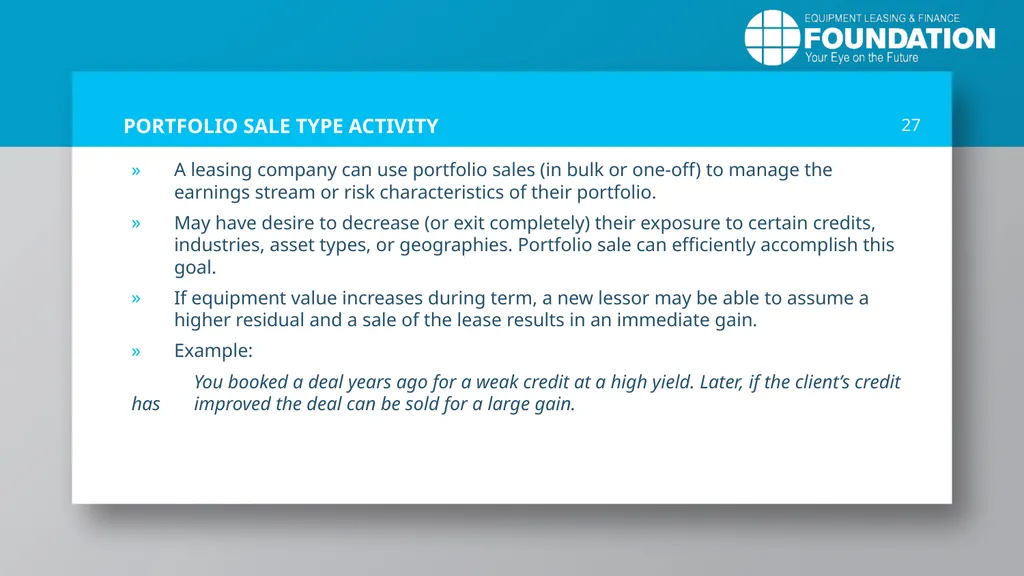
slide27. PORTFOLIO SALE TYPE ACTIVITY A leasing company can use portfolio sales (in bulk or one-off) to manage the earnings stream or risk characteristics of their portfolio.
May have desire to decrease (or exit completely) their exposure to certain credits, industries, asset types, or geographies. Portfolio sale can efficiently accomplish this goal.
If equipment value increases during term, a new lessor may be able to assume a higher residual and a sale of the lease results in an immediate gain.
Example:
You booked a deal years ago for a weak credit at a high yield. Later, if the client’s credit has improved the deal can be sold for a large gain. 27<br>
slide28. EQUIPMENT FINANCE A Progressive Industry 28 4.<br>
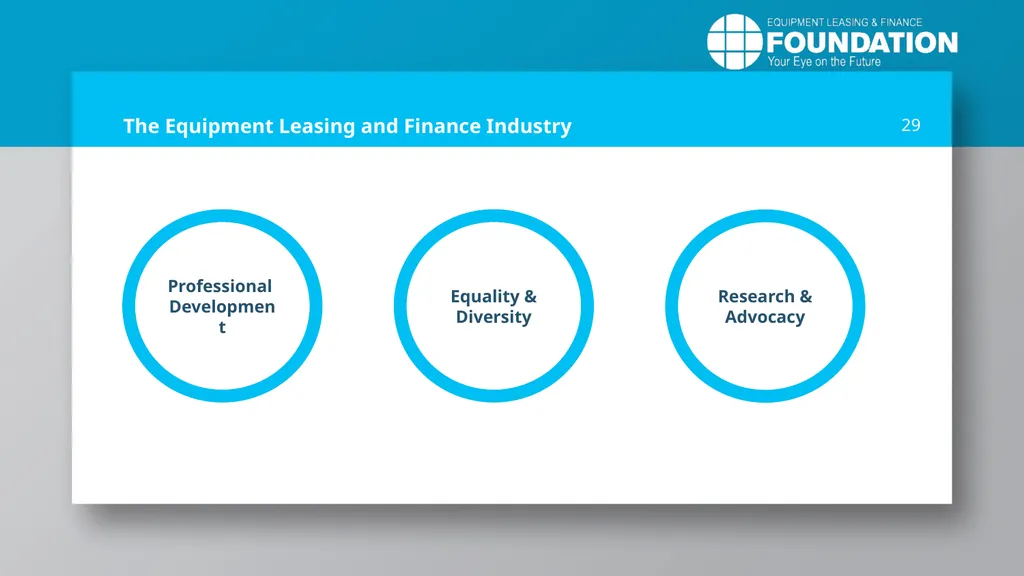
slide29. The Equipment Leasing and Finance Industry 29 Research & Advocacy Professional
Development Equality &
Diversity<br>
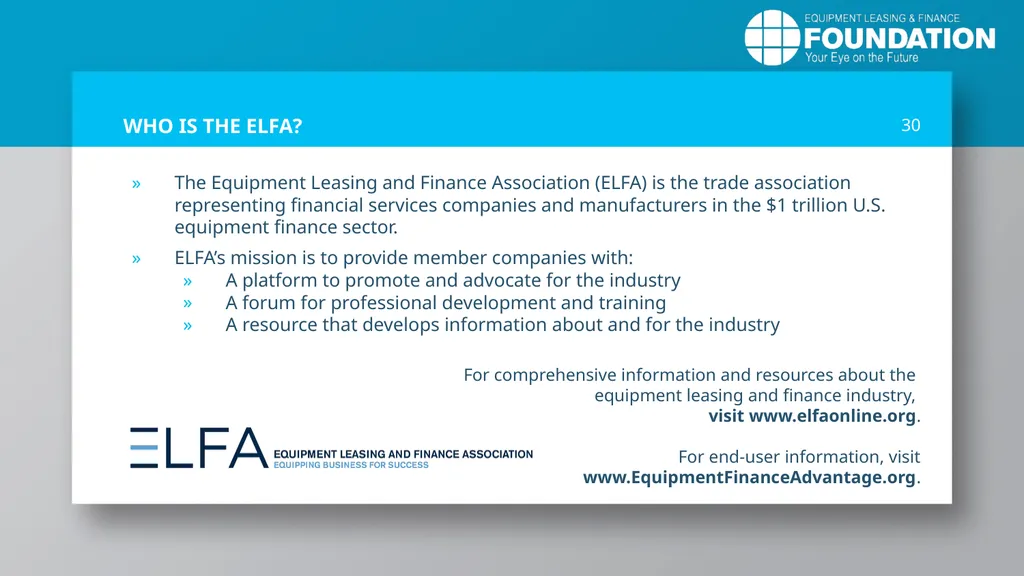
slide30. WHO IS THE ELFA? The Equipment Leasing and Finance Association (ELFA) is the trade association representing financial services companies and manufacturers in the $1 trillion U.S. equipment finance sector.
ELFA’s mission is to provide member companies with:
A platform to promote and advocate for the industry
A forum for professional development and training
A resource that develops information about and for the industry
For comprehensive information and resources about the equipment leasing and finance industry, visit www.elfaonline.org. For end-user information, visit www.EquipmentFinanceAdvantage.org. 30<br>
slide31. ELFA Equality ELFA Equality is committed to making sure that all people, regardless of their race, ethnicity, gender, sexual orientation, age, religion, physical characteristics or mental abilities, feel welcome and valued in the equipment finance industry, the ELFA, and member companies.
Awareness – provide education, information and insights to identify opportunities for increased diversity participation in the ELFA and the equipment finance industry
Advocacy – promote the advancement of diversity in hiring and volunteering in the ELFA and in member companies
Action – prepare programming and mentoring activities which can assist in achieving greater diversity balance 31<br>
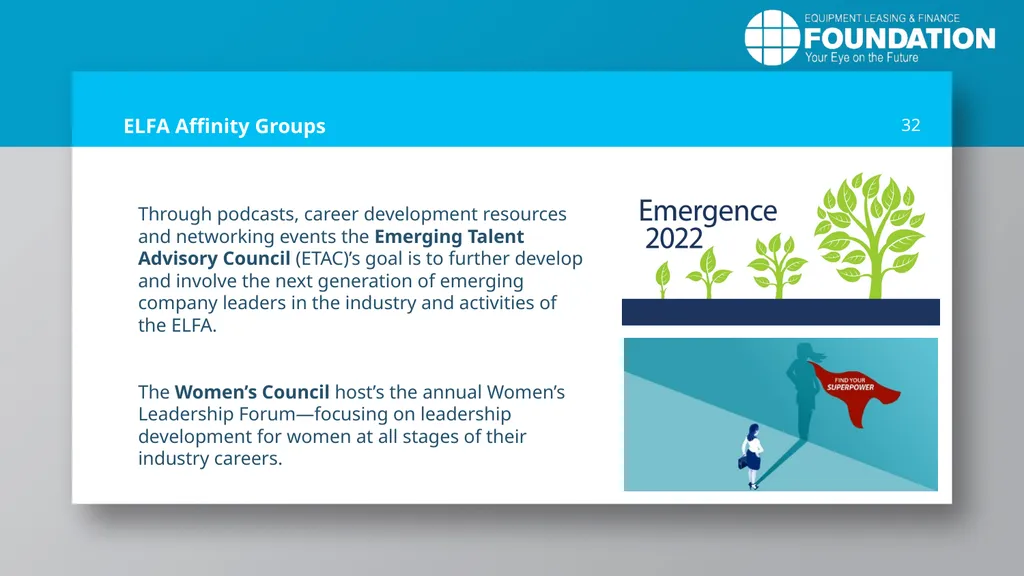
slide32. ELFA Affinity Groups Through podcasts, career development resources and networking events the Emerging Talent Advisory Council (ETAC)’s goal is to further develop and involve the next generation of emerging company leaders in the industry and activities of the ELFA.
The Women’s Council host’s the annual Women’s Leadership Forum—focusing on leadership development for women at all stages of their industry careers. 32<br>
slide33. ABOUT THE FOUNDATION The Equipment Leasing & Finance Foundation is a 501(c)3 nonprofit organization established by ELFA in 1989.
The Foundation propels the equipment finance sector—and its people—forward with its industry-specific knowledge, intelligence, and programs. Through podcasts, research studies and Guest Lecture opportunities, we help people navigate the changes coming up to make better business and personal career decisions.
The Foundation is supported 100% by charitable donations:
Over $650,000 raised in 2021 from corporate and individual contributions
Donor benefits include early release of research and recognition during ELFA events
www.LeaseFoundation.org 33<br>
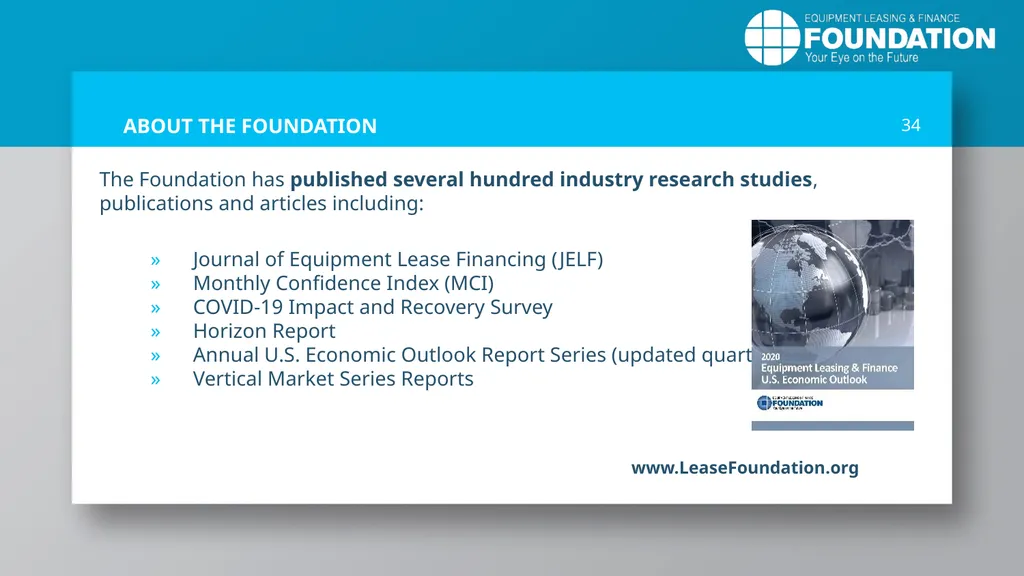
slide34. ABOUT THE FOUNDATION The Foundation has published several hundred industry research studies, publications and articles including:
Journal of Equipment Lease Financing (JELF)
Monthly Confidence Index (MCI)
COVID-19 Impact and Recovery Survey
Horizon Report
Annual U.S. Economic Outlook Report Series (updated quarterly)
Vertical Market Series Reports
www.LeaseFoundation.org 34<br>
slide35. INDUSTRY CERTIFICATION What is a Certified Lease and Finance Professional?
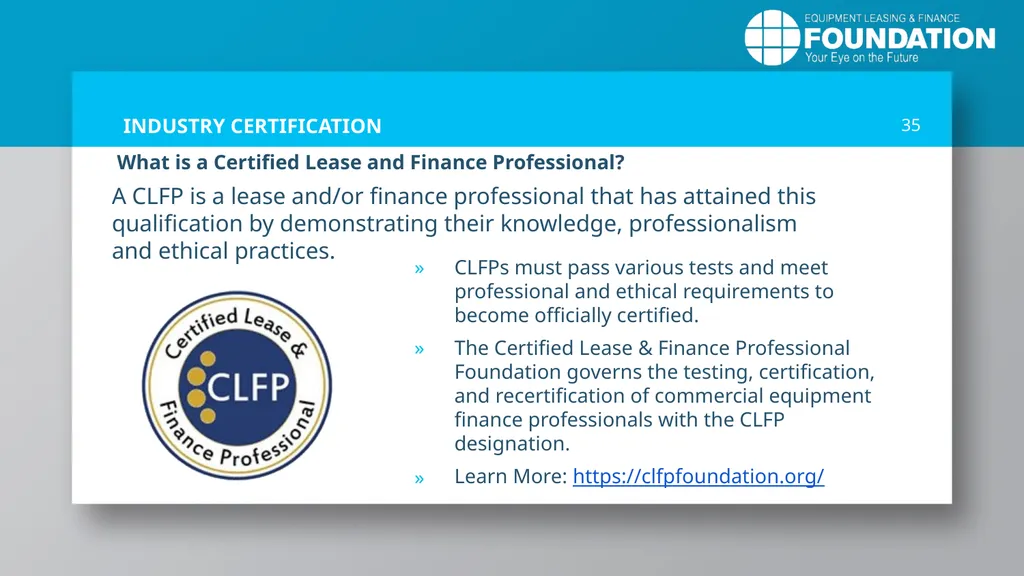
A CLFP is a lease and/or finance professional that has attained this qualification by demonstrating their knowledge, professionalism and ethical practices. CLFPs must pass various tests and meet professional and ethical requirements to become officially certified.
The Certified Lease & Finance Professional Foundation governs the testing, certification, and recertification of commercial equipment finance professionals with the CLFP designation.
Learn More: https://clfpfoundation.org/ 35<br>
slide36. CAREER PATHS IN EQUIPMENT FINANCE 36 5.<br>
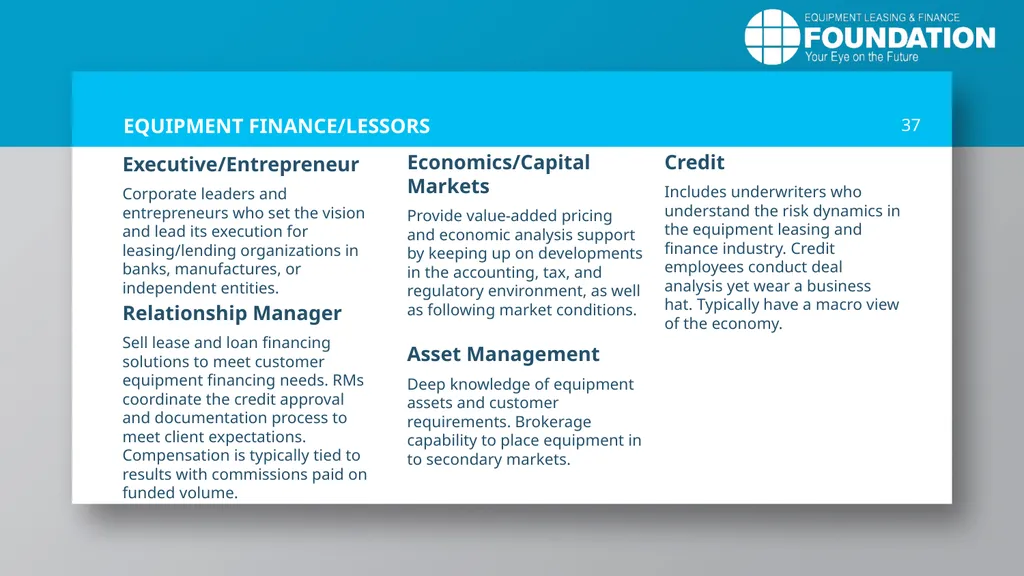
slide37. Executive/Entrepreneur
Corporate leaders and entrepreneurs who set the vision and lead its execution for leasing/lending organizations in banks, manufactures, or independent entities. Economics/Capital Markets
Provide value-added pricing and economic analysis support by keeping up on developments in the accounting, tax, and regulatory environment, as well as following market conditions. Credit
Includes underwriters who understand the risk dynamics in the equipment leasing and finance industry. Credit employees conduct deal analysis yet wear a business hat. Typically have a macro view of the economy. Asset Management
Deep knowledge of equipment assets and customer requirements. Brokerage capability to place equipment in to secondary markets. Relationship Manager
Sell lease and loan financing solutions to meet customer equipment financing needs. RMs coordinate the credit approval and documentation process to meet client expectations. Compensation is typically tied to results with commissions paid on funded volume. EQUIPMENT FINANCE/LESSORS 37<br>
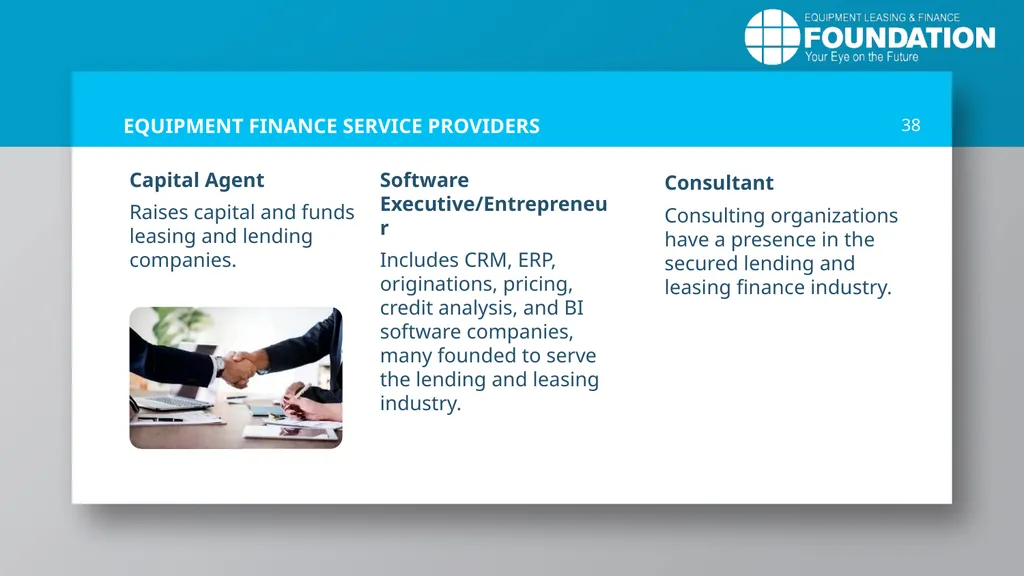
slide38. Capital Agent
Raises capital and funds leasing and lending companies. Software Executive/Entrepreneur
Includes CRM, ERP, originations, pricing, credit analysis, and BI software companies, many founded to serve the lending and leasing industry. Consultant
Consulting organizations have a presence in the secured lending and leasing finance industry. EQUIPMENT FINANCE SERVICE PROVIDERS 38<br>
slide39. Looking for an Internship? 39 https://www.leasefoundation.org/academic-programs/internship-resources-page/<br>
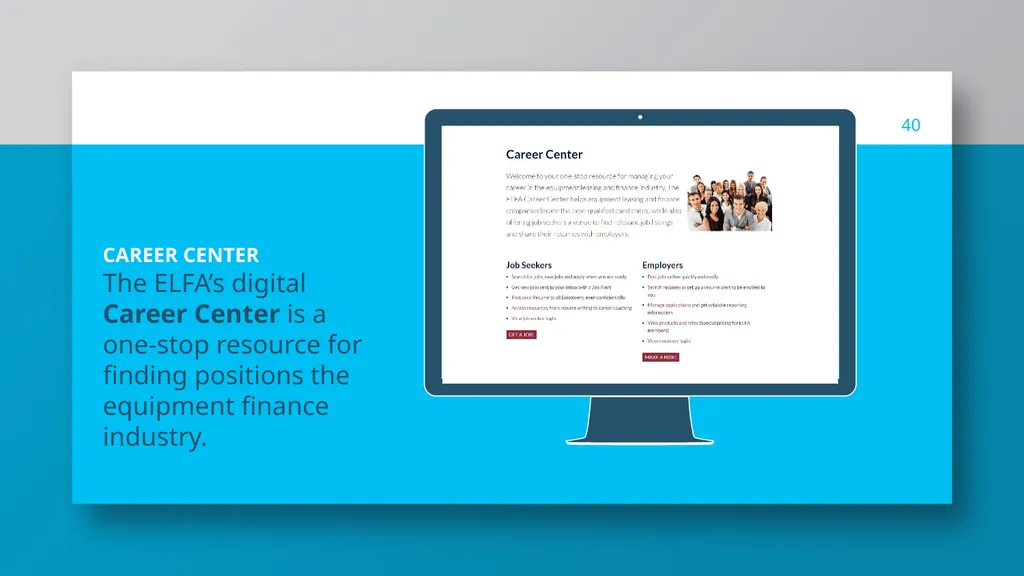
slide40. Place your screenshot here 40 CAREER CENTER The ELFA’s digital Career Center is a one-stop resource for finding positions the equipment finance industry.<br>
slide41. Equipment Leasing & Finance Foundation $5,000 Scholarship Apply By May 20 41<br>
slide42. How to apply for a scholarship……. https://www.leasefoundation.org/academic-programs/home/scholarship-program/ 42<br>
slide43. Any Questions?
You can find me at:
Email address
Company website
@username 43 THANK YOU!<br>
slide2. [ORGANIZATION NAME] Experience (What I’ve enjoyed about this industry):
Academic & Career Path:
Primary Job Function:
Fun Fact About Me: 2 “Personal Quote” [Your Name] [Your Title]<br>
slide3. INDUSTRY OVERVIEW 3 1.<br>
slide4. INDUSTRY OVERVIEW How Equipment Finance Equips Business for Success 4<br>
slide5. INDUSTRY OVERVIEW Most businesses require equipment in order to operate and grow and, for most businesses, equipment financing is a key acquisition strategy.
Each year, an estimated $1.8 trillion is invested by U.S. businesses, nonprofits and government agencies in plant, equipment and software.
Over 50%, or nearly $1 trillion of that investment, was financed through loans, leases and lines of credit. 5<br>
slide6. Equipment Finance Industry Size in 2019<br>
slide7. Equipment finance (lease or loan) is often a key component of a company’s balance sheet. INDUSTRY OVERVIEW Used in conjunction with equity, senior bank debt, and other debt instruments, it is one of the most important ways for businesses to manage their balance sheet. 7<br>
slide8. SECURED LENDING & LEASE FINANCING A loan is a financing agreement that allows a business to acquire, use, and own equipment.
A loan may require a down payment or a pledge of other assets for collateral. Under a loan financing, the borrower remains the owner of the equipment for tax and accounting purposes.
A lease allows a company to acquire and use equipment while conserving its cash flow and lines of credit.
Leasing also provides a new source of credit with the added benefit of being able to expense your lease payments in most instances. Leasing also can protect against equipment obsolescence when upgrades are included in a lease contract or the equipment is returned to the lessor at the end of the lease term. 8<br>
slide9. INDUSTRY OVERVIEW The assets that a business may need to finance are varied; examples include:
Trucks and transportation equipment
Construction and off-road equipment
Manufacturing and mining machinery
Medical technology and equipment
Commercial and corporate aircraft
Rail cars and rolling stock
Vessels and containers
Agricultural equipment
Business, retail, and office equipment
IT equipment and software 9<br>
slide10. WHO ARE THE PLAYERS? Banks 10 Independents Captives Brokers<br>
slide11. WHO ARE THE PLAYERS? 11 Banks Banks finance the sale or lease of equipment. Banks may offer lease financing as one of their financial products in order to provide their customers with a full range of financial services. Arvest Equipment Finance
Pacific Western Bank
Wintrust Commercial Finance
Truist Equipment Finance Corp.
Regions Equipment Finance Corporation
U.S. Bank Equipment Finance
Bank of America Global Leasing
BciCapital, Inc. (BciC)
Farm Credit Leasing
Citizens Asset Finance, Inc.
Investors Bank Equipment Finance<br>
slide12. WHO ARE THE PLAYERS? 12 Captives Captives are companies set up by a manufacturer or equipment dealer to finance the sale or lease of its own products to end-users. Caterpillar Financial Services Corporation
IBM Global Financing
Toyota Industries Commercial Finance, Inc.
John Deere Financial
Cisco Systems Capital Corporation
Stryker Flex Financial<br>
slide13. WHO ARE THE PLAYERS? 13 Independents An independent leasing company is one that is not affiliated with another company. Independent leasing companies vary greatly in the products and services they offer. They may be generalists, or they may specialize by ticket size, by equipment type, or by other criteria. Amur Equipment Finance
Madison Capital
ENGS Commercial Finance Co.
Insight Investments, LLC
Encina Equipment Finance, LLC
LeasePlan USA
Marlin Capital Solutions
Crossroads Equipment Lease & Finance LLC
Stonebriar Commercial Finance
FSG Capital, Inc.<br>
slide14. WHO ARE THE PLAYERS? 14 Brokers Brokers establish a relationship with the potential client, assess their equipment financing need, and help determine the best product and structure to meet this need. The Broker then packages and presents the deal for to best funding partner. Brokers earn fees for services from either the client or the funding partner.<br>
slide15. INDUSTRY OVERVIEW Entrepreneurs are prevalent and many have had successful exits.
First American acquired by City National Bank
McCue acquired by NetSol
Capital Stream acquired by HCL Entrepreneurs have started successful leasing companies.
Allegiant
Boston Financial
Great America 15 Entrepreneurs have started successful software and consulting firms.
The Alta Group
Alfa
Solifi
Ivory Consulting<br>
slide16. MARKET SEGMENTS – SMALL-TICKET FINANCING A market segment is generally represented by transactions under $250,000.
Equipment in this segment includes such items as computers, copiers, restaurant equipment, software, transportation assets and medical equipment. 16<br>
slide17. MARKET SEGMENTS – MIDDLE MARKET FINANCING A market segment generally represented by transactions between $250,000 and $5,000,000.
Equipment in this segment includes construction equipment, larger medical equipment, trucks and trailers, manufacturing equipment, computers and software, solar equipment, and virtually any other equipment type. 17<br>
slide18. MARKET SEGMENTS – BIG-TICKET/LARGE-TICKET FINANCING A market segment generally represented by financing that usually exceeds $5,000,000.
Equipment financed in this segment includes energy projects, railroad equipment, commercial and corporate jets, vessels, other transportation equipment, and large mining, oil and gas exploration. 18<br>
slide19. WHY EQUIPMENT FINANCE? 19 2.<br>
slide20. WHY EQUIPMENT FINANCE? There are countless reasons why it’s a smart idea to use equipment leasing & finance:
Conservation of cash
100% financing
Additional funding channel
Hedge against inflation
Improved expense planning and business-cycle flexibility
Regular technology updates
Tax considerations
Relationship with equipment experts
Obsolescence management
Product and service bundling
Equipment Disposal 20<br>
slide21. Income Tax
Which party can use 100% Bonus Depreciation?
30% interest limitation? BENEFITS OF EQUIPMENT FINANCE Cash Flow
Conserve cash for acquisitions
Match payments to seasonality
Sale/lease back to generate cash
Lowest monthly payment with minimal outlay 21<br>
slide22. Balance Sheet
Alternative or additional source to bank financing
Comply with key ratios from lenders
Measured for performance by ROA/ROE BENEFITS OF EQUIPMENT FINANCE Equipment
Transfer ownership risk to Lessor
Better manage obsolescence risk
Reduce cash requirements during life of equipment 22<br>
slide23. CAPITAL MARKETS 23 3.<br>
slide24. CAPITAL MARKETS Capital markets activity plays an important role in the equipment finance industry.
Capital markets activity is any type of external funding required to operate an equipment leasing company. 24<br>
slide25. EQUIPMENT-BASED ASSET SECURITIZATION Asset securitization allows for “wholesale institutional” type funding by pooling a number of individual loans with diverse characteristics in terms of geography, customer concentration, asset type, and industry diversity.
Classes of bonds are issued with varying degrees of risk (A,B,C); higher risk means higher rates, and are often times rated by S&P, Moody’s, and Fitch to increase potential pool of buyers.
Payments on underlying loans provide cash flow to service bond payments. The issuer absorbs a first loss position, and excess cash is built up during term providing added protection to the bond holder. 25<br>
slide26. SYNDICATIONS Syndications: Participations of financial institutions in a sale and/or assignment of all or part of an underlying lease or loan transaction.
Larger equipment financing companies maintain a buy and sell desk. Large equipment leases or loans may require a syndication strategy to meet the customer’s needs and bank’s credit requirements. Example: ABC Bank Lessor originated an $80 million lease for 1,800 railcars. They approve a “hold position” of $40 million for this client; syndicate $40 million to third party investors.
Customer Benefits: Deal with a single lessor, negotiate 1 set of docs; and 1 servicer.
Benefits to Syndicator: Manage credit exposure, earn fee income, retain client relationship.
Allocation: Investor is allocated specific assets tied to the same lease. If financing is for one large asset that can’t be divided (a large aircraft), a Participation Agreement is created. 26<br>
slide27. PORTFOLIO SALE TYPE ACTIVITY A leasing company can use portfolio sales (in bulk or one-off) to manage the earnings stream or risk characteristics of their portfolio.
May have desire to decrease (or exit completely) their exposure to certain credits, industries, asset types, or geographies. Portfolio sale can efficiently accomplish this goal.
If equipment value increases during term, a new lessor may be able to assume a higher residual and a sale of the lease results in an immediate gain.
Example:
You booked a deal years ago for a weak credit at a high yield. Later, if the client’s credit has improved the deal can be sold for a large gain. 27<br>
slide28. EQUIPMENT FINANCE A Progressive Industry 28 4.<br>
slide29. The Equipment Leasing and Finance Industry 29 Research & Advocacy Professional
Development Equality &
Diversity<br>
slide30. WHO IS THE ELFA? The Equipment Leasing and Finance Association (ELFA) is the trade association representing financial services companies and manufacturers in the $1 trillion U.S. equipment finance sector.
ELFA’s mission is to provide member companies with:
A platform to promote and advocate for the industry
A forum for professional development and training
A resource that develops information about and for the industry
For comprehensive information and resources about the equipment leasing and finance industry, visit www.elfaonline.org. For end-user information, visit www.EquipmentFinanceAdvantage.org. 30<br>
slide31. ELFA Equality ELFA Equality is committed to making sure that all people, regardless of their race, ethnicity, gender, sexual orientation, age, religion, physical characteristics or mental abilities, feel welcome and valued in the equipment finance industry, the ELFA, and member companies.
Awareness – provide education, information and insights to identify opportunities for increased diversity participation in the ELFA and the equipment finance industry
Advocacy – promote the advancement of diversity in hiring and volunteering in the ELFA and in member companies
Action – prepare programming and mentoring activities which can assist in achieving greater diversity balance 31<br>
slide32. ELFA Affinity Groups Through podcasts, career development resources and networking events the Emerging Talent Advisory Council (ETAC)’s goal is to further develop and involve the next generation of emerging company leaders in the industry and activities of the ELFA.
The Women’s Council host’s the annual Women’s Leadership Forum—focusing on leadership development for women at all stages of their industry careers. 32<br>
slide33. ABOUT THE FOUNDATION The Equipment Leasing & Finance Foundation is a 501(c)3 nonprofit organization established by ELFA in 1989.
The Foundation propels the equipment finance sector—and its people—forward with its industry-specific knowledge, intelligence, and programs. Through podcasts, research studies and Guest Lecture opportunities, we help people navigate the changes coming up to make better business and personal career decisions.
The Foundation is supported 100% by charitable donations:
Over $650,000 raised in 2021 from corporate and individual contributions
Donor benefits include early release of research and recognition during ELFA events
www.LeaseFoundation.org 33<br>
slide34. ABOUT THE FOUNDATION The Foundation has published several hundred industry research studies, publications and articles including:
Journal of Equipment Lease Financing (JELF)
Monthly Confidence Index (MCI)
COVID-19 Impact and Recovery Survey
Horizon Report
Annual U.S. Economic Outlook Report Series (updated quarterly)
Vertical Market Series Reports
www.LeaseFoundation.org 34<br>
slide35. INDUSTRY CERTIFICATION What is a Certified Lease and Finance Professional?
A CLFP is a lease and/or finance professional that has attained this qualification by demonstrating their knowledge, professionalism and ethical practices. CLFPs must pass various tests and meet professional and ethical requirements to become officially certified.
The Certified Lease & Finance Professional Foundation governs the testing, certification, and recertification of commercial equipment finance professionals with the CLFP designation.
Learn More: https://clfpfoundation.org/ 35<br>
slide36. CAREER PATHS IN EQUIPMENT FINANCE 36 5.<br>
slide37. Executive/Entrepreneur
Corporate leaders and entrepreneurs who set the vision and lead its execution for leasing/lending organizations in banks, manufactures, or independent entities. Economics/Capital Markets
Provide value-added pricing and economic analysis support by keeping up on developments in the accounting, tax, and regulatory environment, as well as following market conditions. Credit
Includes underwriters who understand the risk dynamics in the equipment leasing and finance industry. Credit employees conduct deal analysis yet wear a business hat. Typically have a macro view of the economy. Asset Management
Deep knowledge of equipment assets and customer requirements. Brokerage capability to place equipment in to secondary markets. Relationship Manager
Sell lease and loan financing solutions to meet customer equipment financing needs. RMs coordinate the credit approval and documentation process to meet client expectations. Compensation is typically tied to results with commissions paid on funded volume. EQUIPMENT FINANCE/LESSORS 37<br>
slide38. Capital Agent
Raises capital and funds leasing and lending companies. Software Executive/Entrepreneur
Includes CRM, ERP, originations, pricing, credit analysis, and BI software companies, many founded to serve the lending and leasing industry. Consultant
Consulting organizations have a presence in the secured lending and leasing finance industry. EQUIPMENT FINANCE SERVICE PROVIDERS 38<br>
slide39. Looking for an Internship? 39 https://www.leasefoundation.org/academic-programs/internship-resources-page/<br>
slide40. Place your screenshot here 40 CAREER CENTER The ELFA’s digital Career Center is a one-stop resource for finding positions the equipment finance industry.<br>
slide41. Equipment Leasing & Finance Foundation $5,000 Scholarship Apply By May 20 41<br>
slide42. How to apply for a scholarship……. https://www.leasefoundation.org/academic-programs/home/scholarship-program/ 42<br>
slide43. Any Questions?
You can find me at:
Email address
Company website
@username 43 THANK YOU!<br>