
Eric C. Boyce, CFA President & CEO Boyce &
DP
Published · 67 slides · 0 views
1 / 1




Description
Eric C. Boyce, CFA President CEO Boyce Associates Wealth Consulting, Inc. www.boycewealth.com Small Business Owners Guide to Expansion, Financing, Realizing Value Securing an Exit 2 Disclaimers Sources US Small Business Administration
Related Topics
Share
Embed code
Download this presentation From Below
"Eric C. Boyce, CFA President & CEO Boyce &" is the property of its rightful owner. Permission is granted to download and print the materials on this website for personal, non-commercial use only, and to display it on your personal computer provided you do not modify the materials and that you retain all copyright notices contained in the materials. By downloading content from our website, you accept the terms of this agreement.
Presentation Transcript
01
Eric C. Boyce, CFA
President & CEO
Boyce & Associates Wealth Consulting, Inc.
www.boycewealth.com Small Business Owners Guide to Expansion, Financing, Realizing Value & Securing an Exit<br>
02
2 Disclaimers
Sources
US Small Business Administration Office of Advocacy, Fit Small Business, Sprout Social, Embroker, Zippia, US Chamber of Commerce, Swoop, Findstack, PR Newswire, Oberlo, Bipartisan Policy Center, Payscale, Guidant, Forbes Advisor, Paycor, CorpNet, Score, DemandSage, FED Small Business, Hostinger.com
Forward looking statements, estimates, and certain information contained herein are based upon proprietary and non-proprietary research and other sources. Information contained herein has been obtained from sources believed to be reliable but are not assured as to accuracy. Past performance is not indicative of future results. There is neither representation nor warranty as to the current accuracy of, nor liability for, decisions based on such information.
Risks: All investments, including stocks, bonds, commodities, alternative investments and real assets, should be considered speculative in nature and could involve risk of loss. All investors are advised to fully understand all risks associated with any kind of investing they choose to do. Hypothetical or simulated performance is not indicative of future results.
Investment advisory services offered through Boyce & Associates Wealth Consulting, Inc., a registered investment adviser. Boyce & Associates Wealth Consulting, Inc. has Representatives Licensed to sell Life Insurance in TX and other states<br>
Sources
US Small Business Administration Office of Advocacy, Fit Small Business, Sprout Social, Embroker, Zippia, US Chamber of Commerce, Swoop, Findstack, PR Newswire, Oberlo, Bipartisan Policy Center, Payscale, Guidant, Forbes Advisor, Paycor, CorpNet, Score, DemandSage, FED Small Business, Hostinger.com
Forward looking statements, estimates, and certain information contained herein are based upon proprietary and non-proprietary research and other sources. Information contained herein has been obtained from sources believed to be reliable but are not assured as to accuracy. Past performance is not indicative of future results. There is neither representation nor warranty as to the current accuracy of, nor liability for, decisions based on such information.
Risks: All investments, including stocks, bonds, commodities, alternative investments and real assets, should be considered speculative in nature and could involve risk of loss. All investors are advised to fully understand all risks associated with any kind of investing they choose to do. Hypothetical or simulated performance is not indicative of future results.
Investment advisory services offered through Boyce & Associates Wealth Consulting, Inc., a registered investment adviser. Boyce & Associates Wealth Consulting, Inc. has Representatives Licensed to sell Life Insurance in TX and other states<br>
03
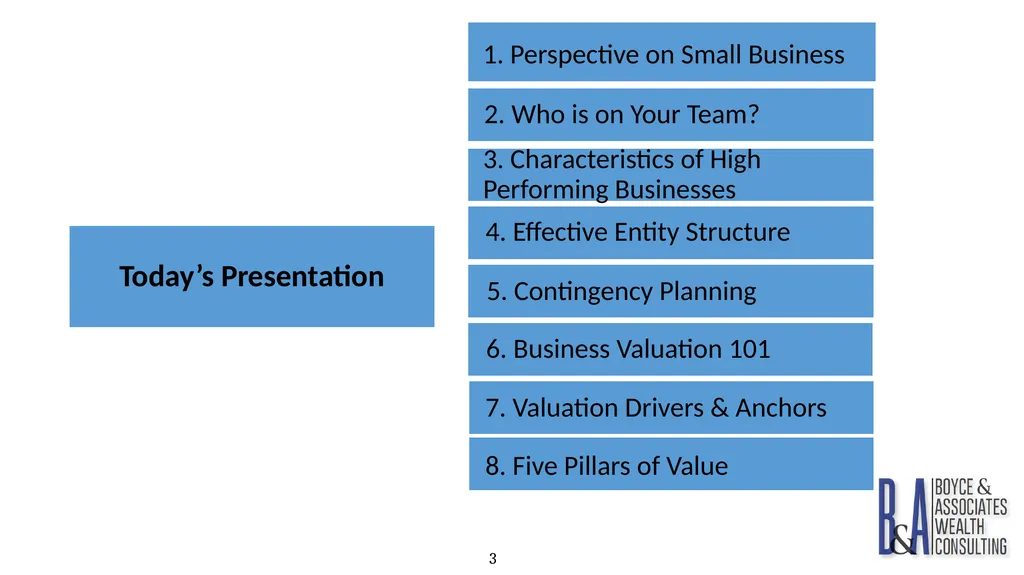
3 2. Who is on Your Team? 1. Perspective on Small Business 3. Characteristics of High Performing Businesses 4. Effective Entity Structure 5. Contingency Planning 6. Business Valuation 101 7. Valuation Drivers & Anchors 8. Five Pillars of Value<br>
04
4 Perspective on Small Business<br>
05
Some Data on Small Business
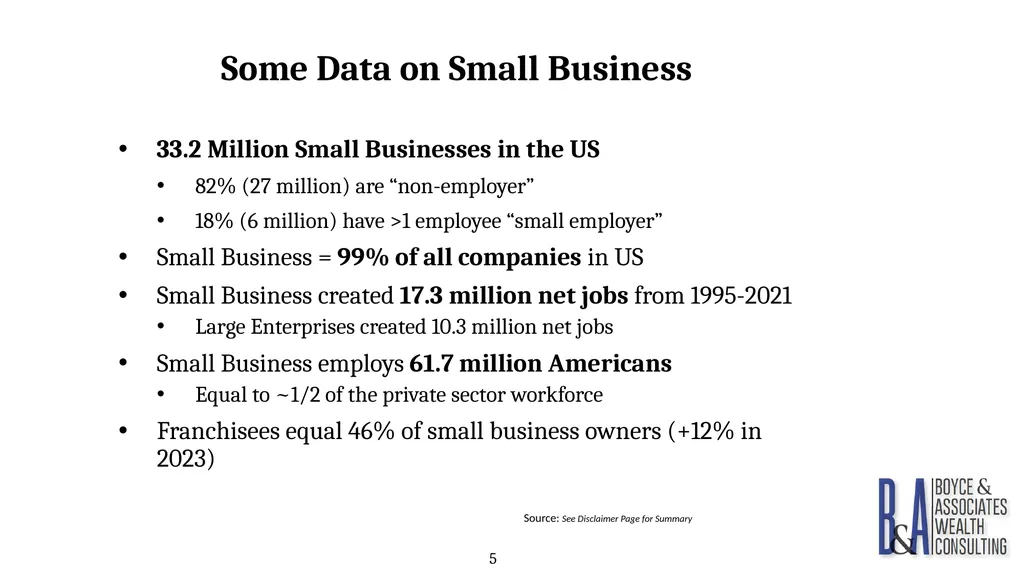
33.2 Million Small Businesses in the US
82% (27 million) are “non-employer”
18% (6 million) have >1 employee “small employer”
Small Business = 99% of all companies in US
Small Business created 17.3 million net jobs from 1995-2021
Large Enterprises created 10.3 million net jobs
Small Business employs 61.7 million Americans
Equal to ~1/2 of the private sector workforce
Franchisees equal 46% of small business owners (+12% in 2023) 5 Source: See Disclaimer Page for Summary<br>
33.2 Million Small Businesses in the US
82% (27 million) are “non-employer”
18% (6 million) have >1 employee “small employer”
Small Business = 99% of all companies in US
Small Business created 17.3 million net jobs from 1995-2021
Large Enterprises created 10.3 million net jobs
Small Business employs 61.7 million Americans
Equal to ~1/2 of the private sector workforce
Franchisees equal 46% of small business owners (+12% in 2023) 5 Source: See Disclaimer Page for Summary<br>
06
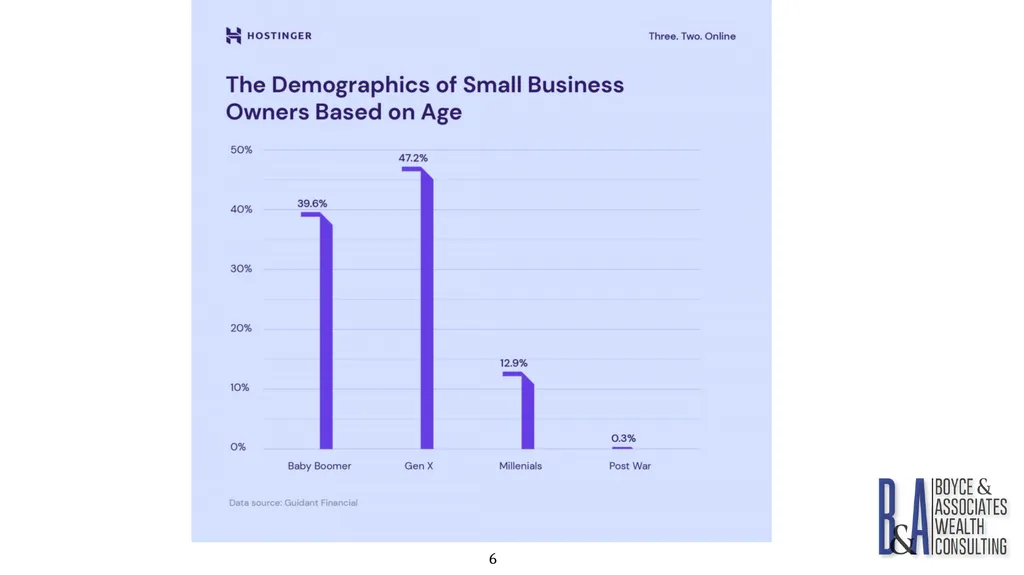
6 Source: See Disclaimer Page for Summary<br>
07
Some Data on Small Business
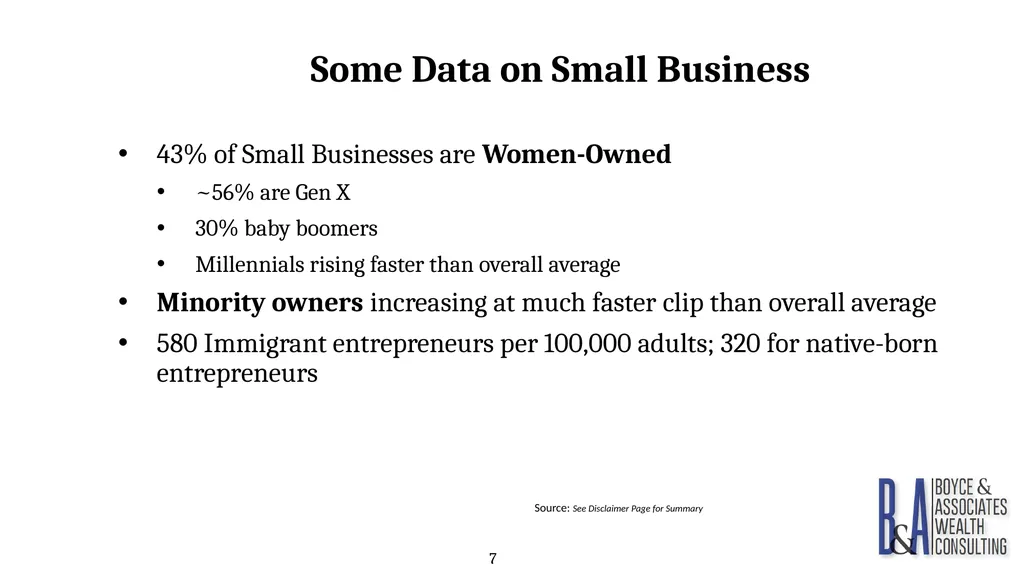
43% of Small Businesses are Women-Owned
~56% are Gen X
30% baby boomers
Millennials rising faster than overall average
Minority owners increasing at much faster clip than overall average
580 Immigrant entrepreneurs per 100,000 adults; 320 for native-born entrepreneurs 7 Source: See Disclaimer Page for Summary<br>
43% of Small Businesses are Women-Owned
~56% are Gen X
30% baby boomers
Millennials rising faster than overall average
Minority owners increasing at much faster clip than overall average
580 Immigrant entrepreneurs per 100,000 adults; 320 for native-born entrepreneurs 7 Source: See Disclaimer Page for Summary<br>
08
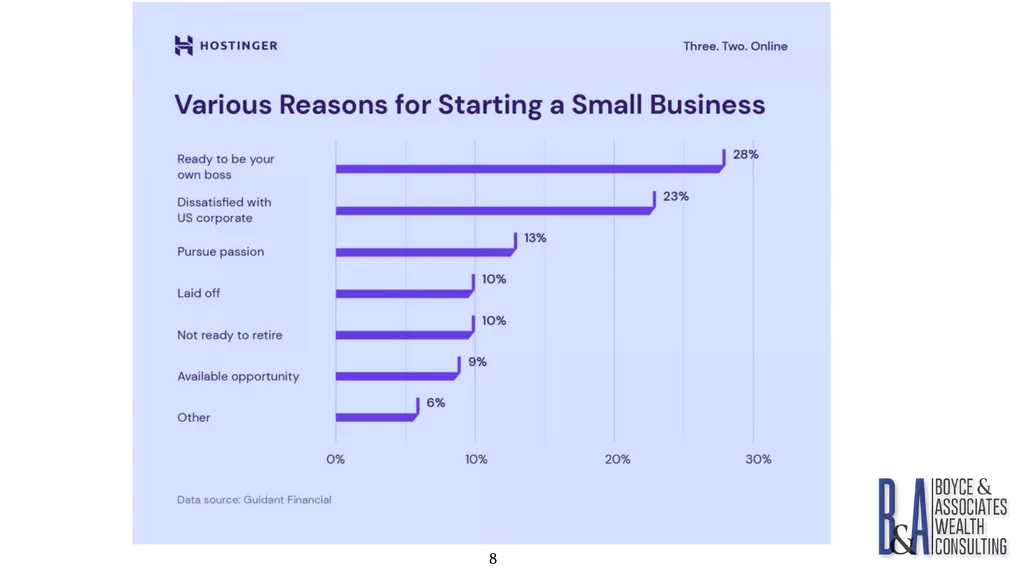
8 Source: See Disclaimer Page for Summary<br>
09
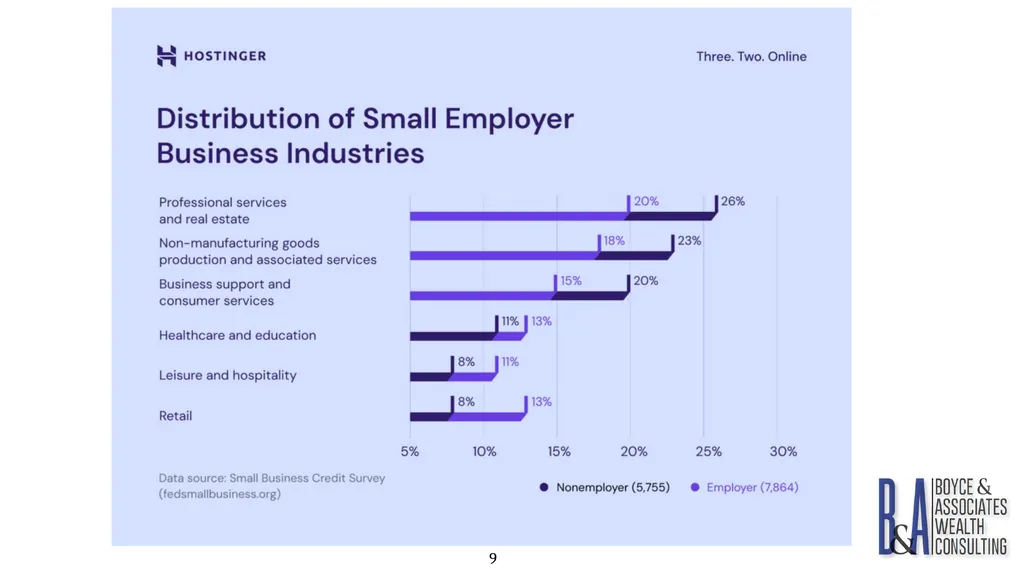
9 Source: See Disclaimer Page for Summary<br>
10
Legal Status
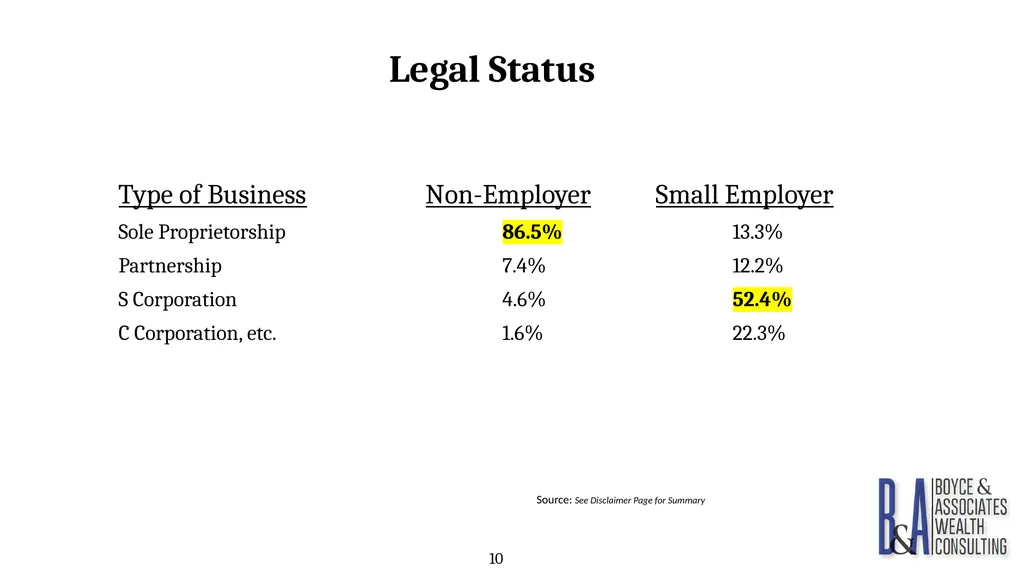
Type of Business Non-Employer Small Employer
Sole Proprietorship 86.5% 13.3%
Partnership 7.4% 12.2%
S Corporation 4.6% 52.4%
C Corporation, etc. 1.6% 22.3% 10 Source: See Disclaimer Page for Summary<br>
Type of Business Non-Employer Small Employer
Sole Proprietorship 86.5% 13.3%
Partnership 7.4% 12.2%
S Corporation 4.6% 52.4%
C Corporation, etc. 1.6% 22.3% 10 Source: See Disclaimer Page for Summary<br>
11
Small Business Finance Statistics
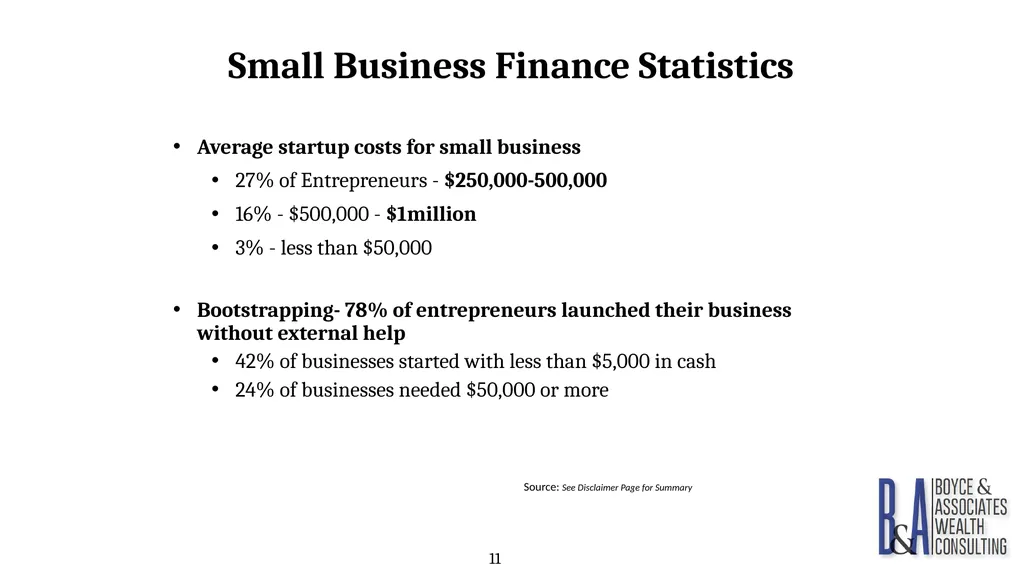
Average startup costs for small business
27% of Entrepreneurs - $250,000-500,000
16% - $500,000 - $1million
3% - less than $50,000
Bootstrapping- 78% of entrepreneurs launched their business without external help
42% of businesses started with less than $5,000 in cash
24% of businesses needed $50,000 or more 11 Source: See Disclaimer Page for Summary<br>
Average startup costs for small business
27% of Entrepreneurs - $250,000-500,000
16% - $500,000 - $1million
3% - less than $50,000
Bootstrapping- 78% of entrepreneurs launched their business without external help
42% of businesses started with less than $5,000 in cash
24% of businesses needed $50,000 or more 11 Source: See Disclaimer Page for Summary<br>
12
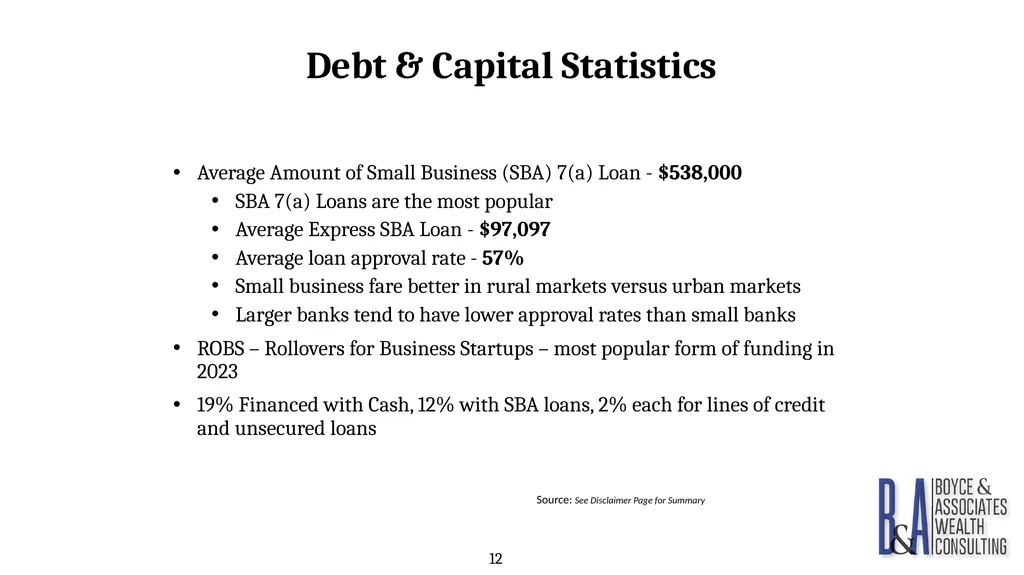
Debt & Capital Statistics
Average Amount of Small Business (SBA) 7(a) Loan - $538,000
SBA 7(a) Loans are the most popular
Average Express SBA Loan - $97,097
Average loan approval rate - 57%
Small business fare better in rural markets versus urban markets
Larger banks tend to have lower approval rates than small banks
ROBS – Rollovers for Business Startups – most popular form of funding in 2023
19% Financed with Cash, 12% with SBA loans, 2% each for lines of credit and unsecured loans 12 Source: See Disclaimer Page for Summary<br>
Average Amount of Small Business (SBA) 7(a) Loan - $538,000
SBA 7(a) Loans are the most popular
Average Express SBA Loan - $97,097
Average loan approval rate - 57%
Small business fare better in rural markets versus urban markets
Larger banks tend to have lower approval rates than small banks
ROBS – Rollovers for Business Startups – most popular form of funding in 2023
19% Financed with Cash, 12% with SBA loans, 2% each for lines of credit and unsecured loans 12 Source: See Disclaimer Page for Summary<br>
13
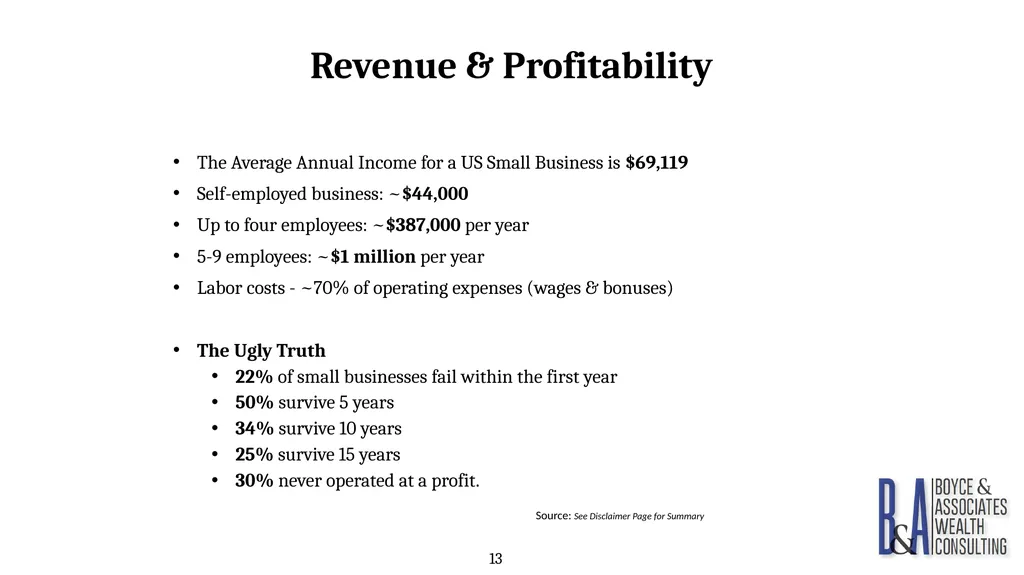
Revenue & Profitability
The Average Annual Income for a US Small Business is $69,119
Self-employed business: ~$44,000
Up to four employees: ~$387,000 per year
5-9 employees: ~$1 million per year
Labor costs - ~70% of operating expenses (wages & bonuses)
The Ugly Truth
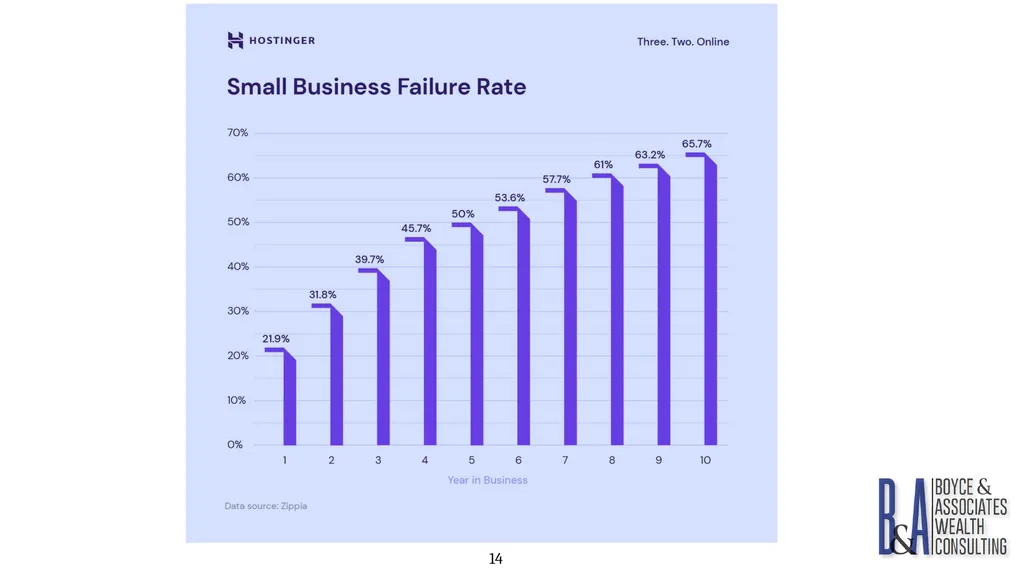
22% of small businesses fail within the first year
50% survive 5 years
34% survive 10 years
25% survive 15 years
30% never operated at a profit. 13 Source: See Disclaimer Page for Summary<br>
The Average Annual Income for a US Small Business is $69,119
Self-employed business: ~$44,000
Up to four employees: ~$387,000 per year
5-9 employees: ~$1 million per year
Labor costs - ~70% of operating expenses (wages & bonuses)
The Ugly Truth
22% of small businesses fail within the first year
50% survive 5 years
34% survive 10 years
25% survive 15 years
30% never operated at a profit. 13 Source: See Disclaimer Page for Summary<br>
14
14 Source: See Disclaimer Page for Summary<br>
15
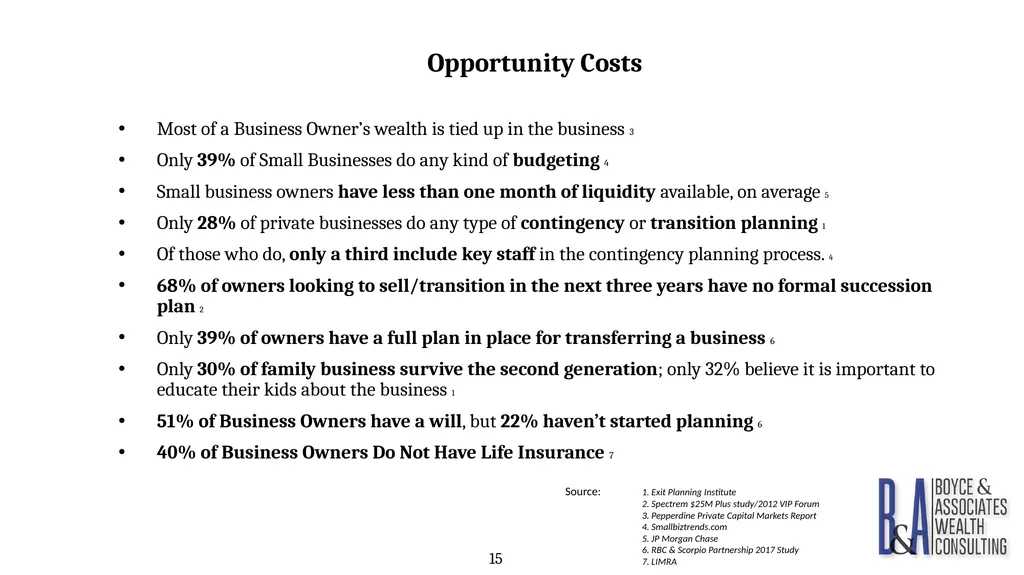
Opportunity Costs
Most of a Business Owner’s wealth is tied up in the business 3
Only 39% of Small Businesses do any kind of budgeting 4
Small business owners have less than one month of liquidity available, on average 5
Only 28% of private businesses do any type of contingency or transition planning 1
Of those who do, only a third include key staff in the contingency planning process. 4
68% of owners looking to sell/transition in the next three years have no formal succession plan 2
Only 39% of owners have a full plan in place for transferring a business 6
Only 30% of family business survive the second generation; only 32% believe it is important to educate their kids about the business 1
51% of Business Owners have a will, but 22% haven’t started planning 6
40% of Business Owners Do Not Have Life Insurance 7 15 Source: 1. Exit Planning Institute
2. Spectrem $25M Plus study/2012 VIP Forum
3. Pepperdine Private Capital Markets Report
4. Smallbiztrends.com
5. JP Morgan Chase
6. RBC & Scorpio Partnership 2017 Study
7. LIMRA<br>
Most of a Business Owner’s wealth is tied up in the business 3
Only 39% of Small Businesses do any kind of budgeting 4
Small business owners have less than one month of liquidity available, on average 5
Only 28% of private businesses do any type of contingency or transition planning 1
Of those who do, only a third include key staff in the contingency planning process. 4
68% of owners looking to sell/transition in the next three years have no formal succession plan 2
Only 39% of owners have a full plan in place for transferring a business 6
Only 30% of family business survive the second generation; only 32% believe it is important to educate their kids about the business 1
51% of Business Owners have a will, but 22% haven’t started planning 6
40% of Business Owners Do Not Have Life Insurance 7 15 Source: 1. Exit Planning Institute
2. Spectrem $25M Plus study/2012 VIP Forum
3. Pepperdine Private Capital Markets Report
4. Smallbiztrends.com
5. JP Morgan Chase
6. RBC & Scorpio Partnership 2017 Study
7. LIMRA<br>
16
16 The Exit Plan
78% of Business Owners expect to fund their retirement through the sale of their business 1
75% of those who sold their business said the sale did not accomplish their goals 2 Source: 1. CNBC
2. Exit Planning Institute<br>
78% of Business Owners expect to fund their retirement through the sale of their business 1
75% of those who sold their business said the sale did not accomplish their goals 2 Source: 1. CNBC
2. Exit Planning Institute<br>
17
17 Who is on Your Team?<br>
18
The Players
Internal (Core) Team
External Advisors
Additional Specialists 18<br>
Internal (Core) Team
External Advisors
Additional Specialists 18<br>
19
Core Team (Internal or Outsourced)
Operations Manager: Ensures smooth day-to-day functioning, overseeing tasks like inventory, scheduling, logistics, and quality control. In smaller businesses, this might be you or a key employee.
Marketing & Sales Team: Drives customer acquisition, brand awareness, and lead generation. This could be a dedicated marketing professional, a sales team, or even yourself for smaller businesses.
Finance & Accounting Professional: Manages the financial health of the business, including bookkeeping, financial reporting, budgeting, and tax preparation. You could outsource this initially, but eventually having someone in-house is crucial.
Customer Service Representative: Provides exceptional support to build customer loyalty and positive brand perception. This could be a dedicated role or integrated into other roles in smaller businesses. 19<br>
Operations Manager: Ensures smooth day-to-day functioning, overseeing tasks like inventory, scheduling, logistics, and quality control. In smaller businesses, this might be you or a key employee.
Marketing & Sales Team: Drives customer acquisition, brand awareness, and lead generation. This could be a dedicated marketing professional, a sales team, or even yourself for smaller businesses.
Finance & Accounting Professional: Manages the financial health of the business, including bookkeeping, financial reporting, budgeting, and tax preparation. You could outsource this initially, but eventually having someone in-house is crucial.
Customer Service Representative: Provides exceptional support to build customer loyalty and positive brand perception. This could be a dedicated role or integrated into other roles in smaller businesses. 19<br>
20
External Advisors
Business Attorney: Provides legal advice, ensures compliance with regulations, and drafts contracts. Consult an attorney as needed, but having one on retainer can be beneficial as your business grows.
Banker: Provides access to capital & treasury management tools to expand services and fund operations
Tax Advisor/CPA: Provides tax planning and preparation services to minimize your tax burden and ensure compliance with tax regulations.
Financial Advisor: Designs Long term financial and investment plans to maximize the benefit of the wealth being created within the business
Estate Planner: Offers assistance with asset protection, succession planning, tax optimization
Human Resources Consultant: Guides you on employee recruitment, onboarding, training, payroll, and legal compliance. You can outsource this initially, but as you grow, it becomes more important.
Business Coach or Mentor: Offers guidance, support, and accountability as you navigate challenges and make strategic decisions. Consider industry-specific expertise if possible. 20<br>
Business Attorney: Provides legal advice, ensures compliance with regulations, and drafts contracts. Consult an attorney as needed, but having one on retainer can be beneficial as your business grows.
Banker: Provides access to capital & treasury management tools to expand services and fund operations
Tax Advisor/CPA: Provides tax planning and preparation services to minimize your tax burden and ensure compliance with tax regulations.
Financial Advisor: Designs Long term financial and investment plans to maximize the benefit of the wealth being created within the business
Estate Planner: Offers assistance with asset protection, succession planning, tax optimization
Human Resources Consultant: Guides you on employee recruitment, onboarding, training, payroll, and legal compliance. You can outsource this initially, but as you grow, it becomes more important.
Business Coach or Mentor: Offers guidance, support, and accountability as you navigate challenges and make strategic decisions. Consider industry-specific expertise if possible. 20<br>
21
Additional Specialists
Web Developer/Designer: Creates and maintains your website, ensuring a user-friendly and visually appealing online presence.
Graphic Designer: Develops marketing materials, branding elements, and other visual content.
Social Media Manager: Manages your social media presence, creating engaging content and interacting with followers.
SEO Specialist: Optimizes your website and online presence to improve search engine ranking and organic traffic.
Public Relations Specialist: Manages your public image, builds relationships with media outlets, and secures positive press coverage. 21<br>
Web Developer/Designer: Creates and maintains your website, ensuring a user-friendly and visually appealing online presence.
Graphic Designer: Develops marketing materials, branding elements, and other visual content.
Social Media Manager: Manages your social media presence, creating engaging content and interacting with followers.
SEO Specialist: Optimizes your website and online presence to improve search engine ranking and organic traffic.
Public Relations Specialist: Manages your public image, builds relationships with media outlets, and secures positive press coverage. 21<br>
22
Choosing the Right Team
Stage of Business: Startups might have the owner wearing multiple hats, while established businesses can afford dedicated teams.
Budget: Outsourcing or utilizing freelancers can be cost-effective initially, but hiring in-house becomes more efficient as your business grows.
Company Culture: Building a strong professional network and fostering trust with your team is essential for overall success.
Notes:
The ideal team is a dynamic group that adapts to your evolving needs.
Look for individuals who complement your skills and expertise, share your vision, and are passionate about helping your business thrive.
Don't hesitate to leverage a combination of internal employees, external advisors, and specialists to create a well-rounded support system. 22<br>
Stage of Business: Startups might have the owner wearing multiple hats, while established businesses can afford dedicated teams.
Budget: Outsourcing or utilizing freelancers can be cost-effective initially, but hiring in-house becomes more efficient as your business grows.
Company Culture: Building a strong professional network and fostering trust with your team is essential for overall success.
Notes:
The ideal team is a dynamic group that adapts to your evolving needs.
Look for individuals who complement your skills and expertise, share your vision, and are passionate about helping your business thrive.
Don't hesitate to leverage a combination of internal employees, external advisors, and specialists to create a well-rounded support system. 22<br>
23
Business Attorney
Legal Expertise and Guidance:
Business Formation & Structuring: Attorneys can help you choose the right business structure (sole proprietorship, LLC, corporation) based on your liability needs and tax implications.
Contract Review & Negotiation: They can ensure your contracts are watertight, protecting your interests in agreements with vendors, customers, employees, and other parties.
Compliance with Regulations: Attorneys can advise you on complex legal and regulatory requirements to ensure your business operates within the boundaries of the law. This includes areas like employment law, environmental regulations, and data privacy laws.
Intellectual Property Protection: They can help you safeguard your intellectual property (trademarks, copyrights, patents) to prevent unauthorized use by competitors.
Risk Management and Dispute Resolution:
Mitigating Legal Risks: Attorneys can identify potential legal risks associated with your business operations and advise on strategies to minimize them.
Contract Dispute Resolution: If a business contract dispute arises, they can help you navigate negotiations, mediation, or litigation to protect your interests.
Employment Law Issues: They can guide you on employee rights, compliance with labor laws, and handling potential employee disputes or terminations. 23<br>
Legal Expertise and Guidance:
Business Formation & Structuring: Attorneys can help you choose the right business structure (sole proprietorship, LLC, corporation) based on your liability needs and tax implications.
Contract Review & Negotiation: They can ensure your contracts are watertight, protecting your interests in agreements with vendors, customers, employees, and other parties.
Compliance with Regulations: Attorneys can advise you on complex legal and regulatory requirements to ensure your business operates within the boundaries of the law. This includes areas like employment law, environmental regulations, and data privacy laws.
Intellectual Property Protection: They can help you safeguard your intellectual property (trademarks, copyrights, patents) to prevent unauthorized use by competitors.
Risk Management and Dispute Resolution:
Mitigating Legal Risks: Attorneys can identify potential legal risks associated with your business operations and advise on strategies to minimize them.
Contract Dispute Resolution: If a business contract dispute arises, they can help you navigate negotiations, mediation, or litigation to protect your interests.
Employment Law Issues: They can guide you on employee rights, compliance with labor laws, and handling potential employee disputes or terminations. 23<br>
24
Business Attorney
Beyond Legal Issues:
Strategic Planning: Business attorneys can offer valuable insights and advice during business planning stages, considering legal and regulatory ramifications of your strategies.
Negotiation Support: Their expertise can be beneficial in negotiations with vendors, landlords, or other business partners, ensuring you secure favorable terms.
Peace of Mind: Knowing you have a qualified legal professional on your side can provide peace of mind and allow you to focus on running your business without constant legal worries.
Factors to Consider:
Stage of Business: Startups might benefit from initial consultations or project-based work, while established businesses might need ongoing legal counsel.
Budget: Business attorneys typically charge hourly fees or retainers. Discuss fees upfront to ensure you find an attorney who aligns with your budget.
Finding the Right Fit: Look for an attorney with experience in your industry who understands the unique challenges faced by small businesses. 24<br>
Beyond Legal Issues:
Strategic Planning: Business attorneys can offer valuable insights and advice during business planning stages, considering legal and regulatory ramifications of your strategies.
Negotiation Support: Their expertise can be beneficial in negotiations with vendors, landlords, or other business partners, ensuring you secure favorable terms.
Peace of Mind: Knowing you have a qualified legal professional on your side can provide peace of mind and allow you to focus on running your business without constant legal worries.
Factors to Consider:
Stage of Business: Startups might benefit from initial consultations or project-based work, while established businesses might need ongoing legal counsel.
Budget: Business attorneys typically charge hourly fees or retainers. Discuss fees upfront to ensure you find an attorney who aligns with your budget.
Finding the Right Fit: Look for an attorney with experience in your industry who understands the unique challenges faced by small businesses. 24<br>
25
Banker
Financial Expertise:
Loan Guidance: Bankers can help you navigate the loan application process, identify the right loan products for your needs, and connect you with loan programs you might not be aware of.
Financial Analysis: They can analyze your financial statements, identify areas for improvement, and offer guidance on budgeting and cash flow management.
Financial Planning: Bankers can assist with long-term financial planning, helping you set financial goals, develop financial projections, and make informed investment decisions.
Business Connections:
Network Building: Bankers often have a network of contacts within the business community, connecting you with potential investors, vendors, or strategic partners.
Mentorship: Some bankers act as mentors, offering guidance and advice based on their experience working with small businesses. 25<br>
Financial Expertise:
Loan Guidance: Bankers can help you navigate the loan application process, identify the right loan products for your needs, and connect you with loan programs you might not be aware of.
Financial Analysis: They can analyze your financial statements, identify areas for improvement, and offer guidance on budgeting and cash flow management.
Financial Planning: Bankers can assist with long-term financial planning, helping you set financial goals, develop financial projections, and make informed investment decisions.
Business Connections:
Network Building: Bankers often have a network of contacts within the business community, connecting you with potential investors, vendors, or strategic partners.
Mentorship: Some bankers act as mentors, offering guidance and advice based on their experience working with small businesses. 25<br>
26
Banker
Additional Services:
Cash Management Solutions: Bankers can help you set up efficient cash management systems, including online banking, merchant services, and automated bill payments.
Business Account Services: They offer various business accounts with features tailored to your specific needs, such as check writing, online banking, and merchant services.
Payment Processing: Many banks offer payment processing solutions to streamline your ability to accept customer payments.
Building a Relationship:
The true value of a banker lies in building a long-term relationship. A good banker will take the time to understand your business, your goals, and your financial situation. This allows them to provide more personalized advice, tailored solutions, and ongoing support as your business grows.
Additional points to consider:
Shop around: Interview bankers from different institutions to find one who understands your industry and has experience working with small businesses.
Clarity on Fees: Be sure to understand all associated fees for services and be comfortable with the bank's overall pricing structure.
Communication is Key: Maintain open communication with your banker, keeping them informed of your business progress and any upcoming financial needs. 26<br>
Additional Services:
Cash Management Solutions: Bankers can help you set up efficient cash management systems, including online banking, merchant services, and automated bill payments.
Business Account Services: They offer various business accounts with features tailored to your specific needs, such as check writing, online banking, and merchant services.
Payment Processing: Many banks offer payment processing solutions to streamline your ability to accept customer payments.
Building a Relationship:
The true value of a banker lies in building a long-term relationship. A good banker will take the time to understand your business, your goals, and your financial situation. This allows them to provide more personalized advice, tailored solutions, and ongoing support as your business grows.
Additional points to consider:
Shop around: Interview bankers from different institutions to find one who understands your industry and has experience working with small businesses.
Clarity on Fees: Be sure to understand all associated fees for services and be comfortable with the bank's overall pricing structure.
Communication is Key: Maintain open communication with your banker, keeping them informed of your business progress and any upcoming financial needs. 26<br>
27
CPA/Tax Advisor
Financial Expertise and Guidance:
Accurate Bookkeeping & Recordkeeping: CPAs ensure your financial records are accurate, organized, and up-to-date. This provides a clear picture of your business's financial health and facilitates informed decision-making.
Tax Planning & Preparation: They can help you navigate complex tax laws, identify deductions and credits you might miss, and develop tax-saving strategies to minimize your tax burden.
Financial Analysis & Reporting: CPAs analyze your financial data to identify trends, assess profitability, and generate comprehensive financial reports crucial for securing funding, attracting investors, or making informed business decisions.
Strategic Planning and Growth:
Business Budgeting & Forecasting: They can help you create realistic budgets, develop financial forecasts, and track your progress towards financial goals.
Cash Flow Management: CPAs can identify areas to optimize cash flow, ensuring you have sufficient funds to meet your financial obligations and support business growth.
Cost Control & Efficiency Improvement: Their analysis can reveal areas to reduce costs and improve operational efficiency, maximizing your profits. 27<br>
Financial Expertise and Guidance:
Accurate Bookkeeping & Recordkeeping: CPAs ensure your financial records are accurate, organized, and up-to-date. This provides a clear picture of your business's financial health and facilitates informed decision-making.
Tax Planning & Preparation: They can help you navigate complex tax laws, identify deductions and credits you might miss, and develop tax-saving strategies to minimize your tax burden.
Financial Analysis & Reporting: CPAs analyze your financial data to identify trends, assess profitability, and generate comprehensive financial reports crucial for securing funding, attracting investors, or making informed business decisions.
Strategic Planning and Growth:
Business Budgeting & Forecasting: They can help you create realistic budgets, develop financial forecasts, and track your progress towards financial goals.
Cash Flow Management: CPAs can identify areas to optimize cash flow, ensuring you have sufficient funds to meet your financial obligations and support business growth.
Cost Control & Efficiency Improvement: Their analysis can reveal areas to reduce costs and improve operational efficiency, maximizing your profits. 27<br>
28
CPA/Tax Advisor
Additional Benefits:
Loan Applications & Financing: CPAs can assist you in preparing loan applications and presentations to secure financing for business expansion or other needs.
Start-Up & Business Structure Advice: For new businesses, they can provide guidance on choosing the right business structure (sole proprietorship, LLC, corporation) based on tax implications and liability considerations.
Peace of Mind: Knowing your finances are in the hands of a qualified professional allows you to focus on running your business with greater confidence.
Here are some factors to consider when deciding if a CPA is right for you:
Stage of Business: Startups might benefit from project-based work or ongoing bookkeeping assistance, while established businesses might require more comprehensive strategic financial planning.
Budget: CPAs typically charge hourly fees or retainers. Discuss fees upfront to find a solution that aligns with your budget.
Finding the Right Fit: Look for a CPA who understands the specific challenges faced by small businesses in your industry. 28<br>
Additional Benefits:
Loan Applications & Financing: CPAs can assist you in preparing loan applications and presentations to secure financing for business expansion or other needs.
Start-Up & Business Structure Advice: For new businesses, they can provide guidance on choosing the right business structure (sole proprietorship, LLC, corporation) based on tax implications and liability considerations.
Peace of Mind: Knowing your finances are in the hands of a qualified professional allows you to focus on running your business with greater confidence.
Here are some factors to consider when deciding if a CPA is right for you:
Stage of Business: Startups might benefit from project-based work or ongoing bookkeeping assistance, while established businesses might require more comprehensive strategic financial planning.
Budget: CPAs typically charge hourly fees or retainers. Discuss fees upfront to find a solution that aligns with your budget.
Finding the Right Fit: Look for a CPA who understands the specific challenges faced by small businesses in your industry. 28<br>
29
Wealth/Financial Advisor
Financial Planning and Growth:
Business Plan Development: Financial advisors can help you develop a robust business plan, including financial projections and funding strategies, which can be crucial for securing loans or attracting investors.
Goal Setting & Budgeting: They can guide you in setting realistic financial goals for your business and creating budgets to achieve them.
Cash Flow Management: Financial advisors can help you develop strategies to optimize cash flow, ensuring you have sufficient funds to cover operational costs, invest in growth opportunities, and avoid cash shortages.
Investment and Risk Management:
Investment Strategies: They can help you develop investment strategies to grow your business capital, considering your risk tolerance and long-term financial objectives.
Retirement Plans: For businesses with employees, financial advisors can assist in setting up retirement plans (e.g., 401(k) plans) to attract and retain talent.
Risk Assessment & Mitigation: Financial advisors can assess potential financial risks faced by your business and develop strategies to mitigate them, such as insurance coverage or diversification of investments.
Financial Analysis and Decision-Making:
Financial Statement Analysis: They can analyze your financial statements to identify trends, assess profitability, and provide insights to inform strategic business decisions.
Cost-Benefit Analysis: When considering major investments or business ventures, financial advisors can help you analyze the costs, potential returns, and overall financial implications.
Debt Management: They can guide you on managing business debt effectively, including strategies for securing favorable loan terms and repayment plans. 29<br>
Financial Planning and Growth:
Business Plan Development: Financial advisors can help you develop a robust business plan, including financial projections and funding strategies, which can be crucial for securing loans or attracting investors.
Goal Setting & Budgeting: They can guide you in setting realistic financial goals for your business and creating budgets to achieve them.
Cash Flow Management: Financial advisors can help you develop strategies to optimize cash flow, ensuring you have sufficient funds to cover operational costs, invest in growth opportunities, and avoid cash shortages.
Investment and Risk Management:
Investment Strategies: They can help you develop investment strategies to grow your business capital, considering your risk tolerance and long-term financial objectives.
Retirement Plans: For businesses with employees, financial advisors can assist in setting up retirement plans (e.g., 401(k) plans) to attract and retain talent.
Risk Assessment & Mitigation: Financial advisors can assess potential financial risks faced by your business and develop strategies to mitigate them, such as insurance coverage or diversification of investments.
Financial Analysis and Decision-Making:
Financial Statement Analysis: They can analyze your financial statements to identify trends, assess profitability, and provide insights to inform strategic business decisions.
Cost-Benefit Analysis: When considering major investments or business ventures, financial advisors can help you analyze the costs, potential returns, and overall financial implications.
Debt Management: They can guide you on managing business debt effectively, including strategies for securing favorable loan terms and repayment plans. 29<br>
30
Wealth/Financial Advisor
Additional Advantages:
Succession Planning: Financial advisors can assist business owners in developing a succession plan to ensure a smooth transition of ownership in the future.
Exit Strategy Development: If you plan to sell your business eventually, a financial advisor can help you develop an exit strategy to maximize its value.
Access to Networks: Financial advisors often have a network of professionals, including lawyers, accountants, and other specialists, who can provide additional support for your business needs.
Important Considerations:
Stage of Business: Startups might benefit from initial consultations or project-based work, while established businesses might require ongoing financial guidance.
Focus and Expertise: Financial advisors have varying areas of specialization. Choose one with experience working with small businesses in your industry.
Fees and Compensation: Financial advisors typically charge fees based on a percentage of assets managed or hourly rates. Discuss their fee structure upfront to ensure alignment with your budget. 30<br>
Additional Advantages:
Succession Planning: Financial advisors can assist business owners in developing a succession plan to ensure a smooth transition of ownership in the future.
Exit Strategy Development: If you plan to sell your business eventually, a financial advisor can help you develop an exit strategy to maximize its value.
Access to Networks: Financial advisors often have a network of professionals, including lawyers, accountants, and other specialists, who can provide additional support for your business needs.
Important Considerations:
Stage of Business: Startups might benefit from initial consultations or project-based work, while established businesses might require ongoing financial guidance.
Focus and Expertise: Financial advisors have varying areas of specialization. Choose one with experience working with small businesses in your industry.
Fees and Compensation: Financial advisors typically charge fees based on a percentage of assets managed or hourly rates. Discuss their fee structure upfront to ensure alignment with your budget. 30<br>
31
Estate Planner
Business Succession Planning:
Succession Strategy Development: An estate planner can guide you through creating a clear and comprehensive succession plan. This plan outlines who will inherit or take control of the business upon your retirement, disability, or death. This minimizes confusion and potential conflicts among heirs or business partners.
Minimizing Business Disruption: A well-defined succession plan ensures a smooth transition of ownership or leadership, minimizing disruption to the business operations and employee morale.
Buy-Sell Agreements: Estate planners can help establish buy-sell agreements between business partners or co-owners, outlining the process and terms for buying out a departing owner's share.
Asset Protection and Wealth Transfer:
Minimizing Estate Taxes: Estate planners can help you develop strategies to reduce your estate's tax burden, ensuring a larger portion of your wealth is passed on to your beneficiaries, including your business. This might involve trusts, gifting strategies, or other tax-saving techniques.
Asset Distribution Planning: They can help you determine how you want your business and other assets distributed to your heirs or beneficiaries. This includes considering factors like fairness, beneficiary needs, and tax implications.
Business Valuation: In some cases, estate planners can work with appraisers to determine the fair market value of your business, which is crucial for estate tax purposes and buy-sell agreements. 31<br>
Business Succession Planning:
Succession Strategy Development: An estate planner can guide you through creating a clear and comprehensive succession plan. This plan outlines who will inherit or take control of the business upon your retirement, disability, or death. This minimizes confusion and potential conflicts among heirs or business partners.
Minimizing Business Disruption: A well-defined succession plan ensures a smooth transition of ownership or leadership, minimizing disruption to the business operations and employee morale.
Buy-Sell Agreements: Estate planners can help establish buy-sell agreements between business partners or co-owners, outlining the process and terms for buying out a departing owner's share.
Asset Protection and Wealth Transfer:
Minimizing Estate Taxes: Estate planners can help you develop strategies to reduce your estate's tax burden, ensuring a larger portion of your wealth is passed on to your beneficiaries, including your business. This might involve trusts, gifting strategies, or other tax-saving techniques.
Asset Distribution Planning: They can help you determine how you want your business and other assets distributed to your heirs or beneficiaries. This includes considering factors like fairness, beneficiary needs, and tax implications.
Business Valuation: In some cases, estate planners can work with appraisers to determine the fair market value of your business, which is crucial for estate tax purposes and buy-sell agreements. 31<br>
32
Estate Planner
Personal Estate Planning:
Will & Power of Attorney: Estate planners can draft a will that reflects your wishes for your business and personal assets. They can also help establish a power of attorney to designate someone to manage your affairs if you become incapacitated.
Beneficiary Designation: They can ensure your retirement accounts, life insurance policies, and other assets have designated beneficiaries to avoid probate and ensure a smooth transfer of ownership.
Family Communication: Estate planners can facilitate open communication within your family about your estate plans, minimizing potential conflicts or misunderstandings after your passing.
Overall Benefits:
Peace of Mind: Having a comprehensive estate plan in place allows you to focus on running your business with the knowledge that your future and the future of your business are well-planned.
Security for Loved Ones: A well-crafted estate plan ensures your loved ones are taken care of financially and your business legacy is protected according to your wishes.
Business Continuity: By ensuring a smooth succession plan, you safeguard the future of your business and the livelihoods of your employees. 32<br>
Personal Estate Planning:
Will & Power of Attorney: Estate planners can draft a will that reflects your wishes for your business and personal assets. They can also help establish a power of attorney to designate someone to manage your affairs if you become incapacitated.
Beneficiary Designation: They can ensure your retirement accounts, life insurance policies, and other assets have designated beneficiaries to avoid probate and ensure a smooth transfer of ownership.
Family Communication: Estate planners can facilitate open communication within your family about your estate plans, minimizing potential conflicts or misunderstandings after your passing.
Overall Benefits:
Peace of Mind: Having a comprehensive estate plan in place allows you to focus on running your business with the knowledge that your future and the future of your business are well-planned.
Security for Loved Ones: A well-crafted estate plan ensures your loved ones are taken care of financially and your business legacy is protected according to your wishes.
Business Continuity: By ensuring a smooth succession plan, you safeguard the future of your business and the livelihoods of your employees. 32<br>
33
33 Characteristics of High Performing Businesses<br>
34
Several key characteristics set high-performing businesses apart from the rest. These encompass aspects of strategy, leadership, culture, and operations:
Strategic Focus: High performers are not accidental successes. They have a clear vision and roadmap, with every decision meticulously planned and evaluated against set goals. They prioritize proactive strategy over reactive firefighting.
Customer Centricity: These businesses understand their customers are the foundation of their existence. Every move revolves around creating value and exceeding customer expectations. They actively seek customer feedback and build strong relationships.
Clear Guiding Principles: A strong foundation of clearly defined values and principles is essential. When communicated effectively throughout the organization, these principles guide decision-making and foster a high-performing culture.
Employee Optimization: High performers recognize that happy, engaged employees are the backbone of their success. They invest in creating a positive work experience, fostering professional development, and recognizing achievements. 34<br>
Strategic Focus: High performers are not accidental successes. They have a clear vision and roadmap, with every decision meticulously planned and evaluated against set goals. They prioritize proactive strategy over reactive firefighting.
Customer Centricity: These businesses understand their customers are the foundation of their existence. Every move revolves around creating value and exceeding customer expectations. They actively seek customer feedback and build strong relationships.
Clear Guiding Principles: A strong foundation of clearly defined values and principles is essential. When communicated effectively throughout the organization, these principles guide decision-making and foster a high-performing culture.
Employee Optimization: High performers recognize that happy, engaged employees are the backbone of their success. They invest in creating a positive work experience, fostering professional development, and recognizing achievements. 34<br>
35
Several key characteristics set high-performing businesses apart from the rest. These encompass aspects of strategy, leadership, culture, and operations:
Quality Focus: Delivering quality products and services is paramount. They have defined quality standards and rigorous quality assurance processes to ensure consistent value for their customers.
Data-Driven Decisions: Intuition can only take you so far. High performing businesses leverage data and analytics to inform their choices and measure their progress. This data-rich approach empowers them to make strategic optimizations.
Adaptability and Agility: The business landscape is constantly evolving. High performers are flexible and able to adapt to changing market conditions and customer needs. They embrace innovation and readily adopt new technologies.
Continuous Learning: A culture of continuous learning is vital. These businesses encourage their employees to develop new skills and stay abreast of industry trends. This ensures they have the expertise needed to stay ahead of the curve. 35<br>
Quality Focus: Delivering quality products and services is paramount. They have defined quality standards and rigorous quality assurance processes to ensure consistent value for their customers.
Data-Driven Decisions: Intuition can only take you so far. High performing businesses leverage data and analytics to inform their choices and measure their progress. This data-rich approach empowers them to make strategic optimizations.
Adaptability and Agility: The business landscape is constantly evolving. High performers are flexible and able to adapt to changing market conditions and customer needs. They embrace innovation and readily adopt new technologies.
Continuous Learning: A culture of continuous learning is vital. These businesses encourage their employees to develop new skills and stay abreast of industry trends. This ensures they have the expertise needed to stay ahead of the curve. 35<br>
36
36 Effective Entity Structure<br>
37
Choosing the right business entity structure is a critical decision for small businesses. It impacts various aspects like taxes, liability, compliance, and even your ability to raise capital.
Here's a breakdown of key factors to consider when determining the most effective entity structure for your small business.
1. Liability Protection:
Sole Proprietorship: This simplest structure offers no liability protection. Your personal assets are on the hook if the business faces lawsuits or debts.
Partnership: Similar to a sole proprietorship, partners share personal liability for business debts and obligations.
Limited Liability Company (LLC): LLCs provide liability protection, shielding your personal assets from business liabilities.
Corporation: Corporations offer the strongest liability protection. The business itself is a separate legal entity, and shareholders' personal assets are generally not at risk.
2. Taxation:
Sole Proprietorship & Partnership: Business profits "pass through" to the owner(s) and are reported on their personal tax returns.
LLC: You can choose how your LLC is taxed. By default, it operates as a pass-through entity similar to a sole proprietorship. However, you can elect to be taxed as an S corporation.
Corporation: Corporations pay taxes on their profits at the corporate tax rate, and then shareholders pay taxes again on any dividends they receive (double taxation). 37<br>
Here's a breakdown of key factors to consider when determining the most effective entity structure for your small business.
1. Liability Protection:
Sole Proprietorship: This simplest structure offers no liability protection. Your personal assets are on the hook if the business faces lawsuits or debts.
Partnership: Similar to a sole proprietorship, partners share personal liability for business debts and obligations.
Limited Liability Company (LLC): LLCs provide liability protection, shielding your personal assets from business liabilities.
Corporation: Corporations offer the strongest liability protection. The business itself is a separate legal entity, and shareholders' personal assets are generally not at risk.
2. Taxation:
Sole Proprietorship & Partnership: Business profits "pass through" to the owner(s) and are reported on their personal tax returns.
LLC: You can choose how your LLC is taxed. By default, it operates as a pass-through entity similar to a sole proprietorship. However, you can elect to be taxed as an S corporation.
Corporation: Corporations pay taxes on their profits at the corporate tax rate, and then shareholders pay taxes again on any dividends they receive (double taxation). 37<br>
38
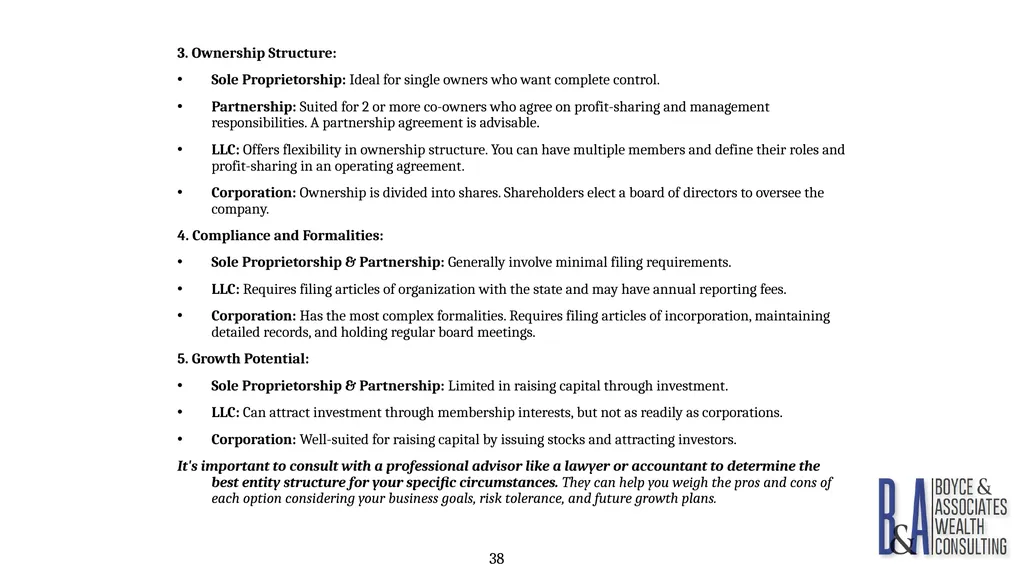
3. Ownership Structure:
Sole Proprietorship: Ideal for single owners who want complete control.
Partnership: Suited for 2 or more co-owners who agree on profit-sharing and management responsibilities. A partnership agreement is advisable.
LLC: Offers flexibility in ownership structure. You can have multiple members and define their roles and profit-sharing in an operating agreement.
Corporation: Ownership is divided into shares. Shareholders elect a board of directors to oversee the company.
4. Compliance and Formalities:
Sole Proprietorship & Partnership: Generally involve minimal filing requirements.
LLC: Requires filing articles of organization with the state and may have annual reporting fees.
Corporation: Has the most complex formalities. Requires filing articles of incorporation, maintaining detailed records, and holding regular board meetings.
5. Growth Potential:
Sole Proprietorship & Partnership: Limited in raising capital through investment.
LLC: Can attract investment through membership interests, but not as readily as corporations.
Corporation: Well-suited for raising capital by issuing stocks and attracting investors.
It's important to consult with a professional advisor like a lawyer or accountant to determine the best entity structure for your specific circumstances. They can help you weigh the pros and cons of each option considering your business goals, risk tolerance, and future growth plans. 38<br>
Sole Proprietorship: Ideal for single owners who want complete control.
Partnership: Suited for 2 or more co-owners who agree on profit-sharing and management responsibilities. A partnership agreement is advisable.
LLC: Offers flexibility in ownership structure. You can have multiple members and define their roles and profit-sharing in an operating agreement.
Corporation: Ownership is divided into shares. Shareholders elect a board of directors to oversee the company.
4. Compliance and Formalities:
Sole Proprietorship & Partnership: Generally involve minimal filing requirements.
LLC: Requires filing articles of organization with the state and may have annual reporting fees.
Corporation: Has the most complex formalities. Requires filing articles of incorporation, maintaining detailed records, and holding regular board meetings.
5. Growth Potential:
Sole Proprietorship & Partnership: Limited in raising capital through investment.
LLC: Can attract investment through membership interests, but not as readily as corporations.
Corporation: Well-suited for raising capital by issuing stocks and attracting investors.
It's important to consult with a professional advisor like a lawyer or accountant to determine the best entity structure for your specific circumstances. They can help you weigh the pros and cons of each option considering your business goals, risk tolerance, and future growth plans. 38<br>
39
39 Contingency Planning<br>
40
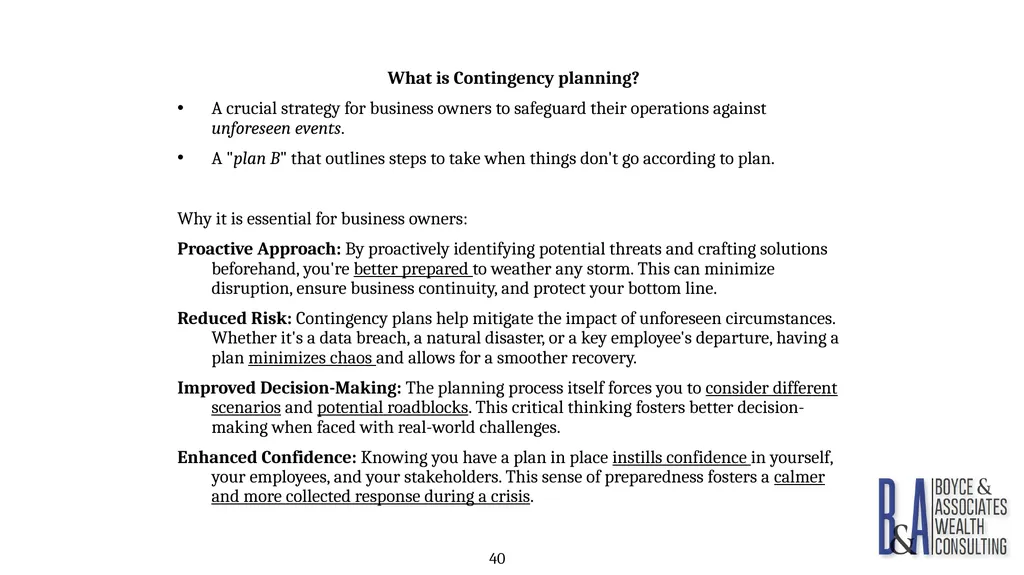
What is Contingency planning?
A crucial strategy for business owners to safeguard their operations against unforeseen events.
A "plan B" that outlines steps to take when things don't go according to plan.
Why it is essential for business owners:
Proactive Approach: By proactively identifying potential threats and crafting solutions beforehand, you're better prepared to weather any storm. This can minimize disruption, ensure business continuity, and protect your bottom line.
Reduced Risk: Contingency plans help mitigate the impact of unforeseen circumstances. Whether it's a data breach, a natural disaster, or a key employee's departure, having a plan minimizes chaos and allows for a smoother recovery.
Improved Decision-Making: The planning process itself forces you to consider different scenarios and potential roadblocks. This critical thinking fosters better decision-making when faced with real-world challenges.
Enhanced Confidence: Knowing you have a plan in place instills confidence in yourself, your employees, and your stakeholders. This sense of preparedness fosters a calmer and more collected response during a crisis. 40<br>
A crucial strategy for business owners to safeguard their operations against unforeseen events.
A "plan B" that outlines steps to take when things don't go according to plan.
Why it is essential for business owners:
Proactive Approach: By proactively identifying potential threats and crafting solutions beforehand, you're better prepared to weather any storm. This can minimize disruption, ensure business continuity, and protect your bottom line.
Reduced Risk: Contingency plans help mitigate the impact of unforeseen circumstances. Whether it's a data breach, a natural disaster, or a key employee's departure, having a plan minimizes chaos and allows for a smoother recovery.
Improved Decision-Making: The planning process itself forces you to consider different scenarios and potential roadblocks. This critical thinking fosters better decision-making when faced with real-world challenges.
Enhanced Confidence: Knowing you have a plan in place instills confidence in yourself, your employees, and your stakeholders. This sense of preparedness fosters a calmer and more collected response during a crisis. 40<br>
41
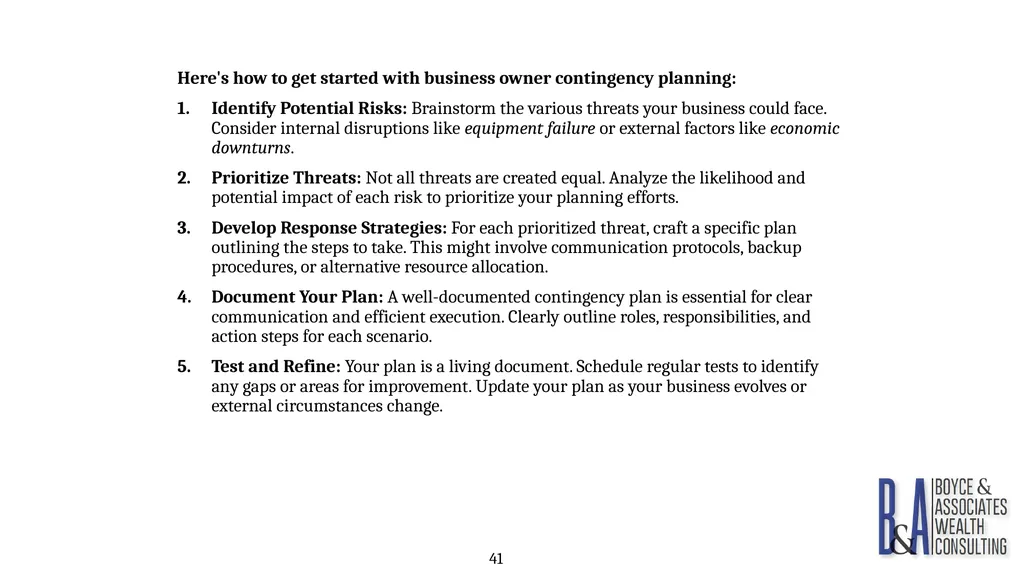
Here's how to get started with business owner contingency planning:
Identify Potential Risks: Brainstorm the various threats your business could face. Consider internal disruptions like equipment failure or external factors like economic downturns.
Prioritize Threats: Not all threats are created equal. Analyze the likelihood and potential impact of each risk to prioritize your planning efforts.
Develop Response Strategies: For each prioritized threat, craft a specific plan outlining the steps to take. This might involve communication protocols, backup procedures, or alternative resource allocation.
Document Your Plan: A well-documented contingency plan is essential for clear communication and efficient execution. Clearly outline roles, responsibilities, and action steps for each scenario.
Test and Refine: Your plan is a living document. Schedule regular tests to identify any gaps or areas for improvement. Update your plan as your business evolves or external circumstances change. 41<br>
Identify Potential Risks: Brainstorm the various threats your business could face. Consider internal disruptions like equipment failure or external factors like economic downturns.
Prioritize Threats: Not all threats are created equal. Analyze the likelihood and potential impact of each risk to prioritize your planning efforts.
Develop Response Strategies: For each prioritized threat, craft a specific plan outlining the steps to take. This might involve communication protocols, backup procedures, or alternative resource allocation.
Document Your Plan: A well-documented contingency plan is essential for clear communication and efficient execution. Clearly outline roles, responsibilities, and action steps for each scenario.
Test and Refine: Your plan is a living document. Schedule regular tests to identify any gaps or areas for improvement. Update your plan as your business evolves or external circumstances change. 41<br>
42
42 Business Valuation 101<br>
43
43 Myth:
Valuations are viewed as expensive, time-consuming and intrusive…<br>
Valuations are viewed as expensive, time-consuming and intrusive…<br>
44
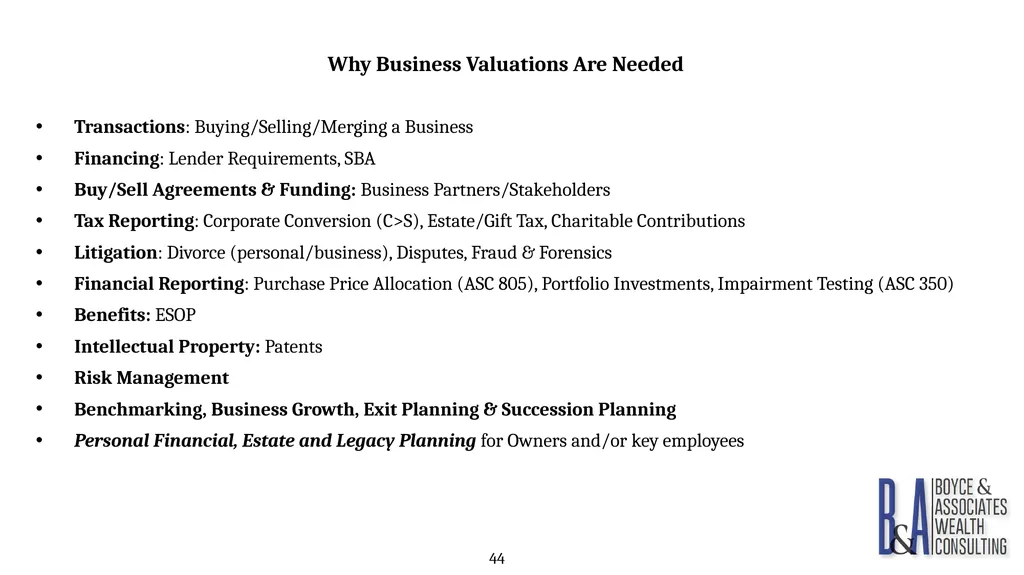
44 Why Business Valuations Are Needed
Transactions: Buying/Selling/Merging a Business
Financing: Lender Requirements, SBA
Buy/Sell Agreements & Funding: Business Partners/Stakeholders
Tax Reporting: Corporate Conversion (C>S), Estate/Gift Tax, Charitable Contributions
Litigation: Divorce (personal/business), Disputes, Fraud & Forensics
Financial Reporting: Purchase Price Allocation (ASC 805), Portfolio Investments, Impairment Testing (ASC 350)
Benefits: ESOP
Intellectual Property: Patents
Risk Management
Benchmarking, Business Growth, Exit Planning & Succession Planning
Personal Financial, Estate and Legacy Planning for Owners and/or key employees<br>
Transactions: Buying/Selling/Merging a Business
Financing: Lender Requirements, SBA
Buy/Sell Agreements & Funding: Business Partners/Stakeholders
Tax Reporting: Corporate Conversion (C>S), Estate/Gift Tax, Charitable Contributions
Litigation: Divorce (personal/business), Disputes, Fraud & Forensics
Financial Reporting: Purchase Price Allocation (ASC 805), Portfolio Investments, Impairment Testing (ASC 350)
Benefits: ESOP
Intellectual Property: Patents
Risk Management
Benchmarking, Business Growth, Exit Planning & Succession Planning
Personal Financial, Estate and Legacy Planning for Owners and/or key employees<br>
45
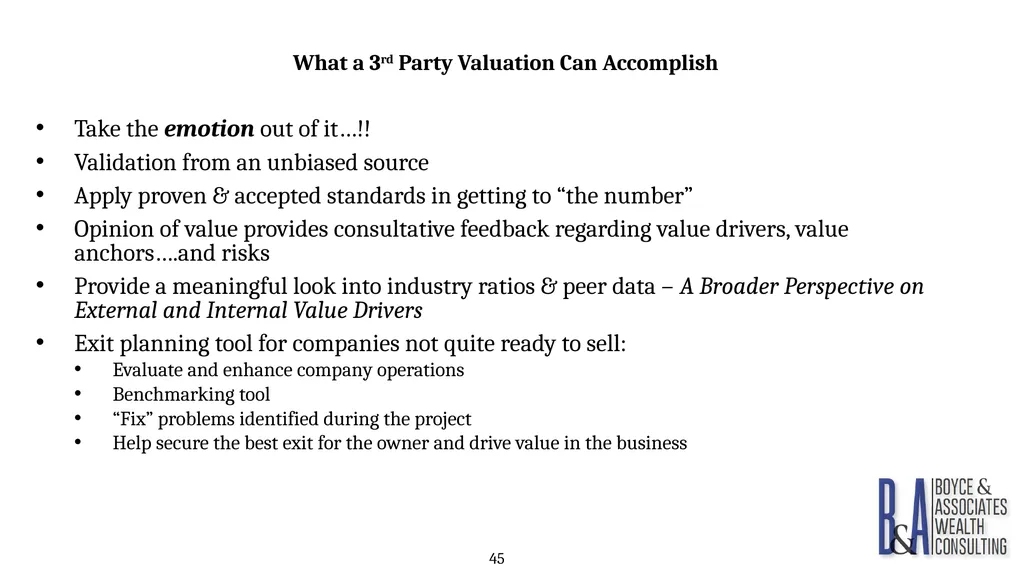
45 What a 3rd Party Valuation Can Accomplish
Take the emotion out of it…!!
Validation from an unbiased source
Apply proven & accepted standards in getting to “the number”
Opinion of value provides consultative feedback regarding value drivers, value anchors….and risks
Provide a meaningful look into industry ratios & peer data – A Broader Perspective on External and Internal Value Drivers
Exit planning tool for companies not quite ready to sell:
Evaluate and enhance company operations
Benchmarking tool
“Fix” problems identified during the project
Help secure the best exit for the owner and drive value in the business<br>
Take the emotion out of it…!!
Validation from an unbiased source
Apply proven & accepted standards in getting to “the number”
Opinion of value provides consultative feedback regarding value drivers, value anchors….and risks
Provide a meaningful look into industry ratios & peer data – A Broader Perspective on External and Internal Value Drivers
Exit planning tool for companies not quite ready to sell:
Evaluate and enhance company operations
Benchmarking tool
“Fix” problems identified during the project
Help secure the best exit for the owner and drive value in the business<br>
46
46 Standards & Certifications
Standardized approach for analyzing and presenting observations, calculations, and conclusions
Reinforces and supports high standards of care, rigor and ethics
CVA – Certified Valuation Analyst
CFA – Chartered Financial Analyst
NACVA - National Association of Certified Valuators & Analysts
USPAP - Uniform Standards of Professional Appraisal Practice<br>
Standardized approach for analyzing and presenting observations, calculations, and conclusions
Reinforces and supports high standards of care, rigor and ethics
CVA – Certified Valuation Analyst
CFA – Chartered Financial Analyst
NACVA - National Association of Certified Valuators & Analysts
USPAP - Uniform Standards of Professional Appraisal Practice<br>
47
47 How Is Value Determined
Income Approach
Market Approach
Asset/Cost Approach<br>
Income Approach
Market Approach
Asset/Cost Approach<br>
48
48 Income Approach
This method focuses on the future profitability of the business.
It considers factors like past financial performance, projected earnings, and industry benchmarks.
Common metrics used include seller's discretionary earnings (SDE) or earnings before interest, taxes, depreciation, and amortization (EBITDA), multiplied by an industry-specific multiple.
This approach is often used for profitable businesses with a strong track record.<br>
This method focuses on the future profitability of the business.
It considers factors like past financial performance, projected earnings, and industry benchmarks.
Common metrics used include seller's discretionary earnings (SDE) or earnings before interest, taxes, depreciation, and amortization (EBITDA), multiplied by an industry-specific multiple.
This approach is often used for profitable businesses with a strong track record.<br>
49
49 Market Approach
This method compares the small business to similar businesses that have recently been sold.
It involves finding comparable companies in terms of industry, size, location, and profitability.
By analyzing recent sales data of comparable businesses, you can estimate a fair market value for your own business.
This approach can be challenging due to the limited availability of data on private company sales.<br>
This method compares the small business to similar businesses that have recently been sold.
It involves finding comparable companies in terms of industry, size, location, and profitability.
By analyzing recent sales data of comparable businesses, you can estimate a fair market value for your own business.
This approach can be challenging due to the limited availability of data on private company sales.<br>
50
50 Asset/Cost Approach
This method focuses on the tangible and intangible assets the business owns.
Add the value of all assets (equipment, inventory, real estate) and subtract liabilities (loans, accounts payable) to arrive at a net asset value.
This approach is often used for businesses with a high proportion of assets or those considering liquidation.<br>
This method focuses on the tangible and intangible assets the business owns.
Add the value of all assets (equipment, inventory, real estate) and subtract liabilities (loans, accounts payable) to arrive at a net asset value.
This approach is often used for businesses with a high proportion of assets or those considering liquidation.<br>
51
51 Premise of Value
Premise of Value refers to the underlying assumptions and conditions surrounding how the subject of the valuation is being considered. It essentially answers the question: Under what circumstances are we valuing this asset?
Two main premises of value dominate most valuation situations:
Going Concern:
This assumes the business or asset will continue operating indefinitely into the foreseeable future. The valuation reflects the ongoing operations and cash flow generation potential of the subject. This is the most common premise for businesses and income-producing assets.
Liquidation:
This assumes the business or asset is being sold off in parts, with its assets converted to cash and liabilities settled.
The valuation reflects the estimated fair market value of the individual assets upon liquidation, often resulting in a lower value than the going concern approach.
This premise is typically used for businesses facing financial distress or assets being discontinued.<br>
Premise of Value refers to the underlying assumptions and conditions surrounding how the subject of the valuation is being considered. It essentially answers the question: Under what circumstances are we valuing this asset?
Two main premises of value dominate most valuation situations:
Going Concern:
This assumes the business or asset will continue operating indefinitely into the foreseeable future. The valuation reflects the ongoing operations and cash flow generation potential of the subject. This is the most common premise for businesses and income-producing assets.
Liquidation:
This assumes the business or asset is being sold off in parts, with its assets converted to cash and liabilities settled.
The valuation reflects the estimated fair market value of the individual assets upon liquidation, often resulting in a lower value than the going concern approach.
This premise is typically used for businesses facing financial distress or assets being discontinued.<br>
52
52 Calculation v. Conclusion of Value
Calculation uses one valuation approach; Conclusion uses all three
Calculation is limited scope; Conclusion looks at both quantitative & qualitative information
Calculation emphasizes Numbers; Conclusion emphasizes an Opinion
Differences in time, cost and information required
Calculation - great for owner planning, small companies, benchmarking
Conclusion - required for Form 409a, Estate or Gift tax, SBA, Litigation<br>
Calculation uses one valuation approach; Conclusion uses all three
Calculation is limited scope; Conclusion looks at both quantitative & qualitative information
Calculation emphasizes Numbers; Conclusion emphasizes an Opinion
Differences in time, cost and information required
Calculation - great for owner planning, small companies, benchmarking
Conclusion - required for Form 409a, Estate or Gift tax, SBA, Litigation<br>
53
53 Information Needed For a Business Valuation
Profit & Loss Statements, Statement of Financial Position, Cash Flow Statement for the last 3-5 years (if possible)
Tax Returns last 3-5 years
Interim Financial Statements
Forecasts, Budgets, Strategic Plans
Helpful Soft Data: Compensation, Turnover, Benefits, Significant or unique assets/liabilities, Working Capital Details<br>
Profit & Loss Statements, Statement of Financial Position, Cash Flow Statement for the last 3-5 years (if possible)
Tax Returns last 3-5 years
Interim Financial Statements
Forecasts, Budgets, Strategic Plans
Helpful Soft Data: Compensation, Turnover, Benefits, Significant or unique assets/liabilities, Working Capital Details<br>
54
54 Value Drivers & Anchors<br>
55
55 Internal Value Drivers
Things you can control:
Integrity of the Financial Statements
Financial Condition/Balance Sheet Stability
Culture, Employee Satisfaction, Stability and Turnover
Key Person(s) Strength/Risk
Key Customer/Supplier Strength/Risks – Diversification
Product/Service Strengths – Sources of Revenue
Owner/Management Risk
Firm Risks – Litigation, Contingent Liabilities
Goodwill<br>
Things you can control:
Integrity of the Financial Statements
Financial Condition/Balance Sheet Stability
Culture, Employee Satisfaction, Stability and Turnover
Key Person(s) Strength/Risk
Key Customer/Supplier Strength/Risks – Diversification
Product/Service Strengths – Sources of Revenue
Owner/Management Risk
Firm Risks – Litigation, Contingent Liabilities
Goodwill<br>
56
56 External Value Drivers
Things which are difficult or impossible to control:
Economic cyclicality
Political Risks, Taxes, Interest Rates
Position within the Industry Life-cycle
Market share and position/competitive landscape<br>
Things which are difficult or impossible to control:
Economic cyclicality
Political Risks, Taxes, Interest Rates
Position within the Industry Life-cycle
Market share and position/competitive landscape<br>
57
57 Additional Factors to Consider
Intangible assets: Brand reputation, customer base, intellectual property, and established processes can add value but are not easily quantified.
Growth potential: A business with strong growth prospects might be valued higher than one with stagnant financials.
Location and market conditions: The geographic location and overall economic climate can influence the value of the business.
Financial health: A business with a solid financial history and manageable debt is generally considered more valuable.<br>
Intangible assets: Brand reputation, customer base, intellectual property, and established processes can add value but are not easily quantified.
Growth potential: A business with strong growth prospects might be valued higher than one with stagnant financials.
Location and market conditions: The geographic location and overall economic climate can influence the value of the business.
Financial health: A business with a solid financial history and manageable debt is generally considered more valuable.<br>
58
58 The Five Pillars of Value<br>
59
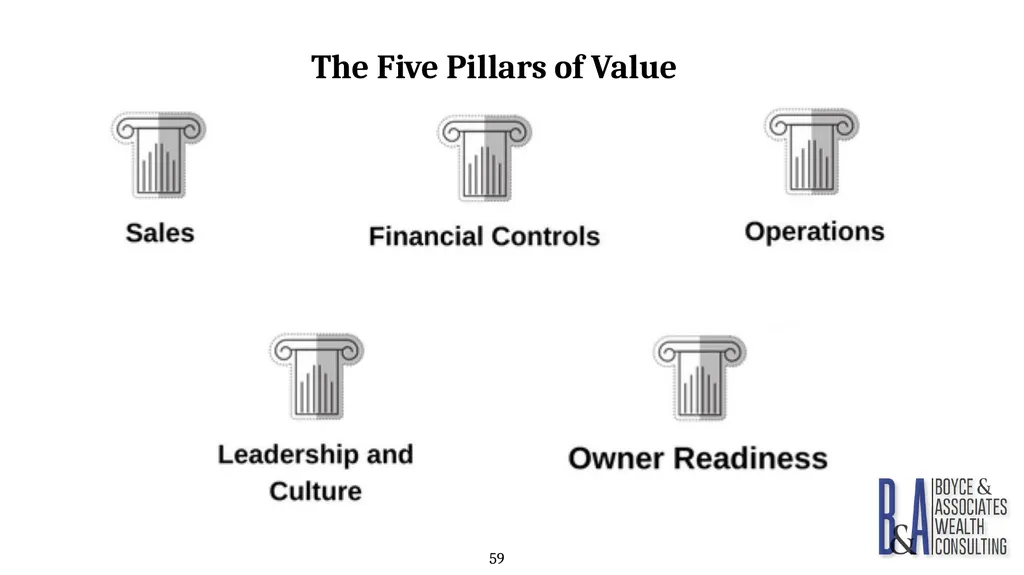
The Five Pillars of Value 59<br>
60
The Five Pillars 60 The sales function is the life blood of the enterprise and essential for its success. Key areas of evaluation include:
Industry Positioning & Competitive Landscape
Value Proposition and Points of Differentiation
Sales & Marketing Strategy
Customer Relationship Management
Goals & Key Performance Indicators
Metrics and Dashboard Assessment<br>
Industry Positioning & Competitive Landscape
Value Proposition and Points of Differentiation
Sales & Marketing Strategy
Customer Relationship Management
Goals & Key Performance Indicators
Metrics and Dashboard Assessment<br>
61
The Five Pillars 61 Lack of financial controls and proper reporting can have the greatest impact on business value. Key areas of evaluation include:
Accounting Policies and Procedures
Financial Organization & Management Structure
Internal Controls
Accounting Software
Financial Statement Integrity
Financial Ratios & Metrics<br>
Accounting Policies and Procedures
Financial Organization & Management Structure
Internal Controls
Accounting Software
Financial Statement Integrity
Financial Ratios & Metrics<br>
62
The Five Pillars 62 Operations includes the People, Processes and Products of your business. Key areas of evaluation include:
Human Resources Policies & Handbook
Corporate Compensation, Benefits and Incentives Analysis
Employee Engagement, Staffing Analysis & Job Satisfaction
Operations & Procedures
Organizational & Efficiency Analysis
Sourcing, Supply Chain, etc.
Price Modeling & Performance Measurement<br>
Human Resources Policies & Handbook
Corporate Compensation, Benefits and Incentives Analysis
Employee Engagement, Staffing Analysis & Job Satisfaction
Operations & Procedures
Organizational & Efficiency Analysis
Sourcing, Supply Chain, etc.
Price Modeling & Performance Measurement<br>
63
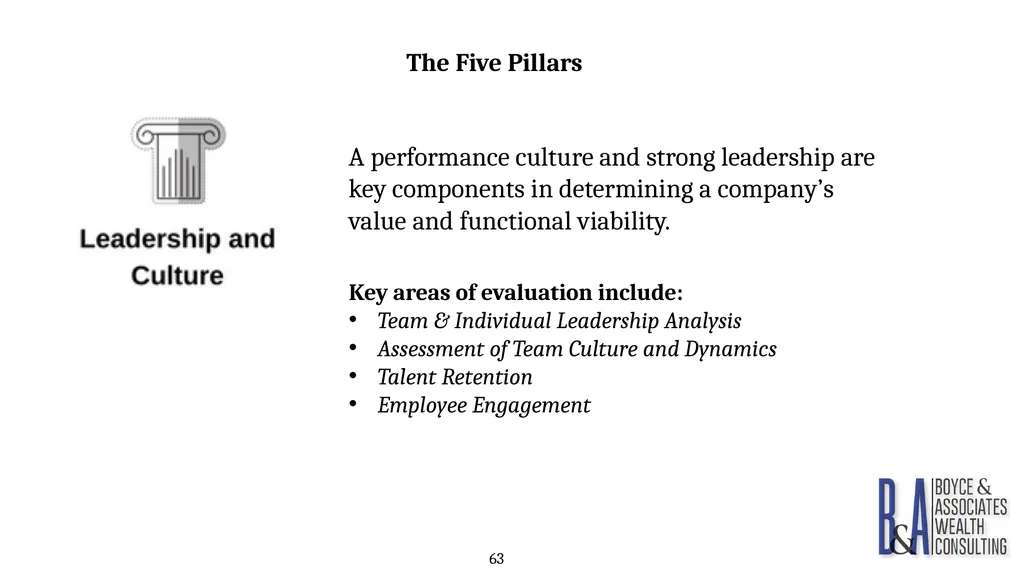
The Five Pillars 63 A performance culture and strong leadership are key components in determining a company’s value and functional viability. Key areas of evaluation include:
Team & Individual Leadership Analysis
Assessment of Team Culture and Dynamics
Talent Retention
Employee Engagement<br>
Team & Individual Leadership Analysis
Assessment of Team Culture and Dynamics
Talent Retention
Employee Engagement<br>
64
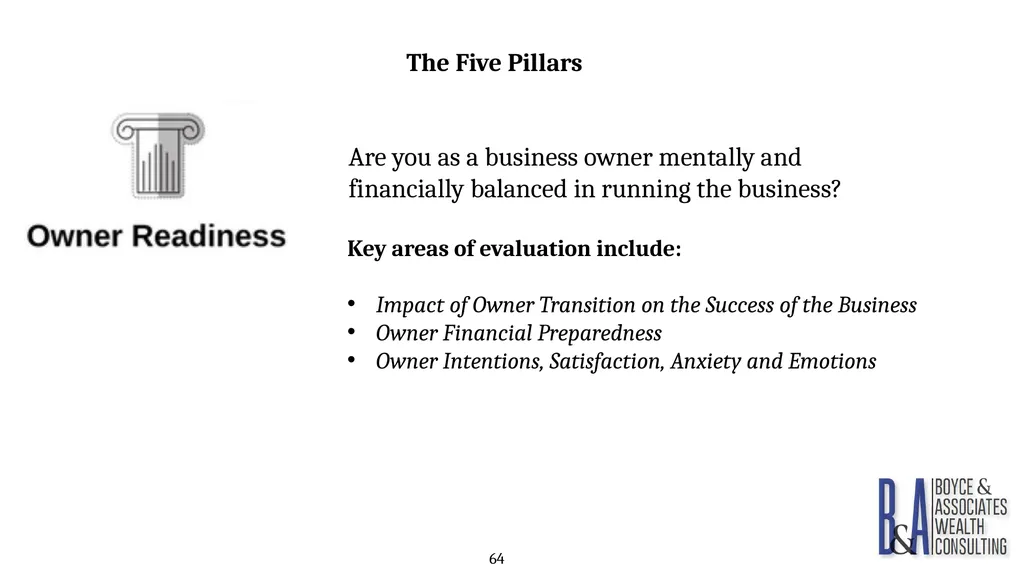
The Five Pillars 64 Are you as a business owner mentally and financially balanced in running the business? Key areas of evaluation include:
Impact of Owner Transition on the Success of the Business
Owner Financial Preparedness
Owner Intentions, Satisfaction, Anxiety and Emotions<br>
Impact of Owner Transition on the Success of the Business
Owner Financial Preparedness
Owner Intentions, Satisfaction, Anxiety and Emotions<br>
65
Are You Leaving Value on the Table?
Due to a lack of…
Goals & Visioning
Key Staff Risk
Competitive Awareness
Financial Statement Quality & Controls
Risk Control – Business or Personal
Contingency Planning for the “unknown” or “unknowable”
Tax Planning 65<br>
Due to a lack of…
Goals & Visioning
Key Staff Risk
Competitive Awareness
Financial Statement Quality & Controls
Risk Control – Business or Personal
Contingency Planning for the “unknown” or “unknowable”
Tax Planning 65<br>
66
A Proactive Checklist for Owners
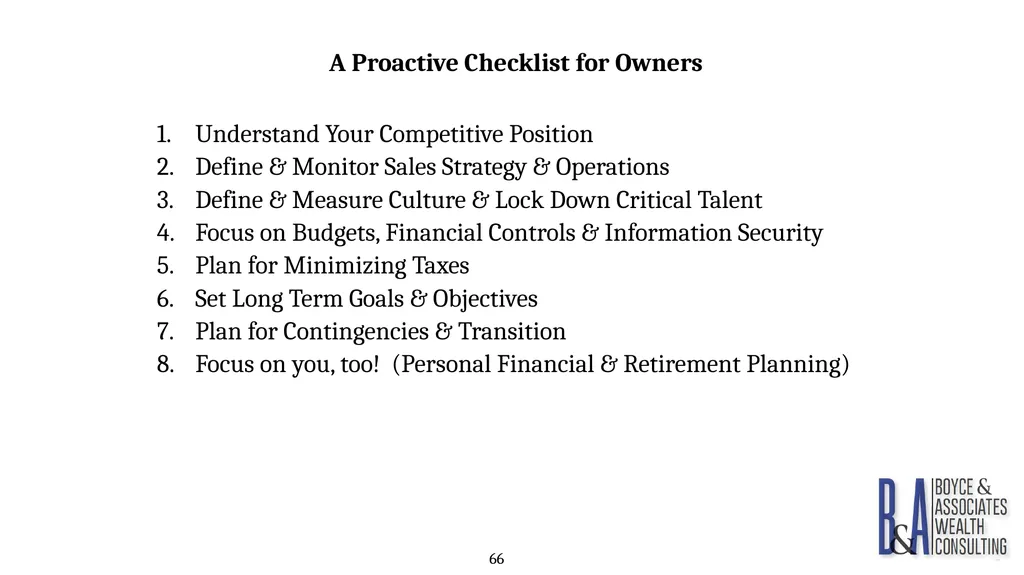
Understand Your Competitive Position
Define & Monitor Sales Strategy & Operations
Define & Measure Culture & Lock Down Critical Talent
Focus on Budgets, Financial Controls & Information Security
Plan for Minimizing Taxes
Set Long Term Goals & Objectives
Plan for Contingencies & Transition
Focus on you, too! (Personal Financial & Retirement Planning) 66<br>
Understand Your Competitive Position
Define & Monitor Sales Strategy & Operations
Define & Measure Culture & Lock Down Critical Talent
Focus on Budgets, Financial Controls & Information Security
Plan for Minimizing Taxes
Set Long Term Goals & Objectives
Plan for Contingencies & Transition
Focus on you, too! (Personal Financial & Retirement Planning) 66<br>
67
For more information, contact:
Eric Boyce
(512) 496-5709
www.boycewealth.com
www.boycevaluations.com 3109 Kenai Drive, Suite 107 Cedar Park, TX 78613
eric@boycewealth.com 67 Copyright 2024 – Boyce & Associates Business Valuations<br>
eric@boycewealth.com 67 Copyright 2024 – Boyce & Associates Business Valuations<br>