
Estimating numerical calculations (from 1.1 Place
EM
Published · 35 slides · 0 views
1 / 1

Description
Estimating numerical calculations (from 1.1 Place value, estimation and rounding) KS3 Mastery PD Materials: Exemplified Key Ideas Materials for use in the classroom or to support professional development discussions Summer 2021 About this
Related Topics
Share
Embed code
Download this presentation From Below
"Estimating numerical calculations (from 1.1 Place" is the property of its rightful owner. Permission is granted to download and print the materials on this website for personal, non-commercial use only, and to display it on your personal computer provided you do not modify the materials and that you retain all copyright notices contained in the materials. By downloading content from our website, you accept the terms of this agreement.
Presentation Transcript
01
Estimating numerical calculations (from 1.1 Place value, estimation and rounding) KS3 Mastery PD Materials: Exemplified Key Ideas
Materials for use in the classroom or to support professional development discussions Summer 2021<br>
Materials for use in the classroom or to support professional development discussions Summer 2021<br>
02
About this resource These slides are designed to complement the 1.1 Place value, estimation and rounding Core Concept document and its associated Theme Overview document 1 The Structure of the number system, both found in the Secondary Mastery Professional Development pages.
These slides re-present the key examples from the Core Concept document so that the examples can be used either directly in the classroom or with a group of teachers. There are prompt questions alongside the examples, and further clarification in the notes.
These slides do not fully replicate the Core Concept document, so should be used alongside it. Reference to specific page numbers, and to other useful NCETM resources, can be found in the notes for each slide.
This slide deck is not designed to be a complete PD session, rather it is a selection of resources that you can adapt and use as needed when planning a session with a group of teachers.<br>
These slides re-present the key examples from the Core Concept document so that the examples can be used either directly in the classroom or with a group of teachers. There are prompt questions alongside the examples, and further clarification in the notes.
These slides do not fully replicate the Core Concept document, so should be used alongside it. Reference to specific page numbers, and to other useful NCETM resources, can be found in the notes for each slide.
This slide deck is not designed to be a complete PD session, rather it is a selection of resources that you can adapt and use as needed when planning a session with a group of teachers.<br>
03
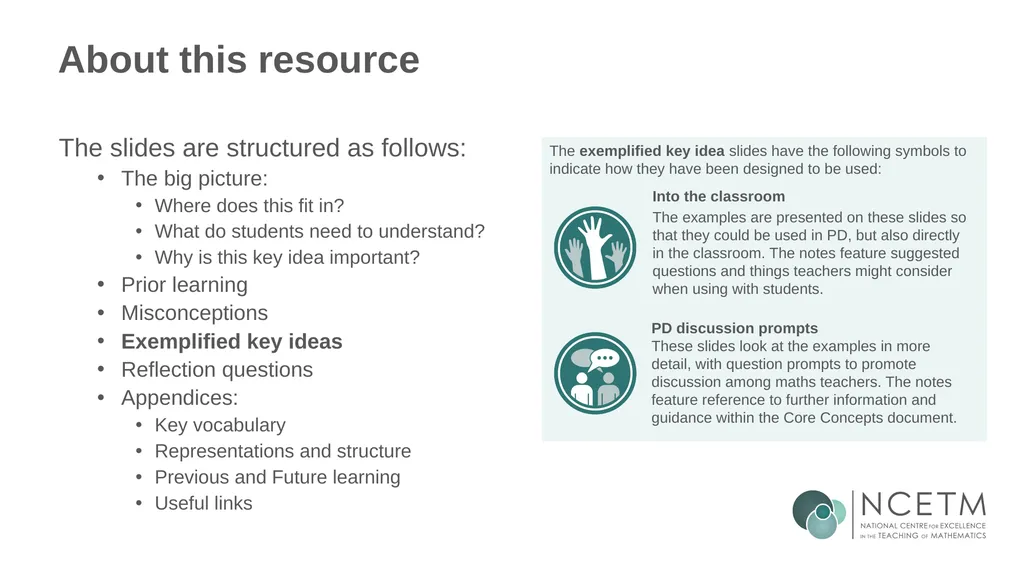
About this resource The slides are structured as follows:
The big picture:
Where does this fit in?
What do students need to understand?
Why is this key idea important?
Prior learning
Misconceptions
Exemplified key ideas
Reflection questions
Appendices:
Key vocabulary
Representations and structure
Previous and Future learning
Useful links The exemplified key idea slides have the following symbols to indicate how they have been designed to be used: Into the classroom
The examples are presented on these slides so that they could be used in PD, but also directly in the classroom. The notes feature suggested questions and things teachers might consider when using with students. PD discussion prompts
These slides look at the examples in more detail, with question prompts to promote discussion among maths teachers. The notes feature reference to further information and guidance within the Core Concepts document.<br>
The big picture:
Where does this fit in?
What do students need to understand?
Why is this key idea important?
Prior learning
Misconceptions
Exemplified key ideas
Reflection questions
Appendices:
Key vocabulary
Representations and structure
Previous and Future learning
Useful links The exemplified key idea slides have the following symbols to indicate how they have been designed to be used: Into the classroom
The examples are presented on these slides so that they could be used in PD, but also directly in the classroom. The notes feature suggested questions and things teachers might consider when using with students. PD discussion prompts
These slides look at the examples in more detail, with question prompts to promote discussion among maths teachers. The notes feature reference to further information and guidance within the Core Concepts document.<br>
04
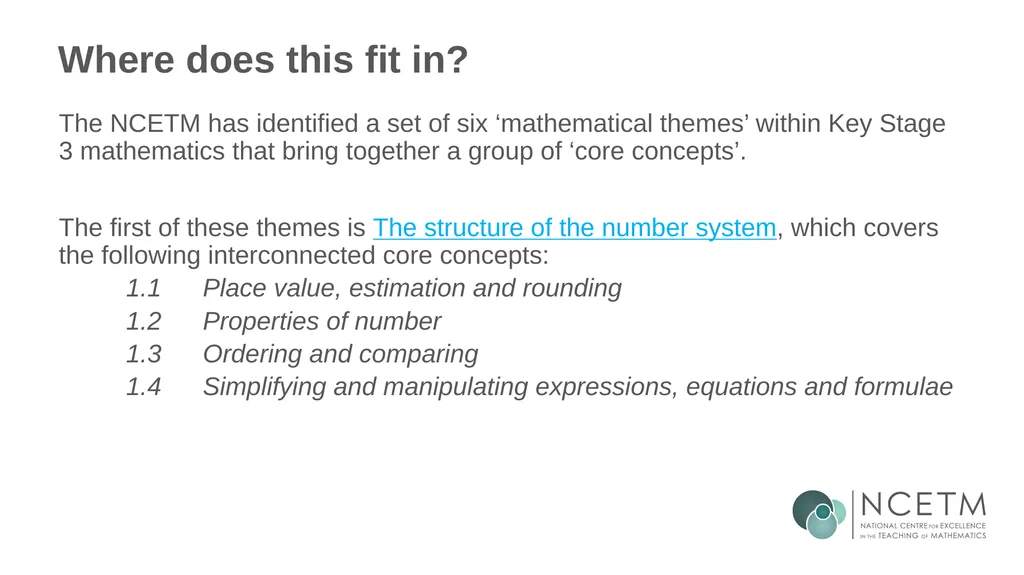
Where does this fit in? The NCETM has identified a set of six ‘mathematical themes’ within Key Stage 3 mathematics that bring together a group of ‘core concepts’.
The first of these themes is The structure of the number system, which covers the following interconnected core concepts:
1.1 Place value, estimation and rounding
1.2 Properties of number
1.3 Ordering and comparing
1.4 Simplifying and manipulating expressions, equations and formulae<br>
The first of these themes is The structure of the number system, which covers the following interconnected core concepts:
1.1 Place value, estimation and rounding
1.2 Properties of number
1.3 Ordering and comparing
1.4 Simplifying and manipulating expressions, equations and formulae<br>
05
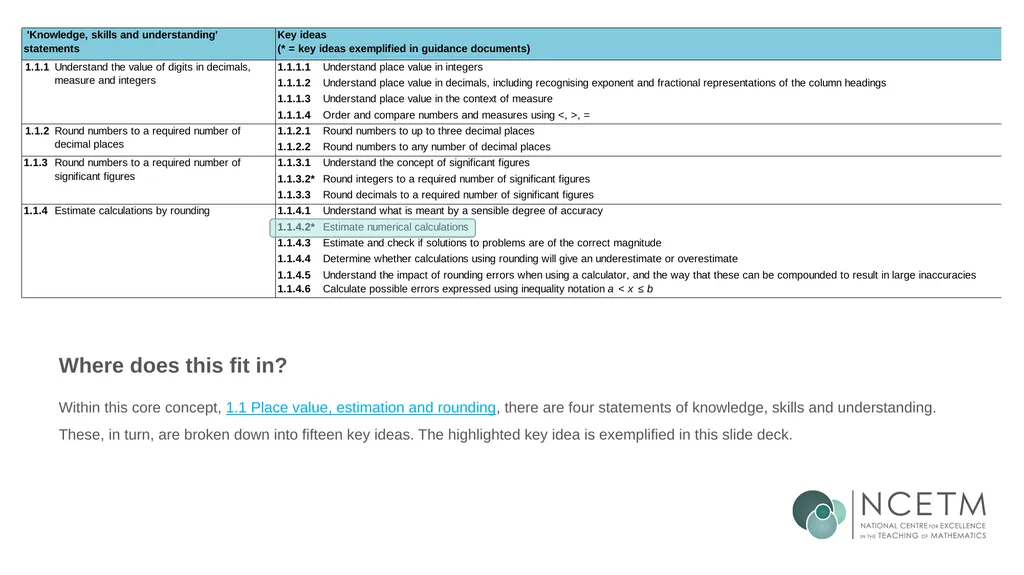
Where does this fit in? Within this core concept, 1.1 Place value, estimation and rounding, there are four statements of knowledge, skills and understanding.
These, in turn, are broken down into fifteen key ideas. The highlighted key idea is exemplified in this slide deck.<br>
These, in turn, are broken down into fifteen key ideas. The highlighted key idea is exemplified in this slide deck.<br>
06
What do students need to understand? What prior knowledge might your students already have?
What language might they use to describe this key idea?
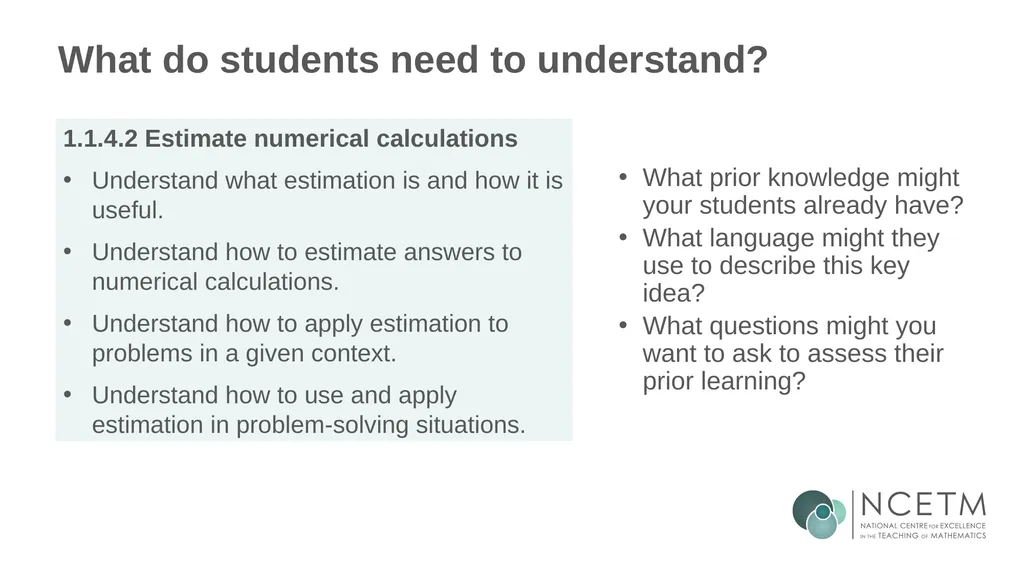
What questions might you want to ask to assess their prior learning? 1.1.4.2 Estimate numerical calculations
Understand what estimation is and how it is useful.
Understand how to estimate answers to numerical calculations.
Understand how to apply estimation to problems in a given context.
Understand how to use and apply estimation in problem-solving situations.<br>
What language might they use to describe this key idea?
What questions might you want to ask to assess their prior learning? 1.1.4.2 Estimate numerical calculations
Understand what estimation is and how it is useful.
Understand how to estimate answers to numerical calculations.
Understand how to apply estimation to problems in a given context.
Understand how to use and apply estimation in problem-solving situations.<br>
07
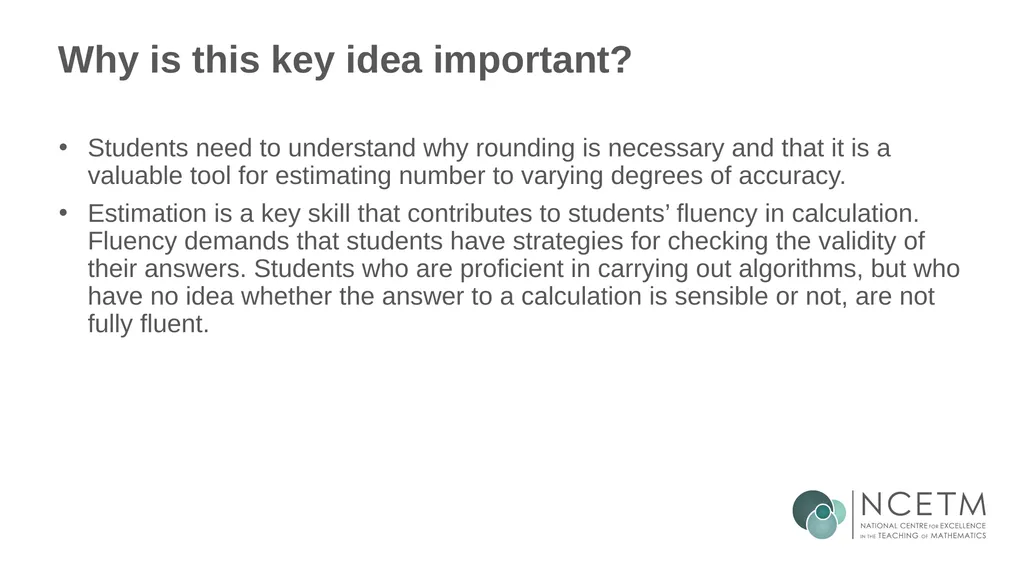
Why is this key idea important? Students need to understand why rounding is necessary and that it is a valuable tool for estimating number to varying degrees of accuracy.
Estimation is a key skill that contributes to students’ fluency in calculation. Fluency demands that students have strategies for checking the validity of their answers. Students who are proficient in carrying out algorithms, but who have no idea whether the answer to a calculation is sensible or not, are not fully fluent.<br>
Estimation is a key skill that contributes to students’ fluency in calculation. Fluency demands that students have strategies for checking the validity of their answers. Students who are proficient in carrying out algorithms, but who have no idea whether the answer to a calculation is sensible or not, are not fully fluent.<br>
08
Prior learning What prior knowledge might your students already have?
What language might they use to describe this key idea?
What questions might you want to ask to assess their prior learning?<br>
What language might they use to describe this key idea?
What questions might you want to ask to assess their prior learning?<br>
09
Checking prior learning The following slides contain questions for checking prior learning.
What representations might students use to support their understanding of these questions?
What variation might you put in place for these questions to fully assess students’ understanding of the concept?
How might changing the language of each question change the difficulty?
Why are these such crucial pre-requisites for this key idea?<br>
What representations might students use to support their understanding of these questions?
What variation might you put in place for these questions to fully assess students’ understanding of the concept?
How might changing the language of each question change the difficulty?
Why are these such crucial pre-requisites for this key idea?<br>
10
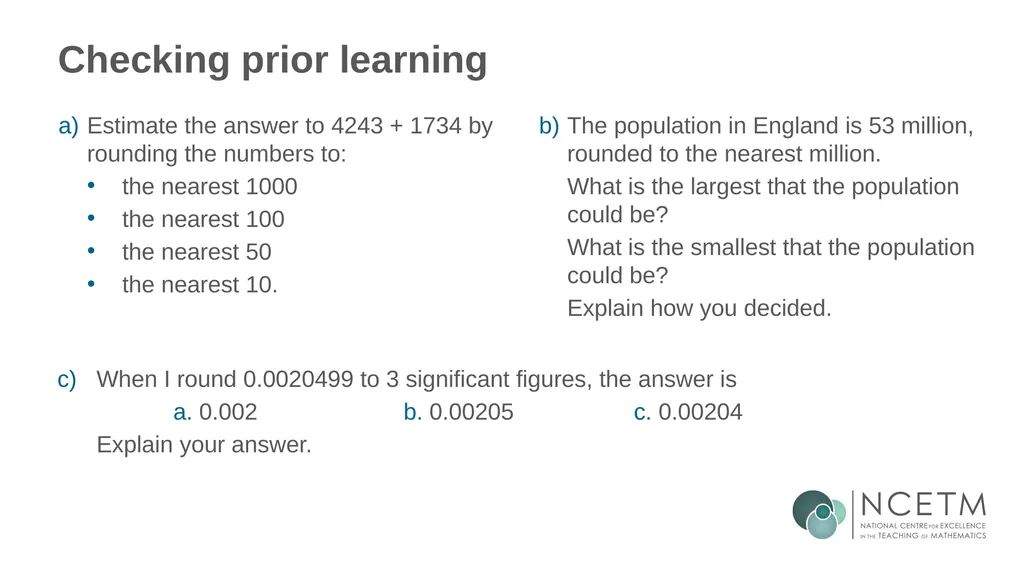
Checking prior learning Estimate the answer to 4243 + 1734 by rounding the numbers to:
the nearest 1000
the nearest 100
the nearest 50
the nearest 10. a) b) The population in England is 53 million, rounded to the nearest million.
What is the largest that the population could be?
What is the smallest that the population could be?
Explain how you decided. When I round 0.0020499 to 3 significant figures, the answer is
a. 0.002 b. 0.00205 c. 0.00204
Explain your answer. c)<br>
the nearest 1000
the nearest 100
the nearest 50
the nearest 10. a) b) The population in England is 53 million, rounded to the nearest million.
What is the largest that the population could be?
What is the smallest that the population could be?
Explain how you decided. When I round 0.0020499 to 3 significant figures, the answer is
a. 0.002 b. 0.00205 c. 0.00204
Explain your answer. c)<br>
11
Common difficulties and misconceptions What aspects of this key idea might pupils find challenging?
What misconceptions might pupils have? When teaching this topic, you may find students encounter difficulties with…
Knowing at what stage to round
Rounding (particularly of decimals)
More information, and some suggestions for overcoming these challenges, can be found on the following slides.<br>
What misconceptions might pupils have? When teaching this topic, you may find students encounter difficulties with…
Knowing at what stage to round
Rounding (particularly of decimals)
More information, and some suggestions for overcoming these challenges, can be found on the following slides.<br>
12
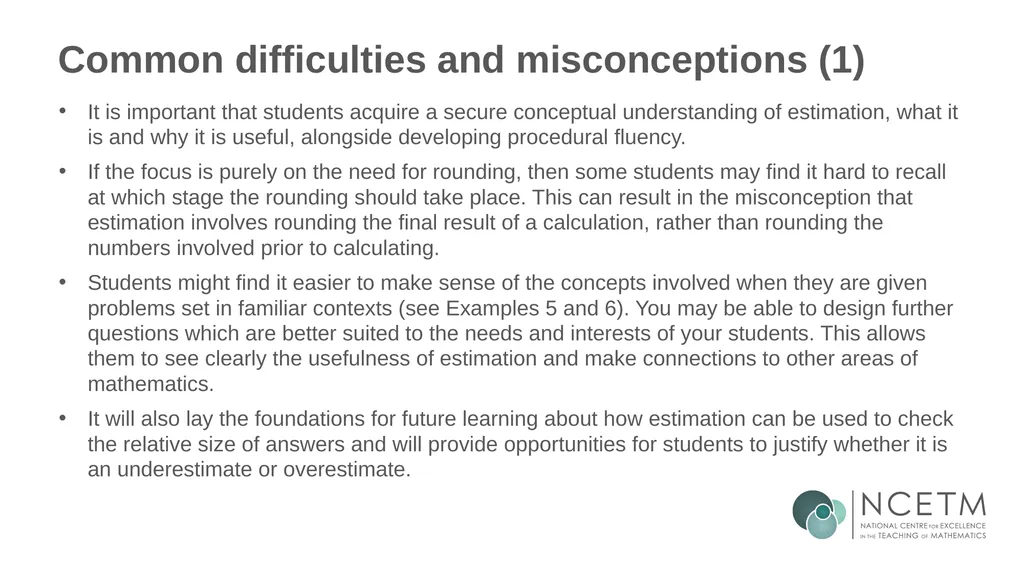
Common difficulties and misconceptions (1) It is important that students acquire a secure conceptual understanding of estimation, what it is and why it is useful, alongside developing procedural fluency.
If the focus is purely on the need for rounding, then some students may find it hard to recall at which stage the rounding should take place. This can result in the misconception that estimation involves rounding the final result of a calculation, rather than rounding the numbers involved prior to calculating.
Students might find it easier to make sense of the concepts involved when they are given problems set in familiar contexts (see Examples 5 and 6). You may be able to design further questions which are better suited to the needs and interests of your students. This allows them to see clearly the usefulness of estimation and make connections to other areas of mathematics.
It will also lay the foundations for future learning about how estimation can be used to check the relative size of answers and will provide opportunities for students to justify whether it is an underestimate or overestimate.<br>
If the focus is purely on the need for rounding, then some students may find it hard to recall at which stage the rounding should take place. This can result in the misconception that estimation involves rounding the final result of a calculation, rather than rounding the numbers involved prior to calculating.
Students might find it easier to make sense of the concepts involved when they are given problems set in familiar contexts (see Examples 5 and 6). You may be able to design further questions which are better suited to the needs and interests of your students. This allows them to see clearly the usefulness of estimation and make connections to other areas of mathematics.
It will also lay the foundations for future learning about how estimation can be used to check the relative size of answers and will provide opportunities for students to justify whether it is an underestimate or overestimate.<br>
13
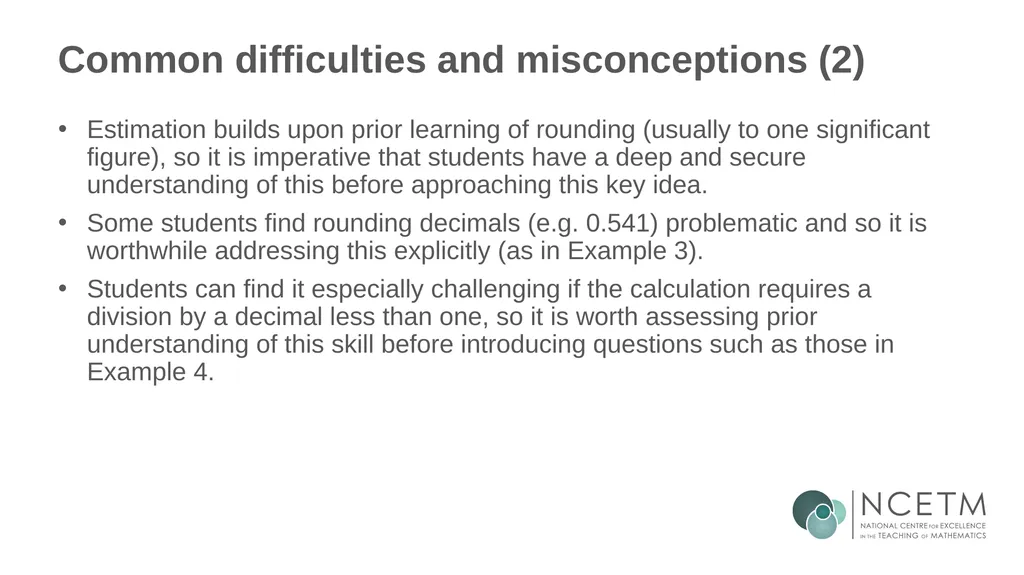
Common difficulties and misconceptions (2) Estimation builds upon prior learning of rounding (usually to one significant figure), so it is imperative that students have a deep and secure understanding of this before approaching this key idea.
Some students find rounding decimals (e.g. 0.541) problematic and so it is worthwhile addressing this explicitly (as in Example 3).
Students can find it especially challenging if the calculation requires a division by a decimal less than one, so it is worth assessing prior understanding of this skill before introducing questions such as those in Example 4.<br>
Some students find rounding decimals (e.g. 0.541) problematic and so it is worthwhile addressing this explicitly (as in Example 3).
Students can find it especially challenging if the calculation requires a division by a decimal less than one, so it is worth assessing prior understanding of this skill before introducing questions such as those in Example 4.<br>
14
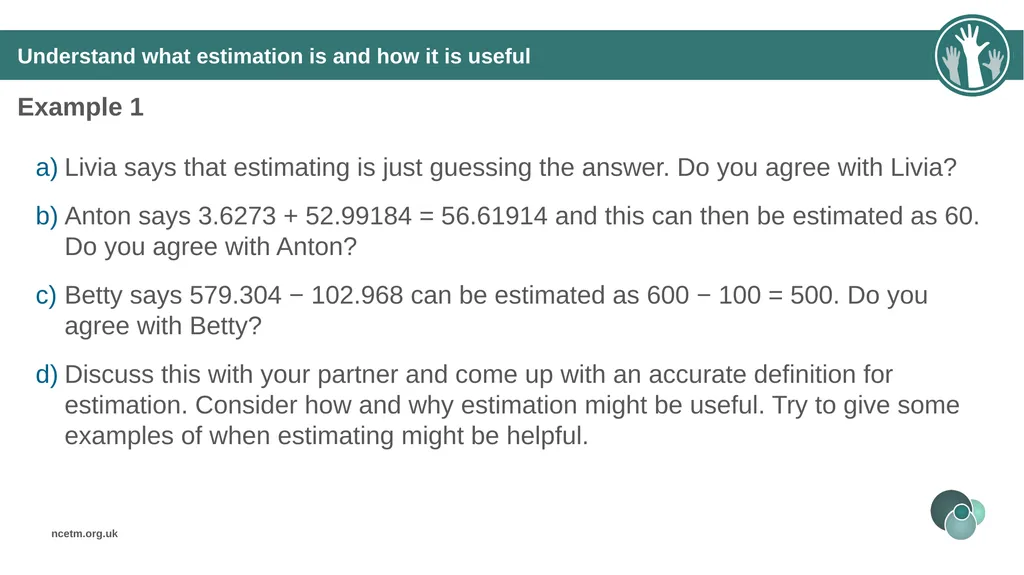
Understand what estimation is and how it is useful Example 1 Livia says that estimating is just guessing the answer. Do you agree with Livia?
Anton says 3.6273 + 52.99184 = 56.61914 and this can then be estimated as 60. Do you agree with Anton?
Betty says 579.304 − 102.968 can be estimated as 600 − 100 = 500. Do you agree with Betty?
Discuss this with your partner and come up with an accurate definition for estimation. Consider how and why estimation might be useful. Try to give some examples of when estimating might be helpful.<br>
Anton says 3.6273 + 52.99184 = 56.61914 and this can then be estimated as 60. Do you agree with Anton?
Betty says 579.304 − 102.968 can be estimated as 600 − 100 = 500. Do you agree with Betty?
Discuss this with your partner and come up with an accurate definition for estimation. Consider how and why estimation might be useful. Try to give some examples of when estimating might be helpful.<br>
15
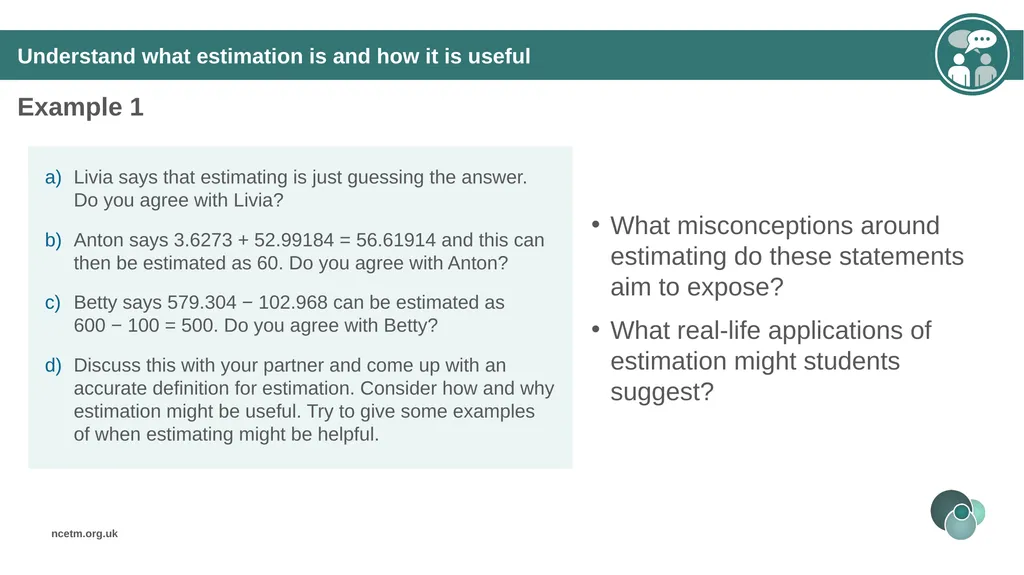
What misconceptions around estimating do these statements aim to expose?
What real-life applications of estimation might students suggest? Understand what estimation is and how it is useful Example 1 Livia says that estimating is just guessing the answer. Do you agree with Livia?
Anton says 3.6273 + 52.99184 = 56.61914 and this can then be estimated as 60. Do you agree with Anton?
Betty says 579.304 − 102.968 can be estimated as 600 − 100 = 500. Do you agree with Betty?
Discuss this with your partner and come up with an accurate definition for estimation. Consider how and why estimation might be useful. Try to give some examples of when estimating might be helpful.<br>
What real-life applications of estimation might students suggest? Understand what estimation is and how it is useful Example 1 Livia says that estimating is just guessing the answer. Do you agree with Livia?
Anton says 3.6273 + 52.99184 = 56.61914 and this can then be estimated as 60. Do you agree with Anton?
Betty says 579.304 − 102.968 can be estimated as 600 − 100 = 500. Do you agree with Betty?
Discuss this with your partner and come up with an accurate definition for estimation. Consider how and why estimation might be useful. Try to give some examples of when estimating might be helpful.<br>
16
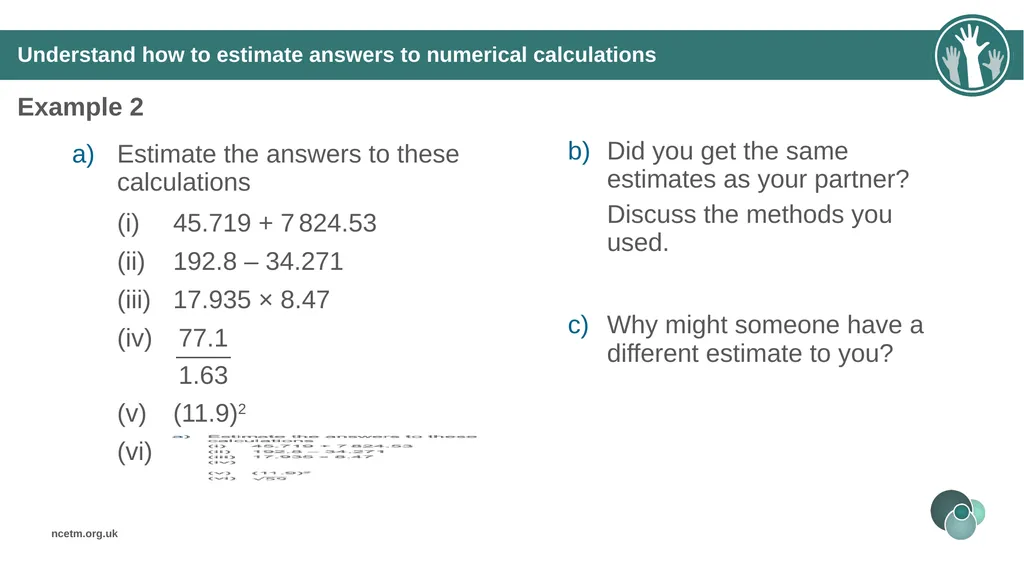
Understand how to estimate answers to numerical calculations Example 2<br>
17
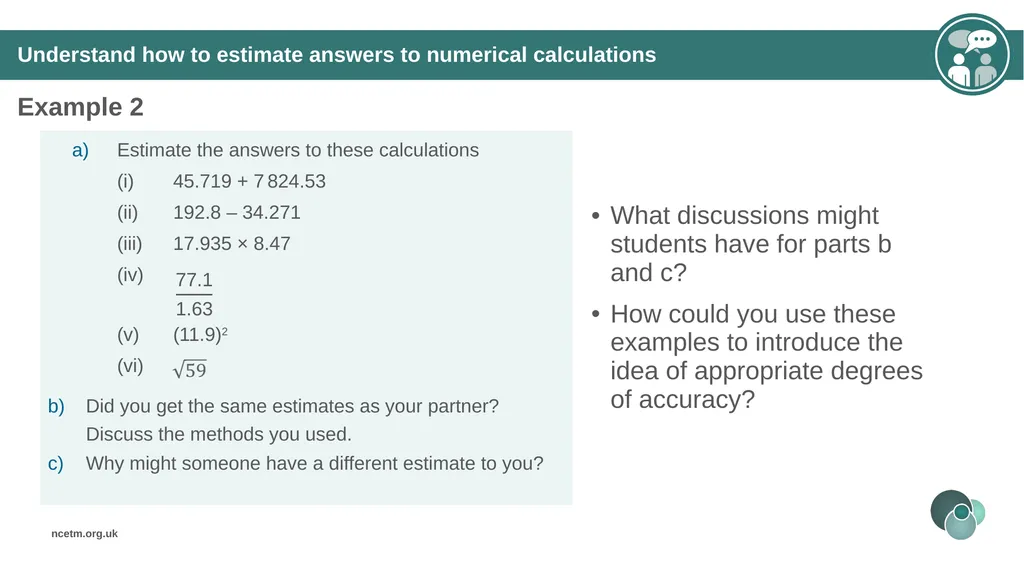
What discussions might students have for parts b and c?
How could you use these examples to introduce the idea of appropriate degrees of accuracy? Understand how to estimate answers to numerical calculations Example 2<br>
How could you use these examples to introduce the idea of appropriate degrees of accuracy? Understand how to estimate answers to numerical calculations Example 2<br>
18
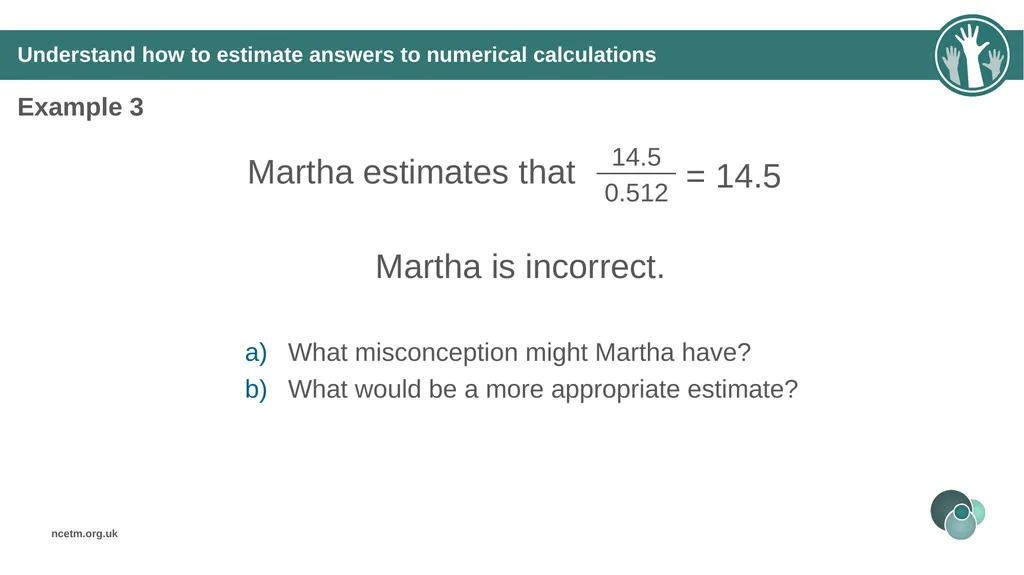
Understand how to estimate answers to numerical calculations Example 3 Martha estimates that .
Martha is incorrect. What misconception might Martha have?
What would be a more appropriate estimate?<br>
Martha is incorrect. What misconception might Martha have?
What would be a more appropriate estimate?<br>
19
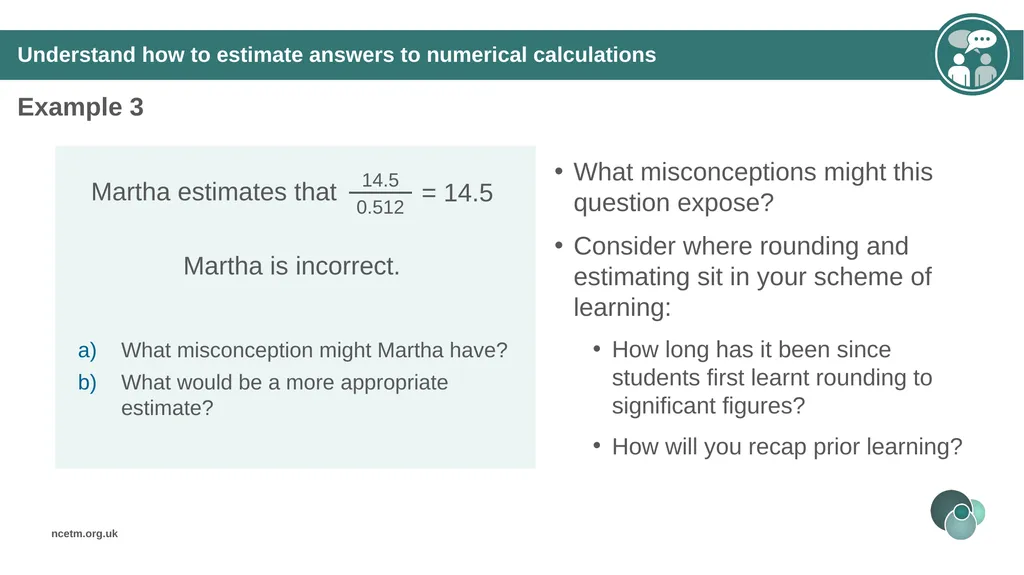
What misconceptions might this question expose?
Consider where rounding and estimating sit in your scheme of learning:
How long has it been since students first learnt rounding to significant figures?
How will you recap prior learning? Understand how to estimate answers to numerical calculations Example 3 Martha estimates that .
Martha is incorrect. What misconception might Martha have?
What would be a more appropriate estimate?<br>
Consider where rounding and estimating sit in your scheme of learning:
How long has it been since students first learnt rounding to significant figures?
How will you recap prior learning? Understand how to estimate answers to numerical calculations Example 3 Martha estimates that .
Martha is incorrect. What misconception might Martha have?
What would be a more appropriate estimate?<br>
20
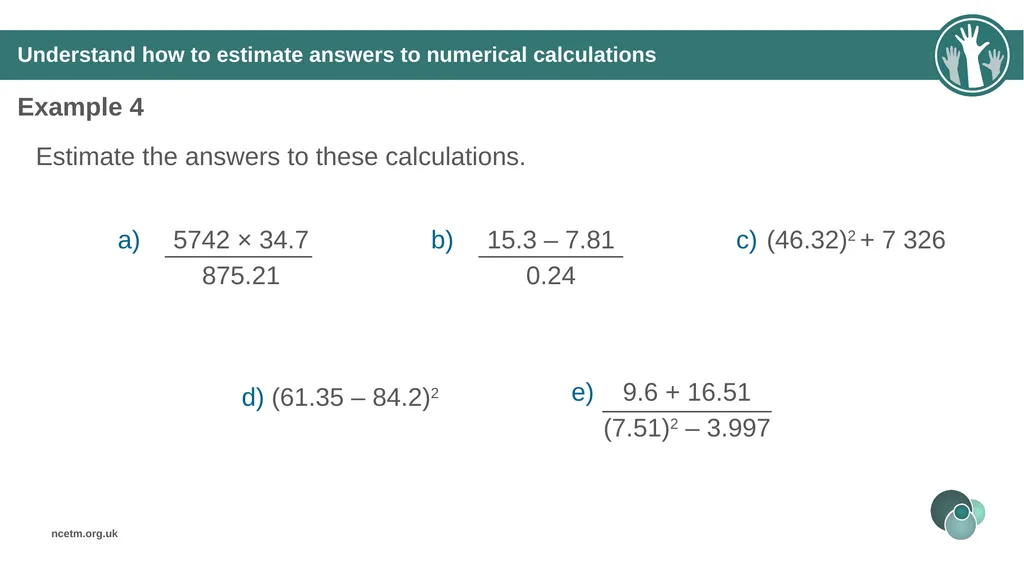
Understand how to estimate answers to numerical calculations Example 4 Estimate the answers to these calculations.<br>
21
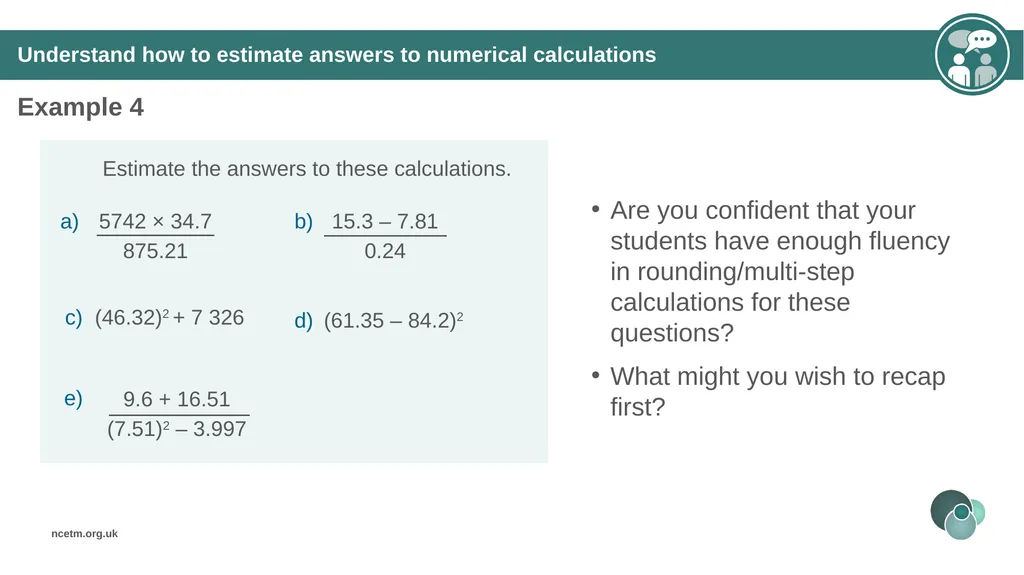
Are you confident that your students have enough fluency in rounding/multi-step calculations for these questions?
What might you wish to recap first? Understand how to estimate answers to numerical calculations Example 4 Estimate the answers to these calculations.<br>
What might you wish to recap first? Understand how to estimate answers to numerical calculations Example 4 Estimate the answers to these calculations.<br>
22
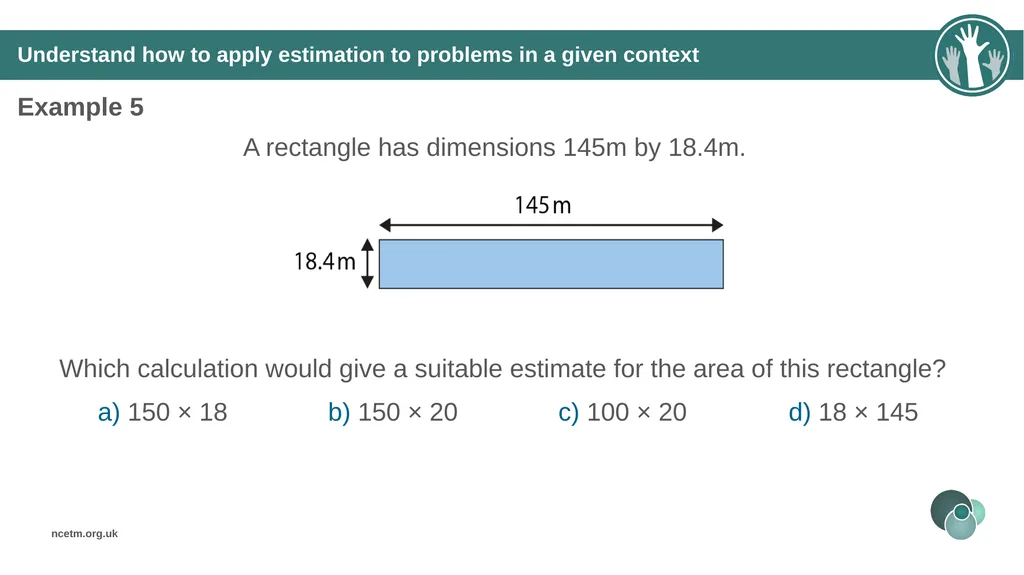
Understand how to apply estimation to problems in a given context Example 5 A rectangle has dimensions 145m by 18.4m. Which calculation would give a suitable estimate for the area of this rectangle?
a) 150 × 18 b) 150 × 20 c) 100 × 20 d) 18 × 145<br>
a) 150 × 18 b) 150 × 20 c) 100 × 20 d) 18 × 145<br>
23
As a department, how have you decided what you deem to be an appropriate level of accuracy when estimating?
How do you communicate this with your students?
What other contexts would your students find useful?
How can you make connections to other areas of mathematics? Understand how to apply estimation to problems in a given context Example 5 A rectangle has dimensions 145m by 18.4m. Which calculation would give a suitable estimate for the area of this rectangle?
a) 150 × 18 b) 150 × 20
c) 100 × 20 d) 18 × 145<br>
How do you communicate this with your students?
What other contexts would your students find useful?
How can you make connections to other areas of mathematics? Understand how to apply estimation to problems in a given context Example 5 A rectangle has dimensions 145m by 18.4m. Which calculation would give a suitable estimate for the area of this rectangle?
a) 150 × 18 b) 150 × 20
c) 100 × 20 d) 18 × 145<br>
24
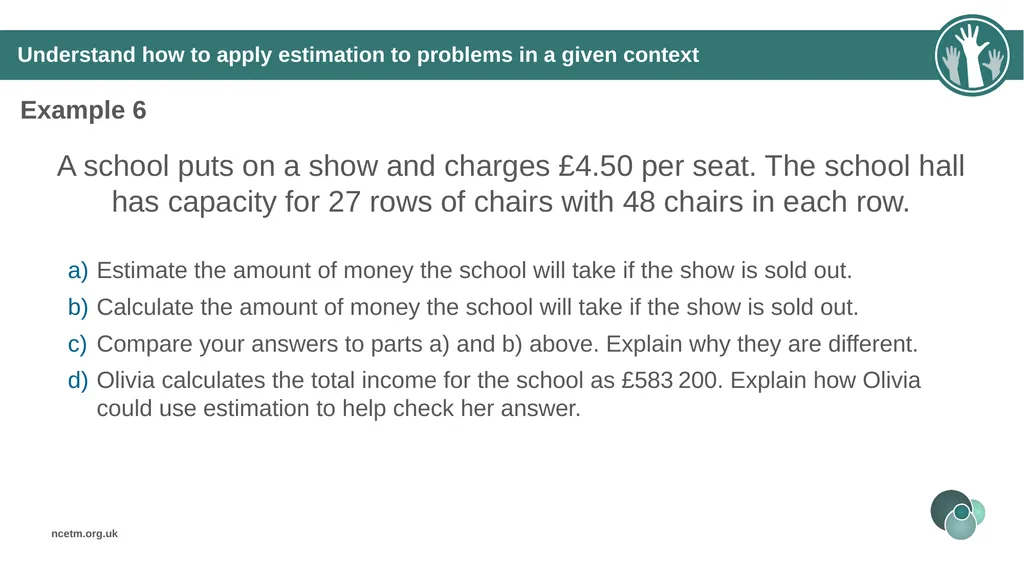
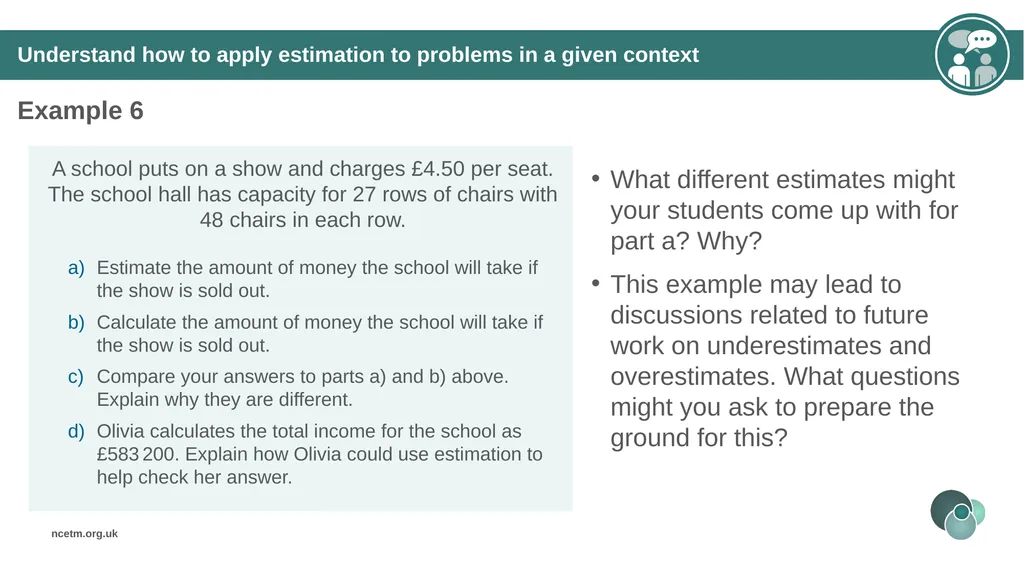
Understand how to apply estimation to problems in a given context Example 6 Estimate the amount of money the school will take if the show is sold out.
Calculate the amount of money the school will take if the show is sold out.
Compare your answers to parts a) and b) above. Explain why they are different.
Olivia calculates the total income for the school as £583 200. Explain how Olivia could use estimation to help check her answer. A school puts on a show and charges £4.50 per seat. The school hall has capacity for 27 rows of chairs with 48 chairs in each row.<br>
Calculate the amount of money the school will take if the show is sold out.
Compare your answers to parts a) and b) above. Explain why they are different.
Olivia calculates the total income for the school as £583 200. Explain how Olivia could use estimation to help check her answer. A school puts on a show and charges £4.50 per seat. The school hall has capacity for 27 rows of chairs with 48 chairs in each row.<br>
25
What different estimates might your students come up with for part a? Why?
This example may lead to discussions related to future work on underestimates and overestimates. What questions might you ask to prepare the ground for this? Understand how to apply estimation to problems in a given context Example 6 Estimate the amount of money the school will take if the show is sold out.
Calculate the amount of money the school will take if the show is sold out.
Compare your answers to parts a) and b) above. Explain why they are different.
Olivia calculates the total income for the school as £583 200. Explain how Olivia could use estimation to help check her answer. A school puts on a show and charges £4.50 per seat. The school hall has capacity for 27 rows of chairs with 48 chairs in each row.<br>
This example may lead to discussions related to future work on underestimates and overestimates. What questions might you ask to prepare the ground for this? Understand how to apply estimation to problems in a given context Example 6 Estimate the amount of money the school will take if the show is sold out.
Calculate the amount of money the school will take if the show is sold out.
Compare your answers to parts a) and b) above. Explain why they are different.
Olivia calculates the total income for the school as £583 200. Explain how Olivia could use estimation to help check her answer. A school puts on a show and charges £4.50 per seat. The school hall has capacity for 27 rows of chairs with 48 chairs in each row.<br>
26
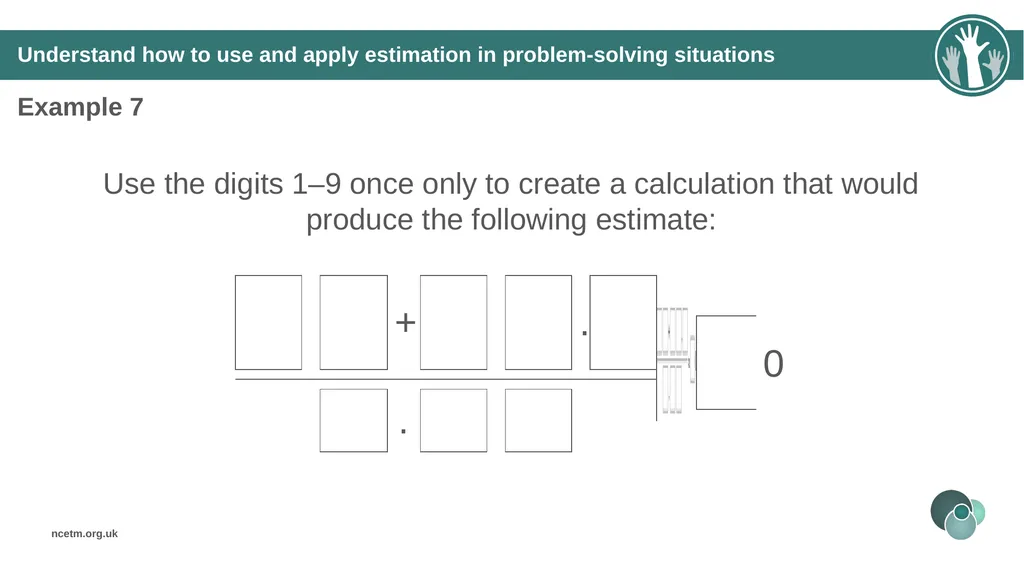
Understand how to use and apply estimation in problem-solving situations Example 7 Use the digits 1–9 once only to create a calculation that would produce the following estimate:<br>
27
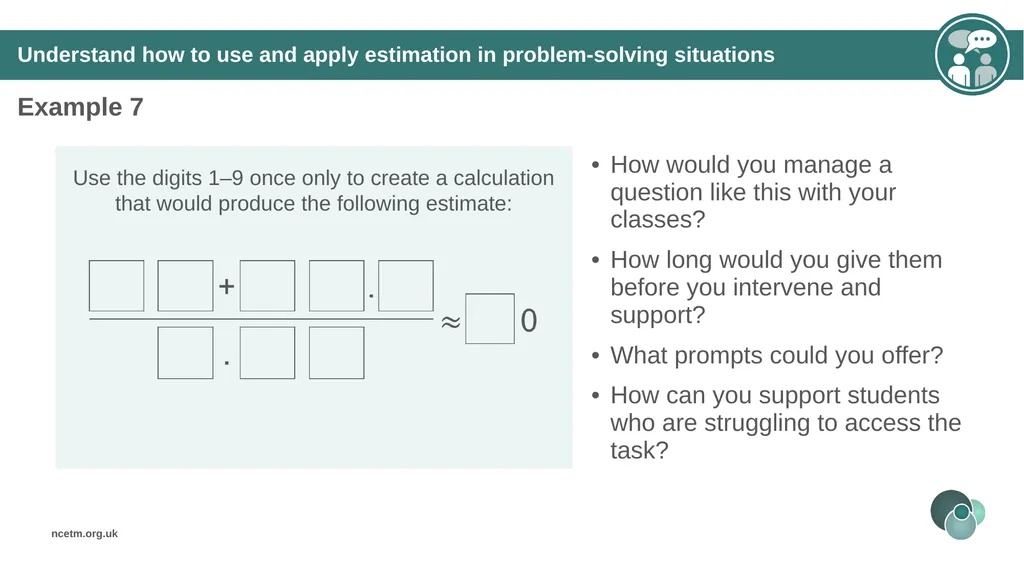
How would you manage a question like this with your classes?
How long would you give them before you intervene and support?
What prompts could you offer?
How can you support students who are struggling to access the task? Understand how to use and apply estimation in problem-solving situations Example 7 Use the digits 1–9 once only to create a calculation that would produce the following estimate:<br>
How long would you give them before you intervene and support?
What prompts could you offer?
How can you support students who are struggling to access the task? Understand how to use and apply estimation in problem-solving situations Example 7 Use the digits 1–9 once only to create a calculation that would produce the following estimate:<br>
28
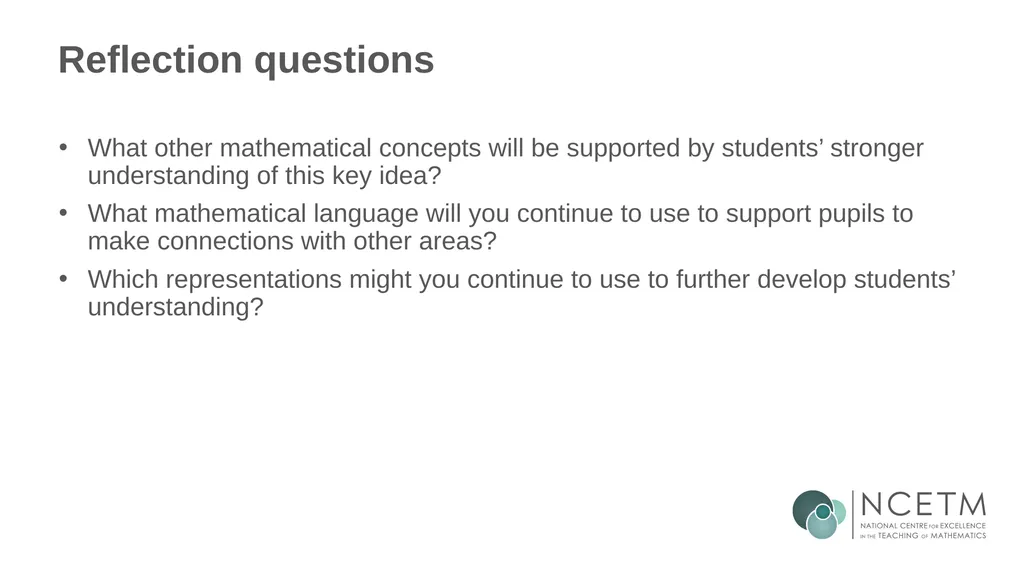
Reflection questions What other mathematical concepts will be supported by students’ stronger understanding of this key idea?
What mathematical language will you continue to use to support pupils to make connections with other areas?
Which representations might you continue to use to further develop students’ understanding?<br>
What mathematical language will you continue to use to support pupils to make connections with other areas?
Which representations might you continue to use to further develop students’ understanding?<br>
29
Appendices You may choose to use the following slides when planning or delivering a PD session. They cover:
Key vocabulary
Representations and structure
Previous learning
Future learning
Library of links<br>
Key vocabulary
Representations and structure
Previous learning
Future learning
Library of links<br>
30
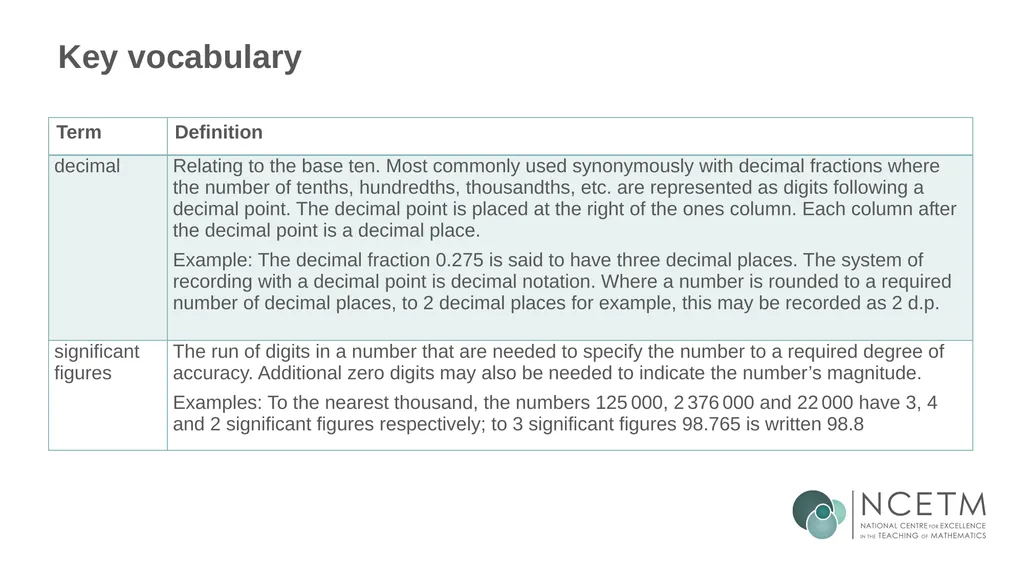
Key vocabulary<br>
31
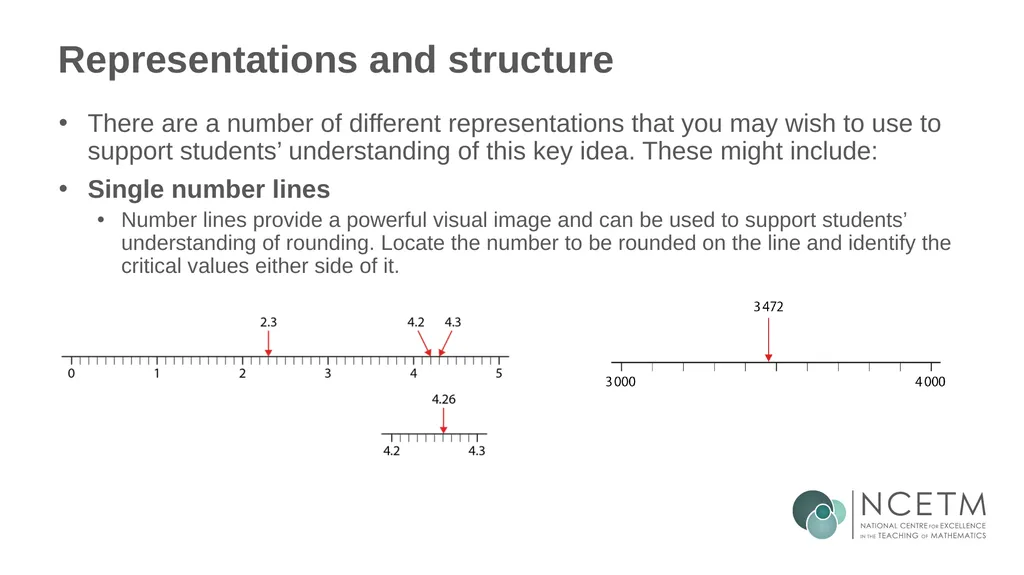
Representations and structure There are a number of different representations that you may wish to use to support students’ understanding of this key idea. These might include:
Single number lines
Number lines provide a powerful visual image and can be used to support students’ understanding of rounding. Locate the number to be rounded on the line and identify the critical values either side of it.<br>
Single number lines
Number lines provide a powerful visual image and can be used to support students’ understanding of rounding. Locate the number to be rounded on the line and identify the critical values either side of it.<br>
32
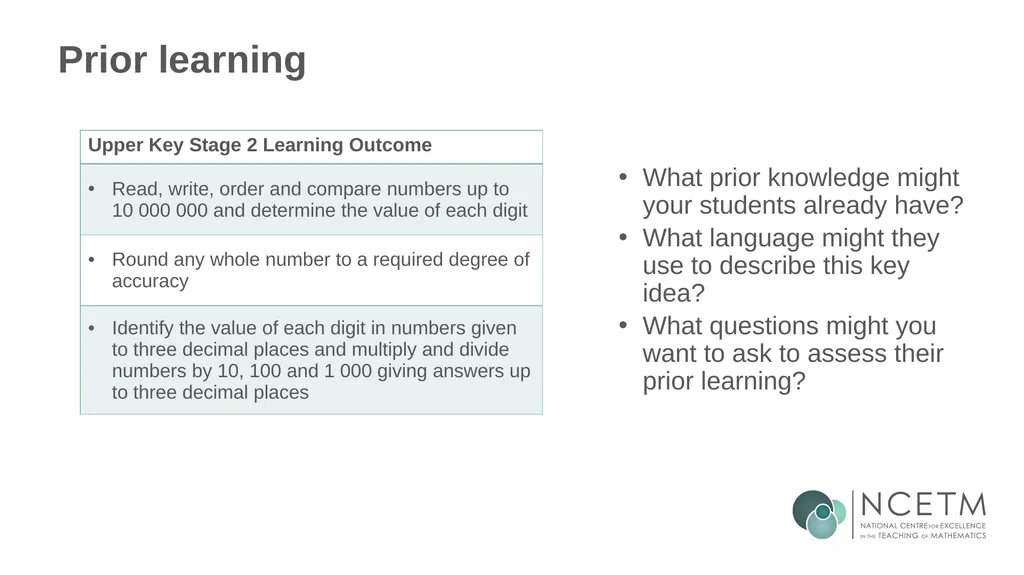
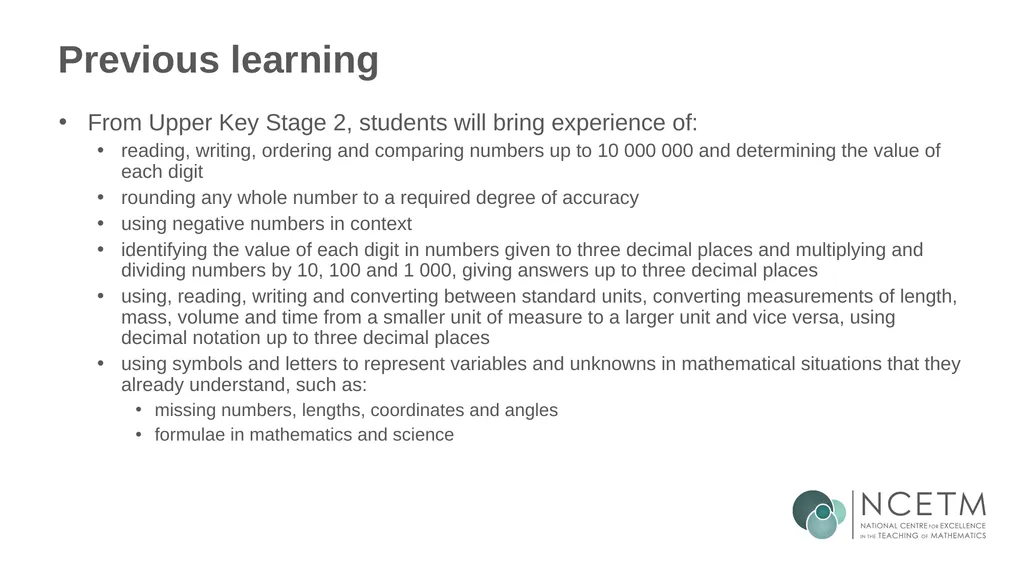
Previous learning From Upper Key Stage 2, students will bring experience of:
reading, writing, ordering and comparing numbers up to 10 000 000 and determining the value of each digit
rounding any whole number to a required degree of accuracy
using negative numbers in context
identifying the value of each digit in numbers given to three decimal places and multiplying and dividing numbers by 10, 100 and 1 000, giving answers up to three decimal places
using, reading, writing and converting between standard units, converting measurements of length, mass, volume and time from a smaller unit of measure to a larger unit and vice versa, using decimal notation up to three decimal places
using symbols and letters to represent variables and unknowns in mathematical situations that they already understand, such as:
missing numbers, lengths, coordinates and angles
formulae in mathematics and science<br>
reading, writing, ordering and comparing numbers up to 10 000 000 and determining the value of each digit
rounding any whole number to a required degree of accuracy
using negative numbers in context
identifying the value of each digit in numbers given to three decimal places and multiplying and dividing numbers by 10, 100 and 1 000, giving answers up to three decimal places
using, reading, writing and converting between standard units, converting measurements of length, mass, volume and time from a smaller unit of measure to a larger unit and vice versa, using decimal notation up to three decimal places
using symbols and letters to represent variables and unknowns in mathematical situations that they already understand, such as:
missing numbers, lengths, coordinates and angles
formulae in mathematics and science<br>
33
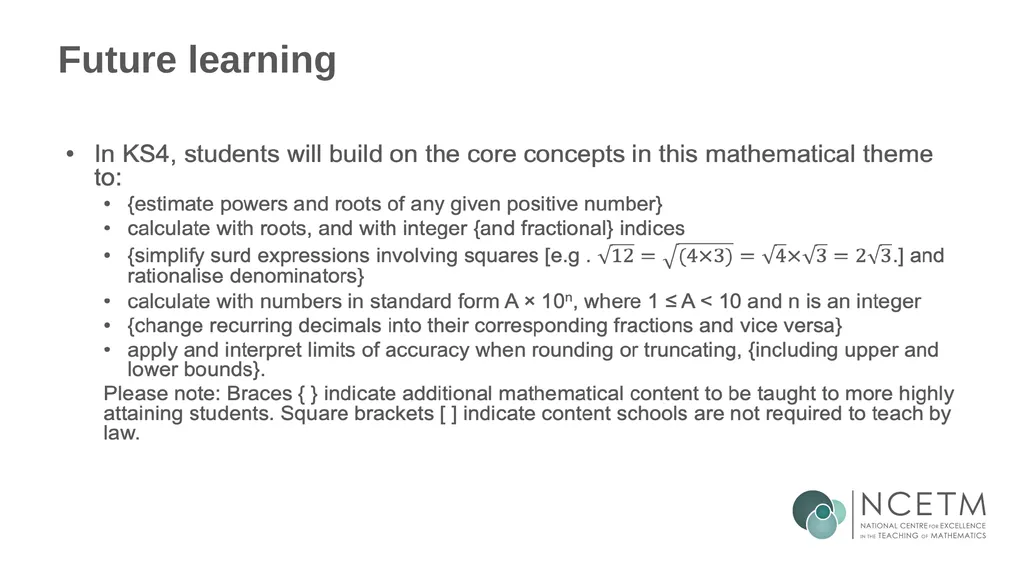
Future learning<br>
34
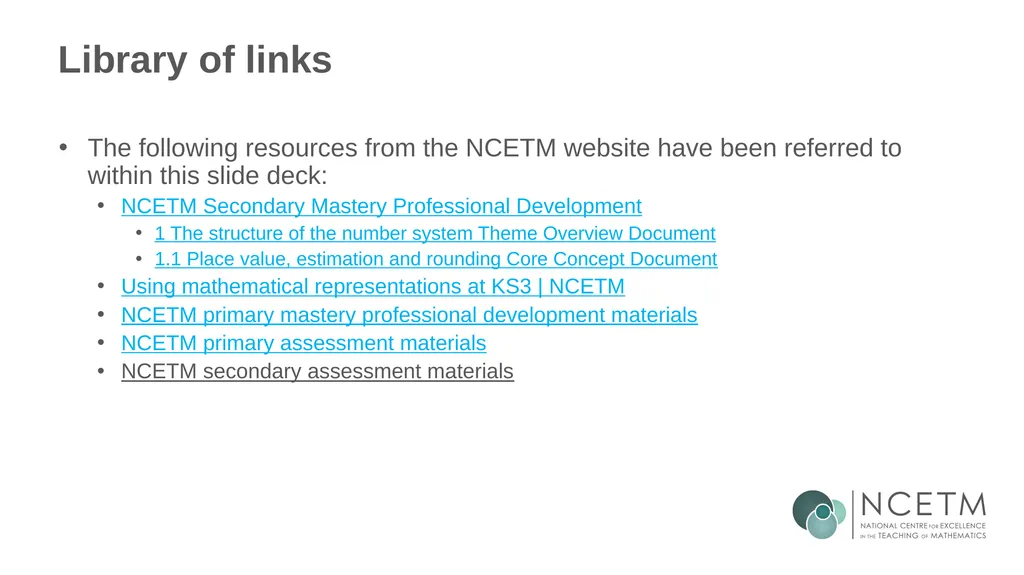
Library of links The following resources from the NCETM website have been referred to within this slide deck:
NCETM Secondary Mastery Professional Development
1 The structure of the number system Theme Overview Document
1.1 Place value, estimation and rounding Core Concept Document
Using mathematical representations at KS3 | NCETM
NCETM primary mastery professional development materials
NCETM primary assessment materials
NCETM secondary assessment materials<br>
NCETM Secondary Mastery Professional Development
1 The structure of the number system Theme Overview Document
1.1 Place value, estimation and rounding Core Concept Document
Using mathematical representations at KS3 | NCETM
NCETM primary mastery professional development materials
NCETM primary assessment materials
NCETM secondary assessment materials<br>