
Ethics of using Google Analytics BC UX Interest





Description: Ethics of using Google Analytics BC UX Interest Group, 4 May 2017 Janis McKenzie, Librarian, eBranch, SFU Library values and ethics Why we should care about Google Analytics (etc.) What we can do Further resources 1. Values and ethics of
Related Topics
Download Presentation
"Ethics of using Google Analytics BC UX Interest" is the property of its rightful owner. Permission is granted to download and print the materials on this website for personal, non-commercial use only, and to display it on your personal computer provided you do not modify the materials and that you retain all copyright notices contained in the materials. By downloading content from our website, you accept the terms of this agreement.
Presentation Transcript
slide1. Ethics of using Google Analytics BC UX Interest Group, 4 May 2017
Janis McKenzie, Librarian, eBranch, SFU<br>
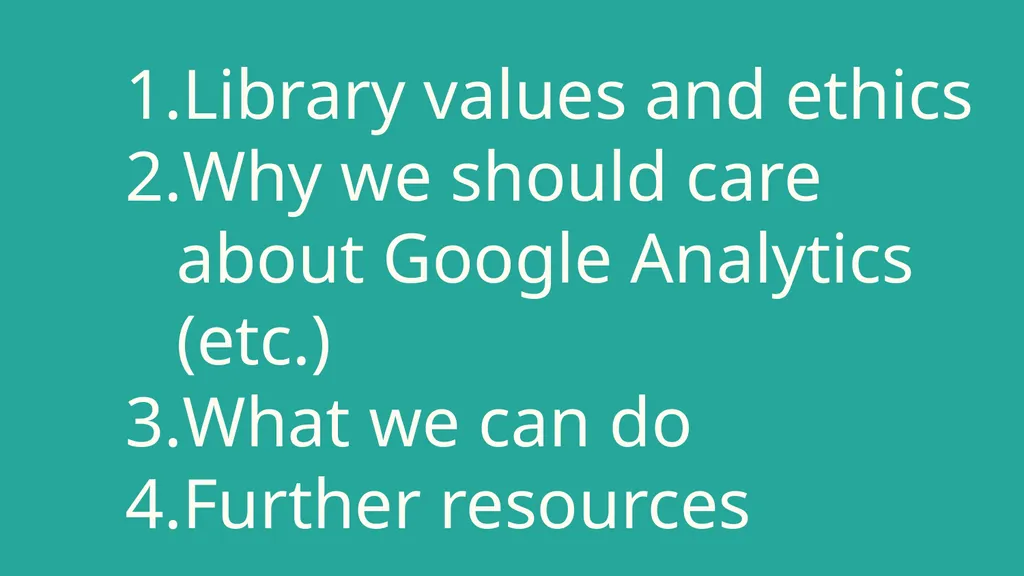
slide2. Library values and ethics
Why we should care about Google Analytics (etc.)
What we can do
Further resources<br>
slide3. 1. Values and ethics of librarianship<br>
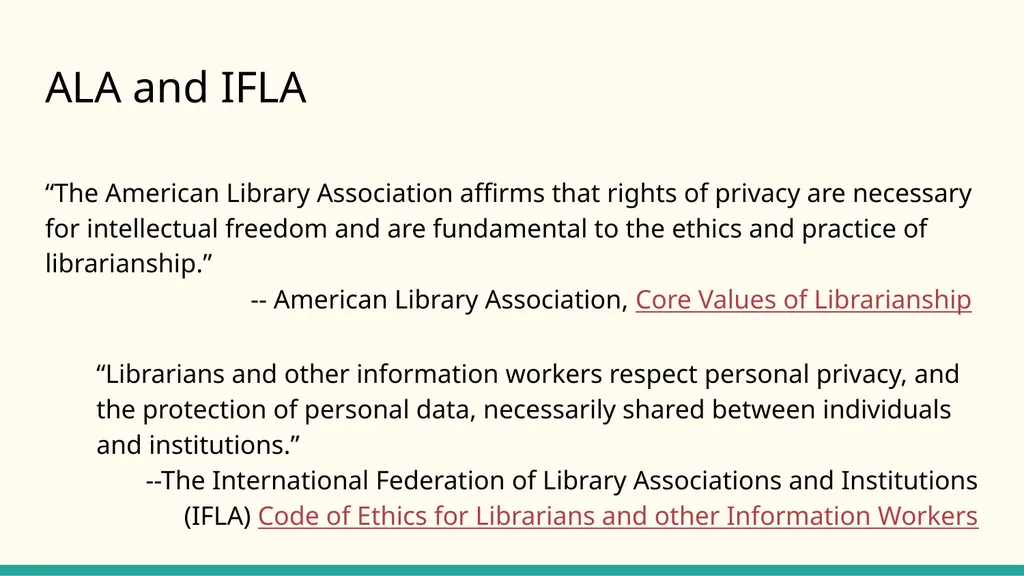
slide4. ALA and IFLA “The American Library Association affirms that rights of privacy are necessary for intellectual freedom and are fundamental to the ethics and practice of librarianship.”
-- American Library Association, Core Values of Librarianship
“Librarians and other information workers respect personal privacy, and the protection of personal data, necessarily shared between individuals and institutions.”
--The International Federation of Library Associations and Institutions (IFLA) Code of Ethics for Librarians and other Information Workers<br>
slide5. CFLA ...The Canadian Federation of Library Associations affirms further that libraries have a core responsibility to support, defend and promote the universal principles of intellectual freedom and privacy….
...Libraries have a core responsibility to safeguard and defend privacy in the individual’s pursuit of expressive content. To this end, libraries protect the identities and activities of library users except when required by the courts to cede them….
--Canadian Federation of Library Associations
Statement on Intellectual Freedom and Libraries<br>
slide6. ACRL 2. Professional Values: Libraries advance professional values of intellectual freedom, intellectual property rights and values, user privacy and confidentiality, collaboration, and user-centered service.
2.1 The library resists all efforts to censor library resources.
2.2 The library protects each library user’s right to privacy and confidentiality.
-- Principles, from Standards for Libraries in Higher Education Principles and Performance Indicators,
Association for College and Research Libraries (a division of the American Library Association)<br>
slide7. Clifford Lynch: “...[O]ne of the most profoundly important social functions of libraries was actually to offer readers such privacy as part of their broad commitment to intellectual freedom, most notably by ensuring that circulation records were not retained over the long term, and thus not available for the authorities…. and by facilitating anonymous use of material within the physical boundaries of the library. And, of course, by building broad and diverse collections that incorporated controversial topics and points of view. They served as intellectual sanctuaries.”
Lynch, C. (2017). The rise of reading analytics and the emerging calculus of reader privacy in the digital world. First Monday, 22(4).<br>
slide8. Asking the tough question: How do our practices line up with our stated values? We are very careful to protect user privacy when it comes to (physical) borrowing records, and we don’t track who uses what print resources in person in our physical spaces.
How do our practices around online use align with the way we protect patrons’ confidentiality when they use print resources?<br>
slide9. 2. Why we should care about Google Analytics (and similar tools)<br>
slide10. Susanna Galbraith on GA and privacy: “Many of us in the library community who have a responsibility to assess the usage of our library’s websites have become very familiar with the popular Google Analytics. Google Analytics is free and robust, and yet the data it collects belongs to Google and is housed on U.S. servers, where data may be subject to the legislation of that country.
“While many may see this as inconsequential (hey, Canada.ca uses Google Analytics, why can’t we?), those of us in the library community who wish to uphold the longstanding tradition in our profession of protecting user privacy, may wish to seek other alternatives.”
Source: Galbraith, S. (2016, February 15). Piwik: Breaking away from Google Analytics. Open Shelf (Ontario Library Association).<br>
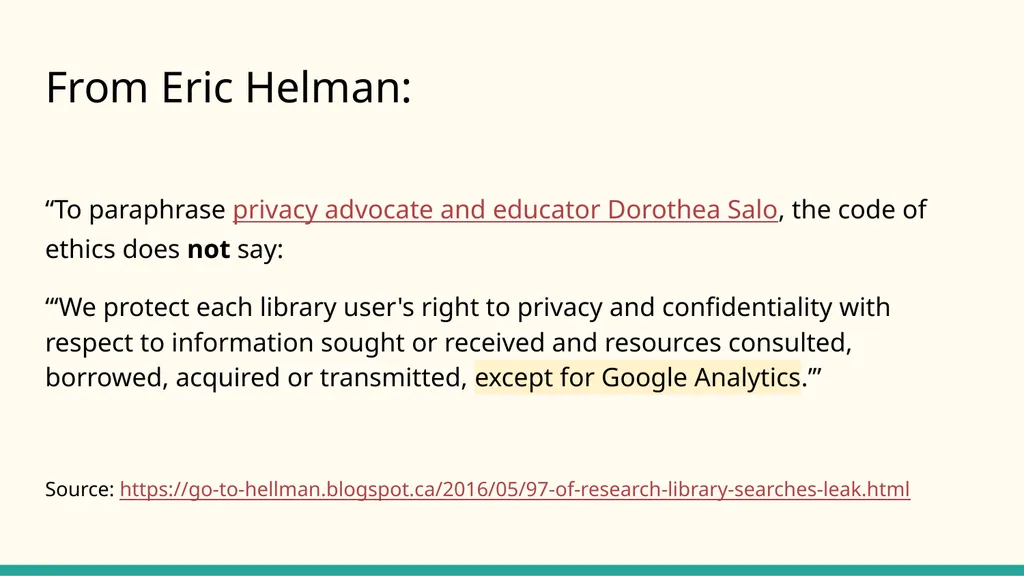
slide11. From Eric Helman: “To paraphrase privacy advocate and educator Dorothea Salo, the code of ethics does not say:
“‘We protect each library user's right to privacy and confidentiality with respect to information sought or received and resources consulted, borrowed, acquired or transmitted, except for Google Analytics.’”
Source: https://go-to-hellman.blogspot.ca/2016/05/97-of-research-library-searches-leak.html<br>
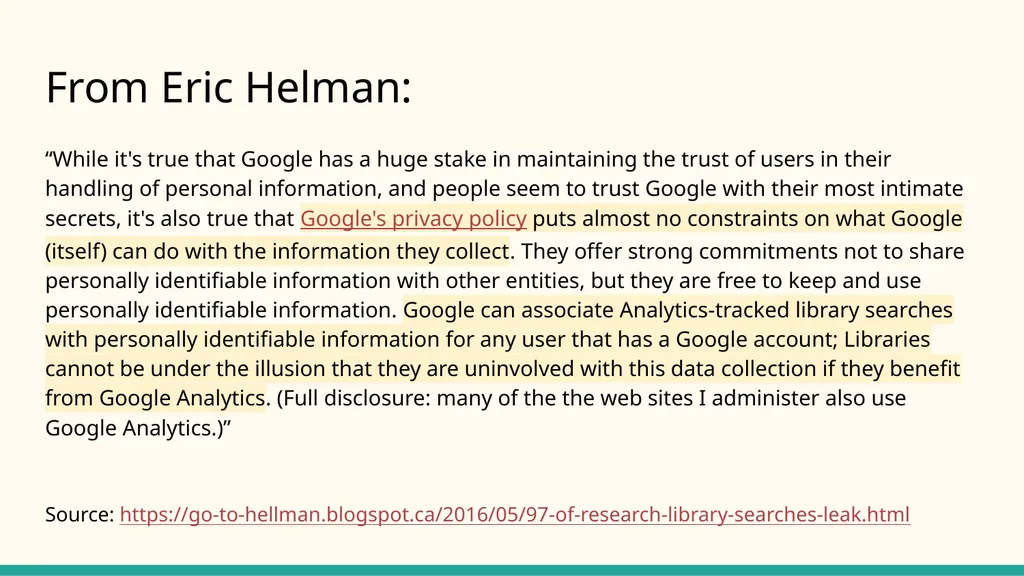
slide12. From Eric Helman: “While it's true that Google has a huge stake in maintaining the trust of users in their handling of personal information, and people seem to trust Google with their most intimate secrets, it's also true that Google's privacy policy puts almost no constraints on what Google (itself) can do with the information they collect. They offer strong commitments not to share personally identifiable information with other entities, but they are free to keep and use personally identifiable information. Google can associate Analytics-tracked library searches with personally identifiable information for any user that has a Google account; Libraries cannot be under the illusion that they are uninvolved with this data collection if they benefit from Google Analytics. (Full disclosure: many of the the web sites I administer also use Google Analytics.)”
Source: https://go-to-hellman.blogspot.ca/2016/05/97-of-research-library-searches-leak.html<br>
slide15. … and other tools too<br>
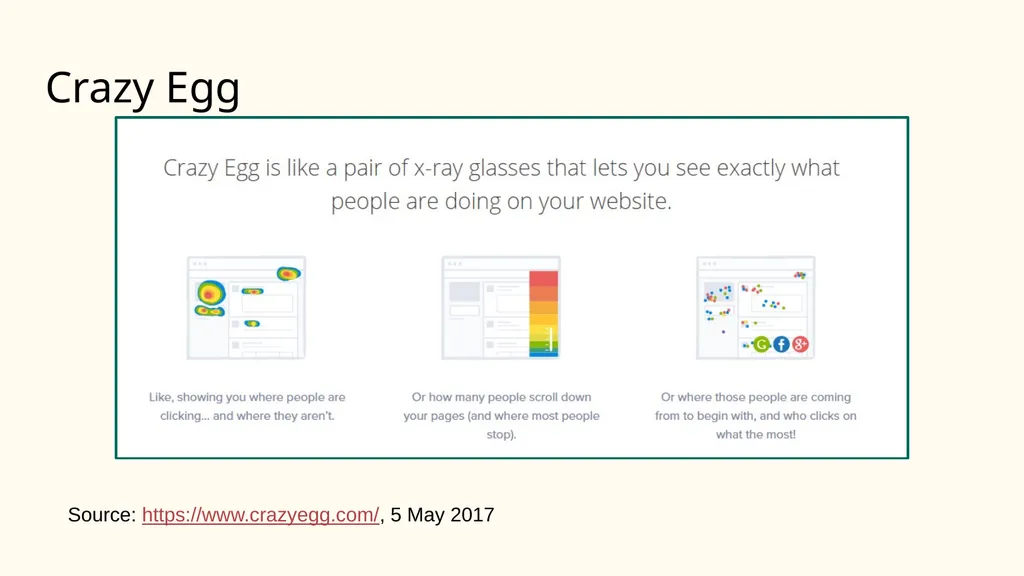
slide16. Crazy Egg Source: https://www.crazyegg.com/, 5 May 2017<br>
slide17. Crazy Egg privacy policy (excerpt) Crazy Egg may also collect certain information about a Client Visitor's computer or mobile device that may be furnished by the Client Visitor's browser or otherwise by the device ("Device Information"), such as:
Browser Information
Operating System Information
Mobile Device Information (e.g., device identifier, mobile operating system, etc.)
IP Address
Page Accessed
Geographic Location
Time of Visit
Referring Site, Application, or Service
Crazy Egg's Analysis Service is not designed to knowingly collect or extract from Visitor Information (including any Recorded Interactions or Device Information) information that could be used to personally identify Client Site Visitors, such as a Client Site Visitor's name, address or phone number ("Personally Identifiable Information") when a Client Site Visitor visits a Client Site that uses the Crazy Egg Analysis Service. In particular, Crazy Egg does not attempt to identify, decipher, or associate Personally Identifying Information regarding a Client Site Visitor from any Recorded Interactions or Device Information.
Source: https://www.crazyegg.com/privacy/ (accessed 3 May 2017)<br>
slide18. 3. What we can do<br>
slide19. Self-education and self-awareness Are we adhering to our professional and institutional principles?
Where do we fall short? Read and review:
Statements on ethics and principles from professional associations, your institution, etc.
Experts and advocates like Eric Hellman (go-to-hellman.blogspot.ca)
News and commentary on the risks of personal data being held and accessed by corporations and governments (here and in other countries)<br>
slide20. Raise awareness with others Ask questions at your institution (how are we protecting user privacy when we….?)
Connect with colleagues<br>
slide21. Advocate Suggest solutions Your library
Your funding/governing institution
Library associations and partnerships<br>
slide22. “Get off Google Analytics” Consider not collecting this kind of data. (How do you use it when you have it? Are there other ways to get the data you need for measurement, and to make improvements?)
Or:
Use an alternative like Piwic.<br>
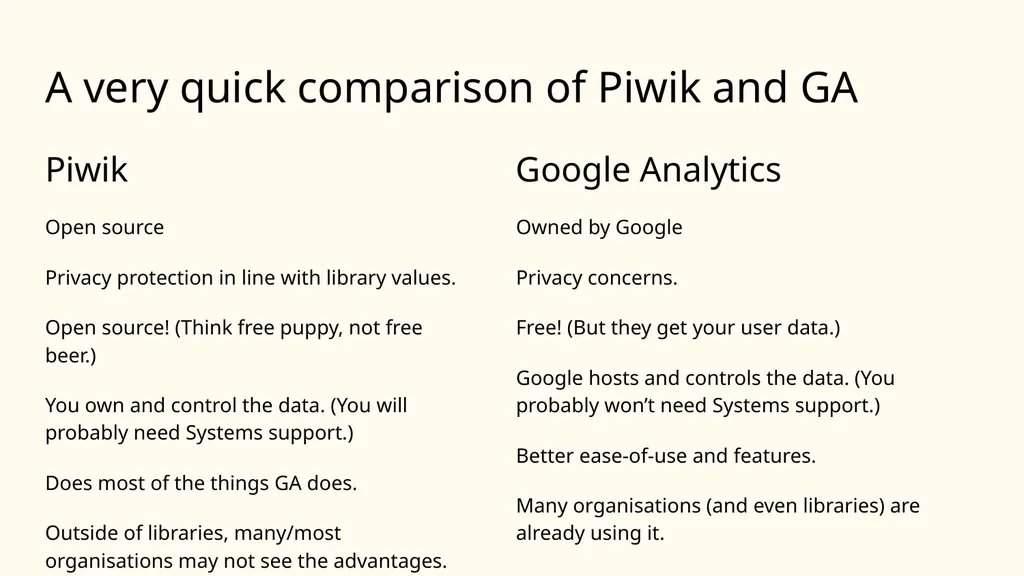
slide23. A very quick comparison of Piwik and GA Piwik
Open source
Privacy protection in line with library values.
Open source! (Think free puppy, not free beer.)
You own and control the data. (You will probably need Systems support.)
Does most of the things GA does.
Outside of libraries, many/most organisations may not see the advantages. Google Analytics
Owned by Google
Privacy concerns.
Free! (But they get your user data.)
Google hosts and controls the data. (You probably won’t need Systems support.)
Better ease-of-use and features.
Many organisations (and even libraries) are already using it.<br>
slide24. Susanna Galbraith on Piwik for libraries: “Much criticism of Google Analytics in libraries is that it is designed for e-commerce websites. Bounce Rates and Conversion Goals are just two examples of Google Analytics features that are not particularly useful for measuring success of library web pages and content.
“All in all, Piwik is an excellent alternative to Google Analytics for libraries, particularly in Canada where visitor privacy is not the only concern, but also the implications of data being stored on U.S. servers. For those who have the means to install software on their web servers, Piwik is highly recommended. For library purposes, Piwik should meet the needs of website assessment, and also address privacy and data storage concerns.”
Source: Galbraith, S. (2016, February 15). Piwik: Breaking away from Google Analytics. Open Shelf (Ontario Library Association).<br>
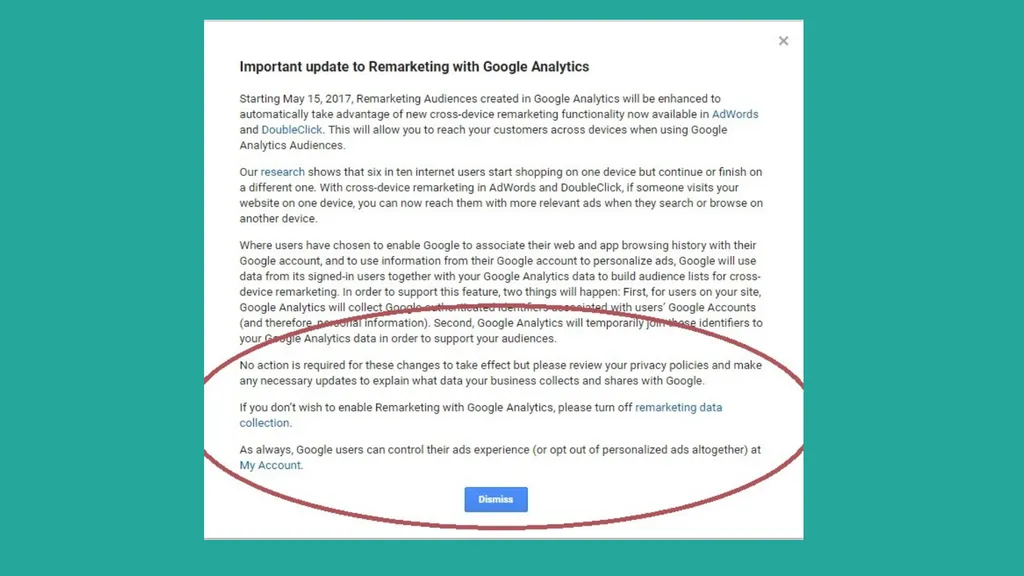
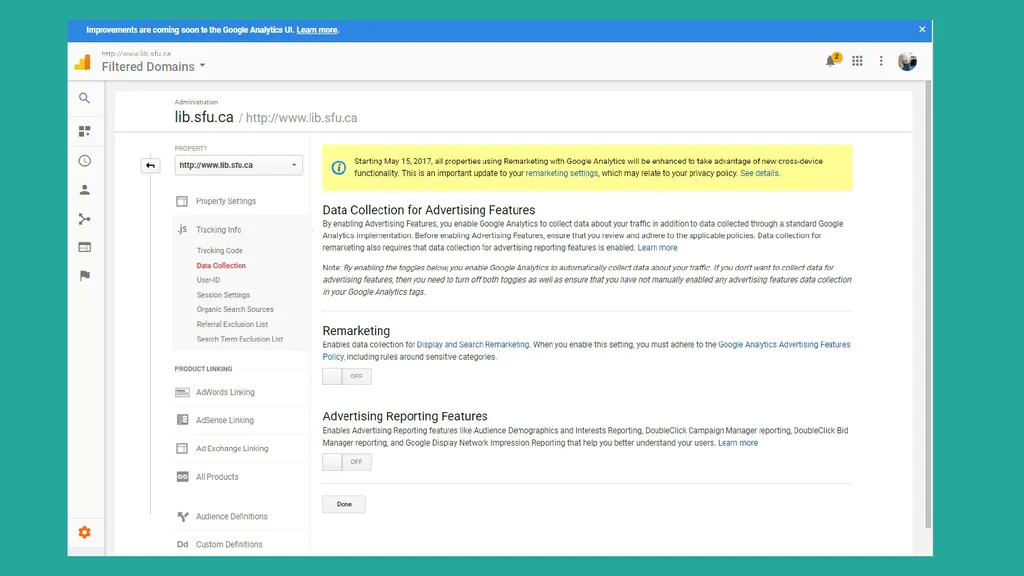
slide25. Do what you can with Google Analytics Tweak your settings: Choose options that protect as much privacy as possible. (Say no to “remarketing.”)
Be open and transparent: Publish a privacy policy that includes GA info; include instructions for opting out.<br>
slide26. Team up. Libraries do this well. Two ideas:
Explore collaborative hosting for Piwik
Advocacy at consortial/ association levels (Will companies like Google listen to us? Will legislators? )<br>
slide27. 4. Further resources<br>
slide28. Sources and some further reading (page 1 of 2) Galbraith, S. (2016, February 15). Piwik: Breaking away from Google Analytics. Open Shelf (Ontario Library Association). Retrieved from: http://www.open-shelf.ca/160215-piwik/
Hellman, E.(2016, May 23). 97% of research library searches leak privacy... and other disappointing statistics [Blog post]. Retrieved from https://go-to-hellman.blogspot.ca/2016/05/97-of-research-library-searches-leak.html
Hellman, E. (n.d.) ARL Library Search [Google Sheet]. (A survey of how each of the 123 ARL libraries are using and configuring Google Analytics -- or not. A quick-and-dirty list; he includes a caveat that there may be some errors.)
Hellman, E. (2017, February 2). How to enable/disable privacy protection in Google Analytics (it's easy to get wrong!) Retrieved from https://go-to-hellman.blogspot.ca/2017/02/how-to-enabledisable-privacy-protection.html<br>
slide29. Sources and further reading, continued Hoffman, A.L. (2016), Privacy, Intellectual Freedom, and Self-Respect: Technological and Philosophical Lessons for Libraries, in Ursula Gorham , Natalie Greene Taylor , Paul T. Jaeger (ed.) Perspectives on Libraries as Institutions of Human Rights and Social Justice (Advances in Librarianship, Volume 41) Emerald Group Publishing Limited., pp.49 - 69. DOI: 10.1108/S0065-283020160000041003
Lynch, C. (2017). The rise of reading analytics and the emerging calculus of reader privacy in the digital world. First Monday, 22(4). Retrieved from http://journals.uic.edu/ojs/index.php/fm/article/view/7414/6096.
Security and privacy in Universal Analytics [Google]. Retrieved from https://support.google.com/analytics/answer/2838718?hl=en, 19 April 2017.<br>
slide30. Sample privacy statements Harvard Library’s Privacy Statement. Retrieved 19 April 2017. (Advises users on steps to protect their privacy and warns about the Patriot Act.)
McGill Library Privacy Notice. Retrieved 19 April 2017. (Includes instructions for opting out of Google Analytics.)
Michigan State Universities Library Policy Statement. Retrieved 19 April 2017. (Includes information about server logs, as well as third party tracking, including Google Analytics.)
Berkeley Library, University of California, Collection, use and disclosure of electronic information. Retrieved 19 April 2017. (An overview of privacy policy principles, and practices throughout library services, as well as Google Analytics.)
Open Context Terms of Use and Privacy Policies. Retrieved 19 April 2017. (Includes reducing user privacy risks, such as use of Piwik.)<br>
slide31. Further conversations around privacy?
Add your name and email to sign-up sheet, or email: janis@sfu.ca Janis McKenzie<br>
slide32. Ethics of using Google Analytics Janis McKenzie
ebranch librarian, Simon Fraser University Library janis@sfu.ca<br>
Janis McKenzie, Librarian, eBranch, SFU<br>
slide2. Library values and ethics
Why we should care about Google Analytics (etc.)
What we can do
Further resources<br>
slide3. 1. Values and ethics of librarianship<br>
slide4. ALA and IFLA “The American Library Association affirms that rights of privacy are necessary for intellectual freedom and are fundamental to the ethics and practice of librarianship.”
-- American Library Association, Core Values of Librarianship
“Librarians and other information workers respect personal privacy, and the protection of personal data, necessarily shared between individuals and institutions.”
--The International Federation of Library Associations and Institutions (IFLA) Code of Ethics for Librarians and other Information Workers<br>
slide5. CFLA ...The Canadian Federation of Library Associations affirms further that libraries have a core responsibility to support, defend and promote the universal principles of intellectual freedom and privacy….
...Libraries have a core responsibility to safeguard and defend privacy in the individual’s pursuit of expressive content. To this end, libraries protect the identities and activities of library users except when required by the courts to cede them….
--Canadian Federation of Library Associations
Statement on Intellectual Freedom and Libraries<br>
slide6. ACRL 2. Professional Values: Libraries advance professional values of intellectual freedom, intellectual property rights and values, user privacy and confidentiality, collaboration, and user-centered service.
2.1 The library resists all efforts to censor library resources.
2.2 The library protects each library user’s right to privacy and confidentiality.
-- Principles, from Standards for Libraries in Higher Education Principles and Performance Indicators,
Association for College and Research Libraries (a division of the American Library Association)<br>
slide7. Clifford Lynch: “...[O]ne of the most profoundly important social functions of libraries was actually to offer readers such privacy as part of their broad commitment to intellectual freedom, most notably by ensuring that circulation records were not retained over the long term, and thus not available for the authorities…. and by facilitating anonymous use of material within the physical boundaries of the library. And, of course, by building broad and diverse collections that incorporated controversial topics and points of view. They served as intellectual sanctuaries.”
Lynch, C. (2017). The rise of reading analytics and the emerging calculus of reader privacy in the digital world. First Monday, 22(4).<br>
slide8. Asking the tough question: How do our practices line up with our stated values? We are very careful to protect user privacy when it comes to (physical) borrowing records, and we don’t track who uses what print resources in person in our physical spaces.
How do our practices around online use align with the way we protect patrons’ confidentiality when they use print resources?<br>
slide9. 2. Why we should care about Google Analytics (and similar tools)<br>
slide10. Susanna Galbraith on GA and privacy: “Many of us in the library community who have a responsibility to assess the usage of our library’s websites have become very familiar with the popular Google Analytics. Google Analytics is free and robust, and yet the data it collects belongs to Google and is housed on U.S. servers, where data may be subject to the legislation of that country.
“While many may see this as inconsequential (hey, Canada.ca uses Google Analytics, why can’t we?), those of us in the library community who wish to uphold the longstanding tradition in our profession of protecting user privacy, may wish to seek other alternatives.”
Source: Galbraith, S. (2016, February 15). Piwik: Breaking away from Google Analytics. Open Shelf (Ontario Library Association).<br>
slide11. From Eric Helman: “To paraphrase privacy advocate and educator Dorothea Salo, the code of ethics does not say:
“‘We protect each library user's right to privacy and confidentiality with respect to information sought or received and resources consulted, borrowed, acquired or transmitted, except for Google Analytics.’”
Source: https://go-to-hellman.blogspot.ca/2016/05/97-of-research-library-searches-leak.html<br>
slide12. From Eric Helman: “While it's true that Google has a huge stake in maintaining the trust of users in their handling of personal information, and people seem to trust Google with their most intimate secrets, it's also true that Google's privacy policy puts almost no constraints on what Google (itself) can do with the information they collect. They offer strong commitments not to share personally identifiable information with other entities, but they are free to keep and use personally identifiable information. Google can associate Analytics-tracked library searches with personally identifiable information for any user that has a Google account; Libraries cannot be under the illusion that they are uninvolved with this data collection if they benefit from Google Analytics. (Full disclosure: many of the the web sites I administer also use Google Analytics.)”
Source: https://go-to-hellman.blogspot.ca/2016/05/97-of-research-library-searches-leak.html<br>
slide15. … and other tools too<br>
slide16. Crazy Egg Source: https://www.crazyegg.com/, 5 May 2017<br>
slide17. Crazy Egg privacy policy (excerpt) Crazy Egg may also collect certain information about a Client Visitor's computer or mobile device that may be furnished by the Client Visitor's browser or otherwise by the device ("Device Information"), such as:
Browser Information
Operating System Information
Mobile Device Information (e.g., device identifier, mobile operating system, etc.)
IP Address
Page Accessed
Geographic Location
Time of Visit
Referring Site, Application, or Service
Crazy Egg's Analysis Service is not designed to knowingly collect or extract from Visitor Information (including any Recorded Interactions or Device Information) information that could be used to personally identify Client Site Visitors, such as a Client Site Visitor's name, address or phone number ("Personally Identifiable Information") when a Client Site Visitor visits a Client Site that uses the Crazy Egg Analysis Service. In particular, Crazy Egg does not attempt to identify, decipher, or associate Personally Identifying Information regarding a Client Site Visitor from any Recorded Interactions or Device Information.
Source: https://www.crazyegg.com/privacy/ (accessed 3 May 2017)<br>
slide18. 3. What we can do<br>
slide19. Self-education and self-awareness Are we adhering to our professional and institutional principles?
Where do we fall short? Read and review:
Statements on ethics and principles from professional associations, your institution, etc.
Experts and advocates like Eric Hellman (go-to-hellman.blogspot.ca)
News and commentary on the risks of personal data being held and accessed by corporations and governments (here and in other countries)<br>
slide20. Raise awareness with others Ask questions at your institution (how are we protecting user privacy when we….?)
Connect with colleagues<br>
slide21. Advocate Suggest solutions Your library
Your funding/governing institution
Library associations and partnerships<br>
slide22. “Get off Google Analytics” Consider not collecting this kind of data. (How do you use it when you have it? Are there other ways to get the data you need for measurement, and to make improvements?)
Or:
Use an alternative like Piwic.<br>
slide23. A very quick comparison of Piwik and GA Piwik
Open source
Privacy protection in line with library values.
Open source! (Think free puppy, not free beer.)
You own and control the data. (You will probably need Systems support.)
Does most of the things GA does.
Outside of libraries, many/most organisations may not see the advantages. Google Analytics
Owned by Google
Privacy concerns.
Free! (But they get your user data.)
Google hosts and controls the data. (You probably won’t need Systems support.)
Better ease-of-use and features.
Many organisations (and even libraries) are already using it.<br>
slide24. Susanna Galbraith on Piwik for libraries: “Much criticism of Google Analytics in libraries is that it is designed for e-commerce websites. Bounce Rates and Conversion Goals are just two examples of Google Analytics features that are not particularly useful for measuring success of library web pages and content.
“All in all, Piwik is an excellent alternative to Google Analytics for libraries, particularly in Canada where visitor privacy is not the only concern, but also the implications of data being stored on U.S. servers. For those who have the means to install software on their web servers, Piwik is highly recommended. For library purposes, Piwik should meet the needs of website assessment, and also address privacy and data storage concerns.”
Source: Galbraith, S. (2016, February 15). Piwik: Breaking away from Google Analytics. Open Shelf (Ontario Library Association).<br>
slide25. Do what you can with Google Analytics Tweak your settings: Choose options that protect as much privacy as possible. (Say no to “remarketing.”)
Be open and transparent: Publish a privacy policy that includes GA info; include instructions for opting out.<br>
slide26. Team up. Libraries do this well. Two ideas:
Explore collaborative hosting for Piwik
Advocacy at consortial/ association levels (Will companies like Google listen to us? Will legislators? )<br>
slide27. 4. Further resources<br>
slide28. Sources and some further reading (page 1 of 2) Galbraith, S. (2016, February 15). Piwik: Breaking away from Google Analytics. Open Shelf (Ontario Library Association). Retrieved from: http://www.open-shelf.ca/160215-piwik/
Hellman, E.(2016, May 23). 97% of research library searches leak privacy... and other disappointing statistics [Blog post]. Retrieved from https://go-to-hellman.blogspot.ca/2016/05/97-of-research-library-searches-leak.html
Hellman, E. (n.d.) ARL Library Search [Google Sheet]. (A survey of how each of the 123 ARL libraries are using and configuring Google Analytics -- or not. A quick-and-dirty list; he includes a caveat that there may be some errors.)
Hellman, E. (2017, February 2). How to enable/disable privacy protection in Google Analytics (it's easy to get wrong!) Retrieved from https://go-to-hellman.blogspot.ca/2017/02/how-to-enabledisable-privacy-protection.html<br>
slide29. Sources and further reading, continued Hoffman, A.L. (2016), Privacy, Intellectual Freedom, and Self-Respect: Technological and Philosophical Lessons for Libraries, in Ursula Gorham , Natalie Greene Taylor , Paul T. Jaeger (ed.) Perspectives on Libraries as Institutions of Human Rights and Social Justice (Advances in Librarianship, Volume 41) Emerald Group Publishing Limited., pp.49 - 69. DOI: 10.1108/S0065-283020160000041003
Lynch, C. (2017). The rise of reading analytics and the emerging calculus of reader privacy in the digital world. First Monday, 22(4). Retrieved from http://journals.uic.edu/ojs/index.php/fm/article/view/7414/6096.
Security and privacy in Universal Analytics [Google]. Retrieved from https://support.google.com/analytics/answer/2838718?hl=en, 19 April 2017.<br>
slide30. Sample privacy statements Harvard Library’s Privacy Statement. Retrieved 19 April 2017. (Advises users on steps to protect their privacy and warns about the Patriot Act.)
McGill Library Privacy Notice. Retrieved 19 April 2017. (Includes instructions for opting out of Google Analytics.)
Michigan State Universities Library Policy Statement. Retrieved 19 April 2017. (Includes information about server logs, as well as third party tracking, including Google Analytics.)
Berkeley Library, University of California, Collection, use and disclosure of electronic information. Retrieved 19 April 2017. (An overview of privacy policy principles, and practices throughout library services, as well as Google Analytics.)
Open Context Terms of Use and Privacy Policies. Retrieved 19 April 2017. (Includes reducing user privacy risks, such as use of Piwik.)<br>
slide31. Further conversations around privacy?
Add your name and email to sign-up sheet, or email: janis@sfu.ca Janis McKenzie<br>
slide32. Ethics of using Google Analytics Janis McKenzie
ebranch librarian, Simon Fraser University Library janis@sfu.ca<br>