
ETSI Strategy at a Glance Short presentation to
AS
Published · 22 slides · 0 views

1 / 1

Description
ETSI Strategy at a Glance Short presentation to learn more about the ETSI Strategy. The Context The new strategy flows from a far-reaching evaluation of the main socioeconomic, policy and technology trends characterizing the ecosystem where
Related Topics
Share
Embed code
Download this presentation From Below
"ETSI Strategy at a Glance Short presentation to" is the property of its rightful owner. Permission is granted to download and print the materials on this website for personal, non-commercial use only, and to display it on your personal computer provided you do not modify the materials and that you retain all copyright notices contained in the materials. By downloading content from our website, you accept the terms of this agreement.
Presentation Transcript
01
ETSI Strategy at a Glance Short presentation to learn more about the ETSI Strategy.<br>
02
The Context The new strategy flows from a far-reaching evaluation of the main socioeconomic, policy and technology trends characterizing the ecosystem where ETSI operates and that impact our activities.<br>
03
Strategic Position Provides ETSI’s position in terms of its Mission and Vision taking the basic principles that characterize and underpin the way ETSI operates as a starting point: Worldwide community, Innovative and market driven, Recognized European Standardization Organization with global impact<br>
04
To provide platforms where interested parties come together and collaborate on the development and promotion of standards for Information and Communication Technology (ICT) systems and services, used globally for the benefit of all.<br>
05
Designing tomorrow’s world, ETSI is at the forefront of new Information and Communication Technology, leading the development of standards that enable a sustainable and securely connected society.<br>
06
ETSI’s 5 Strategic Directions ETSI aims to maintain and strengthen its strategic position through a number of Key Strategic Directions, each defining a major area of development for ETSI.<br>
07
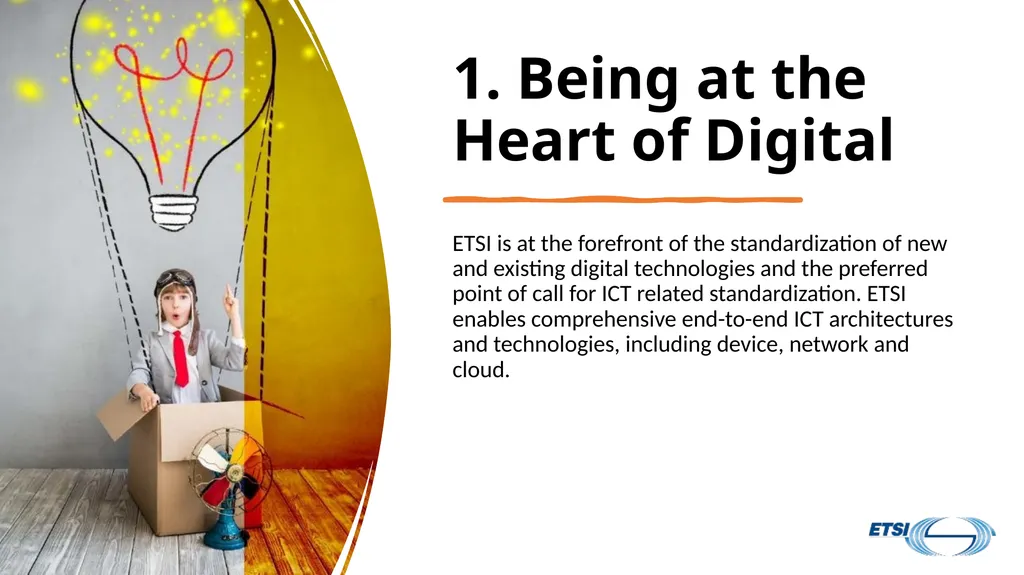
1. Being at the Heart of Digital ETSI is at the forefront of the standardization of new and existing digital technologies and the preferred point of call for ICT related standardization. ETSI enables comprehensive end-to-end ICT architectures and technologies, including device, network and cloud.<br>
08
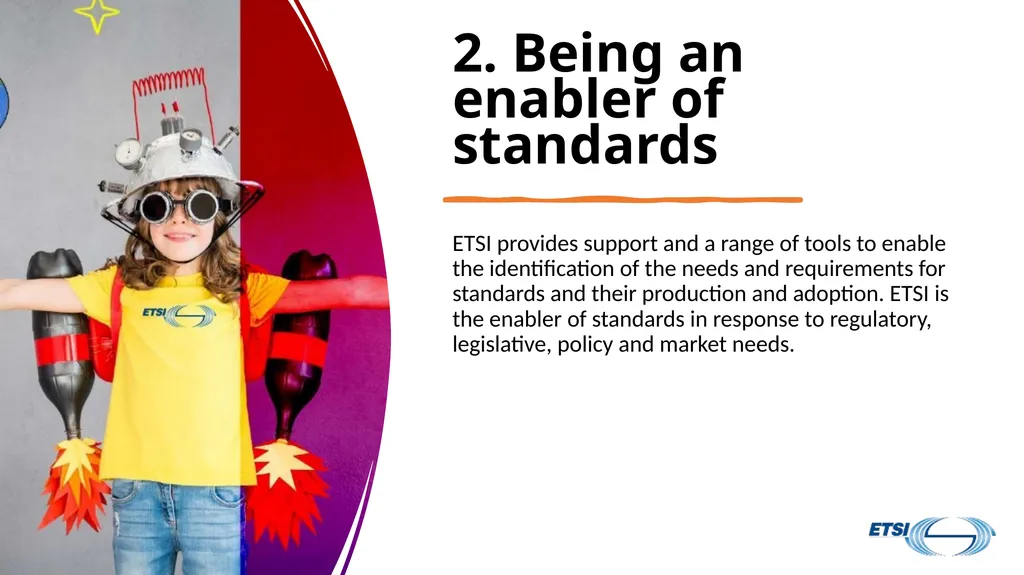
2. Being an enabler of standards ETSI provides support and a range of tools to enable the identification of the needs and requirements for standards and their production and adoption. ETSI is the enabler of standards in response to regulatory, legislative, policy and market needs.<br>
09
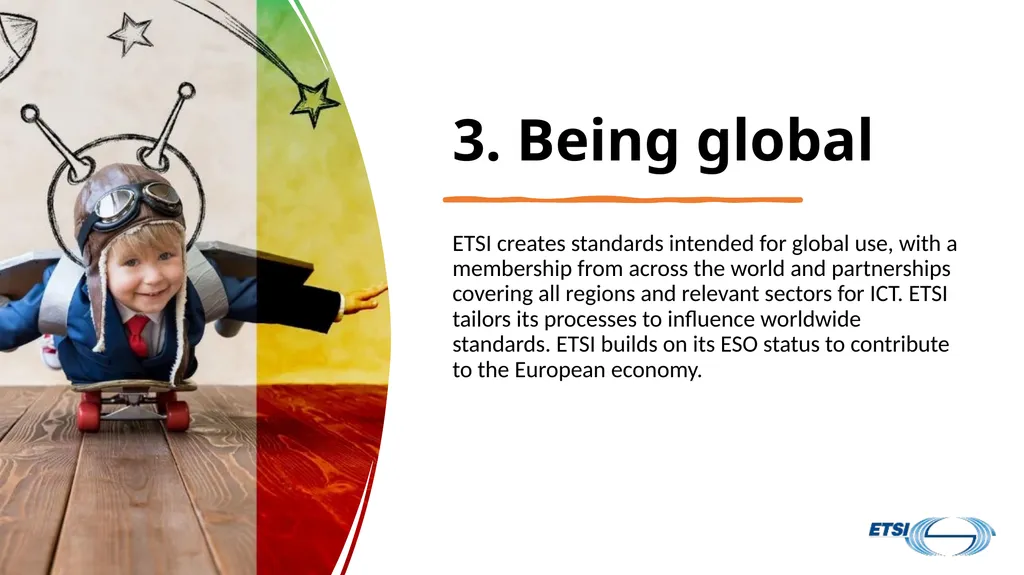
3. Being global ETSI creates standards intended for global use, with a membership from across the world and partnerships covering all regions and relevant sectors for ICT. ETSI tailors its processes to influence worldwide standards. ETSI builds on its ESO status to contribute to the European economy.<br>
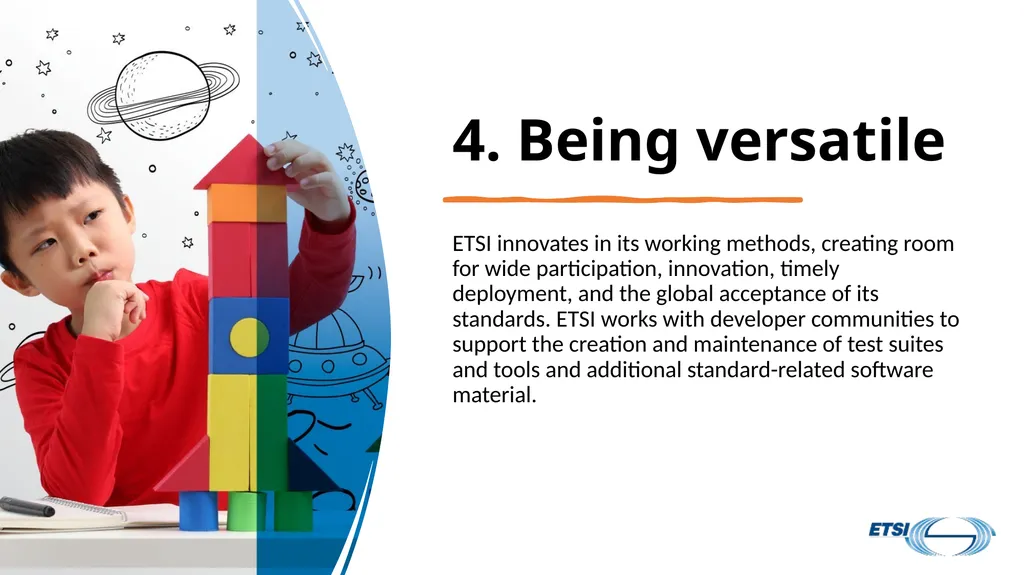
10
4. Being versatile ETSI innovates in its working methods, creating room for wide participation, innovation, timely deployment, and the global acceptance of its standards. ETSI works with developer communities to support the creation and maintenance of test suites and tools and additional standard-related software material.<br>
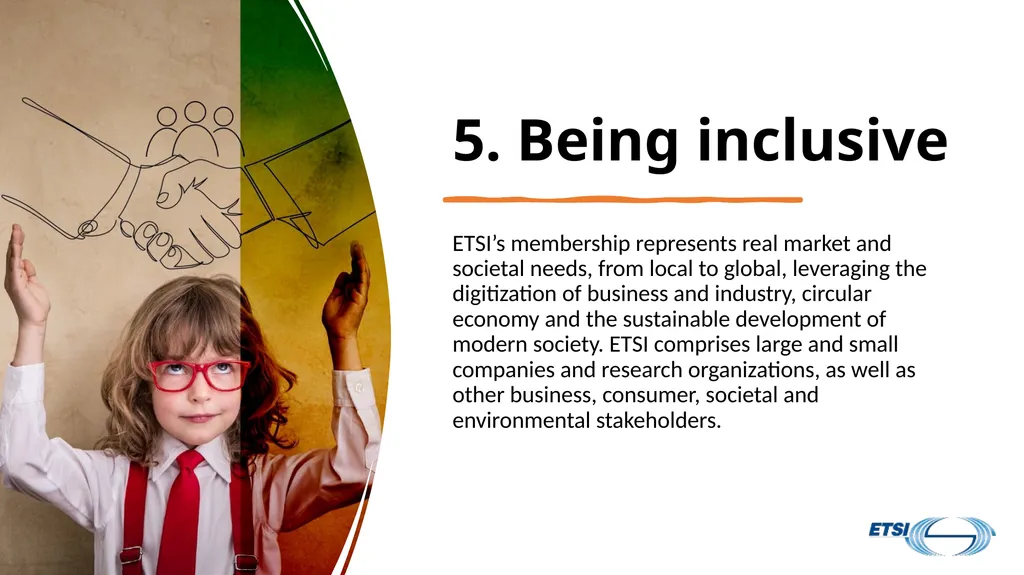
11
5. Being inclusive ETSI’s membership represents real market and societal needs, from local to global, leveraging the digitization of business and industry, circular economy and the sustainable development of modern society. ETSI comprises large and small companies and research organizations, as well as other business, consumer, societal and environmental stakeholders.<br>
12
More information about ETSI’s strategy at:
www.etsi.org/about/our-strategy
Thank You<br>
www.etsi.org/about/our-strategy
Thank You<br>
13
Annex<br>
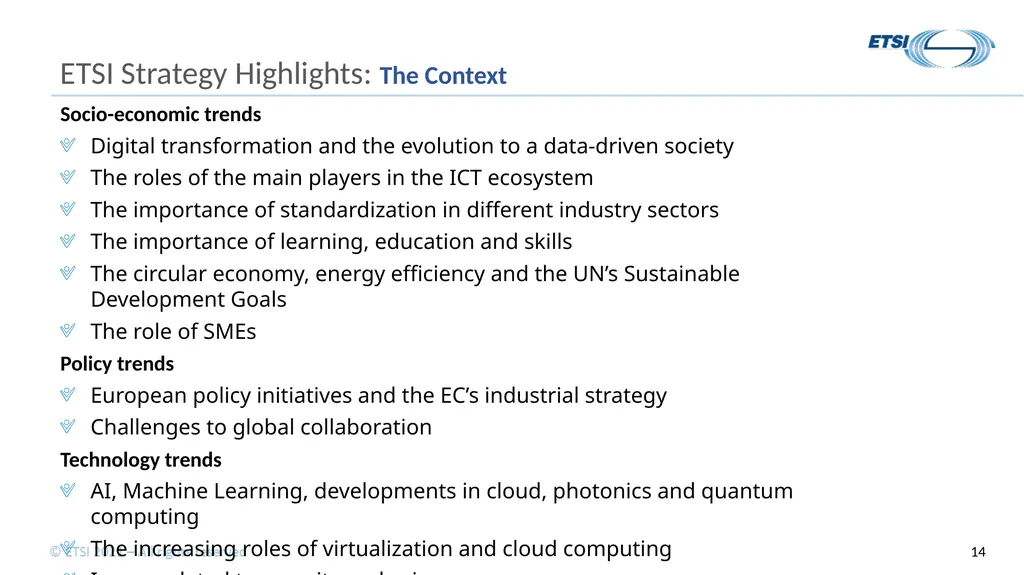
14
ETSI Strategy Highlights: The Context Socio-economic trends
Digital transformation and the evolution to a data-driven society
The roles of the main players in the ICT ecosystem
The importance of standardization in different industry sectors
The importance of learning, education and skills
The circular economy, energy efficiency and the UN’s Sustainable Development Goals
The role of SMEs
Policy trends
European policy initiatives and the EC’s industrial strategy
Challenges to global collaboration
Technology trends
AI, Machine Learning, developments in cloud, photonics and quantum computing
The increasing roles of virtualization and cloud computing
Issues related to security and privacy<br>
Digital transformation and the evolution to a data-driven society
The roles of the main players in the ICT ecosystem
The importance of standardization in different industry sectors
The importance of learning, education and skills
The circular economy, energy efficiency and the UN’s Sustainable Development Goals
The role of SMEs
Policy trends
European policy initiatives and the EC’s industrial strategy
Challenges to global collaboration
Technology trends
AI, Machine Learning, developments in cloud, photonics and quantum computing
The increasing roles of virtualization and cloud computing
Issues related to security and privacy<br>
15
Strategic Position: Worldwide community ETSI is inclusive with a global membership representing a wide range of stakeholders, a global network of partnerships
ETSI works across all sectors of industry and society that make, use or rely on ICT
ETSI favours partnering, promoting global collaboration
ETSI activities are driven by its members
ETSI promotes the knowledge and benefits of standards<br>
ETSI works across all sectors of industry and society that make, use or rely on ICT
ETSI favours partnering, promoting global collaboration
ETSI activities are driven by its members
ETSI promotes the knowledge and benefits of standards<br>
16
Strategic Position: Innovative and market driven ETSI works at the forefront of emerging and developing technologies
ETSI’s work is based on timeliness, quality and responsiveness for the benefit of the market, consumers and society at large
ETSI delivers an extensive portfolio of ICT standards with an end-to-end perspective
ETSI produces standards aimed at being adopted by all markets, even the most competitive
ETSI welcomes and encourages innovation contributed to all its activities, including standards, methodologies, rules and processes
ETSI enables the availability of world class technologies for all through standardization
ETSI promotes the visibility and availability of its standards<br>
ETSI’s work is based on timeliness, quality and responsiveness for the benefit of the market, consumers and society at large
ETSI delivers an extensive portfolio of ICT standards with an end-to-end perspective
ETSI produces standards aimed at being adopted by all markets, even the most competitive
ETSI welcomes and encourages innovation contributed to all its activities, including standards, methodologies, rules and processes
ETSI enables the availability of world class technologies for all through standardization
ETSI promotes the visibility and availability of its standards<br>
17
Strategic Position: Recognized European Standardization Organization with global impact ETSI is fully compliant with WTO TBT provisions and EU Regulations
ETSI adopts a consensus approach in its decision making
ETSI supports EU strategic objectives, regulatory requirements and policies
ETSI in its standardization work strives for a sustainable future
ETSI supports and promotes the EU Industrial Strategy objectives of becoming more green, digital and resilient<br>
ETSI adopts a consensus approach in its decision making
ETSI supports EU strategic objectives, regulatory requirements and policies
ETSI in its standardization work strives for a sustainable future
ETSI supports and promotes the EU Industrial Strategy objectives of becoming more green, digital and resilient<br>
18
Key Strategic Directions: Being at the Heart of Digital ETSI is at the forefront of the standardization of new and existing digital technologies and the preferred point of call for ICT related standardization
ETSI enables comprehensive end-to-end ICT architectures and technologies, including device, network and cloud
ETSI is a recognized ESO by the European Union and the preferred ICT standards partner of the European Commission and the European Free Trade Association
ETSI develops and makes appropriate use of software, including open source, and establishes effective liaisons with open source foundations and communities to further the global adoption of ETSI standards
ETSI engages and works closely with academic, research and innovation communities to stay at the forefront of technology
ETSI cooperates closely with European spectrum authorities, ITU and global spectrum activities to meet spectrum demands in a timely and adequate manner<br>
ETSI enables comprehensive end-to-end ICT architectures and technologies, including device, network and cloud
ETSI is a recognized ESO by the European Union and the preferred ICT standards partner of the European Commission and the European Free Trade Association
ETSI develops and makes appropriate use of software, including open source, and establishes effective liaisons with open source foundations and communities to further the global adoption of ETSI standards
ETSI engages and works closely with academic, research and innovation communities to stay at the forefront of technology
ETSI cooperates closely with European spectrum authorities, ITU and global spectrum activities to meet spectrum demands in a timely and adequate manner<br>
19
Key Strategic Directions: Being an enabler of standards ETSI’s members come to debate and exchange ideas around the development and use of technology of central importance to their success. ETSI also facilitates industry-wide stakeholder workshops and other networking events.
ETSI provides support and a range of tools to enable the identification of the needs and requirements for standards and their production and adoption.
ETSI develops and maintains processes, policies, tools and information databases that can fully meet the needs of its members. These enablers include the ETSI intellectual property rights policy, its interoperability tests and methodologies, and the processes to create, maintain and promote European standards and other standardization deliverables.
ETSI continues to develop means to provide end-to-end support for the standards process, including implementing processes, policies, tools and information databases that are needed to use open-source and engage with open source communities.
ETSI enables standards through its response to regulatory, legislative, policy and market needs: the EC, EFTA, national governments and other policy makers<br>
ETSI provides support and a range of tools to enable the identification of the needs and requirements for standards and their production and adoption.
ETSI develops and maintains processes, policies, tools and information databases that can fully meet the needs of its members. These enablers include the ETSI intellectual property rights policy, its interoperability tests and methodologies, and the processes to create, maintain and promote European standards and other standardization deliverables.
ETSI continues to develop means to provide end-to-end support for the standards process, including implementing processes, policies, tools and information databases that are needed to use open-source and engage with open source communities.
ETSI enables standards through its response to regulatory, legislative, policy and market needs: the EC, EFTA, national governments and other policy makers<br>
20
Key Strategic Directions: Being global ETSI creates standards for global use, with members from across the world and a wide set of partnerships covering all world regions and relevant sectors for ICT
ETSI also contributes to global standards through its collaboration with standard-setting organizations. ETSI establishes partnerships to offer and influence, worldwide standards
ETSI nurtures its unique membership mix and its market driven approach to attract new members, partnerships and standardization activities that require a broad consensus among private and public sectors
ETSI carries out the promotion, education and other strategies to ensure that its work programme and activities are widely known
ETSI builds on its ESO status to contribute to the European economy, EU legislation and policies, inclusiveness and competitiveness of European businesses globally. ETSI encourages the adoption of its standards in other regions of the world<br>
ETSI also contributes to global standards through its collaboration with standard-setting organizations. ETSI establishes partnerships to offer and influence, worldwide standards
ETSI nurtures its unique membership mix and its market driven approach to attract new members, partnerships and standardization activities that require a broad consensus among private and public sectors
ETSI carries out the promotion, education and other strategies to ensure that its work programme and activities are widely known
ETSI builds on its ESO status to contribute to the European economy, EU legislation and policies, inclusiveness and competitiveness of European businesses globally. ETSI encourages the adoption of its standards in other regions of the world<br>
21
Key Strategic Directions: Being versatile ETSI is versatile in the methods it uses to create ICT standards
ETSI innovates in its working methods, creating room for wide participation, innovation, time to deployment, and the global acceptance of ETSI standards
ETSI promotes and develops standards for the digital transformation of economies and societies and the circular economy and green deal
ETSI has a flexible structure of technical bodies that enable the timely creation of standards, and can include organizations that are not ETSI members, where appropriate
ETSI works in synergy with developer communities to support the creation and maintenance of test suites and tools, additional standard-related software material, and reference implementations
ETSI produces technical standards and material to support compliance testing<br>
ETSI innovates in its working methods, creating room for wide participation, innovation, time to deployment, and the global acceptance of ETSI standards
ETSI promotes and develops standards for the digital transformation of economies and societies and the circular economy and green deal
ETSI has a flexible structure of technical bodies that enable the timely creation of standards, and can include organizations that are not ETSI members, where appropriate
ETSI works in synergy with developer communities to support the creation and maintenance of test suites and tools, additional standard-related software material, and reference implementations
ETSI produces technical standards and material to support compliance testing<br>
22
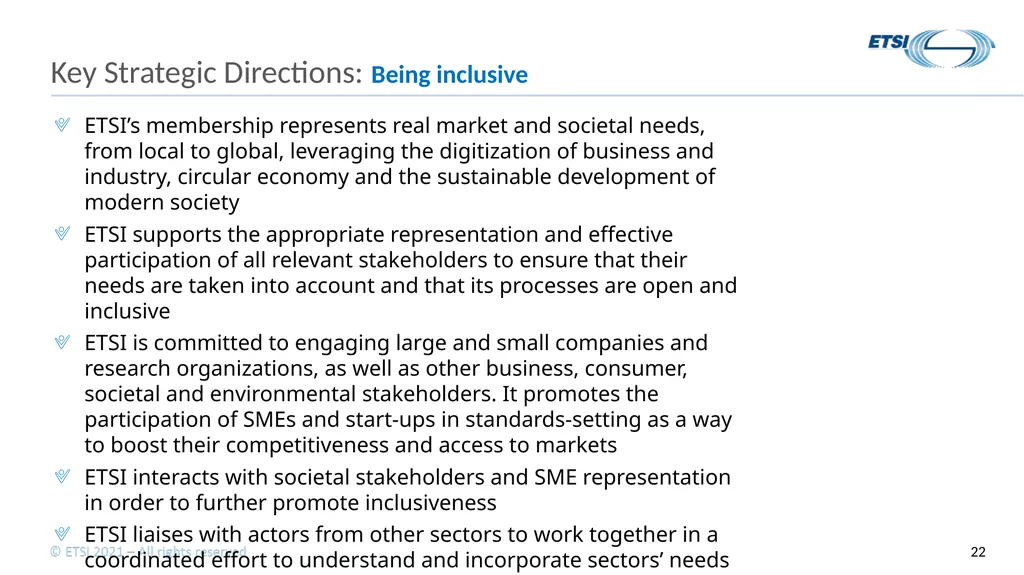
Key Strategic Directions: Being inclusive ETSI’s membership represents real market and societal needs, from local to global, leveraging the digitization of business and industry, circular economy and the sustainable development of modern society
ETSI supports the appropriate representation and effective participation of all relevant stakeholders to ensure that their needs are taken into account and that its processes are open and inclusive
ETSI is committed to engaging large and small companies and research organizations, as well as other business, consumer, societal and environmental stakeholders. It promotes the participation of SMEs and start-ups in standards-setting as a way to boost their competitiveness and access to markets
ETSI interacts with societal stakeholders and SME representation in order to further promote inclusiveness
ETSI liaises with actors from other sectors to work together in a coordinated effort to understand and incorporate sectors’ needs into ETSI standards<br>
ETSI supports the appropriate representation and effective participation of all relevant stakeholders to ensure that their needs are taken into account and that its processes are open and inclusive
ETSI is committed to engaging large and small companies and research organizations, as well as other business, consumer, societal and environmental stakeholders. It promotes the participation of SMEs and start-ups in standards-setting as a way to boost their competitiveness and access to markets
ETSI interacts with societal stakeholders and SME representation in order to further promote inclusiveness
ETSI liaises with actors from other sectors to work together in a coordinated effort to understand and incorporate sectors’ needs into ETSI standards<br>