
Evaluating high-alpha MOX assay improvements


Description: Evaluating high-alpha MOX assay improvements within the multiplicity analysis framework LA-UR-24-26156 V2 24 July 2024 2024 INMM Meeting David Broughton, Daniela Henzlova, Carlos Rael, Jessica Mendez, Joe Longo, Martyn Swinhoe Los Alamos
Related Topics
Download Presentation
"Evaluating high-alpha MOX assay improvements" is the property of its rightful owner. Permission is granted to download and print the materials on this website for personal, non-commercial use only, and to display it on your personal computer provided you do not modify the materials and that you retain all copyright notices contained in the materials. By downloading content from our website, you accept the terms of this agreement.
Presentation Transcript
slide1. Evaluating high-alpha MOX assay improvements
within the multiplicity analysis framework LA-UR-24-26156 V2 24 July 2024 2024 INMM Meeting David Broughton, Daniela Henzlova, Carlos Rael,
Jessica Mendez, Joe Longo, Martyn Swinhoe
Los Alamos National Laboratory
Risa Suzuki, Taketeru Nagatani, Toyofumi Okada Japan Atomic Energy Agency<br>
slide2. Context Over 35 years of bilateral Japan-U.S. collaboration on international safeguards has led to numerous advances in instrumentation and analysis
One outcome was the ENMC (Epithermal Neutron Multiplicity Counter)
JAEA uses the ENMC for NDA of large MOX items (~1-100’s g 240Pueff)
High alpha MOX items have large assay error using standard multiplicity analysis
Here we investigate this error and its mitigation 2 Samples (~0.5-700g Pu) within 1, 2, 3L canisters<br>
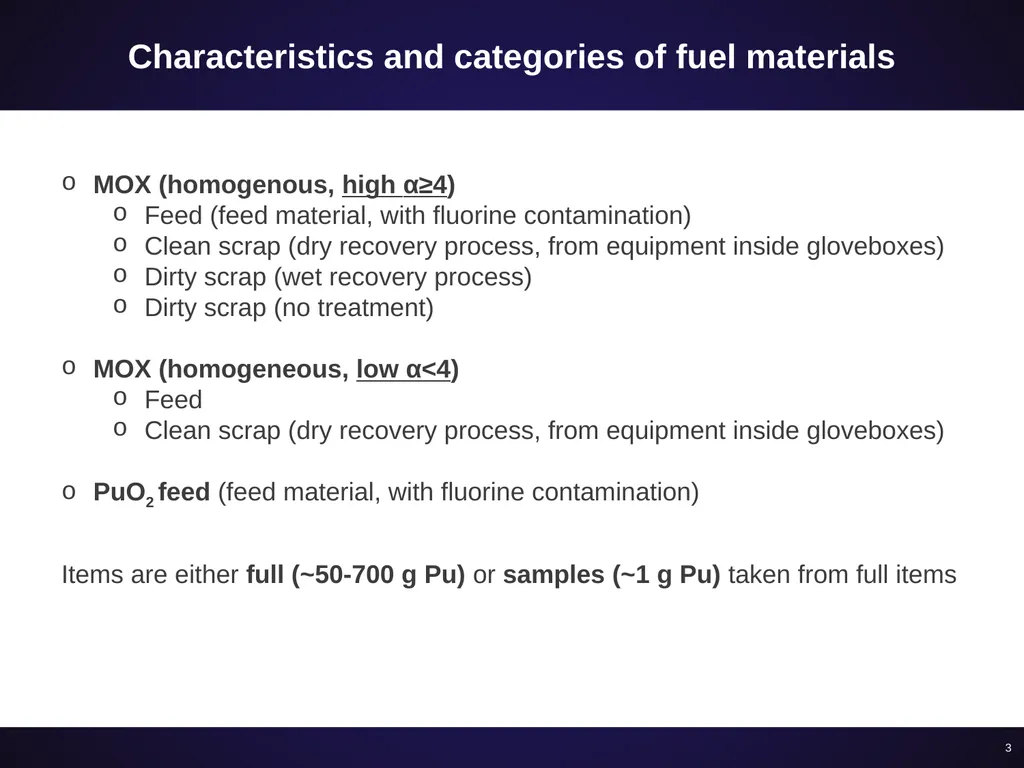
slide3. Characteristics and categories of fuel materials MOX (homogenous, high α≥4)
Feed (feed material, with fluorine contamination)
Clean scrap (dry recovery process, from equipment inside gloveboxes)
Dirty scrap (wet recovery process)
Dirty scrap (no treatment)
MOX (homogeneous, low α<4)
Feed
Clean scrap (dry recovery process, from equipment inside gloveboxes)
PuO2 feed (feed material, with fluorine contamination)
Items are either full (~50-700 g Pu) or samples (~1 g Pu) taken from full items 3<br>
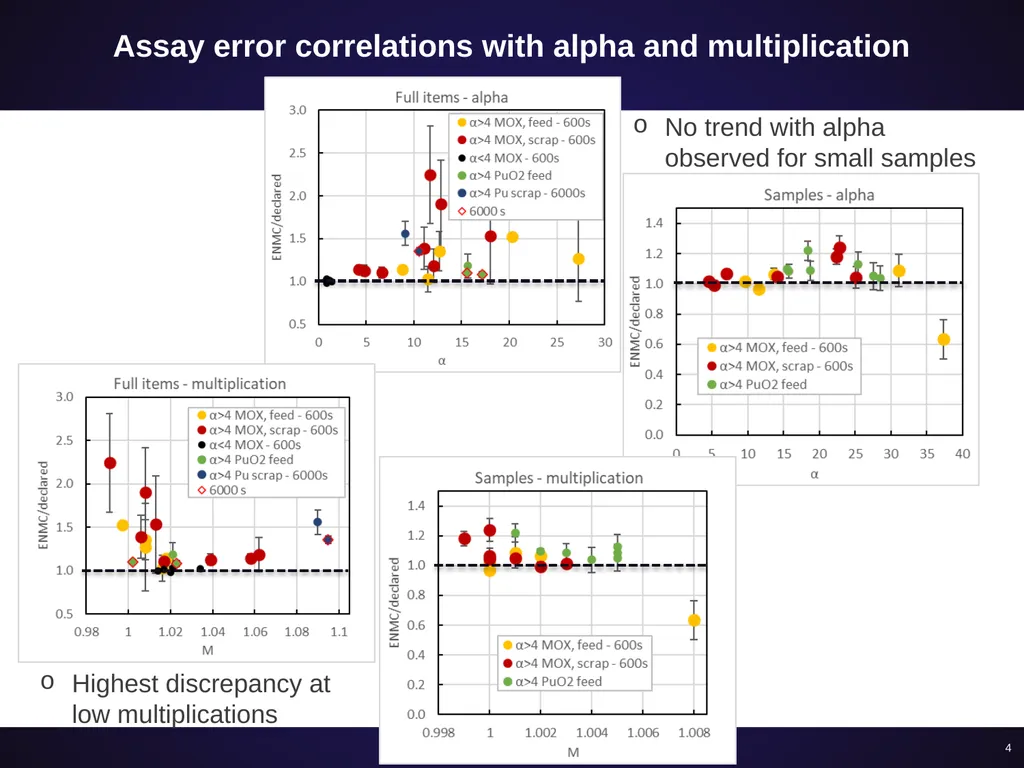
slide4. Assay error correlations with alpha and multiplication No trend with alpha observed for small samples 4 Highest discrepancy at low multiplications<br>
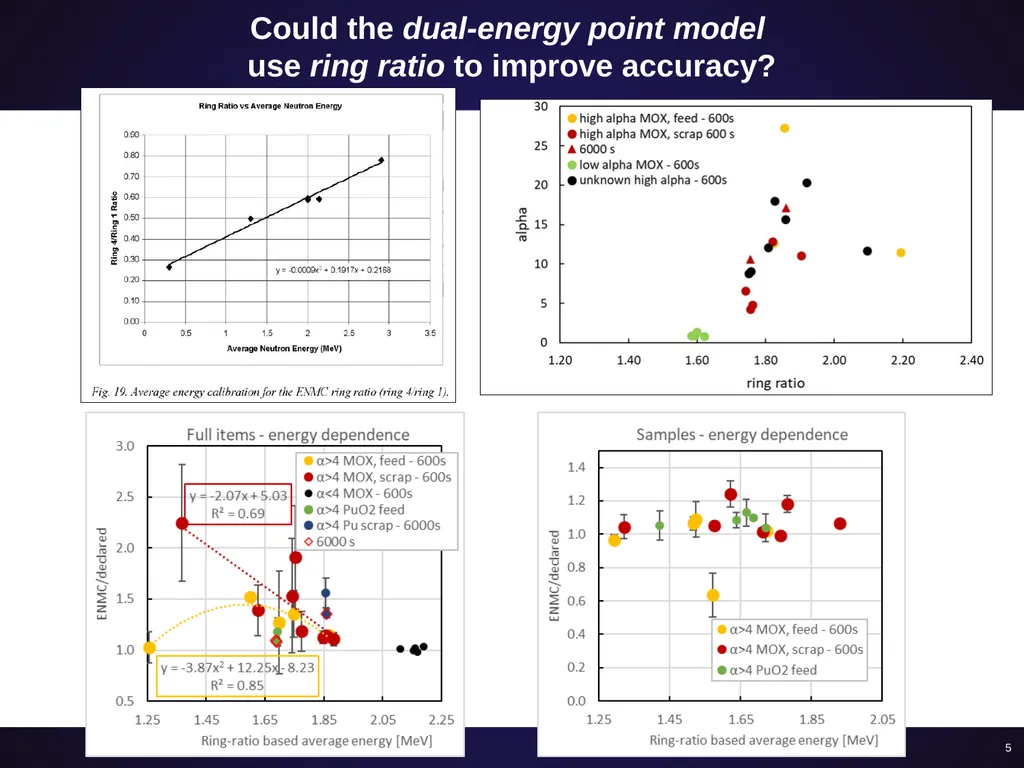
slide5. Could the dual-energy point model use ring ratio to improve accuracy? 5<br>
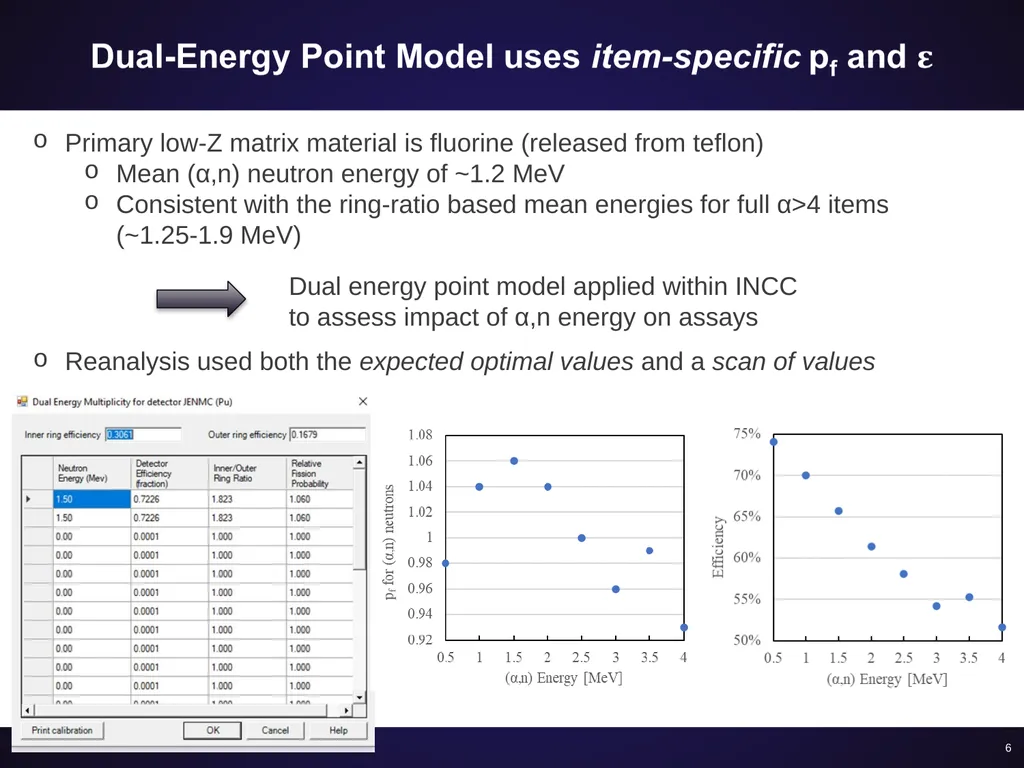
slide6. Primary low-Z matrix material is fluorine (released from teflon)
Mean (α,n) neutron energy of ~1.2 MeV
Consistent with the ring-ratio based mean energies for full α>4 items (~1.25-1.9 MeV) Dual energy point model applied within INCC to assess impact of α,n energy on assays 6 Reanalysis used both the expected optimal values and a scan of values<br>
slide7. Results found dual-energy point model performs no better than standard multiplicity Evaluation performed for three different item types
Parameter scan found greatest improvement using unphysical parameters
Multiplication of 1.5 MeV neutrons and efficiency of 3.5 MeV neutrons
Same parameters improved all evaluated full items (no impact on samples) Need to update parameters in the standard Point Model? (i.e., gate fractions, efficiency) 7 X1 X1<br>
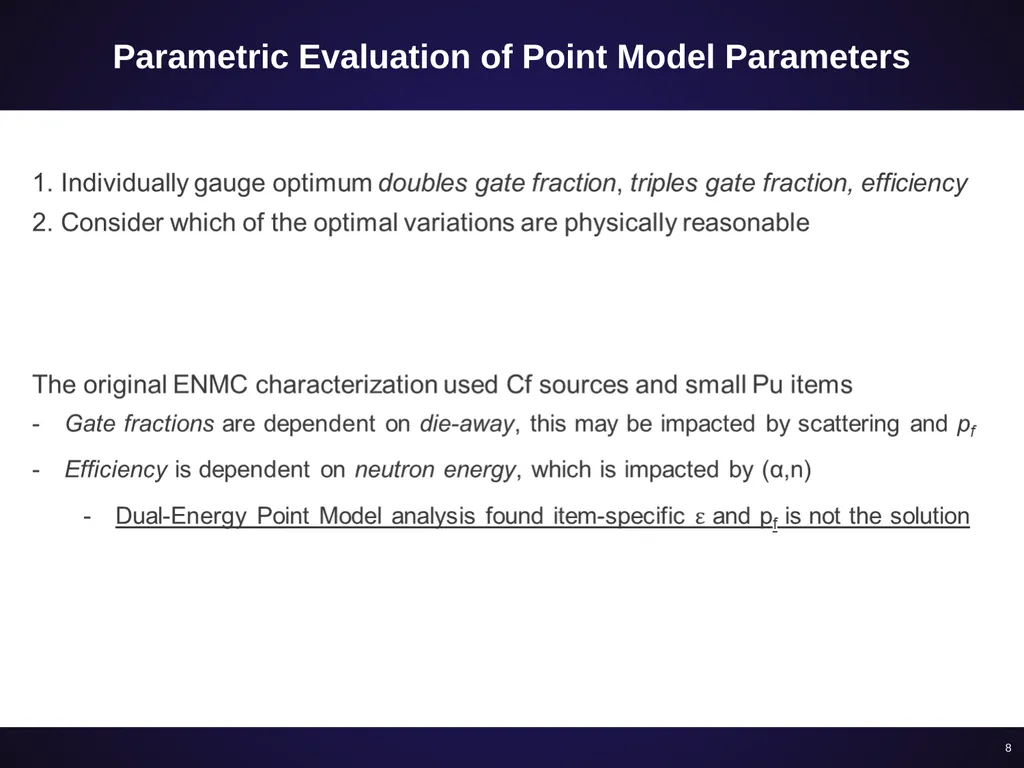
slide8. Parametric Evaluation of Point Model Parameters 8<br>
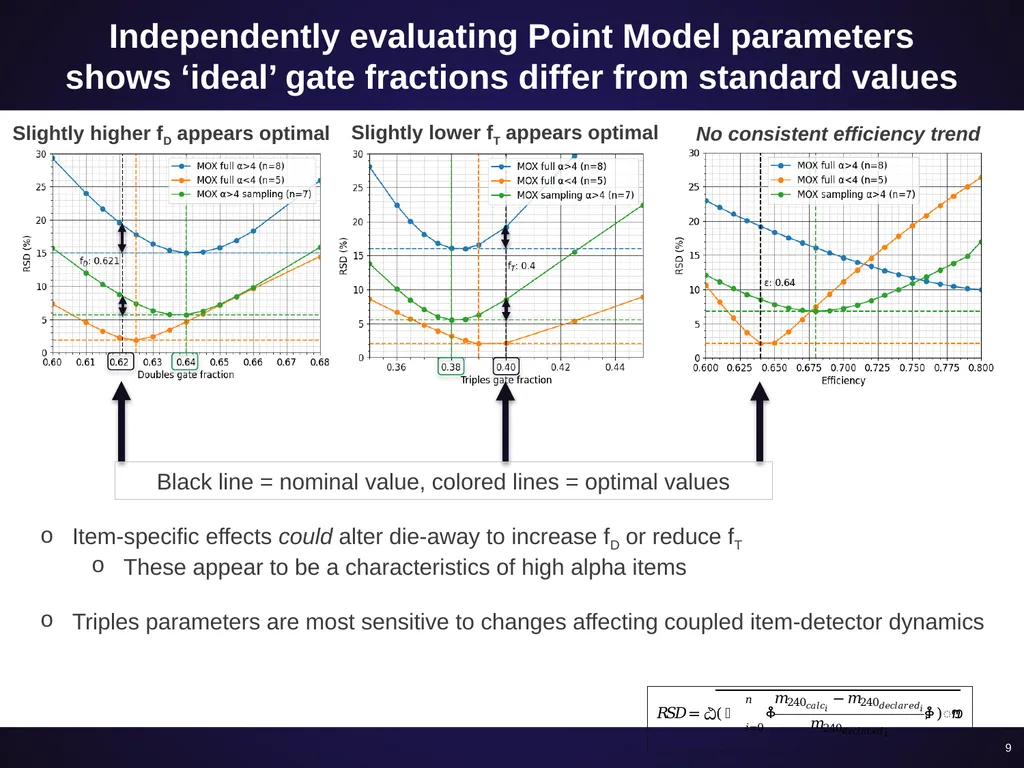
slide9. Independently evaluating Point Model parameters shows ‘ideal’ gate fractions differ from standard values Item-specific effects could alter die-away to increase fD or reduce fT
These appear to be a characteristics of high alpha items
Triples parameters are most sensitive to changes affecting coupled item-detector dynamics Black line = nominal value, colored lines = optimal values Slightly higher fD appears optimal Slightly lower fT appears optimal No consistent efficiency trend 9<br>
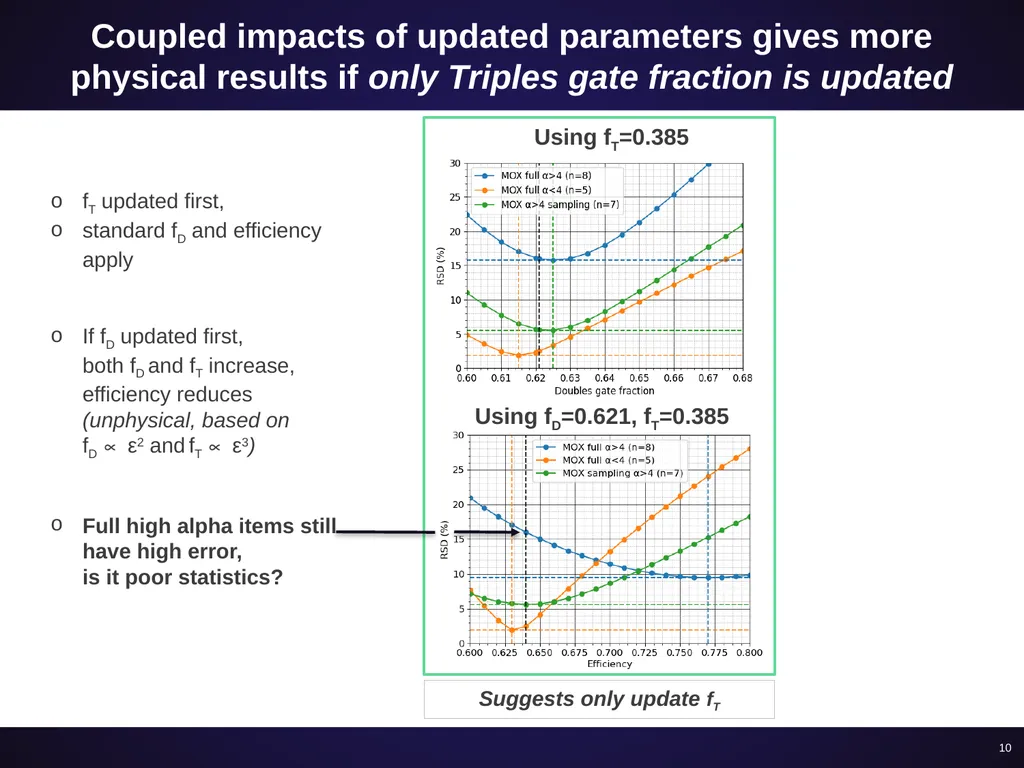
slide10. Coupled impacts of updated parameters gives more physical results if only Triples gate fraction is updated Using fT=0.385 fT updated first,
standard fD and efficiency apply
If fD updated first, both fD and fT increase, efficiency reduces (unphysical, based on fD ∝ ε2 and fT ∝ ε3)
Full high alpha items still have high error, is it poor statistics? Using fD=0.621, fT=0.385 Suggests only update fT 10<br>
slide11. Coupled impacts of updated parameters gives more physical results if only Triples gate fraction is updated Using fT=0.385 Using fD=0.64 Left: fT updated first, standard fD and efficiency apply (may be reasonable)
Right: If fD updated first, both fD and fT increase, efficiency reduces (unphysical, based on fD ∝ ε2 and fT ∝ ε3)
Full high alpha items still have high error, is it poor statistics? Using fD=0.621, fT=0.385 Using fD=0.64, fT=0.4 Current suggested combination 11<br>
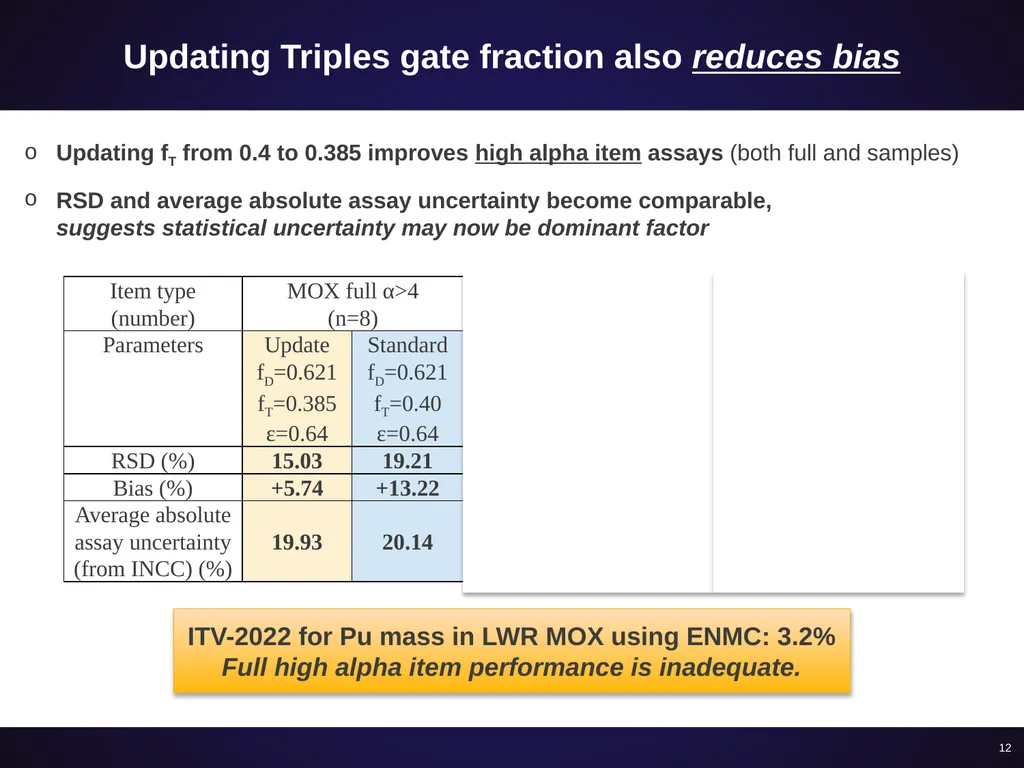
slide12. Updating Triples gate fraction also reduces bias Updating fT from 0.4 to 0.385 improves high alpha item assays (both full and samples)
RSD and average absolute assay uncertainty become comparable, suggests statistical uncertainty may now be dominant factor 12 ITV-2022 for Pu mass in LWR MOX using ENMC: 3.2%
Full high alpha item performance is inadequate.<br>
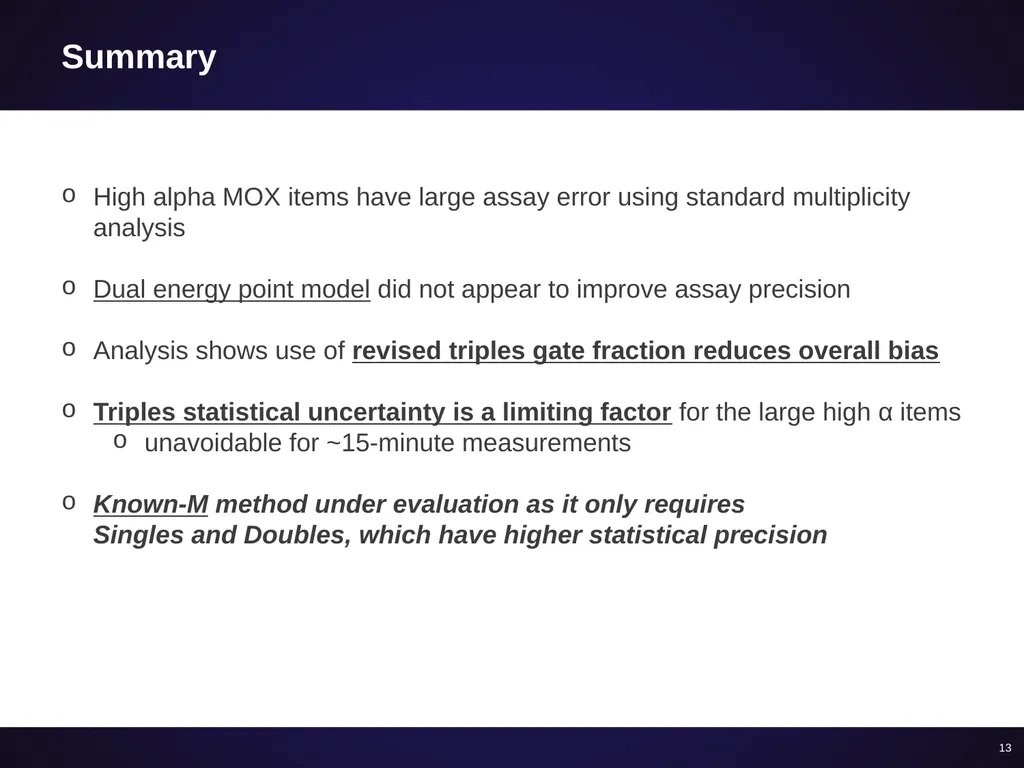
slide13. Summary High alpha MOX items have large assay error using standard multiplicity analysis
Dual energy point model did not appear to improve assay precision
Analysis shows use of revised triples gate fraction reduces overall bias
Triples statistical uncertainty is a limiting factor for the large high α items
unavoidable for ~15-minute measurements
Known-M method under evaluation as it only requires Singles and Doubles, which have higher statistical precision 13<br>
slide14. Full item discrepancies correlate with uncertainty and neutron energy Note that both uncertainty and neutron energy have alpha dependence 14 Explore alternative analysis options focused on (alpha,n)
Dual-energy point model<br>
Los Alamos National Laboratory
Risa Suzuki, Taketeru Nagatani, Toyofumi Okada Japan Atomic Energy Agency<br>
slide2. Context Over 35 years of bilateral Japan-U.S. collaboration on international safeguards has led to numerous advances in instrumentation and analysis
One outcome was the ENMC (Epithermal Neutron Multiplicity Counter)
JAEA uses the ENMC for NDA of large MOX items (~1-100’s g 240Pueff)
High alpha MOX items have large assay error using standard multiplicity analysis
Here we investigate this error and its mitigation 2 Samples (~0.5-700g Pu) within 1, 2, 3L canisters<br>
slide3. Characteristics and categories of fuel materials MOX (homogenous, high α≥4)
Feed (feed material, with fluorine contamination)
Clean scrap (dry recovery process, from equipment inside gloveboxes)
Dirty scrap (wet recovery process)
Dirty scrap (no treatment)
MOX (homogeneous, low α<4)
Feed
Clean scrap (dry recovery process, from equipment inside gloveboxes)
PuO2 feed (feed material, with fluorine contamination)
Items are either full (~50-700 g Pu) or samples (~1 g Pu) taken from full items 3<br>
slide4. Assay error correlations with alpha and multiplication No trend with alpha observed for small samples 4 Highest discrepancy at low multiplications<br>
slide5. Could the dual-energy point model use ring ratio to improve accuracy? 5<br>
slide6. Primary low-Z matrix material is fluorine (released from teflon)
Mean (α,n) neutron energy of ~1.2 MeV
Consistent with the ring-ratio based mean energies for full α>4 items (~1.25-1.9 MeV) Dual energy point model applied within INCC to assess impact of α,n energy on assays 6 Reanalysis used both the expected optimal values and a scan of values<br>
slide7. Results found dual-energy point model performs no better than standard multiplicity Evaluation performed for three different item types
Parameter scan found greatest improvement using unphysical parameters
Multiplication of 1.5 MeV neutrons and efficiency of 3.5 MeV neutrons
Same parameters improved all evaluated full items (no impact on samples) Need to update parameters in the standard Point Model? (i.e., gate fractions, efficiency) 7 X1 X1<br>
slide8. Parametric Evaluation of Point Model Parameters 8<br>
slide9. Independently evaluating Point Model parameters shows ‘ideal’ gate fractions differ from standard values Item-specific effects could alter die-away to increase fD or reduce fT
These appear to be a characteristics of high alpha items
Triples parameters are most sensitive to changes affecting coupled item-detector dynamics Black line = nominal value, colored lines = optimal values Slightly higher fD appears optimal Slightly lower fT appears optimal No consistent efficiency trend 9<br>
slide10. Coupled impacts of updated parameters gives more physical results if only Triples gate fraction is updated Using fT=0.385 fT updated first,
standard fD and efficiency apply
If fD updated first, both fD and fT increase, efficiency reduces (unphysical, based on fD ∝ ε2 and fT ∝ ε3)
Full high alpha items still have high error, is it poor statistics? Using fD=0.621, fT=0.385 Suggests only update fT 10<br>
slide11. Coupled impacts of updated parameters gives more physical results if only Triples gate fraction is updated Using fT=0.385 Using fD=0.64 Left: fT updated first, standard fD and efficiency apply (may be reasonable)
Right: If fD updated first, both fD and fT increase, efficiency reduces (unphysical, based on fD ∝ ε2 and fT ∝ ε3)
Full high alpha items still have high error, is it poor statistics? Using fD=0.621, fT=0.385 Using fD=0.64, fT=0.4 Current suggested combination 11<br>
slide12. Updating Triples gate fraction also reduces bias Updating fT from 0.4 to 0.385 improves high alpha item assays (both full and samples)
RSD and average absolute assay uncertainty become comparable, suggests statistical uncertainty may now be dominant factor 12 ITV-2022 for Pu mass in LWR MOX using ENMC: 3.2%
Full high alpha item performance is inadequate.<br>
slide13. Summary High alpha MOX items have large assay error using standard multiplicity analysis
Dual energy point model did not appear to improve assay precision
Analysis shows use of revised triples gate fraction reduces overall bias
Triples statistical uncertainty is a limiting factor for the large high α items
unavoidable for ~15-minute measurements
Known-M method under evaluation as it only requires Singles and Doubles, which have higher statistical precision 13<br>
slide14. Full item discrepancies correlate with uncertainty and neutron energy Note that both uncertainty and neutron energy have alpha dependence 14 Explore alternative analysis options focused on (alpha,n)
Dual-energy point model<br>