
Evaluation and Management of Hyperkalemia This
KB
Published · 35 slides · 0 views

1 / 1
Description
Evaluation and Management of Hyperkalemia This presentation was funded by and created in collaboration with Relypsa Agenda Pathogenesis of Hyperkalemia Evaluation of Hyperkalemia Hyperkalemia Management Learning Objectives Describe the
Related Topics
Share
Embed code
Download this presentation From Below
"Evaluation and Management of Hyperkalemia This" is the property of its rightful owner. Permission is granted to download and print the materials on this website for personal, non-commercial use only, and to display it on your personal computer provided you do not modify the materials and that you retain all copyright notices contained in the materials. By downloading content from our website, you accept the terms of this agreement.
Presentation Transcript
01
Evaluation and Management of Hyperkalemia This presentation was funded by and created in collaboration with Relypsa<br>
02
Agenda Pathogenesis of Hyperkalemia
Evaluation of Hyperkalemia
Hyperkalemia Management<br>
Evaluation of Hyperkalemia
Hyperkalemia Management<br>
03
Learning Objectives Describe the pathophysiology of hyperkalemia
Understand hyperkalemia-associated risk factors, including kidney disease
Discuss evaluation and methods of testing for hyperkalemia
Discuss treatment strategies in kidney disease patients with hyperkalemia<br>
Understand hyperkalemia-associated risk factors, including kidney disease
Discuss evaluation and methods of testing for hyperkalemia
Discuss treatment strategies in kidney disease patients with hyperkalemia<br>
04
Pathogenesis of Hyperkalemia<br>
05
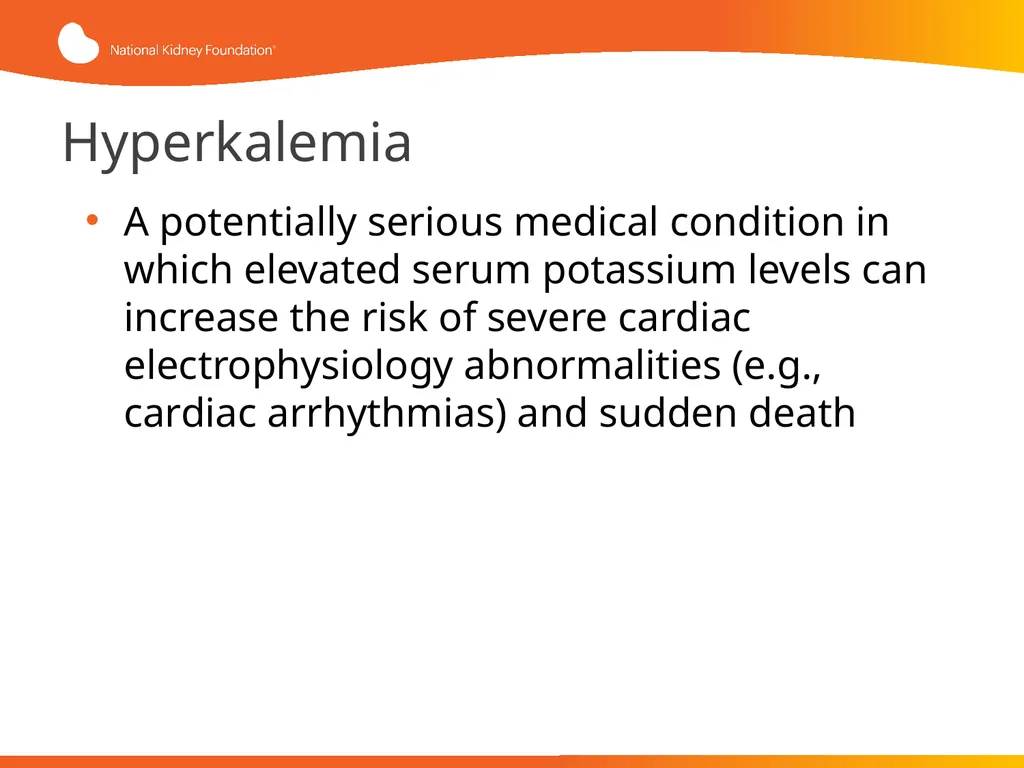
Hyperkalemia A potentially serious medical condition in which elevated serum potassium levels can increase the risk of severe cardiac electrophysiology abnormalities (e.g., cardiac arrhythmias) and sudden death<br>
06
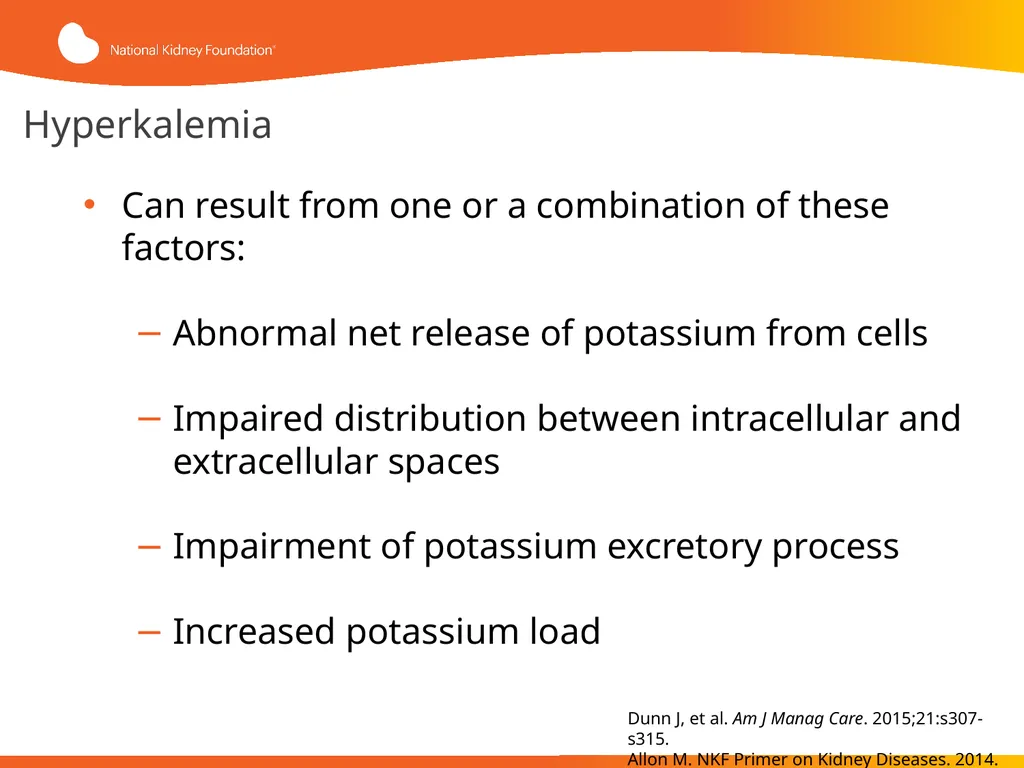
Hyperkalemia Dunn J, et al. Am J Manag Care. 2015;21:s307-s315.
Allon M. NKF Primer on Kidney Diseases. 2014. Can result from one or a combination of these factors:
Abnormal net release of potassium from cells
Impaired distribution between intracellular and extracellular spaces
Impairment of potassium excretory process
Increased potassium load<br>
Allon M. NKF Primer on Kidney Diseases. 2014. Can result from one or a combination of these factors:
Abnormal net release of potassium from cells
Impaired distribution between intracellular and extracellular spaces
Impairment of potassium excretory process
Increased potassium load<br>
07
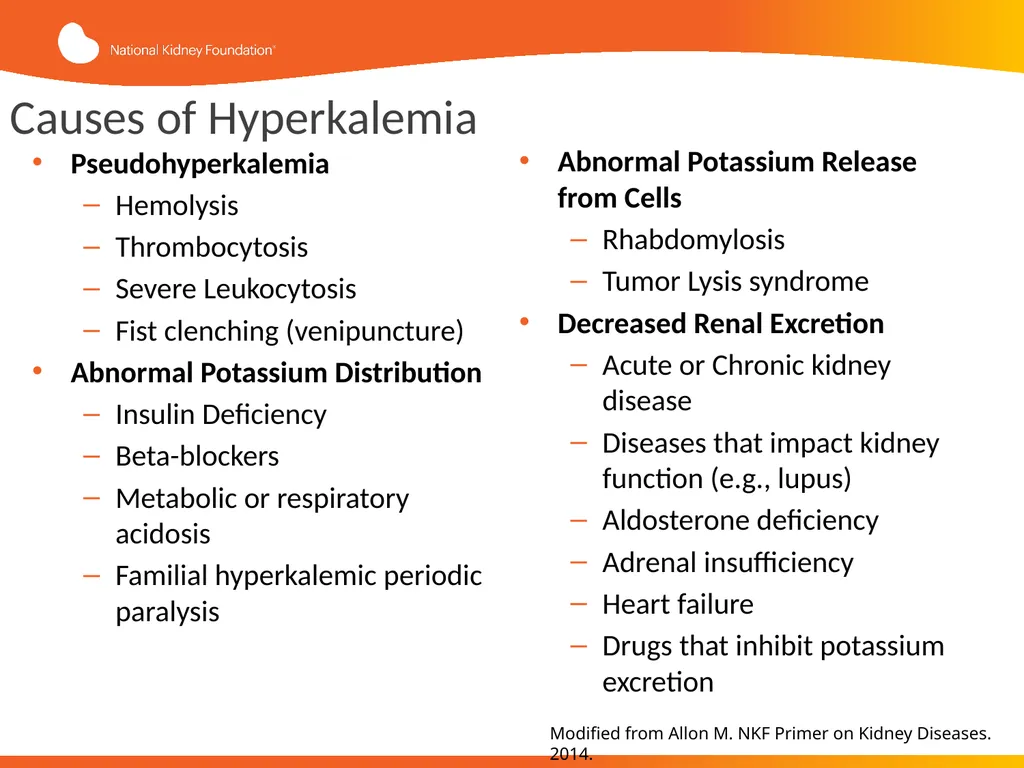
Causes of Hyperkalemia Pseudohyperkalemia
Hemolysis
Thrombocytosis
Severe Leukocytosis
Fist clenching (venipuncture)
Abnormal Potassium Distribution
Insulin Deficiency
Beta-blockers
Metabolic or respiratory acidosis
Familial hyperkalemic periodic paralysis Abnormal Potassium Release from Cells
Rhabdomylosis
Tumor Lysis syndrome
Decreased Renal Excretion
Acute or Chronic kidney disease
Diseases that impact kidney function (e.g., lupus)
Aldosterone deficiency
Adrenal insufficiency
Heart failure
Drugs that inhibit potassium excretion Modified from Allon M. NKF Primer on Kidney Diseases. 2014.<br>
08
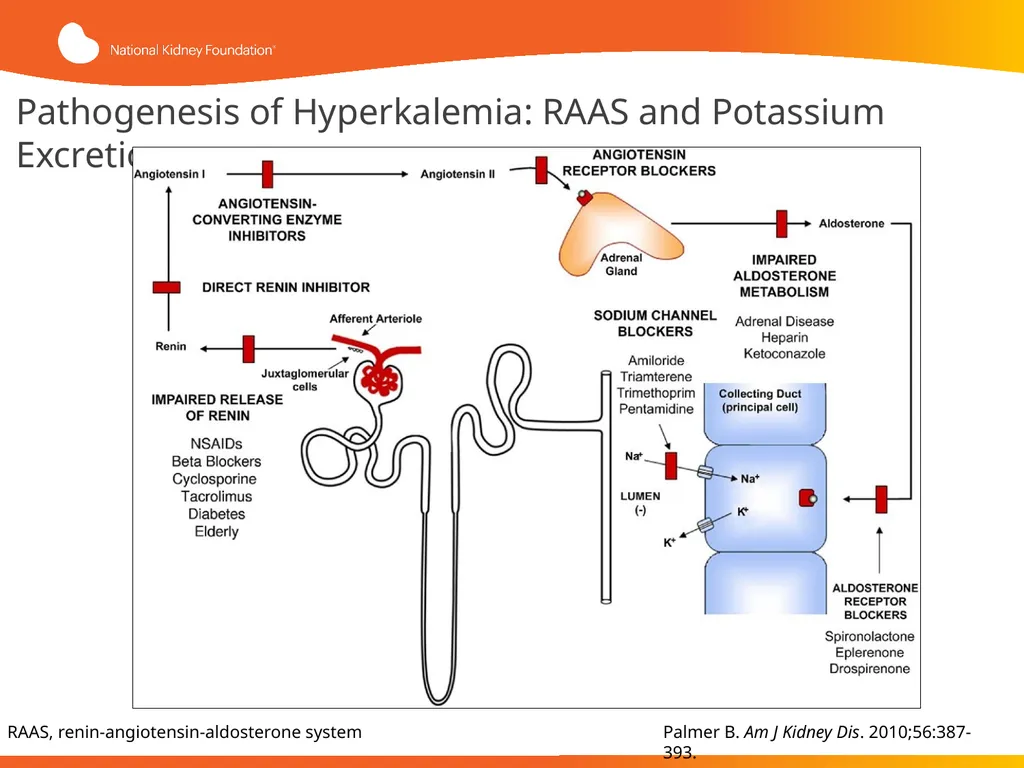
Pathogenesis of Hyperkalemia: RAAS and Potassium Excretion RAAS, renin-angiotensin-aldosterone system Palmer B. Am J Kidney Dis. 2010;56:387-393.<br>
09
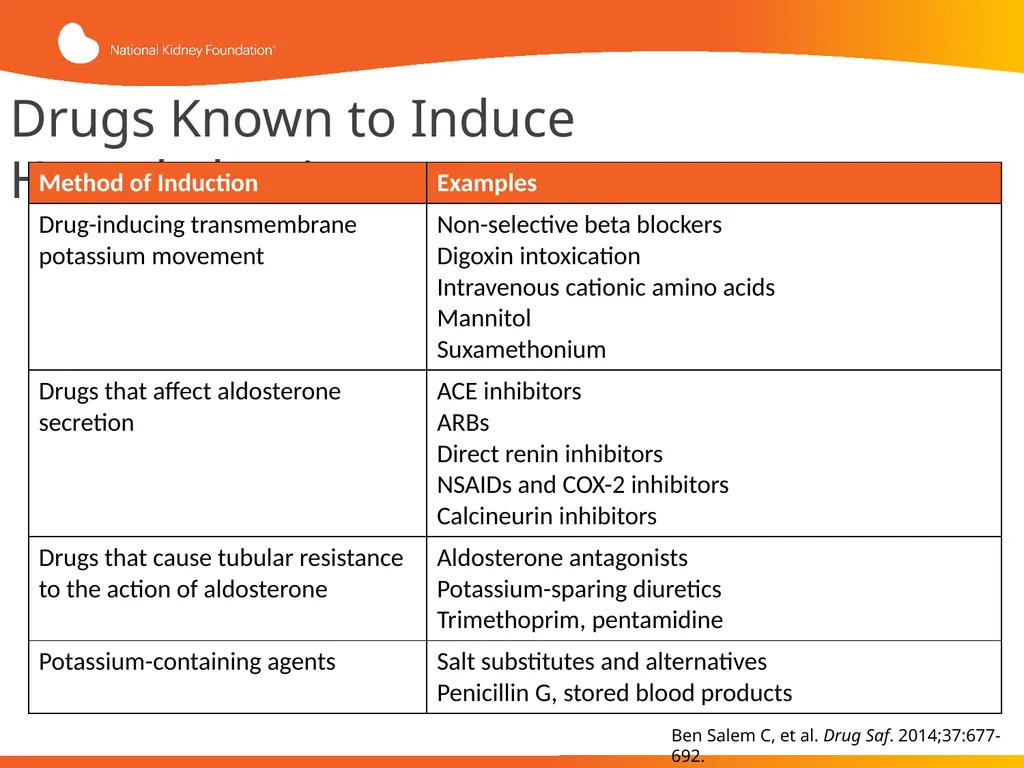
Drugs Known to Induce Hyperkalemia Ben Salem C, et al. Drug Saf. 2014;37:677-692.<br>
10
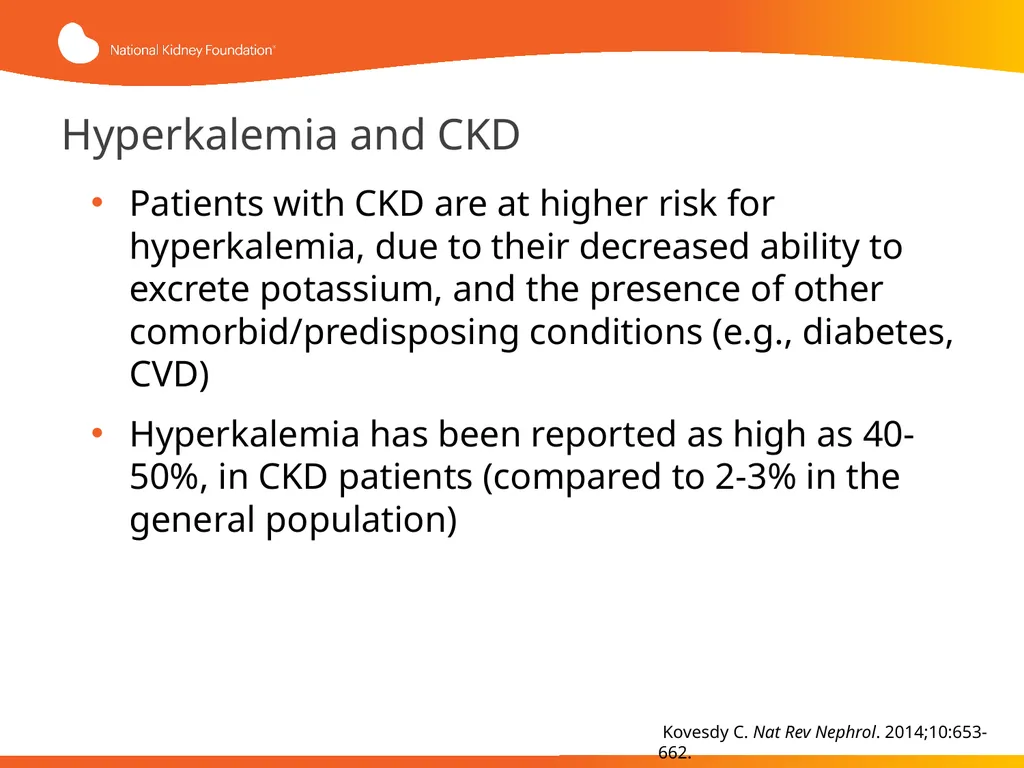
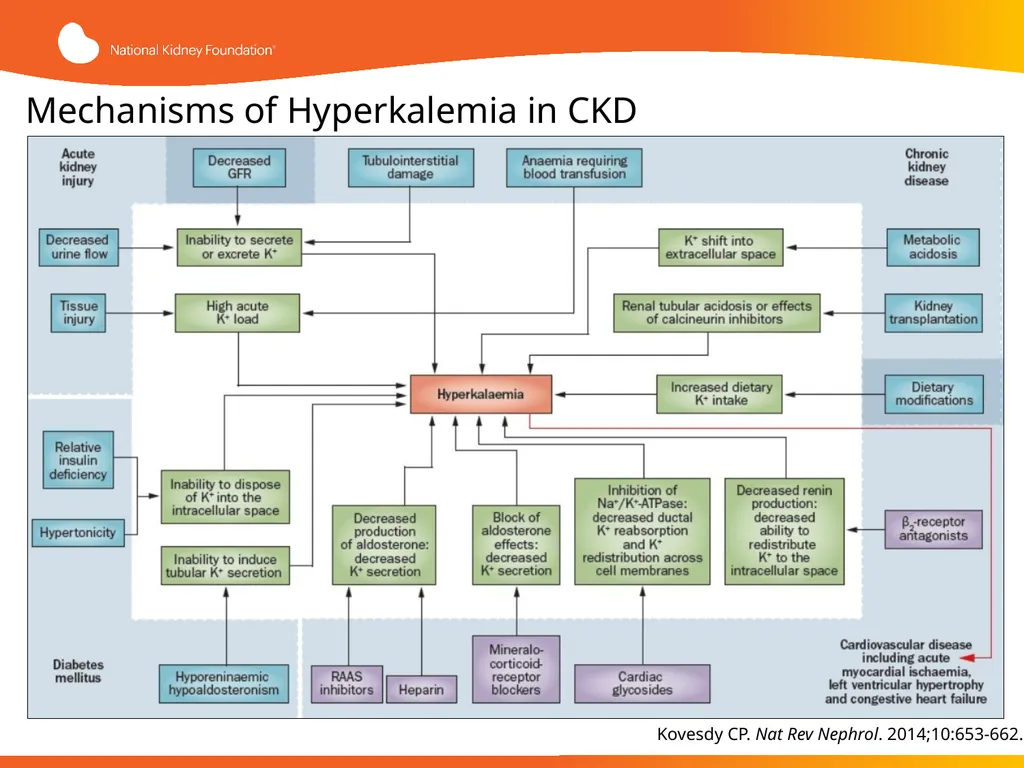
Hyperkalemia and CKD Patients with CKD are at higher risk for hyperkalemia, due to their decreased ability to excrete potassium, and the presence of other comorbid/predisposing conditions (e.g., diabetes, CVD)
Hyperkalemia has been reported as high as 40-50%, in CKD patients (compared to 2-3% in the general population) Kovesdy C. Nat Rev Nephrol. 2014;10:653-662.<br>
Hyperkalemia has been reported as high as 40-50%, in CKD patients (compared to 2-3% in the general population) Kovesdy C. Nat Rev Nephrol. 2014;10:653-662.<br>
11
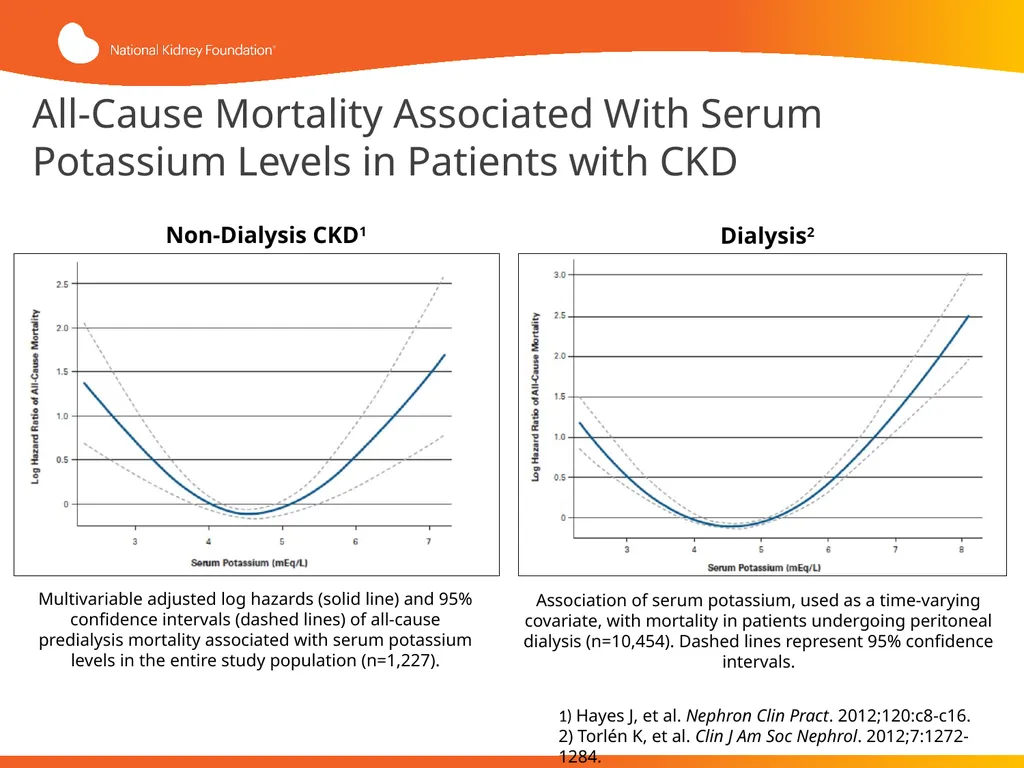
All-Cause Mortality Associated With Serum Potassium Levels in Patients with CKD Non-Dialysis CKD1 Dialysis2 Multivariable adjusted log hazards (solid line) and 95% confidence intervals (dashed lines) of all-cause predialysis mortality associated with serum potassium levels in the entire study population (n=1,227). Association of serum potassium, used as a time-varying covariate, with mortality in patients undergoing peritoneal dialysis (n=10,454). Dashed lines represent 95% confidence intervals. 1) Hayes J, et al. Nephron Clin Pract. 2012;120:c8-c16.
2) Torlén K, et al. Clin J Am Soc Nephrol. 2012;7:1272-1284.<br>
2) Torlén K, et al. Clin J Am Soc Nephrol. 2012;7:1272-1284.<br>
12
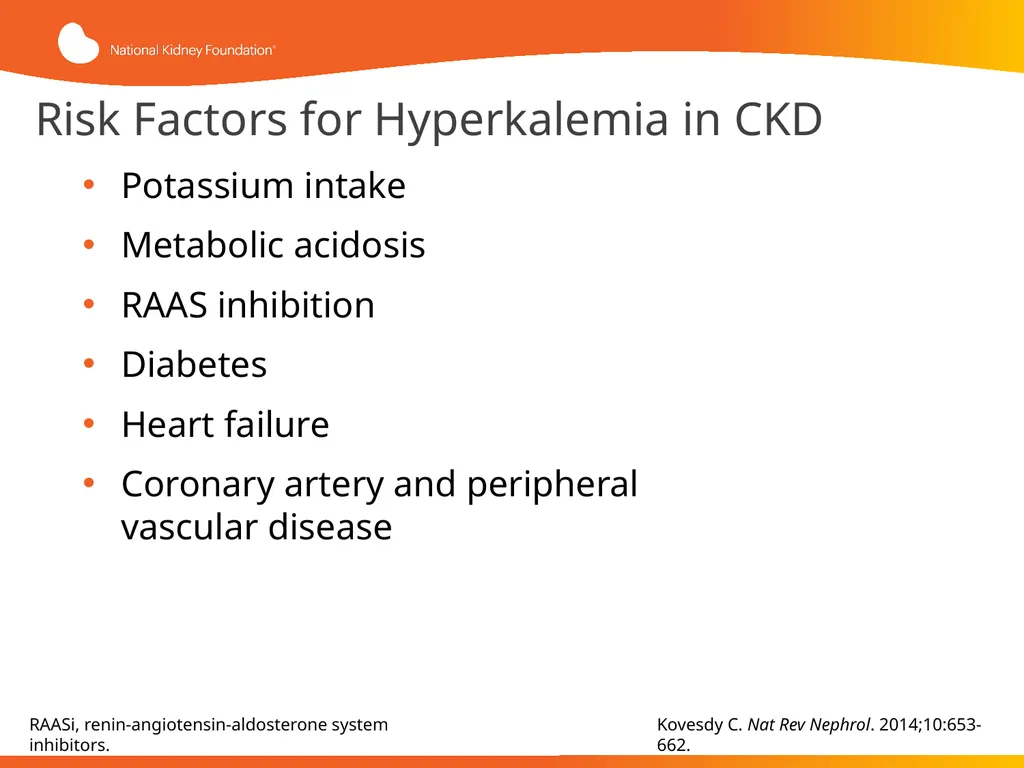
Risk Factors for Hyperkalemia in CKD Kovesdy C. Nat Rev Nephrol. 2014;10:653-662. RAASi, renin-angiotensin-aldosterone system inhibitors. Potassium intake
Metabolic acidosis
RAAS inhibition
Diabetes
Heart failure
Coronary artery and peripheral vascular disease<br>
Metabolic acidosis
RAAS inhibition
Diabetes
Heart failure
Coronary artery and peripheral vascular disease<br>
13
Mechanisms of Hyperkalemia in CKD Kovesdy CP. Nat Rev Nephrol. 2014;10:653-662.<br>
14
Evaluation of Hyperkalemia<br>
15
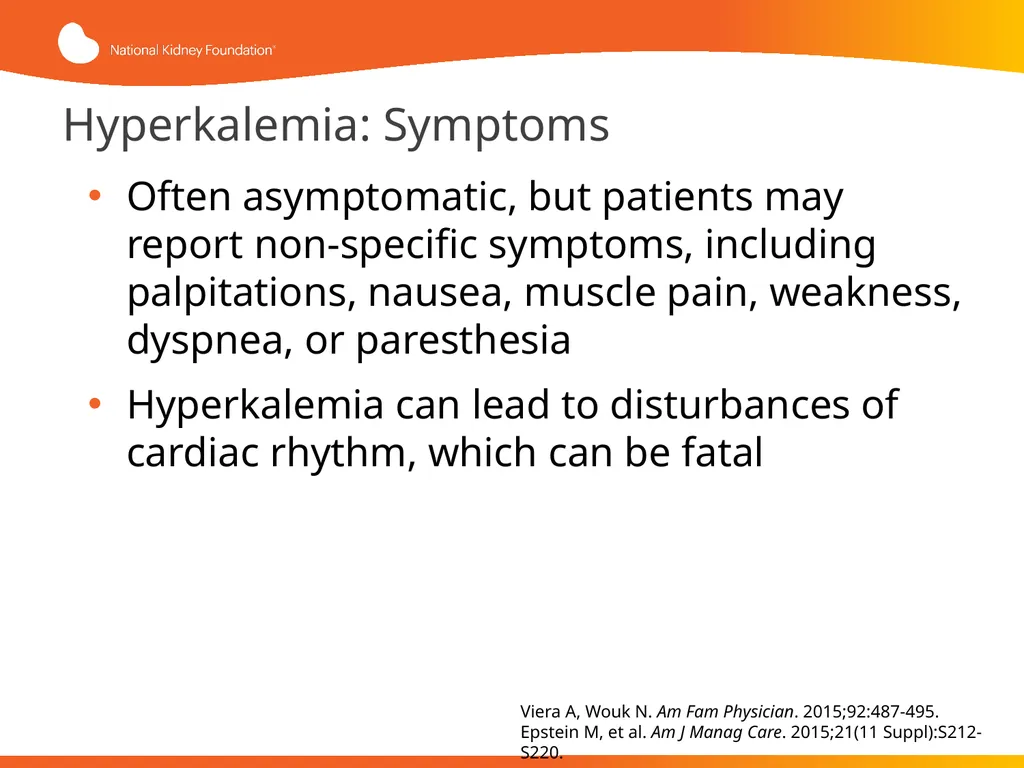
Often asymptomatic, but patients may report non-specific symptoms, including palpitations, nausea, muscle pain, weakness, dyspnea, or paresthesia
Hyperkalemia can lead to disturbances of cardiac rhythm, which can be fatal Hyperkalemia: Symptoms Viera A, Wouk N. Am Fam Physician. 2015;92:487-495.
Epstein M, et al. Am J Manag Care. 2015;21(11 Suppl):S212-S220.<br>
Hyperkalemia can lead to disturbances of cardiac rhythm, which can be fatal Hyperkalemia: Symptoms Viera A, Wouk N. Am Fam Physician. 2015;92:487-495.
Epstein M, et al. Am J Manag Care. 2015;21(11 Suppl):S212-S220.<br>
16
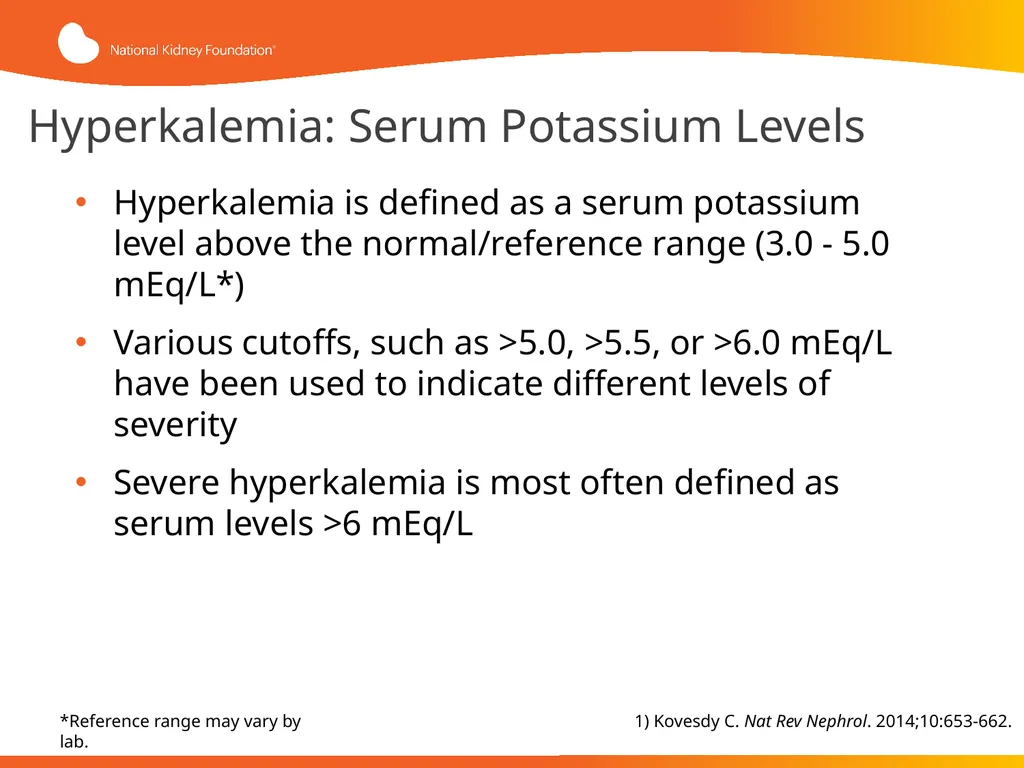
Hyperkalemia: Serum Potassium Levels Hyperkalemia is defined as a serum potassium level above the normal/reference range (3.0 - 5.0 mEq/L*)
Various cutoffs, such as >5.0, >5.5, or >6.0 mEq/L have been used to indicate different levels of severity
Severe hyperkalemia is most often defined as serum levels >6 mEq/L 1) Kovesdy C. Nat Rev Nephrol. 2014;10:653-662. *Reference range may vary by lab.<br>
Various cutoffs, such as >5.0, >5.5, or >6.0 mEq/L have been used to indicate different levels of severity
Severe hyperkalemia is most often defined as serum levels >6 mEq/L 1) Kovesdy C. Nat Rev Nephrol. 2014;10:653-662. *Reference range may vary by lab.<br>
17
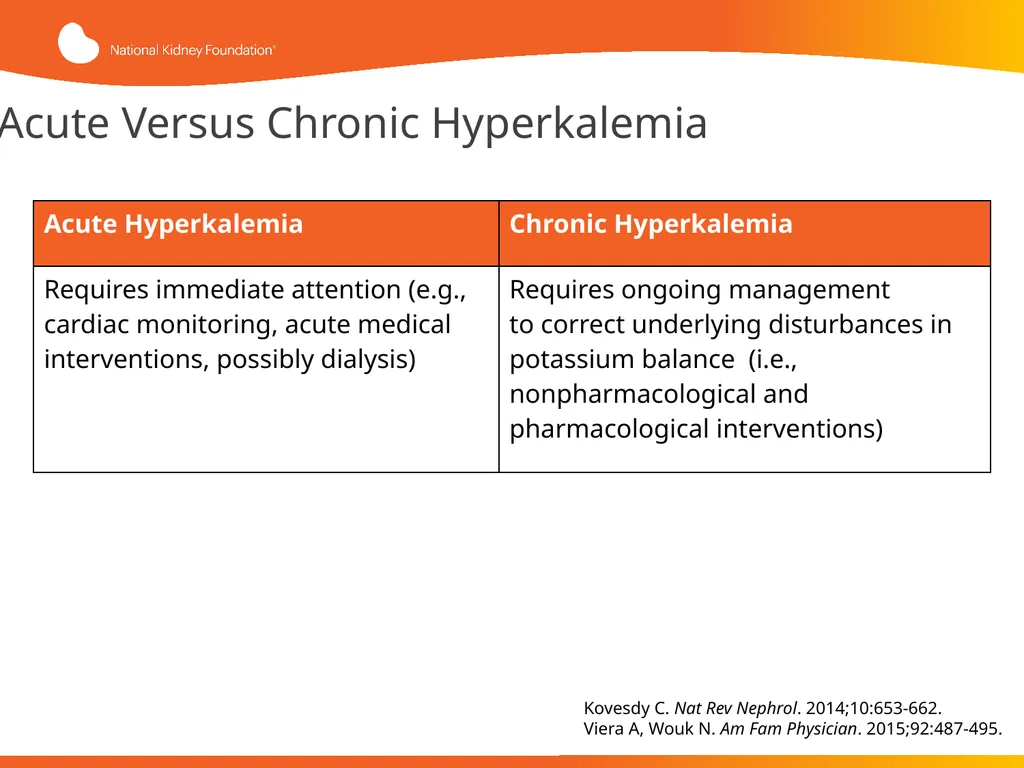
Acute Versus Chronic Hyperkalemia Kovesdy C. Nat Rev Nephrol. 2014;10:653-662.
Viera A, Wouk N. Am Fam Physician. 2015;92:487-495.<br>
Viera A, Wouk N. Am Fam Physician. 2015;92:487-495.<br>
18
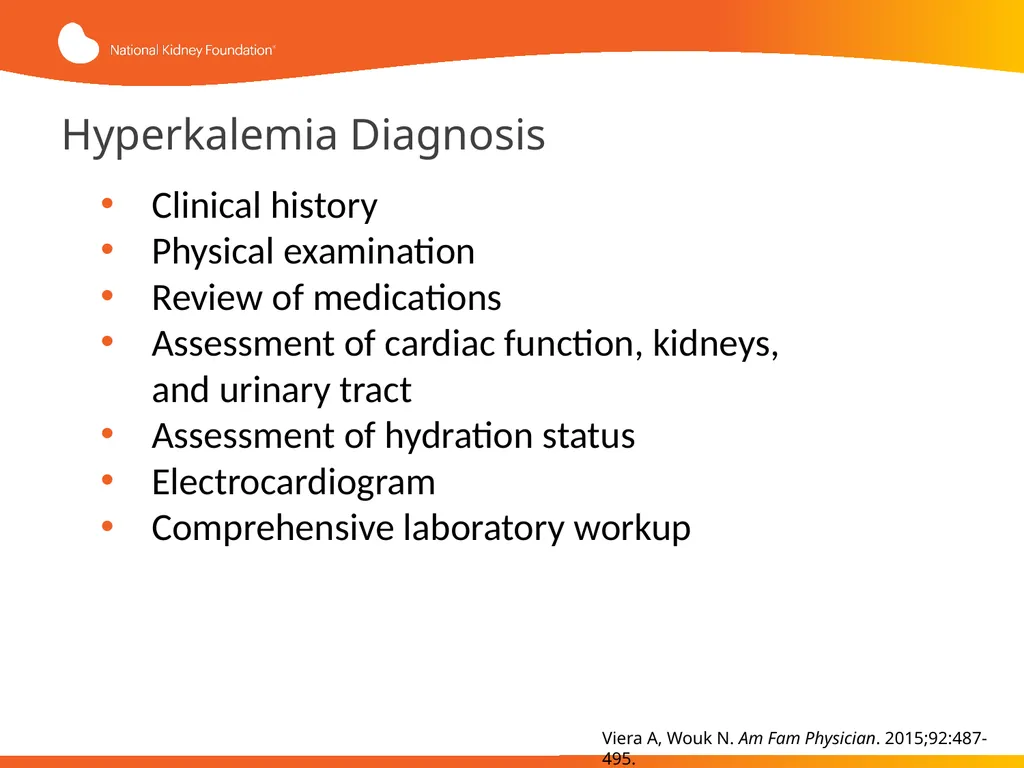
Hyperkalemia Diagnosis Clinical history
Physical examination
Review of medications
Assessment of cardiac function, kidneys, and urinary tract
Assessment of hydration status
Electrocardiogram
Comprehensive laboratory workup Viera A, Wouk N. Am Fam Physician. 2015;92:487-495.<br>
Physical examination
Review of medications
Assessment of cardiac function, kidneys, and urinary tract
Assessment of hydration status
Electrocardiogram
Comprehensive laboratory workup Viera A, Wouk N. Am Fam Physician. 2015;92:487-495.<br>
19
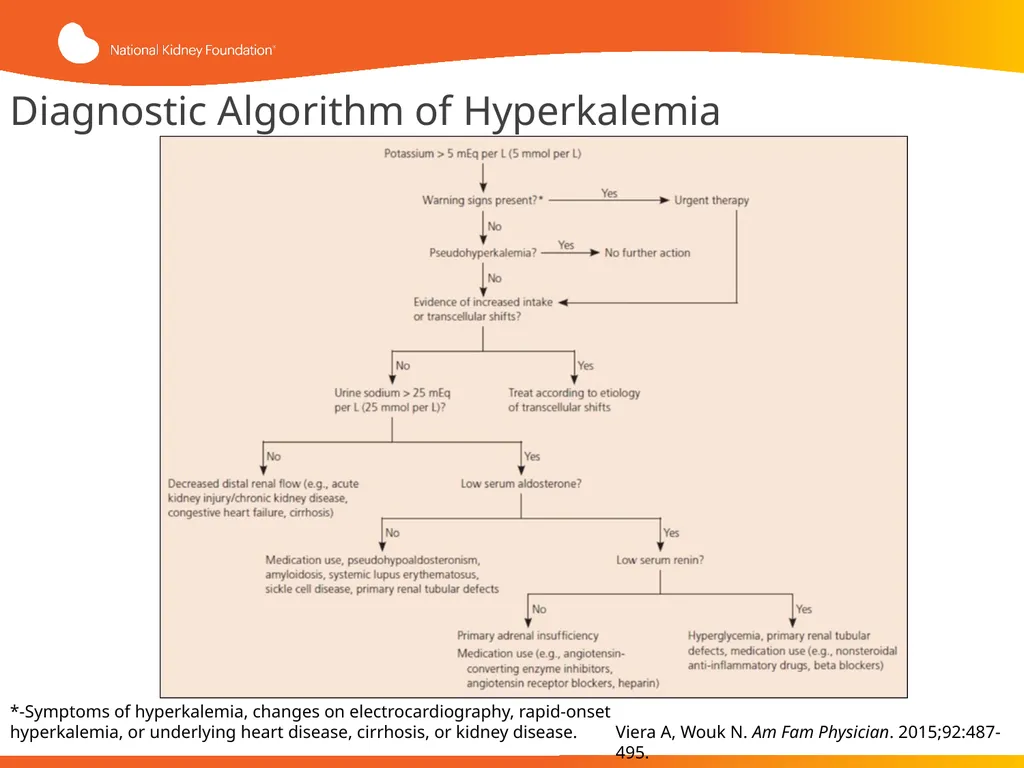
*-Symptoms of hyperkalemia, changes on electrocardiography, rapid-onset hyperkalemia, or underlying heart disease, cirrhosis, or kidney disease. Diagnostic Algorithm of Hyperkalemia Viera A, Wouk N. Am Fam Physician. 2015;92:487-495.<br>
20
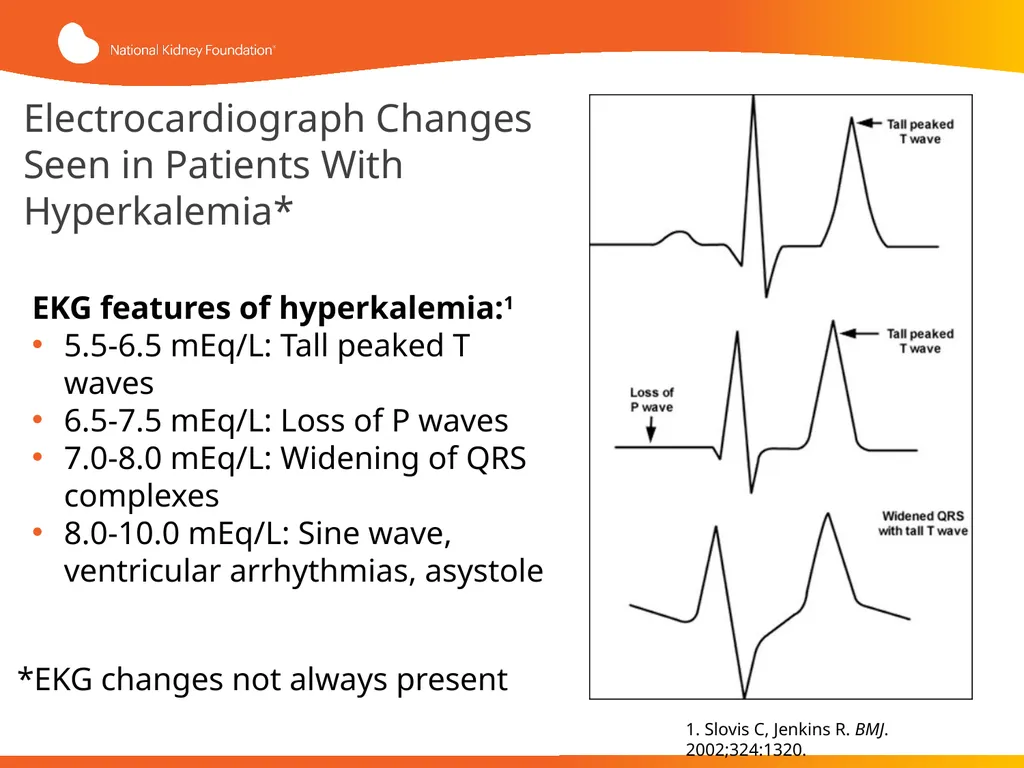
Electrocardiograph Changes Seen in Patients With Hyperkalemia* 1. Slovis C, Jenkins R. BMJ. 2002;324:1320. EKG features of hyperkalemia:1
5.5-6.5 mEq/L: Tall peaked T waves
6.5-7.5 mEq/L: Loss of P waves
7.0-8.0 mEq/L: Widening of QRS complexes
8.0-10.0 mEq/L: Sine wave, ventricular arrhythmias, asystole *EKG changes not always present<br>
5.5-6.5 mEq/L: Tall peaked T waves
6.5-7.5 mEq/L: Loss of P waves
7.0-8.0 mEq/L: Widening of QRS complexes
8.0-10.0 mEq/L: Sine wave, ventricular arrhythmias, asystole *EKG changes not always present<br>
21
Management of Hyperkalemia<br>
22
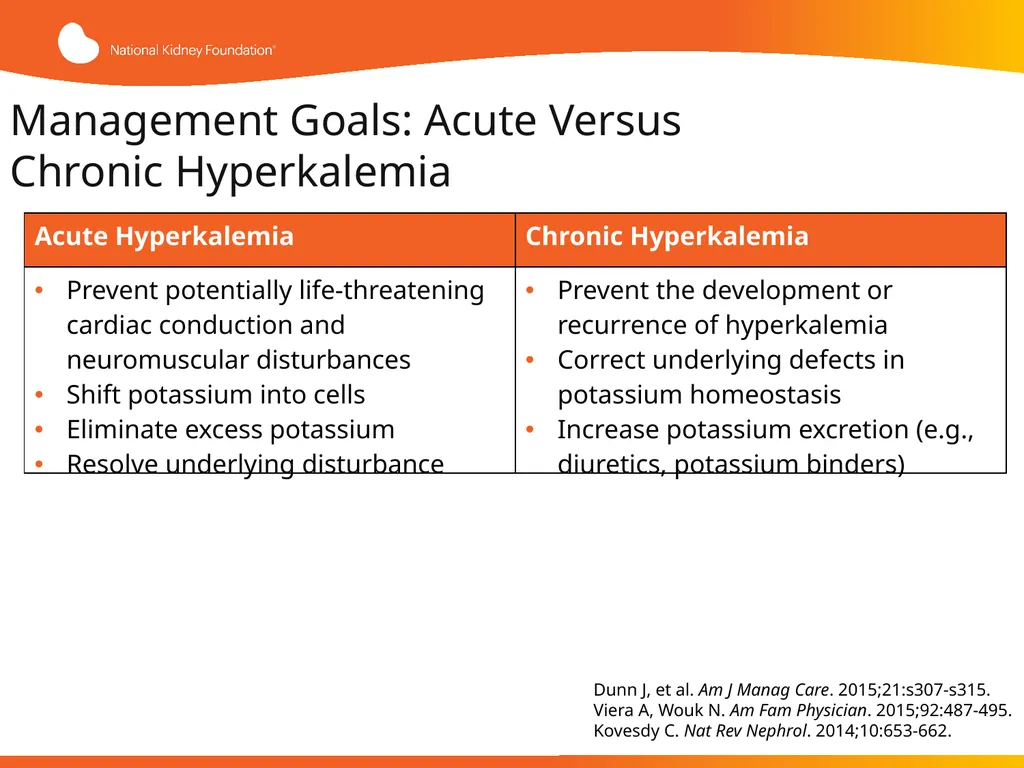
Management Goals: Acute Versus Chronic Hyperkalemia Dunn J, et al. Am J Manag Care. 2015;21:s307-s315.
Viera A, Wouk N. Am Fam Physician. 2015;92:487-495.
Kovesdy C. Nat Rev Nephrol. 2014;10:653-662.<br>
Viera A, Wouk N. Am Fam Physician. 2015;92:487-495.
Kovesdy C. Nat Rev Nephrol. 2014;10:653-662.<br>
23
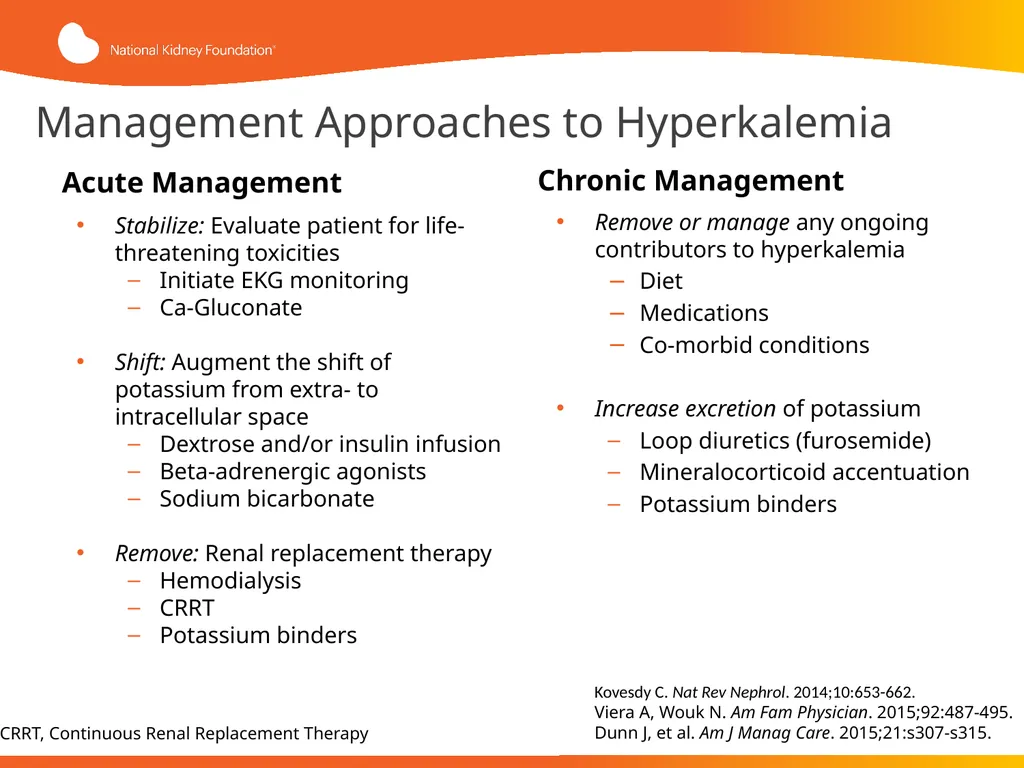
Management Approaches to Hyperkalemia Stabilize: Evaluate patient for life-threatening toxicities
Initiate EKG monitoring
Ca-Gluconate
Shift: Augment the shift of potassium from extra- to intracellular space
Dextrose and/or insulin infusion
Beta-adrenergic agonists
Sodium bicarbonate
Remove: Renal replacement therapy
Hemodialysis
CRRT
Potassium binders Acute Management Remove or manage any ongoing contributors to hyperkalemia
Diet
Medications
Co-morbid conditions
Increase excretion of potassium
Loop diuretics (furosemide)
Mineralocorticoid accentuation
Potassium binders Chronic Management CRRT, Continuous Renal Replacement Therapy Kovesdy C. Nat Rev Nephrol. 2014;10:653-662.
Viera A, Wouk N. Am Fam Physician. 2015;92:487-495.
Dunn J, et al. Am J Manag Care. 2015;21:s307-s315.<br>
24
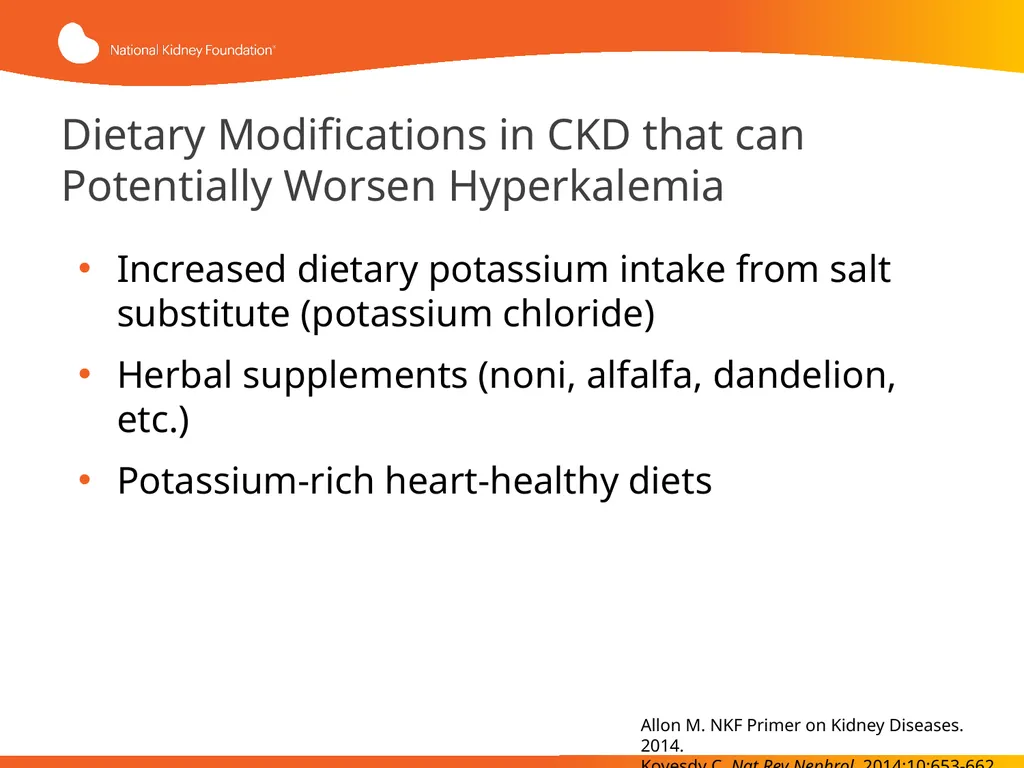
Dietary Modifications in CKD that can Potentially Worsen Hyperkalemia Increased dietary potassium intake from salt substitute (potassium chloride)
Herbal supplements (noni, alfalfa, dandelion, etc.)
Potassium-rich heart-healthy diets Allon M. NKF Primer on Kidney Diseases. 2014.
Kovesdy C. Nat Rev Nephrol. 2014;10:653-662.<br>
Herbal supplements (noni, alfalfa, dandelion, etc.)
Potassium-rich heart-healthy diets Allon M. NKF Primer on Kidney Diseases. 2014.
Kovesdy C. Nat Rev Nephrol. 2014;10:653-662.<br>
25
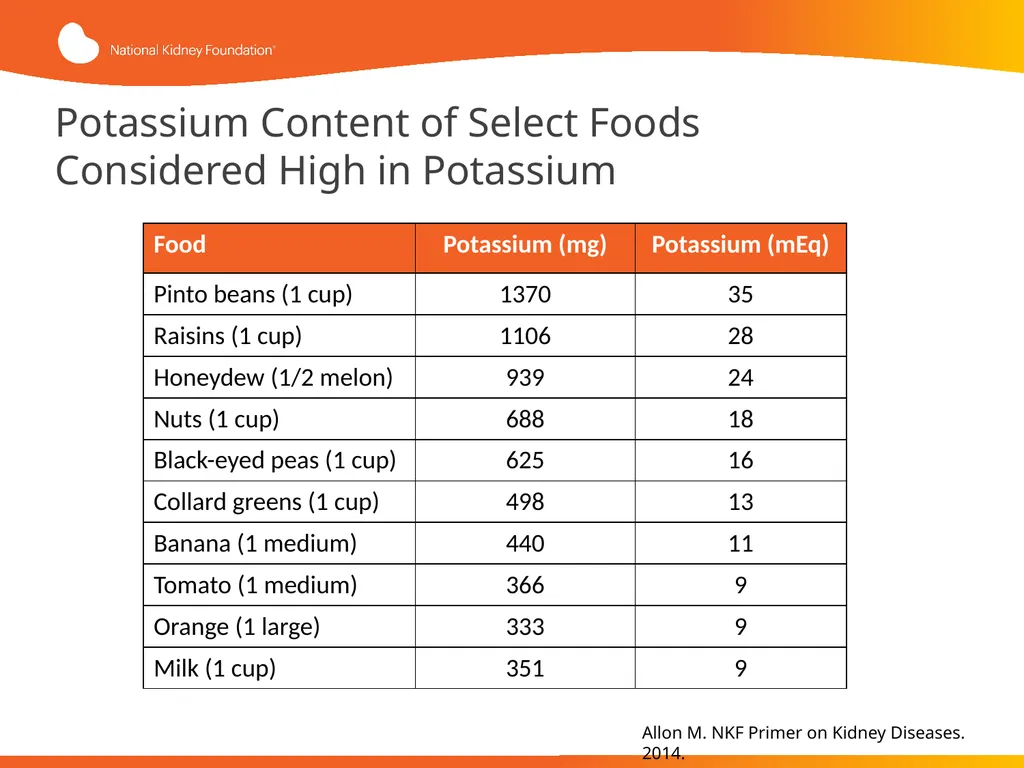
Potassium Content of Select Foods Considered High in Potassium Allon M. NKF Primer on Kidney Diseases. 2014.<br>
26
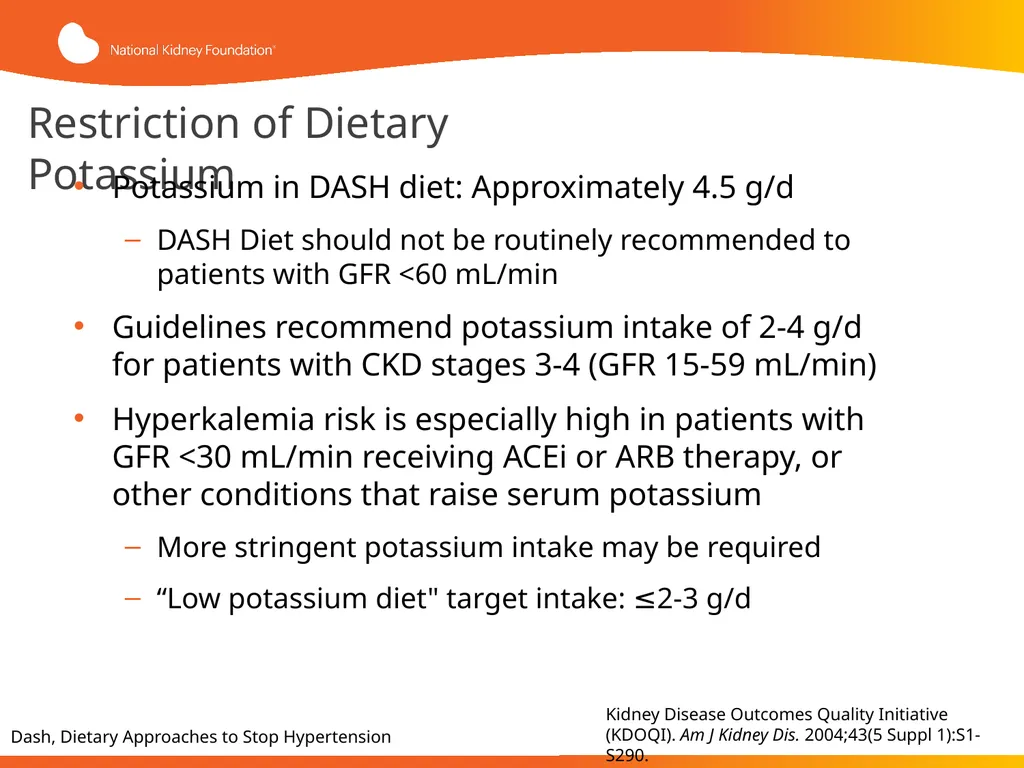
Restriction of Dietary Potassium Potassium in DASH diet: Approximately 4.5 g/d
DASH Diet should not be routinely recommended to patients with GFR <60 mL/min
Guidelines recommend potassium intake of 2-4 g/d for patients with CKD stages 3-4 (GFR 15-59 mL/min)
Hyperkalemia risk is especially high in patients with GFR <30 mL/min receiving ACEi or ARB therapy, or other conditions that raise serum potassium
More stringent potassium intake may be required
“Low potassium diet" target intake: ≤2-3 g/d Kidney Disease Outcomes Quality Initiative (KDOQI). Am J Kidney Dis. 2004;43(5 Suppl 1):S1-S290. Dash, Dietary Approaches to Stop Hypertension<br>
27
Dialysis and Hyperkalemia Kovesdy C. Nat Rev Nephrol. 2014;10:653-662.
Foley R, et al. N Engl J Med. 2011;365:1099-1107.
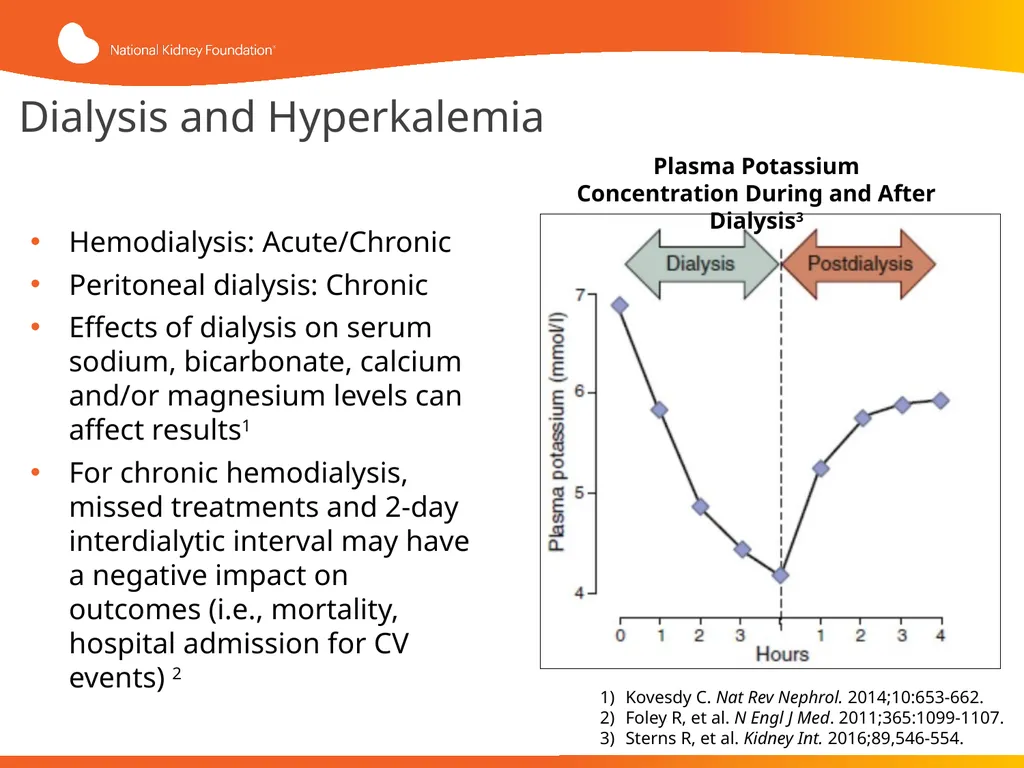
Sterns R, et al. Kidney Int. 2016;89,546-554. Hemodialysis: Acute/Chronic
Peritoneal dialysis: Chronic
Effects of dialysis on serum sodium, bicarbonate, calcium and/or magnesium levels can affect results1
For chronic hemodialysis, missed treatments and 2-day interdialytic interval may have a negative impact on outcomes (i.e., mortality, hospital admission for CV events) 2 Plasma Potassium Concentration During and After Dialysis3<br>
28
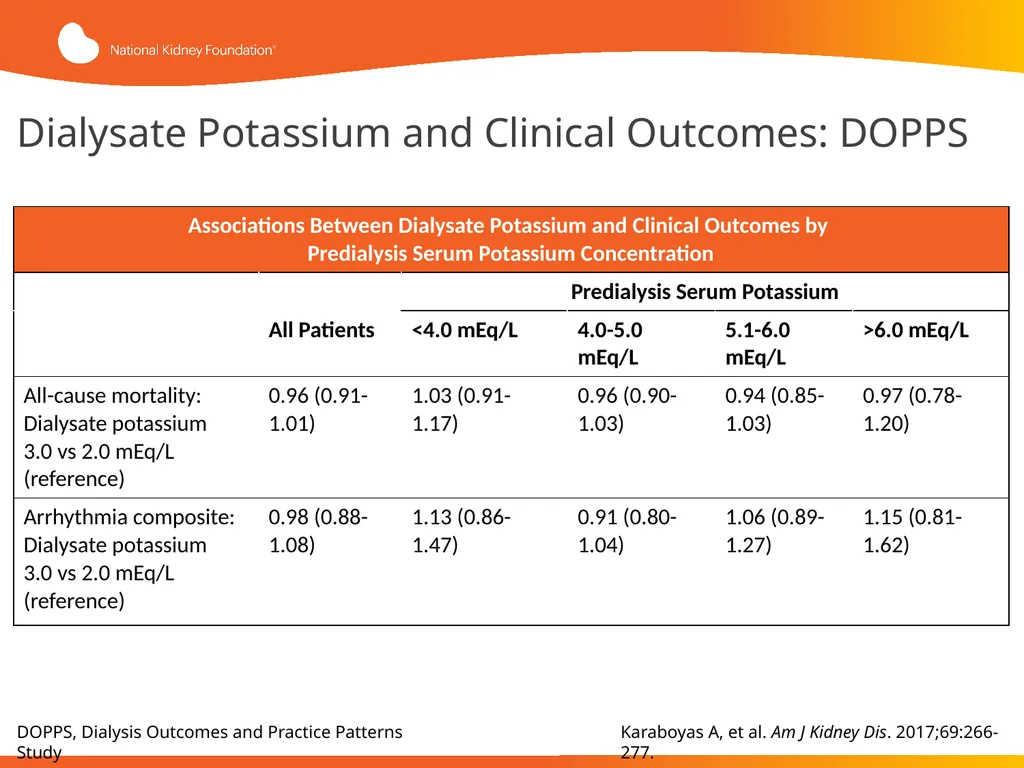
Dialysate Potassium and Clinical Outcomes: DOPPS Karaboyas A, et al. Am J Kidney Dis. 2017;69:266-277. DOPPS, Dialysis Outcomes and Practice Patterns Study<br>
29
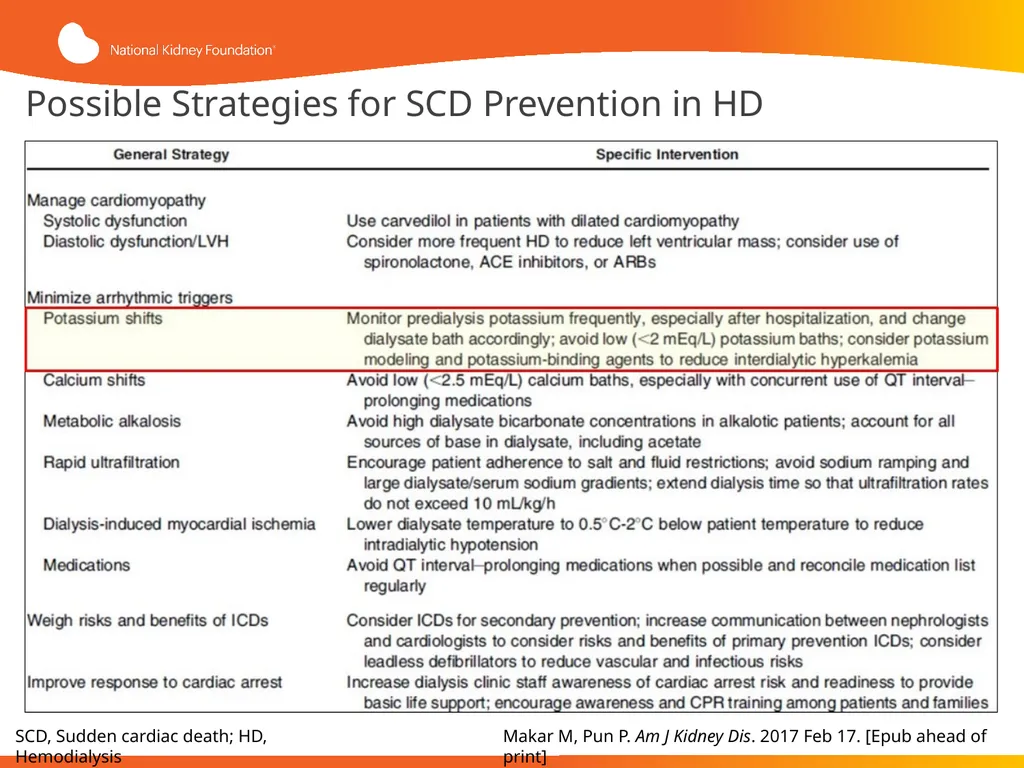
Possible Strategies for SCD Prevention in HD SCD, Sudden cardiac death; HD, Hemodialysis Makar M, Pun P. Am J Kidney Dis. 2017 Feb 17. [Epub ahead of print]<br>
30
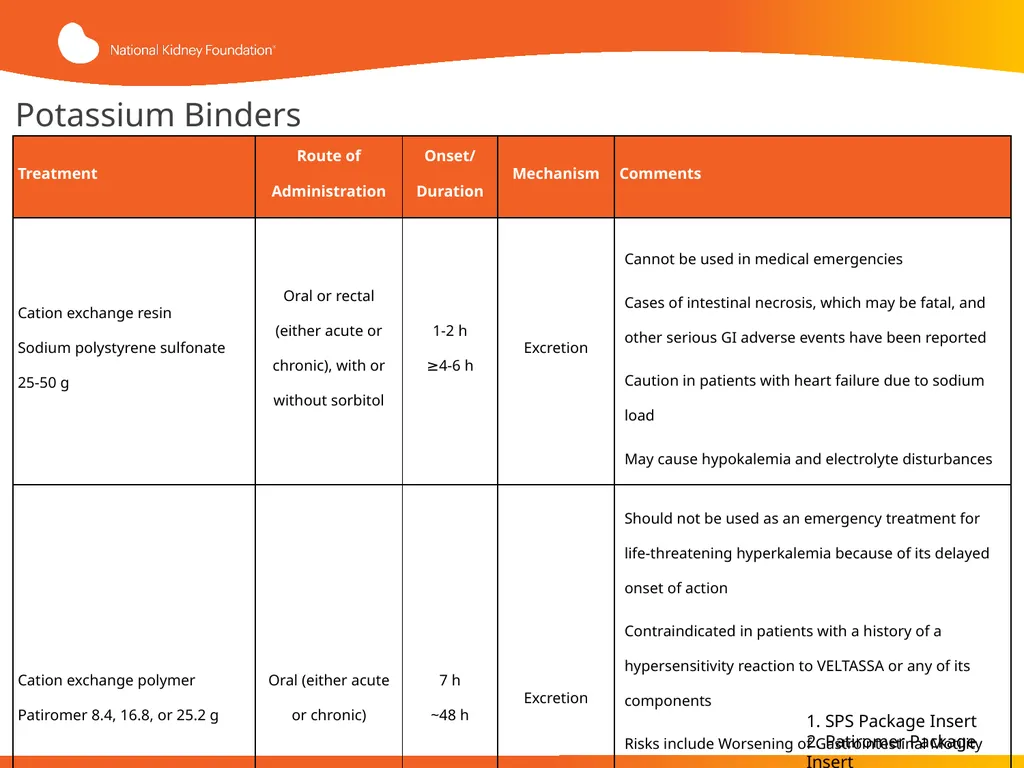
Potassium Binders 1. SPS Package Insert
2. Patiromer Package Insert<br>
2. Patiromer Package Insert<br>
31
Considerations for RAAS Inhibition<br>
32
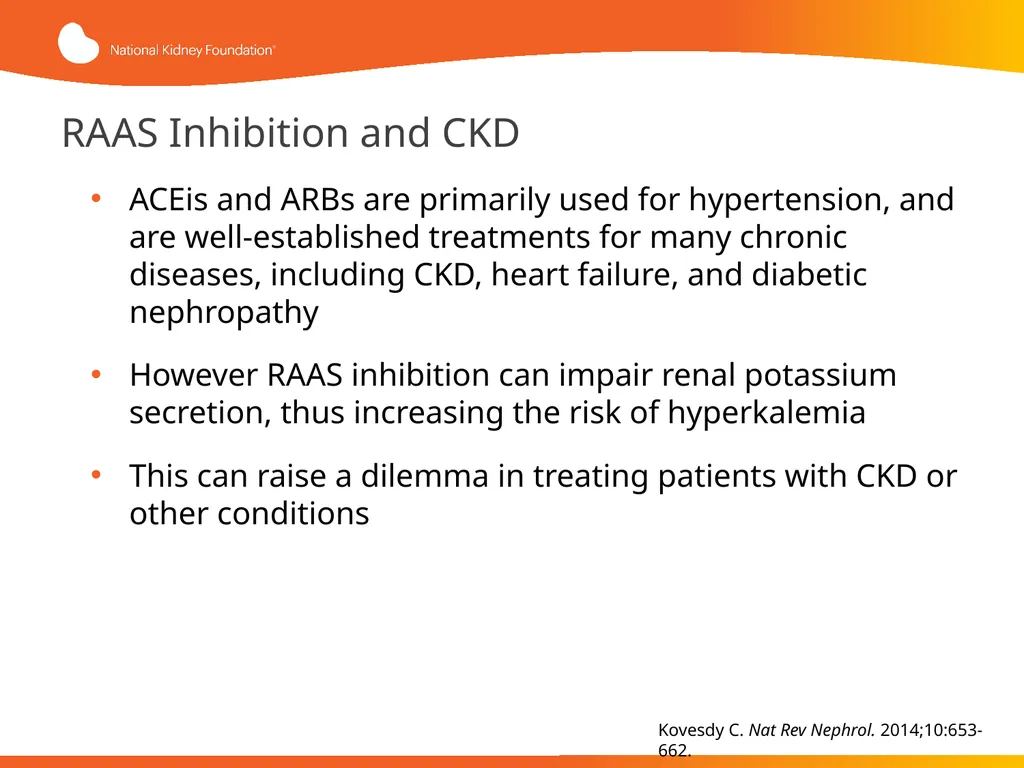
RAAS Inhibition and CKD ACEis and ARBs are primarily used for hypertension, and are well-established treatments for many chronic diseases, including CKD, heart failure, and diabetic nephropathy
However RAAS inhibition can impair renal potassium secretion, thus increasing the risk of hyperkalemia
This can raise a dilemma in treating patients with CKD or other conditions Kovesdy C. Nat Rev Nephrol. 2014;10:653-662.<br>
However RAAS inhibition can impair renal potassium secretion, thus increasing the risk of hyperkalemia
This can raise a dilemma in treating patients with CKD or other conditions Kovesdy C. Nat Rev Nephrol. 2014;10:653-662.<br>
33
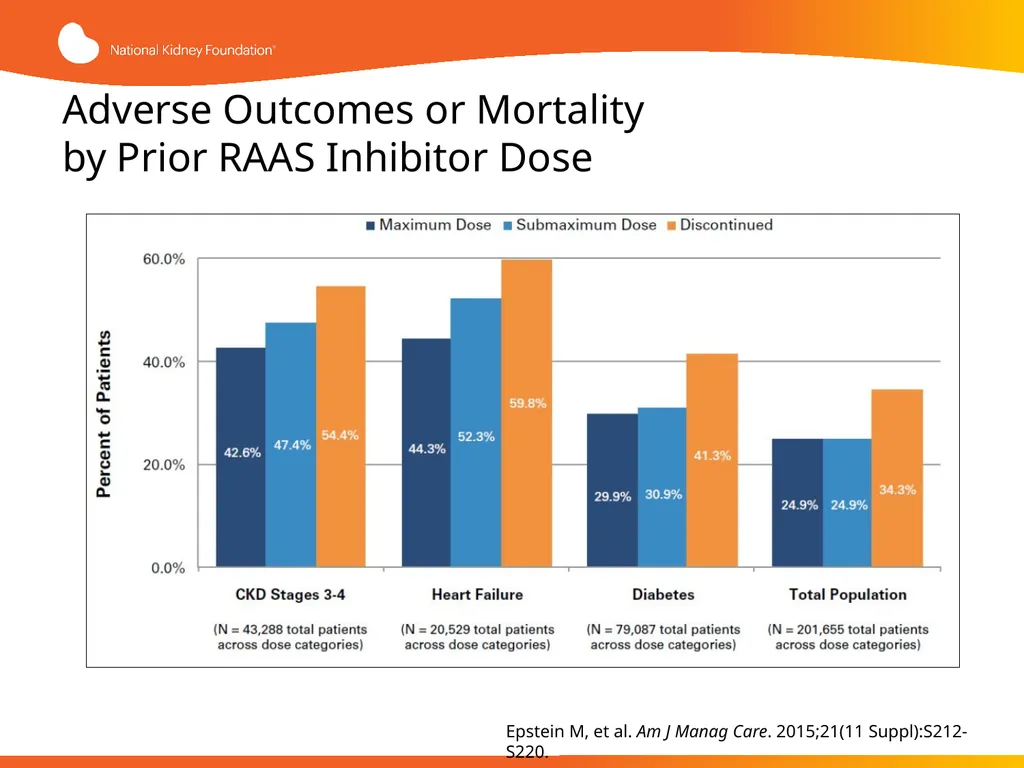
Epstein M, et al. Am J Manag Care. 2015;21(11 Suppl):S212-S220. Adverse Outcomes or Mortality by Prior RAAS Inhibitor Dose<br>
34
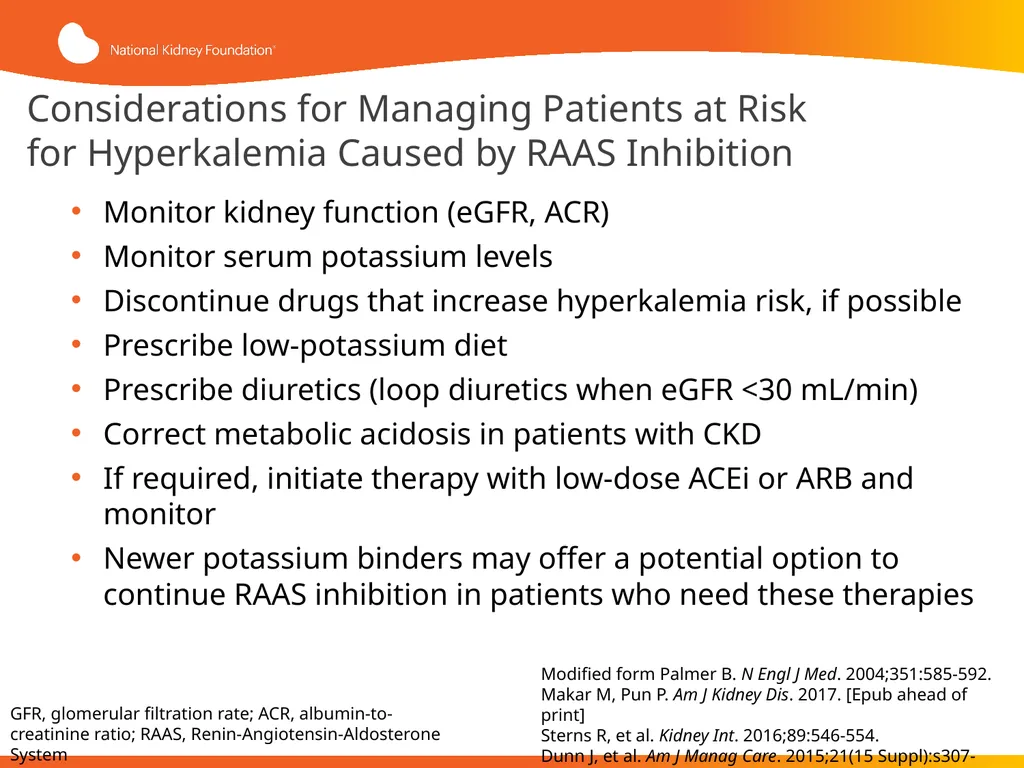
Considerations for Managing Patients at Risk for Hyperkalemia Caused by RAAS Inhibition Monitor kidney function (eGFR, ACR)
Monitor serum potassium levels
Discontinue drugs that increase hyperkalemia risk, if possible
Prescribe low-potassium diet
Prescribe diuretics (loop diuretics when eGFR <30 mL/min)
Correct metabolic acidosis in patients with CKD
If required, initiate therapy with low-dose ACEi or ARB and monitor
Newer potassium binders may offer a potential option to continue RAAS inhibition in patients who need these therapies GFR, glomerular filtration rate; ACR, albumin-to-creatinine ratio; RAAS, Renin-Angiotensin-Aldosterone System Modified form Palmer B. N Engl J Med. 2004;351:585-592.
Makar M, Pun P. Am J Kidney Dis. 2017. [Epub ahead of print]
Sterns R, et al. Kidney Int. 2016;89:546-554.
Dunn J, et al. Am J Manag Care. 2015;21(15 Suppl):s307-s315.<br>
35
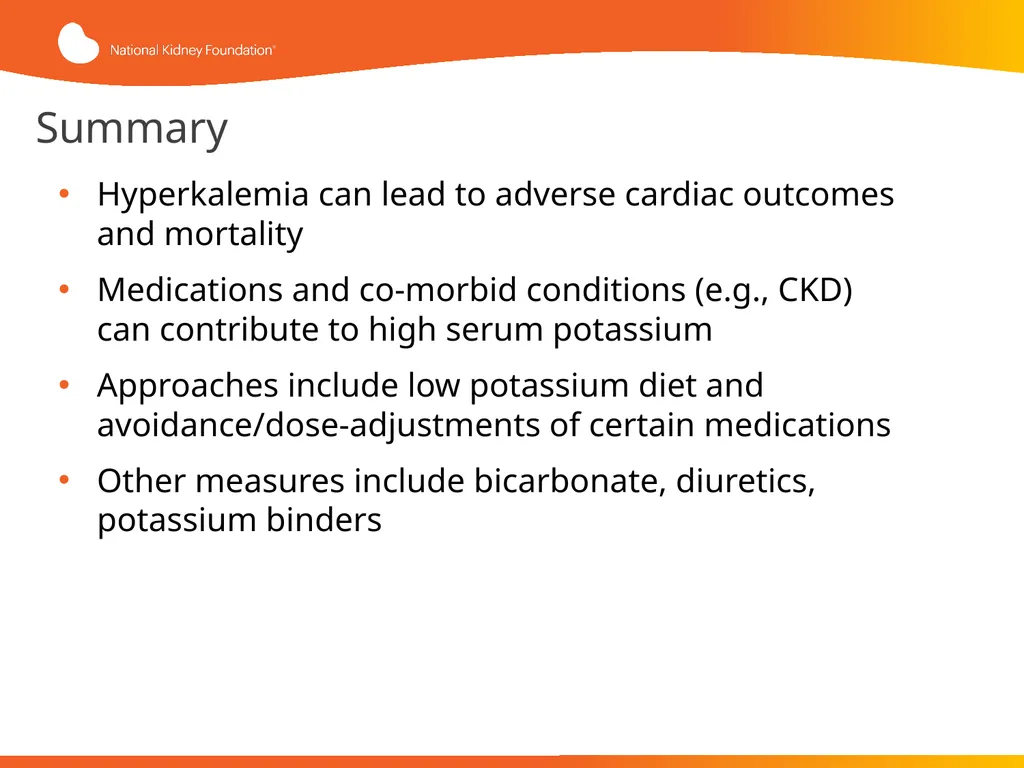
Summary Hyperkalemia can lead to adverse cardiac outcomes and mortality
Medications and co-morbid conditions (e.g., CKD) can contribute to high serum potassium
Approaches include low potassium diet and avoidance/dose-adjustments of certain medications
Other measures include bicarbonate, diuretics, potassium binders<br>
Medications and co-morbid conditions (e.g., CKD) can contribute to high serum potassium
Approaches include low potassium diet and avoidance/dose-adjustments of certain medications
Other measures include bicarbonate, diuretics, potassium binders<br>