
Evaluation support study on the CAP’s impact on

Description: Evaluation support study on the CAPs impact on knowledge exchange and advisory services Agenda Objectives and scope of the evaluation Evaluation themes and support study questions General approach to the evaluation Evaluation process and
Related Topics
Download Presentation
"Evaluation support study on the CAP’s impact on" is the property of its rightful owner. Permission is granted to download and print the materials on this website for personal, non-commercial use only, and to display it on your personal computer provided you do not modify the materials and that you retain all copyright notices contained in the materials. By downloading content from our website, you accept the terms of this agreement.
Presentation Transcript
slide1. Evaluation support study on the CAP’s impact on knowledge exchange and advisory services<br>
slide2. Agenda Objectives and scope of the evaluation
Evaluation themes and support study questions
General approach to the evaluation
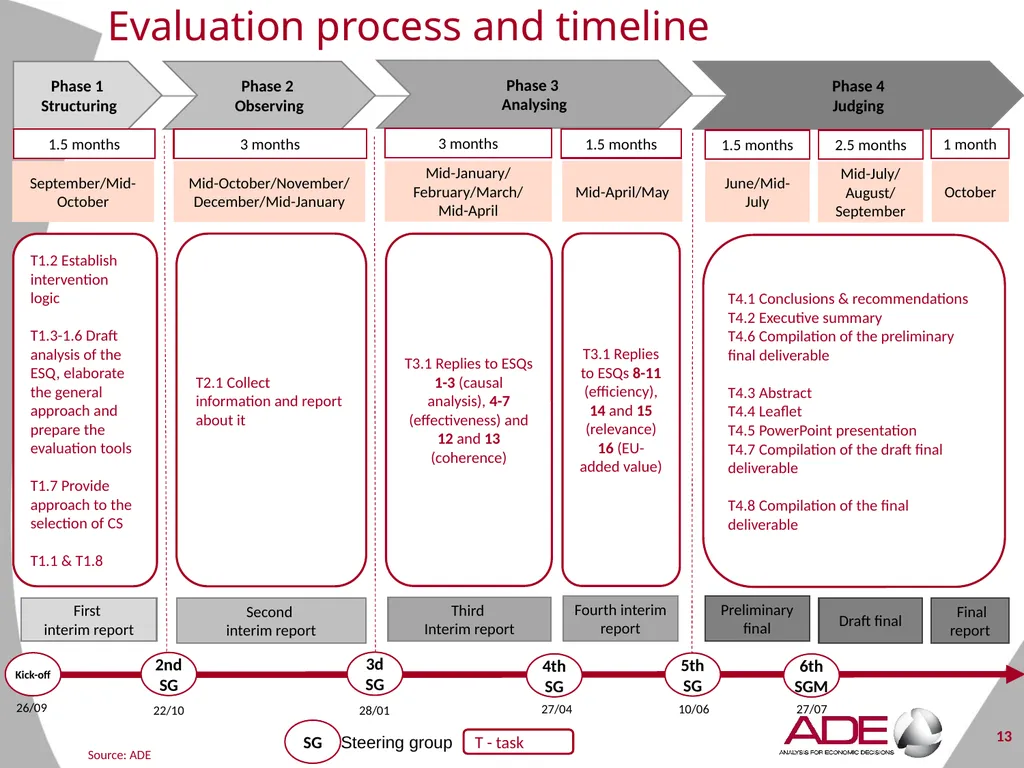
Evaluation process and timeline
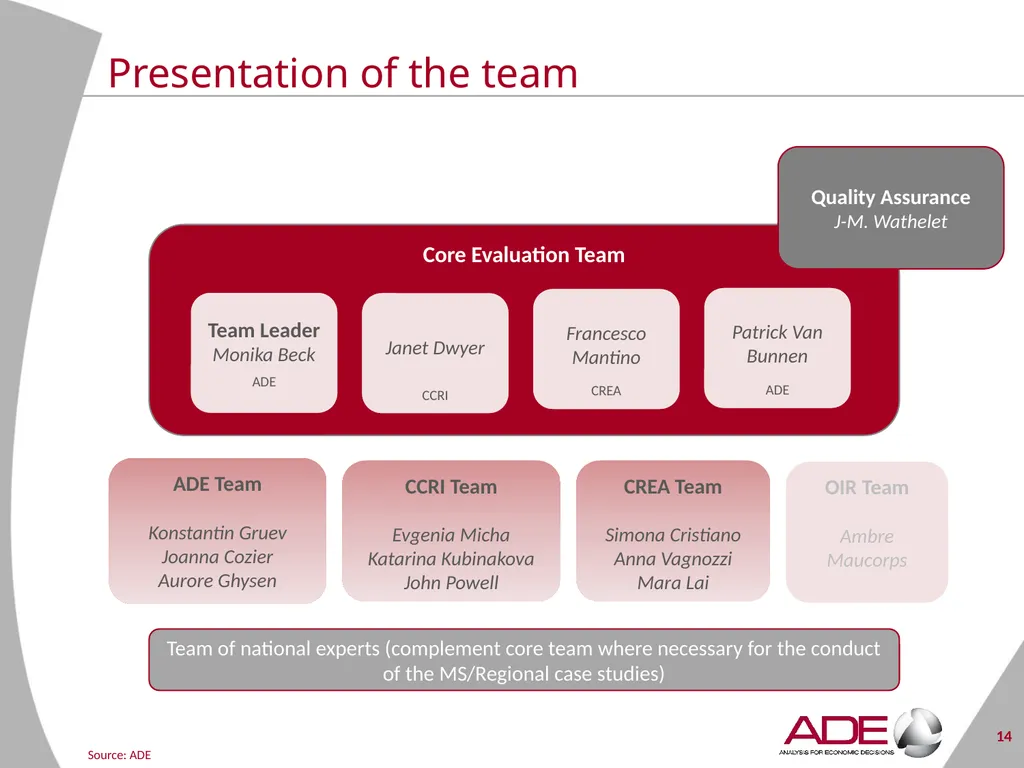
Presentation of the team
Methodology
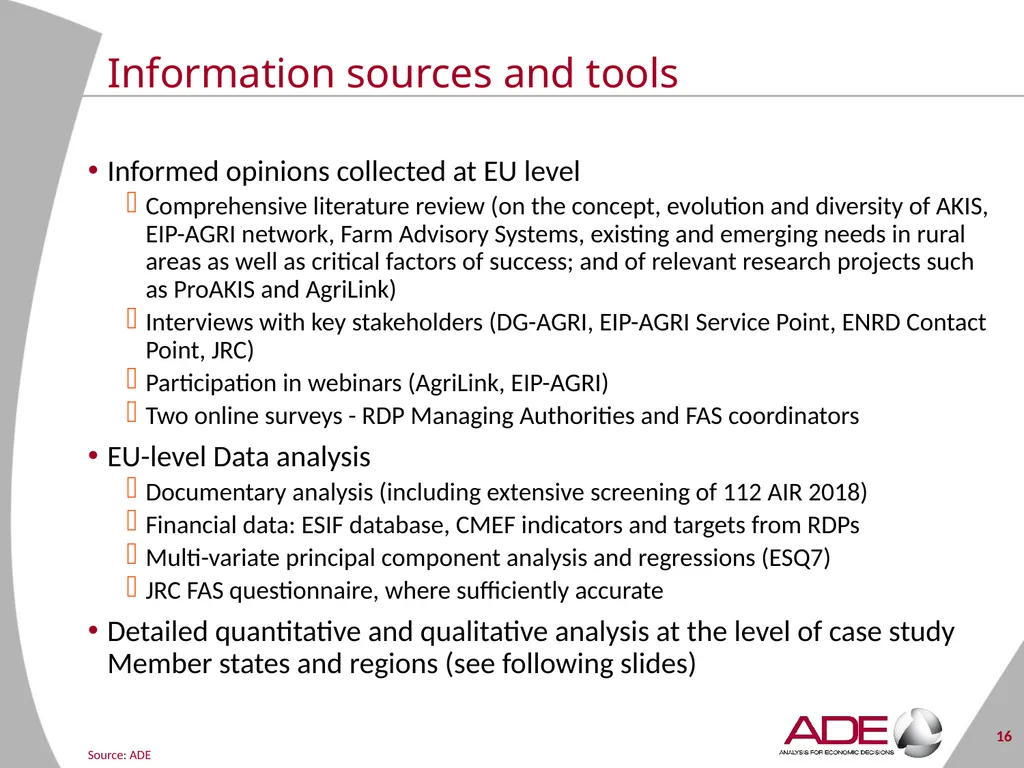
Information sources and tools
Case studies
Surveys
Limitations
Conclusions
Recommendations<br>
slide3. Objectives and scope of the evaluation<br>
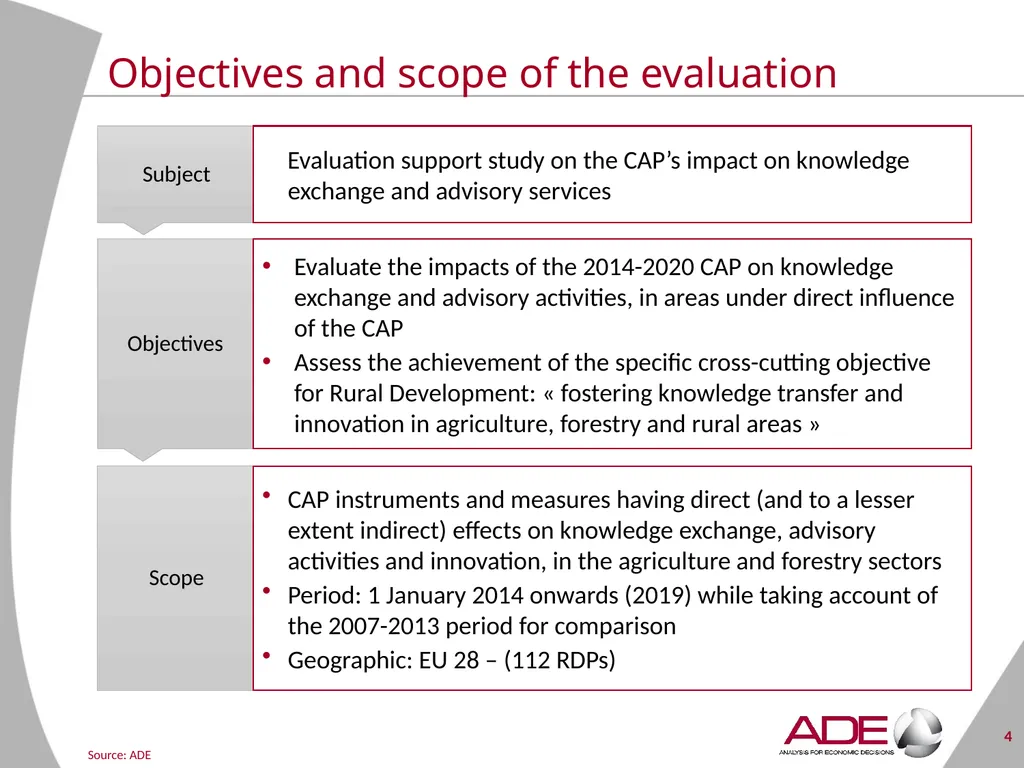
slide4. Objectives and scope of the evaluation 4<br>
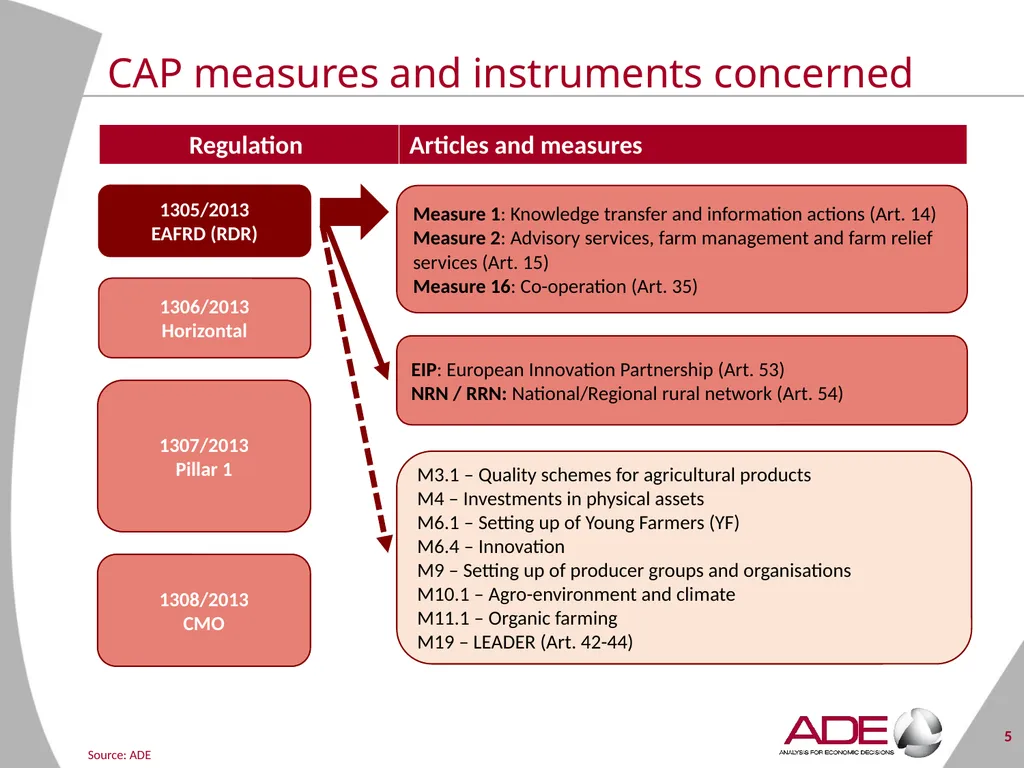
slide5. 1305/2013
EAFRD (RDR) 1306/2013
Horizontal 1307/2013
Pillar 1 1308/2013
CMO Measure 1: Knowledge transfer and information actions (Art. 14)
Measure 2: Advisory services, farm management and farm relief services (Art. 15)
Measure 16: Co-operation (Art. 35) M3.1 – Quality schemes for agricultural products
M4 – Investments in physical assets
M6.1 – Setting up of Young Farmers (YF)
M6.4 – Innovation
M9 – Setting up of producer groups and organisations
M10.1 – Agro-environment and climate
M11.1 – Organic farming
M19 – LEADER (Art. 42-44) EIP: European Innovation Partnership (Art. 53)
NRN / RRN: National/Regional rural network (Art. 54) CAP measures and instruments concerned 5<br>
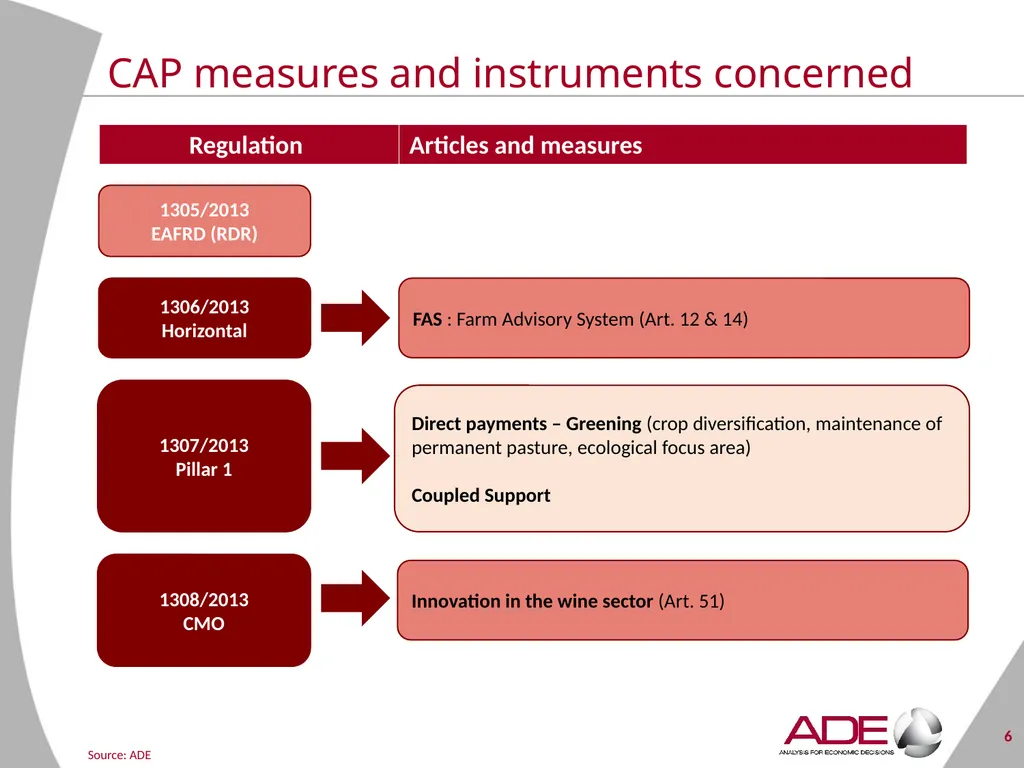
slide6. 1305/2013
EAFRD (RDR) 1306/2013
Horizontal 1307/2013
Pillar 1 1308/2013
CMO Direct payments – Greening (crop diversification, maintenance of permanent pasture, ecological focus area)
Coupled Support FAS : Farm Advisory System (Art. 12 & 14) Innovation in the wine sector (Art. 51) CAP measures and instruments concerned 6<br>
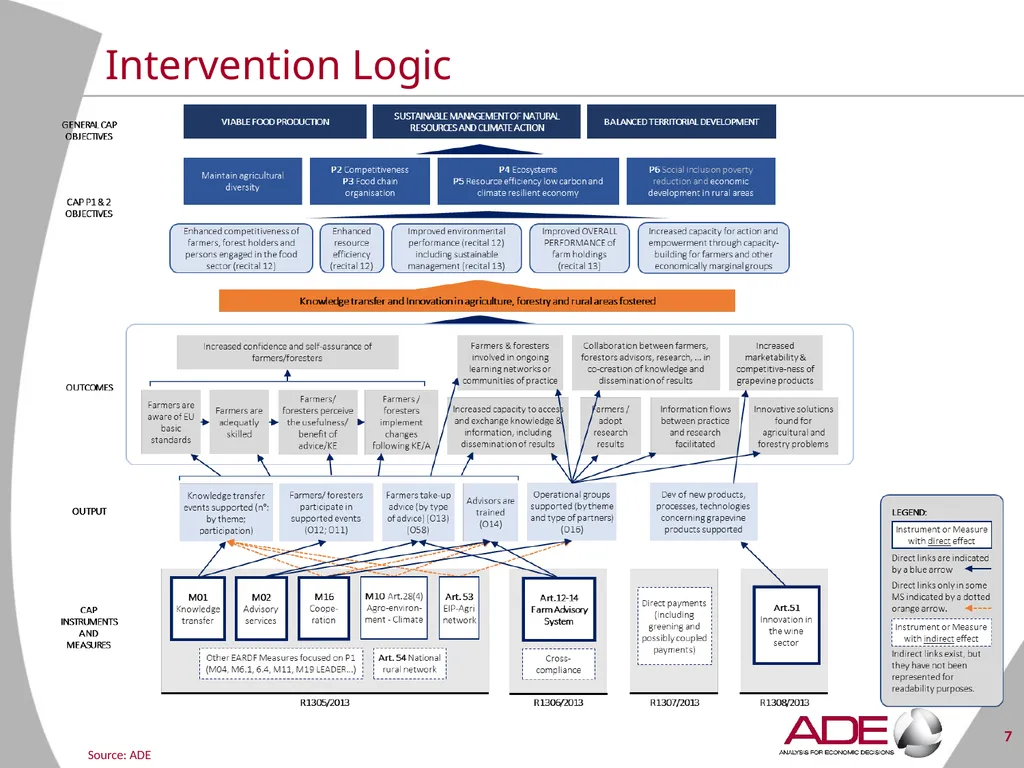
slide7. Intervention Logic 7<br>
slide8. Evaluation themes and support study questions<br>
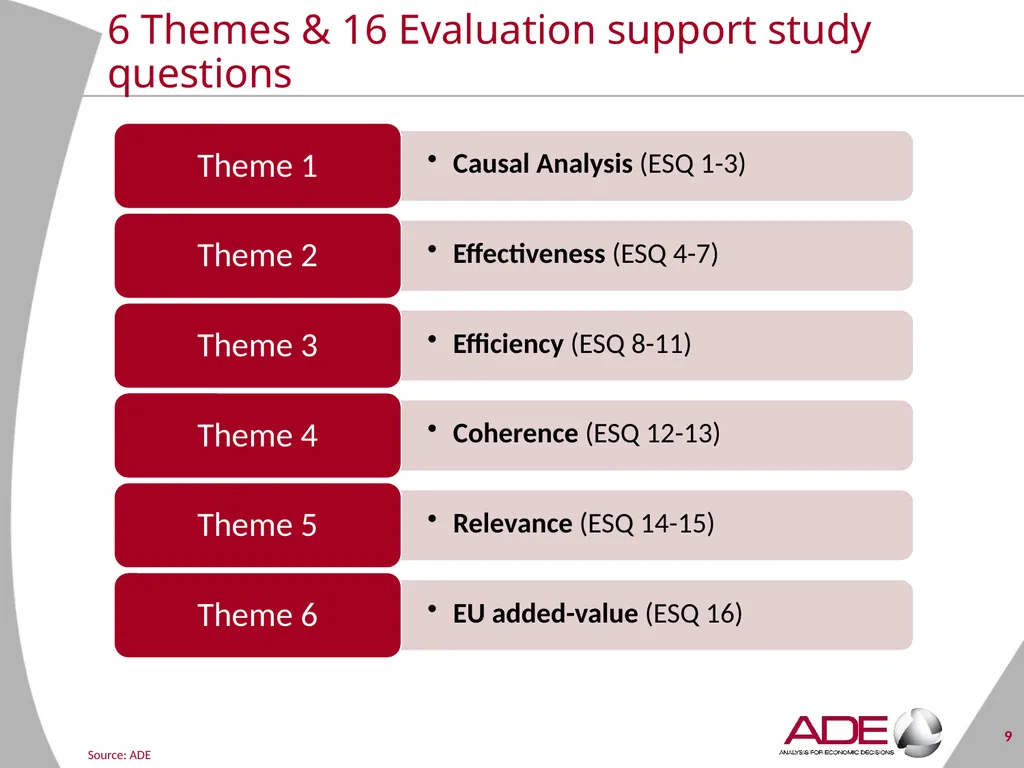
slide9. 9 6 Themes & 16 Evaluation support study questions<br>
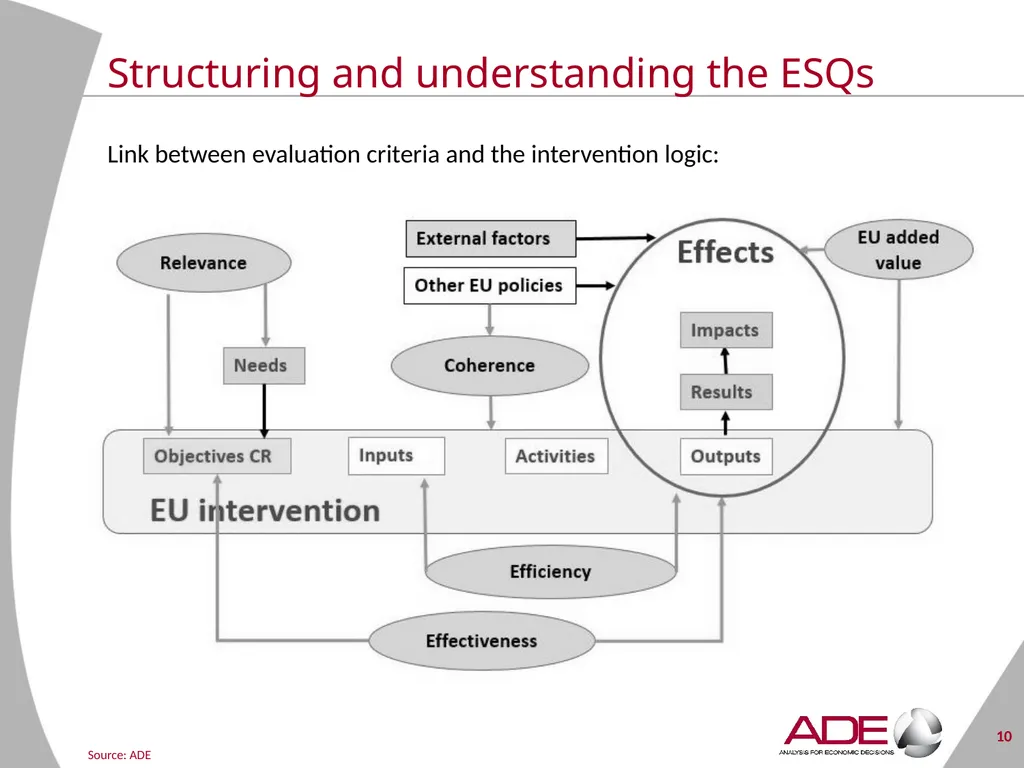
slide10. 10 Structuring and understanding the ESQs Link between evaluation criteria and the intervention logic:<br>
slide11. General approach to the evaluation<br>
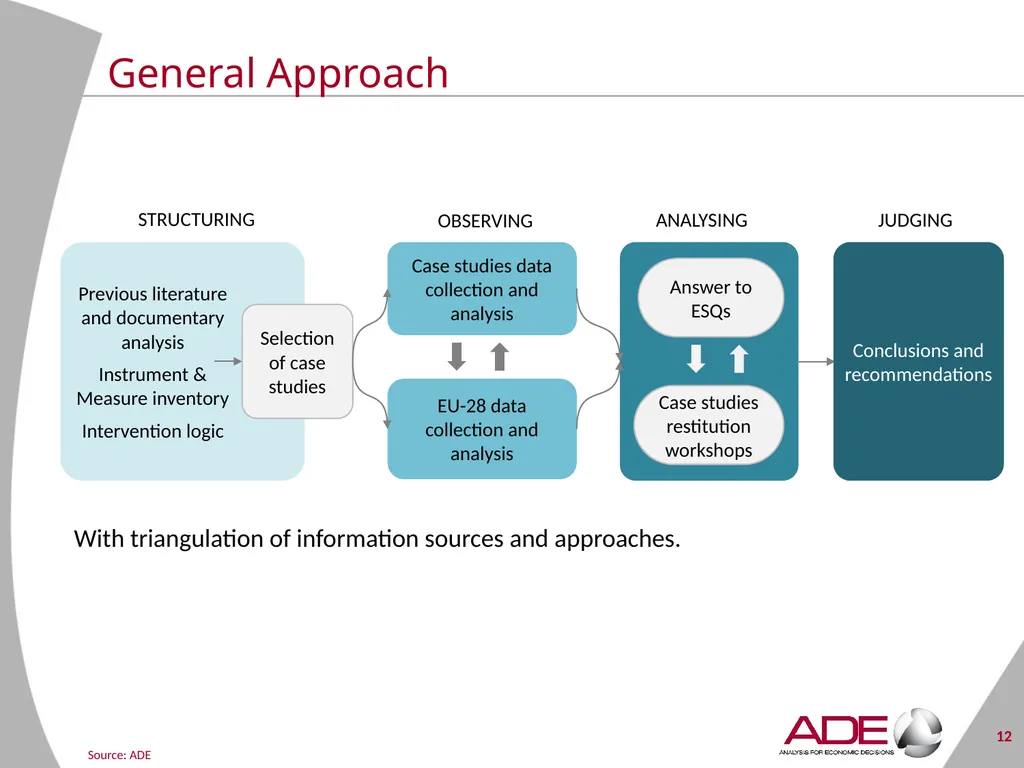
slide12. 12 General Approach With triangulation of information sources and approaches.<br>
slide13. Steering group Phase 1
Structuring Phase 2
Observing Phase 3
Analysing Phase 4
Judging September/Mid-October Kick-off 3d
SG T1.2 Establish intervention logic
T1.3-1.6 Draft analysis of the ESQ, elaborate the general approach and prepare the evaluation tools
T1.7 Provide approach to the selection of CS
T1.1 & T1.8 T2.1 Collect information and report about it T3.1 Replies to ESQs 8-11 (efficiency), 14 and 15 (relevance) 16 (EU-added value) T4.1 Conclusions & recommendations
T4.2 Executive summary
T4.6 Compilation of the preliminary final deliverable
T4.3 Abstract
T4.4 Leaflet
T4.5 PowerPoint presentation
T4.7 Compilation of the draft final deliverable
T4.8 Compilation of the final deliverable First
interim report Second
interim report Fourth interim report Final report 5th
SG SG 2nd SG T - task Evaluation process and timeline 1.5 months 3 months 1.5 months 1.5 months 2.5 months 1 month Preliminary final Draft final Mid-October/November/ December/Mid-January T3.1 Replies to ESQs 1-3 (causal analysis), 4-7 (effectiveness) and 12 and 13 (coherence) Third
Interim report 3 months Mid-January/
February/March/
Mid-April Mid-April/May June/Mid-July Mid-July/
August/
September October 4th
SG 22/10 28/01 27/04 10/06 6th SGM 27/07 13<br>
slide14. 14 Presentation of the team Team of national experts (complement core team where necessary for the conduct of the MS/Regional case studies) Core Evaluation Team Team Leader
Monika Beck
ADE Janet Dwyer
CCRI Francesco Mantino
CREA Patrick Van Bunnen
ADE Quality Assurance
J-M. Wathelet ADE Team
Konstantin Gruev
Joanna Cozier
Aurore Ghysen CCRI Team
Evgenia Micha
Katarina Kubinakova
John Powell CREA Team
Simona Cristiano
Anna Vagnozzi
Mara Lai OIR Team
Ambre Maucorps<br>
slide15. Methodology<br>
slide16. 16 Information sources and tools Informed opinions collected at EU level
Comprehensive literature review (on the concept, evolution and diversity of AKIS, EIP-AGRI network, Farm Advisory Systems, existing and emerging needs in rural areas as well as critical factors of success; and of relevant research projects such as ProAKIS and AgriLink)
Interviews with key stakeholders (DG-AGRI, EIP-AGRI Service Point, ENRD Contact Point, JRC)
Participation in webinars (AgriLink, EIP-AGRI)
Two online surveys - RDP Managing Authorities and FAS coordinators
EU-level Data analysis
Documentary analysis (including extensive screening of 112 AIR 2018)
Financial data: ESIF database, CMEF indicators and targets from RDPs
Multi-variate principal component analysis and regressions (ESQ7)
JRC FAS questionnaire, where sufficiently accurate
Detailed quantitative and qualitative analysis at the level of case study Member states and regions (see following slides)<br>
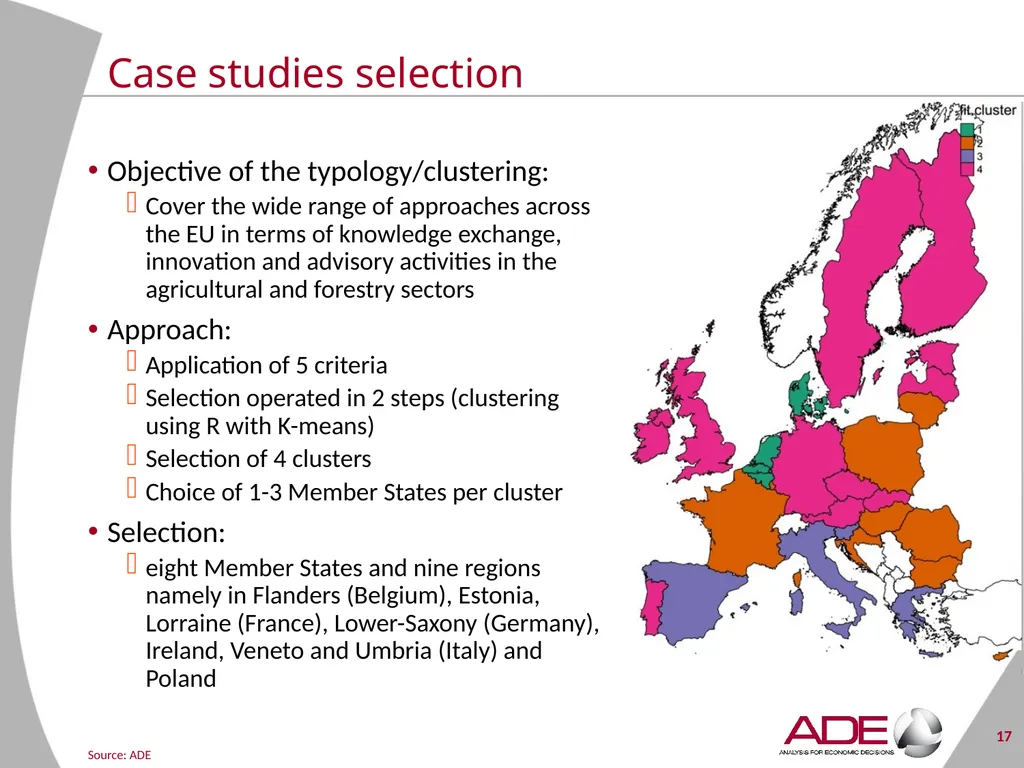
slide17. 17 Case studies selection Objective of the typology/clustering:
Cover the wide range of approaches across the EU in terms of knowledge exchange, innovation and advisory activities in the agricultural and forestry sectors
Approach:
Application of 5 criteria
Selection operated in 2 steps (clustering using R with K-means)
Selection of 4 clusters
Choice of 1-3 Member States per cluster
Selection:
eight Member States and nine regions namely in Flanders (Belgium), Estonia, Lorraine (France), Lower-Saxony (Germany), Ireland, Veneto and Umbria (Italy) and Poland<br>
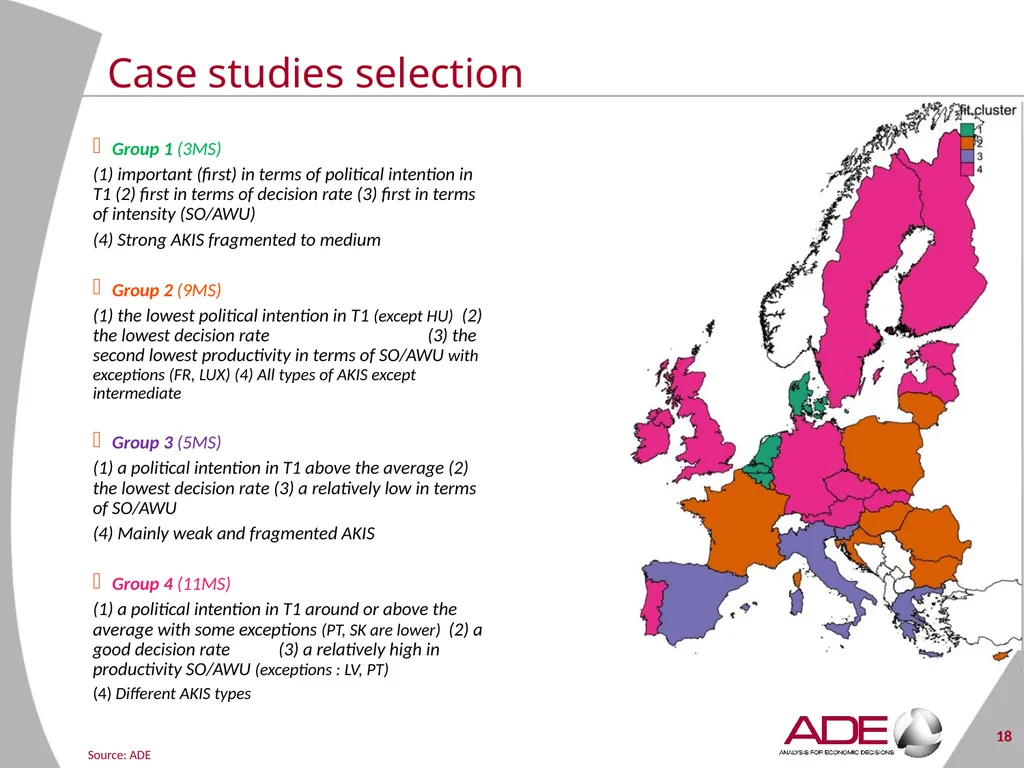
slide18. 18 Group 1 (3MS)
(1) important (first) in terms of political intention in T1 (2) first in terms of decision rate (3) first in terms of intensity (SO/AWU)
(4) Strong AKIS fragmented to medium
Group 2 (9MS)
(1) the lowest political intention in T1 (except HU) (2) the lowest decision rate (3) the second lowest productivity in terms of SO/AWU with exceptions (FR, LUX) (4) All types of AKIS except intermediate
Group 3 (5MS)
(1) a political intention in T1 above the average (2) the lowest decision rate (3) a relatively low in terms of SO/AWU
(4) Mainly weak and fragmented AKIS
Group 4 (11MS)
(1) a political intention in T1 around or above the average with some exceptions (PT, SK are lower) (2) a good decision rate (3) a relatively high in productivity SO/AWU (exceptions : LV, PT)
(4) Different AKIS types Case studies selection<br>
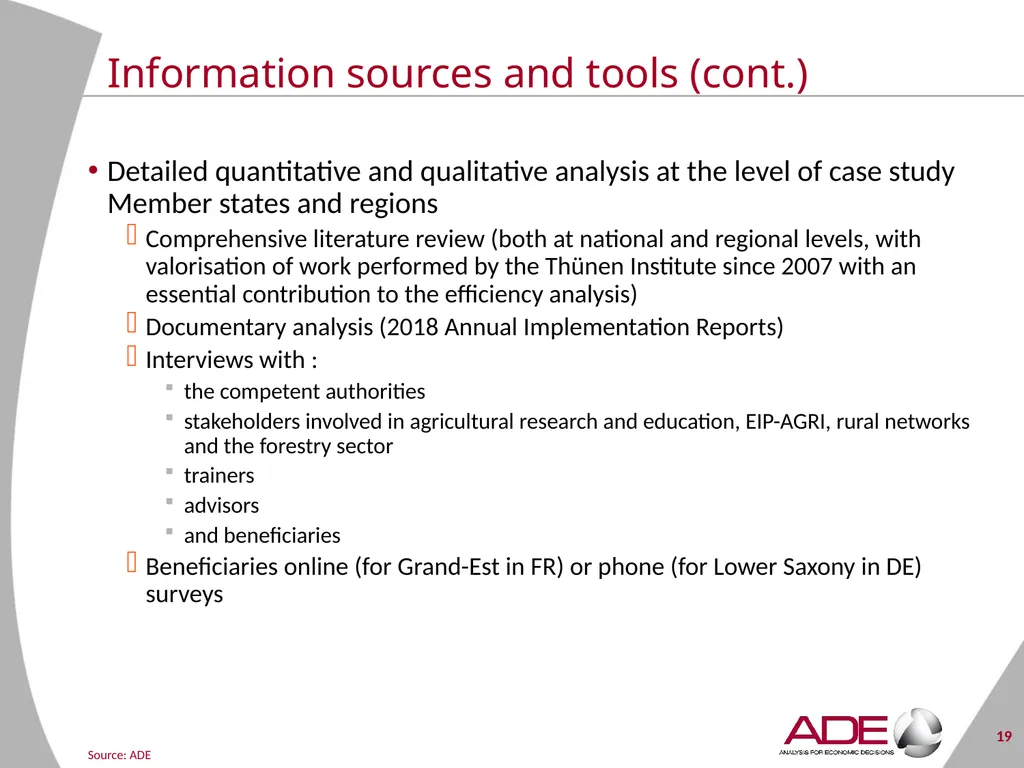
slide19. 19 Information sources and tools (cont.) Detailed quantitative and qualitative analysis at the level of case study Member states and regions
Comprehensive literature review (both at national and regional levels, with valorisation of work performed by the Thünen Institute since 2007 with an essential contribution to the efficiency analysis)
Documentary analysis (2018 Annual Implementation Reports)
Interviews with :
the competent authorities
stakeholders involved in agricultural research and education, EIP-AGRI, rural networks and the forestry sector
trainers
advisors
and beneficiaries
Beneficiaries online (for Grand-Est in FR) or phone (for Lower Saxony in DE) surveys<br>
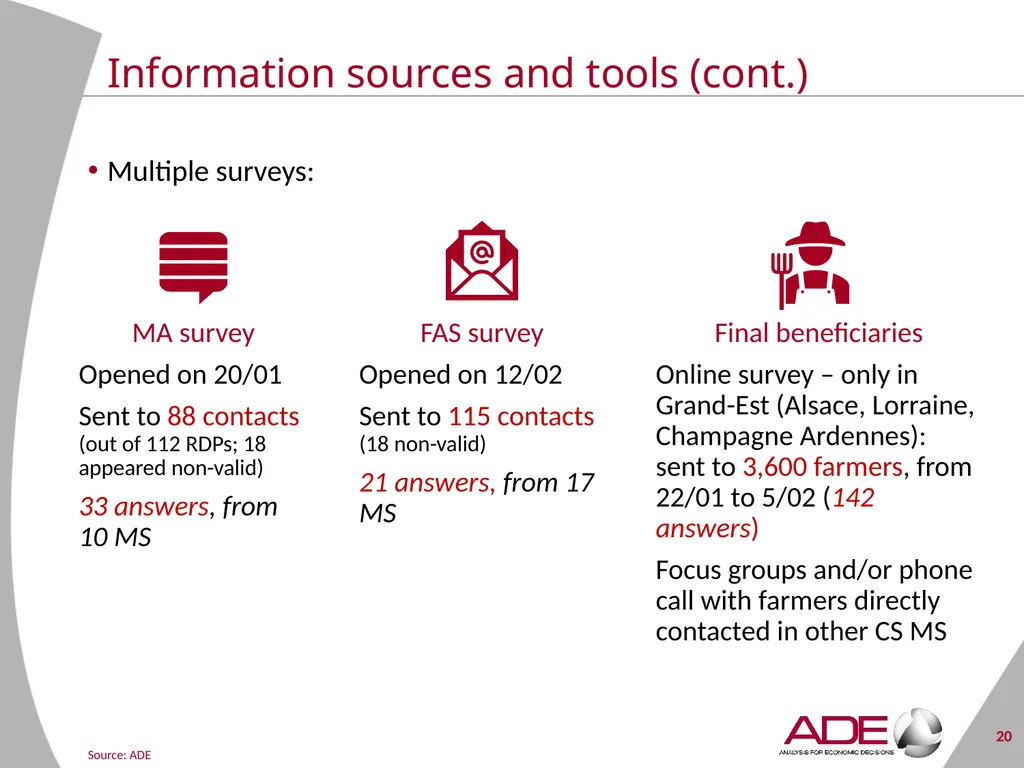
slide20. 20 Information sources and tools (cont.) Multiple surveys: MA survey
Opened on 20/01
Sent to 88 contacts (out of 112 RDPs; 18 appeared non-valid)
33 answers, from 10 MS Final beneficiaries
Online survey – only in Grand-Est (Alsace, Lorraine, Champagne Ardennes): sent to 3,600 farmers, from 22/01 to 5/02 (142 answers)
Focus groups and/or phone call with farmers directly contacted in other CS MS FAS survey
Opened on 12/02
Sent to 115 contacts (18 non-valid)
21 answers, from 17 MS<br>
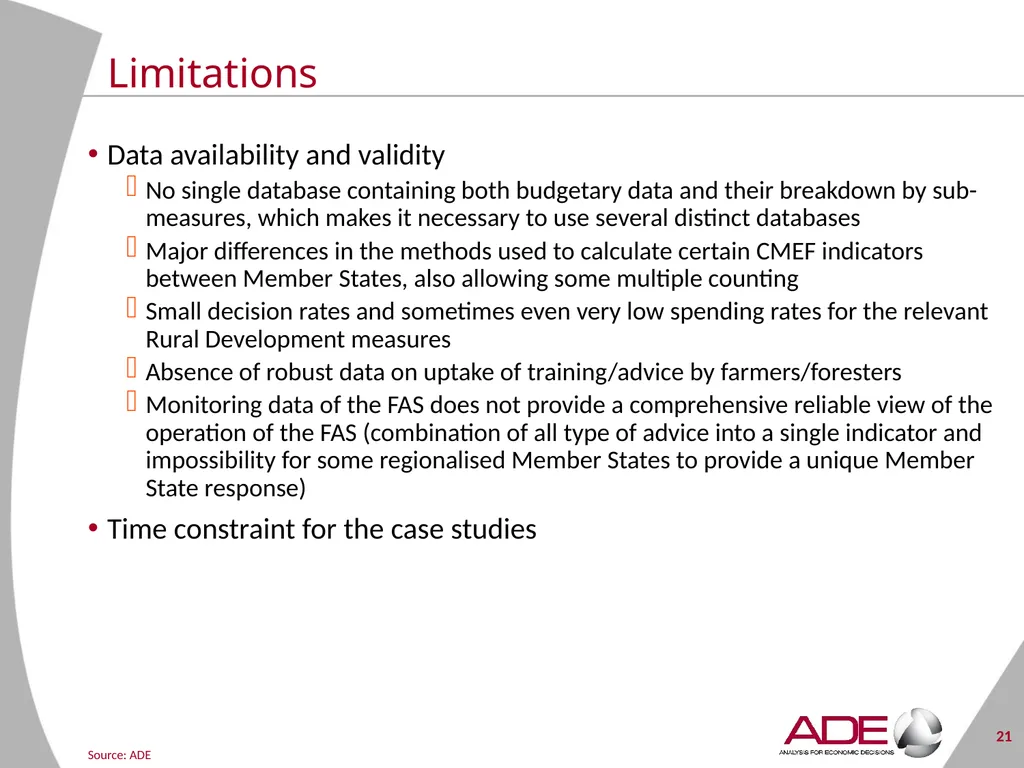
slide21. 21 Limitations Data availability and validity
No single database containing both budgetary data and their breakdown by sub-measures, which makes it necessary to use several distinct databases
Major differences in the methods used to calculate certain CMEF indicators between Member States, also allowing some multiple counting
Small decision rates and sometimes even very low spending rates for the relevant Rural Development measures
Absence of robust data on uptake of training/advice by farmers/foresters
Monitoring data of the FAS does not provide a comprehensive reliable view of the operation of the FAS (combination of all type of advice into a single indicator and impossibility for some regionalised Member States to provide a unique Member State response)
Time constraint for the case studies<br>
slide22. Conclusions<br>
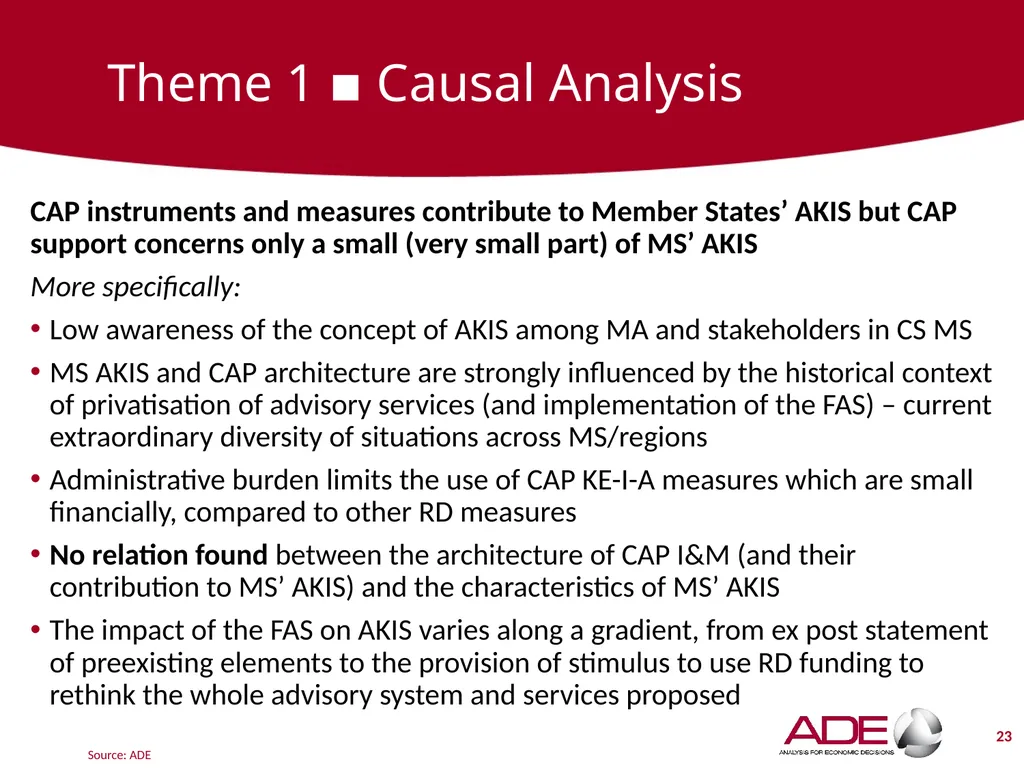
slide23. Theme 1 ▪ Causal Analysis CAP instruments and measures contribute to Member States’ AKIS but CAP support concerns only a small (very small part) of MS’ AKIS
More specifically:
Low awareness of the concept of AKIS among MA and stakeholders in CS MS
MS AKIS and CAP architecture are strongly influenced by the historical context of privatisation of advisory services (and implementation of the FAS) – current extraordinary diversity of situations across MS/regions
Administrative burden limits the use of CAP KE-I-A measures which are small financially, compared to other RD measures
No relation found between the architecture of CAP I&M (and their contribution to MS’ AKIS) and the characteristics of MS’ AKIS
The impact of the FAS on AKIS varies along a gradient, from ex post statement of preexisting elements to the provision of stimulus to use RD funding to rethink the whole advisory system and services proposed 23<br>
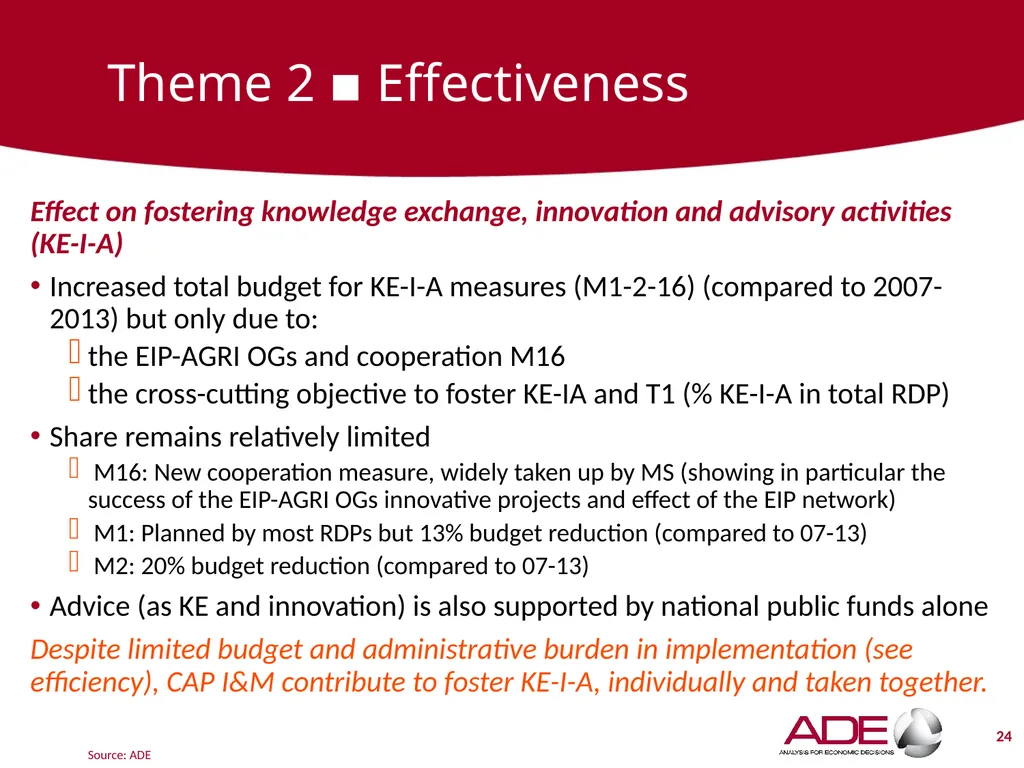
slide24. Theme 2 ▪ Effectiveness Effect on fostering knowledge exchange, innovation and advisory activities (KE-I-A)
Increased total budget for KE-I-A measures (M1-2-16) (compared to 2007-2013) but only due to:
the EIP-AGRI OGs and cooperation M16
the cross-cutting objective to foster KE-IA and T1 (% KE-I-A in total RDP)
Share remains relatively limited
M16: New cooperation measure, widely taken up by MS (showing in particular the success of the EIP-AGRI OGs innovative projects and effect of the EIP network)
M1: Planned by most RDPs but 13% budget reduction (compared to 07-13)
M2: 20% budget reduction (compared to 07-13)
Advice (as KE and innovation) is also supported by national public funds alone
Despite limited budget and administrative burden in implementation (see efficiency), CAP I&M contribute to foster KE-I-A, individually and taken together. 24<br>
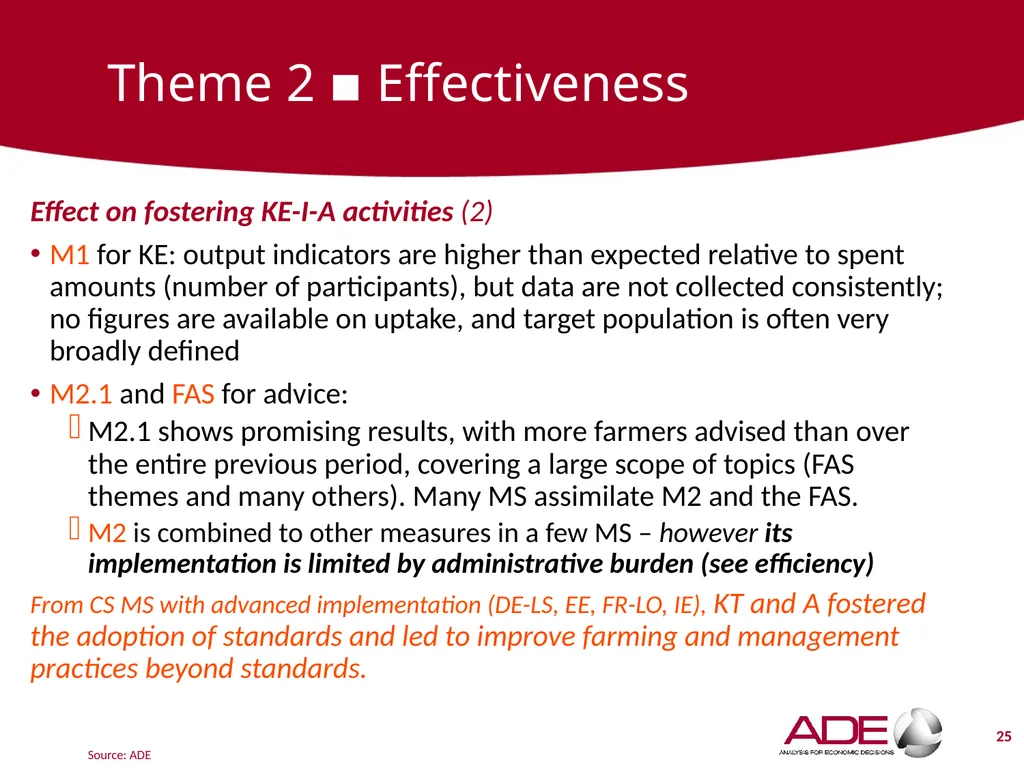
slide25. Theme 2 ▪ Effectiveness Effect on fostering KE-I-A activities (2)
M1 for KE: output indicators are higher than expected relative to spent amounts (number of participants), but data are not collected consistently; no figures are available on uptake, and target population is often very broadly defined
M2.1 and FAS for advice:
M2.1 shows promising results, with more farmers advised than over the entire previous period, covering a large scope of topics (FAS themes and many others). Many MS assimilate M2 and the FAS.
M2 is combined to other measures in a few MS – however its implementation is limited by administrative burden (see efficiency)
From CS MS with advanced implementation (DE-LS, EE, FR-LO, IE), KT and A fostered the adoption of standards and led to improve farming and management practices beyond standards. 25<br>
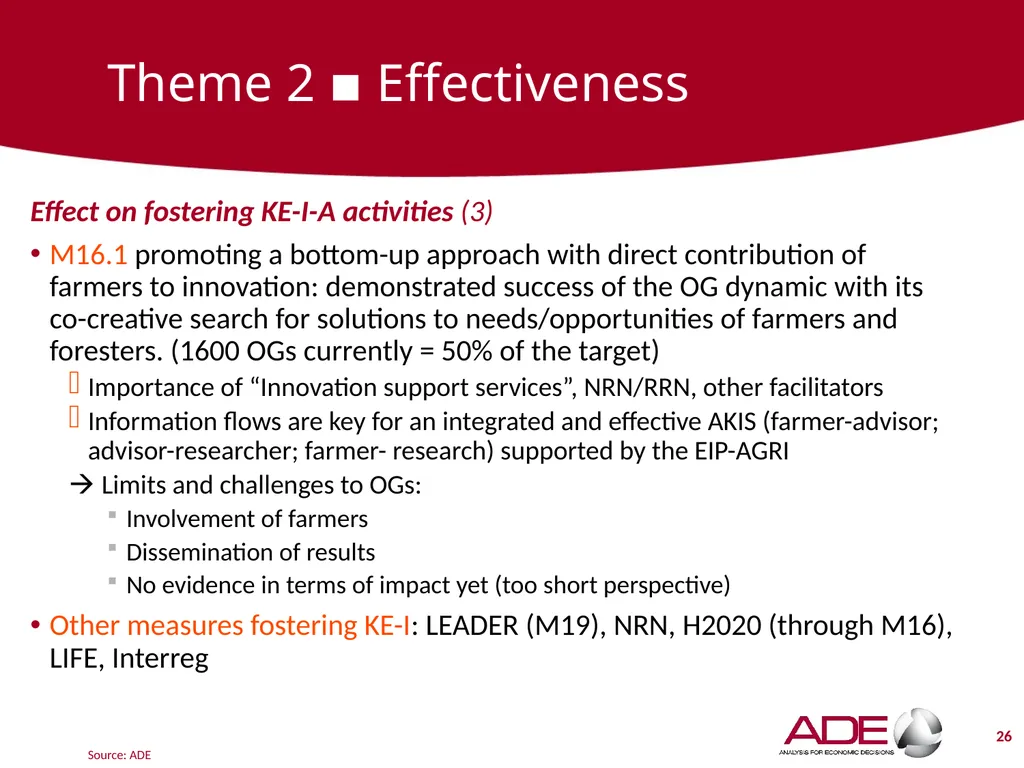
slide26. Theme 2 ▪ Effectiveness Effect on fostering KE-I-A activities (3)
M16.1 promoting a bottom-up approach with direct contribution of farmers to innovation: demonstrated success of the OG dynamic with its co-creative search for solutions to needs/opportunities of farmers and foresters. (1600 OGs currently = 50% of the target)
Importance of “Innovation support services”, NRN/RRN, other facilitators
Information flows are key for an integrated and effective AKIS (farmer-advisor; advisor-researcher; farmer- research) supported by the EIP-AGRI
Limits and challenges to OGs:
Involvement of farmers
Dissemination of results
No evidence in terms of impact yet (too short perspective)
Other measures fostering KE-I: LEADER (M19), NRN, H2020 (through M16), LIFE, Interreg 26<br>
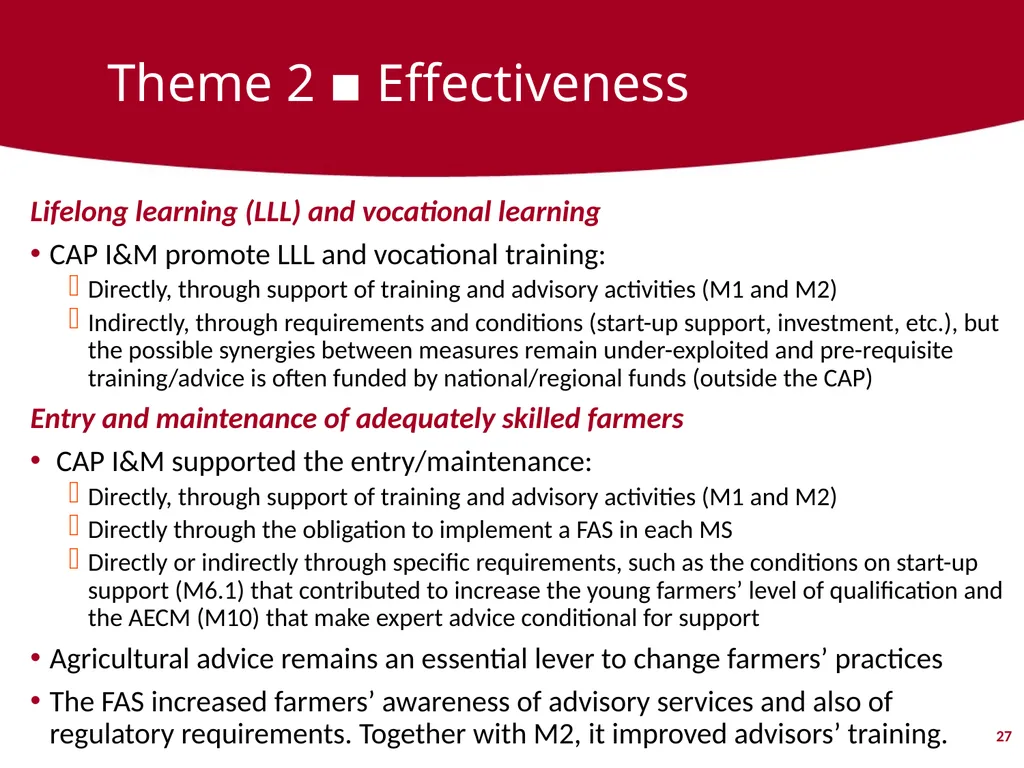
slide27. Theme 2 ▪ Effectiveness Lifelong learning (LLL) and vocational learning
CAP I&M promote LLL and vocational training:
Directly, through support of training and advisory activities (M1 and M2)
Indirectly, through requirements and conditions (start-up support, investment, etc.), but the possible synergies between measures remain under-exploited and pre-requisite training/advice is often funded by national/regional funds (outside the CAP)
Entry and maintenance of adequately skilled farmers
CAP I&M supported the entry/maintenance:
Directly, through support of training and advisory activities (M1 and M2)
Directly through the obligation to implement a FAS in each MS
Directly or indirectly through specific requirements, such as the conditions on start-up support (M6.1) that contributed to increase the young farmers’ level of qualification and the AECM (M10) that make expert advice conditional for support
Agricultural advice remains an essential lever to change farmers’ practices
The FAS increased farmers’ awareness of advisory services and also of regulatory requirements. Together with M2, it improved advisors’ training. 27<br>
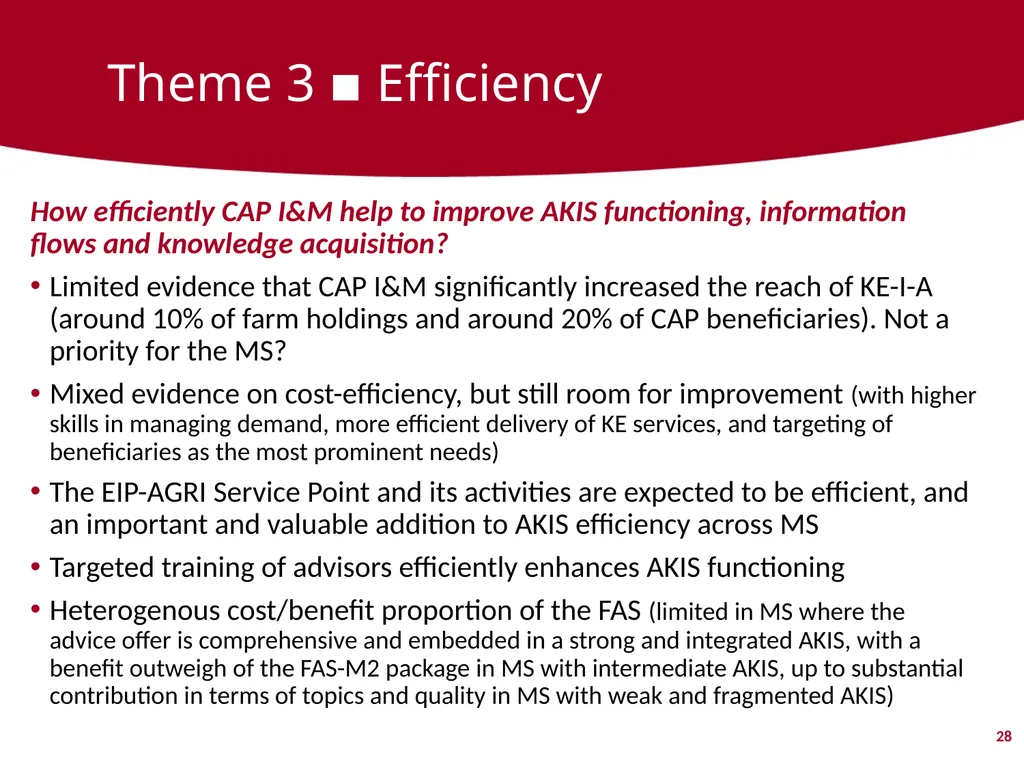
slide28. Theme 3 ▪ Efficiency 28 How efficiently CAP I&M help to improve AKIS functioning, information flows and knowledge acquisition?
Limited evidence that CAP I&M significantly increased the reach of KE-I-A (around 10% of farm holdings and around 20% of CAP beneficiaries). Not a priority for the MS?
Mixed evidence on cost-efficiency, but still room for improvement (with higher skills in managing demand, more efficient delivery of KE services, and targeting of beneficiaries as the most prominent needs)
The EIP-AGRI Service Point and its activities are expected to be efficient, and an important and valuable addition to AKIS efficiency across MS
Targeted training of advisors efficiently enhances AKIS functioning
Heterogenous cost/benefit proportion of the FAS (limited in MS where the advice offer is comprehensive and embedded in a strong and integrated AKIS, with a benefit outweigh of the FAS-M2 package in MS with intermediate AKIS, up to substantial contribution in terms of topics and quality in MS with weak and fragmented AKIS)<br>
slide29. Theme 3 ▪ Efficiency 29 Administrative burden
Low RDP spending rates (31% M1, 17% M2, 18% M16 versus 53% for all RD measures) are an evidence of administrative burden
Distinction between different levels:
Beneficiaries: burden is negligible for training and advice (transfer to operating bodies), and quite important in OGs (who were in a learning process in 2014-2020)
Public administration and intermediary bodies (service providers): burden is high (public procurement rule, learning process for EIP, use of simplified costs at inadequate level and for OGs, proportionality of controls)
EU officials: strong initial efforts for the new EIP-AGRI measure<br>
slide30. Internal coherence within the CAP
Stronger link of the legal framework of the CAP (common objectives and CMEF)
But no common programming for EAGF and EAFRD (contrary to ESIF) - Pillars 1 & 2 are managed by distinct authorities
The FAS addresses greening and cross-compliance common to both pillars
Within Pillar 2, clear search for increased design coherence through its architecture, innovation cross-cutting objective and KE-I Priority 1
But envisaged complementarities and synergies are not fully implemented. The design remains complex. Measures are still largely managed “in silos” at the level of administrations; there is still a lack of flexible and combined use of KE-I-A measures and sub-measures, and synergies with other RD measures, Theme 4 ▪ Coherence 30<br>
slide31. External coherence
ESIF (ESF, ERDF): common programming, clear demarcation lines, but no evidence from case study MS of complementarities and synergies
Horizon 2020: recognised coherence at EU/national level and successful synergies with the EIP-AGRI in some MS (front-runners) Theme 4 ▪ Coherence 31<br>
slide32. Theme 5 ▪ Relevance Regarding beneficiaries’ current and emerging needs
Topics: legal provisions allow to cover all relevant KE-I-A topics, no restrictions
Methods: EU framework quite broad (with an exception of 1-1 advice), but MS feel limitations also compared to their own initial scoping
The SWOT is a step forward in needs’ identification and focus on specific topics. However, possibly due to administrative burden, only a small share of KE-I-A is supported by the CAP and there is no information on the coverage of these needs with national resources
Regarding EU/national/regional policies
The actual contribution of the CAP to fostering KE-I-A is difficult to establish when national funding is also provided
There is evidence that EU & MS networks and institutional developments (EIP-AGRI, etc.) fostered new functionalities (farmer learning; strengthening links between research, innovation and practice). Until now, the number of farmers involved directly in the projects is small, but the impact goes beyond those.
Regarding the FAS obligation
Financial support to the FAS through M2 is valuable especially in MS with weak AKIS 32<br>
slide33. Theme 6 ▪ EU value added There is evidence of the CAP added-value in fostering KE-I-A (despite administrative burden)
EIP-AGRI is highly valued: the promotion of bottom-up approaches focusing on farmers’/foresters’ needs and co-creation is significantly positive to fostering KE-I-A
Cross-cutting consideration of innovation (Priority 1)
RD support enables additional achievements in KE and advice, and the extension of services’ offer
CAP encouraged a key evolution in terms of:
Methods
Thematic coverage 33<br>
slide34. Recommendations<br>
slide35. 35 Recommendations 1. Develop an integrated vision of MS’s AKIS In preparing their CAP strategic plans, MA should develop a comprehensive vision of their AKIS (also at regional level in regionalised MS)
Based on assessment of the existing AKIS, its strengths and weaknesses, the needs and interconnections
Build a strategy based on short- and medium-term vision to strengthen and adapt the system to needs
Emphasis put on information flows between actors and between the various geographical levels<br>
slide36. Recommendations 2. Strengthen coherence between CAP instruments and measures and MS’s AKIS Based on a comprehensive view of the existing AKIS, CAP I&M can be used to:
cover needs in terms of KE-I-A in line with the national/regional strategy
strengthen the system and information flows were needed
Ensure an ‘AKIS concept’ promotion at EU, national and regional levels to make MA/stakeholders familiar with it. 36<br>
slide37. Recommendations 3. Maintain and develop the EIP-AGRI Ensure an “EIP-AGRI promotion strategy” in all MS and ensure that the EIP-AGRI is well integrated in MS’s AKIS
Setup innovation support services. Together with an EIP-AGRI extended Service Point and dedicated innovation strand, they should:
Promote overall the EIP-AGRI and OGs
Support the concrete implementation of OGs
Implement strategies for results’ dissemination
Improve the information flows to and from farmers
Address the current barriers to further encourage farmers’ and advisors’ involvement in OGs
Identify and record the results and impacts of OGs 37<br>
slide38. Recommendations 4. Foster information flows between advisors and both farmers and research Setup incentives for advisors’ initiatives to:
communicate farmers’ needs
disseminate knowledge 5. Maintain training and knowledge support for advisors Provide training in various forms and upskilling for advisors
Encourage MS to link funding of advice to training of advisors 38<br>
slide39. Recommendations 6. Foster holistic advice in response to farmers’ needs including topics of public interest Advice really needs to be adapted to the farmers’ needs
Include topics of public interest but also advice on the economic and environmental performance of the farms, adapted to each local situation 7. Increase the ability of all farmers to access advisory services and promote advisory activities while enabling approaches to evolve Guarantee access to high-quality advice for all EU farmers (taking into account the specificities of their farm)
Ensure financial resources to support these activities and their promotion by AKIS actors and other stakeholders
Complement on farm one-to-one advice by other approaches 39<br>
slide40. Recommendations 8. Place more emphasis upon reaching the ‘hard to reach” Provide specific CAP funding targeting these groups for KE-I-A adapted to their specific needs
Develop strategic approaches to foster the most efficient balance of public, private and hybrid forms of KE-A. 9. Improve ‘targeting’ Target activities to those CAP beneficiaries and farmers where the needs for advice and training are the greatest
Increase awareness of how CAP KE-I-A measures can target excluded groups and strengthen capacity/governance in these contexts 40<br>
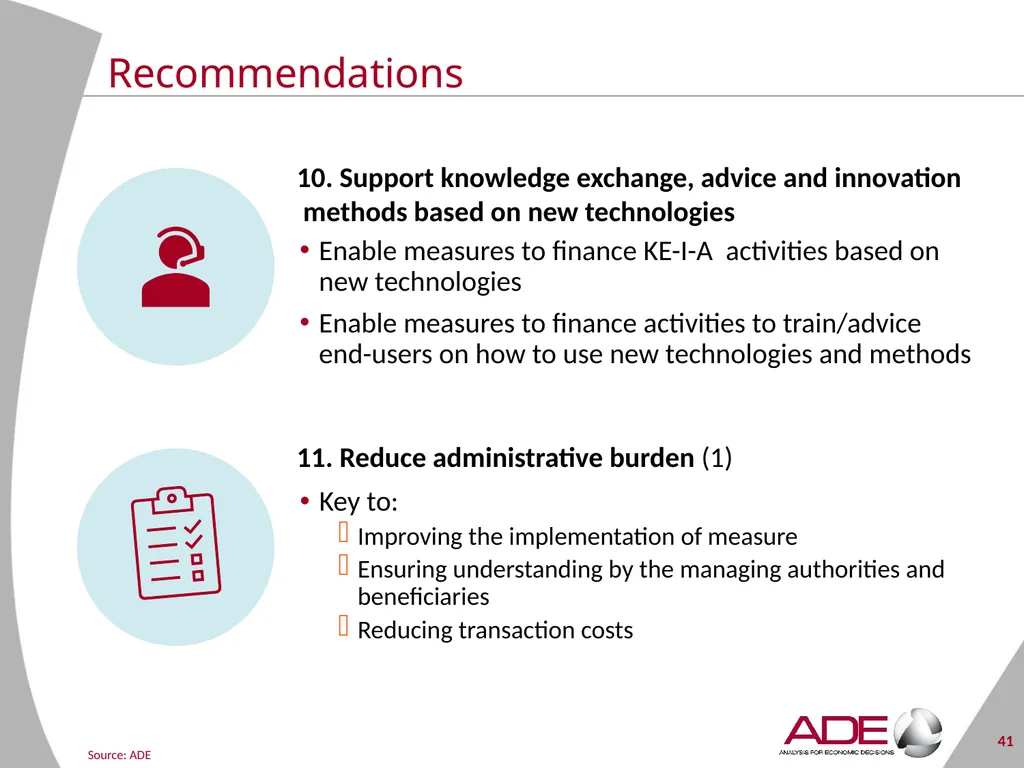
slide41. Recommendations 10. Support knowledge exchange, advice and innovation methods based on new technologies Enable measures to finance KE-I-A activities based on new technologies
Enable measures to finance activities to train/advice end-users on how to use new technologies and methods 11. Reduce administrative burden (1) Key to:
Improving the implementation of measure
Ensuring understanding by the managing authorities and beneficiaries
Reducing transaction costs 41<br>
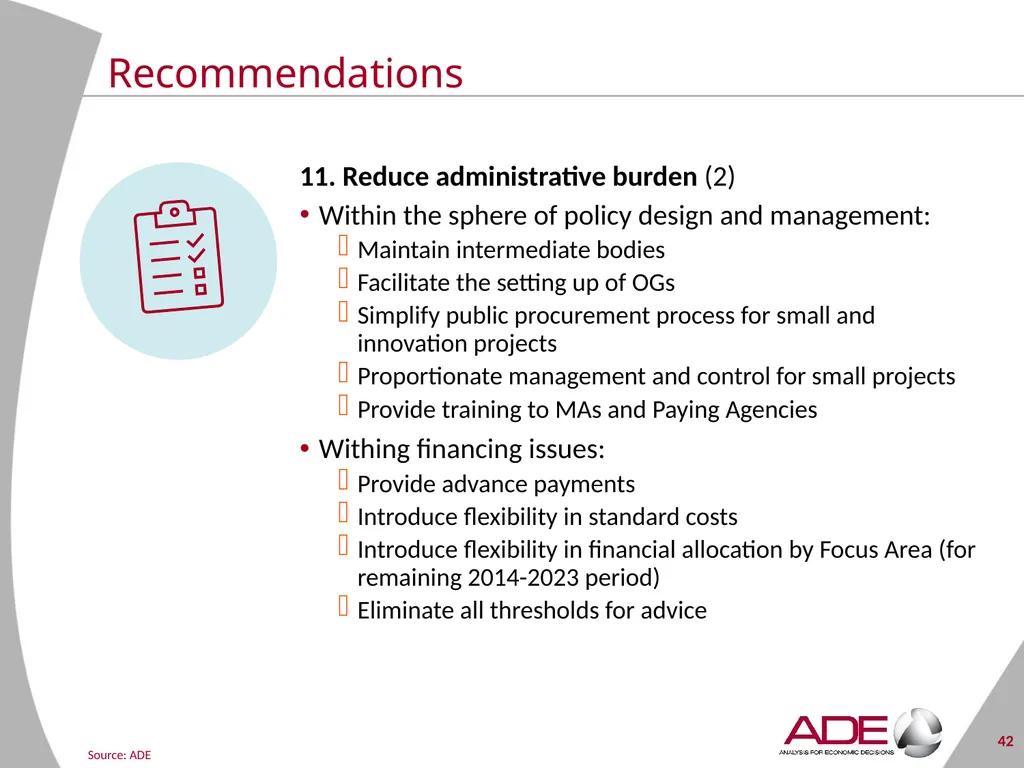
slide42. Recommendations 11. Reduce administrative burden (2) Within the sphere of policy design and management:
Maintain intermediate bodies
Facilitate the setting up of OGs
Simplify public procurement process for small and innovation projects
Proportionate management and control for small projects
Provide training to MAs and Paying Agencies
Withing financing issues:
Provide advance payments
Introduce flexibility in standard costs
Introduce flexibility in financial allocation by Focus Area (for remaining 2014-2023 period)
Eliminate all thresholds for advice 42<br>
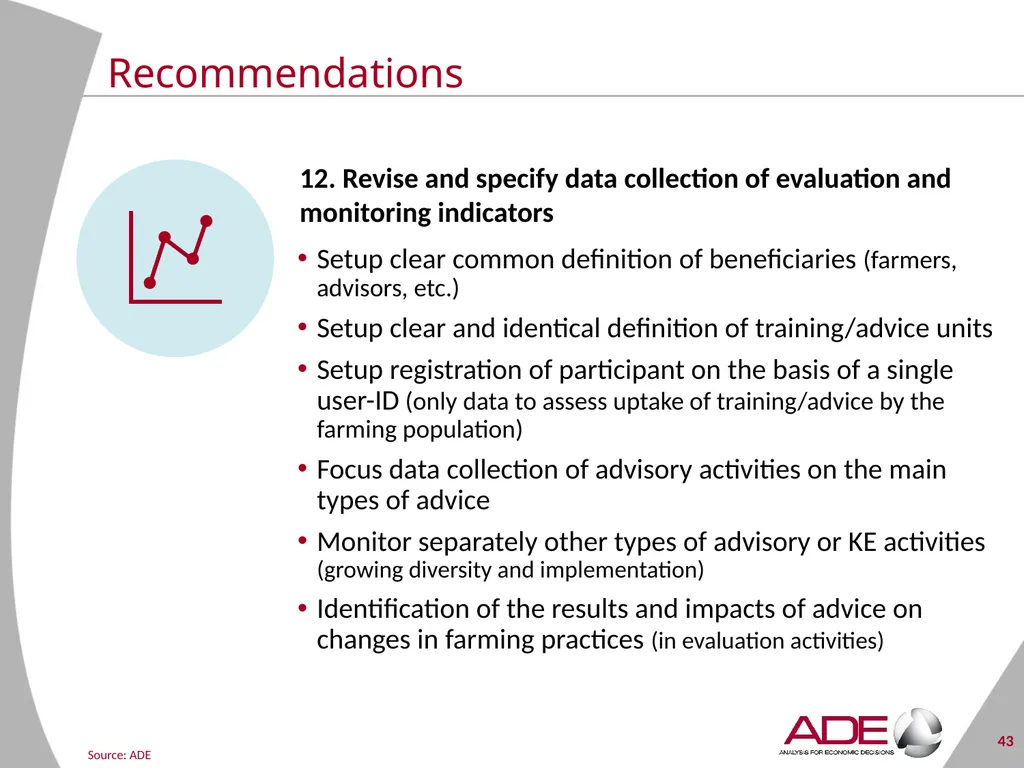
slide43. Recommendations Setup clear common definition of beneficiaries (farmers, advisors, etc.)
Setup clear and identical definition of training/advice units
Setup registration of participant on the basis of a single user-ID (only data to assess uptake of training/advice by the farming population)
Focus data collection of advisory activities on the main types of advice
Monitor separately other types of advisory or KE activities (growing diversity and implementation)
Identification of the results and impacts of advice on changes in farming practices (in evaluation activities) 12. Revise and specify data collection of evaluation and monitoring indicators 43<br>
slide44. Monika Beck Team Leader
Monika.Beck@ade.eu Patrick Van Bunnen, Jean-Marie Wathelet, Joanna Cozier, Aurore Ghysen – ADE
Janet Dwyer, Nenia Micha, Katarina Kubinakova - CCRI
Francesco Mantino - CREA Evaluation team<br>
slide2. Agenda Objectives and scope of the evaluation
Evaluation themes and support study questions
General approach to the evaluation
Evaluation process and timeline
Presentation of the team
Methodology
Information sources and tools
Case studies
Surveys
Limitations
Conclusions
Recommendations<br>
slide3. Objectives and scope of the evaluation<br>
slide4. Objectives and scope of the evaluation 4<br>
slide5. 1305/2013
EAFRD (RDR) 1306/2013
Horizontal 1307/2013
Pillar 1 1308/2013
CMO Measure 1: Knowledge transfer and information actions (Art. 14)
Measure 2: Advisory services, farm management and farm relief services (Art. 15)
Measure 16: Co-operation (Art. 35) M3.1 – Quality schemes for agricultural products
M4 – Investments in physical assets
M6.1 – Setting up of Young Farmers (YF)
M6.4 – Innovation
M9 – Setting up of producer groups and organisations
M10.1 – Agro-environment and climate
M11.1 – Organic farming
M19 – LEADER (Art. 42-44) EIP: European Innovation Partnership (Art. 53)
NRN / RRN: National/Regional rural network (Art. 54) CAP measures and instruments concerned 5<br>
slide6. 1305/2013
EAFRD (RDR) 1306/2013
Horizontal 1307/2013
Pillar 1 1308/2013
CMO Direct payments – Greening (crop diversification, maintenance of permanent pasture, ecological focus area)
Coupled Support FAS : Farm Advisory System (Art. 12 & 14) Innovation in the wine sector (Art. 51) CAP measures and instruments concerned 6<br>
slide7. Intervention Logic 7<br>
slide8. Evaluation themes and support study questions<br>
slide9. 9 6 Themes & 16 Evaluation support study questions<br>
slide10. 10 Structuring and understanding the ESQs Link between evaluation criteria and the intervention logic:<br>
slide11. General approach to the evaluation<br>
slide12. 12 General Approach With triangulation of information sources and approaches.<br>
slide13. Steering group Phase 1
Structuring Phase 2
Observing Phase 3
Analysing Phase 4
Judging September/Mid-October Kick-off 3d
SG T1.2 Establish intervention logic
T1.3-1.6 Draft analysis of the ESQ, elaborate the general approach and prepare the evaluation tools
T1.7 Provide approach to the selection of CS
T1.1 & T1.8 T2.1 Collect information and report about it T3.1 Replies to ESQs 8-11 (efficiency), 14 and 15 (relevance) 16 (EU-added value) T4.1 Conclusions & recommendations
T4.2 Executive summary
T4.6 Compilation of the preliminary final deliverable
T4.3 Abstract
T4.4 Leaflet
T4.5 PowerPoint presentation
T4.7 Compilation of the draft final deliverable
T4.8 Compilation of the final deliverable First
interim report Second
interim report Fourth interim report Final report 5th
SG SG 2nd SG T - task Evaluation process and timeline 1.5 months 3 months 1.5 months 1.5 months 2.5 months 1 month Preliminary final Draft final Mid-October/November/ December/Mid-January T3.1 Replies to ESQs 1-3 (causal analysis), 4-7 (effectiveness) and 12 and 13 (coherence) Third
Interim report 3 months Mid-January/
February/March/
Mid-April Mid-April/May June/Mid-July Mid-July/
August/
September October 4th
SG 22/10 28/01 27/04 10/06 6th SGM 27/07 13<br>
slide14. 14 Presentation of the team Team of national experts (complement core team where necessary for the conduct of the MS/Regional case studies) Core Evaluation Team Team Leader
Monika Beck
ADE Janet Dwyer
CCRI Francesco Mantino
CREA Patrick Van Bunnen
ADE Quality Assurance
J-M. Wathelet ADE Team
Konstantin Gruev
Joanna Cozier
Aurore Ghysen CCRI Team
Evgenia Micha
Katarina Kubinakova
John Powell CREA Team
Simona Cristiano
Anna Vagnozzi
Mara Lai OIR Team
Ambre Maucorps<br>
slide15. Methodology<br>
slide16. 16 Information sources and tools Informed opinions collected at EU level
Comprehensive literature review (on the concept, evolution and diversity of AKIS, EIP-AGRI network, Farm Advisory Systems, existing and emerging needs in rural areas as well as critical factors of success; and of relevant research projects such as ProAKIS and AgriLink)
Interviews with key stakeholders (DG-AGRI, EIP-AGRI Service Point, ENRD Contact Point, JRC)
Participation in webinars (AgriLink, EIP-AGRI)
Two online surveys - RDP Managing Authorities and FAS coordinators
EU-level Data analysis
Documentary analysis (including extensive screening of 112 AIR 2018)
Financial data: ESIF database, CMEF indicators and targets from RDPs
Multi-variate principal component analysis and regressions (ESQ7)
JRC FAS questionnaire, where sufficiently accurate
Detailed quantitative and qualitative analysis at the level of case study Member states and regions (see following slides)<br>
slide17. 17 Case studies selection Objective of the typology/clustering:
Cover the wide range of approaches across the EU in terms of knowledge exchange, innovation and advisory activities in the agricultural and forestry sectors
Approach:
Application of 5 criteria
Selection operated in 2 steps (clustering using R with K-means)
Selection of 4 clusters
Choice of 1-3 Member States per cluster
Selection:
eight Member States and nine regions namely in Flanders (Belgium), Estonia, Lorraine (France), Lower-Saxony (Germany), Ireland, Veneto and Umbria (Italy) and Poland<br>
slide18. 18 Group 1 (3MS)
(1) important (first) in terms of political intention in T1 (2) first in terms of decision rate (3) first in terms of intensity (SO/AWU)
(4) Strong AKIS fragmented to medium
Group 2 (9MS)
(1) the lowest political intention in T1 (except HU) (2) the lowest decision rate (3) the second lowest productivity in terms of SO/AWU with exceptions (FR, LUX) (4) All types of AKIS except intermediate
Group 3 (5MS)
(1) a political intention in T1 above the average (2) the lowest decision rate (3) a relatively low in terms of SO/AWU
(4) Mainly weak and fragmented AKIS
Group 4 (11MS)
(1) a political intention in T1 around or above the average with some exceptions (PT, SK are lower) (2) a good decision rate (3) a relatively high in productivity SO/AWU (exceptions : LV, PT)
(4) Different AKIS types Case studies selection<br>
slide19. 19 Information sources and tools (cont.) Detailed quantitative and qualitative analysis at the level of case study Member states and regions
Comprehensive literature review (both at national and regional levels, with valorisation of work performed by the Thünen Institute since 2007 with an essential contribution to the efficiency analysis)
Documentary analysis (2018 Annual Implementation Reports)
Interviews with :
the competent authorities
stakeholders involved in agricultural research and education, EIP-AGRI, rural networks and the forestry sector
trainers
advisors
and beneficiaries
Beneficiaries online (for Grand-Est in FR) or phone (for Lower Saxony in DE) surveys<br>
slide20. 20 Information sources and tools (cont.) Multiple surveys: MA survey
Opened on 20/01
Sent to 88 contacts (out of 112 RDPs; 18 appeared non-valid)
33 answers, from 10 MS Final beneficiaries
Online survey – only in Grand-Est (Alsace, Lorraine, Champagne Ardennes): sent to 3,600 farmers, from 22/01 to 5/02 (142 answers)
Focus groups and/or phone call with farmers directly contacted in other CS MS FAS survey
Opened on 12/02
Sent to 115 contacts (18 non-valid)
21 answers, from 17 MS<br>
slide21. 21 Limitations Data availability and validity
No single database containing both budgetary data and their breakdown by sub-measures, which makes it necessary to use several distinct databases
Major differences in the methods used to calculate certain CMEF indicators between Member States, also allowing some multiple counting
Small decision rates and sometimes even very low spending rates for the relevant Rural Development measures
Absence of robust data on uptake of training/advice by farmers/foresters
Monitoring data of the FAS does not provide a comprehensive reliable view of the operation of the FAS (combination of all type of advice into a single indicator and impossibility for some regionalised Member States to provide a unique Member State response)
Time constraint for the case studies<br>
slide22. Conclusions<br>
slide23. Theme 1 ▪ Causal Analysis CAP instruments and measures contribute to Member States’ AKIS but CAP support concerns only a small (very small part) of MS’ AKIS
More specifically:
Low awareness of the concept of AKIS among MA and stakeholders in CS MS
MS AKIS and CAP architecture are strongly influenced by the historical context of privatisation of advisory services (and implementation of the FAS) – current extraordinary diversity of situations across MS/regions
Administrative burden limits the use of CAP KE-I-A measures which are small financially, compared to other RD measures
No relation found between the architecture of CAP I&M (and their contribution to MS’ AKIS) and the characteristics of MS’ AKIS
The impact of the FAS on AKIS varies along a gradient, from ex post statement of preexisting elements to the provision of stimulus to use RD funding to rethink the whole advisory system and services proposed 23<br>
slide24. Theme 2 ▪ Effectiveness Effect on fostering knowledge exchange, innovation and advisory activities (KE-I-A)
Increased total budget for KE-I-A measures (M1-2-16) (compared to 2007-2013) but only due to:
the EIP-AGRI OGs and cooperation M16
the cross-cutting objective to foster KE-IA and T1 (% KE-I-A in total RDP)
Share remains relatively limited
M16: New cooperation measure, widely taken up by MS (showing in particular the success of the EIP-AGRI OGs innovative projects and effect of the EIP network)
M1: Planned by most RDPs but 13% budget reduction (compared to 07-13)
M2: 20% budget reduction (compared to 07-13)
Advice (as KE and innovation) is also supported by national public funds alone
Despite limited budget and administrative burden in implementation (see efficiency), CAP I&M contribute to foster KE-I-A, individually and taken together. 24<br>
slide25. Theme 2 ▪ Effectiveness Effect on fostering KE-I-A activities (2)
M1 for KE: output indicators are higher than expected relative to spent amounts (number of participants), but data are not collected consistently; no figures are available on uptake, and target population is often very broadly defined
M2.1 and FAS for advice:
M2.1 shows promising results, with more farmers advised than over the entire previous period, covering a large scope of topics (FAS themes and many others). Many MS assimilate M2 and the FAS.
M2 is combined to other measures in a few MS – however its implementation is limited by administrative burden (see efficiency)
From CS MS with advanced implementation (DE-LS, EE, FR-LO, IE), KT and A fostered the adoption of standards and led to improve farming and management practices beyond standards. 25<br>
slide26. Theme 2 ▪ Effectiveness Effect on fostering KE-I-A activities (3)
M16.1 promoting a bottom-up approach with direct contribution of farmers to innovation: demonstrated success of the OG dynamic with its co-creative search for solutions to needs/opportunities of farmers and foresters. (1600 OGs currently = 50% of the target)
Importance of “Innovation support services”, NRN/RRN, other facilitators
Information flows are key for an integrated and effective AKIS (farmer-advisor; advisor-researcher; farmer- research) supported by the EIP-AGRI
Limits and challenges to OGs:
Involvement of farmers
Dissemination of results
No evidence in terms of impact yet (too short perspective)
Other measures fostering KE-I: LEADER (M19), NRN, H2020 (through M16), LIFE, Interreg 26<br>
slide27. Theme 2 ▪ Effectiveness Lifelong learning (LLL) and vocational learning
CAP I&M promote LLL and vocational training:
Directly, through support of training and advisory activities (M1 and M2)
Indirectly, through requirements and conditions (start-up support, investment, etc.), but the possible synergies between measures remain under-exploited and pre-requisite training/advice is often funded by national/regional funds (outside the CAP)
Entry and maintenance of adequately skilled farmers
CAP I&M supported the entry/maintenance:
Directly, through support of training and advisory activities (M1 and M2)
Directly through the obligation to implement a FAS in each MS
Directly or indirectly through specific requirements, such as the conditions on start-up support (M6.1) that contributed to increase the young farmers’ level of qualification and the AECM (M10) that make expert advice conditional for support
Agricultural advice remains an essential lever to change farmers’ practices
The FAS increased farmers’ awareness of advisory services and also of regulatory requirements. Together with M2, it improved advisors’ training. 27<br>
slide28. Theme 3 ▪ Efficiency 28 How efficiently CAP I&M help to improve AKIS functioning, information flows and knowledge acquisition?
Limited evidence that CAP I&M significantly increased the reach of KE-I-A (around 10% of farm holdings and around 20% of CAP beneficiaries). Not a priority for the MS?
Mixed evidence on cost-efficiency, but still room for improvement (with higher skills in managing demand, more efficient delivery of KE services, and targeting of beneficiaries as the most prominent needs)
The EIP-AGRI Service Point and its activities are expected to be efficient, and an important and valuable addition to AKIS efficiency across MS
Targeted training of advisors efficiently enhances AKIS functioning
Heterogenous cost/benefit proportion of the FAS (limited in MS where the advice offer is comprehensive and embedded in a strong and integrated AKIS, with a benefit outweigh of the FAS-M2 package in MS with intermediate AKIS, up to substantial contribution in terms of topics and quality in MS with weak and fragmented AKIS)<br>
slide29. Theme 3 ▪ Efficiency 29 Administrative burden
Low RDP spending rates (31% M1, 17% M2, 18% M16 versus 53% for all RD measures) are an evidence of administrative burden
Distinction between different levels:
Beneficiaries: burden is negligible for training and advice (transfer to operating bodies), and quite important in OGs (who were in a learning process in 2014-2020)
Public administration and intermediary bodies (service providers): burden is high (public procurement rule, learning process for EIP, use of simplified costs at inadequate level and for OGs, proportionality of controls)
EU officials: strong initial efforts for the new EIP-AGRI measure<br>
slide30. Internal coherence within the CAP
Stronger link of the legal framework of the CAP (common objectives and CMEF)
But no common programming for EAGF and EAFRD (contrary to ESIF) - Pillars 1 & 2 are managed by distinct authorities
The FAS addresses greening and cross-compliance common to both pillars
Within Pillar 2, clear search for increased design coherence through its architecture, innovation cross-cutting objective and KE-I Priority 1
But envisaged complementarities and synergies are not fully implemented. The design remains complex. Measures are still largely managed “in silos” at the level of administrations; there is still a lack of flexible and combined use of KE-I-A measures and sub-measures, and synergies with other RD measures, Theme 4 ▪ Coherence 30<br>
slide31. External coherence
ESIF (ESF, ERDF): common programming, clear demarcation lines, but no evidence from case study MS of complementarities and synergies
Horizon 2020: recognised coherence at EU/national level and successful synergies with the EIP-AGRI in some MS (front-runners) Theme 4 ▪ Coherence 31<br>
slide32. Theme 5 ▪ Relevance Regarding beneficiaries’ current and emerging needs
Topics: legal provisions allow to cover all relevant KE-I-A topics, no restrictions
Methods: EU framework quite broad (with an exception of 1-1 advice), but MS feel limitations also compared to their own initial scoping
The SWOT is a step forward in needs’ identification and focus on specific topics. However, possibly due to administrative burden, only a small share of KE-I-A is supported by the CAP and there is no information on the coverage of these needs with national resources
Regarding EU/national/regional policies
The actual contribution of the CAP to fostering KE-I-A is difficult to establish when national funding is also provided
There is evidence that EU & MS networks and institutional developments (EIP-AGRI, etc.) fostered new functionalities (farmer learning; strengthening links between research, innovation and practice). Until now, the number of farmers involved directly in the projects is small, but the impact goes beyond those.
Regarding the FAS obligation
Financial support to the FAS through M2 is valuable especially in MS with weak AKIS 32<br>
slide33. Theme 6 ▪ EU value added There is evidence of the CAP added-value in fostering KE-I-A (despite administrative burden)
EIP-AGRI is highly valued: the promotion of bottom-up approaches focusing on farmers’/foresters’ needs and co-creation is significantly positive to fostering KE-I-A
Cross-cutting consideration of innovation (Priority 1)
RD support enables additional achievements in KE and advice, and the extension of services’ offer
CAP encouraged a key evolution in terms of:
Methods
Thematic coverage 33<br>
slide34. Recommendations<br>
slide35. 35 Recommendations 1. Develop an integrated vision of MS’s AKIS In preparing their CAP strategic plans, MA should develop a comprehensive vision of their AKIS (also at regional level in regionalised MS)
Based on assessment of the existing AKIS, its strengths and weaknesses, the needs and interconnections
Build a strategy based on short- and medium-term vision to strengthen and adapt the system to needs
Emphasis put on information flows between actors and between the various geographical levels<br>
slide36. Recommendations 2. Strengthen coherence between CAP instruments and measures and MS’s AKIS Based on a comprehensive view of the existing AKIS, CAP I&M can be used to:
cover needs in terms of KE-I-A in line with the national/regional strategy
strengthen the system and information flows were needed
Ensure an ‘AKIS concept’ promotion at EU, national and regional levels to make MA/stakeholders familiar with it. 36<br>
slide37. Recommendations 3. Maintain and develop the EIP-AGRI Ensure an “EIP-AGRI promotion strategy” in all MS and ensure that the EIP-AGRI is well integrated in MS’s AKIS
Setup innovation support services. Together with an EIP-AGRI extended Service Point and dedicated innovation strand, they should:
Promote overall the EIP-AGRI and OGs
Support the concrete implementation of OGs
Implement strategies for results’ dissemination
Improve the information flows to and from farmers
Address the current barriers to further encourage farmers’ and advisors’ involvement in OGs
Identify and record the results and impacts of OGs 37<br>
slide38. Recommendations 4. Foster information flows between advisors and both farmers and research Setup incentives for advisors’ initiatives to:
communicate farmers’ needs
disseminate knowledge 5. Maintain training and knowledge support for advisors Provide training in various forms and upskilling for advisors
Encourage MS to link funding of advice to training of advisors 38<br>
slide39. Recommendations 6. Foster holistic advice in response to farmers’ needs including topics of public interest Advice really needs to be adapted to the farmers’ needs
Include topics of public interest but also advice on the economic and environmental performance of the farms, adapted to each local situation 7. Increase the ability of all farmers to access advisory services and promote advisory activities while enabling approaches to evolve Guarantee access to high-quality advice for all EU farmers (taking into account the specificities of their farm)
Ensure financial resources to support these activities and their promotion by AKIS actors and other stakeholders
Complement on farm one-to-one advice by other approaches 39<br>
slide40. Recommendations 8. Place more emphasis upon reaching the ‘hard to reach” Provide specific CAP funding targeting these groups for KE-I-A adapted to their specific needs
Develop strategic approaches to foster the most efficient balance of public, private and hybrid forms of KE-A. 9. Improve ‘targeting’ Target activities to those CAP beneficiaries and farmers where the needs for advice and training are the greatest
Increase awareness of how CAP KE-I-A measures can target excluded groups and strengthen capacity/governance in these contexts 40<br>
slide41. Recommendations 10. Support knowledge exchange, advice and innovation methods based on new technologies Enable measures to finance KE-I-A activities based on new technologies
Enable measures to finance activities to train/advice end-users on how to use new technologies and methods 11. Reduce administrative burden (1) Key to:
Improving the implementation of measure
Ensuring understanding by the managing authorities and beneficiaries
Reducing transaction costs 41<br>
slide42. Recommendations 11. Reduce administrative burden (2) Within the sphere of policy design and management:
Maintain intermediate bodies
Facilitate the setting up of OGs
Simplify public procurement process for small and innovation projects
Proportionate management and control for small projects
Provide training to MAs and Paying Agencies
Withing financing issues:
Provide advance payments
Introduce flexibility in standard costs
Introduce flexibility in financial allocation by Focus Area (for remaining 2014-2023 period)
Eliminate all thresholds for advice 42<br>
slide43. Recommendations Setup clear common definition of beneficiaries (farmers, advisors, etc.)
Setup clear and identical definition of training/advice units
Setup registration of participant on the basis of a single user-ID (only data to assess uptake of training/advice by the farming population)
Focus data collection of advisory activities on the main types of advice
Monitor separately other types of advisory or KE activities (growing diversity and implementation)
Identification of the results and impacts of advice on changes in farming practices (in evaluation activities) 12. Revise and specify data collection of evaluation and monitoring indicators 43<br>
slide44. Monika Beck Team Leader
Monika.Beck@ade.eu Patrick Van Bunnen, Jean-Marie Wathelet, Joanna Cozier, Aurore Ghysen – ADE
Janet Dwyer, Nenia Micha, Katarina Kubinakova - CCRI
Francesco Mantino - CREA Evaluation team<br>