
Evidence-Based Prevention: The Universal
CB
Published · 29 slides · 0 views
1 / 1
Description
Evidence-Based Prevention: The Universal Prevention Curriculum Zili Sloboda, Sc.D. International Society for Substance Use Prevention and Treatment Professionals The Inaugural Meeting July 6, 2015 Prevention Science and Prevention Practice
Related Topics
Share
Embed code
Download this presentation From Below
"Evidence-Based Prevention: The Universal" is the property of its rightful owner. Permission is granted to download and print the materials on this website for personal, non-commercial use only, and to display it on your personal computer provided you do not modify the materials and that you retain all copyright notices contained in the materials. By downloading content from our website, you accept the terms of this agreement.
Presentation Transcript
01
Evidence-Based Prevention:
The Universal Prevention Curriculum Zili Sloboda, Sc.D.
International Society for Substance Use Prevention and Treatment Professionals
The Inaugural Meeting
July 6, 2015<br>
International Society for Substance Use Prevention and Treatment Professionals
The Inaugural Meeting
July 6, 2015<br>
02
Prevention Science and Prevention Practice Prevention science is an evolving new field
Prevention science draws from many disciplines: epidemiology, health and social sciences, research design methodologies AND practice Applied Prevention Science, Inc. 2<br>
Prevention science draws from many disciplines: epidemiology, health and social sciences, research design methodologies AND practice Applied Prevention Science, Inc. 2<br>
03
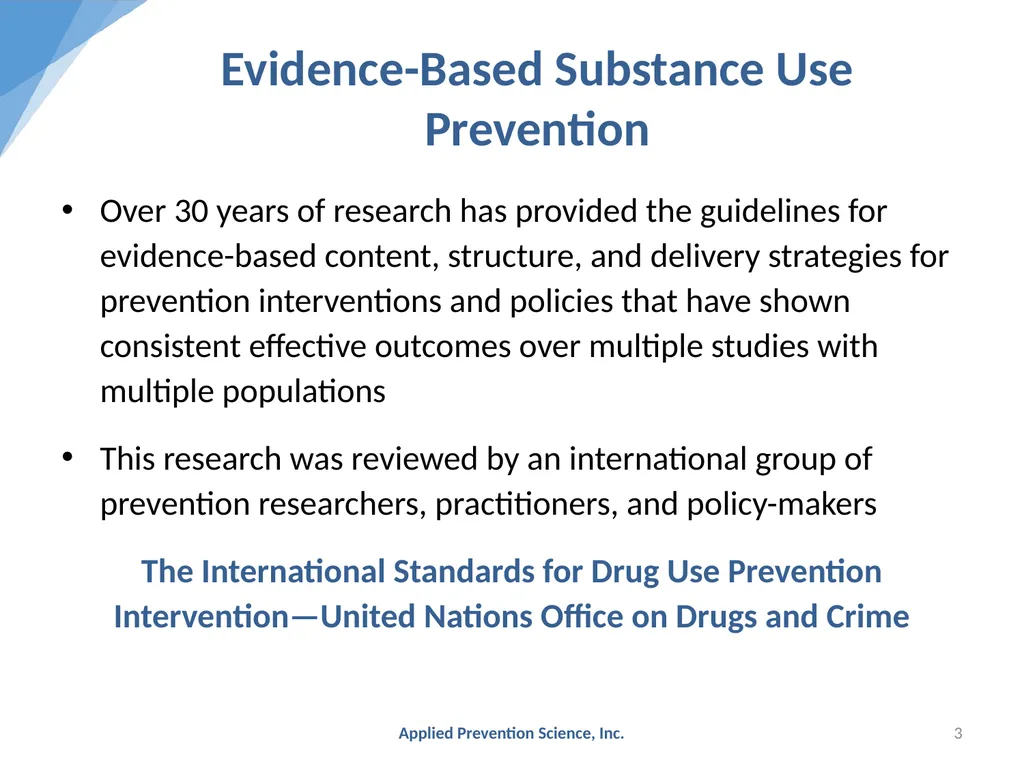
Evidence-Based Substance Use Prevention Over 30 years of research has provided the guidelines for evidence-based content, structure, and delivery strategies for prevention interventions and policies that have shown consistent effective outcomes over multiple studies with multiple populations
This research was reviewed by an international group of prevention researchers, practitioners, and policy-makers
The International Standards for Drug Use Prevention Intervention—United Nations Office on Drugs and Crime Applied Prevention Science, Inc. 3<br>
This research was reviewed by an international group of prevention researchers, practitioners, and policy-makers
The International Standards for Drug Use Prevention Intervention—United Nations Office on Drugs and Crime Applied Prevention Science, Inc. 3<br>
04
Etiology of Substance Use Effective substance use prevention draws on our understanding of the etiology or origins of initial use and the pathways from initial use to abuse
Determinants of or factors involved in substance use initiation are indicated by:
Longitudinal studies of children and adolescents
General populations
Children of substance users (Source: Merriam-Webster Dictionary) 4 Applied Prevention Science, Inc.<br>
Determinants of or factors involved in substance use initiation are indicated by:
Longitudinal studies of children and adolescents
General populations
Children of substance users (Source: Merriam-Webster Dictionary) 4 Applied Prevention Science, Inc.<br>
05
What Do We Know about the Initiation of Substance Use? We know that:
Substance use begins in late childhood and adolescence, and, therefore is a developmental problem.
It is a process that includes many different pathways and mostly driven by behavioral decisions influenced by internal, biological and genetic factors and external, environmental and social factors. Applied Prevention Science, Inc. 5<br>
Substance use begins in late childhood and adolescence, and, therefore is a developmental problem.
It is a process that includes many different pathways and mostly driven by behavioral decisions influenced by internal, biological and genetic factors and external, environmental and social factors. Applied Prevention Science, Inc. 5<br>
06
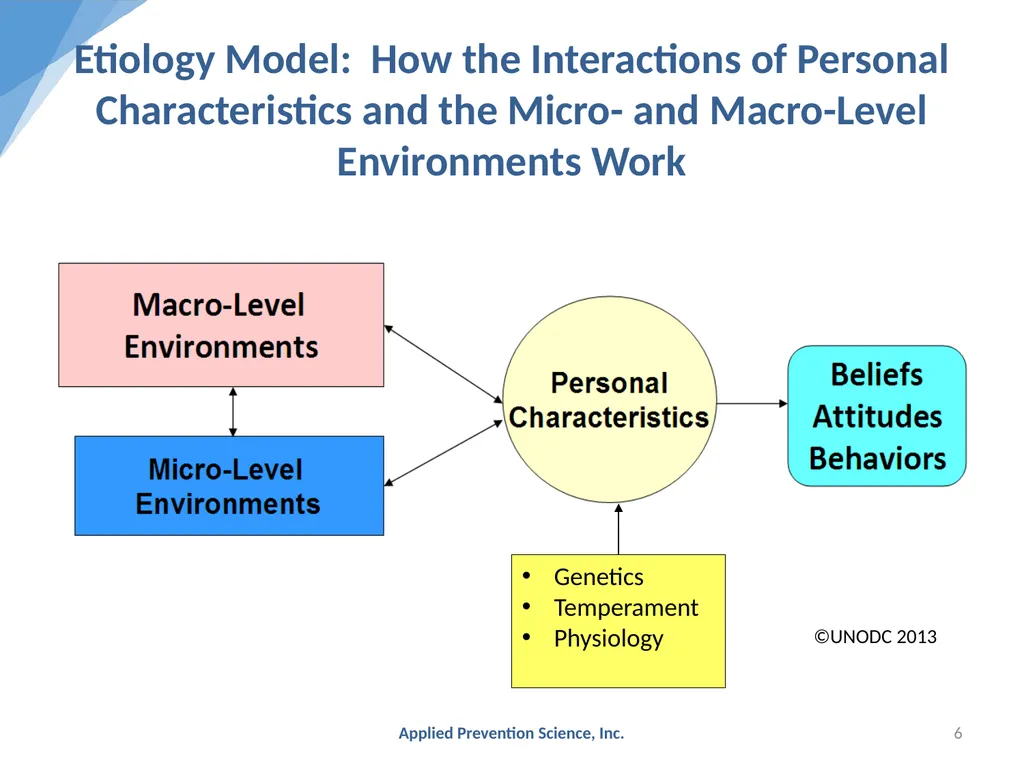
Etiology Model: How the Interactions of Personal Characteristics and the Micro- and Macro-Level Environments Work ©UNODC 2013 Genetics
Temperament
Physiology 6 Applied Prevention Science, Inc.<br>
Temperament
Physiology 6 Applied Prevention Science, Inc.<br>
07
Risk and Protective Factors: Background (1/2) Relatively little research was conducted until the 1970s regarding what factors or processes were associated with the onset of substance use
In the mid-1970s, primarily in the United States, several longitudinal studies were conducted that followed cohorts of early adolescents into adulthood that examined factors that were related to substance use initiation
In 1992 two significant works summarized this research on factors related not only to the initiation of substance use but also to the progression from use to abuse 7 Applied Prevention Science, Inc. Hawkins, J. D., Catalano, R. F., & Miller, J. Y. (1992).
Glantz, M. D. & Pickens, R. W. (1992).<br>
In the mid-1970s, primarily in the United States, several longitudinal studies were conducted that followed cohorts of early adolescents into adulthood that examined factors that were related to substance use initiation
In 1992 two significant works summarized this research on factors related not only to the initiation of substance use but also to the progression from use to abuse 7 Applied Prevention Science, Inc. Hawkins, J. D., Catalano, R. F., & Miller, J. Y. (1992).
Glantz, M. D. & Pickens, R. W. (1992).<br>
08
Risk and Protective Factors: Background (2/2) Risk factors are defined as measures of behavior or psychosocial functioning (including attitudes, beliefs, and personality) that were found to be associated with increased risk to use psychoactive substances
Contextual factors
Individual and interpersonal
Protective factors involve measures that appear to prevent the use of psychoactive substances or reduce the untoward negative effects of risk. Protective factors identified through research include strong bonding to family, school, community and peers that hold prosocial attitudes and support prosocial behaviors. 8 Source: Communities That Care. Risk and Protective Factor Scale Construction Summary Applied Prevention Science, Inc.<br>
Contextual factors
Individual and interpersonal
Protective factors involve measures that appear to prevent the use of psychoactive substances or reduce the untoward negative effects of risk. Protective factors identified through research include strong bonding to family, school, community and peers that hold prosocial attitudes and support prosocial behaviors. 8 Source: Communities That Care. Risk and Protective Factor Scale Construction Summary Applied Prevention Science, Inc.<br>
09
Reconceptualizing Prevention With more research being made available about the etiologic processes associated with the onset of substance use there has been a new way of looking at the process that serves to reconceptualize prevention
This is the process of socialization Applied Prevention Science, Inc. 9<br>
This is the process of socialization Applied Prevention Science, Inc. 9<br>
10
Socialization Human infants are born without any culture.
Socialization is a process of transferring culturally acceptable attitudes, norms, beliefs and behaviors and to respond to such cues in the appropriate manner.
Since socialization is a lifelong process, the individual will be socialized by a large array of different socializing agents (e.g., parents, teachers, peer groups, religious, economic and political organization and virtual agents, such as mass media). 10 Applied Prevention Science, Inc.<br>
Socialization is a process of transferring culturally acceptable attitudes, norms, beliefs and behaviors and to respond to such cues in the appropriate manner.
Since socialization is a lifelong process, the individual will be socialized by a large array of different socializing agents (e.g., parents, teachers, peer groups, religious, economic and political organization and virtual agents, such as mass media). 10 Applied Prevention Science, Inc.<br>
11
Socialization in Modern Societies In complex and multicultural societies, the likelihood that the socialization process is not always optimal has increased:
Complex “cultures” – mechanical vs. organic solidarity
Neighborhood disorganization
Conflicts between socialization agents, e.g., home vs. school
Geographic mobility and immigration
Global village syndrome Applied Prevention Science, Inc. 11<br>
Complex “cultures” – mechanical vs. organic solidarity
Neighborhood disorganization
Conflicts between socialization agents, e.g., home vs. school
Geographic mobility and immigration
Global village syndrome Applied Prevention Science, Inc. 11<br>
12
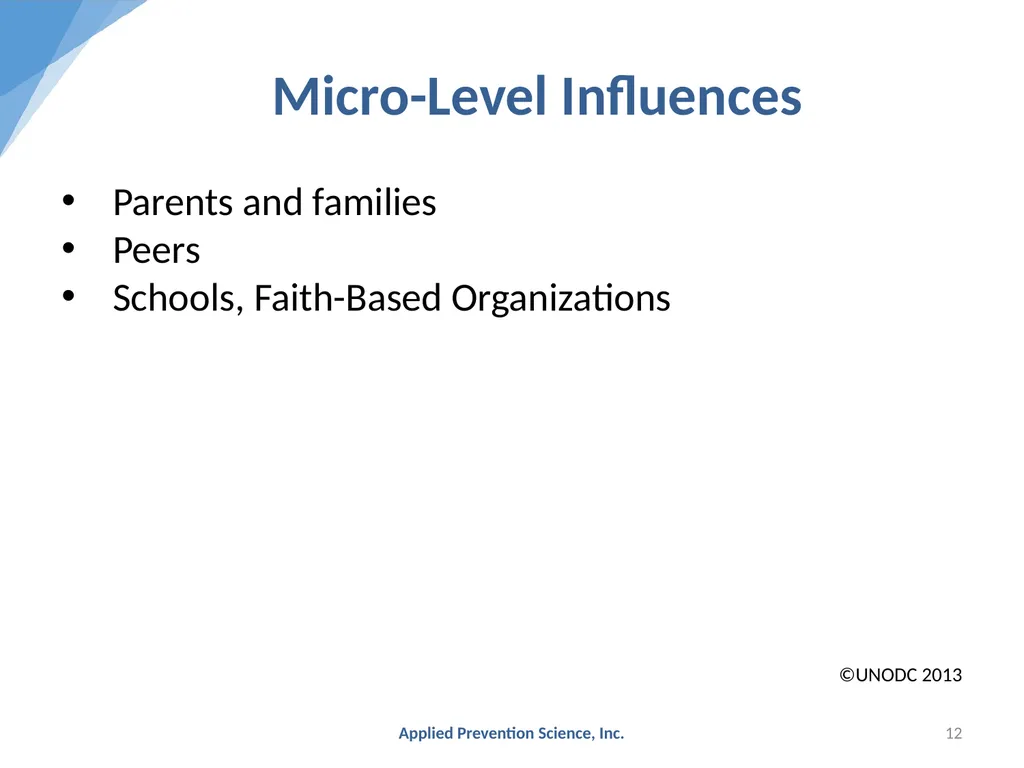
Micro-Level Influences Parents and families
Peers
Schools, Faith-Based Organizations ©UNODC 2013 12 Applied Prevention Science, Inc.<br>
Peers
Schools, Faith-Based Organizations ©UNODC 2013 12 Applied Prevention Science, Inc.<br>
13
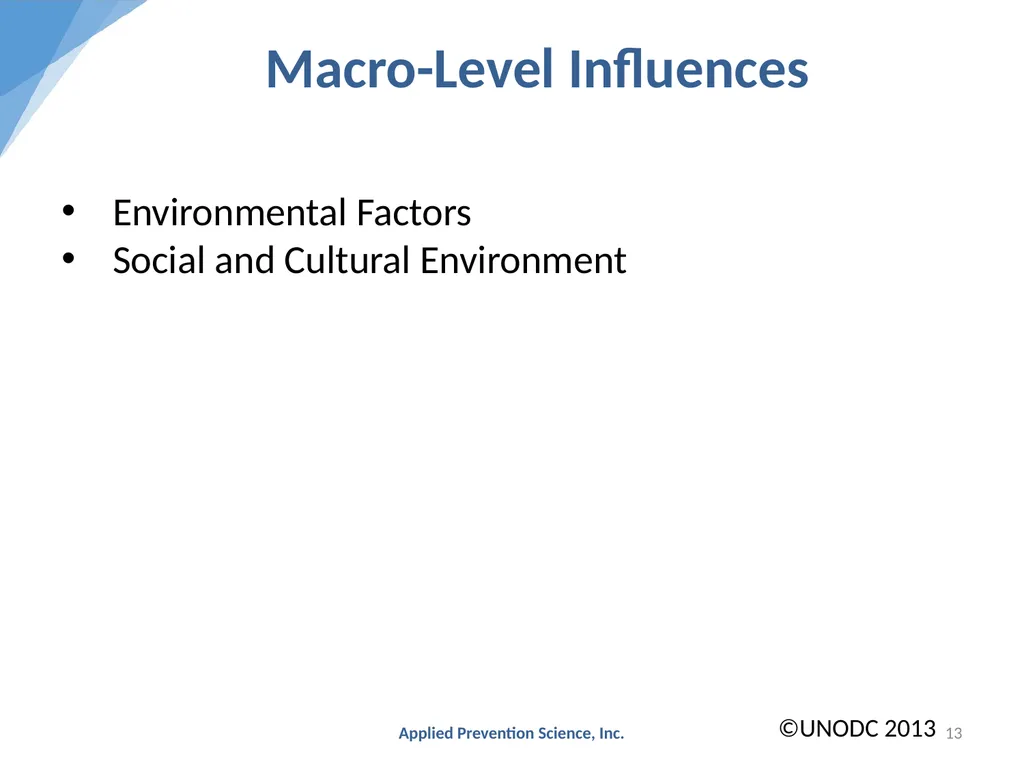
Macro-Level Influences Environmental Factors
Social and Cultural Environment ©UNODC 2013 13 Applied Prevention Science, Inc.<br>
Social and Cultural Environment ©UNODC 2013 13 Applied Prevention Science, Inc.<br>
14
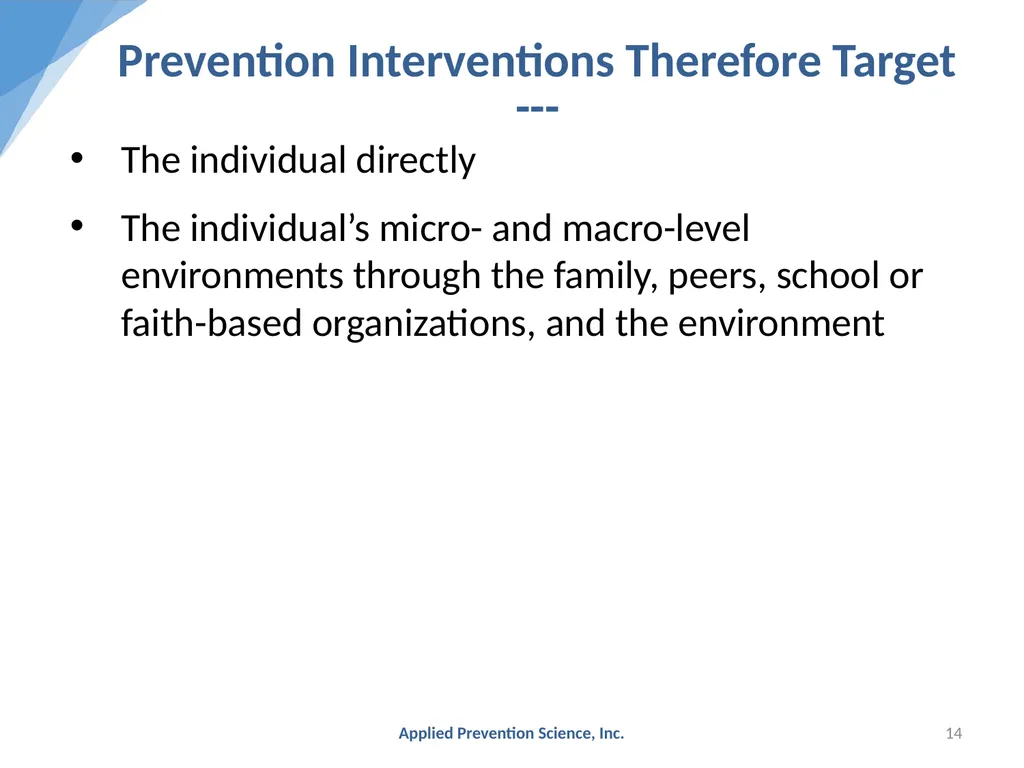
Prevention Interventions Therefore Target --- The individual directly
The individual’s micro- and macro-level environments through the family, peers, school or faith-based organizations, and the environment Applied Prevention Science, Inc. 14<br>
The individual’s micro- and macro-level environments through the family, peers, school or faith-based organizations, and the environment Applied Prevention Science, Inc. 14<br>
15
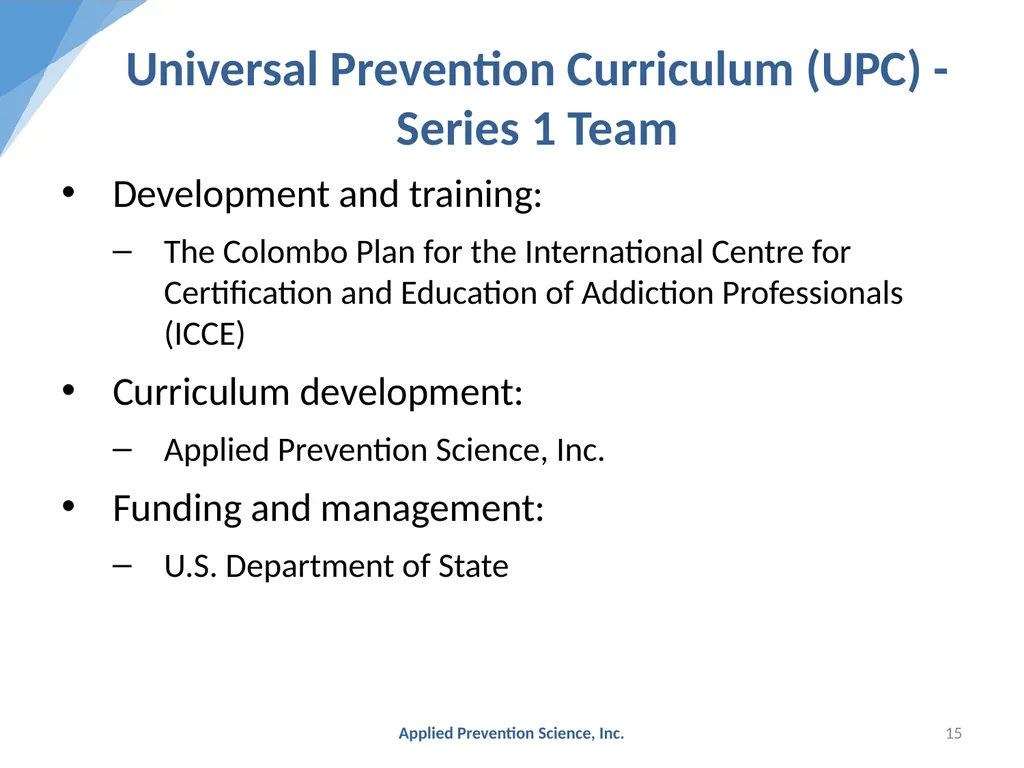
Universal Prevention Curriculum (UPC) -Series 1 Team Development and training:
The Colombo Plan for the International Centre for Certification and Education of Addiction Professionals (ICCE)
Curriculum development:
Applied Prevention Science, Inc.
Funding and management:
U.S. Department of State 15 Applied Prevention Science, Inc.<br>
The Colombo Plan for the International Centre for Certification and Education of Addiction Professionals (ICCE)
Curriculum development:
Applied Prevention Science, Inc.
Funding and management:
U.S. Department of State 15 Applied Prevention Science, Inc.<br>
16
Training Series Goal To reduce the significant health, social, and economic problems associated with substance use throughout the world by:
Building international prevention capacity through training, professionalizing, and expanding the substance use prevention workforce.
Extending evidence-based substance use prevention interventions and policies, i.e.
United Nations Office on Drugs and Crime—International Standards on Drug Use Prevention
European Monitoring Centre on Drugs and Drug Addiction—European Drug Prevention Quality Standards Applied Prevention Science, Inc. 16<br>
Building international prevention capacity through training, professionalizing, and expanding the substance use prevention workforce.
Extending evidence-based substance use prevention interventions and policies, i.e.
United Nations Office on Drugs and Crime—International Standards on Drug Use Prevention
European Monitoring Centre on Drugs and Drug Addiction—European Drug Prevention Quality Standards Applied Prevention Science, Inc. 16<br>
17
Framework: Prevention Science Recent publication of the International Standards on Drug Use Prevention* focuses on the latest research in prevention science
Standards of Knowledge for the Science of Prevention established by the U. S. Society for Prevention Research**
The need to update knowledge of prevention professionals about these evidence-based findings; and
The encouragement of government officials, policy makers, and other stakeholders to apply prevention science and evidence-based interventions and policies to the practice of prevention throughout the world Applied Prevention Science, Inc. 17 *United Nations Office of Drugs and Crime (UNODC), 2012.
**http://www.preventionresearch.org.<br>
Standards of Knowledge for the Science of Prevention established by the U. S. Society for Prevention Research**
The need to update knowledge of prevention professionals about these evidence-based findings; and
The encouragement of government officials, policy makers, and other stakeholders to apply prevention science and evidence-based interventions and policies to the practice of prevention throughout the world Applied Prevention Science, Inc. 17 *United Nations Office of Drugs and Crime (UNODC), 2012.
**http://www.preventionresearch.org.<br>
18
UPC-Series Audiences (1/2) UPC-Series 1—Prevention Coordinators: interface between the policy makers and the public and the prevention practice field. This curriculum series is designed to help them:
Translate prevention science for policy makers, decision makers and major stakeholders, and the public; and
Apply their understanding of prevention science to promote the quality delivery of evidence-based prevention programming. Applied Prevention Science, Inc. 18<br>
Translate prevention science for policy makers, decision makers and major stakeholders, and the public; and
Apply their understanding of prevention science to promote the quality delivery of evidence-based prevention programming. Applied Prevention Science, Inc. 18<br>
19
UPC-Series Audiences (2/2) UPC-Series 2—Prevention Implementers: the “front line” prevention professional who deliver the evidence-based intervention or oversee the implementation of evidence-based policies. This series is intended to help them:
Apply their understanding of prevention science to the quality delivery of evidence-based prevention programming—content, structure, and delivery strategies
Participate effectively in the selection of appropriate evidence-based prevention interventions and policies
Participate effectively in monitoring and evaluation of delivered interventions and policies Applied Prevention Science, Inc. 19<br>
Apply their understanding of prevention science to the quality delivery of evidence-based prevention programming—content, structure, and delivery strategies
Participate effectively in the selection of appropriate evidence-based prevention interventions and policies
Participate effectively in monitoring and evaluation of delivered interventions and policies Applied Prevention Science, Inc. 19<br>
20
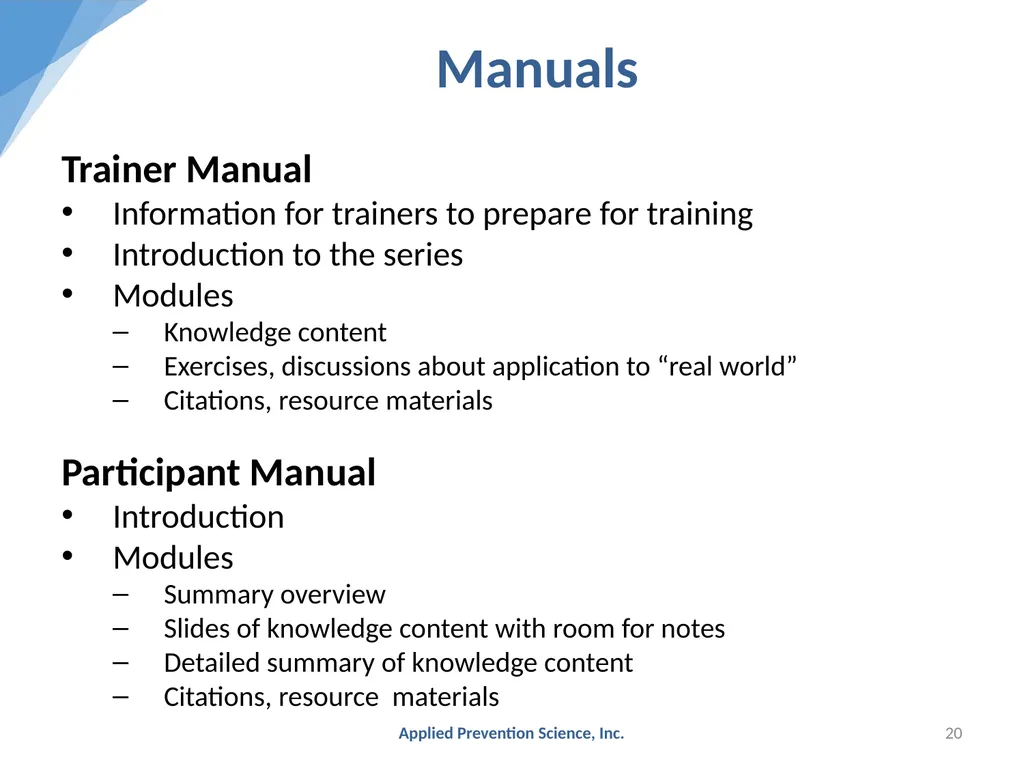
Manuals Trainer Manual
Information for trainers to prepare for training
Introduction to the series
Modules
Knowledge content
Exercises, discussions about application to “real world”
Citations, resource materials
Participant Manual
Introduction
Modules
Summary overview
Slides of knowledge content with room for notes
Detailed summary of knowledge content
Citations, resource materials Applied Prevention Science, Inc. 20<br>
Information for trainers to prepare for training
Introduction to the series
Modules
Knowledge content
Exercises, discussions about application to “real world”
Citations, resource materials
Participant Manual
Introduction
Modules
Summary overview
Slides of knowledge content with room for notes
Detailed summary of knowledge content
Citations, resource materials Applied Prevention Science, Inc. 20<br>
21
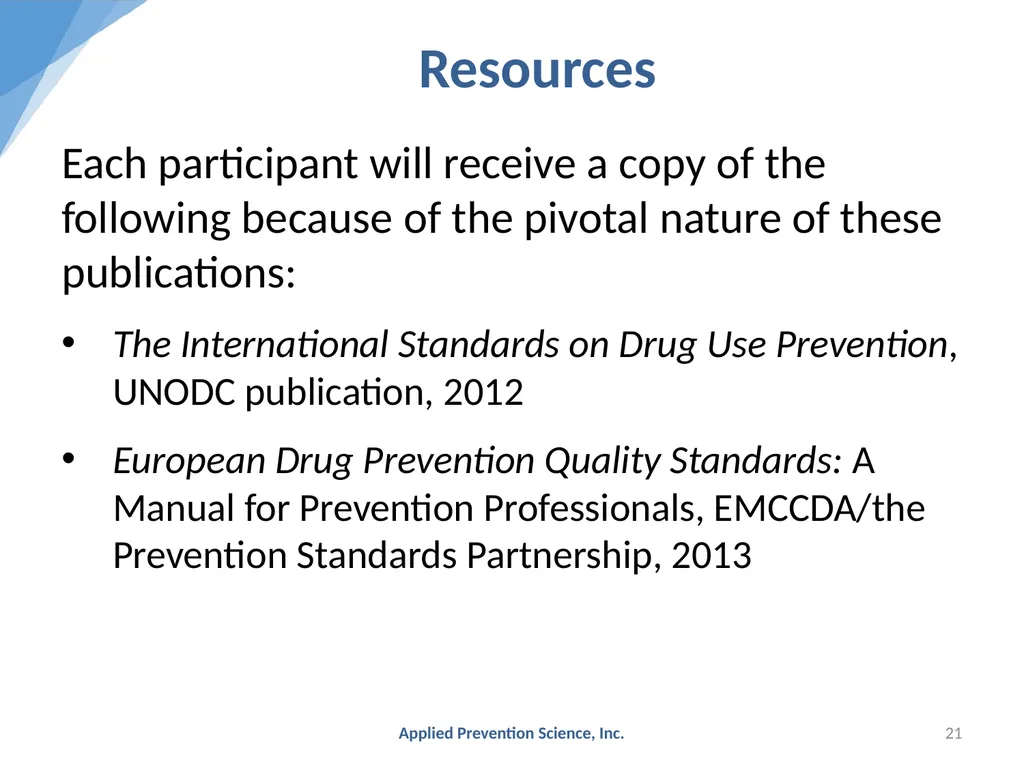
Resources Each participant will receive a copy of the following because of the pivotal nature of these publications:
The International Standards on Drug Use Prevention, UNODC publication, 2012
European Drug Prevention Quality Standards: A Manual for Prevention Professionals, EMCCDA/the Prevention Standards Partnership, 2013 Applied Prevention Science, Inc. 21<br>
The International Standards on Drug Use Prevention, UNODC publication, 2012
European Drug Prevention Quality Standards: A Manual for Prevention Professionals, EMCCDA/the Prevention Standards Partnership, 2013 Applied Prevention Science, Inc. 21<br>
22
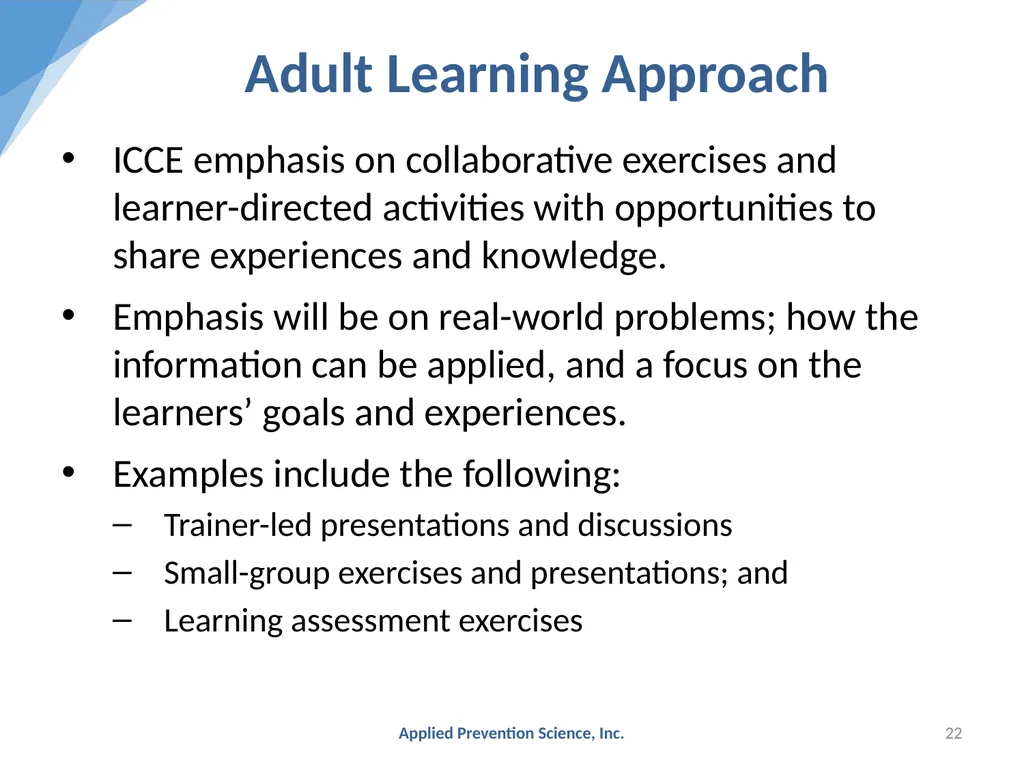
Adult Learning Approach ICCE emphasis on collaborative exercises and learner-directed activities with opportunities to share experiences and knowledge.
Emphasis will be on real-world problems; how the information can be applied, and a focus on the learners’ goals and experiences.
Examples include the following:
Trainer-led presentations and discussions
Small-group exercises and presentations; and
Learning assessment exercises Applied Prevention Science, Inc. 22<br>
Emphasis will be on real-world problems; how the information can be applied, and a focus on the learners’ goals and experiences.
Examples include the following:
Trainer-led presentations and discussions
Small-group exercises and presentations; and
Learning assessment exercises Applied Prevention Science, Inc. 22<br>
23
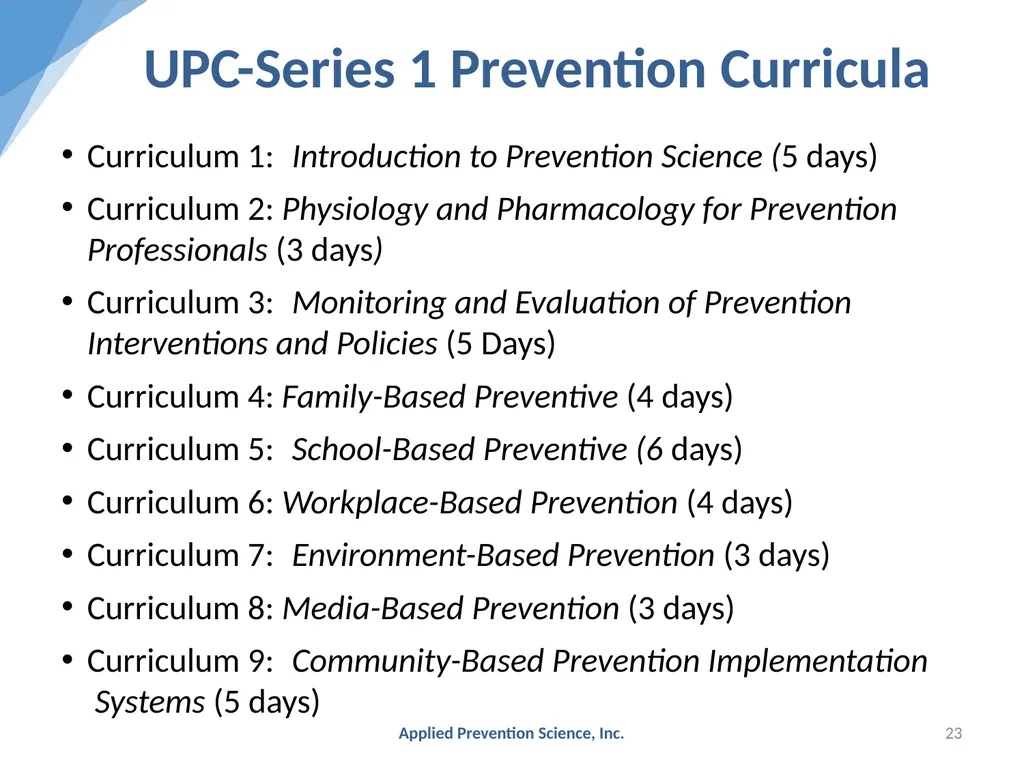
UPC-Series 1 Prevention Curricula Curriculum 1: Introduction to Prevention Science (5 days)
Curriculum 2: Physiology and Pharmacology for Prevention Professionals (3 days)
Curriculum 3: Monitoring and Evaluation of Prevention Interventions and Policies (5 Days)
Curriculum 4: Family-Based Preventive (4 days)
Curriculum 5: School-Based Preventive (6 days)
Curriculum 6: Workplace-Based Prevention (4 days)
Curriculum 7: Environment-Based Prevention (3 days)
Curriculum 8: Media-Based Prevention (3 days)
Curriculum 9: Community-Based Prevention Implementation
Systems (5 days) Applied Prevention Science, Inc. 23<br>
Curriculum 2: Physiology and Pharmacology for Prevention Professionals (3 days)
Curriculum 3: Monitoring and Evaluation of Prevention Interventions and Policies (5 Days)
Curriculum 4: Family-Based Preventive (4 days)
Curriculum 5: School-Based Preventive (6 days)
Curriculum 6: Workplace-Based Prevention (4 days)
Curriculum 7: Environment-Based Prevention (3 days)
Curriculum 8: Media-Based Prevention (3 days)
Curriculum 9: Community-Based Prevention Implementation
Systems (5 days) Applied Prevention Science, Inc. 23<br>
24
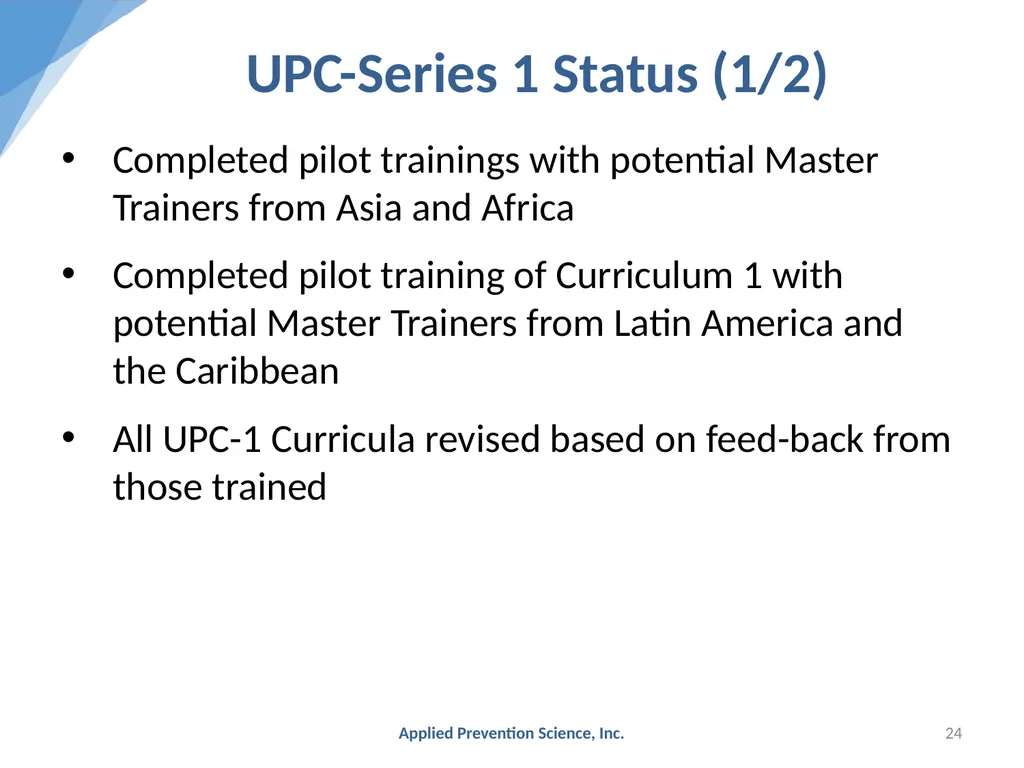
UPC-Series 1 Status (1/2) Completed pilot trainings with potential Master Trainers from Asia and Africa
Completed pilot training of Curriculum 1 with potential Master Trainers from Latin America and the Caribbean
All UPC-1 Curricula revised based on feed-back from those trained Applied Prevention Science, Inc. 24<br>
Completed pilot training of Curriculum 1 with potential Master Trainers from Latin America and the Caribbean
All UPC-1 Curricula revised based on feed-back from those trained Applied Prevention Science, Inc. 24<br>
25
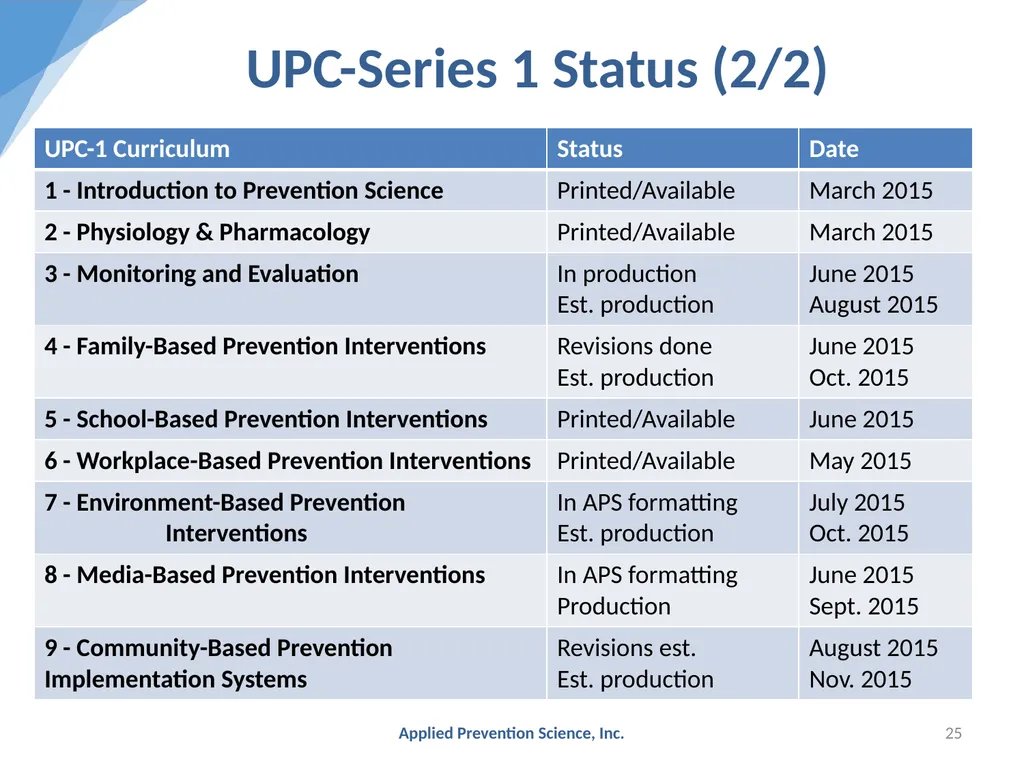
UPC-Series 1 Status (2/2) Applied Prevention Science, Inc. 25<br>
26
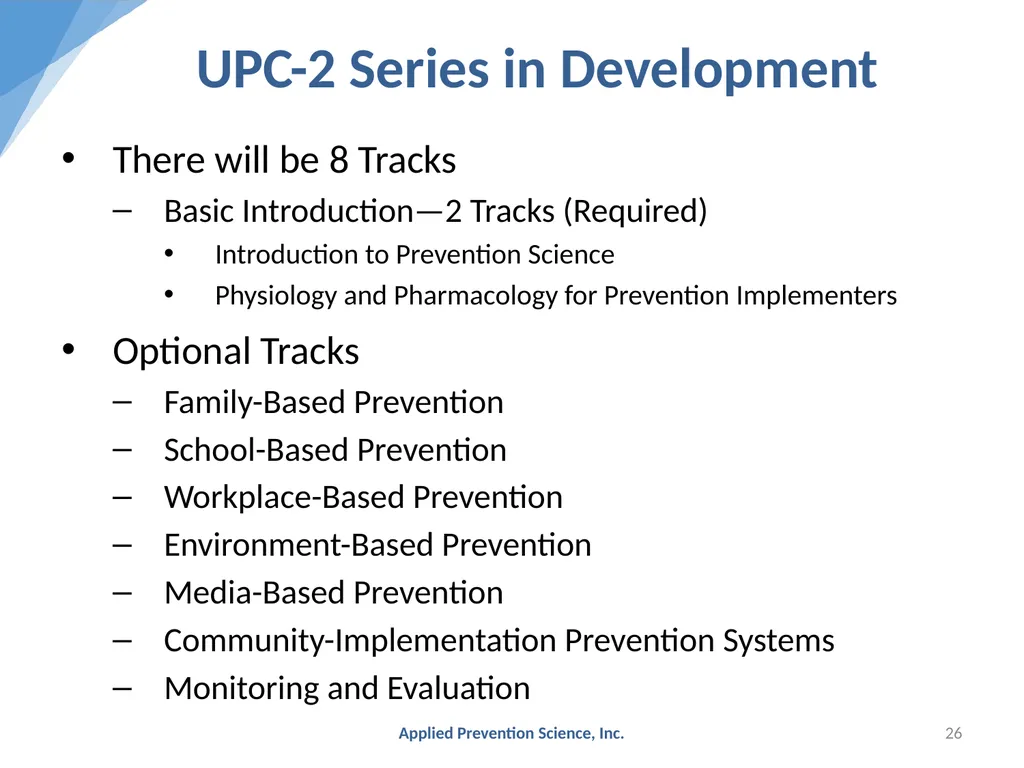
UPC-2 Series in Development There will be 8 Tracks
Basic Introduction—2 Tracks (Required)
Introduction to Prevention Science
Physiology and Pharmacology for Prevention Implementers
Optional Tracks
Family-Based Prevention
School-Based Prevention
Workplace-Based Prevention
Environment-Based Prevention
Media-Based Prevention
Community-Implementation Prevention Systems
Monitoring and Evaluation Applied Prevention Science, Inc. 26<br>
Basic Introduction—2 Tracks (Required)
Introduction to Prevention Science
Physiology and Pharmacology for Prevention Implementers
Optional Tracks
Family-Based Prevention
School-Based Prevention
Workplace-Based Prevention
Environment-Based Prevention
Media-Based Prevention
Community-Implementation Prevention Systems
Monitoring and Evaluation Applied Prevention Science, Inc. 26<br>
27
UPC-2 Series Emphasis Focus on knowledge, competencies, and skills
Focus on application of prevention science to prevention intervention and policy implementation Applied Prevention Science, Inc. 27<br>
Focus on application of prevention science to prevention intervention and policy implementation Applied Prevention Science, Inc. 27<br>
28
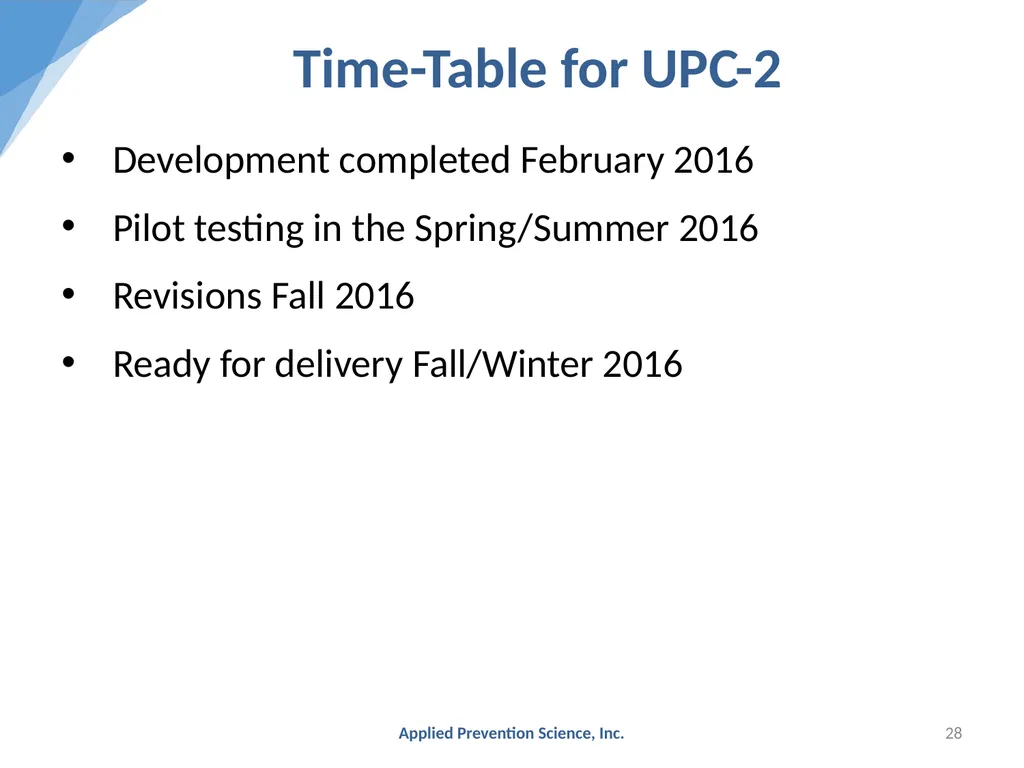
Time-Table for UPC-2 Development completed February 2016
Pilot testing in the Spring/Summer 2016
Revisions Fall 2016
Ready for delivery Fall/Winter 2016 Applied Prevention Science, Inc. 28<br>
Pilot testing in the Spring/Summer 2016
Revisions Fall 2016
Ready for delivery Fall/Winter 2016 Applied Prevention Science, Inc. 28<br>
29
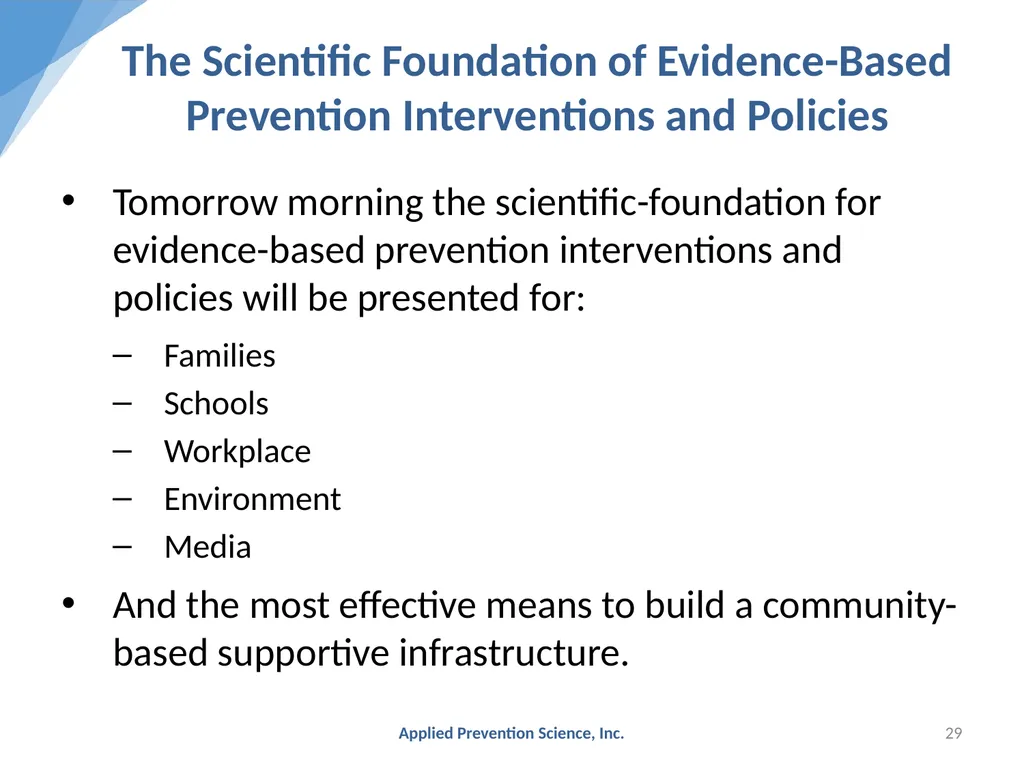
The Scientific Foundation of Evidence-Based Prevention Interventions and Policies Tomorrow morning the scientific-foundation for evidence-based prevention interventions and policies will be presented for:
Families
Schools
Workplace
Environment
Media
And the most effective means to build a community-based supportive infrastructure. Applied Prevention Science, Inc. 29<br>
Families
Schools
Workplace
Environment
Media
And the most effective means to build a community-based supportive infrastructure. Applied Prevention Science, Inc. 29<br>