
Evidence Based Social Work Practice (EBSWP)


















Description: Evidence Based Social Work Practice (EBSWP) Workshop August 22, 2011 Gallaudet University School of Social Work Edward J Mullen 9:00 10:30 Evidence Based Practice: Definitions, History, Competencies 10:30 10:40 Break 10:40 12:00
Related Topics
Download Presentation
"Evidence Based Social Work Practice (EBSWP)" is the property of its rightful owner. Permission is granted to download and print the materials on this website for personal, non-commercial use only, and to display it on your personal computer provided you do not modify the materials and that you retain all copyright notices contained in the materials. By downloading content from our website, you accept the terms of this agreement.
Presentation Transcript
slide1. Evidence Based Social Work Practice (EBSWP) Workshop
August 22, 2011 Gallaudet University
School of Social Work
Edward J Mullen<br>
slide2. 9:00 – 10:30 Evidence Based Practice: Definitions, History, & Competencies
10:30 – 10:40 Break
10:40 – 12:00 Finding Evidence: Evidence-based Practices
12:00 – 1:00 Lunch
1:00 – 2:30 Resources & Curriculum Implications for Teaching & Learning
2:30 – 2:40 Break
2:40 – 4:00 Break-out Group Discussion: Applications to Classroom & Field Curriculum Agenda<br>
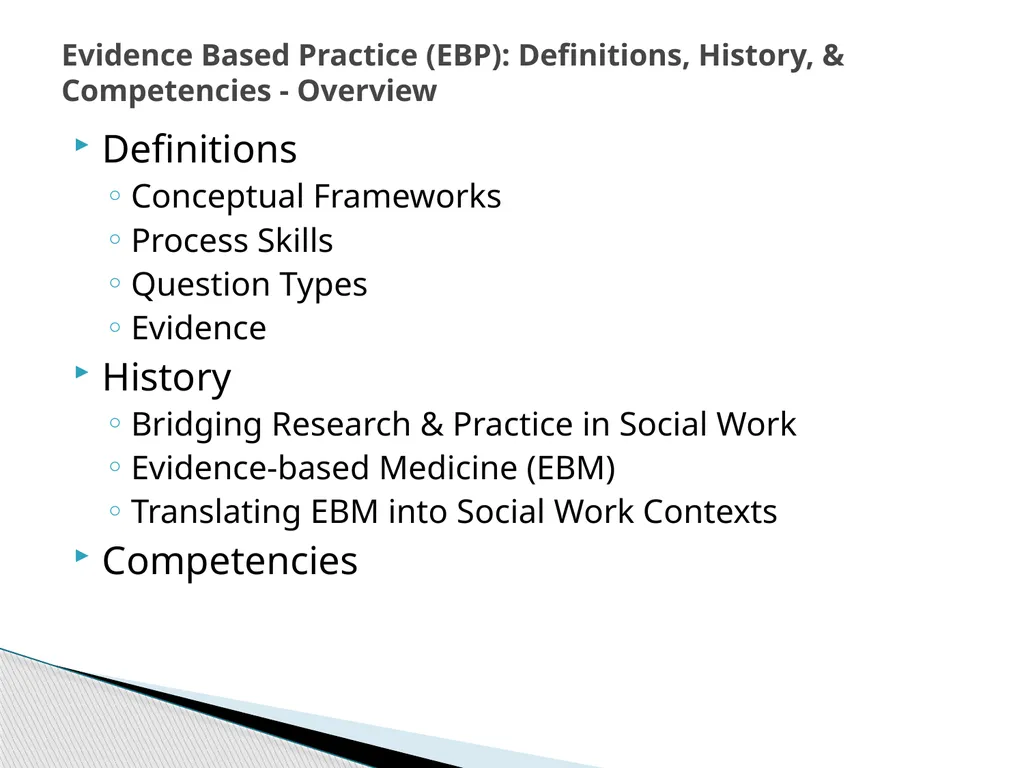
slide3. Definitions
Conceptual Frameworks
Process Skills
Question Types
Evidence
History
Bridging Research & Practice in Social Work
Evidence-based Medicine (EBM)
Translating EBM into Social Work Contexts
Competencies Evidence Based Practice (EBP): Definitions, History, & Competencies - Overview<br>
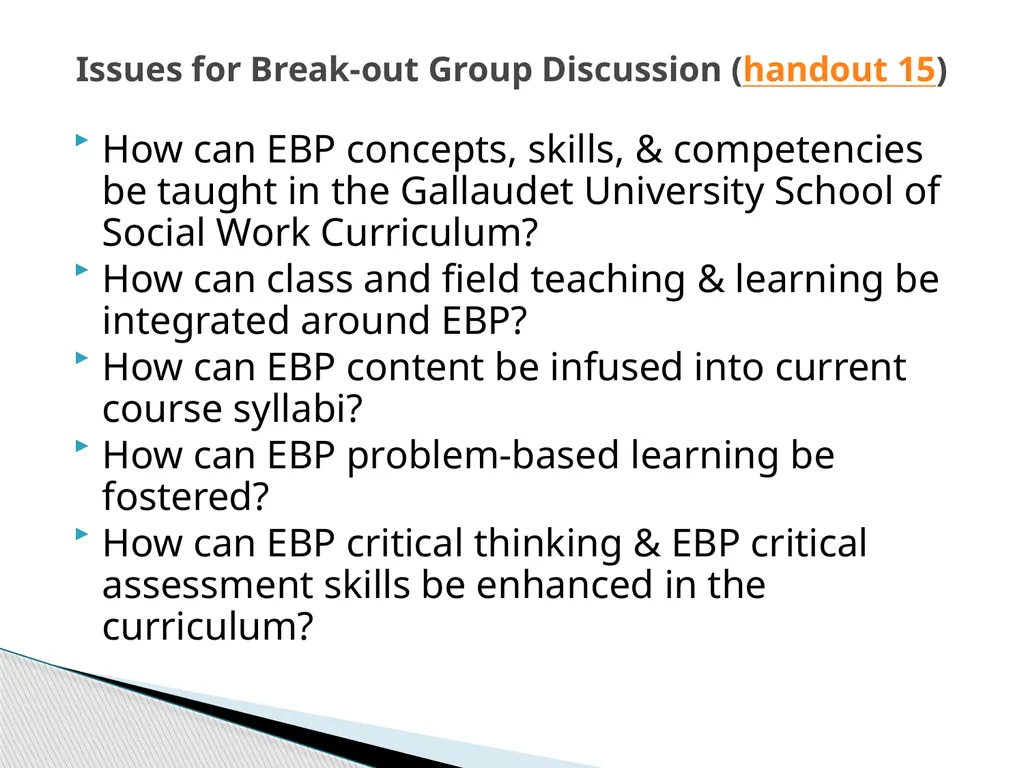
slide4. How can EBP concepts, skills, & competencies be taught in the Gallaudet University School of Social Work Curriculum?
How can class and field teaching & learning be integrated around EBP?
How can EBP content be infused into current course syllabi?
How can EBP problem-based learning be fostered?
How can EBP critical thinking & EBP critical assessment skills be enhanced in the curriculum? Issues for Break-out Group Discussion (handout 15)<br>
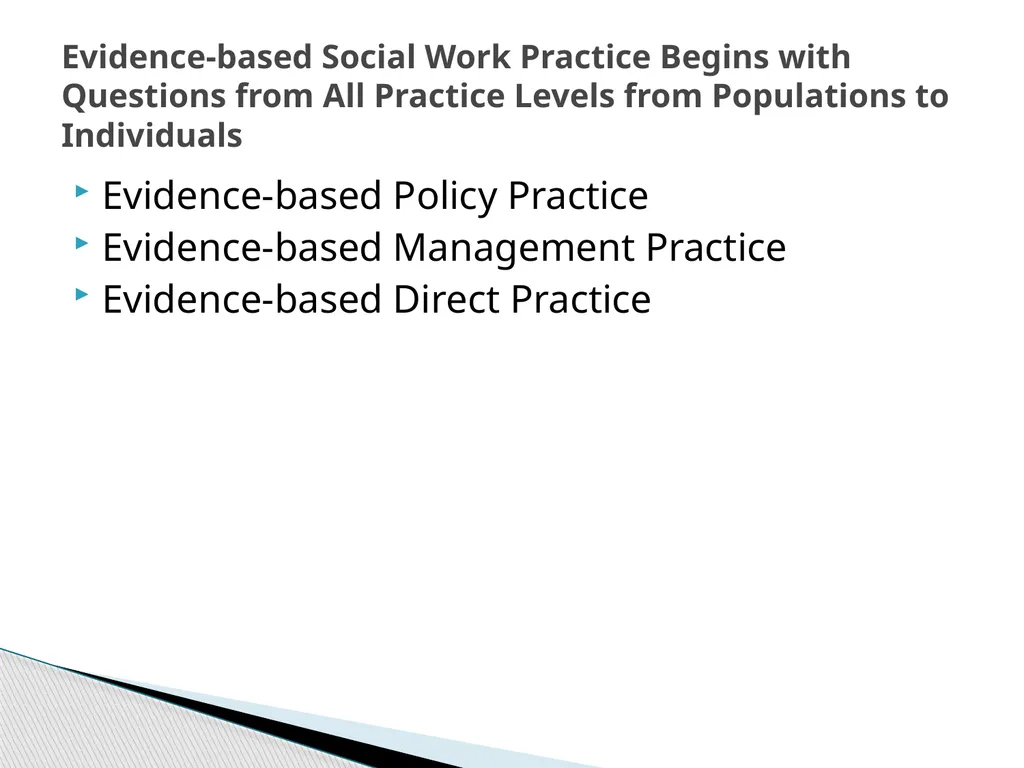
slide5. Evidence-based Policy Practice
Evidence-based Management Practice
Evidence-based Direct Practice Evidence-based Social Work Practice Begins with Questions from All Practice Levels from Populations to Individuals<br>
slide6. Evidence-based policy is concerned with problems about how best to achieve group or population goals. What is Evidence-based Policy Practice?<br>
slide7. For children with mental health problems is it best to:
provide remedial treatment services in residential treatment facilities
Or
in community-based programs that allow children to remain at home? An Evidence-based Policy Question<br>
slide8. Is it best to provide adults with severe and persistent mental disorders:
sheltered work programs
Or
supportive services aimed at securing employment in the community? Another Evidence-based Policy Question<br>
slide9. Evidence-based management deals with problems about how best to organize, finance & implement services to populations. What is Evidence-based Management?<br>
slide10. How best to create & sustain an organizational environment so as to move the organization toward policy-based outcomes? An Evidence-based Management Question:<br>
slide11. How best to create and sustain a learning-based organization? Another Evidence-based Management Question:<br>
slide12. Deals with problems of specific client units
Problems are those of identifiable clients in need of some type of:
Assessment
Intervention
Prevention
Evaluative service
Questions have to do with here-and-now practice choices that must be made for specific clients What is Evidence-based Direct Practice?<br>
slide13. EBP is integration of
Best research evidence
Practitioner expertise
Client values
Research evidence
Practice relevant research from:
Basic sciences
Client-centered practice research about:
Accuracy & precision of assessment tests & interview procedures
Power of prognostic markers;
Efficacy & safety of therapeutic, rehabilitative, & preventive regimens.
Expertise
Ability to use skills & experience to rapidly identify each client’s:
Unique psychosocial state & problems or needs
Individual risks & benefits of potential interventions
Personal values & expectations.
Client values
Unique preferences, concerns, & expectations of client that must be integrated into intervention decisions to serve client EBP Defined by Institute of Medicine National Academy of Science (Adapted for Social Work) (see handout 1)<br>
slide14. Placing client’s benefits FIRST
Practitioners adopt LIFELONG learning
CONTINUALLY ASKING specific questions
of direct practical importance to clients
SEARCHING objectively & efficiently
for current best evidence
Taking appropriate action GUIDED by evidence (Gibbs, et al., 2003). EBP in Social Work (EBSWP)<br>
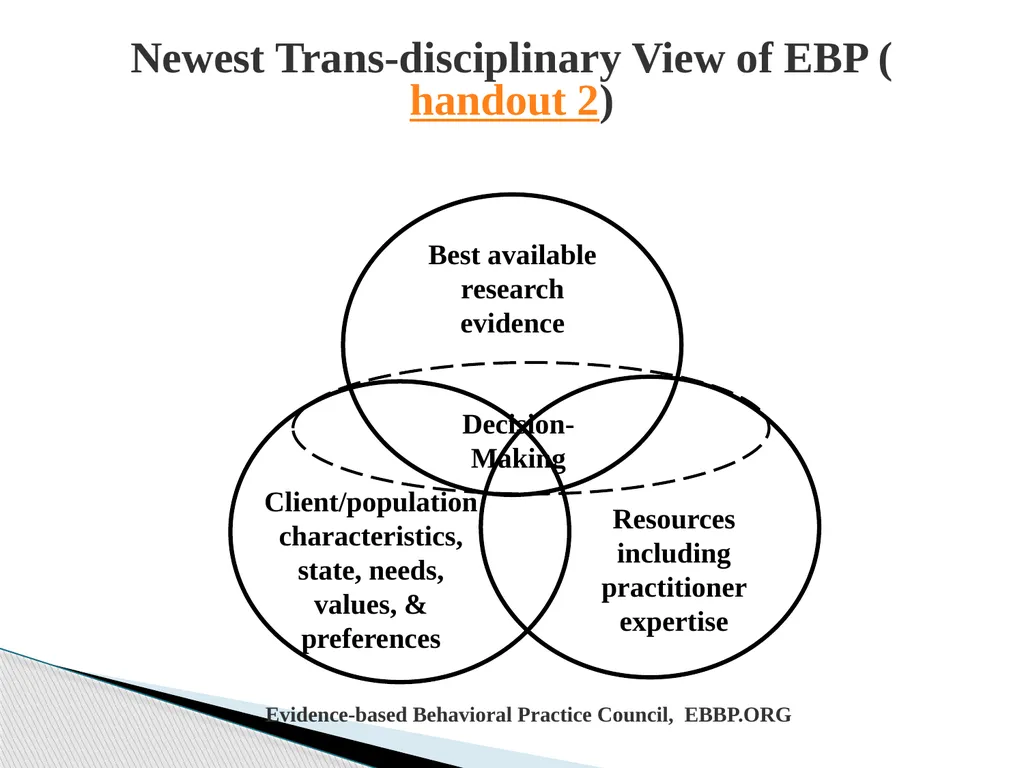
slide15. Newest Trans-disciplinary View of EBP (handout 2) Evidence-based Behavioral Practice Council, EBBP.ORG<br>
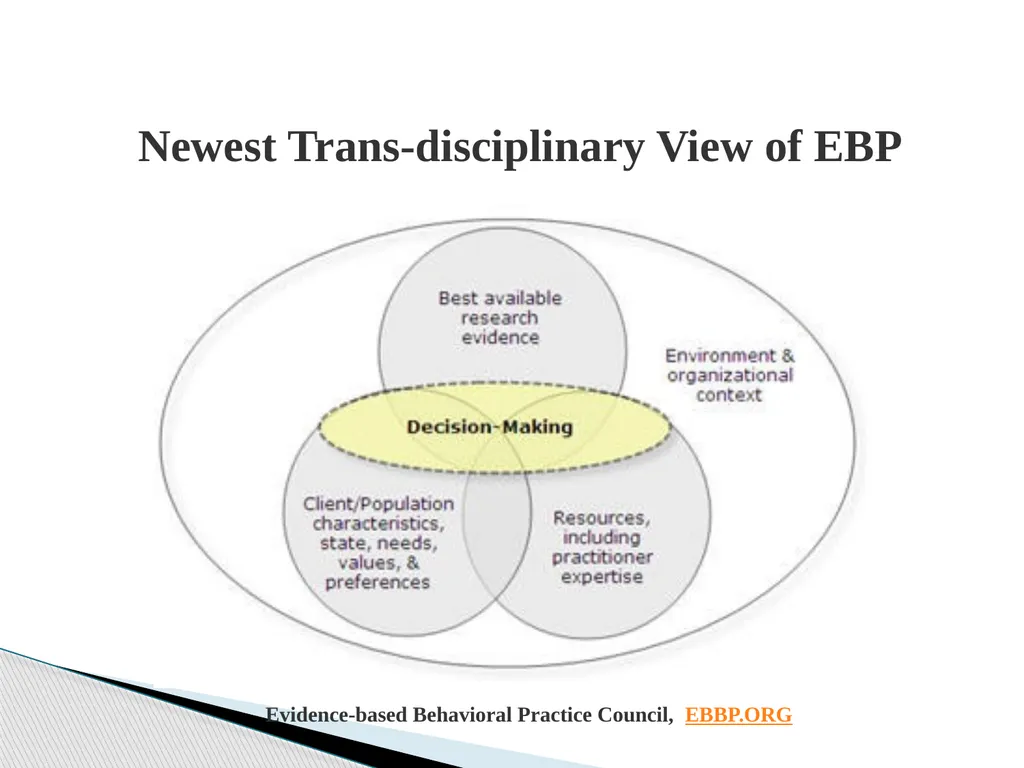
slide16. Evidence-Based Behavioral Practice Newest Trans-disciplinary View of EBP Evidence-based Behavioral Practice Council, EBBP.ORG<br>
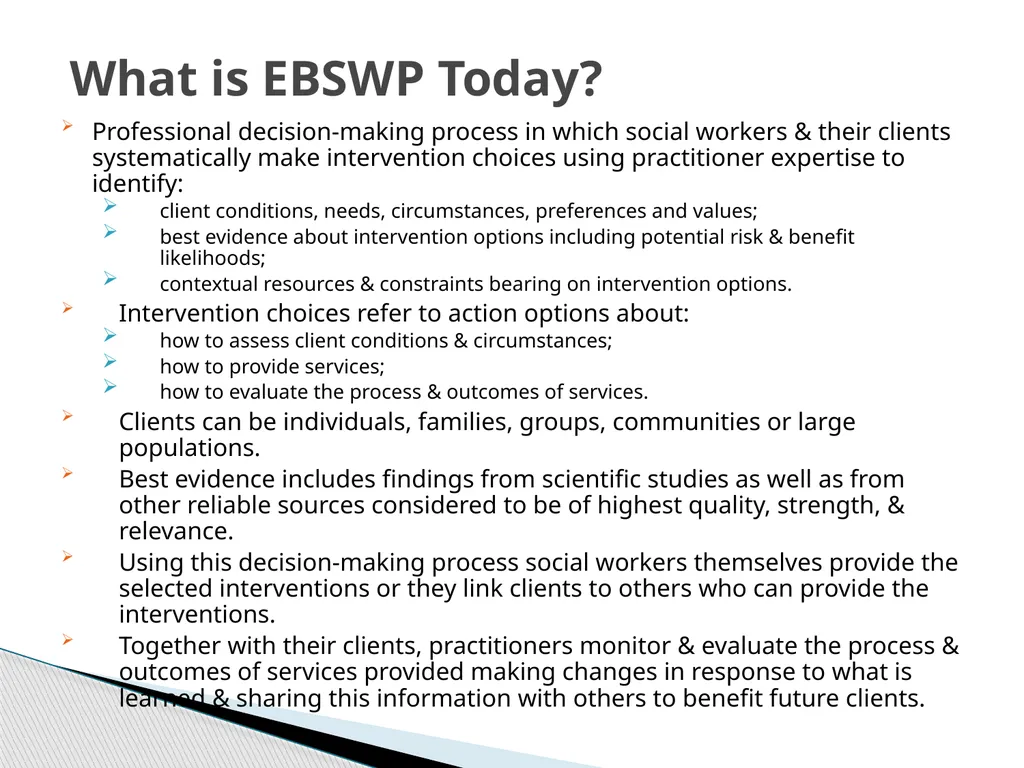
slide17. Professional decision-making process in which social workers & their clients systematically make intervention choices using practitioner expertise to identify:
client conditions, needs, circumstances, preferences and values;
best evidence about intervention options including potential risk & benefit likelihoods;
contextual resources & constraints bearing on intervention options.
Intervention choices refer to action options about:
how to assess client conditions & circumstances;
how to provide services;
how to evaluate the process & outcomes of services.
Clients can be individuals, families, groups, communities or large populations.
Best evidence includes findings from scientific studies as well as from other reliable sources considered to be of highest quality, strength, & relevance.
Using this decision-making process social workers themselves provide the selected interventions or they link clients to others who can provide the interventions.
Together with their clients, practitioners monitor & evaluate the process & outcomes of services provided making changes in response to what is learned & sharing this information with others to benefit future clients. What is EBSWP Today?<br>
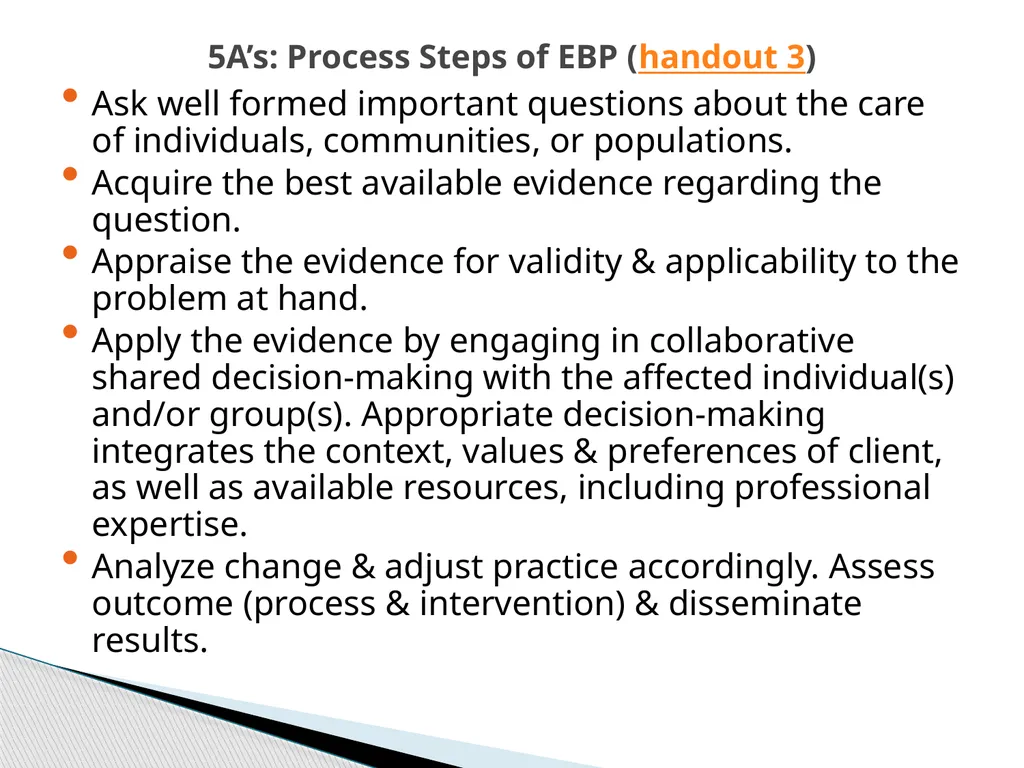
slide18. Ask well formed important questions about the care of individuals, communities, or populations.
Acquire the best available evidence regarding the question.
Appraise the evidence for validity & applicability to the problem at hand.
Apply the evidence by engaging in collaborative shared decision-making with the affected individual(s) and/or group(s). Appropriate decision-making integrates the context, values & preferences of client, as well as available resources, including professional expertise.
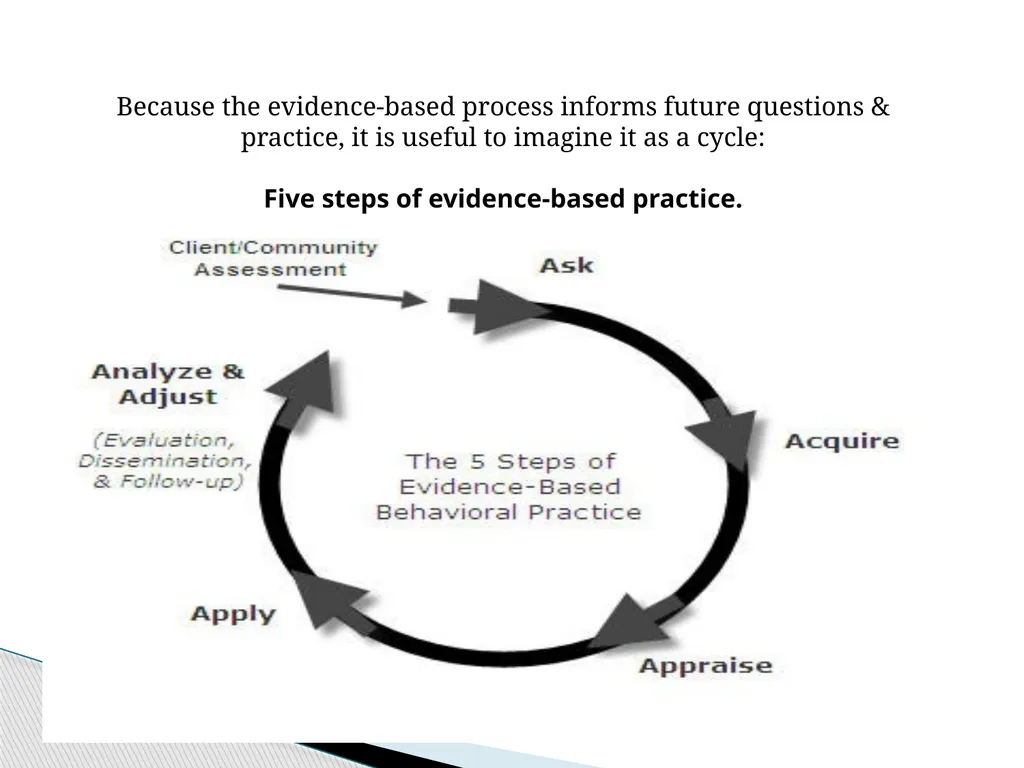
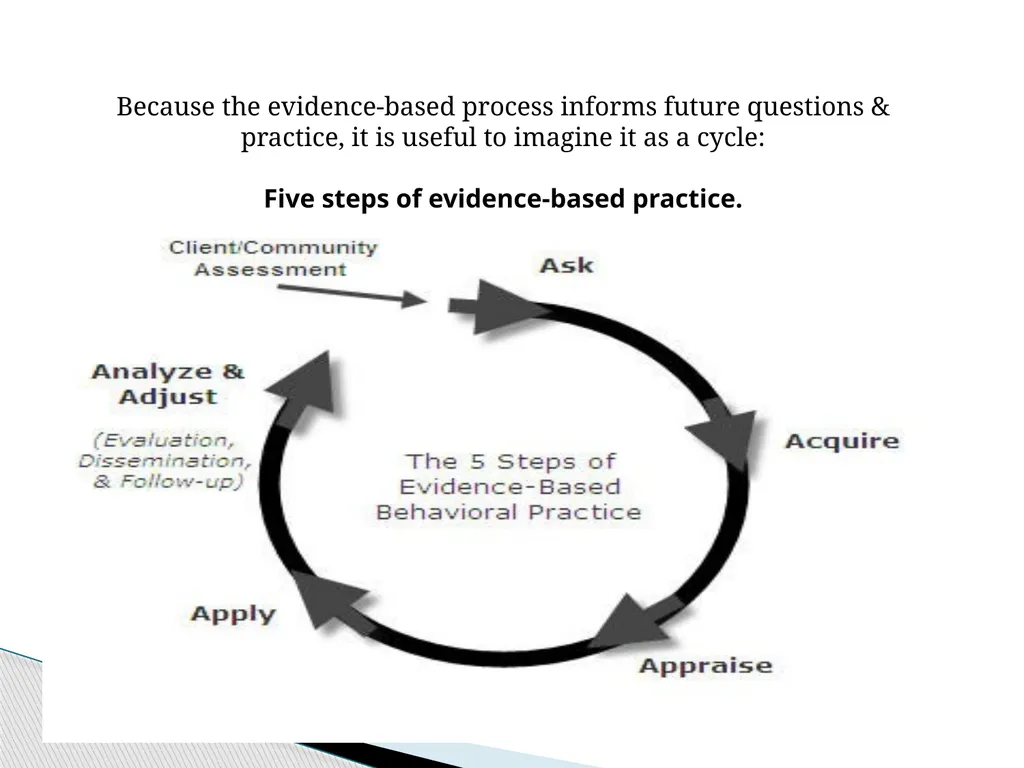
Analyze change & adjust practice accordingly. Assess outcome (process & intervention) & disseminate results. 5A’s: Process Steps of EBP (handout 3)<br>
slide19. Because the evidence-based process informs future questions & practice, it is useful to imagine it as a cycle:
Five steps of evidence-based practice.<br>
slide20. What Is Practitioner Expertise in EBP & What Additional Competencies Are Required?<br>
slide21. Assessment skills:
Competency appraising client & community characteristics, problems, values & expectations, & environmental context
Practitioner’s competency to assess own expertise level:
to implement interventions
outcomes of those techniques once implemented
Process skills:
Competency performing 5 EBP process steps:
ask well-formulated questions
acquire best available research evidence
appraise evidence for quality & relevance
apply evidence by engaging in shared decision-making with those who will be affected
analyze change & adjust practice accordingly
Communication & collaboration skills:
Competency to convey information clearly & appropriately
Competency to listen, observe, adjust, & negotiate as appropriate to achieve understanding & agreement on a course of action
Engagement & intervention skills:
Competency in motivating interest, constructive involvement, & positive change
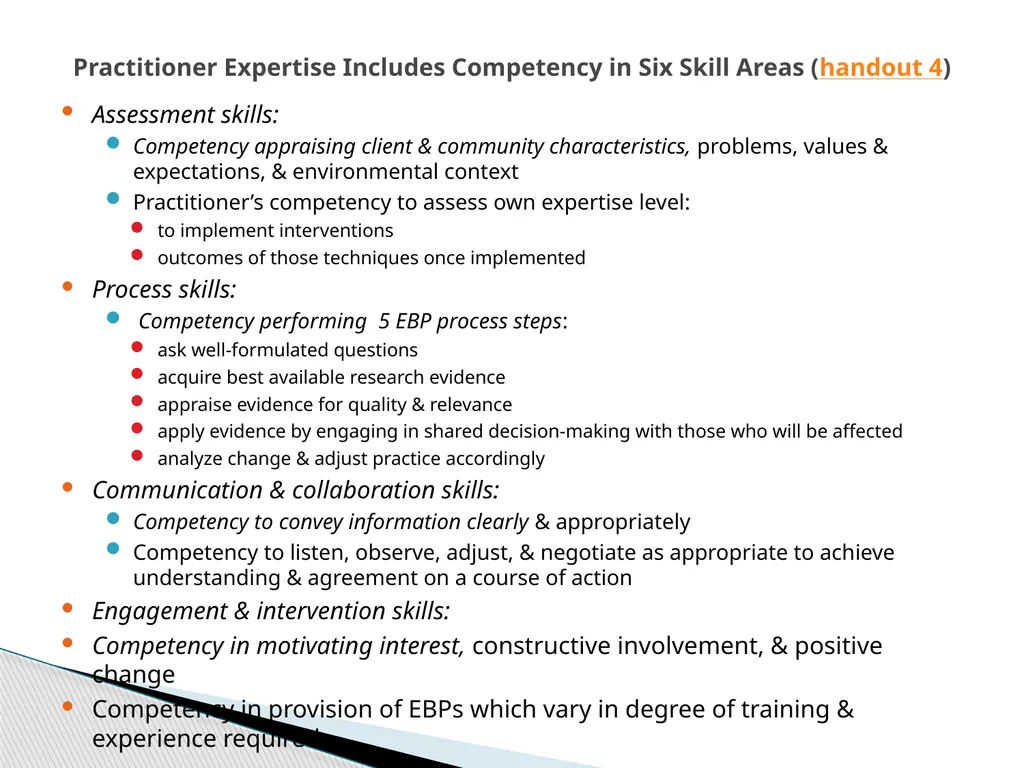
Competency in provision of EBPs which vary in degree of training & experience required Practitioner Expertise Includes Competency in Six Skill Areas (handout 4)<br>
slide22. In 5 A’s First Step Is ASK: What Are EBP Questions that Can Be Asked in EBP?<br>
slide23. In Social Work (Gibbs – handout 5)
Client Oriented Practical Evidence Search (COPES)
In Medicine
Patient Oriented Evidence that Matters (POEM)
Patient (or Problem), Intervention, Comparison, Outcome (PICO) COPES Questions (POEM, PICO)<br>
slide24. Client Oriented
Questions from daily practice, posed by practitioners, that really matter to client’s welfare
Practical
Concern problems that arise frequently
Concern agency mission
Knowing answer could impact decision
Search Oriented
Specific enough to guide electronic evidence search Client Oriented Practical Evidence Search (COPES) Questions:<br>
slide25. Client characteristics
Client problem
What practitioner is considering doing
Alternative course of action against which contemplated action is to be compared
What practitioner seeks to accomplish Parts of COPES Effectiveness Questions<br>
slide26. Examples of COPES Question Types Formed by Social Work Students<br>
slide27. If delinquent youth
Are exposed to
A residential based program
Or
A community based program
Will the former result in fewer delinquent behaviors? Effectiveness Question:<br>
slide28. If families of latency aged boys with conduct disorder
Receive parent management training
Or
No formal training
Will the former exhibit lower externalizing behavior problems? Effectiveness Question<br>
slide29. If disoriented aged persons residing in a nursing home
Are given
Reality orientation therapy
Or
Validation therapy
Which will result in better orientation to time, place, person? Effectiveness Question:<br>
slide30. If sexually active high school students at high risk for pregnancy
Are given
A problem exercise
(Baby-Think-It-Over)
Or
Didactic information
(material on use of birth control methods)
Will the former have fewer pregnancies during the year? Prevention Question:<br>
slide31. Among adolescents at risk for pregnancy
Will a sex education program that stresses abstinence
Or
One that provides birth control information
Result in the lowest pregnancy rates? Prevention Question:<br>
slide32. If adolescents at risk for violence
Receive school based violence prevention programs
Or
No formal violence prevention training
Will the former display lower rates of violence and aggression? Prevention Question:<br>
slide33. If aged residents of a nursing home who may be depressed or may have Alzheimer’s disease or dementia
Are administered
Depression Screening Tests
Or
A Short Mental Status Examination Tests
Which measure will be the briefest, most inexpensive, valid and reliable screening test to discriminate between depression and dementia? Assessment Question:<br>
slide34. If children & adolescents in my caseload
Are administered a computerized brief depression scale
Or
Are screened by a staff psychiatrist
Will the former detect childhood depression as frequently as the latter? Assessment Question:<br>
slide35. If family members of children diagnosed with a learning disorder
Meet in a support group to receive information and support from staff and other families
What aspects of the support group will they find most helpful? Descriptive Question:<br>
slide36. Among children who are cared for by a primary caregiver diagnosed as having a depressive disorder
Compared with
Children whose caregiver has no diagnosed mental disorder
Will the former children be more frequently diagnosed as having a behavioral or emotional disorder? Descriptive Question<br>
slide37. If crisis line callers to a battered women shelter
Are administered
A risk assessment scale by telephone
Or
We rely on practical judgment unaided by a risk assessment scale
Will the scale have higher reliability and predictive validity regarding future violence? Risk Assessment Question:<br>
slide38. Background Questions Ask for General Knowledge about a Condition or Thing
What Causes AIDS?
How Does Neighborhood Violence Affect Probability of Delinquency?
Among children who are cared for by a primary caregiver diagnosed as having a depressive disorder compared with children whose caregiver has no diagnosed mental disorder will the former children be more frequently diagnosed as having a behavioral or emotional disorder? Background & Foreground Questions<br>
slide39. Foreground Questions Ask for Specific Knowledge to Inform Decisions or Actions
If children and adolescents in my caseload are administered a computerized brief depression scale or are screened by a staff psychiatrist will the former detect childhood depression as frequently as the latter?
If adolescents at risk for violence receive school based violence prevention programs or no formal violence prevention training will the former display lower rates of violence and aggression? Background & Foreground Questions<br>
slide40. Enhances quality of decisions about individual clients
Fosters skills to:
Gather and appraise client’s stories, symptoms, signs
Incorporating values and expectations in alliance
Fosters generic skills for finding, appraising, implementing scientific evidence
Provides educational and self-directed life-long learning framework
Identifies knowledge gaps leading to new research
Provides common interdisciplinary language What are the arguments for EBSW?<br>
slide41. EBP moves practitioners away from authoritarian practices & policies
EBP enhances opportunities to honor ethical obligations to clients & students
Helping clients develop critical appraisal skills
Involving clients in design and critique of practice and policy related research
Involving clients as informed participants who share in decision making
Recognizing client’s unique knowledge in terms of application concerns
EBP promotes transparency & honesty
EBP encourages systemic approach for integrating practical, ethical & evidentiary issues
EBP maximizes flow of knowledge & information about knowledge gaps What are the arguments for EBSW? Gambrill, 2003<br>
slide42. EBP originated in medicine in 1990’s
EBM has been transferred into other health disciplines over last 10-15 years
EBP is now widely accepted in health disciplines
A major factor stimulating EBP development is research showing that research findings flow into practice at an extremely slow pace:
Uptake of scientific discoveries into clinical practice: 14% after 17 years (Balas & Boren, 2000)
Only 15% of clinical practices based on evidence (IOM, 1985; Eddy 2005). Brief History of EBP<br>
slide43. EBM was first introduced into American social work in late 1990’s (Gambrill 1999)
Earlier models for integrating research & practice did exist (e.g., the empirical practice movement & scientific practitioner model)
Evidence-based social work practice is, however, qualitatively different from these earlier efforts &, like EBM, has been seen as a paradigm shift
The adoption of EBP has been facilitated by an increase in practice research as well as by mechanisms for evidence dissemination.
EBP is now required for accreditation of social work training programs
Use of research evidence for professional practice is required by the code of ethics for social work Brief History of EBP<br>
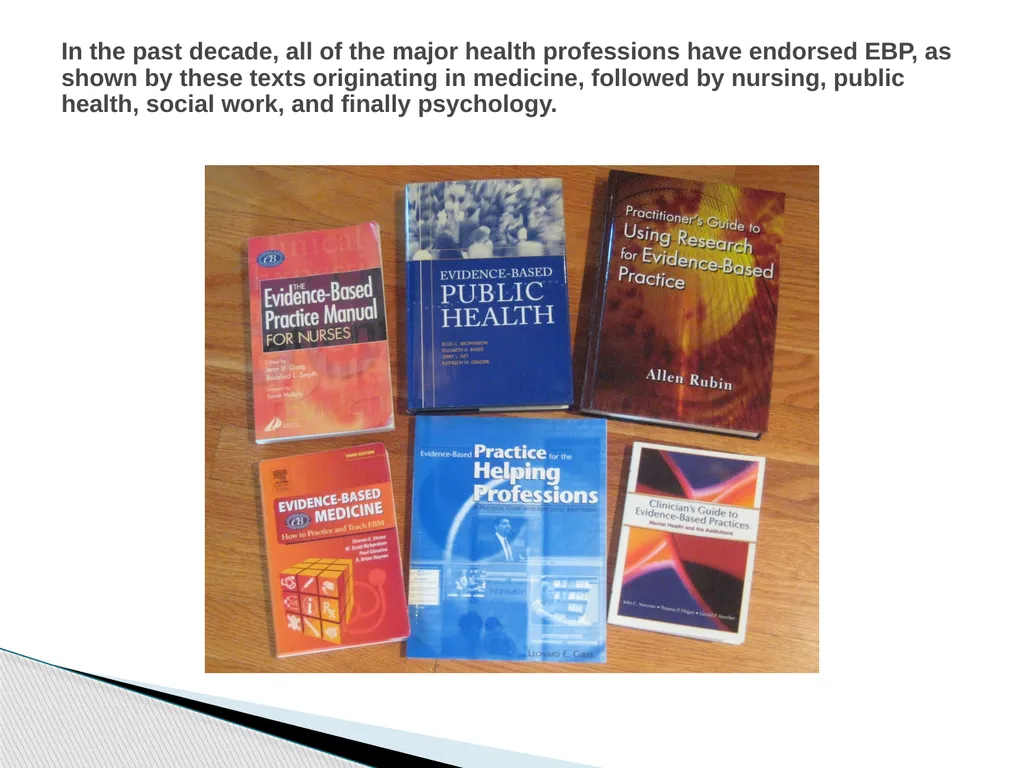
slide44. In the past decade, all of the major health professions have endorsed EBP, as shown by these texts originating in medicine, followed by nursing, public health, social work, and finally psychology.<br>
slide45. End of First Session<br>
slide46. Acquiring evidence as 3rd step of EBP process
What are evidence-based practices (EBPs)?
What qualifies as “evidence”?
How are EBPs & EBP related?
How can EBPs & “evidence” be found? Acquiring Evidence & Evidence-based Practices (EBPs): Overview<br>
slide47. Remember 5A’s which form process steps or skills of EBP (next slide)
Recall that 2nd step is ACQUIRING evidence needed to answer question ASKed in 1st step.
This step requires practitioners to conduct an evidence search to answer questions
Translate question into search terms
Search relevant evidence sources
Best done with assistance of reference librarian How can Evidence be Acquired?<br>
slide48. Because the evidence-based process informs future questions & practice, it is useful to imagine it as a cycle:
Five steps of evidence-based practice.<br>
slide49. Busy practitioners typically do not have time or skills to:
Conduct searches for individual research studies which have examined their EBP question.
Synthesize the research evidence from these individual studies
Practitioners should first search for evidence summaries
Evidence summaries are rapidly becoming available in online systems & clearinghouses
These online systems/clearinghouses frequently do the work of:
Locating research studies
Systematically reviewing & summarizing study findings
Assessing quality, strength, & relevance of evidence
Publishing practice guidelines, model programs, best practices, or other forms of evidence-based recommendations
ONLY in absence of evidence systems, summaries, synopses, or syntheses & ONLY WHEN EBP QUESTION IS IMPORTANT should practitioners conduct searches for individual research studies 1st Rule for Planning Search: Efficiency Using 5S Framework<br>
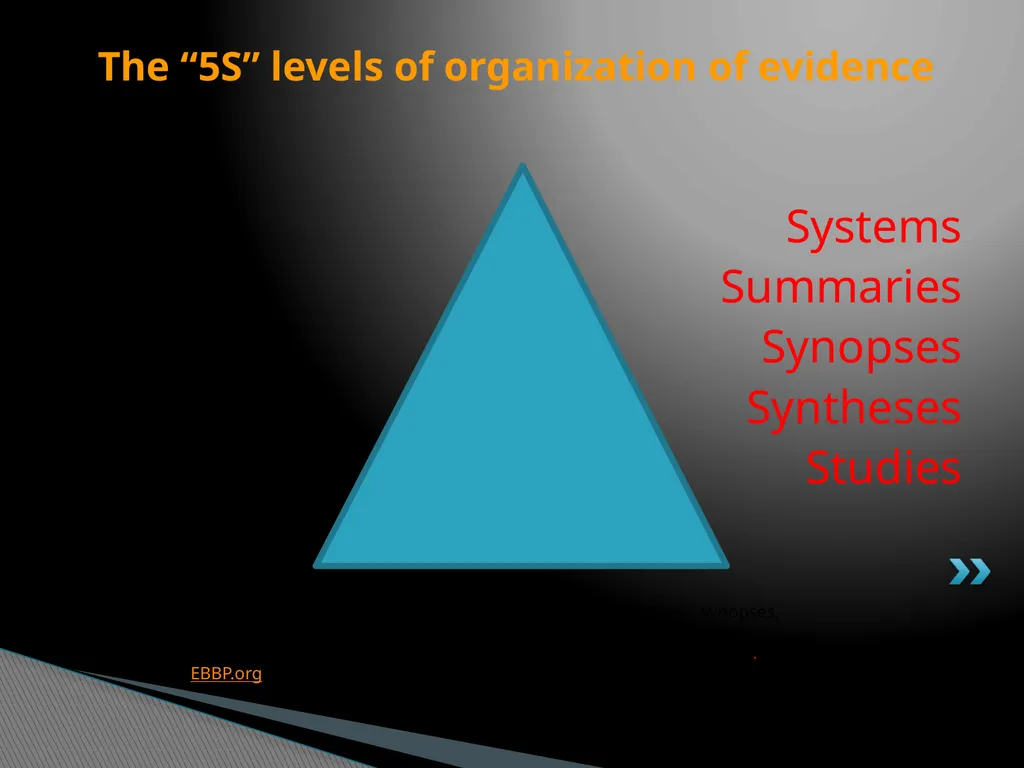
slide50. Systems
Summaries
Synopses
Syntheses
Studies Reproduced from: Haynes, R Brian. 2006. Of studies, syntheses, synopses, summaries, and systems: the “5S” evolution of information services for evidence-based health care decisions. ACP Journal Club 145 (3):A-8 - A-9. EBBP.org The “5S” levels of organization of evidence<br>
slide51. If evidence search is conducted of individual research studies practitioners will need to use their knowledge of research methods to critically appraise individual study validity & relevance
If an evidence search is conducted of sources that have already summarized evidence then practitioners need to be able to critically appraise trustworthiness & relevance of those sources 3rd Step of 5A’s Process is Critical Appraisal of Evidence Found<br>
slide52. Efficacy studies: Many interventions of relevance to social work are now known to be efficacious based on efficacy studies
Effects have been found in controlled research studies often under the best conditions with careful administration to control for possible confounds.
This research not well-suited to testing if intervention will work in real world
Effectiveness studies: Carried out in everyday contexts to test intervention under commonly experienced circumstances
Intervention may be efficacious but may not be effective A Cautionary Note: EBPs May be Supported by Evidence from Efficacy or Effectiveness Studies: An Important Distinction<br>
slide53. Related terms
Empirically supported interventions (ESIs)
Empirically supported treatments (ESTs)
Evidence-based programs (EBPs)
Empirically Informed practices
Practice guidelines
Model Programs
Best practices
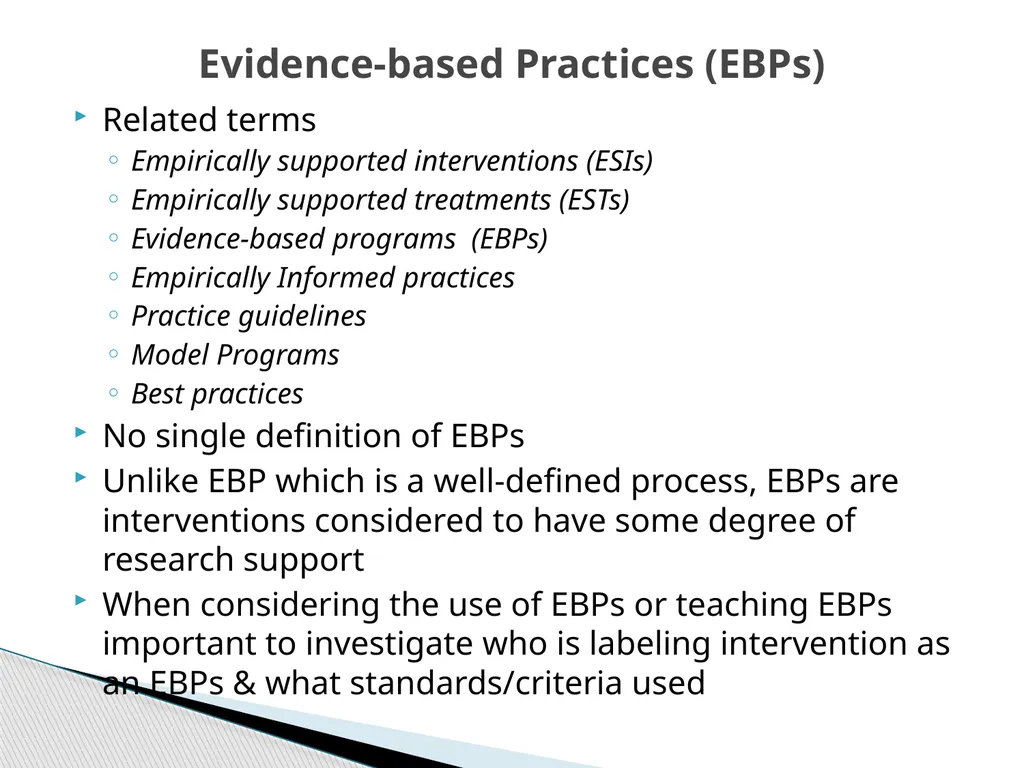
No single definition of EBPs
Unlike EBP which is a well-defined process, EBPs are interventions considered to have some degree of research support
When considering the use of EBPs or teaching EBPs important to investigate who is labeling intervention as an EBPs & what standards/criteria used Evidence-based Practices (EBPs)<br>
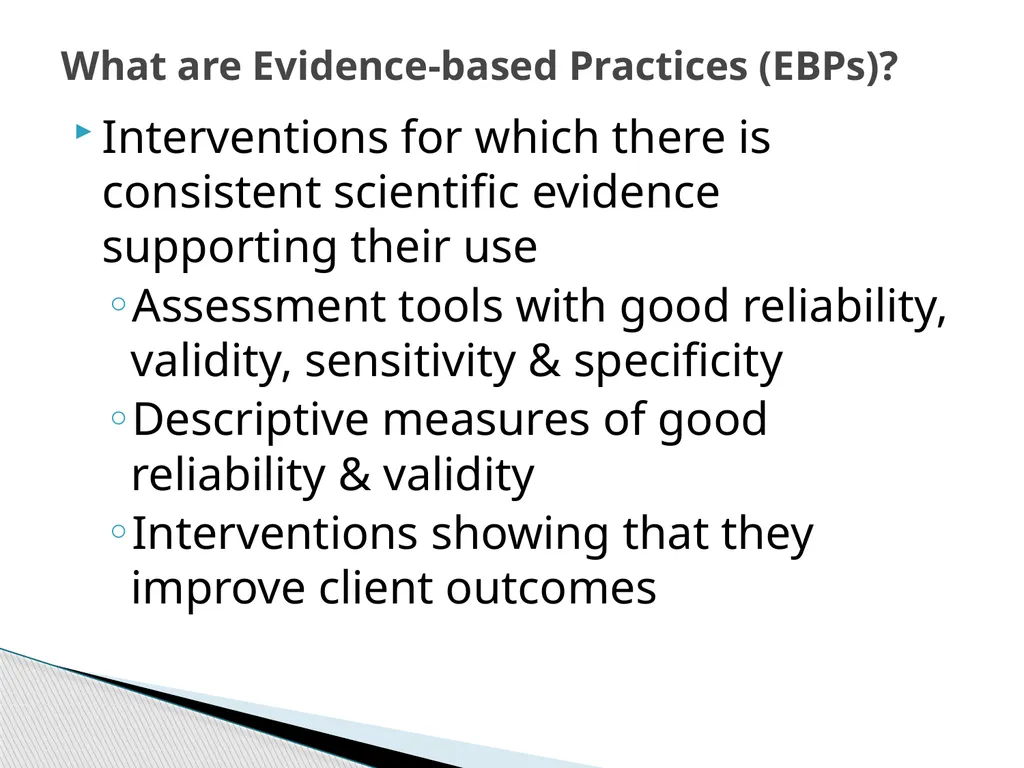
slide54. Interventions for which there is consistent scientific evidence supporting their use
Assessment tools with good reliability, validity, sensitivity & specificity
Descriptive measures of good reliability & validity
Interventions showing that they improve client outcomes What are Evidence-based Practices (EBPs)?<br>
slide55. Evidence-based practices
Skills, techniques, & strategies that can be used by a practitioner individually or in combination
Cognitive behavior therapy
Systematic desensitization
Token economy motivation systems
Social skills teaching strategies
Evidence-based programs
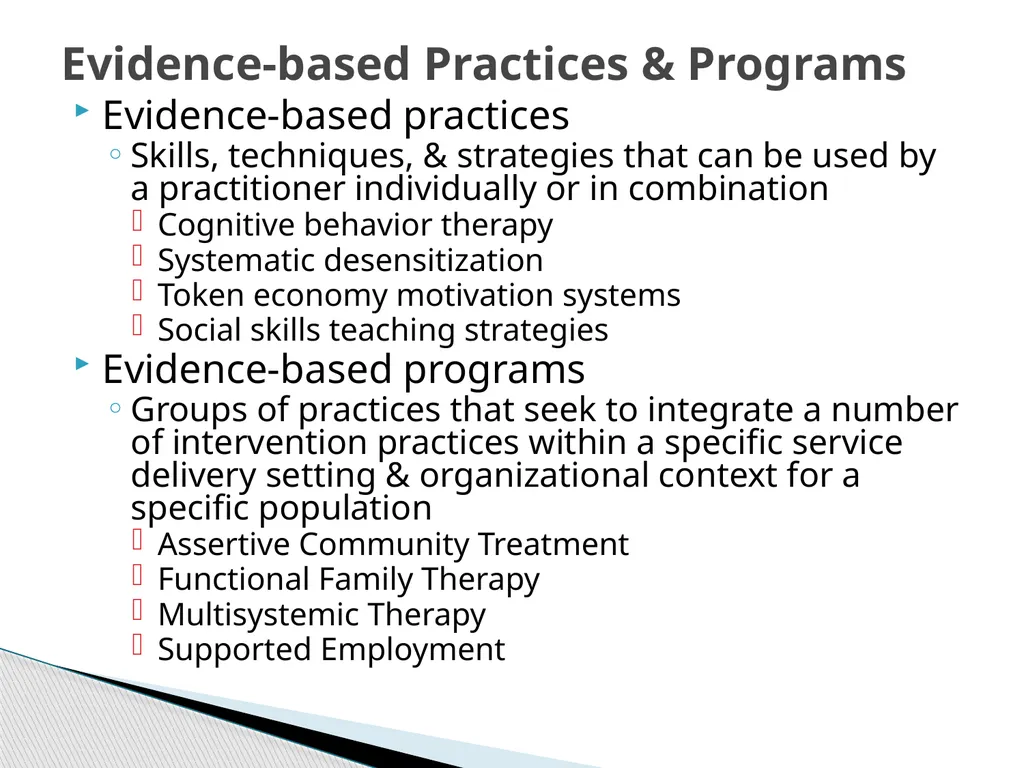
Groups of practices that seek to integrate a number of intervention practices within a specific service delivery setting & organizational context for a specific population
Assertive Community Treatment
Functional Family Therapy
Multisystemic Therapy
Supported Employment Evidence-based Practices & Programs<br>
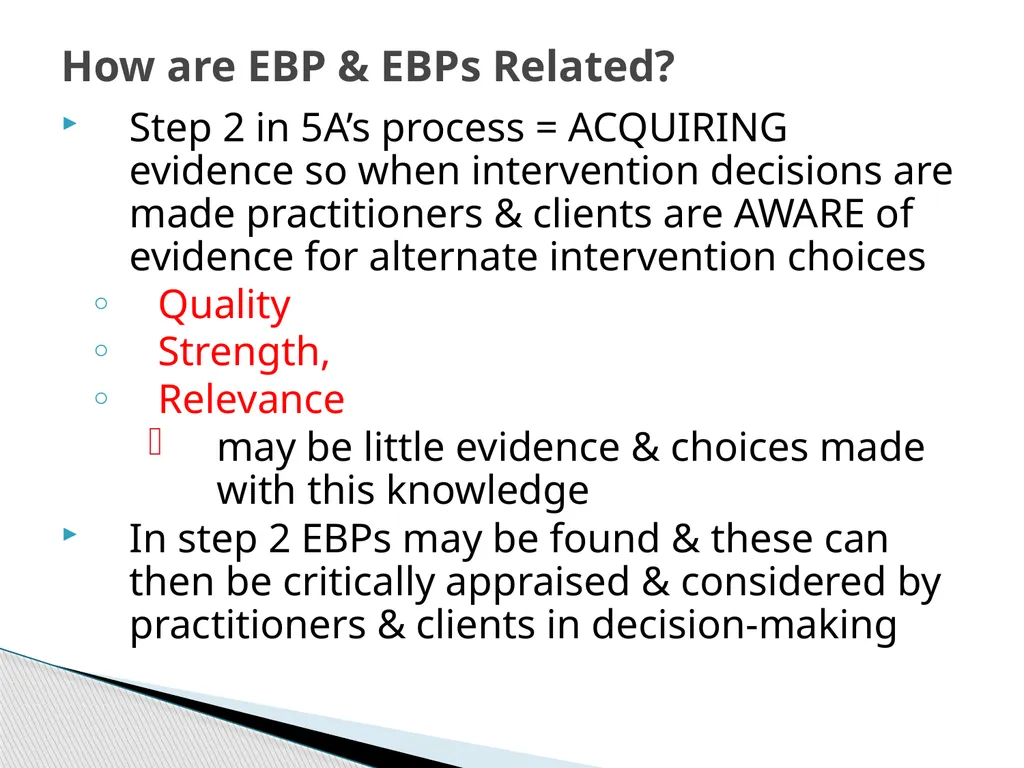
slide56. Step 2 in 5A’s process = ACQUIRING evidence so when intervention decisions are made practitioners & clients are AWARE of evidence for alternate intervention choices
Quality
Strength,
Relevance
may be little evidence & choices made with this knowledge
In step 2 EBPs may be found & these can then be critically appraised & considered by practitioners & clients in decision-making How are EBP & EBPs Related?<br>
slide57. Research evidence
Practice relevant research from:
Basic behavioral & social sciences
Client-centered practice research about:
Accuracy & precision of assessment tests & interview procedures
Power of prognostic markers;
Efficacy & safety of therapeutic, rehabilitative, & preventive regimens.
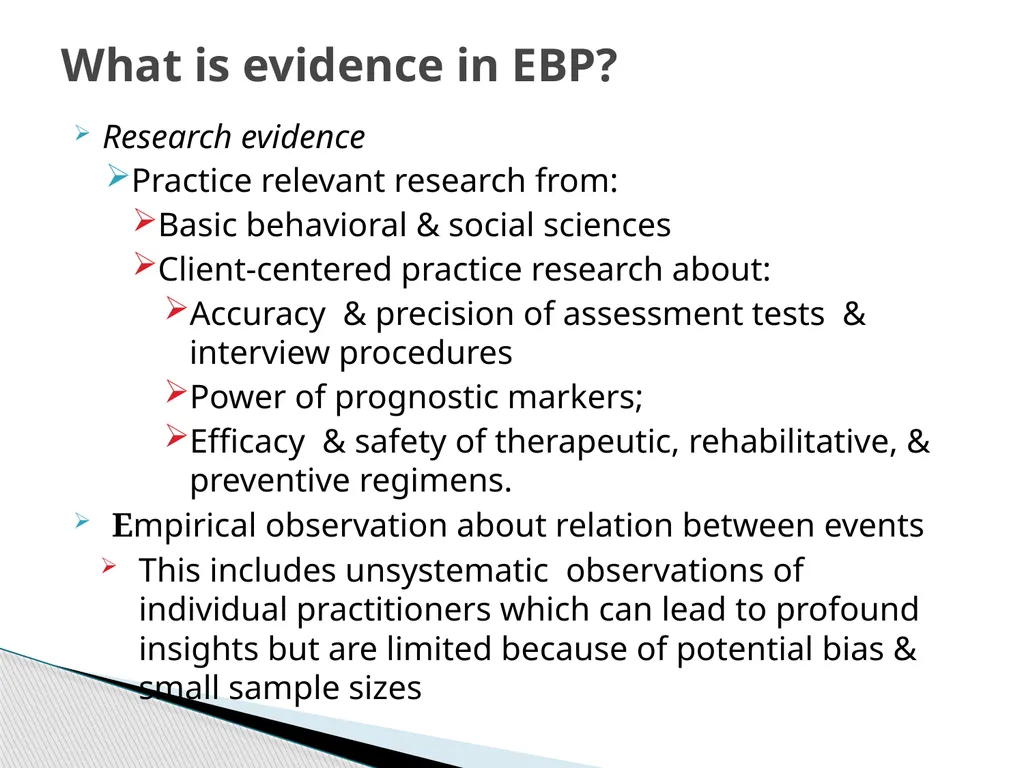
Empirical observation about relation between events
This includes unsystematic observations of individual practitioners which can lead to profound insights but are limited because of potential bias & small sample sizes What is evidence in EBP?<br>
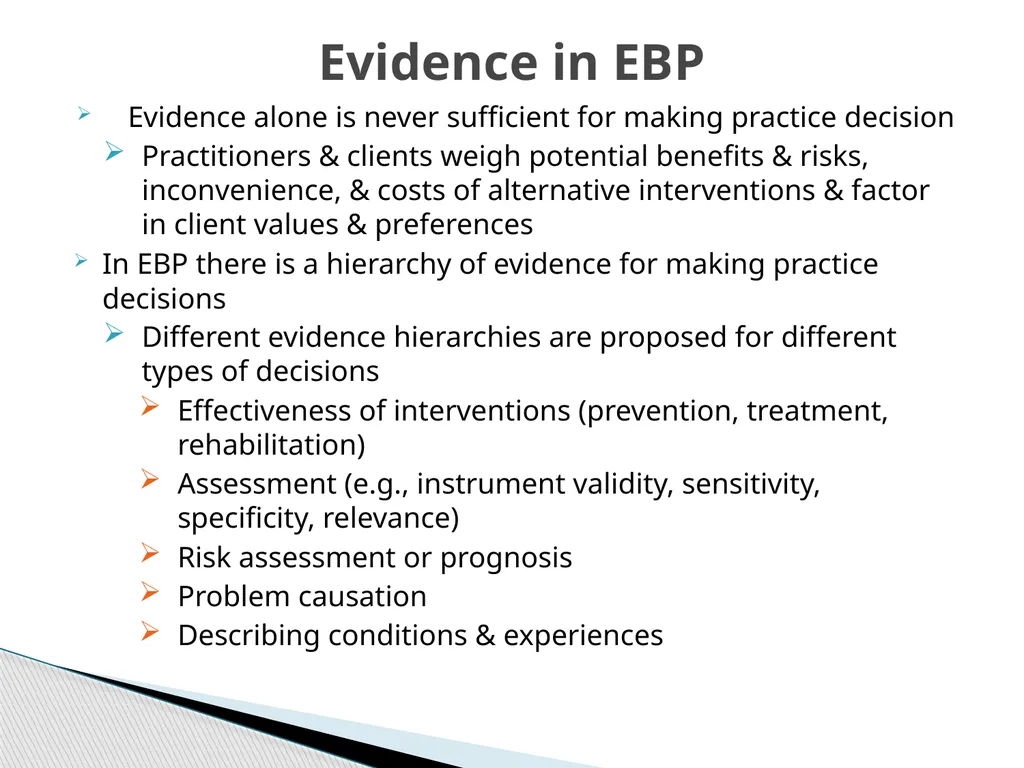
slide58. Evidence alone is never sufficient for making practice decision
Practitioners & clients weigh potential benefits & risks, inconvenience, & costs of alternative interventions & factor in client values & preferences
In EBP there is a hierarchy of evidence for making practice decisions
Different evidence hierarchies are proposed for different types of decisions
Effectiveness of interventions (prevention, treatment, rehabilitation)
Assessment (e.g., instrument validity, sensitivity, specificity, relevance)
Risk assessment or prognosis
Problem causation
Describing conditions & experiences Evidence in EBP<br>
slide59. Questions & Appropriate Research Designs<br>
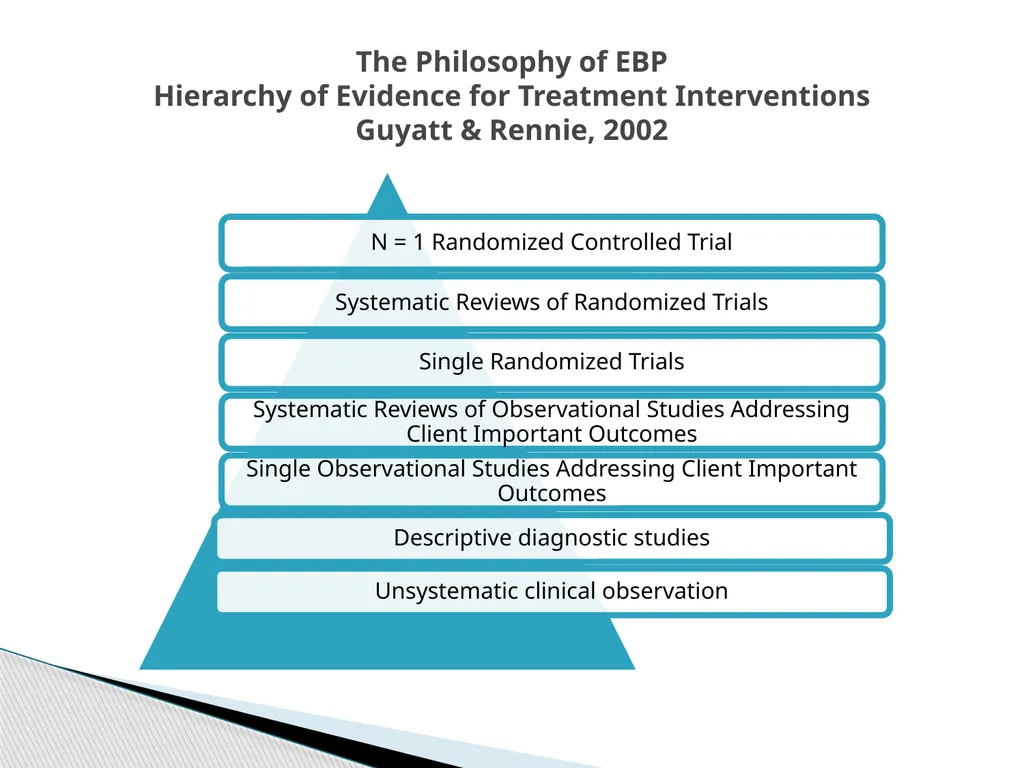
slide60. A practitioner may wish to know whether one intervention has better outcomes than another
EBP has a hierarchy of evidence for effectiveness questions Intervention Effectiveness Questions<br>
slide61. The Philosophy of EBP Hierarchy of Evidence for Treatment Interventions Guyatt & Rennie, 2002<br>
slide62. EBSWP typically begins with assessment of client circumstances, condition, need, values, preferences.
Practitioner may wish to determine mental status of a client & formulate a question asking about reliability, validity, sensitivity & specificity of assessment instrument
Evidence would come from:
Cross-sectional surveys in which alternative measures are compared
Reliability or validity studies
Focus group designs & qualitative methods can be used with groups of clients to explore client values & preferences Assessment Questions<br>
slide63. Practitioners may form questions about causes of social problems that they encounter frequently practice
Knowledge of causes can help practitioners understand frequently encountered problems as well as provide basis for planning interventions to either prevent future occurrences or diminish a client’s problem by removing or reducing causal agents
Evidence could come from:
Cohort or case-controlled studies
Epidemiological research
Case studies Causes of Social Problems<br>
slide64. Practitioners may encounter social problems that are likely to resolve themselves without intervention
May work with groups where risk for development of social problem varies
Some clients may be at high risk, others at a low risk for developing problem
Evidence can come from longitudinal cohort designs Risk Assessment & Likely-outcome (prognosis) Questions<br>
slide65. Practitioners may encounter social problems in their practice that could have been prevented if early signs had been measured & action taken
In these circumstances can ask about what available screening measures for detecting early manifestations of social problems or early warning signs
Evidence can come from cross-section surveys involving large populations
Prevention questions can ask about outcomes of alternative prevention interventions
Hierarchy of evidence for effectiveness questions applies to such prevention questions with preference for RCTs Prevention Questions<br>
slide66. Many Evidence Reviews Are Available<br>
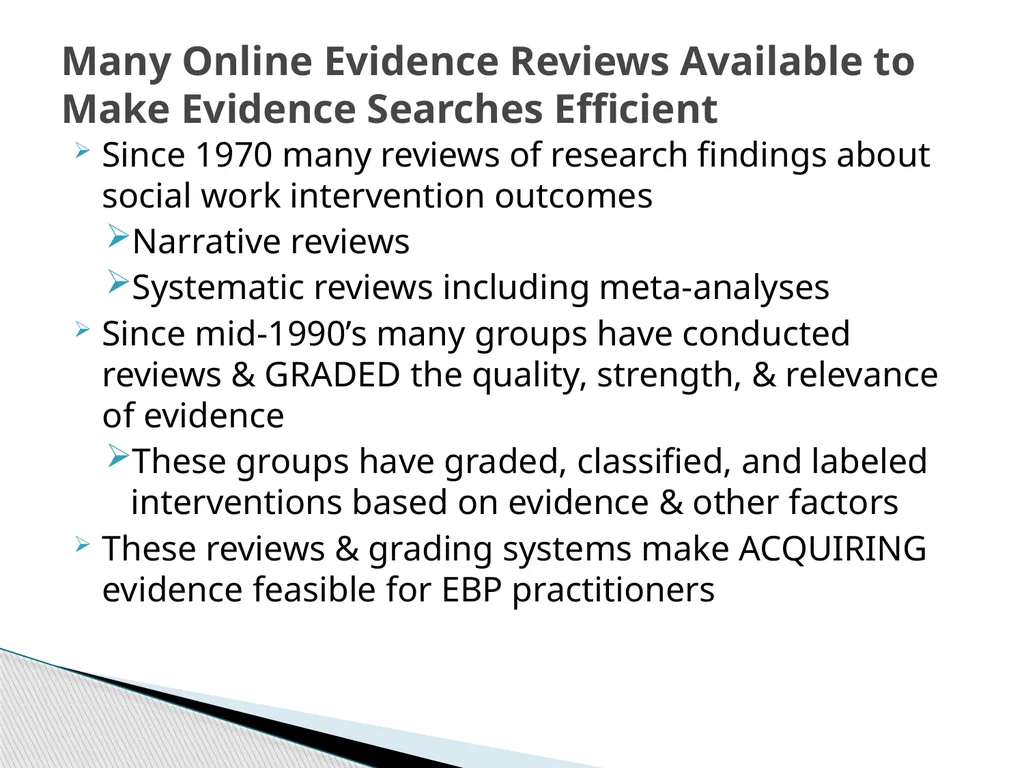
slide67. Since 1970 many reviews of research findings about social work intervention outcomes
Narrative reviews
Systematic reviews including meta-analyses
Since mid-1990’s many groups have conducted reviews & GRADED the quality, strength, & relevance of evidence
These groups have graded, classified, and labeled interventions based on evidence & other factors
These reviews & grading systems make ACQUIRING evidence feasible for EBP practitioners Many Online Evidence Reviews Available to Make Evidence Searches Efficient<br>
slide68. Examples<br>
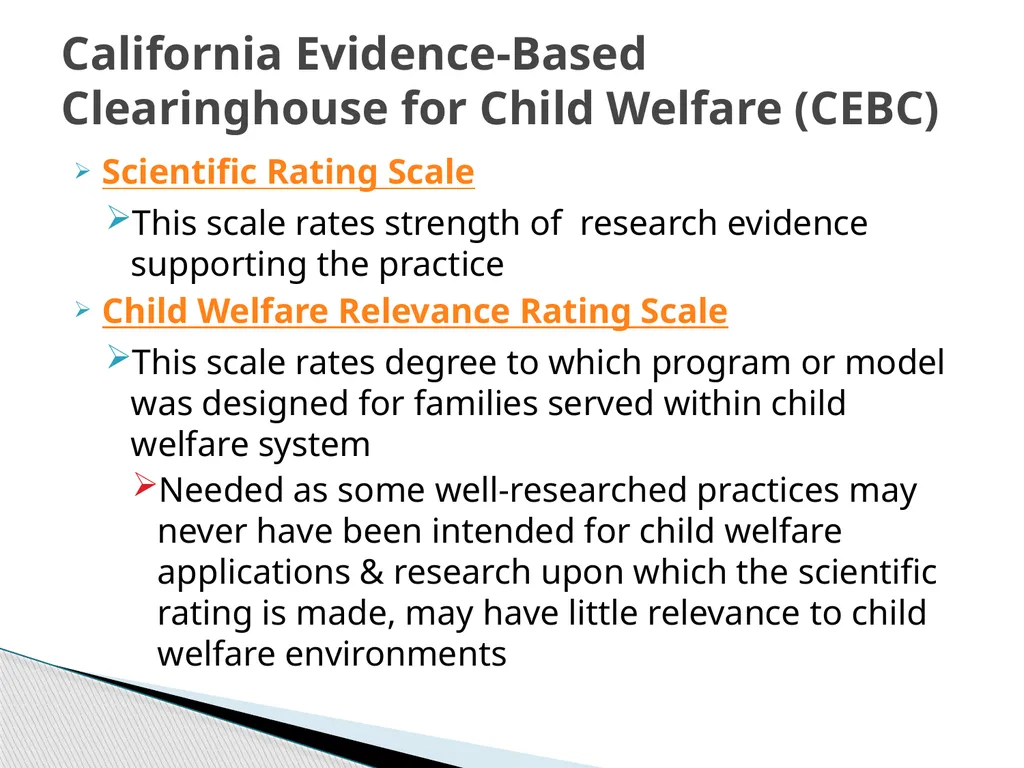
slide69. Scientific Rating Scale
This scale rates strength of research evidence supporting the practice
Child Welfare Relevance Rating Scale
This scale rates degree to which program or model was designed for families served within child welfare system
Needed as some well-researched practices may never have been intended for child welfare applications & research upon which the scientific rating is made, may have little relevance to child welfare environments California Evidence-Based Clearinghouse for Child Welfare (CEBC)<br>
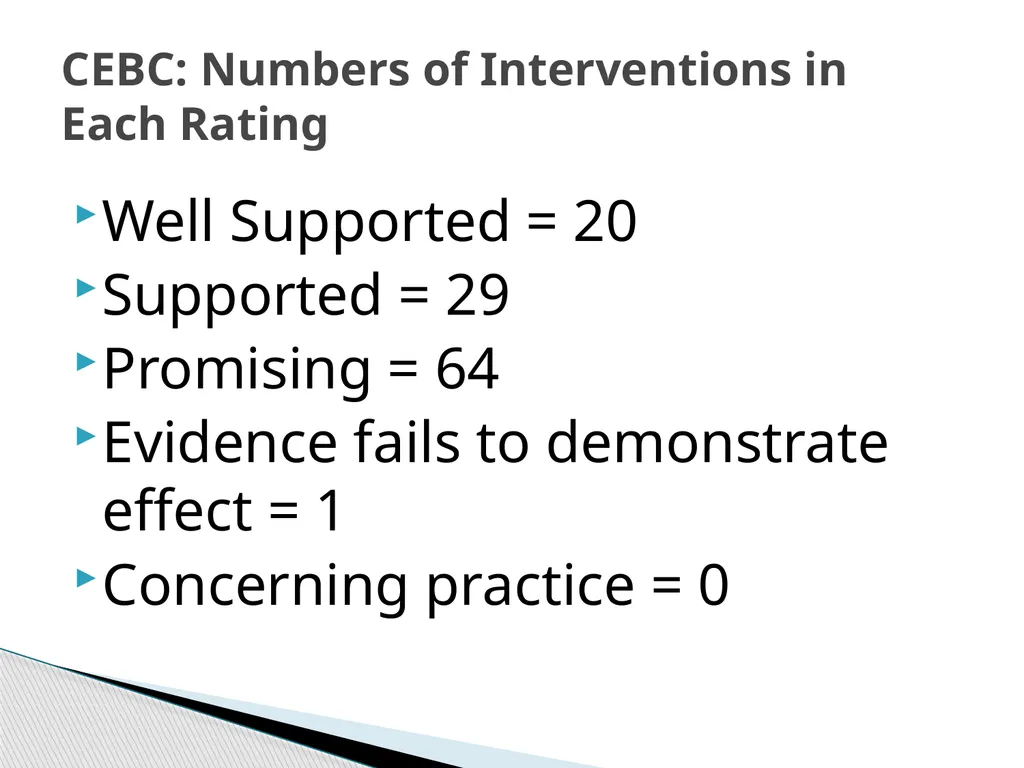
slide70. Well Supported = 20
Supported = 29
Promising = 64
Evidence fails to demonstrate effect = 1
Concerning practice = 0 CEBC: Numbers of Interventions in Each Rating<br>
slide71. Classify psychotherapies into those for which there is:
Clear evidence of efficacy = 31 therapies
Some but limited support for efficacy = 25
less than limited support
Criteria
Replicated demonstration of superiority to control or 1, high quality RCT
Clear description of intervention (e.g., manual)
Clear description of client group Roth & Fonagy<br>
slide72. Robert Wood Johnson Foundation consensus panel
Identified 5 evidence-based psychosocial practices
for treatment of persons with severe mental illness EBP for Persons with Severe Mental Illness<br>
slide73. Assertive community treatment (ACT) A form of intensive, social and medical, team based case management<br>
slide74. Supported employment Providing job and social supports to help individuals obtain and retain jobs in real-world work environments rather than in sheltered work environments.<br>
slide75. Family psycho-education Teaching families about the illness, treatments, options, and how to manage and provide support.<br>
slide76. Skills training and illness self-management Educating patients/clients about their problems and how to deal with their problems<br>
slide77. Integrated dual-disorder treatment Providing effective treatments for individuals with both substance and mental disorders rather than limiting intervention to just one or the other disorder.<br>
slide78. What Selection Criteria Were Used to Establish Interventions as Evidence-based?<br>
slide79. They had been standardized through manuals or guidelines Therefore, they could be reliably taught and implemented
Without clear manuals or guidelines they could not be replicated with reliability<br>
slide80. The practices had been evaluated with controlled research designs Therefore, effects could be considered as due to interventions rather than other factors such as chance or passage of time<br>
slide81. Important outcomes were demonstrated through the use of objective measures Outcomes were not trivial nor were they considered of little value to those receiving interventions
Outcomes were reliably & validly established to have occurred<br>
slide82. Research was conducted by more than one research team Possible bias of an advocate research group was offset by replication of outcomes by another research group<br>
slide83. Practices standardized through manuals or guidelines.
Practices evaluated with controlled research designs.
Important outcomes were objectively measured.
Research was conducted by different research teams. Summary of Selection Criteria:<br>
slide84. In 2010 Congress funded Teen Pregnancy Prevention Initiative
$75 million is for funding replication of programs that have been proven effective through rigorous evaluation
Mathematica Policy Research conducted systematic evidence review
Criteria for study quality & evidence strength were used to rate each intervention found in evidence search
Based on these criteria, OHA set standards an evaluation must meet in order for a program to be considered effective & eligible for funding as an evidence-based program Office of Adolescent Health (OAH): Teen Pregnancy Prevention Programs<br>
slide85. Quality Rating
High, moderate, or low based on rigor & execution of research
High rating
RCTs with low attrition & no sample reassignment
Moderate rating
Quasi-experimental designs with well-matched comparison groups at baseline
Certain RCTs that did not meet all high-rating criteria
Low rating
Quasi-experimental & RCTs not meeting criteria for high or moderate rating Office of Adolescent Health: Teen Pregnancy Prevention Programs<br>
slide86. Evidence of Effectiveness Rating
Program had to be supported by at least one high- or moderate-rated impact study showing a positive, statistically significant impact on at least one priority outcome (sexual activity, contraceptive use, STIs, or pregnancy or births), for either the full study sample or key subgroup (defined by gender or baseline sexual experience).
Programs rated high or moderate on quality & receiving a rating of effectiveness (above) were considered evidence-based (additional criteria used for funding)
28 programs met the funding criteria Office of Adolescent Health: Teen Pregnancy Prevention Programs<br>
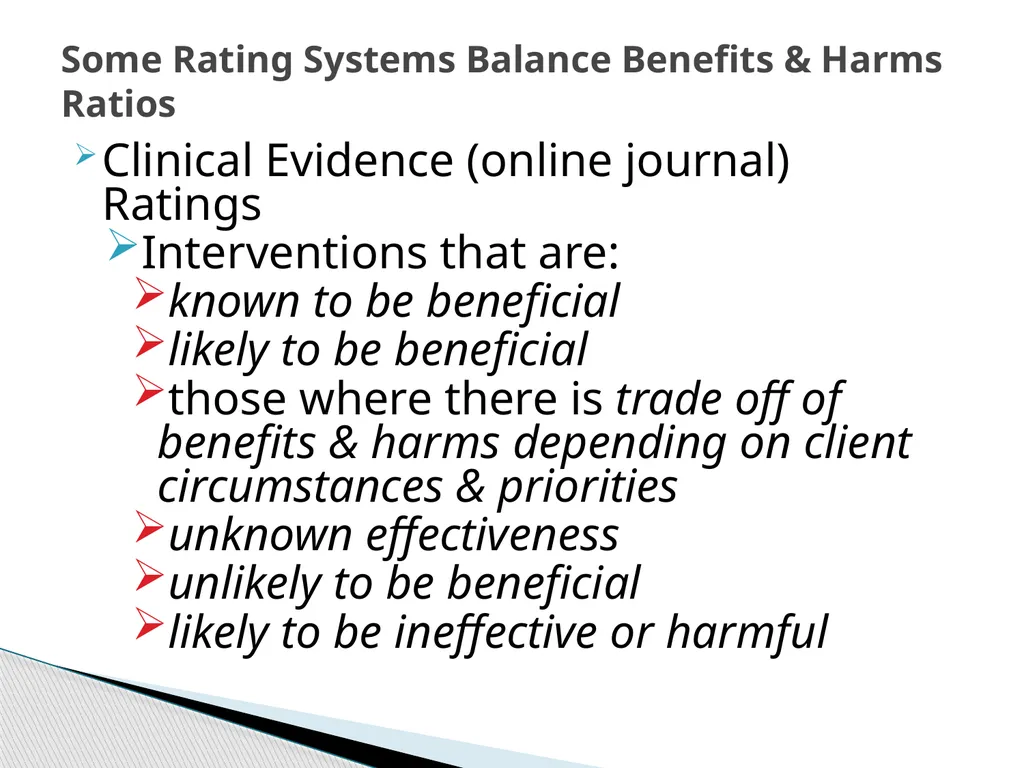
slide87. Clinical Evidence (online journal) Ratings
Interventions that are:
known to be beneficial
likely to be beneficial
those where there is trade off of benefits & harms depending on client circumstances & priorities
unknown effectiveness
unlikely to be beneficial
likely to be ineffective or harmful Some Rating Systems Balance Benefits & Harms Ratios<br>
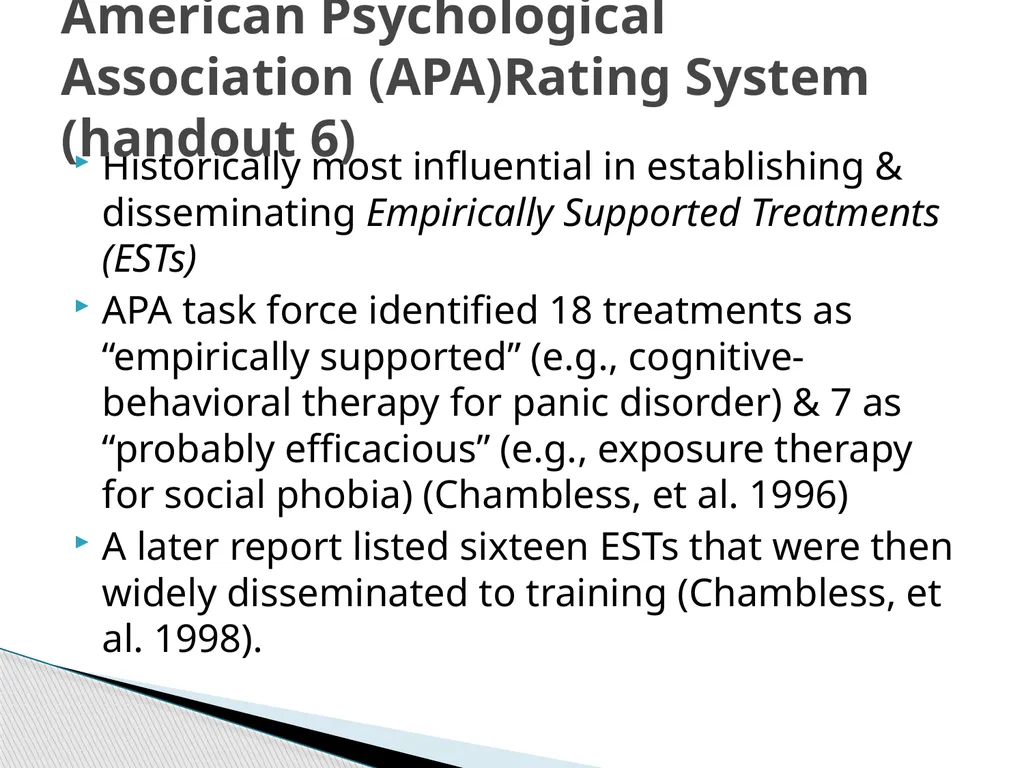
slide88. Historically most influential in establishing & disseminating Empirically Supported Treatments (ESTs)
APA task force identified 18 treatments as “empirically supported” (e.g., cognitive-behavioral therapy for panic disorder) & 7 as “probably efficacious” (e.g., exposure therapy for social phobia) (Chambless, et al. 1996)
A later report listed sixteen ESTs that were then widely disseminated to training (Chambless, et al. 1998). American Psychological Association (APA)Rating System (handout 6)<br>
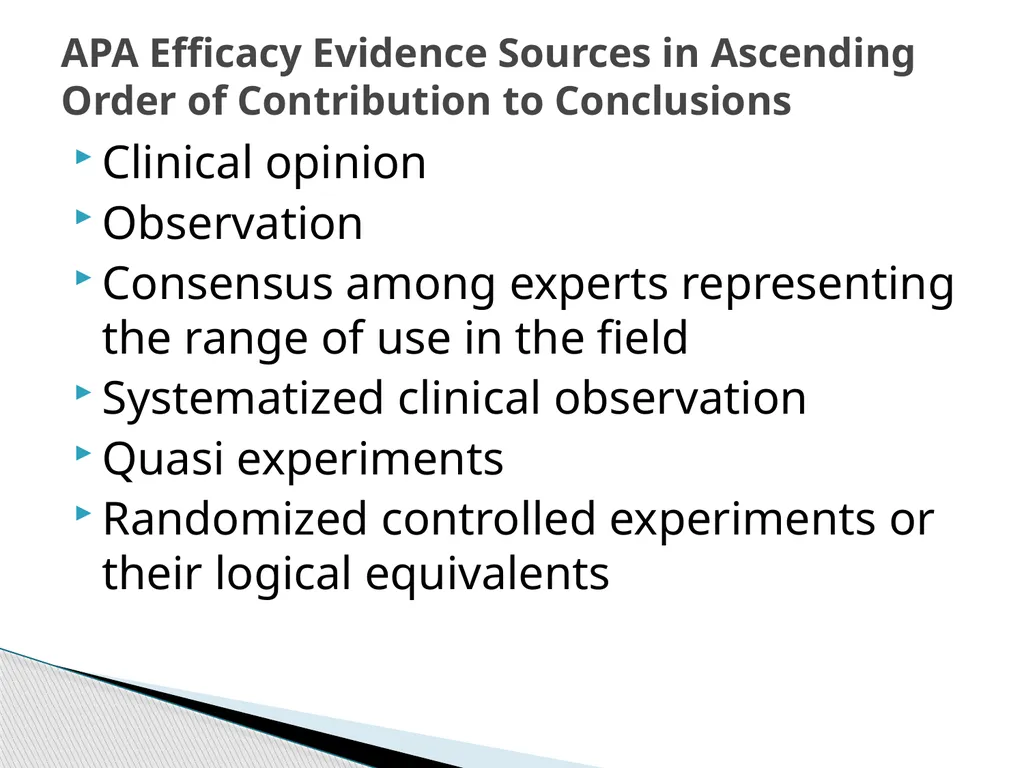
slide89. Clinical opinion
Observation
Consensus among experts representing the range of use in the field
Systematized clinical observation
Quasi experiments
Randomized controlled experiments or their logical equivalents APA Efficacy Evidence Sources in Ascending Order of Contribution to Conclusions<br>
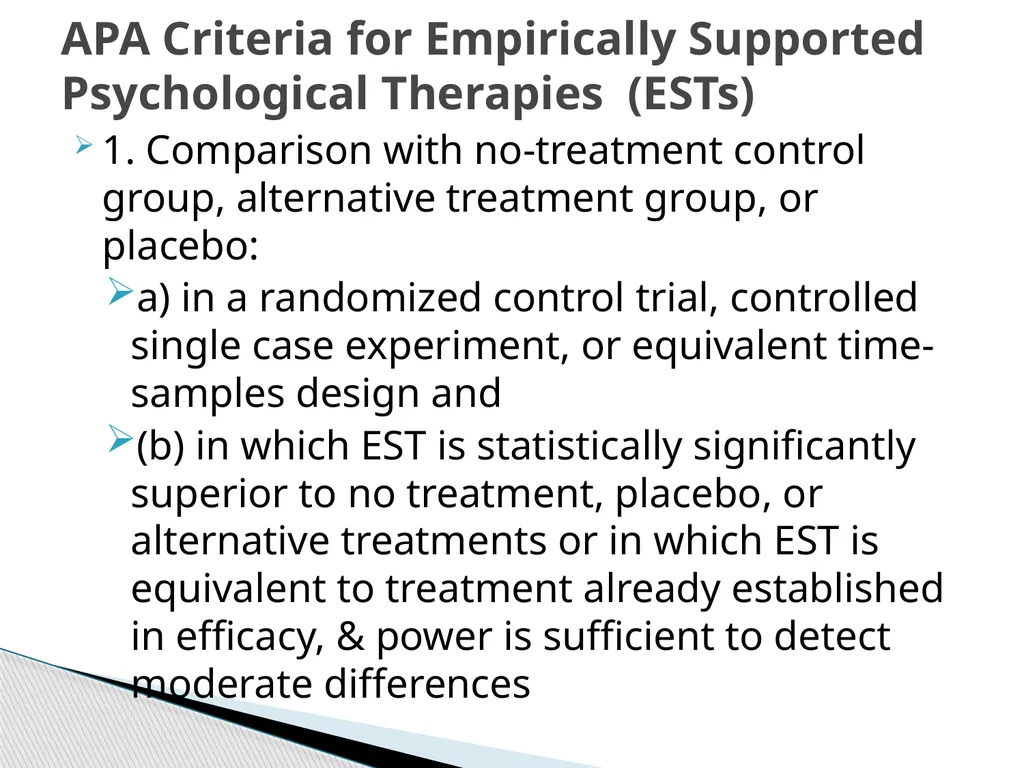
slide90. 1. Comparison with no-treatment control group, alternative treatment group, or placebo:
a) in a randomized control trial, controlled single case experiment, or equivalent time-samples design and
(b) in which EST is statistically significantly superior to no treatment, placebo, or alternative treatments or in which EST is equivalent to treatment already established in efficacy, & power is sufficient to detect moderate differences APA Criteria for Empirically Supported Psychological Therapies (ESTs)<br>
slide91. 2. Studies must have been conducted with:
(a) a treatment manual or its logical equivalent;
(b) a population, treated for specified problems, for whom inclusion criteria have been delineated in reliable, valid manner;
(c) reliable & valid outcome assessment measures, at minimum tapping problems targeted for change;
(d) appropriate data analysis APA Criteria for Empirically Supported Psychological Therapies (ESTs)<br>
slide92. 3. Efficacious
Superiority of EST must have been shown in at least 2 independent research settings (sample size of 3 or more at each site in case of single case experiments)
If conflicting evidence, preponderance of well-controlled data must support EST's efficacy
4. Possibly efficacious
One study (sample size of 3 or more in case of single case experiments) suffices in absence of conflicting evidence
5. Efficacious & specific
Shown to be statistically significantly superior to pill or psychological placebo or to alternative bona fide treatment
in 2 independent research settings
If conflicting evidence, preponderance of well-controlled data must support EST's efficacy & specificity APA Criteria<br>
slide93. Practitioners are to be concerned with both efficacy & utility
Generality of effects across:
Varying & diverse patients, therapists, settings & interaction of factors
Robustness of treatments across modes of delivery
Feasibility which treatments can be delivered in real world settings
Cost associated with treatments APA EST Utility Assessment<br>
slide94. Systematically developed statements to assist practitioner & client decisions about appropriate care for specific circumstances
Professional organizations & governmental agencies have formulated practice guidelines for many conditions
Guidelines prescribe how practitioners should assess & intervene with clients
Sometimes guidelines are based on research findings
Often research is not available
guidelines are based on professional consensus
Rosen & Proctor (2003) provide a comprehensive treatment of practice guidelines in social work Practice Guidelines (handout 6)<br>
slide95. National Guideline Clearinghouse™ (NGC) is a public resource for evidence-based clinical practice guidelines http://www.guideline.gov/index.aspx
U.S. Preventive Service Task Force conducts scientific evidence reviews of a broad range of clinical preventive health care services & develops recommendations for primary care clinicians & health systems. These recommendations are published in the form of "Recommendation Statements.“ U.S. Preventive Service Task Force Practice Guidelines (handout 6)<br>
slide96. Busy practitioners typically do not have time or skills to:
Conduct searches for individual research studies which have examined their EBP question.
Synthesize the research evidence from these individual studies
Practitioners should first search for evidence summaries
Evidence summaries are rapidly becoming available in online systems & clearinghouses
These online systems/clearinghouses frequently do the work of:
Locating research studies
Systematically reviewing & summarizing study findings
Assessing quality, strength, & relevance of evidence
Publishing EBPs, ESI’s, practice guidelines, model programs, best practices, or other forms of evidence-based recommendations
ONLY in absence of evidence systems, summaries, synopses, or syntheses & ONLY WHEN EBP QUESTION IS IMPORTANT should practitioners conduct searches for individual research studies 1st Rule for Planning Search: Efficiency Using 5S Framework<br>
slide97. Acquiring evidence requires skills in using online search terms & strategies (handouts 7-13)
Online review of OBO-SW “Evidence-based Practice: Finding Evidence” (handout) http://oxfordbibliographiesonline.com/view/document/obo-9780195389678/obo-9780195389678-0043.xml?rskey=2Kk0JL&result=5&q=
Online review of EBBP.org “Search for Evidence” module http://www.ebbp.org/training.html
Online review of Columbia University Musher Program EBP resources for finding evidence http://www.columbia.edu/cu/musher/EBP%20Resources.htm
CD-ROM review of REACH-SW “Finding Research Evidence” module (handouts) http://www.danya.com/reach/ Resources for Acquiring Evidence (handouts 7 8 9 10 11 12 13)<br>
slide98. End of Session 2<br>
slide99. Curriculum & Pedagogy of EBP
Digital Resources for Teaching & Learning EBP in Social Work
Curriculum Implications Resources & Curriculum Implications for Teaching & Learning (Key readings, multimedia, internet resources) - Overview<br>
slide100. EBM was developed in 1990’s as a curricular framework for training medical residents at Department of Medicine, McMaster University, Canada
Training program was organized to teach residents:
To develop an attitude of “enlightened skepticism” toward application of diagnostic, therapeutic, & prognostic technologies
To be aware of evidence on which one’s practice is based, soundness of evidence, & strength of inference evidence permits
To develop skills in what later was called 5A’s EBP Curriculum & Pedagogy<br>
slide101. The major text on EBM is focused on both practicing & teaching EBM
(Evidence-Based Medicine: How to Practice and Teach EBM)
Suggested methods are based on collective experience of clinical teachers of EBM Suggestions for Teaching Methods<br>
slide102. “One solution for the problem of obsolescence of professional education is “problem-based learning” or “learning by inquiry”. That is, when confronted by a clinical question for which we are unsure of the current best answer, we need to develop the habit of looking for the current best answer as efficiently as possible.” – Struas, et al, 31. Typically EBP Educators Use Problem-based Learning<br>
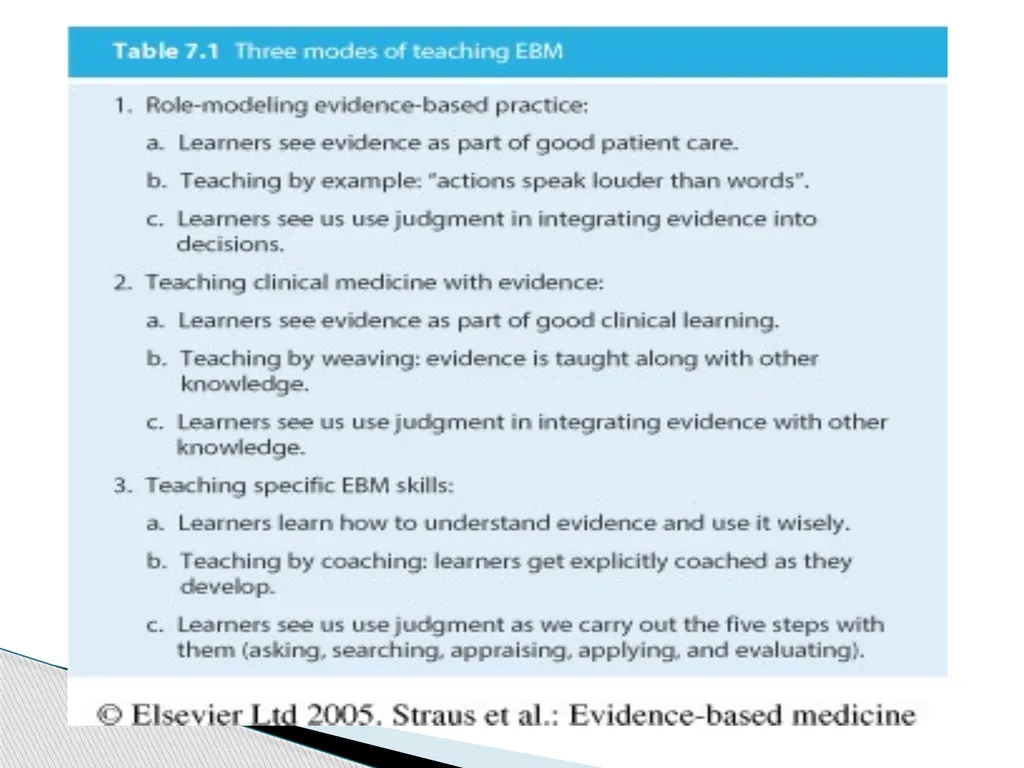
slide103. Role model EBP
Teaching practice using evidence
Teaching specific EBP skills
(Shown in table on next slide for teaching clinical medicine residents) Teaching Modes Used in EBP<br>
slide105. “Standalone teaching improved knowledge but not skills, attitudes, or behaviour
Clinically integrated teaching improved knowledge, skills, attitudes, and behaviour
Teaching of evidence based medicine should be moved from classrooms to clinical practice to achieve improvements in substantial outcomes.”
Coomarasamy, A., & Khan, K. S. (2004) Class & Field Learning Works Best for Shaping EBP Knowledge, Attitudes, & Skills<br>
slide106. Much has been written recently about teaching & learning EBP in social work
EBP is now required by CSWE Curriculum Policy & Accreditation Standards Implications for Teaching & Learning EBP in Social Work<br>
slide107. Teach students to be lifelong learners
Teach the skills & competencies of EBP
Teach students what is currently known & not known about the efficacy & effectiveness of social work practices & programs
Teach students to be knowledgeable & skillful with the empirically supported practices in their area of specialty
Teach current practitioners new knowledge & skills through evidence-based continuing education programs Some Emerging Ideas<br>
slide108. Handout 14 Resources for Teaching & Learning EBP in Social Work<br>
slide109. Online Review of Oxford Bibliographies Online in Social Work (OBO-SW) & Public Health (OBO-PH) http://www.oxfordbibliographiesonline.com/ Resources for Teaching & Learning EBP in Social Work<br>
slide110. Online Review of Columbia University Willma & Albert Musher Program Web Site: Evidence-Based Policy and Practice & Outcomes Measurement Resources http://www.columbia.edu/cu/musher/EBP%20Resources.htm Resources for Teaching & Learning EBP in Social Work<br>
slide111. CD-ROM Review of DANYA International Research & Empirical Applications for Curriculum Enhancement in Social Work (REACH-SW) CD-ROM http://www.danya.com/reach/ Resources for Teaching & Learning EBP in Social Work<br>
slide112. Online Review of EBBP.org web site http://www.ebbp.org/
Implementation Module Resources for Teaching & Learning EBP in Social Work<br>
slide113. Online Review of Evidence-based Practice for the Helping Professions web site http://www.evidence.brookscole.com/ Resources for Teaching & Learning EBP in Social Work<br>
slide114. CSWE Curriculum Policy Statement Requires EBP
Competencies Emphasis in CPS Fits with EBP Competencies but Need to Figure Out Where & How Competencies Can Be Integrated Into Class & Field Curriculum
Faculty Needs Resources for Identifying ESIs for Inclusion in Curriculum
Class & Field Instructors Need to be Supported in Efforts to Make EBP an Integrated Approach to Social Work Education Curriculum Implications<br>
School of Social Work
Edward J Mullen<br>
slide2. 9:00 – 10:30 Evidence Based Practice: Definitions, History, & Competencies
10:30 – 10:40 Break
10:40 – 12:00 Finding Evidence: Evidence-based Practices
12:00 – 1:00 Lunch
1:00 – 2:30 Resources & Curriculum Implications for Teaching & Learning
2:30 – 2:40 Break
2:40 – 4:00 Break-out Group Discussion: Applications to Classroom & Field Curriculum Agenda<br>
slide3. Definitions
Conceptual Frameworks
Process Skills
Question Types
Evidence
History
Bridging Research & Practice in Social Work
Evidence-based Medicine (EBM)
Translating EBM into Social Work Contexts
Competencies Evidence Based Practice (EBP): Definitions, History, & Competencies - Overview<br>
slide4. How can EBP concepts, skills, & competencies be taught in the Gallaudet University School of Social Work Curriculum?
How can class and field teaching & learning be integrated around EBP?
How can EBP content be infused into current course syllabi?
How can EBP problem-based learning be fostered?
How can EBP critical thinking & EBP critical assessment skills be enhanced in the curriculum? Issues for Break-out Group Discussion (handout 15)<br>
slide5. Evidence-based Policy Practice
Evidence-based Management Practice
Evidence-based Direct Practice Evidence-based Social Work Practice Begins with Questions from All Practice Levels from Populations to Individuals<br>
slide6. Evidence-based policy is concerned with problems about how best to achieve group or population goals. What is Evidence-based Policy Practice?<br>
slide7. For children with mental health problems is it best to:
provide remedial treatment services in residential treatment facilities
Or
in community-based programs that allow children to remain at home? An Evidence-based Policy Question<br>
slide8. Is it best to provide adults with severe and persistent mental disorders:
sheltered work programs
Or
supportive services aimed at securing employment in the community? Another Evidence-based Policy Question<br>
slide9. Evidence-based management deals with problems about how best to organize, finance & implement services to populations. What is Evidence-based Management?<br>
slide10. How best to create & sustain an organizational environment so as to move the organization toward policy-based outcomes? An Evidence-based Management Question:<br>
slide11. How best to create and sustain a learning-based organization? Another Evidence-based Management Question:<br>
slide12. Deals with problems of specific client units
Problems are those of identifiable clients in need of some type of:
Assessment
Intervention
Prevention
Evaluative service
Questions have to do with here-and-now practice choices that must be made for specific clients What is Evidence-based Direct Practice?<br>
slide13. EBP is integration of
Best research evidence
Practitioner expertise
Client values
Research evidence
Practice relevant research from:
Basic sciences
Client-centered practice research about:
Accuracy & precision of assessment tests & interview procedures
Power of prognostic markers;
Efficacy & safety of therapeutic, rehabilitative, & preventive regimens.
Expertise
Ability to use skills & experience to rapidly identify each client’s:
Unique psychosocial state & problems or needs
Individual risks & benefits of potential interventions
Personal values & expectations.
Client values
Unique preferences, concerns, & expectations of client that must be integrated into intervention decisions to serve client EBP Defined by Institute of Medicine National Academy of Science (Adapted for Social Work) (see handout 1)<br>
slide14. Placing client’s benefits FIRST
Practitioners adopt LIFELONG learning
CONTINUALLY ASKING specific questions
of direct practical importance to clients
SEARCHING objectively & efficiently
for current best evidence
Taking appropriate action GUIDED by evidence (Gibbs, et al., 2003). EBP in Social Work (EBSWP)<br>
slide15. Newest Trans-disciplinary View of EBP (handout 2) Evidence-based Behavioral Practice Council, EBBP.ORG<br>
slide16. Evidence-Based Behavioral Practice Newest Trans-disciplinary View of EBP Evidence-based Behavioral Practice Council, EBBP.ORG<br>
slide17. Professional decision-making process in which social workers & their clients systematically make intervention choices using practitioner expertise to identify:
client conditions, needs, circumstances, preferences and values;
best evidence about intervention options including potential risk & benefit likelihoods;
contextual resources & constraints bearing on intervention options.
Intervention choices refer to action options about:
how to assess client conditions & circumstances;
how to provide services;
how to evaluate the process & outcomes of services.
Clients can be individuals, families, groups, communities or large populations.
Best evidence includes findings from scientific studies as well as from other reliable sources considered to be of highest quality, strength, & relevance.
Using this decision-making process social workers themselves provide the selected interventions or they link clients to others who can provide the interventions.
Together with their clients, practitioners monitor & evaluate the process & outcomes of services provided making changes in response to what is learned & sharing this information with others to benefit future clients. What is EBSWP Today?<br>
slide18. Ask well formed important questions about the care of individuals, communities, or populations.
Acquire the best available evidence regarding the question.
Appraise the evidence for validity & applicability to the problem at hand.
Apply the evidence by engaging in collaborative shared decision-making with the affected individual(s) and/or group(s). Appropriate decision-making integrates the context, values & preferences of client, as well as available resources, including professional expertise.
Analyze change & adjust practice accordingly. Assess outcome (process & intervention) & disseminate results. 5A’s: Process Steps of EBP (handout 3)<br>
slide19. Because the evidence-based process informs future questions & practice, it is useful to imagine it as a cycle:
Five steps of evidence-based practice.<br>
slide20. What Is Practitioner Expertise in EBP & What Additional Competencies Are Required?<br>
slide21. Assessment skills:
Competency appraising client & community characteristics, problems, values & expectations, & environmental context
Practitioner’s competency to assess own expertise level:
to implement interventions
outcomes of those techniques once implemented
Process skills:
Competency performing 5 EBP process steps:
ask well-formulated questions
acquire best available research evidence
appraise evidence for quality & relevance
apply evidence by engaging in shared decision-making with those who will be affected
analyze change & adjust practice accordingly
Communication & collaboration skills:
Competency to convey information clearly & appropriately
Competency to listen, observe, adjust, & negotiate as appropriate to achieve understanding & agreement on a course of action
Engagement & intervention skills:
Competency in motivating interest, constructive involvement, & positive change
Competency in provision of EBPs which vary in degree of training & experience required Practitioner Expertise Includes Competency in Six Skill Areas (handout 4)<br>
slide22. In 5 A’s First Step Is ASK: What Are EBP Questions that Can Be Asked in EBP?<br>
slide23. In Social Work (Gibbs – handout 5)
Client Oriented Practical Evidence Search (COPES)
In Medicine
Patient Oriented Evidence that Matters (POEM)
Patient (or Problem), Intervention, Comparison, Outcome (PICO) COPES Questions (POEM, PICO)<br>
slide24. Client Oriented
Questions from daily practice, posed by practitioners, that really matter to client’s welfare
Practical
Concern problems that arise frequently
Concern agency mission
Knowing answer could impact decision
Search Oriented
Specific enough to guide electronic evidence search Client Oriented Practical Evidence Search (COPES) Questions:<br>
slide25. Client characteristics
Client problem
What practitioner is considering doing
Alternative course of action against which contemplated action is to be compared
What practitioner seeks to accomplish Parts of COPES Effectiveness Questions<br>
slide26. Examples of COPES Question Types Formed by Social Work Students<br>
slide27. If delinquent youth
Are exposed to
A residential based program
Or
A community based program
Will the former result in fewer delinquent behaviors? Effectiveness Question:<br>
slide28. If families of latency aged boys with conduct disorder
Receive parent management training
Or
No formal training
Will the former exhibit lower externalizing behavior problems? Effectiveness Question<br>
slide29. If disoriented aged persons residing in a nursing home
Are given
Reality orientation therapy
Or
Validation therapy
Which will result in better orientation to time, place, person? Effectiveness Question:<br>
slide30. If sexually active high school students at high risk for pregnancy
Are given
A problem exercise
(Baby-Think-It-Over)
Or
Didactic information
(material on use of birth control methods)
Will the former have fewer pregnancies during the year? Prevention Question:<br>
slide31. Among adolescents at risk for pregnancy
Will a sex education program that stresses abstinence
Or
One that provides birth control information
Result in the lowest pregnancy rates? Prevention Question:<br>
slide32. If adolescents at risk for violence
Receive school based violence prevention programs
Or
No formal violence prevention training
Will the former display lower rates of violence and aggression? Prevention Question:<br>
slide33. If aged residents of a nursing home who may be depressed or may have Alzheimer’s disease or dementia
Are administered
Depression Screening Tests
Or
A Short Mental Status Examination Tests
Which measure will be the briefest, most inexpensive, valid and reliable screening test to discriminate between depression and dementia? Assessment Question:<br>
slide34. If children & adolescents in my caseload
Are administered a computerized brief depression scale
Or
Are screened by a staff psychiatrist
Will the former detect childhood depression as frequently as the latter? Assessment Question:<br>
slide35. If family members of children diagnosed with a learning disorder
Meet in a support group to receive information and support from staff and other families
What aspects of the support group will they find most helpful? Descriptive Question:<br>
slide36. Among children who are cared for by a primary caregiver diagnosed as having a depressive disorder
Compared with
Children whose caregiver has no diagnosed mental disorder
Will the former children be more frequently diagnosed as having a behavioral or emotional disorder? Descriptive Question<br>
slide37. If crisis line callers to a battered women shelter
Are administered
A risk assessment scale by telephone
Or
We rely on practical judgment unaided by a risk assessment scale
Will the scale have higher reliability and predictive validity regarding future violence? Risk Assessment Question:<br>
slide38. Background Questions Ask for General Knowledge about a Condition or Thing
What Causes AIDS?
How Does Neighborhood Violence Affect Probability of Delinquency?
Among children who are cared for by a primary caregiver diagnosed as having a depressive disorder compared with children whose caregiver has no diagnosed mental disorder will the former children be more frequently diagnosed as having a behavioral or emotional disorder? Background & Foreground Questions<br>
slide39. Foreground Questions Ask for Specific Knowledge to Inform Decisions or Actions
If children and adolescents in my caseload are administered a computerized brief depression scale or are screened by a staff psychiatrist will the former detect childhood depression as frequently as the latter?
If adolescents at risk for violence receive school based violence prevention programs or no formal violence prevention training will the former display lower rates of violence and aggression? Background & Foreground Questions<br>
slide40. Enhances quality of decisions about individual clients
Fosters skills to:
Gather and appraise client’s stories, symptoms, signs
Incorporating values and expectations in alliance
Fosters generic skills for finding, appraising, implementing scientific evidence
Provides educational and self-directed life-long learning framework
Identifies knowledge gaps leading to new research
Provides common interdisciplinary language What are the arguments for EBSW?<br>
slide41. EBP moves practitioners away from authoritarian practices & policies
EBP enhances opportunities to honor ethical obligations to clients & students
Helping clients develop critical appraisal skills
Involving clients in design and critique of practice and policy related research
Involving clients as informed participants who share in decision making
Recognizing client’s unique knowledge in terms of application concerns
EBP promotes transparency & honesty
EBP encourages systemic approach for integrating practical, ethical & evidentiary issues
EBP maximizes flow of knowledge & information about knowledge gaps What are the arguments for EBSW? Gambrill, 2003<br>
slide42. EBP originated in medicine in 1990’s
EBM has been transferred into other health disciplines over last 10-15 years
EBP is now widely accepted in health disciplines
A major factor stimulating EBP development is research showing that research findings flow into practice at an extremely slow pace:
Uptake of scientific discoveries into clinical practice: 14% after 17 years (Balas & Boren, 2000)
Only 15% of clinical practices based on evidence (IOM, 1985; Eddy 2005). Brief History of EBP<br>
slide43. EBM was first introduced into American social work in late 1990’s (Gambrill 1999)
Earlier models for integrating research & practice did exist (e.g., the empirical practice movement & scientific practitioner model)
Evidence-based social work practice is, however, qualitatively different from these earlier efforts &, like EBM, has been seen as a paradigm shift
The adoption of EBP has been facilitated by an increase in practice research as well as by mechanisms for evidence dissemination.
EBP is now required for accreditation of social work training programs
Use of research evidence for professional practice is required by the code of ethics for social work Brief History of EBP<br>
slide44. In the past decade, all of the major health professions have endorsed EBP, as shown by these texts originating in medicine, followed by nursing, public health, social work, and finally psychology.<br>
slide45. End of First Session<br>
slide46. Acquiring evidence as 3rd step of EBP process
What are evidence-based practices (EBPs)?
What qualifies as “evidence”?
How are EBPs & EBP related?
How can EBPs & “evidence” be found? Acquiring Evidence & Evidence-based Practices (EBPs): Overview<br>
slide47. Remember 5A’s which form process steps or skills of EBP (next slide)
Recall that 2nd step is ACQUIRING evidence needed to answer question ASKed in 1st step.
This step requires practitioners to conduct an evidence search to answer questions
Translate question into search terms
Search relevant evidence sources
Best done with assistance of reference librarian How can Evidence be Acquired?<br>
slide48. Because the evidence-based process informs future questions & practice, it is useful to imagine it as a cycle:
Five steps of evidence-based practice.<br>
slide49. Busy practitioners typically do not have time or skills to:
Conduct searches for individual research studies which have examined their EBP question.
Synthesize the research evidence from these individual studies
Practitioners should first search for evidence summaries
Evidence summaries are rapidly becoming available in online systems & clearinghouses
These online systems/clearinghouses frequently do the work of:
Locating research studies
Systematically reviewing & summarizing study findings
Assessing quality, strength, & relevance of evidence
Publishing practice guidelines, model programs, best practices, or other forms of evidence-based recommendations
ONLY in absence of evidence systems, summaries, synopses, or syntheses & ONLY WHEN EBP QUESTION IS IMPORTANT should practitioners conduct searches for individual research studies 1st Rule for Planning Search: Efficiency Using 5S Framework<br>
slide50. Systems
Summaries
Synopses
Syntheses
Studies Reproduced from: Haynes, R Brian. 2006. Of studies, syntheses, synopses, summaries, and systems: the “5S” evolution of information services for evidence-based health care decisions. ACP Journal Club 145 (3):A-8 - A-9. EBBP.org The “5S” levels of organization of evidence<br>
slide51. If evidence search is conducted of individual research studies practitioners will need to use their knowledge of research methods to critically appraise individual study validity & relevance
If an evidence search is conducted of sources that have already summarized evidence then practitioners need to be able to critically appraise trustworthiness & relevance of those sources 3rd Step of 5A’s Process is Critical Appraisal of Evidence Found<br>
slide52. Efficacy studies: Many interventions of relevance to social work are now known to be efficacious based on efficacy studies
Effects have been found in controlled research studies often under the best conditions with careful administration to control for possible confounds.
This research not well-suited to testing if intervention will work in real world
Effectiveness studies: Carried out in everyday contexts to test intervention under commonly experienced circumstances
Intervention may be efficacious but may not be effective A Cautionary Note: EBPs May be Supported by Evidence from Efficacy or Effectiveness Studies: An Important Distinction<br>
slide53. Related terms
Empirically supported interventions (ESIs)
Empirically supported treatments (ESTs)
Evidence-based programs (EBPs)
Empirically Informed practices
Practice guidelines
Model Programs
Best practices
No single definition of EBPs
Unlike EBP which is a well-defined process, EBPs are interventions considered to have some degree of research support
When considering the use of EBPs or teaching EBPs important to investigate who is labeling intervention as an EBPs & what standards/criteria used Evidence-based Practices (EBPs)<br>
slide54. Interventions for which there is consistent scientific evidence supporting their use
Assessment tools with good reliability, validity, sensitivity & specificity
Descriptive measures of good reliability & validity
Interventions showing that they improve client outcomes What are Evidence-based Practices (EBPs)?<br>
slide55. Evidence-based practices
Skills, techniques, & strategies that can be used by a practitioner individually or in combination
Cognitive behavior therapy
Systematic desensitization
Token economy motivation systems
Social skills teaching strategies
Evidence-based programs
Groups of practices that seek to integrate a number of intervention practices within a specific service delivery setting & organizational context for a specific population
Assertive Community Treatment
Functional Family Therapy
Multisystemic Therapy
Supported Employment Evidence-based Practices & Programs<br>
slide56. Step 2 in 5A’s process = ACQUIRING evidence so when intervention decisions are made practitioners & clients are AWARE of evidence for alternate intervention choices
Quality
Strength,
Relevance
may be little evidence & choices made with this knowledge
In step 2 EBPs may be found & these can then be critically appraised & considered by practitioners & clients in decision-making How are EBP & EBPs Related?<br>
slide57. Research evidence
Practice relevant research from:
Basic behavioral & social sciences
Client-centered practice research about:
Accuracy & precision of assessment tests & interview procedures
Power of prognostic markers;
Efficacy & safety of therapeutic, rehabilitative, & preventive regimens.
Empirical observation about relation between events
This includes unsystematic observations of individual practitioners which can lead to profound insights but are limited because of potential bias & small sample sizes What is evidence in EBP?<br>
slide58. Evidence alone is never sufficient for making practice decision
Practitioners & clients weigh potential benefits & risks, inconvenience, & costs of alternative interventions & factor in client values & preferences
In EBP there is a hierarchy of evidence for making practice decisions
Different evidence hierarchies are proposed for different types of decisions
Effectiveness of interventions (prevention, treatment, rehabilitation)
Assessment (e.g., instrument validity, sensitivity, specificity, relevance)
Risk assessment or prognosis
Problem causation
Describing conditions & experiences Evidence in EBP<br>
slide59. Questions & Appropriate Research Designs<br>
slide60. A practitioner may wish to know whether one intervention has better outcomes than another
EBP has a hierarchy of evidence for effectiveness questions Intervention Effectiveness Questions<br>
slide61. The Philosophy of EBP Hierarchy of Evidence for Treatment Interventions Guyatt & Rennie, 2002<br>
slide62. EBSWP typically begins with assessment of client circumstances, condition, need, values, preferences.
Practitioner may wish to determine mental status of a client & formulate a question asking about reliability, validity, sensitivity & specificity of assessment instrument
Evidence would come from:
Cross-sectional surveys in which alternative measures are compared
Reliability or validity studies
Focus group designs & qualitative methods can be used with groups of clients to explore client values & preferences Assessment Questions<br>
slide63. Practitioners may form questions about causes of social problems that they encounter frequently practice
Knowledge of causes can help practitioners understand frequently encountered problems as well as provide basis for planning interventions to either prevent future occurrences or diminish a client’s problem by removing or reducing causal agents
Evidence could come from:
Cohort or case-controlled studies
Epidemiological research
Case studies Causes of Social Problems<br>
slide64. Practitioners may encounter social problems that are likely to resolve themselves without intervention
May work with groups where risk for development of social problem varies
Some clients may be at high risk, others at a low risk for developing problem
Evidence can come from longitudinal cohort designs Risk Assessment & Likely-outcome (prognosis) Questions<br>
slide65. Practitioners may encounter social problems in their practice that could have been prevented if early signs had been measured & action taken
In these circumstances can ask about what available screening measures for detecting early manifestations of social problems or early warning signs
Evidence can come from cross-section surveys involving large populations
Prevention questions can ask about outcomes of alternative prevention interventions
Hierarchy of evidence for effectiveness questions applies to such prevention questions with preference for RCTs Prevention Questions<br>
slide66. Many Evidence Reviews Are Available<br>
slide67. Since 1970 many reviews of research findings about social work intervention outcomes
Narrative reviews
Systematic reviews including meta-analyses
Since mid-1990’s many groups have conducted reviews & GRADED the quality, strength, & relevance of evidence
These groups have graded, classified, and labeled interventions based on evidence & other factors
These reviews & grading systems make ACQUIRING evidence feasible for EBP practitioners Many Online Evidence Reviews Available to Make Evidence Searches Efficient<br>
slide68. Examples<br>
slide69. Scientific Rating Scale
This scale rates strength of research evidence supporting the practice
Child Welfare Relevance Rating Scale
This scale rates degree to which program or model was designed for families served within child welfare system
Needed as some well-researched practices may never have been intended for child welfare applications & research upon which the scientific rating is made, may have little relevance to child welfare environments California Evidence-Based Clearinghouse for Child Welfare (CEBC)<br>
slide70. Well Supported = 20
Supported = 29
Promising = 64
Evidence fails to demonstrate effect = 1
Concerning practice = 0 CEBC: Numbers of Interventions in Each Rating<br>
slide71. Classify psychotherapies into those for which there is:
Clear evidence of efficacy = 31 therapies
Some but limited support for efficacy = 25
less than limited support
Criteria
Replicated demonstration of superiority to control or 1, high quality RCT
Clear description of intervention (e.g., manual)
Clear description of client group Roth & Fonagy<br>
slide72. Robert Wood Johnson Foundation consensus panel
Identified 5 evidence-based psychosocial practices
for treatment of persons with severe mental illness EBP for Persons with Severe Mental Illness<br>
slide73. Assertive community treatment (ACT) A form of intensive, social and medical, team based case management<br>
slide74. Supported employment Providing job and social supports to help individuals obtain and retain jobs in real-world work environments rather than in sheltered work environments.<br>
slide75. Family psycho-education Teaching families about the illness, treatments, options, and how to manage and provide support.<br>
slide76. Skills training and illness self-management Educating patients/clients about their problems and how to deal with their problems<br>
slide77. Integrated dual-disorder treatment Providing effective treatments for individuals with both substance and mental disorders rather than limiting intervention to just one or the other disorder.<br>
slide78. What Selection Criteria Were Used to Establish Interventions as Evidence-based?<br>
slide79. They had been standardized through manuals or guidelines Therefore, they could be reliably taught and implemented
Without clear manuals or guidelines they could not be replicated with reliability<br>
slide80. The practices had been evaluated with controlled research designs Therefore, effects could be considered as due to interventions rather than other factors such as chance or passage of time<br>
slide81. Important outcomes were demonstrated through the use of objective measures Outcomes were not trivial nor were they considered of little value to those receiving interventions
Outcomes were reliably & validly established to have occurred<br>
slide82. Research was conducted by more than one research team Possible bias of an advocate research group was offset by replication of outcomes by another research group<br>
slide83. Practices standardized through manuals or guidelines.
Practices evaluated with controlled research designs.
Important outcomes were objectively measured.
Research was conducted by different research teams. Summary of Selection Criteria:<br>
slide84. In 2010 Congress funded Teen Pregnancy Prevention Initiative
$75 million is for funding replication of programs that have been proven effective through rigorous evaluation
Mathematica Policy Research conducted systematic evidence review
Criteria for study quality & evidence strength were used to rate each intervention found in evidence search
Based on these criteria, OHA set standards an evaluation must meet in order for a program to be considered effective & eligible for funding as an evidence-based program Office of Adolescent Health (OAH): Teen Pregnancy Prevention Programs<br>
slide85. Quality Rating
High, moderate, or low based on rigor & execution of research
High rating
RCTs with low attrition & no sample reassignment
Moderate rating
Quasi-experimental designs with well-matched comparison groups at baseline
Certain RCTs that did not meet all high-rating criteria
Low rating
Quasi-experimental & RCTs not meeting criteria for high or moderate rating Office of Adolescent Health: Teen Pregnancy Prevention Programs<br>
slide86. Evidence of Effectiveness Rating
Program had to be supported by at least one high- or moderate-rated impact study showing a positive, statistically significant impact on at least one priority outcome (sexual activity, contraceptive use, STIs, or pregnancy or births), for either the full study sample or key subgroup (defined by gender or baseline sexual experience).
Programs rated high or moderate on quality & receiving a rating of effectiveness (above) were considered evidence-based (additional criteria used for funding)
28 programs met the funding criteria Office of Adolescent Health: Teen Pregnancy Prevention Programs<br>
slide87. Clinical Evidence (online journal) Ratings
Interventions that are:
known to be beneficial
likely to be beneficial
those where there is trade off of benefits & harms depending on client circumstances & priorities
unknown effectiveness
unlikely to be beneficial
likely to be ineffective or harmful Some Rating Systems Balance Benefits & Harms Ratios<br>
slide88. Historically most influential in establishing & disseminating Empirically Supported Treatments (ESTs)
APA task force identified 18 treatments as “empirically supported” (e.g., cognitive-behavioral therapy for panic disorder) & 7 as “probably efficacious” (e.g., exposure therapy for social phobia) (Chambless, et al. 1996)
A later report listed sixteen ESTs that were then widely disseminated to training (Chambless, et al. 1998). American Psychological Association (APA)Rating System (handout 6)<br>
slide89. Clinical opinion
Observation
Consensus among experts representing the range of use in the field
Systematized clinical observation
Quasi experiments
Randomized controlled experiments or their logical equivalents APA Efficacy Evidence Sources in Ascending Order of Contribution to Conclusions<br>
slide90. 1. Comparison with no-treatment control group, alternative treatment group, or placebo:
a) in a randomized control trial, controlled single case experiment, or equivalent time-samples design and
(b) in which EST is statistically significantly superior to no treatment, placebo, or alternative treatments or in which EST is equivalent to treatment already established in efficacy, & power is sufficient to detect moderate differences APA Criteria for Empirically Supported Psychological Therapies (ESTs)<br>
slide91. 2. Studies must have been conducted with:
(a) a treatment manual or its logical equivalent;
(b) a population, treated for specified problems, for whom inclusion criteria have been delineated in reliable, valid manner;
(c) reliable & valid outcome assessment measures, at minimum tapping problems targeted for change;
(d) appropriate data analysis APA Criteria for Empirically Supported Psychological Therapies (ESTs)<br>
slide92. 3. Efficacious
Superiority of EST must have been shown in at least 2 independent research settings (sample size of 3 or more at each site in case of single case experiments)
If conflicting evidence, preponderance of well-controlled data must support EST's efficacy
4. Possibly efficacious
One study (sample size of 3 or more in case of single case experiments) suffices in absence of conflicting evidence
5. Efficacious & specific
Shown to be statistically significantly superior to pill or psychological placebo or to alternative bona fide treatment
in 2 independent research settings
If conflicting evidence, preponderance of well-controlled data must support EST's efficacy & specificity APA Criteria<br>
slide93. Practitioners are to be concerned with both efficacy & utility
Generality of effects across:
Varying & diverse patients, therapists, settings & interaction of factors
Robustness of treatments across modes of delivery
Feasibility which treatments can be delivered in real world settings
Cost associated with treatments APA EST Utility Assessment<br>
slide94. Systematically developed statements to assist practitioner & client decisions about appropriate care for specific circumstances
Professional organizations & governmental agencies have formulated practice guidelines for many conditions
Guidelines prescribe how practitioners should assess & intervene with clients
Sometimes guidelines are based on research findings
Often research is not available
guidelines are based on professional consensus
Rosen & Proctor (2003) provide a comprehensive treatment of practice guidelines in social work Practice Guidelines (handout 6)<br>
slide95. National Guideline Clearinghouse™ (NGC) is a public resource for evidence-based clinical practice guidelines http://www.guideline.gov/index.aspx
U.S. Preventive Service Task Force conducts scientific evidence reviews of a broad range of clinical preventive health care services & develops recommendations for primary care clinicians & health systems. These recommendations are published in the form of "Recommendation Statements.“ U.S. Preventive Service Task Force Practice Guidelines (handout 6)<br>
slide96. Busy practitioners typically do not have time or skills to:
Conduct searches for individual research studies which have examined their EBP question.
Synthesize the research evidence from these individual studies
Practitioners should first search for evidence summaries
Evidence summaries are rapidly becoming available in online systems & clearinghouses
These online systems/clearinghouses frequently do the work of:
Locating research studies
Systematically reviewing & summarizing study findings
Assessing quality, strength, & relevance of evidence
Publishing EBPs, ESI’s, practice guidelines, model programs, best practices, or other forms of evidence-based recommendations
ONLY in absence of evidence systems, summaries, synopses, or syntheses & ONLY WHEN EBP QUESTION IS IMPORTANT should practitioners conduct searches for individual research studies 1st Rule for Planning Search: Efficiency Using 5S Framework<br>
slide97. Acquiring evidence requires skills in using online search terms & strategies (handouts 7-13)
Online review of OBO-SW “Evidence-based Practice: Finding Evidence” (handout) http://oxfordbibliographiesonline.com/view/document/obo-9780195389678/obo-9780195389678-0043.xml?rskey=2Kk0JL&result=5&q=
Online review of EBBP.org “Search for Evidence” module http://www.ebbp.org/training.html
Online review of Columbia University Musher Program EBP resources for finding evidence http://www.columbia.edu/cu/musher/EBP%20Resources.htm
CD-ROM review of REACH-SW “Finding Research Evidence” module (handouts) http://www.danya.com/reach/ Resources for Acquiring Evidence (handouts 7 8 9 10 11 12 13)<br>
slide98. End of Session 2<br>
slide99. Curriculum & Pedagogy of EBP
Digital Resources for Teaching & Learning EBP in Social Work
Curriculum Implications Resources & Curriculum Implications for Teaching & Learning (Key readings, multimedia, internet resources) - Overview<br>
slide100. EBM was developed in 1990’s as a curricular framework for training medical residents at Department of Medicine, McMaster University, Canada
Training program was organized to teach residents:
To develop an attitude of “enlightened skepticism” toward application of diagnostic, therapeutic, & prognostic technologies
To be aware of evidence on which one’s practice is based, soundness of evidence, & strength of inference evidence permits
To develop skills in what later was called 5A’s EBP Curriculum & Pedagogy<br>
slide101. The major text on EBM is focused on both practicing & teaching EBM
(Evidence-Based Medicine: How to Practice and Teach EBM)
Suggested methods are based on collective experience of clinical teachers of EBM Suggestions for Teaching Methods<br>
slide102. “One solution for the problem of obsolescence of professional education is “problem-based learning” or “learning by inquiry”. That is, when confronted by a clinical question for which we are unsure of the current best answer, we need to develop the habit of looking for the current best answer as efficiently as possible.” – Struas, et al, 31. Typically EBP Educators Use Problem-based Learning<br>
slide103. Role model EBP
Teaching practice using evidence
Teaching specific EBP skills
(Shown in table on next slide for teaching clinical medicine residents) Teaching Modes Used in EBP<br>
slide105. “Standalone teaching improved knowledge but not skills, attitudes, or behaviour
Clinically integrated teaching improved knowledge, skills, attitudes, and behaviour
Teaching of evidence based medicine should be moved from classrooms to clinical practice to achieve improvements in substantial outcomes.”
Coomarasamy, A., & Khan, K. S. (2004) Class & Field Learning Works Best for Shaping EBP Knowledge, Attitudes, & Skills<br>
slide106. Much has been written recently about teaching & learning EBP in social work
EBP is now required by CSWE Curriculum Policy & Accreditation Standards Implications for Teaching & Learning EBP in Social Work<br>
slide107. Teach students to be lifelong learners
Teach the skills & competencies of EBP
Teach students what is currently known & not known about the efficacy & effectiveness of social work practices & programs
Teach students to be knowledgeable & skillful with the empirically supported practices in their area of specialty
Teach current practitioners new knowledge & skills through evidence-based continuing education programs Some Emerging Ideas<br>
slide108. Handout 14 Resources for Teaching & Learning EBP in Social Work<br>
slide109. Online Review of Oxford Bibliographies Online in Social Work (OBO-SW) & Public Health (OBO-PH) http://www.oxfordbibliographiesonline.com/ Resources for Teaching & Learning EBP in Social Work<br>
slide110. Online Review of Columbia University Willma & Albert Musher Program Web Site: Evidence-Based Policy and Practice & Outcomes Measurement Resources http://www.columbia.edu/cu/musher/EBP%20Resources.htm Resources for Teaching & Learning EBP in Social Work<br>
slide111. CD-ROM Review of DANYA International Research & Empirical Applications for Curriculum Enhancement in Social Work (REACH-SW) CD-ROM http://www.danya.com/reach/ Resources for Teaching & Learning EBP in Social Work<br>
slide112. Online Review of EBBP.org web site http://www.ebbp.org/
Implementation Module Resources for Teaching & Learning EBP in Social Work<br>
slide113. Online Review of Evidence-based Practice for the Helping Professions web site http://www.evidence.brookscole.com/ Resources for Teaching & Learning EBP in Social Work<br>
slide114. CSWE Curriculum Policy Statement Requires EBP
Competencies Emphasis in CPS Fits with EBP Competencies but Need to Figure Out Where & How Competencies Can Be Integrated Into Class & Field Curriculum
Faculty Needs Resources for Identifying ESIs for Inclusion in Curriculum
Class & Field Instructors Need to be Supported in Efforts to Make EBP an Integrated Approach to Social Work Education Curriculum Implications<br>