02
Evolution of Human Resource Management: (From 19th Century till Recent Times) Identification of evolution of HRM over the period of time is important for understanding the philosophy, functions, and practices of HRM that are followed in different situations so that relevant HRM practices are evolved in the present situation. HRM, being a part of management discipline, has followed the pattern of development of management because of the interrelationship of the problems of both the fields.<br>
04
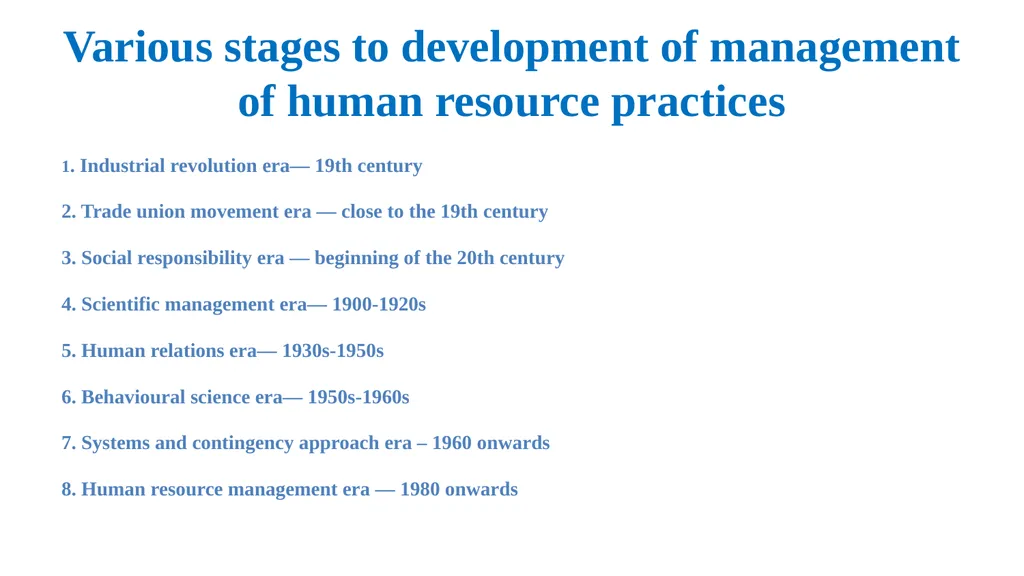
1. Industrial Revolution Era: The systematic development of HRM started with industrial revolution that started during 1850s in Western Europe and USA. The industrial revolution consisted, essentially, the development of machinery, the use of mechanical energy in production processes, and consequently the emergence of the concept of factory with large number of workforce working together.
The factory system replaced the old cottage system. Industrial revolution brought out a number of changes like centralized work locations with large number of workers working together, mechanized production process, migration of workers from their place of origin, and indirect contact between factory owners and workers.<br>
05
1. Industrial Revolution Era: In order to manage people in the factory system of industrial revolution, three systems of HRM were developed- recruitment of workers, training for workers, and control of workers. However, the basic philosophy of managing workers revolved around master-servant relationship.<br>
06
2. Trade Union Movement Era: Shortly after the emergence of factory system, workers started to organize themselves based on their common interests to form workers’ associations which were subsequently known as trade unions. The basic objectives of these associations were to safeguard interest of their members and to sort out their problems which arose primarily because of employment of child labour, long hours of work, and poor working conditions.
Later, other aspects of work such as economic problems and wages, employee benefits and services, etc. also became issues. These trade unions started such weapons as strikes, slowdowns, walkouts, boycotts, etc., for the acceptance of their demands.<br>
07
2. Trade Union Movement Era: These activities of the trade unions forced owners and managers to adopt employee grievance handling systems, arbitration as a means of resolving conflicts between owners/managers and workers, disciplinary practice, expansion of employee benefit programmes, holiday and vacation time, clear definition of job duties, job rights through seniority, and installation of rational and defensible wage structures.<br>
08
3. Social Responsibility Era: In the first decade of 20th century, some factory owners started adopting a more humanistic and paternalistic approach towards workers. Paternalistic approach to labour management is based on the philosophy that labour is just like a child and owner is just like a father and the owner should take care of his labour just like a father takes care of his children.
Those industrialists who adopted paternalistic approach offered a number of concessions and facilities to labour force like reduced number of work hours, improved facilities at workplace, model villages to workers, etc. All these practices led to the development of social welfare aspect of labour management.<br>
09
4. Scientific Management Era: Around the beginning of 20th century, Taylor started to find out ‘one best way of doing thing’ based on time and motion studies. On the basis of his experiments, he was able to increase workers’ productivity considerably and wrote many papers based on these experiments and a book on scientific management.<br>
10
The main principles of scientific management are: (i) Replacing rule of thumb with science,
(ii) harmony, not conflict,
(iii) cooperation, not individualism, and
(iv) development of each and every person.
Scientific management techniques relevant to management of workers are- functional foremanship, standardization and simplification of work, and differential piece wage system.<br>
11
5. Human Relations Era: Around 1920s, management researchers gave a close look at the human factor at work and the variables that affected people’s behaviour. This brief period was termed as ‘Industrial Psychology Era’.
In 1924, a group of professors from Harvard Business School, USA, began an enquiry into the human aspects of work and working conditions at Hawthorne plant of Western Electric Company, Chicago.<br>
12
5. Human Relations Era: They conducted researches from 1924 to 1932 and arrived at the conclusions that productivity of workers depended on- (i) social factors at the workplace, (ii) group formation and group influence, (iii) nature of leadership and supervision, and (iv) communication.
They concluded that in order to have better productivity, management should take care of human relations besides the physical conditions at the workplace. Consequently, the concepts of social system, informal organization, group influence, and non-logical behaviour entered the field of management of personnel.<br>
13
6. Behavioural Science Era: The contribution of behavioural scientists to management practices consists primarily of producing new insights rather than new techniques. It has developed or expanded a useful way of thinking about the role of the manager, the nature of organizations, and the behaviour of individuals within organizations. As against human relations model, they have given the concept of human resource model.<br>
14
7. Systems and Contingency Approach Era: Systems and contingency approach has attracted maximum attention of thinkers in management in the present era. It is an integrated approach which considers management of human resources in its totality based on empirical data. The basic idea of this approach is that analysis of any object must rely on a method of analysis involving simultaneous variations of mutually-dependent variables. This happens when systems approach is applied in managing human resources.<br>
15
8. Human Resource Management Era: When the factory system was applied in production, large number of workers started working together. A need was felt that there should be someone who should take care of recruiting, developing, and looking after welfare of these workers. For this purpose, industrial relations department came into existence in most of the large organizations which was concerned mostly with workers. Industrial relations department was named as personnel department.
Even the American Society for Personnel Administration, the largest professional association in the field of human resource management, changed its name to the Society for Human Resource Management in 1990.<br>