
Evolutionary Robotics Guided by : Prof . Pushpak

Description: Evolutionary Robotics Guided by : Prof . Pushpak Bhattacharya By : Hemant noval Palak dalal Sushil meena Mudit malpani Contents Introduction and Motivation Artificial Evolution Neural Network Controller Morphology Evolution through
Related Topics
Download Presentation
"Evolutionary Robotics Guided by : Prof . Pushpak" is the property of its rightful owner. Permission is granted to download and print the materials on this website for personal, non-commercial use only, and to display it on your personal computer provided you do not modify the materials and that you retain all copyright notices contained in the materials. By downloading content from our website, you accept the terms of this agreement.
Presentation Transcript
slide1. Evolutionary
Robotics Guided by :
Prof . Pushpak Bhattacharya By :
Hemant noval
Palak dalal
Sushil meena
Mudit malpani<br>
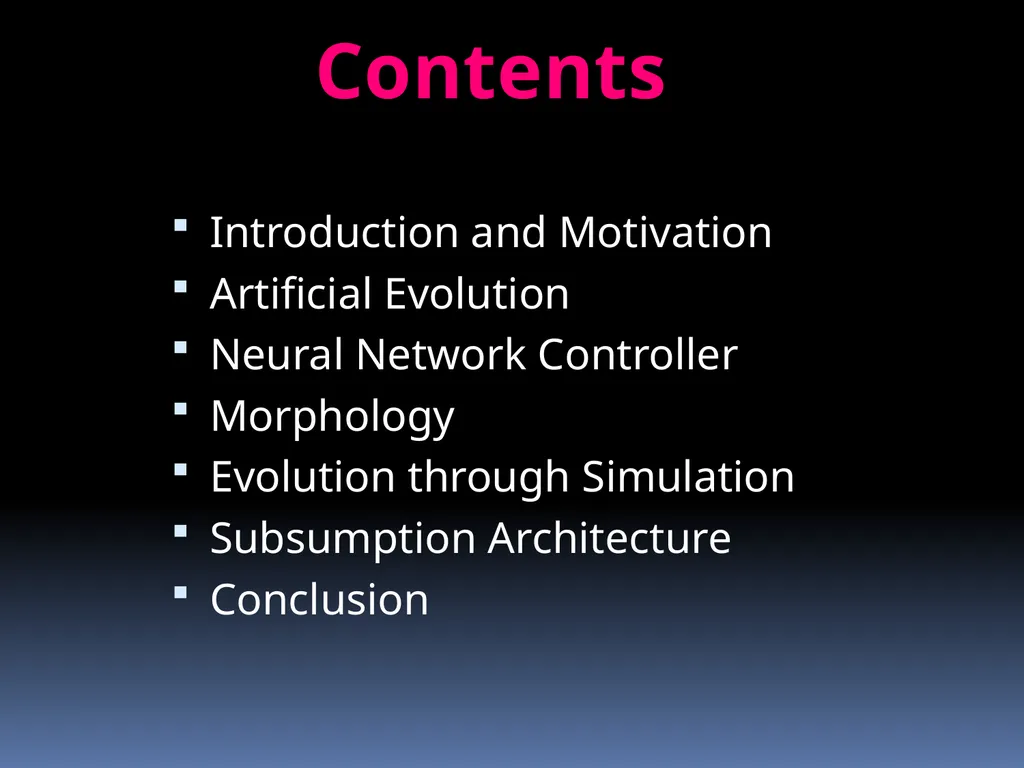
slide2. Contents Introduction and Motivation
Artificial Evolution
Neural Network Controller
Morphology
Evolution through Simulation
Subsumption Architecture
Conclusion<br>
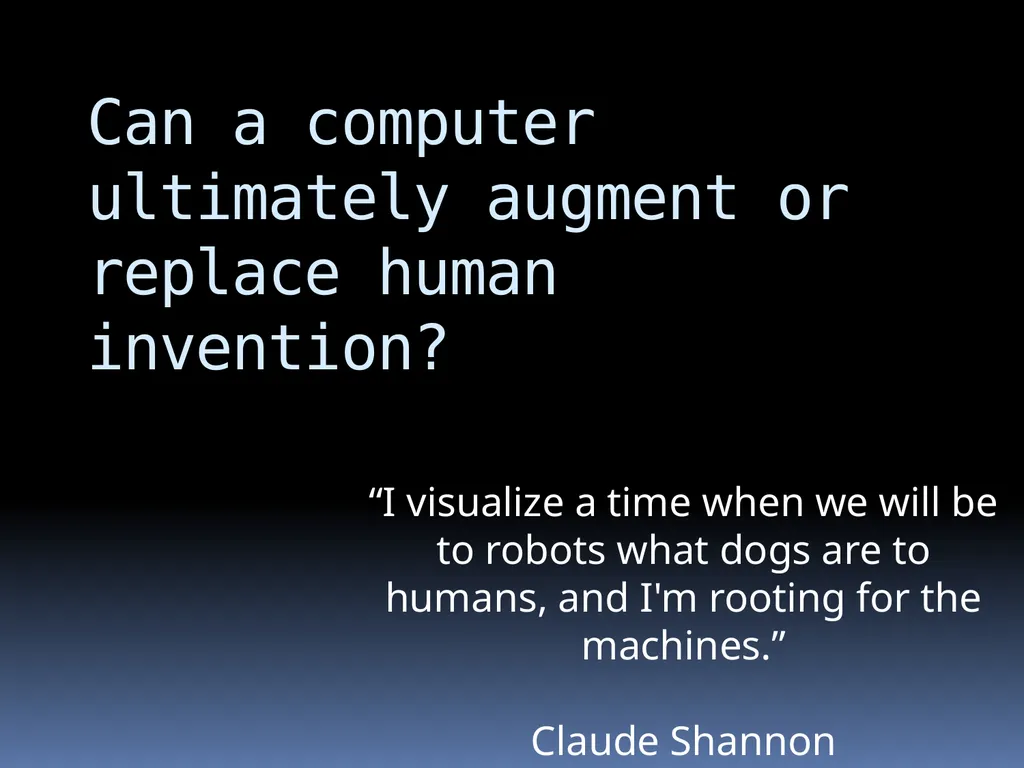
slide3. Can a computer ultimately augment or replace human invention? “I visualize a time when we will be to robots what dogs are to humans, and I'm rooting for the machines.” Claude Shannon<br>
slide4. Primary Goal To develop automatic methods for creating intelligent autonomous robot controllers Definition (from Wikipedia) Evolutionary robotics (ER) is a methodology that uses evolutionary computation to develop controllers for autonomous robots.<br>
slide5. MOTIVATION<br>
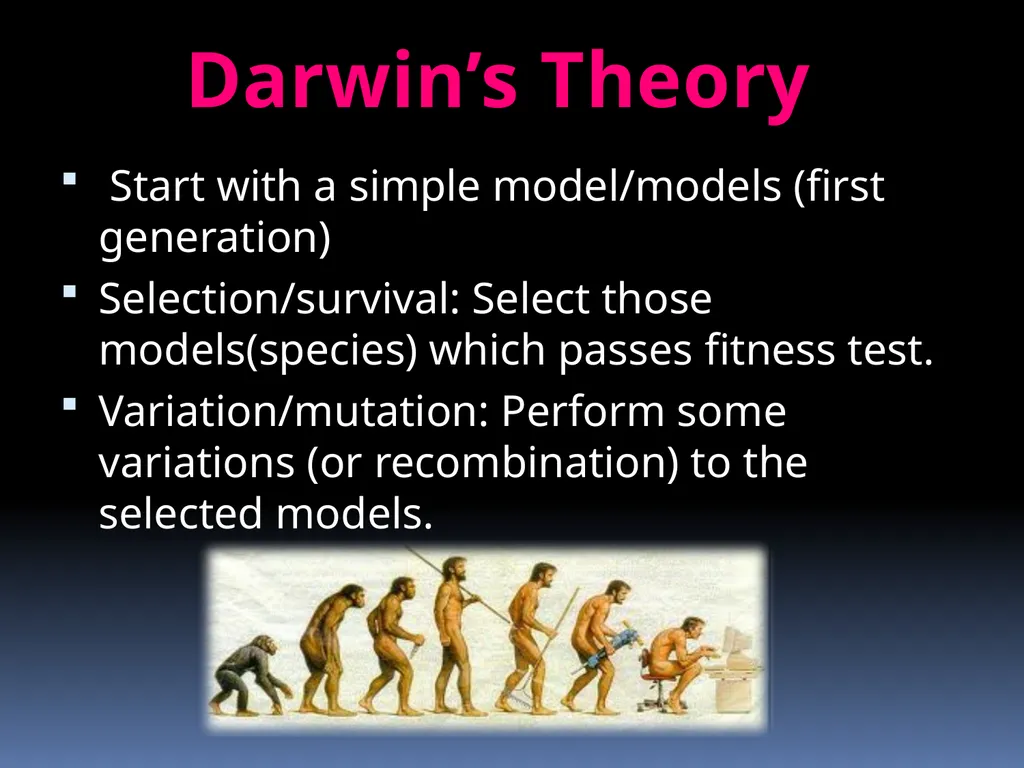
slide6. Start with a simple model/models (first generation)
Selection/survival: Select those models(species) which passes fitness test.
Variation/mutation: Perform some variations (or recombination) to the selected models. Darwin’s Theory<br>
slide7. Engineering students learn about existing solutions and techniques for well-defined, relatively simple problems, and then – through practice – are expected to improve and combine these to create larger, more complex systems.
How is this synthesis process done? We do not know, but we cloak it with the term “creativity”. Human Creativity<br>
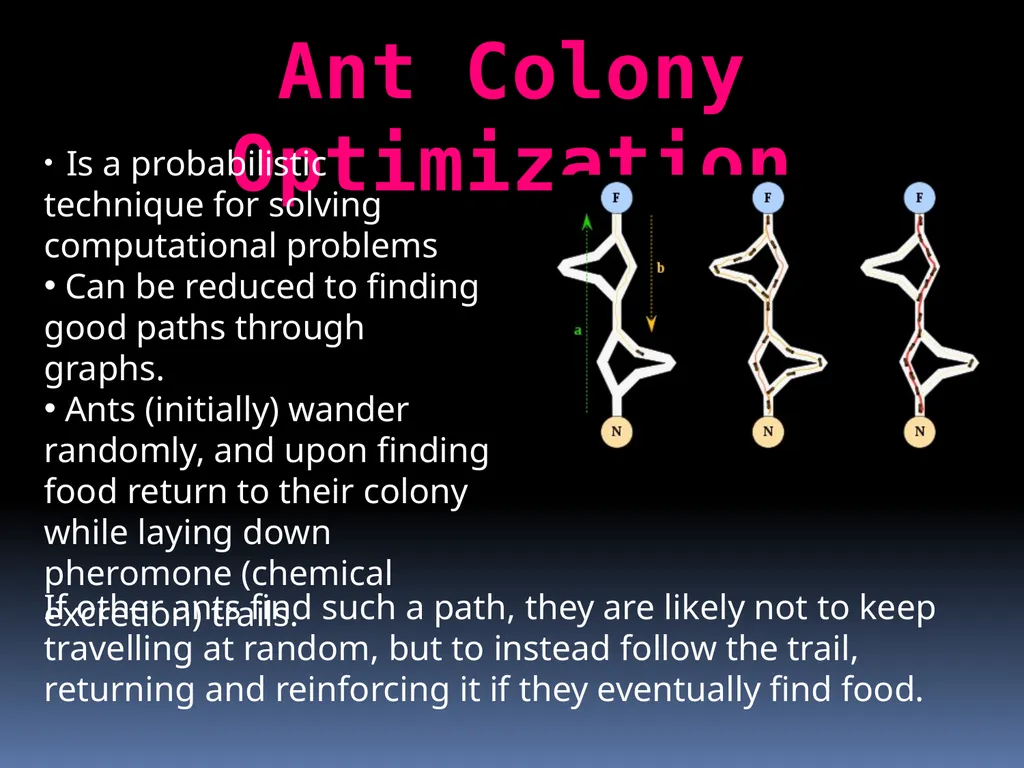
slide8. Ant Colony Optimization Is a probabilistic technique for solving computational problems
Can be reduced to finding good paths through graphs.
Ants (initially) wander randomly, and upon finding food return to their colony while laying down pheromone (chemical excretion) trails. If other ants find such a path, they are likely not to keep travelling at random, but to instead follow the trail, returning and reinforcing it if they eventually find food.<br>
slide9. Need for ER Robotic systems and the environments into which they are placed
Increase in complexity, the difficulty of programming
Their control systems to respond appropriately, increases to the point where it becomes impracticable to foresee every possible state of the robot in its environment.
Find robot controllers for behaviours which are hard to implement by hand<br>
slide10. Controllers Brains of robots
Controls the action of actuators based on the sensor inputs. Morphological Structure Body of Robot Structure of Robots<br>
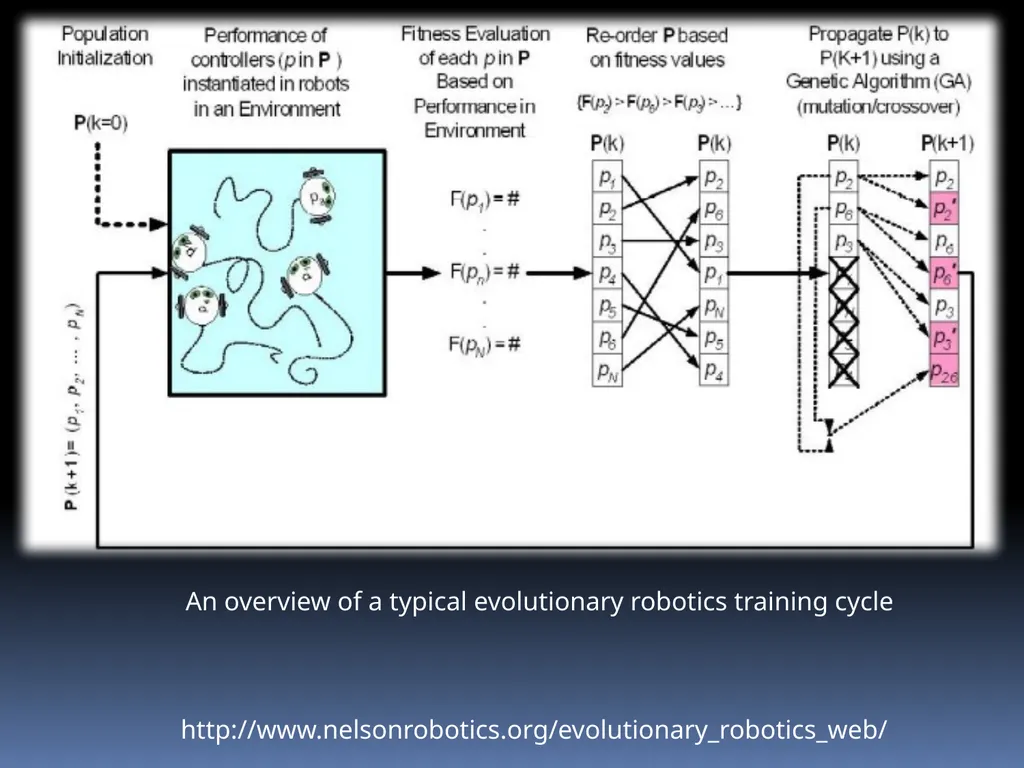
slide11. Artificial Evolution : Survival of the fittest Each robot controller competes in an environment to perform the task for which the robots are being evolved.
Robots are evolved to perform tasks requiring some level of intelligence,.
Evolution is initialized by creating a population of randomly configured robots.
The controllers in the better performing robots are selected, altered and propagated in a repeating process that mimics natural evolution.<br>
slide12. Evolution Initiation – Initial population may be random, blank, or seeded with some prior knowledge in the form of solutions we think are good starting points.
Selection - measure the performance of each solution in the population. The performance, termed fitness in evolutionary terminology, captures the merit of the design with respect to some target performance we are seeking as the designers.
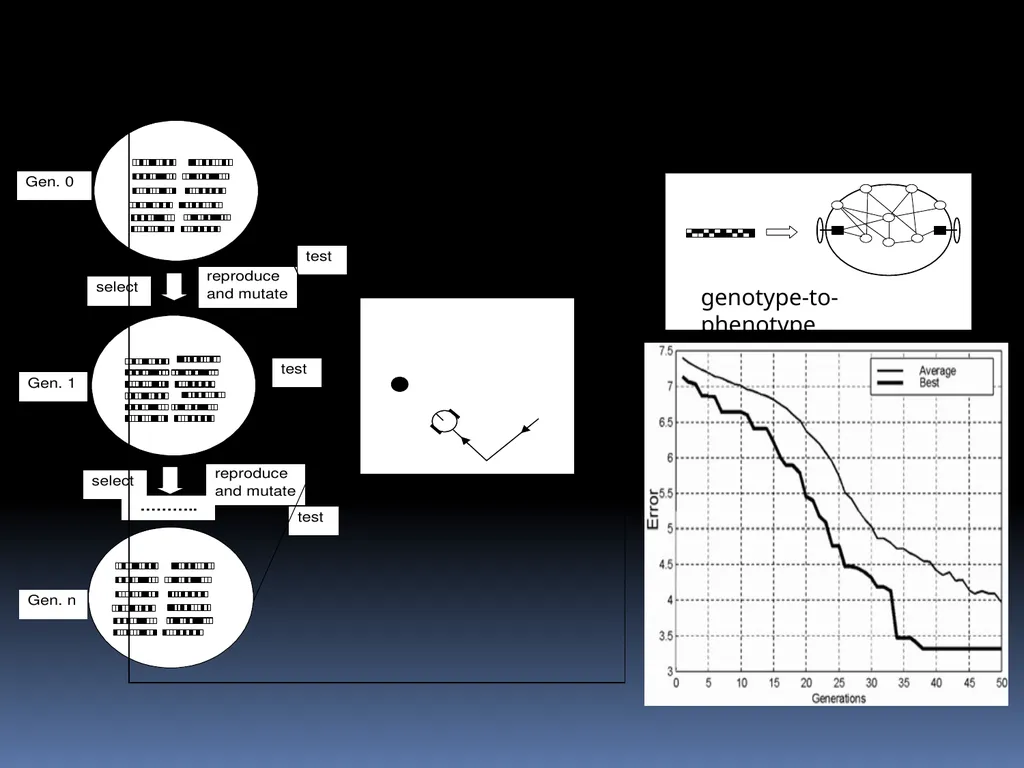
Variation - We select better solutions (parents) and use them to create a new generation of solutions (offspring). The offspring are variations of the parents, created through variation operators like mutation and recombination. The process is repeated generation after generation until good solutions are found.<br>
slide13. An overview of a typical evolutionary robotics training cycle http://www.nelsonrobotics.org/evolutionary_robotics_web/<br>
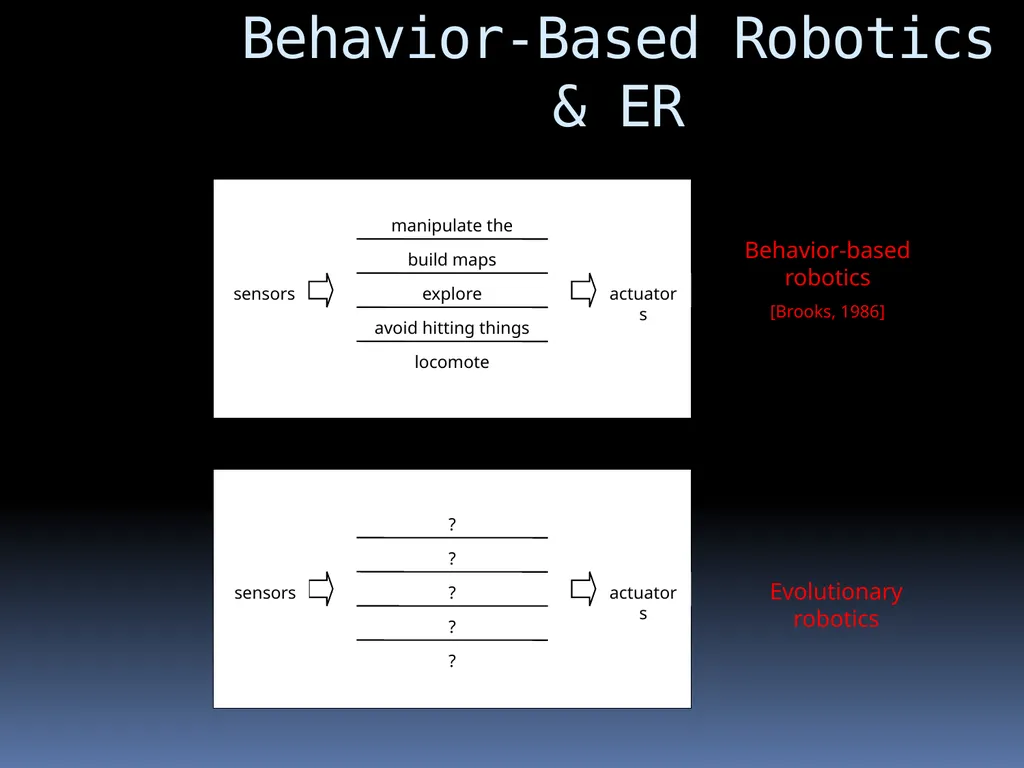
slide14. Behavior-Based Robotics & ER<br>
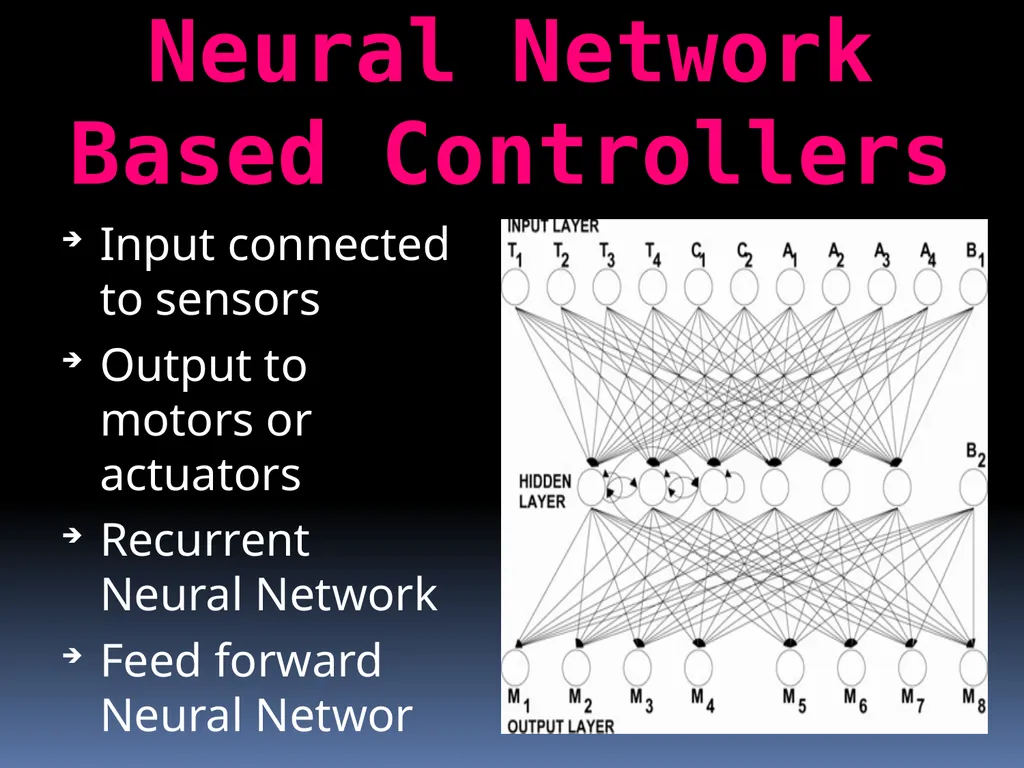
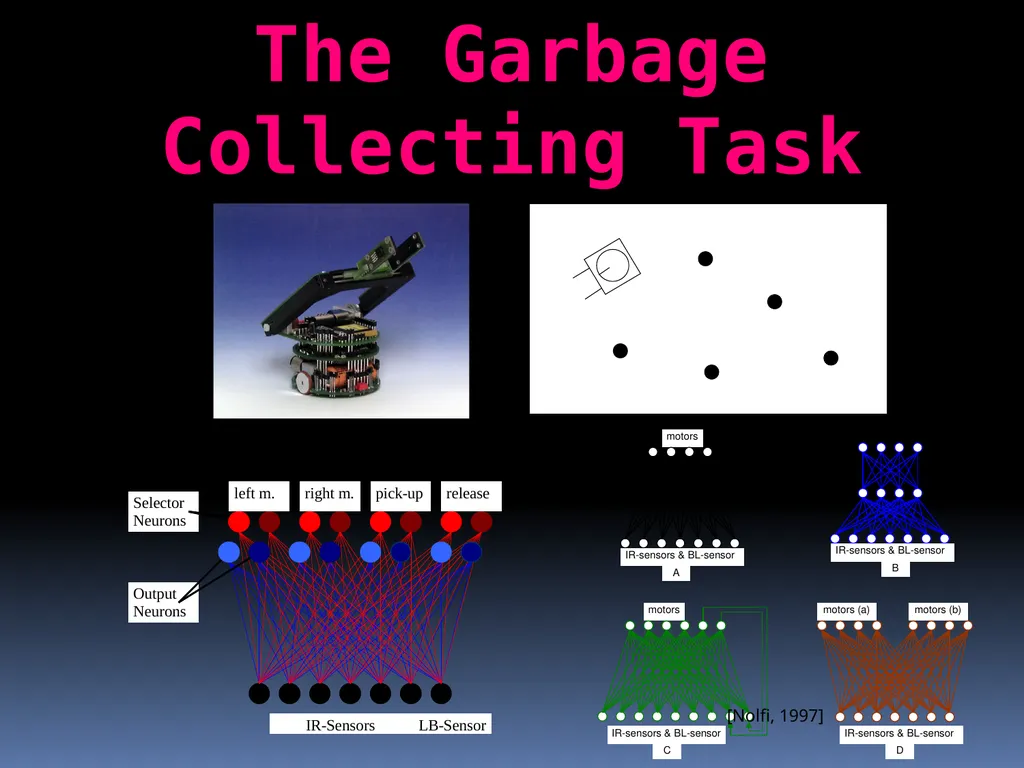
slide16. Neural Network Based Controllers Input connected to sensors
Output to motors or actuators
Recurrent Neural Network
Feed forward Neural Networ<br>
slide17. The Garbage Collecting Task [Nolfi, 1997]<br>
slide18. Based on Stimulus-Response rules.
Schultz et al. demonstrated the evolution of rule-based controllers for learning complex robotic behaviors by evolving the behavior for a shepherd robot to coerce a sheep robot into a corral. Evolved rule based
algorithms<br>
slide19. Evolving Morphology Morphology (body) of robots can be evolved like controllers.
Body of robots made of small units which can be detached/ attached/ reconfigured.
Alternatively, robots can be produced using rapid prototyping equipments.<br>
slide20. Co-evolution of Morphology and Controllers In nature species evolve body and behavior complementarily.
Starting with some basic structure, robots can be trained some simple behavior.
To learn more complex behavior, morphology is evolved to suit it to learn the complex behavior.<br>
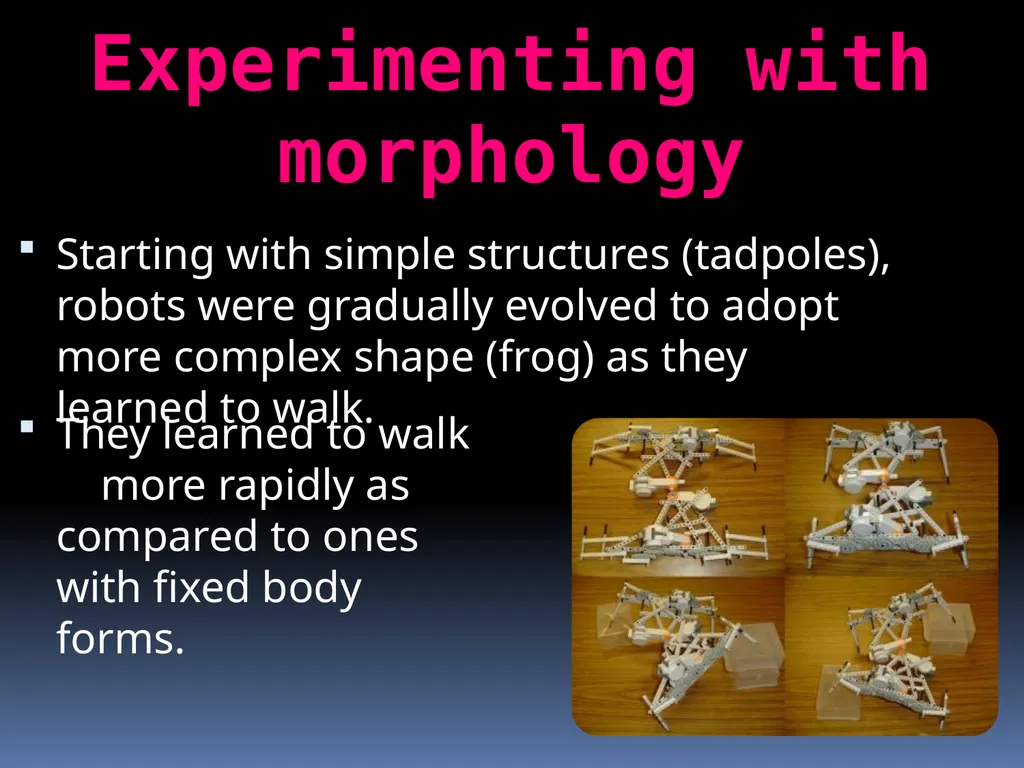
slide21. Starting with simple structures (tadpoles), robots were gradually evolved to adopt more complex shape (frog) as they learned to walk. They learned to walk more rapidly as compared to ones with fixed body forms. Experimenting with morphology<br>
slide22. Evolution Through Simulation Evolving control systems in simulation provide a solution to prevent hardware damage and provides a faster evaluation than the real time speed.
But, simulation has its own drawbacks.
Noise from external environment, imprecise readings and motor control
Experiments conducted with high levels of noise – Solutions may evolve that rely on the excessive noise.<br>
slide23. Noise Inclusion in Simulation Include noise in the simulation of robot.
This evolves controller for a more general robot structure.
Example: To make simulation of robot learning to walk (bipedal), use mass distribution as: m(x, y, z)+ ∆m.
Example: To model air pressure use P + ∆P.<br>
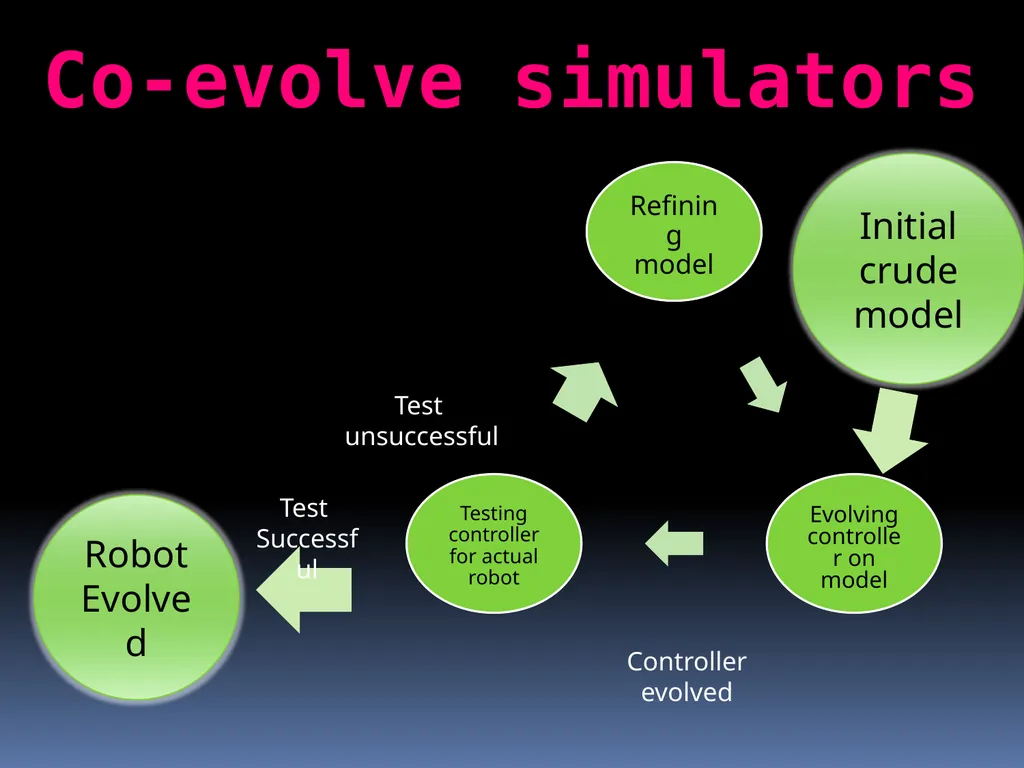
slide24. Co-evolve simulators Start with basic crude modeling of the robot body.
Develop controller for that model.
If it fails for real robot, evolve model so that schism between robot and simulate model abridges.
Ultimately simulation is very close to reality and controller evolved for that simulation does justice with real robot also.<br>
slide25. Co-evolve simulators Test
Successful Robot Evolved Test
unsuccessful Controller
evolved Initial crude model<br>
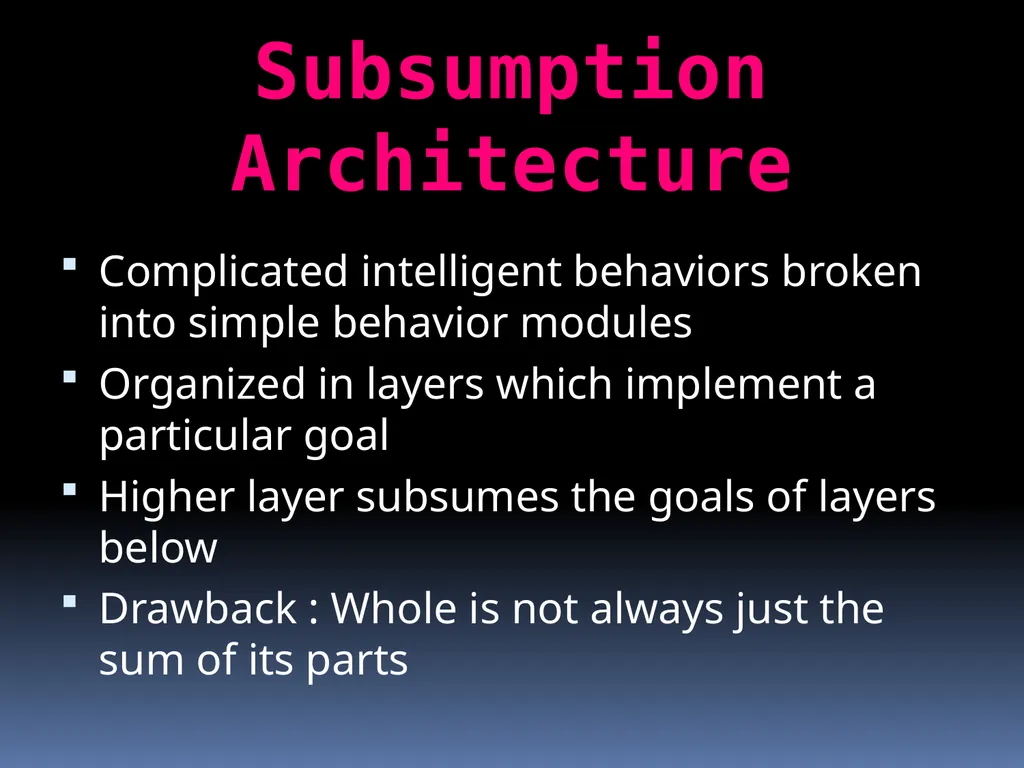
slide26. Subsumption Architecture Complicated intelligent behaviors broken into simple behavior modules
Organized in layers which implement a particular goal
Higher layer subsumes the goals of layers below
Drawback : Whole is not always just the sum of its parts<br>
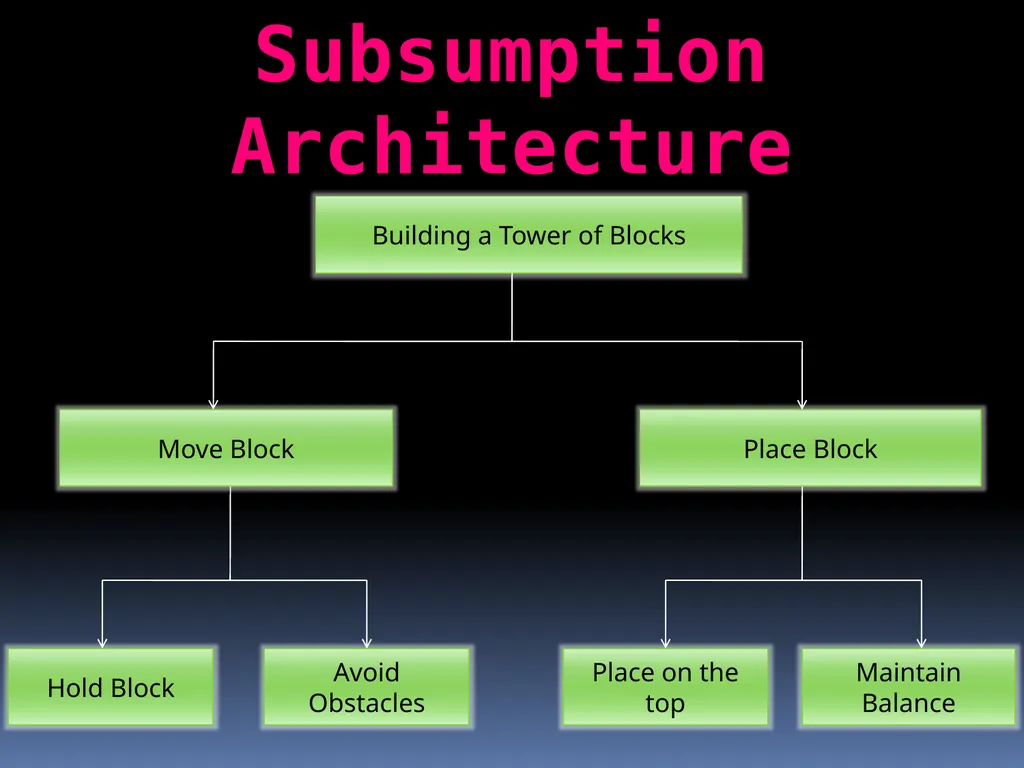
slide27. Building a Tower of Blocks Move Block Maintain Balance Place on the top Avoid Obstacles Hold Block Place Block Subsumption Architecture<br>
slide28. Challenges As an alternative to the hand design, Evolutionary Robotics has generated a great deal of exuberance.
But can the ER techniques produce a net saving of human effort when applied to complex robotics domain.
How to map continuous inputs and outputs to discrete state variables, establishing appropriate intermediate and goal states, determining how many production rules are required<br>
slide29. Challenges Current ER systems are often very simple and could be easily bettered by hand-coded solutions.
Many control-system evaluations achieve satisfactory results in unacceptable runtimes
The robot may also enter into dangerous states in which its hardware could be damaged<br>
slide30. Conclusion Evolutionary algorithms are used to generate control algorithms using the Darwinian principle of survival-of-the-fittest.
Most of the work has focused on the development of control systems for autonomous mobile robots. Some researchers have used the techniques to evolve robotic hardware configurations.<br>
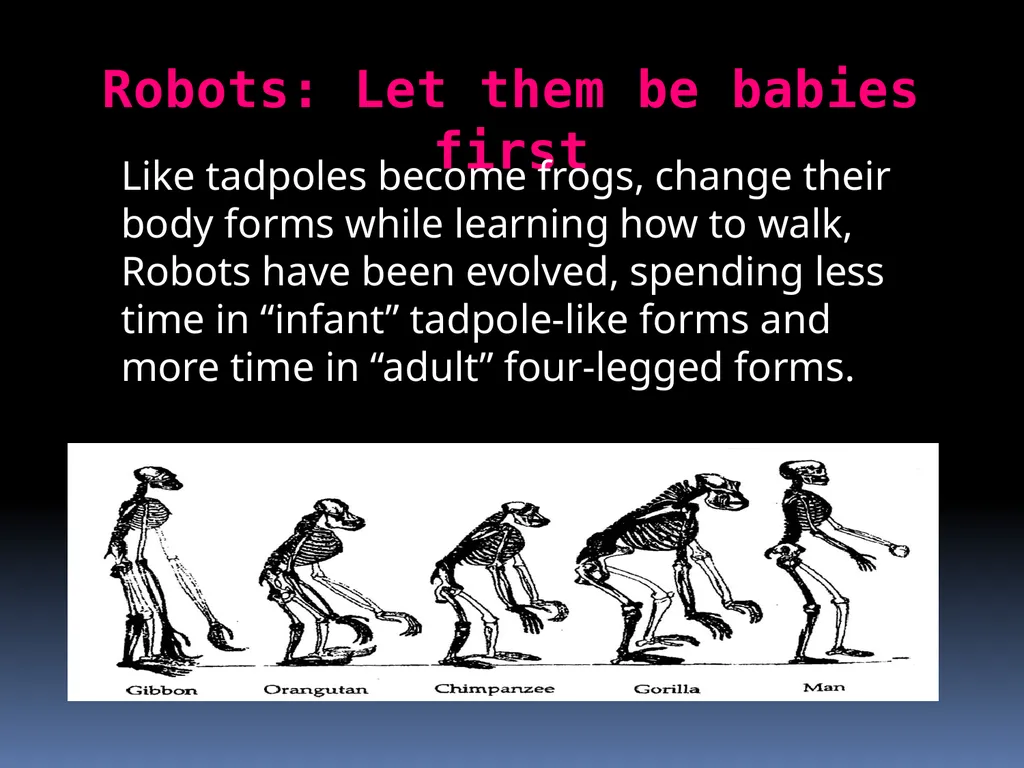
slide31. Robots: Let them be babies first Like tadpoles become frogs, change their body forms while learning how to walk, Robots have been evolved, spending less time in “infant” tadpole-like forms and more time in “adult” four-legged forms.<br>
slide32. Conclusion (Continued) To overcome the dependence on unreliable hardware and poor battery performance, control systems have been evolved through simulation.
Evolutionary techniques hold the potential to solve many difficult problems in robotics which defy simple conventional approaches, but present many challenges as well.<br>
slide33. Scope of ER Human intelligence stems from evolution and adaptation with the environment
ER raise an important question:
Can robots too evolve like humans in future?<br>
slide34. References Evolutionary Robotics and Open-Ended Design Automation -- Hod Lipson, Cornell University
Wikipedia
Challenges and Opportunities of Evolutionary Robotics -- D. A. Sofge, M. A. Potter, M. D. Bugajska, A. C. Schultz
Evolutionary Robotics -- Stefano Nolfi, Dario Floreano
Evolutionary Robotics: From Algorithms To Implementations -- Lingfeng Wang, Kay Chen Tan, Chee Meng Chew
http://www.authorstream.com/Presentation/rajansiva-440202-robotics/
Brooks’ Subsumption Architecture by T. Ryan Fitz-Gibbon<br>
Robotics Guided by :
Prof . Pushpak Bhattacharya By :
Hemant noval
Palak dalal
Sushil meena
Mudit malpani<br>
slide2. Contents Introduction and Motivation
Artificial Evolution
Neural Network Controller
Morphology
Evolution through Simulation
Subsumption Architecture
Conclusion<br>
slide3. Can a computer ultimately augment or replace human invention? “I visualize a time when we will be to robots what dogs are to humans, and I'm rooting for the machines.” Claude Shannon<br>
slide4. Primary Goal To develop automatic methods for creating intelligent autonomous robot controllers Definition (from Wikipedia) Evolutionary robotics (ER) is a methodology that uses evolutionary computation to develop controllers for autonomous robots.<br>
slide5. MOTIVATION<br>
slide6. Start with a simple model/models (first generation)
Selection/survival: Select those models(species) which passes fitness test.
Variation/mutation: Perform some variations (or recombination) to the selected models. Darwin’s Theory<br>
slide7. Engineering students learn about existing solutions and techniques for well-defined, relatively simple problems, and then – through practice – are expected to improve and combine these to create larger, more complex systems.
How is this synthesis process done? We do not know, but we cloak it with the term “creativity”. Human Creativity<br>
slide8. Ant Colony Optimization Is a probabilistic technique for solving computational problems
Can be reduced to finding good paths through graphs.
Ants (initially) wander randomly, and upon finding food return to their colony while laying down pheromone (chemical excretion) trails. If other ants find such a path, they are likely not to keep travelling at random, but to instead follow the trail, returning and reinforcing it if they eventually find food.<br>
slide9. Need for ER Robotic systems and the environments into which they are placed
Increase in complexity, the difficulty of programming
Their control systems to respond appropriately, increases to the point where it becomes impracticable to foresee every possible state of the robot in its environment.
Find robot controllers for behaviours which are hard to implement by hand<br>
slide10. Controllers Brains of robots
Controls the action of actuators based on the sensor inputs. Morphological Structure Body of Robot Structure of Robots<br>
slide11. Artificial Evolution : Survival of the fittest Each robot controller competes in an environment to perform the task for which the robots are being evolved.
Robots are evolved to perform tasks requiring some level of intelligence,.
Evolution is initialized by creating a population of randomly configured robots.
The controllers in the better performing robots are selected, altered and propagated in a repeating process that mimics natural evolution.<br>
slide12. Evolution Initiation – Initial population may be random, blank, or seeded with some prior knowledge in the form of solutions we think are good starting points.
Selection - measure the performance of each solution in the population. The performance, termed fitness in evolutionary terminology, captures the merit of the design with respect to some target performance we are seeking as the designers.
Variation - We select better solutions (parents) and use them to create a new generation of solutions (offspring). The offspring are variations of the parents, created through variation operators like mutation and recombination. The process is repeated generation after generation until good solutions are found.<br>
slide13. An overview of a typical evolutionary robotics training cycle http://www.nelsonrobotics.org/evolutionary_robotics_web/<br>
slide14. Behavior-Based Robotics & ER<br>
slide16. Neural Network Based Controllers Input connected to sensors
Output to motors or actuators
Recurrent Neural Network
Feed forward Neural Networ<br>
slide17. The Garbage Collecting Task [Nolfi, 1997]<br>
slide18. Based on Stimulus-Response rules.
Schultz et al. demonstrated the evolution of rule-based controllers for learning complex robotic behaviors by evolving the behavior for a shepherd robot to coerce a sheep robot into a corral. Evolved rule based
algorithms<br>
slide19. Evolving Morphology Morphology (body) of robots can be evolved like controllers.
Body of robots made of small units which can be detached/ attached/ reconfigured.
Alternatively, robots can be produced using rapid prototyping equipments.<br>
slide20. Co-evolution of Morphology and Controllers In nature species evolve body and behavior complementarily.
Starting with some basic structure, robots can be trained some simple behavior.
To learn more complex behavior, morphology is evolved to suit it to learn the complex behavior.<br>
slide21. Starting with simple structures (tadpoles), robots were gradually evolved to adopt more complex shape (frog) as they learned to walk. They learned to walk more rapidly as compared to ones with fixed body forms. Experimenting with morphology<br>
slide22. Evolution Through Simulation Evolving control systems in simulation provide a solution to prevent hardware damage and provides a faster evaluation than the real time speed.
But, simulation has its own drawbacks.
Noise from external environment, imprecise readings and motor control
Experiments conducted with high levels of noise – Solutions may evolve that rely on the excessive noise.<br>
slide23. Noise Inclusion in Simulation Include noise in the simulation of robot.
This evolves controller for a more general robot structure.
Example: To make simulation of robot learning to walk (bipedal), use mass distribution as: m(x, y, z)+ ∆m.
Example: To model air pressure use P + ∆P.<br>
slide24. Co-evolve simulators Start with basic crude modeling of the robot body.
Develop controller for that model.
If it fails for real robot, evolve model so that schism between robot and simulate model abridges.
Ultimately simulation is very close to reality and controller evolved for that simulation does justice with real robot also.<br>
slide25. Co-evolve simulators Test
Successful Robot Evolved Test
unsuccessful Controller
evolved Initial crude model<br>
slide26. Subsumption Architecture Complicated intelligent behaviors broken into simple behavior modules
Organized in layers which implement a particular goal
Higher layer subsumes the goals of layers below
Drawback : Whole is not always just the sum of its parts<br>
slide27. Building a Tower of Blocks Move Block Maintain Balance Place on the top Avoid Obstacles Hold Block Place Block Subsumption Architecture<br>
slide28. Challenges As an alternative to the hand design, Evolutionary Robotics has generated a great deal of exuberance.
But can the ER techniques produce a net saving of human effort when applied to complex robotics domain.
How to map continuous inputs and outputs to discrete state variables, establishing appropriate intermediate and goal states, determining how many production rules are required<br>
slide29. Challenges Current ER systems are often very simple and could be easily bettered by hand-coded solutions.
Many control-system evaluations achieve satisfactory results in unacceptable runtimes
The robot may also enter into dangerous states in which its hardware could be damaged<br>
slide30. Conclusion Evolutionary algorithms are used to generate control algorithms using the Darwinian principle of survival-of-the-fittest.
Most of the work has focused on the development of control systems for autonomous mobile robots. Some researchers have used the techniques to evolve robotic hardware configurations.<br>
slide31. Robots: Let them be babies first Like tadpoles become frogs, change their body forms while learning how to walk, Robots have been evolved, spending less time in “infant” tadpole-like forms and more time in “adult” four-legged forms.<br>
slide32. Conclusion (Continued) To overcome the dependence on unreliable hardware and poor battery performance, control systems have been evolved through simulation.
Evolutionary techniques hold the potential to solve many difficult problems in robotics which defy simple conventional approaches, but present many challenges as well.<br>
slide33. Scope of ER Human intelligence stems from evolution and adaptation with the environment
ER raise an important question:
Can robots too evolve like humans in future?<br>
slide34. References Evolutionary Robotics and Open-Ended Design Automation -- Hod Lipson, Cornell University
Wikipedia
Challenges and Opportunities of Evolutionary Robotics -- D. A. Sofge, M. A. Potter, M. D. Bugajska, A. C. Schultz
Evolutionary Robotics -- Stefano Nolfi, Dario Floreano
Evolutionary Robotics: From Algorithms To Implementations -- Lingfeng Wang, Kay Chen Tan, Chee Meng Chew
http://www.authorstream.com/Presentation/rajansiva-440202-robotics/
Brooks’ Subsumption Architecture by T. Ryan Fitz-Gibbon<br>