Example lesson 2: Evaluating writers viewpoints and perspectives using music texts James Creamer, Alexandra Park School Free writing Use the words below as a springboard for writing whatever you wish (story, play description, song, rap,
"Example lesson 2: Evaluating writers’ viewpoints" is the property of its rightful owner. Permission is granted to
download and print the materials on this website for personal, non-commercial use only, and to display it
on your personal computer provided you do not modify the materials and that you retain all copyright
notices contained in the materials. By downloading content from our website, you accept the terms of this
agreement.
Presentation Transcript
01
Example lesson 2: Evaluating writers’ viewpoints and perspectives using music texts James Creamer, Alexandra Park School<br>
02
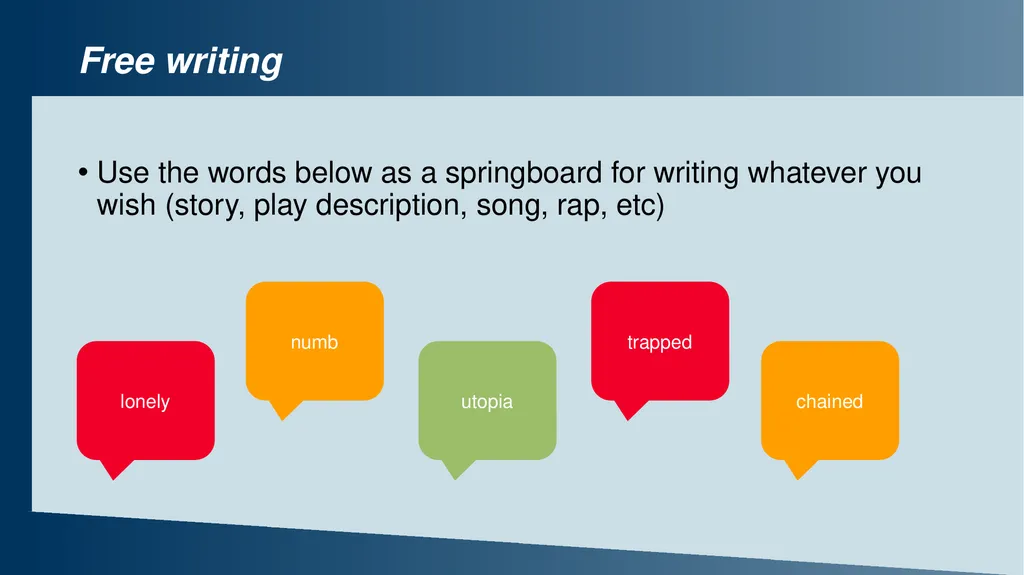
Free writing Use the words below as a springboard for writing whatever you wish (story, play description, song, rap, etc) lonely numb utopia trapped chained<br>
03
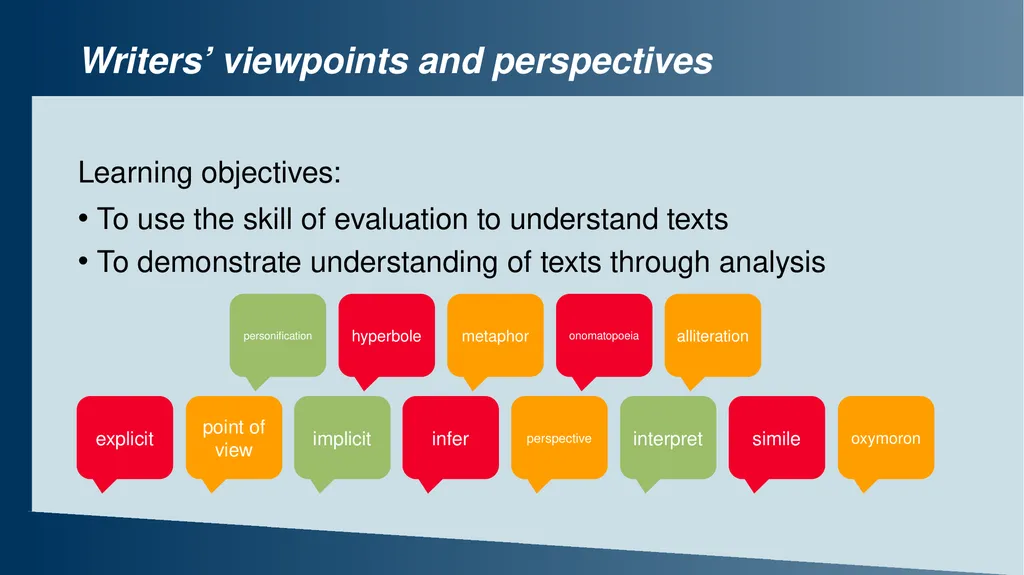
Writers’ viewpoints and perspectives To use the skill of evaluation to understand texts
To demonstrate understanding of texts through analysis Learning objectives: explicit point of view implicit infer perspective interpret simile oxymoron hyperbole alliteration personification onomatopoeia metaphor<br>
04
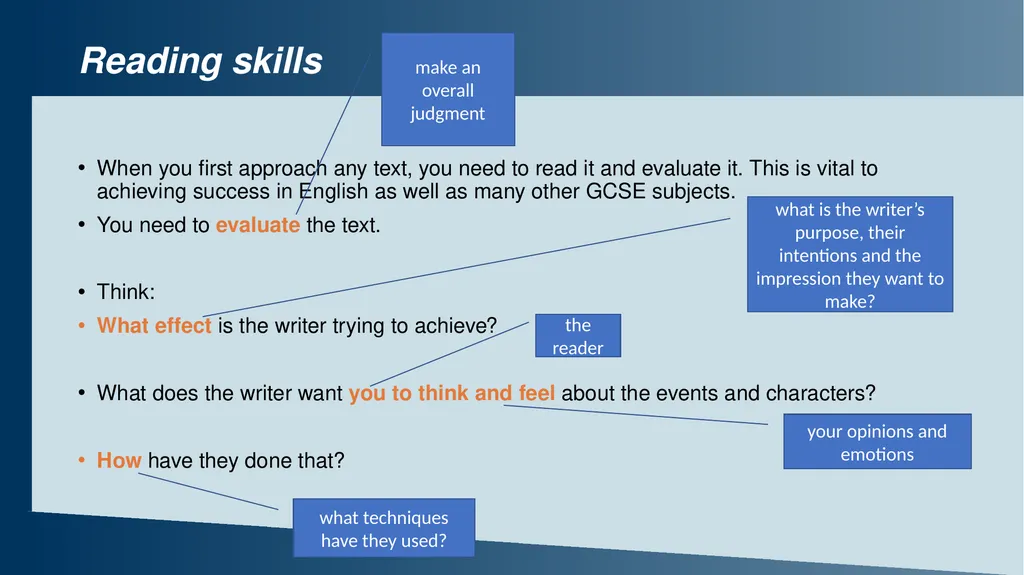
Reading skills When you first approach any text, you need to read it and evaluate it. This is vital to achieving success in English as well as many other GCSE subjects.
You need to evaluate the text.
Think:
What effect is the writer trying to achieve?
What does the writer want you to think and feel about the events and characters?
How have they done that? make an overall judgment what is the writer’s purpose, their intentions and the impression they want to make? the reader your opinions and emotions what techniques have they used?<br>
05
Now look back on your piece of free writing. Explain to your partner: What effect were you trying to achieve?
What did you want your reader to think and feel about the issue / event / characters?
How have you done that?<br>
06
Let’s now apply the skills of evaluation to a pop song. What effect is the artist trying to achieve?
How are they positioning the audience to respond?
YouTube link to Chained to the Rhythm by Katy Perry https://www.youtube.com/watch?v=Um7pMggPnug<br>
07
How has Katy Perry presented her ideas? Work with your group to annotate the song lyrics.
Don’t colour it in!
Do annotate for methods and effects.
How does she want us to respond to the issue / idea?
Let’s try one together…<br>
08
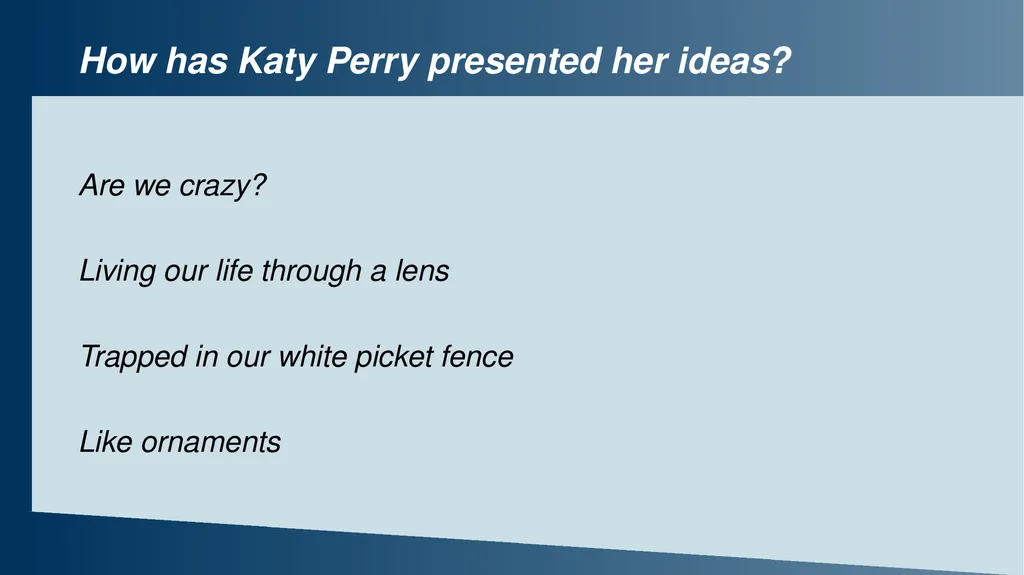
How has Katy Perry presented her ideas? Are we crazy?
Living our life through a lens
Trapped in our white picket fence
Like ornaments<br>
09
How has Katy Perry presented her ideas? Use your skills of evaluation and analysis.
Use the language toolkit on p3 of your GCSE booklets to aid analysis.
Now get annotating!<br>
10
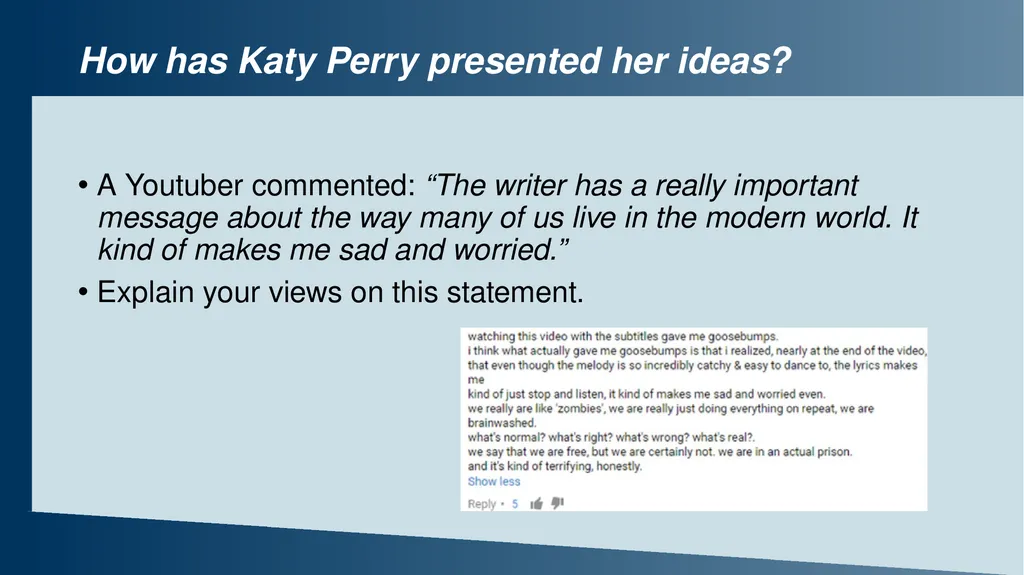
How has Katy Perry presented her ideas? A Youtuber commented: “The writer has a really important message about the way many of us live in the modern world. It kind of makes me sad and worried.”
Explain your views on this statement.<br>
11
How has Katy Perry presented her ideas? In your groups you are now going to write a response to the statement.
You are working together to try to beat the rest of the class to write the best evaluative response.
Next lesson you will have to present your answer to the class and explain why it is the best.
Winning group gets a prize.<br>
12
How has Katy Perry presented her ideas? Success criteria:
Present a clear view in response to the statement.
Back it up with evidence.
Identify methods and facts.
Write one PEE paragraph in response to the statement.
Explain and then evaluate, “perhaps the writer is suggesting…”<br>