Executive-Legislative Relations: The Role of the Legislative Liaison Office Allison Smith Deputy Assistant United States Trade Representative Office of Environment and Natural Resources AGENDA Introduction Basics of the Legislative Liaison
Related Topics
Share
Embed code
Download this presentation From Below
"Executive-Legislative Relations: The Role of the" is the property of its rightful owner. Permission is granted to
download and print the materials on this website for personal, non-commercial use only, and to display it
on your personal computer provided you do not modify the materials and that you retain all copyright
notices contained in the materials. By downloading content from our website, you accept the terms of this
agreement.
Presentation Transcript
01
Executive-Legislative Relations: The Role of the Legislative Liaison Office Allison Smith Deputy Assistant United States Trade Representative Office of Environment and Natural Resources<br>
02
AGENDA Introduction
Basics of the Legislative Liaison Office (hereinafter called “Office of Congressional Affairs”)
How the Office of Congressional Affairs Advances the Agency’s Agenda
The Proactive Agenda
Playing Defense
Putting It All Together
How Can You Help Congressional Affairs Help the Agency (and Congress?)
Q&A<br>
03
Introduction Currently serve in the Office of the United States Trade Representative as a Deputy Assistant USTR for Environment and Natural Resources
From 2021-2023 served as the Deputy Assistant USTR for Congressional Affairs in USTR’s Front Office
From 2013-2021, served on Capitol Hill, namely as the Deputy Chief of Staff and Counsel for Rep. Suzanne Bonamici (D-OR)<br>
04
Basics of the Legislative Liaison Office The primary goal of the Legislative Liaison, or Congressional Affairs Office, is to advance the Agency and Administration’s priorities through direct engagement with Congress
The Office of Congressional Affairs (OCA) will vary in size and makeup depending on the size of the agency
OCA can include a mix of political appointees and career staff, with a variety of backgrounds
Any and all engagement between the Agency and Congress (including members and staff) should be directed by and flow through OCA<br>
05
“Any and all engagement” – An Explainer Receive and respond to letters and questions from Members of Congress and their staff
Receive and respond to oversight requests
Prepare Principals to testify at congressional hearings and respond to Questions for the Record
Prepare Administration staff to provide briefings to Congress
Advance the Administration’s legislative and funding priorities
Inform Members of Congress about activities in their district/state
Organize technical assistance on draft legislation
Get nominees confirmed by the Senate
Attend meetings with Members of Congress and Principal/staff
Help you communicate effectively with Congress<br>
06
How the Office of Congressional Affairs Advances the Agency’s Agenda The Proactive Agenda
Each agency has a mandate for their work and jurisdiction
For instance, at USTR, we negotiate directly with foreign governments to create trade agreements, to resolve disputes, and to participate in global trade policy organizations. We also meet with governments, with business groups, with legislators and with public interest groups to gather input on trade issues and to discuss the President's trade policy positions.
Each Administration and Principal guides the Agency’s work through their priorities. For example, at USTR, President Biden and Amb. Tai have prioritized a number of new trade engagements.
OCA is responsible for producing and implementing the strategy to advance Amb. Tai’s agenda on Capitol Hill<br>
07
Playing Defense OCA is the first line of defense for the Agency when there is a problem on Capitol Hill
Problems can include (but are not limited to!):
Budget and funding issues
Opposition to the aforementioned “proactive agenda”
District/state specific problems related to your Agency’s work
Other
When problems arise, OCA will take the lead on an appropriate response, including scheduling meetings for the Principal and Member of Congress, or their respective staffs, responding to letters, responding to requests to testify, providing budget justifications, or providing district/state specific information for members<br>
08
Putting It All Together—Testifying on the Hill One of the most important recurring events for OCA is when the Principal, or another member of the Agency leadership, testifies on the Hill
Typically the Principal will testify annually before their House and Senate Committees of jurisdictions
They may also testify before their House and Senate Appropriations Committees
Additionally, other Agency principals and leadership may be called to testify<br>
09
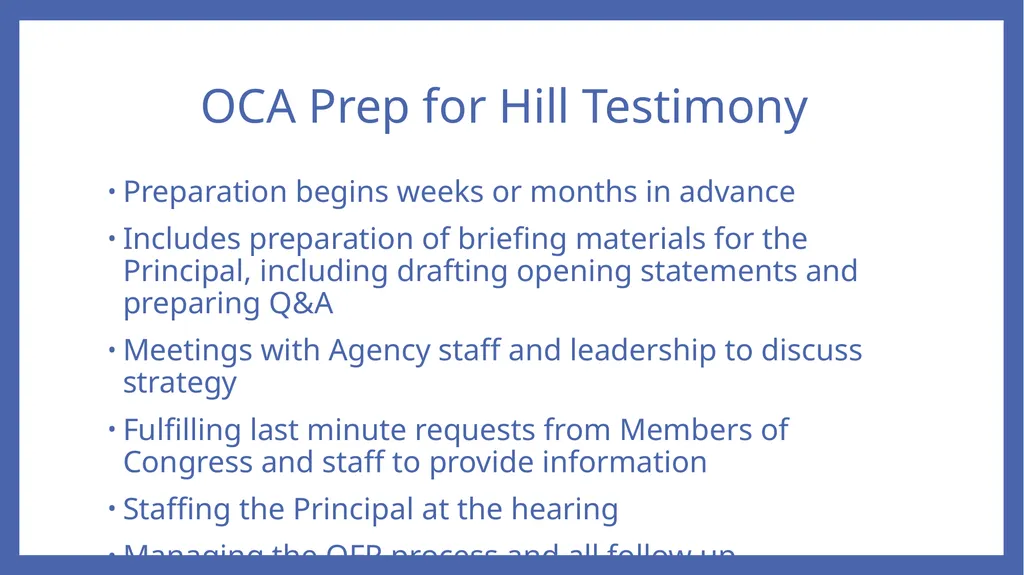
OCA Prep for Hill Testimony Preparation begins weeks or months in advance
Includes preparation of briefing materials for the Principal, including drafting opening statements and preparing Q&A
Meetings with Agency staff and leadership to discuss strategy
Fulfilling last minute requests from Members of Congress and staff to provide information
Staffing the Principal at the hearing
Managing the QFR process and all follow up<br>
10
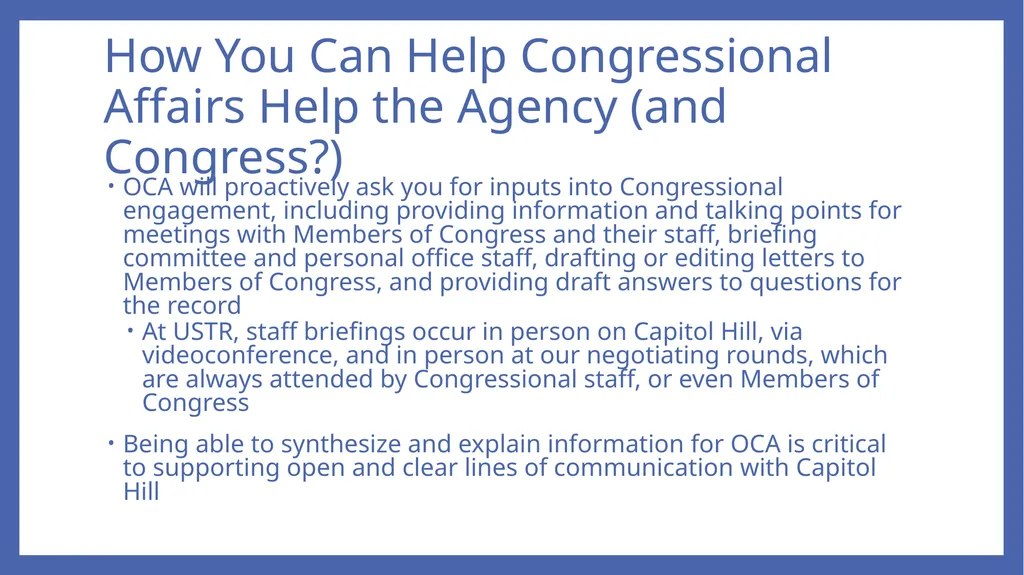
How You Can Help Congressional Affairs Help the Agency (and Congress?) OCA will proactively ask you for inputs into Congressional engagement, including providing information and talking points for meetings with Members of Congress and their staff, briefing committee and personal office staff, drafting or editing letters to Members of Congress, and providing draft answers to questions for the record
At USTR, staff briefings occur in person on Capitol Hill, via videoconference, and in person at our negotiating rounds, which are always attended by Congressional staff, or even Members of Congress
Being able to synthesize and explain information for OCA is critical to supporting open and clear lines of communication with Capitol Hill<br>
11
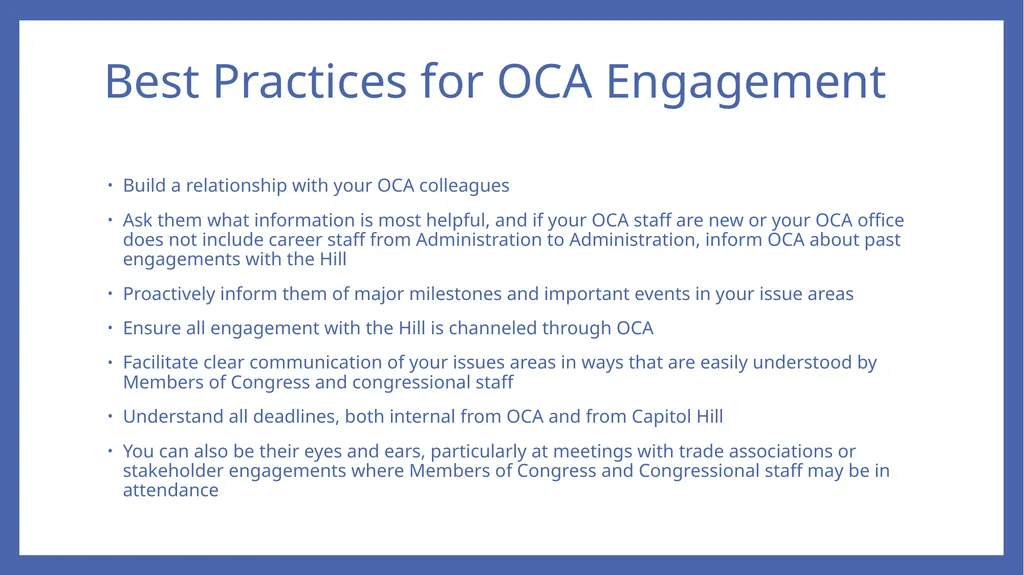
Best Practices for OCA Engagement Build a relationship with your OCA colleagues
Ask them what information is most helpful, and if your OCA staff are new or your OCA office does not include career staff from Administration to Administration, inform OCA about past engagements with the Hill
Proactively inform them of major milestones and important events in your issue areas
Ensure all engagement with the Hill is channeled through OCA
Facilitate clear communication of your issues areas in ways that are easily understood by Members of Congress and congressional staff
Understand all deadlines, both internal from OCA and from Capitol Hill
You can also be their eyes and ears, particularly at meetings with trade associations or stakeholder engagements where Members of Congress and Congressional staff may be in attendance<br>
12
Questions? Contact Information:
Allison Smith
Deputy Assistant USTR for Environment and Natural Resources
Allison.W.Smith@ustr.eop.gov<br>