
Exercising Opportunities for Control in
T
Published · 27 slides · 0 views
1 / 1

Description
Exercising Opportunities for Control in International Arbitration Professor Christopher Gibson July 8, 2020 Exercising Opportunities for Control in International Arbitration Christopher Gibson Professor of Law and Director Business Law and
Related Topics
Share
Embed code
Download this presentation From Below
"Exercising Opportunities for Control in" is the property of its rightful owner. Permission is granted to download and print the materials on this website for personal, non-commercial use only, and to display it on your personal computer provided you do not modify the materials and that you retain all copyright notices contained in the materials. By downloading content from our website, you accept the terms of this agreement.
Presentation Transcript
01
Exercising Opportunities for Control in
International Arbitration Professor Christopher Gibson
July 8, 2020<br>
July 8, 2020<br>
02
Exercising Opportunities for Control in
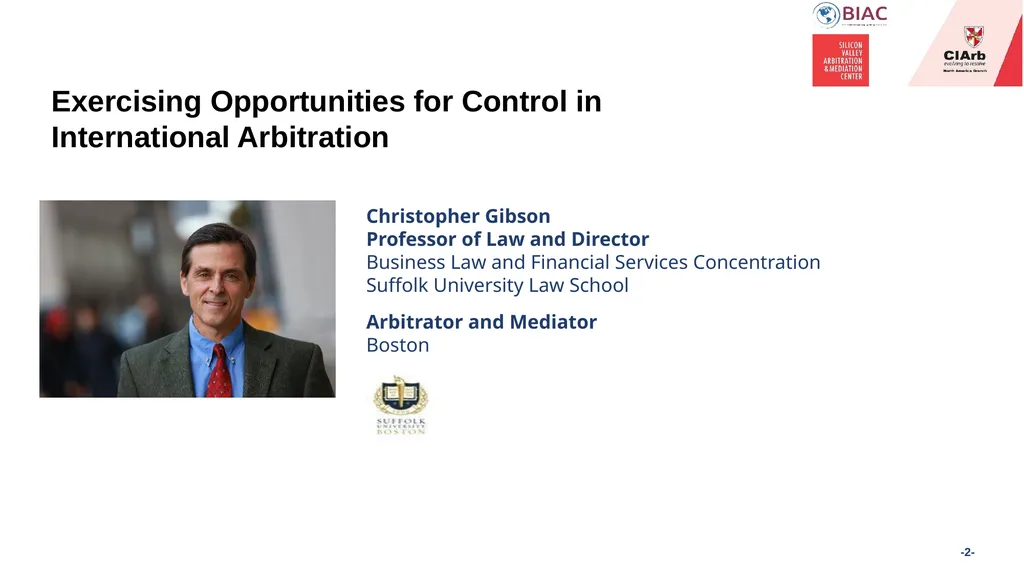
International Arbitration Christopher Gibson
Professor of Law and Director
Business Law and Financial Services Concentration
Suffolk University Law School
Arbitrator and Mediator
Boston -2-<br>
Professor of Law and Director
Business Law and Financial Services Concentration
Suffolk University Law School
Arbitrator and Mediator
Boston -2-<br>
03
Agenda Context for transactions and dispute resolution:
Where we’re at “risk” has not gone away
Extend transactional mindset / skills into dispute resolution
Dispute resolution design – arbitration features tailored to parties’ need
Hypo: Dispute between two life sciences companies -3-<br>
Where we’re at “risk” has not gone away
Extend transactional mindset / skills into dispute resolution
Dispute resolution design – arbitration features tailored to parties’ need
Hypo: Dispute between two life sciences companies -3-<br>
04
Dispute Resolution – Opportunity to Exercise “Practical and Fair Control” Business context: “control” is important for minimizing and allocating risks
Bring that perspective to dispute resolution
Dispute resolution: exercise “control” – practical and fair control – through choices parties make to resolve complex international disputes
Extension of parties’ exercise of post-deal business cooperation “Control your own destiny or someone else will.”
Jack Welch, former CEO -4-<br>
Bring that perspective to dispute resolution
Dispute resolution: exercise “control” – practical and fair control – through choices parties make to resolve complex international disputes
Extension of parties’ exercise of post-deal business cooperation “Control your own destiny or someone else will.”
Jack Welch, former CEO -4-<br>
05
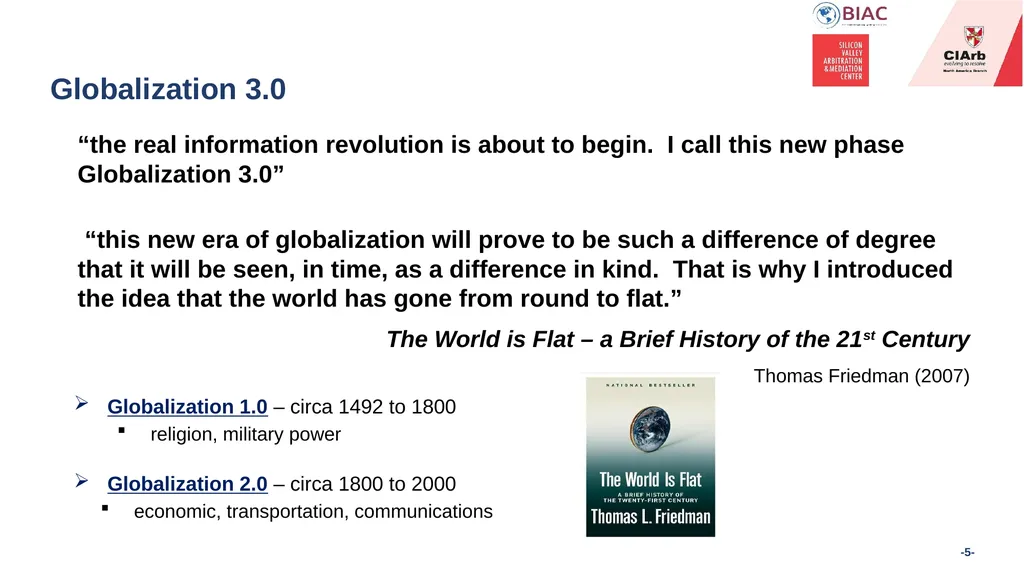
Globalization 3.0 “the real information revolution is about to begin. I call this new phase Globalization 3.0”
“this new era of globalization will prove to be such a difference of degree that it will be seen, in time, as a difference in kind. That is why I introduced the idea that the world has gone from round to flat.”
The World is Flat – a Brief History of the 21st Century
Thomas Friedman (2007)
Globalization 1.0 – circa 1492 to 1800
religion, military power
Globalization 2.0 – circa 1800 to 2000
economic, transportation, communications -5-<br>
“this new era of globalization will prove to be such a difference of degree that it will be seen, in time, as a difference in kind. That is why I introduced the idea that the world has gone from round to flat.”
The World is Flat – a Brief History of the 21st Century
Thomas Friedman (2007)
Globalization 1.0 – circa 1492 to 1800
religion, military power
Globalization 2.0 – circa 1800 to 2000
economic, transportation, communications -5-<br>
06
Flat-World Political Science 101 The Dell Theory of Conflict Prevention
“No two countries that are both part of a major global supply chain, like Dell’s, will ever fight a war against each other as long as they are both part of the same global supply chain….”
Thomas Friedman, The World is Flat -6-<br>
“No two countries that are both part of a major global supply chain, like Dell’s, will ever fight a war against each other as long as they are both part of the same global supply chain….”
Thomas Friedman, The World is Flat -6-<br>
07
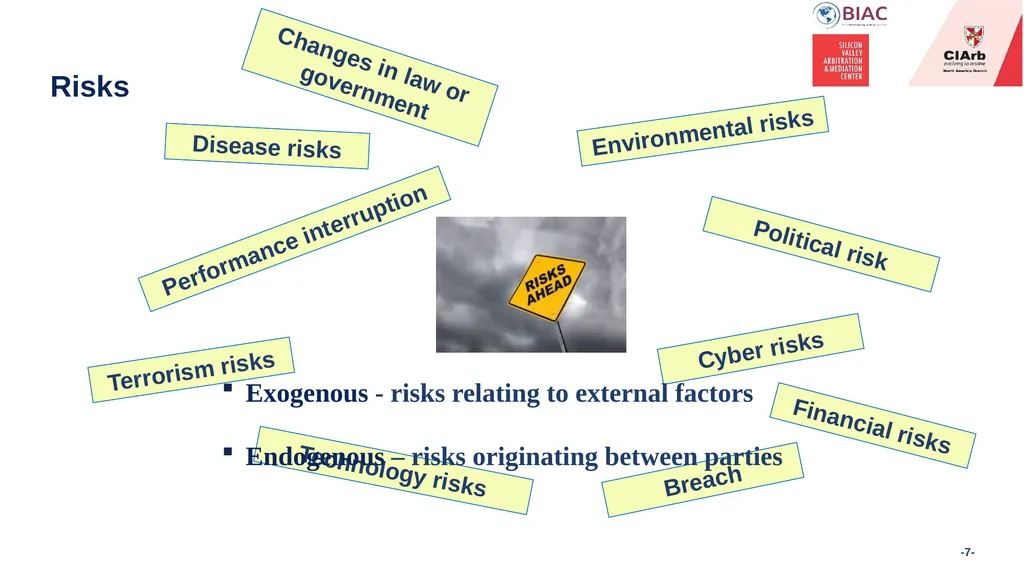
Risks Performance interruption Political risk Technology risks Breach Environmental risks Disease risks Cyber risks Terrorism risks Changes in law or government Exogenous - risks relating to external factors
Endogenous – risks originating between parties Financial risks -7-<br>
Endogenous – risks originating between parties Financial risks -7-<br>
08
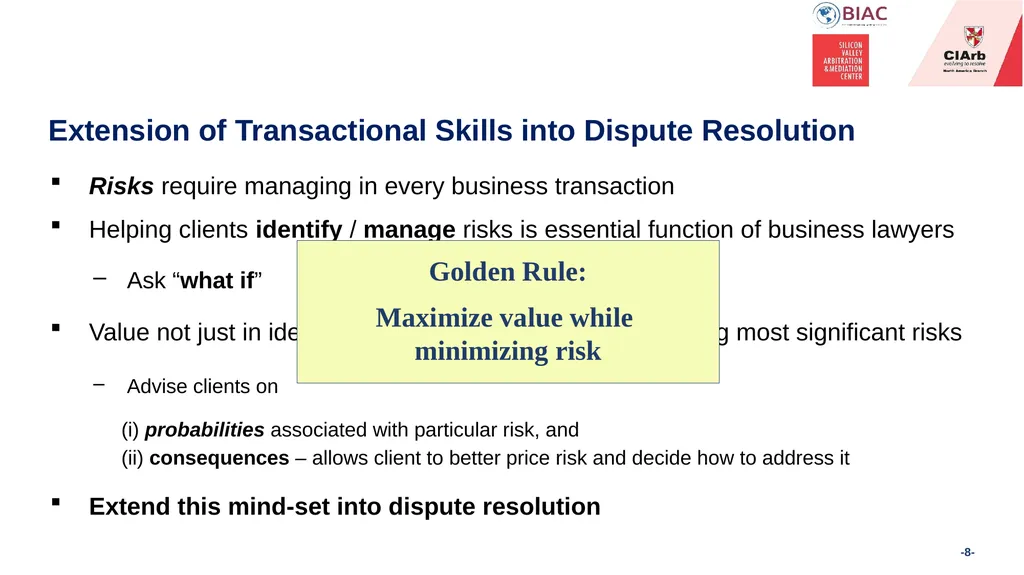
Extension of Transactional Skills into Dispute Resolution Risks require managing in every business transaction
Helping clients identify / manage risks is essential function of business lawyers
Ask “what if”
Value not just in identifying all possible risks, but identifying most significant risks
Advise clients on
(i) probabilities associated with particular risk, and
(ii) consequences – allows client to better price risk and decide how to address it
Extend this mind-set into dispute resolution Golden Rule:
Maximize value while
minimizing risk -8-<br>
Helping clients identify / manage risks is essential function of business lawyers
Ask “what if”
Value not just in identifying all possible risks, but identifying most significant risks
Advise clients on
(i) probabilities associated with particular risk, and
(ii) consequences – allows client to better price risk and decide how to address it
Extend this mind-set into dispute resolution Golden Rule:
Maximize value while
minimizing risk -8-<br>
09
“A contractual provision specifying in advance the forum in which disputes shall be litigated and the law to be applied is…an almost indispensable precondition to achievement of the orderliness and predictability essential to any international business transaction.”
Aware of “sensitivity to the needs of the international commercial system for predictability in the resolution of disputes.”
By agreeing to arbitrate statutory claim, party does not forgo substantive rights and instead “trades the procedures and opportunity for review of the courtroom for the simplicity, informality, and expedition of arbitration” Scherk v Alberto-Culver Co., 417 U.S. 506 (1974) Mitsubishi Motors v. Soler, 473 U.S. 614 (1985) -9- US Supreme Court<br>
Aware of “sensitivity to the needs of the international commercial system for predictability in the resolution of disputes.”
By agreeing to arbitrate statutory claim, party does not forgo substantive rights and instead “trades the procedures and opportunity for review of the courtroom for the simplicity, informality, and expedition of arbitration” Scherk v Alberto-Culver Co., 417 U.S. 506 (1974) Mitsubishi Motors v. Soler, 473 U.S. 614 (1985) -9- US Supreme Court<br>
10
Federal First Circuit (Boston, Northeast, Puerto Rico) “national policy favoring arbitration has extra force when international arbitration is at issue.”
“In keeping with this policy [in favor of arbitration], and in honoring the forum that has been contractually chosen by the parties to resolve their disputes, review of arbitration decisions by the courts is extremely narrow and exceedingly deferential.” Sourcing Unlimited v. Asimco Int'l
526 F.3d 38 (1st Cir. 2008) First State Ins. v. Banco de Seguros Del Estado 254 F.3d 354 (1st Cir. 2001) -10-<br>
“In keeping with this policy [in favor of arbitration], and in honoring the forum that has been contractually chosen by the parties to resolve their disputes, review of arbitration decisions by the courts is extremely narrow and exceedingly deferential.” Sourcing Unlimited v. Asimco Int'l
526 F.3d 38 (1st Cir. 2008) First State Ins. v. Banco de Seguros Del Estado 254 F.3d 354 (1st Cir. 2001) -10-<br>
11
Arbitration and the Courts
“Ideally, the handling of arbitral disputes should resemble a relay race.
In the initial stages, before the arbitrators are seized of the dispute, the baton is in the grasp of the court; for at that stage there is no other organisation which could take steps to prevent the arbitration agreement from being ineffectual.
When the arbitrators take charge they take over the baton and retain it until they have made an award.
At this point, having no longer a function to fulfil, the arbitrators hand back the baton so that the court can, in case of need, lend its coercive powers to the enforcement of the award.” Lord Mustill, “Comments and Conclusions in Conservatory
Provisional Measures in International Arbitration”,
9th Joint Colloquium (ICC Publication 1993)<br>
“Ideally, the handling of arbitral disputes should resemble a relay race.
In the initial stages, before the arbitrators are seized of the dispute, the baton is in the grasp of the court; for at that stage there is no other organisation which could take steps to prevent the arbitration agreement from being ineffectual.
When the arbitrators take charge they take over the baton and retain it until they have made an award.
At this point, having no longer a function to fulfil, the arbitrators hand back the baton so that the court can, in case of need, lend its coercive powers to the enforcement of the award.” Lord Mustill, “Comments and Conclusions in Conservatory
Provisional Measures in International Arbitration”,
9th Joint Colloquium (ICC Publication 1993)<br>
12
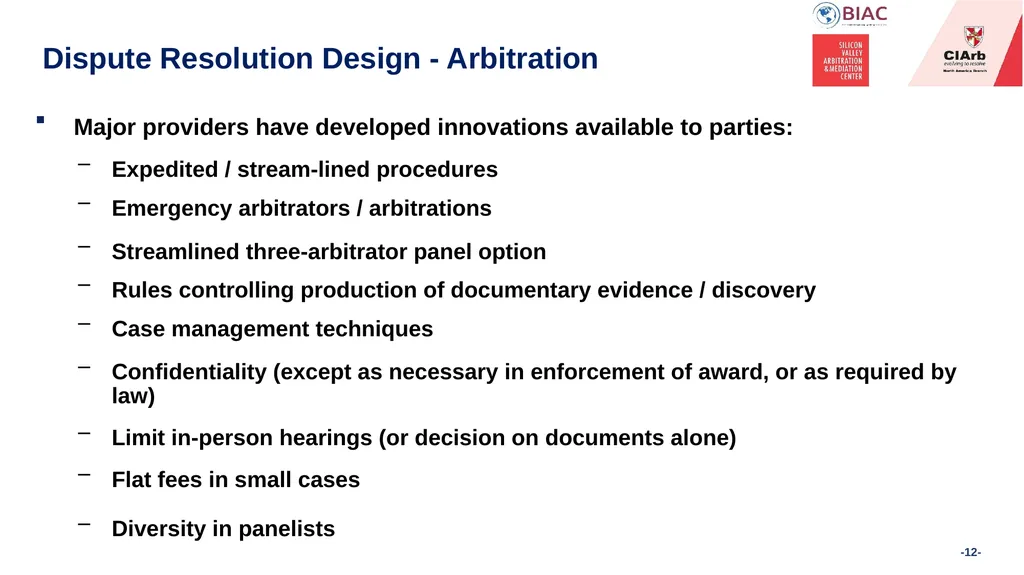
Dispute Resolution Design - Arbitration Major providers have developed innovations available to parties:
Expedited / stream-lined procedures
Emergency arbitrators / arbitrations
Streamlined three-arbitrator panel option
Rules controlling production of documentary evidence / discovery
Case management techniques
Confidentiality (except as necessary in enforcement of award, or as required by law)
Limit in-person hearings (or decision on documents alone)
Flat fees in small cases
Diversity in panelists -12-<br>
Expedited / stream-lined procedures
Emergency arbitrators / arbitrations
Streamlined three-arbitrator panel option
Rules controlling production of documentary evidence / discovery
Case management techniques
Confidentiality (except as necessary in enforcement of award, or as required by law)
Limit in-person hearings (or decision on documents alone)
Flat fees in small cases
Diversity in panelists -12-<br>
13
Advice to corporate/commercial lawyers? Two key moments/points to address possibilities
Arbitration clause
First prehearing conference
Look at every transaction from perspective of what happens if dispute arises
Time for dealing with possibility of dispute is at outset of relationship, not after dispute erupts
Fundamentals:
choice of forum
choice of law
choice of dispute settlement procedures
negotiation → mediation
Consider more detailed provisions arbitration
court litigation -13-<br>
Arbitration clause
First prehearing conference
Look at every transaction from perspective of what happens if dispute arises
Time for dealing with possibility of dispute is at outset of relationship, not after dispute erupts
Fundamentals:
choice of forum
choice of law
choice of dispute settlement procedures
negotiation → mediation
Consider more detailed provisions arbitration
court litigation -13-<br>
14
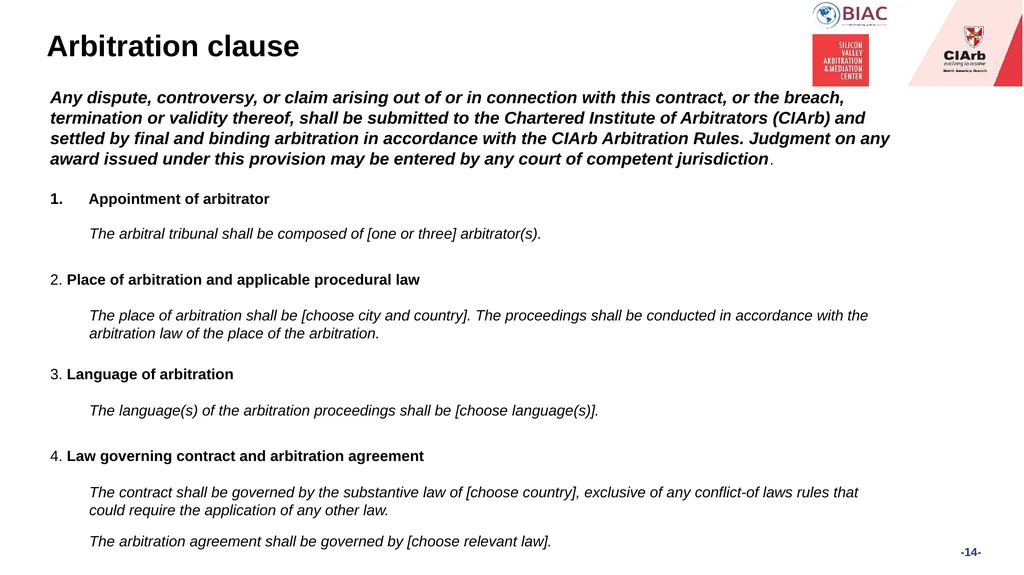
Arbitration clause -14- Any dispute, controversy, or claim arising out of or in connection with this contract, or the breach, termination or validity thereof, shall be submitted to the Chartered Institute of Arbitrators (CIArb) and settled by final and binding arbitration in accordance with the CIArb Arbitration Rules. Judgment on any award issued under this provision may be entered by any court of competent jurisdiction.
Appointment of arbitrator
The arbitral tribunal shall be composed of [one or three] arbitrator(s).
2. Place of arbitration and applicable procedural law
The place of arbitration shall be [choose city and country]. The proceedings shall be conducted in accordance with the arbitration law of the place of the arbitration.
3. Language of arbitration
The language(s) of the arbitration proceedings shall be [choose language(s)].
4. Law governing contract and arbitration agreement
The contract shall be governed by the substantive law of [choose country], exclusive of any conflict-of laws rules that could require the application of any other law.
The arbitration agreement shall be governed by [choose relevant law].<br>
Appointment of arbitrator
The arbitral tribunal shall be composed of [one or three] arbitrator(s).
2. Place of arbitration and applicable procedural law
The place of arbitration shall be [choose city and country]. The proceedings shall be conducted in accordance with the arbitration law of the place of the arbitration.
3. Language of arbitration
The language(s) of the arbitration proceedings shall be [choose language(s)].
4. Law governing contract and arbitration agreement
The contract shall be governed by the substantive law of [choose country], exclusive of any conflict-of laws rules that could require the application of any other law.
The arbitration agreement shall be governed by [choose relevant law].<br>
15
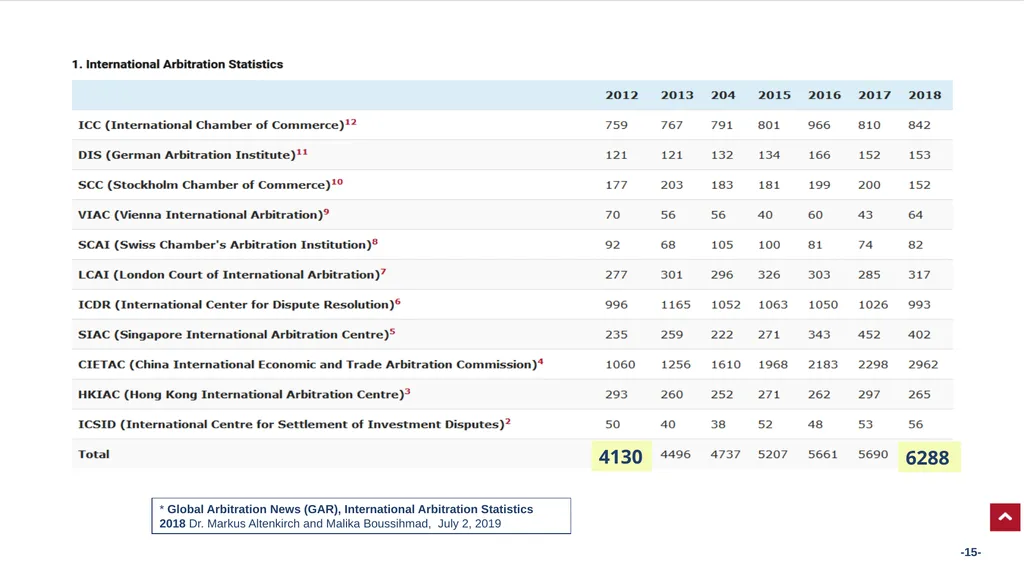
* Global Arbitration News (GAR), International Arbitration Statistics 2018 Dr. Markus Altenkirch and Malika Boussihmad, July 2, 2019 4130 6288 -15-<br>
16
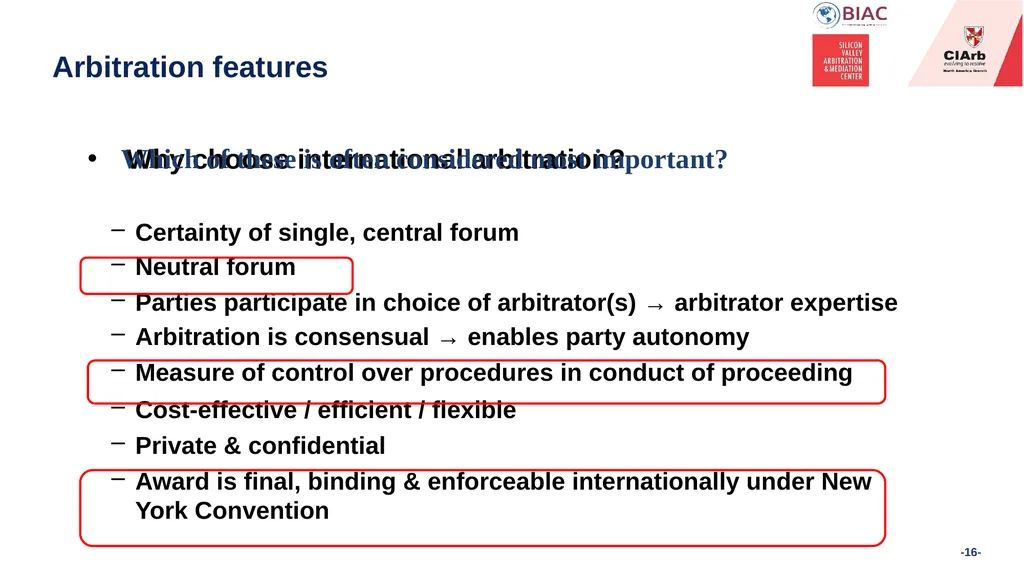
Arbitration features Why choose international arbitration?
Certainty of single, central forum
Neutral forum
Parties participate in choice of arbitrator(s) → arbitrator expertise
Arbitration is consensual → enables party autonomy
Measure of control over procedures in conduct of proceeding
Cost-effective / efficient / flexible
Private & confidential
Award is final, binding & enforceable internationally under New York Convention Which of these is often considered most important? -16-<br>
Certainty of single, central forum
Neutral forum
Parties participate in choice of arbitrator(s) → arbitrator expertise
Arbitration is consensual → enables party autonomy
Measure of control over procedures in conduct of proceeding
Cost-effective / efficient / flexible
Private & confidential
Award is final, binding & enforceable internationally under New York Convention Which of these is often considered most important? -16-<br>
17
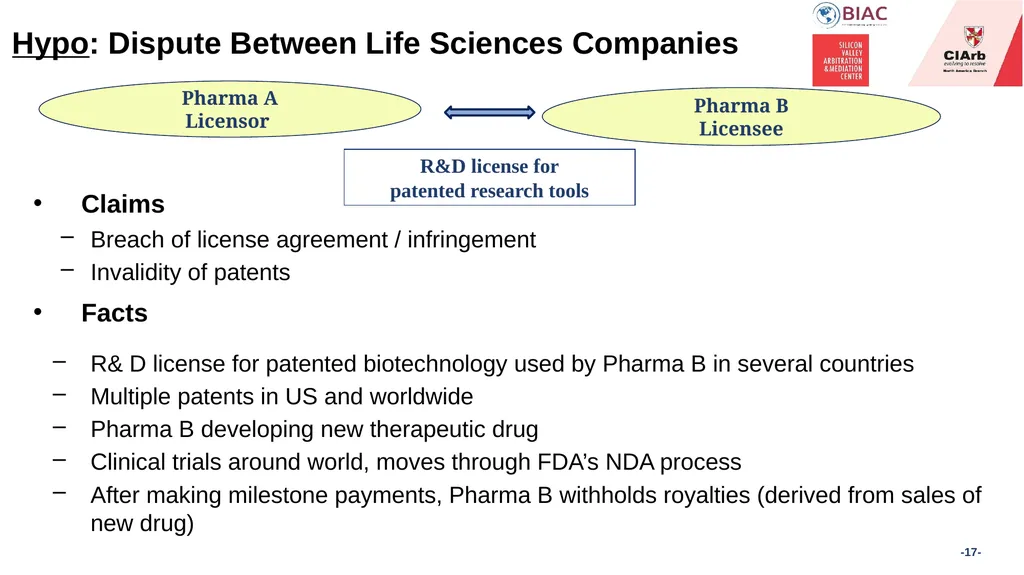
Hypo: Dispute Between Life Sciences Companies Claims
Breach of license agreement / infringement
Invalidity of patents
Facts
R& D license for patented biotechnology used by Pharma B in several countries
Multiple patents in US and worldwide
Pharma B developing new therapeutic drug
Clinical trials around world, moves through FDA’s NDA process
After making milestone payments, Pharma B withholds royalties (derived from sales of new drug) Pharma A
Licensor Pharma B
Licensee R&D license for
patented research tools -17-<br>
Breach of license agreement / infringement
Invalidity of patents
Facts
R& D license for patented biotechnology used by Pharma B in several countries
Multiple patents in US and worldwide
Pharma B developing new therapeutic drug
Clinical trials around world, moves through FDA’s NDA process
After making milestone payments, Pharma B withholds royalties (derived from sales of new drug) Pharma A
Licensor Pharma B
Licensee R&D license for
patented research tools -17-<br>
18
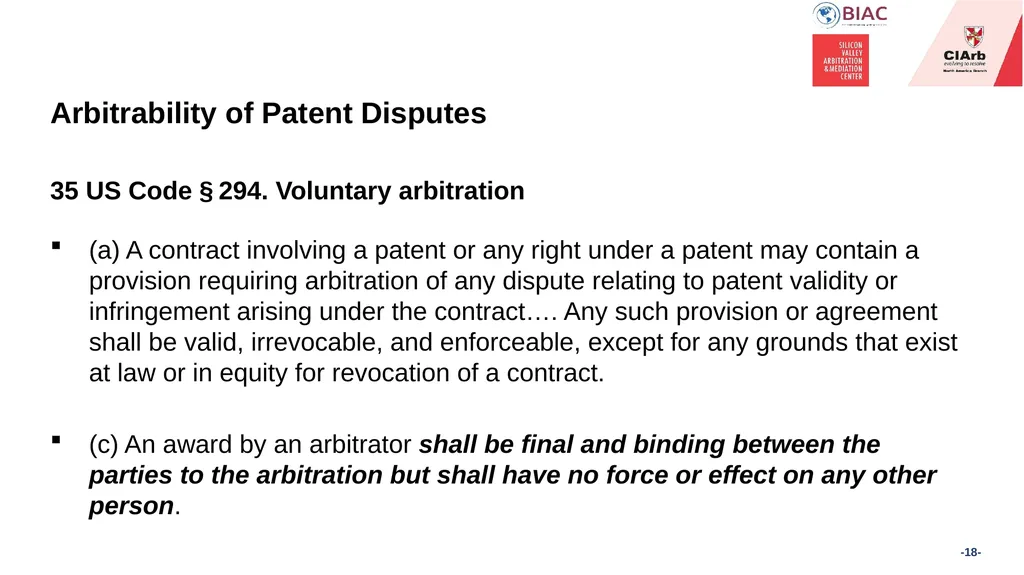
Arbitrability of Patent Disputes 35 US Code § 294. Voluntary arbitration
(a) A contract involving a patent or any right under a patent may contain a provision requiring arbitration of any dispute relating to patent validity or infringement arising under the contract…. Any such provision or agreement shall be valid, irrevocable, and enforceable, except for any grounds that exist at law or in equity for revocation of a contract.
(c) An award by an arbitrator shall be final and binding between the parties to the arbitration but shall have no force or effect on any other person. -18-<br>
(a) A contract involving a patent or any right under a patent may contain a provision requiring arbitration of any dispute relating to patent validity or infringement arising under the contract…. Any such provision or agreement shall be valid, irrevocable, and enforceable, except for any grounds that exist at law or in equity for revocation of a contract.
(c) An award by an arbitrator shall be final and binding between the parties to the arbitration but shall have no force or effect on any other person. -18-<br>
19
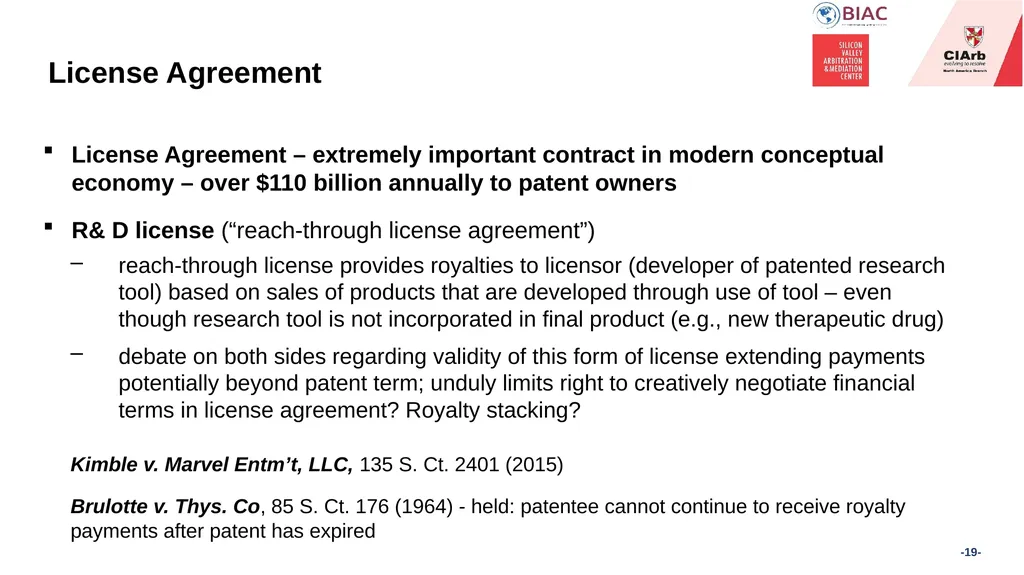
License Agreement License Agreement – extremely important contract in modern conceptual economy – over $110 billion annually to patent owners
R& D license (“reach-through license agreement”)
reach-through license provides royalties to licensor (developer of patented research tool) based on sales of products that are developed through use of tool – even though research tool is not incorporated in final product (e.g., new therapeutic drug)
debate on both sides regarding validity of this form of license extending payments potentially beyond patent term; unduly limits right to creatively negotiate financial terms in license agreement? Royalty stacking?
Kimble v. Marvel Entm’t, LLC, 135 S. Ct. 2401 (2015)
Brulotte v. Thys. Co, 85 S. Ct. 176 (1964) - held: patentee cannot continue to receive royalty payments after patent has expired -19-<br>
R& D license (“reach-through license agreement”)
reach-through license provides royalties to licensor (developer of patented research tool) based on sales of products that are developed through use of tool – even though research tool is not incorporated in final product (e.g., new therapeutic drug)
debate on both sides regarding validity of this form of license extending payments potentially beyond patent term; unduly limits right to creatively negotiate financial terms in license agreement? Royalty stacking?
Kimble v. Marvel Entm’t, LLC, 135 S. Ct. 2401 (2015)
Brulotte v. Thys. Co, 85 S. Ct. 176 (1964) - held: patentee cannot continue to receive royalty payments after patent has expired -19-<br>
20
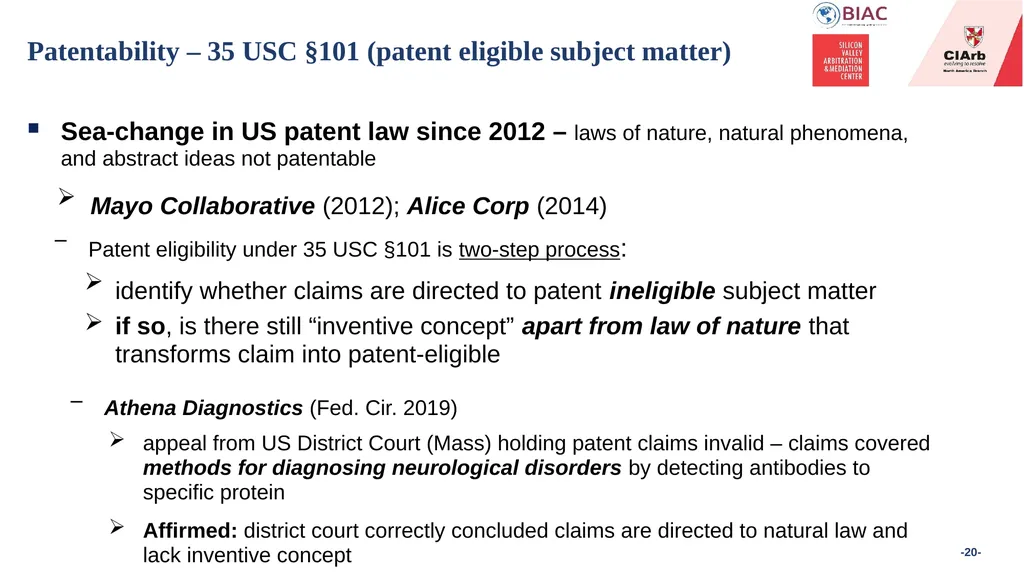
Patentability – 35 USC §101 (patent eligible subject matter) -20- Sea-change in US patent law since 2012 – laws of nature, natural phenomena, and abstract ideas not patentable
Mayo Collaborative (2012); Alice Corp (2014)
Patent eligibility under 35 USC §101 is two-step process:
identify whether claims are directed to patent ineligible subject matter
if so, is there still “inventive concept” apart from law of nature that transforms claim into patent-eligible
Athena Diagnostics (Fed. Cir. 2019)
appeal from US District Court (Mass) holding patent claims invalid – claims covered methods for diagnosing neurological disorders by detecting antibodies to specific protein
Affirmed: district court correctly concluded claims are directed to natural law and lack inventive concept<br>
Mayo Collaborative (2012); Alice Corp (2014)
Patent eligibility under 35 USC §101 is two-step process:
identify whether claims are directed to patent ineligible subject matter
if so, is there still “inventive concept” apart from law of nature that transforms claim into patent-eligible
Athena Diagnostics (Fed. Cir. 2019)
appeal from US District Court (Mass) holding patent claims invalid – claims covered methods for diagnosing neurological disorders by detecting antibodies to specific protein
Affirmed: district court correctly concluded claims are directed to natural law and lack inventive concept<br>
21
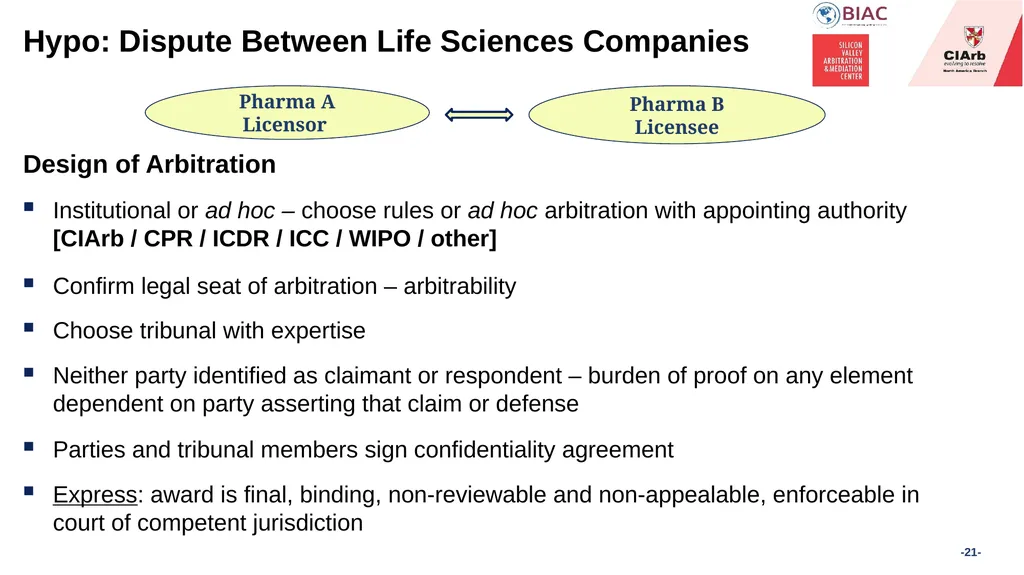
Hypo: Dispute Between Life Sciences Companies Design of Arbitration
Institutional or ad hoc – choose rules or ad hoc arbitration with appointing authority [CIArb / CPR / ICDR / ICC / WIPO / other]
Confirm legal seat of arbitration – arbitrability
Choose tribunal with expertise
Neither party identified as claimant or respondent – burden of proof on any element dependent on party asserting that claim or defense
Parties and tribunal members sign confidentiality agreement
Express: award is final, binding, non-reviewable and non-appealable, enforceable in court of competent jurisdiction Pharma A
Licensor Pharma B
Licensee -21-<br>
Institutional or ad hoc – choose rules or ad hoc arbitration with appointing authority [CIArb / CPR / ICDR / ICC / WIPO / other]
Confirm legal seat of arbitration – arbitrability
Choose tribunal with expertise
Neither party identified as claimant or respondent – burden of proof on any element dependent on party asserting that claim or defense
Parties and tribunal members sign confidentiality agreement
Express: award is final, binding, non-reviewable and non-appealable, enforceable in court of competent jurisdiction Pharma A
Licensor Pharma B
Licensee -21-<br>
22
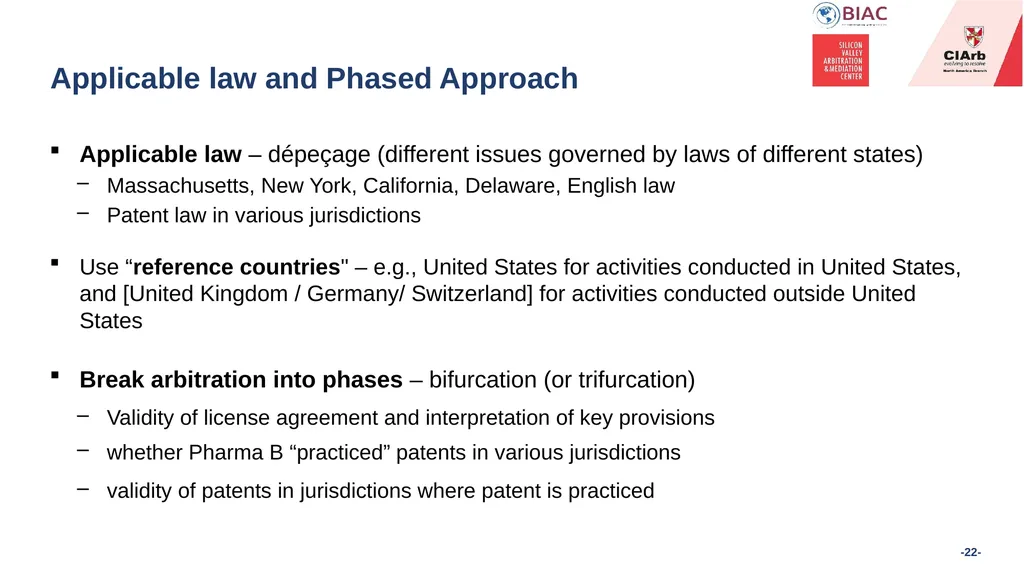
Applicable law and Phased Approach Applicable law – dépeçage (different issues governed by laws of different states)
Massachusetts, New York, California, Delaware, English law
Patent law in various jurisdictions
Use “reference countries" – e.g., United States for activities conducted in United States, and [United Kingdom / Germany/ Switzerland] for activities conducted outside United States
Break arbitration into phases – bifurcation (or trifurcation)
Validity of license agreement and interpretation of key provisions
whether Pharma B “practiced” patents in various jurisdictions
validity of patents in jurisdictions where patent is practiced -22-<br>
Massachusetts, New York, California, Delaware, English law
Patent law in various jurisdictions
Use “reference countries" – e.g., United States for activities conducted in United States, and [United Kingdom / Germany/ Switzerland] for activities conducted outside United States
Break arbitration into phases – bifurcation (or trifurcation)
Validity of license agreement and interpretation of key provisions
whether Pharma B “practiced” patents in various jurisdictions
validity of patents in jurisdictions where patent is practiced -22-<br>
23
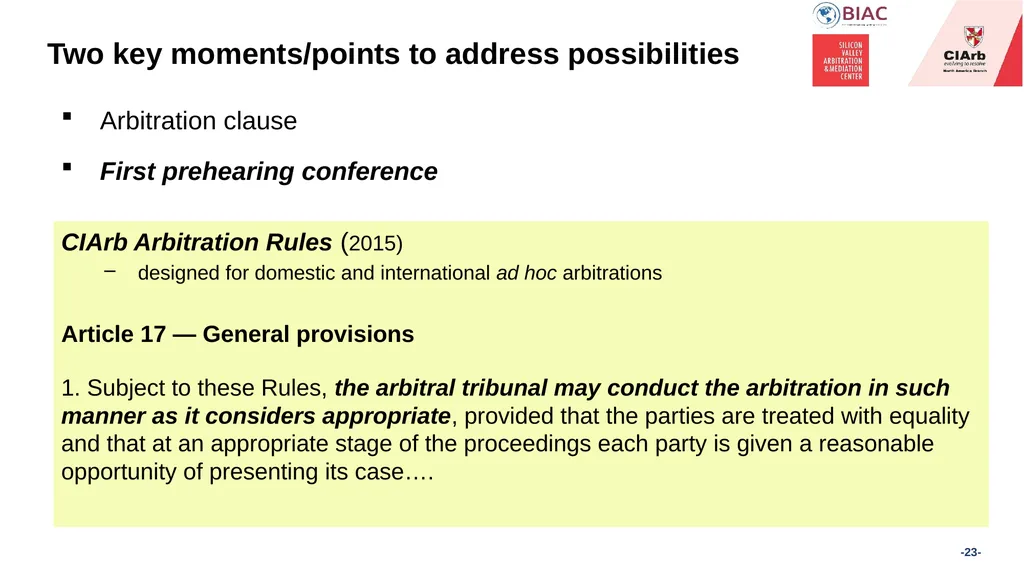
Two key moments/points to address possibilities 23 Arbitration clause
First prehearing conference CIArb Arbitration Rules (2015)
designed for domestic and international ad hoc arbitrations
Article 17 — General provisions
1. Subject to these Rules, the arbitral tribunal may conduct the arbitration in such manner as it considers appropriate, provided that the parties are treated with equality and that at an appropriate stage of the proceedings each party is given a reasonable opportunity of presenting its case….<br>
First prehearing conference CIArb Arbitration Rules (2015)
designed for domestic and international ad hoc arbitrations
Article 17 — General provisions
1. Subject to these Rules, the arbitral tribunal may conduct the arbitration in such manner as it considers appropriate, provided that the parties are treated with equality and that at an appropriate stage of the proceedings each party is given a reasonable opportunity of presenting its case….<br>
24
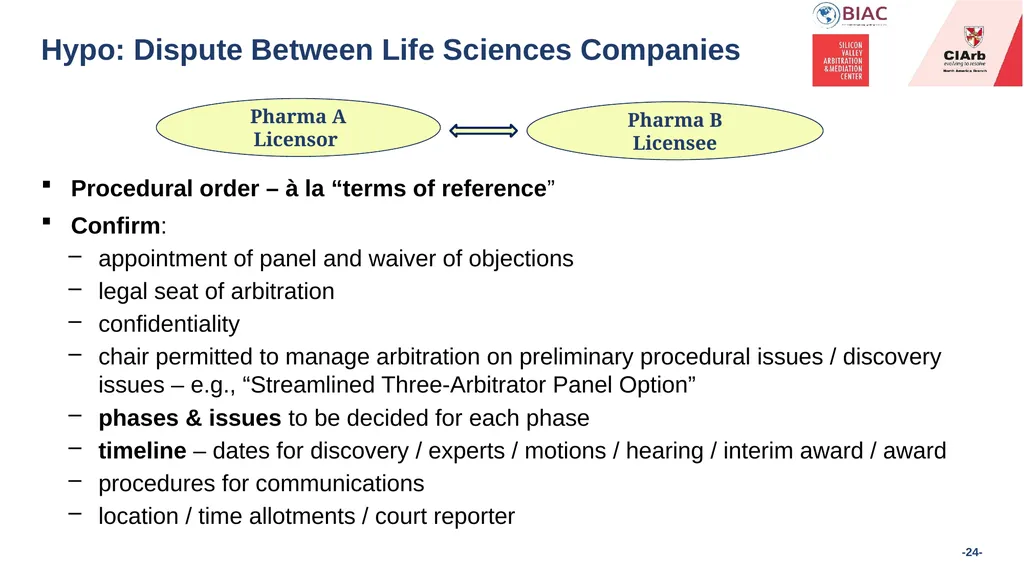
Hypo: Dispute Between Life Sciences Companies -24- Procedural order – à la “terms of reference”
Confirm:
appointment of panel and waiver of objections
legal seat of arbitration
confidentiality
chair permitted to manage arbitration on preliminary procedural issues / discovery issues – e.g., “Streamlined Three-Arbitrator Panel Option”
phases & issues to be decided for each phase
timeline – dates for discovery / experts / motions / hearing / interim award / award
procedures for communications
location / time allotments / court reporter Pharma A
Licensor Pharma B
Licensee<br>
Confirm:
appointment of panel and waiver of objections
legal seat of arbitration
confidentiality
chair permitted to manage arbitration on preliminary procedural issues / discovery issues – e.g., “Streamlined Three-Arbitrator Panel Option”
phases & issues to be decided for each phase
timeline – dates for discovery / experts / motions / hearing / interim award / award
procedures for communications
location / time allotments / court reporter Pharma A
Licensor Pharma B
Licensee<br>
25
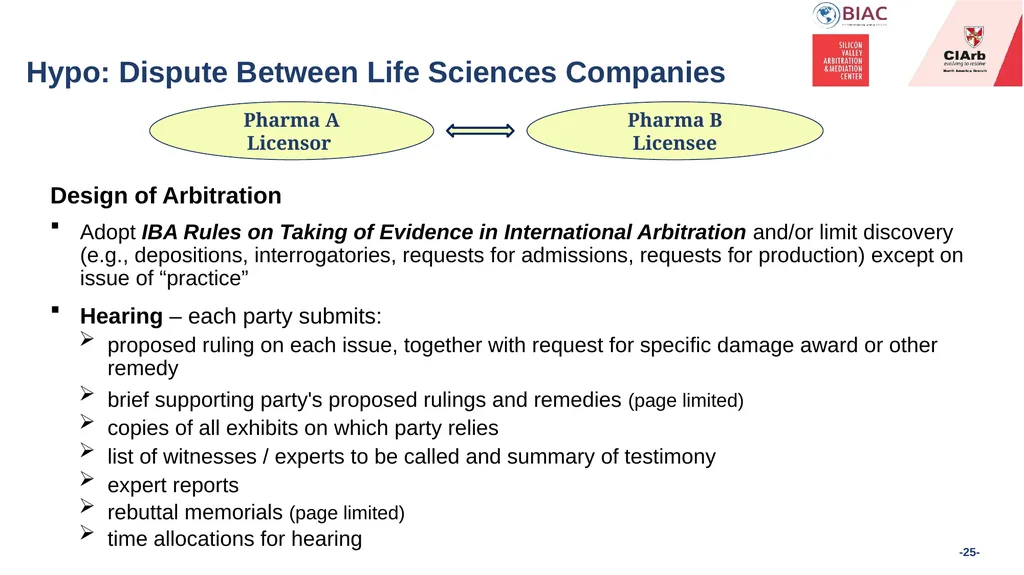
Hypo: Dispute Between Life Sciences Companies -25- Design of Arbitration
Adopt IBA Rules on Taking of Evidence in International Arbitration and/or limit discovery (e.g., depositions, interrogatories, requests for admissions, requests for production) except on issue of “practice”
Hearing – each party submits:
proposed ruling on each issue, together with request for specific damage award or other remedy
brief supporting party's proposed rulings and remedies (page limited)
copies of all exhibits on which party relies
list of witnesses / experts to be called and summary of testimony
expert reports
rebuttal memorials (page limited)
time allocations for hearing Pharma A
Licensor Pharma B
Licensee<br>
Adopt IBA Rules on Taking of Evidence in International Arbitration and/or limit discovery (e.g., depositions, interrogatories, requests for admissions, requests for production) except on issue of “practice”
Hearing – each party submits:
proposed ruling on each issue, together with request for specific damage award or other remedy
brief supporting party's proposed rulings and remedies (page limited)
copies of all exhibits on which party relies
list of witnesses / experts to be called and summary of testimony
expert reports
rebuttal memorials (page limited)
time allocations for hearing Pharma A
Licensor Pharma B
Licensee<br>
26
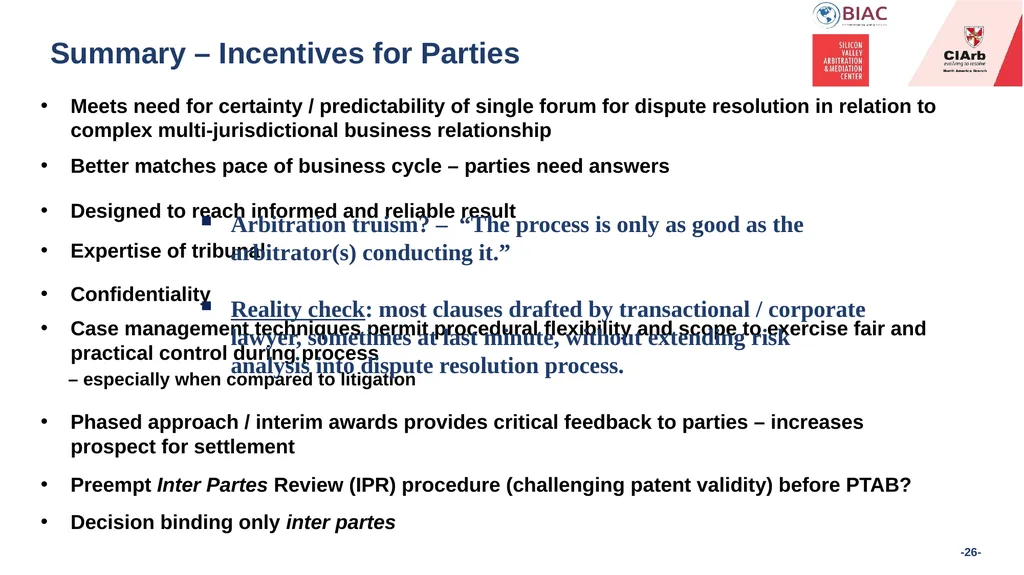
Summary – Incentives for Parties -26- Meets need for certainty / predictability of single forum for dispute resolution in relation to complex multi-jurisdictional business relationship
Better matches pace of business cycle – parties need answers
Designed to reach informed and reliable result
Expertise of tribunal
Confidentiality
Case management techniques permit procedural flexibility and scope to exercise fair and practical control during process
– especially when compared to litigation
Phased approach / interim awards provides critical feedback to parties – increases prospect for settlement
Preempt Inter Partes Review (IPR) procedure (challenging patent validity) before PTAB?
Decision binding only inter partes Arbitration truism? – “The process is only as good as the arbitrator(s) conducting it.”
Reality check: most clauses drafted by transactional / corporate lawyer, sometimes at last minute, without extending risk analysis into dispute resolution process.<br>
Better matches pace of business cycle – parties need answers
Designed to reach informed and reliable result
Expertise of tribunal
Confidentiality
Case management techniques permit procedural flexibility and scope to exercise fair and practical control during process
– especially when compared to litigation
Phased approach / interim awards provides critical feedback to parties – increases prospect for settlement
Preempt Inter Partes Review (IPR) procedure (challenging patent validity) before PTAB?
Decision binding only inter partes Arbitration truism? – “The process is only as good as the arbitrator(s) conducting it.”
Reality check: most clauses drafted by transactional / corporate lawyer, sometimes at last minute, without extending risk analysis into dispute resolution process.<br>
27
Q & A Session
Thank You
Look for upcoming programs at
https://www.ciarbnab.com/<br>