
Expanding Inclusion with Islamic Finance &
LO
Published · 11 slides · 0 views

1 / 1

Description
Expanding Inclusion with Islamic Finance Technology Blake Goud CEO, Responsible Finance Investment Foundation, C.I.C. North America Conference on Islamic Finance October 18-19, 2024 Houston, Texas How has Islamic finance developed in
Related Topics
Share
Embed code
Download this presentation From Below
"Expanding Inclusion with Islamic Finance &" is the property of its rightful owner. Permission is granted to download and print the materials on this website for personal, non-commercial use only, and to display it on your personal computer provided you do not modify the materials and that you retain all copyright notices contained in the materials. By downloading content from our website, you accept the terms of this agreement.
Presentation Transcript
01
Expanding Inclusion with Islamic Finance & Technology
Blake Goud
CEO, Responsible Finance & Investment Foundation, C.I.C. North America Conference on Islamic Finance
October 18-19, 2024
Houston, Texas<br>
October 18-19, 2024
Houston, Texas<br>
02
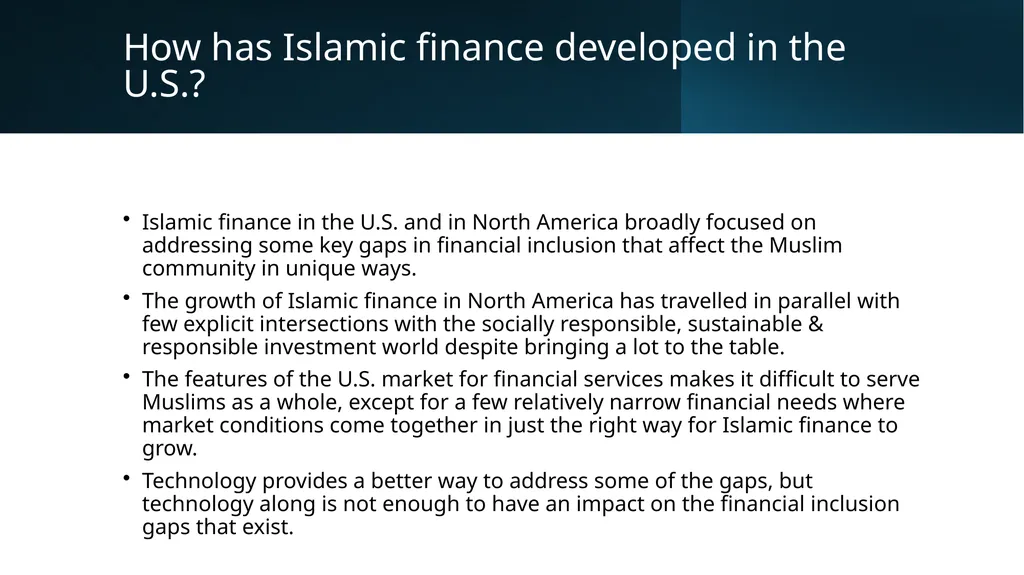
How has Islamic finance developed in the U.S.? Islamic finance in the U.S. and in North America broadly focused on addressing some key gaps in financial inclusion that affect the Muslim community in unique ways.
The growth of Islamic finance in North America has travelled in parallel with few explicit intersections with the socially responsible, sustainable & responsible investment world despite bringing a lot to the table.
The features of the U.S. market for financial services makes it difficult to serve Muslims as a whole, except for a few relatively narrow financial needs where market conditions come together in just the right way for Islamic finance to grow.
Technology provides a better way to address some of the gaps, but technology along is not enough to have an impact on the financial inclusion gaps that exist.<br>
The growth of Islamic finance in North America has travelled in parallel with few explicit intersections with the socially responsible, sustainable & responsible investment world despite bringing a lot to the table.
The features of the U.S. market for financial services makes it difficult to serve Muslims as a whole, except for a few relatively narrow financial needs where market conditions come together in just the right way for Islamic finance to grow.
Technology provides a better way to address some of the gaps, but technology along is not enough to have an impact on the financial inclusion gaps that exist.<br>
03
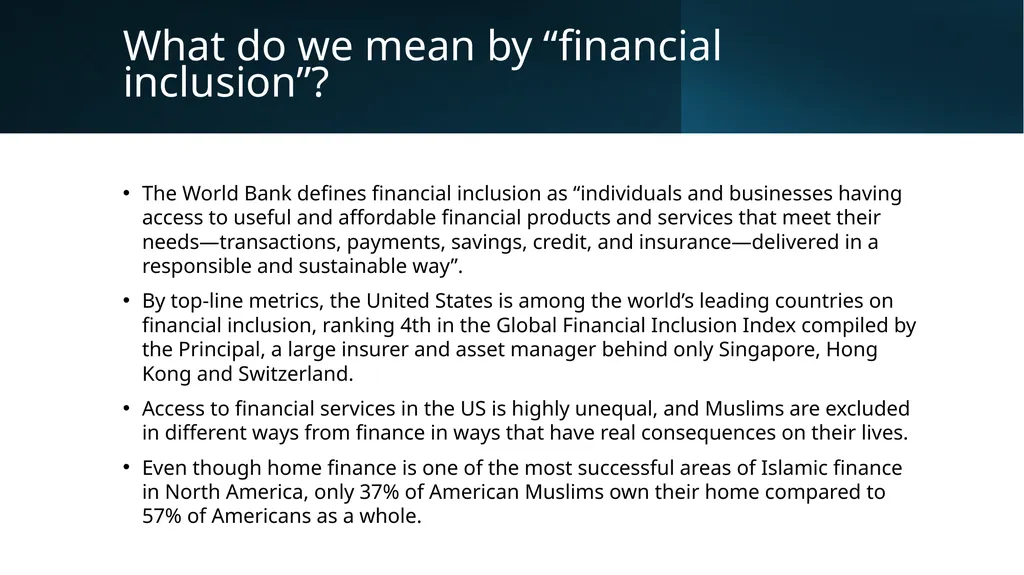
What do we mean by “financial inclusion”? The World Bank defines financial inclusion as “individuals and businesses having access to useful and affordable financial products and services that meet their needs—transactions, payments, savings, credit, and insurance—delivered in a responsible and sustainable way”.
By top-line metrics, the United States is among the world’s leading countries on financial inclusion, ranking 4th in the Global Financial Inclusion Index compiled by the Principal, a large insurer and asset manager behind only Singapore, Hong Kong and Switzerland.
Access to financial services in the US is highly unequal, and Muslims are excluded in different ways from finance in ways that have real consequences on their lives.
Even though home finance is one of the most successful areas of Islamic finance in North America, only 37% of American Muslims own their home compared to 57% of Americans as a whole.<br>
By top-line metrics, the United States is among the world’s leading countries on financial inclusion, ranking 4th in the Global Financial Inclusion Index compiled by the Principal, a large insurer and asset manager behind only Singapore, Hong Kong and Switzerland.
Access to financial services in the US is highly unequal, and Muslims are excluded in different ways from finance in ways that have real consequences on their lives.
Even though home finance is one of the most successful areas of Islamic finance in North America, only 37% of American Muslims own their home compared to 57% of Americans as a whole.<br>
04
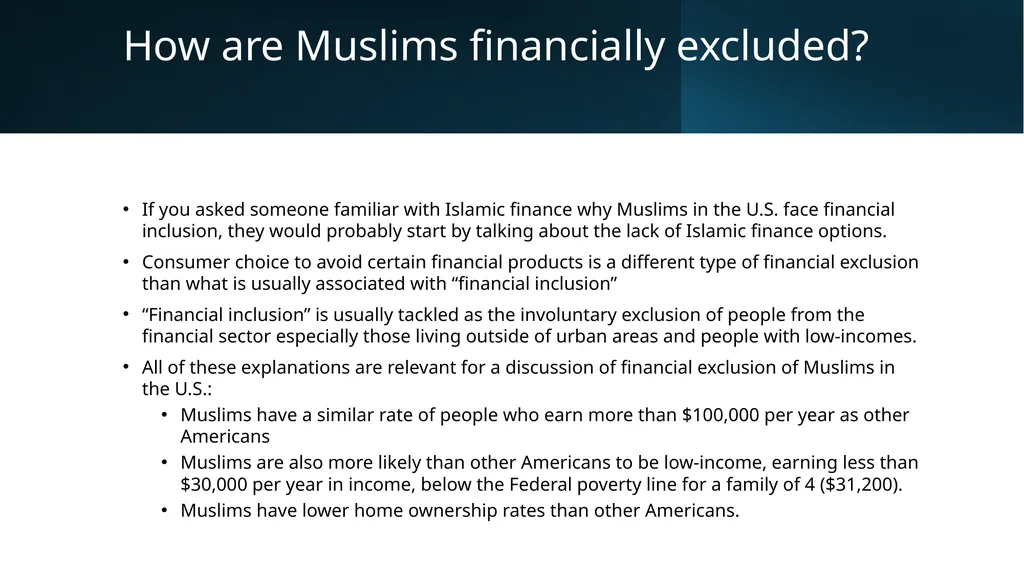
How are Muslims financially excluded? If you asked someone familiar with Islamic finance why Muslims in the U.S. face financial inclusion, they would probably start by talking about the lack of Islamic finance options.
Consumer choice to avoid certain financial products is a different type of financial exclusion than what is usually associated with “financial inclusion”
“Financial inclusion” is usually tackled as the involuntary exclusion of people from the financial sector especially those living outside of urban areas and people with low-incomes.
All of these explanations are relevant for a discussion of financial exclusion of Muslims in the U.S.:
Muslims have a similar rate of people who earn more than $100,000 per year as other Americans
Muslims are also more likely than other Americans to be low-income, earning less than $30,000 per year in income, below the Federal poverty line for a family of 4 ($31,200).
Muslims have lower home ownership rates than other Americans.<br>
Consumer choice to avoid certain financial products is a different type of financial exclusion than what is usually associated with “financial inclusion”
“Financial inclusion” is usually tackled as the involuntary exclusion of people from the financial sector especially those living outside of urban areas and people with low-incomes.
All of these explanations are relevant for a discussion of financial exclusion of Muslims in the U.S.:
Muslims have a similar rate of people who earn more than $100,000 per year as other Americans
Muslims are also more likely than other Americans to be low-income, earning less than $30,000 per year in income, below the Federal poverty line for a family of 4 ($31,200).
Muslims have lower home ownership rates than other Americans.<br>
05
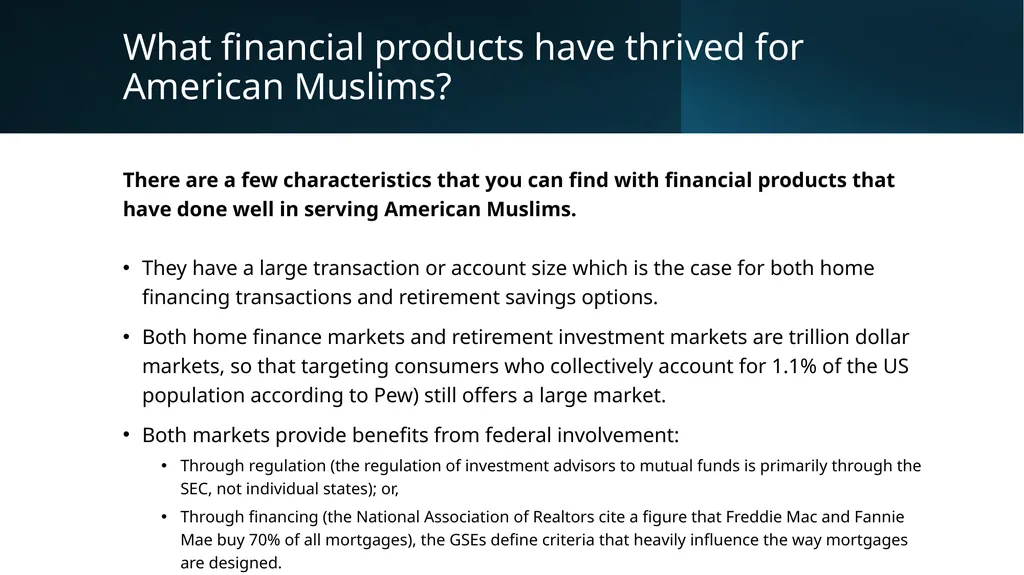
What financial products have thrived for American Muslims? There are a few characteristics that you can find with financial products that have done well in serving American Muslims.
They have a large transaction or account size which is the case for both home financing transactions and retirement savings options.
Both home finance markets and retirement investment markets are trillion dollar markets, so that targeting consumers who collectively account for 1.1% of the US population according to Pew) still offers a large market.
Both markets provide benefits from federal involvement:
Through regulation (the regulation of investment advisors to mutual funds is primarily through the SEC, not individual states); or,
Through financing (the National Association of Realtors cite a figure that Freddie Mac and Fannie Mae buy 70% of all mortgages), the GSEs define criteria that heavily influence the way mortgages are designed.<br>
They have a large transaction or account size which is the case for both home financing transactions and retirement savings options.
Both home finance markets and retirement investment markets are trillion dollar markets, so that targeting consumers who collectively account for 1.1% of the US population according to Pew) still offers a large market.
Both markets provide benefits from federal involvement:
Through regulation (the regulation of investment advisors to mutual funds is primarily through the SEC, not individual states); or,
Through financing (the National Association of Realtors cite a figure that Freddie Mac and Fannie Mae buy 70% of all mortgages), the GSEs define criteria that heavily influence the way mortgages are designed.<br>
06
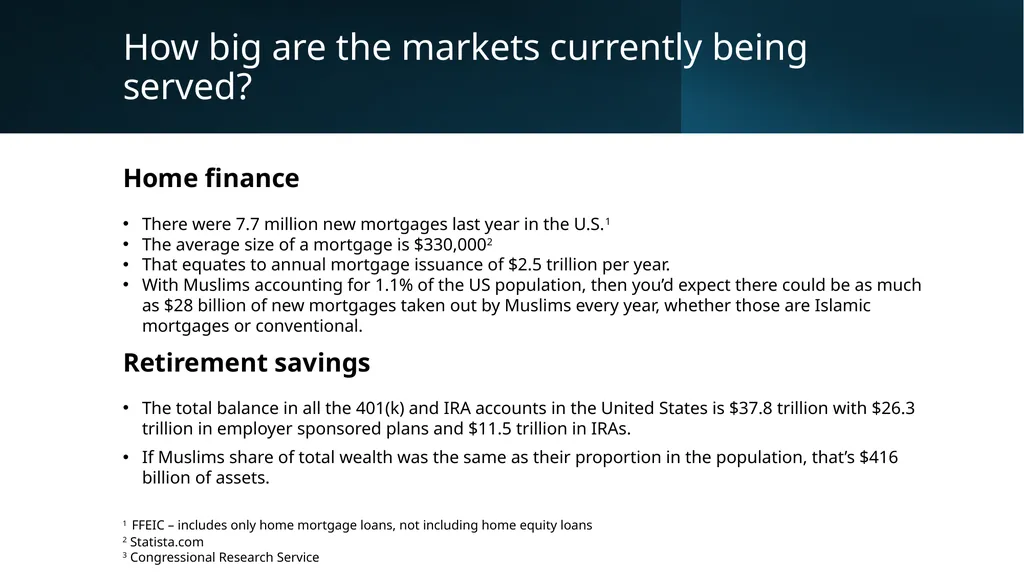
How big are the markets currently being served? Home finance
There were 7.7 million new mortgages last year in the U.S.1
The average size of a mortgage is $330,0002
That equates to annual mortgage issuance of $2.5 trillion per year.
With Muslims accounting for 1.1% of the US population, then you’d expect there could be as much as $28 billion of new mortgages taken out by Muslims every year, whether those are Islamic mortgages or conventional.
Retirement savings
The total balance in all the 401(k) and IRA accounts in the United States is $37.8 trillion with $26.3 trillion in employer sponsored plans and $11.5 trillion in IRAs.
If Muslims share of total wealth was the same as their proportion in the population, that’s $416 billion of assets. 1 FFEIC – includes only home mortgage loans, not including home equity loans
2 Statista.com
3 Congressional Research Service<br>
There were 7.7 million new mortgages last year in the U.S.1
The average size of a mortgage is $330,0002
That equates to annual mortgage issuance of $2.5 trillion per year.
With Muslims accounting for 1.1% of the US population, then you’d expect there could be as much as $28 billion of new mortgages taken out by Muslims every year, whether those are Islamic mortgages or conventional.
Retirement savings
The total balance in all the 401(k) and IRA accounts in the United States is $37.8 trillion with $26.3 trillion in employer sponsored plans and $11.5 trillion in IRAs.
If Muslims share of total wealth was the same as their proportion in the population, that’s $416 billion of assets. 1 FFEIC – includes only home mortgage loans, not including home equity loans
2 Statista.com
3 Congressional Research Service<br>
07
What types of products have the greatest unfilled need Personal finance: Often provided on an unsecured or secured (e.g., HELOCs) through community banks and credit unions that are limited in scale geographically or through national banks without an interest in Islamic finance – how many places have the market size to support a local option?
Small business finance: A large portion of this financing is done through community banks and credit unions that are limited in scale geographically or through national banks without an interest in Islamic finance – how many places have the market size to support a local option?
Vehicle finance: A large portion of this financing is done through community banks and credit unions that are limited in scale geographically or through national banks without an interest in Islamic finance – how many places have the market size to support a local option?
Student loans: private market is very poorly functioning for student loans in general (from a consumer perspective) and there is no Islamic student loan product on the way like what is being developed in the U.K.<br>
Small business finance: A large portion of this financing is done through community banks and credit unions that are limited in scale geographically or through national banks without an interest in Islamic finance – how many places have the market size to support a local option?
Vehicle finance: A large portion of this financing is done through community banks and credit unions that are limited in scale geographically or through national banks without an interest in Islamic finance – how many places have the market size to support a local option?
Student loans: private market is very poorly functioning for student loans in general (from a consumer perspective) and there is no Islamic student loan product on the way like what is being developed in the U.K.<br>
08
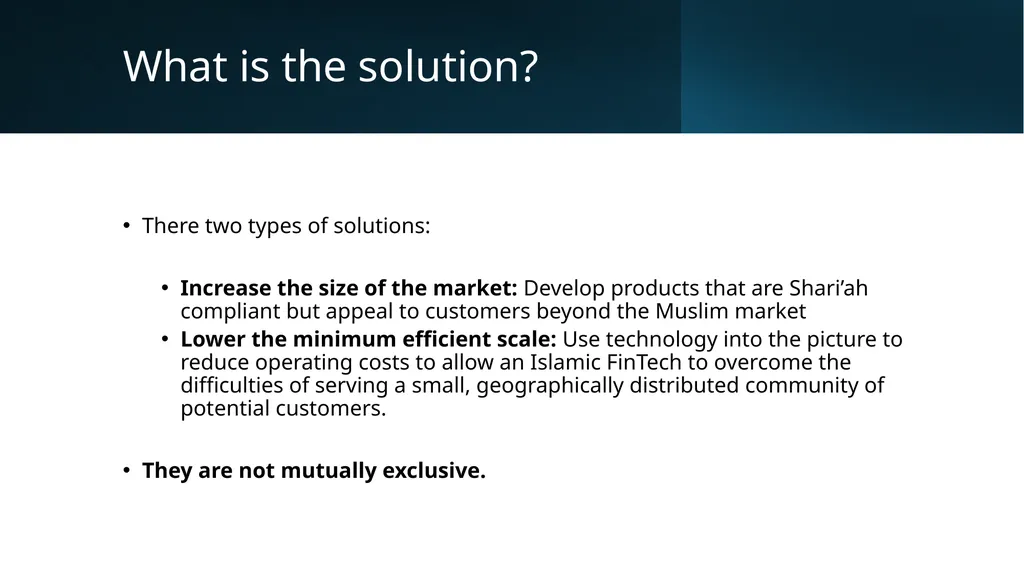
What is the solution? There two types of solutions:
Increase the size of the market: Develop products that are Shari’ah compliant but appeal to customers beyond the Muslim market
Lower the minimum efficient scale: Use technology into the picture to reduce operating costs to allow an Islamic FinTech to overcome the difficulties of serving a small, geographically distributed community of potential customers.
They are not mutually exclusive.<br>
Increase the size of the market: Develop products that are Shari’ah compliant but appeal to customers beyond the Muslim market
Lower the minimum efficient scale: Use technology into the picture to reduce operating costs to allow an Islamic FinTech to overcome the difficulties of serving a small, geographically distributed community of potential customers.
They are not mutually exclusive.<br>
09
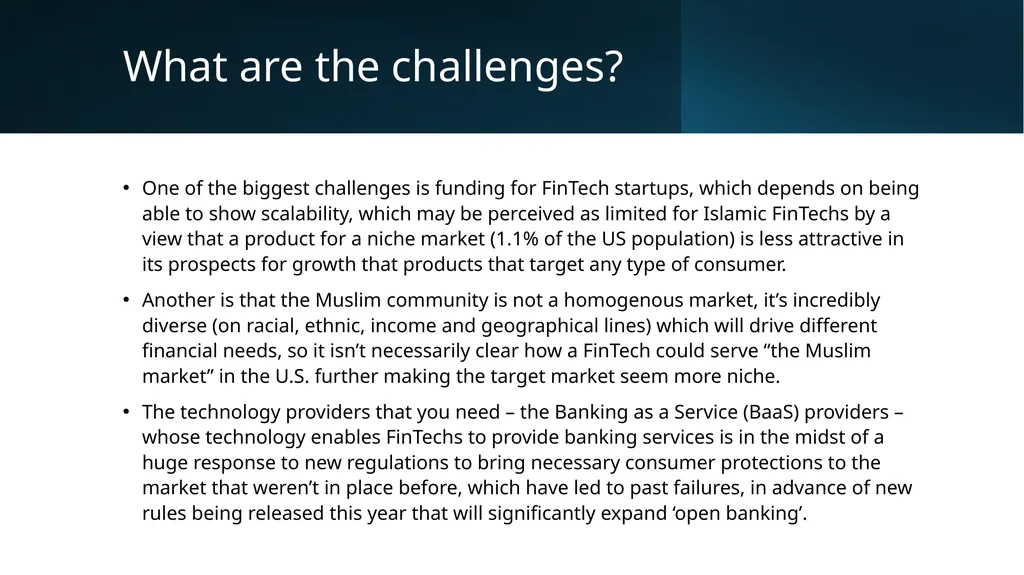
What are the challenges? One of the biggest challenges is funding for FinTech startups, which depends on being able to show scalability, which may be perceived as limited for Islamic FinTechs by a view that a product for a niche market (1.1% of the US population) is less attractive in its prospects for growth that products that target any type of consumer.
Another is that the Muslim community is not a homogenous market, it’s incredibly diverse (on racial, ethnic, income and geographical lines) which will drive different financial needs, so it isn’t necessarily clear how a FinTech could serve “the Muslim market” in the U.S. further making the target market seem more niche.
The technology providers that you need – the Banking as a Service (BaaS) providers – whose technology enables FinTechs to provide banking services is in the midst of a huge response to new regulations to bring necessary consumer protections to the market that weren’t in place before, which have led to past failures, in advance of new rules being released this year that will significantly expand ‘open banking’.<br>
Another is that the Muslim community is not a homogenous market, it’s incredibly diverse (on racial, ethnic, income and geographical lines) which will drive different financial needs, so it isn’t necessarily clear how a FinTech could serve “the Muslim market” in the U.S. further making the target market seem more niche.
The technology providers that you need – the Banking as a Service (BaaS) providers – whose technology enables FinTechs to provide banking services is in the midst of a huge response to new regulations to bring necessary consumer protections to the market that weren’t in place before, which have led to past failures, in advance of new rules being released this year that will significantly expand ‘open banking’.<br>
10
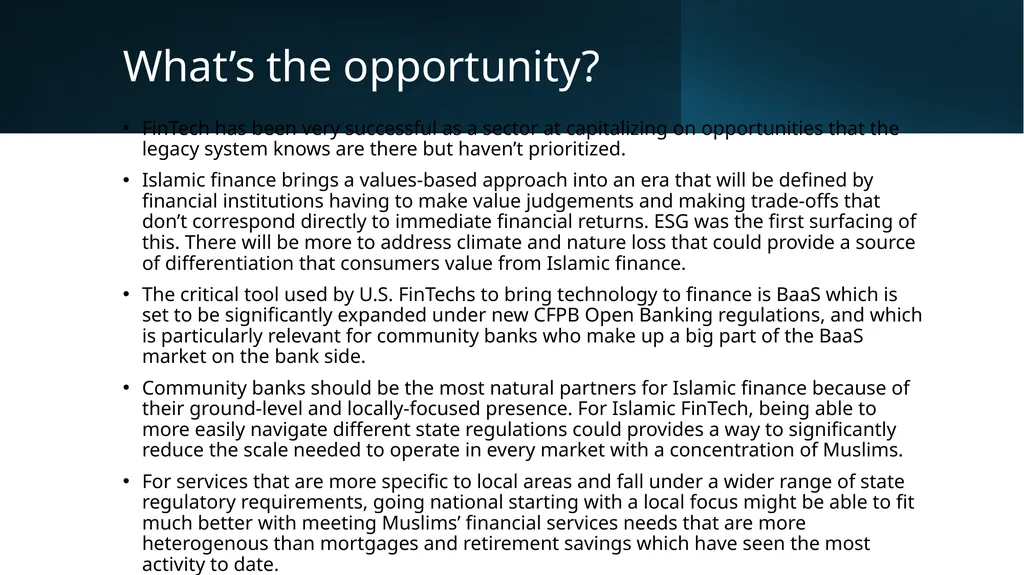
What’s the opportunity? FinTech has been very successful as a sector at capitalizing on opportunities that the legacy system knows are there but haven’t prioritized.
Islamic finance brings a values-based approach into an era that will be defined by financial institutions having to make value judgements and making trade-offs that don’t correspond directly to immediate financial returns. ESG was the first surfacing of this. There will be more to address climate and nature loss that could provide a source of differentiation that consumers value from Islamic finance.
The critical tool used by U.S. FinTechs to bring technology to finance is BaaS which is set to be significantly expanded under new CFPB Open Banking regulations, and which is particularly relevant for community banks who make up a big part of the BaaS market on the bank side.
Community banks should be the most natural partners for Islamic finance because of their ground-level and locally-focused presence. For Islamic FinTech, being able to more easily navigate different state regulations could provides a way to significantly reduce the scale needed to operate in every market with a concentration of Muslims.
For services that are more specific to local areas and fall under a wider range of state regulatory requirements, going national starting with a local focus might be able to fit much better with meeting Muslims’ financial services needs that are more heterogenous than mortgages and retirement savings which have seen the most activity to date.<br>
Islamic finance brings a values-based approach into an era that will be defined by financial institutions having to make value judgements and making trade-offs that don’t correspond directly to immediate financial returns. ESG was the first surfacing of this. There will be more to address climate and nature loss that could provide a source of differentiation that consumers value from Islamic finance.
The critical tool used by U.S. FinTechs to bring technology to finance is BaaS which is set to be significantly expanded under new CFPB Open Banking regulations, and which is particularly relevant for community banks who make up a big part of the BaaS market on the bank side.
Community banks should be the most natural partners for Islamic finance because of their ground-level and locally-focused presence. For Islamic FinTech, being able to more easily navigate different state regulations could provides a way to significantly reduce the scale needed to operate in every market with a concentration of Muslims.
For services that are more specific to local areas and fall under a wider range of state regulatory requirements, going national starting with a local focus might be able to fit much better with meeting Muslims’ financial services needs that are more heterogenous than mortgages and retirement savings which have seen the most activity to date.<br>
11
Thank you!
Blake Goud
CEO
Responsible Finance & Investment Foundation, C.I.C.
www.rfi-foundation.org
blake.goud@rfi-foundation.org North America Conference on Islamic Finance
October 18-19, 2024
Houston, Texas<br>
October 18-19, 2024
Houston, Texas<br>