Experiment: Ice cubes melting in fresh- and salt water See also: http:www.lawrencehallofscience.orgcomscipdfs2TeachingandLearning.pdf http:www.usc.eduorgcosee-westglaciersIceCubeExptFINAL.pdf
"Experiment: Ice cubes melting in fresh- and salt" is the property of its rightful owner. Permission is granted to
download and print the materials on this website for personal, non-commercial use only, and to display it
on your personal computer provided you do not modify the materials and that you retain all copyright
notices contained in the materials. By downloading content from our website, you accept the terms of this
agreement.
Presentation Transcript
01
Experiment: Ice cubes melting in fresh- and salt water See also:
http://www.lawrencehallofscience.org/comsci/pdfs/2_Teaching_and_Learning.pdf
http://www.usc.edu/org/cosee-west/glaciers/Ice_Cube_ExptFINAL.pdf
http://www.cesn.org/cosee_CD/web/activity/Melting_Ice.pdf Mirjam S. Glessmer (mglessmer@gmail.com)<br>
02
Setup Groups of 2-4 students
Find a space so that you are sitting around a flat surface that all of you can easily see
Clear that space (food coloring coming up!)
Nominate one person per group to be the one who will get up when you need to fetch things Mirjam S. Glessmer (mglessmer@gmail.com)<br>
03
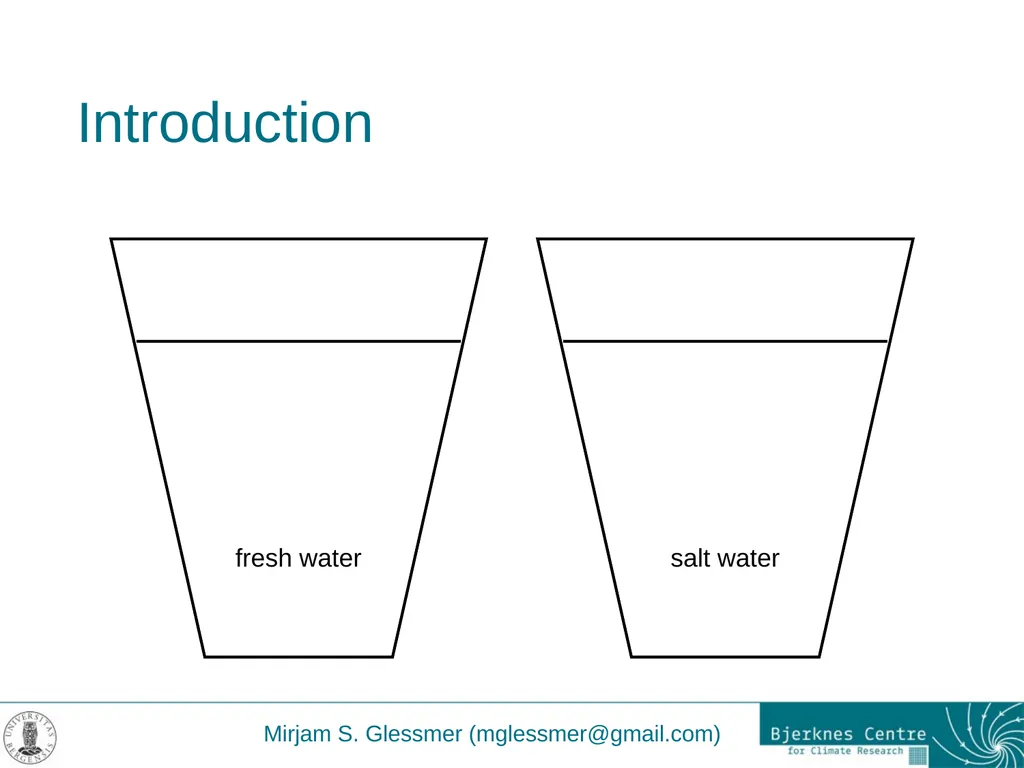
Introduction fresh water salt water Mirjam S. Glessmer (mglessmer@gmail.com)<br>
04
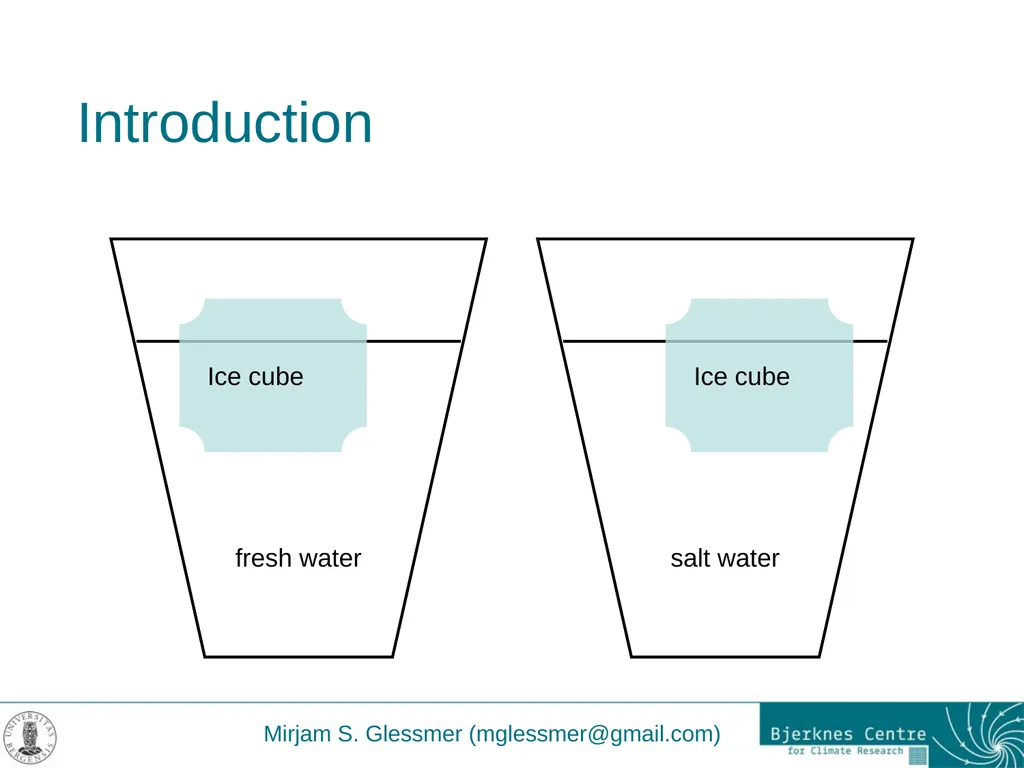
Introduction Ice cube Ice cube fresh water salt water Mirjam S. Glessmer (mglessmer@gmail.com)<br>
05
Make a prediction: When the ice cubes are added, which of the ice cubes will melt faster, the one in fresh water or the one in salt water?
Why? Mirjam S. Glessmer (mglessmer@gmail.com)<br>
06
Setup Each group needs
One beaker of salt water
One beaker of fresh water
Two ice cubes (ideally of the same size)
Food coloring Mirjam S. Glessmer (mglessmer@gmail.com)<br>
07
Observe What happens?
How quickly do the ice cubes melt?
Take the time from when you add the ice cubes until both have melted completely
Does one melt faster than the other? Mirjam S. Glessmer (mglessmer@gmail.com)<br>
08
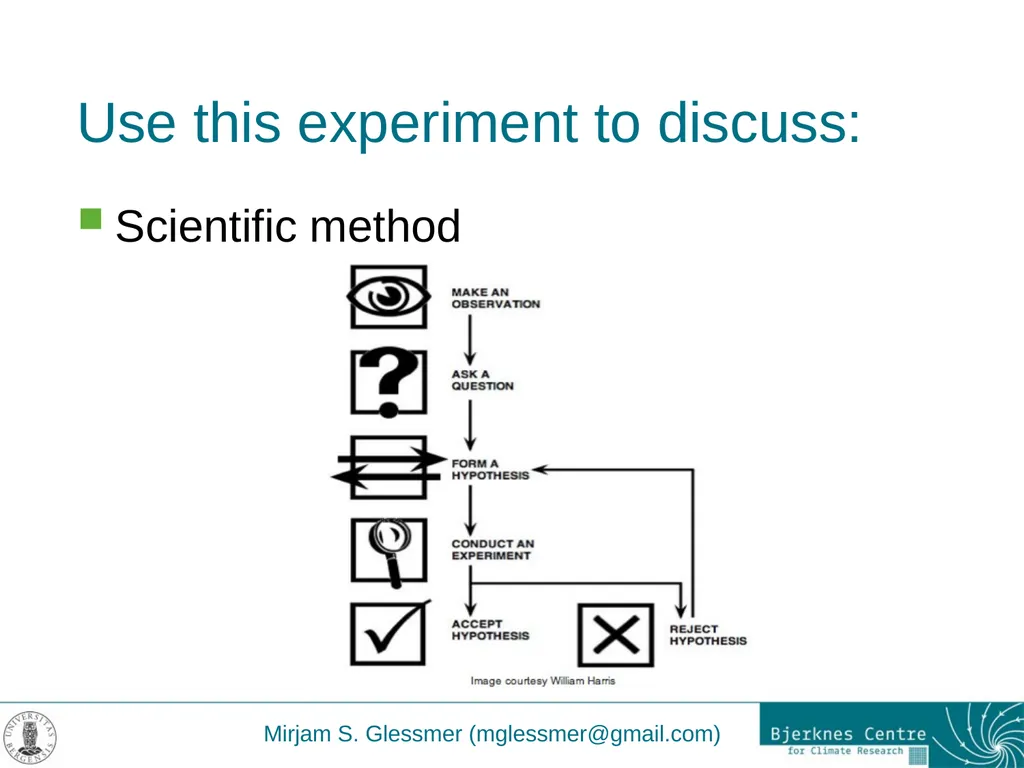
Use this experiment to discuss: Scientific method Mirjam S. Glessmer (mglessmer@gmail.com)<br>
09
Use this experiment to discuss: Scientific method Mirjam S. Glessmer (mglessmer@gmail.com)<br>
10
Use this experiment to discuss: Scientific method
Lab protocol Mirjam S. Glessmer (mglessmer@gmail.com)<br>
11
Use this experiment to discuss: Scientific method
Lab protocol
How to document your experiments
Writing down your hypothesis and how you are planning on testing it Mirjam S. Glessmer (mglessmer@gmail.com)<br>
12
Use this experiment to discuss: Scientific method
Lab protocol
Oceanography
Salt in the ocean
Density driven currents / what else drives currents? Mirjam S. Glessmer (mglessmer@gmail.com)<br>
13
Use this experiment to discuss: Scientific method
Lab protocol
Oceanography
Salt in the ocean
Density driven currents / what else drives currents?
Climate
Importance of ocean currents
Global warming and salinity / freshwater / THC Mirjam S. Glessmer (mglessmer@gmail.com)<br>
14
Alternative setups for different purposes Structured activity
Make prediction about which is going to melt faster, test, discuss
Problem-solving
Get materials without knowing which cup contains the salt water; design experiment to figure out which cup contains what
Open-ended investigation
Use materials to learn about S/F, W/C, density Mirjam S. Glessmer (mglessmer@gmail.com)<br>
15
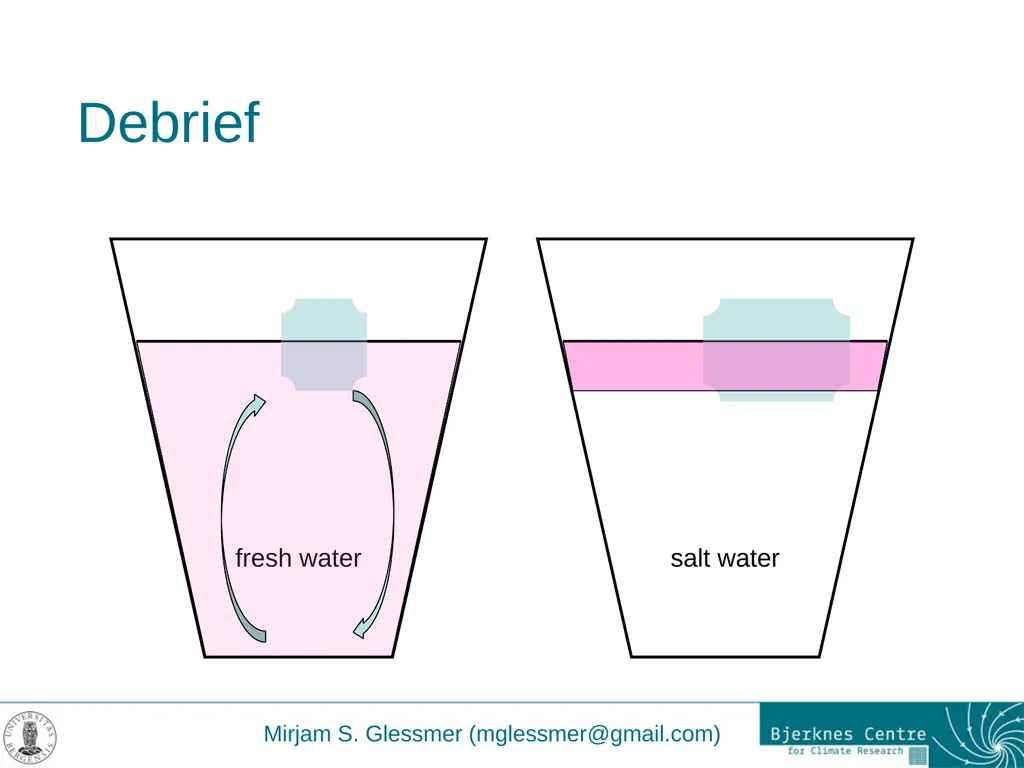
Debrief – discussion points Salt affects the freezing point
Salt crystals dissolve ice
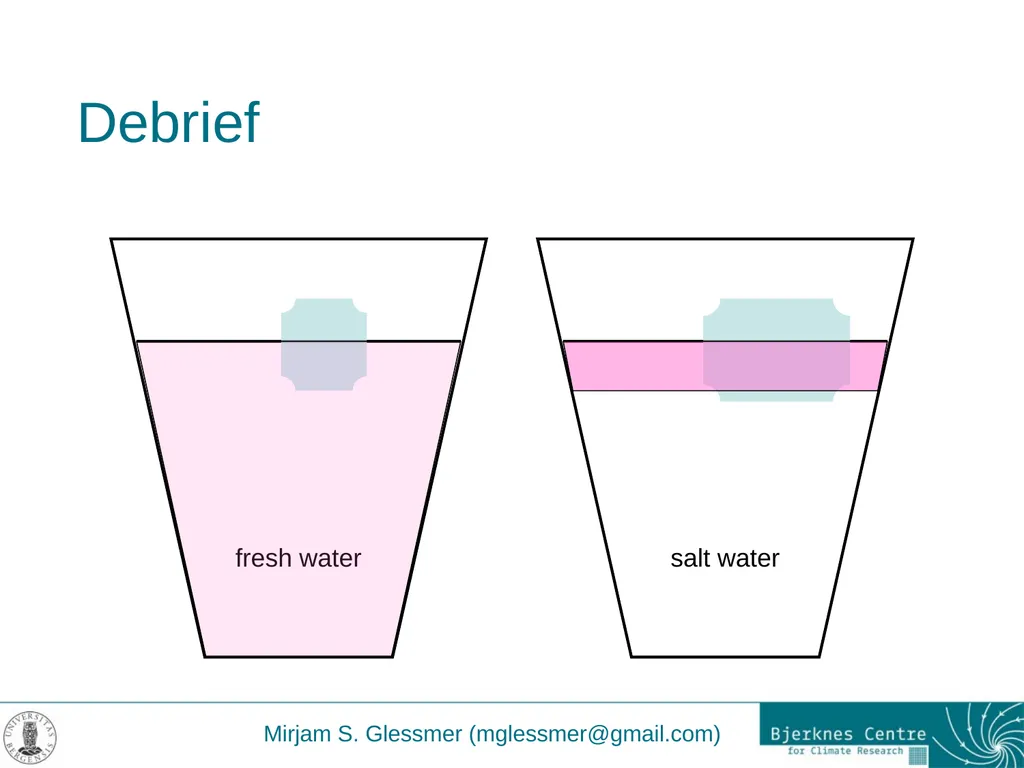
Salt water is denser than fresh water
Less ice will be in contact with salt water
Buoyancy
“like dissolves like”
Relative heat capacity of water
Molecular structure of NaCl Mirjam S. Glessmer (mglessmer@gmail.com)<br>
16
Debrief fresh water salt water Mirjam S. Glessmer (mglessmer@gmail.com)<br>
17
Debrief fresh water salt water Mirjam S. Glessmer (mglessmer@gmail.com)<br>
18
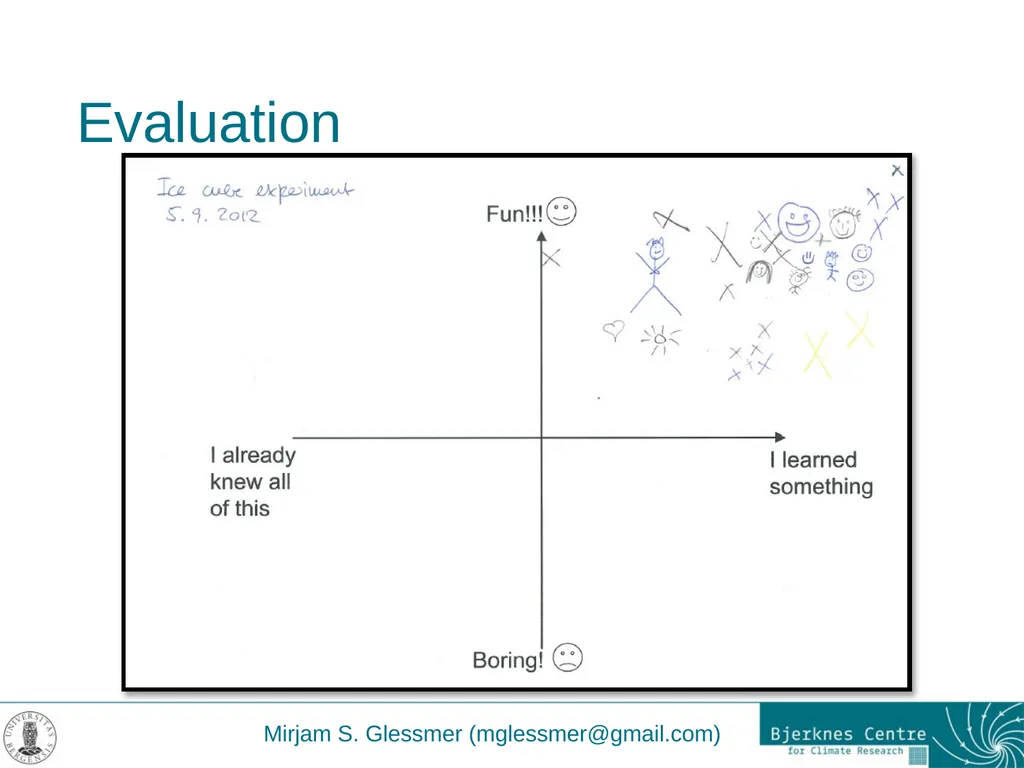
Evaluation Mirjam S. Glessmer (mglessmer@gmail.com)<br>