
Exploring Between and Within Women Differences in
TA
Published · 28 slides · 0 views
1 / 1


Description
Exploring Between and Within Women Differences in Learning and Using Information Systems Technology Virginia Franke Kleist, Ph.D. Chair, Management Information Systems West Virginia University Virginia.Kleistmail.wvu.edu With thanks to WVU
Related Topics
Share
Embed code
Download this presentation From Below
"Exploring Between and Within Women Differences in" is the property of its rightful owner. Permission is granted to download and print the materials on this website for personal, non-commercial use only, and to display it on your personal computer provided you do not modify the materials and that you retain all copyright notices contained in the materials. By downloading content from our website, you accept the terms of this agreement.
Presentation Transcript
01
Exploring Between and Within Women Differences in Learning and Using Information Systems Technology Virginia Franke Kleist, Ph.D.
Chair, Management Information Systems
West Virginia University
Virginia.Kleist@mail.wvu.edu<br>
Chair, Management Information Systems
West Virginia University
Virginia.Kleist@mail.wvu.edu<br>
02
With thanks to WVU NSF ADVANCE Program and Dr. Irene Hanson Frieze Research-in-Progress<br>
03
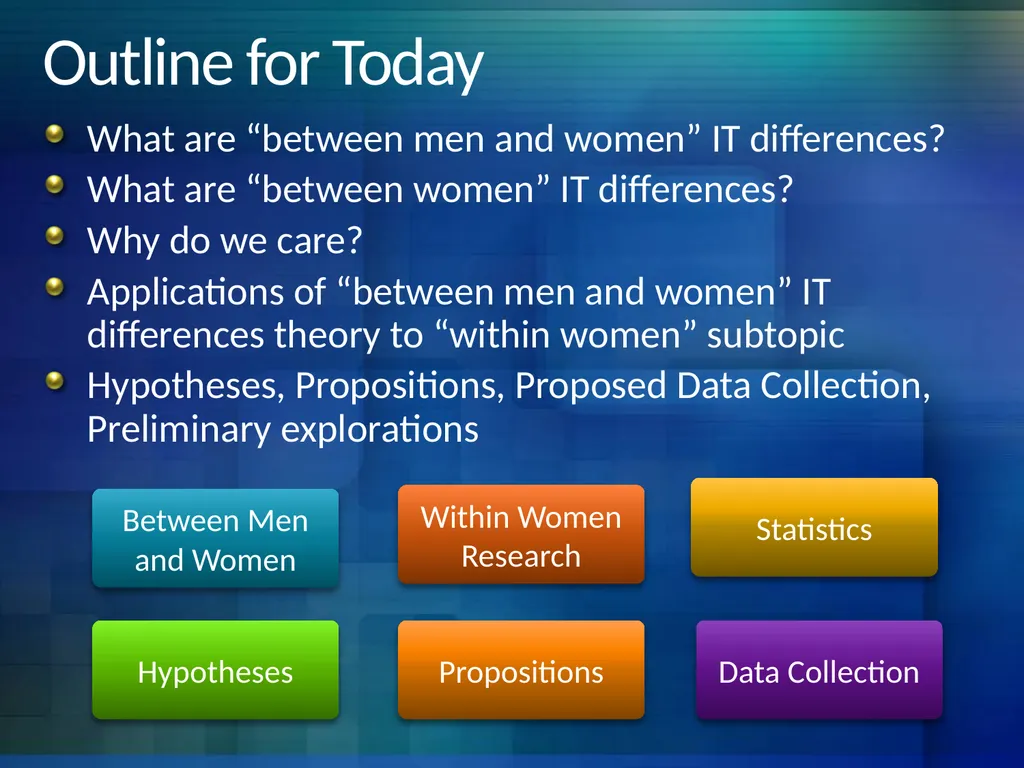
Outline for Today What are “between men and women” IT differences?
What are “between women” IT differences?
Why do we care?
Applications of “between men and women” IT differences theory to “within women” subtopic
Hypotheses, Propositions, Proposed Data Collection, Preliminary explorations Within Women Research Between Men and Women Statistics Data Collection Propositions Hypotheses<br>
What are “between women” IT differences?
Why do we care?
Applications of “between men and women” IT differences theory to “within women” subtopic
Hypotheses, Propositions, Proposed Data Collection, Preliminary explorations Within Women Research Between Men and Women Statistics Data Collection Propositions Hypotheses<br>
04
Differences between Men and Women with respect to Engagement in STEM Fields Childhood/Nurture
Biology/Nature
Environment
Technology
Technology Education<br>
Biology/Nature
Environment
Technology
Technology Education<br>
05
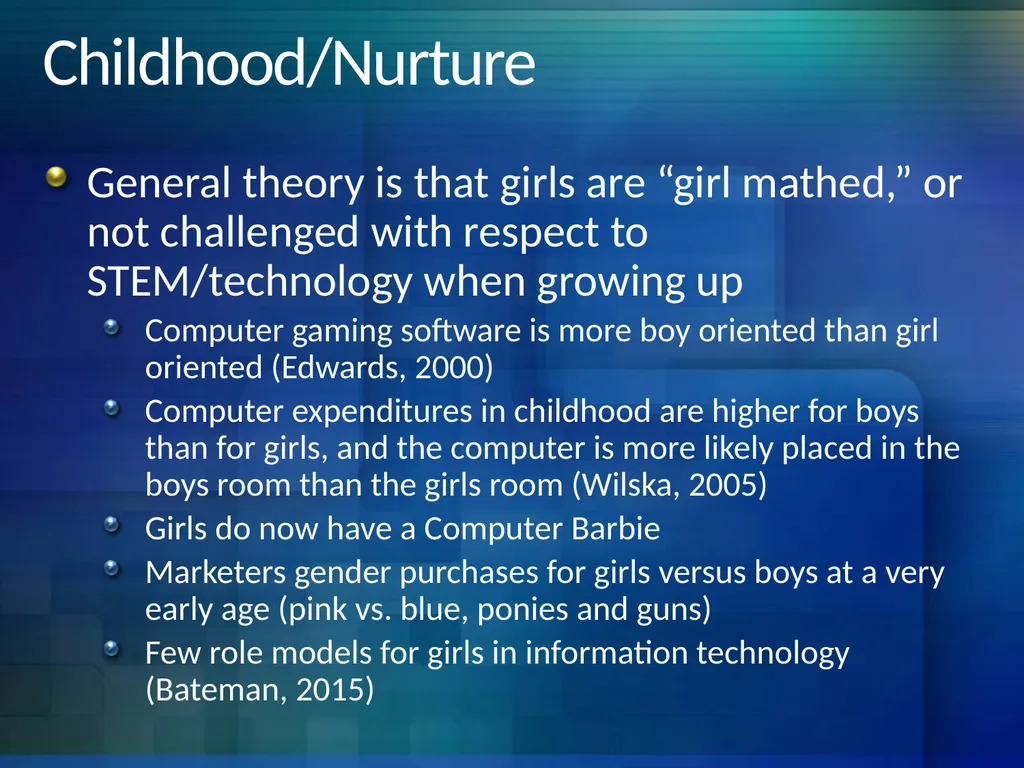
Childhood/Nurture General theory is that girls are “girl mathed,” or not challenged with respect to STEM/technology when growing up
Computer gaming software is more boy oriented than girl oriented (Edwards, 2000)
Computer expenditures in childhood are higher for boys than for girls, and the computer is more likely placed in the boys room than the girls room (Wilska, 2005)
Girls do now have a Computer Barbie
Marketers gender purchases for girls versus boys at a very early age (pink vs. blue, ponies and guns)
Few role models for girls in information technology (Bateman, 2015)<br>
Computer gaming software is more boy oriented than girl oriented (Edwards, 2000)
Computer expenditures in childhood are higher for boys than for girls, and the computer is more likely placed in the boys room than the girls room (Wilska, 2005)
Girls do now have a Computer Barbie
Marketers gender purchases for girls versus boys at a very early age (pink vs. blue, ponies and guns)
Few role models for girls in information technology (Bateman, 2015)<br>
06
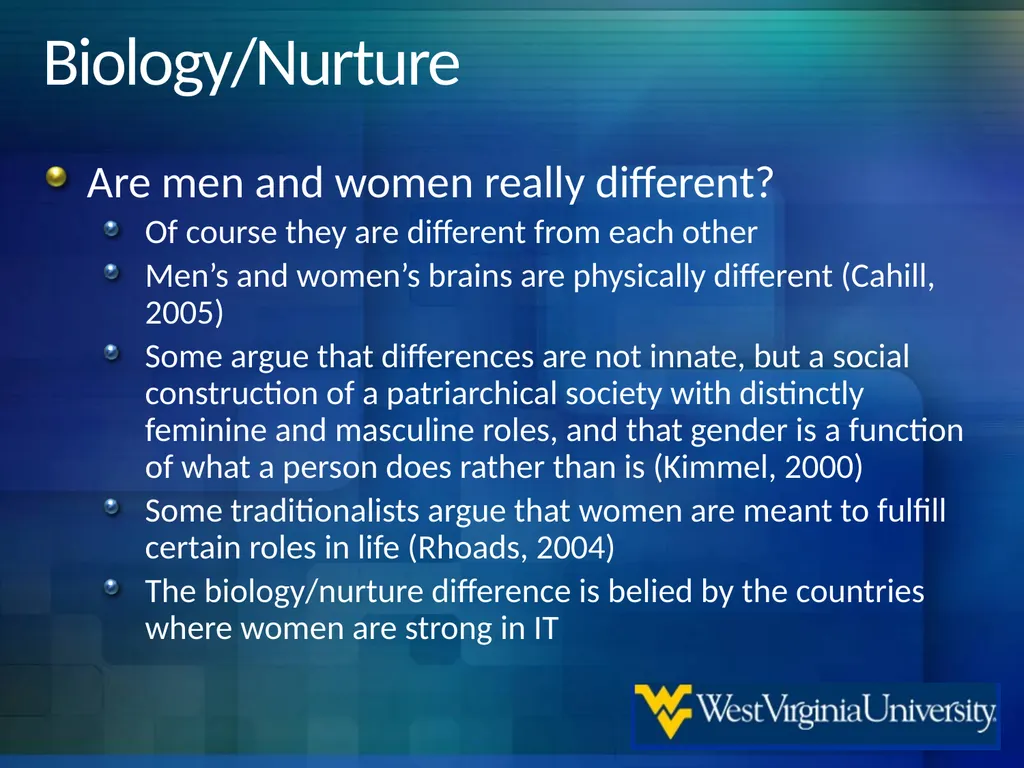
Biology/Nurture Are men and women really different?
Of course they are different from each other
Men’s and women’s brains are physically different (Cahill, 2005)
Some argue that differences are not innate, but a social construction of a patriarchical society with distinctly feminine and masculine roles, and that gender is a function of what a person does rather than is (Kimmel, 2000)
Some traditionalists argue that women are meant to fulfill certain roles in life (Rhoads, 2004)
The biology/nurture difference is belied by the countries where women are strong in IT<br>
Of course they are different from each other
Men’s and women’s brains are physically different (Cahill, 2005)
Some argue that differences are not innate, but a social construction of a patriarchical society with distinctly feminine and masculine roles, and that gender is a function of what a person does rather than is (Kimmel, 2000)
Some traditionalists argue that women are meant to fulfill certain roles in life (Rhoads, 2004)
The biology/nurture difference is belied by the countries where women are strong in IT<br>
07
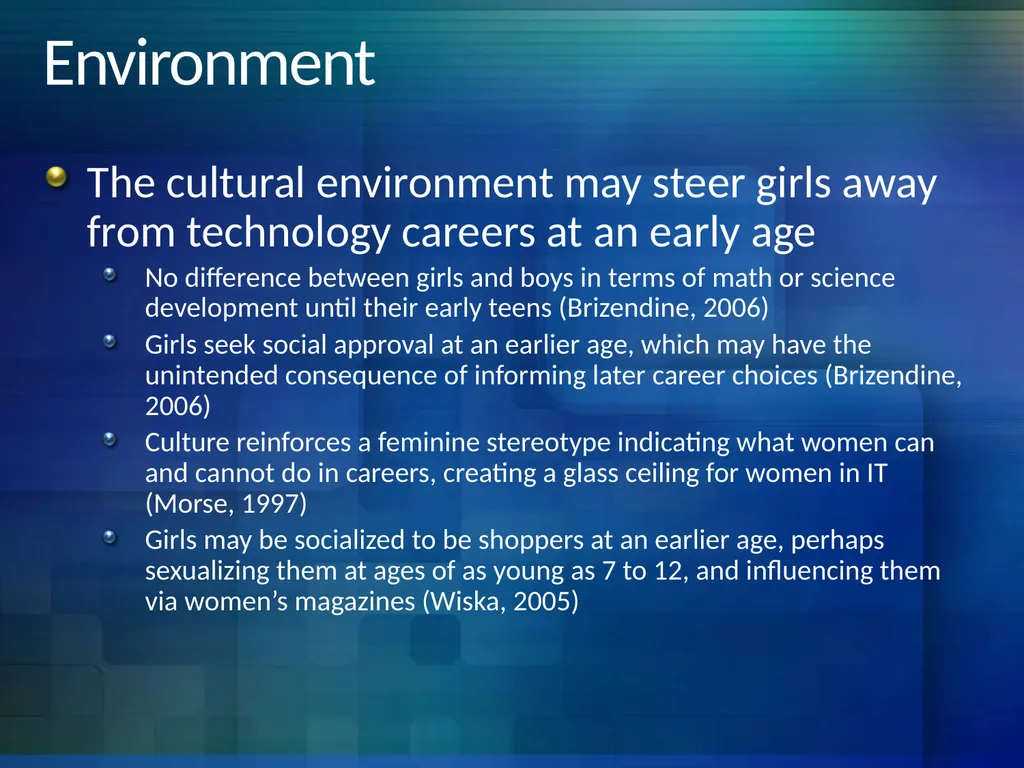
Environment The cultural environment may steer girls away from technology careers at an early age
No difference between girls and boys in terms of math or science development until their early teens (Brizendine, 2006)
Girls seek social approval at an earlier age, which may have the unintended consequence of informing later career choices (Brizendine, 2006)
Culture reinforces a feminine stereotype indicating what women can and cannot do in careers, creating a glass ceiling for women in IT (Morse, 1997)
Girls may be socialized to be shoppers at an earlier age, perhaps sexualizing them at ages of as young as 7 to 12, and influencing them via women’s magazines (Wiska, 2005)<br>
No difference between girls and boys in terms of math or science development until their early teens (Brizendine, 2006)
Girls seek social approval at an earlier age, which may have the unintended consequence of informing later career choices (Brizendine, 2006)
Culture reinforces a feminine stereotype indicating what women can and cannot do in careers, creating a glass ceiling for women in IT (Morse, 1997)
Girls may be socialized to be shoppers at an earlier age, perhaps sexualizing them at ages of as young as 7 to 12, and influencing them via women’s magazines (Wiska, 2005)<br>
08
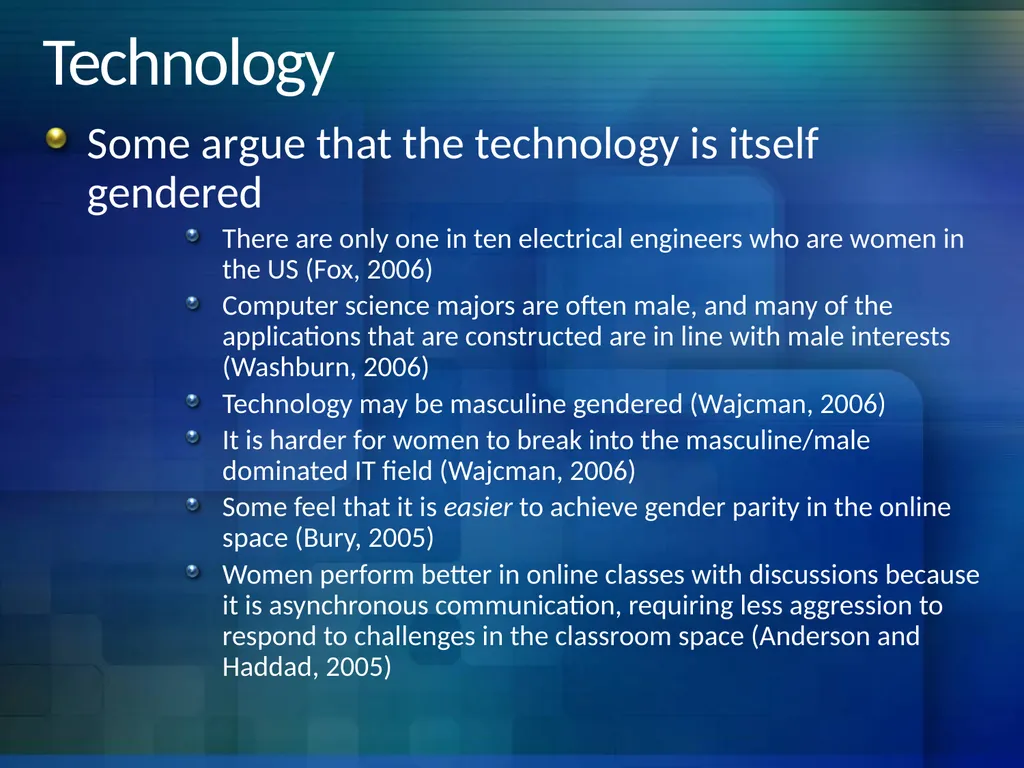
Technology Some argue that the technology is itself gendered
There are only one in ten electrical engineers who are women in the US (Fox, 2006)
Computer science majors are often male, and many of the applications that are constructed are in line with male interests (Washburn, 2006)
Technology may be masculine gendered (Wajcman, 2006)
It is harder for women to break into the masculine/male dominated IT field (Wajcman, 2006)
Some feel that it is easier to achieve gender parity in the online space (Bury, 2005)
Women perform better in online classes with discussions because it is asynchronous communication, requiring less aggression to respond to challenges in the classroom space (Anderson and Haddad, 2005)<br>
There are only one in ten electrical engineers who are women in the US (Fox, 2006)
Computer science majors are often male, and many of the applications that are constructed are in line with male interests (Washburn, 2006)
Technology may be masculine gendered (Wajcman, 2006)
It is harder for women to break into the masculine/male dominated IT field (Wajcman, 2006)
Some feel that it is easier to achieve gender parity in the online space (Bury, 2005)
Women perform better in online classes with discussions because it is asynchronous communication, requiring less aggression to respond to challenges in the classroom space (Anderson and Haddad, 2005)<br>
09
Technology Education Women who study technology tend to feel isolated, and feel unwelcome (Washburn, 2006, P. 70) The men don’t want us to work with them on projects. When we do, they give us these stupid jobs to do. If we say anything, they look at each other, so I just stopped saying anything.
My computer classes don’t usually have any girls I know…I feel like the male students all know each other.
When I have guys who don’t want me in their groups or don’t give me enough to do, I just shut up.
I feel funny in some of the groups. The male students would rather be by themselves than with me.
Some of my professors are really not so friendly to the girls in the classes. I have a woman professor who definitely favors the guys.<br>
My computer classes don’t usually have any girls I know…I feel like the male students all know each other.
When I have guys who don’t want me in their groups or don’t give me enough to do, I just shut up.
I feel funny in some of the groups. The male students would rather be by themselves than with me.
Some of my professors are really not so friendly to the girls in the classes. I have a woman professor who definitely favors the guys.<br>
10
But, Wait Let’s try a new approach
What works for women?
Why are women successful in IT?
What can we learn about women who do IT? Are they different in some way than women who do not do IT? If so, how?
Instead of focusing on how men and women might be different in learning and using technology, let’s look at what is working and how it works.<br>
What works for women?
Why are women successful in IT?
What can we learn about women who do IT? Are they different in some way than women who do not do IT? If so, how?
Instead of focusing on how men and women might be different in learning and using technology, let’s look at what is working and how it works.<br>
11
What are “Within Women Differences?” When we study differences between groups, and this is called “between group differences”
When we study differences of the members of groups, this is “within group differences”
Here, we are interested in what motivates some women to enter careers in technology when other women do not
This is called “within women differences”
Within women differences may be “individual differences.” e.g., some members of a group are different than other members of a group<br>
When we study differences of the members of groups, this is “within group differences”
Here, we are interested in what motivates some women to enter careers in technology when other women do not
This is called “within women differences”
Within women differences may be “individual differences.” e.g., some members of a group are different than other members of a group<br>
12
Why do we care? Women are Behind in the US in STEM Fewer women than men in STEM; women dropping out of STEM:
Nearly half of US women in SET are likely to drop out over time (Hewlett and Sherbin, 2014)
About one third of US SET women intend to drop out of the work force within one year (Sherbin, 2015)
10% of engineers were women in the US in 2010, less than 20% worldwide
Women tend to leave engineering positions after the birth of a child in disproportionate numbers as compared to men
MIS program at WVU consistently has about 10 percent women enrollment<br>
Nearly half of US women in SET are likely to drop out over time (Hewlett and Sherbin, 2014)
About one third of US SET women intend to drop out of the work force within one year (Sherbin, 2015)
10% of engineers were women in the US in 2010, less than 20% worldwide
Women tend to leave engineering positions after the birth of a child in disproportionate numbers as compared to men
MIS program at WVU consistently has about 10 percent women enrollment<br>
13
Why do we care? Women are Behind in the US in STEM, Cont’d Women not in STEM management, have less help, and participation in US is falling:
US women are underrepresented at managerial levels in STEM related jobs (Beede, et al, 2011)
Men tend to get more help in their STEM careers than do women, all else equal (van den Brink and Stobbe, 2014).
Female participation in Computer Science and Math occupations fell from 30% in 2000 to 27% in 2009, not a good trajectory (Beede, et al, 2011).
Ongoing underrepresentation of women in critically important STEM fields does a disservice to any societal goal of gender parity.
Women comprised less than 1% of engineering programs in the US in the 1950s, and women have advanced to earning only slightly less than 20% of bachelor’s degrees over 60 years later (Bix, 2013).<br>
US women are underrepresented at managerial levels in STEM related jobs (Beede, et al, 2011)
Men tend to get more help in their STEM careers than do women, all else equal (van den Brink and Stobbe, 2014).
Female participation in Computer Science and Math occupations fell from 30% in 2000 to 27% in 2009, not a good trajectory (Beede, et al, 2011).
Ongoing underrepresentation of women in critically important STEM fields does a disservice to any societal goal of gender parity.
Women comprised less than 1% of engineering programs in the US in the 1950s, and women have advanced to earning only slightly less than 20% of bachelor’s degrees over 60 years later (Bix, 2013).<br>
14
Why do we care? Relevance to Academics in MIS Can we design our MIS courses to better address gender differences and individual differences?
Can we design our IT learning labs to better address gender differences and individual differences?
Can we design our MIS online courses to better address gender differences and individual differences?
Can we design our MIS educational processes to better address between and within-gender differences?<br>
Can we design our IT learning labs to better address gender differences and individual differences?
Can we design our MIS online courses to better address gender differences and individual differences?
Can we design our MIS educational processes to better address between and within-gender differences?<br>
15
Why do we care? Relevance to Business and Society With fewer placements in information technology positions in the workplace, women are shortchanged and society is missing the potential resource of skilled and capable workers
IT careers are lucrative, engaging and stimulating, and represent 1 in 10 job openings in the US, with strong growth potential over the next decade
In the US, between 35 to 50 percent of publicly held corporate investments are in information technology, and as much as half of that may be wasted investments
Successful systems implementation requires user involvement in the design
If women are not designing and implementing our information systems, and only men are, that might have an impact on the success of systems implementations<br>
IT careers are lucrative, engaging and stimulating, and represent 1 in 10 job openings in the US, with strong growth potential over the next decade
In the US, between 35 to 50 percent of publicly held corporate investments are in information technology, and as much as half of that may be wasted investments
Successful systems implementation requires user involvement in the design
If women are not designing and implementing our information systems, and only men are, that might have an impact on the success of systems implementations<br>
16
Fewer Women in Tech Worldwide? Are other regions like the US? In a word, no. (Data from Forbes, 2015):
US data show 18 % of computer science and technology programs for 2013, a drop from 37% in 1985
US data show 26% of MIS majors are women
25% of startup incubators are women in Middle East
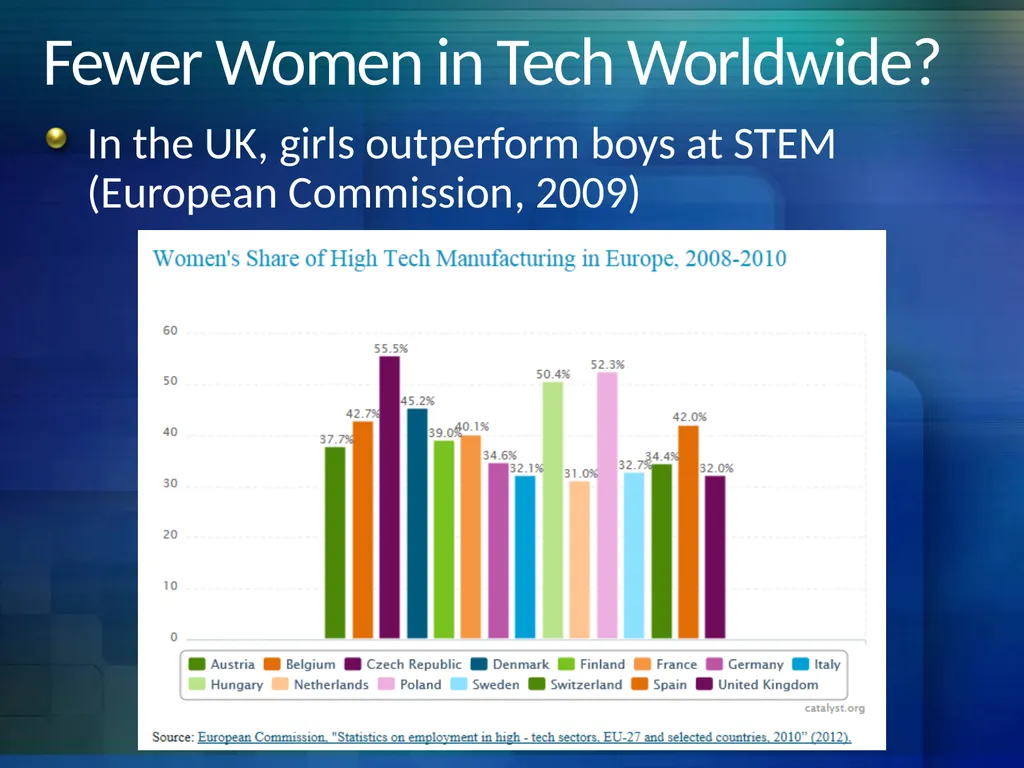
Europe shows 49% women enrollments in STEM type fields (Science, Computer Science, Math, Engineering, manufacturing)
India has 42.1% of women earning BS degrees (e.g., more technical)
A study of seven universities in the Middle East showed between 30 to 70 % female enrollment in computer science or technology programs<br>
US data show 18 % of computer science and technology programs for 2013, a drop from 37% in 1985
US data show 26% of MIS majors are women
25% of startup incubators are women in Middle East
Europe shows 49% women enrollments in STEM type fields (Science, Computer Science, Math, Engineering, manufacturing)
India has 42.1% of women earning BS degrees (e.g., more technical)
A study of seven universities in the Middle East showed between 30 to 70 % female enrollment in computer science or technology programs<br>
17
Fewer Women in Tech Worldwide? In the UK, girls outperform boys at STEM (European Commission, 2009)<br>
18
Research on Within Women Differences Women who are happier in their work and who have appropriate support programs are more likely to stay in STEM disciplines:
Women with positive attitudes tend to stay on in their engineering positions more so than women who leave, stating that they are “not happy” (Buse and Bilimoria, 2014, p. 25).
Awards programs, gender equality policy changes, diversity training and specialized gender support programs are discussed as positive mechanisms that work for helping to encourage successes for women in STEM related fields.
Small differences in the treatment of women and men result in the accumulation of large differences in opportunity for women over time (Burke, 2007)<br>
Women with positive attitudes tend to stay on in their engineering positions more so than women who leave, stating that they are “not happy” (Buse and Bilimoria, 2014, p. 25).
Awards programs, gender equality policy changes, diversity training and specialized gender support programs are discussed as positive mechanisms that work for helping to encourage successes for women in STEM related fields.
Small differences in the treatment of women and men result in the accumulation of large differences in opportunity for women over time (Burke, 2007)<br>
19
Hypotheses H1: Women who enter the IT field may have had more positive role models to observe, may have had a more nuanced childhood with fewer gender constructions, traditional careers were not mandated by the family, were exposed to lots of technology as girls, and careers in IT were not discouraged.
H2: Women who do not enter the IT field may have had fewer positive role models to observe, were raised in a traditional environment, were encouraged to enter traditional careers by the family, were not exposed to lots of technology as girls, and careers in IT were either not discussed or were actively discouraged.<br>
H2: Women who do not enter the IT field may have had fewer positive role models to observe, were raised in a traditional environment, were encouraged to enter traditional careers by the family, were not exposed to lots of technology as girls, and careers in IT were either not discussed or were actively discouraged.<br>
20
Propositions P1: Women in Information Technology careers will use more career oriented words than women in Traditional careers
P2: Women in Traditional careers will use more family oriented words than women in Information Technology careers
P3: Women in Information Technology careers will use more bold, dominant words than women in Traditional careers
Women in Traditional careers will use more nurturing, gentle words than women in IT careers<br>
P2: Women in Traditional careers will use more family oriented words than women in Information Technology careers
P3: Women in Information Technology careers will use more bold, dominant words than women in Traditional careers
Women in Traditional careers will use more nurturing, gentle words than women in IT careers<br>
21
Anecdotally Only Motorcycles
All brothers
Only child, reared more in a boy-like environment
Own a situation, seem to be less retiring or observing from the edges
Don’t let the males bother them or hold them back in class
Are the presidents of our student organization
Tend to have top grades and top job offers<br>
All brothers
Only child, reared more in a boy-like environment
Own a situation, seem to be less retiring or observing from the edges
Don’t let the males bother them or hold them back in class
Are the presidents of our student organization
Tend to have top grades and top job offers<br>
22
What is Twitter Big Data Analysis? Twitter has 6000 tweets per second, 500 million tweets per day (Twitterlivestats.com)
Capture all of the data posted
Sort by hashtags of postings
Search for words using content analysis software
Large data can find small effect sizes
Potential for bias based on technology based women more likely to post compared to nursing and education fields
May have some males posting using these hashtags<br>
Capture all of the data posted
Sort by hashtags of postings
Search for words using content analysis software
Large data can find small effect sizes
Potential for bias based on technology based women more likely to post compared to nursing and education fields
May have some males posting using these hashtags<br>
23
Twitter “Big Data” Research Hashtags for Women in IT:
#womenintech
#stemwomen
#GirlsInStem
#female #technology
#coding #women
#WWCode
#GirlTech
#BusinessWoman
#WomenInStem
#TechGirls
#TechWomen<br>
#womenintech
#stemwomen
#GirlsInStem
#female #technology
#coding #women
#WWCode
#GirlTech
#BusinessWoman
#WomenInStem
#TechGirls
#TechWomen<br>
24
Twitter “Big Data” Research Hashtags for Elementary School Teachers
#teachers
#teacher
#NationalTeacherDay
#ElementaryTeacher
#PrimaryTeacher
#K12Teacher
#edchat
#ElemTeacher
#GradeSchoolTeacher
#MiddleSchoolTeacher
#ForTheLoveOfTeaching<br>
#teachers
#teacher
#NationalTeacherDay
#ElementaryTeacher
#PrimaryTeacher
#K12Teacher
#edchat
#ElemTeacher
#GradeSchoolTeacher
#MiddleSchoolTeacher
#ForTheLoveOfTeaching<br>
25
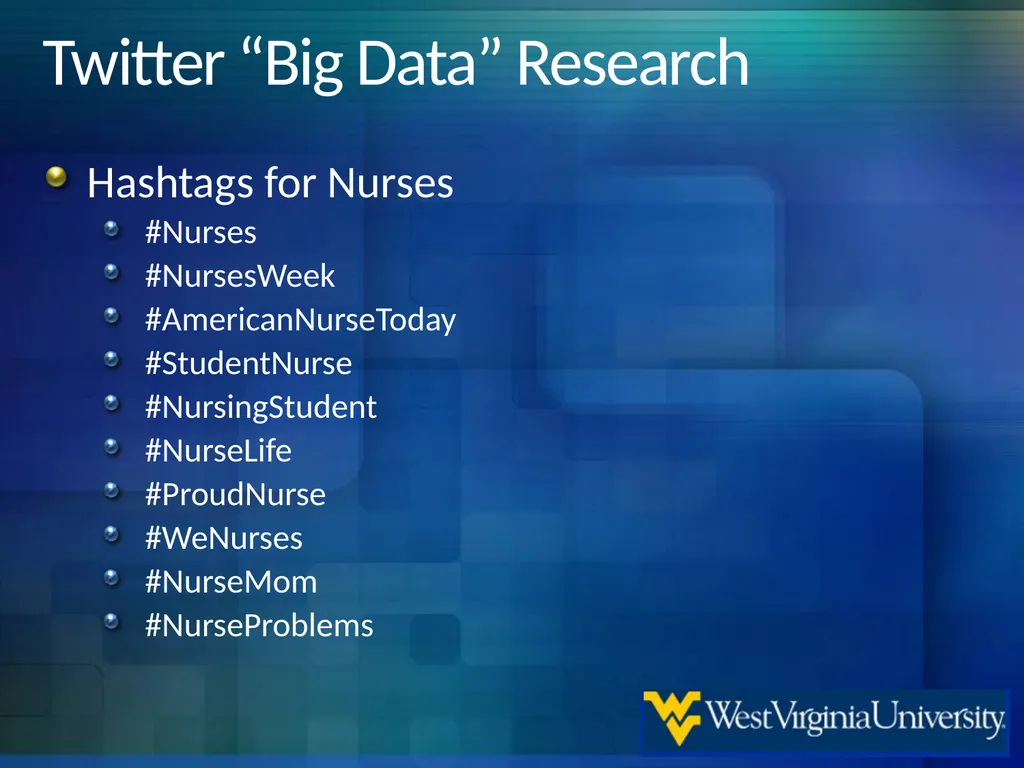
Twitter “Big Data” Research Hashtags for Nurses
#Nurses
#NursesWeek
#AmericanNurseToday
#StudentNurse
#NursingStudent
#NurseLife
#ProudNurse
#WeNurses
#NurseMom
#NurseProblems<br>
#Nurses
#NursesWeek
#AmericanNurseToday
#StudentNurse
#NursingStudent
#NurseLife
#ProudNurse
#WeNurses
#NurseMom
#NurseProblems<br>
26
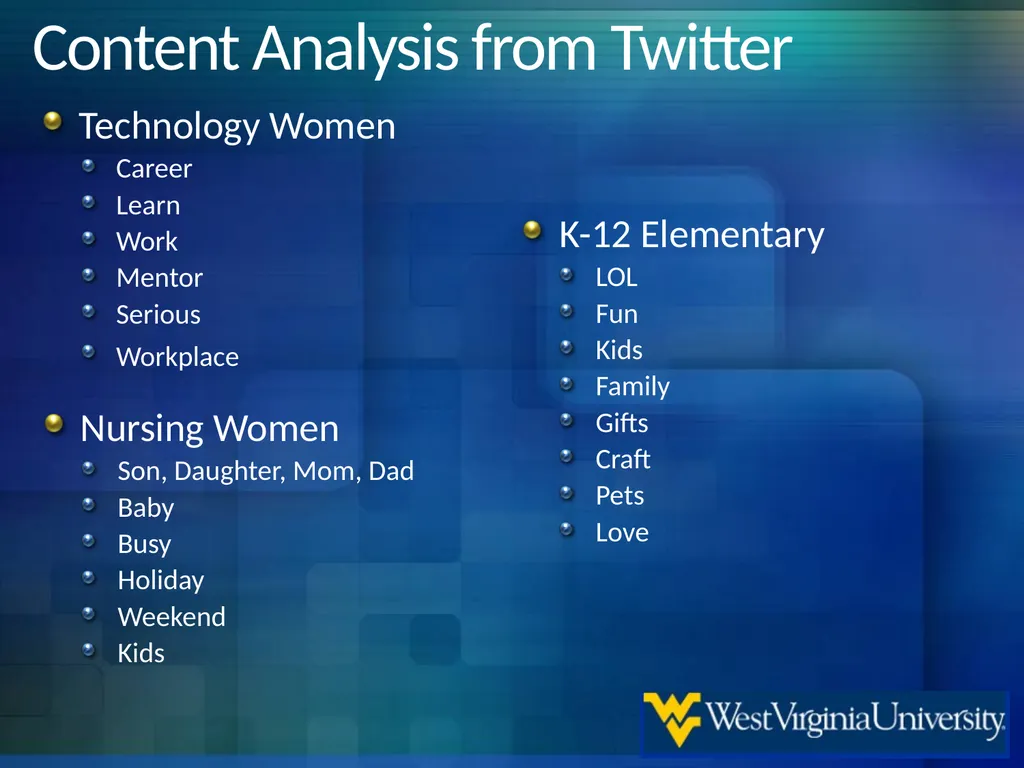
Content Analysis from Twitter Technology Women
Career
Learn
Work
Mentor
Serious
Workplace K-12 Elementary
LOL
Fun
Kids
Family
Gifts
Craft
Pets
Love Nursing Women
Son, Daughter, Mom, Dad
Baby
Busy
Holiday
Weekend
Kids<br>
Career
Learn
Work
Mentor
Serious
Workplace K-12 Elementary
LOL
Fun
Kids
Family
Gifts
Craft
Pets
Love Nursing Women
Son, Daughter, Mom, Dad
Baby
Busy
Holiday
Weekend
Kids<br>
27
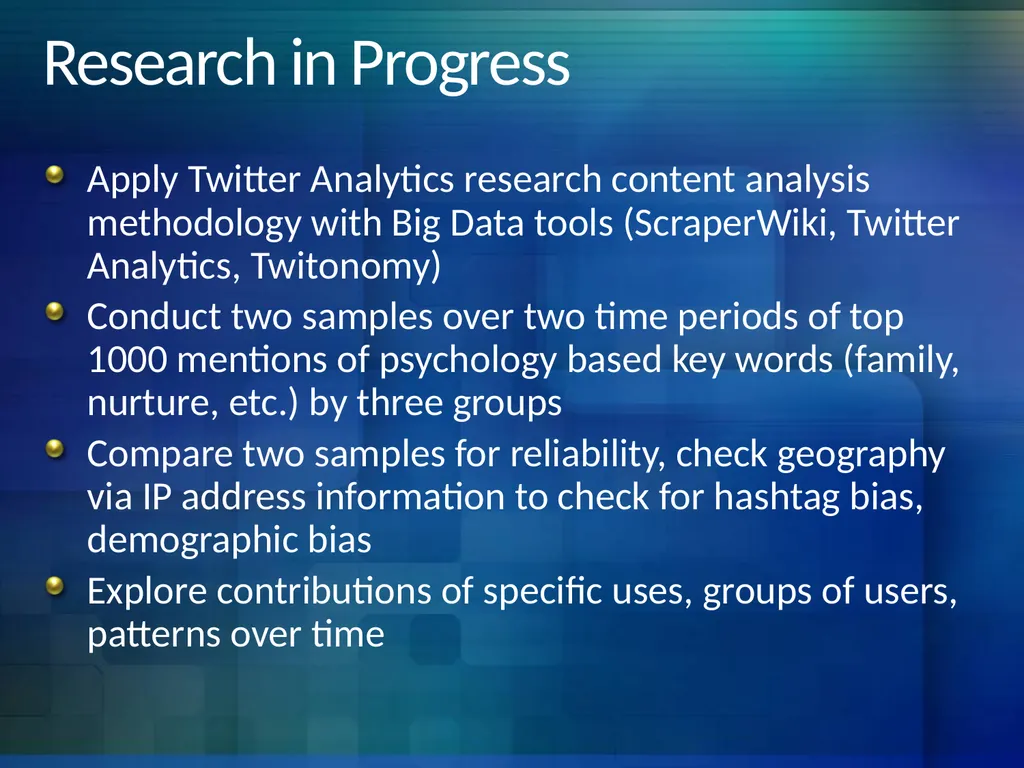
Research in Progress Apply Twitter Analytics research content analysis methodology with Big Data tools (ScraperWiki, Twitter Analytics, Twitonomy)
Conduct two samples over two time periods of top 1000 mentions of psychology based key words (family, nurture, etc.) by three groups
Compare two samples for reliability, check geography via IP address information to check for hashtag bias, demographic bias
Explore contributions of specific uses, groups of users, patterns over time<br>
Conduct two samples over two time periods of top 1000 mentions of psychology based key words (family, nurture, etc.) by three groups
Compare two samples for reliability, check geography via IP address information to check for hashtag bias, demographic bias
Explore contributions of specific uses, groups of users, patterns over time<br>
28
Thank you Questions?<br>