
Exploring Special Plan Types MaryAnn Geary Senior



Description: Exploring Special Plan Types MaryAnn Geary Senior VP Administration, BPAS What is an ESOP? An Employee Stock Ownership Plan (ESOP) is a qualified defined contribution retirement plan that is designed to invest primarily in employer
Related Topics
Download Presentation
"Exploring Special Plan Types MaryAnn Geary Senior" is the property of its rightful owner. Permission is granted to download and print the materials on this website for personal, non-commercial use only, and to display it on your personal computer provided you do not modify the materials and that you retain all copyright notices contained in the materials. By downloading content from our website, you accept the terms of this agreement.
Presentation Transcript
slide1. Exploring Special Plan Types MaryAnn Geary
Senior VP Administration, BPAS<br>
slide2. What is an ESOP? An Employee Stock Ownership Plan (ESOP) is a qualified defined contribution retirement plan that is designed to invest primarily in employer securities<br>
slide3. Type of ESOPs Leveraged and non-leveraged
About 75% of ESOPs are leveraged<br>
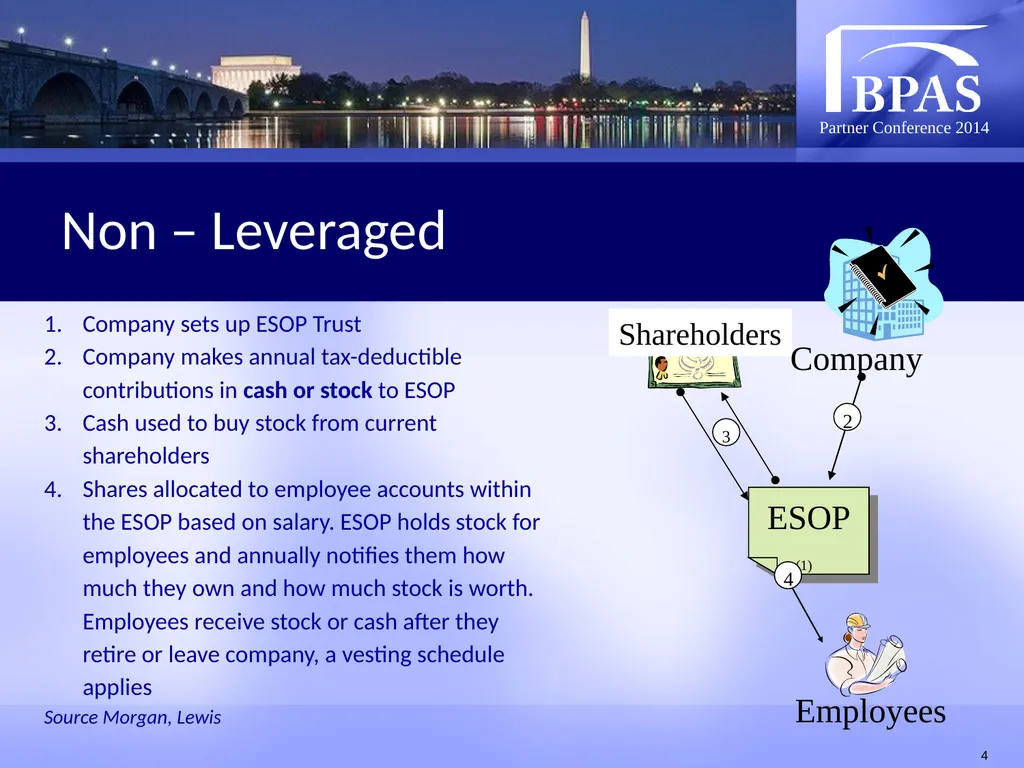
slide4. 4 Company sets up ESOP Trust
Company makes annual tax-deductible contributions in cash or stock to ESOP
Cash used to buy stock from current shareholders
Shares allocated to employee accounts within the ESOP based on salary. ESOP holds stock for employees and annually notifies them how much they own and how much stock is worth. Employees receive stock or cash after they retire or leave company, a vesting schedule applies
Source Morgan, Lewis Non – Leveraged<br>
slide5. (1) Lender lends to company
(2) Company lends to ESOP
(3) ESOP buys stock from existing shareholders
(4) Company makes annual tax-deductible contributions to ESOP.
(5) The ESOP then in turn repays lender
(6) Employees receive stock or cash when they retire or leave (vesting applies)
Source Morgan Lewis Leveraged ESOP<br>
slide6. ESOPs - Advantages Provides ownership mentality for employees which could result in increased productivity
Provides for the continuity of the company and the employees
Can be leveraged
Possible business succession tool
Allows seller to sell in stages, providing a gradual withdrawal while allowing heirs, key employees or others partial ownership interest in company
Can provide tax advantages to corporation and selling stockholder<br>
slide7. ESOPs - Advantages Can be leveraged
Creates market for stock of a closely-held company
Creates a ready buyer for company and allows business to be sold on owner’s terms
Can obtain tax deductible financing for corporate expansion including acquisition of new company assets
Can be used to finance mergers and acquisitions with tax deductible loans to buy stock<br>
slide8. ESOPs - Disadvantages Complicated with high start-up costs compared to other plans
Loan repayments for a leveraged ESOP create an annual contribution obligation
Only allocation methods allowable are pro-rata. ESOPs can not be cross tested or integrated
Owner must adjust to sharing ownership with the employees
Increased fiduciary liability
Participant account balances are not diversified initially
If the company fails……<br>
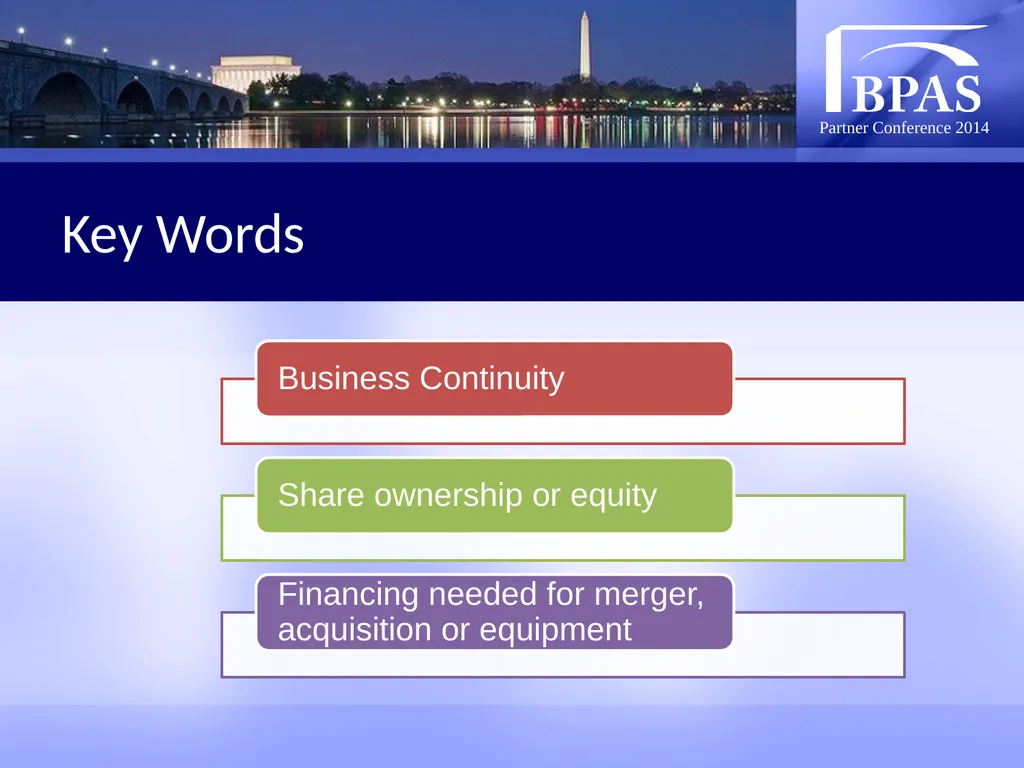
slide9. Key Words<br>
slide10. What is a KSOP? A KSOP is a term of art for an ESOP that includes a 401(k) feature
KSOPs may be invested in employer stock in elective deferral accounts, matching accounts, employer discretionary accounts or any combination of the three<br>
slide11. Advantages of a KSOP A private company wants to make matching contributions in employer stock under an ESOP and not be subject to a duty to diversify plan assets
The employer wishes to use matching contributions to repay a securities acquisition Loan.
The ESOP would otherwise be a frozen or terminating plan, due to ceasing contributions; and the employer wishes to add the 401(k) component so that the plan is active and avoid accelerated vesting<br>
slide12. Advantages of a KSOP The employer wishes to avoid two separate audits, assuming the employer has more than 100 participants
The employer wishes to avoid having multiple SPDs, participant statements and 5500 filings
The employer is publicly traded and employer stock is readily valued, purchased and sold, it can be administered in a daily valuation environment
BPAS administers company stock in a daily valuation environment even if it is thinly traded<br>
slide13. Disadvantages of a KSOP Combining an ESOP with a 401(k) plan will eliminate the possibility of using a prototype or volume submitter document for the 401(k) plan
Combining the plans does not give the employer any advantage regarding coverage or nondiscrimination testing.
Administration of a non-publicly traded ESOP will usually take longer than a 401(k), thereby slowing down the process for the 401(k) plan<br>
slide14. Disadvantages of a KSOP Drafting the SPD for KSOP in a non-publicly-traded company is complex and confusing due to the potentially different distribution and fiduciary rules applicable to each plan
A 401(k) plan and an ESOP may require two different fiduciary standards for investment of plan assets
Matching contributions can be accomplished in a separate ESOP, even when funded with shares released from an ESOP loan suspense account, as long as the plan clearly states that plan to which the matching contribution will be deposited<br>
slide15. What is a Multiple Employer Plan? A Multiple Employer Plan (MEP) is a plan sponsored by two or more employers where at least two of the sponsoring employers are not members of the same controlled group or affiliated service group<br>
slide16. Reasons for Adopting an MEP A business relationship or common ownership may exist even though it may not be sufficient to qualify as a CCG
Employers from an organization or common industry may have employees who shift from one participating employer to another
A leasing organization that needs to avoid violating the exclusive benefit rule<br>
slide17. Related Employers Usually occurs in small plans where two or more businesses have common ownership but not at a level to qualify as a controlled group
Often an association of businesses
Establishing an MEP may help to control costs by reducing administrative expenses<br>
slide18. Disadvantages The primary disadvantage to a MEP is that a failure of one portion of the plan can result in the disqualification of the plan as a whole
DOL opinions indicate that it is scrutinizing MEPS to ensure that the employers constitute a bona fide group of employers
If not, the DOL regards the plan as many individual plans rather than a single plan<br>
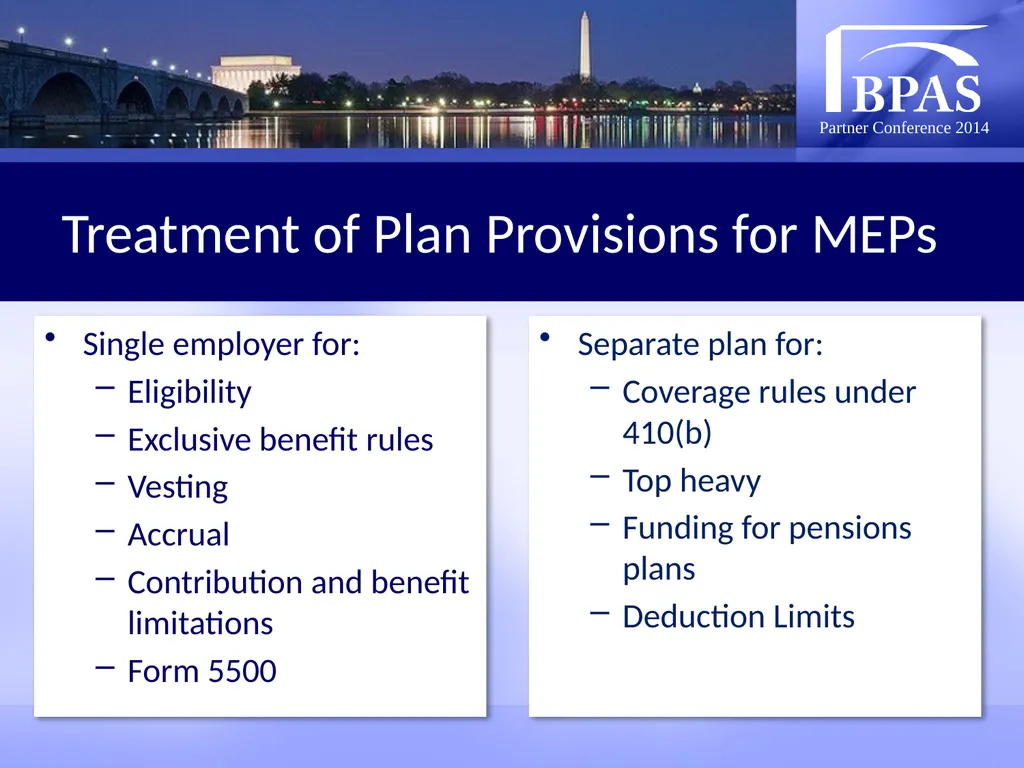
slide19. Treatment of Plan Provisions for MEPs Single employer for:
Eligibility
Exclusive benefit rules
Vesting
Accrual
Contribution and benefit limitations
Form 5500 Separate plan for:
Coverage rules under 410(b)
Top heavy
Funding for pensions plans
Deduction Limits<br>
slide20. What is a Multiple Employer Trust? A Multiple Employer Trust (MET) is a vehicle in which the assets of qualified plans maintained by related or unrelated employers are pooled for investment purposes. It is organized in the form of a trust and a bank or trust company serves as the custodian. The investment manager determines the objectives of the trust and directs the trustee as to its investment<br>
slide21. Advantages of a MET Offer access to investment managers and opportunities in specialized areas
Cost-effective approach to a separately managed account
Savings obtained through efficient management of larger asset pools
Reduction in transaction and administrative costs
Participating plans are afforded simplified reporting of investment value in the MET on a single line on Form 5500<br>
slide22. Disadvantages of a MET Plan fiduciary investing in MET retains fiduciary responsibility for that decision
Investment manager is fiduciary responsible for performance and operation of the trust<br>
slide23. Case Studies<br>
slide24. Case Study #1 Dr. Jalil contacts you about a retirement plan. She and her partner want to start saving $50,000 each per year for retirement. Dr. Jalil’s wife acts as the office manager and comes into the office bi-weekly to process payroll.
Dr. Jalil wants flexibility in contributions as he and his partner have children entering college; they may need cash. He does not want to add an administrative burden for his wife. His staff is older than he and his partner. He does not object to making contributions for his staff as long as he can subject them to a vesting schedule. He anticipates his staff will remain at the current level for at least three years.<br>
slide25. Case Study #2 During a conversation, Jewel, owner of the gym you frequent, mentions she would like to purchase new gym equipment. However, equipment is expensive and the financing will require increased net profits after paying corporate taxes. Jewel is also interested in establishing a retirement plan and wants to know if there is a plan type to help her achieve both goals.<br>
slide26. Case Study #3 Jeffrey owns a fitness company and wants to encourage his employees to increase productivity and decrease expenses. At the same time, he is looking for a higher return on his investments and would like to save taxes and corporate cash flow. His key executives would like ownership in the company. Many of his employees have significant longevity and he would like to reward them with a piece of the profitability they helped to create.<br>
slide27. Case Study #4 Erin, a retired teacher, calls about establishing a retirement plan. Erin provides consulting services to several educational organizations and anticipates income from this practice will be approximately $120,000 (after taxes). Erin did some part-time consulting for the last three years and earned $72,000 each year.
She does not anticipate hiring any employees. Erin is 60 years old and is collecting a pension from her prior employer’s plan. She plans to continue doing consulting services for another 5 years.<br>
slide28. Case Study #5 You meet with Dr. Baker, sole owner of Lakeside Dental. Dr. Baker’s husband works at Lakeside as Office Manager and processes payroll on Quickbooks.
Dr. Baker wants flexibility in contributions; she plans to buy new equipment
She wants to keep plan administration for her husband to a minimum.
She has two employees in addition to her husband and herself – a hygienist and a receptionist. Most staff is older than she and she’d like to make a contribution for them. She does want to subject contributions to a vesting schedule. She wants to retain her current staff and does not anticipate any new hires for the next five years.<br>
slide29. Case Study #6 During a round of golf, your friend, Jim, tells you he wants to begin saving for retirement. Jim has a small business and his mother works for him doing payroll and HR functions.
Jim would like flexibility in contributions and is concerned about the administrative burden on his mother. Jim has one staff member, Jack, who is younger than he and he wants to provide him with a substantial benefit. He would also like to maximize the benefit to his mother. He would like to subject contributions to a vesting schedule. One of his goals is to retain Jack as an employee. He does not anticipate any staff increases in the foreseeable future<br>
slide30. Case Study #7 Kevin is the sole owner of Dermagrafix Corporation. He received two offers by third parties interested in acquiring his company. Kevin tells you, over coffee, he feels both offers are unacceptable. The first offer is too low and while the second offer is acceptable from a price standpoint, the buyer plans to move the company out of state. Kevin has one son working for the company, but he is young and relatively inexperienced--not ready to assume responsibility for corporate ownership. Kevin also tells you that two of his Senior Executives are capable and interested in taking over the company, but they don’t have ready cash to buy Kevin out. Kevin asks you if he should accept one of the offers or if you have another option that he should consider.<br>
slide31. Case Study #8 A few years later, you get another call from Kevin. The ESOP you helped him establish is working well. However, Kevin is concerned he won’t have enough money saved for retirement. He has 25 employees now, including himself and his wife. Everyone is under the age of 30 except Kevin and his wife. Kevin uses an outside payroll vendor and has an office manager that is extremely computer savvy. Kevin suspects many of his employees are not saving for retirement outside of the ESOP and wants to help them achieve a comfortable retirement. He also wants to make the maximum contribution for himself and his wife, which he has determined is $50,000+ per year.<br>
slide32. Case Study #9 You meet Ben at a cocktail party. He tells you that for the past 18 months, he has owned a sports training facility. He is comfortable with the revenue and growth of the business and would like to expand his current employee benefits to include a retirement plan. Ben doesn’t feel he has the time or expertise to administer the plan. He has 15 full-time employees and 5 part-time. He can’t afford to make any employer contributions yet, but hopes to be able to do so in the near future. Ben is 50 and would like to save as much for retirement for himself as possible. He is the only highly-compensated employee. He currently uses an outside payroll vendor that also provides a platform for health benefits<br>
slide33. Case Study #10 Moe, Larry, & Curly occupy office space in your building. In the elevator one morning, you run into Moe. He explains their business to you. Basically, Moe, Larry & Curly each own 1/3 of two private law firms - Dewey, Cheatum & Howe and Dewey, Burnham & Howe. You immediately recognize this makes the law firms part of a brother-sister controlled group.
Moe tells you that Curly also owns 100% of a private investigation firm, Sue, Grabbit & Runne. All three companies are in the same industry and work out of the same office.
Moe asks you if there is any way they could establish a retirement plan to cover employees of the three organizations.<br>
slide34. Questions?<br>
slide35. Contact MaryAnn Geary
Senior VP of Administration
BPAS
mgeary@bpas.com 35<br>
Senior VP Administration, BPAS<br>
slide2. What is an ESOP? An Employee Stock Ownership Plan (ESOP) is a qualified defined contribution retirement plan that is designed to invest primarily in employer securities<br>
slide3. Type of ESOPs Leveraged and non-leveraged
About 75% of ESOPs are leveraged<br>
slide4. 4 Company sets up ESOP Trust
Company makes annual tax-deductible contributions in cash or stock to ESOP
Cash used to buy stock from current shareholders
Shares allocated to employee accounts within the ESOP based on salary. ESOP holds stock for employees and annually notifies them how much they own and how much stock is worth. Employees receive stock or cash after they retire or leave company, a vesting schedule applies
Source Morgan, Lewis Non – Leveraged<br>
slide5. (1) Lender lends to company
(2) Company lends to ESOP
(3) ESOP buys stock from existing shareholders
(4) Company makes annual tax-deductible contributions to ESOP.
(5) The ESOP then in turn repays lender
(6) Employees receive stock or cash when they retire or leave (vesting applies)
Source Morgan Lewis Leveraged ESOP<br>
slide6. ESOPs - Advantages Provides ownership mentality for employees which could result in increased productivity
Provides for the continuity of the company and the employees
Can be leveraged
Possible business succession tool
Allows seller to sell in stages, providing a gradual withdrawal while allowing heirs, key employees or others partial ownership interest in company
Can provide tax advantages to corporation and selling stockholder<br>
slide7. ESOPs - Advantages Can be leveraged
Creates market for stock of a closely-held company
Creates a ready buyer for company and allows business to be sold on owner’s terms
Can obtain tax deductible financing for corporate expansion including acquisition of new company assets
Can be used to finance mergers and acquisitions with tax deductible loans to buy stock<br>
slide8. ESOPs - Disadvantages Complicated with high start-up costs compared to other plans
Loan repayments for a leveraged ESOP create an annual contribution obligation
Only allocation methods allowable are pro-rata. ESOPs can not be cross tested or integrated
Owner must adjust to sharing ownership with the employees
Increased fiduciary liability
Participant account balances are not diversified initially
If the company fails……<br>
slide9. Key Words<br>
slide10. What is a KSOP? A KSOP is a term of art for an ESOP that includes a 401(k) feature
KSOPs may be invested in employer stock in elective deferral accounts, matching accounts, employer discretionary accounts or any combination of the three<br>
slide11. Advantages of a KSOP A private company wants to make matching contributions in employer stock under an ESOP and not be subject to a duty to diversify plan assets
The employer wishes to use matching contributions to repay a securities acquisition Loan.
The ESOP would otherwise be a frozen or terminating plan, due to ceasing contributions; and the employer wishes to add the 401(k) component so that the plan is active and avoid accelerated vesting<br>
slide12. Advantages of a KSOP The employer wishes to avoid two separate audits, assuming the employer has more than 100 participants
The employer wishes to avoid having multiple SPDs, participant statements and 5500 filings
The employer is publicly traded and employer stock is readily valued, purchased and sold, it can be administered in a daily valuation environment
BPAS administers company stock in a daily valuation environment even if it is thinly traded<br>
slide13. Disadvantages of a KSOP Combining an ESOP with a 401(k) plan will eliminate the possibility of using a prototype or volume submitter document for the 401(k) plan
Combining the plans does not give the employer any advantage regarding coverage or nondiscrimination testing.
Administration of a non-publicly traded ESOP will usually take longer than a 401(k), thereby slowing down the process for the 401(k) plan<br>
slide14. Disadvantages of a KSOP Drafting the SPD for KSOP in a non-publicly-traded company is complex and confusing due to the potentially different distribution and fiduciary rules applicable to each plan
A 401(k) plan and an ESOP may require two different fiduciary standards for investment of plan assets
Matching contributions can be accomplished in a separate ESOP, even when funded with shares released from an ESOP loan suspense account, as long as the plan clearly states that plan to which the matching contribution will be deposited<br>
slide15. What is a Multiple Employer Plan? A Multiple Employer Plan (MEP) is a plan sponsored by two or more employers where at least two of the sponsoring employers are not members of the same controlled group or affiliated service group<br>
slide16. Reasons for Adopting an MEP A business relationship or common ownership may exist even though it may not be sufficient to qualify as a CCG
Employers from an organization or common industry may have employees who shift from one participating employer to another
A leasing organization that needs to avoid violating the exclusive benefit rule<br>
slide17. Related Employers Usually occurs in small plans where two or more businesses have common ownership but not at a level to qualify as a controlled group
Often an association of businesses
Establishing an MEP may help to control costs by reducing administrative expenses<br>
slide18. Disadvantages The primary disadvantage to a MEP is that a failure of one portion of the plan can result in the disqualification of the plan as a whole
DOL opinions indicate that it is scrutinizing MEPS to ensure that the employers constitute a bona fide group of employers
If not, the DOL regards the plan as many individual plans rather than a single plan<br>
slide19. Treatment of Plan Provisions for MEPs Single employer for:
Eligibility
Exclusive benefit rules
Vesting
Accrual
Contribution and benefit limitations
Form 5500 Separate plan for:
Coverage rules under 410(b)
Top heavy
Funding for pensions plans
Deduction Limits<br>
slide20. What is a Multiple Employer Trust? A Multiple Employer Trust (MET) is a vehicle in which the assets of qualified plans maintained by related or unrelated employers are pooled for investment purposes. It is organized in the form of a trust and a bank or trust company serves as the custodian. The investment manager determines the objectives of the trust and directs the trustee as to its investment<br>
slide21. Advantages of a MET Offer access to investment managers and opportunities in specialized areas
Cost-effective approach to a separately managed account
Savings obtained through efficient management of larger asset pools
Reduction in transaction and administrative costs
Participating plans are afforded simplified reporting of investment value in the MET on a single line on Form 5500<br>
slide22. Disadvantages of a MET Plan fiduciary investing in MET retains fiduciary responsibility for that decision
Investment manager is fiduciary responsible for performance and operation of the trust<br>
slide23. Case Studies<br>
slide24. Case Study #1 Dr. Jalil contacts you about a retirement plan. She and her partner want to start saving $50,000 each per year for retirement. Dr. Jalil’s wife acts as the office manager and comes into the office bi-weekly to process payroll.
Dr. Jalil wants flexibility in contributions as he and his partner have children entering college; they may need cash. He does not want to add an administrative burden for his wife. His staff is older than he and his partner. He does not object to making contributions for his staff as long as he can subject them to a vesting schedule. He anticipates his staff will remain at the current level for at least three years.<br>
slide25. Case Study #2 During a conversation, Jewel, owner of the gym you frequent, mentions she would like to purchase new gym equipment. However, equipment is expensive and the financing will require increased net profits after paying corporate taxes. Jewel is also interested in establishing a retirement plan and wants to know if there is a plan type to help her achieve both goals.<br>
slide26. Case Study #3 Jeffrey owns a fitness company and wants to encourage his employees to increase productivity and decrease expenses. At the same time, he is looking for a higher return on his investments and would like to save taxes and corporate cash flow. His key executives would like ownership in the company. Many of his employees have significant longevity and he would like to reward them with a piece of the profitability they helped to create.<br>
slide27. Case Study #4 Erin, a retired teacher, calls about establishing a retirement plan. Erin provides consulting services to several educational organizations and anticipates income from this practice will be approximately $120,000 (after taxes). Erin did some part-time consulting for the last three years and earned $72,000 each year.
She does not anticipate hiring any employees. Erin is 60 years old and is collecting a pension from her prior employer’s plan. She plans to continue doing consulting services for another 5 years.<br>
slide28. Case Study #5 You meet with Dr. Baker, sole owner of Lakeside Dental. Dr. Baker’s husband works at Lakeside as Office Manager and processes payroll on Quickbooks.
Dr. Baker wants flexibility in contributions; she plans to buy new equipment
She wants to keep plan administration for her husband to a minimum.
She has two employees in addition to her husband and herself – a hygienist and a receptionist. Most staff is older than she and she’d like to make a contribution for them. She does want to subject contributions to a vesting schedule. She wants to retain her current staff and does not anticipate any new hires for the next five years.<br>
slide29. Case Study #6 During a round of golf, your friend, Jim, tells you he wants to begin saving for retirement. Jim has a small business and his mother works for him doing payroll and HR functions.
Jim would like flexibility in contributions and is concerned about the administrative burden on his mother. Jim has one staff member, Jack, who is younger than he and he wants to provide him with a substantial benefit. He would also like to maximize the benefit to his mother. He would like to subject contributions to a vesting schedule. One of his goals is to retain Jack as an employee. He does not anticipate any staff increases in the foreseeable future<br>
slide30. Case Study #7 Kevin is the sole owner of Dermagrafix Corporation. He received two offers by third parties interested in acquiring his company. Kevin tells you, over coffee, he feels both offers are unacceptable. The first offer is too low and while the second offer is acceptable from a price standpoint, the buyer plans to move the company out of state. Kevin has one son working for the company, but he is young and relatively inexperienced--not ready to assume responsibility for corporate ownership. Kevin also tells you that two of his Senior Executives are capable and interested in taking over the company, but they don’t have ready cash to buy Kevin out. Kevin asks you if he should accept one of the offers or if you have another option that he should consider.<br>
slide31. Case Study #8 A few years later, you get another call from Kevin. The ESOP you helped him establish is working well. However, Kevin is concerned he won’t have enough money saved for retirement. He has 25 employees now, including himself and his wife. Everyone is under the age of 30 except Kevin and his wife. Kevin uses an outside payroll vendor and has an office manager that is extremely computer savvy. Kevin suspects many of his employees are not saving for retirement outside of the ESOP and wants to help them achieve a comfortable retirement. He also wants to make the maximum contribution for himself and his wife, which he has determined is $50,000+ per year.<br>
slide32. Case Study #9 You meet Ben at a cocktail party. He tells you that for the past 18 months, he has owned a sports training facility. He is comfortable with the revenue and growth of the business and would like to expand his current employee benefits to include a retirement plan. Ben doesn’t feel he has the time or expertise to administer the plan. He has 15 full-time employees and 5 part-time. He can’t afford to make any employer contributions yet, but hopes to be able to do so in the near future. Ben is 50 and would like to save as much for retirement for himself as possible. He is the only highly-compensated employee. He currently uses an outside payroll vendor that also provides a platform for health benefits<br>
slide33. Case Study #10 Moe, Larry, & Curly occupy office space in your building. In the elevator one morning, you run into Moe. He explains their business to you. Basically, Moe, Larry & Curly each own 1/3 of two private law firms - Dewey, Cheatum & Howe and Dewey, Burnham & Howe. You immediately recognize this makes the law firms part of a brother-sister controlled group.
Moe tells you that Curly also owns 100% of a private investigation firm, Sue, Grabbit & Runne. All three companies are in the same industry and work out of the same office.
Moe asks you if there is any way they could establish a retirement plan to cover employees of the three organizations.<br>
slide34. Questions?<br>
slide35. Contact MaryAnn Geary
Senior VP of Administration
BPAS
mgeary@bpas.com 35<br>