
Exploring Substance Use in Canada. A Curriculum
BR
Published · 35 slides · 0 views
1 / 1
Description
Exploring Substance Use in Canada. A Curriculum for Social Service Workers Chapter 8: Treatment Approaches Learning Objectives: Describe how treatment in this field is offered on a spectrum Describe both Western and Indigenous treatment
Related Topics
Share
Embed code
Download this presentation From Below
"Exploring Substance Use in Canada. A Curriculum" is the property of its rightful owner. Permission is granted to download and print the materials on this website for personal, non-commercial use only, and to display it on your personal computer provided you do not modify the materials and that you retain all copyright notices contained in the materials. By downloading content from our website, you accept the terms of this agreement.
Presentation Transcript
01
Exploring Substance Use in Canada. A Curriculum for Social Service Workers Chapter 8: Treatment Approaches<br>
02
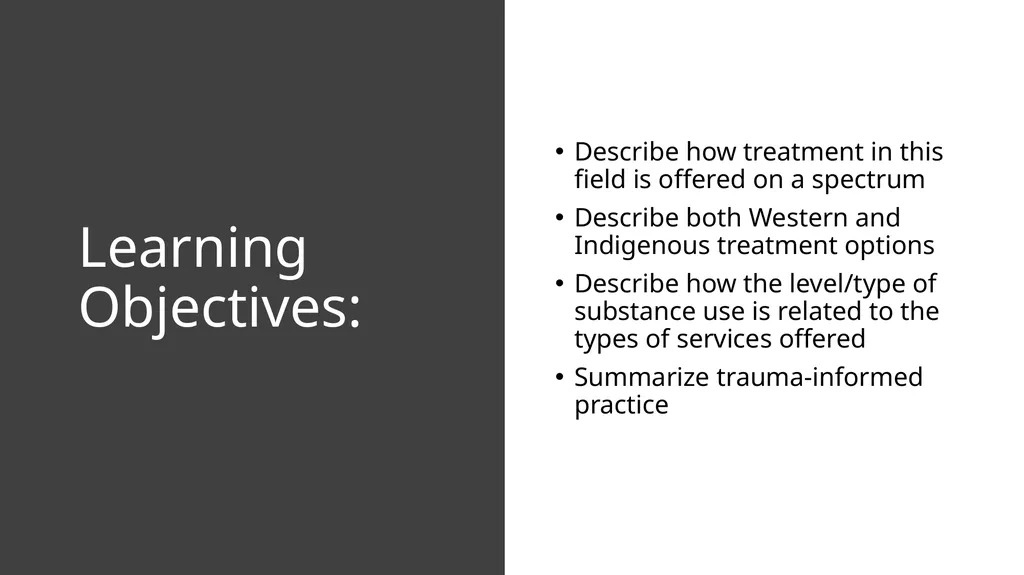
Learning Objectives: Describe how treatment in this field is offered on a spectrum
Describe both Western and Indigenous treatment options
Describe how the level/type of substance use is related to the types of services offered
Summarize trauma-informed practice<br>
Describe both Western and Indigenous treatment options
Describe how the level/type of substance use is related to the types of services offered
Summarize trauma-informed practice<br>
03
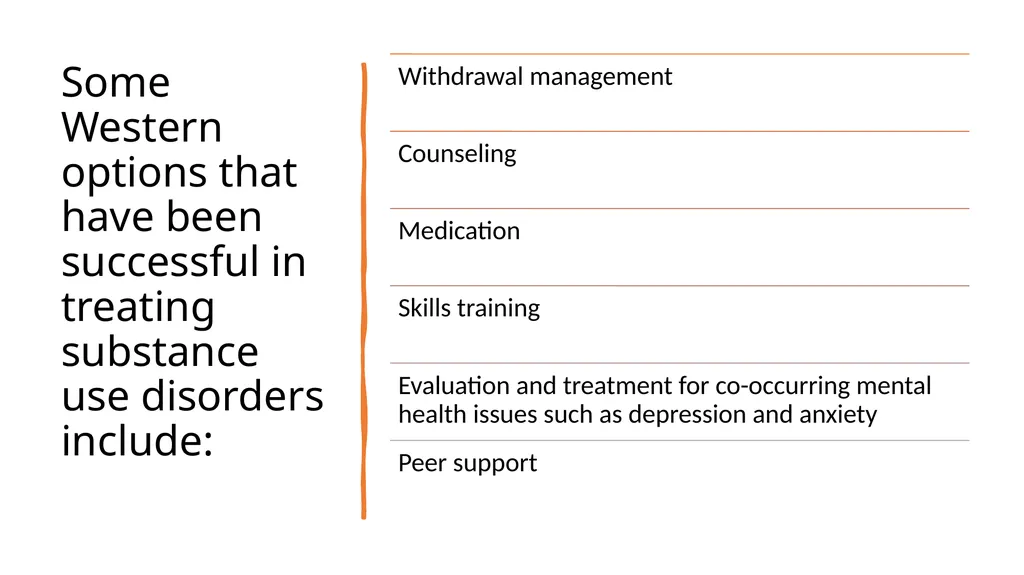
Some Western options that have been successful in treating substance use disorders include:<br>
04
Withdrawal Management (Detoxification) Some substances like alcohol have such a strong impact that they can cause death. Alcohol withdrawal requires medical intervention when a person wants to slow down or stop. This service is often referred to as detoxification (detox) or withdrawal management.
Withdrawal management, is a medically assisted/managed program.
Medications and devices can be used to manage withdrawal symptoms, prevent relapse, and treat co-occurring conditions.
Withdrawal management is not in itself “treatment,” but only the first step in the treatment process.<br>
Withdrawal management, is a medically assisted/managed program.
Medications and devices can be used to manage withdrawal symptoms, prevent relapse, and treat co-occurring conditions.
Withdrawal management is not in itself “treatment,” but only the first step in the treatment process.<br>
05
In-Patient Withdrawal Management If a person has access to a provincial health card, in-patient withdrawal management may be referred by a health care provider, or it may also be self-referred.
If people have the financial means, they may pay privately or access funds through an insurance provider for private in-patient withdrawal management at a private facility.
All individuals are screened to see if they meet the criteria for in-patient withdrawal management. Screening is a tool to determine which service an individual may benefit from, based on their substance use. Screening may highlight some of the areas of intersectionality of substance use.
In-patient withdrawal management is provided by all provincial health care services.
In Nova Scotia, in-patient withdrawal management is provided by the Nova Scotia Health, who “provides medical, supervised withdrawal management and support to individuals that require treatment and support to manage their withdrawal symptoms from substances such as alcohol and drugs” (Nova Scotia Health, n.d.c, para. 1).
In-patient treatment is also offered by privately owned facilities in Nova Scotia, in a beautiful facility with private doctors, registered nurses, and counsellors, all for the cost of approximately $600/day. Some insurance companies cover the costs of private treatment; however, for those without private health insurance, treatment facilities like these may be out of reach.<br>
06
Outpatient Withdrawal Management People living in Nova Scotia who have a NS health card may have access to out-patient withdrawal management.
This program “combines functions of an outpatient (day program) withdrawal management (detox) and structured treatment, providing the support of a team-based approach” (Nova Scotia Health, n.d.d, para. 1).
Not all provincial healthcare facilities in Nova Scotia offer this service. It is currently offered in the Western zone (Nova Scotia Health, n.d.d, para. 4).
Outpatient treatment has been provided in various parts of Nova Scotia; however there have been changes to these types of services.<br>
07
Outpatient Treatment For people who have completed a withdrawal management program, options exist for people who are choosing to engage with a health care provider about their substance use.
The Nova Scotia Health Authority provides a variety of outpatient treatment programs in various locations, from two-week full day programs to weekly appointments (Nova Scotia Health, n.d.b).
The Adult Addictions Day Treatment Program is a more intense program option.
Adult Community Mental Health and Addiction Services is a less intensive program. This program “includes a team of mental health and addictions professionals who provide services on an outpatient basis” (Nova Scotia Health Authority, n.d.a, para. 2) for adults.
The Nova Scotia Health Authority provides a separate service for youth under the age of 19 that is focused on age-appropriate interventions and treatments.<br>
08
Opioid Agonist Treatment (OAT) Methadone treatment is considered an opioid agonist treatment (OAT) and has been successful in treating people who use opiates.
The slow acting methadone reduces withdrawal symptoms, and therefore is considered an opioid agonist.
Methadone, along with buprenorphine and suboxone, other opioid agonists, change lives lives.
Opioid agonist does not work for every person.
The Pharmacy Association of Nova Scotia has a list of pharmacies providing methadone and suboxone here.<br>
09
Mothers and Methadone https://youtu.be/LjT8WvuaFUE (Prince Edward Island Government, 2017).<br>
10
Medication Assisted Treatment The Providence Health Clinic in Vancouver recognized that the continued use of heroin can be fatal if not treated (McLellan et al., 2000) and began working with a small number of individuals who had an opiate use disorder.
They developed SALOME, a prescribed heroin project or heroin assisted treatment (HAT).
SALOME developed out of the NAOMI project, North America’s first HAT program, an initiative between the US and Canada in the 1990’s (Garty et al., 2009).
These projects were breaking new ground as well as challenging ideologies about substance use.
Both NAOMI and SALOME were challenged by previous federal Governments; however, the Providence Health Clinic challenged those decisions and became the only clinic in North America to “provide medical grade heroin and hydromorphone within a supervised clinical setting to chronic substance use patients” (Providence Health Clinic, 2021, para. 1).
This approach to treating substance use allowed individuals, in partnership with their healthcare provider, to manage their substance use like a chronic illness.<br>
11
Salome Patient Experience Video https://youtu.be/8wY0LzYwRYs (Providence Health Vancouver, 2016).<br>
12
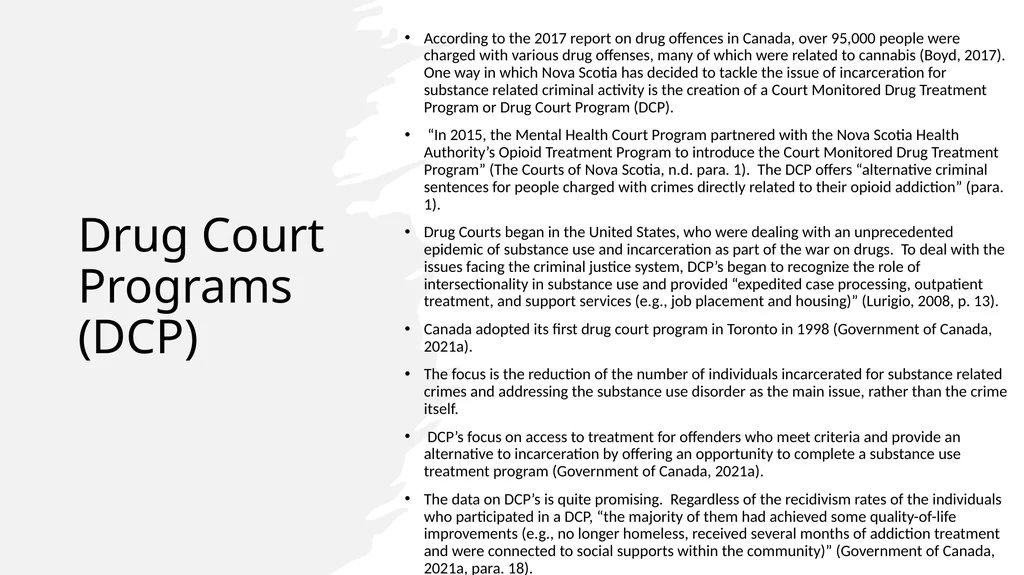
Drug Court Programs (DCP) According to the 2017 report on drug offences in Canada, over 95,000 people were charged with various drug offenses, many of which were related to cannabis (Boyd, 2017). One way in which Nova Scotia has decided to tackle the issue of incarceration for substance related criminal activity is the creation of a Court Monitored Drug Treatment Program or Drug Court Program (DCP).
“In 2015, the Mental Health Court Program partnered with the Nova Scotia Health Authority’s Opioid Treatment Program to introduce the Court Monitored Drug Treatment Program” (The Courts of Nova Scotia, n.d. para. 1). The DCP offers “alternative criminal sentences for people charged with crimes directly related to their opioid addiction” (para. 1).
Drug Courts began in the United States, who were dealing with an unprecedented epidemic of substance use and incarceration as part of the war on drugs. To deal with the issues facing the criminal justice system, DCP’s began to recognize the role of intersectionality in substance use and provided “expedited case processing, outpatient treatment, and support services (e.g., job placement and housing)” (Lurigio, 2008, p. 13).
Canada adopted its first drug court program in Toronto in 1998 (Government of Canada, 2021a).
The focus is the reduction of the number of individuals incarcerated for substance related crimes and addressing the substance use disorder as the main issue, rather than the crime itself.
DCP’s focus on access to treatment for offenders who meet criteria and provide an alternative to incarceration by offering an opportunity to complete a substance use treatment program (Government of Canada, 2021a).
The data on DCP’s is quite promising. Regardless of the recidivism rates of the individuals who participated in a DCP, “the majority of them had achieved some quality-of-life improvements (e.g., no longer homeless, received several months of addiction treatment and were connected to social supports within the community)” (Government of Canada, 2021a, para. 18).<br>
13
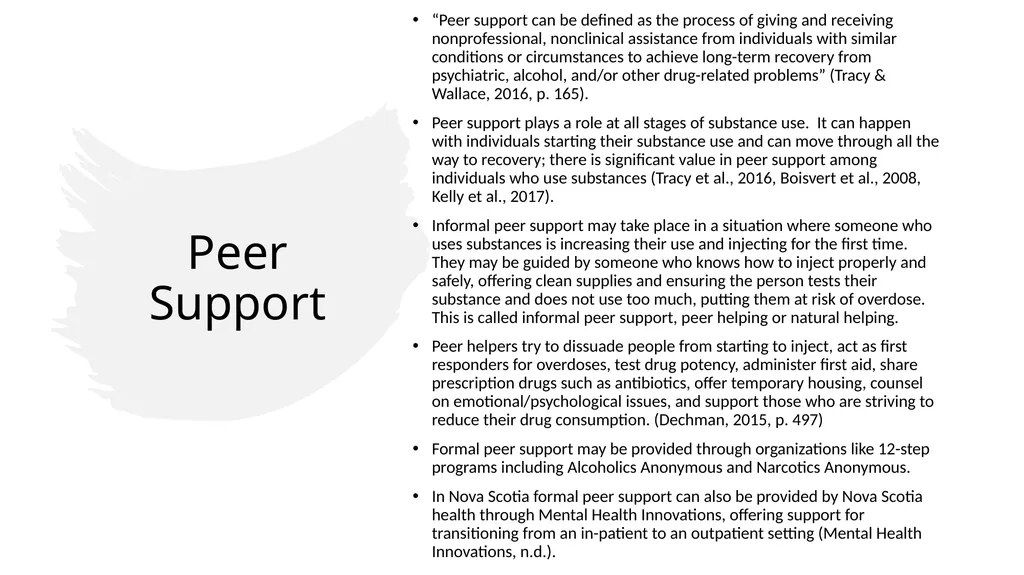
Peer Support “Peer support can be defined as the process of giving and receiving nonprofessional, nonclinical assistance from individuals with similar conditions or circumstances to achieve long-term recovery from psychiatric, alcohol, and/or other drug-related problems” (Tracy & Wallace, 2016, p. 165).
Peer support plays a role at all stages of substance use. It can happen with individuals starting their substance use and can move through all the way to recovery; there is significant value in peer support among individuals who use substances (Tracy et al., 2016, Boisvert et al., 2008, Kelly et al., 2017).
Informal peer support may take place in a situation where someone who uses substances is increasing their use and injecting for the first time. They may be guided by someone who knows how to inject properly and safely, offering clean supplies and ensuring the person tests their substance and does not use too much, putting them at risk of overdose. This is called informal peer support, peer helping or natural helping.
Peer helpers try to dissuade people from starting to inject, act as first responders for overdoses, test drug potency, administer first aid, share prescription drugs such as antibiotics, offer temporary housing, counsel on emotional/psychological issues, and support those who are striving to reduce their drug consumption. (Dechman, 2015, p. 497)
Formal peer support may be provided through organizations like 12-step programs including Alcoholics Anonymous and Narcotics Anonymous.
In Nova Scotia formal peer support can also be provided by Nova Scotia health through Mental Health Innovations, offering support for transitioning from an in-patient to an outpatient setting (Mental Health Innovations, n.d.).<br>
14
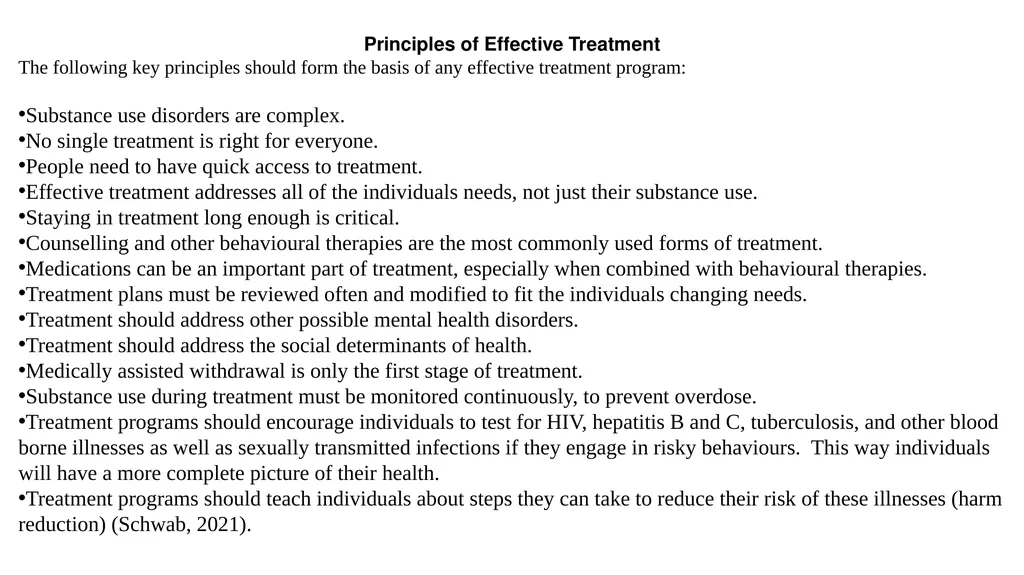
Principles of Effective Treatment
The following key principles should form the basis of any effective treatment program:
Substance use disorders are complex.
No single treatment is right for everyone.
People need to have quick access to treatment.
Effective treatment addresses all of the individuals needs, not just their substance use.
Staying in treatment long enough is critical.
Counselling and other behavioural therapies are the most commonly used forms of treatment.
Medications can be an important part of treatment, especially when combined with behavioural therapies.
Treatment plans must be reviewed often and modified to fit the individuals changing needs.
Treatment should address other possible mental health disorders.
Treatment should address the social determinants of health.
Medically assisted withdrawal is only the first stage of treatment.
Substance use during treatment must be monitored continuously, to prevent overdose.
Treatment programs should encourage individuals to test for HIV, hepatitis B and C, tuberculosis, and other blood borne illnesses as well as sexually transmitted infections if they engage in risky behaviours. This way individuals will have a more complete picture of their health.
Treatment programs should teach individuals about steps they can take to reduce their risk of these illnesses (harm reduction) (Schwab, 2021).<br>
15
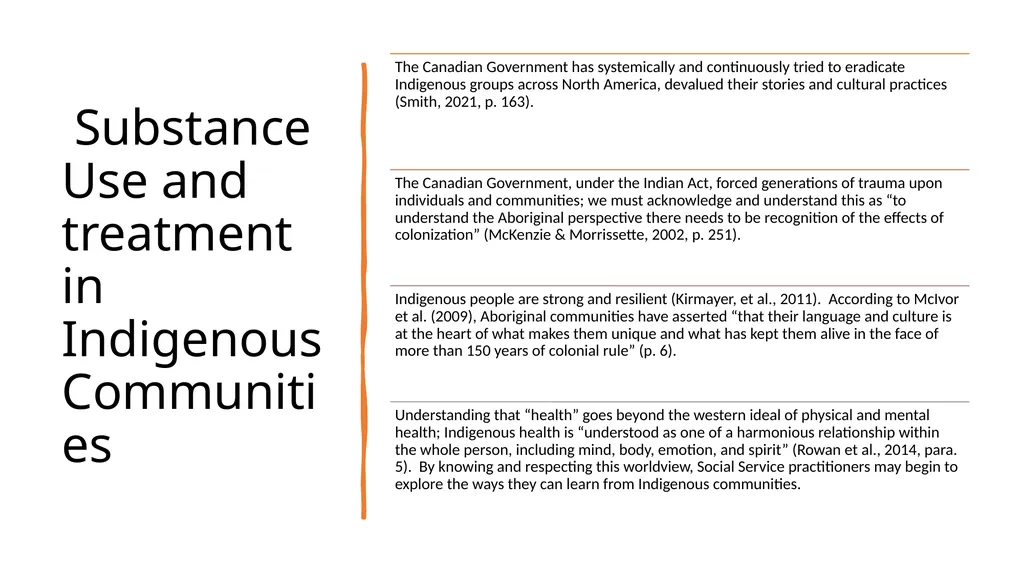
Substance Use and treatment in Indigenous Communities<br>
16
What Non-Indigenous Canadians Need To Know https://youtu.be/b1E-3Hb1-WA (Two Docs, 2019).<br>
17
A Two Eyed Seeing Approach
Culture is a foundation of Indigenous health, from prevention initiatives to healing from substance use and trauma (Chong et al., 2009). Some groups may solely use culture and traditional methods, some may use Western treatment and sometimes individuals and groups use a blending of the two. This blending could be seen as utilizing a two-eyed seeing approach, a concept developed by Elder Albert Marshall which he suggested one uses the strengths of Indigenous knowledge and the strengths of Western knowledge so one may come to see the world more comprehensively and for the benefit of all (Institute for Integrative Science and Health, n.d.).<br>
18
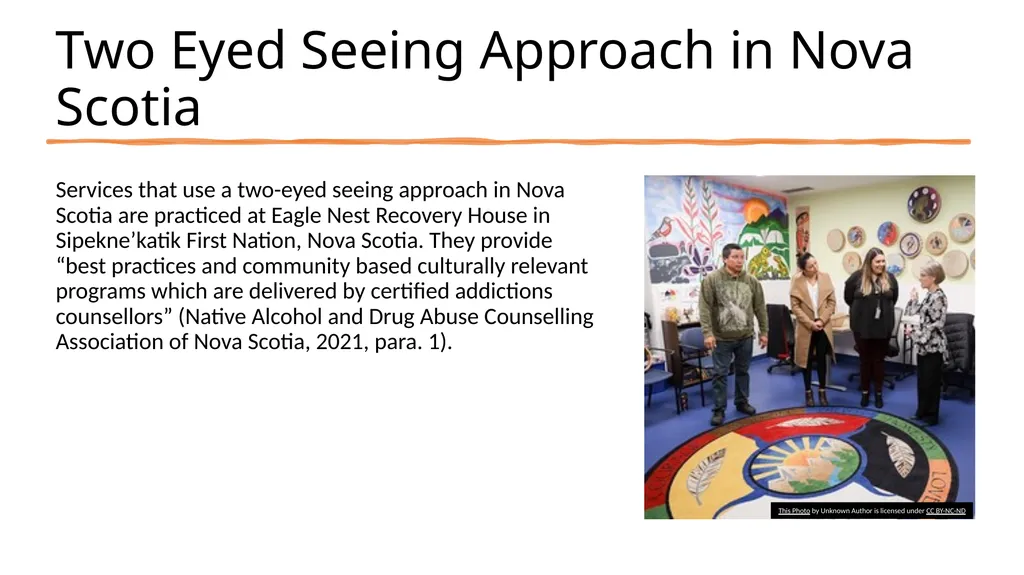
Two Eyed Seeing Approach in Nova Scotia Services that use a two-eyed seeing approach in Nova Scotia are practiced at Eagle Nest Recovery House in Sipekne’katik First Nation, Nova Scotia. They provide “best practices and community based culturally relevant programs which are delivered by certified addictions counsellors” (Native Alcohol and Drug Abuse Counselling Association of Nova Scotia, 2021, para. 1). This Photo by Unknown Author is licensed under CC BY-NC-ND<br>
19
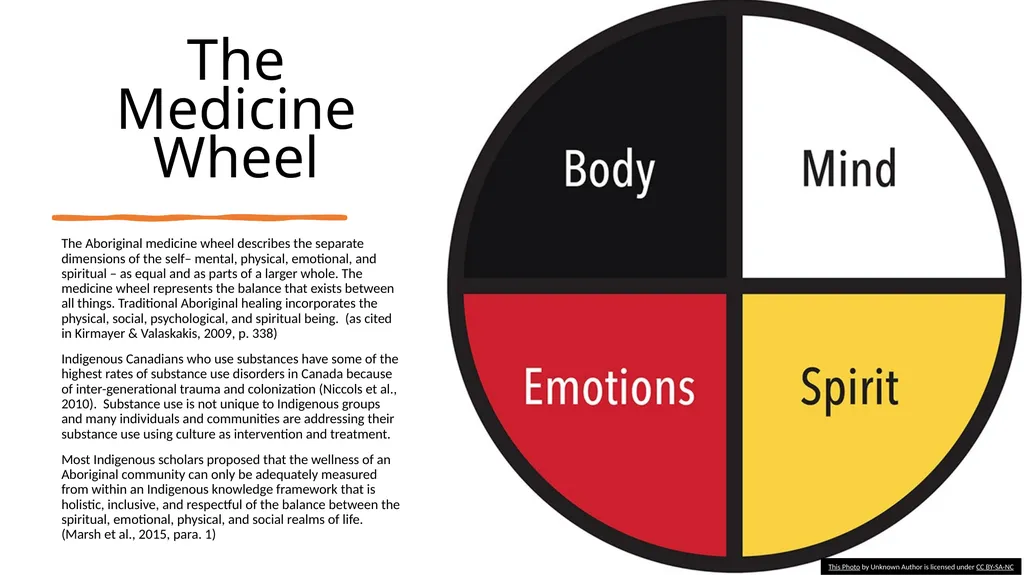
The Medicine Wheel The Aboriginal medicine wheel describes the separate dimensions of the self– mental, physical, emotional, and spiritual – as equal and as parts of a larger whole. The medicine wheel represents the balance that exists between all things. Traditional Aboriginal healing incorporates the physical, social, psychological, and spiritual being. (as cited in Kirmayer & Valaskakis, 2009, p. 338)
Indigenous Canadians who use substances have some of the highest rates of substance use disorders in Canada because of inter-generational trauma and colonization (Niccols et al., 2010). Substance use is not unique to Indigenous groups and many individuals and communities are addressing their substance use using culture as intervention and treatment.
Most Indigenous scholars proposed that the wellness of an Aboriginal community can only be adequately measured from within an Indigenous knowledge framework that is holistic, inclusive, and respectful of the balance between the spiritual, emotional, physical, and social realms of life. (Marsh et al., 2015, para. 1) This Photo by Unknown Author is licensed under CC BY-SA-NC<br>
20
Elders The term Elder “refers to someone who has attained a high degree of understanding of First Nation, Métis, or Inuit history, traditional teachings, ceremonies, and healing practices” (University of Toronto, 2019, para. 1) and is not defined by their age.
Elders do not belong to just one family, they are part of the community, and respect should be given to Elders from all, both Indigenous and non-Indigenous peoples.
Elders have a revered place among Indigenous communities in Canada. “Elders were the carriers of knowledge of both physical and spiritual reality and that they have been educated through the oral tradition” (Marsh et al., 2015, para. 7).
The role of Elders in Indigenous communities cannot be stressed enough. They are the keepers of knowledge and are honoured and respected. Please watch the video below to deepen your understanding of Elders.<br>
21
The Elders: Getting to Know Some of The Most Honored Member of First Nation Communities https://youtu.be/zhVnWwzzeRE (CBC News, 2021).<br>
22
Land Based Treatment Taking time to honour the earth is important, and Indigenous communities have a deep sacred relationship with the land, with the earth.
The land plays a critical role in substance use treatment for Indigenous people.
Carrier Sekani Family Services (2021) “offers a land-based healing program that uses culture and the natural environment to encourage its participants to return to their First Nations’ culture to assist in combating addiction” (para. 5).
Utilizing the land allows a path to healing for communities who have been removed from the land and traditional teaching due to colonization. This type of programming includes both traditional teachings as well as Western interventions, utilizing the concept of two-eyed seeing which honors the best of Indigenous and non-Indigenous treatment philosophies and interventions.<br>
23
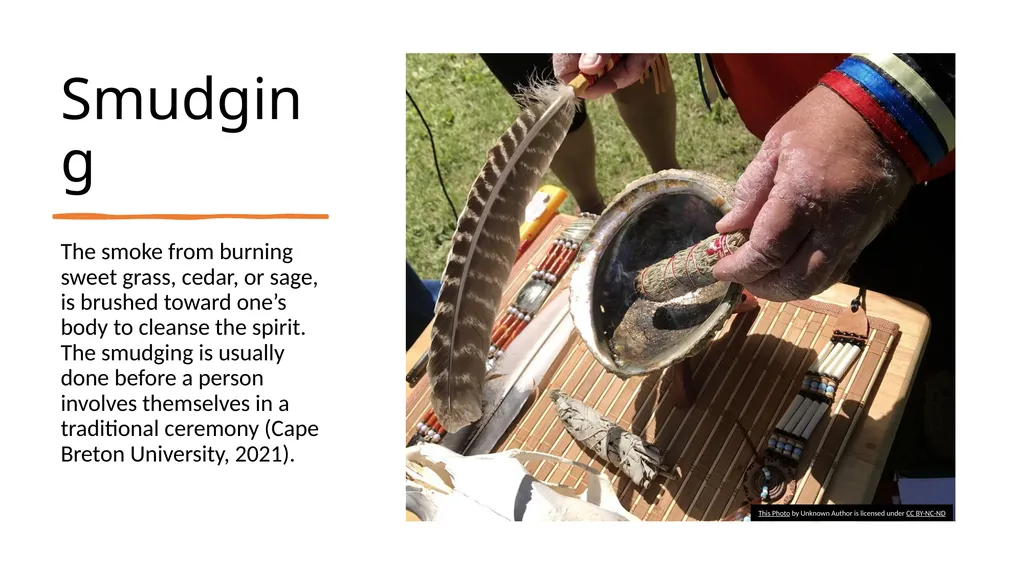
Smudging The smoke from burning sweet grass, cedar, or sage, is brushed toward one’s body to cleanse the spirit. The smudging is usually done before a person involves themselves in a traditional ceremony (Cape Breton University, 2021). This Photo by Unknown Author is licensed under CC BY-NC-ND<br>
24
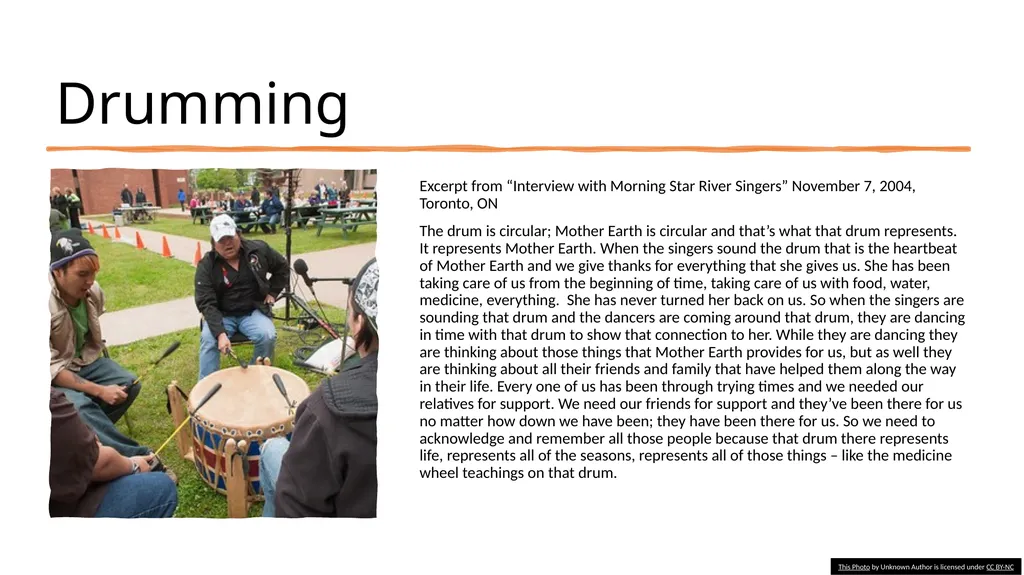
Drumming Excerpt from “Interview with Morning Star River Singers” November 7, 2004, Toronto, ON
The drum is circular; Mother Earth is circular and that’s what that drum represents. It represents Mother Earth. When the singers sound the drum that is the heartbeat of Mother Earth and we give thanks for everything that she gives us. She has been taking care of us from the beginning of time, taking care of us with food, water, medicine, everything. She has never turned her back on us. So when the singers are sounding that drum and the dancers are coming around that drum, they are dancing in time with that drum to show that connection to her. While they are dancing they are thinking about those things that Mother Earth provides for us, but as well they are thinking about all their friends and family that have helped them along the way in their life. Every one of us has been through trying times and we needed our relatives for support. We need our friends for support and they’ve been there for us no matter how down we have been; they have been there for us. So we need to acknowledge and remember all those people because that drum there represents life, represents all of the seasons, represents all of those things – like the medicine wheel teachings on that drum. This Photo by Unknown Author is licensed under CC BY-NC<br>
The drum is circular; Mother Earth is circular and that’s what that drum represents. It represents Mother Earth. When the singers sound the drum that is the heartbeat of Mother Earth and we give thanks for everything that she gives us. She has been taking care of us from the beginning of time, taking care of us with food, water, medicine, everything. She has never turned her back on us. So when the singers are sounding that drum and the dancers are coming around that drum, they are dancing in time with that drum to show that connection to her. While they are dancing they are thinking about those things that Mother Earth provides for us, but as well they are thinking about all their friends and family that have helped them along the way in their life. Every one of us has been through trying times and we needed our relatives for support. We need our friends for support and they’ve been there for us no matter how down we have been; they have been there for us. So we need to acknowledge and remember all those people because that drum there represents life, represents all of the seasons, represents all of those things – like the medicine wheel teachings on that drum. This Photo by Unknown Author is licensed under CC BY-NC<br>
25
Sharing Circles<br>
26
Trauma Informed Practices for Indigenous communities Trauma due to genocide, colonization, residential schools, and the concerted effort to eradicate Indigenous communities in Canada has had a tremendous impact on Indigenous people. Understanding these experiences using a two-eyed seeing approach will help provide a more culturally safe and trauma informed service.<br>
27
Trauma Informed Practices for Women Women are more likely to have experienced sexualized violence, are more likely to engage in survival sex, and are more likely to live in poverty (Torchalla et al., 2014). Knowing the issues that impact women specifically, for example, “adverse and traumatic experiences in early childhood, continuation of adversities and trauma in adulthood, intimate partner violence, structural violence, and transgenerational traumas” (p. 2) service providers must look beyond the substance use to help address the trauma.
According to Homes (2021), “the majority of substance use services lack a gender-responsive and anti-oppressive approach, that specifically addresses the intersectional violence, oppressive barriers, and diverse experiences of women and femmes” (p. 2).<br>
According to Homes (2021), “the majority of substance use services lack a gender-responsive and anti-oppressive approach, that specifically addresses the intersectional violence, oppressive barriers, and diverse experiences of women and femmes” (p. 2).<br>
28
Trauma, Gender, Sex and Substance Abuse https://youtu.be/MxiYc7Kw25w (Centre of Excellence for Women’s Health, 2018).<br>
29
Trauma Informed Practices for 2SLGBTQ communities Individuals who identify as 2SLGBTQ* are impacted by discrimination, victimization, bullying, violence, and trauma; consequently, sexual and gender minority youth are at elevated risk for suicide (Fulginiti et al., 2021).
This group is at a higher risk of substance use disorders due to the trauma they face because of their sexuality (Rojas et al., 2019). To provide a trauma-informed practice for this group, Social Service workers must understand the daily realities of people who identify as 2SLGBTQS. Rojas et al. (2019) suggest the following when working with 2SLGBTQ* communities and substance use disorders:
-Focusing on the psychological impact of homophobia and heterosexism can help explain vulnerability to mental health disorders.
-Asking about compounded stigma: how does the client feel about having a substance use disorder, mental health disorder, and/or trauma? What experiences have they had with stigma?
-When referring out, confirming providers are knowledgeable in LGBTQ+ affirming practices
-Consulting frequently and refer when outside of your area of expertise
-Encouraging participation of partner/significant other in treatment
-Querying about family of origin messages toward LGBTQ+ patients
-If applicable, querying about “coming out” process and/or experiences with family<br>
30
Self Care Please complete the activities in Chapter 8, and report back next class.<br>
31
References Boisvert, R. A., Martin, L. M., Grosek, M., & Claire, A. J. (2008). Effectiveness of a peer-support community in addiction recovery: participation as intervention. Occupational Therapy International, 15(4), 205-220. https://doi.org/10.1002/oti.257
Boyd, S. (2017). Drug arrests in Canada, addendum. https://drugpolicy.ca/wp-content/uploads/2018/09/Addendum.pdf
The British Columbia Centre of Excellence for Women’s Health. (2010). Trauma-informed approaches in addictions treatment: Gendering the national framework. https://bccewh.bc.ca/wp-content/uploads/2014/02/2010_GenderingNatFrameworkTraumaInformed.pdf
British Columbia Ministry of Health. (2013). Problem drinking part 1: Screening and assessment. https://www2.gov.bc.ca/assets/gov/health/practitioner-pro/bc-guidelines/problem_drinking.pdf
Canadian Centre for Substance Use and Addiction. (2017). Motivational interviewing (the essentials of series). https://www.ccsa.ca/motivational-interviewing-essentials-series
Canadian Centre for Substance Use and Addiction. (2014). Trauma informed care. https://www.ccsa.ca/sites/default/files/2019-04/CCSA-Trauma-informed-Care-Toolkit-2014-en.pdf
Canadian Institute of Health Research. (2014). Honouring our strengths: Indigenous culture as intervention in addictions treatment project. https://pressbooks.nscc.ca/app/uploads/sites/246/2022/05/3_Common_Cultural_Interventions.pdf
Centre of Excellence for Women’s Health. (2018). Trauma, gender, sex and substance use. [Video]. Youtube. https://www.youtube.com/watch?v=MxiYc7Kw25w
Cape Breton University. (2021). Oral histories. https://www.cbu.ca/indigenous-affairs/mikmaq-resource-centre/mikmaq-resource-guide/essays/oral-histories/
Carrier Clinic. (2015, Jan. 29). Recovery options: Treatment for drug addiction and alcoholism. [Video]. Youtube. https://www.youtube.com/watch?v=e4D4QUaEp_w
Carrier Sekani Family Services. (2021). Addictions recovery program. https://www.csfs.org/services/addictions-recovery-program
CBC News. (2021, June, 21). The Elders: Getting to know some of the most honoured members of First Nation communities. [Video]. Youtube. https://www.youtube.com/watch?v=zhVnWwzzeRE
Centre for Addiction and Mental Health. (2021a). Cognitive behavioural therapy. https://www.camh.ca/en/health-info/mental-illness-and-addiction-index/cognitive-behavioural-therapy
Centre for Addiction and Mental Health. (2021b). Methadone. https://www.camh.ca/en/health-info/mental-illness-and-addiction-index/methadone
Chong, J., Fortier, Y., & Morris, T. L. (2009). Cultural practices and spiritual development for women in a Native American alcohol and drug treatment program. Journal of Ethnicity in Substance Abuse, 8(3), 261–282. https://doi-org.libproxy.stfx.ca/10.1080/15332640903110450
Institute for Integrative Science and Health. (n.d.) Guiding principles (Two-eyed seeing). http://www.integrativescience.ca/Principles/TwoEyedSeeing/
Dechman, M. K. (2015, May). Peer helpers’ struggles to care for “others” who inject drugs. International Journal of Drug Policy, 26(5), 492-500. https://doi.org/10.1016/j.drugpo.2014.12.010
Dell, C., & Lyons T. (2007). Harm reduction policies and programs for persons of Aboriginal descent. Canadian Centre on Substance Abuse. https://www.researchgate.net/publication/235742014_Harm_Reduction_Policies_and_Programs_for_Persons_of_Aboriginal_Descent<br>
32
References Fulginiti, A., Rhoades, H., Mamey, M., Klemmer, C., Srivastava, A., Weskamp, G., & Goldbach, G. (2021). Sexual minority stress, mental health symptoms, and suicidality among LGBTQ youth accessing crisis services. Journal of Youth and Adolescence, 50(5), 893-905. https://pubmed.ncbi.nlm.nih.gov/33206318/
Gartry, C. C., Oviedo-Joekes, E., Laliberté, N., & Schechter, M. H. (2009). NAOMI: The trials and tribulations of implementing a heroin assisted treatment study in North America. Harm Reduction International Journal, 6(2), 1-14. https://doi.org/10.1186/1477-7517-6-2
Government of Canada. (2021a). Drug treatment court program funding program. https://www.justice.gc.ca/eng/fund-fina/gov-gouv/dtc-ttt.html
Government of Canada. (2021b). Opioids and the opioid crisis-get the facts. https://www.canada.ca/en/health-canada/services/opioids/get-the-facts.html
Hall, J. A., Sarrazin, M. S., Huber, D. L., Vaughn, T., Block, R. I., Reedy, A. R., & Jang, M. (2009). Iowa case management for rural drug abuse. Research on Social Work Practice, 19(4), 407–422. https://doi.org/10.1177/1049731509331925
Homes, C. (2021). Bridging the gap in women’s substance use services: A trauma-informed, gender-responsive, and anti-oppressive approach. http://repository.cityu.edu/bitstream/handle/20.500.11803/1465/ChristineHolmesCapstone.pdf?sequence=2&isAllowed=y
Kaskutas, L. A. (2009). Alcoholics anonymous effectiveness: Faith meets science. Journal of Addictive Diseases, 28(2), 145–157. https://doi.org/10.1080/10550880902772464
Kelly, J. F., Fallah-Sohy, N., Cristello, J. & Bergman, B. (2017). Coping with the enduring unpredictability of opioid addiction: An investigation of a novel family-focused peer-support organization. Journal of Substance Abuse Treatment, 77, 193-200. https://doi.org/10.1016/j.jsat.2017.02.010
Kirmayer, L. J., Dandeneau, S., Marshall, E. Kahentonni Phillips, M., & Williamson, K. J. (2011). Rethinking resilience from Indigenous perspectives. The Canadian Journal of Psychiatry, 56(4), 84–91. https://journals.sagepub.com/doi/pdf/10.1177/070674371105600203
Kruk, E., & Sandberg, K. (2013). A home for body and soul: substance using women in recovery. Harm reduction journal, 10, 39. https://doi.org/10.1186/1477-7517-10-39
Lurigo, A. J. (2008). The first 20 years of drug treatment courts: A brief description of their history and impact. Probation Journal, 72(1), 13-17. https://www.uscourts.gov/sites/default/files/72_1_2_0.pdf
MacKenzie, B., & Morrissette, V. (2002). Social work practice with Canadians of Aboriginal background: Guidelines for respectful social work. In J. R. Graham & A. Al-Krenawi (Eds.), Multicultural social work in Canada: Working with diverse ethno-racial communities (pp. 251-279). Oxford University Press.<br>
33
References Marsh, T. N., Coholic, D., Cote-Meek, S., & Najavits, L. (2015). Blending Aboriginal and Western healing methods to treat intergenerational trauma with substance use disorder in Aboriginal peoples who live in Northeastern Ontario, Canada. Harm Reduction Journal, 12(14). https://doi.org/10.1186/s12954-015-0046-1
McCormick, R. (2009). Aboriginal approaches to counselling. In L. Kirmayer & G. Valaskakis (Eds.), Healing traditions: The mental health of aboriginal peoples in Canada (pp. 337–354). UBC Press.
McLellan A. T., Lewis D. C., O’Brien C. P., & Kleber H. D. (2000). Drug dependence, a chronic medical illness: Implications for treatment, insurance, and outcomes evaluation. JAMA, 284, 1689–1695. https://pubmed.ncbi.nlm.nih.gov/11015800/
McIvor, O., Napoleon, A., & Dickie, K. (2009). Language and culture as protective factors for at-risk communities. Journal of Aboriginal Health, 5, 6-25. https://doi.org/10.18357\/ijih51200912327
Mental Health Innovations (n.d.). Peer support Nova Scotia: Mental health rehumanized. https://www.supportyourpeople.com/peer-support-nova-scotia
Native Alcohol and Drug Abuse Counselling Association of Nova Scotia. (2021). Eagle Nest Recovery. http://www.nadaca.ca/in-patient-treatment-centres/eagles-nest/
Native Drums Website. (2004). The spirit of the drum. Teacher Resource Kit.
Niccols, A., Dell, C. A., & Clarke, S. (2010). Treatment issues for Aboriginal mothers with substance use problems and their children. International Journal of Mental Health and Addiction, 8(2), 320–335. https://doi.org/10.1007/s11469-009-9255-8
Nova Scotia. (2021). Opioid use and overdose strategy. https://novascotia.ca/opioid/
Nova Scotia Health Authority. (n.d.a). Adult addictions day treatment program. https://mha.nshealth.ca/en/services/adult-addictions-day-treatment-program
Nova Scotia Health Authority. (n.d.b). Adult community mental health and addictions services. https://mha.nshealth.ca/en/services/adult-community-mental-health-and-addictions-services
Nova Scotia Health Authority. (n.d.c). In-patient withdrawal management unit. https://mha.nshealth.ca/en/services/inpatient-withdrawal-management-unit
Nova Scotia Health Authority. (n.d.d). Outpatient withdrawal management unit. https://mha.nshealth.ca/en/services/outpatient-withdrawal-management
Petry N. M. (2011). Contingency management: what it is and why psychiatrists should want to use it. The psychiatrist, 35(5), 161–163. https://doi.org/10.1192/pb.bp.110.031831
Prince Edward Island Government. (2017, July 12). Mothers and methadone. [Video]. Youtube. https://www.youtube.com/watch?v=LjT8WvuaFUE&feature=emb_imp_woyt<br>
34
References Providence Health Vancouver. (2016). SALOME patient experience video. [Video]. Youtube. https://www.youtube.com/watch?v=8wY0LzYwRYs
Rothe J. P., Ozegovic, D., & Carroll L. J. (2009). Innovation in qualitative interviews: “Sharing Circles” in a First Nations community. Injury Prevention: Journal of the International Society for Child and Adolescent Injury Prevention, 15, 334-340. https://www.proquest.com/docview/1780953722?pq-origsite=primo&accountid=13803
Reynolds, V. (2012). An ethical stance for justice-doing in community work and therapy. Journal of Systemic Therapies, 31(4), 18–33. https://vikkireynoldsdotca.files.wordpress.com/2017/12/reynoldsandpolancoethicsstanceforjusticedoing2012jst.pdf
Rojas, J., Leckie, R., Hawks, E., Holster, J., Del Carmen Trapp, M., & Ostermeyer, B. (2019). Compounded stigma in LGBTQ people: A framework for understanding the relationship between substance use disorders, mental illness, trauma, and sexual minority status. Psychiatric Annals, 49(10), 446-452. https://doi.org/10.3928/00485713-20190912-01
Rowan, M., Poole, N., Shea, B., Gone, J. P., Mykota, D., Farag, M., Hopkins, C., Hall, L., Mushquash, C., & Dell, C. (2014). Cultural interventions to treat addictions in Indigenous populations: Findings from a scoping study. Substance Abuse Treatment, Prevention and Policy, 9, 34. https://doi.org/10.1186/1747-597X-9-34
Sherbourne Health. (2020). Rainbow Health Ontario. https://www.rainbowhealthontario.ca/
Smith, M. (2021). Things transformed: Inalienability, Indigenous storytelling, and the quest to recover from addiction. Alcoholism Treatment Quarterly, 39(2), 160-174. https://doi-org.libproxy.stfx.ca/10.1080/07347324.2020.1776183
Schwab, J. (2021). Drugs, health and behaviour. Pressbooks. https://psu.pb.unizin.org/bbh143/chapter/drugs-and-the-brain-national-institute-on-drug-abuse-nida/
The Canadian Centre on Substance Use and Addiction. (2021). The national treatment indicators project. https://www.ccsa.ca/national-treatment-indicators
The Courts of Nova Scotia. (n.d.). Drug court program. https://www.courts.ns.ca/provincial_court/NSPC_MHC_drug_treatment_program.htm
The Preservation Project. (2019, July 15). What is the Medicine Wheel? Teachings by Jeff Ward. [Video]. Youtube. https://www.youtube.com/watch?v=bSw0s8rcuSg
Torchalla, I., Linden, I.A., Strehlau, V., Neilson, E.K., & Krausz, M. (2014). “Like a lot’s happened with my whole childhood”: Violence, trauma, and addiction in pregnant and postpartum women from Vancouver’s Downtown Eastside. Harm Reduction Journal, 12(1), 1-10. https://doi.org/10.1186/1477-7517-11-34
Two Docs. (2019, April 2). What non Indigenous Canadians need to know. [Video]. Youtube. https://www.youtube.com/watch?v=b1E-3Hb1-WA
University of Regina. (n.d.). Medicine wheel booklet. https://www.uregina.ca/science/biology/people/faculty-research/gendron-fidji/documents-fidj/Medicine-Wheel-Booklet.pdf
University of Toronto. (2019, Jan. 4). Elders. https://www.oise.utoronto.ca/deepeningknowledge/Teacher_Resources/Curriculum_Resources_(by_subjects)/Social_Sciences_and_Humanities/Elders.html<br>