EXPROPRIATION BILL SUBMISSION Presented by Prof Thuli N Madonsela Law Trust Chair in Social Justice Stellenbosch University To The Portfolio Committee on Public Works National Assembly 07 September 2021 INTRODUCTION It is an honour and
"EXPROPRIATION BILL SUBMISSION Presented by Prof" is the property of its rightful owner. Permission is granted to
download and print the materials on this website for personal, non-commercial use only, and to display it
on your personal computer provided you do not modify the materials and that you retain all copyright
notices contained in the materials. By downloading content from our website, you accept the terms of this
agreement.
Presentation Transcript
01
EXPROPRIATION BILL SUBMISSION Presented by Prof Thuli N Madonsela
Law Trust Chair in Social Justice
Stellenbosch University
To The Portfolio Committee on Public Works – National Assembly
07 September 2021<br>
02
INTRODUCTION It is an honour and privilege to address the Portfolio Committee on the Expropriation Bill of 2021
As Law Trust Chair in Social Justice(CSJ) at Stellenbosch University, we welcome the initiative based on the belief that it is just and proper that a new Expropriation Act, that is attuned to our Constitution, replaces the current Expropriation Act 63 of 1975. It is important to note that the Bill redefines and does not introduce expropriation
We offer commentary on aspects that could undermine social justice, democratic governance and equal enjoyment of land and related property rights for disadvantaged groups, in breach of the constitutional commitment on social justice and related equality duty. Prof Thuli Madonsela 2<br>
03
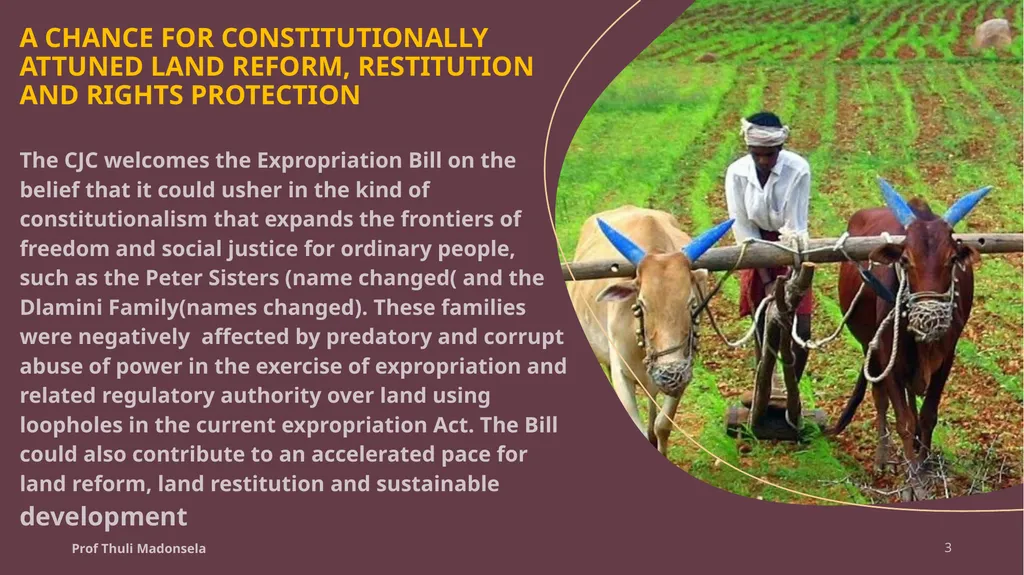
The CJC welcomes the Expropriation Bill on the belief that it could usher in the kind of constitutionalism that expands the frontiers of freedom and social justice for ordinary people, such as the Peter Sisters (name changed( and the Dlamini Family(names changed). These families were negatively affected by predatory and corrupt abuse of power in the exercise of expropriation and related regulatory authority over land using loopholes in the current expropriation Act. The Bill could also contribute to an accelerated pace for land reform, land restitution and sustainable development A CHANCE FOR CONSTITUTIONALLY ATTUNED LAND REFORM, RESTITUTION AND RIGHTS PROTECTION Prof Thuli Madonsela 3<br>
04
Definition adapted rom the Copenhagen Declaration on Social Development (1995), other UN documents and the Constitutional Court’s views in S V Makwanyane and Minister Finance v Van Heerden, among others
Social Justice is about fairness to all (John Rawls A Theory of Justice (1971) The Law Trust Chair in Social Justice has been operational since January 2018 with the purpose of expanding and deepening social justice research and scholarship with a view of making an impact in society particularly regard social impact conscious law and policy making. ABOUT THE CHAIR IN SOCIAL JUSTICE 4 Social justice refers to the equal enjoyment of all rights and freedoms by all reflected in just, equitable and fair distribution of all opportunities, resources, benefits, privileges and burdens in a society, group and between societies.
No group should find it easier or more onerous to exist in a social just society<br>
05
The Constitution commits to establish a society that is based on democratic values, social justice and fundamental human rights where every citizens’ potential is freed and life improved
In S v Makwanyane, Madala J, eloquently clarifies the link between social justice, the African value of Ubuntu and the transformative ethos of the Constitution when he says:
“The Constitution in its post-amble declares:
"... there is a need for understanding but not vengeance, and for reparation but not for retaliation, a need for ubuntu but not victimisation."
The concept “Ubuntu" appears for the first time in the post-amble, but it is a concept that permeates the Constitution generally and more particularly Chapter Three which embodies the entrenched fundamental human rights. The concept carries in it the ideas of humaneness, social justice and fairness”
(Para 237, This is in reference to the Interim Constitution) A TRANSFORMATIVE BLUEPRINT WITH A CLEAR VISION OF SOCIETY Prof Thuli Madonsela 5<br>
06
In Minister of Finance and Other v Van Heerden ((6) SA 121 (CC), Moseneke DCJ stated:
“Of course, democratic values and fundamental human rights espoused by our Constitution are foundational. But just as crucial is the commitment to strive for a society based on social justice. In this way, our Constitution heralds not only equal protection of the law and non-discrimination but also the start of a credible and abiding process of reparation for past exclusion, dispossession, and indignity within the discipline of our constitutional framework (para 25)”
“Equality before the law protection in section 9(1) and measures to promote equality in section 9(2) are both necessary and mutually reinforcing (Para 31)
“ “Absent positive commitment progressively to eradicate socially constructed barriers to equality and to root out systemic or institutionalized underprivilege, the Constitutional promise of equality before the law and its equal protection benefit must, in the context of our country, ring hollow”.
This perspective on equality and related social justice was resonant with the reasoning of Ngcobo J in Bato Star Fishing (PTY) v The Minister of Environmental Affairs and Tourism and Others 2004 (7) BCLR 687, where he stated:
“In this fundamental way, our Constitution differs from other constitutions which assume that all are equal and in so doing simply entrench existing inequalities. Our Constitution recognises that decades of systematic racial discrimination entrenched by the apartheid legal order cannot be eliminated without positive action being taken to achieve that result. We are required to do more than that. The effects of discrimination may continue indefinitely unless there is a commitment to end it.” (Para 37) A TRANSFORMATIVE BLUEPRINT WITH A CLEAR VISION OF SOCIETY Prof Thuli Madonsela 6<br>
07
IMPROVEMENTS
Greater Human Rights awareness (Recognition, compensation as default) (Clause 5(5)(a))
Democratization administrative justice (Clause 28(1)(b))
Recognition of subjects of customary law (Clause 29)
Offers opportunity to test implicit constitutional permission of expropriation without compensation, without changing Constitution
CONCERNS
Technical , long process and expensively long adversarial process
Need upfront capital which Gogo Dlaminis such as Ms Peters and the Dlamini family do not have
Group, particularly communal rights, need better accommodation
Clearer compensation parameters
Could impact negatively on investment ( not only FDI) and food security DOES THE RESTITUTION BILL IMPROVE CONSTITUTIONAL FIDELITY ON SOCIAL JUSTICE AND EQUALITY DUTY Prof Thuli Madonsela 7<br>
08
According to Kapuya and Sihlobo " Between 1994 and 2017, over 9.8 million hectares of land were purchased by the government...at a cost of R60 billion". T Kapuya and W Sihlobo "Evolution of South African Land Reform Process post -1994” in Raymond Parsons (Ed) Recession, Recovery and Reform: South Africa After Covid-19 (2020). Kapuya and Sihlobo point out that this is too expensive. A litigation anchored as opposed to CCMA styled conciliation centric land dispute resolution system might increase the cost further in addition to time consumption. COST OF COMPENSATION Prof Thuli Madonsela 8<br>
09
A holistic policy framework that limits speculation about the intentions processes, target beneficiaries and anticipated impact, could help make a more compelling case for the bill.
Social Impact Assessment (Could use the Social Justice Impact Assessment Matrix (SIAM) to ensure fidelity with social justice commitment and equality duty as per the preamble, S9, s 7,s195 (1)(c),(d)&e) and s237
Affordability impact assessment for Gogo Dlaminis such as the Peters and Dlaminis
Consider UK Equality Duty approach where impact on exacerbating inequality is assessed first and the twin duty of avoiding exacerbating inequality and advancing equality on specified ground is a precondition for approving a new law, policy or plan using SIAM . Add poverty in line with SDG objectives OUR RECOMMENDATIONS Prof Thuli Madonsela: 9<br>
10
021 Thank you
Dankie
E Nkosi Gratitude 10 Prof Thuli Madonsela<br>