
Faculty : Pradeep Deshmukh Sr. Manager, WCL
CB
Published · 54 slides · 0 views
1 / 1

Description
Faculty : Pradeep Deshmukh Sr. Manager, WCL WELCOME TO MASS PRODUCTION TECHNOLGY FOR UNDERGROUND COAL ( Code MNL469) SYLLABUS : STATUS OF COAL MINING IN INDIA AND ABROAD, NEED FOR MASS PRODUCTION TECHNOLOGY FOR INDIAN COAL CONTINUOS MINING
Related Topics
Share
Embed code
Download this presentation From Below
"Faculty : Pradeep Deshmukh Sr. Manager, WCL" is the property of its rightful owner. Permission is granted to download and print the materials on this website for personal, non-commercial use only, and to display it on your personal computer provided you do not modify the materials and that you retain all copyright notices contained in the materials. By downloading content from our website, you accept the terms of this agreement.
Presentation Transcript
01
Faculty : Pradeep Deshmukh
Sr. Manager, WCL WELCOME
TO
MASS PRODUCTION TECHNOLGY FOR UNDERGROUND COAL
( Code MNL469)<br>
TO
MASS PRODUCTION TECHNOLGY FOR UNDERGROUND COAL
( Code MNL469)<br>
02
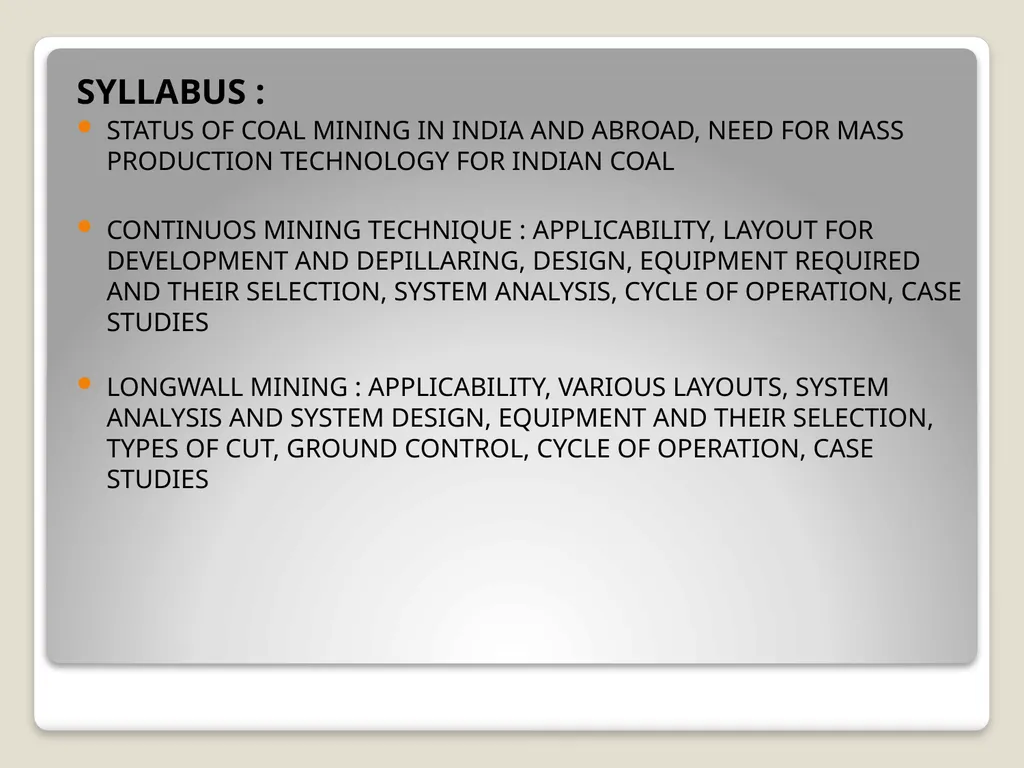
SYLLABUS :
STATUS OF COAL MINING IN INDIA AND ABROAD, NEED FOR MASS PRODUCTION TECHNOLOGY FOR INDIAN COAL
CONTINUOS MINING TECHNIQUE : APPLICABILITY, LAYOUT FOR DEVELOPMENT AND DEPILLARING, DESIGN, EQUIPMENT REQUIRED AND THEIR SELECTION, SYSTEM ANALYSIS, CYCLE OF OPERATION, CASE STUDIES
LONGWALL MINING : APPLICABILITY, VARIOUS LAYOUTS, SYSTEM ANALYSIS AND SYSTEM DESIGN, EQUIPMENT AND THEIR SELECTION, TYPES OF CUT, GROUND CONTROL, CYCLE OF OPERATION, CASE STUDIES<br>
STATUS OF COAL MINING IN INDIA AND ABROAD, NEED FOR MASS PRODUCTION TECHNOLOGY FOR INDIAN COAL
CONTINUOS MINING TECHNIQUE : APPLICABILITY, LAYOUT FOR DEVELOPMENT AND DEPILLARING, DESIGN, EQUIPMENT REQUIRED AND THEIR SELECTION, SYSTEM ANALYSIS, CYCLE OF OPERATION, CASE STUDIES
LONGWALL MINING : APPLICABILITY, VARIOUS LAYOUTS, SYSTEM ANALYSIS AND SYSTEM DESIGN, EQUIPMENT AND THEIR SELECTION, TYPES OF CUT, GROUND CONTROL, CYCLE OF OPERATION, CASE STUDIES<br>
03
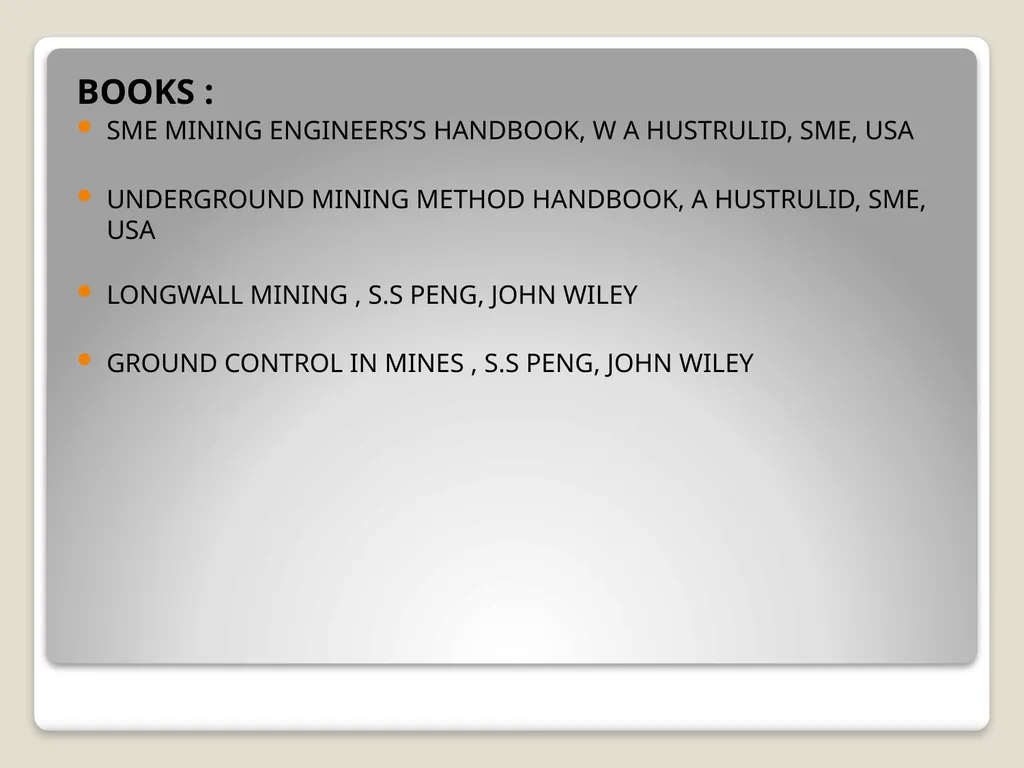
BOOKS :
SME MINING ENGINEERS’S HANDBOOK, W A HUSTRULID, SME, USA
UNDERGROUND MINING METHOD HANDBOOK, A HUSTRULID, SME, USA
LONGWALL MINING , S.S PENG, JOHN WILEY
GROUND CONTROL IN MINES , S.S PENG, JOHN WILEY<br>
SME MINING ENGINEERS’S HANDBOOK, W A HUSTRULID, SME, USA
UNDERGROUND MINING METHOD HANDBOOK, A HUSTRULID, SME, USA
LONGWALL MINING , S.S PENG, JOHN WILEY
GROUND CONTROL IN MINES , S.S PENG, JOHN WILEY<br>
04
CLASS TIMING :
MONDAY , TUESDAY, THURSDAY -- 8AM TO 8.55 AM
EXTRA CLASSES ON SATURDAY AND SUNDAY AS PER REQUIREMENT.
INTRODUCTION: NAME, AND TRAINING UNDER TAKEN IN SEMISTER
(IN LONGWALL OR CONTINUOS MINER)<br>
MONDAY , TUESDAY, THURSDAY -- 8AM TO 8.55 AM
EXTRA CLASSES ON SATURDAY AND SUNDAY AS PER REQUIREMENT.
INTRODUCTION: NAME, AND TRAINING UNDER TAKEN IN SEMISTER
(IN LONGWALL OR CONTINUOS MINER)<br>
05
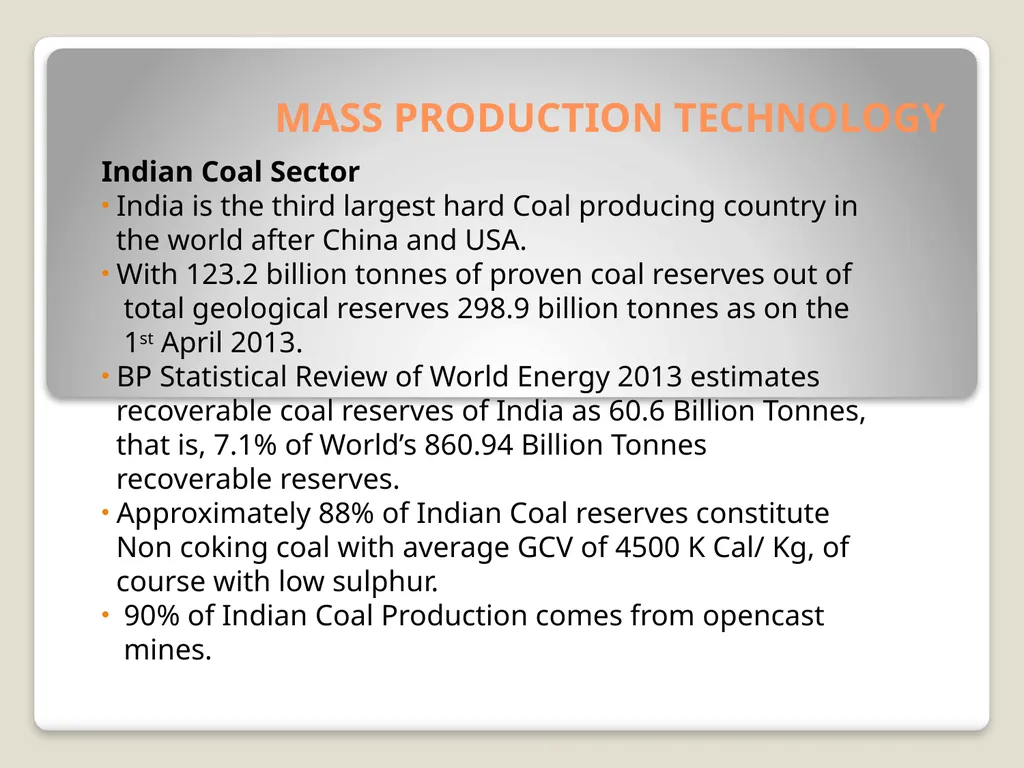
MASS PRODUCTION TECHNOLOGY Indian Coal Sector
India is the third largest hard Coal producing country in
the world after China and USA.
With 123.2 billion tonnes of proven coal reserves out of
total geological reserves 298.9 billion tonnes as on the
1st April 2013.
BP Statistical Review of World Energy 2013 estimates
recoverable coal reserves of India as 60.6 Billion Tonnes,
that is, 7.1% of World’s 860.94 Billion Tonnes
recoverable reserves.
Approximately 88% of Indian Coal reserves constitute
Non coking coal with average GCV of 4500 K Cal/ Kg, of
course with low sulphur.
90% of Indian Coal Production comes from opencast
mines.<br>
India is the third largest hard Coal producing country in
the world after China and USA.
With 123.2 billion tonnes of proven coal reserves out of
total geological reserves 298.9 billion tonnes as on the
1st April 2013.
BP Statistical Review of World Energy 2013 estimates
recoverable coal reserves of India as 60.6 Billion Tonnes,
that is, 7.1% of World’s 860.94 Billion Tonnes
recoverable reserves.
Approximately 88% of Indian Coal reserves constitute
Non coking coal with average GCV of 4500 K Cal/ Kg, of
course with low sulphur.
90% of Indian Coal Production comes from opencast
mines.<br>
06
MASS PRODUCTION TECHNOLOGY
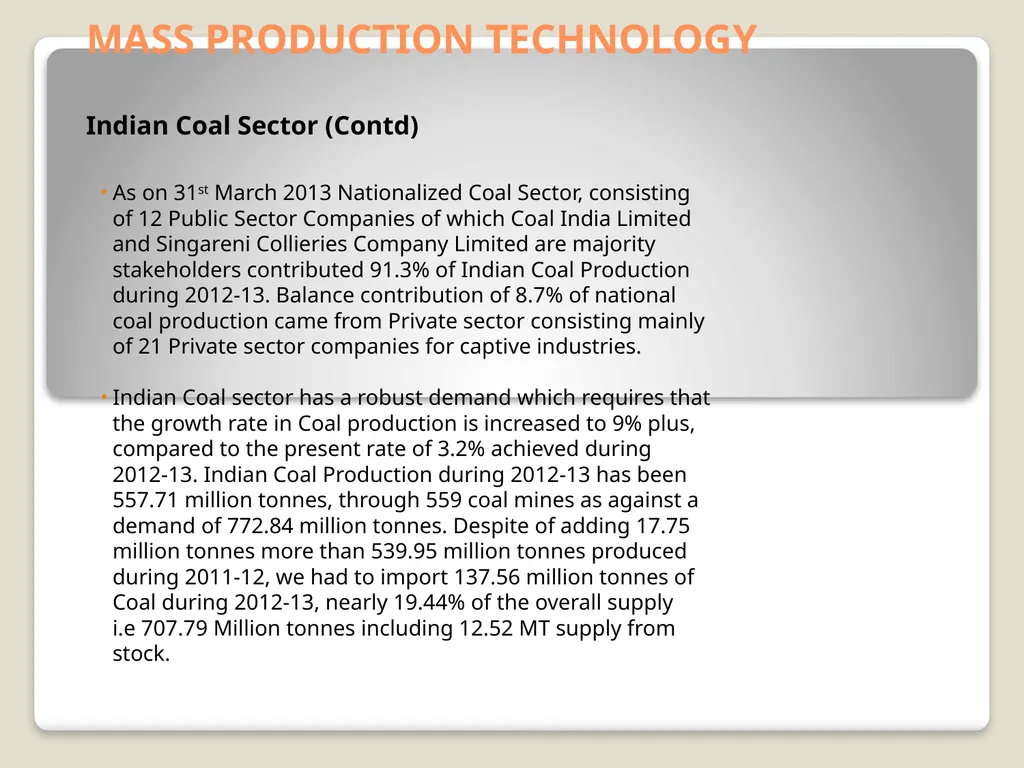
Indian Coal Sector (Contd) As on 31st March 2013 Nationalized Coal Sector, consisting
of 12 Public Sector Companies of which Coal India Limited
and Singareni Collieries Company Limited are majority
stakeholders contributed 91.3% of Indian Coal Production
during 2012-13. Balance contribution of 8.7% of national
coal production came from Private sector consisting mainly
of 21 Private sector companies for captive industries.
Indian Coal sector has a robust demand which requires that
the growth rate in Coal production is increased to 9% plus,
compared to the present rate of 3.2% achieved during
2012-13. Indian Coal Production during 2012-13 has been
557.71 million tonnes, through 559 coal mines as against a
demand of 772.84 million tonnes. Despite of adding 17.75
million tonnes more than 539.95 million tonnes produced
during 2011-12, we had to import 137.56 million tonnes of
Coal during 2012-13, nearly 19.44% of the overall supply
i.e 707.79 Million tonnes including 12.52 MT supply from
stock.<br>
of 12 Public Sector Companies of which Coal India Limited
and Singareni Collieries Company Limited are majority
stakeholders contributed 91.3% of Indian Coal Production
during 2012-13. Balance contribution of 8.7% of national
coal production came from Private sector consisting mainly
of 21 Private sector companies for captive industries.
Indian Coal sector has a robust demand which requires that
the growth rate in Coal production is increased to 9% plus,
compared to the present rate of 3.2% achieved during
2012-13. Indian Coal Production during 2012-13 has been
557.71 million tonnes, through 559 coal mines as against a
demand of 772.84 million tonnes. Despite of adding 17.75
million tonnes more than 539.95 million tonnes produced
during 2011-12, we had to import 137.56 million tonnes of
Coal during 2012-13, nearly 19.44% of the overall supply
i.e 707.79 Million tonnes including 12.52 MT supply from
stock.<br>
07
MASS PRODUCTION TECHNOLOGY
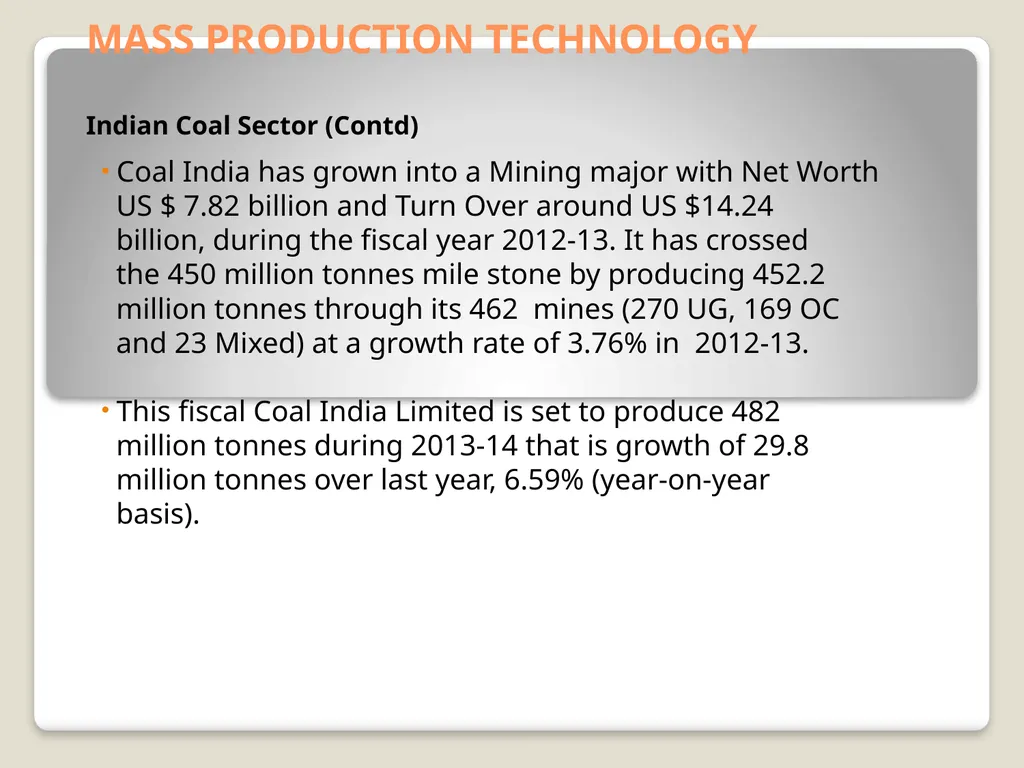
Indian Coal Sector (Contd) Coal India has grown into a Mining major with Net Worth
US $ 7.82 billion and Turn Over around US $14.24
billion, during the fiscal year 2012-13. It has crossed
the 450 million tonnes mile stone by producing 452.2
million tonnes through its 462 mines (270 UG, 169 OC
and 23 Mixed) at a growth rate of 3.76% in 2012-13.
This fiscal Coal India Limited is set to produce 482
million tonnes during 2013-14 that is growth of 29.8
million tonnes over last year, 6.59% (year-on-year
basis).<br>
US $ 7.82 billion and Turn Over around US $14.24
billion, during the fiscal year 2012-13. It has crossed
the 450 million tonnes mile stone by producing 452.2
million tonnes through its 462 mines (270 UG, 169 OC
and 23 Mixed) at a growth rate of 3.76% in 2012-13.
This fiscal Coal India Limited is set to produce 482
million tonnes during 2013-14 that is growth of 29.8
million tonnes over last year, 6.59% (year-on-year
basis).<br>
08
MASS PRODUCTION TECHNOLOGY
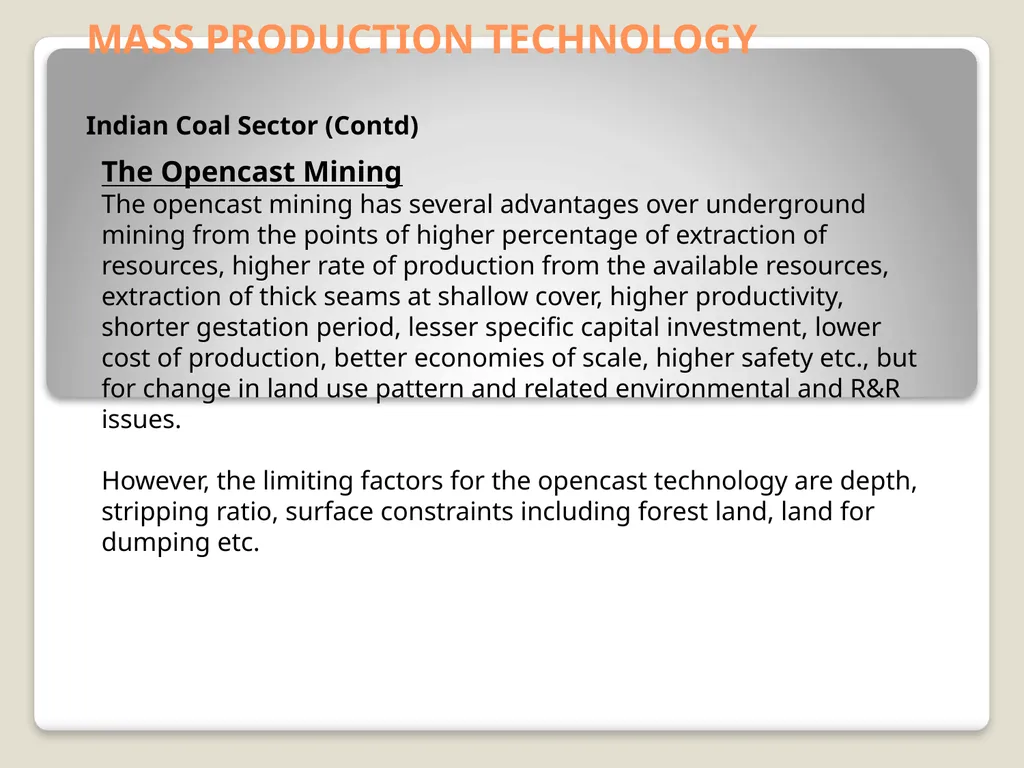
Indian Coal Sector (Contd) The Opencast Mining
The opencast mining has several advantages over underground mining from the points of higher percentage of extraction of resources, higher rate of production from the available resources, extraction of thick seams at shallow cover, higher productivity, shorter gestation period, lesser specific capital investment, lower cost of production, better economies of scale, higher safety etc., but for change in land use pattern and related environmental and R&R issues.
However, the limiting factors for the opencast technology are depth, stripping ratio, surface constraints including forest land, land for dumping etc.<br>
The opencast mining has several advantages over underground mining from the points of higher percentage of extraction of resources, higher rate of production from the available resources, extraction of thick seams at shallow cover, higher productivity, shorter gestation period, lesser specific capital investment, lower cost of production, better economies of scale, higher safety etc., but for change in land use pattern and related environmental and R&R issues.
However, the limiting factors for the opencast technology are depth, stripping ratio, surface constraints including forest land, land for dumping etc.<br>
09
MASS PRODUCTION TECHNOLOGY
Indian Coal Sector (Contd) The Opencast Mining (Contd)
Present Opencast Technology
The prevailing mining technologies deployed in OC mines include:
Shovel dumper combination
Shovel dumper/ dragline combination
Frontend Loader dumper combination
Dragline dozer combination for Overburden
Shovel dumper/in-pit crusher/ conveyor combination
Shovel-dumper /surface miner/rock breaker-tipper combination
Bucket wheel excavator/ conveyor combination (for lignite mining)
The OC mines in India were mostly designed with the combination of 5 cum and 10 cum electric rope shovels with 35T/50T and 85T/120T dumpers. Later on 20 cum shovel in combination with 170 T dumpers were adopted in some large mines. Recently, in two of the largest mines in SECL 42 cum rope shovels with 240 T dumpers were introduced.
Globally, the trend of introduction of higher capacity HEMM like 120 cum Draglines, 56/42 cum Rope Shovels, 34 cum Hyd. Shovels, 400/320/240 T Rear Dumpers, 850 HP Dozers, 20 cum Frontend Loaders is increasing. Indian coal industry would need to examine the scope for adoption of higher size HEMM.<br>
Present Opencast Technology
The prevailing mining technologies deployed in OC mines include:
Shovel dumper combination
Shovel dumper/ dragline combination
Frontend Loader dumper combination
Dragline dozer combination for Overburden
Shovel dumper/in-pit crusher/ conveyor combination
Shovel-dumper /surface miner/rock breaker-tipper combination
Bucket wheel excavator/ conveyor combination (for lignite mining)
The OC mines in India were mostly designed with the combination of 5 cum and 10 cum electric rope shovels with 35T/50T and 85T/120T dumpers. Later on 20 cum shovel in combination with 170 T dumpers were adopted in some large mines. Recently, in two of the largest mines in SECL 42 cum rope shovels with 240 T dumpers were introduced.
Globally, the trend of introduction of higher capacity HEMM like 120 cum Draglines, 56/42 cum Rope Shovels, 34 cum Hyd. Shovels, 400/320/240 T Rear Dumpers, 850 HP Dozers, 20 cum Frontend Loaders is increasing. Indian coal industry would need to examine the scope for adoption of higher size HEMM.<br>
10
MASS PRODUCTION TECHNOLOGY
Indian Coal Sector (Contd) The Opencast Mining (Contd)
In 1990s, Surface Miners were introduced in Indian coal mines for the first time in MCL. Since then it has become a major equipment for soft to medium hard coal extraction providing scope for avoiding drilling and blasting operations and crushing arrangements. With surface miners it is possible to mine in selective manner to avoid dilution of quality of insitu coal. MCL, SECL and CCL are making extensive use of this technology.
Next Generation Opencast Mines
For future resource use, environmental protection and land use, the next generation opencast mines have to be planned considering deep opencast mining of 500 m depth and beyond; extending and deepening existing opencast mines; planning of Super Pits/ mega mines of 25-30 Mt per annum capacity and more; deep seam mining beneath super pits; highwall mining to access exposed coal resources in final opencast batters/benches.<br>
In 1990s, Surface Miners were introduced in Indian coal mines for the first time in MCL. Since then it has become a major equipment for soft to medium hard coal extraction providing scope for avoiding drilling and blasting operations and crushing arrangements. With surface miners it is possible to mine in selective manner to avoid dilution of quality of insitu coal. MCL, SECL and CCL are making extensive use of this technology.
Next Generation Opencast Mines
For future resource use, environmental protection and land use, the next generation opencast mines have to be planned considering deep opencast mining of 500 m depth and beyond; extending and deepening existing opencast mines; planning of Super Pits/ mega mines of 25-30 Mt per annum capacity and more; deep seam mining beneath super pits; highwall mining to access exposed coal resources in final opencast batters/benches.<br>
11
MASS PRODUCTION TECHNOLOGY
Indian Coal Sector (Contd) Underground (UG) Mining Technology
The techno economic feasibility of a deposit dictates its mineability either through OC or UG method. Coal reserves occurring at depth are better suited for mining by UG method. UG production in the country has been declining steadily over past many decades mainly due to the need for quicker augmentation of production in line with rapidly increasing demand which was possible through taking up large size OC projects with economies of scale. The UG technology, in most of the cases requires higher investment, long gestation period and higher cost of production with greater exposure to safety risks involving strata control, fires, subsidence, gas problems etc. However, modern technologies infuse better confidence from safety, production and productivity angles with economies of scale.
The underground mining technologies presently in vogue in India are as follows:
Manual Bord & Pillar system
Semi-mechanized Bord & Pillar System With SDLs / LHDs
Mechanized Bord & Pillar System With Continuous Miners
Mechanized Bord & Pillar System With Continuous Miners
Shortwall Mining Technology
Thick Seam Mining
Steep Seam Mining
Thin Seam Mining
Technologies for deep Mining (>500 meters)<br>
The techno economic feasibility of a deposit dictates its mineability either through OC or UG method. Coal reserves occurring at depth are better suited for mining by UG method. UG production in the country has been declining steadily over past many decades mainly due to the need for quicker augmentation of production in line with rapidly increasing demand which was possible through taking up large size OC projects with economies of scale. The UG technology, in most of the cases requires higher investment, long gestation period and higher cost of production with greater exposure to safety risks involving strata control, fires, subsidence, gas problems etc. However, modern technologies infuse better confidence from safety, production and productivity angles with economies of scale.
The underground mining technologies presently in vogue in India are as follows:
Manual Bord & Pillar system
Semi-mechanized Bord & Pillar System With SDLs / LHDs
Mechanized Bord & Pillar System With Continuous Miners
Mechanized Bord & Pillar System With Continuous Miners
Shortwall Mining Technology
Thick Seam Mining
Steep Seam Mining
Thin Seam Mining
Technologies for deep Mining (>500 meters)<br>
12
MASS PRODUCTION TECHNOLOGY
Indian Coal Sector (Contd) Underground (UG) Mining Technology(Contd..)
Technology for Underground Coal Gasification (UCG)
In India, a large amount of coal exists beyond present techno-economically viable mining depth. Such coals have immense potential to yield energy through UCG. Additionally, there is a huge occurrence of coal in India, which has not even brought into lignite resource inventory, but otherwise known in course of oil and gas exploration in the country. These lignite fields need proper exploration and may be taken up for UCG in addition to known lignite deposits.
UCG got impetus through notifying the activity as one of the end uses under the captive mining policy for coal. This has enabled to consider allotment of identified coal blocks to potential entrepreneurs for developing UCG. Further, coal companies have also taken initiative in developing UCG in the blocks under their command area. CIL, SCCL and NLC joined hands with ONGC for developing UCG and ONGC in turn has associated itself with Skochinsky Institute of Mining, Russia. NLC’s R&D project for UCG did not take off due to non availability of technical consultants. Recently, CIL has taken initiative to develop two of its blocks namely Kaitha in Ramgarh coalfield of CCL and Tesghora-C block of WCL. Government has identified five lignite blocks and two coal blocks for UCG for offer under captive route. The development of UCG needs to be carried forward in the XII Plan in at least some four to five areas to establish the technology.<br>
Technology for Underground Coal Gasification (UCG)
In India, a large amount of coal exists beyond present techno-economically viable mining depth. Such coals have immense potential to yield energy through UCG. Additionally, there is a huge occurrence of coal in India, which has not even brought into lignite resource inventory, but otherwise known in course of oil and gas exploration in the country. These lignite fields need proper exploration and may be taken up for UCG in addition to known lignite deposits.
UCG got impetus through notifying the activity as one of the end uses under the captive mining policy for coal. This has enabled to consider allotment of identified coal blocks to potential entrepreneurs for developing UCG. Further, coal companies have also taken initiative in developing UCG in the blocks under their command area. CIL, SCCL and NLC joined hands with ONGC for developing UCG and ONGC in turn has associated itself with Skochinsky Institute of Mining, Russia. NLC’s R&D project for UCG did not take off due to non availability of technical consultants. Recently, CIL has taken initiative to develop two of its blocks namely Kaitha in Ramgarh coalfield of CCL and Tesghora-C block of WCL. Government has identified five lignite blocks and two coal blocks for UCG for offer under captive route. The development of UCG needs to be carried forward in the XII Plan in at least some four to five areas to establish the technology.<br>
13
MASS PRODUCTION TECHNOLOGY
Indian Coal Sector (Contd) Action for XII Plan
Opencast Mining
Conservation of reserves: designing of large size pits and amalgamation of adjacent mines for extracting locked up coal in batters and barriers;
Scientific approach for designing pit slopes and dump slopes with appropriate monitoring measures;
Large scale adoption of in-pit crushing and conveying of coal and OB;
Standardization of HEMM for various pit capacities;
Integrating washeries with all new opencast mines;
Land reclamation and mine closure plans with monitoring mechanism;
Application of IT for fleet management, inventory, maintenance and safety
In each subsidiary producing coal through OC operation, at least two high capacity OC mines are to be designed with state of the art technology, facilities of electronic monitoring, control system and facilities comparable to the best available in the world.<br>
Opencast Mining
Conservation of reserves: designing of large size pits and amalgamation of adjacent mines for extracting locked up coal in batters and barriers;
Scientific approach for designing pit slopes and dump slopes with appropriate monitoring measures;
Large scale adoption of in-pit crushing and conveying of coal and OB;
Standardization of HEMM for various pit capacities;
Integrating washeries with all new opencast mines;
Land reclamation and mine closure plans with monitoring mechanism;
Application of IT for fleet management, inventory, maintenance and safety
In each subsidiary producing coal through OC operation, at least two high capacity OC mines are to be designed with state of the art technology, facilities of electronic monitoring, control system and facilities comparable to the best available in the world.<br>
14
MASS PRODUCTION TECHNOLOGY
Indian Coal Sector (Contd) Action for XII Plan
Underground Mining
All new underground mines are to be planned with high degree of mechanization;
Large scale introduction of mass production technologies like longwall mining
technology, continuous mining technology etc.
Non mechanized existing mines to be quickly converted to mechanised mines
through adoption of SDL/LHD/Continuous miners and mechanized drilling and
roof bolting;
In each subsidiary producing coal through UG operation, at least two high
capacity UG mines are to be designed with state of the art technology, facilities of
electronic monitoring, control system and facilities comparable to the best
available in the world.
Scientific strata and environment monitoring;
Risk assessment and mitigation plans;
Faster development of infrastructure for UG mines- Mechanised shaft and incline
drivages; high speed skips, conveyors etc.
Introduction of man riding systems in UG mines;
Adoption of telecommunications in underground mines;<br>
Underground Mining
All new underground mines are to be planned with high degree of mechanization;
Large scale introduction of mass production technologies like longwall mining
technology, continuous mining technology etc.
Non mechanized existing mines to be quickly converted to mechanised mines
through adoption of SDL/LHD/Continuous miners and mechanized drilling and
roof bolting;
In each subsidiary producing coal through UG operation, at least two high
capacity UG mines are to be designed with state of the art technology, facilities of
electronic monitoring, control system and facilities comparable to the best
available in the world.
Scientific strata and environment monitoring;
Risk assessment and mitigation plans;
Faster development of infrastructure for UG mines- Mechanised shaft and incline
drivages; high speed skips, conveyors etc.
Introduction of man riding systems in UG mines;
Adoption of telecommunications in underground mines;<br>
15
MASS PRODUCTION TECHNOLOGY
Long Term Forecasts for Coal Demand in India: Integrated Energy Policy document envisages power
requirement for the country energy consumption at a
level of 2043 Million tonnes Oil equivalent, leading to
power requirement of 800 GW, necessitating coal
requirement at 1.6 Billion Tonnes under the least coal
intensive option and 2.6 billion tonnes in Business as
Usual scenario during 2031-32, averaging at the often
quoted figure of 2 Billion Tonnes per Year.
As per Coal vision document, the coal requirement will
be 1.25 Billion tonnes by the year 2025 at 8% GDP
growth.<br>
requirement for the country energy consumption at a
level of 2043 Million tonnes Oil equivalent, leading to
power requirement of 800 GW, necessitating coal
requirement at 1.6 Billion Tonnes under the least coal
intensive option and 2.6 billion tonnes in Business as
Usual scenario during 2031-32, averaging at the often
quoted figure of 2 Billion Tonnes per Year.
As per Coal vision document, the coal requirement will
be 1.25 Billion tonnes by the year 2025 at 8% GDP
growth.<br>
16
MASS PRODUCTION TECHNOLOGY
Coal Demand during XIth XIIth & XIIIth Plan: The target for coal production at the end of the
Eleventh Plan was initially set at 680 million tonnes and
revised downwards to 630 million tonnes at the time of
the MTA. The actual achievement was only 539.95
million tonnes.
This has adversely affected the coal supplies to end
consumers, particularly the power sector. It is estimated
that out of the capacity addition of 41.89 GW, around 25
GW of coal-based capacity commissioned has been sub-
optimally utilised because of inadequate availability of
domestic coal.
Total demand for coal grew by around 6.6 per cent
during the Eleventh Plan against the domestic production
growth of only 4.61 per cent, and the gap was partially
filled from higher imports from the level of. 43.081 Million
Tonnes in 2006-07 to 102.853 million tonnes in 2011-12.<br>
Eleventh Plan was initially set at 680 million tonnes and
revised downwards to 630 million tonnes at the time of
the MTA. The actual achievement was only 539.95
million tonnes.
This has adversely affected the coal supplies to end
consumers, particularly the power sector. It is estimated
that out of the capacity addition of 41.89 GW, around 25
GW of coal-based capacity commissioned has been sub-
optimally utilised because of inadequate availability of
domestic coal.
Total demand for coal grew by around 6.6 per cent
during the Eleventh Plan against the domestic production
growth of only 4.61 per cent, and the gap was partially
filled from higher imports from the level of. 43.081 Million
Tonnes in 2006-07 to 102.853 million tonnes in 2011-12.<br>
17
MASS PRODUCTION TECHNOLOGY
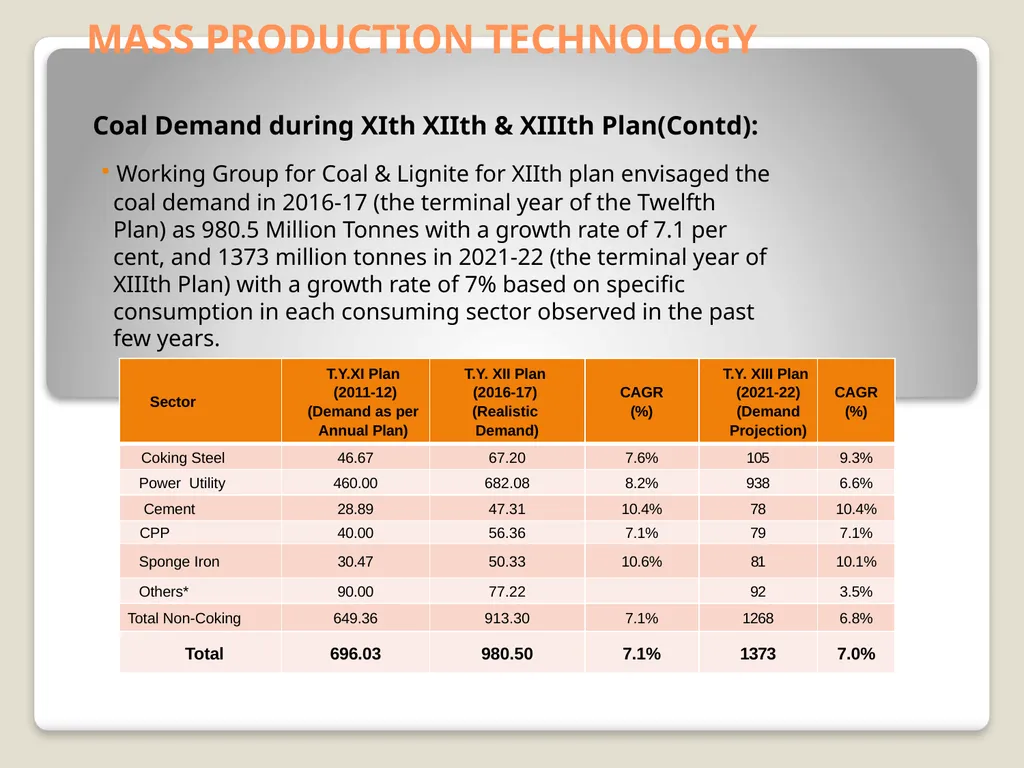
Coal Demand during XIth XIIth & XIIIth Plan(Contd): Working Group for Coal & Lignite for XIIth plan envisaged the
coal demand in 2016-17 (the terminal year of the Twelfth
Plan) as 980.5 Million Tonnes with a growth rate of 7.1 per
cent, and 1373 million tonnes in 2021-22 (the terminal year of
XIIIth Plan) with a growth rate of 7% based on specific
consumption in each consuming sector observed in the past
few years.<br>
coal demand in 2016-17 (the terminal year of the Twelfth
Plan) as 980.5 Million Tonnes with a growth rate of 7.1 per
cent, and 1373 million tonnes in 2021-22 (the terminal year of
XIIIth Plan) with a growth rate of 7% based on specific
consumption in each consuming sector observed in the past
few years.<br>
18
MASS PRODUCTION TECHNOLOGY
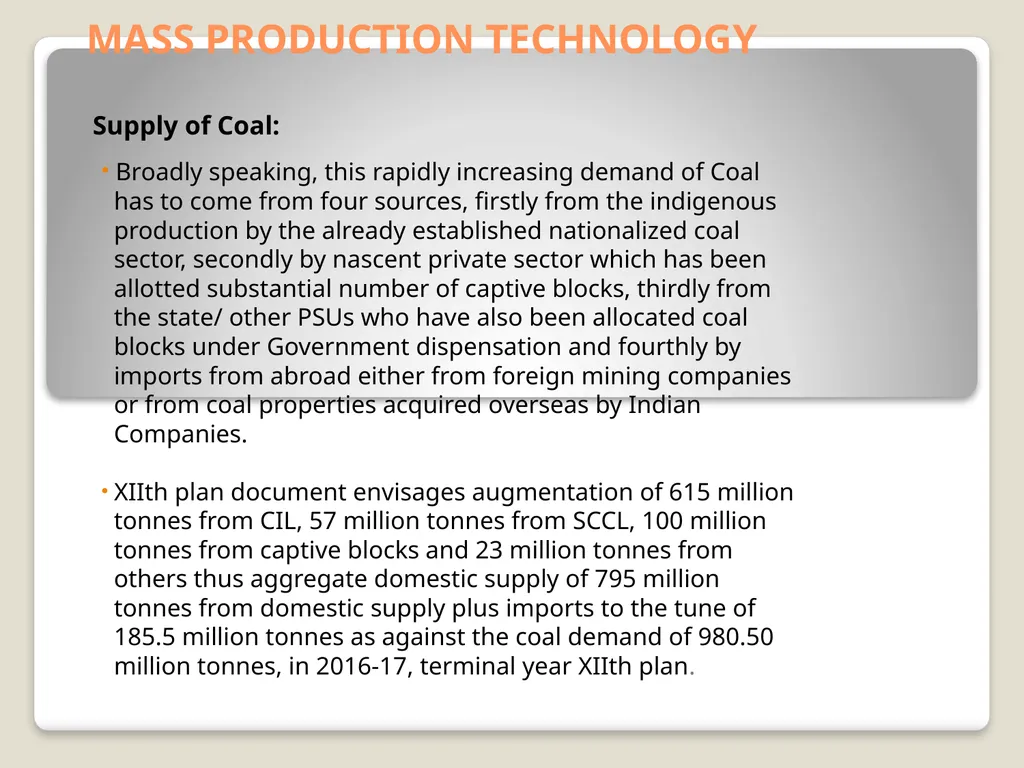
Supply of Coal: Broadly speaking, this rapidly increasing demand of Coal
has to come from four sources, firstly from the indigenous
production by the already established nationalized coal
sector, secondly by nascent private sector which has been
allotted substantial number of captive blocks, thirdly from
the state/ other PSUs who have also been allocated coal
blocks under Government dispensation and fourthly by
imports from abroad either from foreign mining companies
or from coal properties acquired overseas by Indian
Companies.
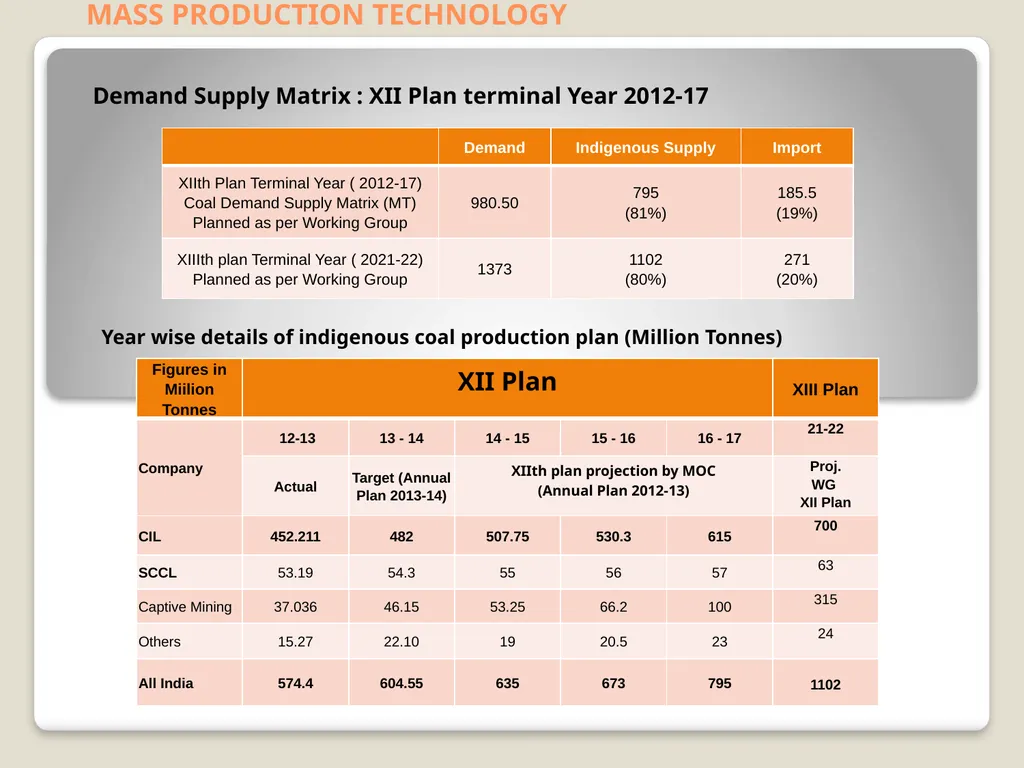
XIIth plan document envisages augmentation of 615 million
tonnes from CIL, 57 million tonnes from SCCL, 100 million
tonnes from captive blocks and 23 million tonnes from
others thus aggregate domestic supply of 795 million
tonnes from domestic supply plus imports to the tune of
185.5 million tonnes as against the coal demand of 980.50
million tonnes, in 2016-17, terminal year XIIth plan.<br>
has to come from four sources, firstly from the indigenous
production by the already established nationalized coal
sector, secondly by nascent private sector which has been
allotted substantial number of captive blocks, thirdly from
the state/ other PSUs who have also been allocated coal
blocks under Government dispensation and fourthly by
imports from abroad either from foreign mining companies
or from coal properties acquired overseas by Indian
Companies.
XIIth plan document envisages augmentation of 615 million
tonnes from CIL, 57 million tonnes from SCCL, 100 million
tonnes from captive blocks and 23 million tonnes from
others thus aggregate domestic supply of 795 million
tonnes from domestic supply plus imports to the tune of
185.5 million tonnes as against the coal demand of 980.50
million tonnes, in 2016-17, terminal year XIIth plan.<br>
19
MASS PRODUCTION TECHNOLOGY
Demand Supply Matrix : XII Plan terminal Year 2012-17 Year wise details of indigenous coal production plan (Million Tonnes)<br>
20
MASS PRODUCTION TECHNOLOGY
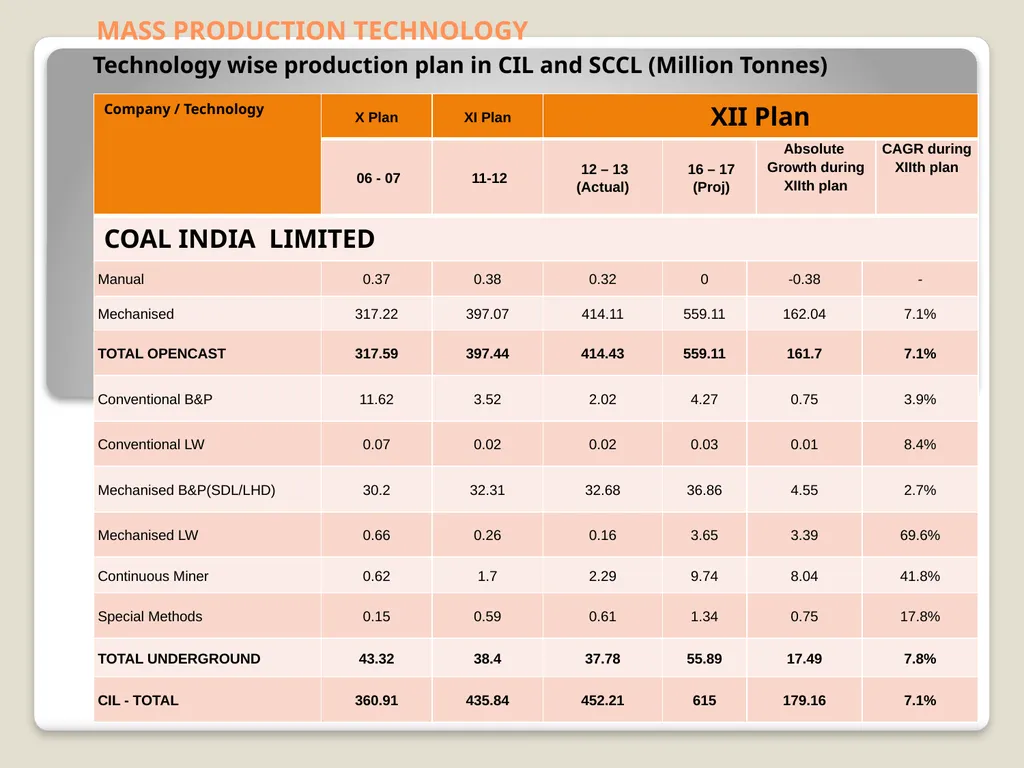
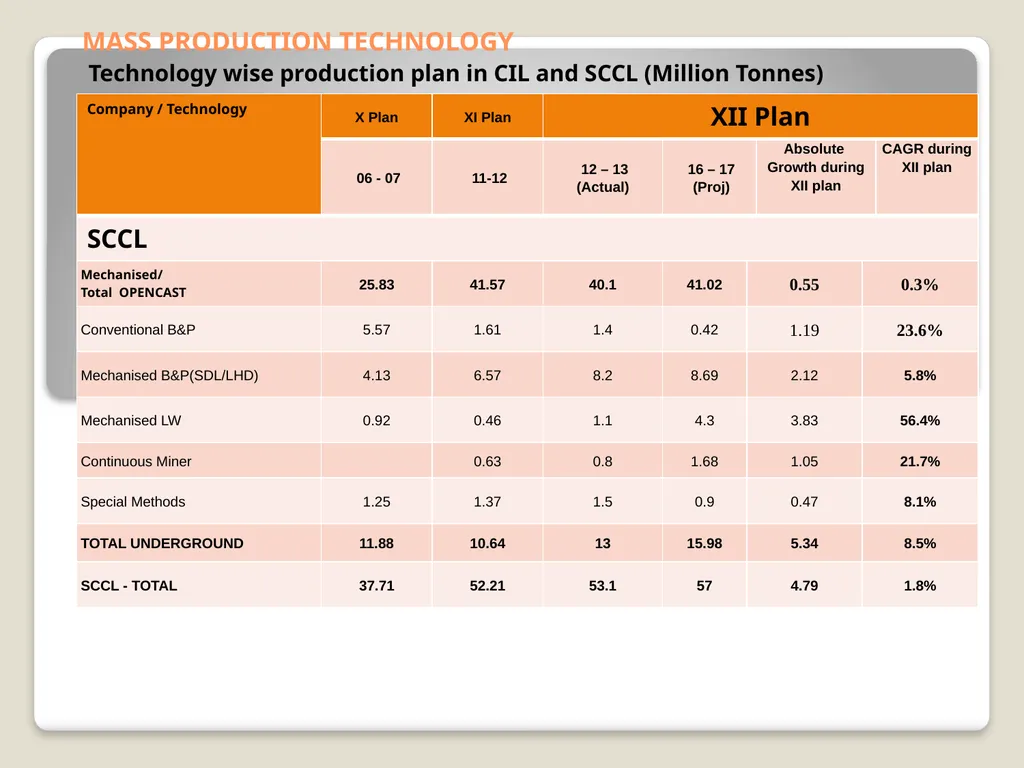
Technology wise production plan in CIL and SCCL (Million Tonnes)<br>
21
MASS PRODUCTION TECHNOLOGY
Technology wise production plan in CIL and SCCL (Million Tonnes)<br>
22
MASS PRODUCTION TECHNOLOGY
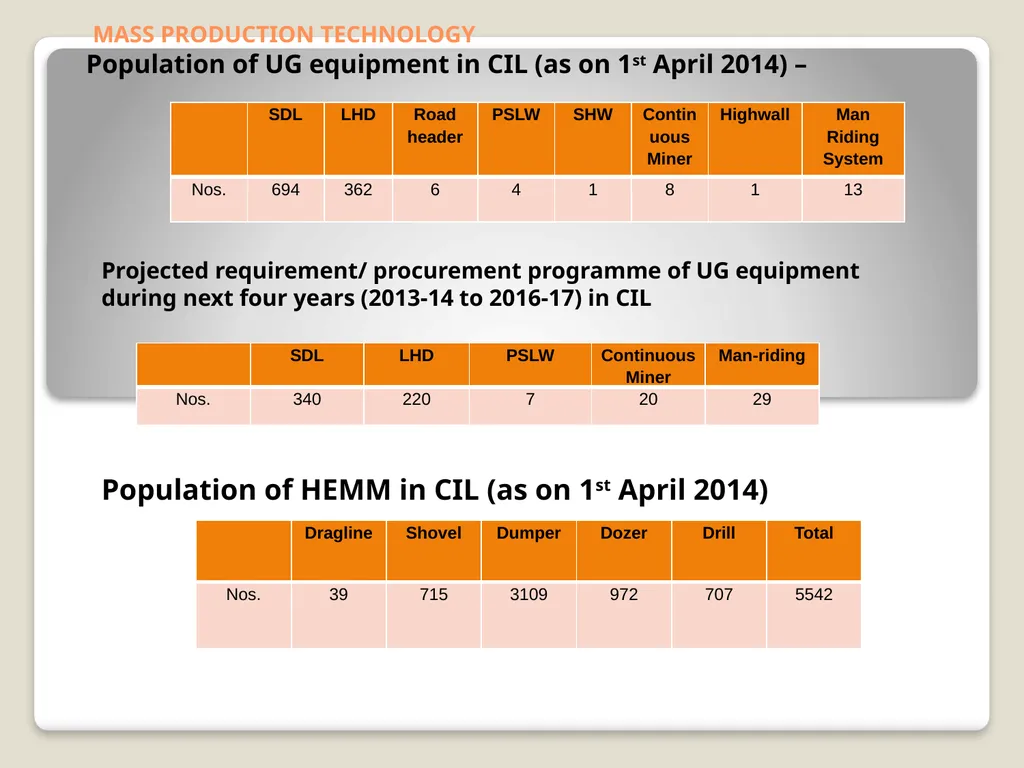
Population of UG equipment in CIL (as on 1st April 2014) – Projected requirement/ procurement programme of UG equipment during next four years (2013-14 to 2016-17) in CIL
Population of HEMM in CIL (as on 1st April 2014)<br>
Population of HEMM in CIL (as on 1st April 2014)<br>
23
MASS PRODUCTION TECHNOLOGY
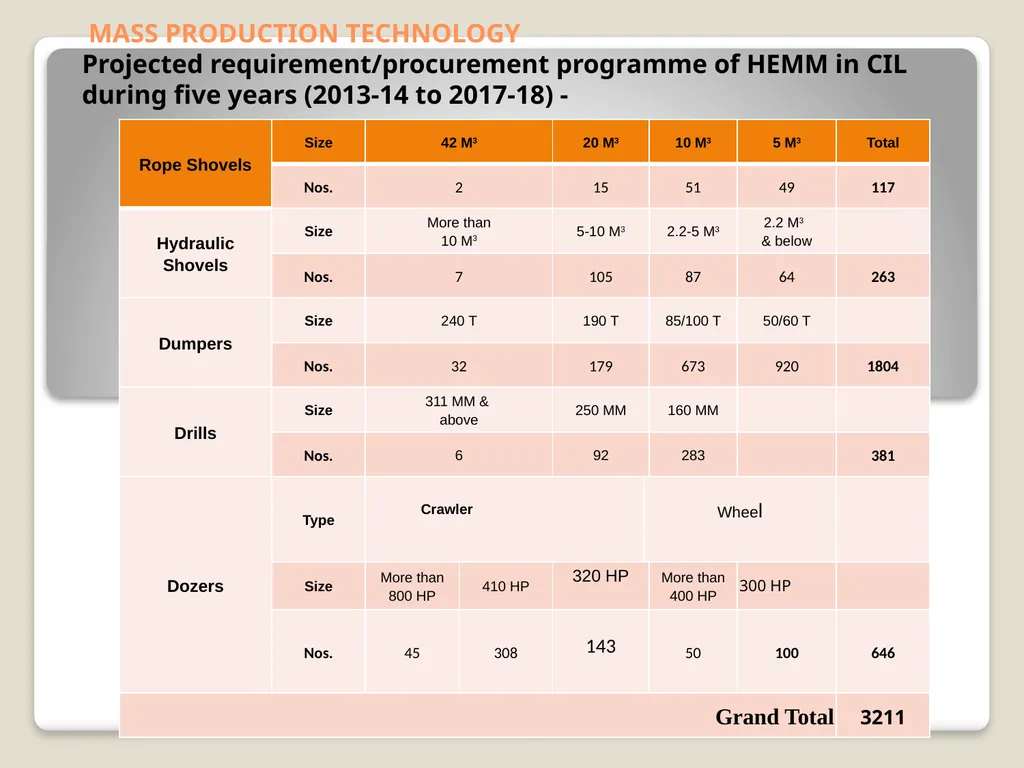
Projected requirement/procurement programme of HEMM in CIL during five years (2013-14 to 2017-18) -<br>
24
MASS PRODUCTION TECHNOLOGY
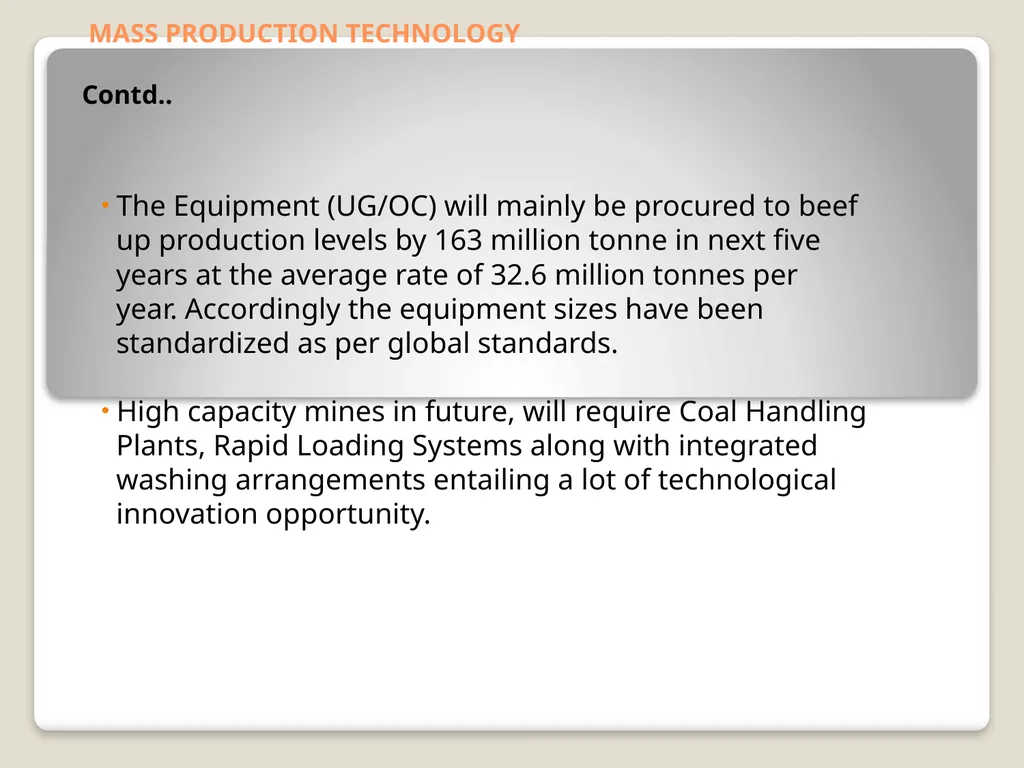
Contd.. The Equipment (UG/OC) will mainly be procured to beef
up production levels by 163 million tonne in next five
years at the average rate of 32.6 million tonnes per
year. Accordingly the equipment sizes have been
standardized as per global standards.
High capacity mines in future, will require Coal Handling
Plants, Rapid Loading Systems along with integrated
washing arrangements entailing a lot of technological
innovation opportunity.<br>
up production levels by 163 million tonne in next five
years at the average rate of 32.6 million tonnes per
year. Accordingly the equipment sizes have been
standardized as per global standards.
High capacity mines in future, will require Coal Handling
Plants, Rapid Loading Systems along with integrated
washing arrangements entailing a lot of technological
innovation opportunity.<br>
25
MASS PRODUCTION TECHNOLOGY
MASS PRODUCTION TECHNOLOGY
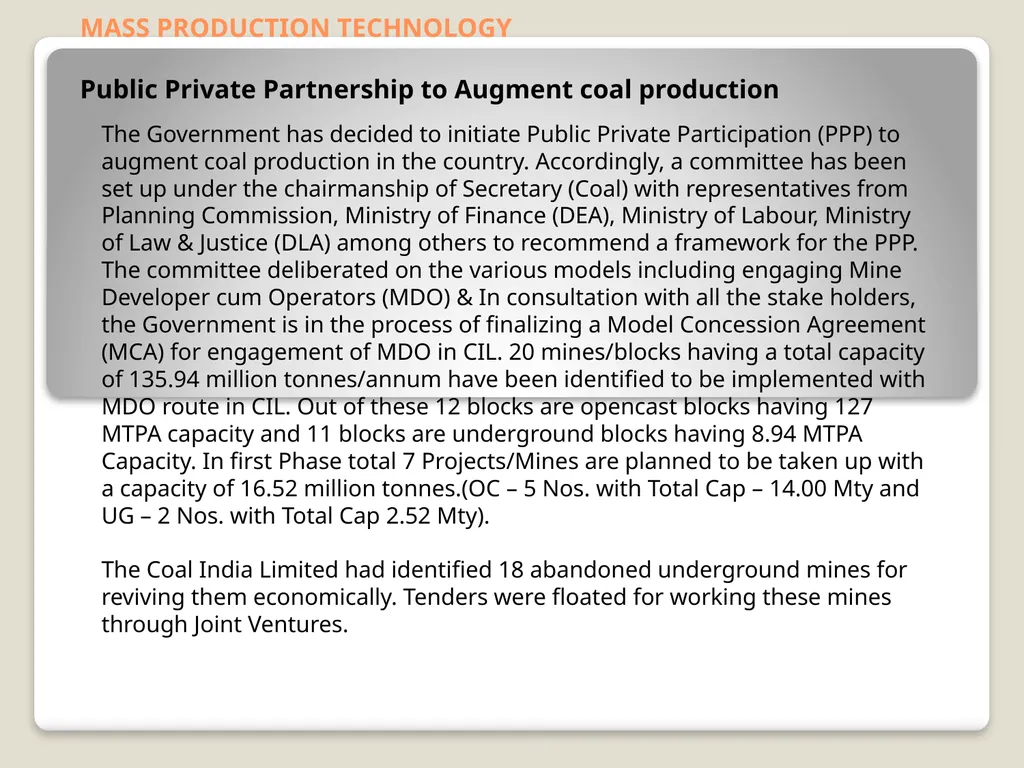
Public Private Partnership to Augment coal production The Government has decided to initiate Public Private Participation (PPP) to augment coal production in the country. Accordingly, a committee has been set up under the chairmanship of Secretary (Coal) with representatives from Planning Commission, Ministry of Finance (DEA), Ministry of Labour, Ministry of Law & Justice (DLA) among others to recommend a framework for the PPP. The committee deliberated on the various models including engaging Mine Developer cum Operators (MDO) & In consultation with all the stake holders, the Government is in the process of finalizing a Model Concession Agreement (MCA) for engagement of MDO in CIL. 20 mines/blocks having a total capacity of 135.94 million tonnes/annum have been identified to be implemented with MDO route in CIL. Out of these 12 blocks are opencast blocks having 127 MTPA capacity and 11 blocks are underground blocks having 8.94 MTPA Capacity. In first Phase total 7 Projects/Mines are planned to be taken up with a capacity of 16.52 million tonnes.(OC – 5 Nos. with Total Cap – 14.00 Mty and UG – 2 Nos. with Total Cap 2.52 Mty).
The Coal India Limited had identified 18 abandoned underground mines for reviving them economically. Tenders were floated for working these mines through Joint Ventures.<br>
The Coal India Limited had identified 18 abandoned underground mines for reviving them economically. Tenders were floated for working these mines through Joint Ventures.<br>
26
MASS PRODUCTION TECHNOLOGY
MASS PRODUCTION TECHNOLOGY
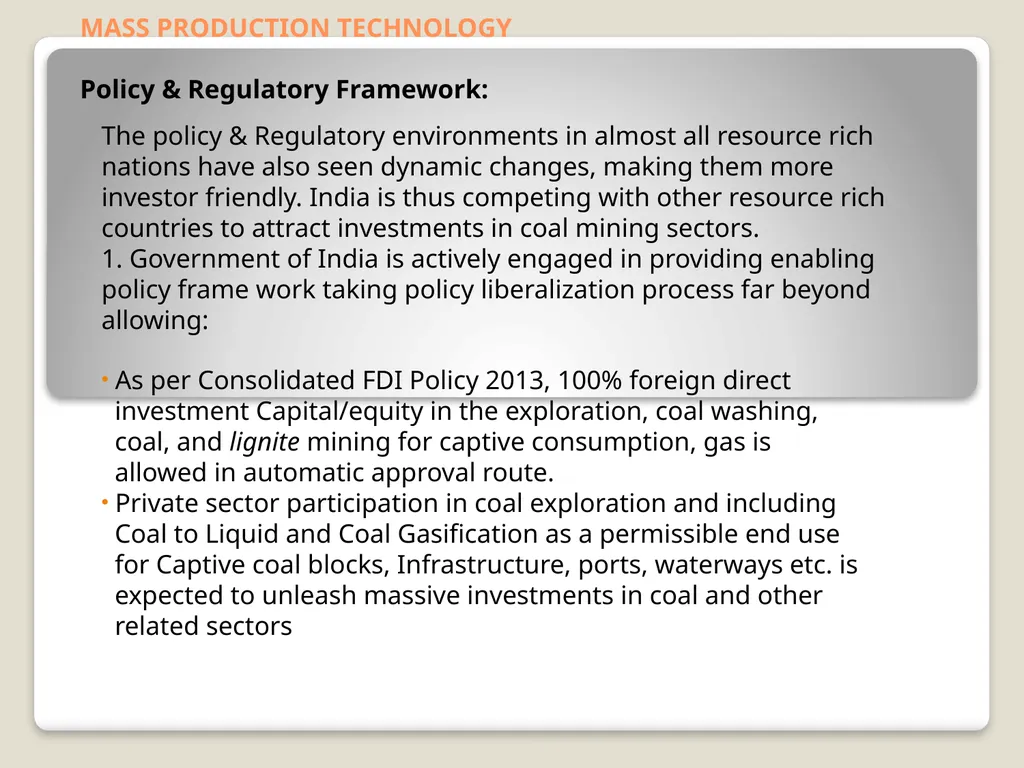
Policy & Regulatory Framework: The policy & Regulatory environments in almost all resource rich nations have also seen dynamic changes, making them more investor friendly. India is thus competing with other resource rich countries to attract investments in coal mining sectors.
1. Government of India is actively engaged in providing enabling policy frame work taking policy liberalization process far beyond allowing:
As per Consolidated FDI Policy 2013, 100% foreign direct
investment Capital/equity in the exploration, coal washing,
coal, and lignite mining for captive consumption, gas is
allowed in automatic approval route.
Private sector participation in coal exploration and including
Coal to Liquid and Coal Gasification as a permissible end use
for Captive coal blocks, Infrastructure, ports, waterways etc. is
expected to unleash massive investments in coal and other
related sectors<br>
1. Government of India is actively engaged in providing enabling policy frame work taking policy liberalization process far beyond allowing:
As per Consolidated FDI Policy 2013, 100% foreign direct
investment Capital/equity in the exploration, coal washing,
coal, and lignite mining for captive consumption, gas is
allowed in automatic approval route.
Private sector participation in coal exploration and including
Coal to Liquid and Coal Gasification as a permissible end use
for Captive coal blocks, Infrastructure, ports, waterways etc. is
expected to unleash massive investments in coal and other
related sectors<br>
27
MASS PRODUCTION TECHNOLOGY
MASS PRODUCTION TECHNOLOGY
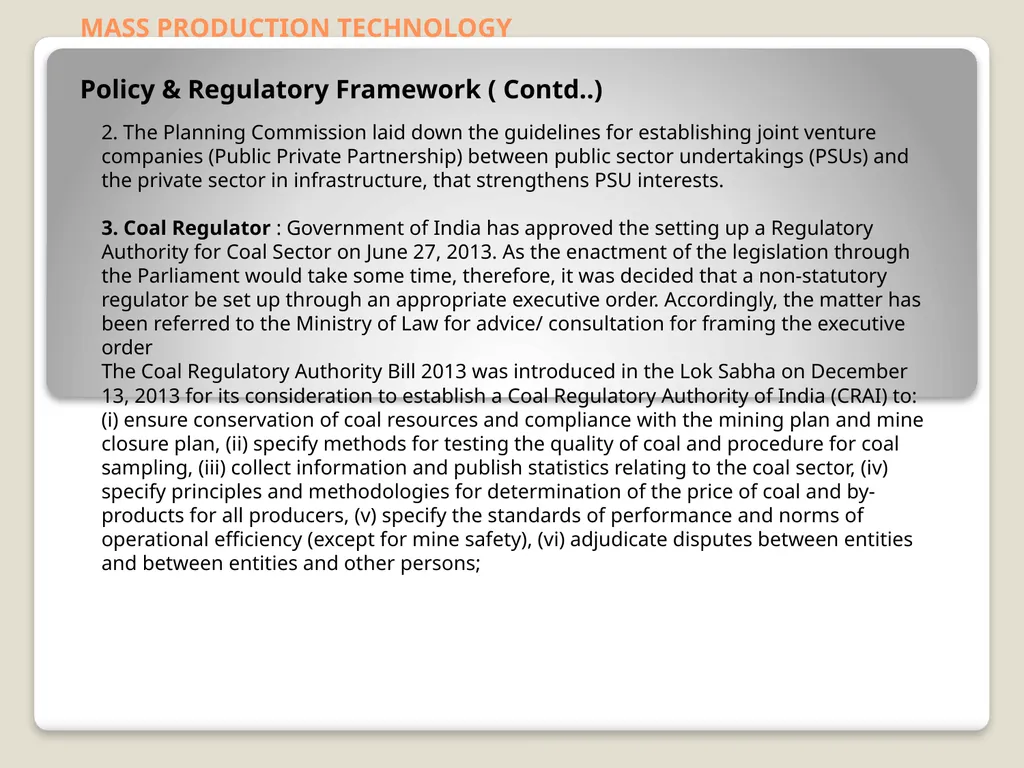
Policy & Regulatory Framework ( Contd..) 2. The Planning Commission laid down the guidelines for establishing joint venture companies (Public Private Partnership) between public sector undertakings (PSUs) and the private sector in infrastructure, that strengthens PSU interests.
3. Coal Regulator : Government of India has approved the setting up a Regulatory Authority for Coal Sector on June 27, 2013. As the enactment of the legislation through the Parliament would take some time, therefore, it was decided that a non-statutory regulator be set up through an appropriate executive order. Accordingly, the matter has been referred to the Ministry of Law for advice/ consultation for framing the executive order
The Coal Regulatory Authority Bill 2013 was introduced in the Lok Sabha on December 13, 2013 for its consideration to establish a Coal Regulatory Authority of India (CRAI) to:
(i) ensure conservation of coal resources and compliance with the mining plan and mine closure plan, (ii) specify methods for testing the quality of coal and procedure for coal sampling, (iii) collect information and publish statistics relating to the coal sector, (iv) specify principles and methodologies for determination of the price of coal and by-products for all producers, (v) specify the standards of performance and norms of operational efficiency (except for mine safety), (vi) adjudicate disputes between entities and between entities and other persons;<br>
3. Coal Regulator : Government of India has approved the setting up a Regulatory Authority for Coal Sector on June 27, 2013. As the enactment of the legislation through the Parliament would take some time, therefore, it was decided that a non-statutory regulator be set up through an appropriate executive order. Accordingly, the matter has been referred to the Ministry of Law for advice/ consultation for framing the executive order
The Coal Regulatory Authority Bill 2013 was introduced in the Lok Sabha on December 13, 2013 for its consideration to establish a Coal Regulatory Authority of India (CRAI) to:
(i) ensure conservation of coal resources and compliance with the mining plan and mine closure plan, (ii) specify methods for testing the quality of coal and procedure for coal sampling, (iii) collect information and publish statistics relating to the coal sector, (iv) specify principles and methodologies for determination of the price of coal and by-products for all producers, (v) specify the standards of performance and norms of operational efficiency (except for mine safety), (vi) adjudicate disputes between entities and between entities and other persons;<br>
28
MASS PRODUCTION TECHNOLOGY
MASS PRODUCTION TECHNOLOGY
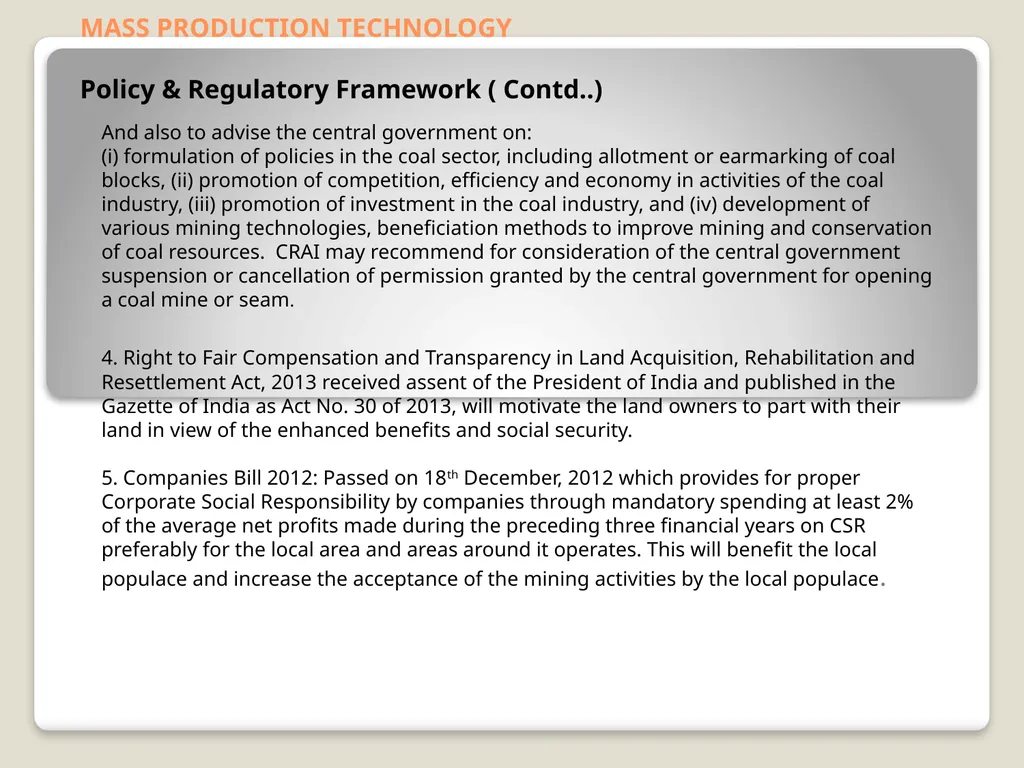
Policy & Regulatory Framework ( Contd..) And also to advise the central government on:
(i) formulation of policies in the coal sector, including allotment or earmarking of coal blocks, (ii) promotion of competition, efficiency and economy in activities of the coal industry, (iii) promotion of investment in the coal industry, and (iv) development of various mining technologies, beneficiation methods to improve mining and conservation of coal resources. CRAI may recommend for consideration of the central government suspension or cancellation of permission granted by the central government for opening a coal mine or seam.
4. Right to Fair Compensation and Transparency in Land Acquisition, Rehabilitation and Resettlement Act, 2013 received assent of the President of India and published in the Gazette of India as Act No. 30 of 2013, will motivate the land owners to part with their land in view of the enhanced benefits and social security.
5. Companies Bill 2012: Passed on 18th December, 2012 which provides for proper Corporate Social Responsibility by companies through mandatory spending at least 2% of the average net profits made during the preceding three financial years on CSR preferably for the local area and areas around it operates. This will benefit the local populace and increase the acceptance of the mining activities by the local populace.<br>
(i) formulation of policies in the coal sector, including allotment or earmarking of coal blocks, (ii) promotion of competition, efficiency and economy in activities of the coal industry, (iii) promotion of investment in the coal industry, and (iv) development of various mining technologies, beneficiation methods to improve mining and conservation of coal resources. CRAI may recommend for consideration of the central government suspension or cancellation of permission granted by the central government for opening a coal mine or seam.
4. Right to Fair Compensation and Transparency in Land Acquisition, Rehabilitation and Resettlement Act, 2013 received assent of the President of India and published in the Gazette of India as Act No. 30 of 2013, will motivate the land owners to part with their land in view of the enhanced benefits and social security.
5. Companies Bill 2012: Passed on 18th December, 2012 which provides for proper Corporate Social Responsibility by companies through mandatory spending at least 2% of the average net profits made during the preceding three financial years on CSR preferably for the local area and areas around it operates. This will benefit the local populace and increase the acceptance of the mining activities by the local populace.<br>
29
MASS PRODUCTION TECHNOLOGY
MASS PRODUCTION TECHNOLOGY
Policy & Regulatory Framework ( Contd..) 6. The Coal Mines (Conservation and Development) Amendment Bill, 2012 has been introduced in the Lok Sabha on November 22, 2012 to amend the Coal Mines (Conservation and Development) Act, 1974 and provides for the conservation of coal and development of mines, and for imposition of excise duty and customs duty, is pending.
7. The Mines and Minerals (Development And Regulation) Amendment Bill, 2008, already been passed 2010 enabling competitive bidding for captive coal blocks.
8. Coal Mines Nationalization Amendment Bill 2000 is pending for suitable amendment in Coal Mines Nationalization Act 1973. The most important and most debated amendment being to permit the captive block owners to sell surplus production after meeting their requirements, which may lead to furtherance of competition. However, Government has formulated a draft policy on usage of surplus coal, including middlings, rejects, etc. which has been circulated to various Ministries / Departments for obtaining their comments. This will motivate and incentivize the captive block holders to produce surplus/more coal which can be effective used to meet the coal shortage and also reduce the import quantity. This will also help partly in addressing the current account deficit issue.<br>
7. The Mines and Minerals (Development And Regulation) Amendment Bill, 2008, already been passed 2010 enabling competitive bidding for captive coal blocks.
8. Coal Mines Nationalization Amendment Bill 2000 is pending for suitable amendment in Coal Mines Nationalization Act 1973. The most important and most debated amendment being to permit the captive block owners to sell surplus production after meeting their requirements, which may lead to furtherance of competition. However, Government has formulated a draft policy on usage of surplus coal, including middlings, rejects, etc. which has been circulated to various Ministries / Departments for obtaining their comments. This will motivate and incentivize the captive block holders to produce surplus/more coal which can be effective used to meet the coal shortage and also reduce the import quantity. This will also help partly in addressing the current account deficit issue.<br>
30
MASS PRODUCTION TECHNOLOGY
MASS PRODUCTION TECHNOLOGY
Policy & Regulatory Framework ( Contd..) 9. Coal sector witnessed a number of other initiatives during 2013 to augment coal production and supply.
Ministry of Coal has constituted a Central co-ordination committee to act as the
coordinating agency for monitoring and expediting FCA (Forest Conservation Act)
clearances to facilitate coordination for timely completion of procedures at the
State level and suggest measures to improve the same headed by Coal Secretary
with representatives from Ministry of Environment and Forests (MoEF), Steel,
Power, Statistics & Programme Implementation, Deptt..of Industrial Policy &
Promotion, Department of Economic Affairs, Principal Secretaries of coal-
producing States, Geological Survey of India, SCCL, CIL, NLC, ASSOCHAM,
FICCI, Federation of Indian Mineral Industries(FIMI), etc.
Prime Minister’s Office has constituted the Inter Ministerial Committee under the
Chairmanship of Chairman, Railway Board with Secretary, /Ministry of Coal,
Secretary,/Ministry of Power and Secretary,/Ministry of Environment & Forest as
members. Concerned Railway officers along with senior officers of CIL, CCL,
RITES, MCL, SECL and IRCON to monitor the progress of coal connectivity
projects so that the roadblocks are removed expeditiously and the projects are
completed in a time bound manner.
The Cabinet Committee on Economic Affairs has approved the supply of coal to
nine of the 24 units in which the development of coal blocks was delayed due to
the ‘Go-No-Go’ Policy of the Ministry of Environment & Forests on FSA basis
subject to review/ readjustment wherever necessary.
10. Indian Coal Sector looks forward for grant of status of infrastructure, thereby getting duty concession for capital goods imports similar on the lines of power sector. It makes prudent business sense as it will result in reduction of cost in the long run and benefit of which will be passed to power sector itself.<br>
Ministry of Coal has constituted a Central co-ordination committee to act as the
coordinating agency for monitoring and expediting FCA (Forest Conservation Act)
clearances to facilitate coordination for timely completion of procedures at the
State level and suggest measures to improve the same headed by Coal Secretary
with representatives from Ministry of Environment and Forests (MoEF), Steel,
Power, Statistics & Programme Implementation, Deptt..of Industrial Policy &
Promotion, Department of Economic Affairs, Principal Secretaries of coal-
producing States, Geological Survey of India, SCCL, CIL, NLC, ASSOCHAM,
FICCI, Federation of Indian Mineral Industries(FIMI), etc.
Prime Minister’s Office has constituted the Inter Ministerial Committee under the
Chairmanship of Chairman, Railway Board with Secretary, /Ministry of Coal,
Secretary,/Ministry of Power and Secretary,/Ministry of Environment & Forest as
members. Concerned Railway officers along with senior officers of CIL, CCL,
RITES, MCL, SECL and IRCON to monitor the progress of coal connectivity
projects so that the roadblocks are removed expeditiously and the projects are
completed in a time bound manner.
The Cabinet Committee on Economic Affairs has approved the supply of coal to
nine of the 24 units in which the development of coal blocks was delayed due to
the ‘Go-No-Go’ Policy of the Ministry of Environment & Forests on FSA basis
subject to review/ readjustment wherever necessary.
10. Indian Coal Sector looks forward for grant of status of infrastructure, thereby getting duty concession for capital goods imports similar on the lines of power sector. It makes prudent business sense as it will result in reduction of cost in the long run and benefit of which will be passed to power sector itself.<br>
31
MASS PRODUCTION TECHNOLOGY Clearances and Licenses – Environmental and Forest
To expedite clearances a co-ordination committee at the Centre and State level
should be set up (Single window concept) with senior representation from the
concerned departments.
To ensure a leaner, transparent and efficient approval process, there is a need to
ensure Forest and environmental clearances in a time bound manner. Also the
number of levels and stages should be reduced.
Clearances and Licenses – Land Acquisition and R&R
Enactment of a central legislation to ensure uniform R&R policy and speedy land
acquisition
Creation of a mechanism to prevent permanent industrial establishments and
habitation over coal bearing areas
Coal companies should actively restore post mining land and return back to the
local communities.
Captive Coal Mining
To take appropriate measures for increasing coal availability from captive coal
mining blocks by amending Coal Mines Nationalization Act.
Future blocks should be allocated on the basis of a transparent bidding process,
with bidders placed on a similar platform.<br>
To expedite clearances a co-ordination committee at the Centre and State level
should be set up (Single window concept) with senior representation from the
concerned departments.
To ensure a leaner, transparent and efficient approval process, there is a need to
ensure Forest and environmental clearances in a time bound manner. Also the
number of levels and stages should be reduced.
Clearances and Licenses – Land Acquisition and R&R
Enactment of a central legislation to ensure uniform R&R policy and speedy land
acquisition
Creation of a mechanism to prevent permanent industrial establishments and
habitation over coal bearing areas
Coal companies should actively restore post mining land and return back to the
local communities.
Captive Coal Mining
To take appropriate measures for increasing coal availability from captive coal
mining blocks by amending Coal Mines Nationalization Act.
Future blocks should be allocated on the basis of a transparent bidding process,
with bidders placed on a similar platform.<br>
32
MASS PRODUCTION TECHNOLOGY REVIEW<br>
33
MASS PRODUCTION TECHNOLOGY Coal Demand
• For the XII Pan period, CEA has indicated a coal based capacity addition plan of
79010 MW (14,560 MW in Central Sector, 12,080 MW in State Sector and 52370 MW in Private Sector). This apart, CEA has also indicated 38905 MW coal based capacity is under various stages of execution. CEA has indicated a coal based generation programme of 1155 BU in 2016-17. 17th Electric Power Survey projected energy requirement of 1392 BU in 2016-17. This excludes generation from captive power plants. After considering the capacity addition programme of CEA and going by the trend that around 70% of the projected energy requirement to be coal based, the Sub-Group assessed that the most likely coal based generation in the TY of XII Plan could be in the order of 975 BU. This indicates a CAGR of 10% in coal based generation programme which is in tune with the suggested growth rate in economy to the tune of 9% during XII Plan. Further, taking in view that there will be substantial increase in use of washed coal and imported coal at power plants, the specific coal consumption has been considered to be 0.70 Kg/Kwh. The coal requirement for power sector, thus works out to 682Mt in 2016-17.
• The estimated demand of steel is related to steel production programme. The
optimistic projection of steel production in 2016-17 is 105 Mt. Based on the
recommendation of the National Steel Policy that 0.64ton coking coal is required to
produce 1 ton of steel, the corresponding coking coal requirement is worked out at 67.2 Mt in 2016-17. This excludes the demand of non-coking coal for captive power plants.<br>
• For the XII Pan period, CEA has indicated a coal based capacity addition plan of
79010 MW (14,560 MW in Central Sector, 12,080 MW in State Sector and 52370 MW in Private Sector). This apart, CEA has also indicated 38905 MW coal based capacity is under various stages of execution. CEA has indicated a coal based generation programme of 1155 BU in 2016-17. 17th Electric Power Survey projected energy requirement of 1392 BU in 2016-17. This excludes generation from captive power plants. After considering the capacity addition programme of CEA and going by the trend that around 70% of the projected energy requirement to be coal based, the Sub-Group assessed that the most likely coal based generation in the TY of XII Plan could be in the order of 975 BU. This indicates a CAGR of 10% in coal based generation programme which is in tune with the suggested growth rate in economy to the tune of 9% during XII Plan. Further, taking in view that there will be substantial increase in use of washed coal and imported coal at power plants, the specific coal consumption has been considered to be 0.70 Kg/Kwh. The coal requirement for power sector, thus works out to 682Mt in 2016-17.
• The estimated demand of steel is related to steel production programme. The
optimistic projection of steel production in 2016-17 is 105 Mt. Based on the
recommendation of the National Steel Policy that 0.64ton coking coal is required to
produce 1 ton of steel, the corresponding coking coal requirement is worked out at 67.2 Mt in 2016-17. This excludes the demand of non-coking coal for captive power plants.<br>
34
MASS PRODUCTION TECHNOLOGY •The envisaged cement production programme in 2016-17 is 394.2 Mt and the
assessed coal requirement is 47.31 Mt. This excludes the demand for captive power
plants.
• The assessment of demand for captive power plants is 56.36 Mt, which includes
the plants of the Fertilizer sectors. In absence of plant-wise consumption details, the
demand is estimated on the basis of the past consumption trends.
• The coal demand for the sponge iron sector is assessed at 50.33 Mt on the basis
of the optimistic production projection given by steel industry and coal consumption
norm of the National Steel Policy.
• After consultation with the major consuming sectors, two scenarios for coal
demand have been worked out for the TY of XII Plan. Under Scenario-I (Consumers’
perspective demand) the demand works out to 1203.88 Mt implying a CAGR of 11.5%
against the demand of 2011-12 projected in Annual Plan. Scenario-II is the realistic
requirement of coal arrived at taking in to consideration the envisaged demand of enduse products and likely production of major coal consuming sectors and the trend of
specific coal consumption by each of the sectors. The coal requirement in Scenario-II has
been projected at 980.50 Mt implying a CAGR of 7.1%. In absolute term the incremental
demand is projected at 284.5 Mt from a level of 696 Mt in 2011-12 to 980.5 Mt in 2016-
17.
• Out of the projected demand of 980.5 Mt, the demand of power utilities is 682
Mt, which is almost 70%. If the demand of captive power to the extent of 56.36 Mt is
included the projected demand for power sector works out to more than 75%. The share
of steel sector at 67.2 Mt forms 7% of the total demand. The share of cement and sponge iron sectors works out to 4.7% and 5.1% of the total demand respectively..<br>
assessed coal requirement is 47.31 Mt. This excludes the demand for captive power
plants.
• The assessment of demand for captive power plants is 56.36 Mt, which includes
the plants of the Fertilizer sectors. In absence of plant-wise consumption details, the
demand is estimated on the basis of the past consumption trends.
• The coal demand for the sponge iron sector is assessed at 50.33 Mt on the basis
of the optimistic production projection given by steel industry and coal consumption
norm of the National Steel Policy.
• After consultation with the major consuming sectors, two scenarios for coal
demand have been worked out for the TY of XII Plan. Under Scenario-I (Consumers’
perspective demand) the demand works out to 1203.88 Mt implying a CAGR of 11.5%
against the demand of 2011-12 projected in Annual Plan. Scenario-II is the realistic
requirement of coal arrived at taking in to consideration the envisaged demand of enduse products and likely production of major coal consuming sectors and the trend of
specific coal consumption by each of the sectors. The coal requirement in Scenario-II has
been projected at 980.50 Mt implying a CAGR of 7.1%. In absolute term the incremental
demand is projected at 284.5 Mt from a level of 696 Mt in 2011-12 to 980.5 Mt in 2016-
17.
• Out of the projected demand of 980.5 Mt, the demand of power utilities is 682
Mt, which is almost 70%. If the demand of captive power to the extent of 56.36 Mt is
included the projected demand for power sector works out to more than 75%. The share
of steel sector at 67.2 Mt forms 7% of the total demand. The share of cement and sponge iron sectors works out to 4.7% and 5.1% of the total demand respectively..<br>
35
MASS PRODUCTION TECHNOLOGY Demand vis-a-vis Availability
In overall terms the gap between the projected demand of 980.50 Mt and the projected domestic availability of 715.0 Mt works out to 265.5 Mt in 2016-17. This comprises of 35.50 Mt of coking coal and 230.0 Mt of thermal coal. If the production is enhanced to the level visualized in the optimistic scenario, the demand-availability gap would reduce to 185.50 Mt (Coking: 35.50 Mt & Non-coking 150.0Mt). This requirement would need to be met from imports.<br>
In overall terms the gap between the projected demand of 980.50 Mt and the projected domestic availability of 715.0 Mt works out to 265.5 Mt in 2016-17. This comprises of 35.50 Mt of coking coal and 230.0 Mt of thermal coal. If the production is enhanced to the level visualized in the optimistic scenario, the demand-availability gap would reduce to 185.50 Mt (Coking: 35.50 Mt & Non-coking 150.0Mt). This requirement would need to be met from imports.<br>
36
MASS PRODUCTION TECHNOLOGY Coal movement & Infrastructure development
• In the year 2010-11, the share of rail in movement of coal in the Country had been 52%. The share of other mode of transportation had been 27% by road, 15% by MGR and 7% by belt/rope. Against this, the coal movement matrix in the TY of XII plan (2016- 17) is envisaged to be with 58 % share of rail, 25% share of road, 11% of MGR and 6% of belt/rope. This includes movement of 800Mt of indigenous coal and coal products and 265.50Mt of imported coal. The plan for increased movement of imported coal is the reasons for increased share of railways in the XII Plan.
• In the end of XII Plan the average wagon requirement is envisaged at 446.4 rakes/day out of which 165.6 rakes/day will be required on account of imported coal. Wagon loading in 2010-11 had been 295.6 rakes/day. The annualized growth in rail loading, thus envisaged to be 7.1%.
• It is proposed to augment rail movement of coal through dedicated freight corridors, matching wagon volumes and matching loading and unloading facilities at colliery and power station ends.<br>
• In the year 2010-11, the share of rail in movement of coal in the Country had been 52%. The share of other mode of transportation had been 27% by road, 15% by MGR and 7% by belt/rope. Against this, the coal movement matrix in the TY of XII plan (2016- 17) is envisaged to be with 58 % share of rail, 25% share of road, 11% of MGR and 6% of belt/rope. This includes movement of 800Mt of indigenous coal and coal products and 265.50Mt of imported coal. The plan for increased movement of imported coal is the reasons for increased share of railways in the XII Plan.
• In the end of XII Plan the average wagon requirement is envisaged at 446.4 rakes/day out of which 165.6 rakes/day will be required on account of imported coal. Wagon loading in 2010-11 had been 295.6 rakes/day. The annualized growth in rail loading, thus envisaged to be 7.1%.
• It is proposed to augment rail movement of coal through dedicated freight corridors, matching wagon volumes and matching loading and unloading facilities at colliery and power station ends.<br>
37
MASS PRODUCTION TECHNOLOGY Coal quality & Beneficiation
• Growth in production of indigenous coking coal from 32.1 Mt in 2006-07 to 49.5 Mt in 2010-11. Metallurgical coking coal production remained at about 18 Mt. Efforts are being made to build washeries for low volatile coking coal to enhance the supply of washed coking coal to steel plants.
• Total installed capacity of coking coal washeries is projected to increase to 48.98
MTY in 2016-17 from the present capacity of 29.88 MTY. Washed coking coal
production of 6.37 Mt in 2010-11 is projected to increase to 13.9 Mt in 2016-17.
• Total installed capacity of non coking coal washeries is projected to increase to
174.96 MTY in 2016-17 from the present capacity of 95.96 MTY. Washed non coking production of 32.64 Mt in 2010-11 is projected to increase to 114.46 Mt in 2016- 17.
• CIL has initiated action to set up 20 coking and non coking coal washeries with a
total capacity of 111 MTY in 1st phase and thereafter 17 coking & non coking coal
washeries with 128.80 MTY capacity in 2nd phase.
• Capacity addition required for non coking coal washeries by the XIIth plan is 161 Mt which will reduce further with construction of some new washeries in private sector.
• Environment clearance relating to disposal of washery rejects is one of the main
issues causing delay in commencing construction of the washeries. Setting up new
FBC plants using washery rejects as fuel need to be encouraged supported by tax
holidays.<br>
• Growth in production of indigenous coking coal from 32.1 Mt in 2006-07 to 49.5 Mt in 2010-11. Metallurgical coking coal production remained at about 18 Mt. Efforts are being made to build washeries for low volatile coking coal to enhance the supply of washed coking coal to steel plants.
• Total installed capacity of coking coal washeries is projected to increase to 48.98
MTY in 2016-17 from the present capacity of 29.88 MTY. Washed coking coal
production of 6.37 Mt in 2010-11 is projected to increase to 13.9 Mt in 2016-17.
• Total installed capacity of non coking coal washeries is projected to increase to
174.96 MTY in 2016-17 from the present capacity of 95.96 MTY. Washed non coking production of 32.64 Mt in 2010-11 is projected to increase to 114.46 Mt in 2016- 17.
• CIL has initiated action to set up 20 coking and non coking coal washeries with a
total capacity of 111 MTY in 1st phase and thereafter 17 coking & non coking coal
washeries with 128.80 MTY capacity in 2nd phase.
• Capacity addition required for non coking coal washeries by the XIIth plan is 161 Mt which will reduce further with construction of some new washeries in private sector.
• Environment clearance relating to disposal of washery rejects is one of the main
issues causing delay in commencing construction of the washeries. Setting up new
FBC plants using washery rejects as fuel need to be encouraged supported by tax
holidays.<br>
38
MASS PRODUCTION TECHNOLOGY MINING TECHNOLOGY
• Technology is the key to higher production, productivity and safety. In India
around 90% of the coal is produced by opencast method and only 10% by underground
methods. Bigger size of HEMM is finding greater application for higher production and
productivity in opencast mines. 42 cum rope shovel shovels, 240 T rear dumpers and 33
cum Dragline have already been deployed. Future mines need to be planned for a
maximum depth of 300 to 500 m with still larger sizes of HEMM, e.g. 56 cum Shovels
400/320/260 T dumpers and crushing conveying of coal and OB. More than 25 % of OC
production comes from Surface Miners, eliminating the need for drilling, blasting as well
as sizing.
• The prevailing underground technology is semi-mechanised operation through
Load Haul Dumps (LHDs) and Side Discharge Loaders (SDLs). Still about 12% of
underground production comes from manual loading operation which needs to be totally
phased out through suitable mechanisation during XII Plan period.
• The mechanised underground operation has come a long way over the years
overcoming initial failures especially due to typical Indian strata condition. Considerable
change has taken place around the globe in development of roof support design and
capacity and other equipment and machinery. The Powered Support Longwall and
Continuous Miner technology is being applied with success in many mines and there is a
need to popularise and establish these as predominant underground technology
especially for greater depth. The allied areas like tele-communication, transport,
ventilation, manriding system should also keep pace with the development.<br>
• Technology is the key to higher production, productivity and safety. In India
around 90% of the coal is produced by opencast method and only 10% by underground
methods. Bigger size of HEMM is finding greater application for higher production and
productivity in opencast mines. 42 cum rope shovel shovels, 240 T rear dumpers and 33
cum Dragline have already been deployed. Future mines need to be planned for a
maximum depth of 300 to 500 m with still larger sizes of HEMM, e.g. 56 cum Shovels
400/320/260 T dumpers and crushing conveying of coal and OB. More than 25 % of OC
production comes from Surface Miners, eliminating the need for drilling, blasting as well
as sizing.
• The prevailing underground technology is semi-mechanised operation through
Load Haul Dumps (LHDs) and Side Discharge Loaders (SDLs). Still about 12% of
underground production comes from manual loading operation which needs to be totally
phased out through suitable mechanisation during XII Plan period.
• The mechanised underground operation has come a long way over the years
overcoming initial failures especially due to typical Indian strata condition. Considerable
change has taken place around the globe in development of roof support design and
capacity and other equipment and machinery. The Powered Support Longwall and
Continuous Miner technology is being applied with success in many mines and there is a
need to popularise and establish these as predominant underground technology
especially for greater depth. The allied areas like tele-communication, transport,
ventilation, manriding system should also keep pace with the development.<br>
39
MASS PRODUCTION TECHNOLOGY PRODUCTIVITY AND BENCH MARKING
• The increase in productivity aims at efficient and effective utilization of resources. Though the opencast mines have recorded a consistent increase in productivity over the years, the underground OMS is hovering around 0.7 tonne. The lower mechanization and automation of underground mines is the main cause of low productivity. Though average manpower productivity in opencast mines is around 10 tonne per manshift, some coal companies have attained a level of 20 tonne/ manshift. This calls for a proper analytical approach like benchmarking. The lower availability and utilization of machinery in some mines and coal companies need to be addressed by Cutting down the idle and breakdown time of machinery, better maintenance and timely procurement of spares, eliminating mismatch between excavating and transportation capacities and better discipline and
training of workmen.
• Use of mass production underground technology like longwall, continuous miner,
road headers etc. in underground mines, OITDS for all big opencast mines, rapid loading system for coal dispatch, Modern communication and reporting system and proper monitoring at every level are required better productivity.<br>
• The increase in productivity aims at efficient and effective utilization of resources. Though the opencast mines have recorded a consistent increase in productivity over the years, the underground OMS is hovering around 0.7 tonne. The lower mechanization and automation of underground mines is the main cause of low productivity. Though average manpower productivity in opencast mines is around 10 tonne per manshift, some coal companies have attained a level of 20 tonne/ manshift. This calls for a proper analytical approach like benchmarking. The lower availability and utilization of machinery in some mines and coal companies need to be addressed by Cutting down the idle and breakdown time of machinery, better maintenance and timely procurement of spares, eliminating mismatch between excavating and transportation capacities and better discipline and
training of workmen.
• Use of mass production underground technology like longwall, continuous miner,
road headers etc. in underground mines, OITDS for all big opencast mines, rapid loading system for coal dispatch, Modern communication and reporting system and proper monitoring at every level are required better productivity.<br>
40
MASS PRODUCTION TECHNOLOGY FORMULATION AND IMPLEMENTATION OF COAL PROJECTS
• Formulation of coal/ lignite projects is the most vital area to meet the growing
demand of the nation. Being site specific a new project involves large area of land and
R&R. Varied conditions of geology, geography, resource, quality, production potential
need to be carefully assessed and addressed to during project formulation. The
development of infrastructure, evacuation system has to be suitably planned keeping in
mind the future potential and the entire coalfield.
• Analysis of Cost and Time overruns in Coal Projects in India reveal the main
reasons as, delay in forestry and Environment clearance, problems faced during land
acquisition, R&R, law & Order, delay in Procurement of Equipment especially, HEMM,
construction of CHP, railway siding or evacuation network problems etc.
• CIL had identified 145 projects with an ultimate production capacity of 391.22 Mty
in the XI plan period. Of these, 80 projects having ultimate sanctioned capacity of 195.78
Mty have been approved till July 2011 for a capital investment of 11293.27 Cr. and are
in various stages of implementation. Out of these, 37 projects contributed 80.11 Mt in
2010-11. In 2011-12, 42 projects are expected to contribute 88.71 Mt. 65 identified
projects of XI Plan period having a total estimated capacity of 195.44 Mty are under
formulation/approval.
• In the XII Plan period production from Existing and Completed projects of CIL is
expected to decline from 218.37 Mt in 2011-12, Terminal Year of XII Plan, to 192.42 Mt
in 2016-17. Production from Ongoing Projects is programmed to increase from 227.63
Mt in 2011-12, to 300.18 Mt in 2016-17. Another 63.8 Mt is envesaged to come from
future new/expansion projects to be taken-up during XII plan. As many as 70
new/expansion projects and around 50 spillover projects of XI Plan are to be taken up in
the XII Plan period.
• In SCCL, 33 projects were envisaged for implementation with a capacity of 56.674
Mty during XI Plan Period. Out of 33 Projects, 24 (36.72 Mty) Projects have been taken up
during the XI plan period and production started. During XII Plan, nine new projects are
proposed to be taken up.
• For better monitoring of project implementation projects need to be monitored on
MS Projects software, web based monitoring is to be adopted, package based contract
management eliminating delays to be devised and powers at various levels as per the
enhanced empowerment of coal companies to be delegated down the line.<br>
• Formulation of coal/ lignite projects is the most vital area to meet the growing
demand of the nation. Being site specific a new project involves large area of land and
R&R. Varied conditions of geology, geography, resource, quality, production potential
need to be carefully assessed and addressed to during project formulation. The
development of infrastructure, evacuation system has to be suitably planned keeping in
mind the future potential and the entire coalfield.
• Analysis of Cost and Time overruns in Coal Projects in India reveal the main
reasons as, delay in forestry and Environment clearance, problems faced during land
acquisition, R&R, law & Order, delay in Procurement of Equipment especially, HEMM,
construction of CHP, railway siding or evacuation network problems etc.
• CIL had identified 145 projects with an ultimate production capacity of 391.22 Mty
in the XI plan period. Of these, 80 projects having ultimate sanctioned capacity of 195.78
Mty have been approved till July 2011 for a capital investment of 11293.27 Cr. and are
in various stages of implementation. Out of these, 37 projects contributed 80.11 Mt in
2010-11. In 2011-12, 42 projects are expected to contribute 88.71 Mt. 65 identified
projects of XI Plan period having a total estimated capacity of 195.44 Mty are under
formulation/approval.
• In the XII Plan period production from Existing and Completed projects of CIL is
expected to decline from 218.37 Mt in 2011-12, Terminal Year of XII Plan, to 192.42 Mt
in 2016-17. Production from Ongoing Projects is programmed to increase from 227.63
Mt in 2011-12, to 300.18 Mt in 2016-17. Another 63.8 Mt is envesaged to come from
future new/expansion projects to be taken-up during XII plan. As many as 70
new/expansion projects and around 50 spillover projects of XI Plan are to be taken up in
the XII Plan period.
• In SCCL, 33 projects were envisaged for implementation with a capacity of 56.674
Mty during XI Plan Period. Out of 33 Projects, 24 (36.72 Mty) Projects have been taken up
during the XI plan period and production started. During XII Plan, nine new projects are
proposed to be taken up.
• For better monitoring of project implementation projects need to be monitored on
MS Projects software, web based monitoring is to be adopted, package based contract
management eliminating delays to be devised and powers at various levels as per the
enhanced empowerment of coal companies to be delegated down the line.<br>
41
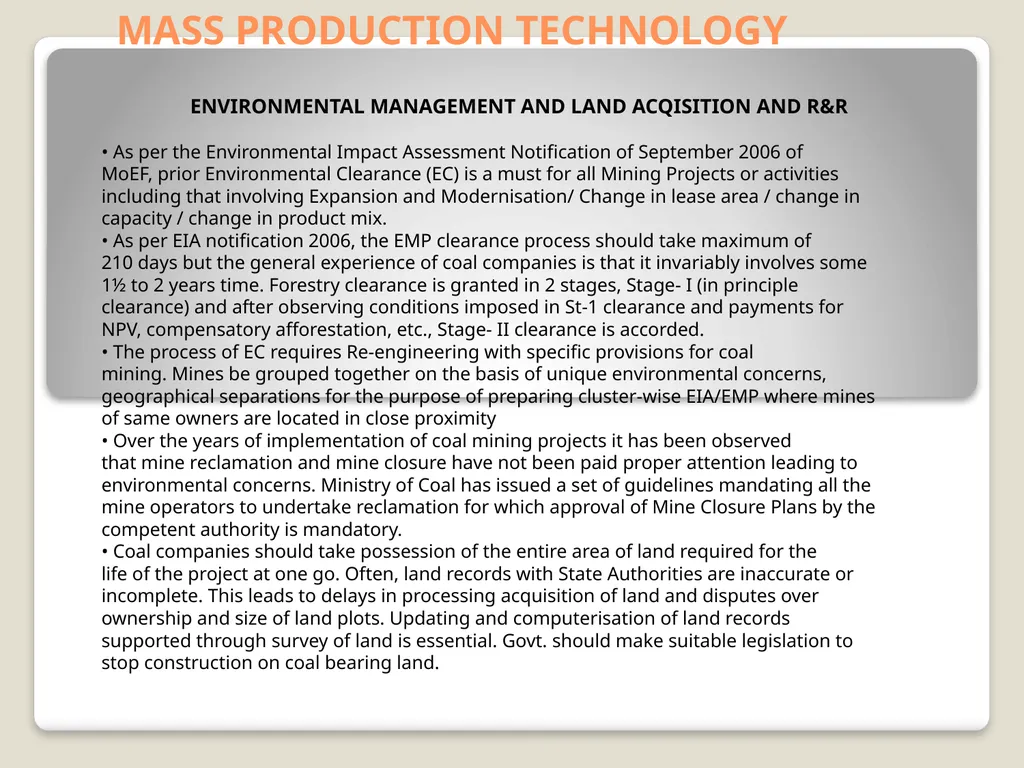
MASS PRODUCTION TECHNOLOGY ENVIRONMENTAL MANAGEMENT AND LAND ACQISITION AND R&R
• As per the Environmental Impact Assessment Notification of September 2006 of
MoEF, prior Environmental Clearance (EC) is a must for all Mining Projects or activities
including that involving Expansion and Modernisation/ Change in lease area / change in
capacity / change in product mix.
• As per EIA notification 2006, the EMP clearance process should take maximum of
210 days but the general experience of coal companies is that it invariably involves some
1½ to 2 years time. Forestry clearance is granted in 2 stages, Stage- I (in principle
clearance) and after observing conditions imposed in St-1 clearance and payments for
NPV, compensatory afforestation, etc., Stage- II clearance is accorded.
• The process of EC requires Re-engineering with specific provisions for coal
mining. Mines be grouped together on the basis of unique environmental concerns,
geographical separations for the purpose of preparing cluster-wise EIA/EMP where mines
of same owners are located in close proximity
• Over the years of implementation of coal mining projects it has been observed
that mine reclamation and mine closure have not been paid proper attention leading to
environmental concerns. Ministry of Coal has issued a set of guidelines mandating all the
mine operators to undertake reclamation for which approval of Mine Closure Plans by the
competent authority is mandatory.
• Coal companies should take possession of the entire area of land required for the
life of the project at one go. Often, land records with State Authorities are inaccurate or
incomplete. This leads to delays in processing acquisition of land and disputes over
ownership and size of land plots. Updating and computerisation of land records
supported through survey of land is essential. Govt. should make suitable legislation to
stop construction on coal bearing land.<br>
• As per the Environmental Impact Assessment Notification of September 2006 of
MoEF, prior Environmental Clearance (EC) is a must for all Mining Projects or activities
including that involving Expansion and Modernisation/ Change in lease area / change in
capacity / change in product mix.
• As per EIA notification 2006, the EMP clearance process should take maximum of
210 days but the general experience of coal companies is that it invariably involves some
1½ to 2 years time. Forestry clearance is granted in 2 stages, Stage- I (in principle
clearance) and after observing conditions imposed in St-1 clearance and payments for
NPV, compensatory afforestation, etc., Stage- II clearance is accorded.
• The process of EC requires Re-engineering with specific provisions for coal
mining. Mines be grouped together on the basis of unique environmental concerns,
geographical separations for the purpose of preparing cluster-wise EIA/EMP where mines
of same owners are located in close proximity
• Over the years of implementation of coal mining projects it has been observed
that mine reclamation and mine closure have not been paid proper attention leading to
environmental concerns. Ministry of Coal has issued a set of guidelines mandating all the
mine operators to undertake reclamation for which approval of Mine Closure Plans by the
competent authority is mandatory.
• Coal companies should take possession of the entire area of land required for the
life of the project at one go. Often, land records with State Authorities are inaccurate or
incomplete. This leads to delays in processing acquisition of land and disputes over
ownership and size of land plots. Updating and computerisation of land records
supported through survey of land is essential. Govt. should make suitable legislation to
stop construction on coal bearing land.<br>
42
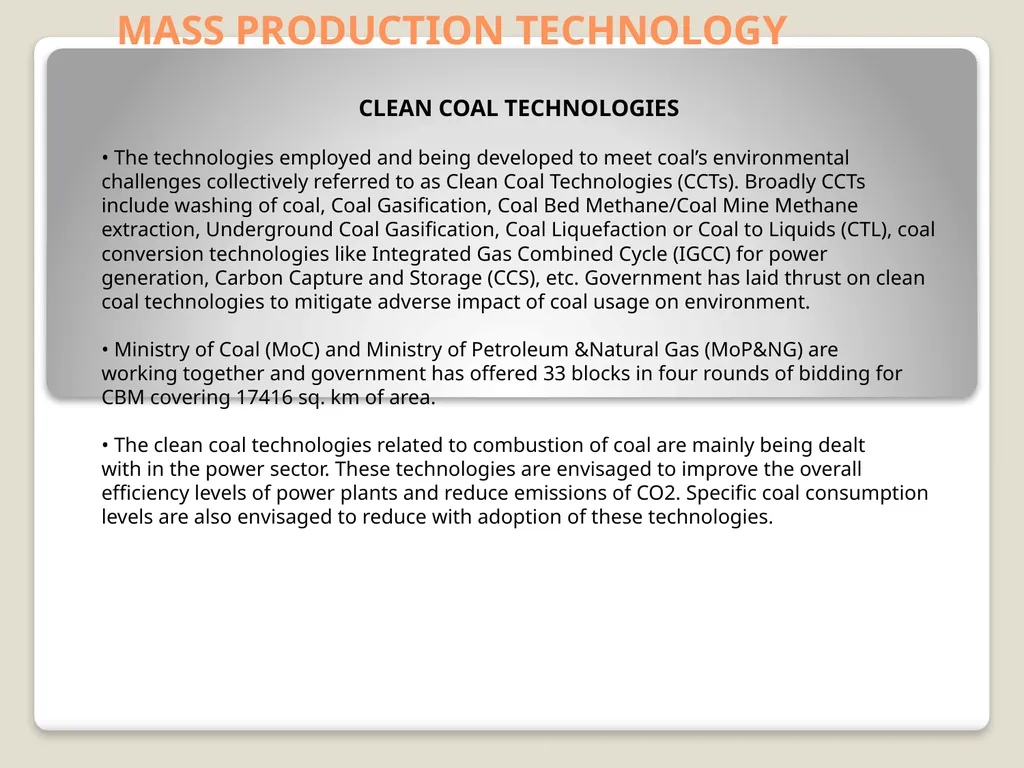
MASS PRODUCTION TECHNOLOGY CLEAN COAL TECHNOLOGIES
• The technologies employed and being developed to meet coal’s environmental
challenges collectively referred to as Clean Coal Technologies (CCTs). Broadly CCTs
include washing of coal, Coal Gasification, Coal Bed Methane/Coal Mine Methane
extraction, Underground Coal Gasification, Coal Liquefaction or Coal to Liquids (CTL), coal conversion technologies like Integrated Gas Combined Cycle (IGCC) for power generation, Carbon Capture and Storage (CCS), etc. Government has laid thrust on clean coal technologies to mitigate adverse impact of coal usage on environment.
• Ministry of Coal (MoC) and Ministry of Petroleum &Natural Gas (MoP&NG) are
working together and government has offered 33 blocks in four rounds of bidding for CBM covering 17416 sq. km of area.
• The clean coal technologies related to combustion of coal are mainly being dealt
with in the power sector. These technologies are envisaged to improve the overall
efficiency levels of power plants and reduce emissions of CO2. Specific coal consumption levels are also envisaged to reduce with adoption of these technologies.<br>
• The technologies employed and being developed to meet coal’s environmental
challenges collectively referred to as Clean Coal Technologies (CCTs). Broadly CCTs
include washing of coal, Coal Gasification, Coal Bed Methane/Coal Mine Methane
extraction, Underground Coal Gasification, Coal Liquefaction or Coal to Liquids (CTL), coal conversion technologies like Integrated Gas Combined Cycle (IGCC) for power generation, Carbon Capture and Storage (CCS), etc. Government has laid thrust on clean coal technologies to mitigate adverse impact of coal usage on environment.
• Ministry of Coal (MoC) and Ministry of Petroleum &Natural Gas (MoP&NG) are
working together and government has offered 33 blocks in four rounds of bidding for CBM covering 17416 sq. km of area.
• The clean coal technologies related to combustion of coal are mainly being dealt
with in the power sector. These technologies are envisaged to improve the overall
efficiency levels of power plants and reduce emissions of CO2. Specific coal consumption levels are also envisaged to reduce with adoption of these technologies.<br>
43
MASS PRODUCTION TECHNOLOGY AUTOMATION & APPLICATION OF INFORMATION TECHNOLOGY
• Automation is the key to high productivity, production and safety. The
information revolution of the country is gradually getting into mining industry and has a
significant impact on mine operations. The field of application is vast and almost
unlimited. Top Down approach of is to be adopted for various business functions
including IT infrastructure is to be laid at subsidiary Hqs. and to be extended to area and
unit level to individual’s desk.
RESEARCH & DEVELOPMENT
• Soon after Nationalization of the coal industry in mid 1970’s, the three pronged
approach for Research and Development in coal, viz. Coal S&T Programme under the
Standing Scientific Research Committee (SSRC), in house Research and Development
Programmes of coal companies and Inter-Sectoral Science Technology Advisory
Committee (IS-STAC) has been adopted during different Five Year Plans. R&D in coal is
carried out under four major areas namely production, productivity and safety; coal
beneficiation; coal utilisation; and environment and ecology.
• Some of the emerging new areas of R&D are in-situ coal gasification, Liquefaction
of coal, Coal Bed Methane(CBM), Shale gas estimation & its recovery, 3D seismic survey,
Study of structure of coal seam and roof rocks in hydro-fracturing areas.
• Coal companies should consider investing at least 1% of their PBT in R&D every
year. Private sector participation in R&D work should be encouraged, research scholars,
academicians and reputed overseas institutions for R&D should be involved.<br>
• Automation is the key to high productivity, production and safety. The
information revolution of the country is gradually getting into mining industry and has a
significant impact on mine operations. The field of application is vast and almost
unlimited. Top Down approach of is to be adopted for various business functions
including IT infrastructure is to be laid at subsidiary Hqs. and to be extended to area and
unit level to individual’s desk.
RESEARCH & DEVELOPMENT
• Soon after Nationalization of the coal industry in mid 1970’s, the three pronged
approach for Research and Development in coal, viz. Coal S&T Programme under the
Standing Scientific Research Committee (SSRC), in house Research and Development
Programmes of coal companies and Inter-Sectoral Science Technology Advisory
Committee (IS-STAC) has been adopted during different Five Year Plans. R&D in coal is
carried out under four major areas namely production, productivity and safety; coal
beneficiation; coal utilisation; and environment and ecology.
• Some of the emerging new areas of R&D are in-situ coal gasification, Liquefaction
of coal, Coal Bed Methane(CBM), Shale gas estimation & its recovery, 3D seismic survey,
Study of structure of coal seam and roof rocks in hydro-fracturing areas.
• Coal companies should consider investing at least 1% of their PBT in R&D every
year. Private sector participation in R&D work should be encouraged, research scholars,
academicians and reputed overseas institutions for R&D should be involved.<br>
44
MASS PRODUCTION TECHNOLOGY SAFETY
• Coal mining operations are governed by the Mines Act, 1952 and the rules and
regulations framed thereunder in regard to safety and health. The Directorate General of Mines Safety (DGMS), under the Ministry of Labour & Employment is the regulatory authority to enforce the statutes relating to mine safety. There is a Standing Committee on Safety in Coal Mines, chaired by Minister in Charge of Coal, with representatives from Ministry of Coal, Ministry of Labour & Employment, DGMS, Trade Unions, Coal companies (All PSUs & Private), State Mines & Mineral Development Corporations. The Committee meets biannually to take stock of the safety situation in coal and lignite mines and suggests measures for bringing further improvement in the field of safety.
• In recent years, accidents in opencast mines due to transport equipment have
shown a rising trend. Measures such as Simulator to impart training for all HEMM
operators and virtual reality training facilities at Central Training Institute need to be established in all coal companies.<br>
• Coal mining operations are governed by the Mines Act, 1952 and the rules and
regulations framed thereunder in regard to safety and health. The Directorate General of Mines Safety (DGMS), under the Ministry of Labour & Employment is the regulatory authority to enforce the statutes relating to mine safety. There is a Standing Committee on Safety in Coal Mines, chaired by Minister in Charge of Coal, with representatives from Ministry of Coal, Ministry of Labour & Employment, DGMS, Trade Unions, Coal companies (All PSUs & Private), State Mines & Mineral Development Corporations. The Committee meets biannually to take stock of the safety situation in coal and lignite mines and suggests measures for bringing further improvement in the field of safety.
• In recent years, accidents in opencast mines due to transport equipment have
shown a rising trend. Measures such as Simulator to impart training for all HEMM
operators and virtual reality training facilities at Central Training Institute need to be established in all coal companies.<br>
45
MASS PRODUCTION TECHNOLOGY Suggestive Measures for Improved Project Formulation
The project formulation must address the following basics:
Fulfilling coal demand/Linkage;
Taking advance action in respect of land acquisition and infrastructure development
Exploration/ Geology;
Geo-technical studies and investigations;
Coal reserves/ Coal Quality/ Depth and extent of mining
Mining Method
Formulating optimum strategy.
Planning future expansion should the need arises
Choosing right size of equipment
Minimizing coal losses
Choosing sites for OB dumps, resettlement, afforestation and infrastructure.
Mine Development
Targets & Production
Power supply, Maintenance and production support facilities
Water Supply
Outsourcing
Coal washing
Evacuation & Dispatch
Manpower and training
Infrastructure Planning
Safety
Economic viability and evaluation
- Up-dation of various technical and financial project parameters for estimating capital and operating
expenditure;
- Technical and financial optimization of the projects taking into account the type of mining technology;
- Incremental viability analysis in case of capacity expansion/ modernization and technical up-
gradation of projects etc.;
- Proper definition of construction and capacity built up periods;
Financing/ funding
Access to Land
R&R
Environment & Forestry Issues
Implementation Schedule
Reclamation & Closure<br>
The project formulation must address the following basics:
Fulfilling coal demand/Linkage;
Taking advance action in respect of land acquisition and infrastructure development
Exploration/ Geology;
Geo-technical studies and investigations;
Coal reserves/ Coal Quality/ Depth and extent of mining
Mining Method
Formulating optimum strategy.
Planning future expansion should the need arises
Choosing right size of equipment
Minimizing coal losses
Choosing sites for OB dumps, resettlement, afforestation and infrastructure.
Mine Development
Targets & Production
Power supply, Maintenance and production support facilities
Water Supply
Outsourcing
Coal washing
Evacuation & Dispatch
Manpower and training
Infrastructure Planning
Safety
Economic viability and evaluation
- Up-dation of various technical and financial project parameters for estimating capital and operating
expenditure;
- Technical and financial optimization of the projects taking into account the type of mining technology;
- Incremental viability analysis in case of capacity expansion/ modernization and technical up-
gradation of projects etc.;
- Proper definition of construction and capacity built up periods;
Financing/ funding
Access to Land
R&R
Environment & Forestry Issues
Implementation Schedule
Reclamation & Closure<br>
46
MASS PRODUCTION TECHNOLOGY HR REQUIREMENT
• In order to keep pace with the stupendous growth of the coal sector, it is
imperative that human resource planning is given paramount importance.
• Looking at CIL as a case study one can safely predict the requirements of human
resources for the national coal sector and work out a stratagem for upgrading skills for new levels of productivity and performance.
• The coal industry needs an innovative framework to attract, select, deploy and
develop the industry’s human resources.
• A situational analysis reveals that CIL is emerging as a geriatric organization with average organizational age over 50, with vanishing skill set based on experience.
• CIL is faced with a shrinking base of experienced front-line supervisors. A host of
training initiatives have been proposed to revamp the existing training infrastructure which includes:
- Strengthen the miners’ ability to act competently in emergencies;
- Use of simulation to enhance the perceptual judgment.
- Revamping of VTCs with state-of-the-art facilities.
- Use of simulators and computer aided techniques in Training Institutes;
- Transformation of IICM into an open university.
• Significant recommendations have been made which advocate CIL to surmount the daunting challenge of human resource development at all levels - from front line supervisors to senior level executives - for a new order of performance.<br>
• In order to keep pace with the stupendous growth of the coal sector, it is
imperative that human resource planning is given paramount importance.
• Looking at CIL as a case study one can safely predict the requirements of human
resources for the national coal sector and work out a stratagem for upgrading skills for new levels of productivity and performance.
• The coal industry needs an innovative framework to attract, select, deploy and
develop the industry’s human resources.
• A situational analysis reveals that CIL is emerging as a geriatric organization with average organizational age over 50, with vanishing skill set based on experience.
• CIL is faced with a shrinking base of experienced front-line supervisors. A host of
training initiatives have been proposed to revamp the existing training infrastructure which includes:
- Strengthen the miners’ ability to act competently in emergencies;
- Use of simulation to enhance the perceptual judgment.
- Revamping of VTCs with state-of-the-art facilities.
- Use of simulators and computer aided techniques in Training Institutes;
- Transformation of IICM into an open university.
• Significant recommendations have been made which advocate CIL to surmount the daunting challenge of human resource development at all levels - from front line supervisors to senior level executives - for a new order of performance.<br>
47
MASS PRODUCTION TECHNOLOGY ACQUISITION OF COAL ASSETS ABROAD
• The gap between demand and indigenous availability of coal has been consistently
widening. The projected gap is estimated to increase from a level of 137Mt in the TY of XI Plan to 265Mt in the TY of XII Plan and to further increase at the level of 423 Mt in the TY of 2021-22.
• While identifying the countries for acquiring coal assets issues related to the
international coal trade routes, the present import sources of India, port & logistics
infrastructure facilities available in the source countries and the port facilities available in
India need to be taken into consideration.
• Conservative attitude of the host countries in regards to allow entry to foreign
players in controlling a strategic asset like coal, the aggressive Chinese model of Merger
& Acquisition to control coal properties in different parts of the world, absence of any
sovereign fund for developing infrastructure in the host countries and limited
empowerment in respect of Indian PSUs to take strategic business decisions are identified as constraints in acquiring foreign asset by Indian entrepreneurs.
• Clear-cut Govt. guidelines allowing PSUs to be strategically aggressive for maiden
foreign acquisitions, policy to appoint Investment Bankers on nomination basis to
incentivize them for bringing exclusive deals which can be transacted on one-to-one
basis, to do away with the distinction between listed and unlisted companies in respect of acquiring foreign assets, introduction of definite tools/Guidelines related to financial
parameters for quick decision making and to fast track the entire Merger & Acquisition
(M&A) transaction and inclusion of suitable clause for reviewing the proposed financial
powers of the Board related to periodic foreign investment are some of the measures
proposed for effective result.<br>
• The gap between demand and indigenous availability of coal has been consistently
widening. The projected gap is estimated to increase from a level of 137Mt in the TY of XI Plan to 265Mt in the TY of XII Plan and to further increase at the level of 423 Mt in the TY of 2021-22.
• While identifying the countries for acquiring coal assets issues related to the
international coal trade routes, the present import sources of India, port & logistics
infrastructure facilities available in the source countries and the port facilities available in
India need to be taken into consideration.
• Conservative attitude of the host countries in regards to allow entry to foreign
players in controlling a strategic asset like coal, the aggressive Chinese model of Merger
& Acquisition to control coal properties in different parts of the world, absence of any
sovereign fund for developing infrastructure in the host countries and limited
empowerment in respect of Indian PSUs to take strategic business decisions are identified as constraints in acquiring foreign asset by Indian entrepreneurs.
• Clear-cut Govt. guidelines allowing PSUs to be strategically aggressive for maiden
foreign acquisitions, policy to appoint Investment Bankers on nomination basis to
incentivize them for bringing exclusive deals which can be transacted on one-to-one
basis, to do away with the distinction between listed and unlisted companies in respect of acquiring foreign assets, introduction of definite tools/Guidelines related to financial
parameters for quick decision making and to fast track the entire Merger & Acquisition
(M&A) transaction and inclusion of suitable clause for reviewing the proposed financial
powers of the Board related to periodic foreign investment are some of the measures
proposed for effective result.<br>
48
MASS PRODUCTION TECHNOLOGY RECOMMENDATIONS<br>
49
MASS PRODUCTION TECHNOLOGY As mines go deeper, increased excavation would warrant higher capacity
equipment. Draglines with bucket capacity of 45-55 cu.m. with a dumping radius
of over 100 m will find applicability in the opencast mines of Singrauli Coalfield.
Higher capacity rope shovels upto 42 cu.m. with 240 t rear dumpers will be
Introduced in the mines of Korba Coalfield. High capacity dozers of sizes upto
850 hp will complement the large excavators.
Besides engaging high capacity equipment, we also need to have advanced
Truck Dispatching Systems (TDS) based on Global Positioning System (GPS)
for efficient control and monitoring of operation in large mines. Only such
systems and control can bring maximum benefits through improved utilization
of such large equipment. Significant advances have been made in improving
capacity utilisation of opencast equipment through such controls/systems, in
advanced countries. Wide application of these devices in Indian mines will
pave the way for further improvement in opencast operations.
The picture for underground operations in the Indian mining industry leaves
much to be desired. Underground coal production has gradually declined since
the mid – 1980s. The only large-scale technological upgradation that has been
possible in underground coal mines is for loading of coal at the faces, which
has reduced engagement of manual labour, and in the use of roof bolting,
which has reduced the consumption of timber for roof support. Although side
discharge loaders (SDL) and load-haul dumpers (LHD) have been introduced in
large numbers, machine productivity has remained low at a level of only 80
tonne per day on an average. In the case of roof bolting also the technology
employed is old-fashioned. Hand-held type of electrical drills are mostly
employed. These can drill only in weak and medium strength strata and are
not effective in many of the strong sandstone strata encountered in mines<br>
equipment. Draglines with bucket capacity of 45-55 cu.m. with a dumping radius
of over 100 m will find applicability in the opencast mines of Singrauli Coalfield.
Higher capacity rope shovels upto 42 cu.m. with 240 t rear dumpers will be
Introduced in the mines of Korba Coalfield. High capacity dozers of sizes upto
850 hp will complement the large excavators.
Besides engaging high capacity equipment, we also need to have advanced
Truck Dispatching Systems (TDS) based on Global Positioning System (GPS)
for efficient control and monitoring of operation in large mines. Only such
systems and control can bring maximum benefits through improved utilization
of such large equipment. Significant advances have been made in improving
capacity utilisation of opencast equipment through such controls/systems, in
advanced countries. Wide application of these devices in Indian mines will
pave the way for further improvement in opencast operations.
The picture for underground operations in the Indian mining industry leaves
much to be desired. Underground coal production has gradually declined since
the mid – 1980s. The only large-scale technological upgradation that has been
possible in underground coal mines is for loading of coal at the faces, which
has reduced engagement of manual labour, and in the use of roof bolting,
which has reduced the consumption of timber for roof support. Although side
discharge loaders (SDL) and load-haul dumpers (LHD) have been introduced in
large numbers, machine productivity has remained low at a level of only 80
tonne per day on an average. In the case of roof bolting also the technology
employed is old-fashioned. Hand-held type of electrical drills are mostly
employed. These can drill only in weak and medium strength strata and are
not effective in many of the strong sandstone strata encountered in mines<br>
50
MASS PRODUCTION TECHNOLOGY like those in Jharia coalfield. With such drill machines it is also difficult for
the drilling crew to drill holes upward with dust falling all over them.
Despite the introduction of powered support longwall mining (PSLW) about
three decades ago, its application has remained limited to only a few mines.
Its contribution is just over 5 Mt a year, which accounts for less than 8%
of the total underground coal production. The traditional bord and pillar mining
has continued to remain the mainstay of underground coal mines with its low
productivity, low percentage extraction coupled with ventilation and other
problems.
In the coming years serious consideration needs to be given by the coal
industry to lay special emphasis on underground workings. PSLW technology,
which has produced remarkable achievements elsewhere, will need to be given
a proper thrust so that deep-seated good quality coal seams can be extracted
safely and economically. In recent months a beginning has been made with
mechanised bord and pillar extraction employing continuous miners and shuttle
cars. This technology needs to be established fully so that seams at shallow
to medium depth can be extracted profitably. A suitable method for extraction
of our good quality coals in thick seams and for coal locked in developed
pillars also needs to be established without further loss of time. A suitable
method for managing massive and hard roof strata encountered in many of
our mines will also have to be evolved so that extraction can be carried out
without undue risks to life and equipment.<br>
the drilling crew to drill holes upward with dust falling all over them.
Despite the introduction of powered support longwall mining (PSLW) about
three decades ago, its application has remained limited to only a few mines.
Its contribution is just over 5 Mt a year, which accounts for less than 8%
of the total underground coal production. The traditional bord and pillar mining
has continued to remain the mainstay of underground coal mines with its low
productivity, low percentage extraction coupled with ventilation and other
problems.
In the coming years serious consideration needs to be given by the coal
industry to lay special emphasis on underground workings. PSLW technology,
which has produced remarkable achievements elsewhere, will need to be given
a proper thrust so that deep-seated good quality coal seams can be extracted
safely and economically. In recent months a beginning has been made with
mechanised bord and pillar extraction employing continuous miners and shuttle
cars. This technology needs to be established fully so that seams at shallow
to medium depth can be extracted profitably. A suitable method for extraction
of our good quality coals in thick seams and for coal locked in developed
pillars also needs to be established without further loss of time. A suitable
method for managing massive and hard roof strata encountered in many of
our mines will also have to be evolved so that extraction can be carried out
without undue risks to life and equipment.<br>
51
MASS PRODUCTION TECHNOLOGY PART II
CONTINUOS MINING TECHNIQUE :
APPLICABILITY, LAYOUT FOR
DEVELOPMENT AND DEPILLARING,
DESIGN, EQUIPMENT REQUIRED AND
THEIR SELECTION, SYSTEM ANALYSIS,
CYCLE OF OPERATION,
CASE STUDIES<br>
CONTINUOS MINING TECHNIQUE :
APPLICABILITY, LAYOUT FOR
DEVELOPMENT AND DEPILLARING,
DESIGN, EQUIPMENT REQUIRED AND
THEIR SELECTION, SYSTEM ANALYSIS,
CYCLE OF OPERATION,
CASE STUDIES<br>
52
MASS PRODUCTION TECHNOLOGY The solution for room and pillar mining is comprehensive with products to
meet all of a room & pillar operation’s production needs. Each of the DBT
products has a range of models that are matched in capacity and seam
heights to the models of other DBT products. Specifically, every piece of
equipment has been developed to optimize the performance of the entire
suite of equipment within a particular mine’s parameters and conditions.
The heart of any modern room & pillar production system is the continuous
miner. DBT continuous miners are designed for various seam heights with
easy or hard cutting conditions. DBT miners offer reliable design, easy
maintenance, high availability, and high rates of production. This
combination of features allows the DBT Continuous Miner to be part of a
cost-effective room & pillar application.
DBT miners are multi-motor machines that use eight electric motors
dedicated to the specific functions of cutting, loading, conveying, tramming,
hydraulic power, and dust collection. The electric motors provide power to
gearboxes, which are modularized to facilitate easy removal for repair and
maintenance. The power ratings of DBT miners make them especially
effective in difficult seams with major rock inclusions, or for trimming hard
roof and floor surfaces.<br>
meet all of a room & pillar operation’s production needs. Each of the DBT
products has a range of models that are matched in capacity and seam
heights to the models of other DBT products. Specifically, every piece of
equipment has been developed to optimize the performance of the entire
suite of equipment within a particular mine’s parameters and conditions.
The heart of any modern room & pillar production system is the continuous
miner. DBT continuous miners are designed for various seam heights with
easy or hard cutting conditions. DBT miners offer reliable design, easy
maintenance, high availability, and high rates of production. This
combination of features allows the DBT Continuous Miner to be part of a
cost-effective room & pillar application.
DBT miners are multi-motor machines that use eight electric motors
dedicated to the specific functions of cutting, loading, conveying, tramming,
hydraulic power, and dust collection. The electric motors provide power to
gearboxes, which are modularized to facilitate easy removal for repair and
maintenance. The power ratings of DBT miners make them especially
effective in difficult seams with major rock inclusions, or for trimming hard
roof and floor surfaces.<br>
53
MASS PRODUCTION TECHNOLOGY The cutter head is the heart of the CM. DBT offers an all-gear cutter
heads (chainless) for all models of its continuous miners. Power is transmitted
into the cutter head from identical right and left AC electrical cutter motors.
This motor power is transmitted though gear drive trains to the cutter drums.
The DBT miners have three drums that encompass the cutting element of the
miners. The right and left drums are bolted and keyed to the drum drive
shaft. The center drum is split into two halves, for easy removal, that are
bolted together and are keyed to the drum drive shaft. This design provides
easy access for drum or gearbox maintenance or repair.
DBT supplies drums equipped with bit holders in a variety of styles and
shank diameters. It is important to know that the larger bit holders only work
well in bit patterns that are spaced wide apart, 75 mm or greater. This is for
two reasons, first, with a large holder, the available space to locate the holder
on the drum is limited, and second, holders in close proximity limit the material
flow between them. Holders with restricted flow between them can increase
dust and fines and can cause machine vibration or oscillation.
Because choosing the best bit pattern, for the application, is necessary
for optimal production, DBT sales and engineering personnel have extensive
experience with drum bit patterns and can make a recommendation on a bit
pattern and on bit spacing for all coal seams and mining conditions. For unique
applications, DBT can provide laboratory-cutting tests to more thoroughly define
the bit geometry and spacing.
Once coal is cut by the cutter drums, the gathering head collects the
coal and the conveyor transports it through the machine and into the
haulage vehicle.<br>
heads (chainless) for all models of its continuous miners. Power is transmitted
into the cutter head from identical right and left AC electrical cutter motors.
This motor power is transmitted though gear drive trains to the cutter drums.
The DBT miners have three drums that encompass the cutting element of the
miners. The right and left drums are bolted and keyed to the drum drive
shaft. The center drum is split into two halves, for easy removal, that are
bolted together and are keyed to the drum drive shaft. This design provides
easy access for drum or gearbox maintenance or repair.
DBT supplies drums equipped with bit holders in a variety of styles and
shank diameters. It is important to know that the larger bit holders only work
well in bit patterns that are spaced wide apart, 75 mm or greater. This is for
two reasons, first, with a large holder, the available space to locate the holder
on the drum is limited, and second, holders in close proximity limit the material
flow between them. Holders with restricted flow between them can increase
dust and fines and can cause machine vibration or oscillation.
Because choosing the best bit pattern, for the application, is necessary
for optimal production, DBT sales and engineering personnel have extensive
experience with drum bit patterns and can make a recommendation on a bit
pattern and on bit spacing for all coal seams and mining conditions. For unique
applications, DBT can provide laboratory-cutting tests to more thoroughly define
the bit geometry and spacing.
Once coal is cut by the cutter drums, the gathering head collects the
coal and the conveyor transports it through the machine and into the
haulage vehicle.<br>
54
MASS PRODUCTION TECHNOLOGY<br>