Fast, high-quality PRNG for heterogeneous computing Marco Barbone, Georgi Gaydadjiev, Alexander Howard, Wayne Luk, George Savvidy, Konstantin Savvidy, Andy Rose, Alexander Tapper m.barbone19imperial.ac.uk Monte Carlo simulations 2
"Fast, high-quality PRNG for heterogeneous" is the property of its rightful owner. Permission is granted to
download and print the materials on this website for personal, non-commercial use only, and to display it
on your personal computer provided you do not modify the materials and that you retain all copyright
notices contained in the materials. By downloading content from our website, you accept the terms of this
agreement.
Presentation Transcript
01
Fast, high-quality PRNG for heterogeneous computing Marco Barbone, Georgi Gaydadjiev, Alexander Howard, Wayne Luk, George Savvidy,
Konstantin Savvidy, Andy Rose, Alexander Tapper
m.barbone19@imperial.ac.uk<br>
02
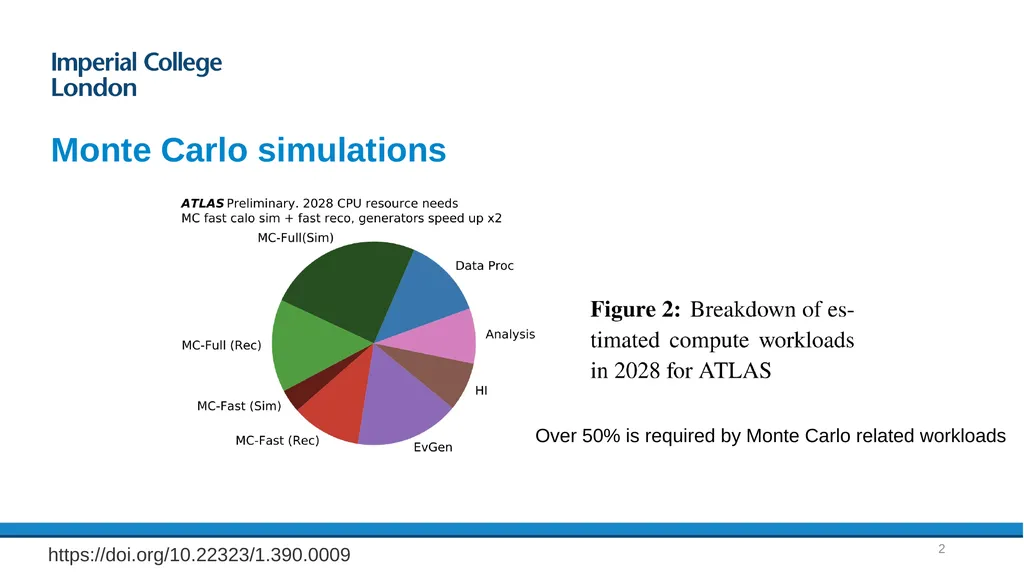
Monte Carlo simulations 2 https://doi.org/10.22323/1.390.0009 Over 50% is required by Monte Carlo related workloads<br>
03
Motivation GPUs/FPGAs RNGs are:
Slow and high-quality
Fast and low-quality
In the GPU case, closed-source 3 There is no middle-ground https://docs.nvidia.com/cuda/curand/index.html<br>
04
MixMax RNG It is a high-quality generator suitable for MC simulations
Quality, speed tunable based on state-size
Even small state size offers high quality numbers
It offers a seeding mechanism that guarantees no collisions between streams
Used in CLHEP & Geant4 (default) 4 https://doi.org/10.1051/epjconf/201921402012<br>
05
Goal Accelerate MixMax and compare the performance against state-of-the-art RNGs
Provide a reliable RNG for Monte Carlo simulations 5<br>
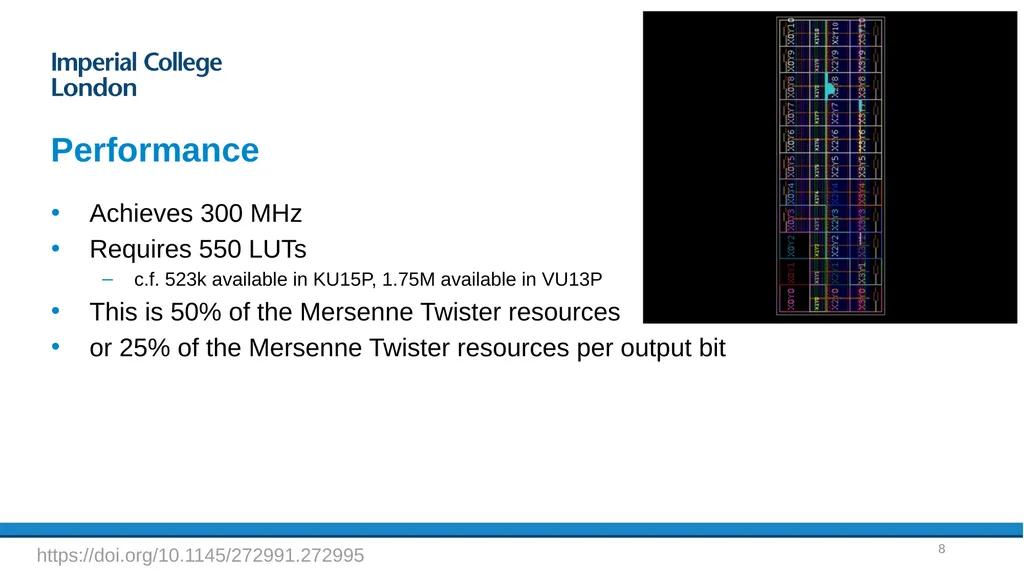
Performance Achieves 300 MHz
Requires 550 LUTs
c.f. 523k available in KU15P, 1.75M available in VU13P
This is 50% of the Mersenne Twister resources
or 25% of the Mersenne Twister resources per output bit 8 https://doi.org/10.1145/272991.272995<br>
09
GPU C++/CUDA design Each thread contains an RNG, state is not shared
GPU is seeded with 128 bits, the thread id is concatenated to generate different streams
Only 128 bits needs to be transferred to the GPU
The user can change this behavior
Clear C++ interface 9<br>
10
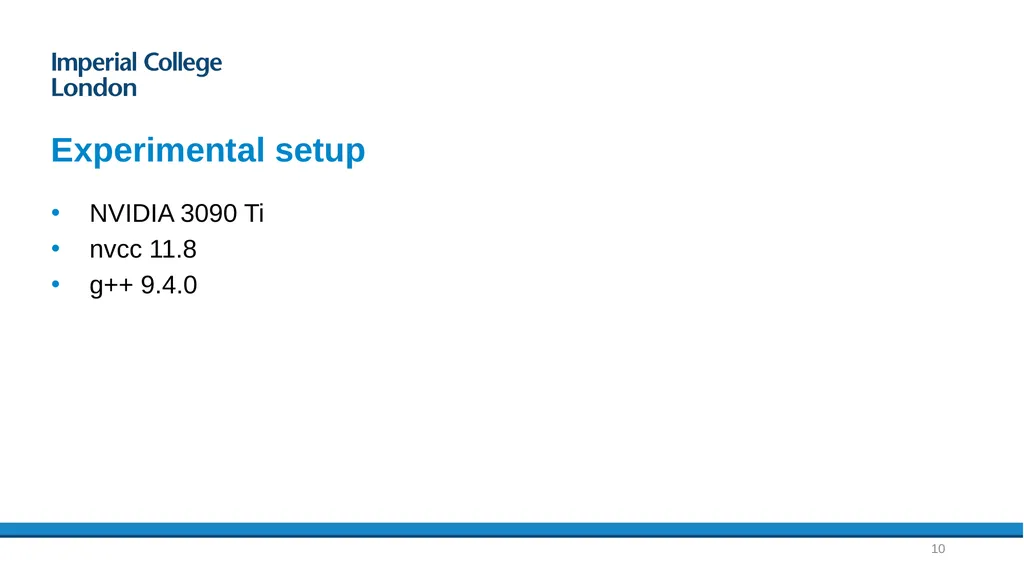
Experimental setup NVIDIA 3090 Ti
nvcc 11.8
g++ 9.4.0 10<br>
11
Validation Compared against the original implementation
Test took ~3 months (server crashed due to blackout....)
Results never diverged 11<br>
Against Mersenne twister for GPU (MTGP32) 13 Parameters iteration = generating 32768 numbers<br>
14
MixMax is 14 times faster than Mersenne Twister on GPU
25% of the Mersenne Twister resources per output bit on FPGA
Seeding is easier and faster (128 bits, compared to O(KB))
MixMax has the potential to become de-facto the standard RNG on any platform
Suitable for ML & MC due to parallelism, efficiency and quality
Future work: Delivered via CLHEP or standalone repository Conclusion 14<br>
15
Backup<br>
16
What is MixMax? The MIXMAX generator is a family of pseudorandom number generators (PRNG) and is based on Anosov C-systems (Anosov diffeomorphism) and Kolmogorov K-systems (Kolmogorov automorphism). https://doi.org/10.1016/j.cpc.2015.06.003<br>
17
What is MixMax? The MIXMAX generator is a family of pseudorandom number generators (PRNG) and is based on Anosov C-systems (Anosov diffeomorphism) and Kolmogorov K-systems (Kolmogorov automorphism).
It is a very good PRNG
Used in CLHEP & Geant4 (default) https://doi.org/10.1051/epjconf/201921402012<br>