FCC circumference constraints from the injectors and the RF system Linhao Zhang, Heiko Damerau, Ivan Karpov 31052022 FCC week 2022 30 May 03 June, Paris, France Outline Introduction Starting point Baseline FCC-hh harmonic 400 MHz
"FCC circumference constraints from the injectors" is the property of its rightful owner. Permission is granted to
download and print the materials on this website for personal, non-commercial use only, and to display it
on your personal computer provided you do not modify the materials and that you retain all copyright
notices contained in the materials. By downloading content from our website, you accept the terms of this
agreement.
Presentation Transcript
01
FCC circumference constraints from the injectors and the RF system Linhao Zhang, Heiko Damerau, Ivan Karpov
31/05/2022
FCC week 2022
30 May – 03 June, Paris, France<br>
02
Outline Introduction
Starting point
Baseline FCC-hh harmonic @ 400 MHz
Alternative FCC-hh harmonic @ 500 MHz
Summary 2<br>
03
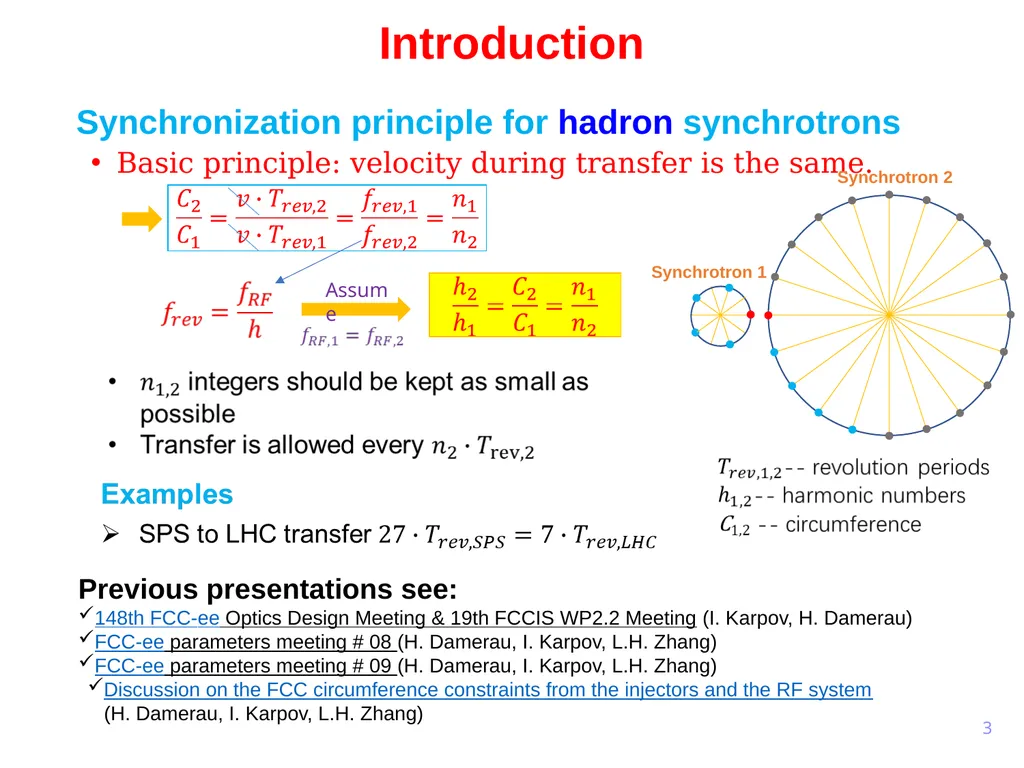
Introduction Synchronization principle for hadron synchrotrons
Basic principle: velocity during transfer is the same. Previous presentations see:
148th FCC-ee Optics Design Meeting & 19th FCCIS WP2.2 Meeting (I. Karpov, H. Damerau)
FCC-ee parameters meeting # 08 (H. Damerau, I. Karpov, L.H. Zhang)
FCC-ee parameters meeting # 09 (H. Damerau, I. Karpov, L.H. Zhang)
Discussion on the FCC circumference constraints from the injectors and the RF system (H. Damerau, I. Karpov, L.H. Zhang) 3 Synchrotron 2 Synchrotron 1 Assume<br>
04
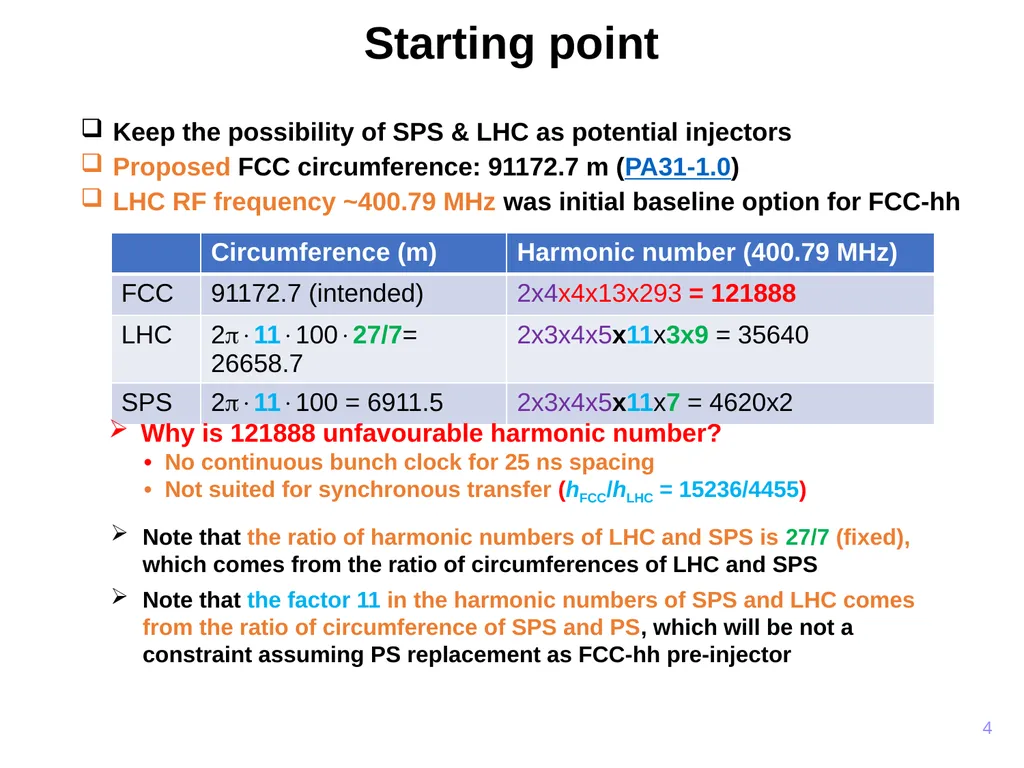
Starting point 4 Keep the possibility of SPS & LHC as potential injectors
Proposed FCC circumference: 91172.7 m (PA31-1.0)
LHC RF frequency ~400.79 MHz was initial baseline option for FCC-hh Note that the ratio of harmonic numbers of LHC and SPS is 27/7 (fixed), which comes from the ratio of circumferences of LHC and SPS
Note that the factor 11 in the harmonic numbers of SPS and LHC comes from the ratio of circumference of SPS and PS, which will be not a constraint assuming PS replacement as FCC-hh pre-injector Why is 121888 unfavourable harmonic number?
• No continuous bunch clock for 25 ns spacing
• Not suited for synchronous transfer (hFCC/hLHC = 15236/4455)<br>
05
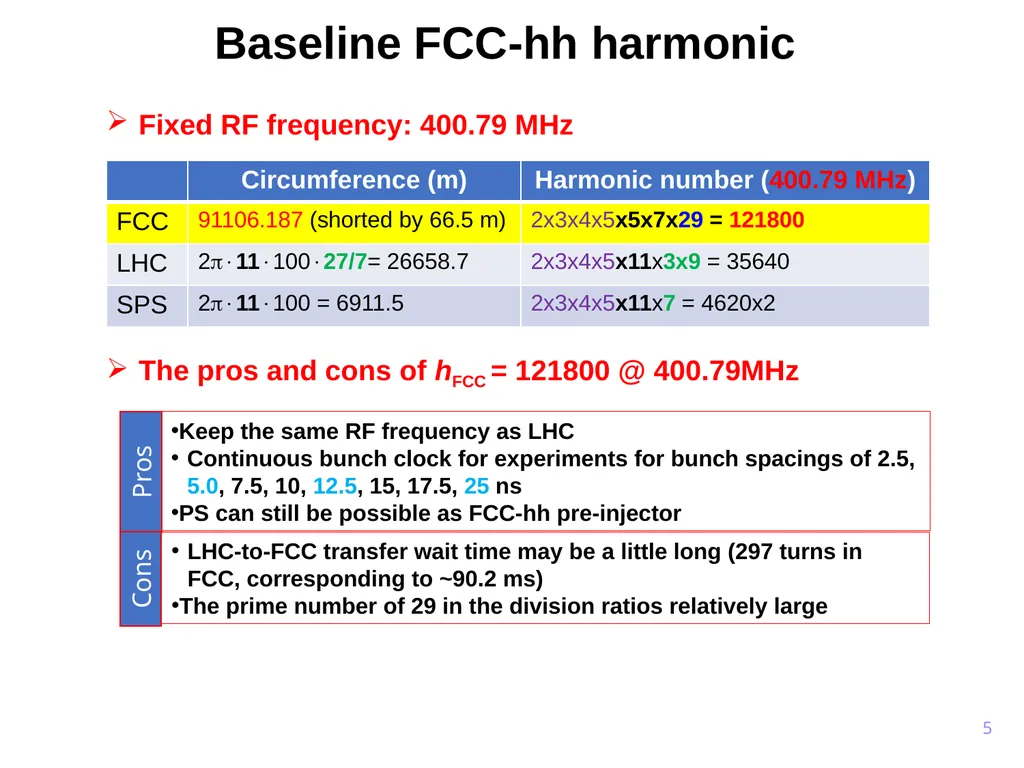
Baseline FCC-hh harmonic 5 The pros and cons of hFCC = 121800 @ 400.79MHz Fixed RF frequency: 400.79 MHz<br>
06
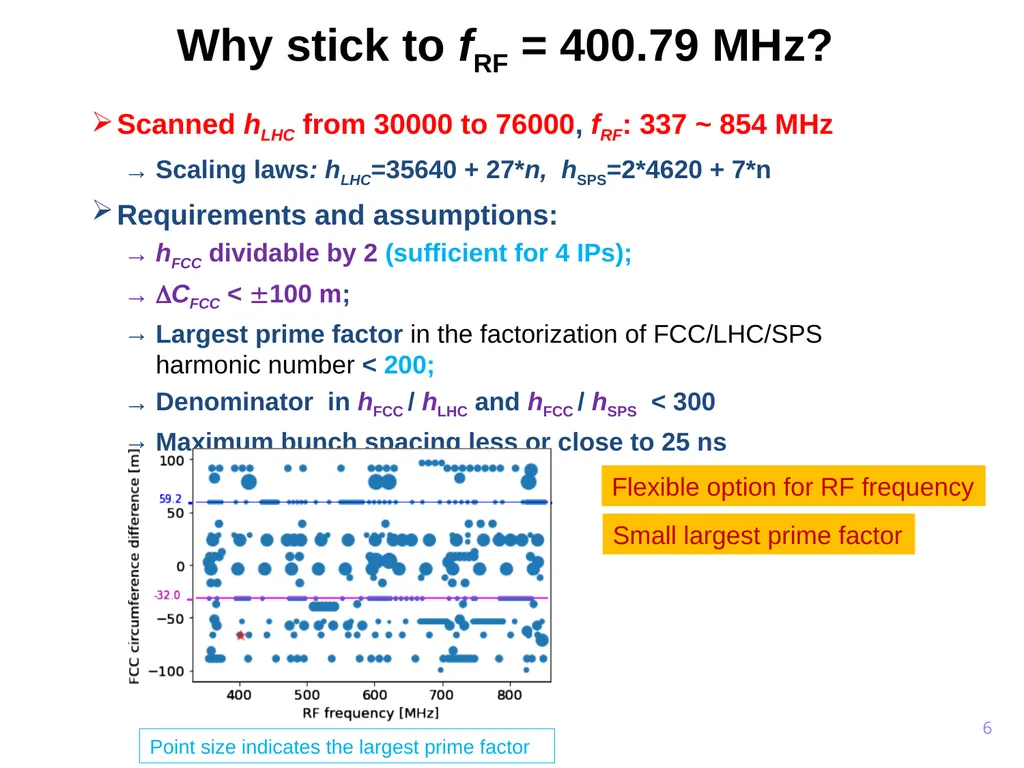
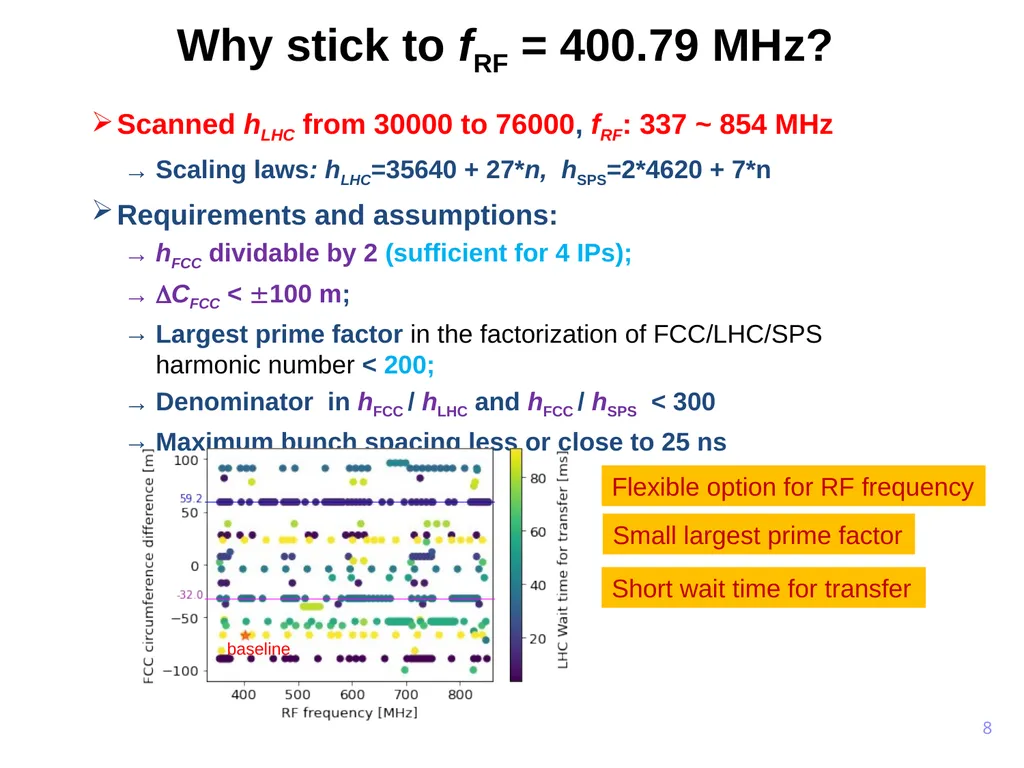
Why stick to fRF = 400.79 MHz? 6 Scanned hLHC from 30000 to 76000, fRF: 337 ~ 854 MHz
Scaling laws: hLHC=35640 + 27*n, hSPS=2*4620 + 7*n
Requirements and assumptions:
hFCC dividable by 2 (sufficient for 4 IPs);
CFCC < 100 m;
Largest prime factor in the factorization of FCC/LHC/SPS harmonic number < 200;
Denominator in hFCC / hLHC and hFCC / hSPS < 300
Maximum bunch spacing less or close to 25 ns Flexible option for RF frequency baseline Point size indicates the largest prime factor Small largest prime factor<br>
07
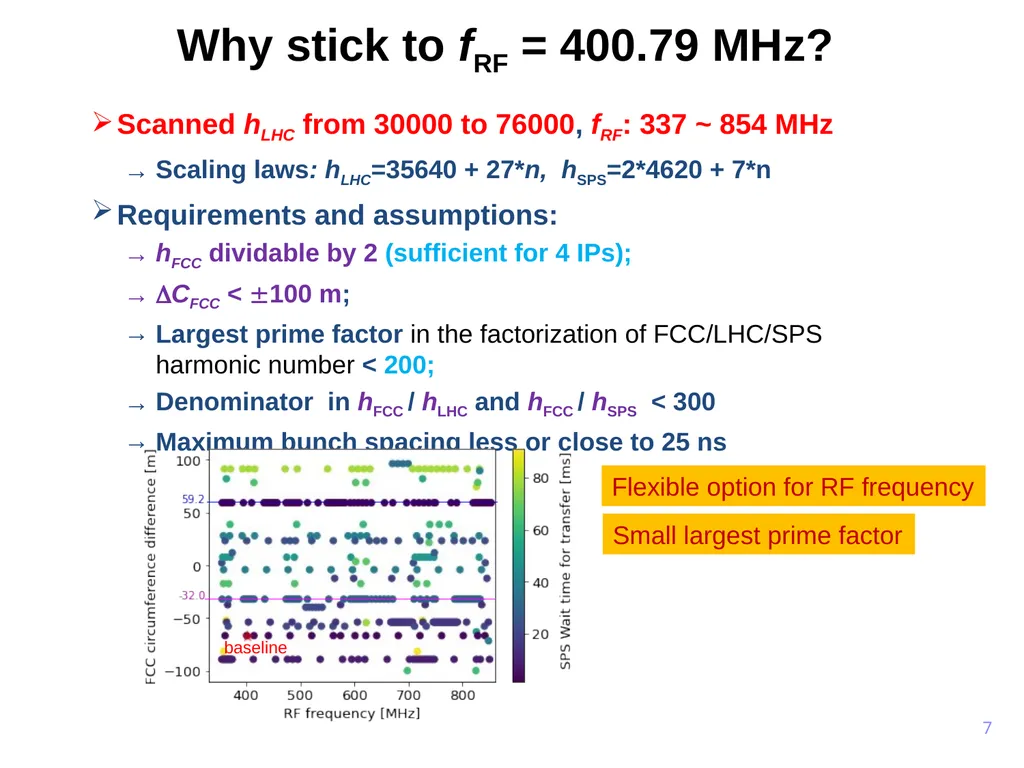
Why stick to fRF = 400.79 MHz? 7 Scanned hLHC from 30000 to 76000, fRF: 337 ~ 854 MHz
Scaling laws: hLHC=35640 + 27*n, hSPS=2*4620 + 7*n
Requirements and assumptions:
hFCC dividable by 2 (sufficient for 4 IPs);
CFCC < 100 m;
Largest prime factor in the factorization of FCC/LHC/SPS harmonic number < 200;
Denominator in hFCC / hLHC and hFCC / hSPS < 300
Maximum bunch spacing less or close to 25 ns Flexible option for RF frequency Small largest prime factor baseline<br>
08
Why stick to fRF = 400.79 MHz? 8 Scanned hLHC from 30000 to 76000, fRF: 337 ~ 854 MHz
Scaling laws: hLHC=35640 + 27*n, hSPS=2*4620 + 7*n
Requirements and assumptions:
hFCC dividable by 2 (sufficient for 4 IPs);
CFCC < 100 m;
Largest prime factor in the factorization of FCC/LHC/SPS harmonic number < 200;
Denominator in hFCC / hLHC and hFCC / hSPS < 300
Maximum bunch spacing less or close to 25 ns Flexible option for RF frequency Small largest prime factor Short wait time for transfer baseline<br>
09
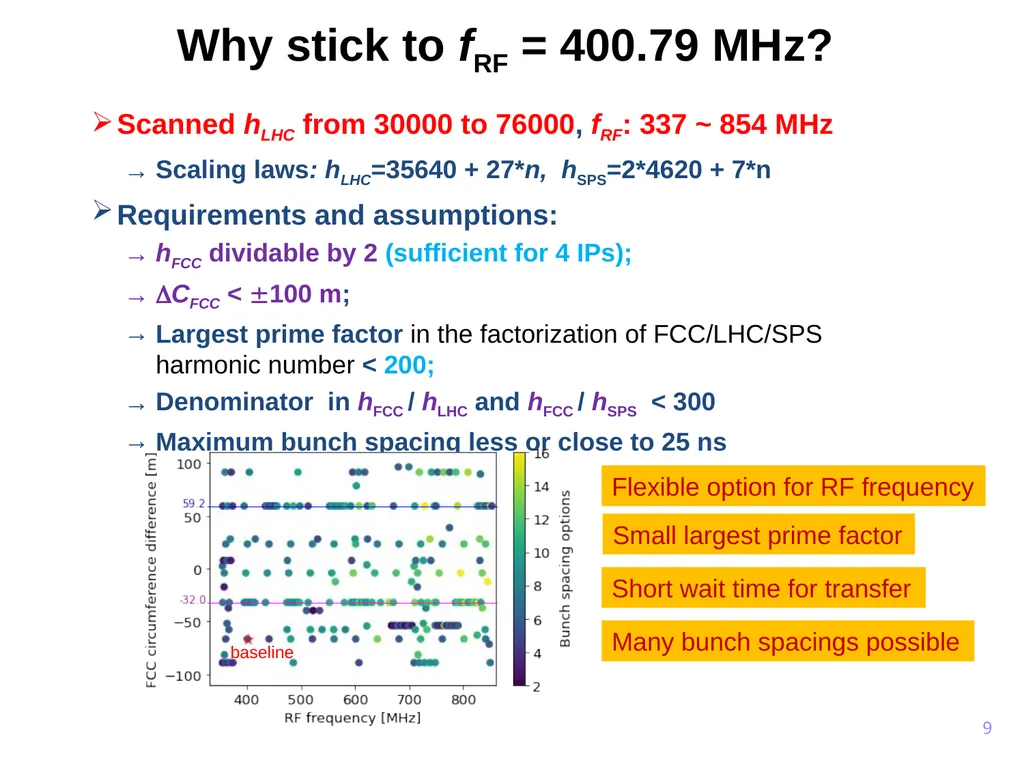
Why stick to fRF = 400.79 MHz? 9 Scanned hLHC from 30000 to 76000, fRF: 337 ~ 854 MHz
Scaling laws: hLHC=35640 + 27*n, hSPS=2*4620 + 7*n
Requirements and assumptions:
hFCC dividable by 2 (sufficient for 4 IPs);
CFCC < 100 m;
Largest prime factor in the factorization of FCC/LHC/SPS harmonic number < 200;
Denominator in hFCC / hLHC and hFCC / hSPS < 300
Maximum bunch spacing less or close to 25 ns Flexible option for RF frequency Small largest prime factor Short wait time for transfer Many bunch spacings possible baseline<br>
10
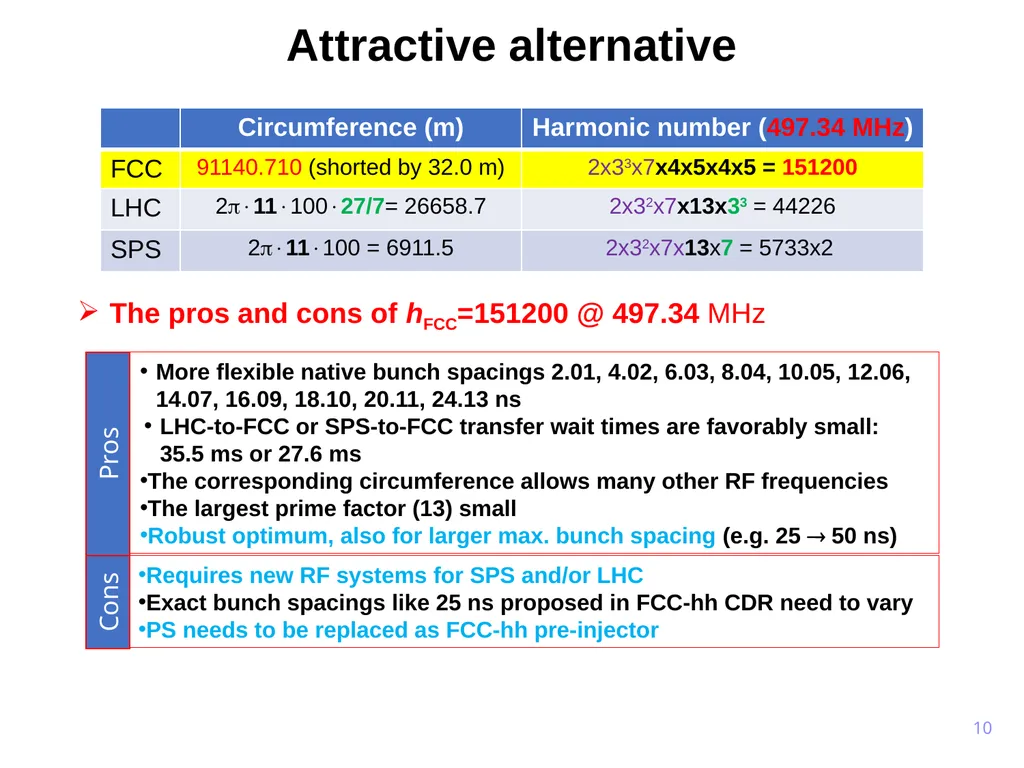
Attractive alternative 10 The pros and cons of hFCC=151200 @ 497.34 MHz<br>
11
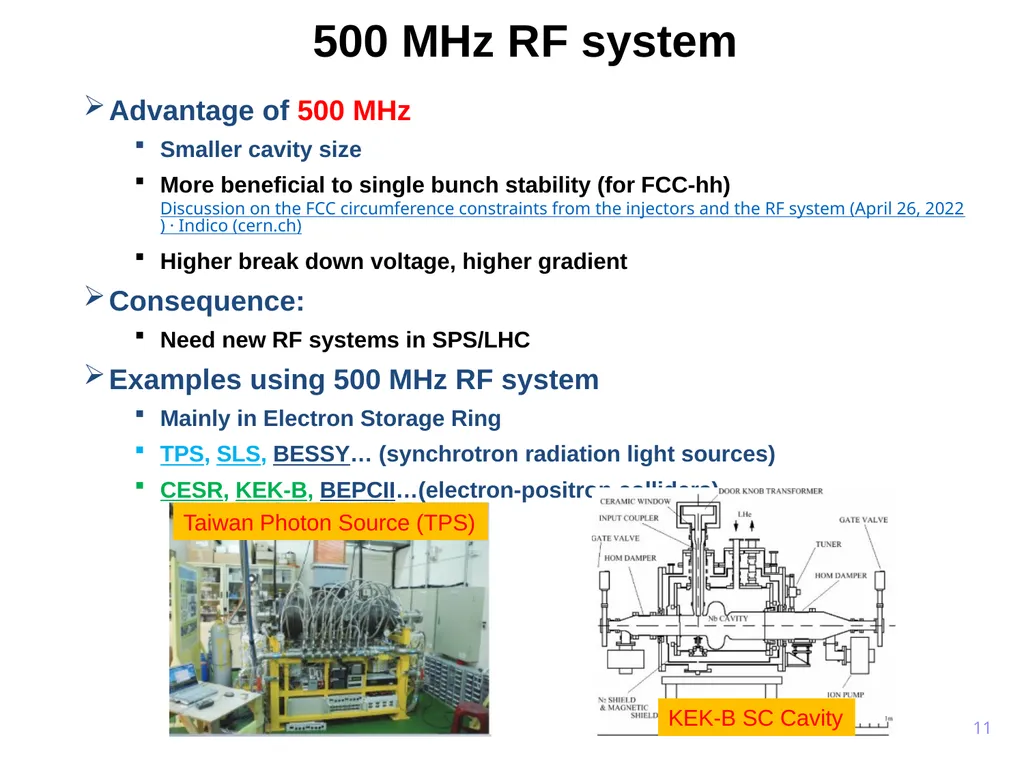
500 MHz RF system Advantage of 500 MHz
Smaller cavity size
More beneficial to single bunch stability (for FCC-hh) Discussion on the FCC circumference constraints from the injectors and the RF system (April 26, 2022) · Indico (cern.ch)
Higher break down voltage, higher gradient
Consequence:
Need new RF systems in SPS/LHC
Examples using 500 MHz RF system
Mainly in Electron Storage Ring
TPS, SLS, BESSY… (synchrotron radiation light sources)
CESR, KEK-B, BEPCII…(electron-positron colliders) 11 Taiwan Photon Source (TPS) KEK-B SC Cavity<br>
12
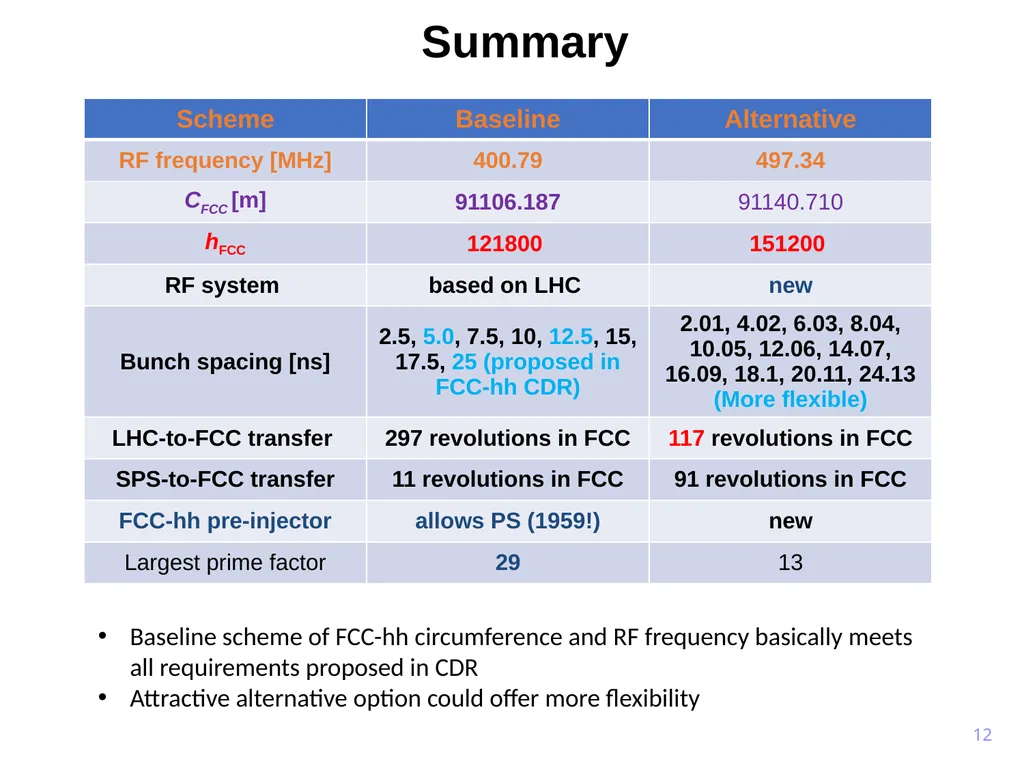
Summary Baseline scheme of FCC-hh circumference and RF frequency basically meets all requirements proposed in CDR
Attractive alternative option could offer more flexibility 12<br>
13
Thanks for your attention! 13<br>
14
Spare slides 14<br>
15
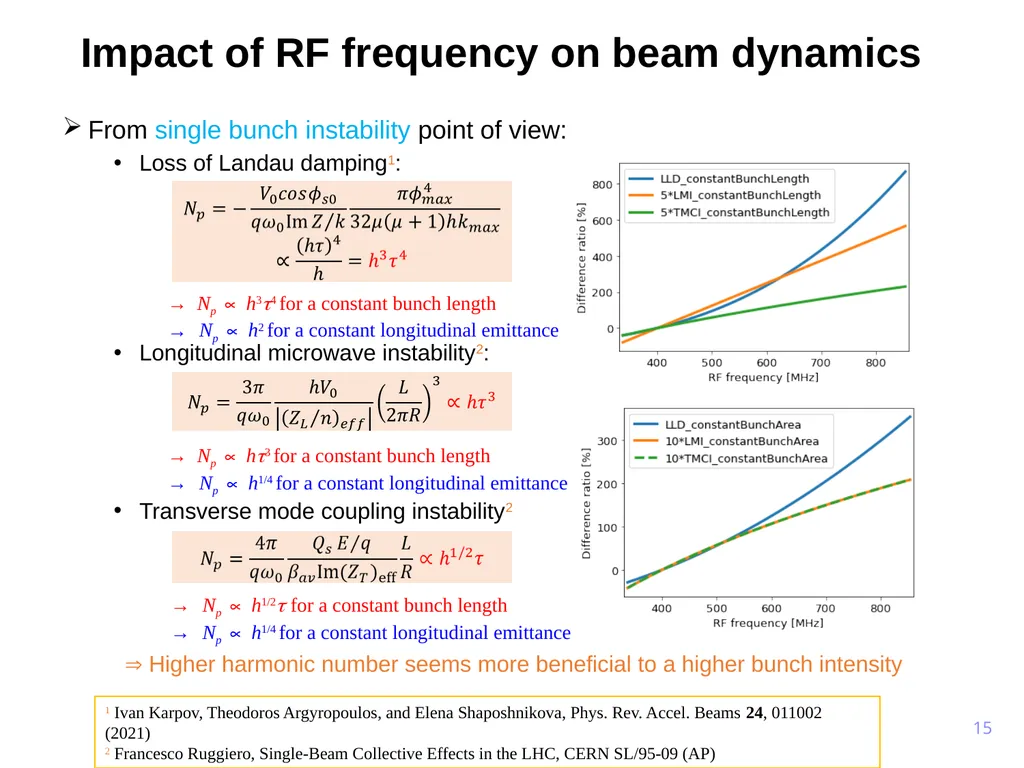
From single bunch instability point of view:
Loss of Landau damping1:
Longitudinal microwave instability2:
Transverse mode coupling instability2 15 1 Ivan Karpov, Theodoros Argyropoulos, and Elena Shaposhnikova, Phys. Rev. Accel. Beams 24, 011002 (2021)
2 Francesco Ruggiero, Single-Beam Collective Effects in the LHC, CERN SL/95-09 (AP) → Np ∝ h34 for a constant bunch length
Np ∝ h2 for a constant longitudinal emittance → Np ∝ h3 for a constant bunch length
Np ∝ h1/4 for a constant longitudinal emittance Np ∝ h1/2 for a constant bunch length
Np ∝ h1/4 for a constant longitudinal emittance Higher harmonic number seems more beneficial to a higher bunch intensity Impact of RF frequency on beam dynamics<br>
16
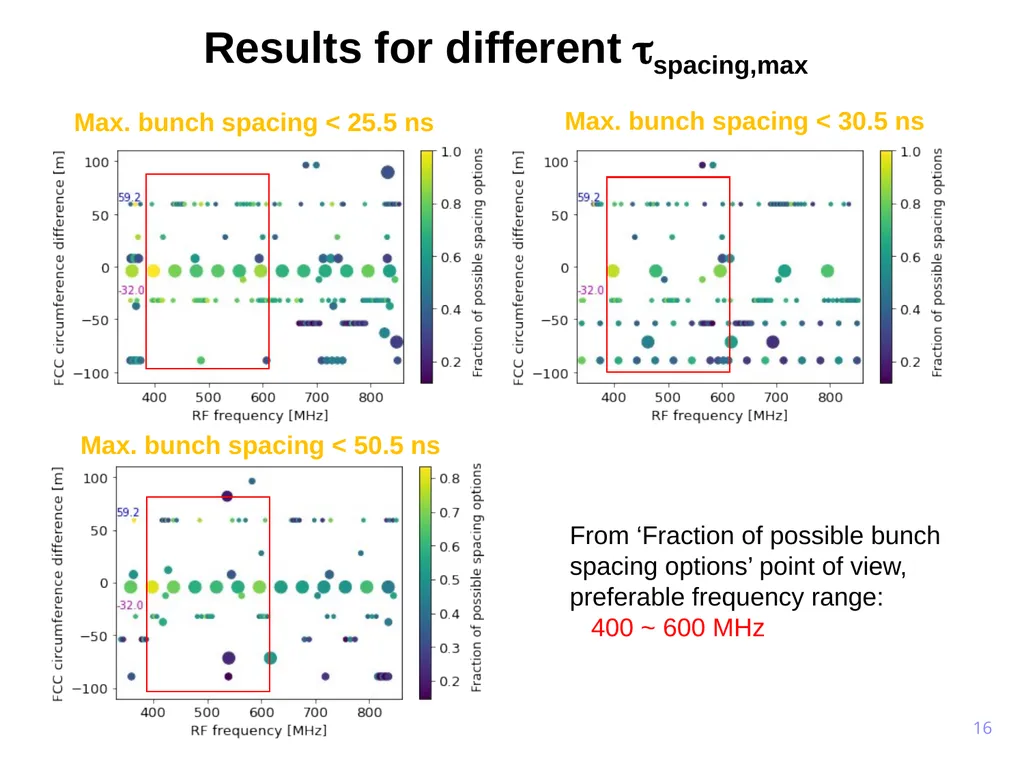
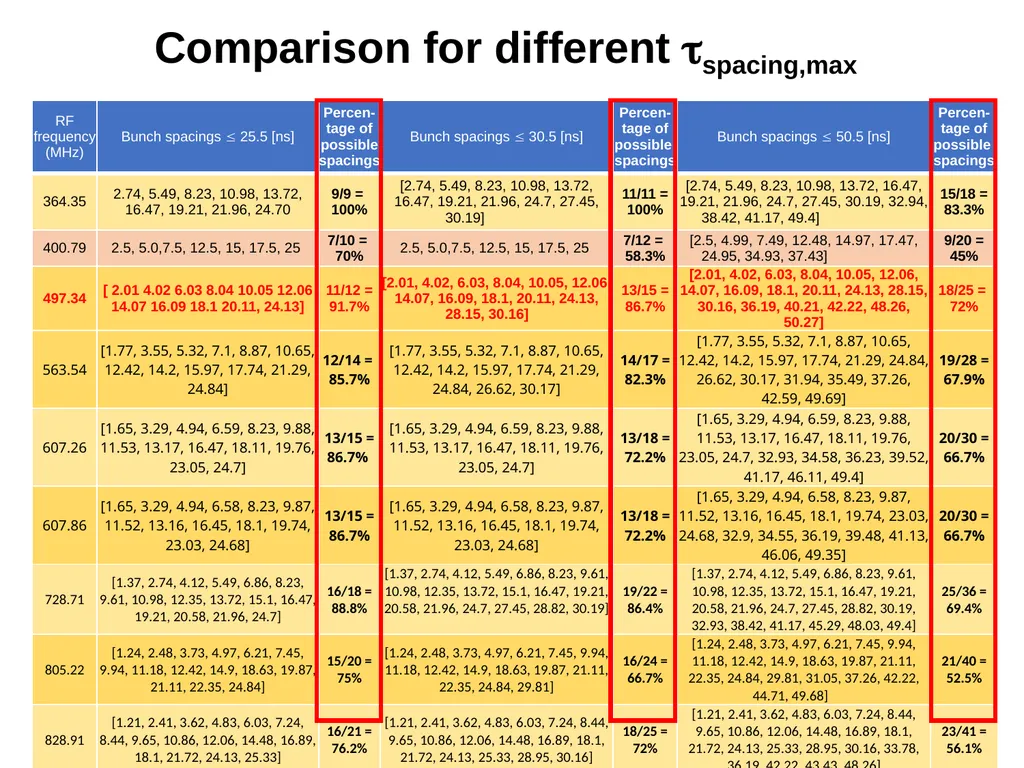
16 Results for different spacing,max Max. bunch spacing < 25.5 ns Max. bunch spacing < 50.5 ns Max. bunch spacing < 30.5 ns From ‘Fraction of possible bunch spacing options’ point of view, preferable frequency range:
400 ~ 600 MHz<br>
17
17 Comparison for different spacing,max<br>
18
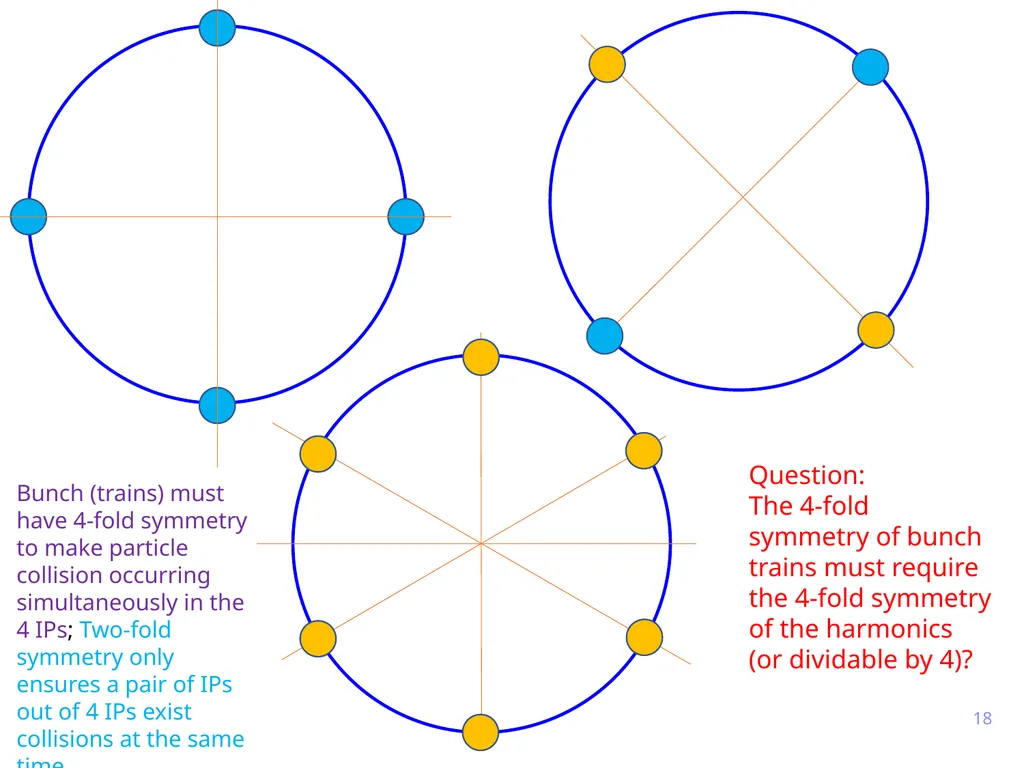
18 Bunch (trains) must have 4-fold symmetry to make particle collision occurring simultaneously in the 4 IPs; Two-fold symmetry only ensures a pair of IPs out of 4 IPs exist collisions at the same time Question:
The 4-fold symmetry of bunch trains must require the 4-fold symmetry of the harmonics (or dividable by 4)?<br>
19
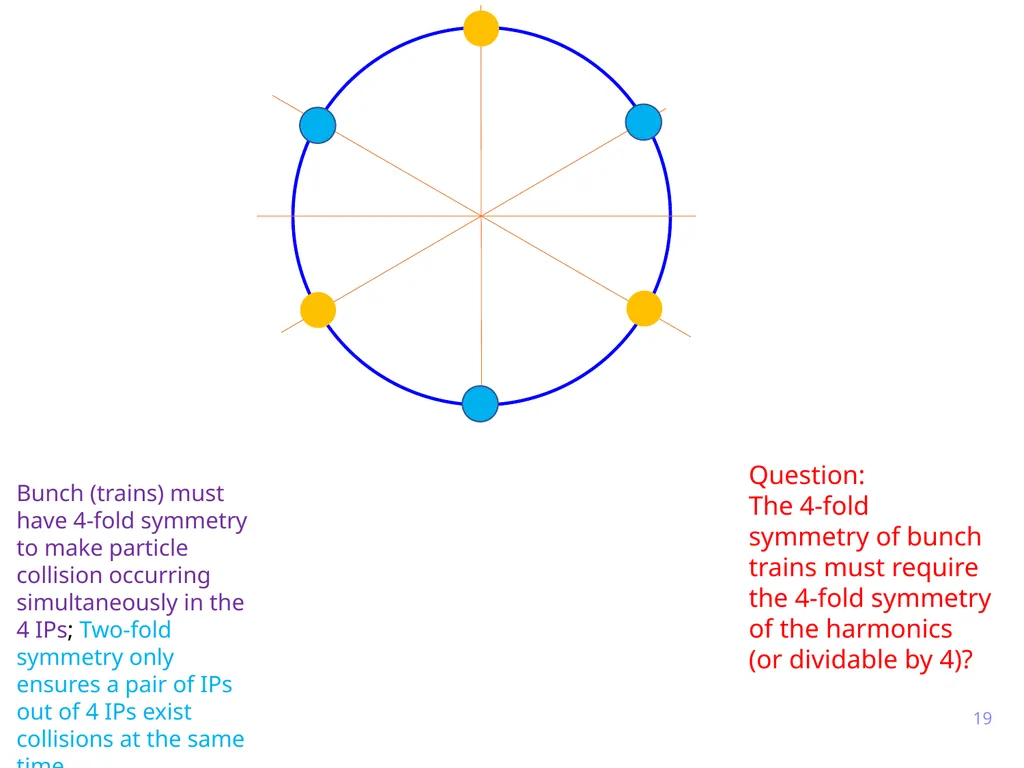
19 Bunch (trains) must have 4-fold symmetry to make particle collision occurring simultaneously in the 4 IPs; Two-fold symmetry only ensures a pair of IPs out of 4 IPs exist collisions at the same time Question:
The 4-fold symmetry of bunch trains must require the 4-fold symmetry of the harmonics (or dividable by 4)?<br>