
FDI in Bulgaria: Dynamics and Opportunities for
SN
Published · 28 slides · 0 views

1 / 1


Description
FDI in Bulgaria: Dynamics and Opportunities for Korean Businesses Assoc. Prof. Dr. Daniela Bobeva Economic Research Institute at BAS Outline IER priorities and experience in foreign investment research and foreign trade What we do and we do
Related Topics
Share
Embed code
Download this presentation From Below
"FDI in Bulgaria: Dynamics and Opportunities for" is the property of its rightful owner. Permission is granted to download and print the materials on this website for personal, non-commercial use only, and to display it on your personal computer provided you do not modify the materials and that you retain all copyright notices contained in the materials. By downloading content from our website, you accept the terms of this agreement.
Presentation Transcript
01
FDI in Bulgaria: Dynamics and Opportunities for Korean Businesses Assoc. Prof. Dr. Daniela Bobeva
Economic Research Institute at BAS<br>
Economic Research Institute at BAS<br>
02
Outline IER priorities and experience in foreign investment research and foreign trade
What we do and we do not know about foreign investment to/in Bulgaria
Bulgaria-Korea economic relations: why researchers have to help<br>
What we do and we do not know about foreign investment to/in Bulgaria
Bulgaria-Korea economic relations: why researchers have to help<br>
03
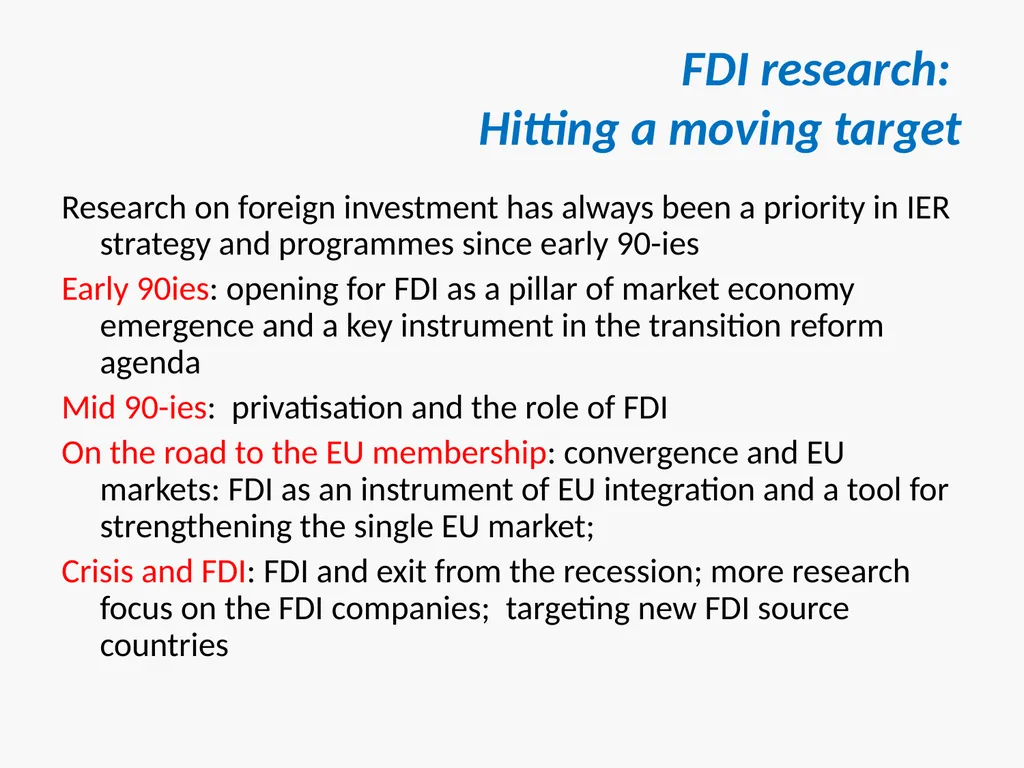
FDI research:
Hitting a moving target Research on foreign investment has always been a priority in IER strategy and programmes since early 90-ies
Early 90ies: opening for FDI as a pillar of market economy emergence and a key instrument in the transition reform agenda
Mid 90-ies: privatisation and the role of FDI
On the road to the EU membership: convergence and EU markets: FDI as an instrument of EU integration and a tool for strengthening the single EU market;
Crisis and FDI: FDI and exit from the recession; more research focus on the FDI companies; targeting new FDI source countries<br>
04
Relocation of Western companies in Bulgaria FDI and intercompany relations after the EU accession (Professor Goev, Associate professor Minchev (2009-2011): Studying 100 foreign investment companies in Bulgaria compared with the same data from 2001. Assessing the relations between the Bulgarian and foreign companies.<br>
05
Promoting competitiveness of Joint ventures in Bulgaria Dr. Marangozov . The study focuses on competitiveness and Joint ventures in the context of local and European practices and legislation.<br>
06
Structuring Balance of Payments Prof. Minasian : The study results in a comprehensive set of policy measures to improve macroeconomic policies and synergies between different polices that serve for macroeconomic and financial stability and balancing externalities.<br>
07
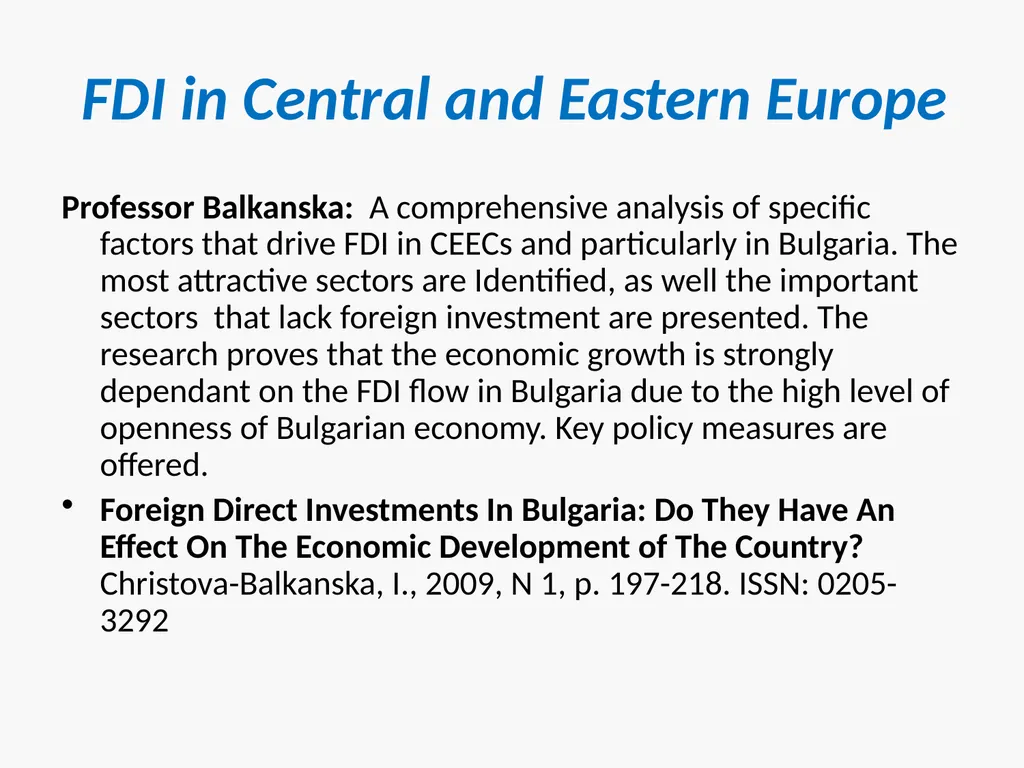
FDI in Central and Eastern Europe Professor Balkanska: A comprehensive analysis of specific factors that drive FDI in CEECs and particularly in Bulgaria. The most attractive sectors are Identified, as well the important sectors that lack foreign investment are presented. The research proves that the economic growth is strongly dependant on the FDI flow in Bulgaria due to the high level of openness of Bulgarian economy. Key policy measures are offered.
Foreign Direct Investments In Bulgaria: Do They Have An Effect On The Economic Development of The Country? Christova-Balkanska, I., 2009, N 1, p. 197-218. ISSN: 0205-3292<br>
Foreign Direct Investments In Bulgaria: Do They Have An Effect On The Economic Development of The Country? Christova-Balkanska, I., 2009, N 1, p. 197-218. ISSN: 0205-3292<br>
08
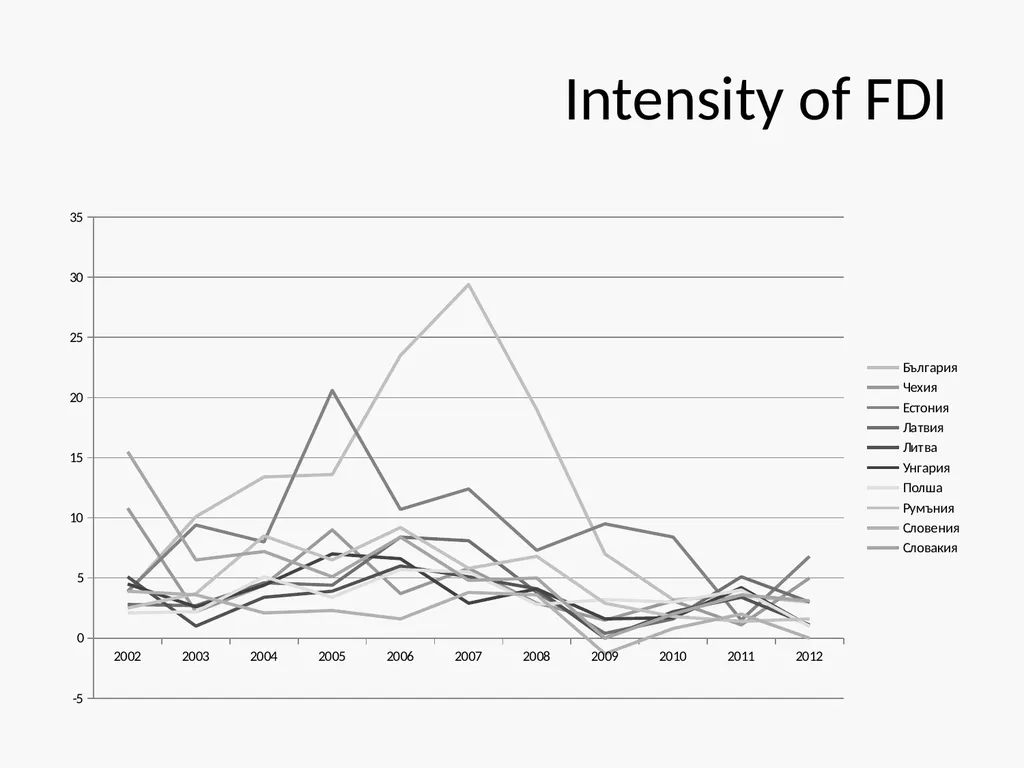
Intensity of FDI<br>
09
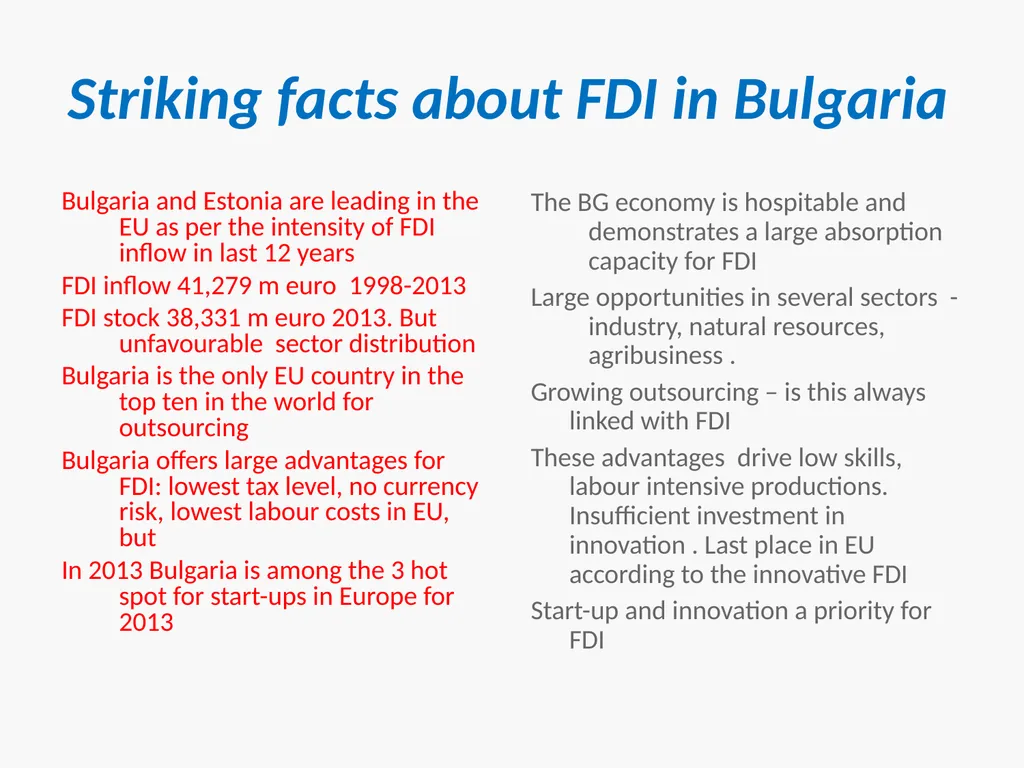
Striking facts about FDI in Bulgaria Bulgaria and Estonia are leading in the EU as per the intensity of FDI inflow in last 12 years
FDI inflow 41,279 m euro 1998-2013
FDI stock 38,331 m euro 2013. But unfavourable sector distribution
Bulgaria is the only EU country in the top ten in the world for outsourcing
Bulgaria offers large advantages for FDI: lowest tax level, no currency risk, lowest labour costs in EU, but
In 2013 Bulgaria is among the 3 hot spot for start-ups in Europe for 2013 The BG economy is hospitable and demonstrates a large absorption capacity for FDI
Large opportunities in several sectors - industry, natural resources, agribusiness .
Growing outsourcing – is this always linked with FDI
These advantages drive low skills, labour intensive productions. Insufficient investment in innovation . Last place in EU according to the innovative FDI
Start-up and innovation a priority for FDI<br>
10
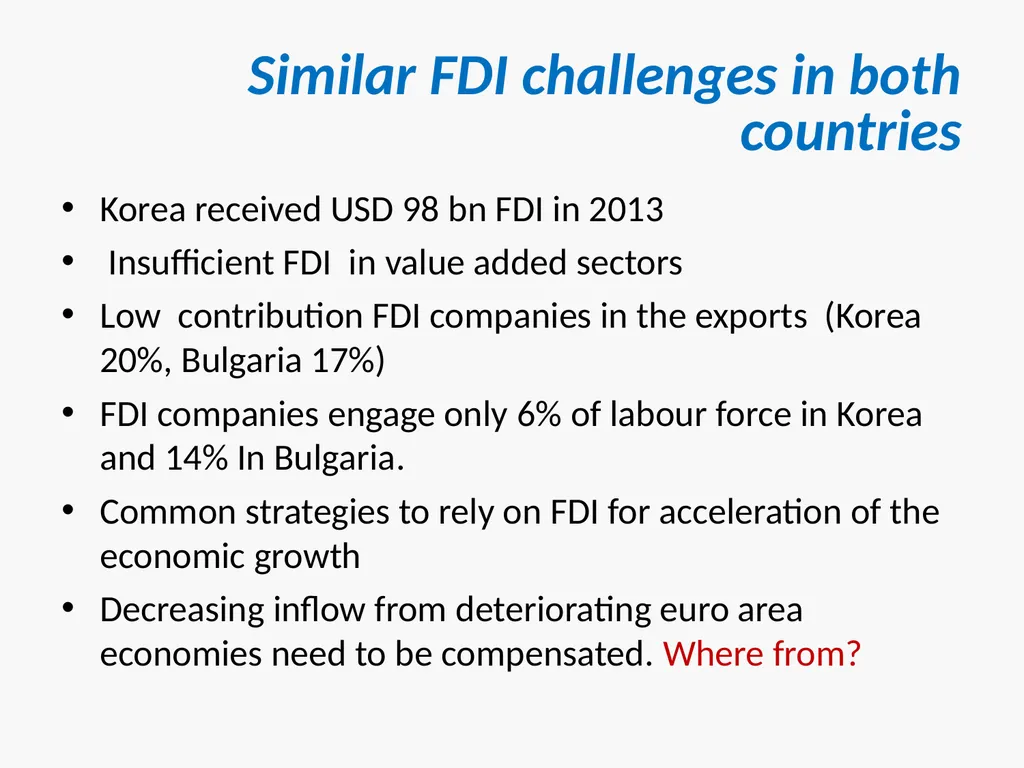
Similar FDI challenges in both countries Korea received USD 98 bn FDI in 2013
Insufficient FDI in value added sectors
Low contribution FDI companies in the exports (Korea 20%, Bulgaria 17%)
FDI companies engage only 6% of labour force in Korea and 14% In Bulgaria.
Common strategies to rely on FDI for acceleration of the economic growth
Decreasing inflow from deteriorating euro area economies need to be compensated. Where from?<br>
11
Asian economies as a source of FDI ? Traditionally Japan was considered as a country that largely invests aboard but the last two decades put on the stage other Asian countries
China and Republic of Korea invest abroad more than received inflow
India, Pakistan and Vietnam FDI inflow is still larger than the outflow but the FDI is growing. Their current account deficits are largely covered by the FDI inflow
Internationalisation of fast growing Asian economies takes time. Realistically, FDI from R Korea, China and Japan could be encouraged in a short<br>
12
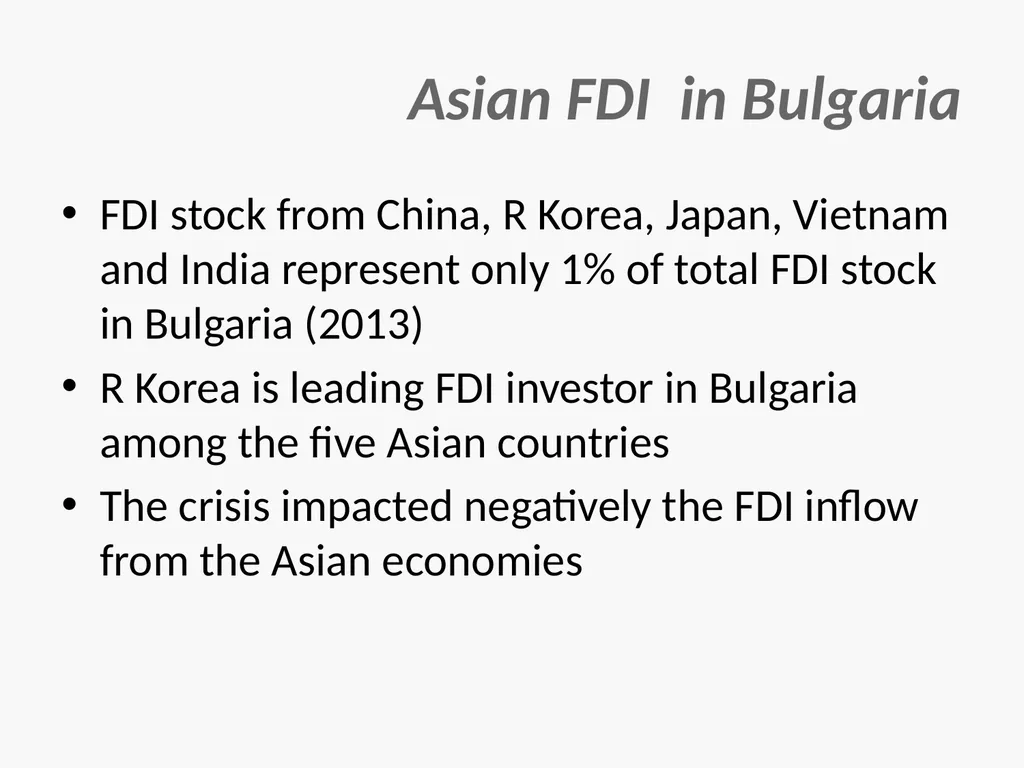
Asian FDI in Bulgaria FDI stock from China, R Korea, Japan, Vietnam and India represent only 1% of total FDI stock in Bulgaria (2013)
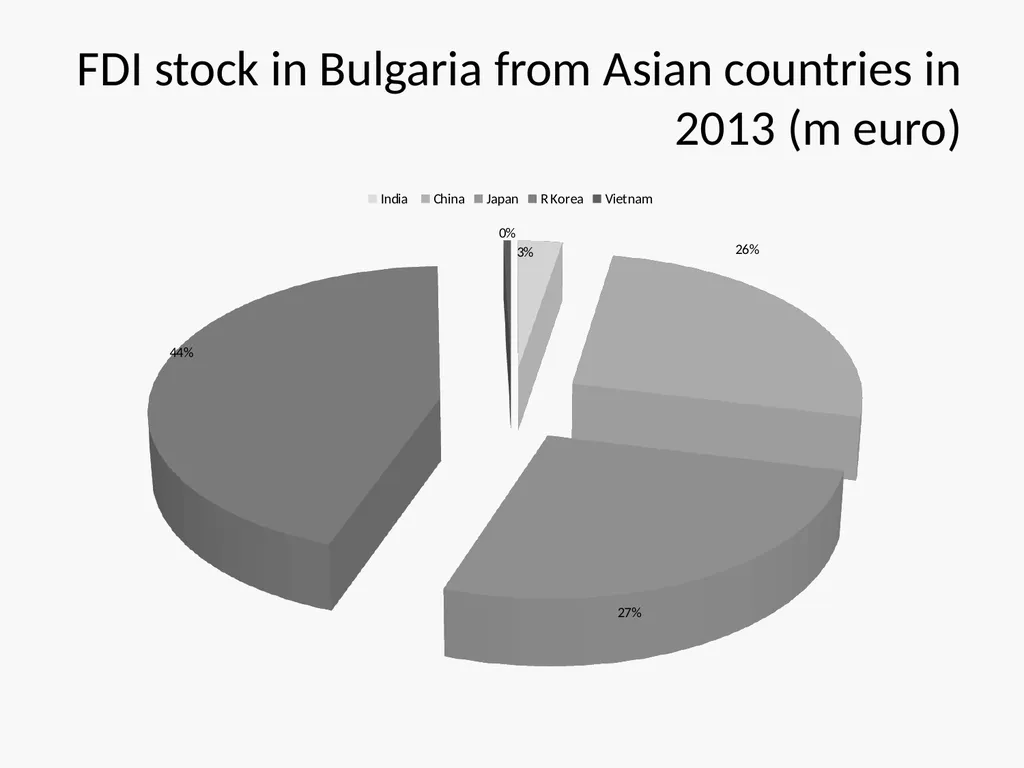
R Korea is leading FDI investor in Bulgaria among the five Asian countries
The crisis impacted negatively the FDI inflow from the Asian economies<br>
R Korea is leading FDI investor in Bulgaria among the five Asian countries
The crisis impacted negatively the FDI inflow from the Asian economies<br>
13
FDI stock in Bulgaria from Asian countries in 2013 (m euro)<br>
14
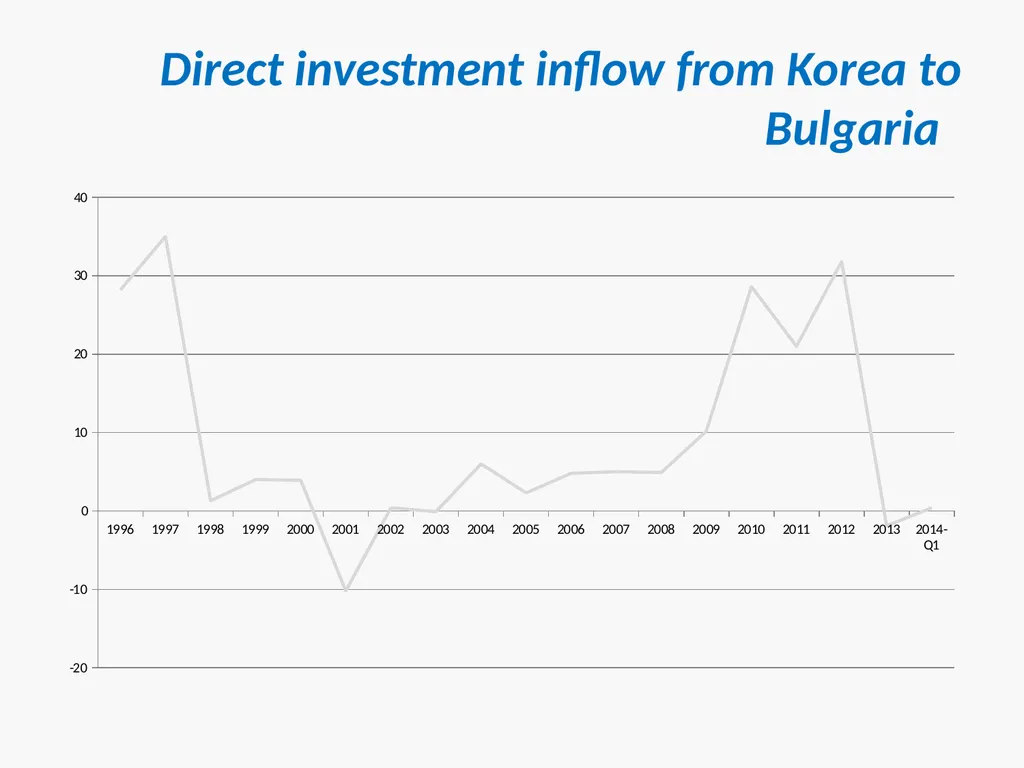
Direct investment inflow from Korea to Bulgaria<br>
15
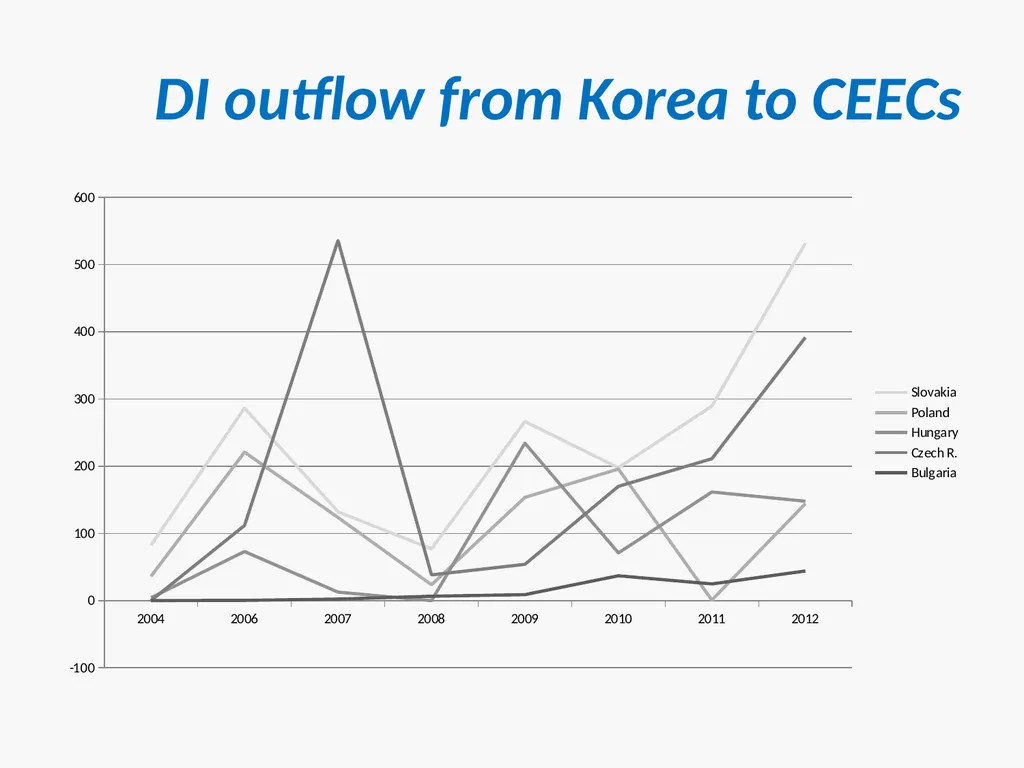
DI outflow from Korea to CEECs<br>
16
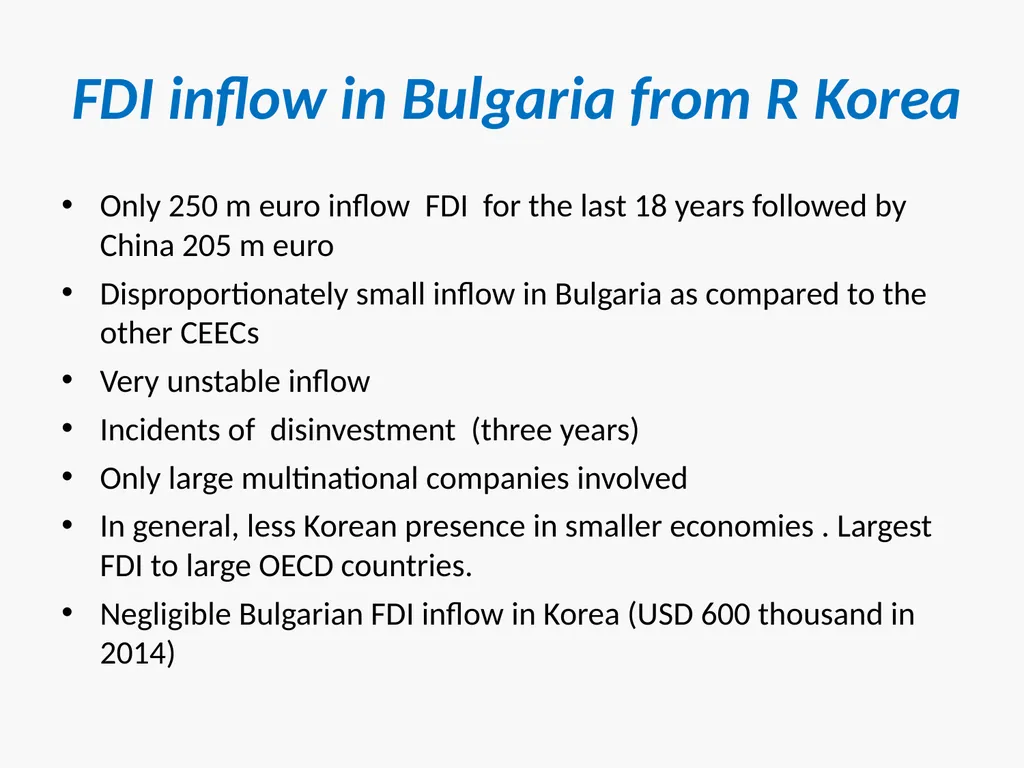
FDI inflow in Bulgaria from R Korea Only 250 m euro inflow FDI for the last 18 years followed by China 205 m euro
Disproportionately small inflow in Bulgaria as compared to the other CEECs
Very unstable inflow
Incidents of disinvestment (three years)
Only large multinational companies involved
In general, less Korean presence in smaller economies . Largest FDI to large OECD countries.
Negligible Bulgarian FDI inflow in Korea (USD 600 thousand in 2014)<br>
17
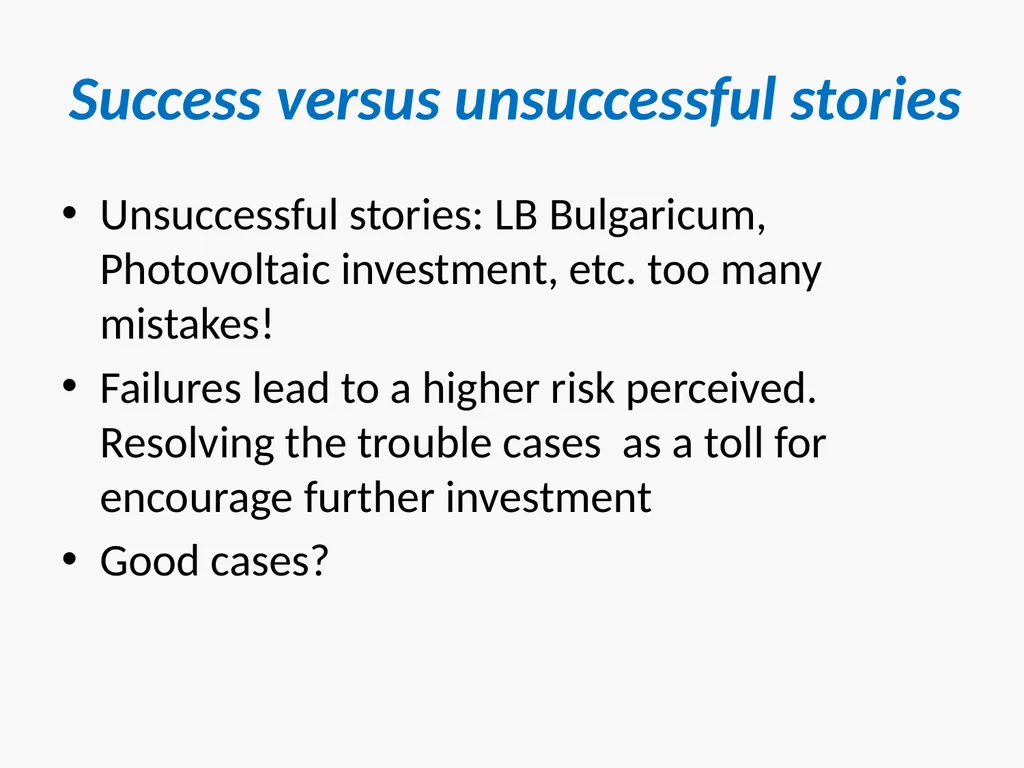
Success versus unsuccessful stories Unsuccessful stories: LB Bulgaricum, Photovoltaic investment, etc. too many mistakes!
Failures lead to a higher risk perceived. Resolving the trouble cases as a toll for encourage further investment
Good cases?<br>
Failures lead to a higher risk perceived. Resolving the trouble cases as a toll for encourage further investment
Good cases?<br>
18
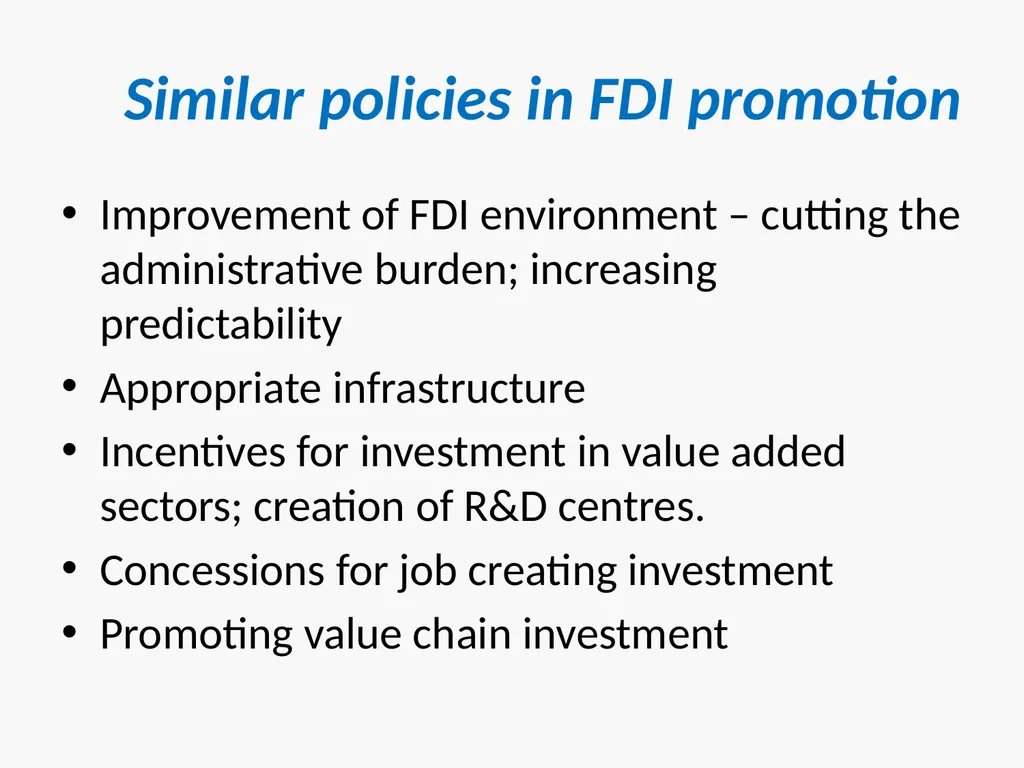
Similar policies in FDI promotion Improvement of FDI environment – cutting the administrative burden; increasing predictability
Appropriate infrastructure
Incentives for investment in value added sectors; creation of R&D centres.
Concessions for job creating investment
Promoting value chain investment<br>
Appropriate infrastructure
Incentives for investment in value added sectors; creation of R&D centres.
Concessions for job creating investment
Promoting value chain investment<br>
19
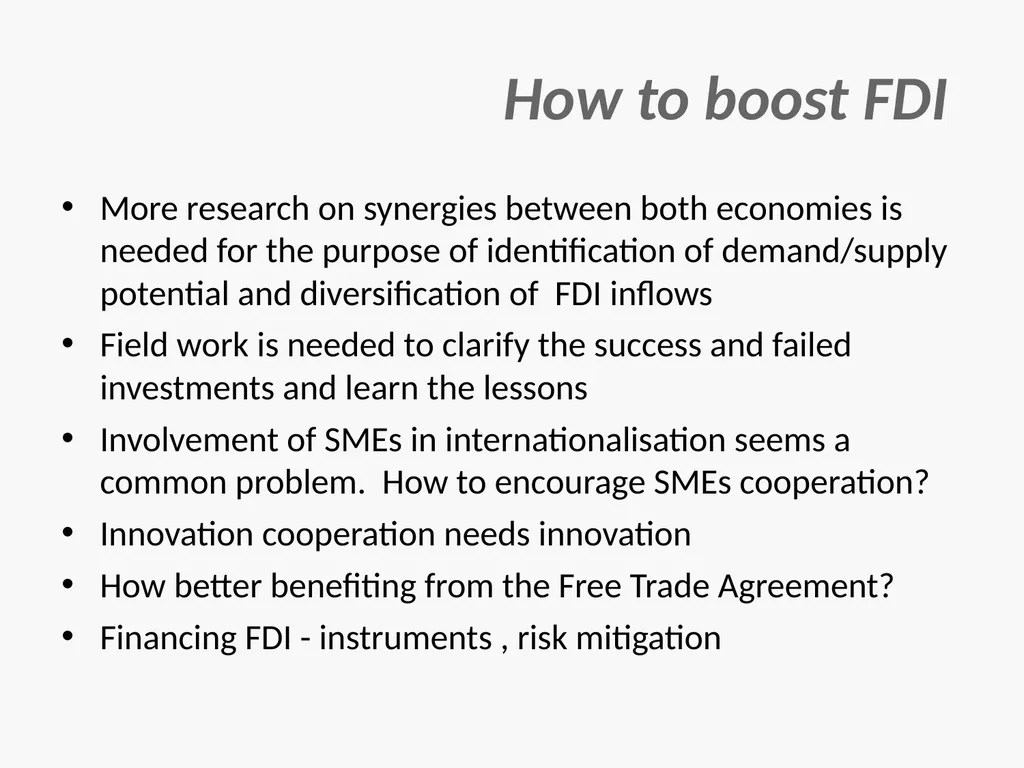
How to boost FDI More research on synergies between both economies is needed for the purpose of identification of demand/supply potential and diversification of FDI inflows
Field work is needed to clarify the success and failed investments and learn the lessons
Involvement of SMEs in internationalisation seems a common problem. How to encourage SMEs cooperation?
Innovation cooperation needs innovation
How better benefiting from the Free Trade Agreement?
Financing FDI - instruments , risk mitigation<br>
20
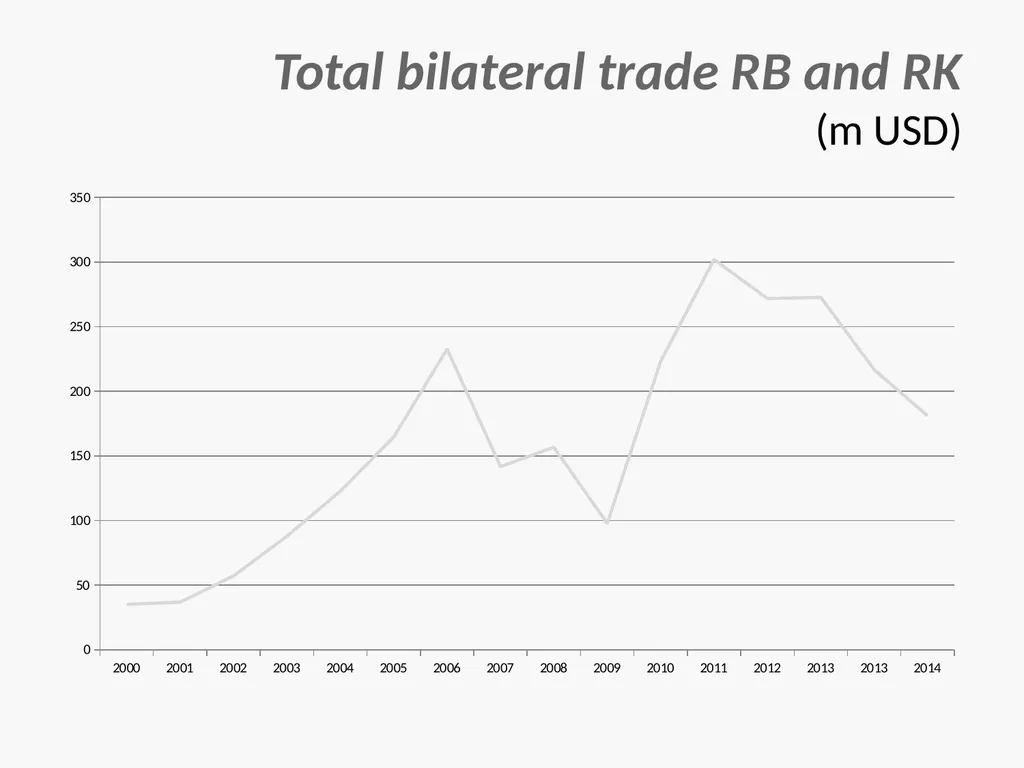
Total bilateral trade RB and RK
(m USD)<br>
21
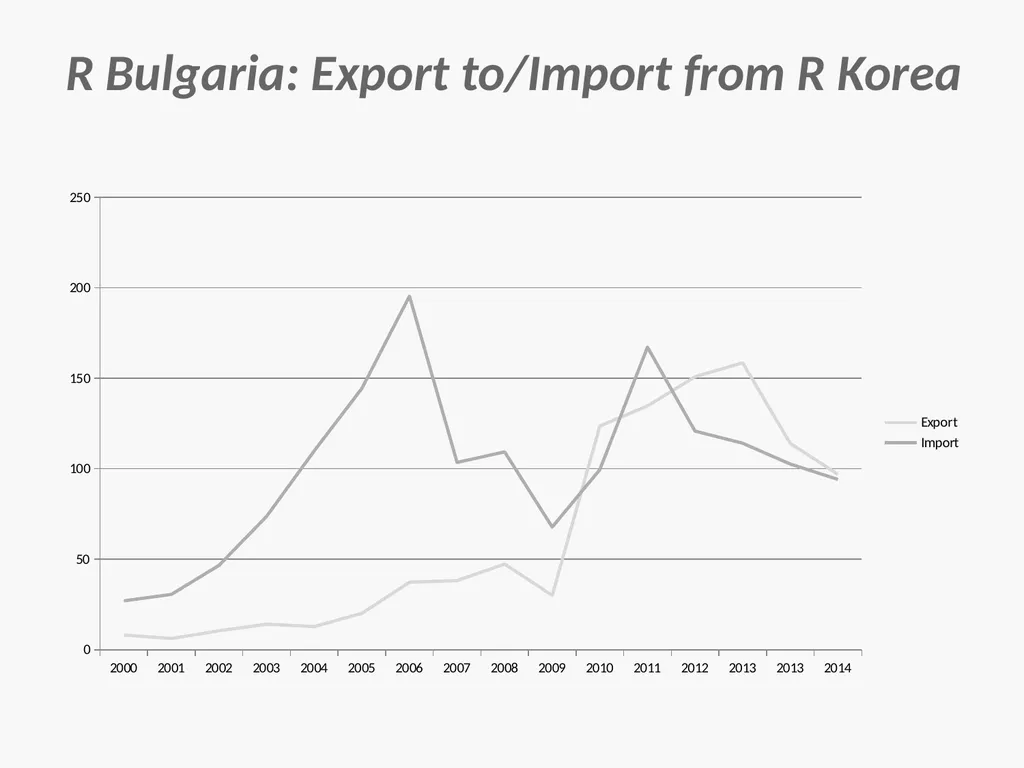
R Bulgaria: Export to/Import from R Korea<br>
22
Bilateral trade Trade between the two countries substantially increased in the last decade and more pronounced after 2006
The trend has been volatile since 2007 which is associated with both export and import dynamics
The recent financial and economic crises impacted strongly the export and at much lesser extend the import from Korea
The EU – Korea Trade agreement has a little impact on bilateral economic relations
The export of Bulgarian goods is caching up with the import from R Korea and the trade between the two countries converge to achieve a balance
Prices of metals strongly impact the total trade between the countries<br>
23
Favourable legal framework The Free Trade Agreement between EU and R Korea signed on July 1, 2011 is the first with an Asian country which is expected to boost bilateral trade. But it does not happen automatically. The agreement creates only opportunities. The information is needed to be spread among participants and also discussions aiming at mutual understanding should take place<br>
24
Institutional framework in place Sofia Office of Korean Agency for Export and Investment Promotion / Корейската агенция за насърчаване на търговията и инвестициите (КОТРА) contributes to bilateral relations
In 1990 Bulgaria- Korea Committee for Economic Cooperation<br>
In 1990 Bulgaria- Korea Committee for Economic Cooperation<br>
25
Challenges Still bilateral trade is below the potential
Overconcentration of bilateral trade in few goods: over 80% of export to R Korea are metals and 40% of import are diodes and chemicals
Non tariff restrictions
Transportation costs
Financing tools<br>
Overconcentration of bilateral trade in few goods: over 80% of export to R Korea are metals and 40% of import are diodes and chemicals
Non tariff restrictions
Transportation costs
Financing tools<br>
26
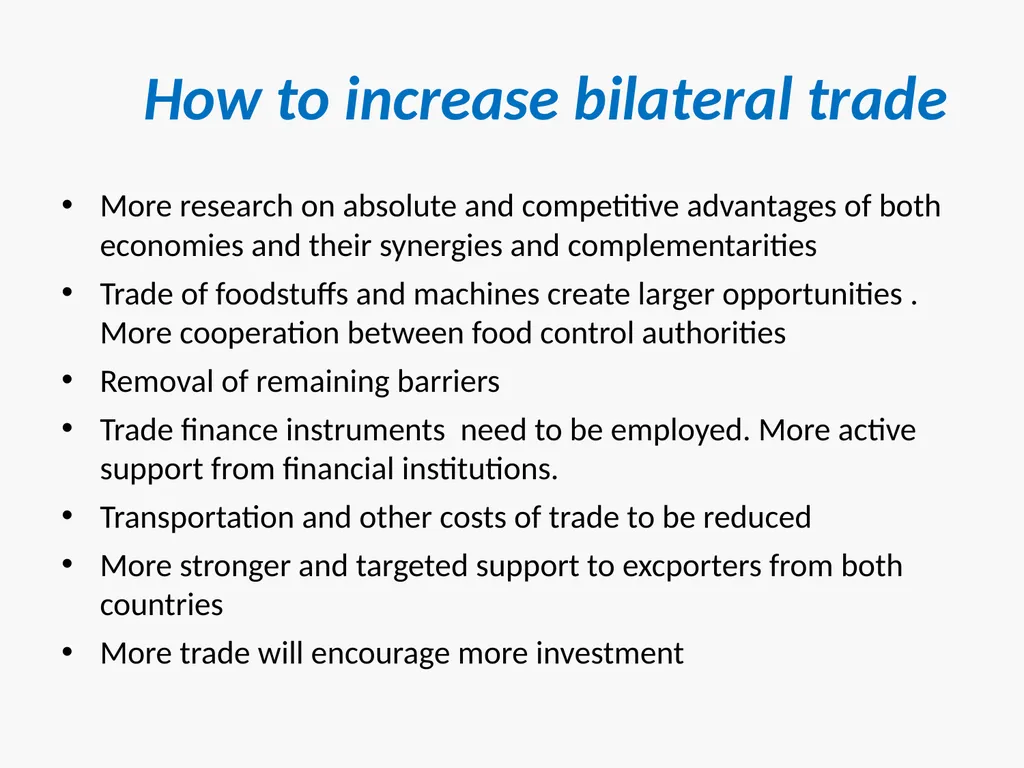
How to increase bilateral trade More research on absolute and competitive advantages of both economies and their synergies and complementarities
Trade of foodstuffs and machines create larger opportunities . More cooperation between food control authorities
Removal of remaining barriers
Trade finance instruments need to be employed. More active support from financial institutions.
Transportation and other costs of trade to be reduced
More stronger and targeted support to excporters from both countries
More trade will encourage more investment<br>
27
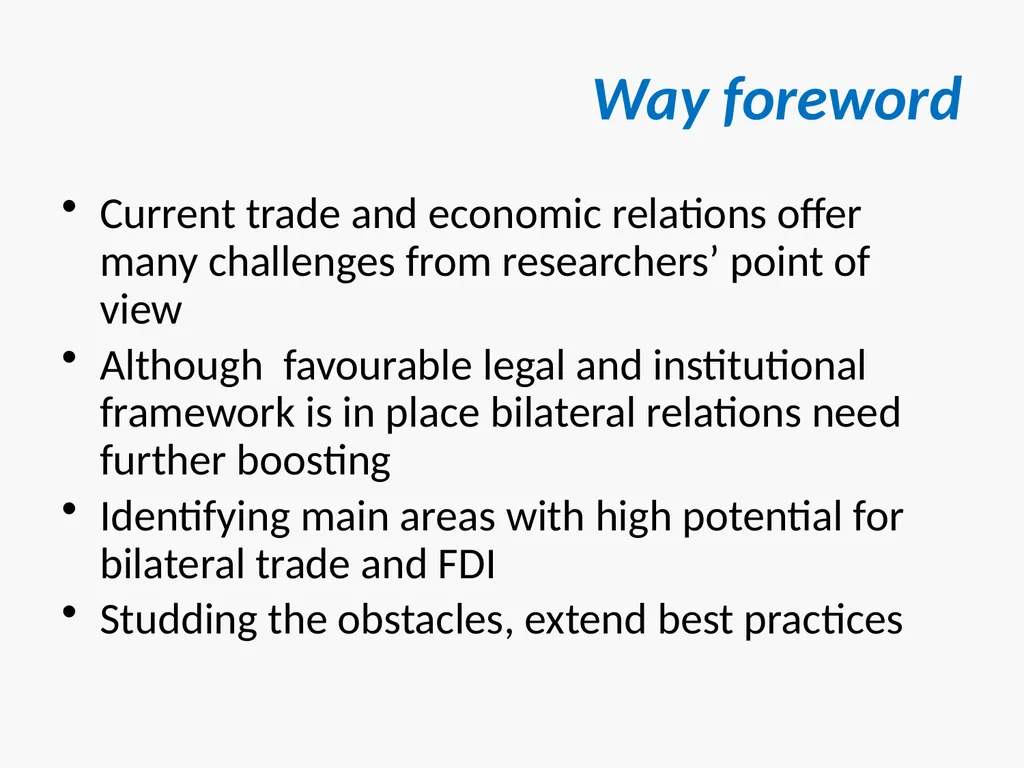
Way foreword Current trade and economic relations offer many challenges from researchers’ point of view
Although favourable legal and institutional framework is in place bilateral relations need further boosting
Identifying main areas with high potential for bilateral trade and FDI
Studding the obstacles, extend best practices<br>
Although favourable legal and institutional framework is in place bilateral relations need further boosting
Identifying main areas with high potential for bilateral trade and FDI
Studding the obstacles, extend best practices<br>
28
Thank you !
Let’s answer the questions together<br>
Let’s answer the questions together<br>