‘Fearless’ By Janice Galloway Pre-Reading What
Description: Fearless By Janice Galloway Pre-Reading What does the word Fearless make you think of? What do you think the story will be about? Check Understanding Fearless When referring to the text Fearless we must use inverted commas. However,
Related Topics
Download Presentation
"‘Fearless’ By Janice Galloway Pre-Reading What" is the property of its rightful owner. Permission is granted to download and print the materials on this website for personal, non-commercial use only, and to display it on your personal computer provided you do not modify the materials and that you retain all copyright notices contained in the materials. By downloading content from our website, you accept the terms of this agreement.
Presentation Transcript
slide1. ‘Fearless’ By Janice Galloway<br>
slide2. Pre-Reading What does the word Fearless make you think of?
What do you think the story will be about?<br>
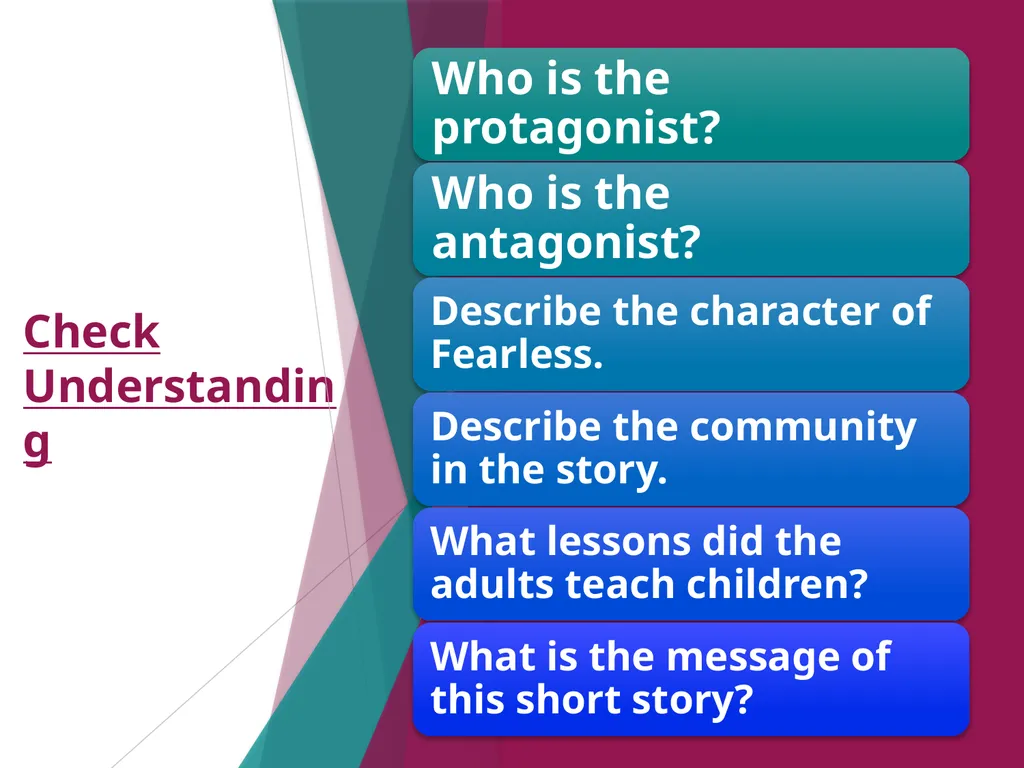
slide4. Check Understanding<br>
slide5. ‘Fearless’ When referring to the text ‘Fearless’ we must use inverted commas. However, they are not needed when referring to the character of Fearless.
Possessive form of Fearless is Fearless’
E.g. The actions of Fearless are despicable.
Fearless’ actions are despicable.<br>
slide6. Author vs. Character Galloway is the author but also the narrator of this story.
Although this is a fiction text it is based on a time in Galloway’s own childhood.
When we refer to author we simply use Galloway
When we refer to the character we use ‘young Galloway’.
Exception: the final paragraph of the story is in present time and therefore Galloway is no longer a child.<br>
slide7. Title<br>
slide8. TITLE (PUN) 3 meanings:
Fearless = literally the name of the male character.
Fear less = by the end, she has come to fear men less.
Fear less = as a child she lost her fear for a moment. Galloway clearly tells the reader that this was beyond her control.
“Every part of her being was rejecting this male oppression. And it still does..”<br>
slide9. Plot In the exam you must be able to write a brief summary of your text.
In your group discuss they most important aspects of the story.
Decide on 4 main plot points.<br>
slide10. Plot Fearless’ general abuse in community
The women’s attitudes to Fearless
The (lack of) reaction from the men.
She kicks Fearless = turning point/climax.<br>
slide11. Theme The theme is the ‘big picture’ idea in a text. E.g. What the text is about.
In ‘A View from the Bridge’ some themes were Family, Love, Loyalty and Justice.
Discuss the themes we can see in ‘Fearless’.<br>
slide12. Themes Gender Division
Inequality
Violence
Alcoholism
Misogyny<br>
slide13. Misogyny: The hatred of women.<br>
slide14. Themes Gender divide may look at both sides. Galloway focuses on Fearless’ hatred of women by describing an atrocious character for whom we have nothing but dislike. By immersing the reader in young Galloway’s hatred (through first person narration) we identify with the point she is making.<br>
slide15. Setting The setting is extremely important because the experiences the characters have are closely shaped by the immediate environment that they find themselves exposed to.
In your groups discuss the setting of the story.
Think about the wider setting as well as the more obvious settings.
How do you know what the setting is? (i.e. quotes)<br>
slide16. SETTING 1950s West of Scotland (Salcoats)
‘Fearless’ suggests the importance of place in its relation to identity.
Many of the themes in the story are associated with Scotland during this era.
Male-dominated and misogynistic society where women were almost second-class citizens; looked down upon.
“volatile maleness of the whole west coast legend” (p.25)<br>
slide17. Characterisation of Fearless Some ways to explore a character:
Their appearance
What they say and/or do
Others’ reaction to them/about them<br>
slide18. Characterisation In paragraph two we are given a thorough description of the character of Fearless. Comment upon the effectiveness of Galloway’s language in this paragraph. Use at least two examples.
Galloway is quick to point out that Fearless wasn’t a tramp in paragraph three. Outline the reasons for her opinion.
Choose three words or phrases from page 24 that show how domineering Fearless was considered. Explain your choice.
Galloway compares Fearless to other characters on pages 24 & 25. Why are these comparisons effective?<br>
slide19. NARRATIVE STANCE Narrative stance is the viewpoint from which we are told the story.
Think about the point of view of narrator in this story.
In your groups discuss why this might be important. Try to link the narrative stance back to the themes of the story.<br>
slide20. NARRRATIVE STANCE Internal narration
First person
Female perspective
Child’s perspective<br>
slide21. TENSE Galloway uses more than one tense in ‘Fearless’.
In your groups, identify each tense and explain why it has been used.<br>
slide22. TENSE: PAST AND PRESENT First person narrative, mostly re-telling of childhood event therefore past tense: “when I was wee…”
She changes in the middle to bring story to present day “It was a long time ago.”
Galloway changes her tense to show that she STILL has hatred for men; still believes men feel they are superior to women.<br>
slide23. Social Conditioning Social conditioning refers to the process of training individuals in a society to behave in a manner approved by the society in general.
In your your groups discuss the social conditioning that occurs in this story.<br>
slide24. Social Conditioning People are expected to behave in a certain way in Fearless’ company.
Fearless teaches the people in society how to behave. He does this through his abusive actions if they do not behave in the ‘correct’ way.
The other adults in society teach the children, especially girls, to fear Fearless. They do this by behaving the ‘correct’ way themselves and using Fearless as a threatening image.<br>
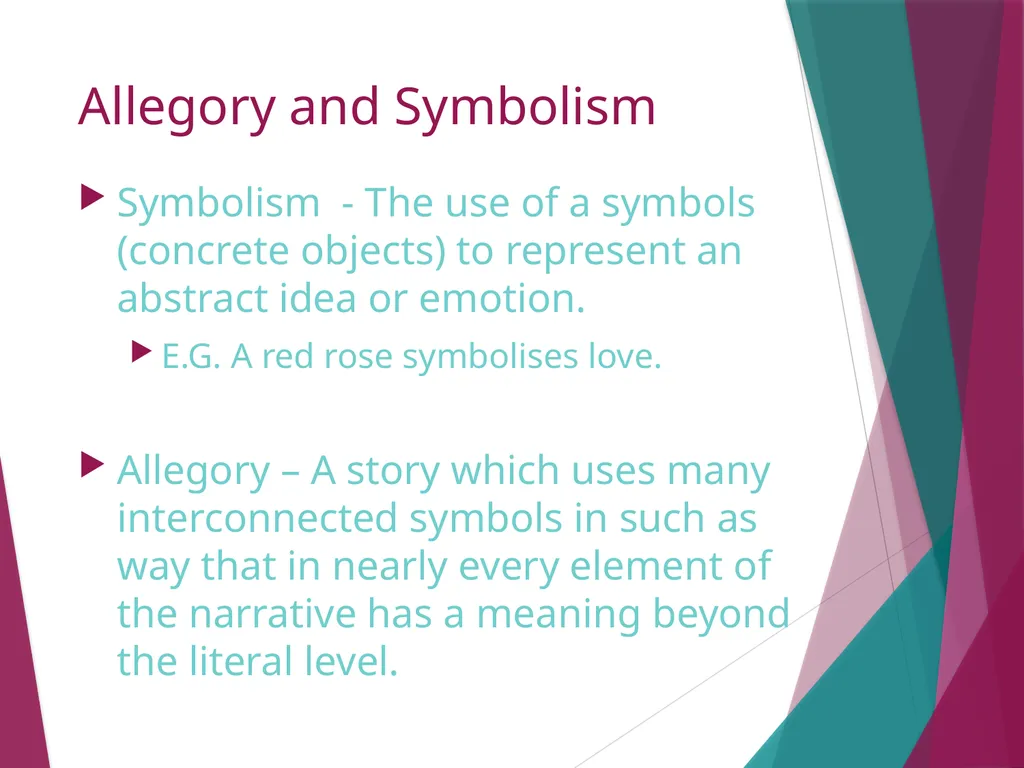
slide25. Allegory and Symbolism Symbolism - The use of a symbols (concrete objects) to represent an abstract idea or emotion.
E.G. A red rose symbolises love.
Allegory – A story which uses many interconnected symbols in such as way that in nearly every element of the narrative has a meaning beyond the literal level.<br>
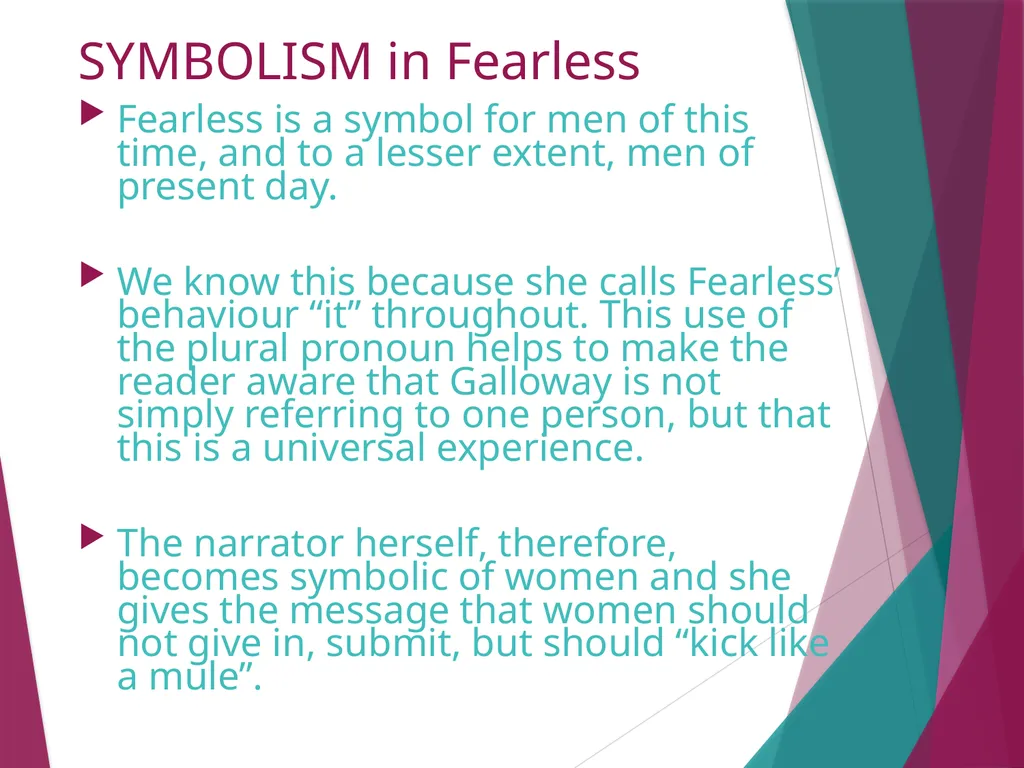
slide26. SYMBOLISM in Fearless Fearless is a symbol for men of this time, and to a lesser extent, men of present day.
We know this because she calls Fearless’ behaviour “it” throughout. This use of the plural pronoun helps to make the reader aware that Galloway is not simply referring to one person, but that this is a universal experience.
The narrator herself, therefore, becomes symbolic of women and she gives the message that women should not give in, submit, but should “kick like a mule”.<br>
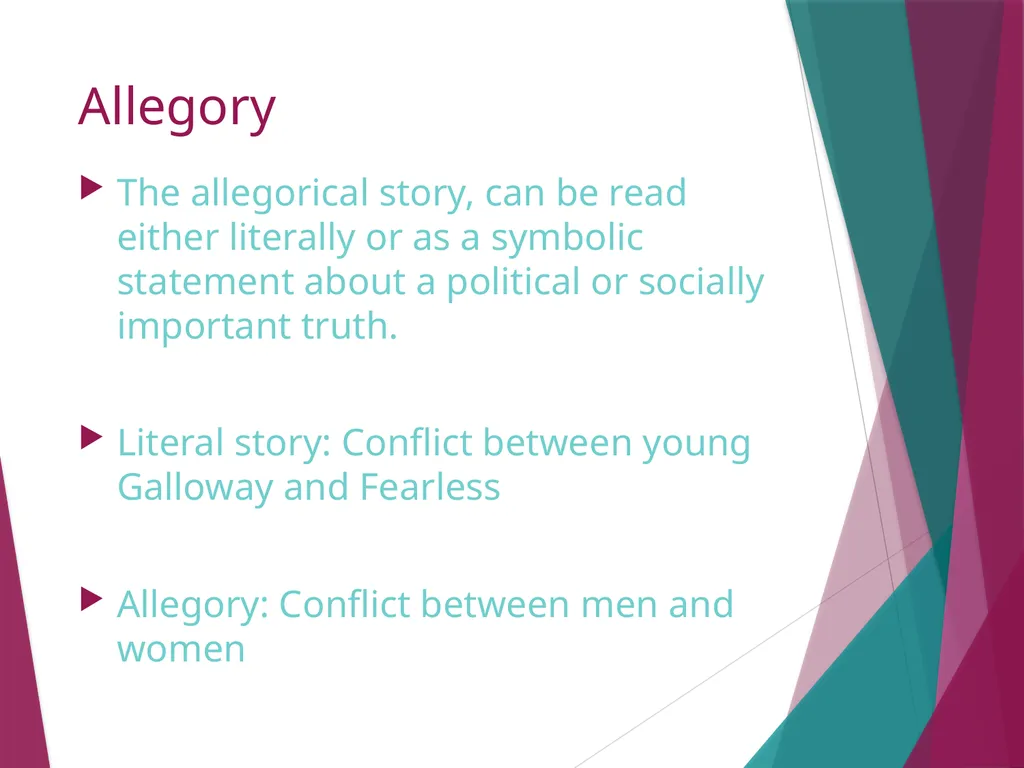
slide27. Allegory The allegorical story, can be read either literally or as a symbolic statement about a political or socially important truth.
Literal story: Conflict between young Galloway and Fearless
Allegory: Conflict between men and women<br>

slide2. Pre-Reading What does the word Fearless make you think of?
What do you think the story will be about?<br>
slide4. Check Understanding<br>
slide5. ‘Fearless’ When referring to the text ‘Fearless’ we must use inverted commas. However, they are not needed when referring to the character of Fearless.
Possessive form of Fearless is Fearless’
E.g. The actions of Fearless are despicable.
Fearless’ actions are despicable.<br>
slide6. Author vs. Character Galloway is the author but also the narrator of this story.
Although this is a fiction text it is based on a time in Galloway’s own childhood.
When we refer to author we simply use Galloway
When we refer to the character we use ‘young Galloway’.
Exception: the final paragraph of the story is in present time and therefore Galloway is no longer a child.<br>
slide7. Title<br>
slide8. TITLE (PUN) 3 meanings:
Fearless = literally the name of the male character.
Fear less = by the end, she has come to fear men less.
Fear less = as a child she lost her fear for a moment. Galloway clearly tells the reader that this was beyond her control.
“Every part of her being was rejecting this male oppression. And it still does..”<br>
slide9. Plot In the exam you must be able to write a brief summary of your text.
In your group discuss they most important aspects of the story.
Decide on 4 main plot points.<br>
slide10. Plot Fearless’ general abuse in community
The women’s attitudes to Fearless
The (lack of) reaction from the men.
She kicks Fearless = turning point/climax.<br>
slide11. Theme The theme is the ‘big picture’ idea in a text. E.g. What the text is about.
In ‘A View from the Bridge’ some themes were Family, Love, Loyalty and Justice.
Discuss the themes we can see in ‘Fearless’.<br>
slide12. Themes Gender Division
Inequality
Violence
Alcoholism
Misogyny<br>
slide13. Misogyny: The hatred of women.<br>
slide14. Themes Gender divide may look at both sides. Galloway focuses on Fearless’ hatred of women by describing an atrocious character for whom we have nothing but dislike. By immersing the reader in young Galloway’s hatred (through first person narration) we identify with the point she is making.<br>
slide15. Setting The setting is extremely important because the experiences the characters have are closely shaped by the immediate environment that they find themselves exposed to.
In your groups discuss the setting of the story.
Think about the wider setting as well as the more obvious settings.
How do you know what the setting is? (i.e. quotes)<br>
slide16. SETTING 1950s West of Scotland (Salcoats)
‘Fearless’ suggests the importance of place in its relation to identity.
Many of the themes in the story are associated with Scotland during this era.
Male-dominated and misogynistic society where women were almost second-class citizens; looked down upon.
“volatile maleness of the whole west coast legend” (p.25)<br>
slide17. Characterisation of Fearless Some ways to explore a character:
Their appearance
What they say and/or do
Others’ reaction to them/about them<br>
slide18. Characterisation In paragraph two we are given a thorough description of the character of Fearless. Comment upon the effectiveness of Galloway’s language in this paragraph. Use at least two examples.
Galloway is quick to point out that Fearless wasn’t a tramp in paragraph three. Outline the reasons for her opinion.
Choose three words or phrases from page 24 that show how domineering Fearless was considered. Explain your choice.
Galloway compares Fearless to other characters on pages 24 & 25. Why are these comparisons effective?<br>
slide19. NARRATIVE STANCE Narrative stance is the viewpoint from which we are told the story.
Think about the point of view of narrator in this story.
In your groups discuss why this might be important. Try to link the narrative stance back to the themes of the story.<br>
slide20. NARRRATIVE STANCE Internal narration
First person
Female perspective
Child’s perspective<br>
slide21. TENSE Galloway uses more than one tense in ‘Fearless’.
In your groups, identify each tense and explain why it has been used.<br>
slide22. TENSE: PAST AND PRESENT First person narrative, mostly re-telling of childhood event therefore past tense: “when I was wee…”
She changes in the middle to bring story to present day “It was a long time ago.”
Galloway changes her tense to show that she STILL has hatred for men; still believes men feel they are superior to women.<br>
slide23. Social Conditioning Social conditioning refers to the process of training individuals in a society to behave in a manner approved by the society in general.
In your your groups discuss the social conditioning that occurs in this story.<br>
slide24. Social Conditioning People are expected to behave in a certain way in Fearless’ company.
Fearless teaches the people in society how to behave. He does this through his abusive actions if they do not behave in the ‘correct’ way.
The other adults in society teach the children, especially girls, to fear Fearless. They do this by behaving the ‘correct’ way themselves and using Fearless as a threatening image.<br>
slide25. Allegory and Symbolism Symbolism - The use of a symbols (concrete objects) to represent an abstract idea or emotion.
E.G. A red rose symbolises love.
Allegory – A story which uses many interconnected symbols in such as way that in nearly every element of the narrative has a meaning beyond the literal level.<br>
slide26. SYMBOLISM in Fearless Fearless is a symbol for men of this time, and to a lesser extent, men of present day.
We know this because she calls Fearless’ behaviour “it” throughout. This use of the plural pronoun helps to make the reader aware that Galloway is not simply referring to one person, but that this is a universal experience.
The narrator herself, therefore, becomes symbolic of women and she gives the message that women should not give in, submit, but should “kick like a mule”.<br>
slide27. Allegory The allegorical story, can be read either literally or as a symbolic statement about a political or socially important truth.
Literal story: Conflict between young Galloway and Fearless
Allegory: Conflict between men and women<br>