
February 7, 2024 Administrative Rulemaking
Description: February 7, 2024 Administrative Rulemaking Seminar: OMB and SBA Review Patrick Price Special Counsel, Office of Management and Budget General Counsel, State Budget Agency Chad Ranney Deputy Director General Counsel, Office of Management
Related Topics
Download Presentation
"February 7, 2024 Administrative Rulemaking" is the property of its rightful owner. Permission is granted to download and print the materials on this website for personal, non-commercial use only, and to display it on your personal computer provided you do not modify the materials and that you retain all copyright notices contained in the materials. By downloading content from our website, you accept the terms of this agreement.
Presentation Transcript
slide1. February 7, 2024 Administrative Rulemaking Seminar:
OMB and SBA Review Patrick Price
Special Counsel, Office of Management and Budget
General Counsel, State Budget Agency
Chad Ranney Deputy Director & General Counsel, Office of Management and Budget<br>
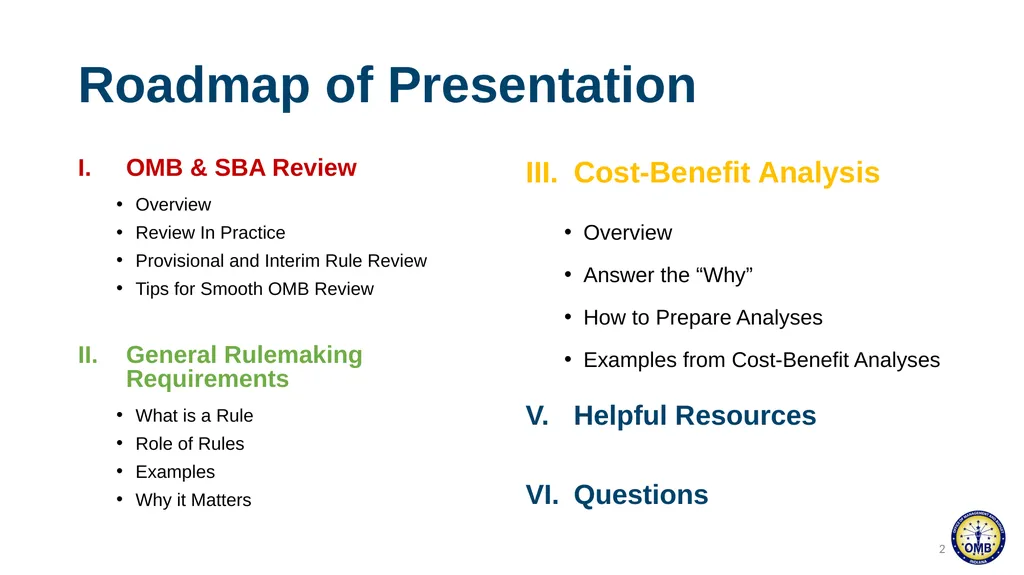
slide2. Roadmap of Presentation OMB & SBA Review
Overview
Review In Practice
Provisional and Interim Rule Review
Tips for Smooth OMB Review
General Rulemaking Requirements
What is a Rule
Role of Rules
Examples
Why it Matters Cost-Benefit Analysis
Overview
Answer the “Why”
How to Prepare Analyses
Examples from Cost-Benefit Analyses
Helpful Resources
Questions 2<br>
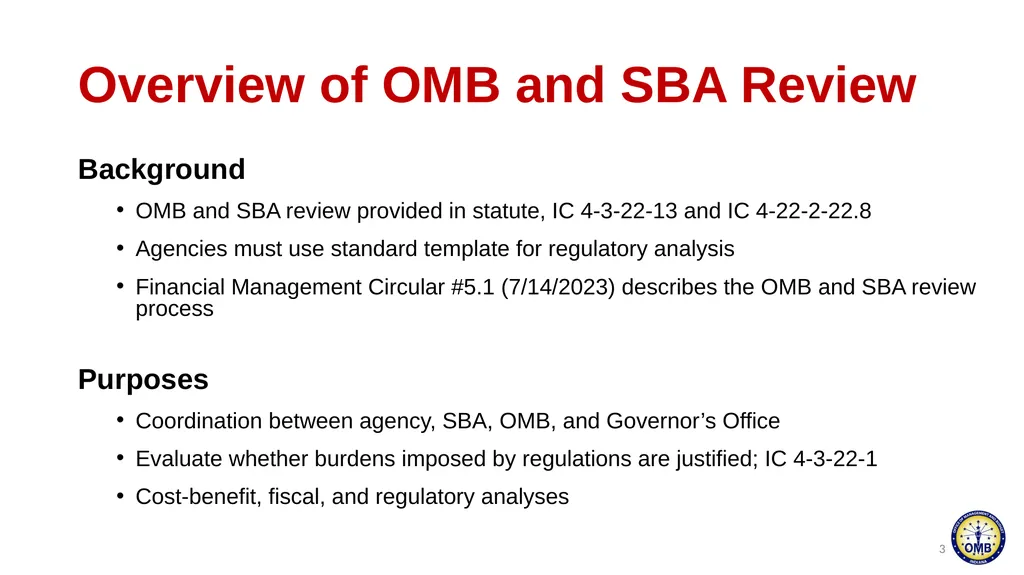
slide3. Overview of OMB and SBA Review Background
OMB and SBA review provided in statute, IC 4-3-22-13 and IC 4-22-2-22.8
Agencies must use standard template for regulatory analysis
Financial Management Circular #5.1 (7/14/2023) describes the OMB and SBA review process
Purposes
Coordination between agency, SBA, OMB, and Governor’s Office
Evaluate whether burdens imposed by regulations are justified; IC 4-3-22-1
Cost-benefit, fiscal, and regulatory analyses 3<br>
slide4. Scope of OMB and SBA Review FMC #5.1 OMB and SBA Review Process
Applies to ALL regular rulemakings under IC 4-22-2-23
Does NOT APPLY to provisional rules
Covered by Financial Management Circular #5.3
Does NOT APPLY to interim rules
Covered by Financial Management Circular #5.4
Does NOT APPLY to re-adoptions of expiring rules
Agency prepares readoption analysis instead 4<br>
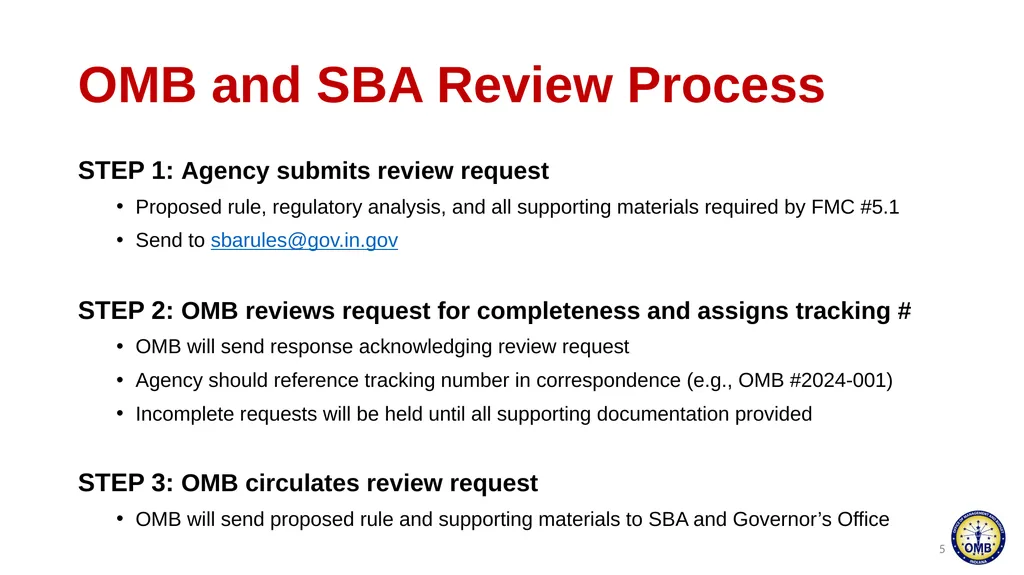
slide5. OMB and SBA Review Process STEP 1: Agency submits review request
Proposed rule, regulatory analysis, and all supporting materials required by FMC #5.1
Send to sbarules@gov.in.gov
STEP 2: OMB reviews request for completeness and assigns tracking #
OMB will send response acknowledging review request
Agency should reference tracking number in correspondence (e.g., OMB #2024-001)
Incomplete requests will be held until all supporting documentation provided
STEP 3: OMB circulates review request
OMB will send proposed rule and supporting materials to SBA and Governor’s Office 5<br>
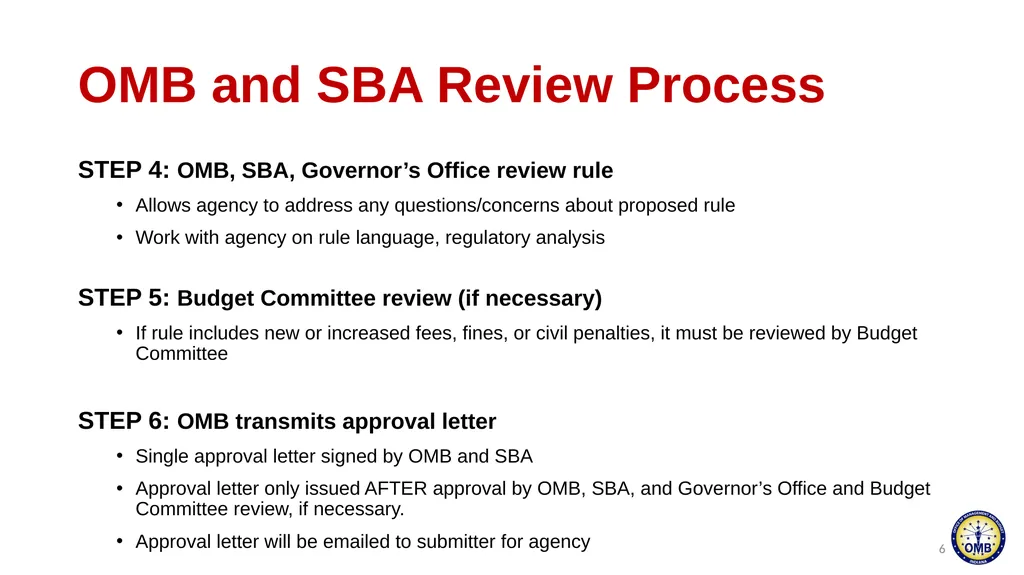
slide6. OMB and SBA Review Process STEP 4: OMB, SBA, Governor’s Office review rule
Allows agency to address any questions/concerns about proposed rule
Work with agency on rule language, regulatory analysis
STEP 5: Budget Committee review (if necessary)
If rule includes new or increased fees, fines, or civil penalties, it must be reviewed by Budget Committee
STEP 6: OMB transmits approval letter
Single approval letter signed by OMB and SBA
Approval letter only issued AFTER approval by OMB, SBA, and Governor’s Office and Budget Committee review, if necessary.
Approval letter will be emailed to submitter for agency 6<br>
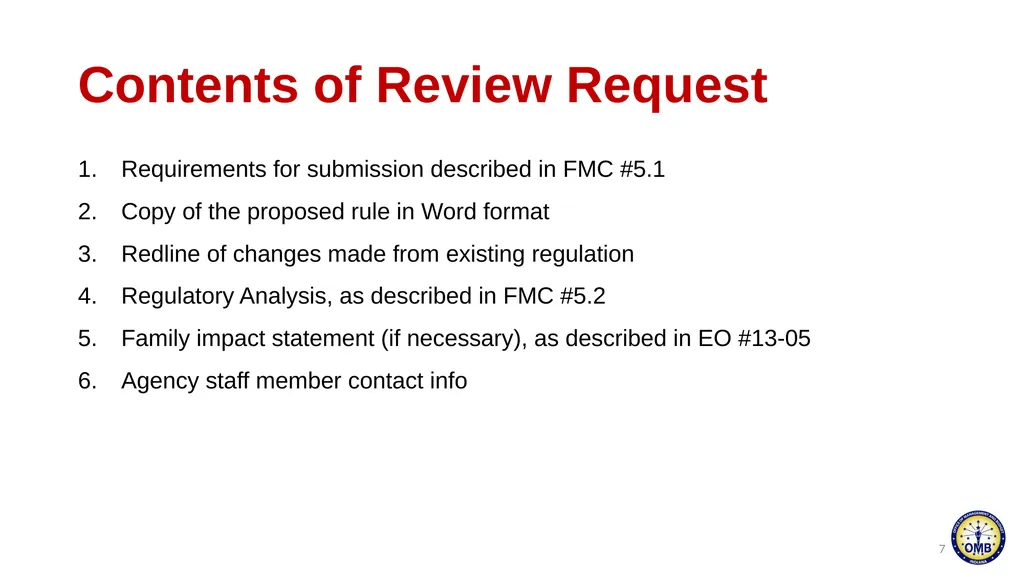
slide7. Contents of Review Request Requirements for submission described in FMC #5.1
Copy of the proposed rule in Word format
Redline of changes made from existing regulation
Regulatory Analysis, as described in FMC #5.2
Family impact statement (if necessary), as described in EO #13-05
Agency staff member contact info 7<br>
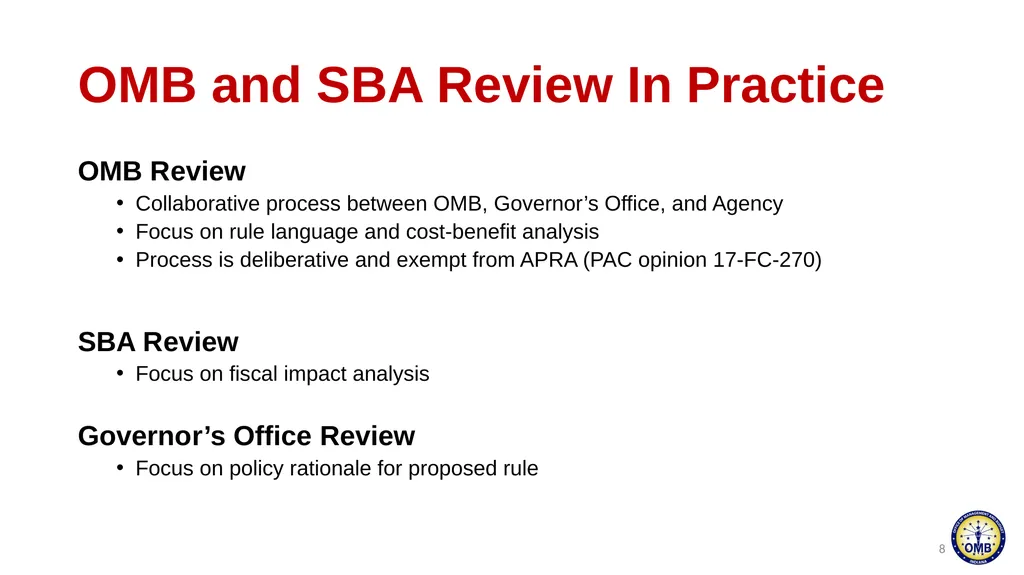
slide8. OMB and SBA Review In Practice OMB Review
Collaborative process between OMB, Governor’s Office, and Agency
Focus on rule language and cost-benefit analysis
Process is deliberative and exempt from APRA (PAC opinion 17-FC-270)
SBA Review
Focus on fiscal impact analysis
Governor’s Office Review
Focus on policy rationale for proposed rule 8<br>
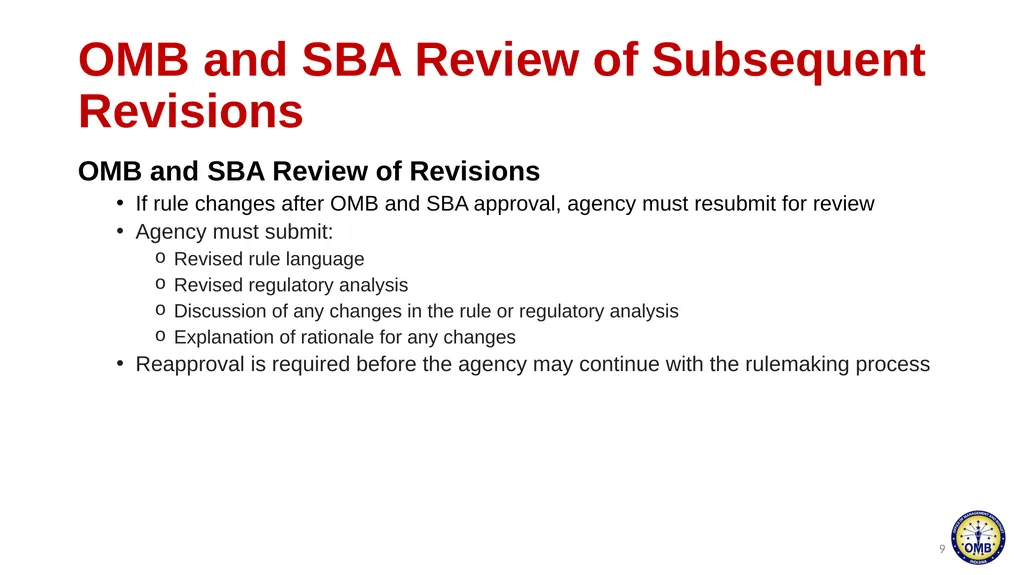
slide9. OMB and SBA Review of Subsequent Revisions OMB and SBA Review of Revisions
If rule changes after OMB and SBA approval, agency must resubmit for review
Agency must submit:
Revised rule language
Revised regulatory analysis
Discussion of any changes in the rule or regulatory analysis
Explanation of rationale for any changes
Reapproval is required before the agency may continue with the rulemaking process 9<br>
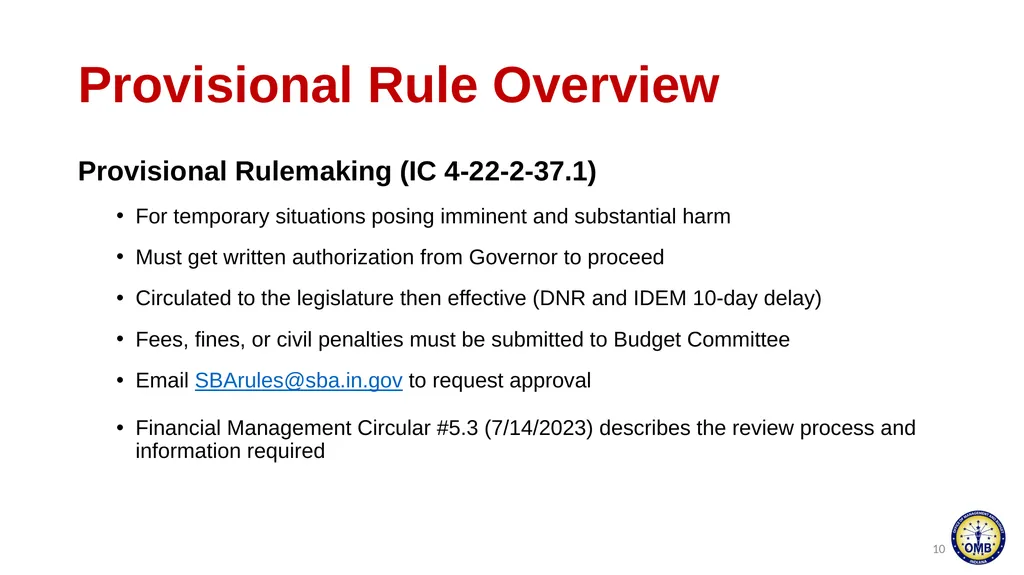
slide10. Provisional Rule Overview Provisional Rulemaking (IC 4-22-2-37.1)
For temporary situations posing imminent and substantial harm
Must get written authorization from Governor to proceed
Circulated to the legislature then effective (DNR and IDEM 10-day delay)
Fees, fines, or civil penalties must be submitted to Budget Committee
Email SBArules@sba.in.gov to request approval
Financial Management Circular #5.3 (7/14/2023) describes the review process and information required 10<br>
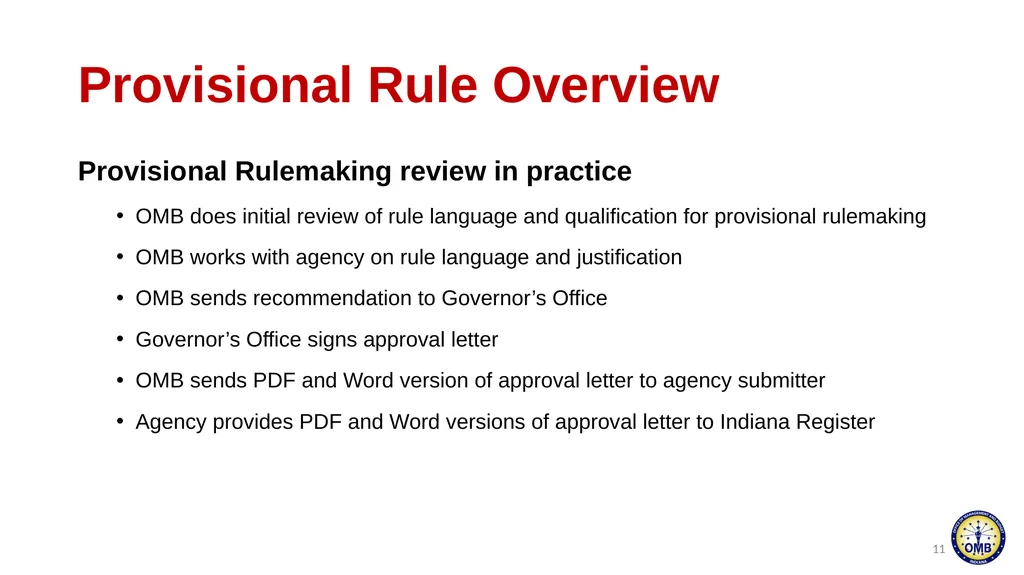
slide11. Provisional Rule Overview Provisional Rulemaking review in practice
OMB does initial review of rule language and qualification for provisional rulemaking
OMB works with agency on rule language and justification
OMB sends recommendation to Governor’s Office
Governor’s Office signs approval letter
OMB sends PDF and Word version of approval letter to agency submitter
Agency provides PDF and Word versions of approval letter to Indiana Register 11<br>
slide12. Interim Rule Overview Interim Rulemaking (IC 4-22-2-37.2)
For changes required by new or updated statutes, federal regulations, or professional codes
Placeholder that gives agency time to do formal rulemaking
Must get written authorization from Governor to proceed
Publish Notice of Interim Rulemaking and 30-day comment period (no public hearing)
Fees, fines, or civil penalties must be submitted to Budget Committee
Email SBArules@sba.in.gov to request approval
Financial Management Circular #5.4 (7/14/2023) describes the review process and information required 12<br>
slide13. Interim Rule Overview Interim Rulemaking review in practice
OMB does initial review of rule language and qualification for interim rulemaking
OMB works with agency on rule language and justification
OMB sends recommendation to Governor’s Office
Governor’s Office signs approval letter
OMB sends PDF and Word version of approval letter to agency submitter
Agency provides PDF and Word versions of approval letter to Indiana Register 13<br>
slide14. Budget Committee Review Budget Committee Review
Required for any proposed rule that adds or amends language to increase or expand application of a fee, fine, or civil penalty
Templates for Budget Committee report available on OMB website:
https://www.in.gov/omb/rule-approval-process/rulemaking-resources/
Work with SBA budget analyst for agency to request to be added to Budget Committee agenda after initial approval by OMB 14<br>
slide15. Tips for Smooth OMB Review Be prepared to talk to us about the rule
Have everyone in the discussion at the same time – lawyers and subject matter experts
Don’t bite off too much
Rule only moves as fast as the slowest portion
Can break off higher priority portions to move through first
Don’t reinvent the wheel
modifying existing administrative code tends to be easier than a repeal and replace
Consider hiring outside resources for big rules 15<br>
slide16. Tips for Smooth Review Identify what is new
Redlines (changes from existing requirements)
Follow rule drafting manual guidelines
Check legal authority for each provision
Feedback from interested parties
Avoid duplication of statutory or CFR language (consider manuals)
Include requirements from forms or policy
Consider talking to OMB before drafting 16<br>
slide17. What is a Rule – Statute Indiana Code establishes what must be included in regulation
IC 4–22–2–3(b)
“Rule” means the whole or any part of an agency statement of general applicability that:
(1) Has or is designed to have the effect of law; and
(2) Implements, interprets, or prescribes:
(A) Law or policy; or
(B) The organization, procedure, or practice requirements of an agency. 17<br>
slide18. What is a Rule – Case Law Courts have adhered closely to the statutory definition
Rules have Four Elements
Villegas v. Silverman, 832 N.E.2d 598 (Ind. Ct. App. 2005)
An administrative rule is:
(1) “an agency statement of general applicability to a class;”
(2) that is “applied prospectively to the class;”
(3) that is “applied as though it has the effect of law;” and
(4) that “affect[s] the substantive rights of the class.”
“Effect of Law” means Mandatory
Ward v. Carter, 90 N.E.3d 660 (Ind. 2018)
“an agency regulation carries the effect of law when it prescribes binding standards of conduct for persons subject to agency authority.”
“[I]f an agency rule acts as a coercive mechanism or wields coercive power over people, it carries the effect of law.” 18<br>
slide19. What is a Rule – Examples In General
Requirements that must be met need to be in statute or regulation
Basis for denying application or permit must be in statute or rule
Basis for violation or enforcement action must be in statute or rule
Examples
Information required to be submitted in an application
Documents required to prove identification
Required equipment
Required training standards
Fees, Fines, and Civil Penalties
Specific dollar amount
Formula - must explain how the fee is calculated 19<br>
slide20. Why isn’t Policy Enough? Because statute requires certain process for adoption
Agency power to make rules flows from General Assembly
Agencies can only make rules where authorized by statute
General Assembly requires rules to be adopted using certain process
Administrative Rules and Procedures Act (IC 4-22-2)
Requires due process (sort of)
Villegas v. Silverman, 832 N.E.2d 598 (Ind. Ct. App. 2005)
“These requirements dictate, among other things, public input into any proposed rule changes. The duty of the BMV to issue licenses in a manner that it deems prudent does not supercede the mandate to allow the public to participate in the rule-making process.” 20<br>
slide21. Why isn’t Policy Enough? Courts will not enforce rules without procedural steps
Agency policies without rulemaking steps do not carry the effect of law
“We hold that the new identification requirements are a rule, and because they were not promulgated in accordance with the ARPA, they are void and without effect.” Villegas, 832 N.E.2d at 610
“IDEM may only regulate by a new rule if the proper rulemaking procedures have been followed.” Indiana-Kentucky Elec. Corp. v. Comm'r, Indiana Dep't of Env't Mgmt., 820 N.E.2d 771, 780 (Ind. Ct. App. 2005)
Examples of rule “alternatives” rejected by courts:
Written policy: Villegas, (required documents for driver’s license)
Oral policy: Indiana-Kentucky Elec. Corp., (location of environmental monitoring equipment)
Contract: Am. Trucking Associations, Inc. v. City of Los Angeles, Cal., 569 U.S. 641 (2013) (imposing “distinctive governmental” authority through contract) 21<br>
slide22. The Role of Rules – Statutes vs. Rules Statutes set general program requirements
Regulations fill in details
Regulations can expand on or explain statutory requirements and definitions
Rules should not duplicate statute, IC 4-22-2-19.5(a)(3)
If your rule repeats statute, must update rule each time statute is updated
Means more rules and more confusion 22<br>
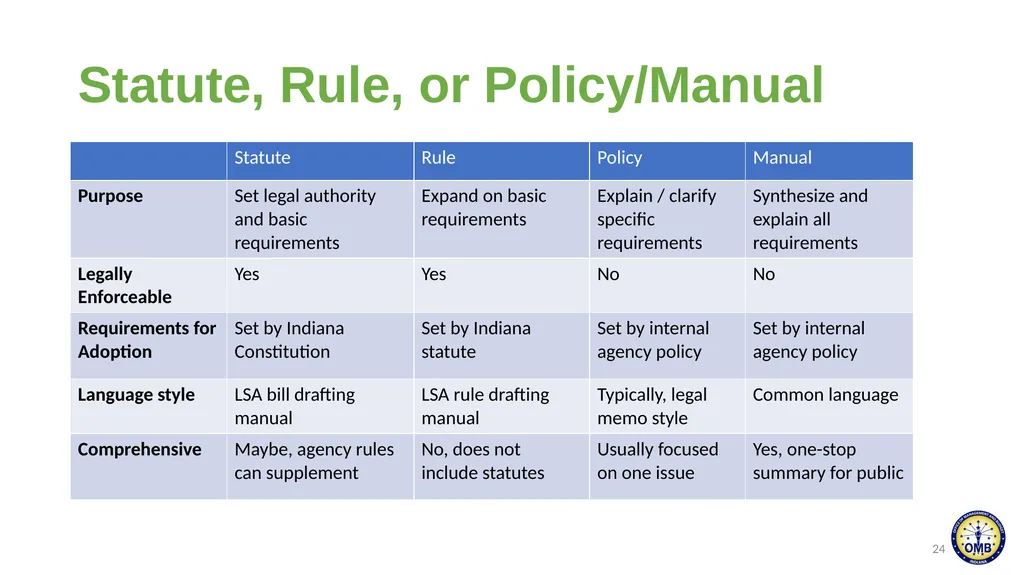
slide23. The Role of Rules – Rules vs. Policies/Manuals Rules impose requirements
Rules are legally enforceable
Policies and Manuals explain requirements
Manuals can combine requirements from statute and regulation and explain in regular language for regulated parties
Examples, BMV Driver’s Manual, DNR Hunting Manual
Policies and Manuals are not legally enforceable 23<br>
slide24. Statute, Rule, or Policy/Manual 24<br>
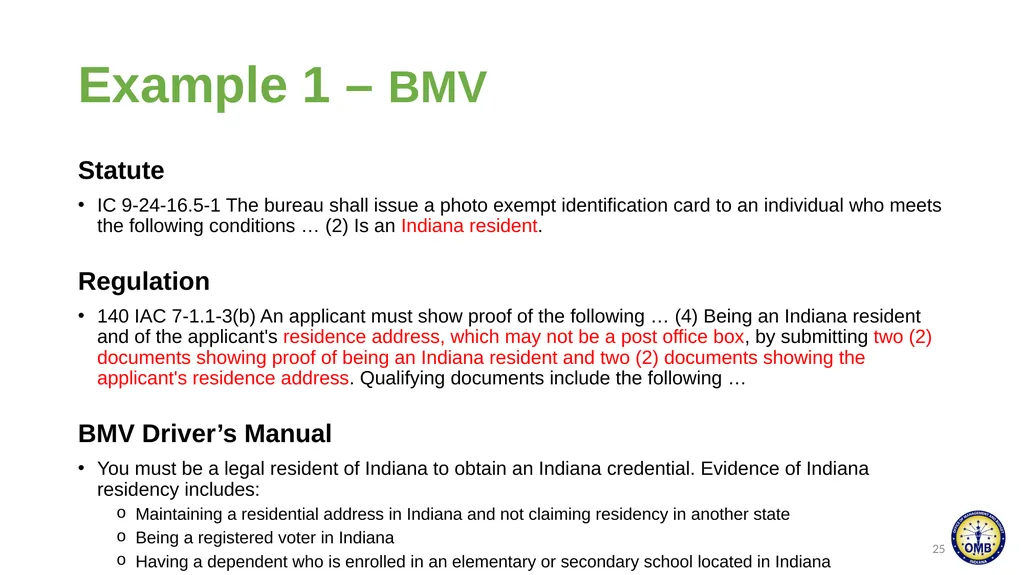
slide25. Example 1 – BMV Statute
IC 9-24-16.5-1 The bureau shall issue a photo exempt identification card to an individual who meets the following conditions … (2) Is an Indiana resident.
Regulation
140 IAC 7-1.1-3(b) An applicant must show proof of the following … (4) Being an Indiana resident and of the applicant's residence address, which may not be a post office box, by submitting two (2) documents showing proof of being an Indiana resident and two (2) documents showing the applicant's residence address. Qualifying documents include the following …
BMV Driver’s Manual
You must be a legal resident of Indiana to obtain an Indiana credential. Evidence of Indiana residency includes:
Maintaining a residential address in Indiana and not claiming residency in another state
Being a registered voter in Indiana
Having a dependent who is enrolled in an elementary or secondary school located in Indiana 25<br>
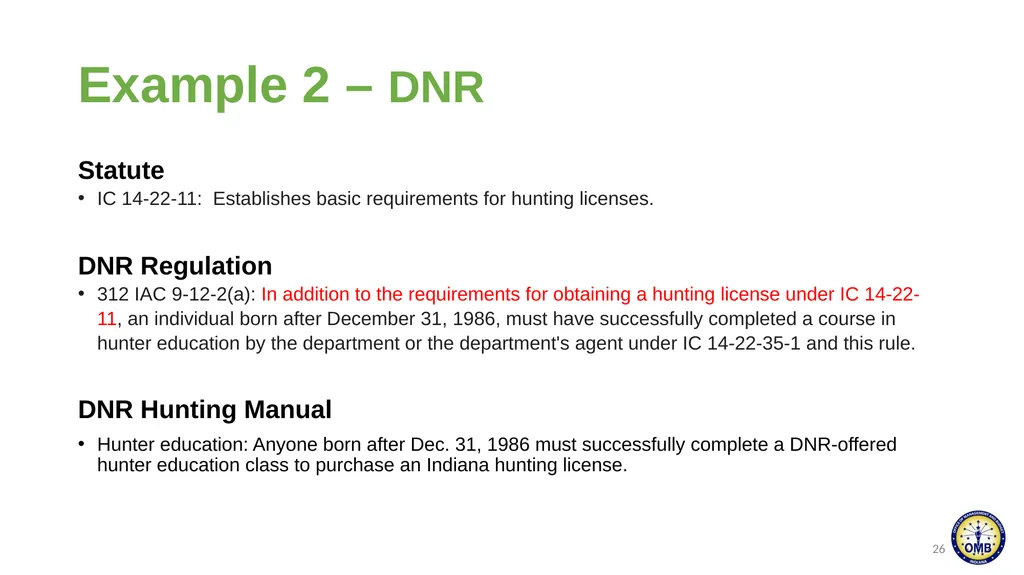
slide26. Example 2 – DNR Statute
IC 14-22-11: Establishes basic requirements for hunting licenses.
DNR Regulation
312 IAC 9-12-2(a): In addition to the requirements for obtaining a hunting license under IC 14-22-11, an individual born after December 31, 1986, must have successfully completed a course in hunter education by the department or the department's agent under IC 14-22-35-1 and this rule.
DNR Hunting Manual
Hunter education: Anyone born after Dec. 31, 1986 must successfully complete a DNR-offered hunter education class to purchase an Indiana hunting license. 26<br>
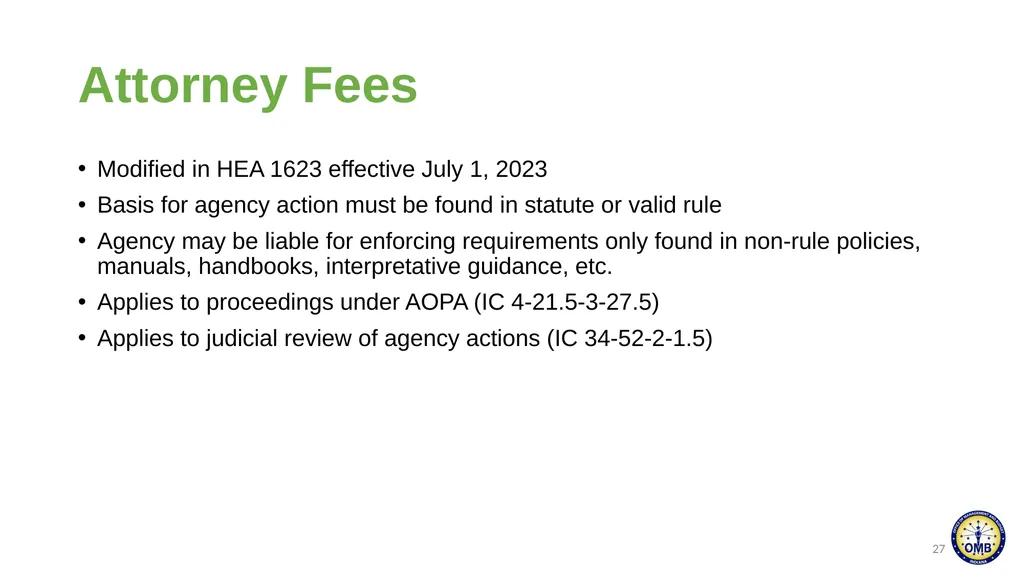
slide27. Attorney Fees Modified in HEA 1623 effective July 1, 2023
Basis for agency action must be found in statute or valid rule
Agency may be liable for enforcing requirements only found in non-rule policies, manuals, handbooks, interpretative guidance, etc.
Applies to proceedings under AOPA (IC 4-21.5-3-27.5)
Applies to judicial review of agency actions (IC 34-52-2-1.5) 27<br>
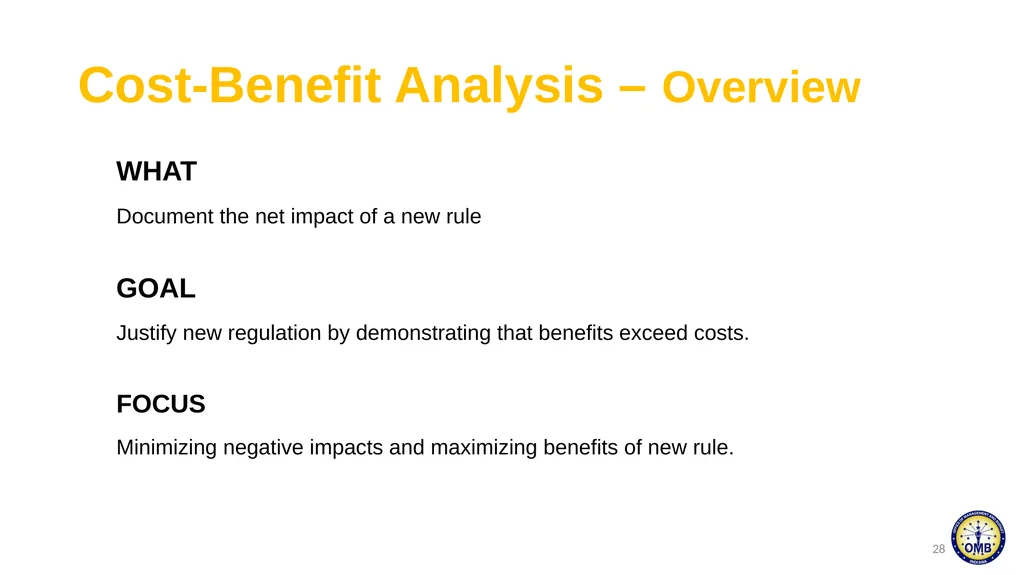
slide28. Cost-Benefit Analysis – Overview WHAT
Document the net impact of a new rule
GOAL
Justify new regulation by demonstrating that benefits exceed costs.
FOCUS
Minimizing negative impacts and maximizing benefits of new rule. 28<br>
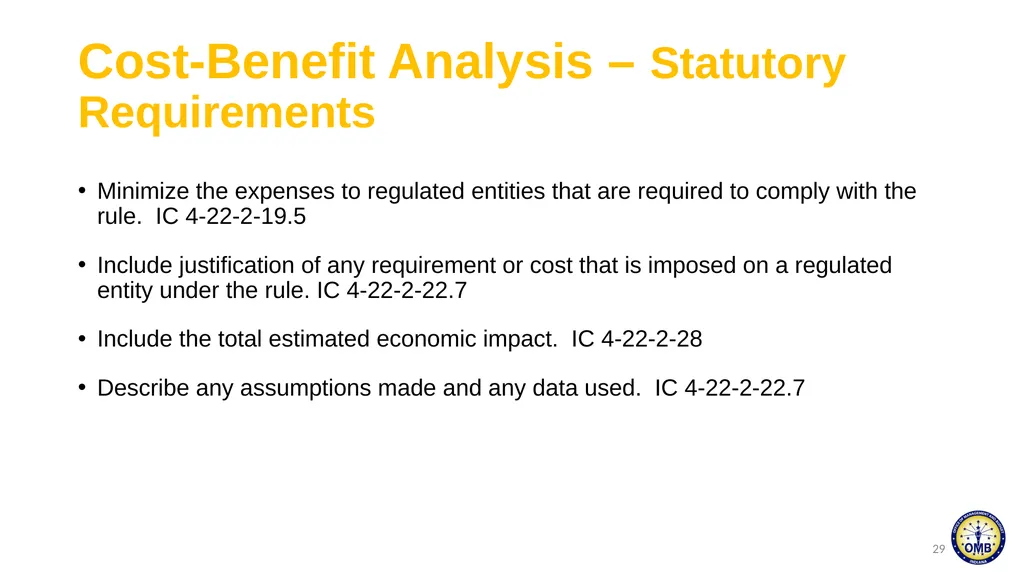
slide29. Cost-Benefit Analysis – Statutory Requirements Minimize the expenses to regulated entities that are required to comply with the rule. IC 4-22-2-19.5
Include justification of any requirement or cost that is imposed on a regulated entity under the rule. IC 4-22-2-22.7
Include the total estimated economic impact. IC 4-22-2-28
Describe any assumptions made and any data used. IC 4-22-2-22.7 29<br>
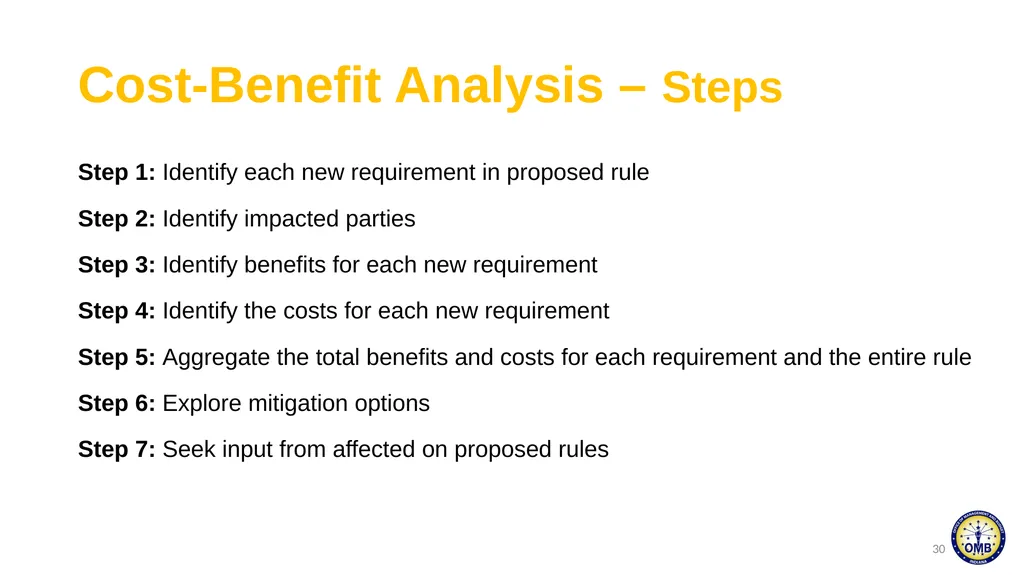
slide30. Cost-Benefit Analysis – Steps Step 1: Identify each new requirement in proposed rule
Step 2: Identify impacted parties
Step 3: Identify benefits for each new requirement
Step 4: Identify the costs for each new requirement
Step 5: Aggregate the total benefits and costs for each requirement and the entire rule
Step 6: Explore mitigation options
Step 7: Seek input from affected on proposed rules 30<br>
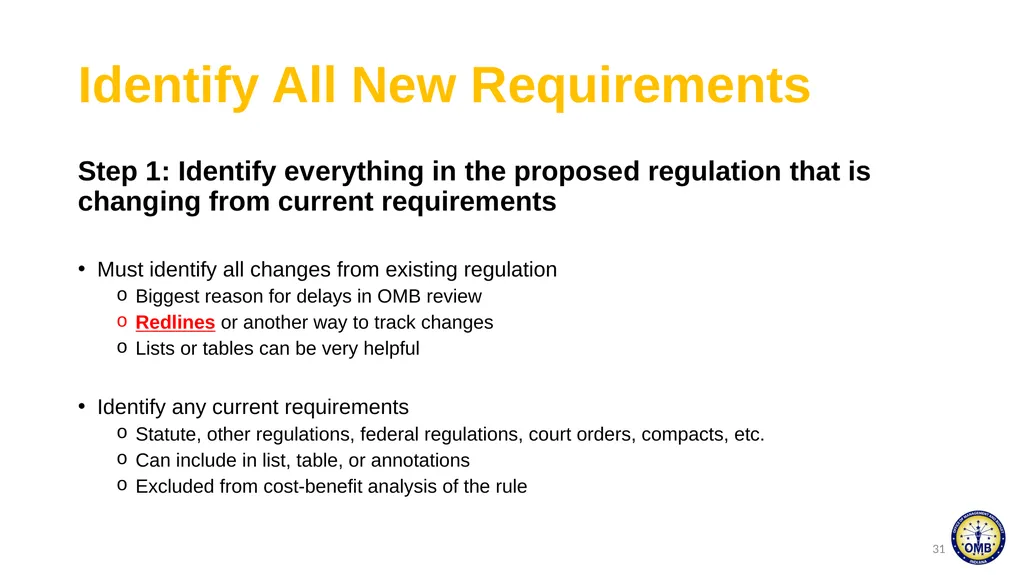
slide31. Identify All New Requirements Step 1: Identify everything in the proposed regulation that is changing from current requirements
Must identify all changes from existing regulation
Biggest reason for delays in OMB review
Redlines or another way to track changes
Lists or tables can be very helpful
Identify any current requirements
Statute, other regulations, federal regulations, court orders, compacts, etc.
Can include in list, table, or annotations
Excluded from cost-benefit analysis of the rule 31<br>
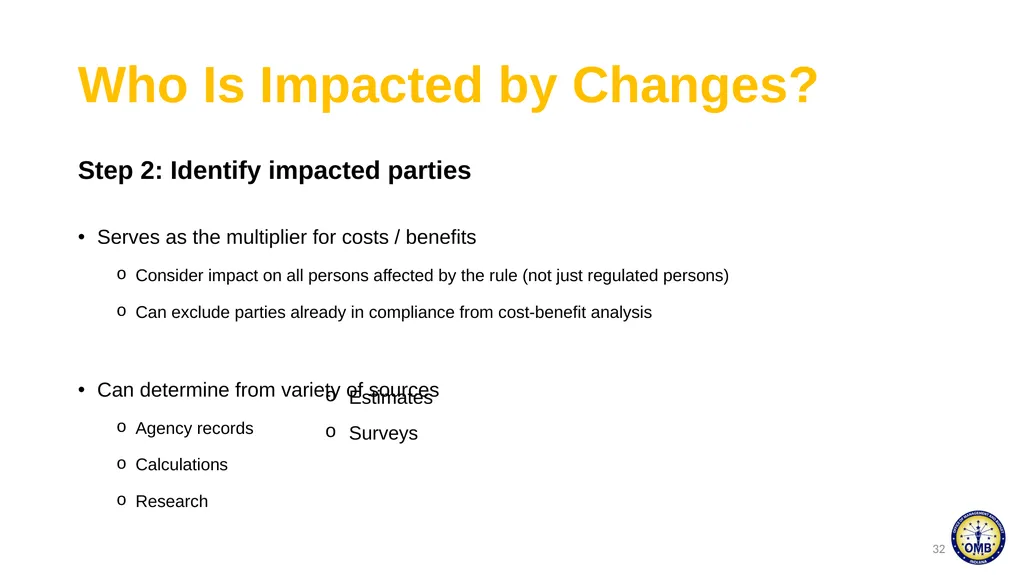
slide32. Who Is Impacted by Changes? Step 2: Identify impacted parties
Serves as the multiplier for costs / benefits
Consider impact on all persons affected by the rule (not just regulated persons)
Can exclude parties already in compliance from cost-benefit analysis
Can determine from variety of sources
Agency records
Calculations
Research Estimates
Surveys 32<br>
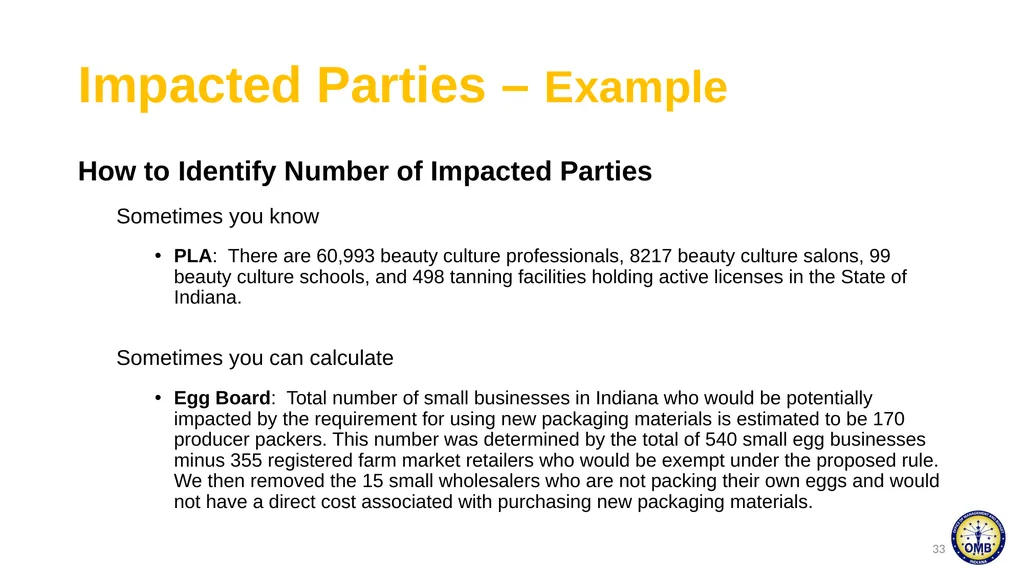
slide33. Impacted Parties – Example How to Identify Number of Impacted Parties
Sometimes you know
PLA: There are 60,993 beauty culture professionals, 8217 beauty culture salons, 99 beauty culture schools, and 498 tanning facilities holding active licenses in the State of Indiana.
Sometimes you can calculate
Egg Board: Total number of small businesses in Indiana who would be potentially impacted by the requirement for using new packaging materials is estimated to be 170 producer packers. This number was determined by the total of 540 small egg businesses minus 355 registered farm market retailers who would be exempt under the proposed rule. We then removed the 15 small wholesalers who are not packing their own eggs and would not have a direct cost associated with purchasing new packaging materials. 33<br>
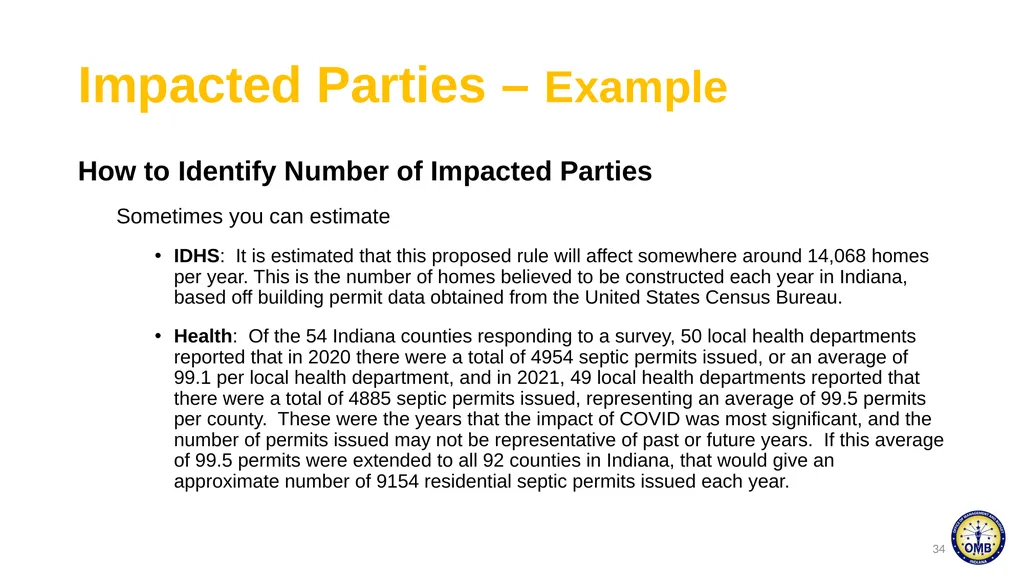
slide34. Impacted Parties – Example How to Identify Number of Impacted Parties
Sometimes you can estimate
IDHS: It is estimated that this proposed rule will affect somewhere around 14,068 homes per year. This is the number of homes believed to be constructed each year in Indiana, based off building permit data obtained from the United States Census Bureau.
Health: Of the 54 Indiana counties responding to a survey, 50 local health departments reported that in 2020 there were a total of 4954 septic permits issued, or an average of 99.1 per local health department, and in 2021, 49 local health departments reported that there were a total of 4885 septic permits issued, representing an average of 99.5 permits per county. These were the years that the impact of COVID was most significant, and the number of permits issued may not be representative of past or future years. If this average of 99.5 permits were extended to all 92 counties in Indiana, that would give an approximate number of 9154 residential septic permits issued each year. 34<br>
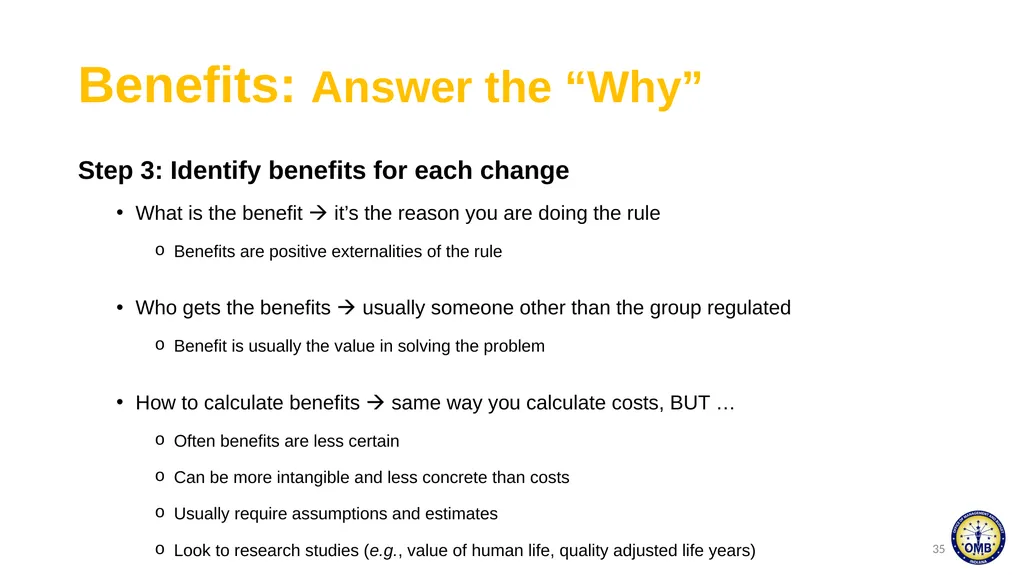
slide35. Benefits: Answer the “Why” Step 3: Identify benefits for each change
What is the benefit it’s the reason you are doing the rule
Benefits are positive externalities of the rule
Who gets the benefits usually someone other than the group regulated
Benefit is usually the value in solving the problem
How to calculate benefits same way you calculate costs, BUT …
Often benefits are less certain
Can be more intangible and less concrete than costs
Usually require assumptions and estimates
Look to research studies (e.g., value of human life, quality adjusted life years) 35<br>
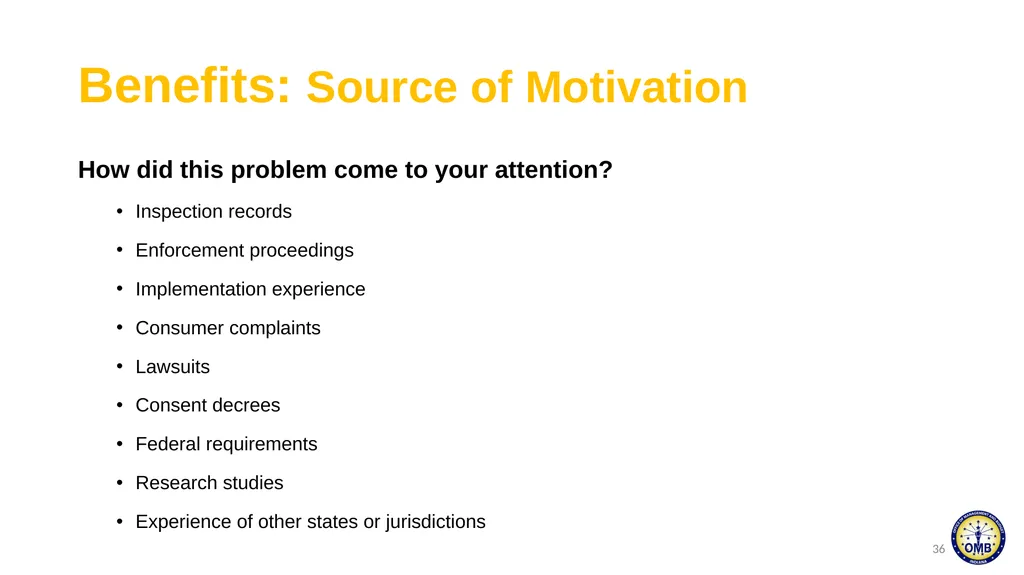
slide36. Benefits: Source of Motivation How did this problem come to your attention?
Inspection records
Enforcement proceedings
Implementation experience
Consumer complaints
Lawsuits
Consent decrees
Federal requirements
Research studies
Experience of other states or jurisdictions 36<br>
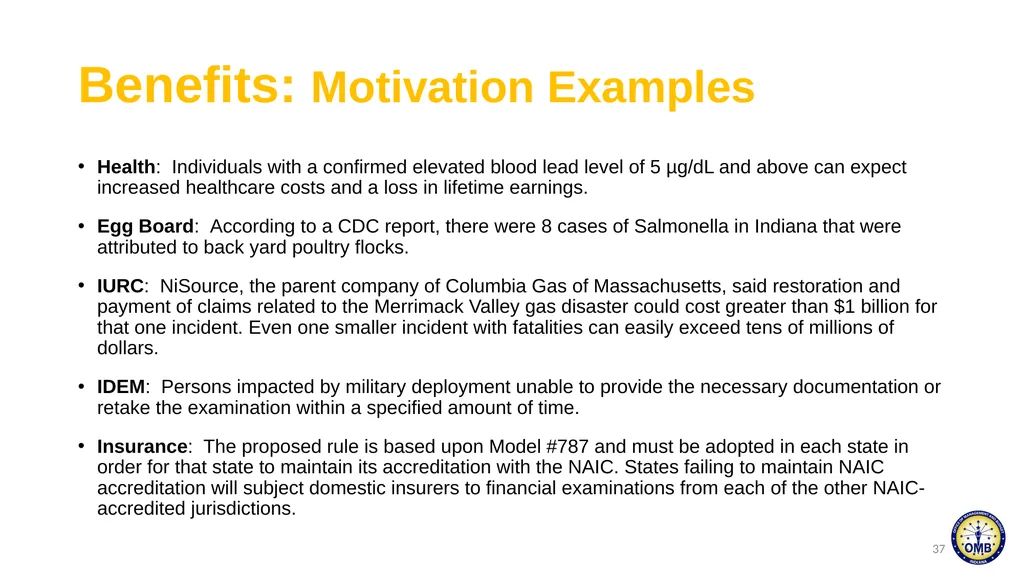
slide37. Benefits: Motivation Examples Health: Individuals with a confirmed elevated blood lead level of 5 µg/dL and above can expect increased healthcare costs and a loss in lifetime earnings.
Egg Board: According to a CDC report, there were 8 cases of Salmonella in Indiana that were attributed to back yard poultry flocks.
IURC: NiSource, the parent company of Columbia Gas of Massachusetts, said restoration and payment of claims related to the Merrimack Valley gas disaster could cost greater than $1 billion for that one incident. Even one smaller incident with fatalities can easily exceed tens of millions of dollars.
IDEM: Persons impacted by military deployment unable to provide the necessary documentation or retake the examination within a specified amount of time.
Insurance: The proposed rule is based upon Model #787 and must be adopted in each state in order for that state to maintain its accreditation with the NAIC. States failing to maintain NAIC accreditation will subject domestic insurers to financial examinations from each of the other NAIC-accredited jurisdictions. 37<br>
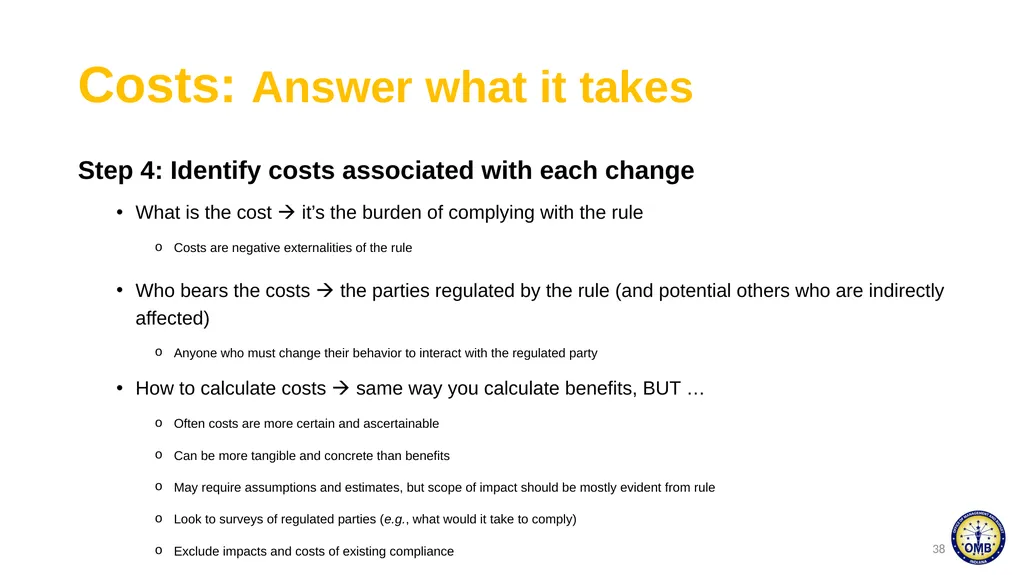
slide38. Costs: Answer what it takes Step 4: Identify costs associated with each change
What is the cost it’s the burden of complying with the rule
Costs are negative externalities of the rule
Who bears the costs the parties regulated by the rule (and potential others who are indirectly affected)
Anyone who must change their behavior to interact with the regulated party
How to calculate costs same way you calculate benefits, BUT …
Often costs are more certain and ascertainable
Can be more tangible and concrete than benefits
May require assumptions and estimates, but scope of impact should be mostly evident from rule
Look to surveys of regulated parties (e.g., what would it take to comply)
Exclude impacts and costs of existing compliance 38<br>
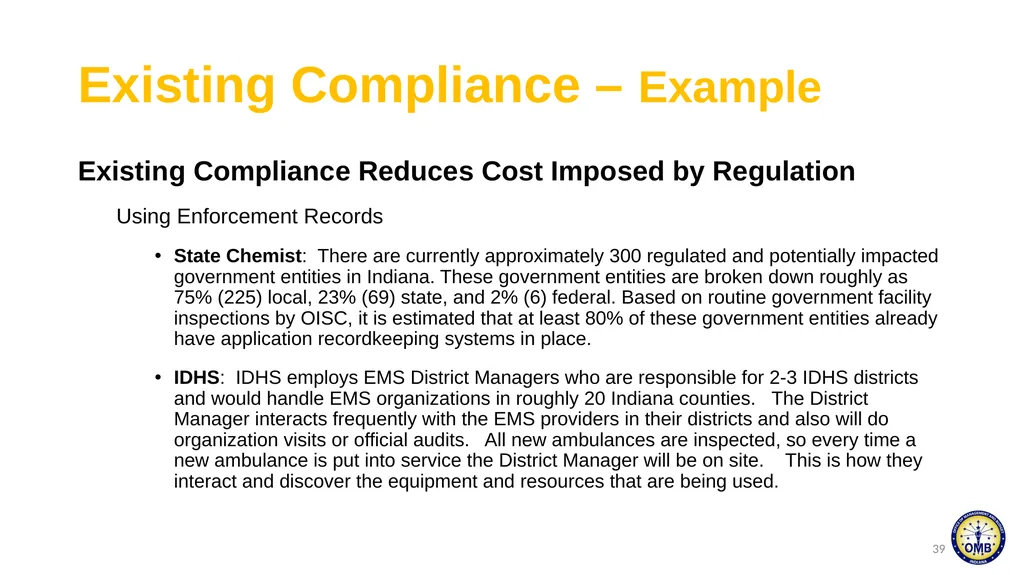
slide39. Existing Compliance – Example Existing Compliance Reduces Cost Imposed by Regulation
Using Enforcement Records
State Chemist: There are currently approximately 300 regulated and potentially impacted government entities in Indiana. These government entities are broken down roughly as 75% (225) local, 23% (69) state, and 2% (6) federal. Based on routine government facility inspections by OISC, it is estimated that at least 80% of these government entities already have application recordkeeping systems in place.
IDHS: IDHS employs EMS District Managers who are responsible for 2-3 IDHS districts and would handle EMS organizations in roughly 20 Indiana counties. The District Manager interacts frequently with the EMS providers in their districts and also will do organization visits or official audits. All new ambulances are inspected, so every time a new ambulance is put into service the District Manager will be on site. This is how they interact and discover the equipment and resources that are being used. 39<br>
slide40. Existing Compliance – Example Using Surveys
DOC: A fiscal impact toolkit was developed to measure a detention facility’s current level of compliance with the new standards, and if noncompliant, the extent of any fiscal impact to achieve compliance. All nineteen (19) juvenile detention facilities were provided the fiscal impact toolkit; of those, twelve (12) of the detention facilities completed the toolkit. A potential fiscal impact was reported for a total of nine (9) standards.
Using Surveys plus internet research
BMV: BMV has conducted a survey of all licensed driver education schools to determine how many vehicles this amendment would impact. Of the 80 schools that responded, five vehicles total were reported to not already have this safety feature in place. Assuming a replacement cost of $13.99 for the mirror (determined via internet research), the anticipated cost to all licensed entities is approximately $70. 40<br>
slide41. Add It All Up Step 5: Tally costs and benefits for each new requirement and aggregate for the entire rule
For each new requirement, sum the benefits and costs
Multiply average costs / benefits by number of impacted parties
Exclude parties already in compliance from cost-benefit analysis
Evaluate the net benefit for each requirement separately
Benefits from one requirement cannot offset costs of another
Aggregate the calculation for each requirement to determine the total net benefit of rule
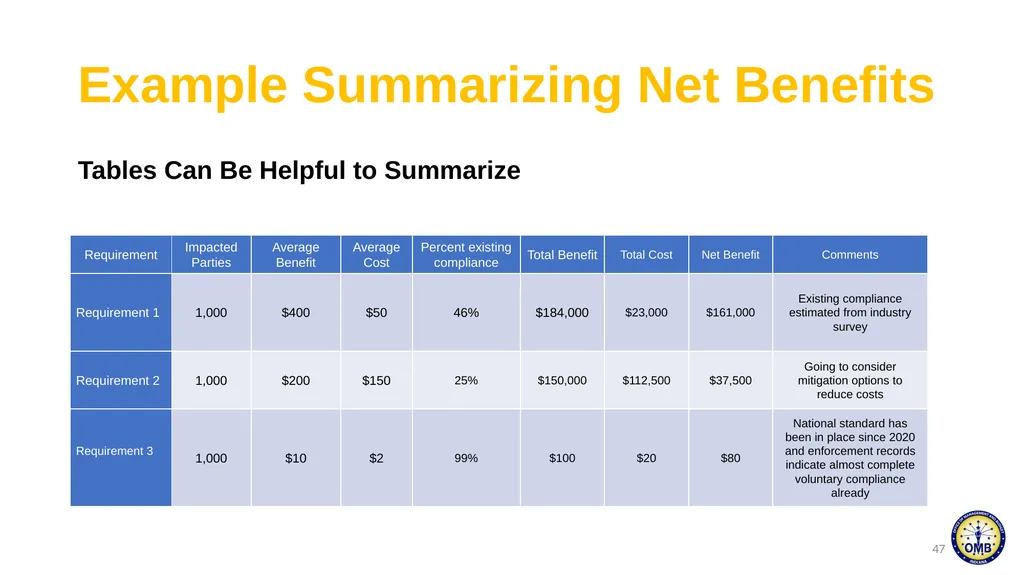
Consider using a table 41<br>
slide42. Tallying Costs – Example Number of impacted parties x Cost imposed – Existing compliance
PLA: Dry needling courses are typically three days and include 27 to 29 hours of instruction. The estimated cost for a Physical Therapist to take two courses is $1,300 to $2,000, not including travel or lodging. Based on a survey that was sent to over 40 leaders of hospital physical therapy departments and physical therapy private practices across the state, approximately 239 licensed Physical Therapist have already completed 1 dry needling course and approximately 76 license Physical Therapist have completed 2 or more dry needling courses. The estimated cost for a Physical Therapist who has already taken one course would be $600 to $1,000, not including travel or lodging, and Physical Therapists who have already completed 2 or more dry needling courses may not require any additional training. The total estimated cost for existing Physical Therapists who have taken at least one dry needling course to meet the new standard is $239,000. 42<br>
slide43. Weighing Costs and Benefits – Example 1 Quantify the overall benefits of the regulation
Health: Individuals with a confirmed elevated blood lead level of 5 µg/dL and above can expect increased healthcare costs and a loss in lifetime earnings. A Columbia Law School review of one cohort of 1- and 2-year-olds in Texas in 2014 estimated that the per child societal costs of children with blood lead levels more than 5 µg/dL was $10,813. This includes costs associated with immediate medical intervention, lead related ADHD, parental time-off work, special education costs, and lost earning potential. It does not include pain and suffering, future-related adult medical expenses, or criminal justice costs. In Indiana, using the same conservative assumed per-child savings, Hoosiers would see avoided costs of $20.9M in for those children above 5 µg/dL in year one. 43<br>
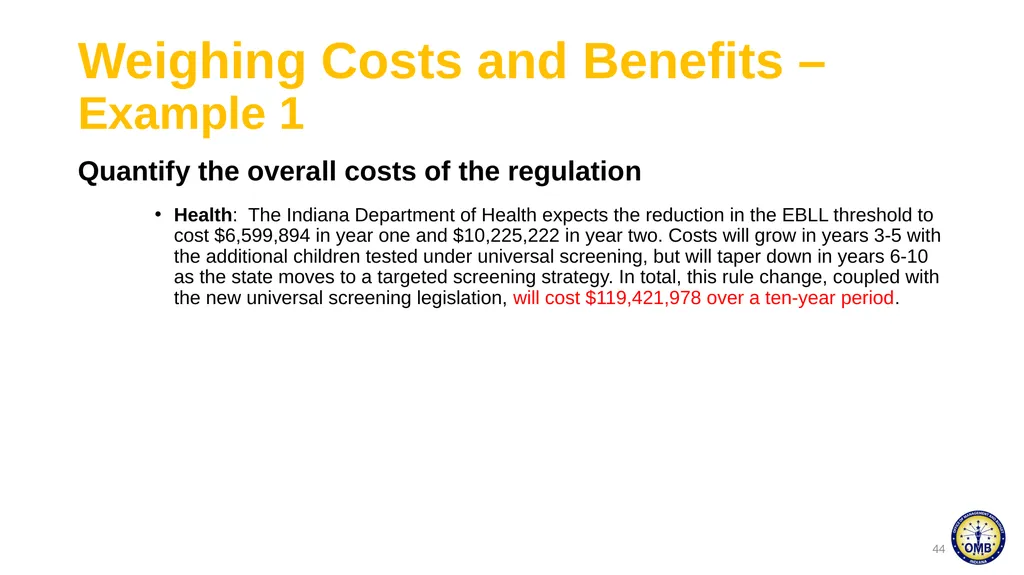
slide44. Weighing Costs and Benefits – Example 1 Quantify the overall costs of the regulation
Health: The Indiana Department of Health expects the reduction in the EBLL threshold to cost $6,599,894 in year one and $10,225,222 in year two. Costs will grow in years 3-5 with the additional children tested under universal screening, but will taper down in years 6-10 as the state moves to a targeted screening strategy. In total, this rule change, coupled with the new universal screening legislation, will cost $119,421,978 over a ten-year period. 44<br>
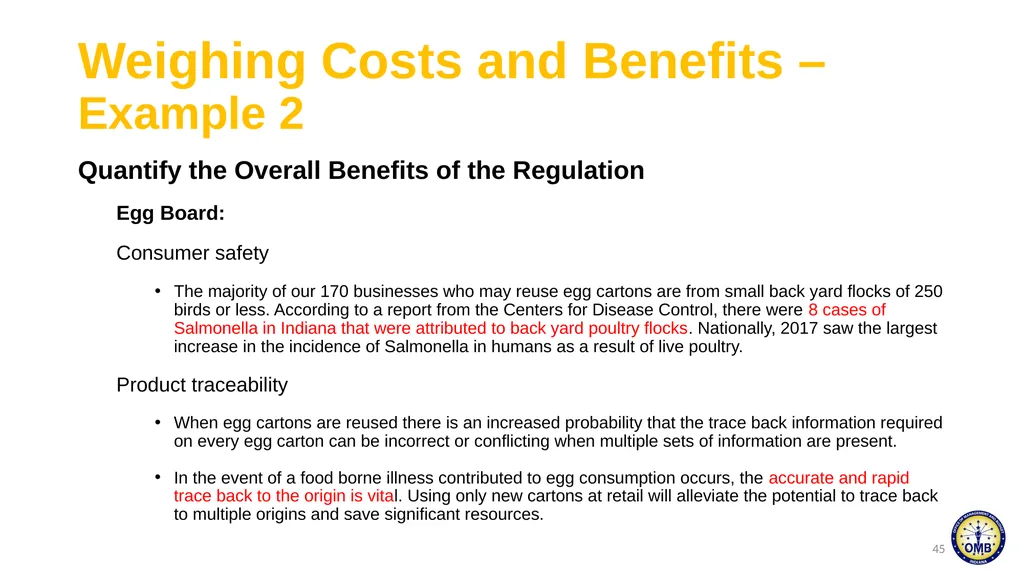
slide45. Weighing Costs and Benefits – Example 2 Quantify the Overall Benefits of the Regulation
Egg Board:
Consumer safety
The majority of our 170 businesses who may reuse egg cartons are from small back yard flocks of 250 birds or less. According to a report from the Centers for Disease Control, there were 8 cases of Salmonella in Indiana that were attributed to back yard poultry flocks. Nationally, 2017 saw the largest increase in the incidence of Salmonella in humans as a result of live poultry.
Product traceability
When egg cartons are reused there is an increased probability that the trace back information required on every egg carton can be incorrect or conflicting when multiple sets of information are present.
In the event of a food borne illness contributed to egg consumption occurs, the accurate and rapid trace back to the origin is vital. Using only new cartons at retail will alleviate the potential to trace back to multiple origins and save significant resources. 45<br>
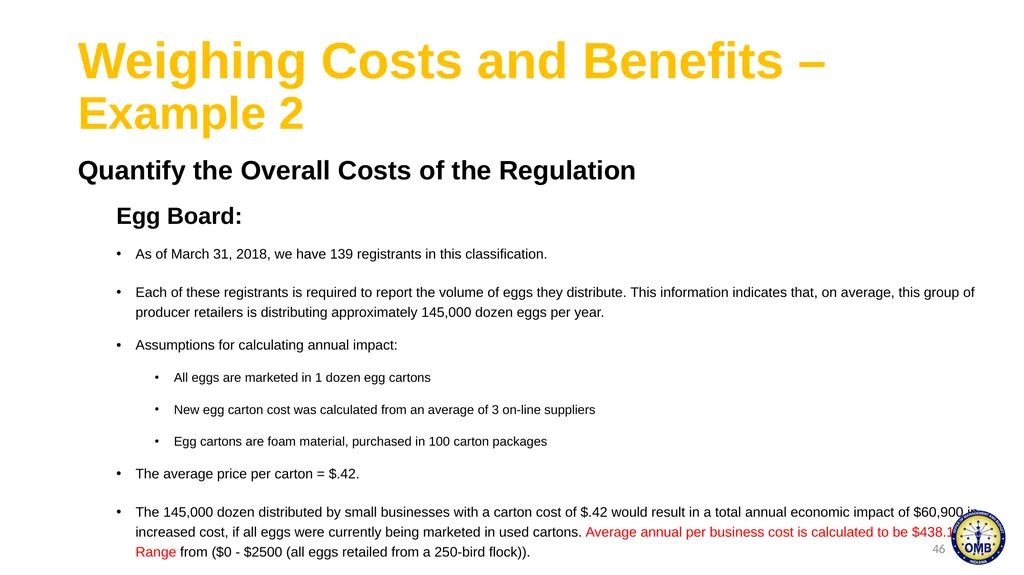
slide46. Weighing Costs and Benefits – Example 2 Quantify the Overall Costs of the Regulation
Egg Board:
As of March 31, 2018, we have 139 registrants in this classification.
Each of these registrants is required to report the volume of eggs they distribute. This information indicates that, on average, this group of producer retailers is distributing approximately 145,000 dozen eggs per year.
Assumptions for calculating annual impact:
All eggs are marketed in 1 dozen egg cartons
New egg carton cost was calculated from an average of 3 on-line suppliers
Egg cartons are foam material, purchased in 100 carton packages
The average price per carton = $.42.
The 145,000 dozen distributed by small businesses with a carton cost of $.42 would result in a total annual economic impact of $60,900 in increased cost, if all eggs were currently being marketed in used cartons. Average annual per business cost is calculated to be $438.13. Range from ($0 - $2500 (all eggs retailed from a 250-bird flock)). 46<br>
slide47. Example Summarizing Net Benefits Tables Can Be Helpful to Summarize 47<br>
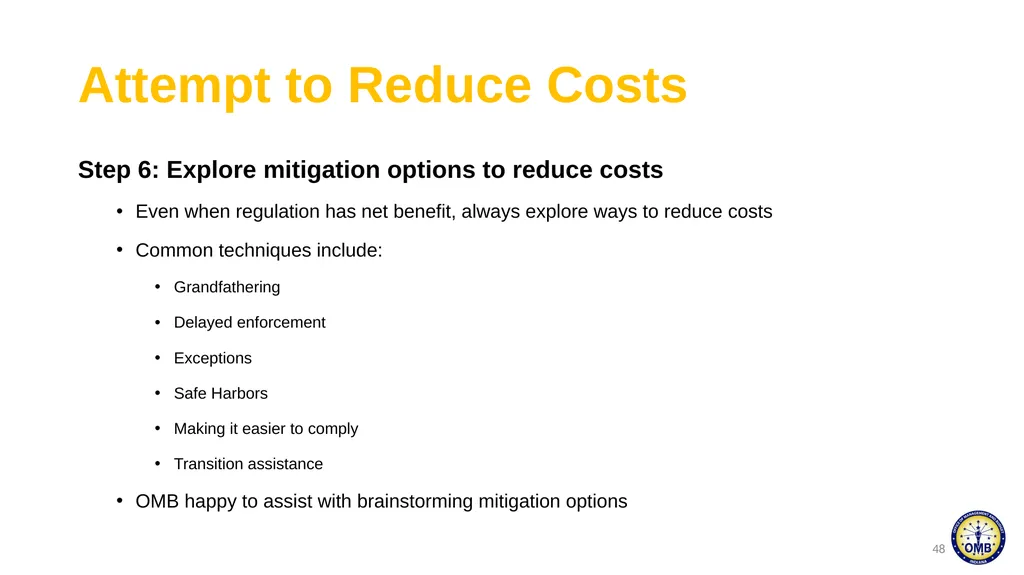
slide48. Attempt to Reduce Costs Step 6: Explore mitigation options to reduce costs
Even when regulation has net benefit, always explore ways to reduce costs
Common techniques include:
Grandfathering
Delayed enforcement
Exceptions
Safe Harbors
Making it easier to comply
Transition assistance
OMB happy to assist with brainstorming mitigation options 48<br>
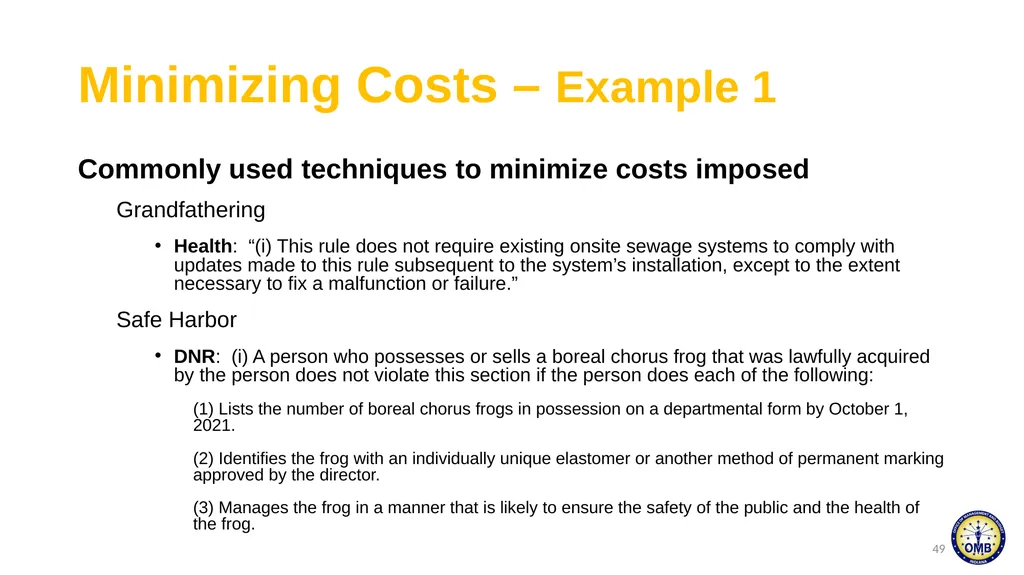
slide49. Minimizing Costs – Example 1 Commonly used techniques to minimize costs imposed
Grandfathering
Health: “(i) This rule does not require existing onsite sewage systems to comply with updates made to this rule subsequent to the system’s installation, except to the extent necessary to fix a malfunction or failure.”
Safe Harbor
DNR: (i) A person who possesses or sells a boreal chorus frog that was lawfully acquired by the person does not violate this section if the person does each of the following:
(1) Lists the number of boreal chorus frogs in possession on a departmental form by October 1, 2021.
(2) Identifies the frog with an individually unique elastomer or another method of permanent marking approved by the director.
(3) Manages the frog in a manner that is likely to ensure the safety of the public and the health of the frog. 49<br>
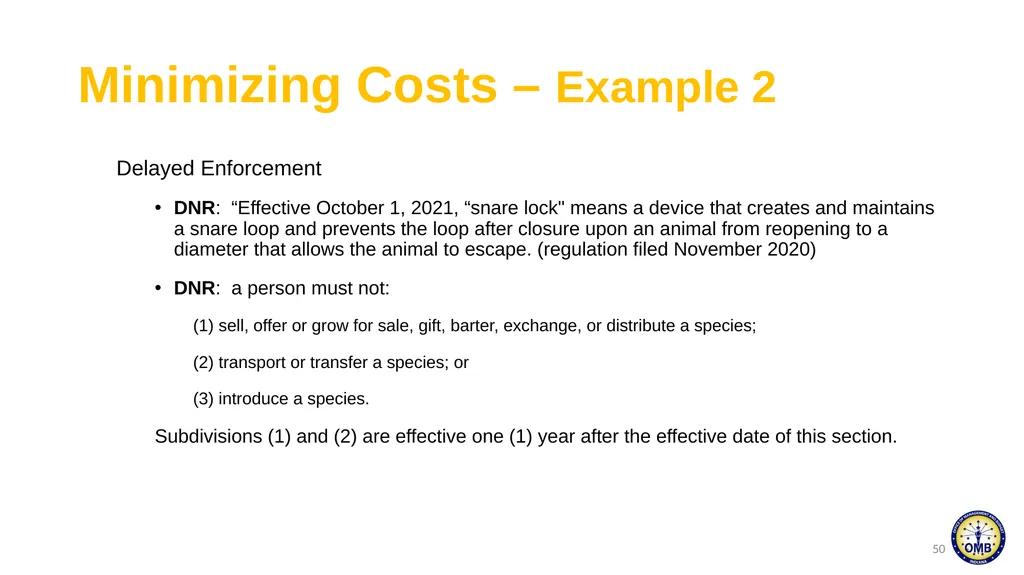
slide50. Minimizing Costs – Example 2 Delayed Enforcement
DNR: “Effective October 1, 2021, “snare lock" means a device that creates and maintains a snare loop and prevents the loop after closure upon an animal from reopening to a diameter that allows the animal to escape. (regulation filed November 2020)
DNR: a person must not:
(1) sell, offer or grow for sale, gift, barter, exchange, or distribute a species;
(2) transport or transfer a species; or
(3) introduce a species.
Subdivisions (1) and (2) are effective one (1) year after the effective date of this section. 50<br>
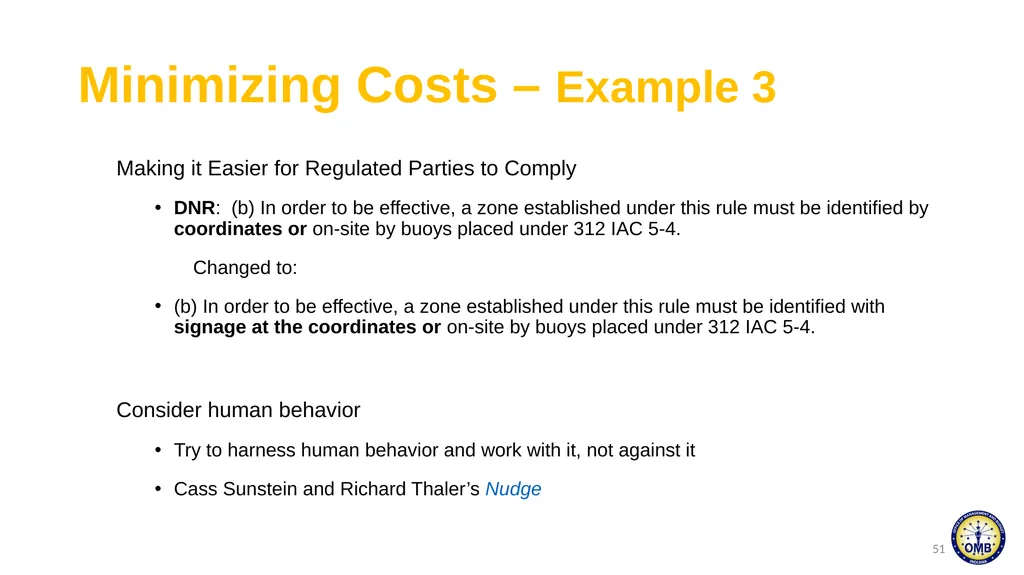
slide51. Minimizing Costs – Example 3 Making it Easier for Regulated Parties to Comply
DNR: (b) In order to be effective, a zone established under this rule must be identified by coordinates or on-site by buoys placed under 312 IAC 5-4.
Changed to:
(b) In order to be effective, a zone established under this rule must be identified with signage at the coordinates or on-site by buoys placed under 312 IAC 5-4.
Consider human behavior
Try to harness human behavior and work with it, not against it
Cass Sunstein and Richard Thaler’s Nudge 51<br>
slide52. Minimizing Costs – Example 4 Helping Regulated Parties with Transition
DNR will notify trappers and hunters of rule changes through news releases sent out electronically, updates on the website, and updated information in the Hunting & Trapping Guide that is printed and distributed each year.
BOAH sends out emails to interested stakeholders so they are aware of upcoming rulemaking matters before the board. The BOAH posts the board agenda in a prominent location on the website so the rule information can be found on this page in addition to the rulemaking docket. The BOAH also sends out an issues newsletter to stakeholders on a quarterly basis. 52<br>
slide53. Getting a Second Opinion Step 7: Seek input from affected parties
Many benefits to seeking input from affected parties before OMB review
We will ask
Validates the work you have done
Regulated parties can identify factors you may have missed
Buy-in from regulated parties makes review easier
Avoids surprises
Avoids legislative response 53<br>
slide54. Input of Regulated Parties – Example 1 Obtaining input of regulated parties can be very helpful
DHS: Any amendments to this code were done in a public meeting, following the submission of a code change proposal that was posted on the Commission’s website for public comment before being voted on by the subcommittee. The subcommittee contained members of the fire service industry, building inspection industry, architects, engineers, and builders. The subcommittee would discuss, and hear comments on, all proposals before voting on whether to adopt the code change proposal. This method of adoption was to ensure that the policy decisions were taking into account all sides of the issue (i.e. safety, cost, feasibility, etc.).
Gaming: IGC has conducted three stakeholder meetings, on May 29, 2019, June 17, 2019, and on August 1, 2019, during which time regulations were discussed. In addition, on July 2, 2019, the IGC posted a draft emergency rule to its website, www.in.gov/IGC, and allowed any interested party to provide comment on the proposed regulations through August 1, 2019. Our final emergency rule was adopted by our Commission at our August 28, 2019 business meeting and submitted to LSA for posting and was placed on IGC’s website. 54<br>
slide55. Input of Regulated Parties – Example 2 IURC: Staff sought feedback from stakeholders in Indiana by soliciting comments on draft proposed rules during two different comment periods. The Commission sought feedback from the pipeline operators in Indiana, the Indiana Energy Association (a trade group of Indiana’s electric and gas investor-owned utilities), the Indiana Office of Utility Consumer Counselor, the Indiana Underground Plant Protection Service, Inc. (generally known as Indiana 811) and legal counsel for major Indiana operators. In addition, the Commission solicited comments from all excavators in the Commission’s database, which includes contact information for excavators that have been involved in an excavation damage case or have otherwise interacted with the Commission over the last 10 years. This solicitation was sent to more than 10,000 entities throughout Indiana. The Commission staff made modifications to its draft rule based on received comments. The Commission staff then solicited comments on the revised version, and received additional comments from three entities. The Commission staff met with the Indiana 811 board of directors, and made additional revisions based on the meeting and the second round of comments. The Commission understands that the stakeholders have no remaining objections to these rule amendments. 55<br>
slide56. Input of Regulated Parties – Example 3 State Chemist: The State Chemist / Pesticide Review Board had a series of discussions with industry and government organizations to discuss the proposed changes, implementation plan, and timelines. These included discussions with Agricultural Council of Indiana (ACI), Indiana Farm Bureau (IFB), Indiana Professional Lawn and Landscape Association (IPLLA), Indiana Nursery Association (INA), Indiana Pest Management Association (IPMA), National Railroad Contractors Association (NRCA), Indiana Vector Management Association (IVMA), Purdue University Cooperative Extension Service (CES), Purdue Pesticide Programs (PPP), Indiana Department of Environmental Management (IDEM), and Indiana State Department of Health (ISDH). 56<br>
slide57. Helpful Resources Contact Information
Chad Ranney Patrick Price
Deputy Director & General Counsel Special Counsel
Office of Management and Budget Office of Management and Budget
(317) 233-9204 (317) 232-5626
cranney@gov.in.gov pprice@gov.in.gov
Jessica Mehrlich
Operations and Policy Assistant
Office of Management and Budget
(317) 234-4411
jmehrlich@gov.in.gov OMB Website
Overview of OMB/SBA processes
Links to key documents
Links to rulemaking resources
Freakonomics - All You Need is Nudge 57<br>
Chad Ranney Deputy Director & General Counsel, Office of Management and Budget<br>
slide2. Roadmap of Presentation OMB & SBA Review
Overview
Review In Practice
Provisional and Interim Rule Review
Tips for Smooth OMB Review
General Rulemaking Requirements
What is a Rule
Role of Rules
Examples
Why it Matters Cost-Benefit Analysis
Overview
Answer the “Why”
How to Prepare Analyses
Examples from Cost-Benefit Analyses
Helpful Resources
Questions 2<br>
slide3. Overview of OMB and SBA Review Background
OMB and SBA review provided in statute, IC 4-3-22-13 and IC 4-22-2-22.8
Agencies must use standard template for regulatory analysis
Financial Management Circular #5.1 (7/14/2023) describes the OMB and SBA review process
Purposes
Coordination between agency, SBA, OMB, and Governor’s Office
Evaluate whether burdens imposed by regulations are justified; IC 4-3-22-1
Cost-benefit, fiscal, and regulatory analyses 3<br>
slide4. Scope of OMB and SBA Review FMC #5.1 OMB and SBA Review Process
Applies to ALL regular rulemakings under IC 4-22-2-23
Does NOT APPLY to provisional rules
Covered by Financial Management Circular #5.3
Does NOT APPLY to interim rules
Covered by Financial Management Circular #5.4
Does NOT APPLY to re-adoptions of expiring rules
Agency prepares readoption analysis instead 4<br>
slide5. OMB and SBA Review Process STEP 1: Agency submits review request
Proposed rule, regulatory analysis, and all supporting materials required by FMC #5.1
Send to sbarules@gov.in.gov
STEP 2: OMB reviews request for completeness and assigns tracking #
OMB will send response acknowledging review request
Agency should reference tracking number in correspondence (e.g., OMB #2024-001)
Incomplete requests will be held until all supporting documentation provided
STEP 3: OMB circulates review request
OMB will send proposed rule and supporting materials to SBA and Governor’s Office 5<br>
slide6. OMB and SBA Review Process STEP 4: OMB, SBA, Governor’s Office review rule
Allows agency to address any questions/concerns about proposed rule
Work with agency on rule language, regulatory analysis
STEP 5: Budget Committee review (if necessary)
If rule includes new or increased fees, fines, or civil penalties, it must be reviewed by Budget Committee
STEP 6: OMB transmits approval letter
Single approval letter signed by OMB and SBA
Approval letter only issued AFTER approval by OMB, SBA, and Governor’s Office and Budget Committee review, if necessary.
Approval letter will be emailed to submitter for agency 6<br>
slide7. Contents of Review Request Requirements for submission described in FMC #5.1
Copy of the proposed rule in Word format
Redline of changes made from existing regulation
Regulatory Analysis, as described in FMC #5.2
Family impact statement (if necessary), as described in EO #13-05
Agency staff member contact info 7<br>
slide8. OMB and SBA Review In Practice OMB Review
Collaborative process between OMB, Governor’s Office, and Agency
Focus on rule language and cost-benefit analysis
Process is deliberative and exempt from APRA (PAC opinion 17-FC-270)
SBA Review
Focus on fiscal impact analysis
Governor’s Office Review
Focus on policy rationale for proposed rule 8<br>
slide9. OMB and SBA Review of Subsequent Revisions OMB and SBA Review of Revisions
If rule changes after OMB and SBA approval, agency must resubmit for review
Agency must submit:
Revised rule language
Revised regulatory analysis
Discussion of any changes in the rule or regulatory analysis
Explanation of rationale for any changes
Reapproval is required before the agency may continue with the rulemaking process 9<br>
slide10. Provisional Rule Overview Provisional Rulemaking (IC 4-22-2-37.1)
For temporary situations posing imminent and substantial harm
Must get written authorization from Governor to proceed
Circulated to the legislature then effective (DNR and IDEM 10-day delay)
Fees, fines, or civil penalties must be submitted to Budget Committee
Email SBArules@sba.in.gov to request approval
Financial Management Circular #5.3 (7/14/2023) describes the review process and information required 10<br>
slide11. Provisional Rule Overview Provisional Rulemaking review in practice
OMB does initial review of rule language and qualification for provisional rulemaking
OMB works with agency on rule language and justification
OMB sends recommendation to Governor’s Office
Governor’s Office signs approval letter
OMB sends PDF and Word version of approval letter to agency submitter
Agency provides PDF and Word versions of approval letter to Indiana Register 11<br>
slide12. Interim Rule Overview Interim Rulemaking (IC 4-22-2-37.2)
For changes required by new or updated statutes, federal regulations, or professional codes
Placeholder that gives agency time to do formal rulemaking
Must get written authorization from Governor to proceed
Publish Notice of Interim Rulemaking and 30-day comment period (no public hearing)
Fees, fines, or civil penalties must be submitted to Budget Committee
Email SBArules@sba.in.gov to request approval
Financial Management Circular #5.4 (7/14/2023) describes the review process and information required 12<br>
slide13. Interim Rule Overview Interim Rulemaking review in practice
OMB does initial review of rule language and qualification for interim rulemaking
OMB works with agency on rule language and justification
OMB sends recommendation to Governor’s Office
Governor’s Office signs approval letter
OMB sends PDF and Word version of approval letter to agency submitter
Agency provides PDF and Word versions of approval letter to Indiana Register 13<br>
slide14. Budget Committee Review Budget Committee Review
Required for any proposed rule that adds or amends language to increase or expand application of a fee, fine, or civil penalty
Templates for Budget Committee report available on OMB website:
https://www.in.gov/omb/rule-approval-process/rulemaking-resources/
Work with SBA budget analyst for agency to request to be added to Budget Committee agenda after initial approval by OMB 14<br>
slide15. Tips for Smooth OMB Review Be prepared to talk to us about the rule
Have everyone in the discussion at the same time – lawyers and subject matter experts
Don’t bite off too much
Rule only moves as fast as the slowest portion
Can break off higher priority portions to move through first
Don’t reinvent the wheel
modifying existing administrative code tends to be easier than a repeal and replace
Consider hiring outside resources for big rules 15<br>
slide16. Tips for Smooth Review Identify what is new
Redlines (changes from existing requirements)
Follow rule drafting manual guidelines
Check legal authority for each provision
Feedback from interested parties
Avoid duplication of statutory or CFR language (consider manuals)
Include requirements from forms or policy
Consider talking to OMB before drafting 16<br>
slide17. What is a Rule – Statute Indiana Code establishes what must be included in regulation
IC 4–22–2–3(b)
“Rule” means the whole or any part of an agency statement of general applicability that:
(1) Has or is designed to have the effect of law; and
(2) Implements, interprets, or prescribes:
(A) Law or policy; or
(B) The organization, procedure, or practice requirements of an agency. 17<br>
slide18. What is a Rule – Case Law Courts have adhered closely to the statutory definition
Rules have Four Elements
Villegas v. Silverman, 832 N.E.2d 598 (Ind. Ct. App. 2005)
An administrative rule is:
(1) “an agency statement of general applicability to a class;”
(2) that is “applied prospectively to the class;”
(3) that is “applied as though it has the effect of law;” and
(4) that “affect[s] the substantive rights of the class.”
“Effect of Law” means Mandatory
Ward v. Carter, 90 N.E.3d 660 (Ind. 2018)
“an agency regulation carries the effect of law when it prescribes binding standards of conduct for persons subject to agency authority.”
“[I]f an agency rule acts as a coercive mechanism or wields coercive power over people, it carries the effect of law.” 18<br>
slide19. What is a Rule – Examples In General
Requirements that must be met need to be in statute or regulation
Basis for denying application or permit must be in statute or rule
Basis for violation or enforcement action must be in statute or rule
Examples
Information required to be submitted in an application
Documents required to prove identification
Required equipment
Required training standards
Fees, Fines, and Civil Penalties
Specific dollar amount
Formula - must explain how the fee is calculated 19<br>
slide20. Why isn’t Policy Enough? Because statute requires certain process for adoption
Agency power to make rules flows from General Assembly
Agencies can only make rules where authorized by statute
General Assembly requires rules to be adopted using certain process
Administrative Rules and Procedures Act (IC 4-22-2)
Requires due process (sort of)
Villegas v. Silverman, 832 N.E.2d 598 (Ind. Ct. App. 2005)
“These requirements dictate, among other things, public input into any proposed rule changes. The duty of the BMV to issue licenses in a manner that it deems prudent does not supercede the mandate to allow the public to participate in the rule-making process.” 20<br>
slide21. Why isn’t Policy Enough? Courts will not enforce rules without procedural steps
Agency policies without rulemaking steps do not carry the effect of law
“We hold that the new identification requirements are a rule, and because they were not promulgated in accordance with the ARPA, they are void and without effect.” Villegas, 832 N.E.2d at 610
“IDEM may only regulate by a new rule if the proper rulemaking procedures have been followed.” Indiana-Kentucky Elec. Corp. v. Comm'r, Indiana Dep't of Env't Mgmt., 820 N.E.2d 771, 780 (Ind. Ct. App. 2005)
Examples of rule “alternatives” rejected by courts:
Written policy: Villegas, (required documents for driver’s license)
Oral policy: Indiana-Kentucky Elec. Corp., (location of environmental monitoring equipment)
Contract: Am. Trucking Associations, Inc. v. City of Los Angeles, Cal., 569 U.S. 641 (2013) (imposing “distinctive governmental” authority through contract) 21<br>
slide22. The Role of Rules – Statutes vs. Rules Statutes set general program requirements
Regulations fill in details
Regulations can expand on or explain statutory requirements and definitions
Rules should not duplicate statute, IC 4-22-2-19.5(a)(3)
If your rule repeats statute, must update rule each time statute is updated
Means more rules and more confusion 22<br>
slide23. The Role of Rules – Rules vs. Policies/Manuals Rules impose requirements
Rules are legally enforceable
Policies and Manuals explain requirements
Manuals can combine requirements from statute and regulation and explain in regular language for regulated parties
Examples, BMV Driver’s Manual, DNR Hunting Manual
Policies and Manuals are not legally enforceable 23<br>
slide24. Statute, Rule, or Policy/Manual 24<br>
slide25. Example 1 – BMV Statute
IC 9-24-16.5-1 The bureau shall issue a photo exempt identification card to an individual who meets the following conditions … (2) Is an Indiana resident.
Regulation
140 IAC 7-1.1-3(b) An applicant must show proof of the following … (4) Being an Indiana resident and of the applicant's residence address, which may not be a post office box, by submitting two (2) documents showing proof of being an Indiana resident and two (2) documents showing the applicant's residence address. Qualifying documents include the following …
BMV Driver’s Manual
You must be a legal resident of Indiana to obtain an Indiana credential. Evidence of Indiana residency includes:
Maintaining a residential address in Indiana and not claiming residency in another state
Being a registered voter in Indiana
Having a dependent who is enrolled in an elementary or secondary school located in Indiana 25<br>
slide26. Example 2 – DNR Statute
IC 14-22-11: Establishes basic requirements for hunting licenses.
DNR Regulation
312 IAC 9-12-2(a): In addition to the requirements for obtaining a hunting license under IC 14-22-11, an individual born after December 31, 1986, must have successfully completed a course in hunter education by the department or the department's agent under IC 14-22-35-1 and this rule.
DNR Hunting Manual
Hunter education: Anyone born after Dec. 31, 1986 must successfully complete a DNR-offered hunter education class to purchase an Indiana hunting license. 26<br>
slide27. Attorney Fees Modified in HEA 1623 effective July 1, 2023
Basis for agency action must be found in statute or valid rule
Agency may be liable for enforcing requirements only found in non-rule policies, manuals, handbooks, interpretative guidance, etc.
Applies to proceedings under AOPA (IC 4-21.5-3-27.5)
Applies to judicial review of agency actions (IC 34-52-2-1.5) 27<br>
slide28. Cost-Benefit Analysis – Overview WHAT
Document the net impact of a new rule
GOAL
Justify new regulation by demonstrating that benefits exceed costs.
FOCUS
Minimizing negative impacts and maximizing benefits of new rule. 28<br>
slide29. Cost-Benefit Analysis – Statutory Requirements Minimize the expenses to regulated entities that are required to comply with the rule. IC 4-22-2-19.5
Include justification of any requirement or cost that is imposed on a regulated entity under the rule. IC 4-22-2-22.7
Include the total estimated economic impact. IC 4-22-2-28
Describe any assumptions made and any data used. IC 4-22-2-22.7 29<br>
slide30. Cost-Benefit Analysis – Steps Step 1: Identify each new requirement in proposed rule
Step 2: Identify impacted parties
Step 3: Identify benefits for each new requirement
Step 4: Identify the costs for each new requirement
Step 5: Aggregate the total benefits and costs for each requirement and the entire rule
Step 6: Explore mitigation options
Step 7: Seek input from affected on proposed rules 30<br>
slide31. Identify All New Requirements Step 1: Identify everything in the proposed regulation that is changing from current requirements
Must identify all changes from existing regulation
Biggest reason for delays in OMB review
Redlines or another way to track changes
Lists or tables can be very helpful
Identify any current requirements
Statute, other regulations, federal regulations, court orders, compacts, etc.
Can include in list, table, or annotations
Excluded from cost-benefit analysis of the rule 31<br>
slide32. Who Is Impacted by Changes? Step 2: Identify impacted parties
Serves as the multiplier for costs / benefits
Consider impact on all persons affected by the rule (not just regulated persons)
Can exclude parties already in compliance from cost-benefit analysis
Can determine from variety of sources
Agency records
Calculations
Research Estimates
Surveys 32<br>
slide33. Impacted Parties – Example How to Identify Number of Impacted Parties
Sometimes you know
PLA: There are 60,993 beauty culture professionals, 8217 beauty culture salons, 99 beauty culture schools, and 498 tanning facilities holding active licenses in the State of Indiana.
Sometimes you can calculate
Egg Board: Total number of small businesses in Indiana who would be potentially impacted by the requirement for using new packaging materials is estimated to be 170 producer packers. This number was determined by the total of 540 small egg businesses minus 355 registered farm market retailers who would be exempt under the proposed rule. We then removed the 15 small wholesalers who are not packing their own eggs and would not have a direct cost associated with purchasing new packaging materials. 33<br>
slide34. Impacted Parties – Example How to Identify Number of Impacted Parties
Sometimes you can estimate
IDHS: It is estimated that this proposed rule will affect somewhere around 14,068 homes per year. This is the number of homes believed to be constructed each year in Indiana, based off building permit data obtained from the United States Census Bureau.
Health: Of the 54 Indiana counties responding to a survey, 50 local health departments reported that in 2020 there were a total of 4954 septic permits issued, or an average of 99.1 per local health department, and in 2021, 49 local health departments reported that there were a total of 4885 septic permits issued, representing an average of 99.5 permits per county. These were the years that the impact of COVID was most significant, and the number of permits issued may not be representative of past or future years. If this average of 99.5 permits were extended to all 92 counties in Indiana, that would give an approximate number of 9154 residential septic permits issued each year. 34<br>
slide35. Benefits: Answer the “Why” Step 3: Identify benefits for each change
What is the benefit it’s the reason you are doing the rule
Benefits are positive externalities of the rule
Who gets the benefits usually someone other than the group regulated
Benefit is usually the value in solving the problem
How to calculate benefits same way you calculate costs, BUT …
Often benefits are less certain
Can be more intangible and less concrete than costs
Usually require assumptions and estimates
Look to research studies (e.g., value of human life, quality adjusted life years) 35<br>
slide36. Benefits: Source of Motivation How did this problem come to your attention?
Inspection records
Enforcement proceedings
Implementation experience
Consumer complaints
Lawsuits
Consent decrees
Federal requirements
Research studies
Experience of other states or jurisdictions 36<br>
slide37. Benefits: Motivation Examples Health: Individuals with a confirmed elevated blood lead level of 5 µg/dL and above can expect increased healthcare costs and a loss in lifetime earnings.
Egg Board: According to a CDC report, there were 8 cases of Salmonella in Indiana that were attributed to back yard poultry flocks.
IURC: NiSource, the parent company of Columbia Gas of Massachusetts, said restoration and payment of claims related to the Merrimack Valley gas disaster could cost greater than $1 billion for that one incident. Even one smaller incident with fatalities can easily exceed tens of millions of dollars.
IDEM: Persons impacted by military deployment unable to provide the necessary documentation or retake the examination within a specified amount of time.
Insurance: The proposed rule is based upon Model #787 and must be adopted in each state in order for that state to maintain its accreditation with the NAIC. States failing to maintain NAIC accreditation will subject domestic insurers to financial examinations from each of the other NAIC-accredited jurisdictions. 37<br>
slide38. Costs: Answer what it takes Step 4: Identify costs associated with each change
What is the cost it’s the burden of complying with the rule
Costs are negative externalities of the rule
Who bears the costs the parties regulated by the rule (and potential others who are indirectly affected)
Anyone who must change their behavior to interact with the regulated party
How to calculate costs same way you calculate benefits, BUT …
Often costs are more certain and ascertainable
Can be more tangible and concrete than benefits
May require assumptions and estimates, but scope of impact should be mostly evident from rule
Look to surveys of regulated parties (e.g., what would it take to comply)
Exclude impacts and costs of existing compliance 38<br>
slide39. Existing Compliance – Example Existing Compliance Reduces Cost Imposed by Regulation
Using Enforcement Records
State Chemist: There are currently approximately 300 regulated and potentially impacted government entities in Indiana. These government entities are broken down roughly as 75% (225) local, 23% (69) state, and 2% (6) federal. Based on routine government facility inspections by OISC, it is estimated that at least 80% of these government entities already have application recordkeeping systems in place.
IDHS: IDHS employs EMS District Managers who are responsible for 2-3 IDHS districts and would handle EMS organizations in roughly 20 Indiana counties. The District Manager interacts frequently with the EMS providers in their districts and also will do organization visits or official audits. All new ambulances are inspected, so every time a new ambulance is put into service the District Manager will be on site. This is how they interact and discover the equipment and resources that are being used. 39<br>
slide40. Existing Compliance – Example Using Surveys
DOC: A fiscal impact toolkit was developed to measure a detention facility’s current level of compliance with the new standards, and if noncompliant, the extent of any fiscal impact to achieve compliance. All nineteen (19) juvenile detention facilities were provided the fiscal impact toolkit; of those, twelve (12) of the detention facilities completed the toolkit. A potential fiscal impact was reported for a total of nine (9) standards.
Using Surveys plus internet research
BMV: BMV has conducted a survey of all licensed driver education schools to determine how many vehicles this amendment would impact. Of the 80 schools that responded, five vehicles total were reported to not already have this safety feature in place. Assuming a replacement cost of $13.99 for the mirror (determined via internet research), the anticipated cost to all licensed entities is approximately $70. 40<br>
slide41. Add It All Up Step 5: Tally costs and benefits for each new requirement and aggregate for the entire rule
For each new requirement, sum the benefits and costs
Multiply average costs / benefits by number of impacted parties
Exclude parties already in compliance from cost-benefit analysis
Evaluate the net benefit for each requirement separately
Benefits from one requirement cannot offset costs of another
Aggregate the calculation for each requirement to determine the total net benefit of rule
Consider using a table 41<br>
slide42. Tallying Costs – Example Number of impacted parties x Cost imposed – Existing compliance
PLA: Dry needling courses are typically three days and include 27 to 29 hours of instruction. The estimated cost for a Physical Therapist to take two courses is $1,300 to $2,000, not including travel or lodging. Based on a survey that was sent to over 40 leaders of hospital physical therapy departments and physical therapy private practices across the state, approximately 239 licensed Physical Therapist have already completed 1 dry needling course and approximately 76 license Physical Therapist have completed 2 or more dry needling courses. The estimated cost for a Physical Therapist who has already taken one course would be $600 to $1,000, not including travel or lodging, and Physical Therapists who have already completed 2 or more dry needling courses may not require any additional training. The total estimated cost for existing Physical Therapists who have taken at least one dry needling course to meet the new standard is $239,000. 42<br>
slide43. Weighing Costs and Benefits – Example 1 Quantify the overall benefits of the regulation
Health: Individuals with a confirmed elevated blood lead level of 5 µg/dL and above can expect increased healthcare costs and a loss in lifetime earnings. A Columbia Law School review of one cohort of 1- and 2-year-olds in Texas in 2014 estimated that the per child societal costs of children with blood lead levels more than 5 µg/dL was $10,813. This includes costs associated with immediate medical intervention, lead related ADHD, parental time-off work, special education costs, and lost earning potential. It does not include pain and suffering, future-related adult medical expenses, or criminal justice costs. In Indiana, using the same conservative assumed per-child savings, Hoosiers would see avoided costs of $20.9M in for those children above 5 µg/dL in year one. 43<br>
slide44. Weighing Costs and Benefits – Example 1 Quantify the overall costs of the regulation
Health: The Indiana Department of Health expects the reduction in the EBLL threshold to cost $6,599,894 in year one and $10,225,222 in year two. Costs will grow in years 3-5 with the additional children tested under universal screening, but will taper down in years 6-10 as the state moves to a targeted screening strategy. In total, this rule change, coupled with the new universal screening legislation, will cost $119,421,978 over a ten-year period. 44<br>
slide45. Weighing Costs and Benefits – Example 2 Quantify the Overall Benefits of the Regulation
Egg Board:
Consumer safety
The majority of our 170 businesses who may reuse egg cartons are from small back yard flocks of 250 birds or less. According to a report from the Centers for Disease Control, there were 8 cases of Salmonella in Indiana that were attributed to back yard poultry flocks. Nationally, 2017 saw the largest increase in the incidence of Salmonella in humans as a result of live poultry.
Product traceability
When egg cartons are reused there is an increased probability that the trace back information required on every egg carton can be incorrect or conflicting when multiple sets of information are present.
In the event of a food borne illness contributed to egg consumption occurs, the accurate and rapid trace back to the origin is vital. Using only new cartons at retail will alleviate the potential to trace back to multiple origins and save significant resources. 45<br>
slide46. Weighing Costs and Benefits – Example 2 Quantify the Overall Costs of the Regulation
Egg Board:
As of March 31, 2018, we have 139 registrants in this classification.
Each of these registrants is required to report the volume of eggs they distribute. This information indicates that, on average, this group of producer retailers is distributing approximately 145,000 dozen eggs per year.
Assumptions for calculating annual impact:
All eggs are marketed in 1 dozen egg cartons
New egg carton cost was calculated from an average of 3 on-line suppliers
Egg cartons are foam material, purchased in 100 carton packages
The average price per carton = $.42.
The 145,000 dozen distributed by small businesses with a carton cost of $.42 would result in a total annual economic impact of $60,900 in increased cost, if all eggs were currently being marketed in used cartons. Average annual per business cost is calculated to be $438.13. Range from ($0 - $2500 (all eggs retailed from a 250-bird flock)). 46<br>
slide47. Example Summarizing Net Benefits Tables Can Be Helpful to Summarize 47<br>
slide48. Attempt to Reduce Costs Step 6: Explore mitigation options to reduce costs
Even when regulation has net benefit, always explore ways to reduce costs
Common techniques include:
Grandfathering
Delayed enforcement
Exceptions
Safe Harbors
Making it easier to comply
Transition assistance
OMB happy to assist with brainstorming mitigation options 48<br>
slide49. Minimizing Costs – Example 1 Commonly used techniques to minimize costs imposed
Grandfathering
Health: “(i) This rule does not require existing onsite sewage systems to comply with updates made to this rule subsequent to the system’s installation, except to the extent necessary to fix a malfunction or failure.”
Safe Harbor
DNR: (i) A person who possesses or sells a boreal chorus frog that was lawfully acquired by the person does not violate this section if the person does each of the following:
(1) Lists the number of boreal chorus frogs in possession on a departmental form by October 1, 2021.
(2) Identifies the frog with an individually unique elastomer or another method of permanent marking approved by the director.
(3) Manages the frog in a manner that is likely to ensure the safety of the public and the health of the frog. 49<br>
slide50. Minimizing Costs – Example 2 Delayed Enforcement
DNR: “Effective October 1, 2021, “snare lock" means a device that creates and maintains a snare loop and prevents the loop after closure upon an animal from reopening to a diameter that allows the animal to escape. (regulation filed November 2020)
DNR: a person must not:
(1) sell, offer or grow for sale, gift, barter, exchange, or distribute a species;
(2) transport or transfer a species; or
(3) introduce a species.
Subdivisions (1) and (2) are effective one (1) year after the effective date of this section. 50<br>
slide51. Minimizing Costs – Example 3 Making it Easier for Regulated Parties to Comply
DNR: (b) In order to be effective, a zone established under this rule must be identified by coordinates or on-site by buoys placed under 312 IAC 5-4.
Changed to:
(b) In order to be effective, a zone established under this rule must be identified with signage at the coordinates or on-site by buoys placed under 312 IAC 5-4.
Consider human behavior
Try to harness human behavior and work with it, not against it
Cass Sunstein and Richard Thaler’s Nudge 51<br>
slide52. Minimizing Costs – Example 4 Helping Regulated Parties with Transition
DNR will notify trappers and hunters of rule changes through news releases sent out electronically, updates on the website, and updated information in the Hunting & Trapping Guide that is printed and distributed each year.
BOAH sends out emails to interested stakeholders so they are aware of upcoming rulemaking matters before the board. The BOAH posts the board agenda in a prominent location on the website so the rule information can be found on this page in addition to the rulemaking docket. The BOAH also sends out an issues newsletter to stakeholders on a quarterly basis. 52<br>
slide53. Getting a Second Opinion Step 7: Seek input from affected parties
Many benefits to seeking input from affected parties before OMB review
We will ask
Validates the work you have done
Regulated parties can identify factors you may have missed
Buy-in from regulated parties makes review easier
Avoids surprises
Avoids legislative response 53<br>
slide54. Input of Regulated Parties – Example 1 Obtaining input of regulated parties can be very helpful
DHS: Any amendments to this code were done in a public meeting, following the submission of a code change proposal that was posted on the Commission’s website for public comment before being voted on by the subcommittee. The subcommittee contained members of the fire service industry, building inspection industry, architects, engineers, and builders. The subcommittee would discuss, and hear comments on, all proposals before voting on whether to adopt the code change proposal. This method of adoption was to ensure that the policy decisions were taking into account all sides of the issue (i.e. safety, cost, feasibility, etc.).
Gaming: IGC has conducted three stakeholder meetings, on May 29, 2019, June 17, 2019, and on August 1, 2019, during which time regulations were discussed. In addition, on July 2, 2019, the IGC posted a draft emergency rule to its website, www.in.gov/IGC, and allowed any interested party to provide comment on the proposed regulations through August 1, 2019. Our final emergency rule was adopted by our Commission at our August 28, 2019 business meeting and submitted to LSA for posting and was placed on IGC’s website. 54<br>
slide55. Input of Regulated Parties – Example 2 IURC: Staff sought feedback from stakeholders in Indiana by soliciting comments on draft proposed rules during two different comment periods. The Commission sought feedback from the pipeline operators in Indiana, the Indiana Energy Association (a trade group of Indiana’s electric and gas investor-owned utilities), the Indiana Office of Utility Consumer Counselor, the Indiana Underground Plant Protection Service, Inc. (generally known as Indiana 811) and legal counsel for major Indiana operators. In addition, the Commission solicited comments from all excavators in the Commission’s database, which includes contact information for excavators that have been involved in an excavation damage case or have otherwise interacted with the Commission over the last 10 years. This solicitation was sent to more than 10,000 entities throughout Indiana. The Commission staff made modifications to its draft rule based on received comments. The Commission staff then solicited comments on the revised version, and received additional comments from three entities. The Commission staff met with the Indiana 811 board of directors, and made additional revisions based on the meeting and the second round of comments. The Commission understands that the stakeholders have no remaining objections to these rule amendments. 55<br>
slide56. Input of Regulated Parties – Example 3 State Chemist: The State Chemist / Pesticide Review Board had a series of discussions with industry and government organizations to discuss the proposed changes, implementation plan, and timelines. These included discussions with Agricultural Council of Indiana (ACI), Indiana Farm Bureau (IFB), Indiana Professional Lawn and Landscape Association (IPLLA), Indiana Nursery Association (INA), Indiana Pest Management Association (IPMA), National Railroad Contractors Association (NRCA), Indiana Vector Management Association (IVMA), Purdue University Cooperative Extension Service (CES), Purdue Pesticide Programs (PPP), Indiana Department of Environmental Management (IDEM), and Indiana State Department of Health (ISDH). 56<br>
slide57. Helpful Resources Contact Information
Chad Ranney Patrick Price
Deputy Director & General Counsel Special Counsel
Office of Management and Budget Office of Management and Budget
(317) 233-9204 (317) 232-5626
cranney@gov.in.gov pprice@gov.in.gov
Jessica Mehrlich
Operations and Policy Assistant
Office of Management and Budget
(317) 234-4411
jmehrlich@gov.in.gov OMB Website
Overview of OMB/SBA processes
Links to key documents
Links to rulemaking resources
Freakonomics - All You Need is Nudge 57<br>