
Federal Accounting Standards Advisory Board
LS
Published · 24 slides · 0 views
1 / 1
Description
Federal Accounting Standards Advisory Board Public-Private Partnerships - Financial Statement Reporting for Grants Training Session National Grants Management Association Crystal Gateway Marriott Arlington, VA Thursday, March 31, 2016
Related Topics
Share
Embed code
Download this presentation From Below
"Federal Accounting Standards Advisory Board" is the property of its rightful owner. Permission is granted to download and print the materials on this website for personal, non-commercial use only, and to display it on your personal computer provided you do not modify the materials and that you retain all copyright notices contained in the materials. By downloading content from our website, you accept the terms of this agreement.
Presentation Transcript
01
Federal Accounting Standards Advisory Board
Public-Private Partnerships - Financial Statement Reporting for Grants
Training Session
National Grants Management Association
Crystal Gateway Marriott
Arlington, VA Thursday, March 31, 2016
8:30am – 9:45am 1<br>
8:30am – 9:45am 1<br>
02
Disclaimer
Views expressed are those of the speakers. The Board expresses its views in official publications.
FASAB’s Mission
The FASAB serves the public interest by improving federal financial reporting through issuing federal financial accounting standards and providing guidance after considering the needs of external and internal users of federal financial information. 2<br>
03
Today’s Speakers
P3 Task Force Members Robert D. Helwig JD; Bob Helwig Consulting, LLC
Formerly Office of the Secretary of Defense
Larry Checco; Founder & President Checco Communications
Domenic N. Savini, CPA CMA; FASAB Assistant Director and P3 Project Director 3<br>
Larry Checco; Founder & President Checco Communications
Domenic N. Savini, CPA CMA; FASAB Assistant Director and P3 Project Director 3<br>
04
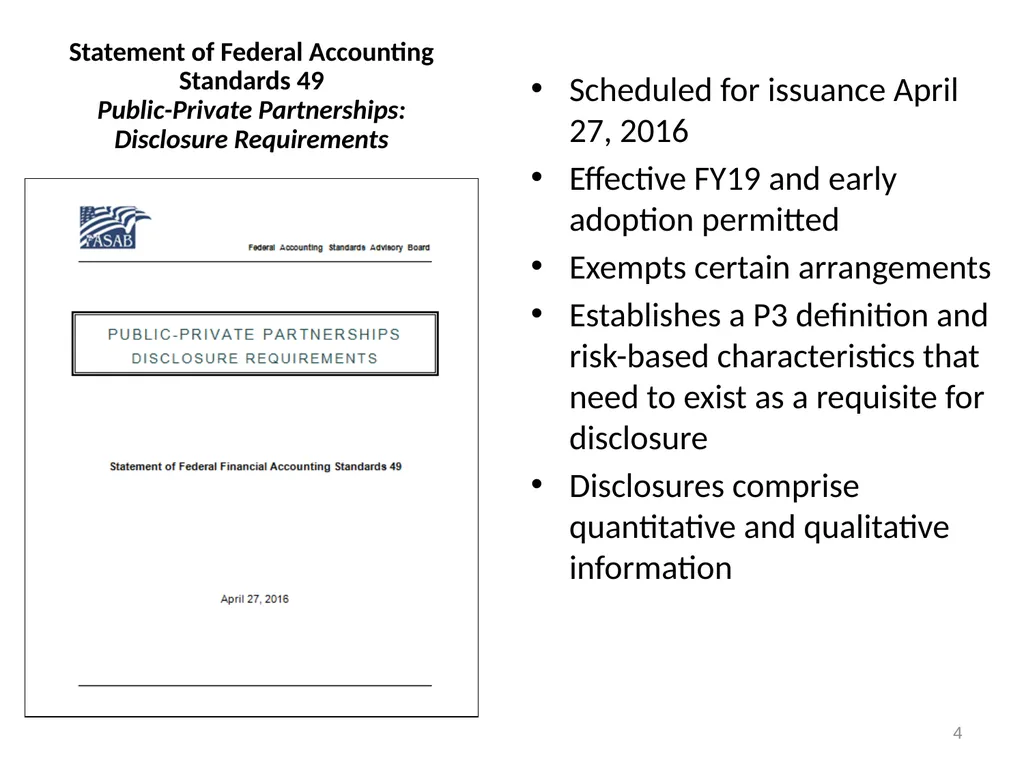
Statement of Federal Accounting Standards 49
Public-Private Partnerships: Disclosure Requirements Scheduled for issuance April 27, 2016
Effective FY19 and early adoption permitted
Exempts certain arrangements
Establishes a P3 definition and risk-based characteristics that need to exist as a requisite for disclosure
Disclosures comprise quantitative and qualitative information 4<br>
Effective FY19 and early adoption permitted
Exempts certain arrangements
Establishes a P3 definition and risk-based characteristics that need to exist as a requisite for disclosure
Disclosures comprise quantitative and qualitative information 4<br>
05
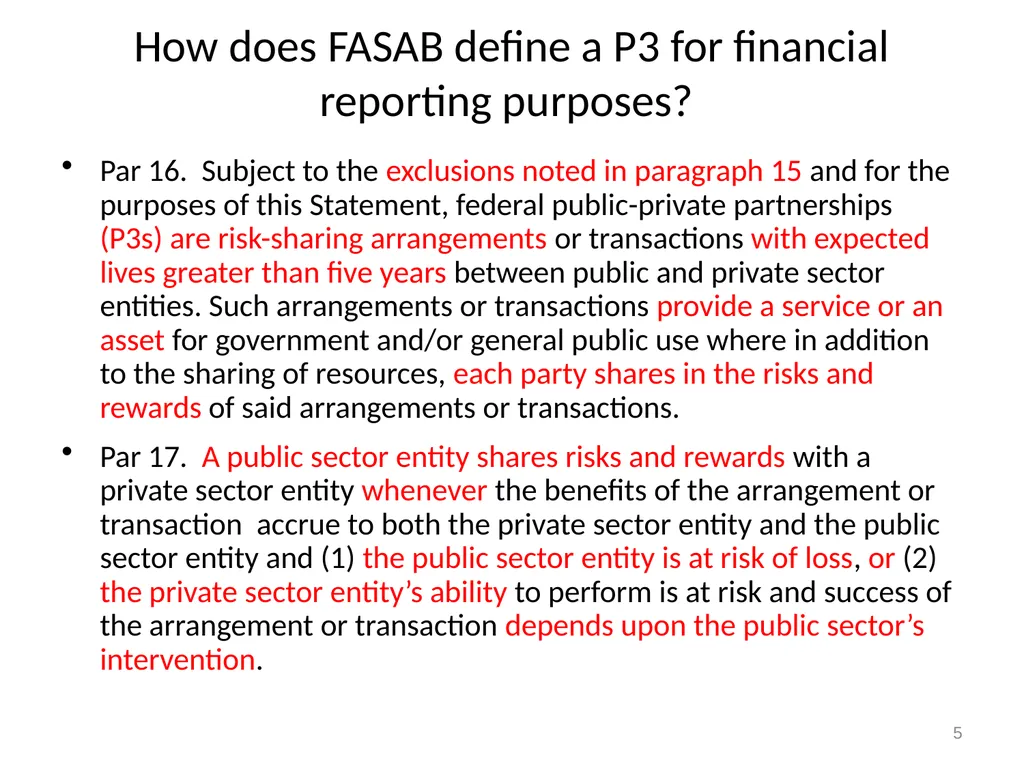
How does FASAB define a P3 for financial reporting purposes? Par 16. Subject to the exclusions noted in paragraph 15 and for the purposes of this Statement, federal public-private partnerships (P3s) are risk-sharing arrangements or transactions with expected lives greater than five years between public and private sector entities. Such arrangements or transactions provide a service or an asset for government and/or general public use where in addition to the sharing of resources, each party shares in the risks and rewards of said arrangements or transactions.
Par 17. A public sector entity shares risks and rewards with a private sector entity whenever the benefits of the arrangement or transaction accrue to both the private sector entity and the public sector entity and (1) the public sector entity is at risk of loss, or (2) the private sector entity’s ability to perform is at risk and success of the arrangement or transaction depends upon the public sector’s intervention. 5<br>
Par 17. A public sector entity shares risks and rewards with a private sector entity whenever the benefits of the arrangement or transaction accrue to both the private sector entity and the public sector entity and (1) the public sector entity is at risk of loss, or (2) the private sector entity’s ability to perform is at risk and success of the arrangement or transaction depends upon the public sector’s intervention. 5<br>
06
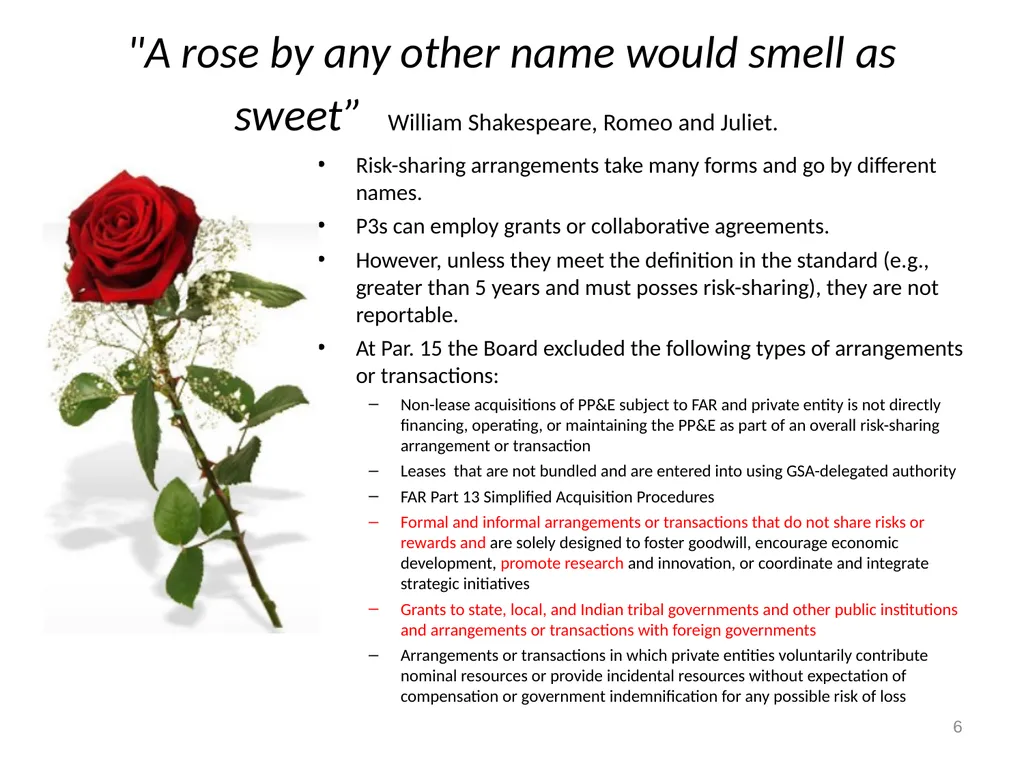
"A rose by any other name would smell as sweet” William Shakespeare, Romeo and Juliet. Risk-sharing arrangements take many forms and go by different names.
P3s can employ grants or collaborative agreements.
However, unless they meet the definition in the standard (e.g., greater than 5 years and must posses risk-sharing), they are not reportable.
At Par. 15 the Board excluded the following types of arrangements or transactions:
Non-lease acquisitions of PP&E subject to FAR and private entity is not directly financing, operating, or maintaining the PP&E as part of an overall risk-sharing arrangement or transaction
Leases that are not bundled and are entered into using GSA-delegated authority
FAR Part 13 Simplified Acquisition Procedures
Formal and informal arrangements or transactions that do not share risks or rewards and are solely designed to foster goodwill, encourage economic development, promote research and innovation, or coordinate and integrate strategic initiatives
Grants to state, local, and Indian tribal governments and other public institutions and arrangements or transactions with foreign governments
Arrangements or transactions in which private entities voluntarily contribute nominal resources or provide incidental resources without expectation of compensation or government indemnification for any possible risk of loss 6<br>
07
TASK FORCE MEMBER
Robert D. Helwig JD
Bob Helwig Consulting, LLC
Formerly Office of the Secretary of Defense 7<br>
08
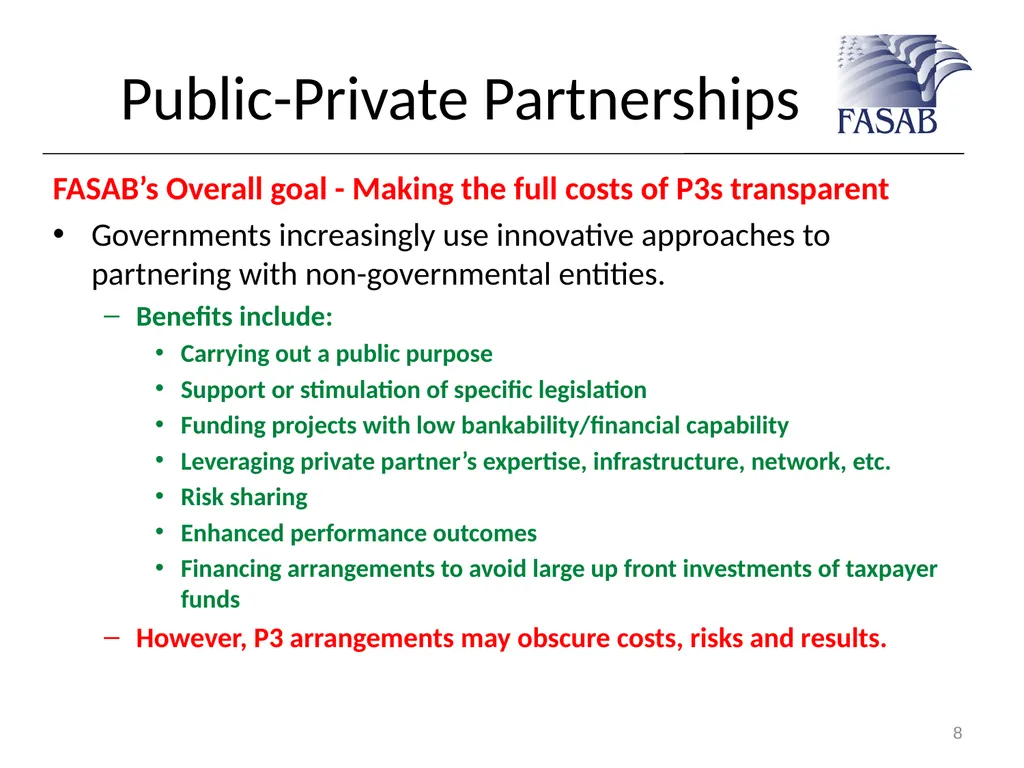
8 Public-Private Partnerships FASAB’s Overall goal - Making the full costs of P3s transparent
Governments increasingly use innovative approaches to partnering with non-governmental entities.
Benefits include:
Carrying out a public purpose
Support or stimulation of specific legislation
Funding projects with low bankability/financial capability
Leveraging private partner’s expertise, infrastructure, network, etc.
Risk sharing
Enhanced performance outcomes
Financing arrangements to avoid large up front investments of taxpayer funds
However, P3 arrangements may obscure costs, risks and results.<br>
09
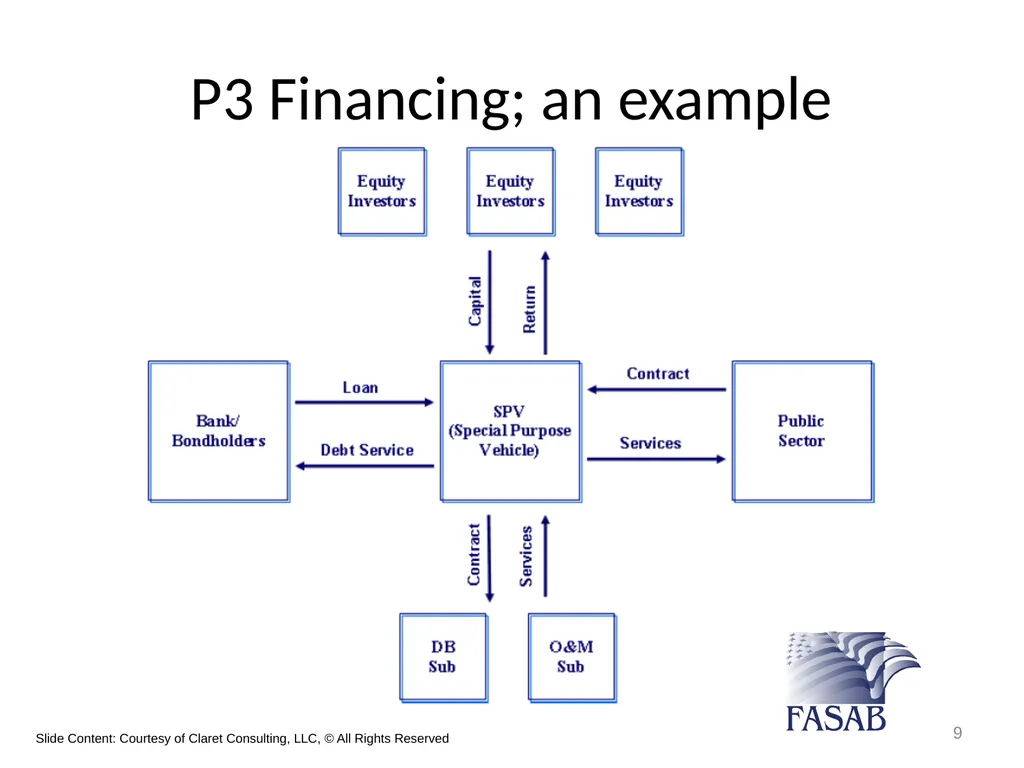
P3 Financing; an example 9 Slide Content: Courtesy of Claret Consulting, LLC, © All Rights Reserved<br>
10
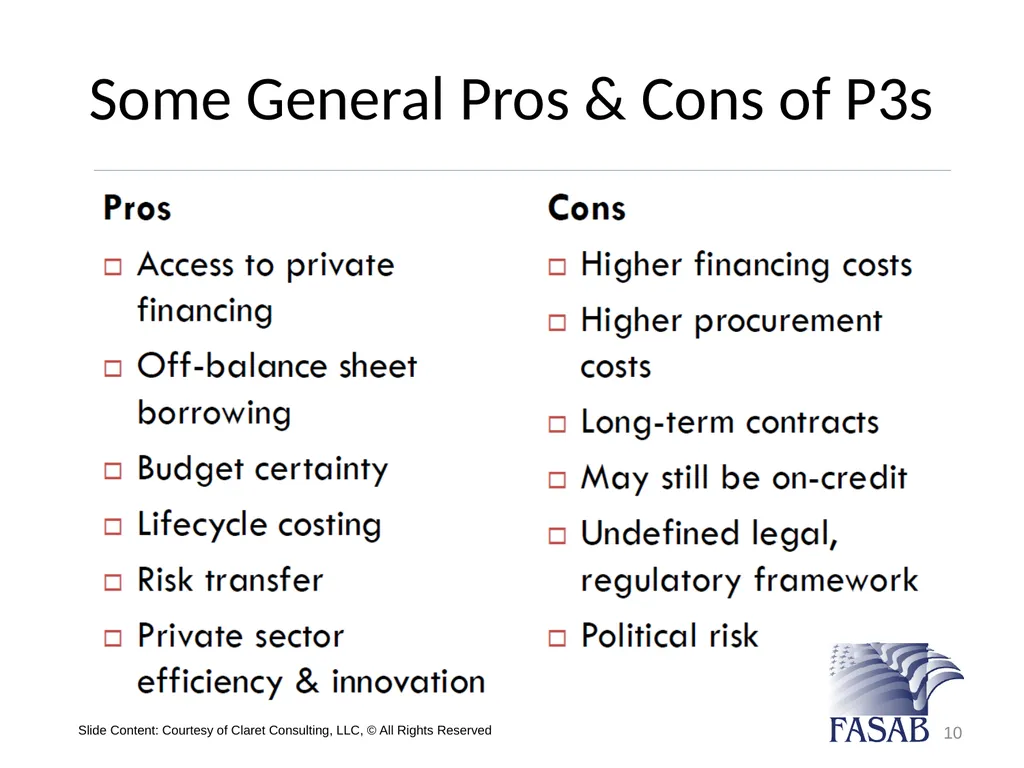
Some General Pros & Cons of P3s 10 Slide Content: Courtesy of Claret Consulting, LLC, © All Rights Reserved<br>
11
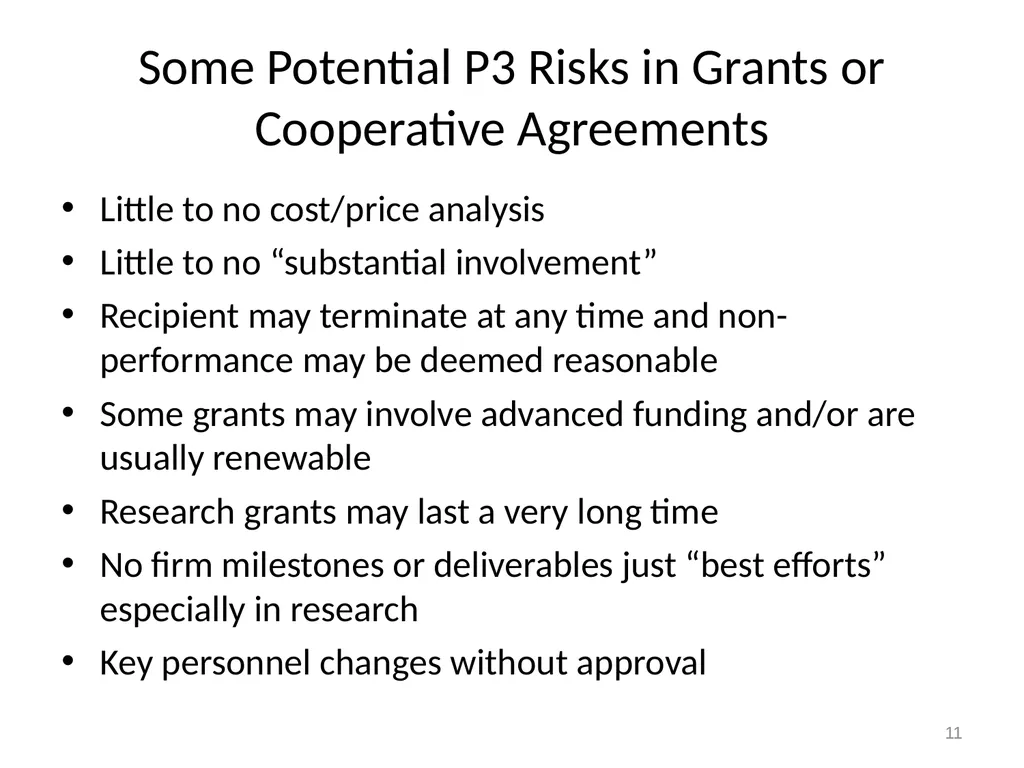
Some Potential P3 Risks in Grants or Cooperative Agreements Little to no cost/price analysis
Little to no “substantial involvement”
Recipient may terminate at any time and non-performance may be deemed reasonable
Some grants may involve advanced funding and/or are usually renewable
Research grants may last a very long time
No firm milestones or deliverables just “best efforts” especially in research
Key personnel changes without approval 11<br>
12
TASK FORCE MEMBER
Larry Checco
Founder & President
Checco Communications 12<br>
13
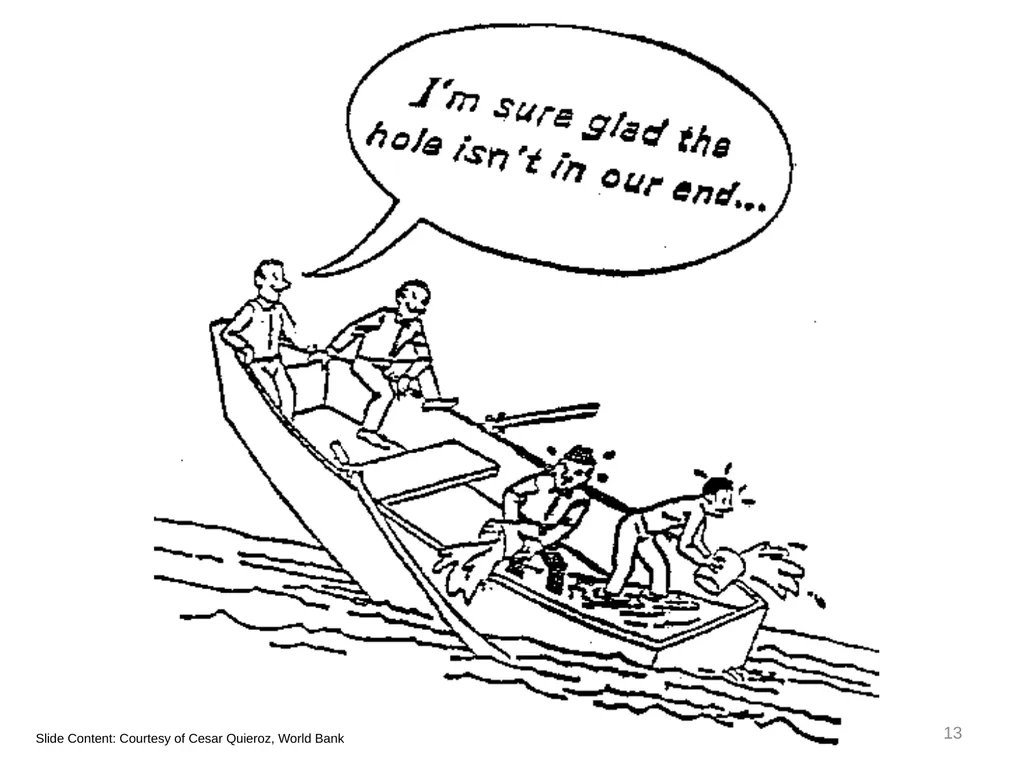
Slide Content: Courtesy of Cesar Quieroz, World Bank 13<br>
14
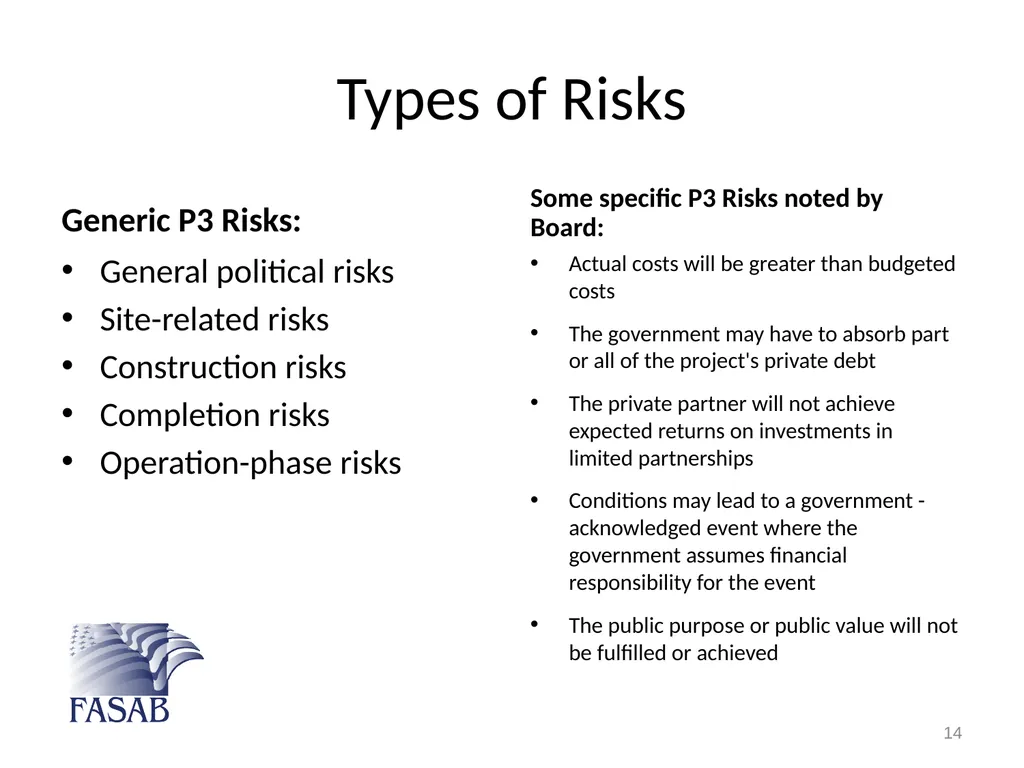
Types of Risks Generic P3 Risks: General political risks
Site-related risks
Construction risks
Completion risks
Operation-phase risks Some specific P3 Risks noted by Board: Actual costs will be greater than budgeted costs
The government may have to absorb part or all of the project's private debt
The private partner will not achieve expected returns on investments in limited partnerships
Conditions may lead to a government - acknowledged event where the government assumes financial responsibility for the event
The public purpose or public value will not be fulfilled or achieved 14<br>
15
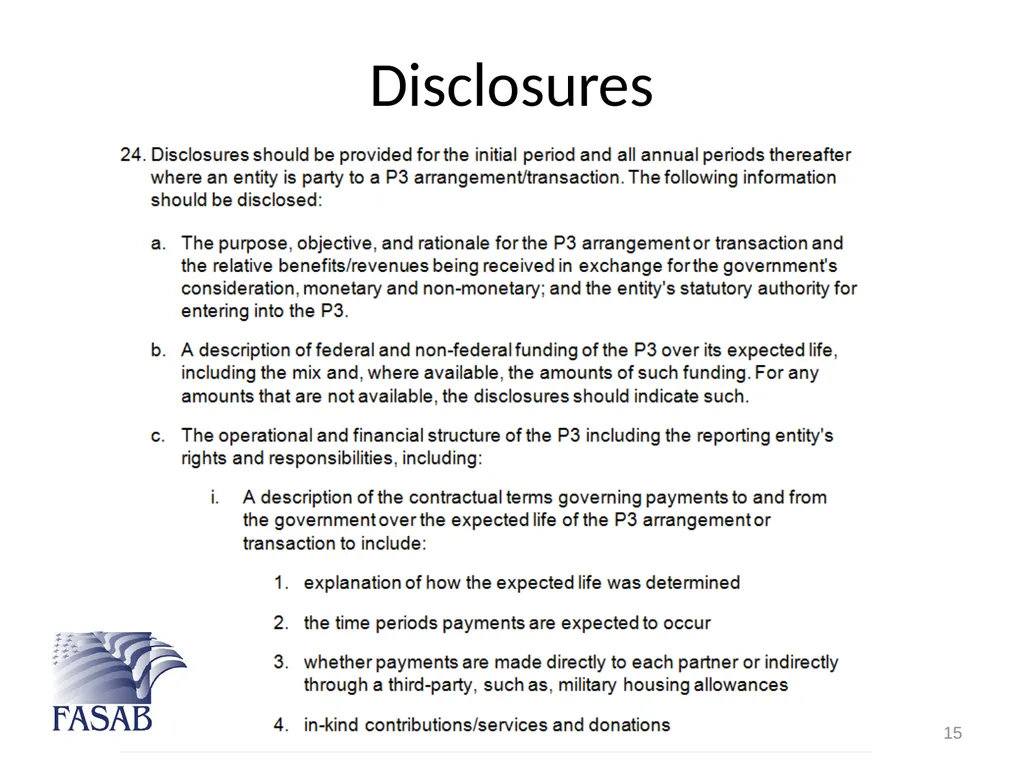
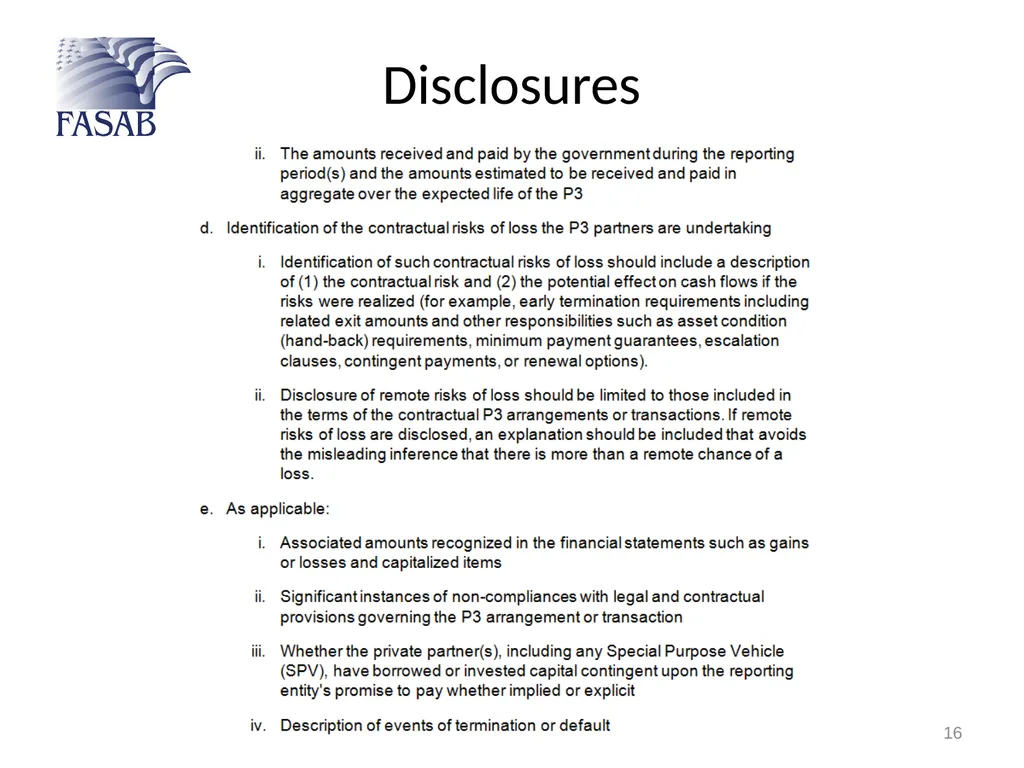
Disclosures 15<br>
16
Disclosures 16<br>
17
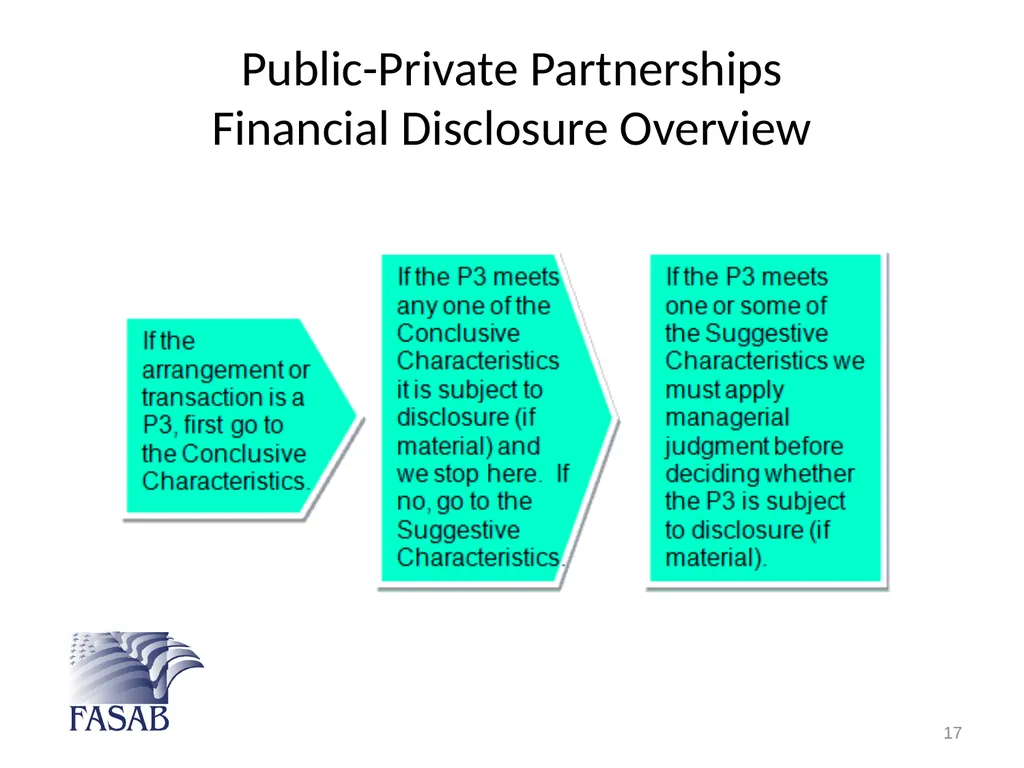
Public-Private Partnerships
Financial Disclosure Overview 17<br>
18
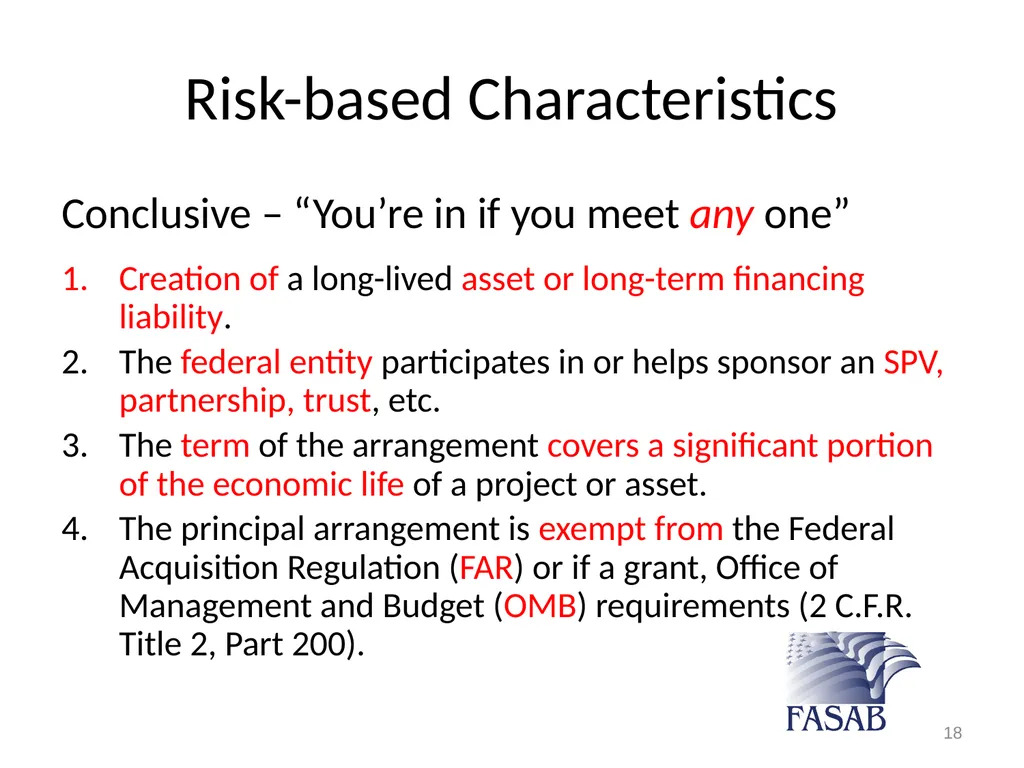
Risk-based Characteristics Conclusive – “You’re in if you meet any one”
Creation of a long-lived asset or long-term financing liability.
The federal entity participates in or helps sponsor an SPV, partnership, trust, etc.
The term of the arrangement covers a significant portion of the economic life of a project or asset.
The principal arrangement is exempt from the Federal Acquisition Regulation (FAR) or if a grant, Office of Management and Budget (OMB) requirements (2 C.F.R. Title 2, Part 200). 18<br>
19
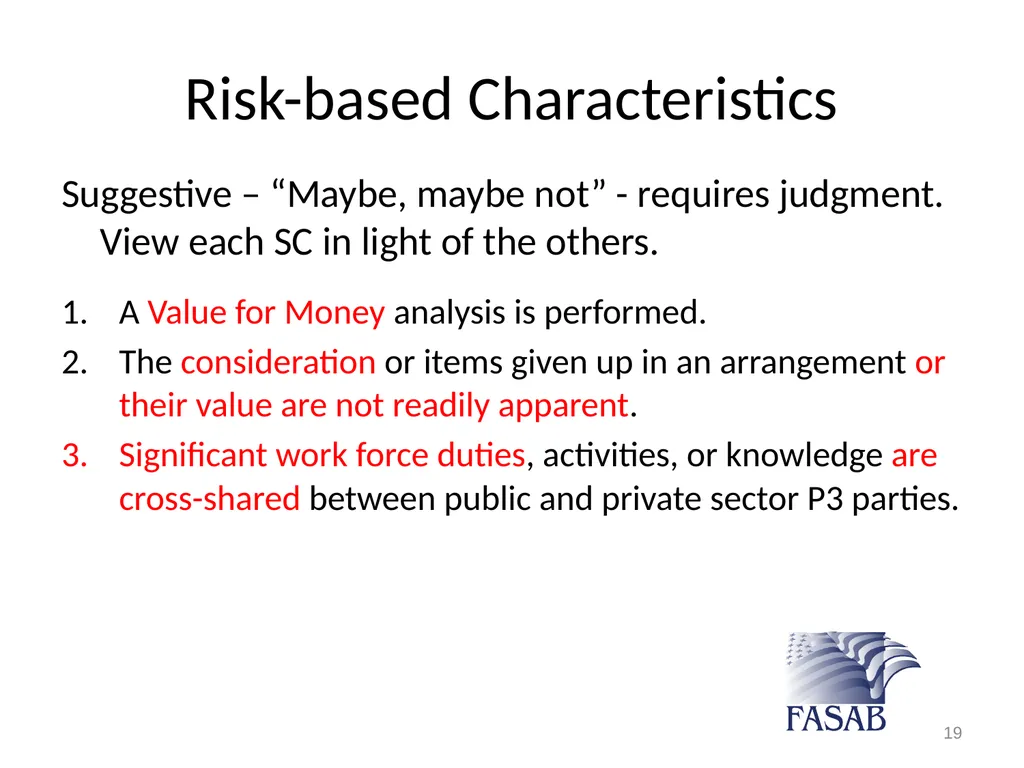
Risk-based Characteristics Suggestive – “Maybe, maybe not” - requires judgment. View each SC in light of the others.
A Value for Money analysis is performed.
The consideration or items given up in an arrangement or their value are not readily apparent.
Significant work force duties, activities, or knowledge are cross-shared between public and private sector P3 parties. 19<br>
A Value for Money analysis is performed.
The consideration or items given up in an arrangement or their value are not readily apparent.
Significant work force duties, activities, or knowledge are cross-shared between public and private sector P3 parties. 19<br>
20
Risk-based Characteristics The focus is more on collaboration and informal, real-time, resolution processes as opposed to formal, contractual, administrative processes.
The government relies on either the private sector partner’s or a third party’s determination of a P3’s performance or return on investment/equity, without performing its own verification of performance/return on investment/equity. 20<br>
The government relies on either the private sector partner’s or a third party’s determination of a P3’s performance or return on investment/equity, without performing its own verification of performance/return on investment/equity. 20<br>
21
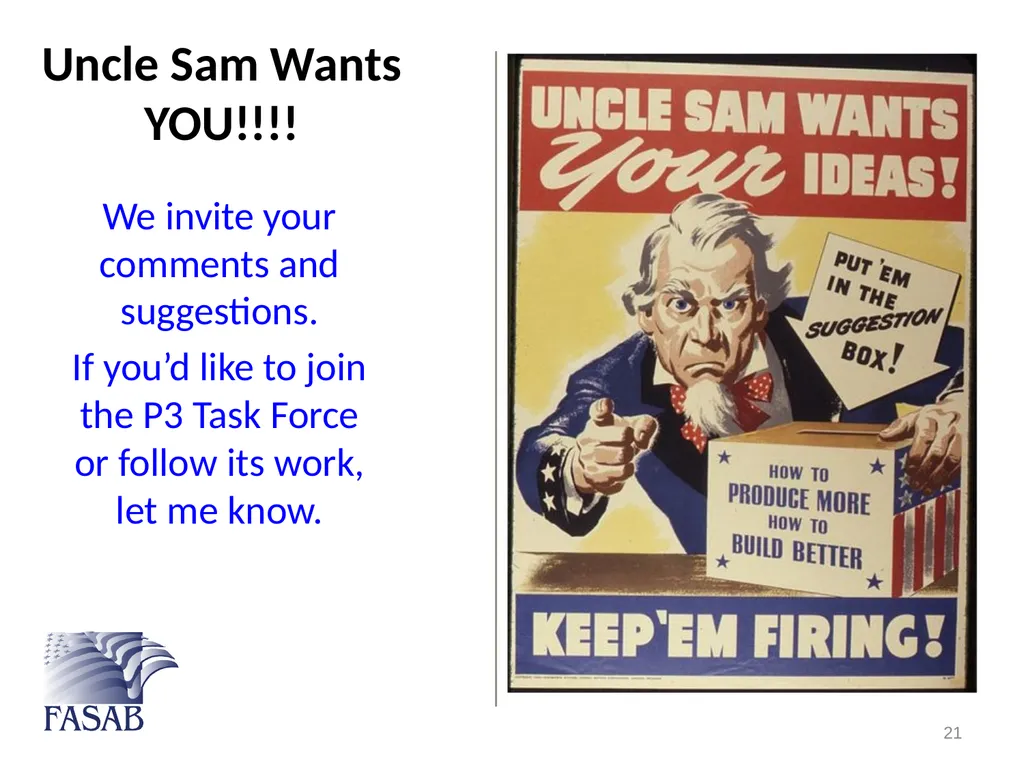
Uncle Sam Wants YOU!!!! . We invite your comments and suggestions.
If you’d like to join the P3 Task Force or follow its work, let me know. 21<br>
If you’d like to join the P3 Task Force or follow its work, let me know. 21<br>
22
TASK FORCE MEMBER
Robert D. Helwig JD
Bob Helwig Consulting, LLC
Formerly Office of the Secretary of Defense Mr. Helwig has been involved in privatization initiatives since 1996 when he joined the Department of Defense Housing Revitalization Office. He has been engaged in privatizing both military housing and utilities involving concept development, contract solicitation, deal structuring, portfolio management, and financial analysis.
He has Bachelor degrees in Political Science and French from the California State University; a Master's degree in International Policy from the Monterey Institute of International Studies; and a Juris Doctor from George Washington University. He is a member of both the Maryland and Washington, D.C. Bars. He is currently a Doctoral Candidate in Public Administration at the University of Baltimore, writing his dissertation on P3s.
He can be contacted via email: bobhelwigbhc@gmail.com or phone: 301.943.7959 22<br>
23
TASK FORCE MEMBER
Larry Checco
Founder & President
Checco Communications Mr. Checco is a nationally sought-after speaker and consultant on branding and leadership and is a faculty member of the NeighborWorks® Training Institute.
Larry’s books on branding and leadership have successfully sold thousands of copies throughout the United States, Australia, Canada, South Africa, Sweden, Israel, Southeast Asia and elsewhere around the globe.
Larry has been recognized as a leading branding professional, and his articles are cited and reprinted on countless websites.
Larry holds a degree in Economics from Syracuse University, as well as an MA in Journalism and Public Affairs from American University.
He can be reached via email: Larry.Checco@Verizon.net or phone: 301.602-8332. 23<br>
24
Contact and Website Information Dom can be reached at: savinid@fasab.gov, 202 512-6841
General inquiries can be directed to fasab@fasab.gov
Phone: 202 512-7350
www.FASAB.gov
Listserv
Exposure Drafts
Active Projects 24<br>
General inquiries can be directed to fasab@fasab.gov
Phone: 202 512-7350
www.FASAB.gov
Listserv
Exposure Drafts
Active Projects 24<br>