
Federal Grant Reporting 101 & Lessons Learned






Description: Federal Grant Reporting 101 Lessons Learned Office of the Chief Financial Officer Jill Martin Jill.Martinks.gov (785) 296-2909 Roger Basinger Roger.Basingerks.gov (785) 296-8083 2 Federal Grant Reporting 101 Time Effort Reporting
Related Topics
Download Presentation
"Federal Grant Reporting 101 & Lessons Learned" is the property of its rightful owner. Permission is granted to download and print the materials on this website for personal, non-commercial use only, and to display it on your personal computer provided you do not modify the materials and that you retain all copyright notices contained in the materials. By downloading content from our website, you accept the terms of this agreement.
Presentation Transcript
slide1. Federal Grant Reporting 101 & Lessons Learned<br>
slide2. Office of the Chief Financial Officer
Jill Martin
Jill.Martin@ks.gov
(785) 296-2909
Roger Basinger
Roger.Basinger@ks.gov
(785) 296-8083 2<br>
slide3. Federal Grant Reporting 101
Time & Effort Reporting
Subrecipient vs. Contractor
Pass Through Responsibilities
Risk Assessments (What other States are Doing)
Other Issues/Questions 3<br>
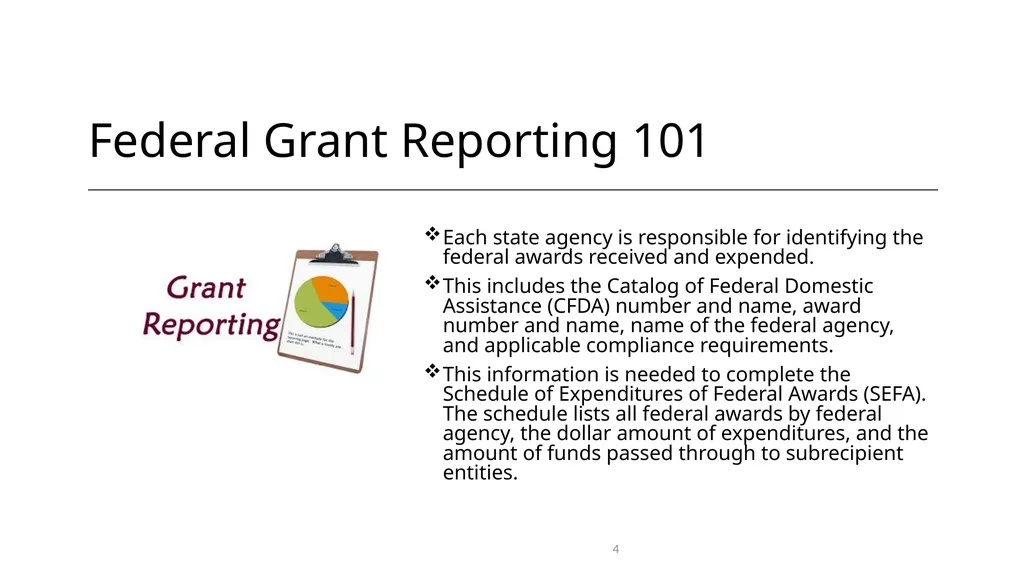
slide4. Federal Grant Reporting 101 Each state agency is responsible for identifying the federal awards received and expended.
This includes the Catalog of Federal Domestic Assistance (CFDA) number and name, award number and name, name of the federal agency, and applicable compliance requirements.
This information is needed to complete the Schedule of Expenditures of Federal Awards (SEFA). The schedule lists all federal awards by federal agency, the dollar amount of expenditures, and the amount of funds passed through to subrecipient entities. 4<br>
slide5. Federal Grant Reporting 101 Main Issues with Reporting Federal Expenditures:
Using incorrect account codes
Treating contractual expenditures as a subrecipient relationship and vice versa
Transfers between state agencies not being reported correctly
More than just the Federal portion of grant reported (state dollars also included) 5<br>
slide6. Federal Grant Reporting 101 Adding a New Federal Grant/CFDA Number:
A special revenue fund must be established to track federal grant expenditures.
The agency wanting to establish the fund will need to get spending authority through the Division of Budget.
The new fund (usually a 3000 series fund) should then be established through the Central Responsibilities Team within our office.
Ideally, each CFDA number should be tied to its own fund. 6<br>
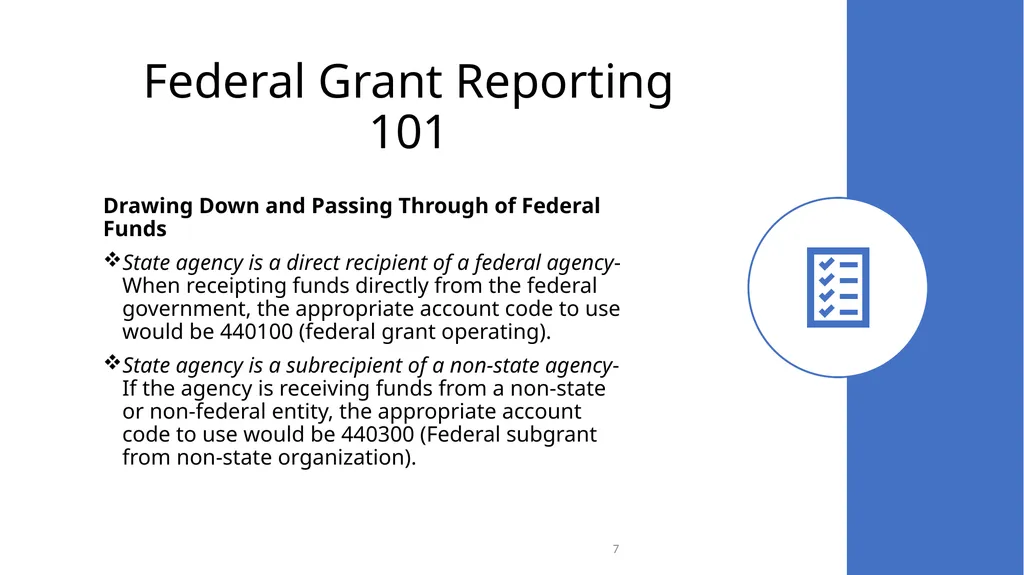
slide7. Federal Grant Reporting 101 Drawing Down and Passing Through of Federal Funds
State agency is a direct recipient of a federal agency-When receipting funds directly from the federal government, the appropriate account code to use would be 440100 (federal grant operating).
State agency is a subrecipient of a non-state agency-If the agency is receiving funds from a non-state or non-federal entity, the appropriate account code to use would be 440300 (Federal subgrant from non-state organization). 7<br>
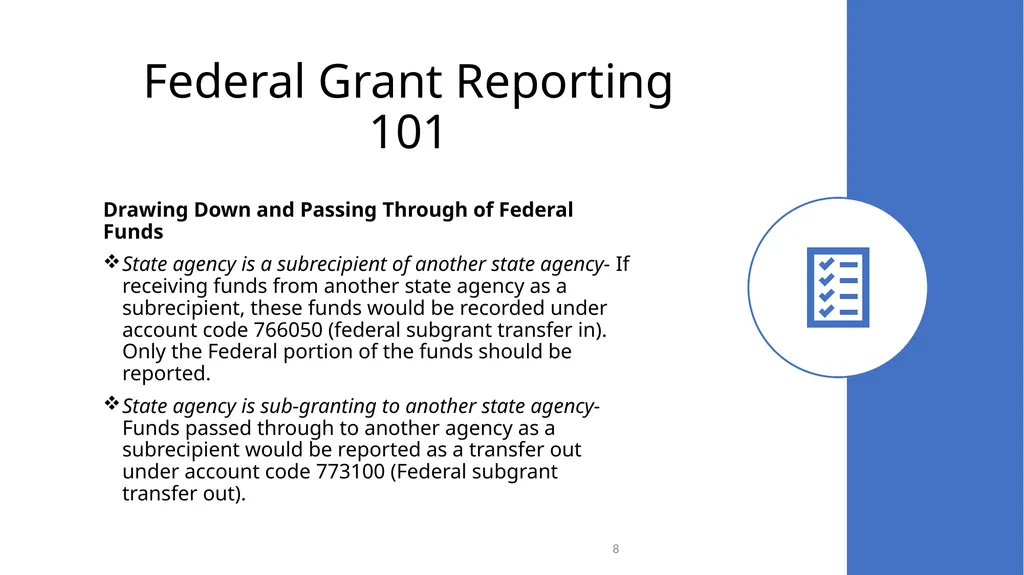
slide8. Federal Grant Reporting 101 Drawing Down and Passing Through of Federal Funds
State agency is a subrecipient of another state agency- If receiving funds from another state agency as a subrecipient, these funds would be recorded under account code 766050 (federal subgrant transfer in). Only the Federal portion of the funds should be reported.
State agency is sub-granting to another state agency- Funds passed through to another agency as a subrecipient would be reported as a transfer out under account code 773100 (Federal subgrant transfer out). 8<br>
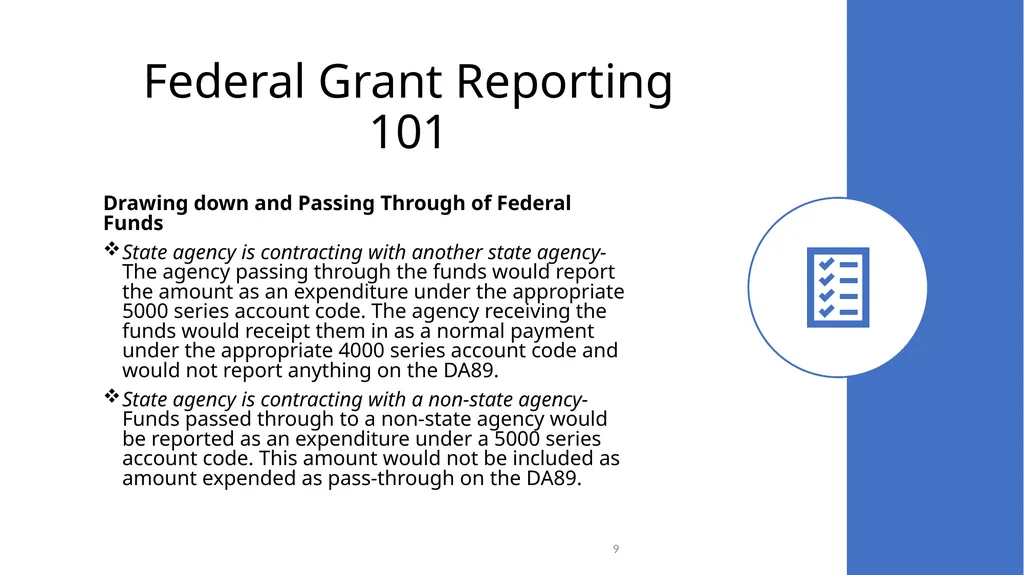
slide9. Federal Grant Reporting 101 Drawing down and Passing Through of Federal Funds
State agency is contracting with another state agency- The agency passing through the funds would report the amount as an expenditure under the appropriate 5000 series account code. The agency receiving the funds would receipt them in as a normal payment under the appropriate 4000 series account code and would not report anything on the DA89.
State agency is contracting with a non-state agency-Funds passed through to a non-state agency would be reported as an expenditure under a 5000 series account code. This amount would not be included as amount expended as pass-through on the DA89. 9<br>
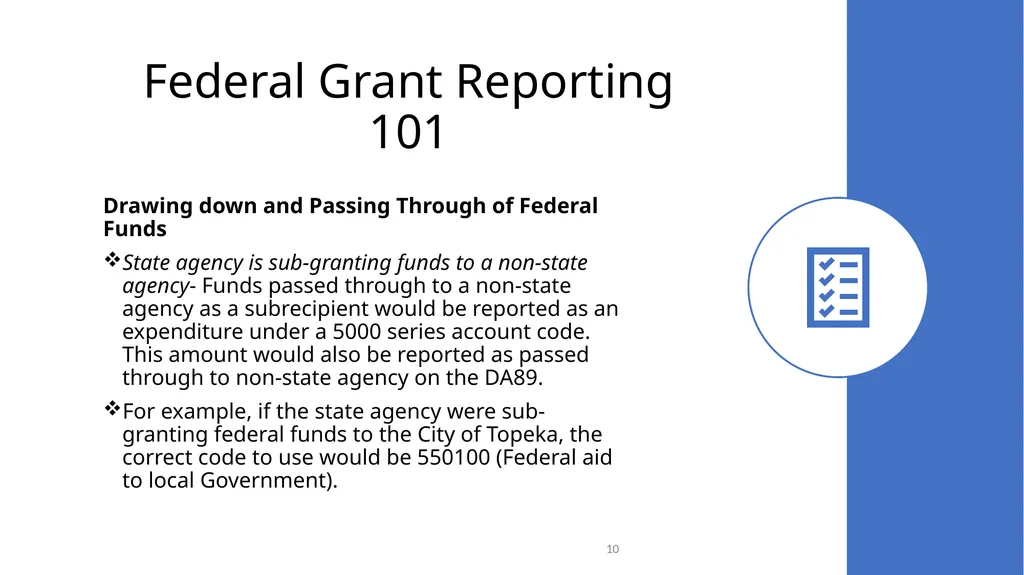
slide10. Federal Grant Reporting 101 Drawing down and Passing Through of Federal Funds
State agency is sub-granting funds to a non-state agency- Funds passed through to a non-state agency as a subrecipient would be reported as an expenditure under a 5000 series account code. This amount would also be reported as passed through to non-state agency on the DA89.
For example, if the state agency were sub-granting federal funds to the City of Topeka, the correct code to use would be 550100 (Federal aid to local Government). 10<br>
slide11. Federal Grant Reporting 101 Drawing Down and Passing Through of Federal Funds
Due to several agencies being on a reimbursement basis, as of May 2018, Federal funds are allowed to go negative at the end of the fiscal year (Policy 8,004).
When a negative cash balance is anticipated at fiscal year end, agencies are required to record an accounts receivable in SMART for the amount expected to be reimbursed. 11<br>
slide12. Federal Grant Reporting 101 Additional Issues with Reporting on the DA89:
Reporting funds as indirect instead of direct and vice versa.
Reporting funds received or expended from a non-state agency as a transfer.
Not including contract numbers and titles for indirect grants.
Not reporting whole dollars for expenditures reported. 12<br>
slide13. Federal Grant Reporting 101 Agency A has determined that Agency B is a contractor. Agency A gives Agency B $500,000 to carry out contractual services under the program. How should this be reported for both Agency A and Agency B?
Answer: Agency A would report the $500,000 as an expenditure. However, they would not report this amount as sub-granted out. Agency B would not report anything on the DA89, as the funds had already lost their federal identity. 13<br>
slide14. Federal Grant Reporting 101 Agency A provides $100,000 in federal funds to Agency B. Agency B will be determining eligibility for participants in the program and providing services to clients after eligibility has been determined. How should this be reported by both Agency A and Agency B?
Answer: As this appears to be a subrecipient relationship, Agency A would report a transfer out for $100,000 to Agency B under account code 773100. This amount would be listed as sub-granted to state agencies on the DA89. However, both sides of the $100,000 should be reported on the transfer in/out tabs of the DA89. 14<br>
slide15. Federal Grant Reporting 101 Agency A provides Agency B with $50,000 to carry out a portion of the program. Of the $50,000, 20% are state funds and the remaining 80% are federal. How should this be reported on the DA89 for both agencies?
Answer: Only federal expenditures would be reported on the DA89. Agency A would report a transfer out of $40,000 (using account code 773100) as this is the federal portion. Agency B would report a transfer in of $40,000 (using account code 766050). 15<br>
slide16. Federal Grant Reporting 101 Agency A receives $500,000 from the U.S. Department of Defense for a research and development grant. Should this be reported as a direct or indirect source of funding?
Answer: Agency A would report the $500,000 as a direct source of funding from the U.S. Department of Defense. 16<br>
slide17. 17<br>
slide18. Time & Effort Reporting 200.430 (i)(1) states:
Charges to Federal awards for salaries and wages must be based on records that accurately reflect the work performed. 18<br>
slide19. Time & Effort Reporting Records must:
Be supported by a system of internal control which provides reasonable assurance that the charges are accurate, allowable, and properly allocated
Be incorporated into the official records of the non-federal entity
Reasonably reflect the total activity for which the employee is compensated by the non-Federal entity, not exceeding 100% of compensated activities
Comply with the established accounting policies and practices of the non-federal entity
Support the distribution of the employee’s salary or wages among specific activities or cost objectives if the employee works on more than one Federal award. 19<br>
slide20. Time & Effort Reporting Budget estimates do not qualify as support for charges to Federal awards, but may be used for interim accounting purposes if :
The system for establishing the estimates produces reasonable approximations of activity actually performed
At least quarterly comparisons of actual costs to budgeted distributions are done and adjustments are made to reflect the hours worked 20<br>
slide21. Time & Effort Reporting Leave time (sick, vacation, holidays, etc.) is allowed to be charged to the grant if:
They are provided under established written leave policies
The costs are equitably allocated to all related activities
The accounting basis (cash or accrual) selected for costing each type of leave is consistently followed 21<br>
slide22. Time & Effort Reporting Utah Finding
During the fiscal year 2018 audit, the Office of the State Auditor within the state of Utah issued three findings to three different state agencies related to inappropriate leave allocations.
The errors were typically related to situations where employees worked on multiple federal or state funded activities and the hours charged for leave taken were not properly allocated between the activities. 22<br>
slide23. Time & Effort Reporting Utah Finding
The lack of appropriate leave allocations occurred for various reasons, including:
The State payroll system charges leave taken to predetermined account coding.
Some departments were not aware that leave charged to predetermined account coding may require subsequent reviews and allocations.
Some departments may have been aware of the need for these allocations but have chosen to charge the leave solely to State funding sources.
Other departments were aware of the potential need for these allocations but incorrectly calculated the allocations. 23<br>
slide24. Time & Effort Reporting Utah Finding
The Office of the State Auditor felt that the State did not provide sufficient systems, methods, or guidance to adequately and efficiently address the leave allocation issues for all State agencies. They recommended that the Utah Division of Finance:
Improve systems or methods to more efficiently and accurately resolve leave allocation issues.
Improve its monitoring efforts and internal controls over the leave allocation processes to ensure resolution of this issue for all state agencies. 24<br>
slide25. Time & Effort Reporting Suzie works on a grant but also has other duties not related to the grant. Suzie is an exempt employee and usually works over 40 hours per week. Last week Suzie worked 30 hours on the grant, while 20 hours were spent on other duties (totaling 50 hours). How should Suzie’s time be allocated to the grant?
Answer: Suzie’s time should be allocated at 60%to the grant and the other 40% would be allocated amongst the other activities. 25<br>
slide26. Time & Effort Reporting John works on three different grants. He usually spends 50% of his time on grant A, 25% on grant B, and 25% on grant C. However, he has been spending the majority of his time on grant A more recently (but not 100% of his time). He decides to take a week vacation and charges the entire week to grant A, since that is the grant he works on the most. Is this allocation correct?
Answer: No, vacation time should be based on the percentage of time worked for that pay period. John did not spend 100% of his time on grant A. Leave time should be based on whatever percentage of time John worked on each grant for that pay period. 26<br>
slide27. 27<br>
slide28. Subrecipient vs. Contractor Determination of Subrecipient vs. Contractor
Determining a subrecipient or contractor relationship still seems to be an ongoing issue
Pass through entities must make case by case determinations
Generally, the determination is verified through the review of the proposal narrative, budget, and other related documents as well as discussions with key personnel
The entity providing the funds is the one who should make the determination 28<br>
slide29. Subrecipient vs. Contractor According to CFR 200.330, subawards are provided to subrecipients for the purpose of carrying out a portion of a Federal award. Characteristics include:
The entity determines who is eligible to receive what Federal assistance
Has its performance measured in relation to whether objectives of a federal program were met
Has responsibility for programmatic decision making
Is responsible for adherence to applicable Federal program requirements
In accordance with its agreement, uses the federal funds to carry out a program for a public purpose specified, as opposed to providing goods or services for the benefit of the pass-through entity 29<br>
slide30. Subrecipient vs. Contractor Contracts are entered into for the purpose of obtaining goods and services for the non-federal entity’s own use. Characteristics include:
The entity provides the goods or services within normal business operations.
Provides similar goods or services to many different purchasers.
Normally operates in a competitive environment.
Provides goods or services that are ancillary to the operation of the Federal program
Is not subject to compliance requirements of the Federal program as result of the agreement, though similar requirements may apply for other reasons. 30<br>
slide31. Subrecipient vs. Contractor Something that might help in determination:
Appendix E of the U.S. Department of Labor Employment and Training Administration’s One-Stop Comprehensive Financial Management Technical Assistance Guide states the following:
Under no circumstances should a designation of contractor be made for providers that have a financial or performance requirement related to eligibility or selection of participants. 31<br>
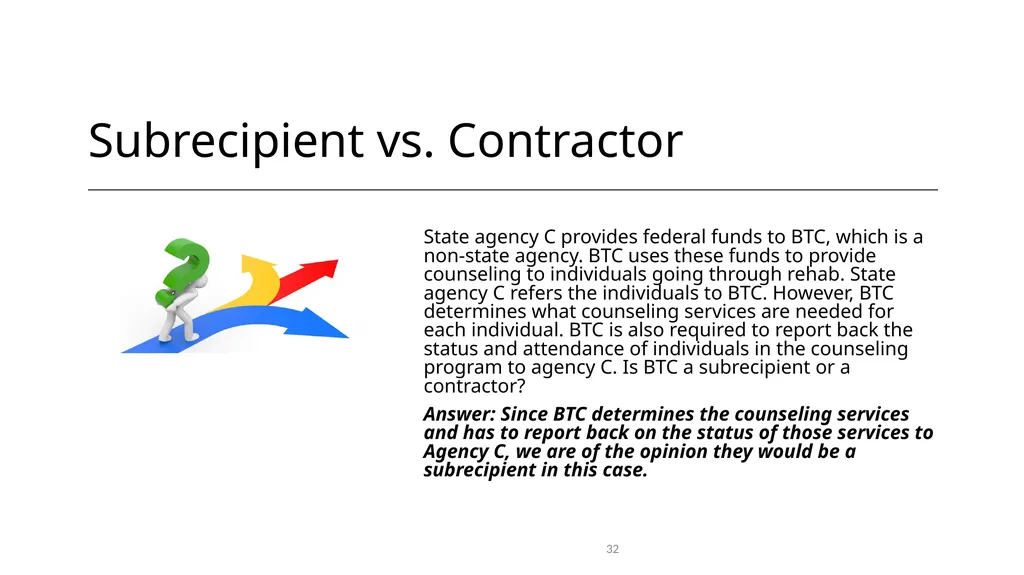
slide32. Subrecipient vs. Contractor State agency C provides federal funds to BTC, which is a non-state agency. BTC uses these funds to provide counseling to individuals going through rehab. State agency C refers the individuals to BTC. However, BTC determines what counseling services are needed for each individual. BTC is also required to report back the status and attendance of individuals in the counseling program to agency C. Is BTC a subrecipient or a contractor?
Answer: Since BTC determines the counseling services and has to report back on the status of those services to Agency C, we are of the opinion they would be a subrecipient in this case. 32<br>
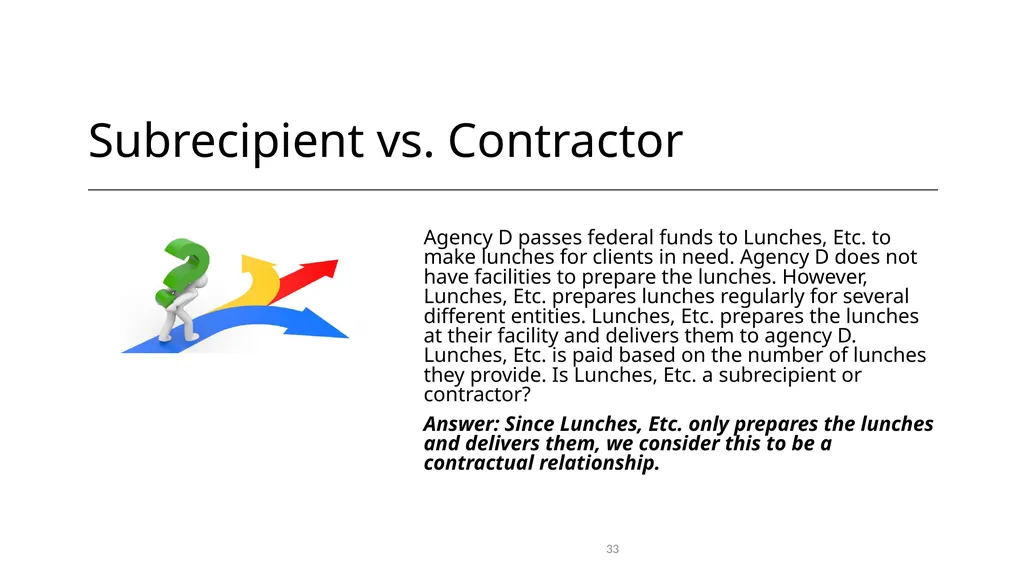
slide33. Subrecipient vs. Contractor Agency D passes federal funds to Lunches, Etc. to make lunches for clients in need. Agency D does not have facilities to prepare the lunches. However, Lunches, Etc. prepares lunches regularly for several different entities. Lunches, Etc. prepares the lunches at their facility and delivers them to agency D. Lunches, Etc. is paid based on the number of lunches they provide. Is Lunches, Etc. a subrecipient or contractor?
Answer: Since Lunches, Etc. only prepares the lunches and delivers them, we consider this to be a contractual relationship. 33<br>
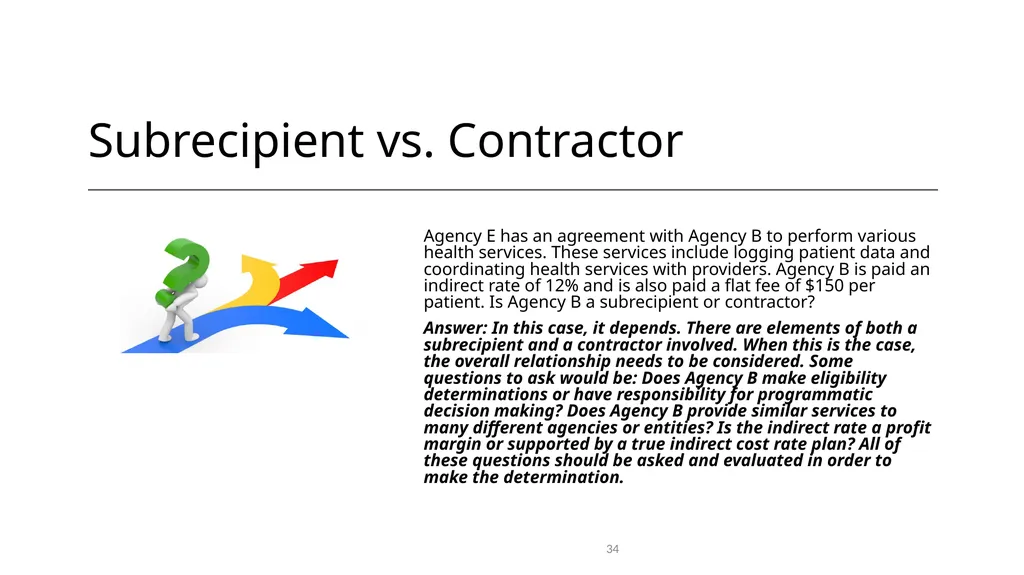
slide34. Subrecipient vs. Contractor Agency E has an agreement with Agency B to perform various health services. These services include logging patient data and coordinating health services with providers. Agency B is paid an indirect rate of 12% and is also paid a flat fee of $150 per patient. Is Agency B a subrecipient or contractor?
Answer: In this case, it depends. There are elements of both a subrecipient and a contractor involved. When this is the case, the overall relationship needs to be considered. Some questions to ask would be: Does Agency B make eligibility determinations or have responsibility for programmatic decision making? Does Agency B provide similar services to many different agencies or entities? Is the indirect rate a profit margin or supported by a true indirect cost rate plan? All of these questions should be asked and evaluated in order to make the determination. 34<br>
slide35. Pass Through Entity Responsibilities CFR 200.331 states:
When passing through funds to a subrecipient, pass through entities must ensure every subaward is clearly identified to the subrecipient as a subaward….. 35<br>
slide36. Pass Through Entity Responsibilities Required information includes:
CFDA number and name
Federal award identification number (FAIN)
Name of federal awarding agency, name of pass-through
Subrecipient name and DUNS number
Subaward period of performance (dates)
Amount of federal awards
Indirect cost rate to be used
All requirements imposed by the pass-through entity on the subrecipient so that the Federal award is used in accordance with Federal statutes/regulations 36<br>
slide37. Pass Through Entity Responsibilities The pass-through entity must:
Evaluate each subrecipient’s risk of non-compliance with Federal statutes, regulations and terms for purposes of determining the appropriate subrecipient monitoring (risk assessment).
Monitor the activities of the subrecipient to ensure the subaward is being used for authorized purposes and is in compliance with Federal statutes, regulations, and the terms and conditions of the subaward. 37<br>
slide38. Pass Through Entity Responsibilities Risk Assessment
The primary purpose of the risk assessment is to determine the appropriate level of monitoring to ensure objectives are being met and that Federal guidelines are being followed. Assessment of risk can include (but is not limited to):
Subrecipient’s prior experience with the same or similar awards
Results of previous audits
Whether the subrecipient has new personnel or substantially changed systems
The extent and result of Federal awarding agency monitoring 38<br>
slide39. Pass Through Entity Responsibilities Subrecipient Monitoring -200.331 (d)(1-3)
Subrecipient monitoring must include (but is not limited to):
Reviewing financial and programmatic reports required by the pass-through entity
Following up and ensuring that the subrecipient takes timely and appropriate actions on all deficiencies pertaining to the award detected through audits, on-site reviews, and other means
Issuing management decisions for audit findings pertaining to the Federal award provided to the subrecipient from the pass-through entity 39<br>
slide40. Pass Through Entity Responsibilities Indirect Cost Rates-200.331(a)(4)
Subaward agreements should include:
An approved federally recognized indirect cost rate negotiated between the subrecipient and the federal government, or if no such rate exists, either a rate negotiated between the pass-through entity and the subrecipient (in compliance with this part) or a de minimis indirect cost rate…. 40<br>
slide41. Pass Through Entity Responsibilities Indirect Cost Rates
Per the FAQs:
If the subrecipient has a negotiated rate with the Federal government, that rate must be used.
It is not permissible for pass-through entities to force or entice a proposed subrecipient without a negotiated rate to accept less than the de minimis rate.
Pass-through entities MAY, but are not required to, negotiate a rate with a subrecipient who asks to do so. However, this is only if the subrecipient does not already have an indirect cost rate. 41<br>
slide42. Indirect Cost Rates Agency F passes federal funds through to Agency G (who is another state agency). Agency G is determined to be a subrecipient. The Federal award specifies that indirect costs should be capped at 10%. However, Agency G has a federally approved cost rate of 18%. Which indirect cost rate should be used?
Answer: Since the federal award specifies that indirect costs are to be capped at 10%, that rate must be used, even though the agency has a federally approved indirect cost rate. 42<br>
slide43. Indirect Cost Rates Agency B passes through funds to Agency A. Agency A is determined to be a subrecipient. The Federal award is silent on indirect costs. Agency B wants to charge a flat indirect cost rate of 5%. Agency A does not have a federally approved indirect cost rate. Which indirect cost rate should be used?
Answer: In this case, the de minimis rate of 10% should be used. According to the FAQs, it is not permissible to force or entice a proposed subrecipient without a negotiated rate to accept less than the de minimis rate. The subrecipient can choose to wave indirect costs or negotiate a different rate, but the decision must solely be made by the subrecipient and must not be encouraged or coerced in any way by the pass-through entity. 43<br>
slide44. Indirect Cost Rates Agency H passes through federal funds to a non-state agency where a subrecipient relationship has been determined. The non-state agency has a Federally approved indirect cost rate of 15%. The Federal award is silent on indirect costs. However, Agency H wants to cap the indirect costs at 10%. Which rate should be used?
Answer: In this case the federal award is silent on what can be charged for indirect costs. However, the agency has taken it upon themselves to cap the indirect costs at 10%. In accordance with the Uniform Guidance, the 15% federally approved rate should be used. 44<br>
slide45. 45<br>
slide46. Risk Assessments (What Other States are Doing) A work group was formed amongst several states to discuss the risk assessment process.
The goal of the group is to see what other states are doing in regard to risk assessments and to determine any similarities or differences that exist.
The Federal Office of Management and Budget (OMB) has also indicated an interest in doing some work at the Federal level in terms of standardizing risk assessment and is interested in learning what other states are currently doing. 46<br>
slide47. Risk Assessments (What Other States are Doing) Several states shared documents such as risk assessments, internal control questionnaires, subaward agreements, subaward contractor determinations, subrecipient monitoring guides, etc.
To join this workgroup or get further information you can contact Matt Hanson, Statewide Grants Administrator, with the state of Arizona at Matthew.Hanson@azdoa.gov or (602) 542-7567. 47<br>
slide48. 48<br>
slide2. Office of the Chief Financial Officer
Jill Martin
Jill.Martin@ks.gov
(785) 296-2909
Roger Basinger
Roger.Basinger@ks.gov
(785) 296-8083 2<br>
slide3. Federal Grant Reporting 101
Time & Effort Reporting
Subrecipient vs. Contractor
Pass Through Responsibilities
Risk Assessments (What other States are Doing)
Other Issues/Questions 3<br>
slide4. Federal Grant Reporting 101 Each state agency is responsible for identifying the federal awards received and expended.
This includes the Catalog of Federal Domestic Assistance (CFDA) number and name, award number and name, name of the federal agency, and applicable compliance requirements.
This information is needed to complete the Schedule of Expenditures of Federal Awards (SEFA). The schedule lists all federal awards by federal agency, the dollar amount of expenditures, and the amount of funds passed through to subrecipient entities. 4<br>
slide5. Federal Grant Reporting 101 Main Issues with Reporting Federal Expenditures:
Using incorrect account codes
Treating contractual expenditures as a subrecipient relationship and vice versa
Transfers between state agencies not being reported correctly
More than just the Federal portion of grant reported (state dollars also included) 5<br>
slide6. Federal Grant Reporting 101 Adding a New Federal Grant/CFDA Number:
A special revenue fund must be established to track federal grant expenditures.
The agency wanting to establish the fund will need to get spending authority through the Division of Budget.
The new fund (usually a 3000 series fund) should then be established through the Central Responsibilities Team within our office.
Ideally, each CFDA number should be tied to its own fund. 6<br>
slide7. Federal Grant Reporting 101 Drawing Down and Passing Through of Federal Funds
State agency is a direct recipient of a federal agency-When receipting funds directly from the federal government, the appropriate account code to use would be 440100 (federal grant operating).
State agency is a subrecipient of a non-state agency-If the agency is receiving funds from a non-state or non-federal entity, the appropriate account code to use would be 440300 (Federal subgrant from non-state organization). 7<br>
slide8. Federal Grant Reporting 101 Drawing Down and Passing Through of Federal Funds
State agency is a subrecipient of another state agency- If receiving funds from another state agency as a subrecipient, these funds would be recorded under account code 766050 (federal subgrant transfer in). Only the Federal portion of the funds should be reported.
State agency is sub-granting to another state agency- Funds passed through to another agency as a subrecipient would be reported as a transfer out under account code 773100 (Federal subgrant transfer out). 8<br>
slide9. Federal Grant Reporting 101 Drawing down and Passing Through of Federal Funds
State agency is contracting with another state agency- The agency passing through the funds would report the amount as an expenditure under the appropriate 5000 series account code. The agency receiving the funds would receipt them in as a normal payment under the appropriate 4000 series account code and would not report anything on the DA89.
State agency is contracting with a non-state agency-Funds passed through to a non-state agency would be reported as an expenditure under a 5000 series account code. This amount would not be included as amount expended as pass-through on the DA89. 9<br>
slide10. Federal Grant Reporting 101 Drawing down and Passing Through of Federal Funds
State agency is sub-granting funds to a non-state agency- Funds passed through to a non-state agency as a subrecipient would be reported as an expenditure under a 5000 series account code. This amount would also be reported as passed through to non-state agency on the DA89.
For example, if the state agency were sub-granting federal funds to the City of Topeka, the correct code to use would be 550100 (Federal aid to local Government). 10<br>
slide11. Federal Grant Reporting 101 Drawing Down and Passing Through of Federal Funds
Due to several agencies being on a reimbursement basis, as of May 2018, Federal funds are allowed to go negative at the end of the fiscal year (Policy 8,004).
When a negative cash balance is anticipated at fiscal year end, agencies are required to record an accounts receivable in SMART for the amount expected to be reimbursed. 11<br>
slide12. Federal Grant Reporting 101 Additional Issues with Reporting on the DA89:
Reporting funds as indirect instead of direct and vice versa.
Reporting funds received or expended from a non-state agency as a transfer.
Not including contract numbers and titles for indirect grants.
Not reporting whole dollars for expenditures reported. 12<br>
slide13. Federal Grant Reporting 101 Agency A has determined that Agency B is a contractor. Agency A gives Agency B $500,000 to carry out contractual services under the program. How should this be reported for both Agency A and Agency B?
Answer: Agency A would report the $500,000 as an expenditure. However, they would not report this amount as sub-granted out. Agency B would not report anything on the DA89, as the funds had already lost their federal identity. 13<br>
slide14. Federal Grant Reporting 101 Agency A provides $100,000 in federal funds to Agency B. Agency B will be determining eligibility for participants in the program and providing services to clients after eligibility has been determined. How should this be reported by both Agency A and Agency B?
Answer: As this appears to be a subrecipient relationship, Agency A would report a transfer out for $100,000 to Agency B under account code 773100. This amount would be listed as sub-granted to state agencies on the DA89. However, both sides of the $100,000 should be reported on the transfer in/out tabs of the DA89. 14<br>
slide15. Federal Grant Reporting 101 Agency A provides Agency B with $50,000 to carry out a portion of the program. Of the $50,000, 20% are state funds and the remaining 80% are federal. How should this be reported on the DA89 for both agencies?
Answer: Only federal expenditures would be reported on the DA89. Agency A would report a transfer out of $40,000 (using account code 773100) as this is the federal portion. Agency B would report a transfer in of $40,000 (using account code 766050). 15<br>
slide16. Federal Grant Reporting 101 Agency A receives $500,000 from the U.S. Department of Defense for a research and development grant. Should this be reported as a direct or indirect source of funding?
Answer: Agency A would report the $500,000 as a direct source of funding from the U.S. Department of Defense. 16<br>
slide17. 17<br>
slide18. Time & Effort Reporting 200.430 (i)(1) states:
Charges to Federal awards for salaries and wages must be based on records that accurately reflect the work performed. 18<br>
slide19. Time & Effort Reporting Records must:
Be supported by a system of internal control which provides reasonable assurance that the charges are accurate, allowable, and properly allocated
Be incorporated into the official records of the non-federal entity
Reasonably reflect the total activity for which the employee is compensated by the non-Federal entity, not exceeding 100% of compensated activities
Comply with the established accounting policies and practices of the non-federal entity
Support the distribution of the employee’s salary or wages among specific activities or cost objectives if the employee works on more than one Federal award. 19<br>
slide20. Time & Effort Reporting Budget estimates do not qualify as support for charges to Federal awards, but may be used for interim accounting purposes if :
The system for establishing the estimates produces reasonable approximations of activity actually performed
At least quarterly comparisons of actual costs to budgeted distributions are done and adjustments are made to reflect the hours worked 20<br>
slide21. Time & Effort Reporting Leave time (sick, vacation, holidays, etc.) is allowed to be charged to the grant if:
They are provided under established written leave policies
The costs are equitably allocated to all related activities
The accounting basis (cash or accrual) selected for costing each type of leave is consistently followed 21<br>
slide22. Time & Effort Reporting Utah Finding
During the fiscal year 2018 audit, the Office of the State Auditor within the state of Utah issued three findings to three different state agencies related to inappropriate leave allocations.
The errors were typically related to situations where employees worked on multiple federal or state funded activities and the hours charged for leave taken were not properly allocated between the activities. 22<br>
slide23. Time & Effort Reporting Utah Finding
The lack of appropriate leave allocations occurred for various reasons, including:
The State payroll system charges leave taken to predetermined account coding.
Some departments were not aware that leave charged to predetermined account coding may require subsequent reviews and allocations.
Some departments may have been aware of the need for these allocations but have chosen to charge the leave solely to State funding sources.
Other departments were aware of the potential need for these allocations but incorrectly calculated the allocations. 23<br>
slide24. Time & Effort Reporting Utah Finding
The Office of the State Auditor felt that the State did not provide sufficient systems, methods, or guidance to adequately and efficiently address the leave allocation issues for all State agencies. They recommended that the Utah Division of Finance:
Improve systems or methods to more efficiently and accurately resolve leave allocation issues.
Improve its monitoring efforts and internal controls over the leave allocation processes to ensure resolution of this issue for all state agencies. 24<br>
slide25. Time & Effort Reporting Suzie works on a grant but also has other duties not related to the grant. Suzie is an exempt employee and usually works over 40 hours per week. Last week Suzie worked 30 hours on the grant, while 20 hours were spent on other duties (totaling 50 hours). How should Suzie’s time be allocated to the grant?
Answer: Suzie’s time should be allocated at 60%to the grant and the other 40% would be allocated amongst the other activities. 25<br>
slide26. Time & Effort Reporting John works on three different grants. He usually spends 50% of his time on grant A, 25% on grant B, and 25% on grant C. However, he has been spending the majority of his time on grant A more recently (but not 100% of his time). He decides to take a week vacation and charges the entire week to grant A, since that is the grant he works on the most. Is this allocation correct?
Answer: No, vacation time should be based on the percentage of time worked for that pay period. John did not spend 100% of his time on grant A. Leave time should be based on whatever percentage of time John worked on each grant for that pay period. 26<br>
slide27. 27<br>
slide28. Subrecipient vs. Contractor Determination of Subrecipient vs. Contractor
Determining a subrecipient or contractor relationship still seems to be an ongoing issue
Pass through entities must make case by case determinations
Generally, the determination is verified through the review of the proposal narrative, budget, and other related documents as well as discussions with key personnel
The entity providing the funds is the one who should make the determination 28<br>
slide29. Subrecipient vs. Contractor According to CFR 200.330, subawards are provided to subrecipients for the purpose of carrying out a portion of a Federal award. Characteristics include:
The entity determines who is eligible to receive what Federal assistance
Has its performance measured in relation to whether objectives of a federal program were met
Has responsibility for programmatic decision making
Is responsible for adherence to applicable Federal program requirements
In accordance with its agreement, uses the federal funds to carry out a program for a public purpose specified, as opposed to providing goods or services for the benefit of the pass-through entity 29<br>
slide30. Subrecipient vs. Contractor Contracts are entered into for the purpose of obtaining goods and services for the non-federal entity’s own use. Characteristics include:
The entity provides the goods or services within normal business operations.
Provides similar goods or services to many different purchasers.
Normally operates in a competitive environment.
Provides goods or services that are ancillary to the operation of the Federal program
Is not subject to compliance requirements of the Federal program as result of the agreement, though similar requirements may apply for other reasons. 30<br>
slide31. Subrecipient vs. Contractor Something that might help in determination:
Appendix E of the U.S. Department of Labor Employment and Training Administration’s One-Stop Comprehensive Financial Management Technical Assistance Guide states the following:
Under no circumstances should a designation of contractor be made for providers that have a financial or performance requirement related to eligibility or selection of participants. 31<br>
slide32. Subrecipient vs. Contractor State agency C provides federal funds to BTC, which is a non-state agency. BTC uses these funds to provide counseling to individuals going through rehab. State agency C refers the individuals to BTC. However, BTC determines what counseling services are needed for each individual. BTC is also required to report back the status and attendance of individuals in the counseling program to agency C. Is BTC a subrecipient or a contractor?
Answer: Since BTC determines the counseling services and has to report back on the status of those services to Agency C, we are of the opinion they would be a subrecipient in this case. 32<br>
slide33. Subrecipient vs. Contractor Agency D passes federal funds to Lunches, Etc. to make lunches for clients in need. Agency D does not have facilities to prepare the lunches. However, Lunches, Etc. prepares lunches regularly for several different entities. Lunches, Etc. prepares the lunches at their facility and delivers them to agency D. Lunches, Etc. is paid based on the number of lunches they provide. Is Lunches, Etc. a subrecipient or contractor?
Answer: Since Lunches, Etc. only prepares the lunches and delivers them, we consider this to be a contractual relationship. 33<br>
slide34. Subrecipient vs. Contractor Agency E has an agreement with Agency B to perform various health services. These services include logging patient data and coordinating health services with providers. Agency B is paid an indirect rate of 12% and is also paid a flat fee of $150 per patient. Is Agency B a subrecipient or contractor?
Answer: In this case, it depends. There are elements of both a subrecipient and a contractor involved. When this is the case, the overall relationship needs to be considered. Some questions to ask would be: Does Agency B make eligibility determinations or have responsibility for programmatic decision making? Does Agency B provide similar services to many different agencies or entities? Is the indirect rate a profit margin or supported by a true indirect cost rate plan? All of these questions should be asked and evaluated in order to make the determination. 34<br>
slide35. Pass Through Entity Responsibilities CFR 200.331 states:
When passing through funds to a subrecipient, pass through entities must ensure every subaward is clearly identified to the subrecipient as a subaward….. 35<br>
slide36. Pass Through Entity Responsibilities Required information includes:
CFDA number and name
Federal award identification number (FAIN)
Name of federal awarding agency, name of pass-through
Subrecipient name and DUNS number
Subaward period of performance (dates)
Amount of federal awards
Indirect cost rate to be used
All requirements imposed by the pass-through entity on the subrecipient so that the Federal award is used in accordance with Federal statutes/regulations 36<br>
slide37. Pass Through Entity Responsibilities The pass-through entity must:
Evaluate each subrecipient’s risk of non-compliance with Federal statutes, regulations and terms for purposes of determining the appropriate subrecipient monitoring (risk assessment).
Monitor the activities of the subrecipient to ensure the subaward is being used for authorized purposes and is in compliance with Federal statutes, regulations, and the terms and conditions of the subaward. 37<br>
slide38. Pass Through Entity Responsibilities Risk Assessment
The primary purpose of the risk assessment is to determine the appropriate level of monitoring to ensure objectives are being met and that Federal guidelines are being followed. Assessment of risk can include (but is not limited to):
Subrecipient’s prior experience with the same or similar awards
Results of previous audits
Whether the subrecipient has new personnel or substantially changed systems
The extent and result of Federal awarding agency monitoring 38<br>
slide39. Pass Through Entity Responsibilities Subrecipient Monitoring -200.331 (d)(1-3)
Subrecipient monitoring must include (but is not limited to):
Reviewing financial and programmatic reports required by the pass-through entity
Following up and ensuring that the subrecipient takes timely and appropriate actions on all deficiencies pertaining to the award detected through audits, on-site reviews, and other means
Issuing management decisions for audit findings pertaining to the Federal award provided to the subrecipient from the pass-through entity 39<br>
slide40. Pass Through Entity Responsibilities Indirect Cost Rates-200.331(a)(4)
Subaward agreements should include:
An approved federally recognized indirect cost rate negotiated between the subrecipient and the federal government, or if no such rate exists, either a rate negotiated between the pass-through entity and the subrecipient (in compliance with this part) or a de minimis indirect cost rate…. 40<br>
slide41. Pass Through Entity Responsibilities Indirect Cost Rates
Per the FAQs:
If the subrecipient has a negotiated rate with the Federal government, that rate must be used.
It is not permissible for pass-through entities to force or entice a proposed subrecipient without a negotiated rate to accept less than the de minimis rate.
Pass-through entities MAY, but are not required to, negotiate a rate with a subrecipient who asks to do so. However, this is only if the subrecipient does not already have an indirect cost rate. 41<br>
slide42. Indirect Cost Rates Agency F passes federal funds through to Agency G (who is another state agency). Agency G is determined to be a subrecipient. The Federal award specifies that indirect costs should be capped at 10%. However, Agency G has a federally approved cost rate of 18%. Which indirect cost rate should be used?
Answer: Since the federal award specifies that indirect costs are to be capped at 10%, that rate must be used, even though the agency has a federally approved indirect cost rate. 42<br>
slide43. Indirect Cost Rates Agency B passes through funds to Agency A. Agency A is determined to be a subrecipient. The Federal award is silent on indirect costs. Agency B wants to charge a flat indirect cost rate of 5%. Agency A does not have a federally approved indirect cost rate. Which indirect cost rate should be used?
Answer: In this case, the de minimis rate of 10% should be used. According to the FAQs, it is not permissible to force or entice a proposed subrecipient without a negotiated rate to accept less than the de minimis rate. The subrecipient can choose to wave indirect costs or negotiate a different rate, but the decision must solely be made by the subrecipient and must not be encouraged or coerced in any way by the pass-through entity. 43<br>
slide44. Indirect Cost Rates Agency H passes through federal funds to a non-state agency where a subrecipient relationship has been determined. The non-state agency has a Federally approved indirect cost rate of 15%. The Federal award is silent on indirect costs. However, Agency H wants to cap the indirect costs at 10%. Which rate should be used?
Answer: In this case the federal award is silent on what can be charged for indirect costs. However, the agency has taken it upon themselves to cap the indirect costs at 10%. In accordance with the Uniform Guidance, the 15% federally approved rate should be used. 44<br>
slide45. 45<br>
slide46. Risk Assessments (What Other States are Doing) A work group was formed amongst several states to discuss the risk assessment process.
The goal of the group is to see what other states are doing in regard to risk assessments and to determine any similarities or differences that exist.
The Federal Office of Management and Budget (OMB) has also indicated an interest in doing some work at the Federal level in terms of standardizing risk assessment and is interested in learning what other states are currently doing. 46<br>
slide47. Risk Assessments (What Other States are Doing) Several states shared documents such as risk assessments, internal control questionnaires, subaward agreements, subaward contractor determinations, subrecipient monitoring guides, etc.
To join this workgroup or get further information you can contact Matt Hanson, Statewide Grants Administrator, with the state of Arizona at Matthew.Hanson@azdoa.gov or (602) 542-7567. 47<br>
slide48. 48<br>