FIN 614: Financial Management Larry Schrenk, Instructor Video 19 (Topic 4.1): Bond Characteristics Topics Bond Basics Bond Example Additional Issues What is a Bond? A long-term debt instrument in which a borrower agrees to make payments of
Related Topics
Share
Embed code
Download this presentation From Below
"FIN 614: Financial Management Larry Schrenk," is the property of its rightful owner. Permission is granted to
download and print the materials on this website for personal, non-commercial use only, and to display it
on your personal computer provided you do not modify the materials and that you retain all copyright
notices contained in the materials. By downloading content from our website, you accept the terms of this
agreement.
Presentation Transcript
01
FIN 614: Financial Management
Larry Schrenk, Instructor Video 19 (Topic 4.1): Bond Characteristics<br>
02
Topics Bond Basics
Bond Example
Additional Issues<br>
03
What is a Bond? A long-term debt instrument in which a borrower agrees to make payments of principal and interest, on specific dates, to the holders of the bond.
Debt/Liability–Source of Corporate Capital
Fixed-Income Security<br>
04
Bond Markets Primarily traded in the over-the-counter (OTC) market.
Most bonds are owned by and traded among large financial institutions.
Full information on bond trades in the OTC market is not published, but a representative group of bonds is listed and traded on the bond division of the NYSE.<br>
05
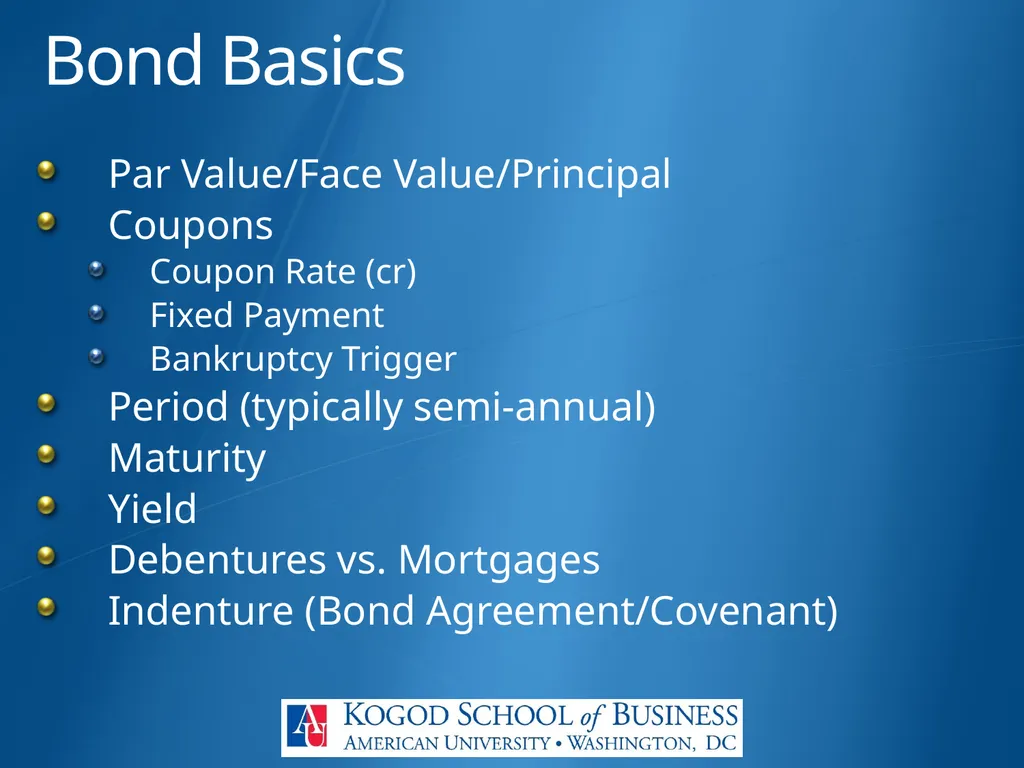
Bond Basics Par Value/Face Value/Principal
Coupons
Coupon Rate (cr)
Fixed Payment
Bankruptcy Trigger
Period (typically semi-annual)
Maturity
Yield
Debentures vs. Mortgages
Indenture (Bond Agreement/Covenant)<br>
06
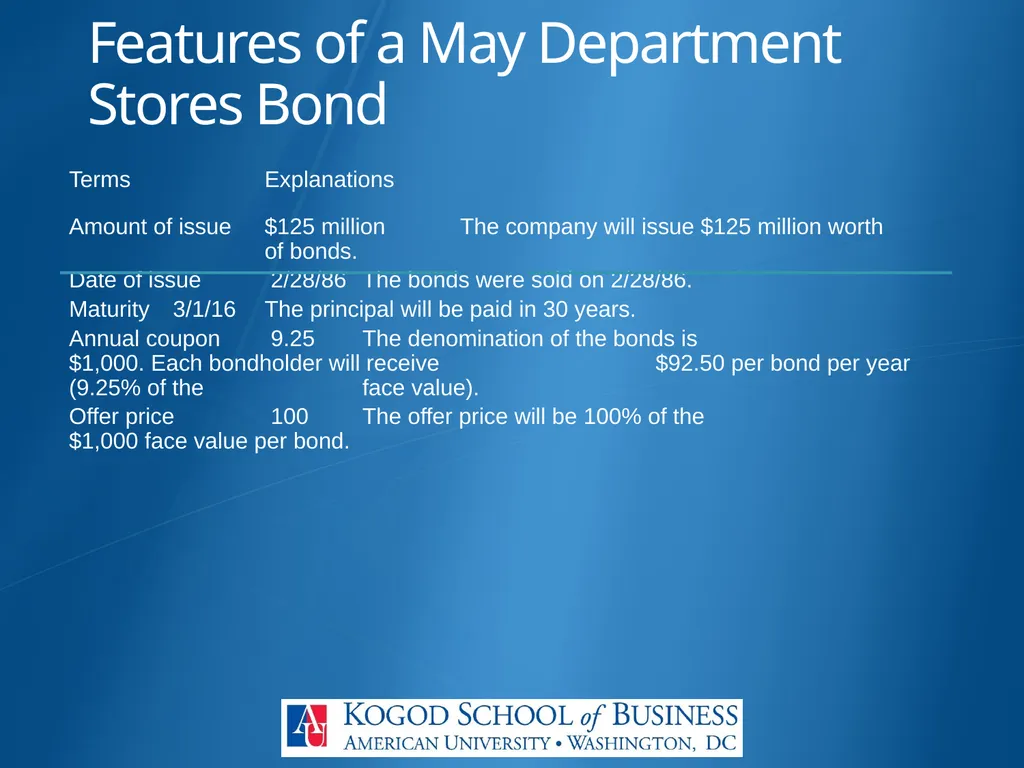
Features of a May Department Stores Bond Terms Explanations
Amount of issue $125 million The company will issue $125 million worth of bonds.
Date of issue 2/28/86 The bonds were sold on 2/28/86.
Maturity 3/1/16 The principal will be paid in 30 years.
Annual coupon 9.25 The denomination of the bonds is $1,000. Each bondholder will receive $92.50 per bond per year (9.25% of the face value).
Offer price 100 The offer price will be 100% of the $1,000 face value per bond.<br>
07
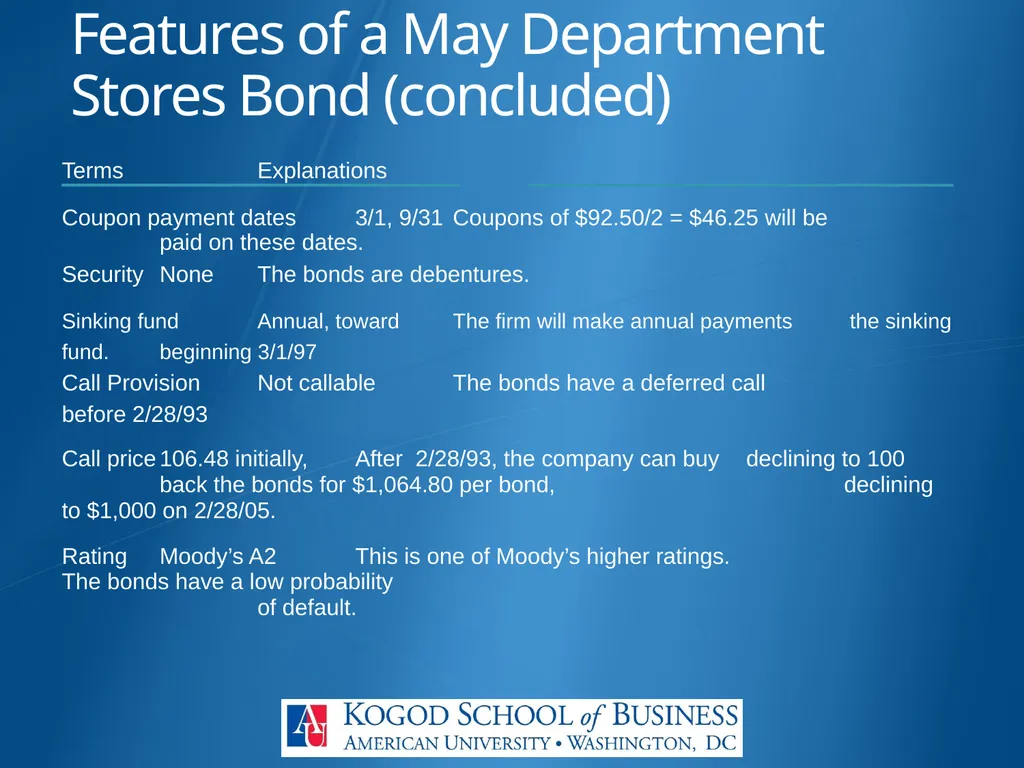
Features of a May Department Stores Bond (concluded) Terms Explanations
Coupon payment dates 3/1, 9/31 Coupons of $92.50/2 = $46.25 will be paid on these dates.
Security None The bonds are debentures.
Sinking fund Annual, toward The firm will make annual payments the sinking fund. beginning 3/1/97 Call Provision Not callable The bonds have a deferred call before 2/28/93
Call price 106.48 initially, After 2/28/93, the company can buy declining to 100 back the bonds for $1,064.80 per bond, declining to $1,000 on 2/28/05.
Rating Moody’s A2 This is one of Moody’s higher ratings. The bonds have a low probability of default.<br>
08
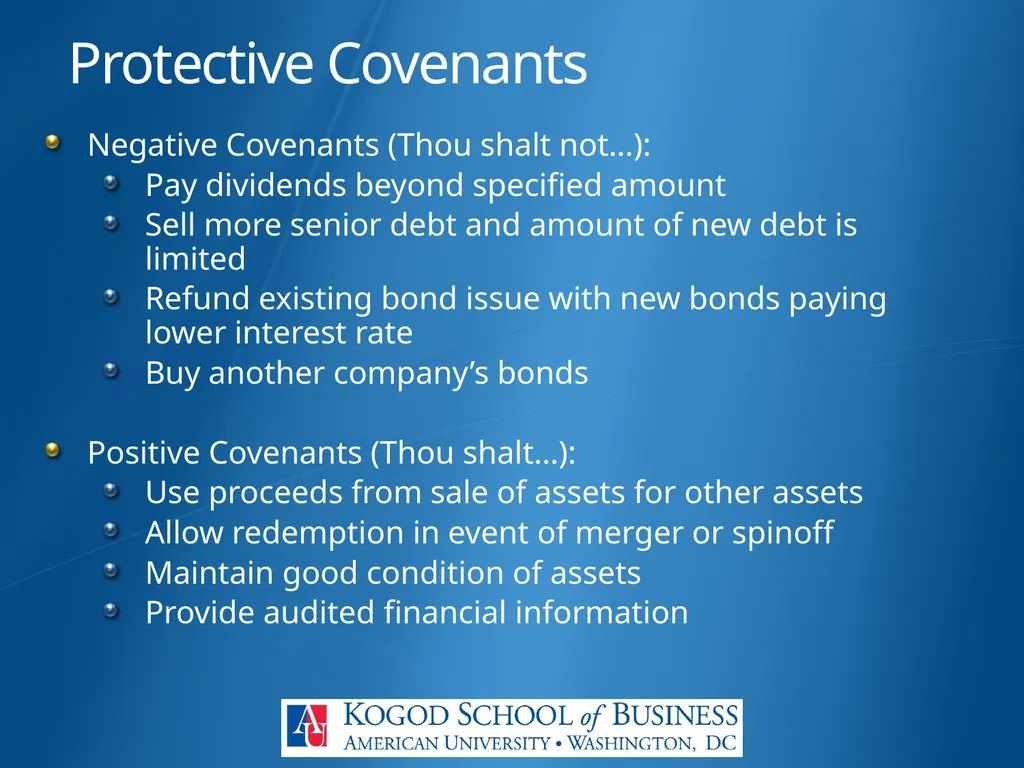
Protective Covenants Negative Covenants (Thou shalt not…):
Pay dividends beyond specified amount
Sell more senior debt and amount of new debt is limited
Refund existing bond issue with new bonds paying lower interest rate
Buy another company’s bonds
Positive Covenants (Thou shalt…):
Use proceeds from sale of assets for other assets
Allow redemption in event of merger or spinoff
Maintain good condition of assets
Provide audited financial information<br>
09
Bond Types Zero-Coupon Bonds
Fixed-Coupon Bonds
Variable Rate Coupon Bonds<br>
10
Issuers of Bonds Government
U.S. Treasury Securities
Treasury Inflation-Protected Securities (TIPS)
State and Local (‘Muni’s’)
Corporate
Corporate Bonds
Short-Term Debt
Commercial Paper
Home Mortgages<br>
11
Bonds Risks Default Risk
Interest Rate Risk
Price Risk
Reinvestment Risk<br>
12
Pros and Cons Pros
Leverage
Payments Tax-Deductible
No Voting Rights
Cons
Fixed Interest Payments
Principal Repayment
Bankruptcy<br>
13
Other Features Embedded Options
Callable Bond
Convertible Bond
Sinking Fund<br>
14
Factors Affecting Default Risk and Bond Ratings Financial Performance
Debt Ratio
TIE Ratio
Current Ratio
Bond Contract Provisions
Secured vs. Unsecured Debt
Senior vs. Subordinated Debt
Guarantee and Sinking Fund Provisions
Debt Maturity<br>
15
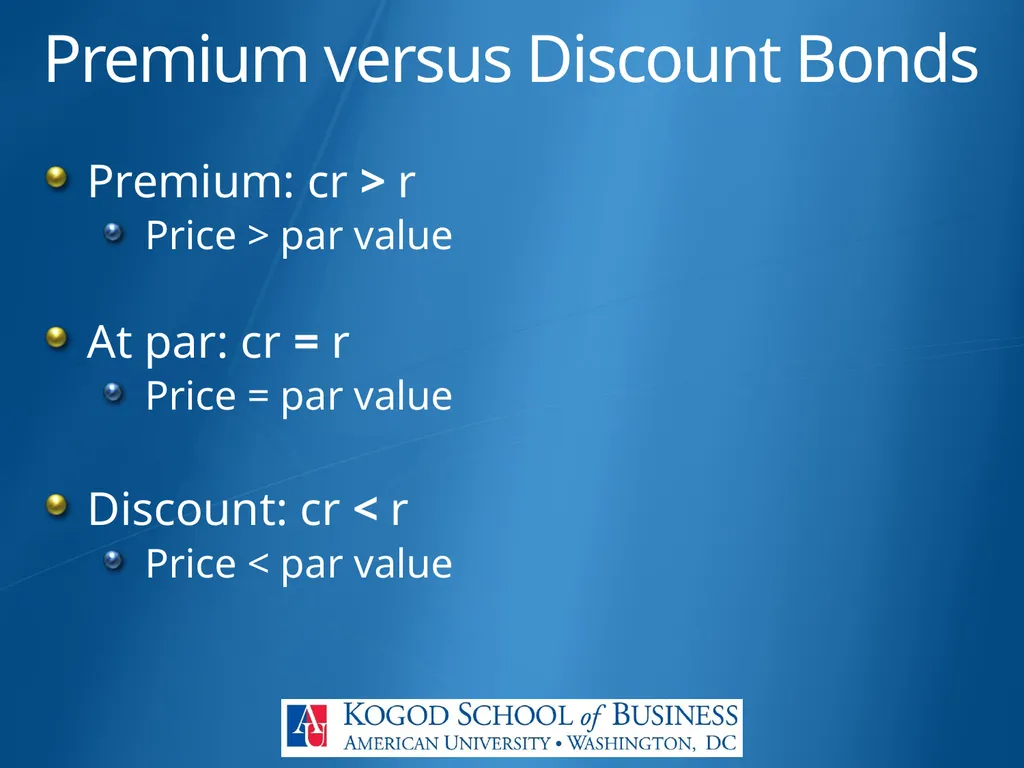
Premium versus Discount Bonds Premium: cr > r
Price > par value
At par: cr = r
Price = par value
Discount: cr < r
Price < par value<br>
16
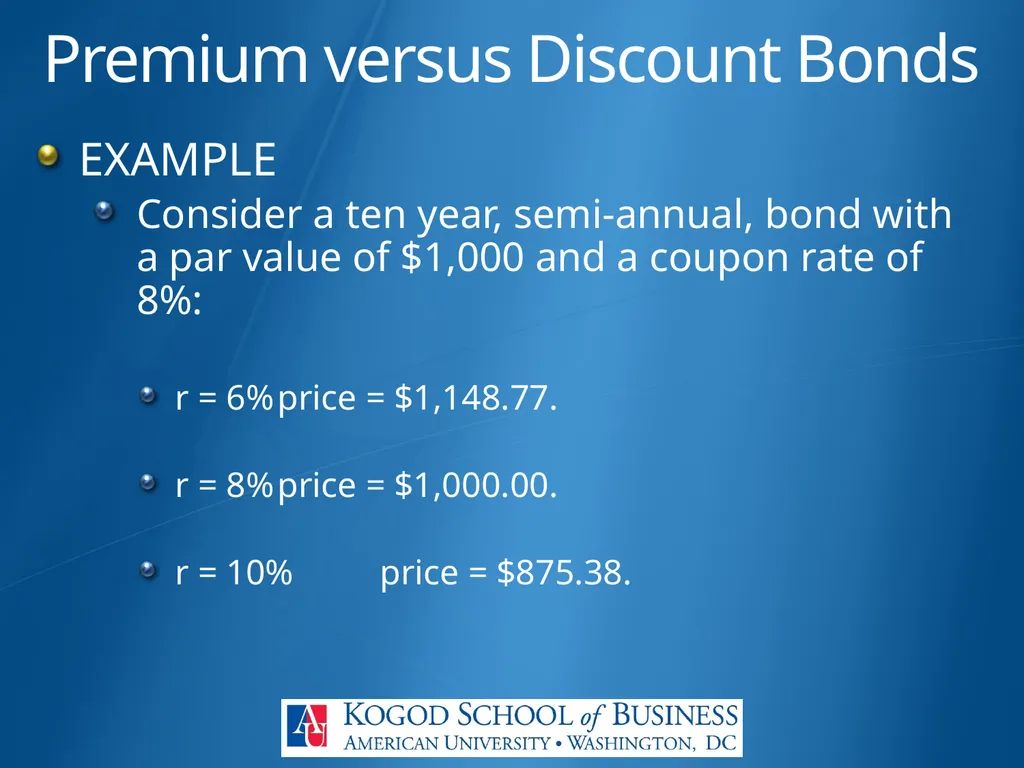
Premium versus Discount Bonds EXAMPLE
Consider a ten year, semi-annual, bond with a par value of $1,000 and a coupon rate of 8%:
r = 6% price = $1,148.77.
r = 8% price = $1,000.00.
r = 10% price = $875.38.<br>
17
FIN 614: Financial Management
Larry Schrenk, Instructor Video 19 (Topic 4.1): Bond Characteristics<br>