
FINANCE Budgets/Forecasts/Cashflow Workshop Jenny
SB
Published · 30 slides · 0 views
1 / 1

Description
FINANCE BudgetsForecastsCashflow Workshop Jenny Holloway Business Mentor and Coach February 2025 Jenny Holloway Be Your Own Boss FINANCE INTRODUCTIONS Jenny Holloway Be Your Own Boss FINANCE Topics: Elements of Financial Management
Related Topics
Share
Embed code
Download this presentation From Below
"FINANCE Budgets/Forecasts/Cashflow Workshop Jenny" is the property of its rightful owner. Permission is granted to download and print the materials on this website for personal, non-commercial use only, and to display it on your personal computer provided you do not modify the materials and that you retain all copyright notices contained in the materials. By downloading content from our website, you accept the terms of this agreement.
Presentation Transcript
01
FINANCE Budgets/Forecasts/Cashflow
Workshop
Jenny Holloway
Business Mentor and Coach
February 2025 Jenny Holloway – Be Your Own Boss<br>
Workshop
Jenny Holloway
Business Mentor and Coach
February 2025 Jenny Holloway – Be Your Own Boss<br>
02
FINANCE INTRODUCTIONS Jenny Holloway – Be Your Own Boss<br>
03
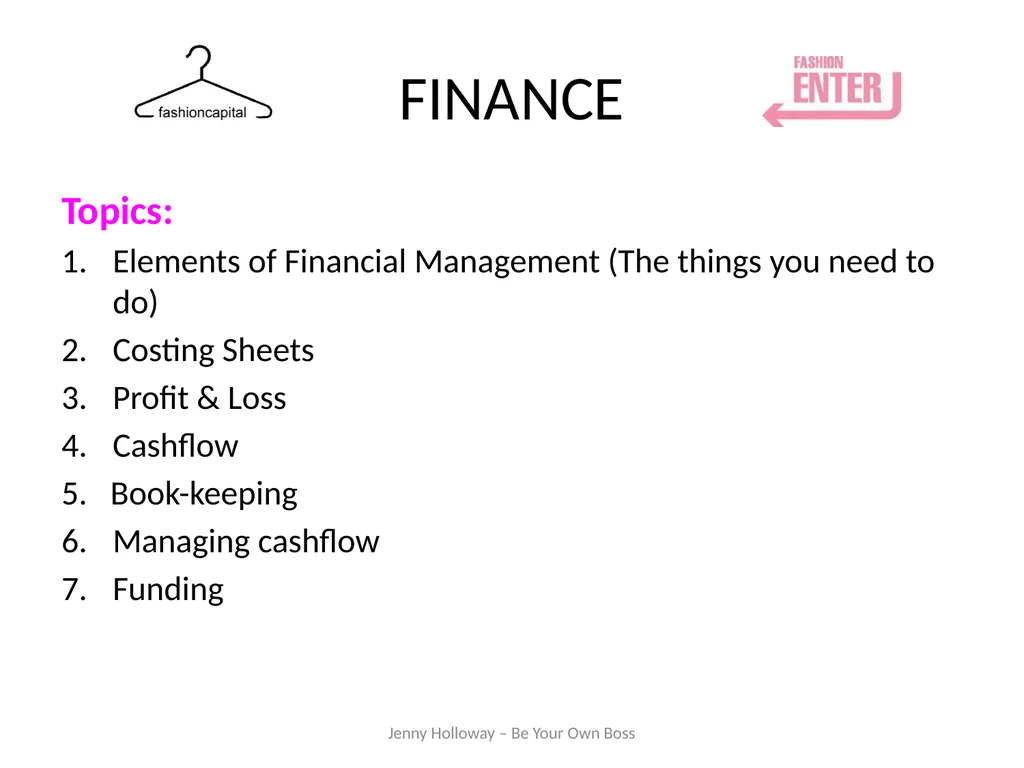
FINANCE Topics:
Elements of Financial Management (The things you need to do)
Costing Sheets
Profit & Loss
Cashflow
5. Book-keeping
Managing cashflow
Funding Jenny Holloway – Be Your Own Boss<br>
Elements of Financial Management (The things you need to do)
Costing Sheets
Profit & Loss
Cashflow
5. Book-keeping
Managing cashflow
Funding Jenny Holloway – Be Your Own Boss<br>
04
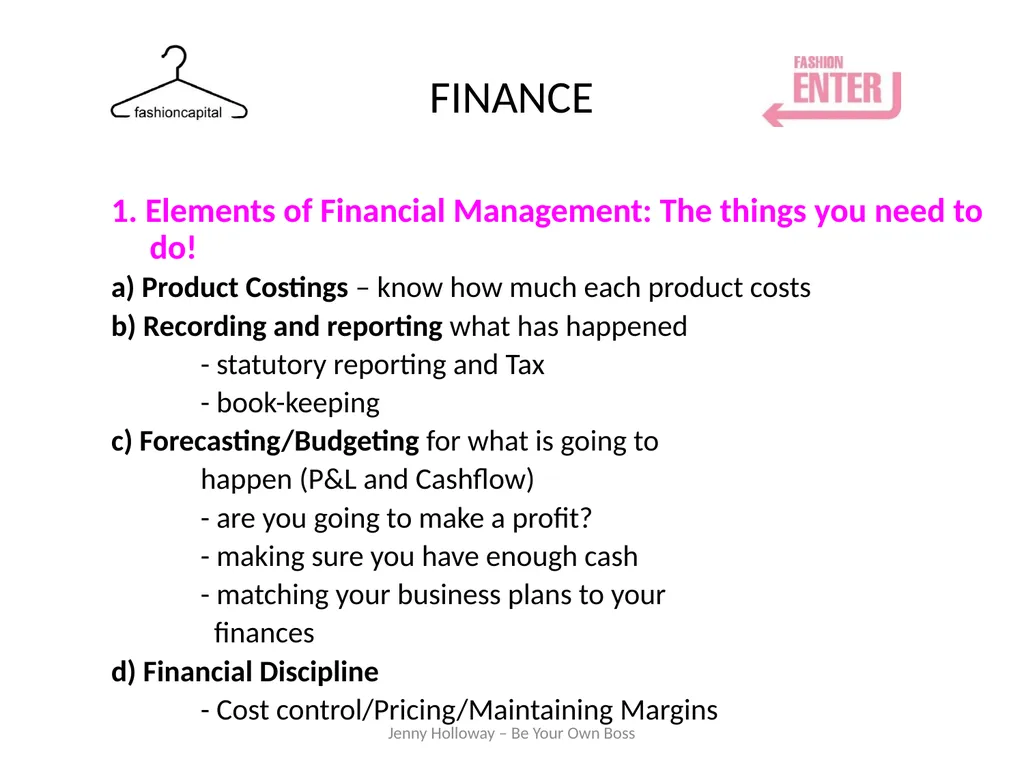
FINANCE 1. Elements of Financial Management: The things you need to do!
a) Product Costings – know how much each product costs
b) Recording and reporting what has happened
- statutory reporting and Tax
- book-keeping
c) Forecasting/Budgeting for what is going to
happen (P&L and Cashflow)
- are you going to make a profit?
- making sure you have enough cash
- matching your business plans to your
finances
d) Financial Discipline
- Cost control/Pricing/Maintaining Margins Jenny Holloway – Be Your Own Boss<br>
a) Product Costings – know how much each product costs
b) Recording and reporting what has happened
- statutory reporting and Tax
- book-keeping
c) Forecasting/Budgeting for what is going to
happen (P&L and Cashflow)
- are you going to make a profit?
- making sure you have enough cash
- matching your business plans to your
finances
d) Financial Discipline
- Cost control/Pricing/Maintaining Margins Jenny Holloway – Be Your Own Boss<br>
05
FINANCE Elements of Financial Management:
a) Product Costings
a) Know how much each product is going to cost you when you go into production.
b) Check if your pricing is ok compared with your
product costs Jenny Holloway – Be Your Own Boss<br>
a) Product Costings
a) Know how much each product is going to cost you when you go into production.
b) Check if your pricing is ok compared with your
product costs Jenny Holloway – Be Your Own Boss<br>
06
FINANCE Elements of Financial Management:
b) Recording and reporting what has happened:
i) Statutory reporting and Tax
- Sole Trader – annual tax return
- Ltd Company – annual accounts
Using an accountant:
- Prepares and submits annual accs.
- Prepares and submits tax returns
- Gives tax and financial advice
- Can do payroll, VAT, book-keeping etc Jenny Holloway – Be Your Own Boss<br>
b) Recording and reporting what has happened:
i) Statutory reporting and Tax
- Sole Trader – annual tax return
- Ltd Company – annual accounts
Using an accountant:
- Prepares and submits annual accs.
- Prepares and submits tax returns
- Gives tax and financial advice
- Can do payroll, VAT, book-keeping etc Jenny Holloway – Be Your Own Boss<br>
07
FINANCE Elements of Financial Management:
ii) Monitoring and book-keeping
Why monitor what is happening?
- stay in control
- make sure you are on track
- spot problems straight away
Why do book-keeping?
- monitor income & spending
- needed for annual accs & tax
- needed for VAT returns Jenny Holloway – Be Your Own Boss<br>
ii) Monitoring and book-keeping
Why monitor what is happening?
- stay in control
- make sure you are on track
- spot problems straight away
Why do book-keeping?
- monitor income & spending
- needed for annual accs & tax
- needed for VAT returns Jenny Holloway – Be Your Own Boss<br>
08
FINANCE Elements of Financial Management:
c) Forecasting/Budgeting for what is going to happen
- why do forecasting?
- enables you to measure success
- enables you to anticipate cash requirements
- enables you to take informed decisions Jenny Holloway – Be Your Own Boss<br>
c) Forecasting/Budgeting for what is going to happen
- why do forecasting?
- enables you to measure success
- enables you to anticipate cash requirements
- enables you to take informed decisions Jenny Holloway – Be Your Own Boss<br>
09
FINANCES Elements of Financial Management:
d) Financial Discipline
Top Tips:
- Know your product costings and pricing in detail, so you know how much margin you are making
- Know your budgets. You can be flexible but understand the financial implications of going outside your budget
- Get the best possible payment terms from customers and
suppliers Jenny Holloway – Be Your Own Boss<br>
d) Financial Discipline
Top Tips:
- Know your product costings and pricing in detail, so you know how much margin you are making
- Know your budgets. You can be flexible but understand the financial implications of going outside your budget
- Get the best possible payment terms from customers and
suppliers Jenny Holloway – Be Your Own Boss<br>
10
PRODUCT COSTING 2. Product Costings:
How much is each product going to cost you?
How does your price compare with your costs?
Include the cost per garment for the following:
+ Materials (e.g. Fabrics and Trims)
+ Production cost
+ Packaging?
+ Anything else? Jenny Holloway – Be Your Own Boss<br>
How much is each product going to cost you?
How does your price compare with your costs?
Include the cost per garment for the following:
+ Materials (e.g. Fabrics and Trims)
+ Production cost
+ Packaging?
+ Anything else? Jenny Holloway – Be Your Own Boss<br>
11
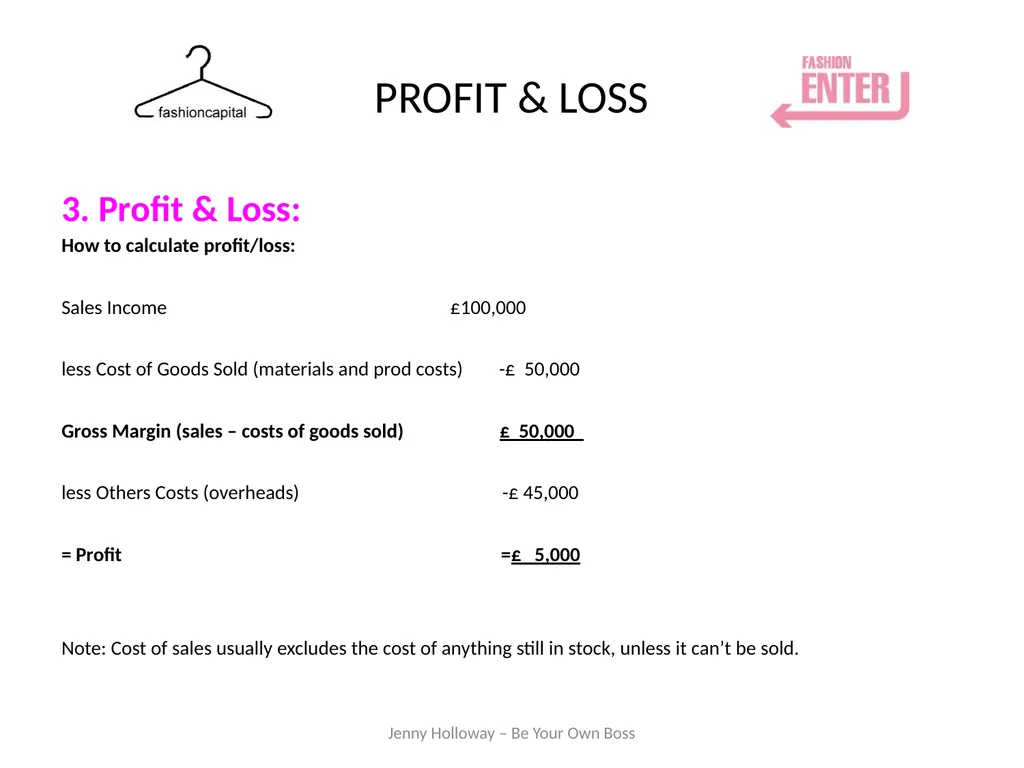
PROFIT & LOSS 3. Profit & Loss:
How to calculate profit/loss:
Sales Income £100,000
less Cost of Goods Sold (materials and prod costs) -£ 50,000
Gross Margin (sales – costs of goods sold) £ 50,000
less Others Costs (overheads) -£ 45,000
= Profit =£ 5,000
Note: Cost of sales usually excludes the cost of anything still in stock, unless it can’t be sold. Jenny Holloway – Be Your Own Boss<br>
How to calculate profit/loss:
Sales Income £100,000
less Cost of Goods Sold (materials and prod costs) -£ 50,000
Gross Margin (sales – costs of goods sold) £ 50,000
less Others Costs (overheads) -£ 45,000
= Profit =£ 5,000
Note: Cost of sales usually excludes the cost of anything still in stock, unless it can’t be sold. Jenny Holloway – Be Your Own Boss<br>
12
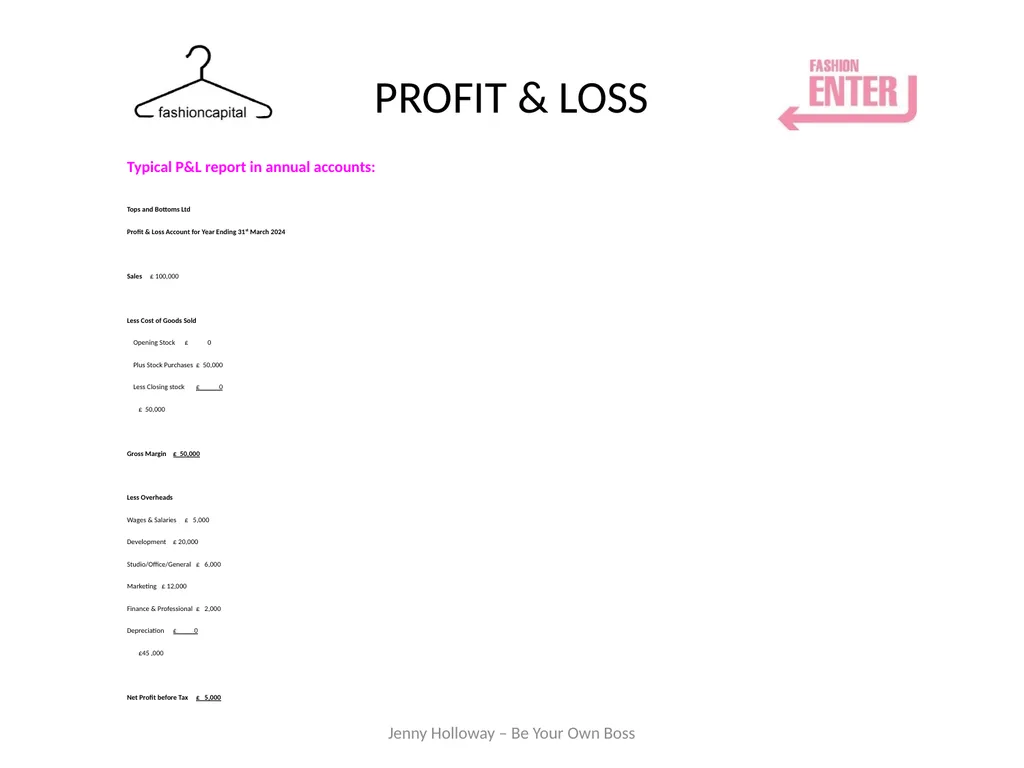
PROFIT & LOSS Typical P&L report in annual accounts:
Tops and Bottoms Ltd
Profit & Loss Account for Year Ending 31st March 2024
Sales £ 100,000
Less Cost of Goods Sold
Opening Stock £ 0
Plus Stock Purchases £ 50,000
Less Closing stock £ 0
£ 50,000
Gross Margin £ 50,000
Less Overheads
Wages & Salaries £ 5,000
Development £ 20,000
Studio/Office/General £ 6,000
Marketing £ 12,000
Finance & Professional £ 2,000
Depreciation £ 0
£45 ,000
Net Profit before Tax £ 5,000 Jenny Holloway – Be Your Own Boss<br>
Tops and Bottoms Ltd
Profit & Loss Account for Year Ending 31st March 2024
Sales £ 100,000
Less Cost of Goods Sold
Opening Stock £ 0
Plus Stock Purchases £ 50,000
Less Closing stock £ 0
£ 50,000
Gross Margin £ 50,000
Less Overheads
Wages & Salaries £ 5,000
Development £ 20,000
Studio/Office/General £ 6,000
Marketing £ 12,000
Finance & Professional £ 2,000
Depreciation £ 0
£45 ,000
Net Profit before Tax £ 5,000 Jenny Holloway – Be Your Own Boss<br>
13
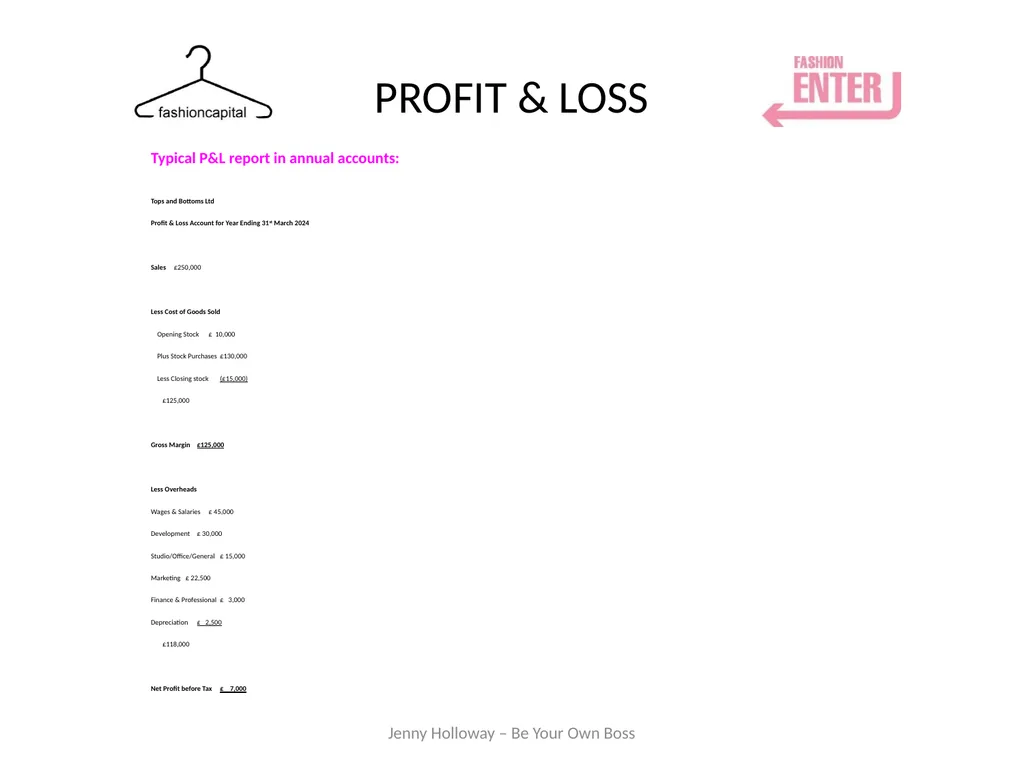
PROFIT & LOSS Typical P&L report in annual accounts:
Tops and Bottoms Ltd
Profit & Loss Account for Year Ending 31st March 2024
Sales £250,000
Less Cost of Goods Sold
Opening Stock £ 10,000
Plus Stock Purchases £130,000
Less Closing stock (£15,000)
£125,000
Gross Margin £125,000
Less Overheads
Wages & Salaries £ 45,000
Development £ 30,000
Studio/Office/General £ 15,000
Marketing £ 22,500
Finance & Professional £ 3,000
Depreciation £ 2,500
£118,000
Net Profit before Tax £ 7,000 Jenny Holloway – Be Your Own Boss<br>
Tops and Bottoms Ltd
Profit & Loss Account for Year Ending 31st March 2024
Sales £250,000
Less Cost of Goods Sold
Opening Stock £ 10,000
Plus Stock Purchases £130,000
Less Closing stock (£15,000)
£125,000
Gross Margin £125,000
Less Overheads
Wages & Salaries £ 45,000
Development £ 30,000
Studio/Office/General £ 15,000
Marketing £ 22,500
Finance & Professional £ 3,000
Depreciation £ 2,500
£118,000
Net Profit before Tax £ 7,000 Jenny Holloway – Be Your Own Boss<br>
14
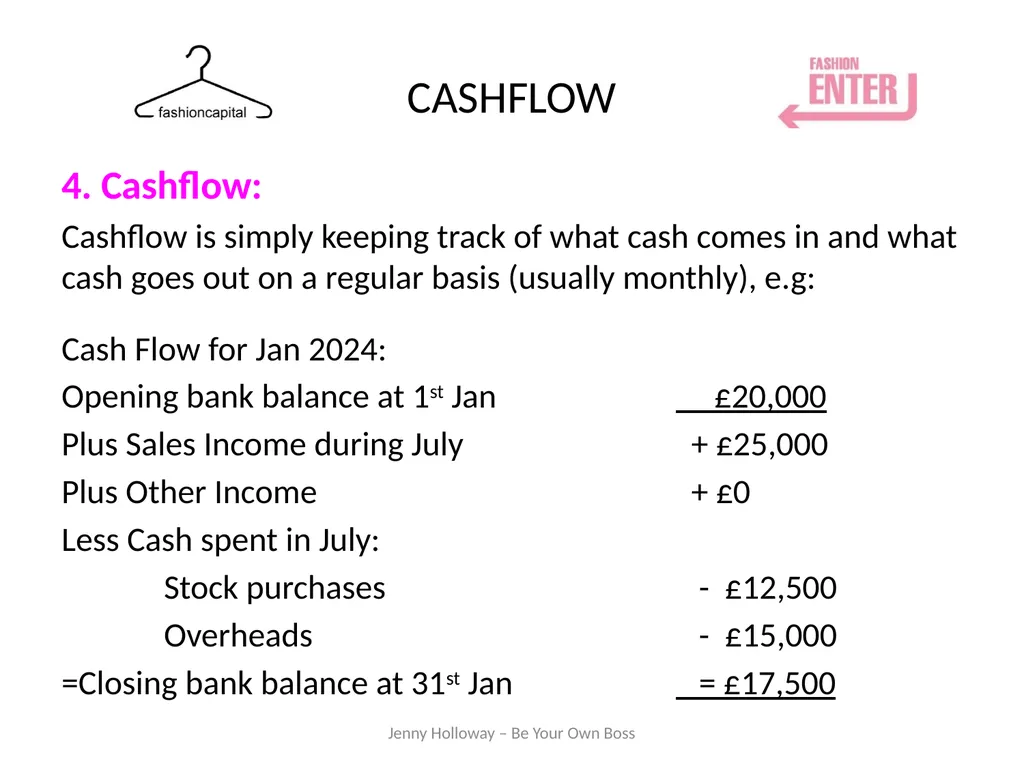
CASHFLOW 4. Cashflow:
Cashflow is simply keeping track of what cash comes in and what cash goes out on a regular basis (usually monthly), e.g:
Cash Flow for Jan 2024:
Opening bank balance at 1st Jan £20,000
Plus Sales Income during July + £25,000
Plus Other Income + £0
Less Cash spent in July:
Stock purchases - £12,500
Overheads - £15,000
=Closing bank balance at 31st Jan = £17,500 Jenny Holloway – Be Your Own Boss<br>
Cashflow is simply keeping track of what cash comes in and what cash goes out on a regular basis (usually monthly), e.g:
Cash Flow for Jan 2024:
Opening bank balance at 1st Jan £20,000
Plus Sales Income during July + £25,000
Plus Other Income + £0
Less Cash spent in July:
Stock purchases - £12,500
Overheads - £15,000
=Closing bank balance at 31st Jan = £17,500 Jenny Holloway – Be Your Own Boss<br>
15
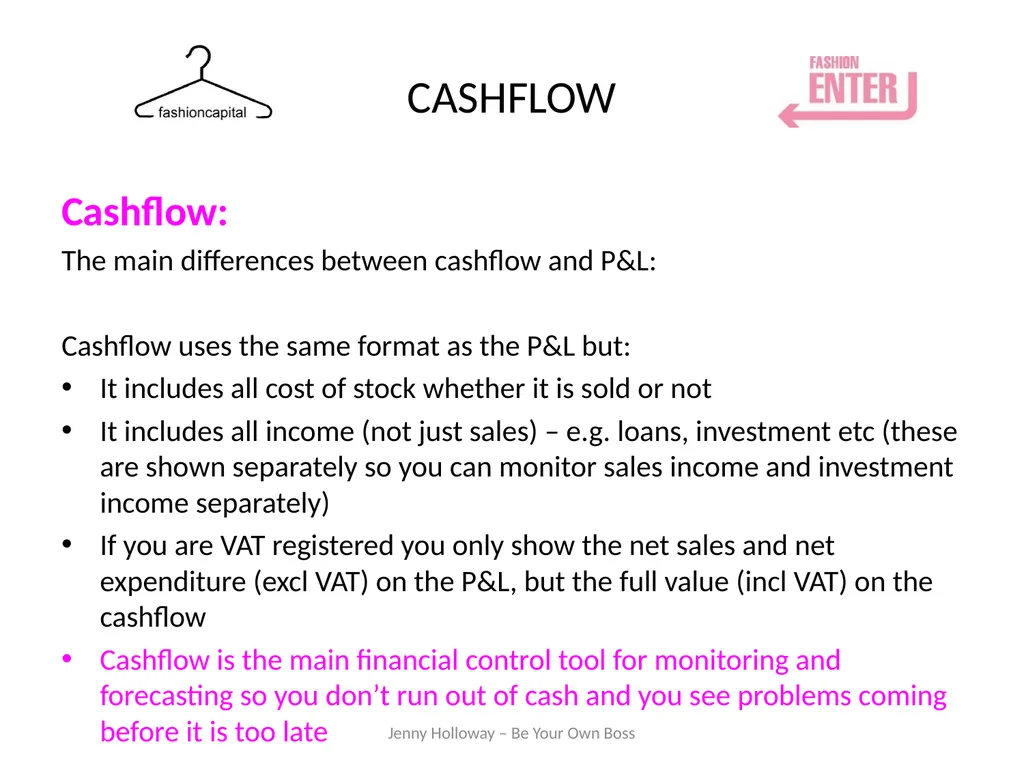
CASHFLOW Cashflow:
The main differences between cashflow and P&L:
Cashflow uses the same format as the P&L but:
It includes all cost of stock whether it is sold or not
It includes all income (not just sales) – e.g. loans, investment etc (these are shown separately so you can monitor sales income and investment income separately)
If you are VAT registered you only show the net sales and net expenditure (excl VAT) on the P&L, but the full value (incl VAT) on the cashflow
Cashflow is the main financial control tool for monitoring and forecasting so you don’t run out of cash and you see problems coming before it is too late Jenny Holloway – Be Your Own Boss<br>
The main differences between cashflow and P&L:
Cashflow uses the same format as the P&L but:
It includes all cost of stock whether it is sold or not
It includes all income (not just sales) – e.g. loans, investment etc (these are shown separately so you can monitor sales income and investment income separately)
If you are VAT registered you only show the net sales and net expenditure (excl VAT) on the P&L, but the full value (incl VAT) on the cashflow
Cashflow is the main financial control tool for monitoring and forecasting so you don’t run out of cash and you see problems coming before it is too late Jenny Holloway – Be Your Own Boss<br>
16
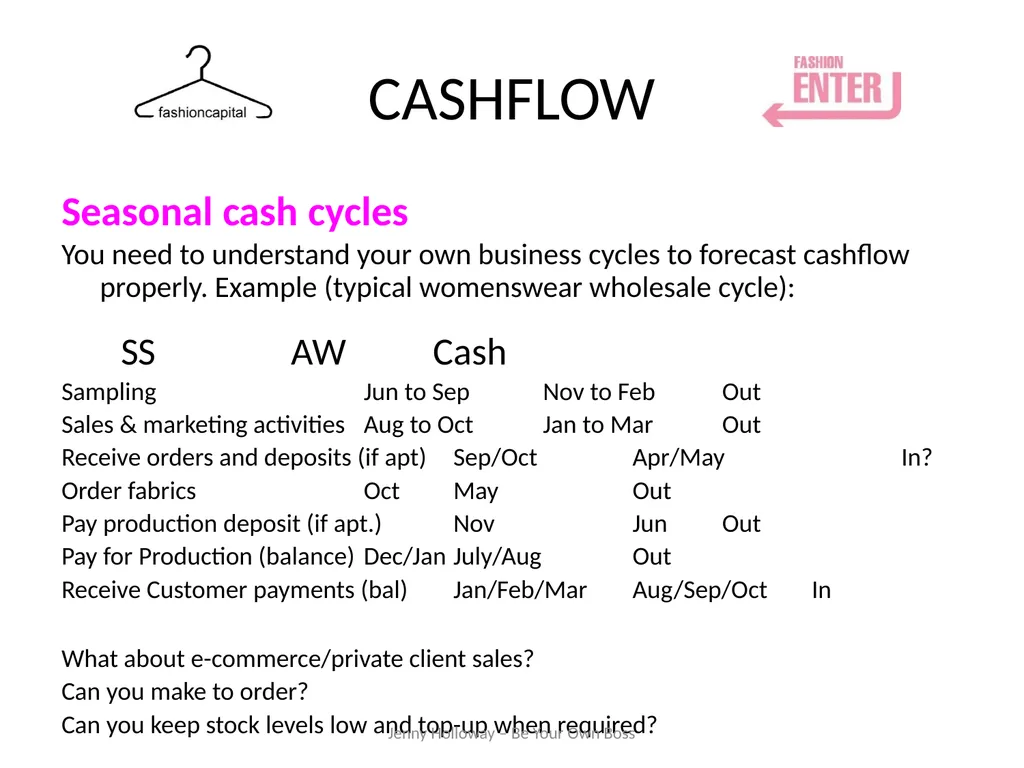
CASHFLOW Seasonal cash cycles
You need to understand your own business cycles to forecast cashflow properly. Example (typical womenswear wholesale cycle):
SS AW Cash
Sampling Jun to Sep Nov to Feb Out
Sales & marketing activities Aug to Oct Jan to Mar Out
Receive orders and deposits (if apt) Sep/Oct Apr/May In?
Order fabrics Oct May Out
Pay production deposit (if apt.) Nov Jun Out
Pay for Production (balance) Dec/Jan July/Aug Out
Receive Customer payments (bal) Jan/Feb/Mar Aug/Sep/Oct In
What about e-commerce/private client sales?
Can you make to order?
Can you keep stock levels low and top-up when required? Jenny Holloway – Be Your Own Boss<br>
You need to understand your own business cycles to forecast cashflow properly. Example (typical womenswear wholesale cycle):
SS AW Cash
Sampling Jun to Sep Nov to Feb Out
Sales & marketing activities Aug to Oct Jan to Mar Out
Receive orders and deposits (if apt) Sep/Oct Apr/May In?
Order fabrics Oct May Out
Pay production deposit (if apt.) Nov Jun Out
Pay for Production (balance) Dec/Jan July/Aug Out
Receive Customer payments (bal) Jan/Feb/Mar Aug/Sep/Oct In
What about e-commerce/private client sales?
Can you make to order?
Can you keep stock levels low and top-up when required? Jenny Holloway – Be Your Own Boss<br>
17
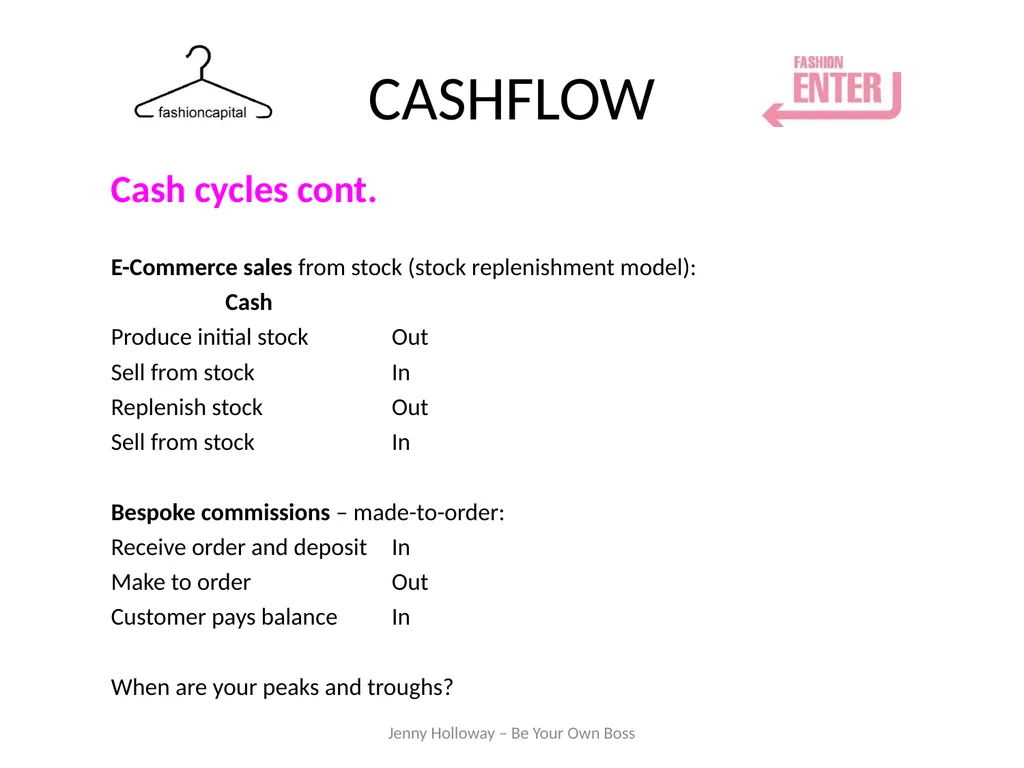
CASHFLOW Cash cycles cont.
E-Commerce sales from stock (stock replenishment model):
Cash
Produce initial stock Out
Sell from stock In
Replenish stock Out
Sell from stock In
Bespoke commissions – made-to-order:
Receive order and deposit In
Make to order Out
Customer pays balance In
When are your peaks and troughs? Jenny Holloway – Be Your Own Boss<br>
E-Commerce sales from stock (stock replenishment model):
Cash
Produce initial stock Out
Sell from stock In
Replenish stock Out
Sell from stock In
Bespoke commissions – made-to-order:
Receive order and deposit In
Make to order Out
Customer pays balance In
When are your peaks and troughs? Jenny Holloway – Be Your Own Boss<br>
18
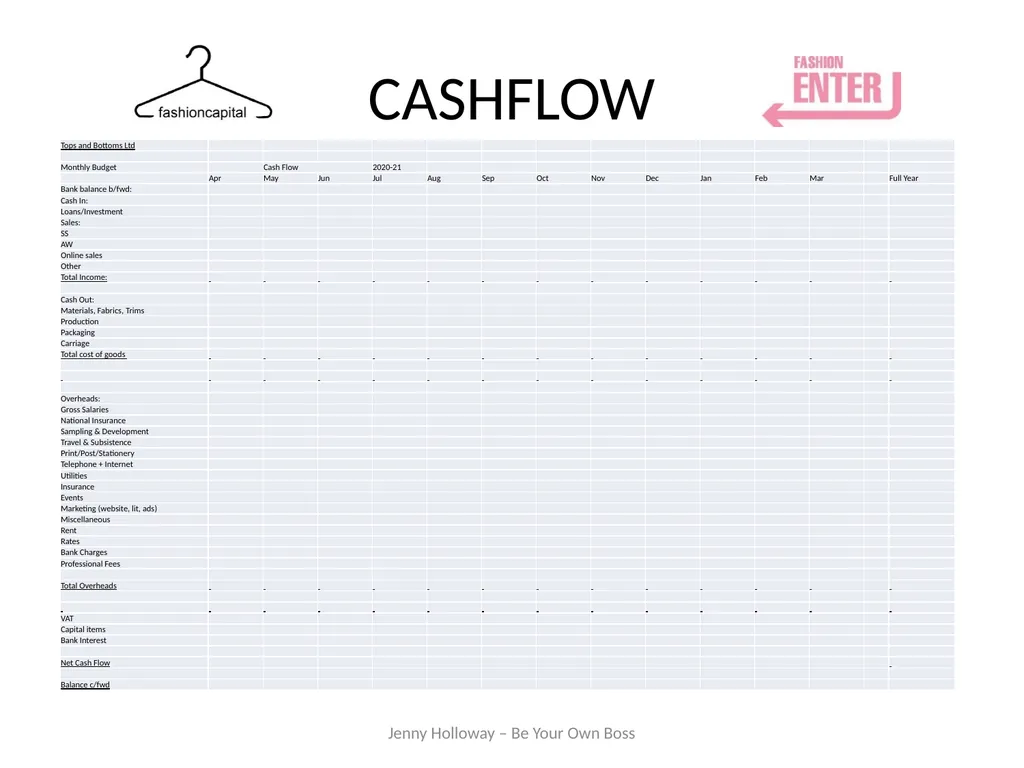
CASHFLOW Jenny Holloway – Be Your Own Boss<br>
19
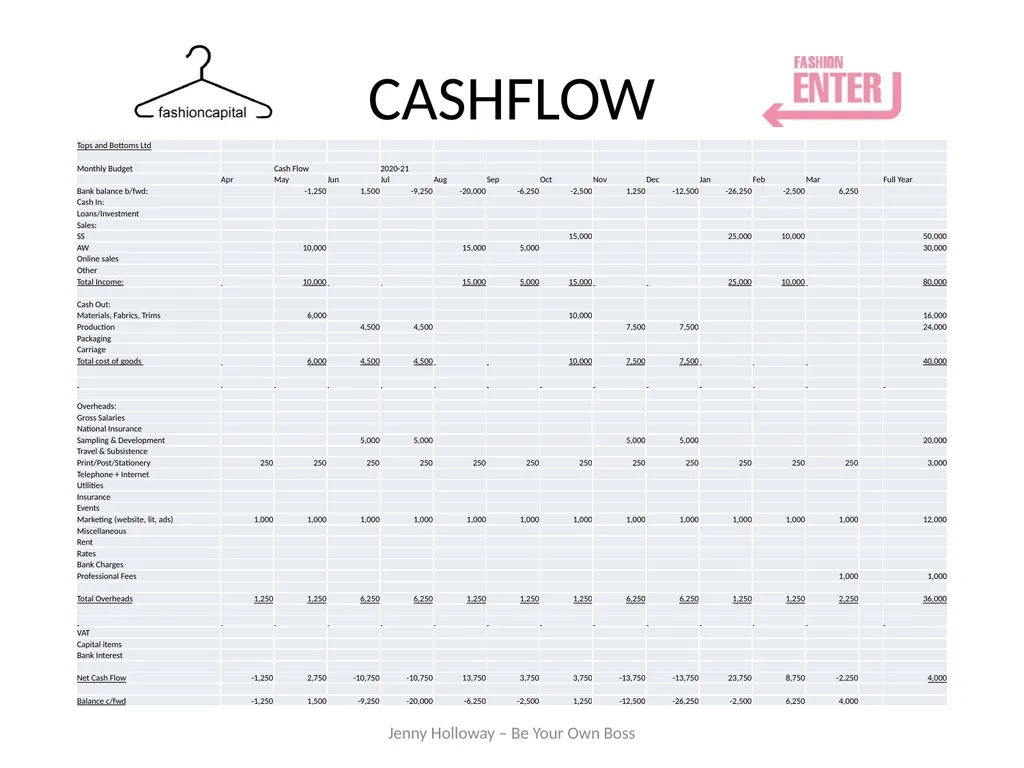
CASHFLOW Jenny Holloway – Be Your Own Boss<br>
20
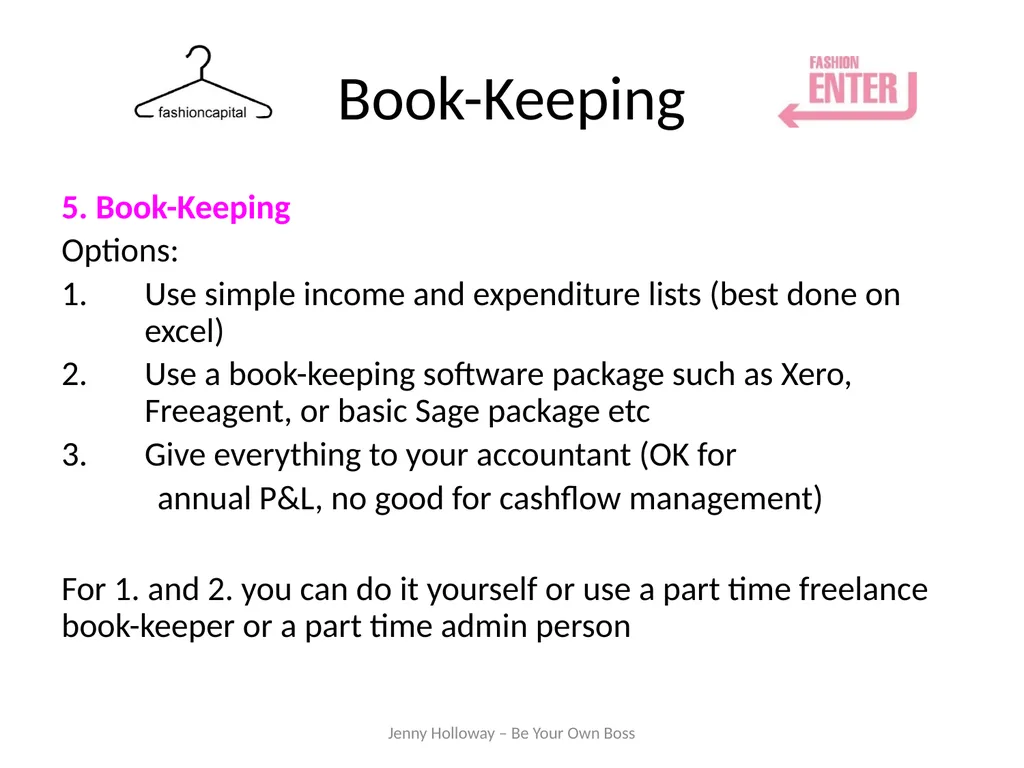
Book-Keeping 5. Book-Keeping
Options:
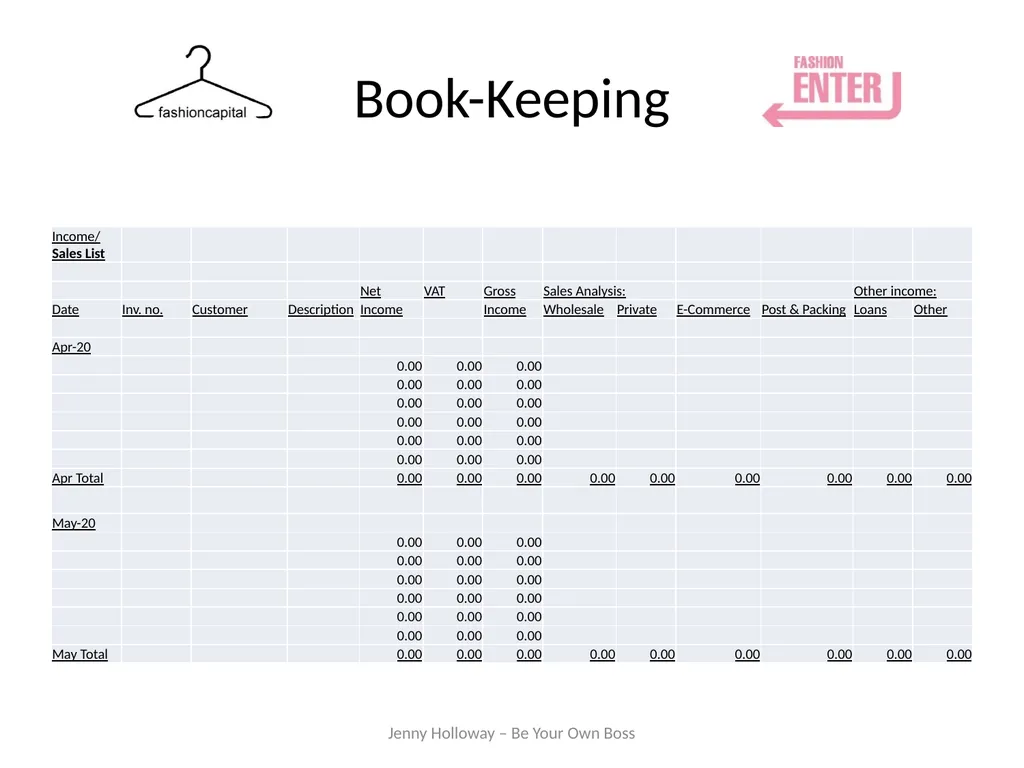
Use simple income and expenditure lists (best done on excel)
Use a book-keeping software package such as Xero, Freeagent, or basic Sage package etc
Give everything to your accountant (OK for
annual P&L, no good for cashflow management)
For 1. and 2. you can do it yourself or use a part time freelance book-keeper or a part time admin person Jenny Holloway – Be Your Own Boss<br>
Options:
Use simple income and expenditure lists (best done on excel)
Use a book-keeping software package such as Xero, Freeagent, or basic Sage package etc
Give everything to your accountant (OK for
annual P&L, no good for cashflow management)
For 1. and 2. you can do it yourself or use a part time freelance book-keeper or a part time admin person Jenny Holloway – Be Your Own Boss<br>
21
Book-Keeping Jenny Holloway – Be Your Own Boss<br>
22
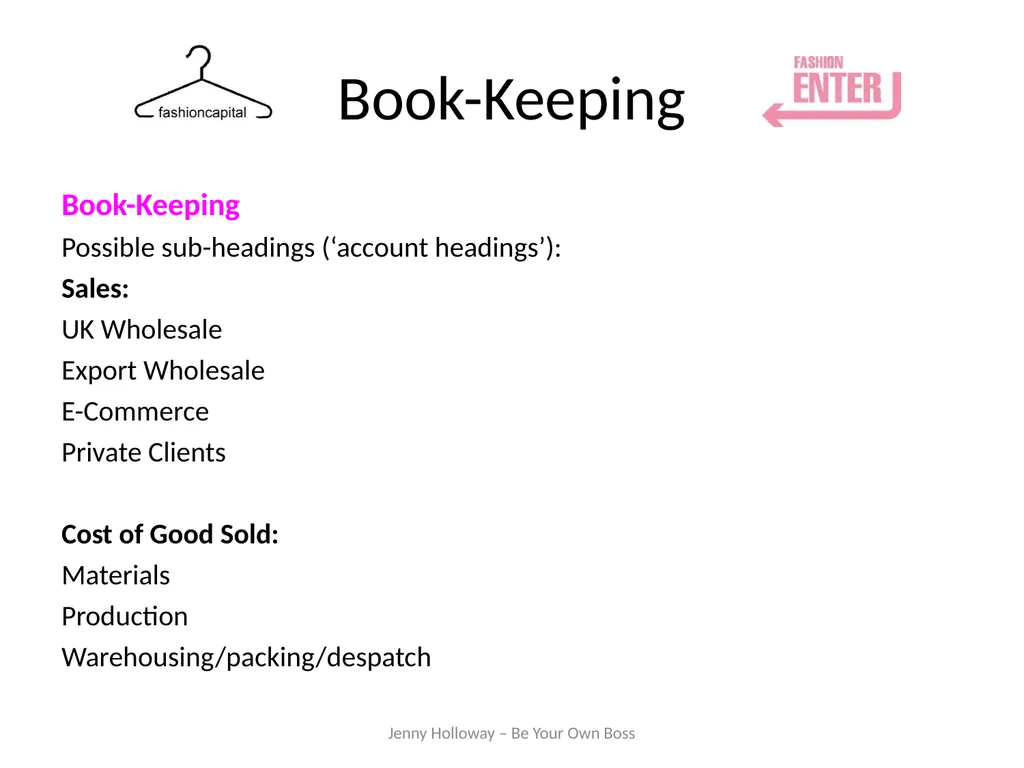
Book-Keeping Book-Keeping
Possible sub-headings (‘account headings’):
Sales:
UK Wholesale
Export Wholesale
E-Commerce
Private Clients
Cost of Good Sold:
Materials
Production
Warehousing/packing/despatch Jenny Holloway – Be Your Own Boss<br>
Possible sub-headings (‘account headings’):
Sales:
UK Wholesale
Export Wholesale
E-Commerce
Private Clients
Cost of Good Sold:
Materials
Production
Warehousing/packing/despatch Jenny Holloway – Be Your Own Boss<br>
23
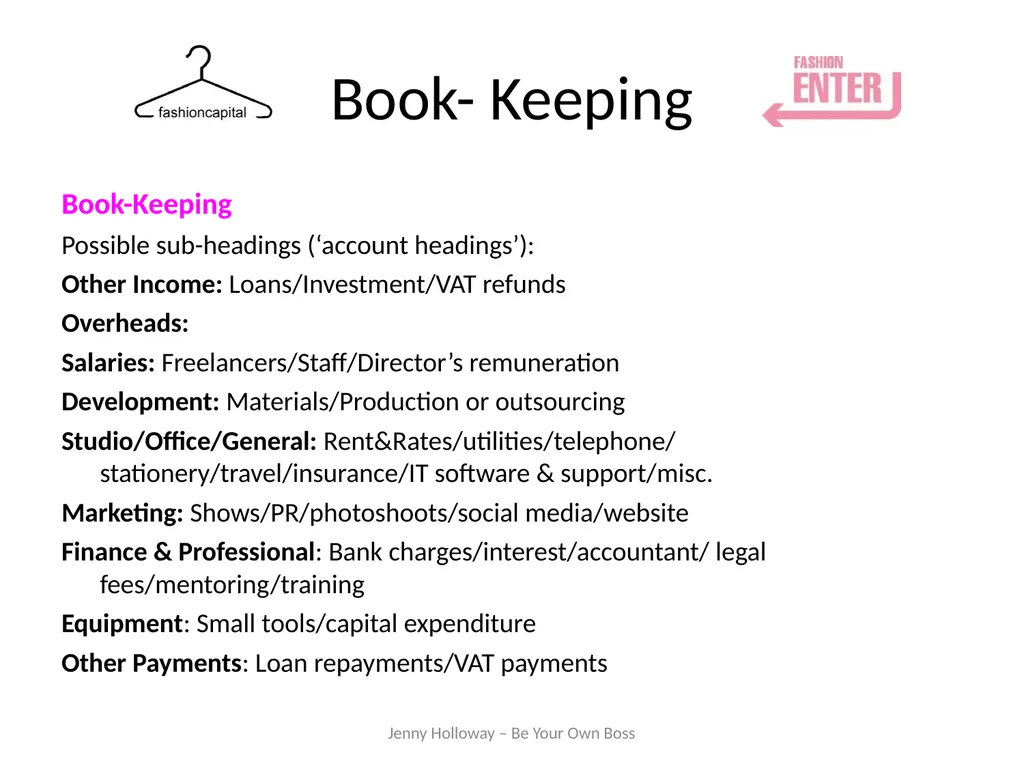
Book- Keeping Book-Keeping
Possible sub-headings (‘account headings’):
Other Income: Loans/Investment/VAT refunds
Overheads:
Salaries: Freelancers/Staff/Director’s remuneration
Development: Materials/Production or outsourcing
Studio/Office/General: Rent&Rates/utilities/telephone/ stationery/travel/insurance/IT software & support/misc.
Marketing: Shows/PR/photoshoots/social media/website
Finance & Professional: Bank charges/interest/accountant/ legal fees/mentoring/training
Equipment: Small tools/capital expenditure
Other Payments: Loan repayments/VAT payments Jenny Holloway – Be Your Own Boss<br>
Possible sub-headings (‘account headings’):
Other Income: Loans/Investment/VAT refunds
Overheads:
Salaries: Freelancers/Staff/Director’s remuneration
Development: Materials/Production or outsourcing
Studio/Office/General: Rent&Rates/utilities/telephone/ stationery/travel/insurance/IT software & support/misc.
Marketing: Shows/PR/photoshoots/social media/website
Finance & Professional: Bank charges/interest/accountant/ legal fees/mentoring/training
Equipment: Small tools/capital expenditure
Other Payments: Loan repayments/VAT payments Jenny Holloway – Be Your Own Boss<br>
24
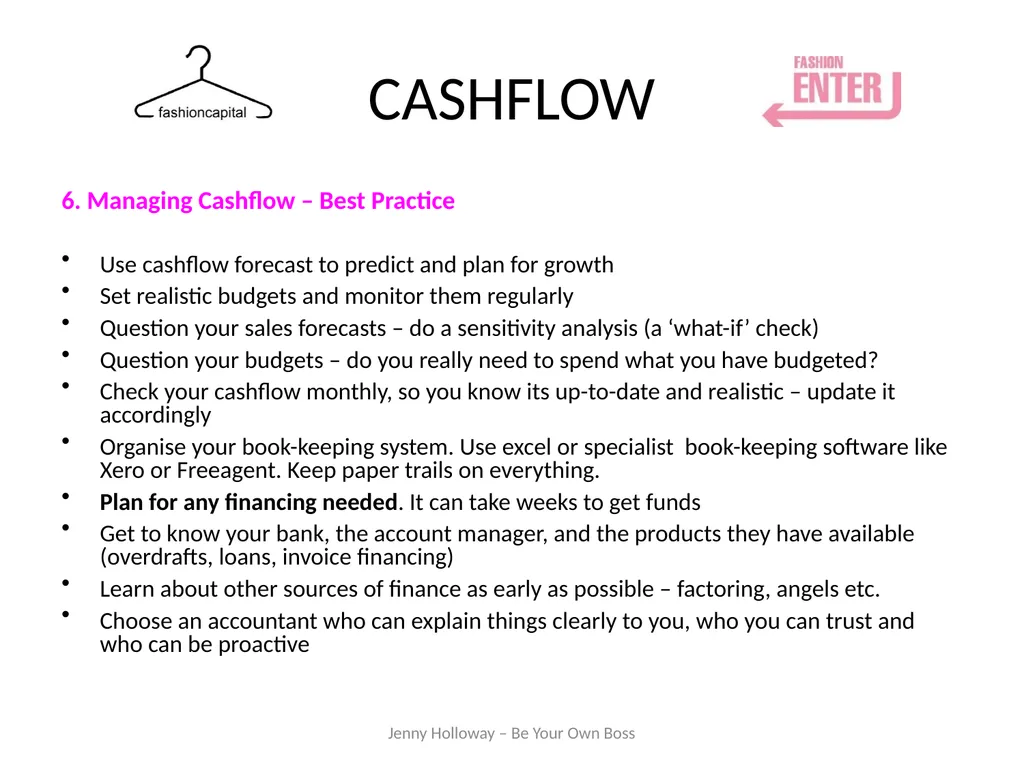
CASHFLOW 6. Managing Cashflow – Best Practice
Use cashflow forecast to predict and plan for growth
Set realistic budgets and monitor them regularly
Question your sales forecasts – do a sensitivity analysis (a ‘what-if’ check)
Question your budgets – do you really need to spend what you have budgeted?
Check your cashflow monthly, so you know its up-to-date and realistic – update it accordingly
Organise your book-keeping system. Use excel or specialist book-keeping software like Xero or Freeagent. Keep paper trails on everything.
Plan for any financing needed. It can take weeks to get funds
Get to know your bank, the account manager, and the products they have available (overdrafts, loans, invoice financing)
Learn about other sources of finance as early as possible – factoring, angels etc.
Choose an accountant who can explain things clearly to you, who you can trust and who can be proactive Jenny Holloway – Be Your Own Boss<br>
Use cashflow forecast to predict and plan for growth
Set realistic budgets and monitor them regularly
Question your sales forecasts – do a sensitivity analysis (a ‘what-if’ check)
Question your budgets – do you really need to spend what you have budgeted?
Check your cashflow monthly, so you know its up-to-date and realistic – update it accordingly
Organise your book-keeping system. Use excel or specialist book-keeping software like Xero or Freeagent. Keep paper trails on everything.
Plan for any financing needed. It can take weeks to get funds
Get to know your bank, the account manager, and the products they have available (overdrafts, loans, invoice financing)
Learn about other sources of finance as early as possible – factoring, angels etc.
Choose an accountant who can explain things clearly to you, who you can trust and who can be proactive Jenny Holloway – Be Your Own Boss<br>
25
FUNDING 7. ACCESSING FINANCE
Why might you need more money? Jenny Holloway – Be Your Own Boss<br>
Why might you need more money? Jenny Holloway – Be Your Own Boss<br>
26
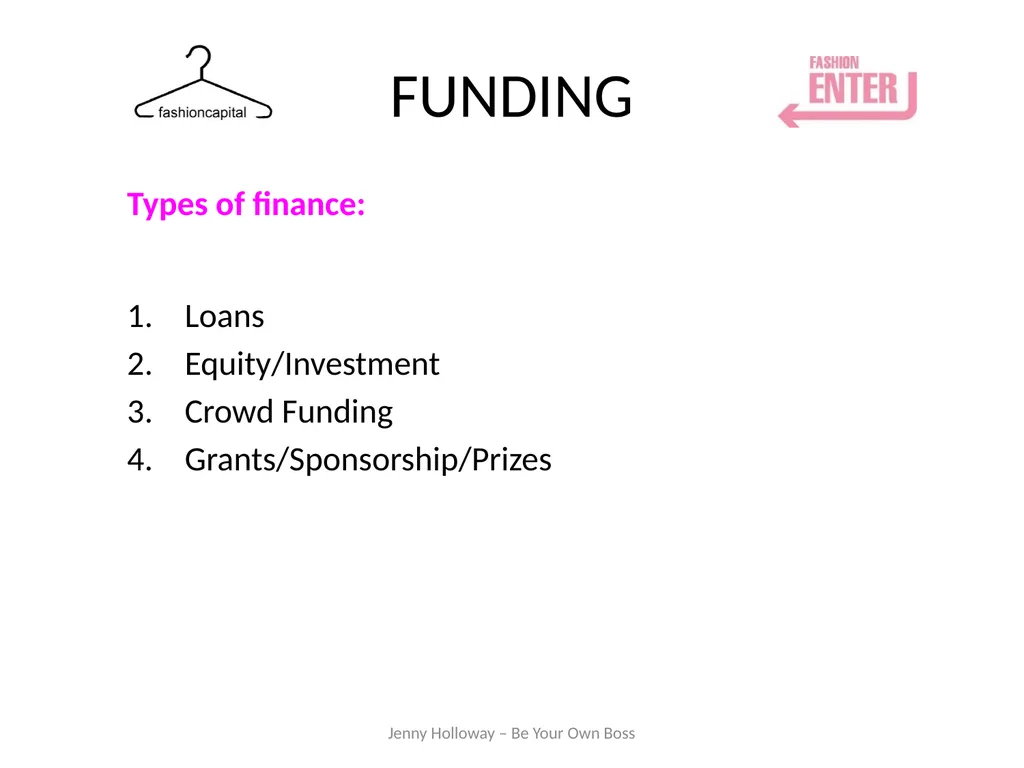
FUNDING Types of finance:
Loans
Equity/Investment
Crowd Funding
Grants/Sponsorship/Prizes Jenny Holloway – Be Your Own Boss<br>
Loans
Equity/Investment
Crowd Funding
Grants/Sponsorship/Prizes Jenny Holloway – Be Your Own Boss<br>
27
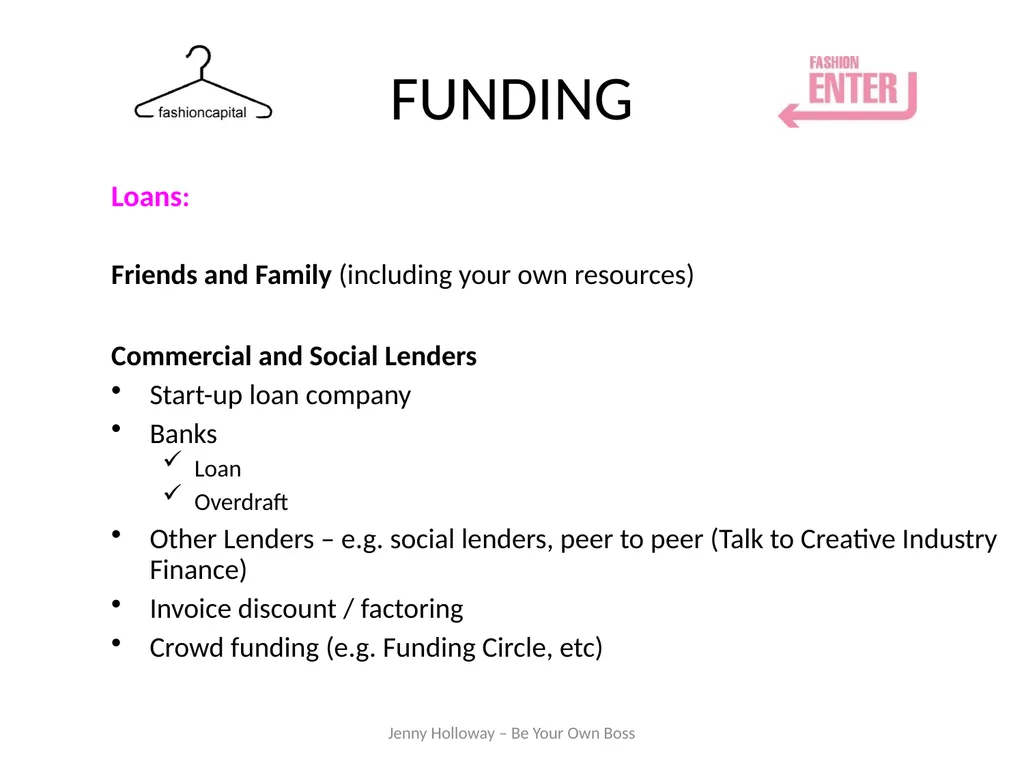
FUNDING Loans:
Friends and Family (including your own resources)
Commercial and Social Lenders
Start-up loan company
Banks
Loan
Overdraft
Other Lenders – e.g. social lenders, peer to peer (Talk to Creative Industry Finance)
Invoice discount / factoring
Crowd funding (e.g. Funding Circle, etc) Jenny Holloway – Be Your Own Boss<br>
Friends and Family (including your own resources)
Commercial and Social Lenders
Start-up loan company
Banks
Loan
Overdraft
Other Lenders – e.g. social lenders, peer to peer (Talk to Creative Industry Finance)
Invoice discount / factoring
Crowd funding (e.g. Funding Circle, etc) Jenny Holloway – Be Your Own Boss<br>
28
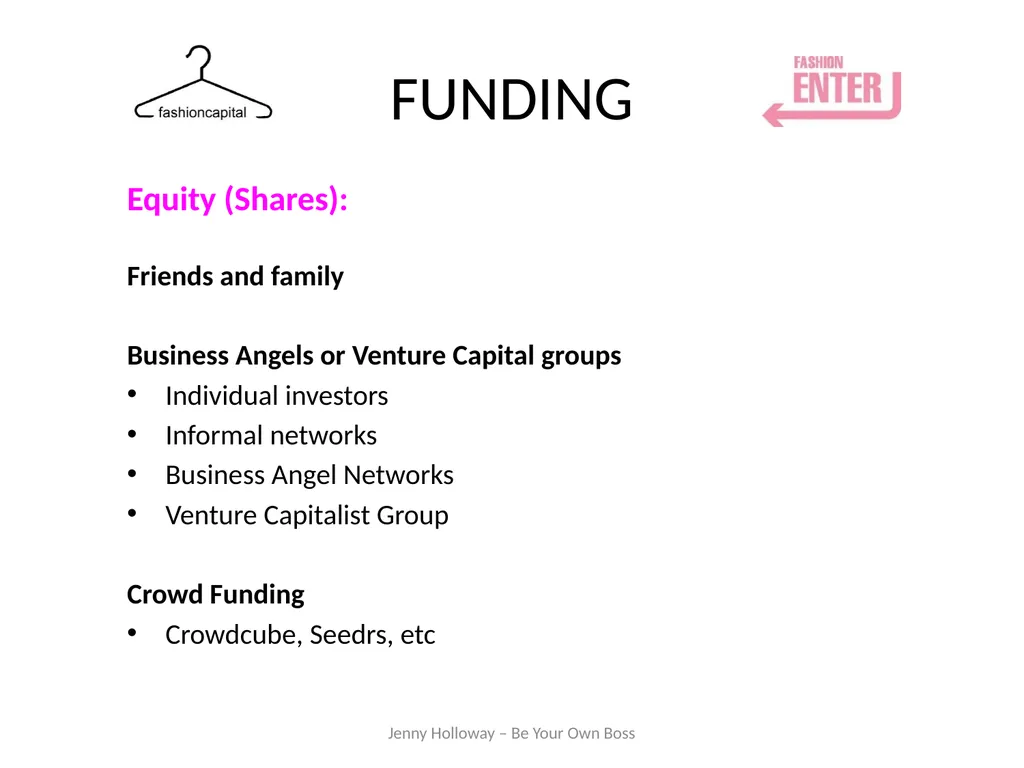
FUNDING Equity (Shares):
Friends and family
Business Angels or Venture Capital groups
Individual investors
Informal networks
Business Angel Networks
Venture Capitalist Group
Crowd Funding
Crowdcube, Seedrs, etc Jenny Holloway – Be Your Own Boss<br>
Friends and family
Business Angels or Venture Capital groups
Individual investors
Informal networks
Business Angel Networks
Venture Capitalist Group
Crowd Funding
Crowdcube, Seedrs, etc Jenny Holloway – Be Your Own Boss<br>
29
FUNDING Grants/Sponsorship/Prizes etc:
Grants
keep your eyes open/talk to your peers, mentor, business advisors etc
Examples: UKTI/UKFT support for certain overseas shows
Arts Council
Government – e.g. support for businesses that take on an apprentice
Sponsorship
do you know anyone who might want to be associated with your brand?
Prizes and Awards
Keep an eye on competitions and awards plus other sector organisations
Crowdfunding
e.g. Kickstarter Jenny Holloway – Be Your Own Boss<br>
Grants
keep your eyes open/talk to your peers, mentor, business advisors etc
Examples: UKTI/UKFT support for certain overseas shows
Arts Council
Government – e.g. support for businesses that take on an apprentice
Sponsorship
do you know anyone who might want to be associated with your brand?
Prizes and Awards
Keep an eye on competitions and awards plus other sector organisations
Crowdfunding
e.g. Kickstarter Jenny Holloway – Be Your Own Boss<br>
30
FINANCE Thank you, and any questions
Jenny Holloway
Business Mentor and Coach
Fashion Capital CEO Jenny Holloway – Be Your Own Boss<br>
Jenny Holloway
Business Mentor and Coach
Fashion Capital CEO Jenny Holloway – Be Your Own Boss<br>