
Finance Committee Workshop Characteristics of



Description: Finance Committee Workshop Characteristics of Financially Vital Congregations Financial Transparency Sharing clear, easy-to-understand financial reports with members Implementing a strong system of internal controls Providing for an
Related Topics
Download Presentation
"Finance Committee Workshop Characteristics of" is the property of its rightful owner. Permission is granted to download and print the materials on this website for personal, non-commercial use only, and to display it on your personal computer provided you do not modify the materials and that you retain all copyright notices contained in the materials. By downloading content from our website, you accept the terms of this agreement.
Presentation Transcript
slide1. Finance Committee Workshop<br>
slide2. Characteristics of Financially Vital Congregations * Financial Transparency
Sharing clear, easy-to-understand financial reports with members
Implementing a strong system of internal controls
Providing for an annual audit of the financial reports
Missional Budgeting and Fundraising
Facilitate the congregation-wide activity of discerning, planning and budgeting for God’s mission
Best Practices
Engage in practices that ensure their current financial health and long-term sustainability * Source: UMC Guidelines, Finance: Handling God’s Money in the Church<br>
slide3. Financial Transparency – Financial Reports Statement of Financial Position (balance sheet)
Reflects the overall financial position of the organization at a given moment in time. It shows the accumulated results of all the individual years of your organization’s operations put together.
Assets = what you have or what you are owed
Liabilities = what you owe
Net Assets = what’s left (Assets – Liabilities)
Unrestricted – can be used for operating expenses or any other purpose
Restricted – designated to a specific program/project (examples: Mission Fund or Youth Ministry fund)<br>
slide4. Financial Transparency – Financial Reports (continued) Statement of Financial Position (balance sheet)
Assets – examples and what to look for and/or ask:
Cash – do I have enough to pay the bills? Is it properly invested to maximize interest? Have we protected restricted funds? Is the balance increasing or decreasing?
Accounts Receivable (money owed to us) – are we collecting on a timely basis? Are there any that will never be paid? Do we have an allowance for doubtful accounts (an estimate of those that will not be paid)?
Fixed Assets (Land, buildings & equipment) – have we invested enough or too much?<br>
slide5. Financial Transparency – Financial Reports (continued) Statement of Financial Position (balance sheet)
Liabilities – examples and what to look for and/or ask:
Accounts payable (unpaid bills to vendors) / Accrued expenses (usually estimated expense not yet invoiced/paid) – are we paying our vendors timely? Do we have enough cash to pay?
Loans – do we have the means to pay over time?<br>
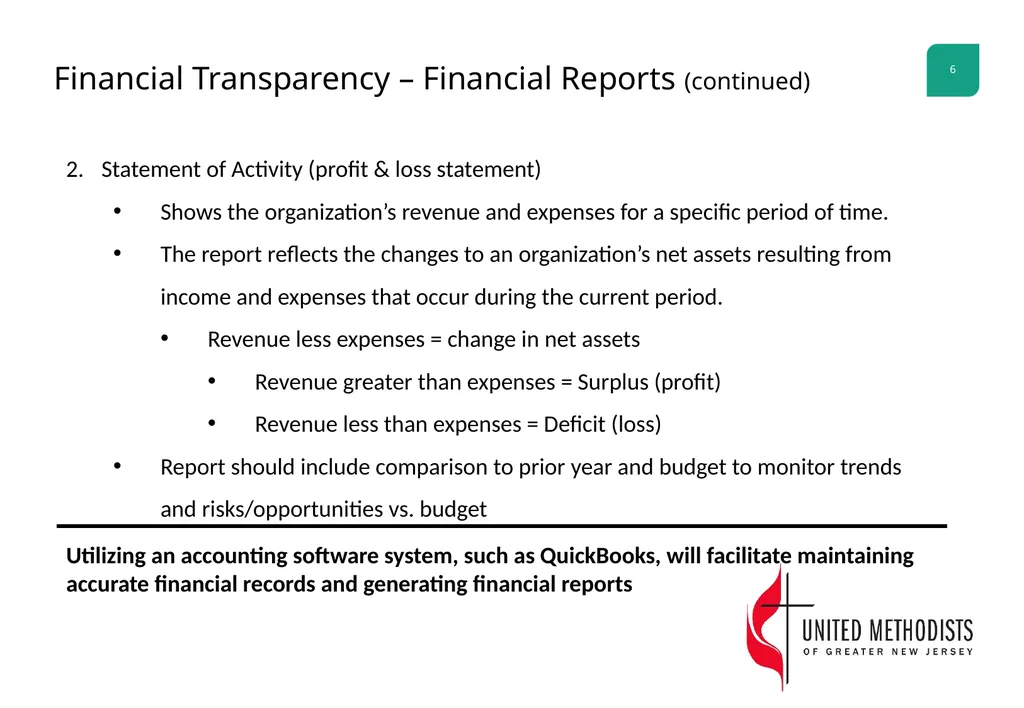
slide6. Financial Transparency – Financial Reports (continued) Statement of Activity (profit & loss statement)
Shows the organization’s revenue and expenses for a specific period of time.
The report reflects the changes to an organization’s net assets resulting from income and expenses that occur during the current period.
Revenue less expenses = change in net assets
Revenue greater than expenses = Surplus (profit)
Revenue less than expenses = Deficit (loss)
Report should include comparison to prior year and budget to monitor trends and risks/opportunities vs. budget Utilizing an accounting software system, such as QuickBooks, will facilitate maintaining accurate financial records and generating financial reports<br>
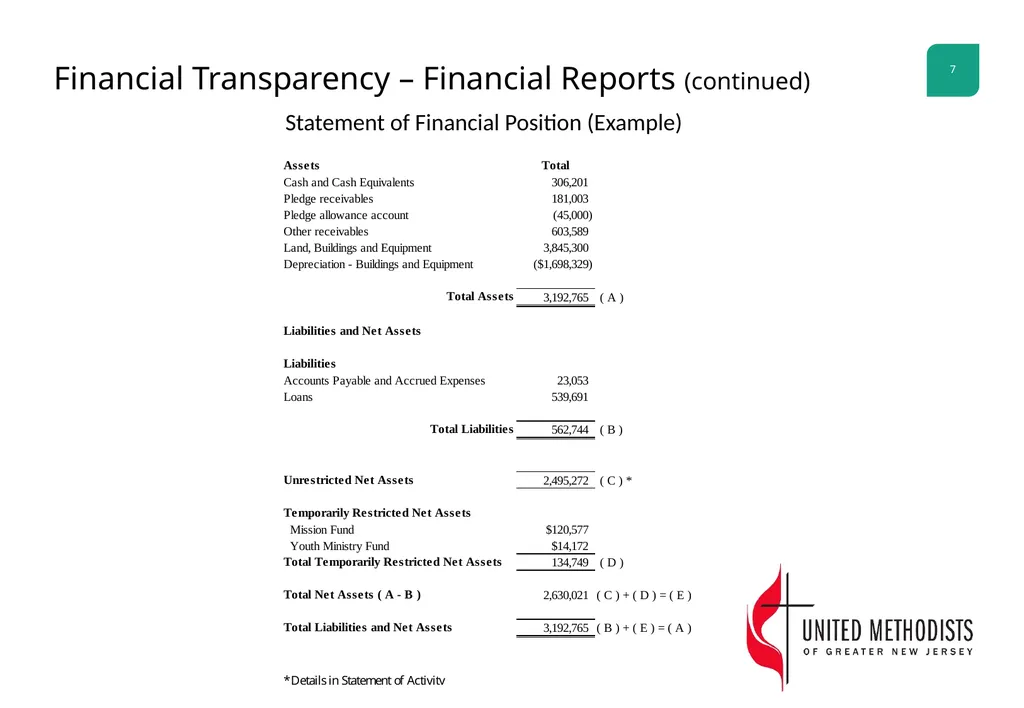
slide7. Financial Transparency – Financial Reports (continued) Statement of Financial Position (Example)<br>
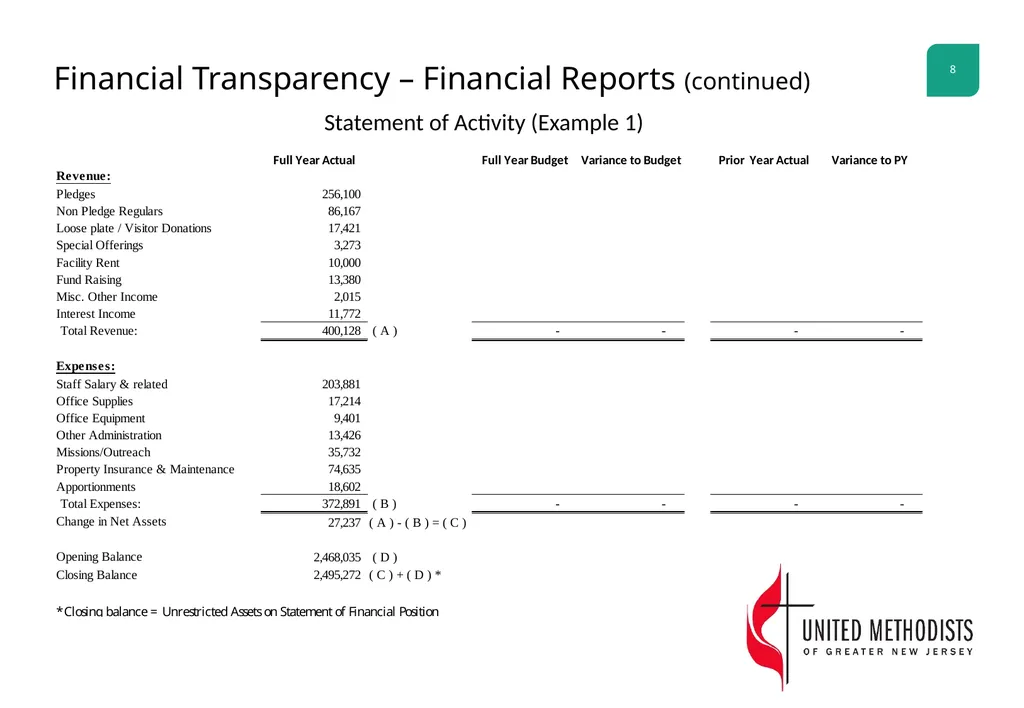
slide8. Financial Transparency – Financial Reports (continued) Statement of Activity (Example 1)<br>
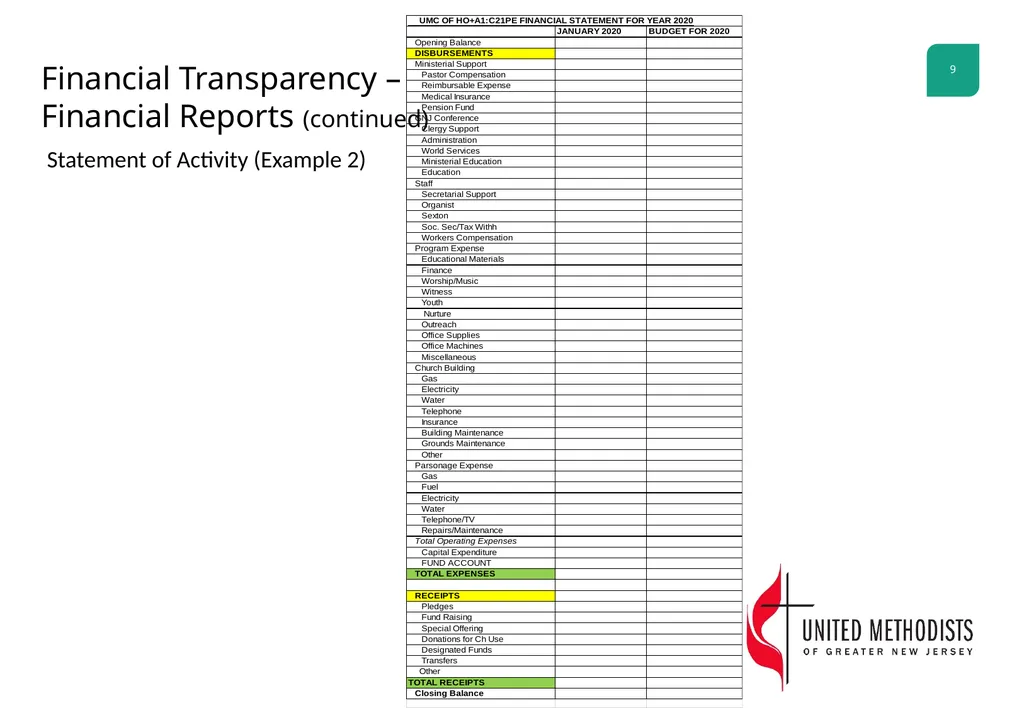
slide9. Financial Transparency –
Financial Reports (continued) Statement of Activity (Example 2)<br>
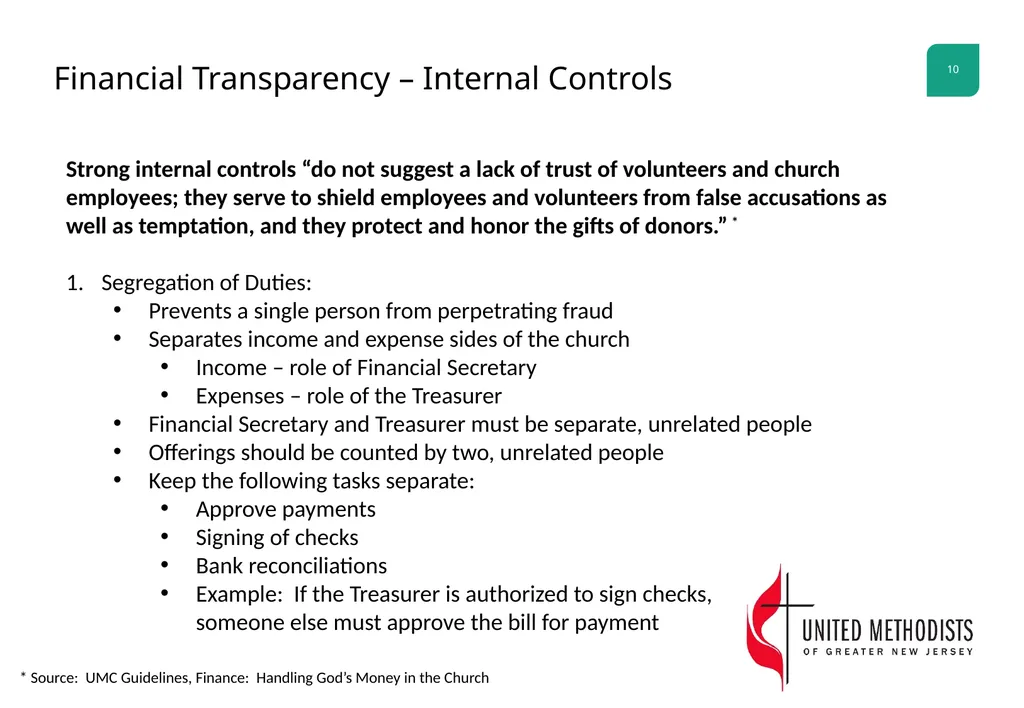
slide10. Financial Transparency – Internal Controls Strong internal controls “do not suggest a lack of trust of volunteers and church employees; they serve to shield employees and volunteers from false accusations as well as temptation, and they protect and honor the gifts of donors.” *
Segregation of Duties:
Prevents a single person from perpetrating fraud
Separates income and expense sides of the church
Income – role of Financial Secretary
Expenses – role of the Treasurer
Financial Secretary and Treasurer must be separate, unrelated people
Offerings should be counted by two, unrelated people
Keep the following tasks separate:
Approve payments
Signing of checks
Bank reconciliations
Example: If the Treasurer is authorized to sign checks, someone else must approve the bill for payment * Source: UMC Guidelines, Finance: Handling God’s Money in the Church<br>
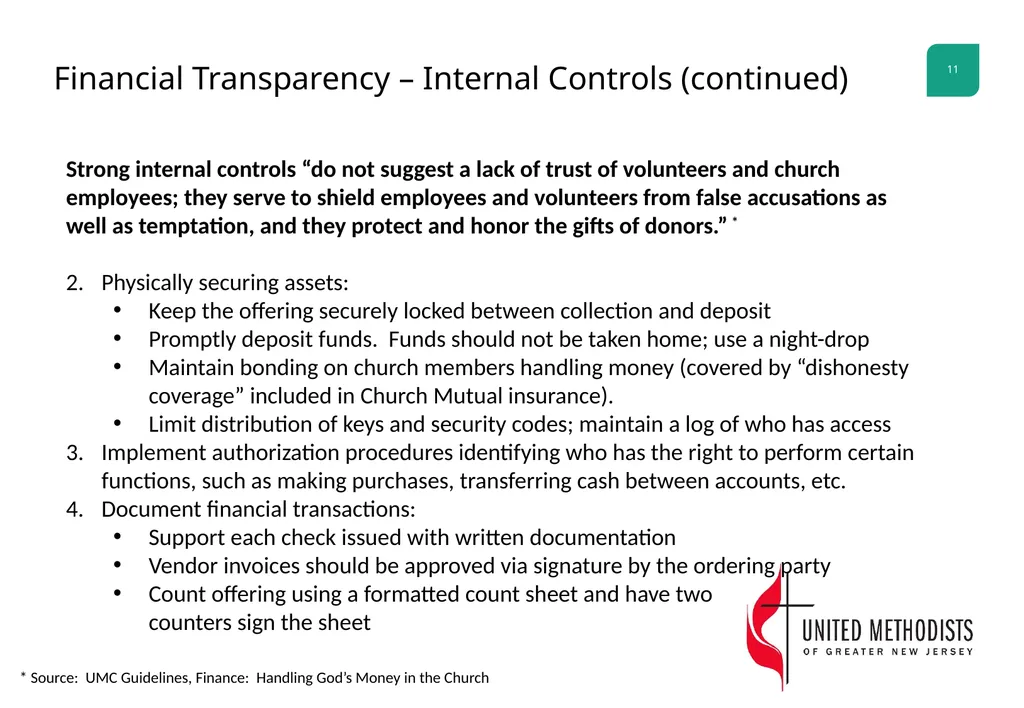
slide11. Financial Transparency – Internal Controls (continued) Strong internal controls “do not suggest a lack of trust of volunteers and church employees; they serve to shield employees and volunteers from false accusations as well as temptation, and they protect and honor the gifts of donors.” *
Physically securing assets:
Keep the offering securely locked between collection and deposit
Promptly deposit funds. Funds should not be taken home; use a night-drop
Maintain bonding on church members handling money (covered by “dishonesty coverage” included in Church Mutual insurance).
Limit distribution of keys and security codes; maintain a log of who has access
Implement authorization procedures identifying who has the right to perform certain functions, such as making purchases, transferring cash between accounts, etc.
Document financial transactions:
Support each check issued with written documentation
Vendor invoices should be approved via signature by the ordering party
Count offering using a formatted count sheet and have two counters sign the sheet * Source: UMC Guidelines, Finance: Handling God’s Money in the Church<br>
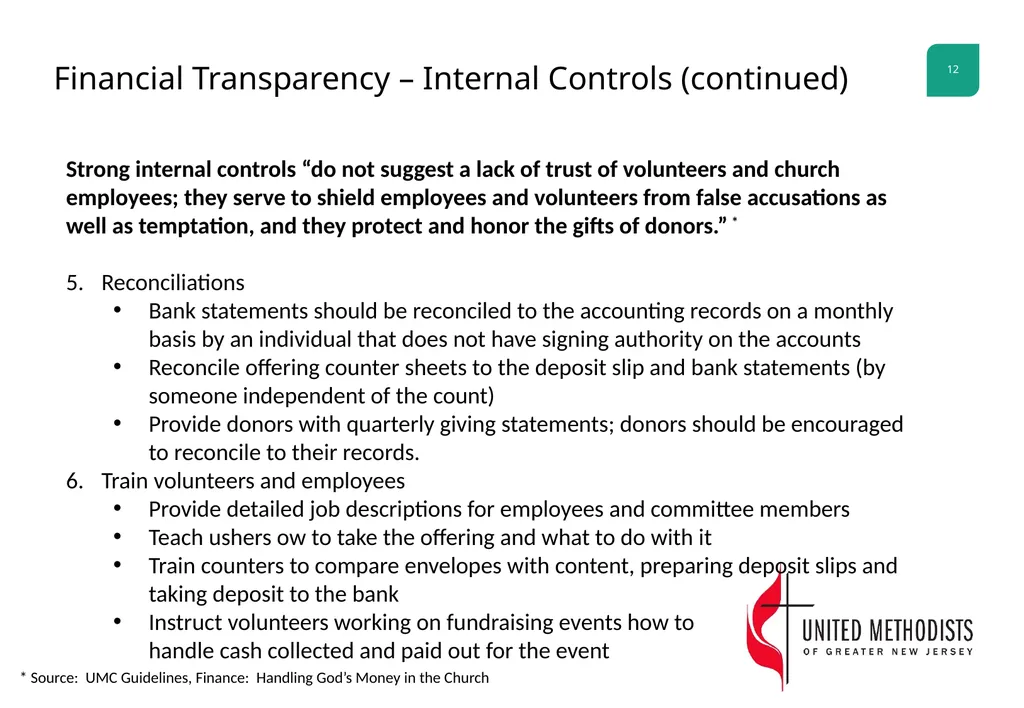
slide12. Financial Transparency – Internal Controls (continued) Strong internal controls “do not suggest a lack of trust of volunteers and church employees; they serve to shield employees and volunteers from false accusations as well as temptation, and they protect and honor the gifts of donors.” *
Reconciliations
Bank statements should be reconciled to the accounting records on a monthly basis by an individual that does not have signing authority on the accounts
Reconcile offering counter sheets to the deposit slip and bank statements (by someone independent of the count)
Provide donors with quarterly giving statements; donors should be encouraged to reconcile to their records.
Train volunteers and employees
Provide detailed job descriptions for employees and committee members
Teach ushers ow to take the offering and what to do with it
Train counters to compare envelopes with content, preparing deposit slips and taking deposit to the bank
Instruct volunteers working on fundraising events how to handle cash collected and paid out for the event * Source: UMC Guidelines, Finance: Handling God’s Money in the Church<br>
slide13. Financial Transparency – Internal Controls (continued) Strong internal controls “do not suggest a lack of trust of volunteers and church employees; they serve to shield employees and volunteers from false accusations as well as temptation, and they protect and honor the gifts of donors.” *
Book of Discipline, 258.4c:
The committee on finance should develop written financial policies to document the internal controls of the local church. These policies should be reviewed for adequacy and effectiveness annually by the committee on finance and submitted as a report to the charge conference. * Source: UMC Guidelines, Finance: Handling God’s Money in the Church<br>
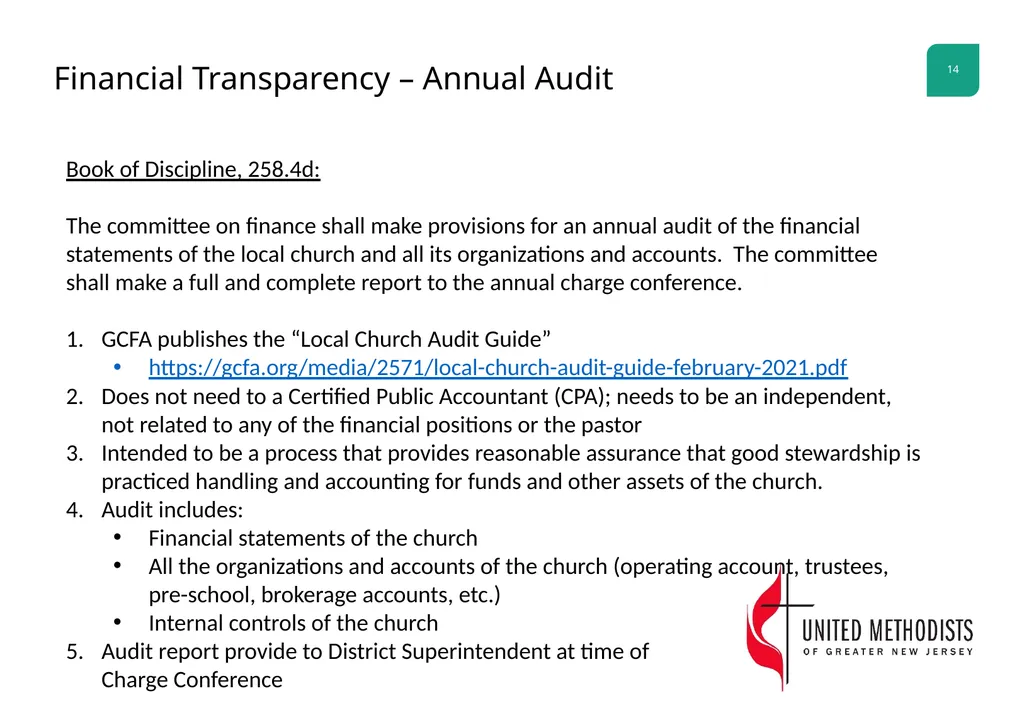
slide14. Financial Transparency – Annual Audit Book of Discipline, 258.4d:
The committee on finance shall make provisions for an annual audit of the financial statements of the local church and all its organizations and accounts. The committee shall make a full and complete report to the annual charge conference.
GCFA publishes the “Local Church Audit Guide”
https://gcfa.org/media/2571/local-church-audit-guide-february-2021.pdf
Does not need to a Certified Public Accountant (CPA); needs to be an independent, not related to any of the financial positions or the pastor
Intended to be a process that provides reasonable assurance that good stewardship is practiced handling and accounting for funds and other assets of the church.
Audit includes:
Financial statements of the church
All the organizations and accounts of the church (operating account, trustees, pre-school, brokerage accounts, etc.)
Internal controls of the church
Audit report provide to District Superintendent at time of Charge Conference<br>
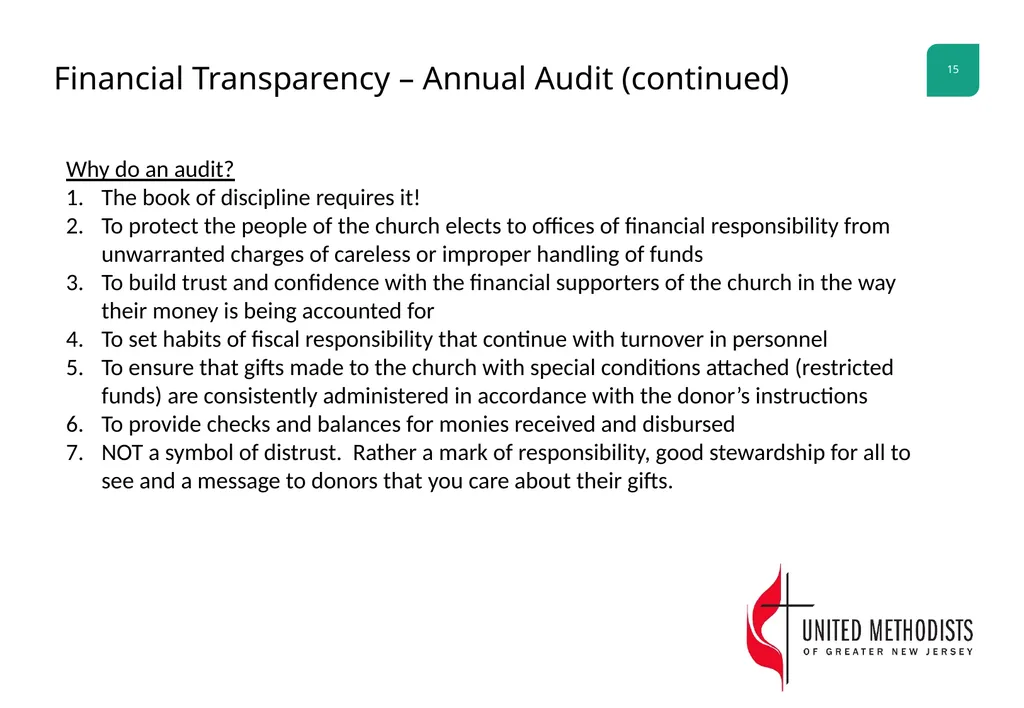
slide15. Financial Transparency – Annual Audit (continued) Why do an audit?
The book of discipline requires it!
To protect the people of the church elects to offices of financial responsibility from unwarranted charges of careless or improper handling of funds
To build trust and confidence with the financial supporters of the church in the way their money is being accounted for
To set habits of fiscal responsibility that continue with turnover in personnel
To ensure that gifts made to the church with special conditions attached (restricted funds) are consistently administered in accordance with the donor’s instructions
To provide checks and balances for monies received and disbursed
NOT a symbol of distrust. Rather a mark of responsibility, good stewardship for all to see and a message to donors that you care about their gifts.<br>
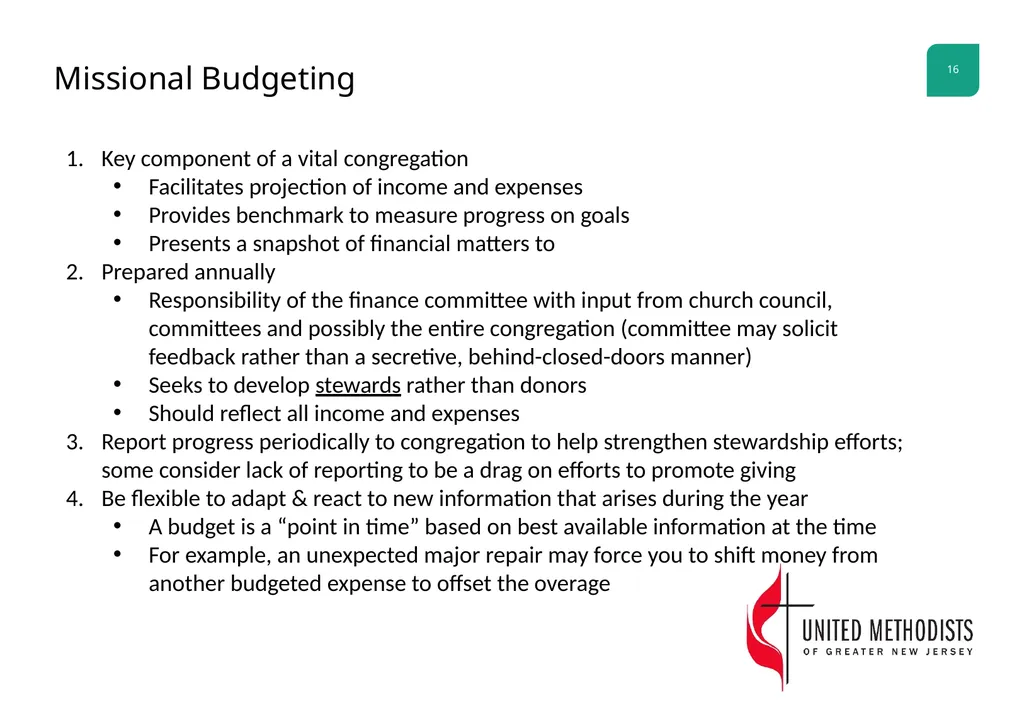
slide16. Missional Budgeting Key component of a vital congregation
Facilitates projection of income and expenses
Provides benchmark to measure progress on goals
Presents a snapshot of financial matters to
Prepared annually
Responsibility of the finance committee with input from church council, committees and possibly the entire congregation (committee may solicit feedback rather than a secretive, behind-closed-doors manner)
Seeks to develop stewards rather than donors
Should reflect all income and expenses
Report progress periodically to congregation to help strengthen stewardship efforts; some consider lack of reporting to be a drag on efforts to promote giving
Be flexible to adapt & react to new information that arises during the year
A budget is a “point in time” based on best available information at the time
For example, an unexpected major repair may force you to shift money from another budgeted expense to offset the overage<br>
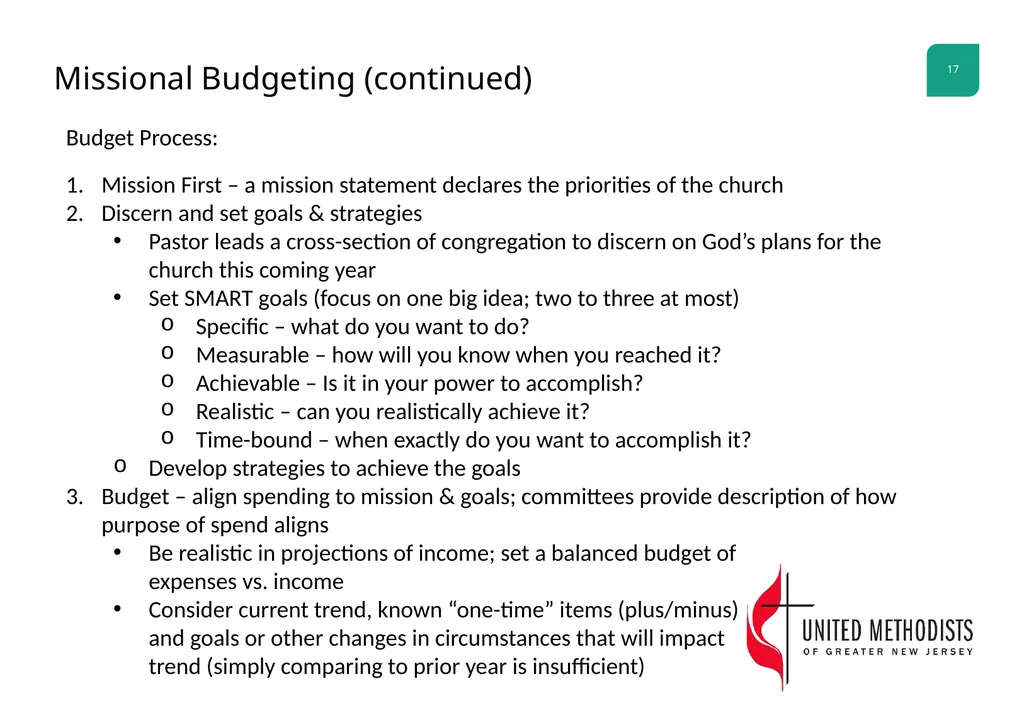
slide17. Missional Budgeting (continued) Budget Process:
Mission First – a mission statement declares the priorities of the church
Discern and set goals & strategies
Pastor leads a cross-section of congregation to discern on God’s plans for the church this coming year
Set SMART goals (focus on one big idea; two to three at most)
Specific – what do you want to do?
Measurable – how will you know when you reached it?
Achievable – Is it in your power to accomplish?
Realistic – can you realistically achieve it?
Time-bound – when exactly do you want to accomplish it?
Develop strategies to achieve the goals
Budget – align spending to mission & goals; committees provide description of how purpose of spend aligns
Be realistic in projections of income; set a balanced budget of expenses vs. income
Consider current trend, known “one-time” items (plus/minus) and goals or other changes in circumstances that will impact trend (simply comparing to prior year is insufficient)<br>
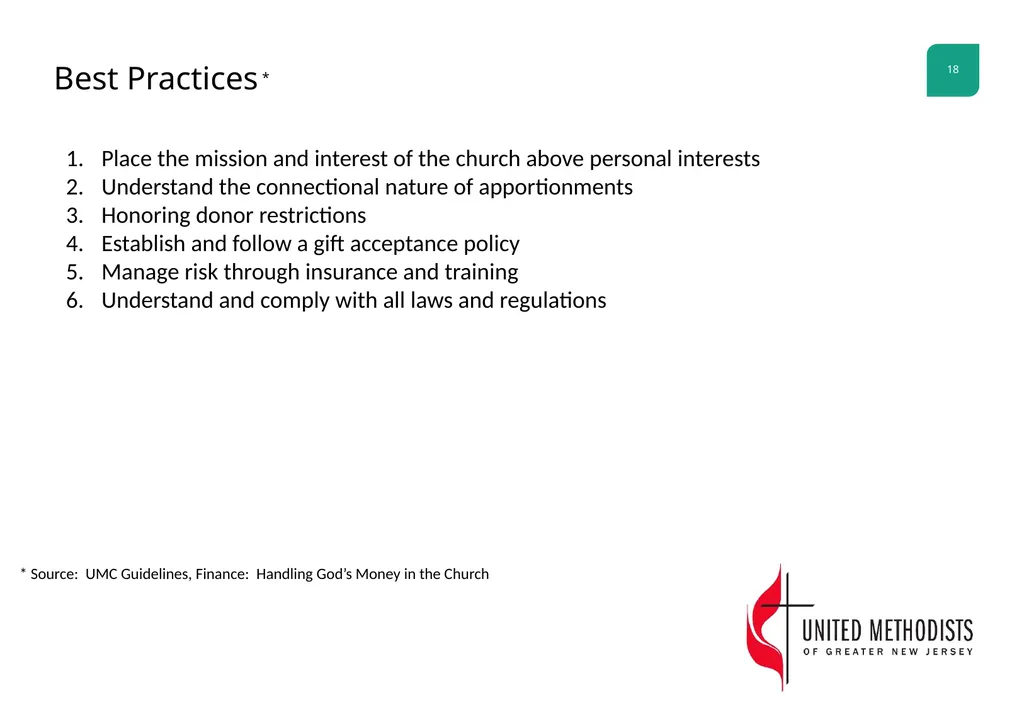
slide18. Best Practices * Place the mission and interest of the church above personal interests
Understand the connectional nature of apportionments
Honoring donor restrictions
Establish and follow a gift acceptance policy
Manage risk through insurance and training
Understand and comply with all laws and regulations * Source: UMC Guidelines, Finance: Handling God’s Money in the Church<br>
slide19. APPENDIX
JOB DESCRIPTIONS<br>
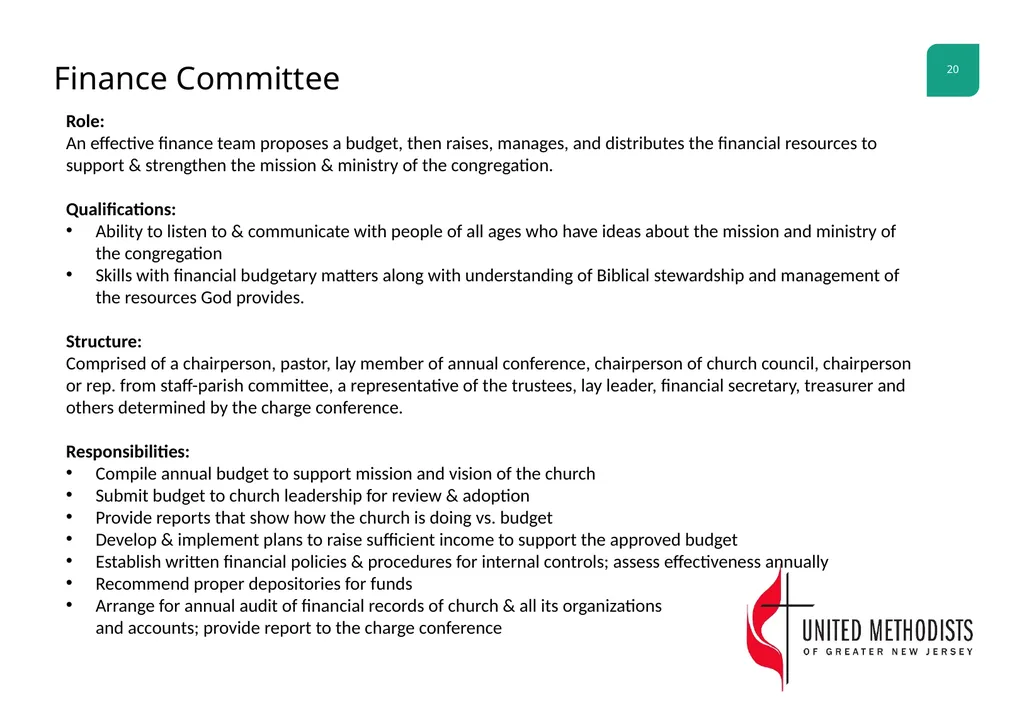
slide20. Finance Committee Role:
An effective finance team proposes a budget, then raises, manages, and distributes the financial resources to support & strengthen the mission & ministry of the congregation.
Qualifications:
Ability to listen to & communicate with people of all ages who have ideas about the mission and ministry of the congregation
Skills with financial budgetary matters along with understanding of Biblical stewardship and management of the resources God provides.
Structure:
Comprised of a chairperson, pastor, lay member of annual conference, chairperson of church council, chairperson or rep. from staff-parish committee, a representative of the trustees, lay leader, financial secretary, treasurer and others determined by the charge conference.
Responsibilities:
Compile annual budget to support mission and vision of the church
Submit budget to church leadership for review & adoption
Provide reports that show how the church is doing vs. budget
Develop & implement plans to raise sufficient income to support the approved budget
Establish written financial policies & procedures for internal controls; assess effectiveness annually
Recommend proper depositories for funds
Arrange for annual audit of financial records of church & all its organizations and accounts; provide report to the charge conference<br>
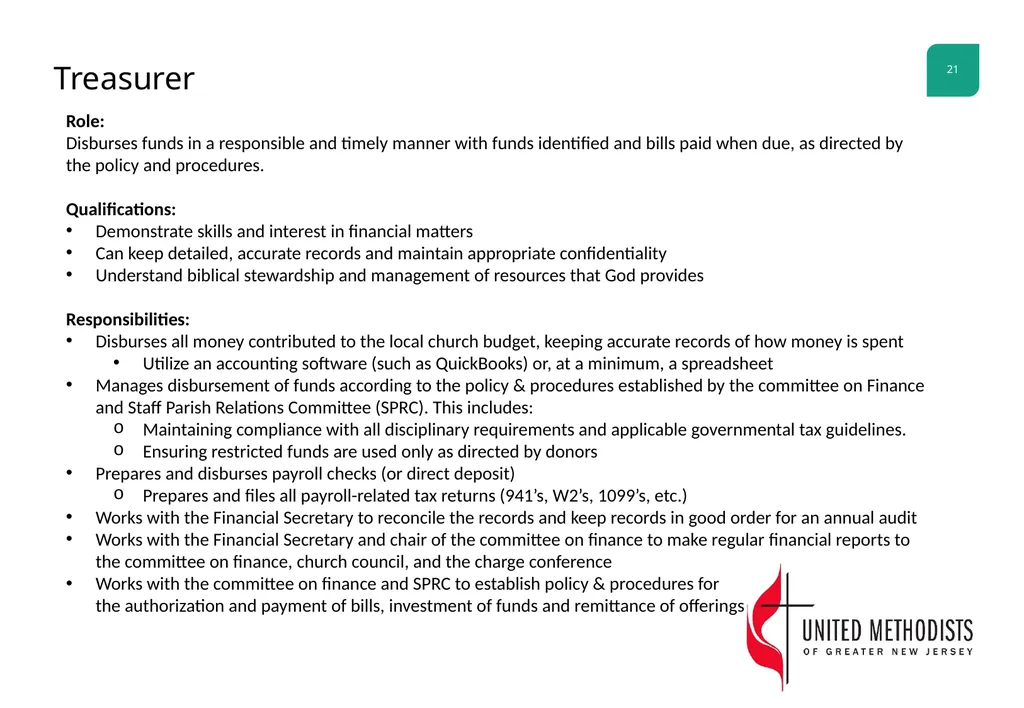
slide21. Treasurer Role:
Disburses funds in a responsible and timely manner with funds identified and bills paid when due, as directed by the policy and procedures.
Qualifications:
Demonstrate skills and interest in financial matters
Can keep detailed, accurate records and maintain appropriate confidentiality
Understand biblical stewardship and management of resources that God provides
Responsibilities:
Disburses all money contributed to the local church budget, keeping accurate records of how money is spent
Utilize an accounting software (such as QuickBooks) or, at a minimum, a spreadsheet
Manages disbursement of funds according to the policy & procedures established by the committee on Finance and Staff Parish Relations Committee (SPRC). This includes:
Maintaining compliance with all disciplinary requirements and applicable governmental tax guidelines.
Ensuring restricted funds are used only as directed by donors
Prepares and disburses payroll checks (or direct deposit)
Prepares and files all payroll-related tax returns (941’s, W2’s, 1099’s, etc.)
Works with the Financial Secretary to reconcile the records and keep records in good order for an annual audit
Works with the Financial Secretary and chair of the committee on finance to make regular financial reports to the committee on finance, church council, and the charge conference
Works with the committee on finance and SPRC to establish policy & procedures for the authorization and payment of bills, investment of funds and remittance of offerings<br>
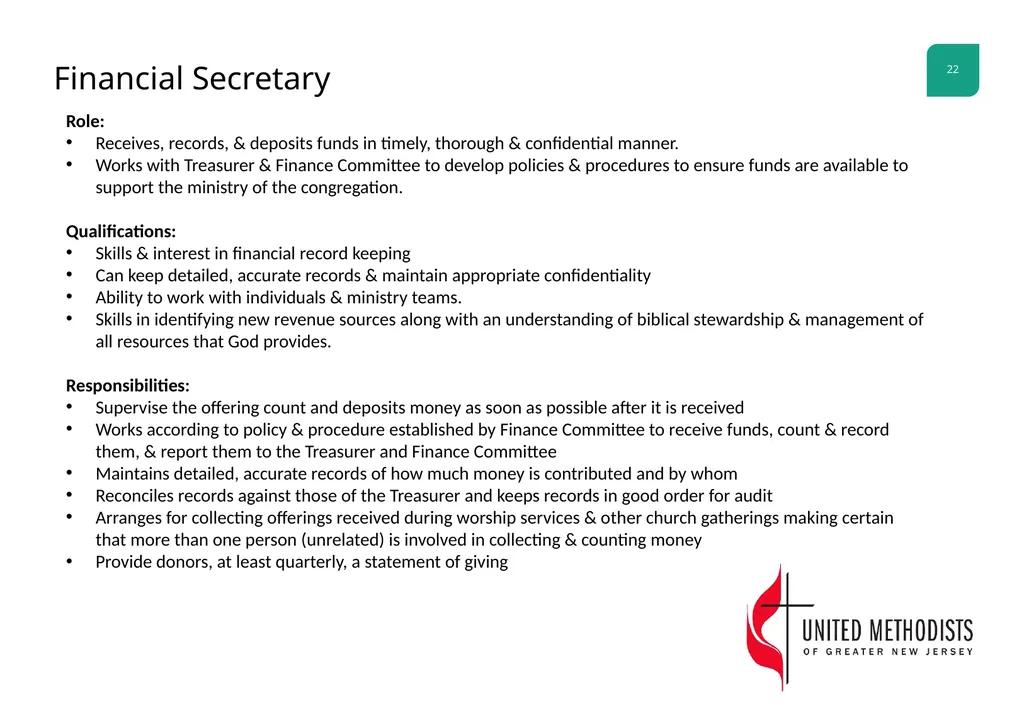
slide22. Financial Secretary Role:
Receives, records, & deposits funds in timely, thorough & confidential manner.
Works with Treasurer & Finance Committee to develop policies & procedures to ensure funds are available to support the ministry of the congregation.
Qualifications:
Skills & interest in financial record keeping
Can keep detailed, accurate records & maintain appropriate confidentiality
Ability to work with individuals & ministry teams.
Skills in identifying new revenue sources along with an understanding of biblical stewardship & management of all resources that God provides.
Responsibilities:
Supervise the offering count and deposits money as soon as possible after it is received
Works according to policy & procedure established by Finance Committee to receive funds, count & record them, & report them to the Treasurer and Finance Committee
Maintains detailed, accurate records of how much money is contributed and by whom
Reconciles records against those of the Treasurer and keeps records in good order for audit
Arranges for collecting offerings received during worship services & other church gatherings making certain that more than one person (unrelated) is involved in collecting & counting money
Provide donors, at least quarterly, a statement of giving<br>
slide23. APPENDIX
Shared Ministry & Billings<br>
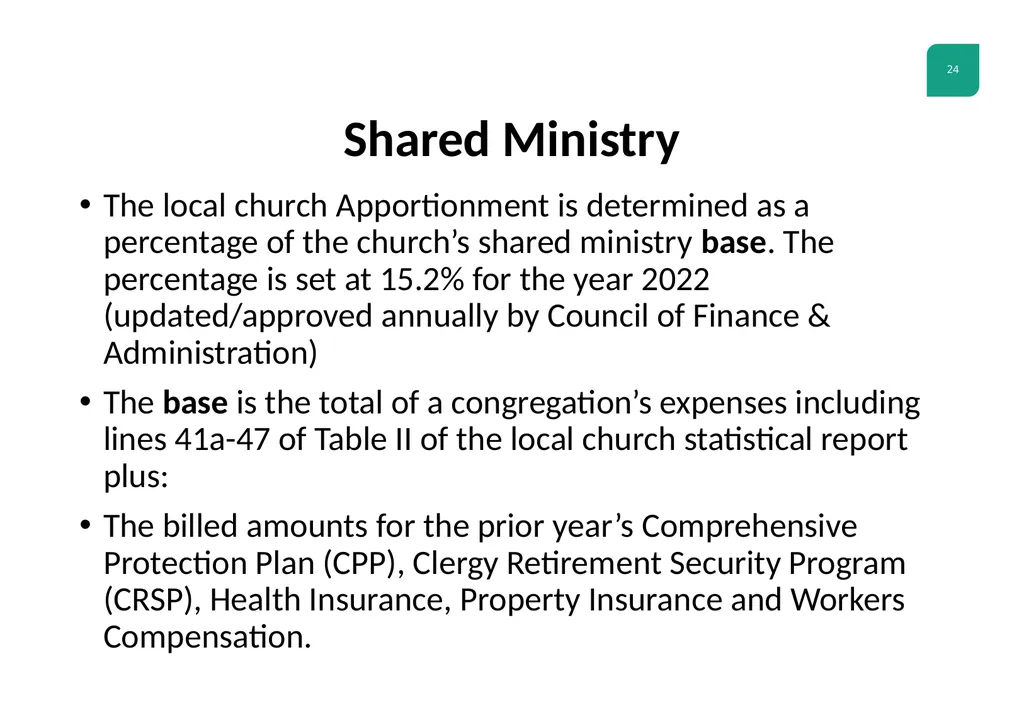
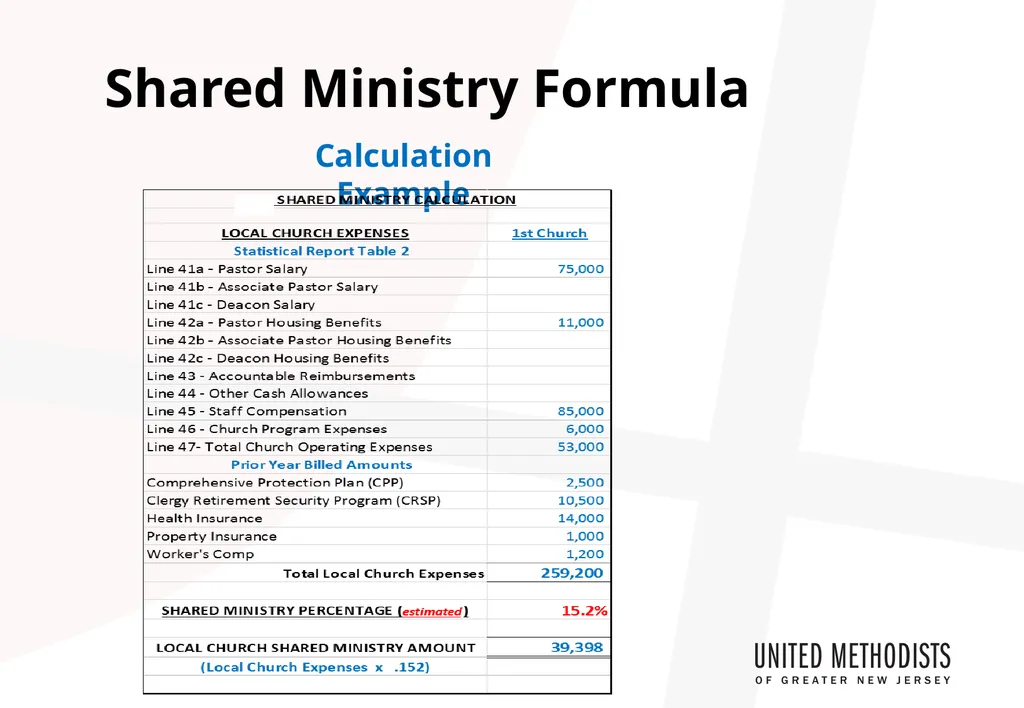
slide24. Shared Ministry The local church Apportionment is determined as a percentage of the church’s shared ministry base. The percentage is set at 15.2% for the year 2022 (updated/approved annually by Council of Finance & Administration)
The base is the total of a congregation’s expenses including lines 41a-47 of Table II of the local church statistical report plus:
The billed amounts for the prior year’s Comprehensive Protection Plan (CPP), Clergy Retirement Security Program (CRSP), Health Insurance, Property Insurance and Workers Compensation.<br>
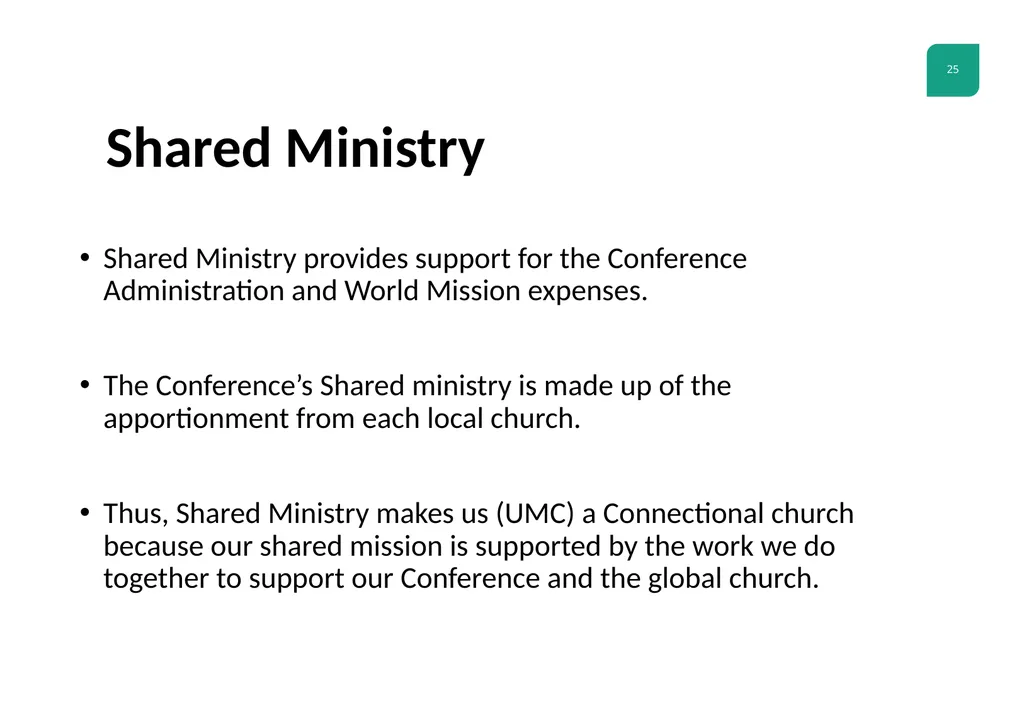
slide25. Shared Ministry Shared Ministry provides support for the Conference Administration and World Mission expenses.
The Conference’s Shared ministry is made up of the apportionment from each local church.
Thus, Shared Ministry makes us (UMC) a Connectional church because our shared mission is supported by the work we do together to support our Conference and the global church.<br>
slide26. Shared Ministry Formula Calculation Example<br>
slide27. Other Billings Include Pastor Benefits:
Clergy Retirement Security Program (CRSP)
Comprehensive Protection Plan (CPP)
Health Insurance Contributions
Staff Benefits:
Workers’ Compensation
Church Insurance<br>
slide2. Characteristics of Financially Vital Congregations * Financial Transparency
Sharing clear, easy-to-understand financial reports with members
Implementing a strong system of internal controls
Providing for an annual audit of the financial reports
Missional Budgeting and Fundraising
Facilitate the congregation-wide activity of discerning, planning and budgeting for God’s mission
Best Practices
Engage in practices that ensure their current financial health and long-term sustainability * Source: UMC Guidelines, Finance: Handling God’s Money in the Church<br>
slide3. Financial Transparency – Financial Reports Statement of Financial Position (balance sheet)
Reflects the overall financial position of the organization at a given moment in time. It shows the accumulated results of all the individual years of your organization’s operations put together.
Assets = what you have or what you are owed
Liabilities = what you owe
Net Assets = what’s left (Assets – Liabilities)
Unrestricted – can be used for operating expenses or any other purpose
Restricted – designated to a specific program/project (examples: Mission Fund or Youth Ministry fund)<br>
slide4. Financial Transparency – Financial Reports (continued) Statement of Financial Position (balance sheet)
Assets – examples and what to look for and/or ask:
Cash – do I have enough to pay the bills? Is it properly invested to maximize interest? Have we protected restricted funds? Is the balance increasing or decreasing?
Accounts Receivable (money owed to us) – are we collecting on a timely basis? Are there any that will never be paid? Do we have an allowance for doubtful accounts (an estimate of those that will not be paid)?
Fixed Assets (Land, buildings & equipment) – have we invested enough or too much?<br>
slide5. Financial Transparency – Financial Reports (continued) Statement of Financial Position (balance sheet)
Liabilities – examples and what to look for and/or ask:
Accounts payable (unpaid bills to vendors) / Accrued expenses (usually estimated expense not yet invoiced/paid) – are we paying our vendors timely? Do we have enough cash to pay?
Loans – do we have the means to pay over time?<br>
slide6. Financial Transparency – Financial Reports (continued) Statement of Activity (profit & loss statement)
Shows the organization’s revenue and expenses for a specific period of time.
The report reflects the changes to an organization’s net assets resulting from income and expenses that occur during the current period.
Revenue less expenses = change in net assets
Revenue greater than expenses = Surplus (profit)
Revenue less than expenses = Deficit (loss)
Report should include comparison to prior year and budget to monitor trends and risks/opportunities vs. budget Utilizing an accounting software system, such as QuickBooks, will facilitate maintaining accurate financial records and generating financial reports<br>
slide7. Financial Transparency – Financial Reports (continued) Statement of Financial Position (Example)<br>
slide8. Financial Transparency – Financial Reports (continued) Statement of Activity (Example 1)<br>
slide9. Financial Transparency –
Financial Reports (continued) Statement of Activity (Example 2)<br>
slide10. Financial Transparency – Internal Controls Strong internal controls “do not suggest a lack of trust of volunteers and church employees; they serve to shield employees and volunteers from false accusations as well as temptation, and they protect and honor the gifts of donors.” *
Segregation of Duties:
Prevents a single person from perpetrating fraud
Separates income and expense sides of the church
Income – role of Financial Secretary
Expenses – role of the Treasurer
Financial Secretary and Treasurer must be separate, unrelated people
Offerings should be counted by two, unrelated people
Keep the following tasks separate:
Approve payments
Signing of checks
Bank reconciliations
Example: If the Treasurer is authorized to sign checks, someone else must approve the bill for payment * Source: UMC Guidelines, Finance: Handling God’s Money in the Church<br>
slide11. Financial Transparency – Internal Controls (continued) Strong internal controls “do not suggest a lack of trust of volunteers and church employees; they serve to shield employees and volunteers from false accusations as well as temptation, and they protect and honor the gifts of donors.” *
Physically securing assets:
Keep the offering securely locked between collection and deposit
Promptly deposit funds. Funds should not be taken home; use a night-drop
Maintain bonding on church members handling money (covered by “dishonesty coverage” included in Church Mutual insurance).
Limit distribution of keys and security codes; maintain a log of who has access
Implement authorization procedures identifying who has the right to perform certain functions, such as making purchases, transferring cash between accounts, etc.
Document financial transactions:
Support each check issued with written documentation
Vendor invoices should be approved via signature by the ordering party
Count offering using a formatted count sheet and have two counters sign the sheet * Source: UMC Guidelines, Finance: Handling God’s Money in the Church<br>
slide12. Financial Transparency – Internal Controls (continued) Strong internal controls “do not suggest a lack of trust of volunteers and church employees; they serve to shield employees and volunteers from false accusations as well as temptation, and they protect and honor the gifts of donors.” *
Reconciliations
Bank statements should be reconciled to the accounting records on a monthly basis by an individual that does not have signing authority on the accounts
Reconcile offering counter sheets to the deposit slip and bank statements (by someone independent of the count)
Provide donors with quarterly giving statements; donors should be encouraged to reconcile to their records.
Train volunteers and employees
Provide detailed job descriptions for employees and committee members
Teach ushers ow to take the offering and what to do with it
Train counters to compare envelopes with content, preparing deposit slips and taking deposit to the bank
Instruct volunteers working on fundraising events how to handle cash collected and paid out for the event * Source: UMC Guidelines, Finance: Handling God’s Money in the Church<br>
slide13. Financial Transparency – Internal Controls (continued) Strong internal controls “do not suggest a lack of trust of volunteers and church employees; they serve to shield employees and volunteers from false accusations as well as temptation, and they protect and honor the gifts of donors.” *
Book of Discipline, 258.4c:
The committee on finance should develop written financial policies to document the internal controls of the local church. These policies should be reviewed for adequacy and effectiveness annually by the committee on finance and submitted as a report to the charge conference. * Source: UMC Guidelines, Finance: Handling God’s Money in the Church<br>
slide14. Financial Transparency – Annual Audit Book of Discipline, 258.4d:
The committee on finance shall make provisions for an annual audit of the financial statements of the local church and all its organizations and accounts. The committee shall make a full and complete report to the annual charge conference.
GCFA publishes the “Local Church Audit Guide”
https://gcfa.org/media/2571/local-church-audit-guide-february-2021.pdf
Does not need to a Certified Public Accountant (CPA); needs to be an independent, not related to any of the financial positions or the pastor
Intended to be a process that provides reasonable assurance that good stewardship is practiced handling and accounting for funds and other assets of the church.
Audit includes:
Financial statements of the church
All the organizations and accounts of the church (operating account, trustees, pre-school, brokerage accounts, etc.)
Internal controls of the church
Audit report provide to District Superintendent at time of Charge Conference<br>
slide15. Financial Transparency – Annual Audit (continued) Why do an audit?
The book of discipline requires it!
To protect the people of the church elects to offices of financial responsibility from unwarranted charges of careless or improper handling of funds
To build trust and confidence with the financial supporters of the church in the way their money is being accounted for
To set habits of fiscal responsibility that continue with turnover in personnel
To ensure that gifts made to the church with special conditions attached (restricted funds) are consistently administered in accordance with the donor’s instructions
To provide checks and balances for monies received and disbursed
NOT a symbol of distrust. Rather a mark of responsibility, good stewardship for all to see and a message to donors that you care about their gifts.<br>
slide16. Missional Budgeting Key component of a vital congregation
Facilitates projection of income and expenses
Provides benchmark to measure progress on goals
Presents a snapshot of financial matters to
Prepared annually
Responsibility of the finance committee with input from church council, committees and possibly the entire congregation (committee may solicit feedback rather than a secretive, behind-closed-doors manner)
Seeks to develop stewards rather than donors
Should reflect all income and expenses
Report progress periodically to congregation to help strengthen stewardship efforts; some consider lack of reporting to be a drag on efforts to promote giving
Be flexible to adapt & react to new information that arises during the year
A budget is a “point in time” based on best available information at the time
For example, an unexpected major repair may force you to shift money from another budgeted expense to offset the overage<br>
slide17. Missional Budgeting (continued) Budget Process:
Mission First – a mission statement declares the priorities of the church
Discern and set goals & strategies
Pastor leads a cross-section of congregation to discern on God’s plans for the church this coming year
Set SMART goals (focus on one big idea; two to three at most)
Specific – what do you want to do?
Measurable – how will you know when you reached it?
Achievable – Is it in your power to accomplish?
Realistic – can you realistically achieve it?
Time-bound – when exactly do you want to accomplish it?
Develop strategies to achieve the goals
Budget – align spending to mission & goals; committees provide description of how purpose of spend aligns
Be realistic in projections of income; set a balanced budget of expenses vs. income
Consider current trend, known “one-time” items (plus/minus) and goals or other changes in circumstances that will impact trend (simply comparing to prior year is insufficient)<br>
slide18. Best Practices * Place the mission and interest of the church above personal interests
Understand the connectional nature of apportionments
Honoring donor restrictions
Establish and follow a gift acceptance policy
Manage risk through insurance and training
Understand and comply with all laws and regulations * Source: UMC Guidelines, Finance: Handling God’s Money in the Church<br>
slide19. APPENDIX
JOB DESCRIPTIONS<br>
slide20. Finance Committee Role:
An effective finance team proposes a budget, then raises, manages, and distributes the financial resources to support & strengthen the mission & ministry of the congregation.
Qualifications:
Ability to listen to & communicate with people of all ages who have ideas about the mission and ministry of the congregation
Skills with financial budgetary matters along with understanding of Biblical stewardship and management of the resources God provides.
Structure:
Comprised of a chairperson, pastor, lay member of annual conference, chairperson of church council, chairperson or rep. from staff-parish committee, a representative of the trustees, lay leader, financial secretary, treasurer and others determined by the charge conference.
Responsibilities:
Compile annual budget to support mission and vision of the church
Submit budget to church leadership for review & adoption
Provide reports that show how the church is doing vs. budget
Develop & implement plans to raise sufficient income to support the approved budget
Establish written financial policies & procedures for internal controls; assess effectiveness annually
Recommend proper depositories for funds
Arrange for annual audit of financial records of church & all its organizations and accounts; provide report to the charge conference<br>
slide21. Treasurer Role:
Disburses funds in a responsible and timely manner with funds identified and bills paid when due, as directed by the policy and procedures.
Qualifications:
Demonstrate skills and interest in financial matters
Can keep detailed, accurate records and maintain appropriate confidentiality
Understand biblical stewardship and management of resources that God provides
Responsibilities:
Disburses all money contributed to the local church budget, keeping accurate records of how money is spent
Utilize an accounting software (such as QuickBooks) or, at a minimum, a spreadsheet
Manages disbursement of funds according to the policy & procedures established by the committee on Finance and Staff Parish Relations Committee (SPRC). This includes:
Maintaining compliance with all disciplinary requirements and applicable governmental tax guidelines.
Ensuring restricted funds are used only as directed by donors
Prepares and disburses payroll checks (or direct deposit)
Prepares and files all payroll-related tax returns (941’s, W2’s, 1099’s, etc.)
Works with the Financial Secretary to reconcile the records and keep records in good order for an annual audit
Works with the Financial Secretary and chair of the committee on finance to make regular financial reports to the committee on finance, church council, and the charge conference
Works with the committee on finance and SPRC to establish policy & procedures for the authorization and payment of bills, investment of funds and remittance of offerings<br>
slide22. Financial Secretary Role:
Receives, records, & deposits funds in timely, thorough & confidential manner.
Works with Treasurer & Finance Committee to develop policies & procedures to ensure funds are available to support the ministry of the congregation.
Qualifications:
Skills & interest in financial record keeping
Can keep detailed, accurate records & maintain appropriate confidentiality
Ability to work with individuals & ministry teams.
Skills in identifying new revenue sources along with an understanding of biblical stewardship & management of all resources that God provides.
Responsibilities:
Supervise the offering count and deposits money as soon as possible after it is received
Works according to policy & procedure established by Finance Committee to receive funds, count & record them, & report them to the Treasurer and Finance Committee
Maintains detailed, accurate records of how much money is contributed and by whom
Reconciles records against those of the Treasurer and keeps records in good order for audit
Arranges for collecting offerings received during worship services & other church gatherings making certain that more than one person (unrelated) is involved in collecting & counting money
Provide donors, at least quarterly, a statement of giving<br>
slide23. APPENDIX
Shared Ministry & Billings<br>
slide24. Shared Ministry The local church Apportionment is determined as a percentage of the church’s shared ministry base. The percentage is set at 15.2% for the year 2022 (updated/approved annually by Council of Finance & Administration)
The base is the total of a congregation’s expenses including lines 41a-47 of Table II of the local church statistical report plus:
The billed amounts for the prior year’s Comprehensive Protection Plan (CPP), Clergy Retirement Security Program (CRSP), Health Insurance, Property Insurance and Workers Compensation.<br>
slide25. Shared Ministry Shared Ministry provides support for the Conference Administration and World Mission expenses.
The Conference’s Shared ministry is made up of the apportionment from each local church.
Thus, Shared Ministry makes us (UMC) a Connectional church because our shared mission is supported by the work we do together to support our Conference and the global church.<br>
slide26. Shared Ministry Formula Calculation Example<br>
slide27. Other Billings Include Pastor Benefits:
Clergy Retirement Security Program (CRSP)
Comprehensive Protection Plan (CPP)
Health Insurance Contributions
Staff Benefits:
Workers’ Compensation
Church Insurance<br>