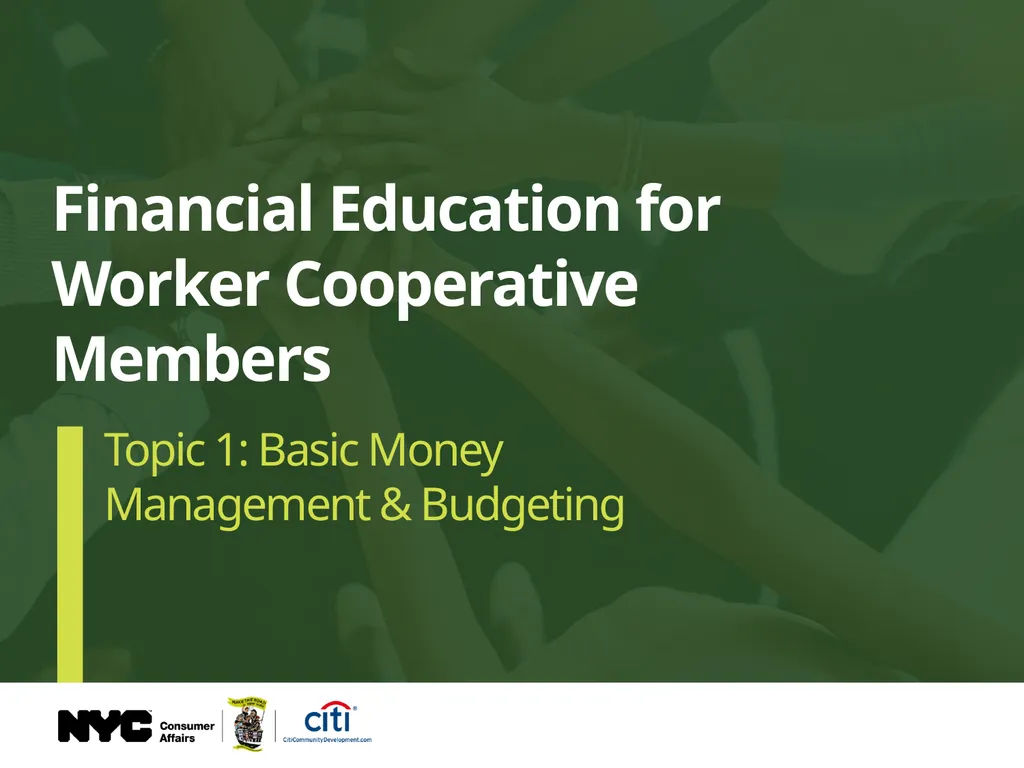
Financial Education for Worker Cooperative Members
Description: Financial Education for Worker Cooperative Members Topic 1: Basic Money Management Budgeting It consists of 5 two-hour-long workshops: Topic 1: Basic Money Management Budgeting Topic 2: Banking Basic Financial Transactions Topic 3:
Related Topics
Download Presentation
"Financial Education for Worker Cooperative Members" is the property of its rightful owner. Permission is granted to download and print the materials on this website for personal, non-commercial use only, and to display it on your personal computer provided you do not modify the materials and that you retain all copyright notices contained in the materials. By downloading content from our website, you accept the terms of this agreement.
Presentation Transcript
slide1. Financial Education for Worker Cooperative Members Topic 1: Basic Money Management & Budgeting<br>
slide2. It consists of 5 two-hour-long workshops:
Topic 1: Basic Money Management & Budgeting
Topic 2: Banking & Basic Financial Transactions
Topic 3: Credit
Topic 4: Creating a Profitable Business
Topic 5: Basic Financial Statements Introduction Financial Education for Worker Cooperative Members This curriculum was created as part of a project between the New York City Department of Consumer Affairs Office of Financial Empowerment and Make the Road New York, with the support of Citi Community Development to integrate financial empowerment tools and training into the cooperative development process.<br>
slide3. How can financial decisions impact our financial stability, security and the ability to build wealth?
What processes and steps are needed to assess our current financial situation?
What tools can be used to take control of our finances and plan?
How do we set goals, and how do we achieve them?
How can we as worker-owners support one another in growing our financial health, and how can our cooperatives better support us? Questions to Think About Financial Education for Worker Cooperative Members<br>
slide4. Societal barriers
Personal barriers Questions to Think About Financial Education for Worker Cooperative Members What Can be Barriers to Financial Stability and Building Wealth?<br>
slide5. Questions to Think About Financial Education for Worker Cooperative Members Societal barriers include:
Lack of access to:
Opportunity/well-paying jobs
Capital
Information
Education/training
Immigration status
Social Isolation
Language
Lack of trust in institutions What Can be Barriers to Financial Stability and Building Wealth?<br>
slide6. Questions to Think About Financial Education for Worker Cooperative Members Solutions to societal barriers include:
Creating economic opportunity through:
Workers cooperatives
Self-employment
Education/training
Seeking out existing support or benefits such as SNAP, food banks, and other resources; subsidized health insurance for children and family
Creating own mechanisms for financial support such as savings circles; seek out networks for emotional support such as houses of worship, community based organizations What Can be Barriers to Financial Stability and Building Wealth?<br>
slide7. Questions to Think About Financial Education for Worker Cooperative Members Personal barriers include:
High rents and cost of living in New York City
Living paycheck to paycheck:
Any unanticipated event can turn life upside down; no options in an emergency
No ability to plan
Future is not secure What Can be Barriers to Financial Stability and Building Wealth?<br>
slide8. Questions to Think About Financial Education for Worker Cooperative Members Personal barriers include, cont’d:
Not setting priorities:
Distinguish between needs and wants
Ensure that needs—basics for our survival—are covered: food, shelter, clothing
Wants: not needed for survival
Failure to set goals and plan for the future What Can be Barriers to Financial Stability and Building Wealth?<br>
slide9. Questions to Think About What Can be Barriers to Financial Stability and Building Wealth? Personal barriers include, cont’d:
Attitudes about money
Unrealistic expectations or no expectations
Not connecting the dots:
Income and expenses are interrelated
Wealth is built penny by penny, nickel by nickel…<br>
slide10. Evaluating attitudes and views about money
Money generally looked upon as a “problem”
Experiences reinforce negative associations with money
Money controls your life
Control of money usually associated with making “sacrifices” Solutions to Personal Barriers include:<br>
slide11. Change Attitudes About Money
Reframe your view of money – Use new vocabulary
- Money is a tool – not a problem
- You can control of money to meet goals & achieve desired quality of life
- It’s not about sacrifices; it’s about choices
Taking steps to take control
Planning can help to bring stability and security
Seek assistance at Financial Empowerment Centers and other community based organization resources Solutions to Personal Barriers include:<br>
slide12. Steps Toward Controlling Your Finances Assess current financial situation – income and expense statement
Create a budget
Create a savings and investment plan
Create a spending plan
Integrate budget, savings and investment, and spending plans
Get support for implementing your plans – financial counseling, worker co-op manager<br>
slide13. Income and Expense Statement Identify income – How much is available from all sources
Regular fixed sources of income, e.g. salary/wages; cooperative distributions or advances
Other sources of income – odd jobs, investment income, interest
Public and private benefits, e.g. food stamps (SNAP), social security, disability, WIC, food banks Step 1 – Assess the Current Financial Situation<br>
slide14. Identify Expenses – What is currently being spent, and/or must be paid?
Regular fixed expenses – don’t change from month to month, e.g., rent, mortgage
Regular variable expenses – occur monthly, but amounts may vary, e.g. utility bills based on usage
Flexible expenses – not regularly recurring, e.g. clothing purchases
Debts:- Credit cards, loans, judgments Step 1 – Assess the Current Financial Situation Income and Expense Statement<br>
slide15. Step 1 – Assess the Current Financial Situation Create “Income and Expense Statement” (may be same form used for budget)
Periodic – e.g., weekly or monthly
Positive cash flow – income exceeds expenses
Break-even point – income equals expenses
Negative cash flow – expenses exceed income
Implications of cash flow for budgeting and planning
Create a method to track expenditures Compare Expenses and Income<br>
slide16. A plan for applying available income to expenses
Sets limits
Creates discipline Step 2 – Create a Budget What is a Budget?<br>
slide17. Realistic assessment so adjustments can be made
Increases focus on financial priorities
Identifies areas where overspending may occur, and raises consciousness of expenditures
Identifies areas where reduction of expenditures can result in additional cash flow to pay other bills, save or invest Step 2 – Create a Budget Importance of Budgeting<br>
slide18. Needs – basic food, shelter and clothing
Obligations such as credit card debt, or loans which have legal consequences for non-payment
Savings – reserves
Investments, retirement, children’s education, home purchase
Wants – discretionary expenses Step 2 – Create a Budget Budgeting Priorities<br>
slide19. How do income and expenses match up?
If income and expenses are equal: Managing, but not making any head way. No cash flow.
Review Expenses: Are there any reductions in expenses that can be used to pay down debt, increase savings, or investments?
If income exceeds expenditures: A good position, = positive cash flow.
Review Expenditures: Are there expenses that can be reduced to increase saving and investment? Step 2 – Create a Budget Creating the Budget<br>
slide20. If expenses exceed income: You are losing ground, especially if using credit to cover expenses = negative cash flow. Only two options:
Increase revenues, and/or
Decrease expenses Step 2 – Create a Budget Creating the Budget<br>
slide21. Review “Current Income & Expense Statement”
Prioritize – decide where available funds will be allocated
Reduce expenditures anywhere possible Step 2 – Create a Budget Prepare the Budget<br>
slide22. Allocate portions of income to savings and/or investments
Allows for flexibility
Tied to goals Step 3 – Create Savings & Investment Plan<br>
slide23. Step 4 – Create a Plan for Discretionary Spending After budget stabilizes financial situation (know upper limits for expenditures)
Allows for flexibility while still living within means – proactive application of funds
Tied to goals<br>
slide24. Integrate
Budget
Savings & Investment Plan
Spending Plan
Review and update integrated Budget, Savings & Investment, and Spending Plans Step 5 – Integrate, Review & Upgrade<br>
slide25. “What You Need” vs. “What You Want”
Timelines
Short Term – One year or less
Moderate Term – One to five years
Long Term – Five to ten years from now
Start on SMART and Realistic Plan Setting Goals<br>
slide26. Specific – “I will save $1,000,” not “I will save more money.”
Measurable – You can easily track whether you have achieved or on the path to achieving your goal (increase savings by $83.33/month to reach $1,000 at year’s end)
Achievable – Requires that you know what action steps must be taken in order to achieve the goal (setting aside $83.33 monthly)
Realistic – It is possible for you to execute, and you have using tools at your disposal (e.g., you have $83.33 left after expenses each month, and will make automatic transfers to savings from each paycheck
Time-based – Set a time for achieving goal (e.g., within one year) SMART Goal Setting<br>
slide27. Summary Taking control and making the right financial decisions today lead to stability and security in the future
Assessment current financial situation
Create a budget to allocate income to priorities
Plan to apply excess funds to savings, investments and then to discretionary spending
Integrate budget, savings & investment and spending plan
Set realistic goals
Get support to help you achieve your goals © June 2017. New York City Department of Consumer Affairs. All rights reserved.<br>
slide2. It consists of 5 two-hour-long workshops:
Topic 1: Basic Money Management & Budgeting
Topic 2: Banking & Basic Financial Transactions
Topic 3: Credit
Topic 4: Creating a Profitable Business
Topic 5: Basic Financial Statements Introduction Financial Education for Worker Cooperative Members This curriculum was created as part of a project between the New York City Department of Consumer Affairs Office of Financial Empowerment and Make the Road New York, with the support of Citi Community Development to integrate financial empowerment tools and training into the cooperative development process.<br>
slide3. How can financial decisions impact our financial stability, security and the ability to build wealth?
What processes and steps are needed to assess our current financial situation?
What tools can be used to take control of our finances and plan?
How do we set goals, and how do we achieve them?
How can we as worker-owners support one another in growing our financial health, and how can our cooperatives better support us? Questions to Think About Financial Education for Worker Cooperative Members<br>
slide4. Societal barriers
Personal barriers Questions to Think About Financial Education for Worker Cooperative Members What Can be Barriers to Financial Stability and Building Wealth?<br>
slide5. Questions to Think About Financial Education for Worker Cooperative Members Societal barriers include:
Lack of access to:
Opportunity/well-paying jobs
Capital
Information
Education/training
Immigration status
Social Isolation
Language
Lack of trust in institutions What Can be Barriers to Financial Stability and Building Wealth?<br>
slide6. Questions to Think About Financial Education for Worker Cooperative Members Solutions to societal barriers include:
Creating economic opportunity through:
Workers cooperatives
Self-employment
Education/training
Seeking out existing support or benefits such as SNAP, food banks, and other resources; subsidized health insurance for children and family
Creating own mechanisms for financial support such as savings circles; seek out networks for emotional support such as houses of worship, community based organizations What Can be Barriers to Financial Stability and Building Wealth?<br>
slide7. Questions to Think About Financial Education for Worker Cooperative Members Personal barriers include:
High rents and cost of living in New York City
Living paycheck to paycheck:
Any unanticipated event can turn life upside down; no options in an emergency
No ability to plan
Future is not secure What Can be Barriers to Financial Stability and Building Wealth?<br>
slide8. Questions to Think About Financial Education for Worker Cooperative Members Personal barriers include, cont’d:
Not setting priorities:
Distinguish between needs and wants
Ensure that needs—basics for our survival—are covered: food, shelter, clothing
Wants: not needed for survival
Failure to set goals and plan for the future What Can be Barriers to Financial Stability and Building Wealth?<br>
slide9. Questions to Think About What Can be Barriers to Financial Stability and Building Wealth? Personal barriers include, cont’d:
Attitudes about money
Unrealistic expectations or no expectations
Not connecting the dots:
Income and expenses are interrelated
Wealth is built penny by penny, nickel by nickel…<br>
slide10. Evaluating attitudes and views about money
Money generally looked upon as a “problem”
Experiences reinforce negative associations with money
Money controls your life
Control of money usually associated with making “sacrifices” Solutions to Personal Barriers include:<br>
slide11. Change Attitudes About Money
Reframe your view of money – Use new vocabulary
- Money is a tool – not a problem
- You can control of money to meet goals & achieve desired quality of life
- It’s not about sacrifices; it’s about choices
Taking steps to take control
Planning can help to bring stability and security
Seek assistance at Financial Empowerment Centers and other community based organization resources Solutions to Personal Barriers include:<br>
slide12. Steps Toward Controlling Your Finances Assess current financial situation – income and expense statement
Create a budget
Create a savings and investment plan
Create a spending plan
Integrate budget, savings and investment, and spending plans
Get support for implementing your plans – financial counseling, worker co-op manager<br>
slide13. Income and Expense Statement Identify income – How much is available from all sources
Regular fixed sources of income, e.g. salary/wages; cooperative distributions or advances
Other sources of income – odd jobs, investment income, interest
Public and private benefits, e.g. food stamps (SNAP), social security, disability, WIC, food banks Step 1 – Assess the Current Financial Situation<br>
slide14. Identify Expenses – What is currently being spent, and/or must be paid?
Regular fixed expenses – don’t change from month to month, e.g., rent, mortgage
Regular variable expenses – occur monthly, but amounts may vary, e.g. utility bills based on usage
Flexible expenses – not regularly recurring, e.g. clothing purchases
Debts:- Credit cards, loans, judgments Step 1 – Assess the Current Financial Situation Income and Expense Statement<br>
slide15. Step 1 – Assess the Current Financial Situation Create “Income and Expense Statement” (may be same form used for budget)
Periodic – e.g., weekly or monthly
Positive cash flow – income exceeds expenses
Break-even point – income equals expenses
Negative cash flow – expenses exceed income
Implications of cash flow for budgeting and planning
Create a method to track expenditures Compare Expenses and Income<br>
slide16. A plan for applying available income to expenses
Sets limits
Creates discipline Step 2 – Create a Budget What is a Budget?<br>
slide17. Realistic assessment so adjustments can be made
Increases focus on financial priorities
Identifies areas where overspending may occur, and raises consciousness of expenditures
Identifies areas where reduction of expenditures can result in additional cash flow to pay other bills, save or invest Step 2 – Create a Budget Importance of Budgeting<br>
slide18. Needs – basic food, shelter and clothing
Obligations such as credit card debt, or loans which have legal consequences for non-payment
Savings – reserves
Investments, retirement, children’s education, home purchase
Wants – discretionary expenses Step 2 – Create a Budget Budgeting Priorities<br>
slide19. How do income and expenses match up?
If income and expenses are equal: Managing, but not making any head way. No cash flow.
Review Expenses: Are there any reductions in expenses that can be used to pay down debt, increase savings, or investments?
If income exceeds expenditures: A good position, = positive cash flow.
Review Expenditures: Are there expenses that can be reduced to increase saving and investment? Step 2 – Create a Budget Creating the Budget<br>
slide20. If expenses exceed income: You are losing ground, especially if using credit to cover expenses = negative cash flow. Only two options:
Increase revenues, and/or
Decrease expenses Step 2 – Create a Budget Creating the Budget<br>
slide21. Review “Current Income & Expense Statement”
Prioritize – decide where available funds will be allocated
Reduce expenditures anywhere possible Step 2 – Create a Budget Prepare the Budget<br>
slide22. Allocate portions of income to savings and/or investments
Allows for flexibility
Tied to goals Step 3 – Create Savings & Investment Plan<br>
slide23. Step 4 – Create a Plan for Discretionary Spending After budget stabilizes financial situation (know upper limits for expenditures)
Allows for flexibility while still living within means – proactive application of funds
Tied to goals<br>
slide24. Integrate
Budget
Savings & Investment Plan
Spending Plan
Review and update integrated Budget, Savings & Investment, and Spending Plans Step 5 – Integrate, Review & Upgrade<br>
slide25. “What You Need” vs. “What You Want”
Timelines
Short Term – One year or less
Moderate Term – One to five years
Long Term – Five to ten years from now
Start on SMART and Realistic Plan Setting Goals<br>
slide26. Specific – “I will save $1,000,” not “I will save more money.”
Measurable – You can easily track whether you have achieved or on the path to achieving your goal (increase savings by $83.33/month to reach $1,000 at year’s end)
Achievable – Requires that you know what action steps must be taken in order to achieve the goal (setting aside $83.33 monthly)
Realistic – It is possible for you to execute, and you have using tools at your disposal (e.g., you have $83.33 left after expenses each month, and will make automatic transfers to savings from each paycheck
Time-based – Set a time for achieving goal (e.g., within one year) SMART Goal Setting<br>
slide27. Summary Taking control and making the right financial decisions today lead to stability and security in the future
Assessment current financial situation
Create a budget to allocate income to priorities
Plan to apply excess funds to savings, investments and then to discretionary spending
Integrate budget, savings & investment and spending plan
Set realistic goals
Get support to help you achieve your goals © June 2017. New York City Department of Consumer Affairs. All rights reserved.<br>