
Financial Risk Management for U.S. Chapters
Description: Financial Risk Management for U.S. Chapters Updated: March 2025 Chapter Financial Risk Management Training This presentation will cover: Chapter Treasurer Duties Financial Accounting and Banking Best Practices Chapter Annual Financial
Related Topics
Download Presentation
"Financial Risk Management for U.S. Chapters" is the property of its rightful owner. Permission is granted to download and print the materials on this website for personal, non-commercial use only, and to display it on your personal computer provided you do not modify the materials and that you retain all copyright notices contained in the materials. By downloading content from our website, you accept the terms of this agreement.
Presentation Transcript
slide1. Financial Risk Management
for U.S. Chapters Updated: March 2025<br>
slide2. Chapter Financial Risk Management Training This presentation will cover:
Chapter Treasurer Duties
Financial Accounting and Banking Best Practices
Chapter Annual Financial Audits
Revenue and Tax Reporting
Fiduciary Duties
Fundraising Specifics
Most of this information is provided in the Manual for Chapter Operations<br>
slide3. Chapter Treasurer Duties Make deposits and issue checks authorized by the BOG
Balance/Reconcile monthly statements and present to BOG for review and approval
Keep financial records
Chapter Account used for Operations Only
Use Separate Accounts for Special Events such as CRC Fund or Scholarships
Other special accounts?
File Taxation and Revenue Reports
Be aware of scams<br>
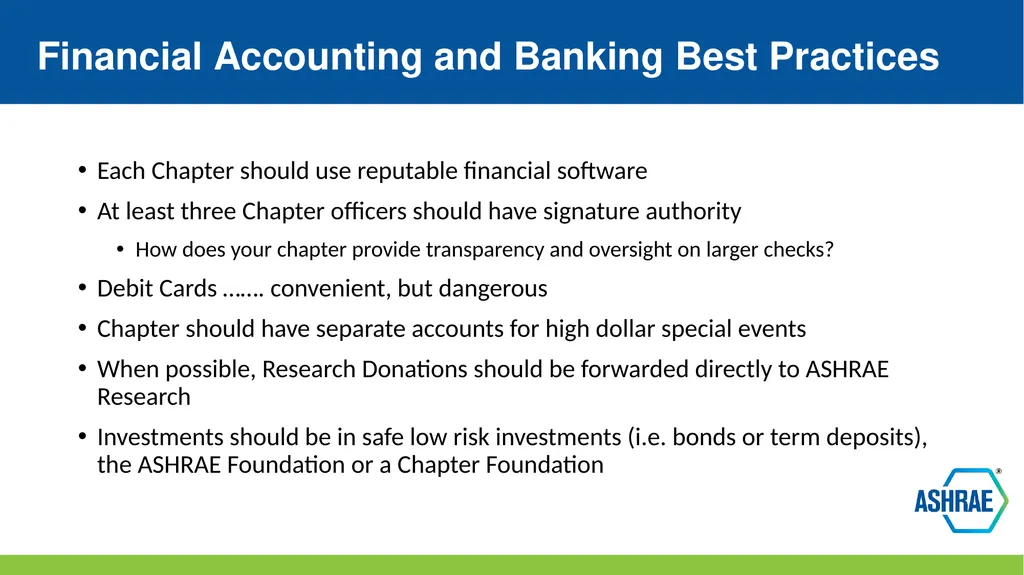
slide4. Financial Accounting and Banking Best Practices Each Chapter should use reputable financial software
At least three Chapter officers should have signature authority
How does your chapter provide transparency and oversight on larger checks?
Debit Cards ……. convenient, but dangerous
Chapter should have separate accounts for high dollar special events
When possible, Research Donations should be forwarded directly to ASHRAE Research
Investments should be in safe low risk investments (i.e. bonds or term deposits), the ASHRAE Foundation or a Chapter Foundation<br>
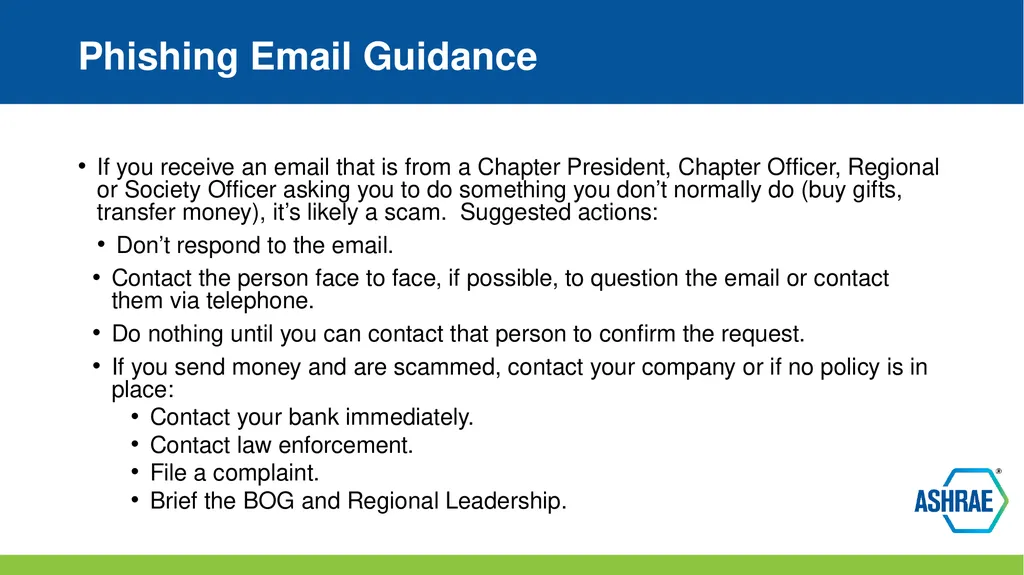
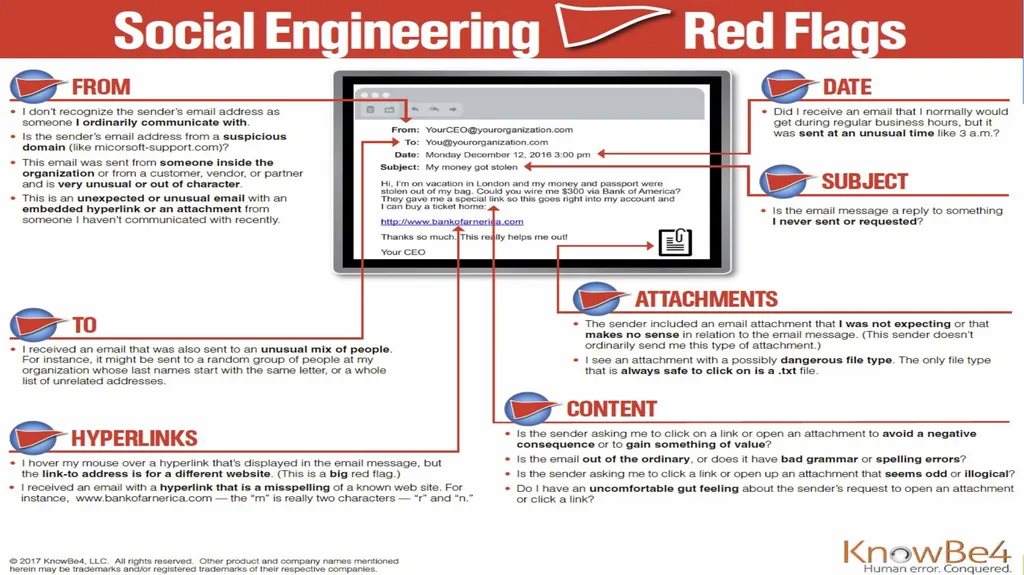
slide5. Phishing Email Guidance If you receive an email that is from a Chapter President, Chapter Officer, Regional or Society Officer asking you to do something you don’t normally do (buy gifts, transfer money), it’s likely a scam. Suggested actions:
Don’t respond to the email.
Contact the person face to face, if possible, to question the email or contact them via telephone.
Do nothing until you can contact that person to confirm the request.
If you send money and are scammed, contact your company or if no policy is in place:
Contact your bank immediately.
Contact law enforcement.
File a complaint.
Brief the BOG and Regional Leadership.<br>
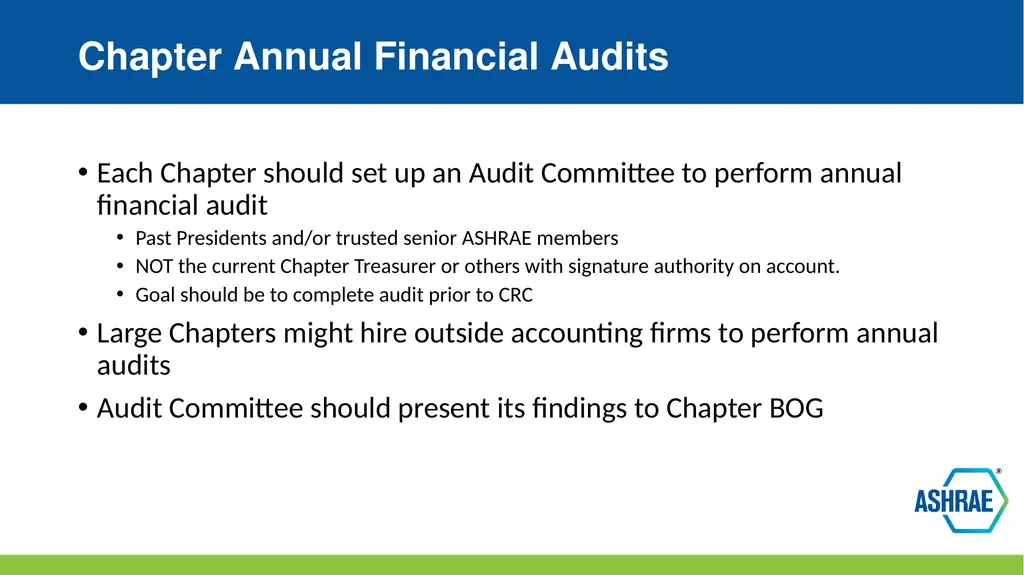
slide7. Chapter Annual Financial Audits Each Chapter should set up an Audit Committee to perform annual financial audit
Past Presidents and/or trusted senior ASHRAE members
NOT the current Chapter Treasurer or others with signature authority on account.
Goal should be to complete audit prior to CRC
Large Chapters might hire outside accounting firms to perform annual audits
Audit Committee should present its findings to Chapter BOG<br>
slide8. Revenue and Taxation Reporting Each U.S. Chapter must
Register with its state (Secretary of Sate, Department of Revenue, etc.)
File both federal and state tax returns to keep its non-profit status
All Chapters must complete annual IRS 990 Form
Small Chapters and Large Chapters complete different IRS 990 Forms
Private Foundations complete a separate form
NOTES:
There are penalties for not filing both federal and state tax returns.
Society can be at risk if a chapter loses its non-profit status. Chapter should find out whether its state requires separate non-profit registrations and/or filings.
Tax filings must report any lobbying expenses incurred by the chapter. (Note: the vast majority of chapters will not need to report any expenses because very few chapters expend money related to such activities.)<br>
slide9. Revenue and Taxation Reporting, cont’d. ASHRAE is a 501(c)(3) Charitable Organization
IRS Form 990 information and filing instructions
https://www.irs.gov/charities-non-profits/current-form-990-series-forms-and-instructions
Information about 501(c)(3) Charitable Organizations
https://www.irs.gov/charities-non-profits/charitable-organizations<br>
slide10. Revenue and Taxation Reporting: Small ASHRAE Chapter Annual gross receipts are normally less than $50,000
Three Year Average (preceding two years and current year)
Annual Electronic Filing Form 990-N (E-Postcard)
https://www.irs.gov/charities-non-profits/annual-electronic-filing-requirement-for-small-exempt-organizations-form-990-n-e-postcard<br>
slide11. Revenue and Taxation Reporting: Small ASHRAE Chapter, cont’d Information needed for Form 990-N (E-Postcard)
Name of chapter
Chapter mailing address
Chapter employer/tax identification number
Name and address of principal officer
Certification that gross receipts are under $50,000<br>
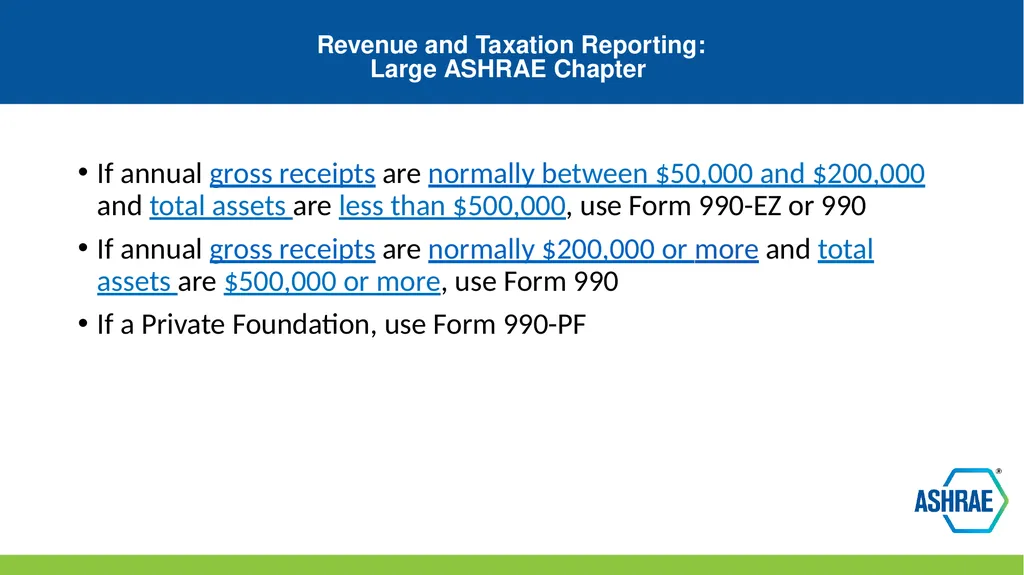
slide12. Revenue and Taxation Reporting: Large ASHRAE Chapter If annual gross receipts are normally between $50,000 and $200,000 and total assets are less than $500,000, use Form 990-EZ or 990
If annual gross receipts are normally $200,000 or more and total assets are $500,000 or more, use Form 990
If a Private Foundation, use Form 990-PF<br>
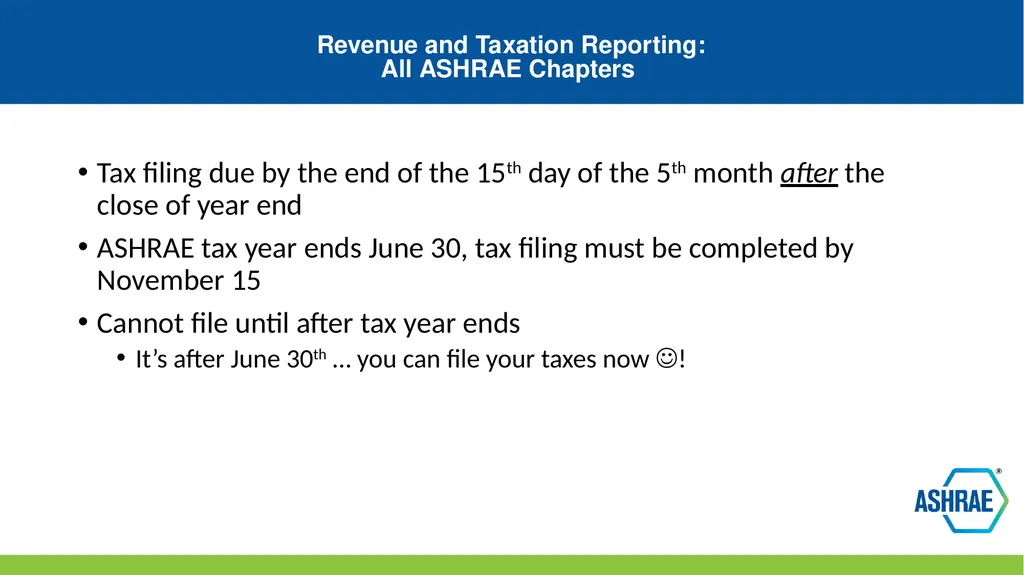
slide13. Revenue and Taxation Reporting: All ASHRAE Chapters Tax filing due by the end of the 15th day of the 5th month after the close of year end
ASHRAE tax year ends June 30, tax filing must be completed by November 15
Cannot file until after tax year ends
It’s after June 30th … you can file your taxes now !<br>
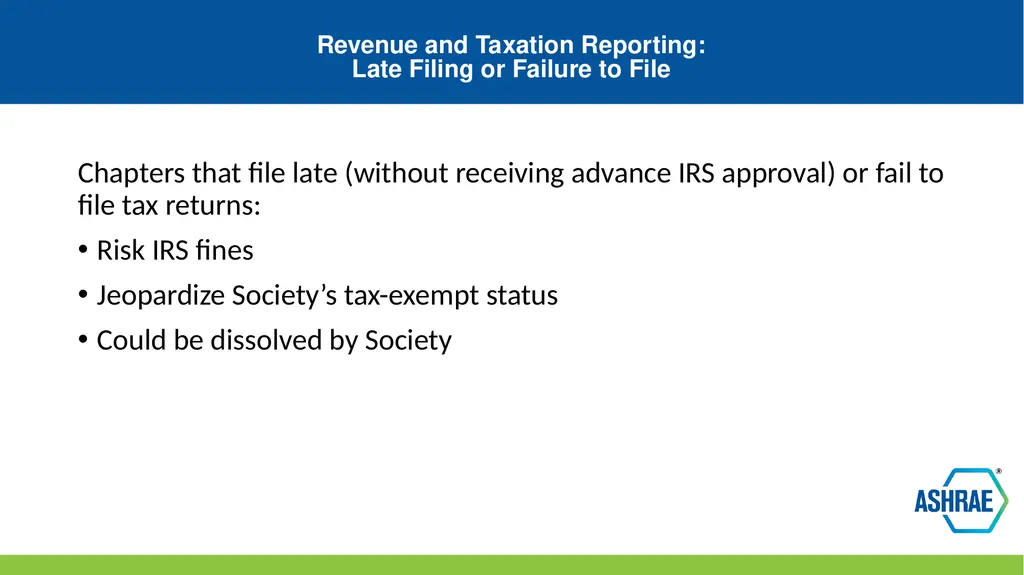
slide14. Revenue and Taxation Reporting: Late Filing or Failure to File Chapters that file late (without receiving advance IRS approval) or fail to file tax returns:
Risk IRS fines
Jeopardize Society’s tax-exempt status
Could be dissolved by Society<br>
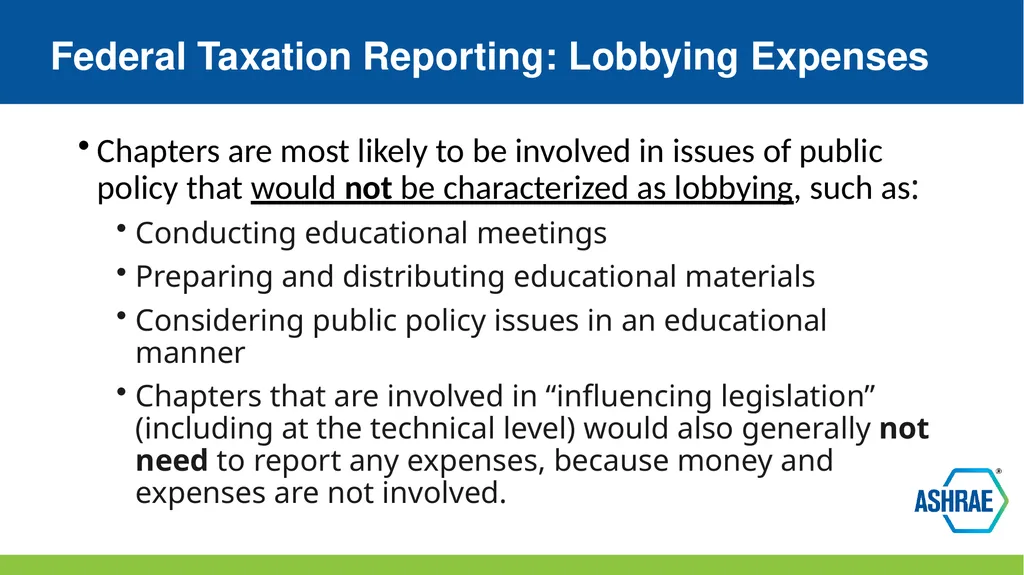
slide15. Federal Taxation Reporting: Lobbying Expenses Chapters are most likely to be involved in issues of public policy that would not be characterized as lobbying, such as:
Conducting educational meetings
Preparing and distributing educational materials
Considering public policy issues in an educational manner
Chapters that are involved in “influencing legislation” (including at the technical level) would also generally not need to report any expenses, because money and expenses are not involved.<br>
slide16. Federal Taxation Reporting: Lobbying Expenses (cont.) Some chapters (likely very few, if any) may need to report such expenses.
Federal definition of lobbying: attempting to influence legislation.
“Legislation” includes:
Action by Congress, any state legislature, any local council, or similar governing body, with respect to acts, bills, resolutions, or similar items (such as legislative confirmation of appointive office), or by the public in referendum, ballot initiative, constitutional amendment, or similar procedure. It does not include actions by executive, judicial, or administrative bodies.
“Attempting to influence” means that the organization:
Contacts, or urges the public to contact, members or employees of a legislative body for the purpose of proposing, supporting, or opposing legislation, or
Advocates the adoption or rejection of legislation.<br>
slide17. Federal Taxation Reporting: Lobbying Expenses (cont.) Lobbying expenses include:
Transportation/travel expenses, food/entertainment expenditures, or other expenditures associated with a Government Outreach Event at which lobbying takes place.
Any consultant or staff hired to support lobbying conducted by the chapter.
Note: HQ staff would not be included in these expenses as they are not paid for by the chapter.<br>
slide18. Federal Taxation Reporting: Lobbying Expenses (cont.) For Federal Income Tax Reporting:
All Lobbying expenses should be tracked.
Form 990EZ or Form 990 (see Revenue and Taxation slides for reporting requirements); Lobbying expenses will need to be reported on Schedule C (Political Campaign and Lobbying Activities) for that respective Form.
Form 990-N (E-Postcard) does not require a Schedule C.
For State Governments: Additional rules and reporting requirements may be required. The Chapter is responsible for adhering to those requirements.<br>
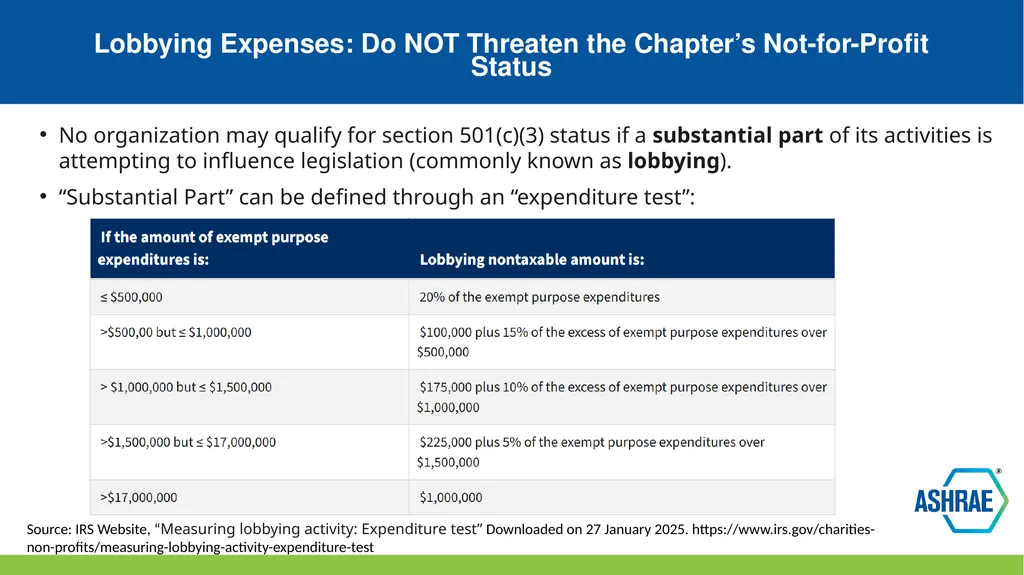
slide19. Lobbying Expenses: Do NOT Threaten the Chapter’s Not-for-Profit Status No organization may qualify for section 501(c)(3) status if a substantial part of its activities is attempting to influence legislation (commonly known as lobbying).
“Substantial Part” can be defined through an “expenditure test”: Source: IRS Website, “Measuring lobbying activity: Expenditure test” Downloaded on 27 January 2025. https://www.irs.gov/charities-non-profits/measuring-lobbying-activity-expenditure-test<br>
slide20. Fiduciary Duties Each Chapter Officer has a Fiduciary duty to the Chapter
https://dictionary.law.com/ defines a fiduciary as a person who has the power and obligation to act for another…under circumstances that require total trust, good faith and honesty.
Board members must exercise reasonable care in overseeing the organization’s financial and operational activities.<br>
slide21. Fiduciary Duties: Loyalty Board members must act solely in the best interests of the organization and its constituents, and not for personal gain.
Includes the obligation to avoid conflicts of interest
Step aside or abstain from voting when even an appearance of a conflict of interest
Comply with ASHRAE’s Codes of Ethics
Code of Ethics Commitment
This statement should be included on all agendas and read before all committee meetings:
In this and all other ASHRAE meetings, we will act with honesty, fairness, courtesy, competence, inclusiveness and respect for others, which exemplify our core values of excellence, commitment, integrity, collaboration, volunteerism and diversity, and we shall avoid all real or perceived conflicts of interests.
https://www.ashrae.org/about/governance/code-of-ethics<br>
slide22. Fiduciary Duties: Obedience Board members must act in accordance with the organization’s mission, charter and bylaws, and any applicable state or federal laws.
Board members who violate these duties may be held personally liable for any financial harm the organization suffers as a result.<br>
slide23. Fiduciary Duties: Can a Volunteer be Liable? Although volunteers enjoy some protection from financial responsibility, that protection varies by state and isn’t absolute
Society’s Privacy Policy does not apply to sites of any ASHRAE chapter, region, student branch, technical committee or other group affiliated or associated with the Society<br>
slide24. Fundraising: Best Financial Practices Investment funds and operating accounts must be separate
Research Promotion events should have separate accounting practices
Scholarship Funds should have a separate account within the chapter
Funds should be allocated precisely as advertised (i.e. if an event is advertised as being for RP, then all the money raised must go to RP, not just the net amount)<br>
slide25. Fundraising: State Registration Compliance Law
Provides basic information on a Chapter’s
Finances
Governance
Fundraising Activities
Confirms you are working with a legitimate nonprofit that is soliciting funds in that state<br>
slide26. Fundraising: State Registration, cont’d Why Register With the State? - IT’S THE LAW!!
Failure to register can…
Result in significant fines and penalties
Result in state orders to cease and desist operations
Jeopardize all fundraising activities
How does a Chapter register?
ASHRAE works with a company called URS Compliance
URS Compliance will prepare, submit and file reports and paperwork with state agencies on the Chapter’s behalf
ASHRAE will pay the URS Compliance fee in states in which a Chapter has 3 or more area assigned members
Chapters will pay
State fees
Penalties and fines for current or past years<br>
slide27. Fundraising: State Registration, cont’d What if I have questions?
Contact your DRC
Contact RP Staff at rp@ashrae.org
Contact a professional CPA (for questions about taxes or fundraising specific to state requirements)<br>
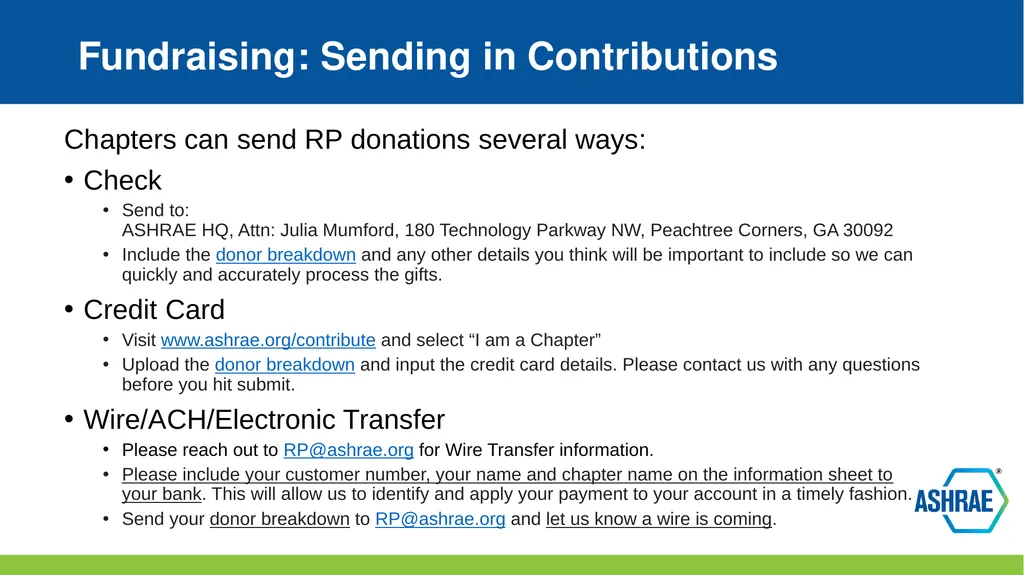
slide28. Fundraising: Sending in Contributions Chapters can send RP donations several ways:
Check
Send to: ASHRAE HQ, Attn: Julia Mumford, 180 Technology Parkway NW, Peachtree Corners, GA 30092
Include the donor breakdown and any other details you think will be important to include so we can quickly and accurately process the gifts.
Credit Card
Visit www.ashrae.org/contribute and select “I am a Chapter”
Upload the donor breakdown and input the credit card details. Please contact us with any questions before you hit submit.
Wire/ACH/Electronic Transfer
Please reach out to RP@ashrae.org for Wire Transfer information.
Please include your customer number, your name and chapter name on the information sheet to your bank. This will allow us to identify and apply your payment to your account in a timely fashion.
Send your donor breakdown to RP@ashrae.org and let us know a wire is coming.<br>
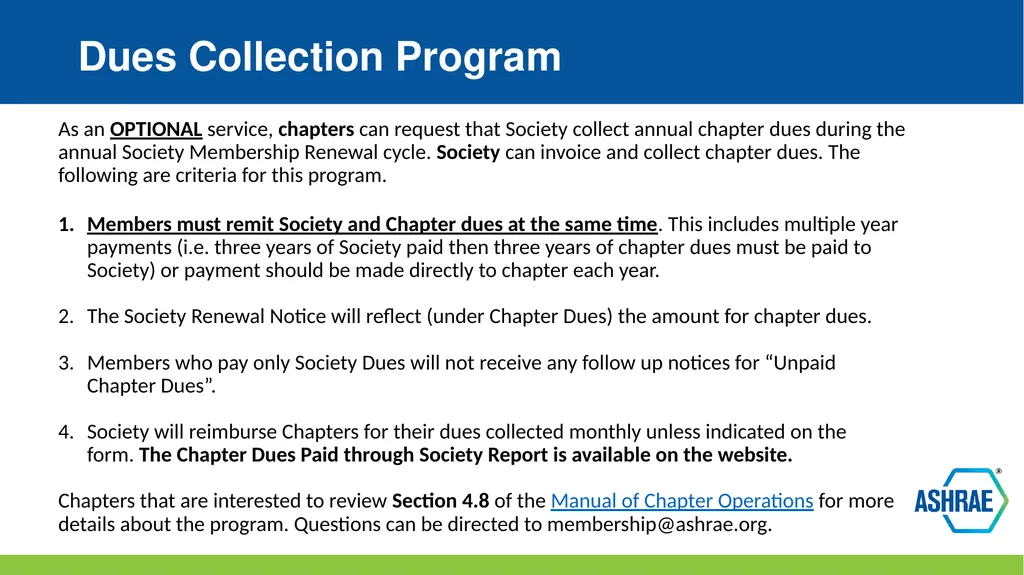
slide29. Dues Collection Program As an OPTIONAL service, chapters can request that Society collect annual chapter dues during the annual Society Membership Renewal cycle. Society can invoice and collect chapter dues. The following are criteria for this program.
Members must remit Society and Chapter dues at the same time. This includes multiple year payments (i.e. three years of Society paid then three years of chapter dues must be paid to Society) or payment should be made directly to chapter each year.
The Society Renewal Notice will reflect (under Chapter Dues) the amount for chapter dues.
Members who pay only Society Dues will not receive any follow up notices for “Unpaid Chapter Dues”.
Society will reimburse Chapters for their dues collected monthly unless indicated on the form. The Chapter Dues Paid through Society Report is available on the website.
Chapters that are interested to review Section 4.8 of the Manual of Chapter Operations for more details about the program. Questions can be directed to membership@ashrae.org.<br>
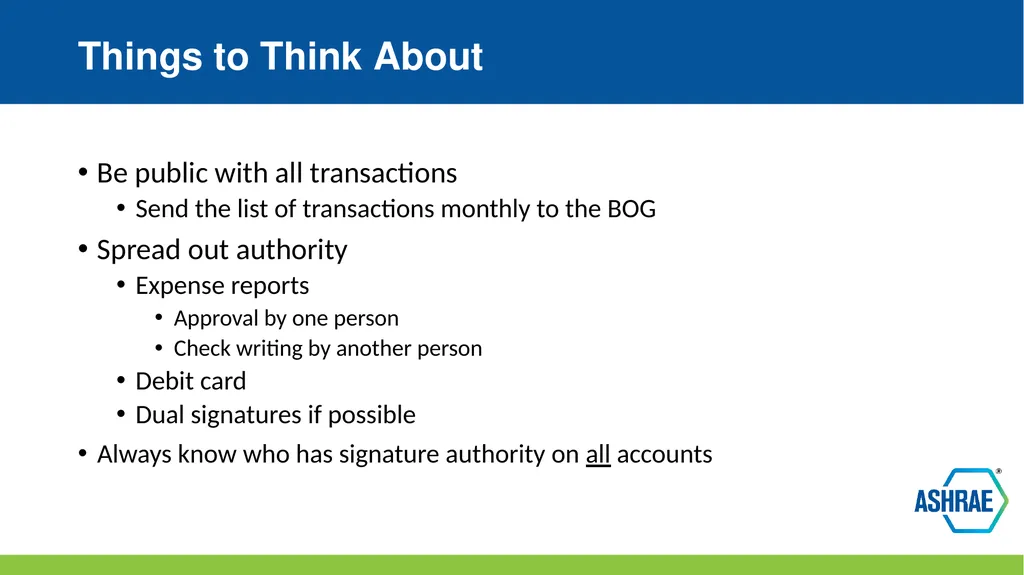
slide30. Things to Think About Be public with all transactions
Send the list of transactions monthly to the BOG
Spread out authority
Expense reports
Approval by one person
Check writing by another person
Debit card
Dual signatures if possible
Always know who has signature authority on all accounts<br>
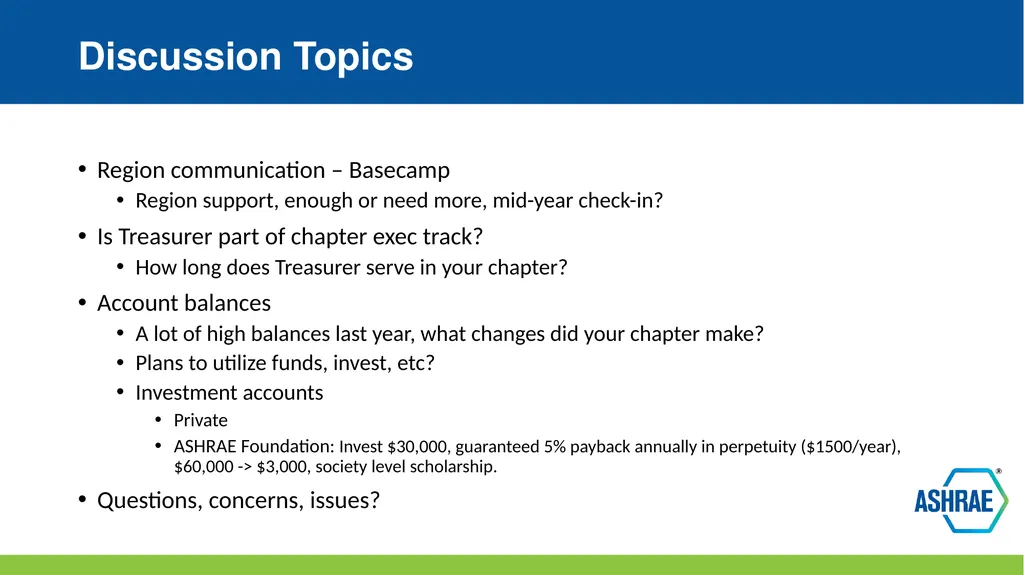
slide31. Discussion Topics Region communication – Basecamp
Region support, enough or need more, mid-year check-in?
Is Treasurer part of chapter exec track?
How long does Treasurer serve in your chapter?
Account balances
A lot of high balances last year, what changes did your chapter make?
Plans to utilize funds, invest, etc?
Investment accounts
Private
ASHRAE Foundation: Invest $30,000, guaranteed 5% payback annually in perpetuity ($1500/year), $60,000 -> $3,000, society level scholarship.
Questions, concerns, issues?<br>
slide32. Thank you! Thank you for your service to your chapter and ASHRAE!
Enjoy your participation in ASHRAE!<br>
for U.S. Chapters Updated: March 2025<br>
slide2. Chapter Financial Risk Management Training This presentation will cover:
Chapter Treasurer Duties
Financial Accounting and Banking Best Practices
Chapter Annual Financial Audits
Revenue and Tax Reporting
Fiduciary Duties
Fundraising Specifics
Most of this information is provided in the Manual for Chapter Operations<br>
slide3. Chapter Treasurer Duties Make deposits and issue checks authorized by the BOG
Balance/Reconcile monthly statements and present to BOG for review and approval
Keep financial records
Chapter Account used for Operations Only
Use Separate Accounts for Special Events such as CRC Fund or Scholarships
Other special accounts?
File Taxation and Revenue Reports
Be aware of scams<br>
slide4. Financial Accounting and Banking Best Practices Each Chapter should use reputable financial software
At least three Chapter officers should have signature authority
How does your chapter provide transparency and oversight on larger checks?
Debit Cards ……. convenient, but dangerous
Chapter should have separate accounts for high dollar special events
When possible, Research Donations should be forwarded directly to ASHRAE Research
Investments should be in safe low risk investments (i.e. bonds or term deposits), the ASHRAE Foundation or a Chapter Foundation<br>
slide5. Phishing Email Guidance If you receive an email that is from a Chapter President, Chapter Officer, Regional or Society Officer asking you to do something you don’t normally do (buy gifts, transfer money), it’s likely a scam. Suggested actions:
Don’t respond to the email.
Contact the person face to face, if possible, to question the email or contact them via telephone.
Do nothing until you can contact that person to confirm the request.
If you send money and are scammed, contact your company or if no policy is in place:
Contact your bank immediately.
Contact law enforcement.
File a complaint.
Brief the BOG and Regional Leadership.<br>
slide7. Chapter Annual Financial Audits Each Chapter should set up an Audit Committee to perform annual financial audit
Past Presidents and/or trusted senior ASHRAE members
NOT the current Chapter Treasurer or others with signature authority on account.
Goal should be to complete audit prior to CRC
Large Chapters might hire outside accounting firms to perform annual audits
Audit Committee should present its findings to Chapter BOG<br>
slide8. Revenue and Taxation Reporting Each U.S. Chapter must
Register with its state (Secretary of Sate, Department of Revenue, etc.)
File both federal and state tax returns to keep its non-profit status
All Chapters must complete annual IRS 990 Form
Small Chapters and Large Chapters complete different IRS 990 Forms
Private Foundations complete a separate form
NOTES:
There are penalties for not filing both federal and state tax returns.
Society can be at risk if a chapter loses its non-profit status. Chapter should find out whether its state requires separate non-profit registrations and/or filings.
Tax filings must report any lobbying expenses incurred by the chapter. (Note: the vast majority of chapters will not need to report any expenses because very few chapters expend money related to such activities.)<br>
slide9. Revenue and Taxation Reporting, cont’d. ASHRAE is a 501(c)(3) Charitable Organization
IRS Form 990 information and filing instructions
https://www.irs.gov/charities-non-profits/current-form-990-series-forms-and-instructions
Information about 501(c)(3) Charitable Organizations
https://www.irs.gov/charities-non-profits/charitable-organizations<br>
slide10. Revenue and Taxation Reporting: Small ASHRAE Chapter Annual gross receipts are normally less than $50,000
Three Year Average (preceding two years and current year)
Annual Electronic Filing Form 990-N (E-Postcard)
https://www.irs.gov/charities-non-profits/annual-electronic-filing-requirement-for-small-exempt-organizations-form-990-n-e-postcard<br>
slide11. Revenue and Taxation Reporting: Small ASHRAE Chapter, cont’d Information needed for Form 990-N (E-Postcard)
Name of chapter
Chapter mailing address
Chapter employer/tax identification number
Name and address of principal officer
Certification that gross receipts are under $50,000<br>
slide12. Revenue and Taxation Reporting: Large ASHRAE Chapter If annual gross receipts are normally between $50,000 and $200,000 and total assets are less than $500,000, use Form 990-EZ or 990
If annual gross receipts are normally $200,000 or more and total assets are $500,000 or more, use Form 990
If a Private Foundation, use Form 990-PF<br>
slide13. Revenue and Taxation Reporting: All ASHRAE Chapters Tax filing due by the end of the 15th day of the 5th month after the close of year end
ASHRAE tax year ends June 30, tax filing must be completed by November 15
Cannot file until after tax year ends
It’s after June 30th … you can file your taxes now !<br>
slide14. Revenue and Taxation Reporting: Late Filing or Failure to File Chapters that file late (without receiving advance IRS approval) or fail to file tax returns:
Risk IRS fines
Jeopardize Society’s tax-exempt status
Could be dissolved by Society<br>
slide15. Federal Taxation Reporting: Lobbying Expenses Chapters are most likely to be involved in issues of public policy that would not be characterized as lobbying, such as:
Conducting educational meetings
Preparing and distributing educational materials
Considering public policy issues in an educational manner
Chapters that are involved in “influencing legislation” (including at the technical level) would also generally not need to report any expenses, because money and expenses are not involved.<br>
slide16. Federal Taxation Reporting: Lobbying Expenses (cont.) Some chapters (likely very few, if any) may need to report such expenses.
Federal definition of lobbying: attempting to influence legislation.
“Legislation” includes:
Action by Congress, any state legislature, any local council, or similar governing body, with respect to acts, bills, resolutions, or similar items (such as legislative confirmation of appointive office), or by the public in referendum, ballot initiative, constitutional amendment, or similar procedure. It does not include actions by executive, judicial, or administrative bodies.
“Attempting to influence” means that the organization:
Contacts, or urges the public to contact, members or employees of a legislative body for the purpose of proposing, supporting, or opposing legislation, or
Advocates the adoption or rejection of legislation.<br>
slide17. Federal Taxation Reporting: Lobbying Expenses (cont.) Lobbying expenses include:
Transportation/travel expenses, food/entertainment expenditures, or other expenditures associated with a Government Outreach Event at which lobbying takes place.
Any consultant or staff hired to support lobbying conducted by the chapter.
Note: HQ staff would not be included in these expenses as they are not paid for by the chapter.<br>
slide18. Federal Taxation Reporting: Lobbying Expenses (cont.) For Federal Income Tax Reporting:
All Lobbying expenses should be tracked.
Form 990EZ or Form 990 (see Revenue and Taxation slides for reporting requirements); Lobbying expenses will need to be reported on Schedule C (Political Campaign and Lobbying Activities) for that respective Form.
Form 990-N (E-Postcard) does not require a Schedule C.
For State Governments: Additional rules and reporting requirements may be required. The Chapter is responsible for adhering to those requirements.<br>
slide19. Lobbying Expenses: Do NOT Threaten the Chapter’s Not-for-Profit Status No organization may qualify for section 501(c)(3) status if a substantial part of its activities is attempting to influence legislation (commonly known as lobbying).
“Substantial Part” can be defined through an “expenditure test”: Source: IRS Website, “Measuring lobbying activity: Expenditure test” Downloaded on 27 January 2025. https://www.irs.gov/charities-non-profits/measuring-lobbying-activity-expenditure-test<br>
slide20. Fiduciary Duties Each Chapter Officer has a Fiduciary duty to the Chapter
https://dictionary.law.com/ defines a fiduciary as a person who has the power and obligation to act for another…under circumstances that require total trust, good faith and honesty.
Board members must exercise reasonable care in overseeing the organization’s financial and operational activities.<br>
slide21. Fiduciary Duties: Loyalty Board members must act solely in the best interests of the organization and its constituents, and not for personal gain.
Includes the obligation to avoid conflicts of interest
Step aside or abstain from voting when even an appearance of a conflict of interest
Comply with ASHRAE’s Codes of Ethics
Code of Ethics Commitment
This statement should be included on all agendas and read before all committee meetings:
In this and all other ASHRAE meetings, we will act with honesty, fairness, courtesy, competence, inclusiveness and respect for others, which exemplify our core values of excellence, commitment, integrity, collaboration, volunteerism and diversity, and we shall avoid all real or perceived conflicts of interests.
https://www.ashrae.org/about/governance/code-of-ethics<br>
slide22. Fiduciary Duties: Obedience Board members must act in accordance with the organization’s mission, charter and bylaws, and any applicable state or federal laws.
Board members who violate these duties may be held personally liable for any financial harm the organization suffers as a result.<br>
slide23. Fiduciary Duties: Can a Volunteer be Liable? Although volunteers enjoy some protection from financial responsibility, that protection varies by state and isn’t absolute
Society’s Privacy Policy does not apply to sites of any ASHRAE chapter, region, student branch, technical committee or other group affiliated or associated with the Society<br>
slide24. Fundraising: Best Financial Practices Investment funds and operating accounts must be separate
Research Promotion events should have separate accounting practices
Scholarship Funds should have a separate account within the chapter
Funds should be allocated precisely as advertised (i.e. if an event is advertised as being for RP, then all the money raised must go to RP, not just the net amount)<br>
slide25. Fundraising: State Registration Compliance Law
Provides basic information on a Chapter’s
Finances
Governance
Fundraising Activities
Confirms you are working with a legitimate nonprofit that is soliciting funds in that state<br>
slide26. Fundraising: State Registration, cont’d Why Register With the State? - IT’S THE LAW!!
Failure to register can…
Result in significant fines and penalties
Result in state orders to cease and desist operations
Jeopardize all fundraising activities
How does a Chapter register?
ASHRAE works with a company called URS Compliance
URS Compliance will prepare, submit and file reports and paperwork with state agencies on the Chapter’s behalf
ASHRAE will pay the URS Compliance fee in states in which a Chapter has 3 or more area assigned members
Chapters will pay
State fees
Penalties and fines for current or past years<br>
slide27. Fundraising: State Registration, cont’d What if I have questions?
Contact your DRC
Contact RP Staff at rp@ashrae.org
Contact a professional CPA (for questions about taxes or fundraising specific to state requirements)<br>
slide28. Fundraising: Sending in Contributions Chapters can send RP donations several ways:
Check
Send to: ASHRAE HQ, Attn: Julia Mumford, 180 Technology Parkway NW, Peachtree Corners, GA 30092
Include the donor breakdown and any other details you think will be important to include so we can quickly and accurately process the gifts.
Credit Card
Visit www.ashrae.org/contribute and select “I am a Chapter”
Upload the donor breakdown and input the credit card details. Please contact us with any questions before you hit submit.
Wire/ACH/Electronic Transfer
Please reach out to RP@ashrae.org for Wire Transfer information.
Please include your customer number, your name and chapter name on the information sheet to your bank. This will allow us to identify and apply your payment to your account in a timely fashion.
Send your donor breakdown to RP@ashrae.org and let us know a wire is coming.<br>
slide29. Dues Collection Program As an OPTIONAL service, chapters can request that Society collect annual chapter dues during the annual Society Membership Renewal cycle. Society can invoice and collect chapter dues. The following are criteria for this program.
Members must remit Society and Chapter dues at the same time. This includes multiple year payments (i.e. three years of Society paid then three years of chapter dues must be paid to Society) or payment should be made directly to chapter each year.
The Society Renewal Notice will reflect (under Chapter Dues) the amount for chapter dues.
Members who pay only Society Dues will not receive any follow up notices for “Unpaid Chapter Dues”.
Society will reimburse Chapters for their dues collected monthly unless indicated on the form. The Chapter Dues Paid through Society Report is available on the website.
Chapters that are interested to review Section 4.8 of the Manual of Chapter Operations for more details about the program. Questions can be directed to membership@ashrae.org.<br>
slide30. Things to Think About Be public with all transactions
Send the list of transactions monthly to the BOG
Spread out authority
Expense reports
Approval by one person
Check writing by another person
Debit card
Dual signatures if possible
Always know who has signature authority on all accounts<br>
slide31. Discussion Topics Region communication – Basecamp
Region support, enough or need more, mid-year check-in?
Is Treasurer part of chapter exec track?
How long does Treasurer serve in your chapter?
Account balances
A lot of high balances last year, what changes did your chapter make?
Plans to utilize funds, invest, etc?
Investment accounts
Private
ASHRAE Foundation: Invest $30,000, guaranteed 5% payback annually in perpetuity ($1500/year), $60,000 -> $3,000, society level scholarship.
Questions, concerns, issues?<br>
slide32. Thank you! Thank you for your service to your chapter and ASHRAE!
Enjoy your participation in ASHRAE!<br>