
First Year Information night Statistics and
Description: First Year Information night Statistics and Actuarial Science (SAS) 1 11262024 Meet (some of) your Statistics and Actuarial Science Advisors Emily Kozlowski Associate Professor Teaching Stream, Head ActSci advisor, Waterloo alumni,
Related Topics
Download Presentation
"First Year Information night Statistics and" is the property of its rightful owner. Permission is granted to download and print the materials on this website for personal, non-commercial use only, and to display it on your personal computer provided you do not modify the materials and that you retain all copyright notices contained in the materials. By downloading content from our website, you accept the terms of this agreement.
Presentation Transcript
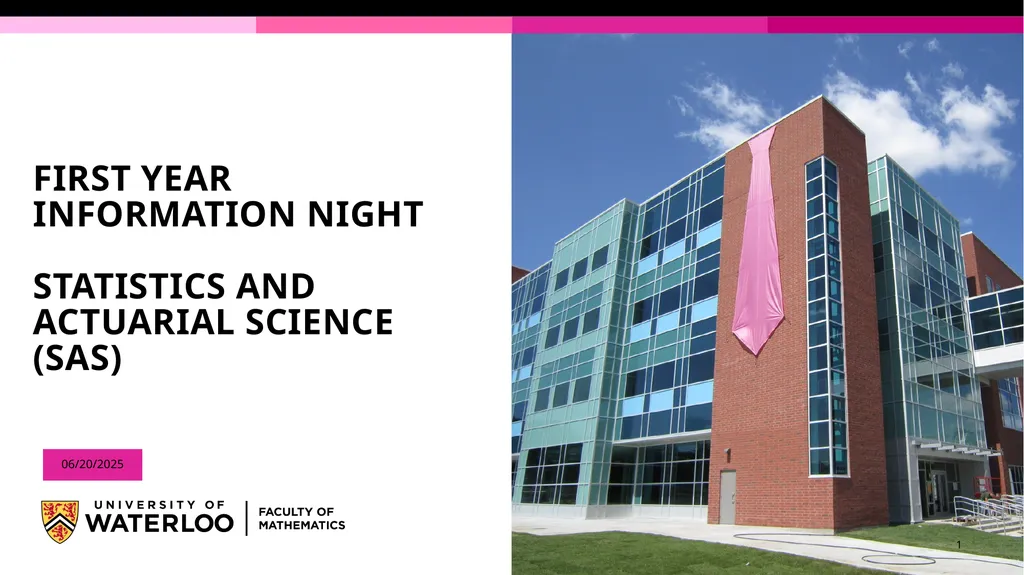
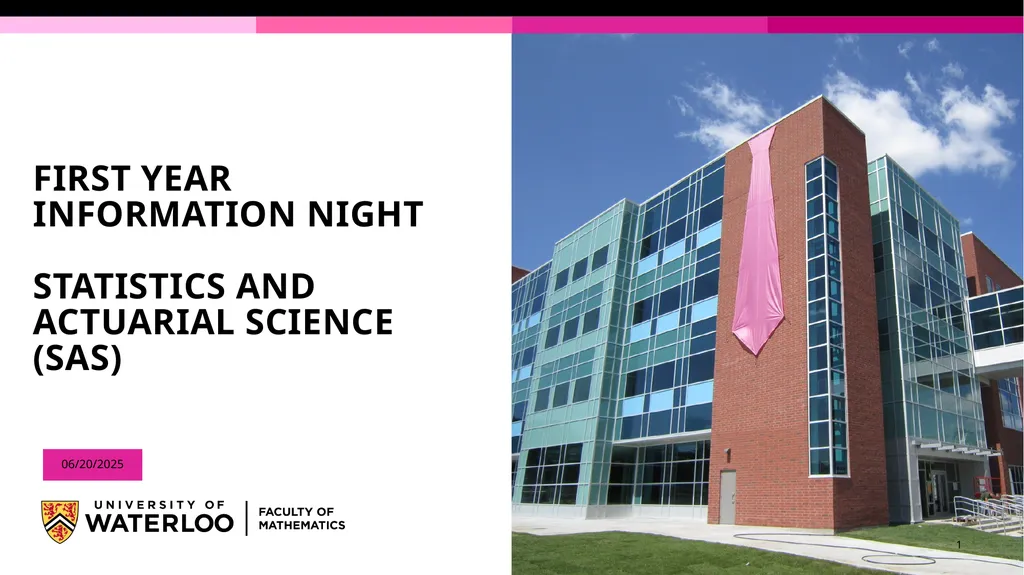
slide1. First Year Information night
Statistics and Actuarial Science (SAS) 1 11/26/2024<br>
slide2. Meet (some of) your Statistics and Actuarial Science Advisors Emily Kozlowski – Associate Professor Teaching Stream, Head ActSci advisor, Waterloo alumni, twice (BMath & MMath), in Actuarial Science, and an associate in the SOA & CIA.
Riley Metzger – Associate Professor Teaching Stream, Head Stat advisor, and Waterloo alumni, twice (BMath & MMath), in Statistics. PAGE 2<br>
slide3. What do the advisors do? Sign course (selection) override forms for all STAT and ACTSC courses (also MTHEL 131 and ENGL 378).
Sign plan modification forms (used to declare majors/joints/minors/specializations) for all ACTSC and STAT plans.
Answer questions about courses in ACTSC and STAT. Things like pre-req or anti-req questions, substitutions, offerings, order to complete them and so on.
Answer questions about the programs in ACTSC and STAT, such as electives needed, average to maintain, average calculation, how to do a double major or a minor with it.
Many, many more things! PAGE 3<br>
slide4. How do I get help from an advisor? First check the FAQ and Table of Questions pages on the department website.
If you can’t find your question, then you can either email the advisors at SASUGradAdv@uwaterloo.ca or visit us (in-person or virtually) during our regular advising hours. Hours are posted on the department website. PAGE 4 FAQ Tables of Questions Advising hours<br>
slide5. Statistics, Biostatistics and DAta Science PAGE 5<br>
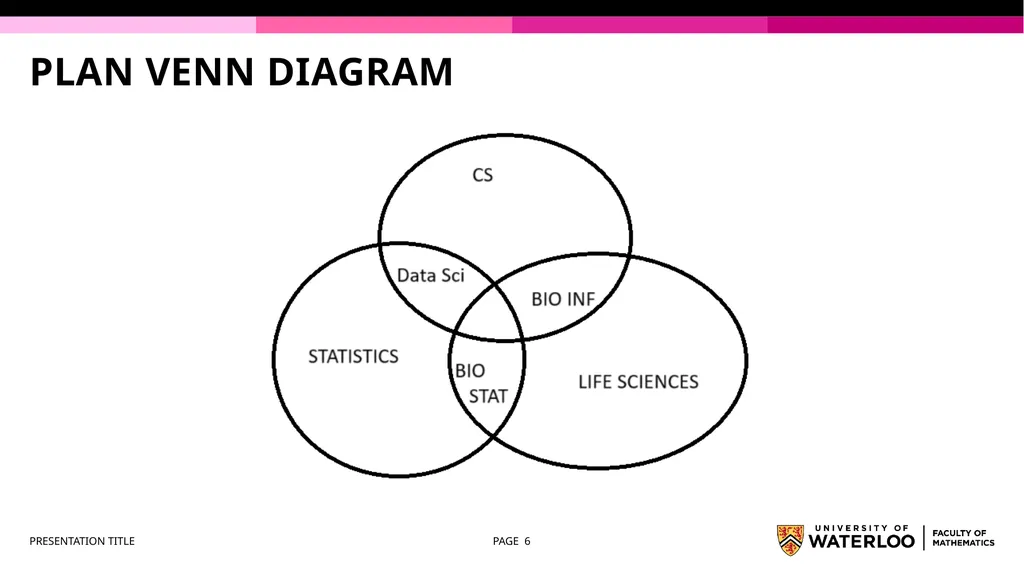
slide6. PRESENTATION TITLE PAGE 6 Plan Venn diagram<br>
slide7. Hal Varian, Executive Google.com Dream Job - Statistician (BioStatistician or Data Scientist) PRESENTATION TITLE PAGE 7<br>
slide8. Statistics PAGE 8<br>
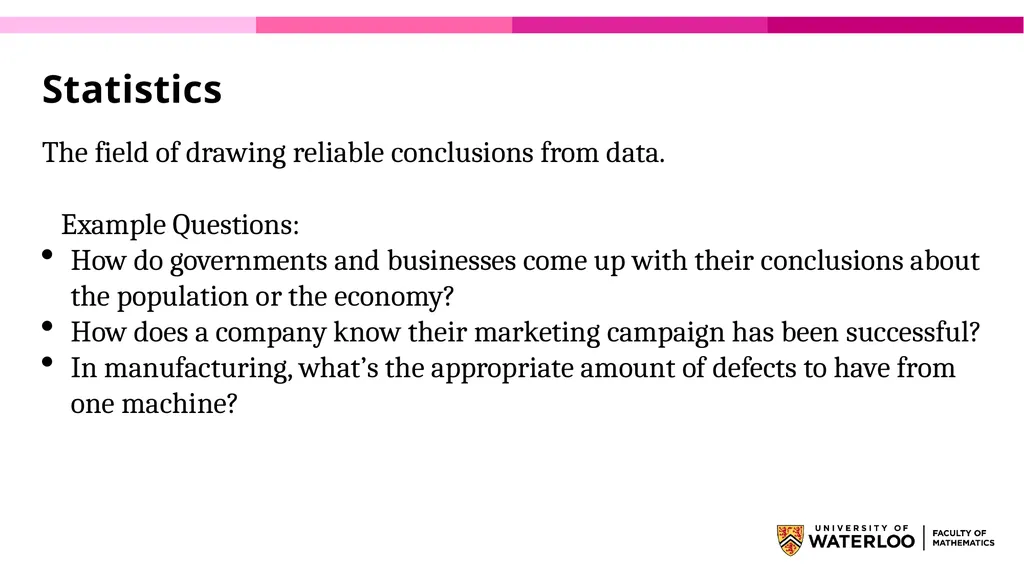
slide9. Statistics The field of drawing reliable conclusions from data.
Example Questions:
How do governments and businesses come up with their conclusions about the population or the economy?
How does a company know their marketing campaign has been successful?
In manufacturing, what’s the appropriate amount of defects to have from one machine?<br>
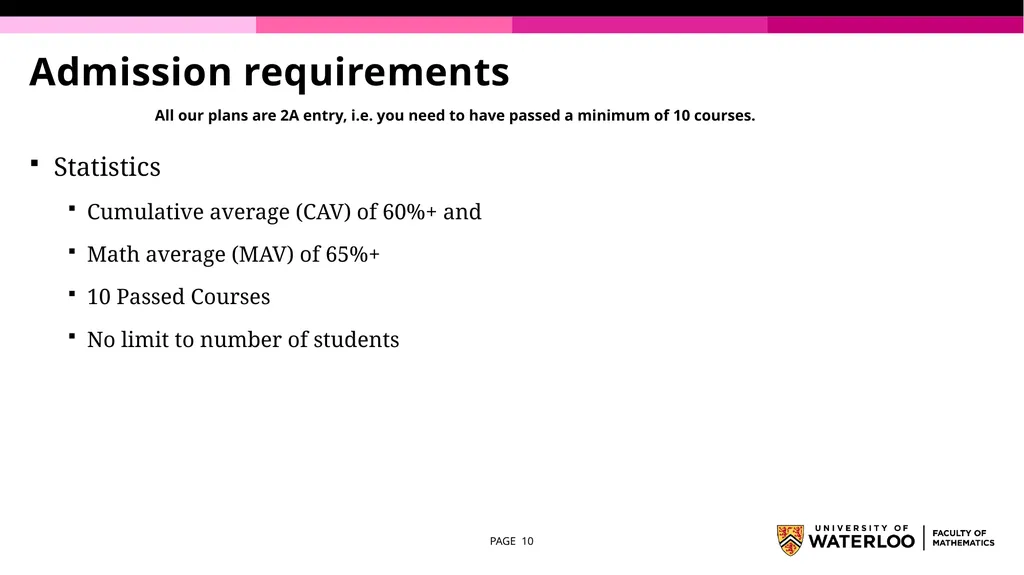
slide10. Admission requirements Statistics
Cumulative average (CAV) of 60%+ and
Math average (MAV) of 65%+
10 Passed Courses
No limit to number of students All our plans are 2A entry, i.e. you need to have passed a minimum of 10 courses. PAGE 10<br>
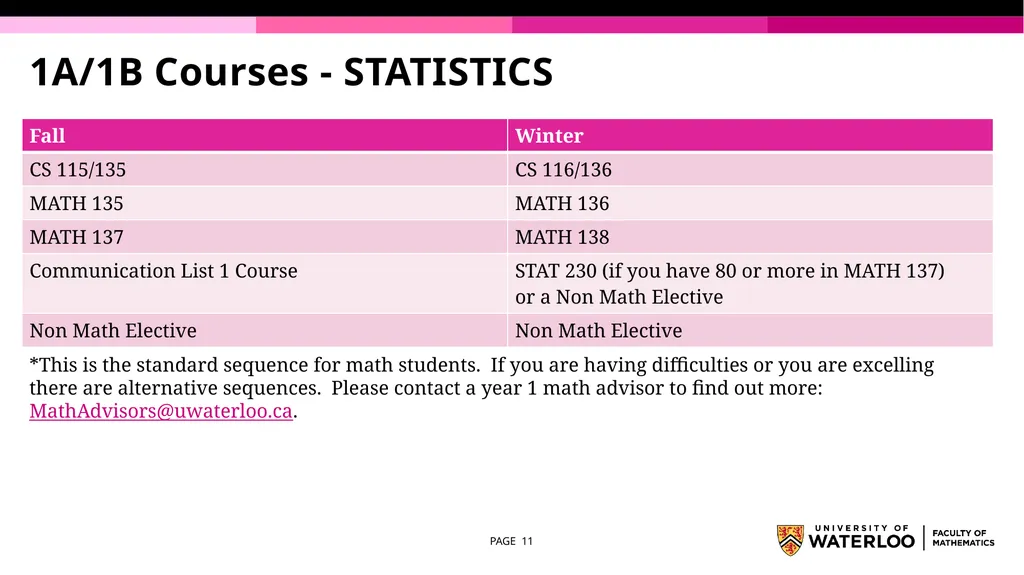
slide11. 1A/1B Courses - STATISTICS PAGE 11 *This is the standard sequence for math students. If you are having difficulties or you are excelling there are alternative sequences. Please contact a year 1 math advisor to find out more: MathAdvisors@uwaterloo.ca.<br>
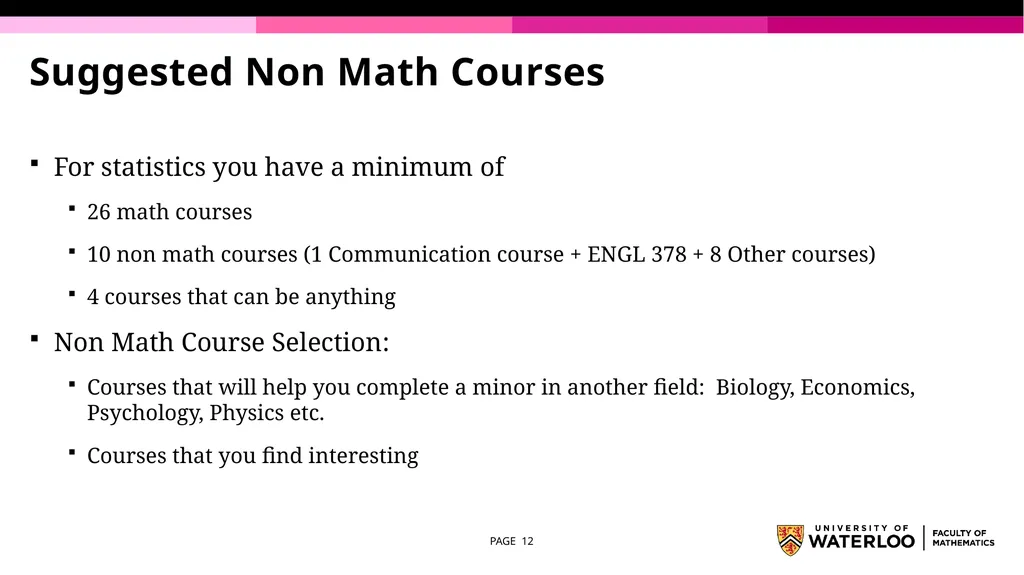
slide12. Suggested Non Math Courses For statistics you have a minimum of
26 math courses
10 non math courses (1 Communication course + ENGL 378 + 8 Other courses)
4 courses that can be anything
Non Math Course Selection:
Courses that will help you complete a minor in another field: Biology, Economics, Psychology, Physics etc.
Courses that you find interesting PAGE 12<br>
slide13. Biostatistics PAGE 13<br>
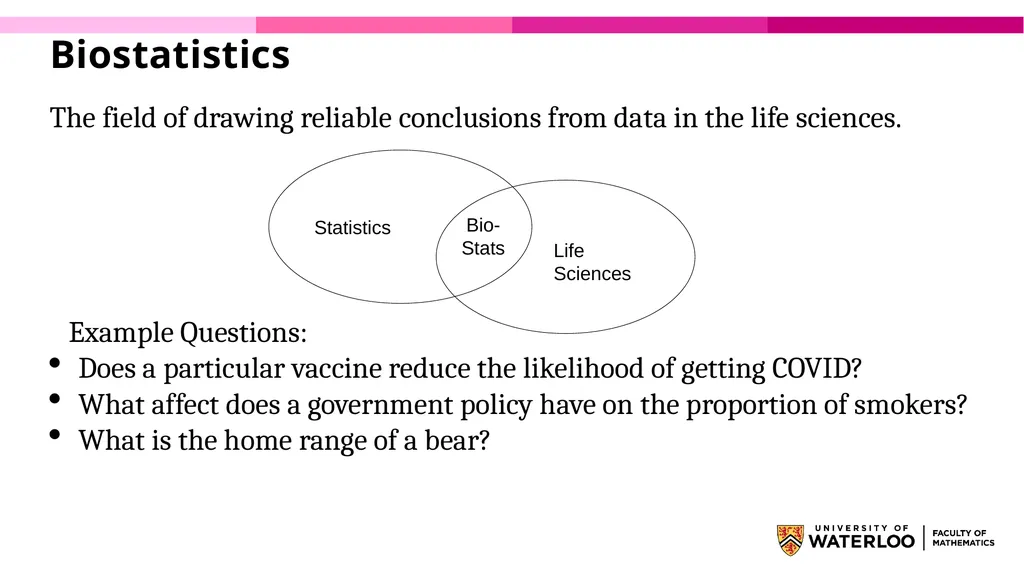
slide14. Biostatistics The field of drawing reliable conclusions from data in the life sciences.
Example Questions:
Does a particular vaccine reduce the likelihood of getting COVID?
What affect does a government policy have on the proportion of smokers?
What is the home range of a bear? Statistics Life
Sciences Bio-Stats<br>
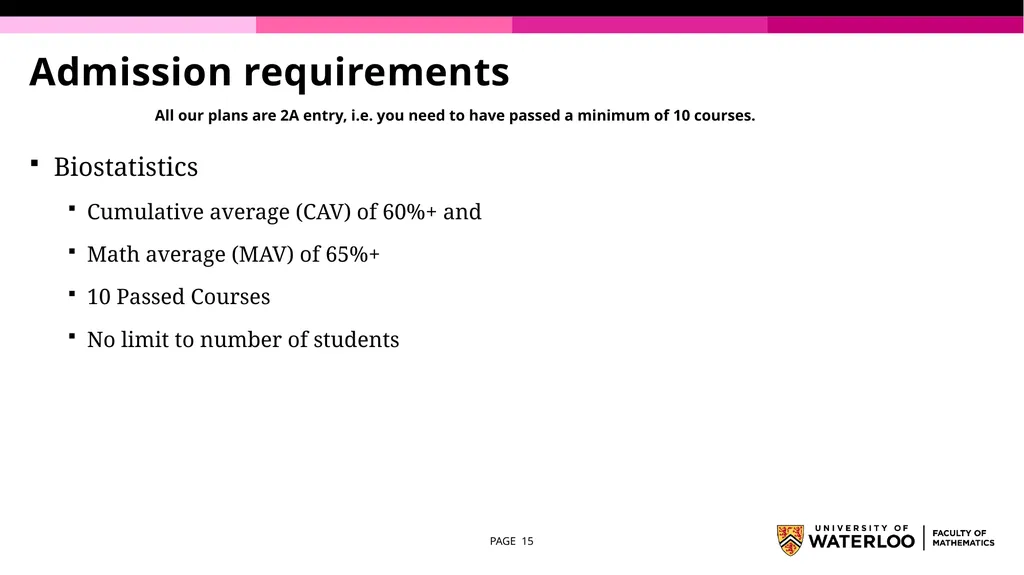
slide15. Admission requirements Biostatistics
Cumulative average (CAV) of 60%+ and
Math average (MAV) of 65%+
10 Passed Courses
No limit to number of students All our plans are 2A entry, i.e. you need to have passed a minimum of 10 courses. PAGE 15<br>
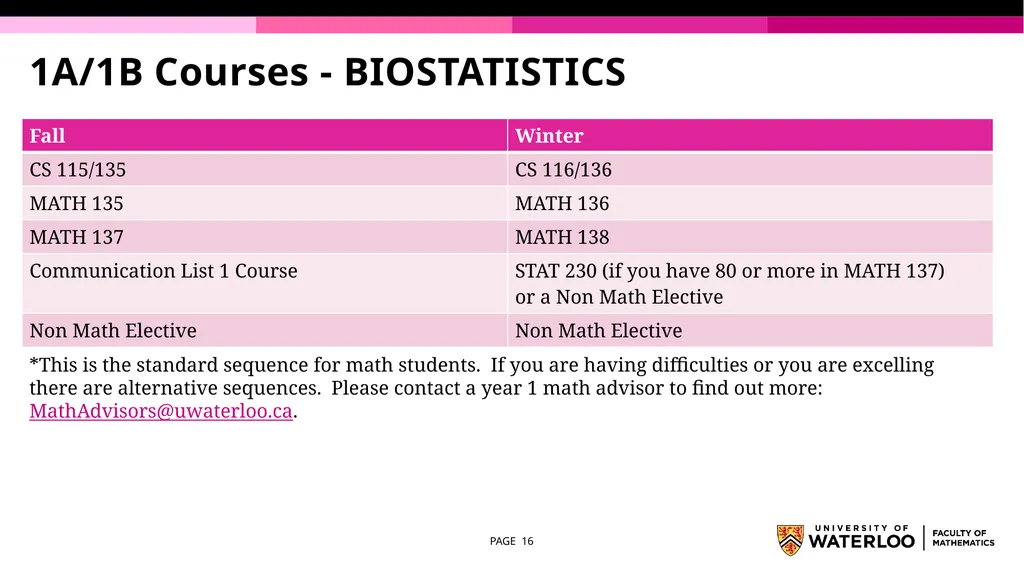
slide16. 1A/1B Courses - BIOSTATISTICS PAGE 16 *This is the standard sequence for math students. If you are having difficulties or you are excelling there are alternative sequences. Please contact a year 1 math advisor to find out more: MathAdvisors@uwaterloo.ca.<br>
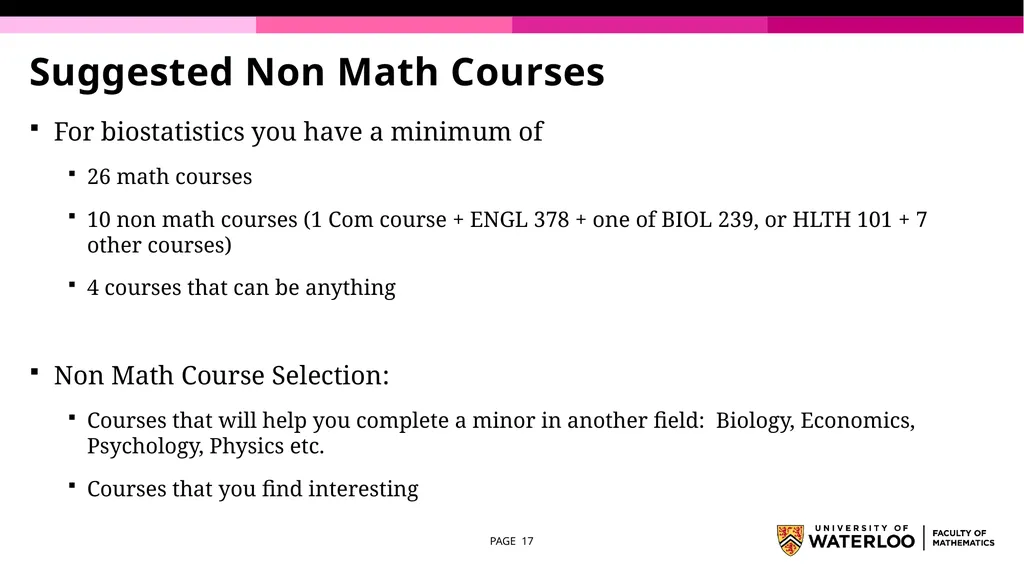
slide17. Suggested Non Math Courses For biostatistics you have a minimum of
26 math courses
10 non math courses (1 Com course + ENGL 378 + one of BIOL 239, or HLTH 101 + 7 other courses)
4 courses that can be anything
Non Math Course Selection:
Courses that will help you complete a minor in another field: Biology, Economics, Psychology, Physics etc.
Courses that you find interesting PAGE 17<br>
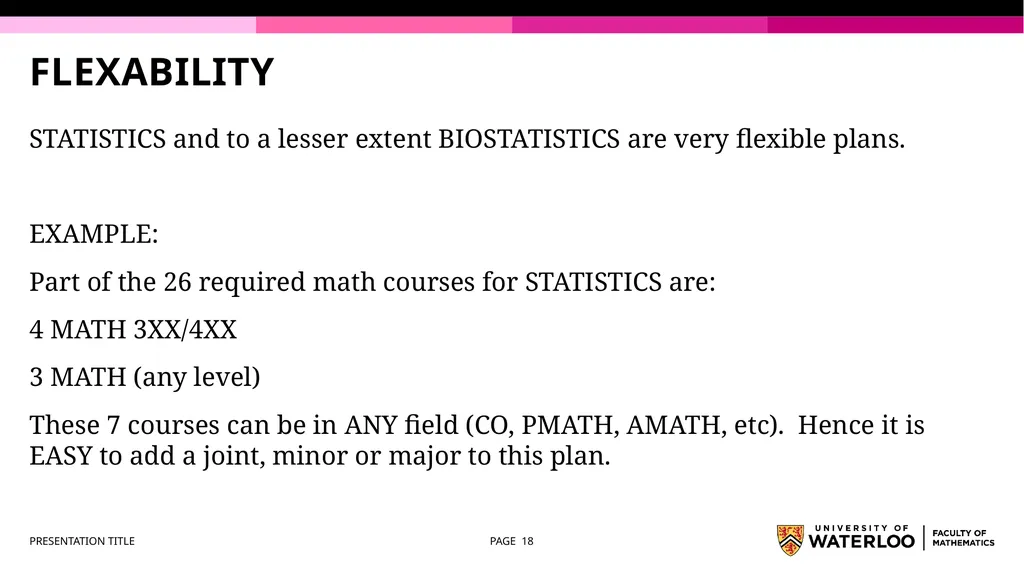
slide18. STATISTICS and to a lesser extent BIOSTATISTICS are very flexible plans.
EXAMPLE:
Part of the 26 required math courses for STATISTICS are:
4 MATH 3XX/4XX
3 MATH (any level)
These 7 courses can be in ANY field (CO, PMATH, AMATH, etc). Hence it is EASY to add a joint, minor or major to this plan. PRESENTATION TITLE PAGE 18 Flexability<br>
slide19. Data SCIENCE PAGE 19<br>
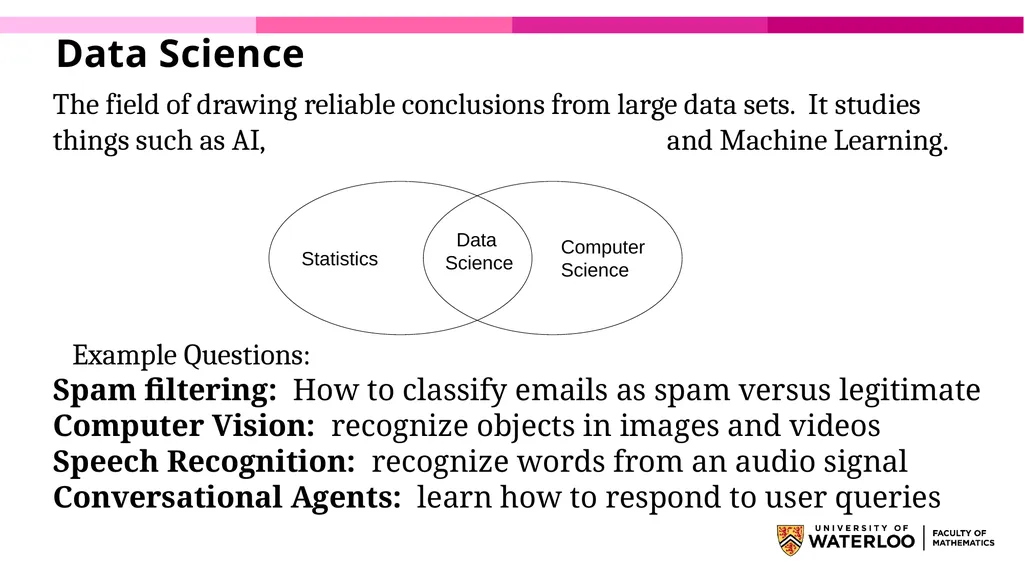
slide20. Data Science The field of drawing reliable conclusions from large data sets. It studies things such as AI, and Machine Learning.
Example Questions:
Spam filtering: How to classify emails as spam versus legitimate
Computer Vision: recognize objects in images and videos
Speech Recognition: recognize words from an audio signal
Conversational Agents: learn how to respond to user queries Statistics Computer
Science Data
Science<br>
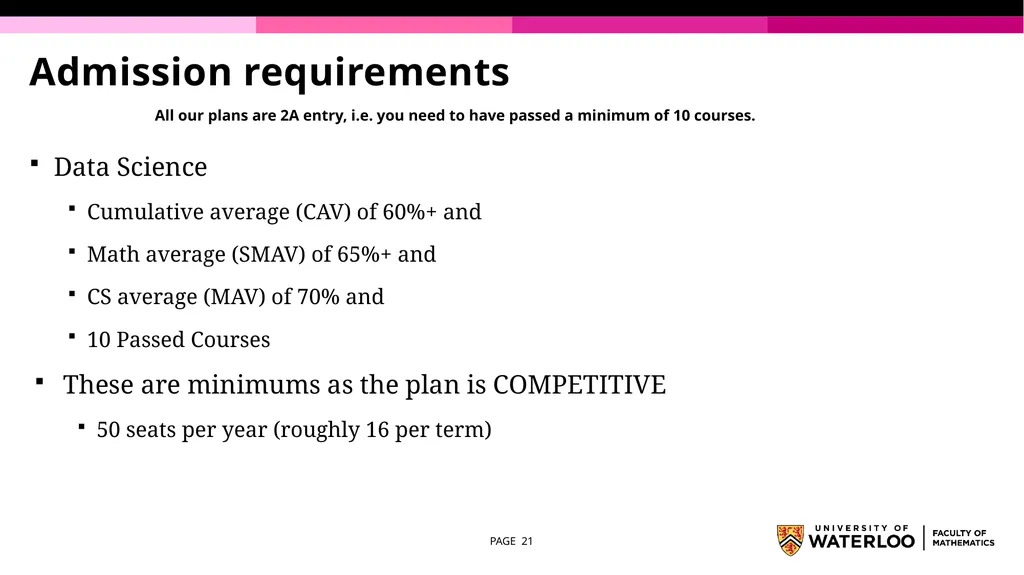
slide21. Admission requirements Data Science
Cumulative average (CAV) of 60%+ and
Math average (SMAV) of 65%+ and
CS average (MAV) of 70% and
10 Passed Courses
These are minimums as the plan is COMPETITIVE
50 seats per year (roughly 16 per term) All our plans are 2A entry, i.e. you need to have passed a minimum of 10 courses. PAGE 21<br>
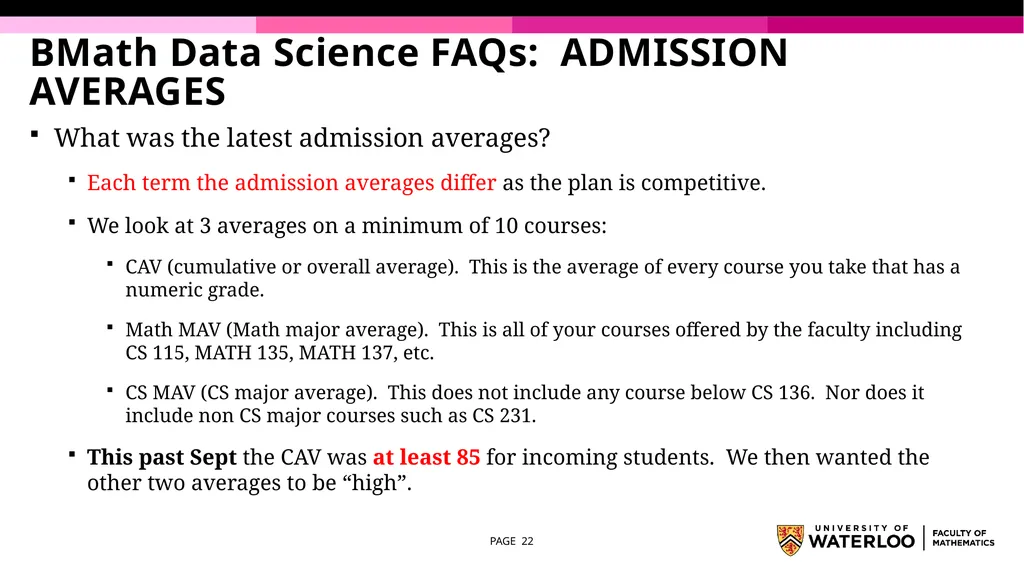
slide22. BMath Data Science FAQs: ADMISSION AVERAGES What was the latest admission averages?
Each term the admission averages differ as the plan is competitive.
We look at 3 averages on a minimum of 10 courses:
CAV (cumulative or overall average). This is the average of every course you take that has a numeric grade.
Math MAV (Math major average). This is all of your courses offered by the faculty including CS 115, MATH 135, MATH 137, etc.
CS MAV (CS major average). This does not include any course below CS 136. Nor does it include non CS major courses such as CS 231.
This past Sept the CAV was at least 85 for incoming students. We then wanted the other two averages to be “high”. PAGE 22<br>
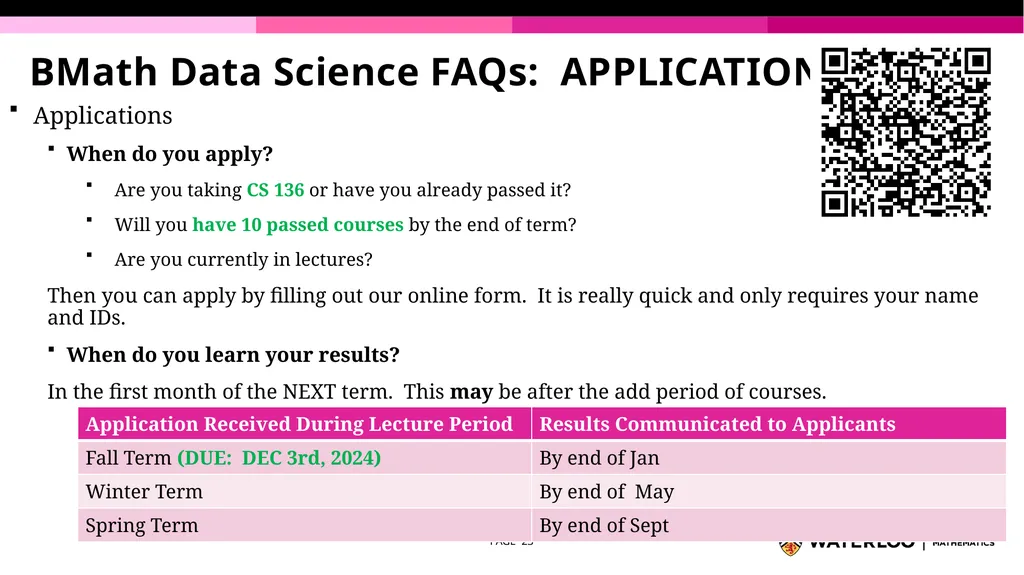
slide23. BMath Data Science FAQs: APPLICATIONS Applications
When do you apply?
Are you taking CS 136 or have you already passed it?
Will you have 10 passed courses by the end of term?
Are you currently in lectures?
Then you can apply by filling out our online form. It is really quick and only requires your name and IDs.
When do you learn your results?
In the first month of the NEXT term. This may be after the add period of courses. PAGE 23<br>
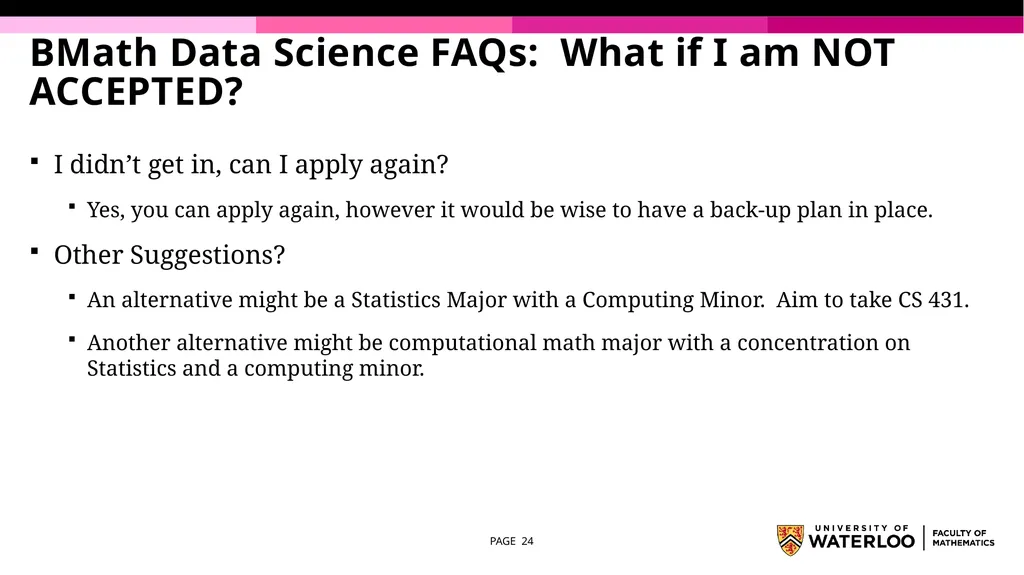
slide24. BMath Data Science FAQs: What if I am NOT ACCEPTED? I didn’t get in, can I apply again?
Yes, you can apply again, however it would be wise to have a back-up plan in place.
Other Suggestions?
An alternative might be a Statistics Major with a Computing Minor. Aim to take CS 431.
Another alternative might be computational math major with a concentration on Statistics and a computing minor. PAGE 24<br>
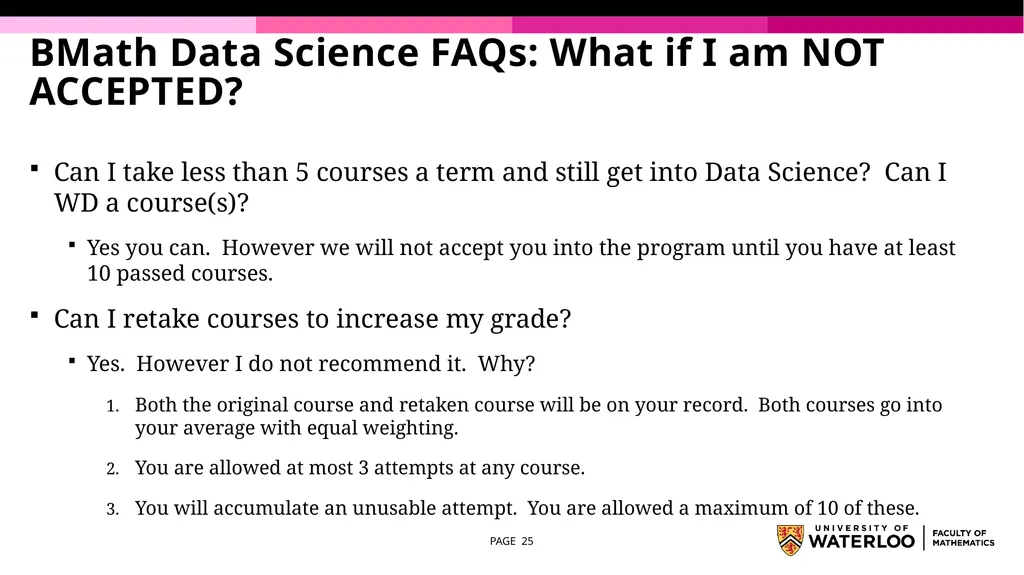
slide25. BMath Data Science FAQs: What if I am NOT ACCEPTED? Can I take less than 5 courses a term and still get into Data Science? Can I WD a course(s)?
Yes you can. However we will not accept you into the program until you have at least 10 passed courses.
Can I retake courses to increase my grade?
Yes. However I do not recommend it. Why?
Both the original course and retaken course will be on your record. Both courses go into your average with equal weighting.
You are allowed at most 3 attempts at any course.
You will accumulate an unusable attempt. You are allowed a maximum of 10 of these. PAGE 25<br>
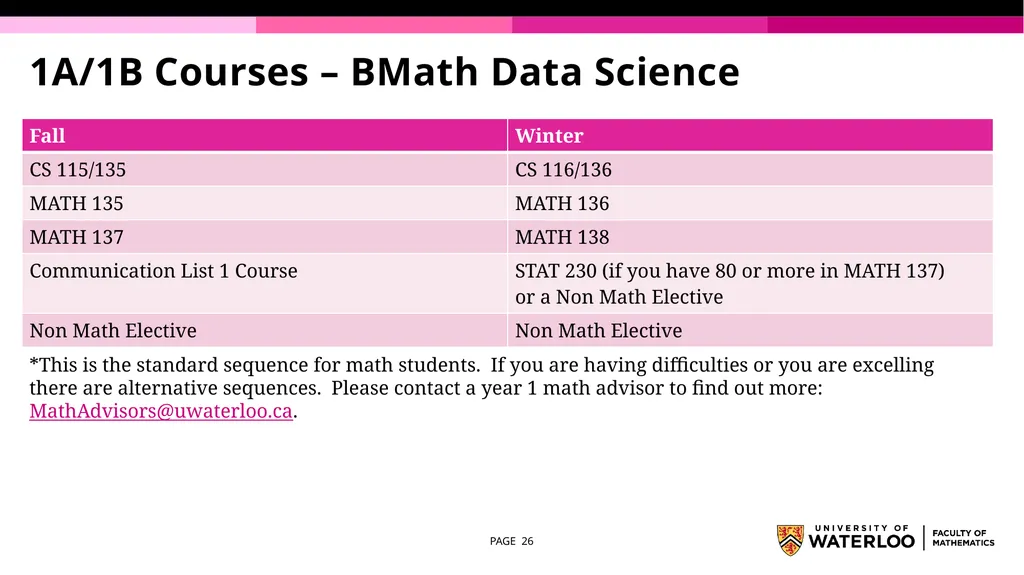
slide26. 1A/1B Courses – BMath Data Science PAGE 26 *This is the standard sequence for math students. If you are having difficulties or you are excelling there are alternative sequences. Please contact a year 1 math advisor to find out more: MathAdvisors@uwaterloo.ca.<br>
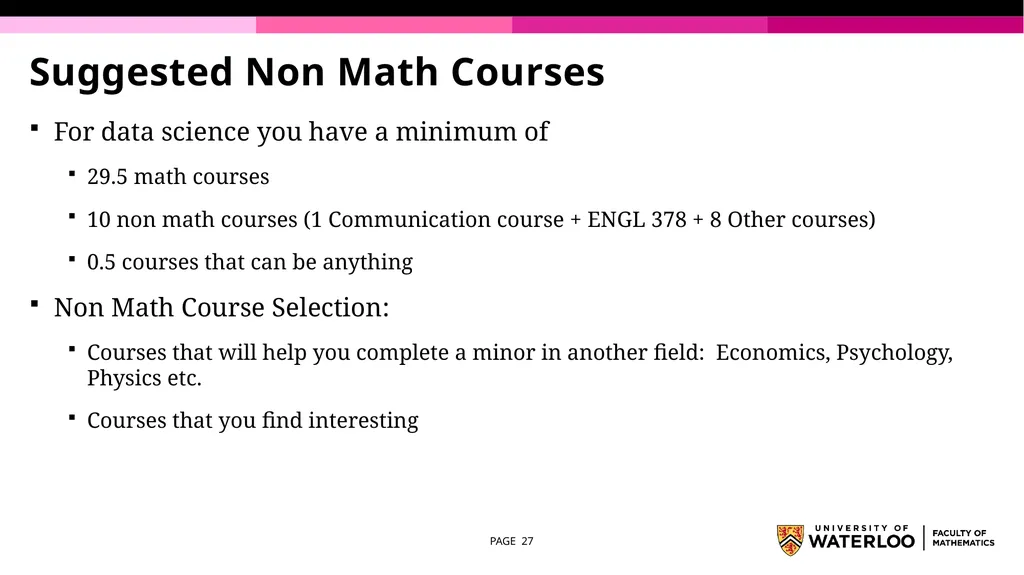
slide27. Suggested Non Math Courses For data science you have a minimum of
29.5 math courses
10 non math courses (1 Communication course + ENGL 378 + 8 Other courses)
0.5 courses that can be anything
Non Math Course Selection:
Courses that will help you complete a minor in another field: Economics, Psychology, Physics etc.
Courses that you find interesting PAGE 27<br>
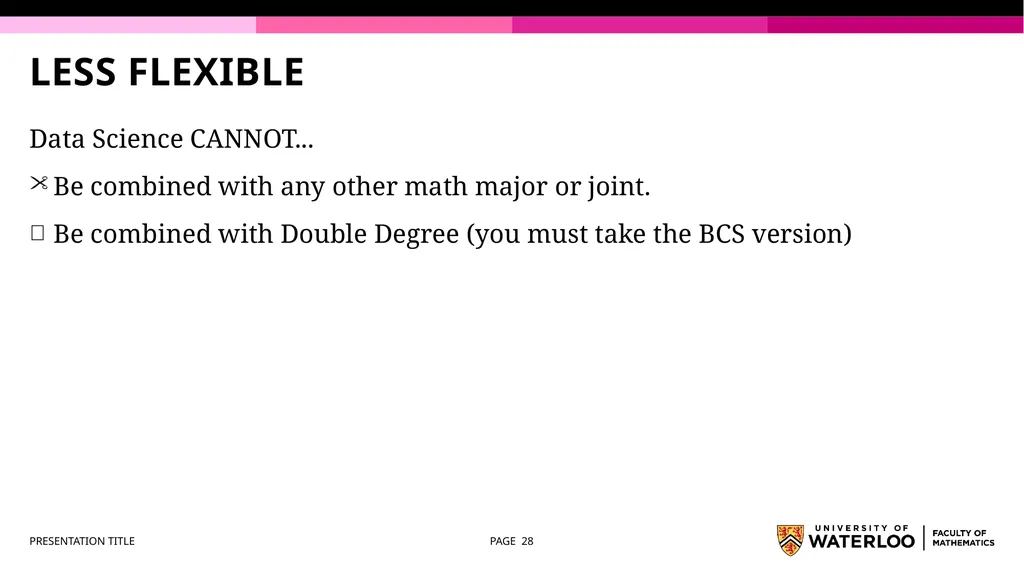
slide28. LESS FLEXIBLE Data Science CANNOT...
Be combined with any other math major or joint.
Be combined with Double Degree (you must take the BCS version) PRESENTATION TITLE PAGE 28<br>
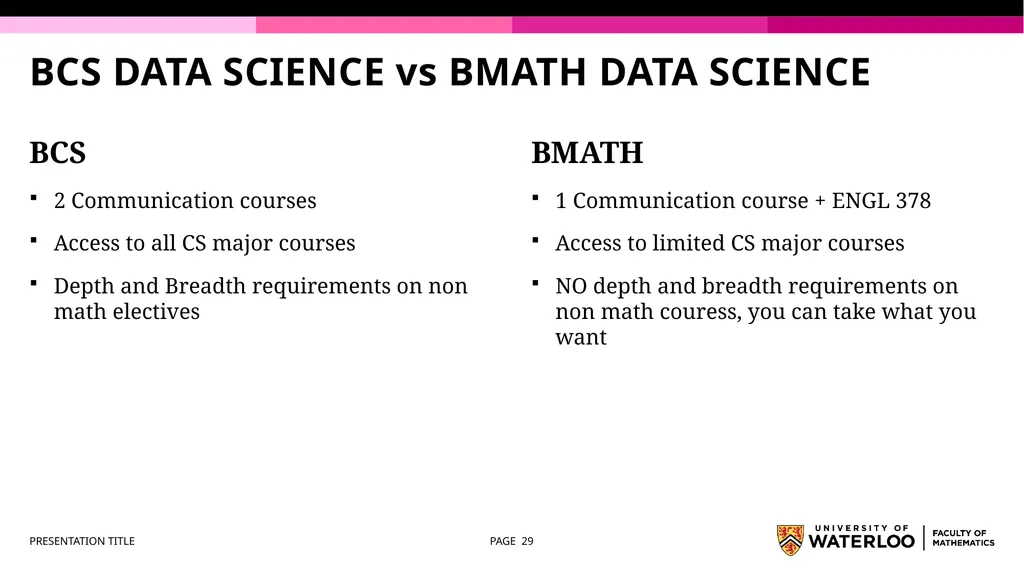
slide29. BCS 2 Communication courses
Access to all CS major courses
Depth and Breadth requirements on non math electives BMATH 1 Communication course + ENGL 378
Access to limited CS major courses
NO depth and breadth requirements on non math couress, you can take what you want BCS DATA SCIENCE vs BMATH DATA SCIENCE PRESENTATION TITLE PAGE 29<br>
slide30. COURSES OF INTEREST In Biostatisitcs, Data Science and Statistics PAGE 30<br>
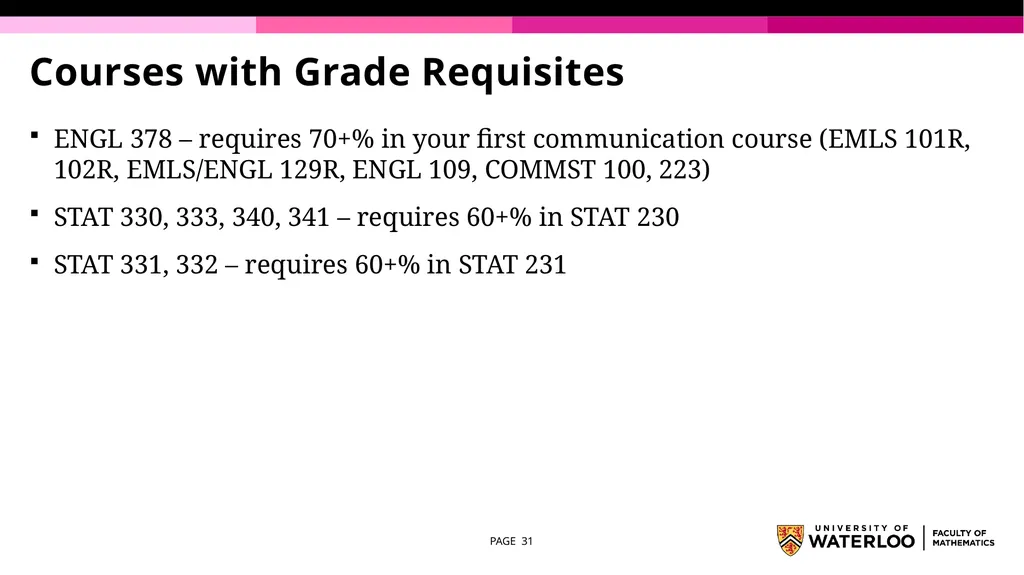
slide31. Courses with Grade Requisites ENGL 378 – requires 70+% in your first communication course (EMLS 101R, 102R, EMLS/ENGL 129R, ENGL 109, COMMST 100, 223)
STAT 330, 333, 340, 341 – requires 60+% in STAT 230
STAT 331, 332 – requires 60+% in STAT 231 PAGE 31<br>
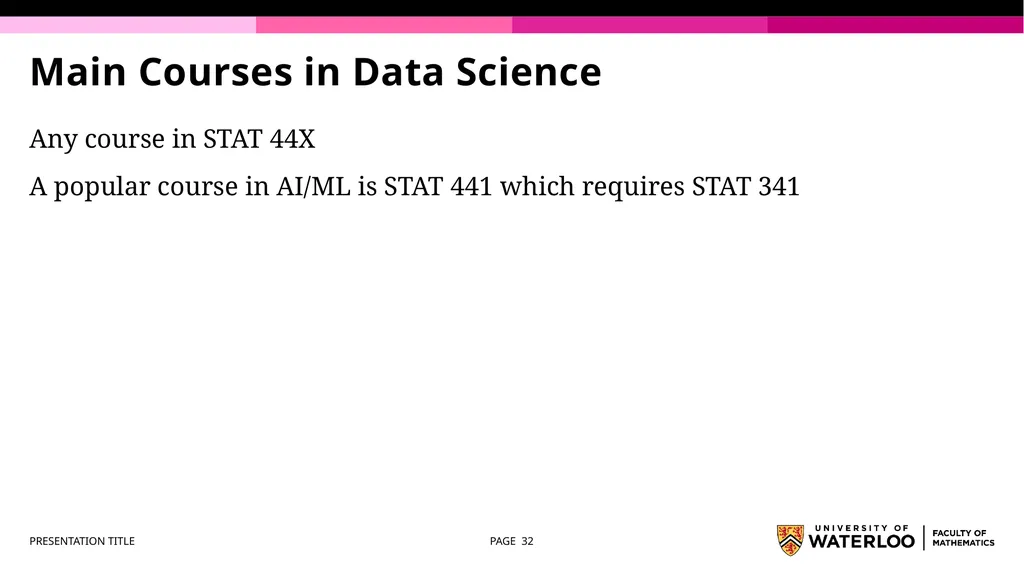
slide32. Main Courses in Data Science Any course in STAT 44X
A popular course in AI/ML is STAT 441 which requires STAT 341 PRESENTATION TITLE PAGE 32<br>
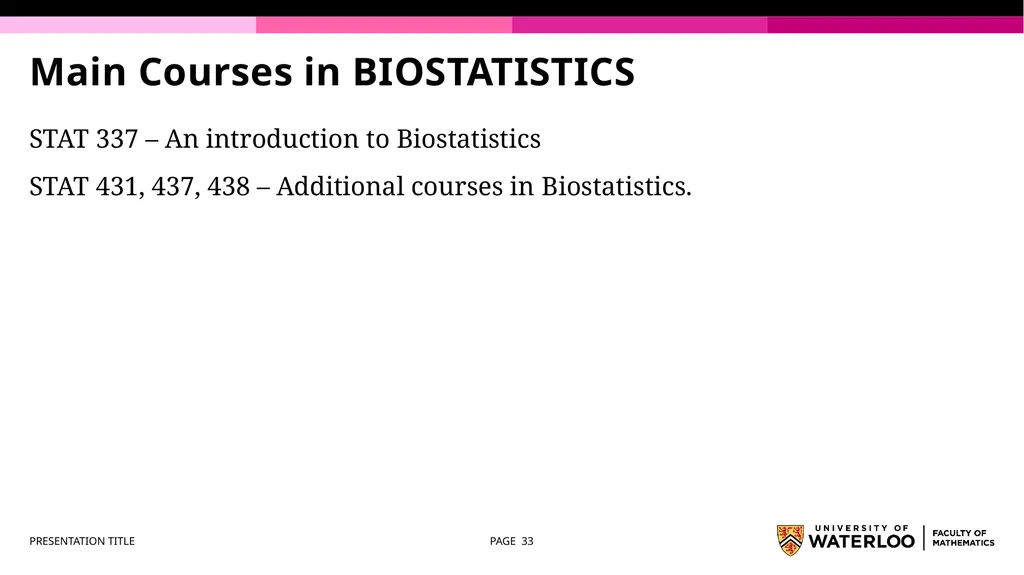
slide33. Main Courses in BIOSTATISTICS STAT 337 – An introduction to Biostatistics
STAT 431, 437, 438 – Additional courses in Biostatistics. PRESENTATION TITLE PAGE 33<br>
slide34. EMPLOYMENT In Biostatistics, Data Science and Statistics PAGE 34<br>
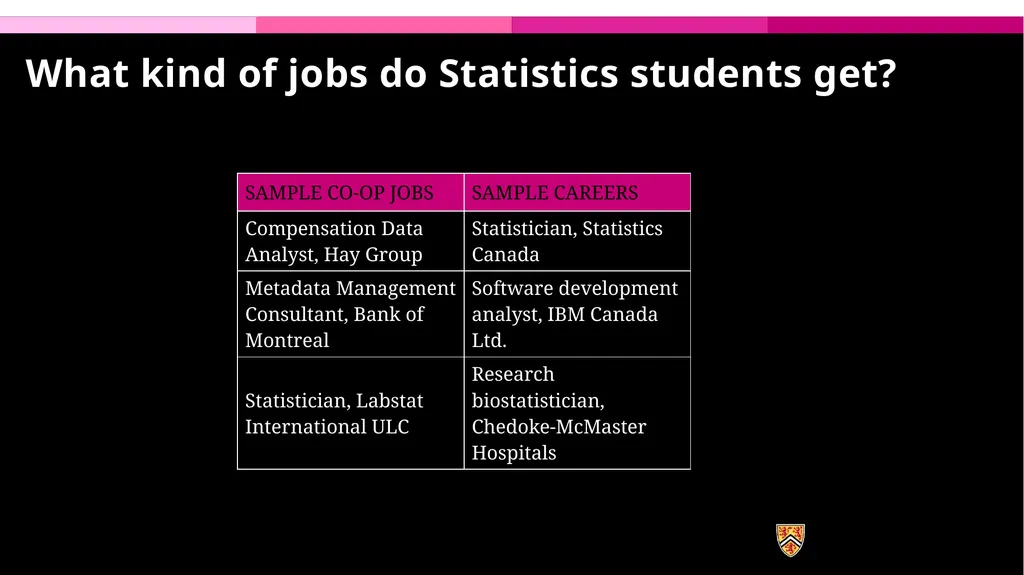
slide35. What kind of jobs do Statistics students get?<br>
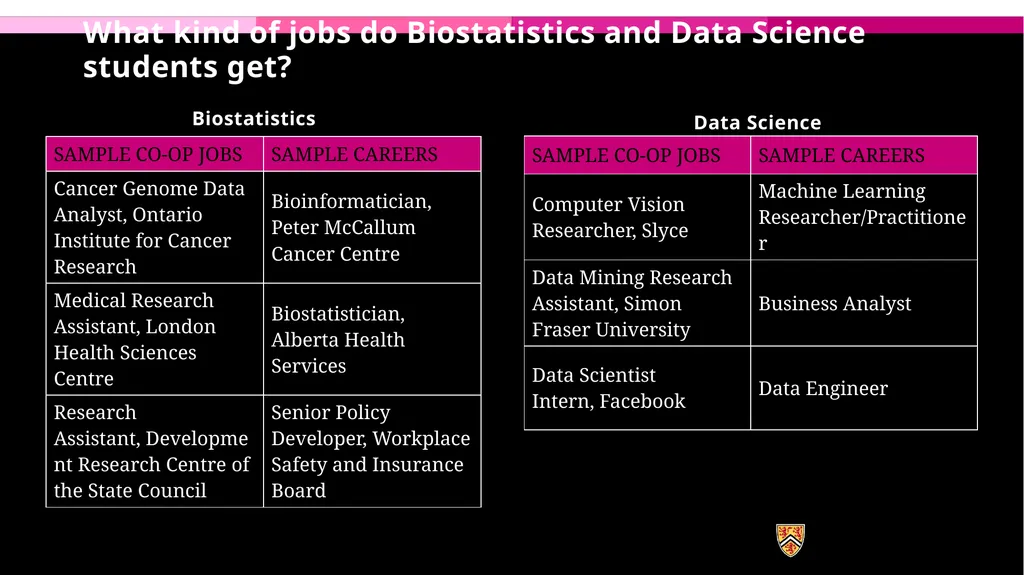
slide36. What kind of jobs do Biostatistics and Data Science students get? Biostatistics Data Science<br>
slide37. Actuarial Science PAGE 37<br>
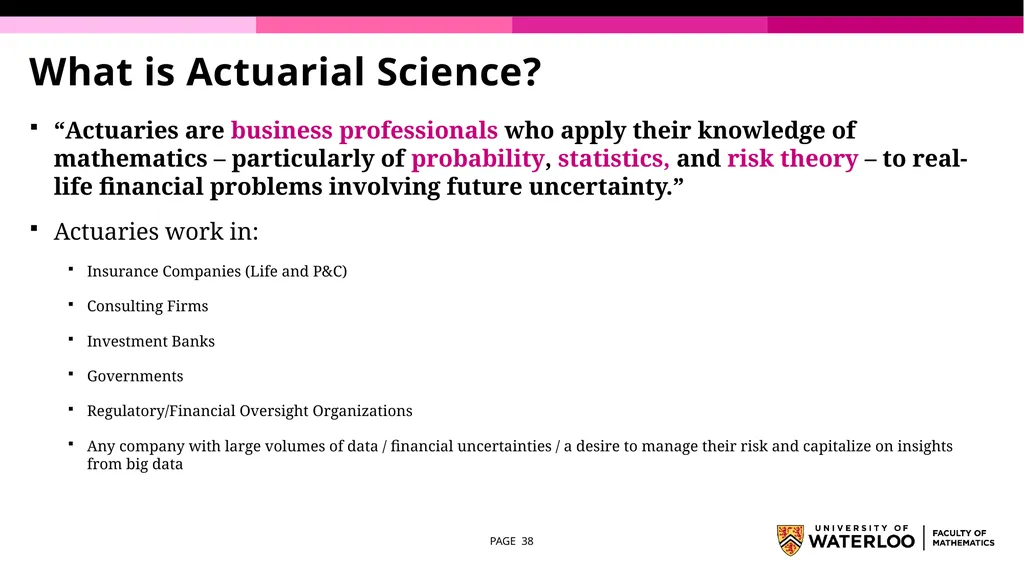
slide38. What is Actuarial Science? “Actuaries are business professionals who apply their knowledge of mathematics – particularly of probability, statistics, and risk theory – to real-life financial problems involving future uncertainty.”
Actuaries work in:
Insurance Companies (Life and P&C)
Consulting Firms
Investment Banks
Governments
Regulatory/Financial Oversight Organizations
Any company with large volumes of data / financial uncertainties / a desire to manage their risk and capitalize on insights from big data PAGE 38<br>
slide39. What is Actuarial Science? PAGE 39 https://www.youtube.com/watch?v=X2bax2Sim8Q<br>
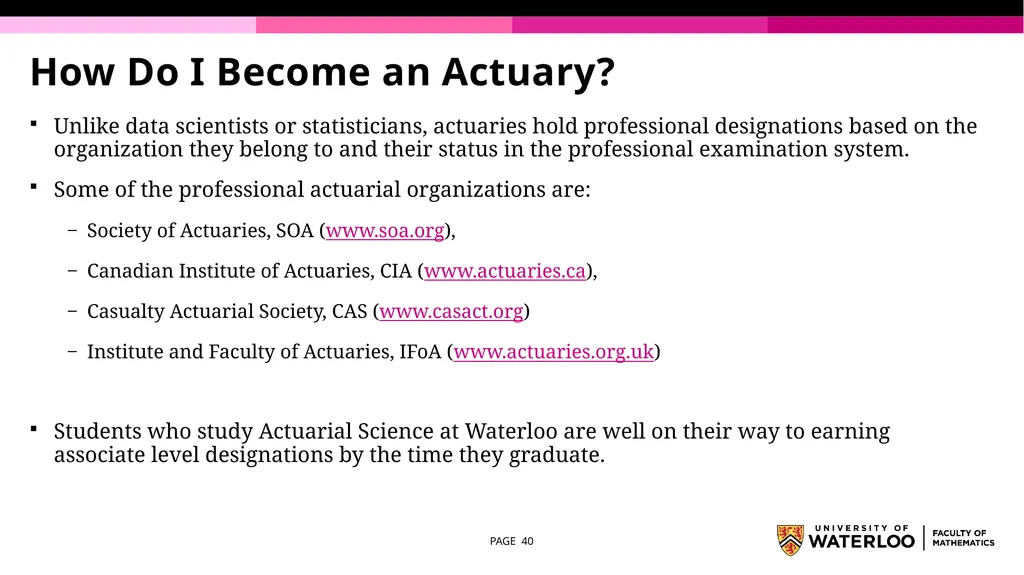
slide40. How Do I Become an Actuary? Unlike data scientists or statisticians, actuaries hold professional designations based on the organization they belong to and their status in the professional examination system.
Some of the professional actuarial organizations are:
Society of Actuaries, SOA (www.soa.org),
Canadian Institute of Actuaries, CIA (www.actuaries.ca),
Casualty Actuarial Society, CAS (www.casact.org)
Institute and Faculty of Actuaries, IFoA (www.actuaries.org.uk)
Students who study Actuarial Science at Waterloo are well on their way to earning associate level designations by the time they graduate. PAGE 40<br>
slide41. Why be an Actuary? Accredited actuaries have significant brand recognition and career growth potential (both salary amount and diverse opportunities)
Apply a combination of statistics, finance, data science, and risk management along with domain knowledge within insurance or otherwise
Rewarding career with the opportunity to serve the public good
Demand for actuaries is very high currently PAGE 41<br>
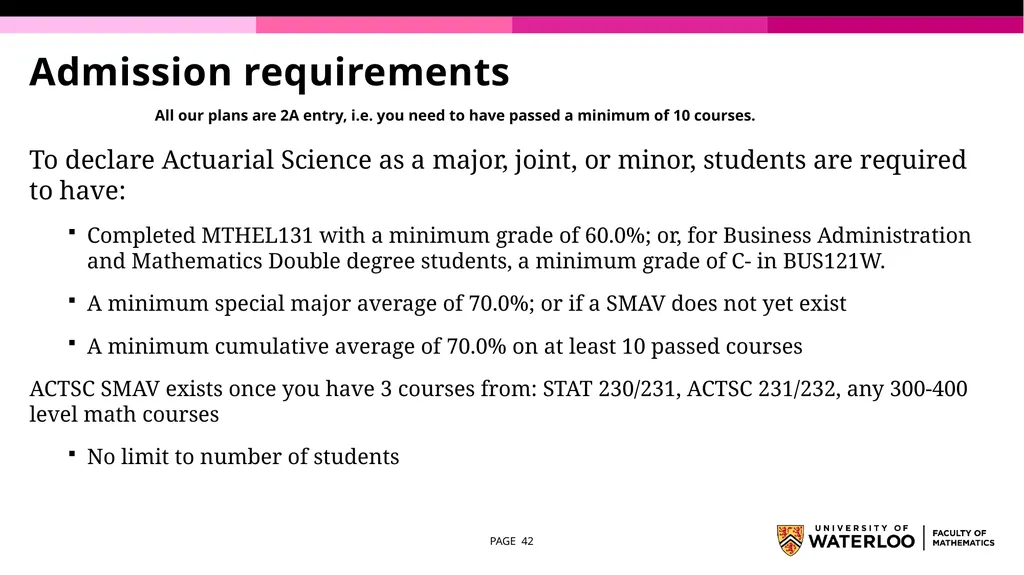
slide42. Admission requirements To declare Actuarial Science as a major, joint, or minor, students are required to have:
Completed MTHEL131 with a minimum grade of 60.0%; or, for Business Administration and Mathematics Double degree students, a minimum grade of C- in BUS121W.
A minimum special major average of 70.0%; or if a SMAV does not yet exist
A minimum cumulative average of 70.0% on at least 10 passed courses
ACTSC SMAV exists once you have 3 courses from: STAT 230/231, ACTSC 231/232, any 300-400 level math courses
No limit to number of students All our plans are 2A entry, i.e. you need to have passed a minimum of 10 courses. PAGE 42<br>
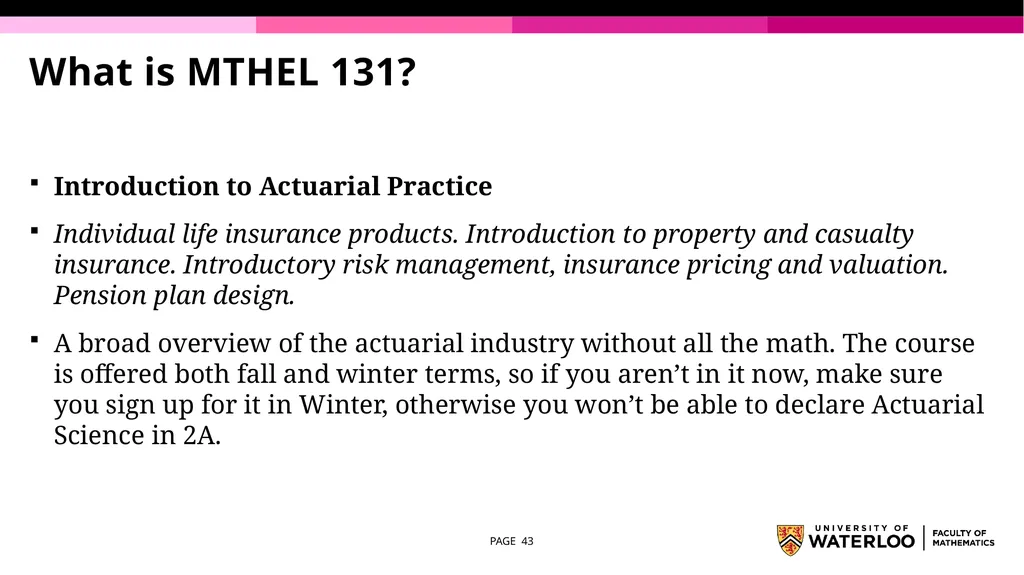
slide43. What is MTHEL 131? Introduction to Actuarial Practice
Individual life insurance products. Introduction to property and casualty insurance. Introductory risk management, insurance pricing and valuation. Pension plan design.
A broad overview of the actuarial industry without all the math. The course is offered both fall and winter terms, so if you aren’t in it now, make sure you sign up for it in Winter, otherwise you won’t be able to declare Actuarial Science in 2A. PAGE 43<br>
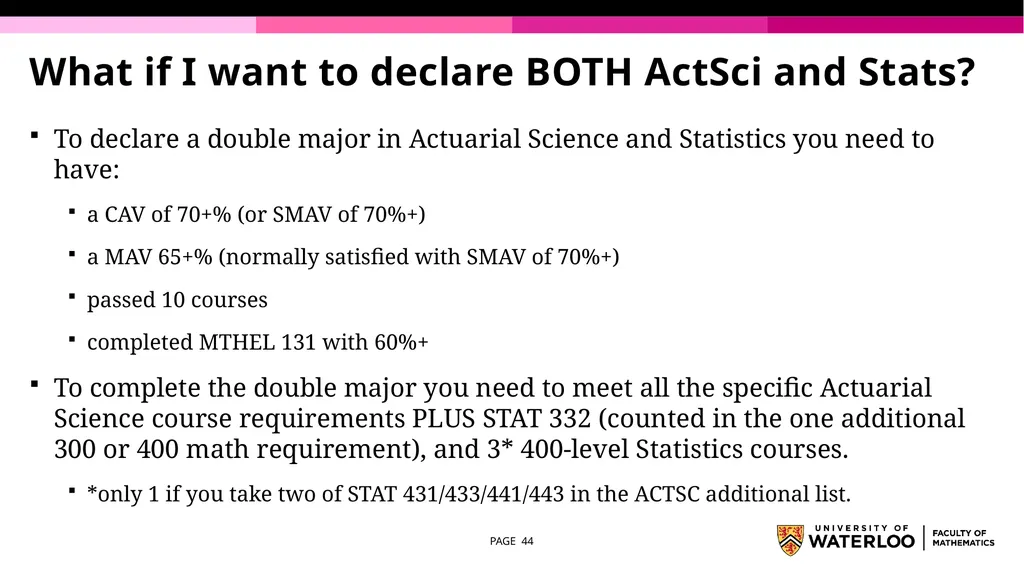
slide44. What if I want to declare BOTH ActSci and Stats? To declare a double major in Actuarial Science and Statistics you need to have:
a CAV of 70+% (or SMAV of 70%+)
a MAV 65+% (normally satisfied with SMAV of 70%+)
passed 10 courses
completed MTHEL 131 with 60%+
To complete the double major you need to meet all the specific Actuarial Science course requirements PLUS STAT 332 (counted in the one additional 300 or 400 math requirement), and 3* 400-level Statistics courses.
*only 1 if you take two of STAT 431/433/441/443 in the ACTSC additional list. PAGE 44<br>
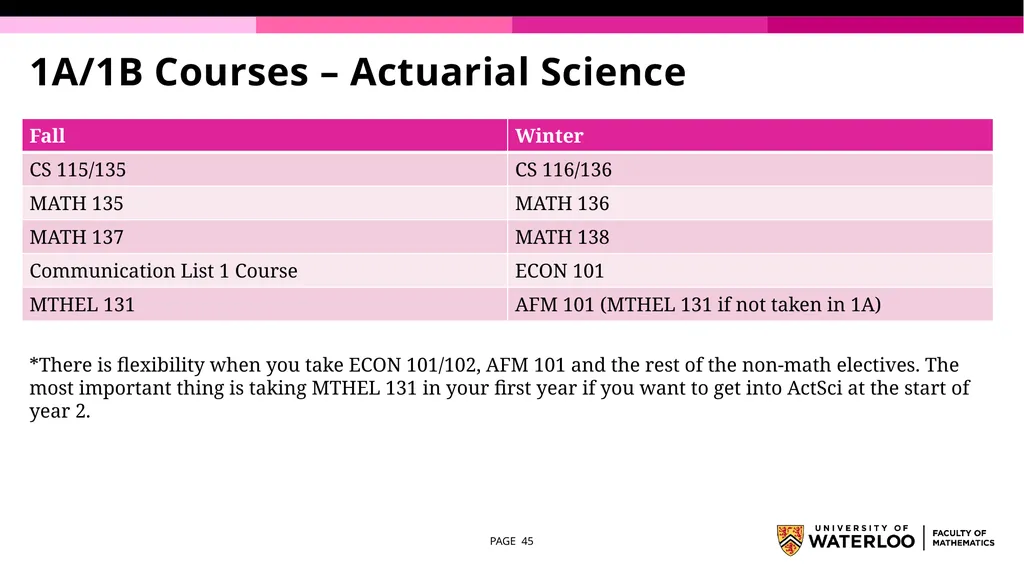
slide45. 1A/1B Courses – Actuarial Science PAGE 45 *There is flexibility when you take ECON 101/102, AFM 101 and the rest of the non-math electives. The most important thing is taking MTHEL 131 in your first year if you want to get into ActSci at the start of year 2.<br>
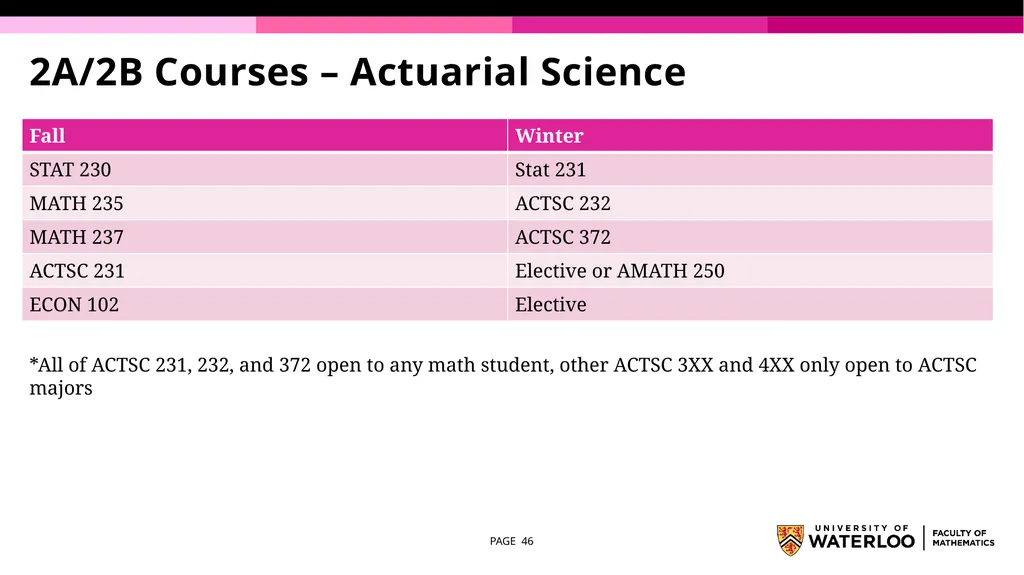
slide46. 2A/2B Courses – Actuarial Science PAGE 46 *All of ACTSC 231, 232, and 372 open to any math student, other ACTSC 3XX and 4XX only open to ACTSC majors<br>
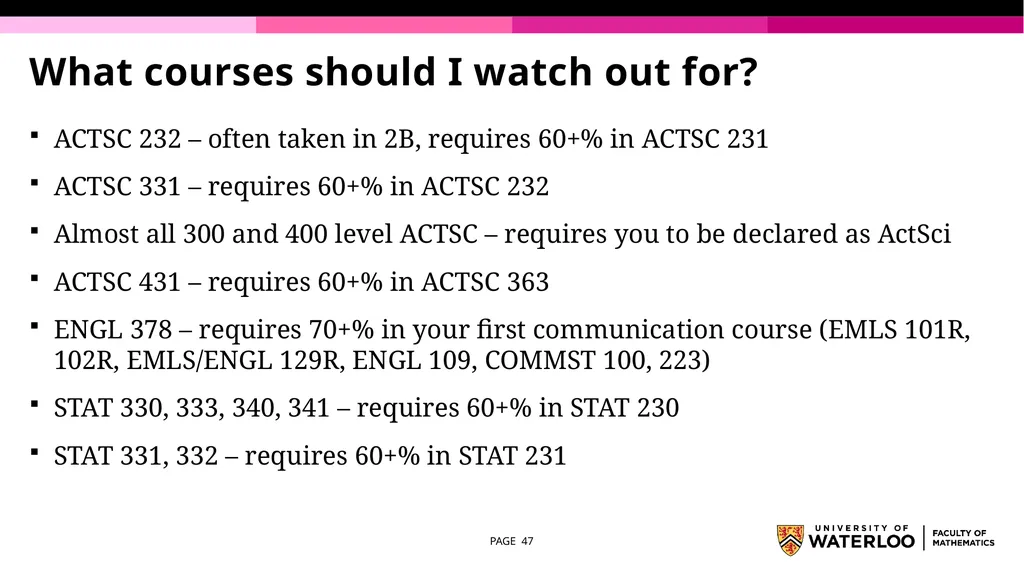
slide47. What courses should I watch out for? ACTSC 232 – often taken in 2B, requires 60+% in ACTSC 231
ACTSC 331 – requires 60+% in ACTSC 232
Almost all 300 and 400 level ACTSC – requires you to be declared as ActSci
ACTSC 431 – requires 60+% in ACTSC 363
ENGL 378 – requires 70+% in your first communication course (EMLS 101R, 102R, EMLS/ENGL 129R, ENGL 109, COMMST 100, 223)
STAT 330, 333, 340, 341 – requires 60+% in STAT 230
STAT 331, 332 – requires 60+% in STAT 231 PAGE 47<br>
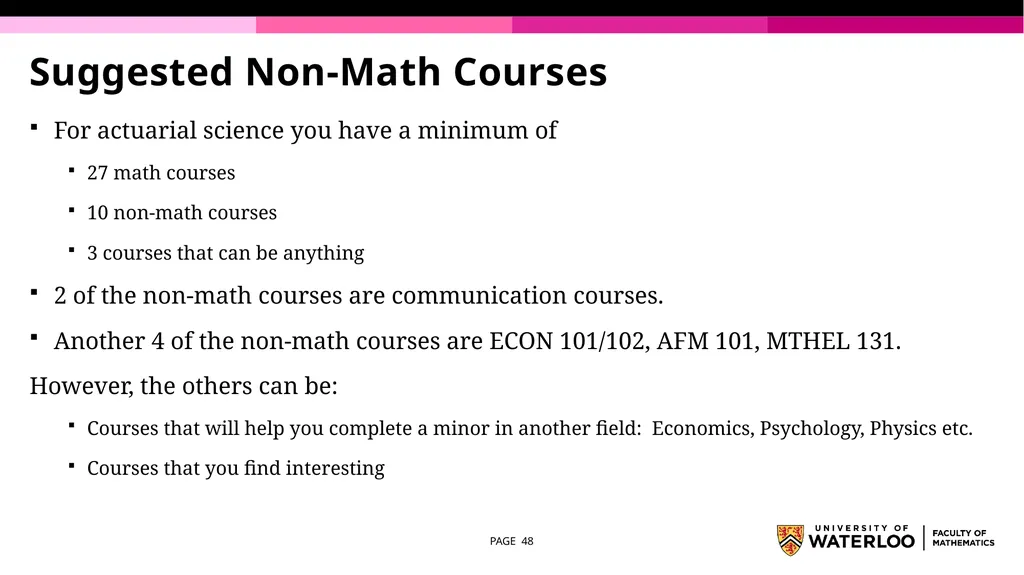
slide48. Suggested Non-Math Courses For actuarial science you have a minimum of
27 math courses
10 non-math courses
3 courses that can be anything
2 of the non-math courses are communication courses.
Another 4 of the non-math courses are ECON 101/102, AFM 101, MTHEL 131.
However, the others can be:
Courses that will help you complete a minor in another field: Economics, Psychology, Physics etc.
Courses that you find interesting PAGE 48<br>
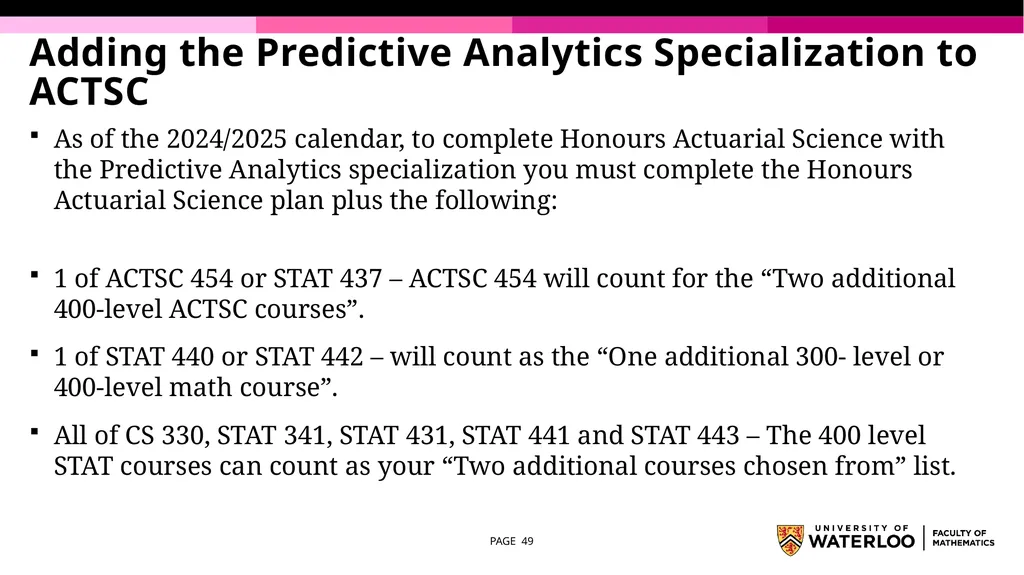
slide49. Adding the Predictive Analytics Specialization to ACTSC As of the 2024/2025 calendar, to complete Honours Actuarial Science with the Predictive Analytics specialization you must complete the Honours Actuarial Science plan plus the following:
1 of ACTSC 454 or STAT 437 – ACTSC 454 will count for the “Two additional 400-level ACTSC courses”.
1 of STAT 440 or STAT 442 – will count as the “One additional 300- level or 400-level math course”.
All of CS 330, STAT 341, STAT 431, STAT 441 and STAT 443 – The 400 level STAT courses can count as your “Two additional courses chosen from” list. PAGE 49<br>
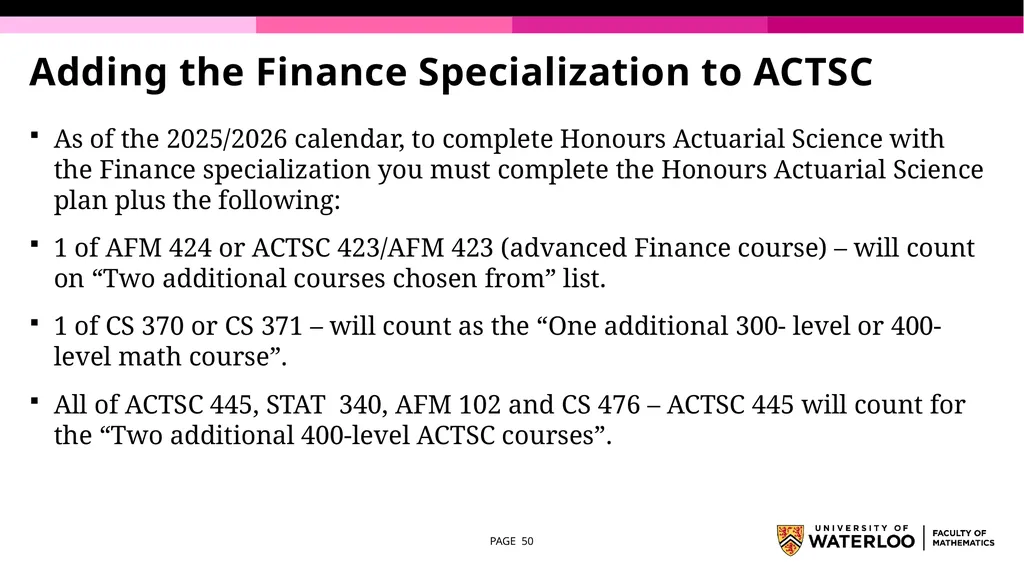
slide50. Adding the Finance Specialization to ACTSC As of the 2025/2026 calendar, to complete Honours Actuarial Science with the Finance specialization you must complete the Honours Actuarial Science plan plus the following:
1 of AFM 424 or ACTSC 423/AFM 423 (advanced Finance course) – will count on “Two additional courses chosen from” list.
1 of CS 370 or CS 371 – will count as the “One additional 300- level or 400-level math course”.
All of ACTSC 445, STAT 340, AFM 102 and CS 476 – ACTSC 445 will count for the “Two additional 400-level ACTSC courses”. PAGE 50<br>
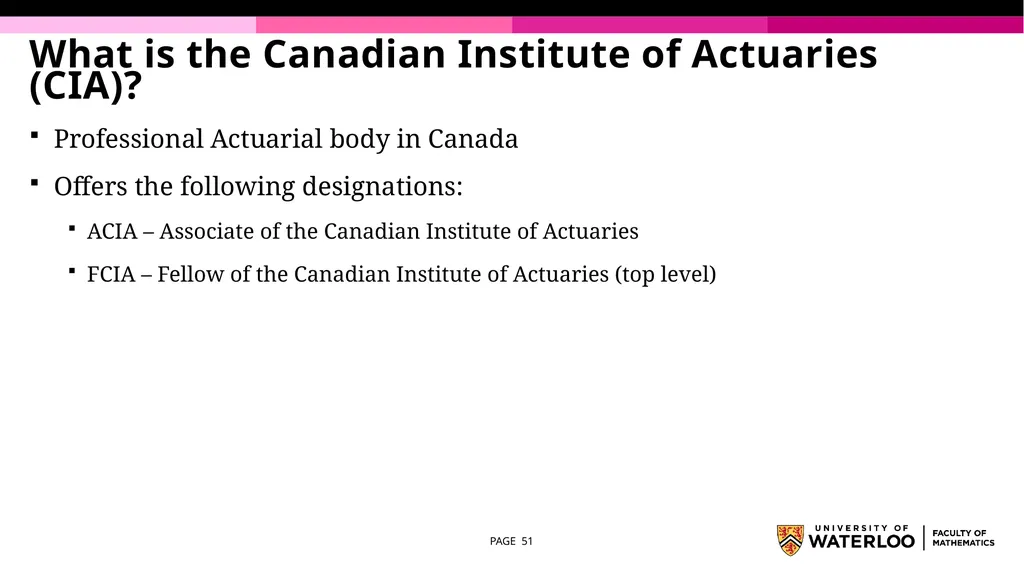
slide51. What is the Canadian Institute of Actuaries (CIA)? Professional Actuarial body in Canada
Offers the following designations:
ACIA – Associate of the Canadian Institute of Actuaries
FCIA – Fellow of the Canadian Institute of Actuaries (top level) PAGE 51<br>
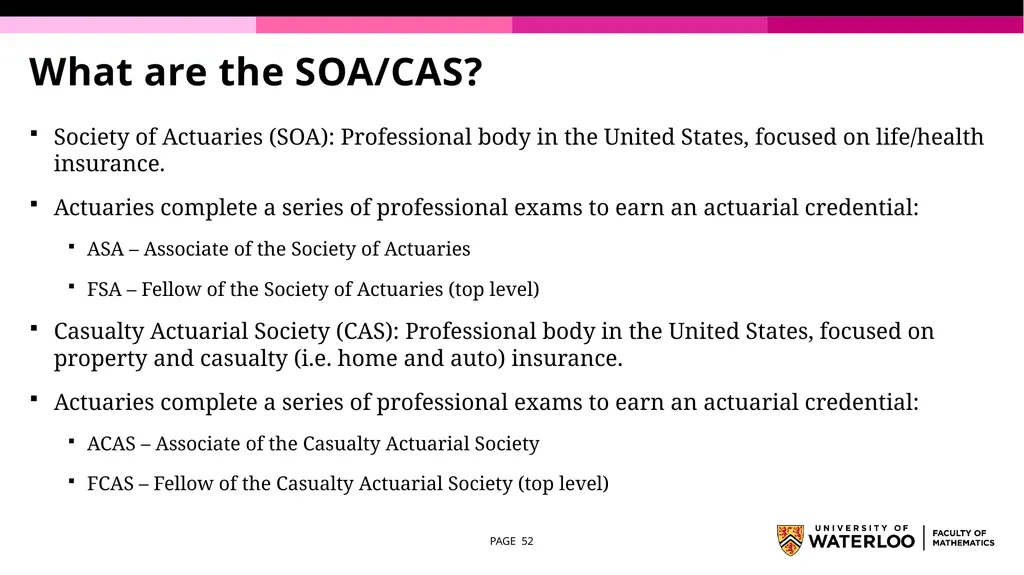
slide52. What are the SOA/CAS? Society of Actuaries (SOA): Professional body in the United States, focused on life/health insurance.
Actuaries complete a series of professional exams to earn an actuarial credential:
ASA – Associate of the Society of Actuaries
FSA – Fellow of the Society of Actuaries (top level)
Casualty Actuarial Society (CAS): Professional body in the United States, focused on property and casualty (i.e. home and auto) insurance.
Actuaries complete a series of professional exams to earn an actuarial credential:
ACAS – Associate of the Casualty Actuarial Society
FCAS – Fellow of the Casualty Actuarial Society (top level) PAGE 52<br>
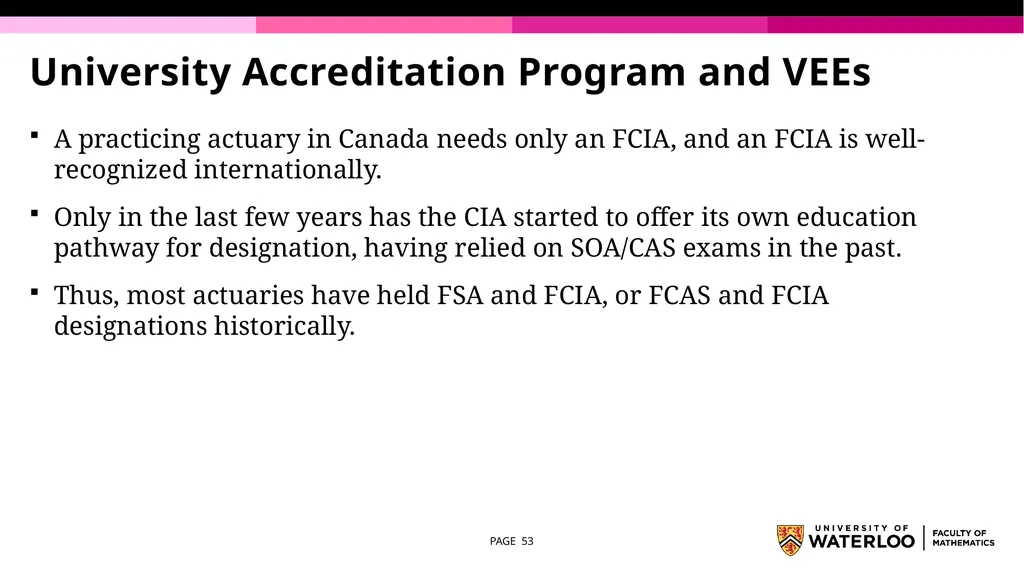
slide53. University Accreditation Program and VEEs A practicing actuary in Canada needs only an FCIA, and an FCIA is well-recognized internationally.
Only in the last few years has the CIA started to offer its own education pathway for designation, having relied on SOA/CAS exams in the past.
Thus, most actuaries have held FSA and FCIA, or FCAS and FCIA designations historically. PAGE 53<br>
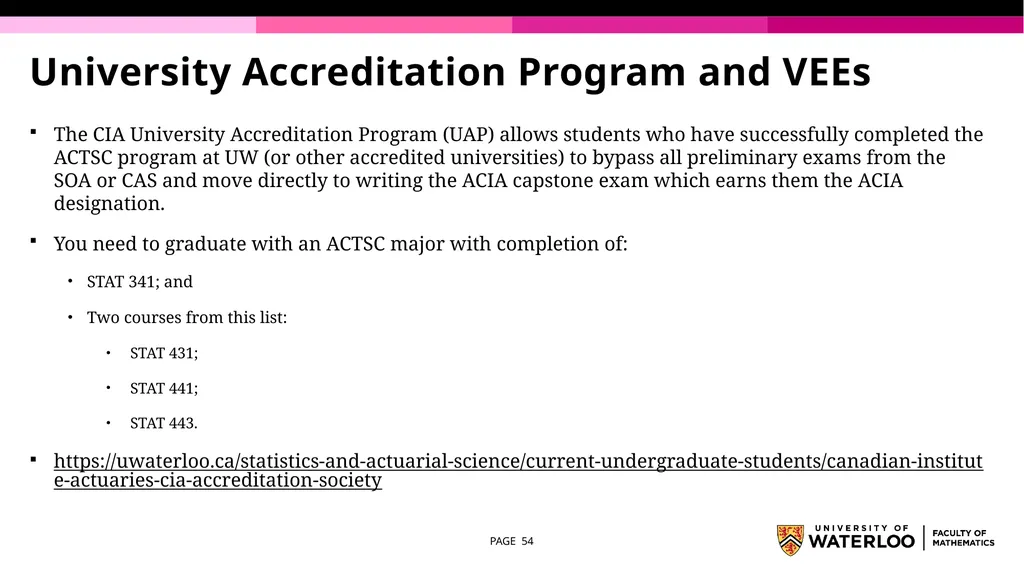
slide54. University Accreditation Program and VEEs The CIA University Accreditation Program (UAP) allows students who have successfully completed the ACTSC program at UW (or other accredited universities) to bypass all preliminary exams from the SOA or CAS and move directly to writing the ACIA capstone exam which earns them the ACIA designation.
You need to graduate with an ACTSC major with completion of:
STAT 341; and
Two courses from this list:
STAT 431;
STAT 441;
STAT 443.
https://uwaterloo.ca/statistics-and-actuarial-science/current-undergraduate-students/canadian-institute-actuaries-cia-accreditation-society PAGE 54<br>
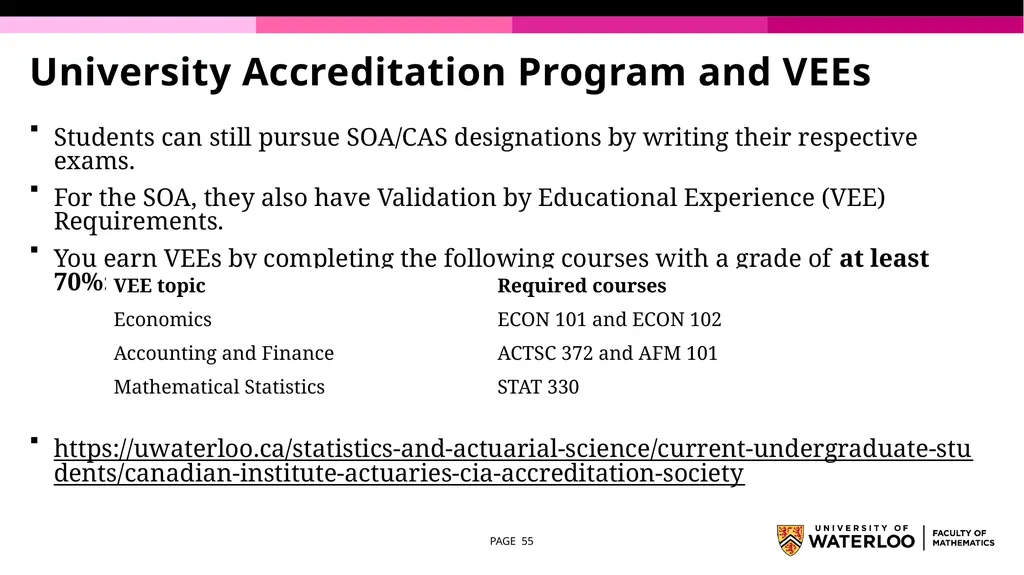
slide55. University Accreditation Program and VEEs Students can still pursue SOA/CAS designations by writing their respective exams.
For the SOA, they also have Validation by Educational Experience (VEE) Requirements.
You earn VEEs by completing the following courses with a grade of at least 70%:
https://uwaterloo.ca/statistics-and-actuarial-science/current-undergraduate-students/canadian-institute-actuaries-cia-accreditation-society PAGE 55<br>
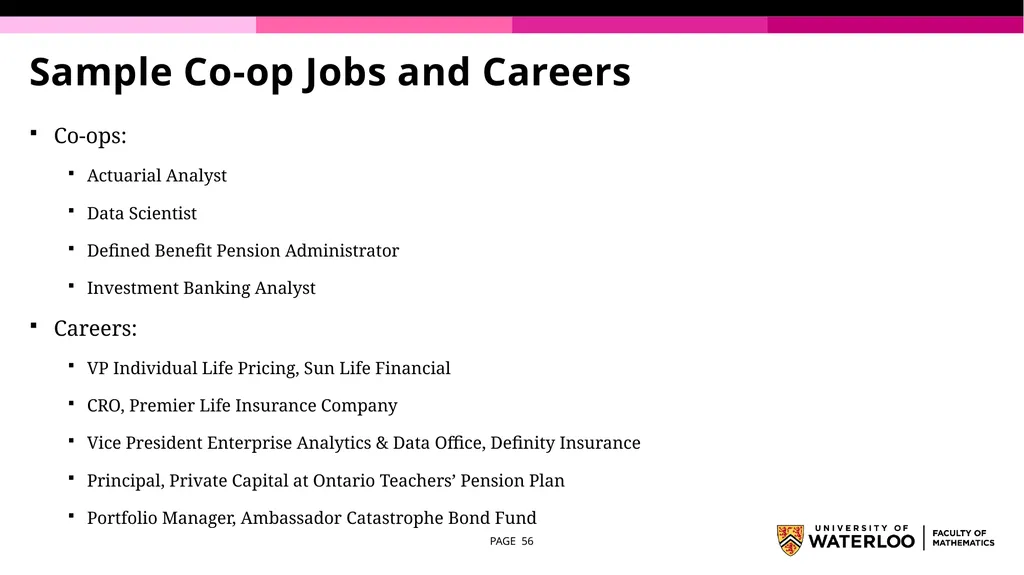
slide56. Sample Co-op Jobs and Careers Co-ops:
Actuarial Analyst
Data Scientist
Defined Benefit Pension Administrator
Investment Banking Analyst
Careers:
VP Individual Life Pricing, Sun Life Financial
CRO, Premier Life Insurance Company
Vice President Enterprise Analytics & Data Office, Definity Insurance
Principal, Private Capital at Ontario Teachers’ Pension Plan
Portfolio Manager, Ambassador Catastrophe Bond Fund PAGE 56<br>
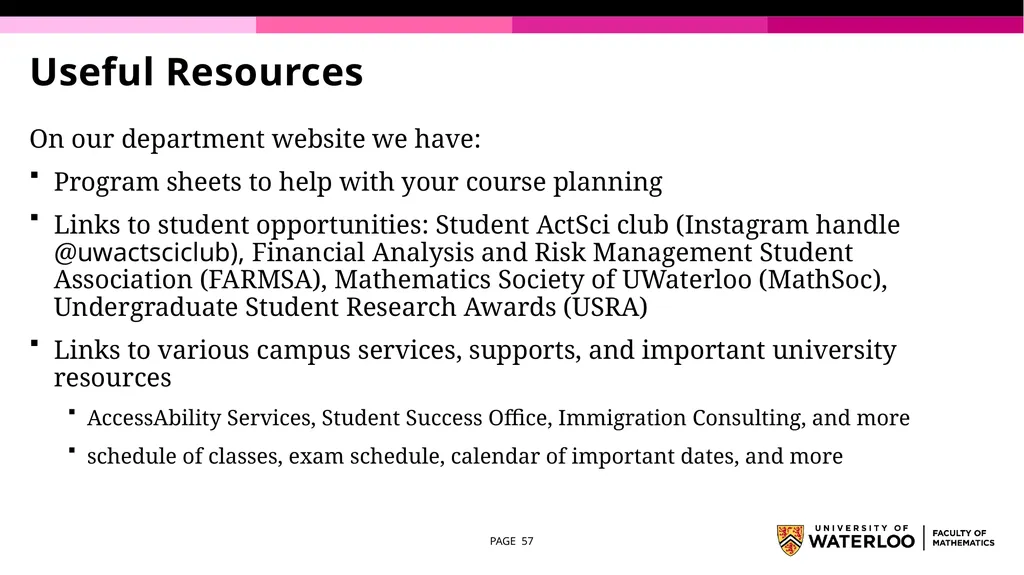
slide57. Useful Resources On our department website we have:
Program sheets to help with your course planning
Links to student opportunities: Student ActSci club (Instagram handle @uwactsciclub), Financial Analysis and Risk Management Student Association (FARMSA), Mathematics Society of UWaterloo (MathSoc), Undergraduate Student Research Awards (USRA)
Links to various campus services, supports, and important university resources
AccessAbility Services, Student Success Office, Immigration Consulting, and more
schedule of classes, exam schedule, calendar of important dates, and more PAGE 57<br>
slide58. Thank you for coming! Questions? PAGE 58 https://uwaterloo.ca/statistics-and-actuarial-science/undergraduate-studies<br>
slide2. Meet (some of) your Statistics and Actuarial Science Advisors Emily Kozlowski – Associate Professor Teaching Stream, Head ActSci advisor, Waterloo alumni, twice (BMath & MMath), in Actuarial Science, and an associate in the SOA & CIA.
Riley Metzger – Associate Professor Teaching Stream, Head Stat advisor, and Waterloo alumni, twice (BMath & MMath), in Statistics. PAGE 2<br>
slide3. What do the advisors do? Sign course (selection) override forms for all STAT and ACTSC courses (also MTHEL 131 and ENGL 378).
Sign plan modification forms (used to declare majors/joints/minors/specializations) for all ACTSC and STAT plans.
Answer questions about courses in ACTSC and STAT. Things like pre-req or anti-req questions, substitutions, offerings, order to complete them and so on.
Answer questions about the programs in ACTSC and STAT, such as electives needed, average to maintain, average calculation, how to do a double major or a minor with it.
Many, many more things! PAGE 3<br>
slide4. How do I get help from an advisor? First check the FAQ and Table of Questions pages on the department website.
If you can’t find your question, then you can either email the advisors at SASUGradAdv@uwaterloo.ca or visit us (in-person or virtually) during our regular advising hours. Hours are posted on the department website. PAGE 4 FAQ Tables of Questions Advising hours<br>
slide5. Statistics, Biostatistics and DAta Science PAGE 5<br>
slide6. PRESENTATION TITLE PAGE 6 Plan Venn diagram<br>
slide7. Hal Varian, Executive Google.com Dream Job - Statistician (BioStatistician or Data Scientist) PRESENTATION TITLE PAGE 7<br>
slide8. Statistics PAGE 8<br>
slide9. Statistics The field of drawing reliable conclusions from data.
Example Questions:
How do governments and businesses come up with their conclusions about the population or the economy?
How does a company know their marketing campaign has been successful?
In manufacturing, what’s the appropriate amount of defects to have from one machine?<br>
slide10. Admission requirements Statistics
Cumulative average (CAV) of 60%+ and
Math average (MAV) of 65%+
10 Passed Courses
No limit to number of students All our plans are 2A entry, i.e. you need to have passed a minimum of 10 courses. PAGE 10<br>
slide11. 1A/1B Courses - STATISTICS PAGE 11 *This is the standard sequence for math students. If you are having difficulties or you are excelling there are alternative sequences. Please contact a year 1 math advisor to find out more: MathAdvisors@uwaterloo.ca.<br>
slide12. Suggested Non Math Courses For statistics you have a minimum of
26 math courses
10 non math courses (1 Communication course + ENGL 378 + 8 Other courses)
4 courses that can be anything
Non Math Course Selection:
Courses that will help you complete a minor in another field: Biology, Economics, Psychology, Physics etc.
Courses that you find interesting PAGE 12<br>
slide13. Biostatistics PAGE 13<br>
slide14. Biostatistics The field of drawing reliable conclusions from data in the life sciences.
Example Questions:
Does a particular vaccine reduce the likelihood of getting COVID?
What affect does a government policy have on the proportion of smokers?
What is the home range of a bear? Statistics Life
Sciences Bio-Stats<br>
slide15. Admission requirements Biostatistics
Cumulative average (CAV) of 60%+ and
Math average (MAV) of 65%+
10 Passed Courses
No limit to number of students All our plans are 2A entry, i.e. you need to have passed a minimum of 10 courses. PAGE 15<br>
slide16. 1A/1B Courses - BIOSTATISTICS PAGE 16 *This is the standard sequence for math students. If you are having difficulties or you are excelling there are alternative sequences. Please contact a year 1 math advisor to find out more: MathAdvisors@uwaterloo.ca.<br>
slide17. Suggested Non Math Courses For biostatistics you have a minimum of
26 math courses
10 non math courses (1 Com course + ENGL 378 + one of BIOL 239, or HLTH 101 + 7 other courses)
4 courses that can be anything
Non Math Course Selection:
Courses that will help you complete a minor in another field: Biology, Economics, Psychology, Physics etc.
Courses that you find interesting PAGE 17<br>
slide18. STATISTICS and to a lesser extent BIOSTATISTICS are very flexible plans.
EXAMPLE:
Part of the 26 required math courses for STATISTICS are:
4 MATH 3XX/4XX
3 MATH (any level)
These 7 courses can be in ANY field (CO, PMATH, AMATH, etc). Hence it is EASY to add a joint, minor or major to this plan. PRESENTATION TITLE PAGE 18 Flexability<br>
slide19. Data SCIENCE PAGE 19<br>
slide20. Data Science The field of drawing reliable conclusions from large data sets. It studies things such as AI, and Machine Learning.
Example Questions:
Spam filtering: How to classify emails as spam versus legitimate
Computer Vision: recognize objects in images and videos
Speech Recognition: recognize words from an audio signal
Conversational Agents: learn how to respond to user queries Statistics Computer
Science Data
Science<br>
slide21. Admission requirements Data Science
Cumulative average (CAV) of 60%+ and
Math average (SMAV) of 65%+ and
CS average (MAV) of 70% and
10 Passed Courses
These are minimums as the plan is COMPETITIVE
50 seats per year (roughly 16 per term) All our plans are 2A entry, i.e. you need to have passed a minimum of 10 courses. PAGE 21<br>
slide22. BMath Data Science FAQs: ADMISSION AVERAGES What was the latest admission averages?
Each term the admission averages differ as the plan is competitive.
We look at 3 averages on a minimum of 10 courses:
CAV (cumulative or overall average). This is the average of every course you take that has a numeric grade.
Math MAV (Math major average). This is all of your courses offered by the faculty including CS 115, MATH 135, MATH 137, etc.
CS MAV (CS major average). This does not include any course below CS 136. Nor does it include non CS major courses such as CS 231.
This past Sept the CAV was at least 85 for incoming students. We then wanted the other two averages to be “high”. PAGE 22<br>
slide23. BMath Data Science FAQs: APPLICATIONS Applications
When do you apply?
Are you taking CS 136 or have you already passed it?
Will you have 10 passed courses by the end of term?
Are you currently in lectures?
Then you can apply by filling out our online form. It is really quick and only requires your name and IDs.
When do you learn your results?
In the first month of the NEXT term. This may be after the add period of courses. PAGE 23<br>
slide24. BMath Data Science FAQs: What if I am NOT ACCEPTED? I didn’t get in, can I apply again?
Yes, you can apply again, however it would be wise to have a back-up plan in place.
Other Suggestions?
An alternative might be a Statistics Major with a Computing Minor. Aim to take CS 431.
Another alternative might be computational math major with a concentration on Statistics and a computing minor. PAGE 24<br>
slide25. BMath Data Science FAQs: What if I am NOT ACCEPTED? Can I take less than 5 courses a term and still get into Data Science? Can I WD a course(s)?
Yes you can. However we will not accept you into the program until you have at least 10 passed courses.
Can I retake courses to increase my grade?
Yes. However I do not recommend it. Why?
Both the original course and retaken course will be on your record. Both courses go into your average with equal weighting.
You are allowed at most 3 attempts at any course.
You will accumulate an unusable attempt. You are allowed a maximum of 10 of these. PAGE 25<br>
slide26. 1A/1B Courses – BMath Data Science PAGE 26 *This is the standard sequence for math students. If you are having difficulties or you are excelling there are alternative sequences. Please contact a year 1 math advisor to find out more: MathAdvisors@uwaterloo.ca.<br>
slide27. Suggested Non Math Courses For data science you have a minimum of
29.5 math courses
10 non math courses (1 Communication course + ENGL 378 + 8 Other courses)
0.5 courses that can be anything
Non Math Course Selection:
Courses that will help you complete a minor in another field: Economics, Psychology, Physics etc.
Courses that you find interesting PAGE 27<br>
slide28. LESS FLEXIBLE Data Science CANNOT...
Be combined with any other math major or joint.
Be combined with Double Degree (you must take the BCS version) PRESENTATION TITLE PAGE 28<br>
slide29. BCS 2 Communication courses
Access to all CS major courses
Depth and Breadth requirements on non math electives BMATH 1 Communication course + ENGL 378
Access to limited CS major courses
NO depth and breadth requirements on non math couress, you can take what you want BCS DATA SCIENCE vs BMATH DATA SCIENCE PRESENTATION TITLE PAGE 29<br>
slide30. COURSES OF INTEREST In Biostatisitcs, Data Science and Statistics PAGE 30<br>
slide31. Courses with Grade Requisites ENGL 378 – requires 70+% in your first communication course (EMLS 101R, 102R, EMLS/ENGL 129R, ENGL 109, COMMST 100, 223)
STAT 330, 333, 340, 341 – requires 60+% in STAT 230
STAT 331, 332 – requires 60+% in STAT 231 PAGE 31<br>
slide32. Main Courses in Data Science Any course in STAT 44X
A popular course in AI/ML is STAT 441 which requires STAT 341 PRESENTATION TITLE PAGE 32<br>
slide33. Main Courses in BIOSTATISTICS STAT 337 – An introduction to Biostatistics
STAT 431, 437, 438 – Additional courses in Biostatistics. PRESENTATION TITLE PAGE 33<br>
slide34. EMPLOYMENT In Biostatistics, Data Science and Statistics PAGE 34<br>
slide35. What kind of jobs do Statistics students get?<br>
slide36. What kind of jobs do Biostatistics and Data Science students get? Biostatistics Data Science<br>
slide37. Actuarial Science PAGE 37<br>
slide38. What is Actuarial Science? “Actuaries are business professionals who apply their knowledge of mathematics – particularly of probability, statistics, and risk theory – to real-life financial problems involving future uncertainty.”
Actuaries work in:
Insurance Companies (Life and P&C)
Consulting Firms
Investment Banks
Governments
Regulatory/Financial Oversight Organizations
Any company with large volumes of data / financial uncertainties / a desire to manage their risk and capitalize on insights from big data PAGE 38<br>
slide39. What is Actuarial Science? PAGE 39 https://www.youtube.com/watch?v=X2bax2Sim8Q<br>
slide40. How Do I Become an Actuary? Unlike data scientists or statisticians, actuaries hold professional designations based on the organization they belong to and their status in the professional examination system.
Some of the professional actuarial organizations are:
Society of Actuaries, SOA (www.soa.org),
Canadian Institute of Actuaries, CIA (www.actuaries.ca),
Casualty Actuarial Society, CAS (www.casact.org)
Institute and Faculty of Actuaries, IFoA (www.actuaries.org.uk)
Students who study Actuarial Science at Waterloo are well on their way to earning associate level designations by the time they graduate. PAGE 40<br>
slide41. Why be an Actuary? Accredited actuaries have significant brand recognition and career growth potential (both salary amount and diverse opportunities)
Apply a combination of statistics, finance, data science, and risk management along with domain knowledge within insurance or otherwise
Rewarding career with the opportunity to serve the public good
Demand for actuaries is very high currently PAGE 41<br>
slide42. Admission requirements To declare Actuarial Science as a major, joint, or minor, students are required to have:
Completed MTHEL131 with a minimum grade of 60.0%; or, for Business Administration and Mathematics Double degree students, a minimum grade of C- in BUS121W.
A minimum special major average of 70.0%; or if a SMAV does not yet exist
A minimum cumulative average of 70.0% on at least 10 passed courses
ACTSC SMAV exists once you have 3 courses from: STAT 230/231, ACTSC 231/232, any 300-400 level math courses
No limit to number of students All our plans are 2A entry, i.e. you need to have passed a minimum of 10 courses. PAGE 42<br>
slide43. What is MTHEL 131? Introduction to Actuarial Practice
Individual life insurance products. Introduction to property and casualty insurance. Introductory risk management, insurance pricing and valuation. Pension plan design.
A broad overview of the actuarial industry without all the math. The course is offered both fall and winter terms, so if you aren’t in it now, make sure you sign up for it in Winter, otherwise you won’t be able to declare Actuarial Science in 2A. PAGE 43<br>
slide44. What if I want to declare BOTH ActSci and Stats? To declare a double major in Actuarial Science and Statistics you need to have:
a CAV of 70+% (or SMAV of 70%+)
a MAV 65+% (normally satisfied with SMAV of 70%+)
passed 10 courses
completed MTHEL 131 with 60%+
To complete the double major you need to meet all the specific Actuarial Science course requirements PLUS STAT 332 (counted in the one additional 300 or 400 math requirement), and 3* 400-level Statistics courses.
*only 1 if you take two of STAT 431/433/441/443 in the ACTSC additional list. PAGE 44<br>
slide45. 1A/1B Courses – Actuarial Science PAGE 45 *There is flexibility when you take ECON 101/102, AFM 101 and the rest of the non-math electives. The most important thing is taking MTHEL 131 in your first year if you want to get into ActSci at the start of year 2.<br>
slide46. 2A/2B Courses – Actuarial Science PAGE 46 *All of ACTSC 231, 232, and 372 open to any math student, other ACTSC 3XX and 4XX only open to ACTSC majors<br>
slide47. What courses should I watch out for? ACTSC 232 – often taken in 2B, requires 60+% in ACTSC 231
ACTSC 331 – requires 60+% in ACTSC 232
Almost all 300 and 400 level ACTSC – requires you to be declared as ActSci
ACTSC 431 – requires 60+% in ACTSC 363
ENGL 378 – requires 70+% in your first communication course (EMLS 101R, 102R, EMLS/ENGL 129R, ENGL 109, COMMST 100, 223)
STAT 330, 333, 340, 341 – requires 60+% in STAT 230
STAT 331, 332 – requires 60+% in STAT 231 PAGE 47<br>
slide48. Suggested Non-Math Courses For actuarial science you have a minimum of
27 math courses
10 non-math courses
3 courses that can be anything
2 of the non-math courses are communication courses.
Another 4 of the non-math courses are ECON 101/102, AFM 101, MTHEL 131.
However, the others can be:
Courses that will help you complete a minor in another field: Economics, Psychology, Physics etc.
Courses that you find interesting PAGE 48<br>
slide49. Adding the Predictive Analytics Specialization to ACTSC As of the 2024/2025 calendar, to complete Honours Actuarial Science with the Predictive Analytics specialization you must complete the Honours Actuarial Science plan plus the following:
1 of ACTSC 454 or STAT 437 – ACTSC 454 will count for the “Two additional 400-level ACTSC courses”.
1 of STAT 440 or STAT 442 – will count as the “One additional 300- level or 400-level math course”.
All of CS 330, STAT 341, STAT 431, STAT 441 and STAT 443 – The 400 level STAT courses can count as your “Two additional courses chosen from” list. PAGE 49<br>
slide50. Adding the Finance Specialization to ACTSC As of the 2025/2026 calendar, to complete Honours Actuarial Science with the Finance specialization you must complete the Honours Actuarial Science plan plus the following:
1 of AFM 424 or ACTSC 423/AFM 423 (advanced Finance course) – will count on “Two additional courses chosen from” list.
1 of CS 370 or CS 371 – will count as the “One additional 300- level or 400-level math course”.
All of ACTSC 445, STAT 340, AFM 102 and CS 476 – ACTSC 445 will count for the “Two additional 400-level ACTSC courses”. PAGE 50<br>
slide51. What is the Canadian Institute of Actuaries (CIA)? Professional Actuarial body in Canada
Offers the following designations:
ACIA – Associate of the Canadian Institute of Actuaries
FCIA – Fellow of the Canadian Institute of Actuaries (top level) PAGE 51<br>
slide52. What are the SOA/CAS? Society of Actuaries (SOA): Professional body in the United States, focused on life/health insurance.
Actuaries complete a series of professional exams to earn an actuarial credential:
ASA – Associate of the Society of Actuaries
FSA – Fellow of the Society of Actuaries (top level)
Casualty Actuarial Society (CAS): Professional body in the United States, focused on property and casualty (i.e. home and auto) insurance.
Actuaries complete a series of professional exams to earn an actuarial credential:
ACAS – Associate of the Casualty Actuarial Society
FCAS – Fellow of the Casualty Actuarial Society (top level) PAGE 52<br>
slide53. University Accreditation Program and VEEs A practicing actuary in Canada needs only an FCIA, and an FCIA is well-recognized internationally.
Only in the last few years has the CIA started to offer its own education pathway for designation, having relied on SOA/CAS exams in the past.
Thus, most actuaries have held FSA and FCIA, or FCAS and FCIA designations historically. PAGE 53<br>
slide54. University Accreditation Program and VEEs The CIA University Accreditation Program (UAP) allows students who have successfully completed the ACTSC program at UW (or other accredited universities) to bypass all preliminary exams from the SOA or CAS and move directly to writing the ACIA capstone exam which earns them the ACIA designation.
You need to graduate with an ACTSC major with completion of:
STAT 341; and
Two courses from this list:
STAT 431;
STAT 441;
STAT 443.
https://uwaterloo.ca/statistics-and-actuarial-science/current-undergraduate-students/canadian-institute-actuaries-cia-accreditation-society PAGE 54<br>
slide55. University Accreditation Program and VEEs Students can still pursue SOA/CAS designations by writing their respective exams.
For the SOA, they also have Validation by Educational Experience (VEE) Requirements.
You earn VEEs by completing the following courses with a grade of at least 70%:
https://uwaterloo.ca/statistics-and-actuarial-science/current-undergraduate-students/canadian-institute-actuaries-cia-accreditation-society PAGE 55<br>
slide56. Sample Co-op Jobs and Careers Co-ops:
Actuarial Analyst
Data Scientist
Defined Benefit Pension Administrator
Investment Banking Analyst
Careers:
VP Individual Life Pricing, Sun Life Financial
CRO, Premier Life Insurance Company
Vice President Enterprise Analytics & Data Office, Definity Insurance
Principal, Private Capital at Ontario Teachers’ Pension Plan
Portfolio Manager, Ambassador Catastrophe Bond Fund PAGE 56<br>
slide57. Useful Resources On our department website we have:
Program sheets to help with your course planning
Links to student opportunities: Student ActSci club (Instagram handle @uwactsciclub), Financial Analysis and Risk Management Student Association (FARMSA), Mathematics Society of UWaterloo (MathSoc), Undergraduate Student Research Awards (USRA)
Links to various campus services, supports, and important university resources
AccessAbility Services, Student Success Office, Immigration Consulting, and more
schedule of classes, exam schedule, calendar of important dates, and more PAGE 57<br>
slide58. Thank you for coming! Questions? PAGE 58 https://uwaterloo.ca/statistics-and-actuarial-science/undergraduate-studies<br>