Fiscal Framework and Revenue Proposals Presentation to the Standing Committee of Finance and the Select Committee of Finance By Guy Harris CA (SA) Founder of KLOP Accelerator and Education Governance Activist I March 2017 Subject to
"Fiscal Framework and Revenue Proposals" is the property of its rightful owner. Permission is granted to
download and print the materials on this website for personal, non-commercial use only, and to display it
on your personal computer provided you do not modify the materials and that you retain all copyright
notices contained in the materials. By downloading content from our website, you accept the terms of this
agreement.
Presentation Transcript
01
Fiscal Framework and Revenue Proposals Presentation to the Standing Committee of Finance and the Select Committee of Finance By Guy Harris CA (SA)
Founder of KLOP Accelerator and Education & Governance Activist
I March 2017 Subject to revision prior to presentation to the Committees<br>
02
Outline Transforming for Inclusive Growth
Overview of Input
The Economic Environment
Effective Early Childhood Education is the Foundation for Future Skills
Job Creating Levers
Supportive Environment for Job Creating Medium Sized Business Development
Selected Privatisation for Funding Pivotal Projects
Reregulation
In Summary
The Presenter<br>
03
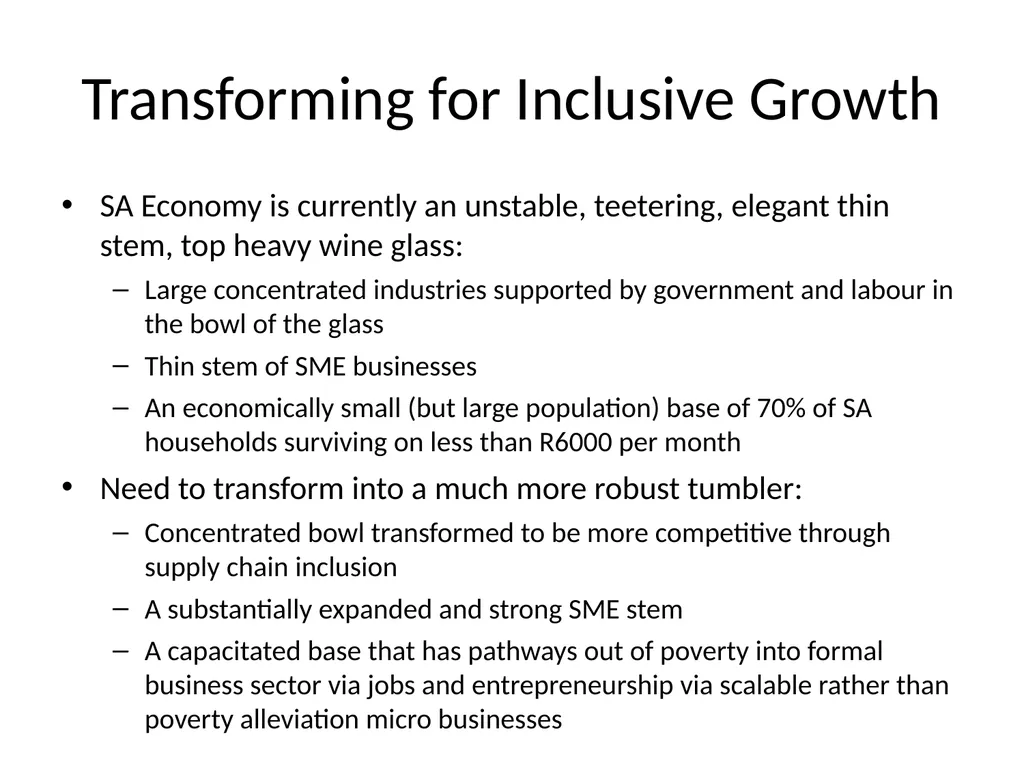
Transforming for Inclusive Growth SA Economy is currently an unstable, teetering, elegant thin stem, top heavy wine glass:
Large concentrated industries supported by government and labour in the bowl of the glass
Thin stem of SME businesses
An economically small (but large population) base of 70% of SA households surviving on less than R6000 per month
Need to transform into a much more robust tumbler:
Concentrated bowl transformed to be more competitive through supply chain inclusion
A substantially expanded and strong SME stem
A capacitated base that has pathways out of poverty into formal business sector via jobs and entrepreneurship via scalable rather than poverty alleviation micro businesses<br>
04
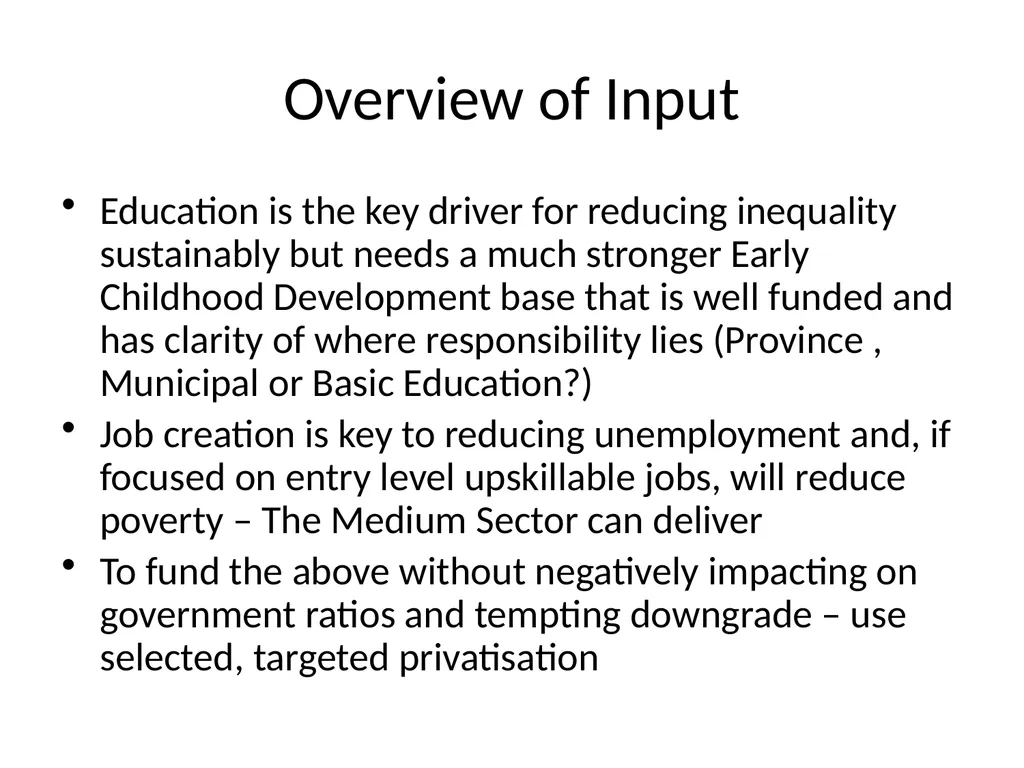
Overview of Input Education is the key driver for reducing inequality sustainably but needs a much stronger Early Childhood Development base that is well funded and has clarity of where responsibility lies (Province , Municipal or Basic Education?)
Job creation is key to reducing unemployment and, if focused on entry level upskillable jobs, will reduce poverty – The Medium Sector can deliver
To fund the above without negatively impacting on government ratios and tempting downgrade – use selected, targeted privatisation<br>
05
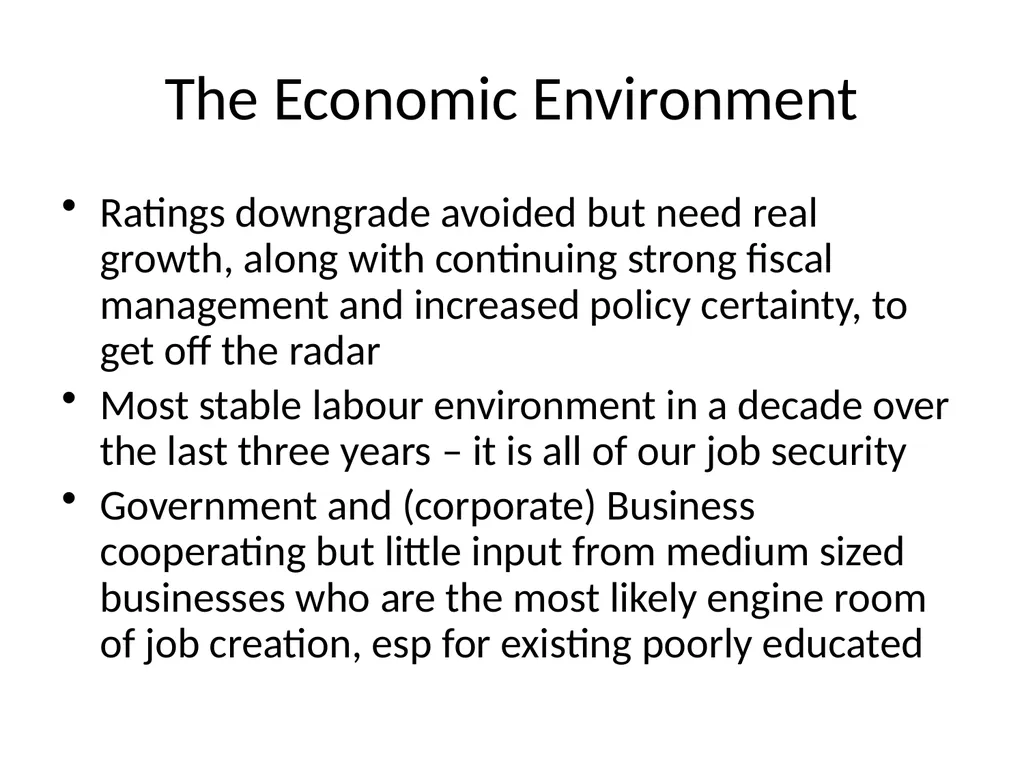
The Economic Environment Ratings downgrade avoided but need real growth, along with continuing strong fiscal management and increased policy certainty, to get off the radar
Most stable labour environment in a decade over the last three years – it is all of our job security
Government and (corporate) Business cooperating but little input from medium sized businesses who are the most likely engine room of job creation, esp for existing poorly educated<br>
06
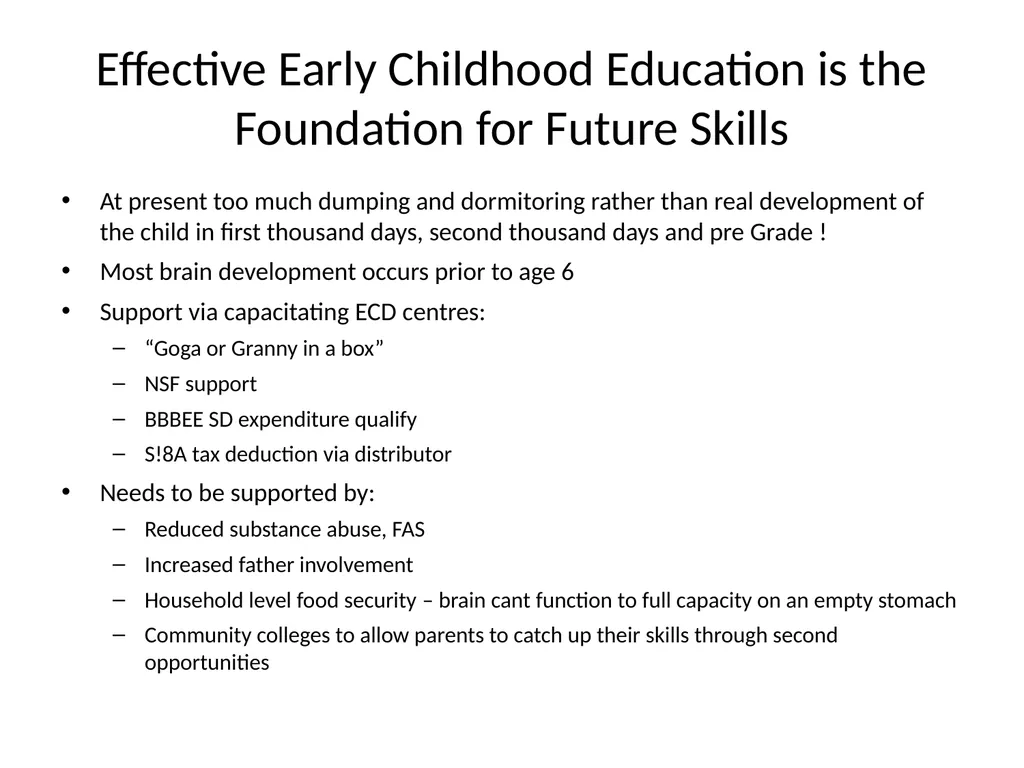
Effective Early Childhood Education is the Foundation for Future Skills At present too much dumping and dormitoring rather than real development of the child in first thousand days, second thousand days and pre Grade !
Most brain development occurs prior to age 6
Support via capacitating ECD centres:
“Goga or Granny in a box”
NSF support
BBBEE SD expenditure qualify
S!8A tax deduction via distributor
Needs to be supported by:
Reduced substance abuse, FAS
Increased father involvement
Household level food security – brain cant function to full capacity on an empty stomach
Community colleges to allow parents to catch up their skills through second opportunities<br>
07
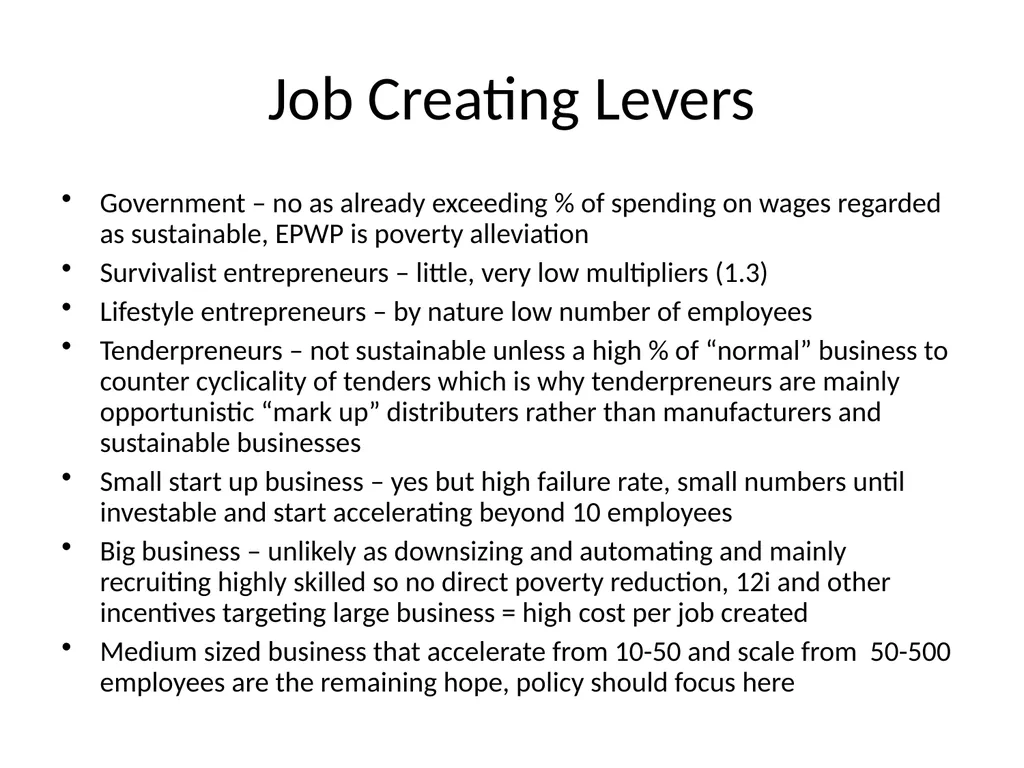
Job Creating Levers Government – no as already exceeding % of spending on wages regarded as sustainable, EPWP is poverty alleviation
Survivalist entrepreneurs – little, very low multipliers (1.3)
Lifestyle entrepreneurs – by nature low number of employees
Tenderpreneurs – not sustainable unless a high % of “normal” business to counter cyclicality of tenders which is why tenderpreneurs are mainly opportunistic “mark up” distributers rather than manufacturers and sustainable businesses
Small start up business – yes but high failure rate, small numbers until investable and start accelerating beyond 10 employees
Big business – unlikely as downsizing and automating and mainly recruiting highly skilled so no direct poverty reduction, 12i and other incentives targeting large business = high cost per job created
Medium sized business that accelerate from 10-50 and scale from 50-500 employees are the remaining hope, policy should focus here<br>
08
Supportive Environment for Job Creating Medium Sized Business Development Need Angel Investors rather than high end Venture Capital/low end Private Equity, new channels
Incentives to grow beyond R50m to R500m turnover not disincentives to stay below R50m
30 day payment enforced and, if not working, get Treasury to factor valid dept, soe and municipal debts
Big business should also commit to 30 days and banks should factor those valid unpaid debts
An effective 12J that works quickly and has uptake similar to the UK
Large scale deregulation to make it easier to start and grow to critical mass<br>
09
Selected Privatisation for Funding Pivotal Projects Start with non core and non strategic assets
Play to strengths of the private sector
Help put SOE’s onto proper capitalisation – recapitalisation via revenue is very inefficient - SARS is the only winner
An example – old power stations near end of life where State can set the rules and Private Sector can sweat the asset and extend the useful lives through innovation and focused management<br>
10
Reregulation Current regulation driven via large consolidated industries and cascaded down to smaller players with limited exemption opportunities
Three tier proposal:
Small – focus on health and safety
Medium – swing balance to management but employees and their representatives have ways of taking unscrupulous and exploitative owners to task, encourage gainsharing
Big – current model but Bargaining Councils tasked (and tracked) with expanding their industry, ensuring job creation and enhancing competitiveness
Dramatically simplify tax, registration and compliance for small and medium businesses, esp high job creators
Make entrepreneurship visas more accessible subject to graduated delivery of local jobs sustainably<br>
11
In Summary Education is the key driver of reducing inequality, along with redistribution which is not sustainable
In a knowledge based 4.0 economy need effective education + far more than the existing 4% of youth getting >50% in maths + good reading, writing, arithmetic, coding and social skills
Early Childhood Development is the base and needs even more support #feesmustrisetofundECD
Job creation, most likely via medium sized business, is key to reducing unemployment and if jobs are entry level upskillable jobs will start reducing poverty
To fund the above without raising Debt/GDP ratio or further increasing marginal tax rates (corporate, individual or indirect) requires innovative thinking and strong leadership<br>
12
The Presenter Guy Harris CA(SA)
0825598755
guyharrissa@gmail.com
20 years at Deloitte – Head of Consulting Durban
20 years at Bell Equipment as a Director – 50 years ago was a midsize scalable business
Now focused on scaling medium sized business and various governance and education involvements<br>