
Fiscal Year 2022 Emergency Solutions Grant (ESG)
MT
Published · 78 slides · 0 views

1 / 1








Description
Fiscal Year 2022 Emergency Solutions Grant (ESG) Outreach, Shelter, RRHP Overview Diane Walker, ESG Analyst 317-234-7575 diwalkerihcda.in.gov Agenda Compliance and Monitoring Street Outreach Emergency Shelter Short-term rental assistance
Related Topics
Share
Embed code
Download this presentation From Below
"Fiscal Year 2022 Emergency Solutions Grant (ESG)" is the property of its rightful owner. Permission is granted to download and print the materials on this website for personal, non-commercial use only, and to display it on your personal computer provided you do not modify the materials and that you retain all copyright notices contained in the materials. By downloading content from our website, you accept the terms of this agreement.
Presentation Transcript
01
Fiscal Year 2022
Emergency Solutions Grant (ESG) Outreach, Shelter, RR/HP
Overview
Diane Walker, ESG Analyst
317-234-7575 diwalker@ihcda.in.gov<br>
02
Agenda Compliance and Monitoring
Street Outreach
Emergency Shelter
Short-term rental assistance included with Shelter award
Rapid Rehousing
Homeless Prevention
Claims overview
Questions<br>
Street Outreach
Emergency Shelter
Short-term rental assistance included with Shelter award
Rapid Rehousing
Homeless Prevention
Claims overview
Questions<br>
03
Compliance and Monitoring<br>
04
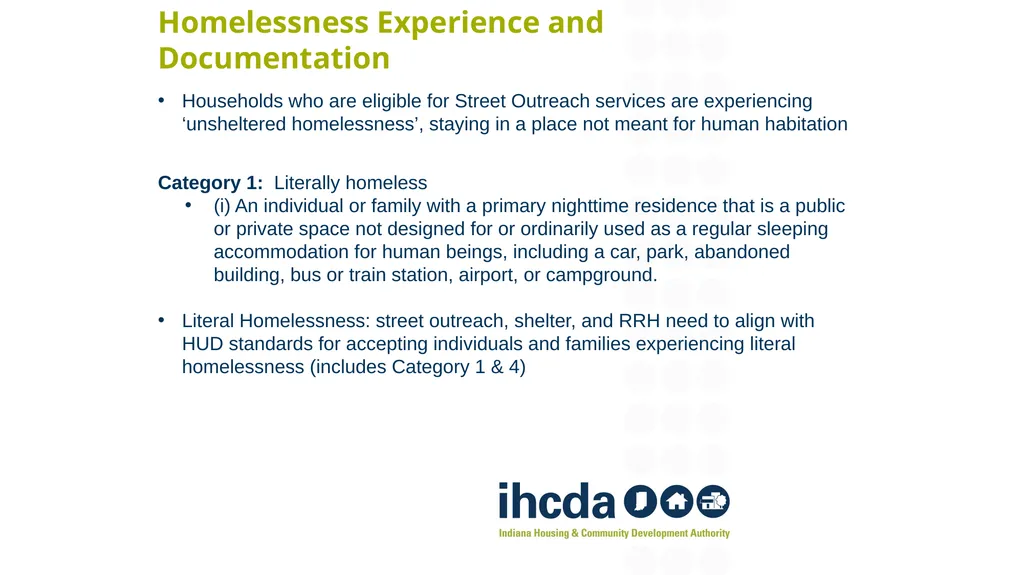
Homelessness Experience and Documentation Households who are eligible for Street Outreach services are experiencing ‘unsheltered homelessness’, staying in a place not meant for human habitation
Category 1: Literally homeless
(i) An individual or family with a primary nighttime residence that is a public or private space not designed for or ordinarily used as a regular sleeping accommodation for human beings, including a car, park, abandoned building, bus or train station, airport, or campground.
Literal Homelessness: street outreach, shelter, and RRH need to align with HUD standards for accepting individuals and families experiencing literal homelessness (includes Category 1 & 4)<br>
Category 1: Literally homeless
(i) An individual or family with a primary nighttime residence that is a public or private space not designed for or ordinarily used as a regular sleeping accommodation for human beings, including a car, park, abandoned building, bus or train station, airport, or campground.
Literal Homelessness: street outreach, shelter, and RRH need to align with HUD standards for accepting individuals and families experiencing literal homelessness (includes Category 1 & 4)<br>
05
Eligibility Criteria: Rapid Re-Housing Category 4:
Fleeing, or is attempting to flee domestic violence AND
• No subsequent residence has been identified AND
• No resources or support networks to obtain permanent housing
Category 4: This is not a new homeless eligibility category, but it has been expanded to include people who are fleeing or attempting to flee domestic violence, as well as sexual assault, stalking or other dangerous or life-threatening situations related to violence.<br>
Fleeing, or is attempting to flee domestic violence AND
• No subsequent residence has been identified AND
• No resources or support networks to obtain permanent housing
Category 4: This is not a new homeless eligibility category, but it has been expanded to include people who are fleeing or attempting to flee domestic violence, as well as sexual assault, stalking or other dangerous or life-threatening situations related to violence.<br>
06
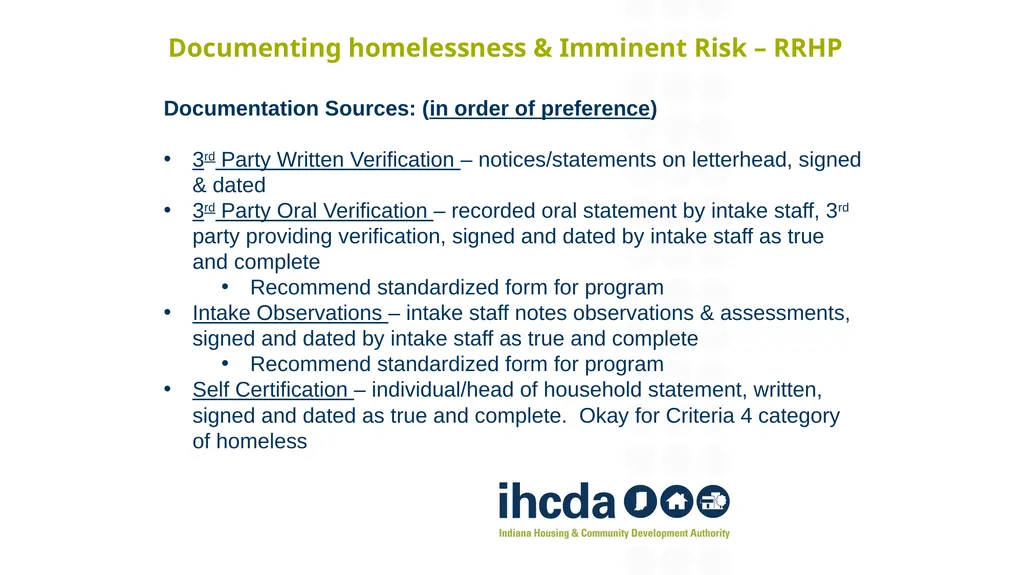
Documenting homelessness & Imminent Risk – RRHP Documentation Sources: (in order of preference)
3rd Party Written Verification – notices/statements on letterhead, signed & dated
3rd Party Oral Verification – recorded oral statement by intake staff, 3rd party providing verification, signed and dated by intake staff as true and complete
Recommend standardized form for program
Intake Observations – intake staff notes observations & assessments, signed and dated by intake staff as true and complete
Recommend standardized form for program
Self Certification – individual/head of household statement, written, signed and dated as true and complete. Okay for Criteria 4 category of homeless<br>
3rd Party Written Verification – notices/statements on letterhead, signed & dated
3rd Party Oral Verification – recorded oral statement by intake staff, 3rd party providing verification, signed and dated by intake staff as true and complete
Recommend standardized form for program
Intake Observations – intake staff notes observations & assessments, signed and dated by intake staff as true and complete
Recommend standardized form for program
Self Certification – individual/head of household statement, written, signed and dated as true and complete. Okay for Criteria 4 category of homeless<br>
07
Documentation of Homelessness The HUD Homeless Documentation form was created for use as a guide for proper documentation of homelessness.
It is not required that this specific form be used, however it is required that it is documented from where the participant was referred, 3rd party verification obtained when possible, and to have a space for client and staff signatures.<br>
It is not required that this specific form be used, however it is required that it is documented from where the participant was referred, 3rd party verification obtained when possible, and to have a space for client and staff signatures.<br>
08
Terminating Assistance: Grievance Procedures To terminate rental assistance or housing relocation and stabilization services to a program participant, the required formal process, at a minimum, must consist of:
(1) Written notice to the program participant containing a clear statement of the reasons for termination;
(2) A review of the decision,(Appeals process) in which the program participant is given the opportunity to present written or oral objections before a person other than the person (or a subordinate of that person) who made or approved the termination decision;
(3) Prompt written notice of the final decision to the program participant.
(c) Ability to provide further assistance. Termination under this section does not bar the sub-recipient from providing further assistance at a later date to the same family or individual.
IHCDA will not be involved in appeals<br>
(1) Written notice to the program participant containing a clear statement of the reasons for termination;
(2) A review of the decision,(Appeals process) in which the program participant is given the opportunity to present written or oral objections before a person other than the person (or a subordinate of that person) who made or approved the termination decision;
(3) Prompt written notice of the final decision to the program participant.
(c) Ability to provide further assistance. Termination under this section does not bar the sub-recipient from providing further assistance at a later date to the same family or individual.
IHCDA will not be involved in appeals<br>
09
Homeless Management Information System (HMIS) and Coordinated Entry Secure, confidential Web-based data collection system that tracks data on the nature and extent of homelessness in your individual program(s), your community, and also statewide and nationally.
Features of HMIS/ DV Client Track:
User-friendly, customizable, easy to generate reports
Case Management Tool: Can track employee hours, client goals, outcomes, and manage case loads
Arizona Self-Sufficiency Matrix- built in vulnerability matrix to quantify clients’ progress over time
ESG Shelters must participate in Coordinated Entry, HP does not have to participate in CE.<br>
Features of HMIS/ DV Client Track:
User-friendly, customizable, easy to generate reports
Case Management Tool: Can track employee hours, client goals, outcomes, and manage case loads
Arizona Self-Sufficiency Matrix- built in vulnerability matrix to quantify clients’ progress over time
ESG Shelters must participate in Coordinated Entry, HP does not have to participate in CE.<br>
10
ESG Reporting Requirements-HMIS Sub-recipients that utilize Essential Services funds are required to document case notes and services in HMIS or DV Client Track for all program participants
At this time, enter only ENROLLED/ELIGIBLE persons into HMIS for ESG RR & HP Program.<br>
At this time, enter only ENROLLED/ELIGIBLE persons into HMIS for ESG RR & HP Program.<br>
11
Domestic Violence Database Requirements Must have comparable system to HMIS system (collect same universal data elements, produce aggregate, client-level, unduplicated reports)
DV Client Track is available to DV shelters who cannot meet the requirement with their current database.
Contact the DV Client Track helpdesk at: dvhelpdesk@ihcda.in.gov
for assistance.<br>
DV Client Track is available to DV shelters who cannot meet the requirement with their current database.
Contact the DV Client Track helpdesk at: dvhelpdesk@ihcda.in.gov
for assistance.<br>
12
Point in Time Count Participation Participation expectations:
Update Housing Inventory Chart (HIC) form (November)
Communicate and respond timely with PIT Coordinator and Regional Planning Council Chair requests
Keep HMIS or Client Track Data up to date
Fill out PIT surveys when applicable (DV providers not on Cient Track or as part of unsheltered count efforts)
Pull PIT Report from HMIS/CT as required, check data carefully, send to appropriate IHCDA staff on time<br>
Update Housing Inventory Chart (HIC) form (November)
Communicate and respond timely with PIT Coordinator and Regional Planning Council Chair requests
Keep HMIS or Client Track Data up to date
Fill out PIT surveys when applicable (DV providers not on Cient Track or as part of unsheltered count efforts)
Pull PIT Report from HMIS/CT as required, check data carefully, send to appropriate IHCDA staff on time<br>
13
Services for Special Populations Funds may be used to provide services for homeless youth, victim services, and services for people living with HIV/AIDS, so long as the costs of providing these services are eligible ESG Outreach activities (Engagement, Case Management, Medical/Mental Health Services or Transportation)
The term victim services means services that assist program participants who are victims of domestic violence, dating violence, sexual assault, or stalking, including services offered by rape crisis centers and domestic violence shelters, and other organizations with a documented history of effective work concerning domestic violence, dating violence, sexual assault, or stalking<br>
The term victim services means services that assist program participants who are victims of domestic violence, dating violence, sexual assault, or stalking, including services offered by rape crisis centers and domestic violence shelters, and other organizations with a documented history of effective work concerning domestic violence, dating violence, sexual assault, or stalking<br>
14
Record Retention Period of record retention:
All records pertaining to each fiscal year of ESG funds must be retained for the greater of five (5) years following the end of the award period. Copies made by microfilming, photocopying, or similar methods may be substituted for the original records.
Documentation of each program participant’s qualification as a family or individual at risk of homelessness or as a homeless family or individual and other program participant records must be retained for 5 years after the
expenditure of all funds from the grant under which the program participant was served<br>
All records pertaining to each fiscal year of ESG funds must be retained for the greater of five (5) years following the end of the award period. Copies made by microfilming, photocopying, or similar methods may be substituted for the original records.
Documentation of each program participant’s qualification as a family or individual at risk of homelessness or as a homeless family or individual and other program participant records must be retained for 5 years after the
expenditure of all funds from the grant under which the program participant was served<br>
15
Budget Modifications and Amendments 1. Line Item:
a) Sub-recipients can modify the amounts among line items within an activity for each type of award.
There is no limit on the number of line item budget modifications that can be submitted throughout the award period.
2. Changing between activities:
For RRH awards, changing budgets from what is listed in Exhibit B of Award Agreement (between activities). These must be approved by IHCDA. Maximum of one Budget Amendment is allowable per year.
-Example: moving funds from RRH to HP or vice versa.
IHCDA will need to make changes in HUD’s accounting system and that is why they are required to be approved. It will delay payment if these steps are missed.<br>
a) Sub-recipients can modify the amounts among line items within an activity for each type of award.
There is no limit on the number of line item budget modifications that can be submitted throughout the award period.
2. Changing between activities:
For RRH awards, changing budgets from what is listed in Exhibit B of Award Agreement (between activities). These must be approved by IHCDA. Maximum of one Budget Amendment is allowable per year.
-Example: moving funds from RRH to HP or vice versa.
IHCDA will need to make changes in HUD’s accounting system and that is why they are required to be approved. It will delay payment if these steps are missed.<br>
16
Award Monitoring 25% of programs are monitored each program year- 1st time awardees must be monitored during the grant year.
The IHCDA Monitoring Analyst will send the monitoring tool in advance. Programs will be contacted before monitoring visit with a minimum of two weeks advance notice. We are currently only completing desk-top monitors until further notice.
Emphasis on compliance with federal requirements such as:
Client file review for case management and required documentation
Financial review including match reporting and claims
Utilization of Coordinated Entry and HMIS<br>
The IHCDA Monitoring Analyst will send the monitoring tool in advance. Programs will be contacted before monitoring visit with a minimum of two weeks advance notice. We are currently only completing desk-top monitors until further notice.
Emphasis on compliance with federal requirements such as:
Client file review for case management and required documentation
Financial review including match reporting and claims
Utilization of Coordinated Entry and HMIS<br>
17
STREET OUTREACH<br>
18
ESG Outreach Program Requirements Funds can serve people experiencing category 1 homelessness only (HUD’s definition of homeless)
Document homeless status (use form)
100% match (must be documented)
Keep accurate financial, service delivery records, should be retained for 5 years from the end of the award period
Working e-mail and access to Internet, financial software
Required to attend Award Trainings/Webinars
Ensure Confidentiality! Never email us client names!!
All of these requirements will be detailed in the ESG Outreach Award Manual<br>
Document homeless status (use form)
100% match (must be documented)
Keep accurate financial, service delivery records, should be retained for 5 years from the end of the award period
Working e-mail and access to Internet, financial software
Required to attend Award Trainings/Webinars
Ensure Confidentiality! Never email us client names!!
All of these requirements will be detailed in the ESG Outreach Award Manual<br>
19
Engagement The cost of activities to locate, identify and build relationships with people who are unsheltered and engage them for the purpose of providing immediate support and connection to resources.
Initial assessment
Addressing urgent needs; meals, clothing, blankets, toiletries
Active connection of information and referrals to resources and programs
Examples: connection to assessment for Coordinated Entry System, emergency shelter, community-based services, rapid rehousing programs, etc.<br>
Initial assessment
Addressing urgent needs; meals, clothing, blankets, toiletries
Active connection of information and referrals to resources and programs
Examples: connection to assessment for Coordinated Entry System, emergency shelter, community-based services, rapid rehousing programs, etc.<br>
20
Case Management The cost of assessing housing and service needs, arranging, coordinating, and monitoring the delivery of individualized services to meet the needs of the program participant
Eligible services and activities are as follows:
verifying and documenting eligibility; (homeless documentation form)
counseling
developing, securing and coordinating services
obtaining Federal, State, and local benefits
monitoring and evaluating program participant progress
providing information and referrals to other providers
developing an individualized housing and service plan, including planning a path to permanent housing stability<br>
Eligible services and activities are as follows:
verifying and documenting eligibility; (homeless documentation form)
counseling
developing, securing and coordinating services
obtaining Federal, State, and local benefits
monitoring and evaluating program participant progress
providing information and referrals to other providers
developing an individualized housing and service plan, including planning a path to permanent housing stability<br>
21
Emergency Health Services Eligible treatment consists of:
assessing a program participant's health problems and developing a treatment plan
assisting program participants to understand their health needs
providing directly or assisting program participants to obtain appropriate emergency medical treatment
providing medication and follow-up services
***Funds may be used only for these services to the extent that other appropriate health services are inaccessible or unavailable within the community
Must have documentation.<br>
assessing a program participant's health problems and developing a treatment plan
assisting program participants to understand their health needs
providing directly or assisting program participants to obtain appropriate emergency medical treatment
providing medication and follow-up services
***Funds may be used only for these services to the extent that other appropriate health services are inaccessible or unavailable within the community
Must have documentation.<br>
22
Emergency Mental Health Services Eligible treatment consists of:
assessing a program participant's health problems and developing a treatment plan
assisting program participants to understand their health needs
providing directly or assisting program participants to obtain appropriate emergency medical treatment
providing medication and follow-up services
***Funds may be used only for these services to the extent that other appropriate mental health services are inaccessible or unavailable within the community
Must have documentation.<br>
assessing a program participant's health problems and developing a treatment plan
assisting program participants to understand their health needs
providing directly or assisting program participants to obtain appropriate emergency medical treatment
providing medication and follow-up services
***Funds may be used only for these services to the extent that other appropriate mental health services are inaccessible or unavailable within the community
Must have documentation.<br>
23
Transportation The transportation costs of travel by outreach workers, social workers, medical professionals, or other service providers are eligible, provided that this travel takes place during the provision of ESG eligible services
Eligible costs include:
The cost of a program participant's travel on public transportation
The cost of transporting a participant to emergency housing or other service facilities
Mileage reimbursement when an employee’s own vehicle is used
The cost of purchasing or leasing a vehicle for the sub-recipient in which staff transports program participants and/or staff serving program participants, and the cost of gas, insurance, taxes and maintenance for the vehicle
The travel costs program staff to accompany or assist program participants to use public transportation<br>
Eligible costs include:
The cost of a program participant's travel on public transportation
The cost of transporting a participant to emergency housing or other service facilities
Mileage reimbursement when an employee’s own vehicle is used
The cost of purchasing or leasing a vehicle for the sub-recipient in which staff transports program participants and/or staff serving program participants, and the cost of gas, insurance, taxes and maintenance for the vehicle
The travel costs program staff to accompany or assist program participants to use public transportation<br>
24
EMERGENCY SHELTER<br>
25
ESG Shelter Program Requirements Funds can serve people experiencing category 1 and category 4 homelessness (HUD’s definition of homeless)
You must document homelessness!
Age or gender of a child must not be used as a basis for denying shelter to a family
HUD Equal Access Rule: LGBTQ+ or family make-up cannot bar access or impact shelter services
100% match (must be documented)
Termination/Grievance Procedure
Participation of Homeless Persons in organization to the extent possible
Keep accurate financial, service delivery records, for 5 years following the end of the award period
Working e-mail and access to Internet, financial software
Non- domestic violence shelter must use HMIS, DV must use comparable database (we recommend DV ClientTrack) Must enter not just for ESG program, but all homeless programs in agency. Enter client data within 5 days of intake.<br>
You must document homelessness!
Age or gender of a child must not be used as a basis for denying shelter to a family
HUD Equal Access Rule: LGBTQ+ or family make-up cannot bar access or impact shelter services
100% match (must be documented)
Termination/Grievance Procedure
Participation of Homeless Persons in organization to the extent possible
Keep accurate financial, service delivery records, for 5 years following the end of the award period
Working e-mail and access to Internet, financial software
Non- domestic violence shelter must use HMIS, DV must use comparable database (we recommend DV ClientTrack) Must enter not just for ESG program, but all homeless programs in agency. Enter client data within 5 days of intake.<br>
26
Eligible Activities-Essential Services Case management- salary of case manager working directly with shelter clients
Child Care- payment to a licensed daycare center for child-care of shelter clients including providing meals, snacks, and activities
Education Services- cost of books, instructional materials, literacy training
Employment Assistance and Job Training- cost of job training programs; assistance in acquisition of vocational license and/or certificate
Outpatient Health Services- outpatient Doctor examination, health screening, preventative medical care, medication, dental care<br>
Child Care- payment to a licensed daycare center for child-care of shelter clients including providing meals, snacks, and activities
Education Services- cost of books, instructional materials, literacy training
Employment Assistance and Job Training- cost of job training programs; assistance in acquisition of vocational license and/or certificate
Outpatient Health Services- outpatient Doctor examination, health screening, preventative medical care, medication, dental care<br>
27
Eligible Activities-Essential Services Legal Services- hourly fees and legal advice from licensed attorneys;
Life Skills Training- training budgeting resources, managing money, conflict resolution, shopping for food, etc.
Mental Health Services- outpatient treatment by licensed professionals
Substance Abuse Treatment Services- outpatient treatment for up to 30 days
Transportation- travel to and from essential service activities-bus tokens, shelter vehicle
Services for Special Populations-Otherwise eligible essential services tailored to address the special needs of homeless youth, victims of domestic violence and related crimes/threats, and people living with HIV/AIDS in emergency shelters.<br>
Life Skills Training- training budgeting resources, managing money, conflict resolution, shopping for food, etc.
Mental Health Services- outpatient treatment by licensed professionals
Substance Abuse Treatment Services- outpatient treatment for up to 30 days
Transportation- travel to and from essential service activities-bus tokens, shelter vehicle
Services for Special Populations-Otherwise eligible essential services tailored to address the special needs of homeless youth, victims of domestic violence and related crimes/threats, and people living with HIV/AIDS in emergency shelters.<br>
28
Essential Services-Ineligible Activities Salaries of employees not working directly with clients
Staff recruitment/training
Training not sponsored by HUD
Transportation costs not directly associated with service delivery
Transportation-gas cards or filling client’s car with gas
Inpatient detoxification and other inpatient drug or alcohol treatment<br>
Staff recruitment/training
Training not sponsored by HUD
Transportation costs not directly associated with service delivery
Transportation-gas cards or filling client’s car with gas
Inpatient detoxification and other inpatient drug or alcohol treatment<br>
29
Eligible operating costs of the shelter building related to the provision of emergency housing including:
Maintenance (minor or routine repairs), rent, security, fuel (for shelter not vehicle), equipment, insurance, utilities, food, furnishings, and supplies necessary for the operation of the emergency shelter
Payment of short-term motel/hotel stays where no appropriate emergency shelter is available
No more than 10% of each sub-recipient’s total award can be utilized for operations staff salaries
Excludes maintenance and security salary costs Shelter Operations<br>
Maintenance (minor or routine repairs), rent, security, fuel (for shelter not vehicle), equipment, insurance, utilities, food, furnishings, and supplies necessary for the operation of the emergency shelter
Payment of short-term motel/hotel stays where no appropriate emergency shelter is available
No more than 10% of each sub-recipient’s total award can be utilized for operations staff salaries
Excludes maintenance and security salary costs Shelter Operations<br>
30
Eligible Activities- Operations Maintenance: carpet cleaning in shelter rooms; fixing plumbing issue in shelter; salary of maintenance worker; killing bed bugs, etc.
Rent: lease of shelter building
Security: monthly cost of security system for shelter; software for computer security
Utilities: gas or electric bill for shelter building<br>
Rent: lease of shelter building
Security: monthly cost of security system for shelter; software for computer security
Utilities: gas or electric bill for shelter building<br>
31
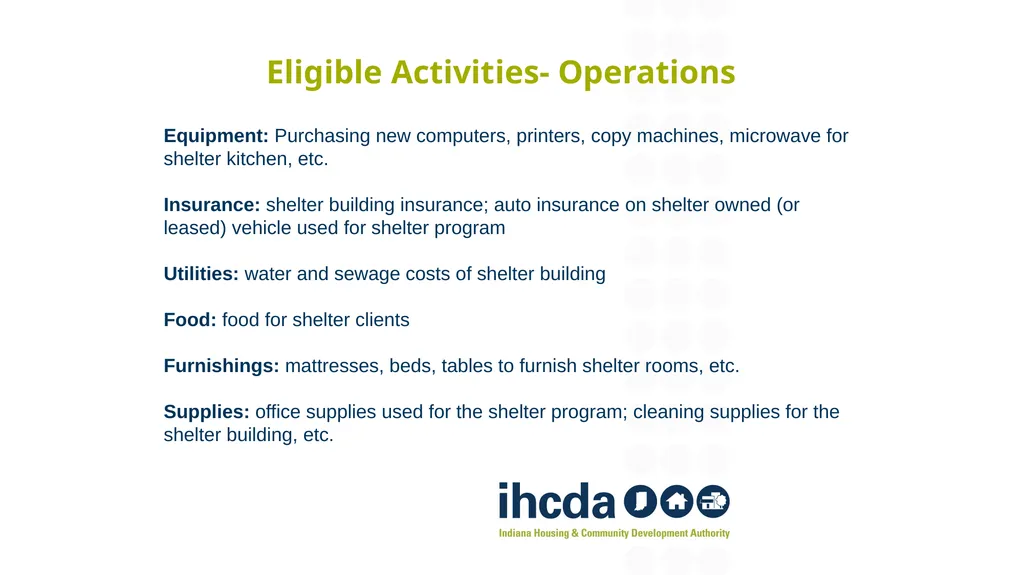
Eligible Activities- Operations Equipment: Purchasing new computers, printers, copy machines, microwave for shelter kitchen, etc.
Insurance: shelter building insurance; auto insurance on shelter owned (or leased) vehicle used for shelter program
Utilities: water and sewage costs of shelter building
Food: food for shelter clients
Furnishings: mattresses, beds, tables to furnish shelter rooms, etc.
Supplies: office supplies used for the shelter program; cleaning supplies for the shelter building, etc.<br>
Insurance: shelter building insurance; auto insurance on shelter owned (or leased) vehicle used for shelter program
Utilities: water and sewage costs of shelter building
Food: food for shelter clients
Furnishings: mattresses, beds, tables to furnish shelter rooms, etc.
Supplies: office supplies used for the shelter program; cleaning supplies for the shelter building, etc.<br>
32
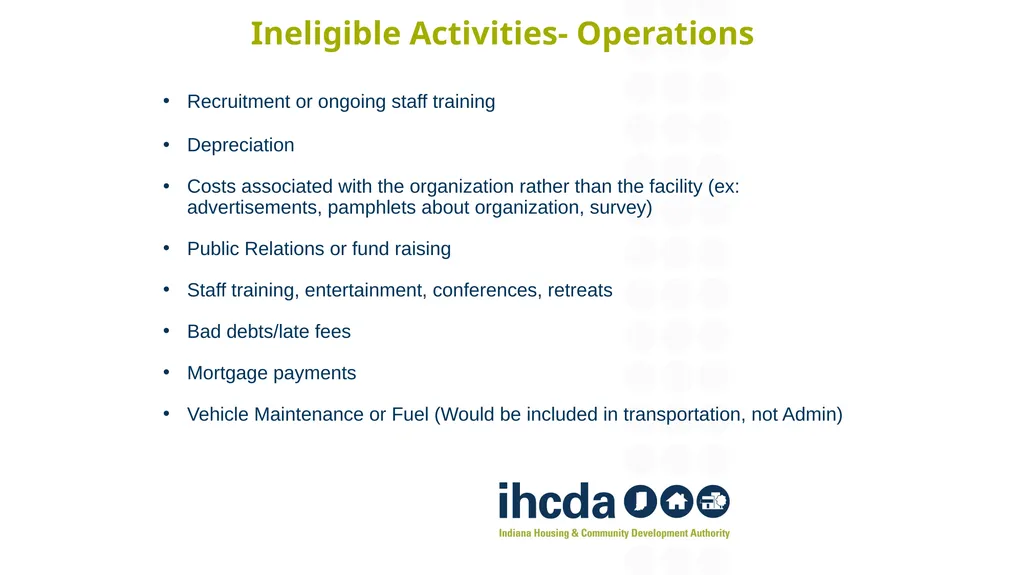
Ineligible Activities- Operations Recruitment or ongoing staff training
Depreciation
Costs associated with the organization rather than the facility (ex: advertisements, pamphlets about organization, survey)
Public Relations or fund raising
Staff training, entertainment, conferences, retreats
Bad debts/late fees
Mortgage payments
Vehicle Maintenance or Fuel (Would be included in transportation, not Admin)<br>
Depreciation
Costs associated with the organization rather than the facility (ex: advertisements, pamphlets about organization, survey)
Public Relations or fund raising
Staff training, entertainment, conferences, retreats
Bad debts/late fees
Mortgage payments
Vehicle Maintenance or Fuel (Would be included in transportation, not Admin)<br>
33
Rental Assistance (RRH as part of Shelter Award) Housing relocation and stabilization services and short term, one-time financial assistance, as necessary, to help a homeless individual or family move as quickly as possible out of shelter system and into permanent housing and achieve stability in their own housing.
Communities that have most successfully decreased the number of people experiencing homelessness have employed Rapid Re-housing programs as a central part of the solution.
Directly reduces homelessness, frees up space in emergency shelter to be able to more effectively and rapidly triage people through emergency crisis center
Helps your shelter program to get people into permanent housing quickly and thus reduce length of stay and be able to serve more people
Population served: literally homeless only. Those in a shelter, place not meant for human habitation. No income requirements<br>
Communities that have most successfully decreased the number of people experiencing homelessness have employed Rapid Re-housing programs as a central part of the solution.
Directly reduces homelessness, frees up space in emergency shelter to be able to more effectively and rapidly triage people through emergency crisis center
Helps your shelter program to get people into permanent housing quickly and thus reduce length of stay and be able to serve more people
Population served: literally homeless only. Those in a shelter, place not meant for human habitation. No income requirements<br>
34
Rental Assistance (RRH as part of Shelter Award) Financial Assistance (Short-term only)
Security, Utility Deposits
Utility Payments & Arrears
Last Month’s Rent
Rental Application Fees
Moving costs (truck rental, moving company, short term storage)
Services (need to provide financial assistance or rental assistance to use)
Housing Search & Placement
Housing Stability Case Management
Legal Services
Credit Repair
Rental Assistance (One time payment only)
First Month’s Rent (need to sign lease agreement w/ landlord)
Rental Arrears (up to 6 months; sign form with landlord, tenant, proof of arrears)<br>
Security, Utility Deposits
Utility Payments & Arrears
Last Month’s Rent
Rental Application Fees
Moving costs (truck rental, moving company, short term storage)
Services (need to provide financial assistance or rental assistance to use)
Housing Search & Placement
Housing Stability Case Management
Legal Services
Credit Repair
Rental Assistance (One time payment only)
First Month’s Rent (need to sign lease agreement w/ landlord)
Rental Arrears (up to 6 months; sign form with landlord, tenant, proof of arrears)<br>
35
Rental Assistance-Ineligible Activities Housing/services to persons who don’t meet HUD’s literal homelessness definition
Direct payments to individuals needing assistance<br>
Direct payments to individuals needing assistance<br>
36
RAPID REHOUSING<br>
37
Rapid Rehousing Program Model Access to Rapid Rehousing without Pre-Condition:
No income requirement
No criminal history thresholds
No criteria related to rental/housing history
Rental Subsidies available for up to 24 months in a 3 year period; based on household need
Expand housing-focused Case Management<br>
No income requirement
No criminal history thresholds
No criteria related to rental/housing history
Rental Subsidies available for up to 24 months in a 3 year period; based on household need
Expand housing-focused Case Management<br>
38
Required Documentation 1. Homeless Documentation – utilize HUD Homeless Documentation Form or HMIS intake form
2. Coordinated Entry Assessment-VI-SPDAT
3. HMIS Intake
4. Arizona Self Sufficiency Matrix – inside HMIS
5. Housing Plan – in HMIS system
6. Housing Inspection – Habitability Form
7. Lead Based Paint Inspection - signed acknowledgment of receipt of lead-based paint disclosures should be in client file.
8. Rent Reasonable check - Utilize Affordablehousing.com/formerly GoSection 8
Copy/print and place in file
Contact ESG Analyst for log-in credentials for Affordablehousing.com/GoSection 8
Review Affordablehousing.com/GoSection 8 user manual
*Rent cannot be over FMR – utilize most up to date FMR<br>
2. Coordinated Entry Assessment-VI-SPDAT
3. HMIS Intake
4. Arizona Self Sufficiency Matrix – inside HMIS
5. Housing Plan – in HMIS system
6. Housing Inspection – Habitability Form
7. Lead Based Paint Inspection - signed acknowledgment of receipt of lead-based paint disclosures should be in client file.
8. Rent Reasonable check - Utilize Affordablehousing.com/formerly GoSection 8
Copy/print and place in file
Contact ESG Analyst for log-in credentials for Affordablehousing.com/GoSection 8
Review Affordablehousing.com/GoSection 8 user manual
*Rent cannot be over FMR – utilize most up to date FMR<br>
39
Required Documentation 9. Income information collected – place in file
Income calculation form
Zero Income form
10. Utility Allowance- Only needed if utilities are not included in rent
11. Lease Agreement Forms –
RAP (rental assistance program contract) – between tenant & sub-recipient;
RAP between landlord & sub-recipient
12. Save a copy of the tenant’s lease with the landlord in the file.
13. Provide agency termination policy & procedures and appeals process.
- should have signed acknowledgement of receipt of policy.
14. Case Management required monthly. Utilize HMIS service case management for time spent with each household/person
15. Required VAWA Forms – Forms 5380-5383. Forms will be sent after training.<br>
Income calculation form
Zero Income form
10. Utility Allowance- Only needed if utilities are not included in rent
11. Lease Agreement Forms –
RAP (rental assistance program contract) – between tenant & sub-recipient;
RAP between landlord & sub-recipient
12. Save a copy of the tenant’s lease with the landlord in the file.
13. Provide agency termination policy & procedures and appeals process.
- should have signed acknowledgement of receipt of policy.
14. Case Management required monthly. Utilize HMIS service case management for time spent with each household/person
15. Required VAWA Forms – Forms 5380-5383. Forms will be sent after training.<br>
40
Income Requirement for Rapid Re-housing There is no income threshold with Rapid Re-housing:
Households with income, pay 30% of their adjusted gross income
Households without income are not required to contribute financially to their rent until an increase in income occurs
Complete the zero-income affidavit if a person enters the program without household income<br>
Households with income, pay 30% of their adjusted gross income
Households without income are not required to contribute financially to their rent until an increase in income occurs
Complete the zero-income affidavit if a person enters the program without household income<br>
41
Housing Relocation & Stabilization Services: Financial Assistance Costs ESG funds may be used to pay housing owners, utility companies, and other third parties for the following costs:
Rental application fees:
ESG funds may pay for the rental housing application fee that is charged by the owner to all applicants
(2) Security deposits:
ESG funds may pay for a security deposit that is equal to no more than 2 months’ rent.
(3) Last month’s rent:
If necessary to obtain housing for a program participant, the last month’s rent may be paid from ESG funds to the owner of that housing at the time the owner is paid the security deposit and the first month’s rent. This assistance must not exceed one month’s rent and must be included in calculating the program participant’s total rental assistance, which cannot exceed 24 months during any 3-year period.
*1st month’s rent is part of rental assistance activity<br>
Rental application fees:
ESG funds may pay for the rental housing application fee that is charged by the owner to all applicants
(2) Security deposits:
ESG funds may pay for a security deposit that is equal to no more than 2 months’ rent.
(3) Last month’s rent:
If necessary to obtain housing for a program participant, the last month’s rent may be paid from ESG funds to the owner of that housing at the time the owner is paid the security deposit and the first month’s rent. This assistance must not exceed one month’s rent and must be included in calculating the program participant’s total rental assistance, which cannot exceed 24 months during any 3-year period.
*1st month’s rent is part of rental assistance activity<br>
42
Housing Relocation & Stabilization Services: Financial Assistance Costs (4) Utility deposits:
ESG funds may pay for a standard utility deposit required by the utility company for all customers. Deposits are limited to the allowable covered utilities as noted below.
(5) Utility payments:
ESG funds may pay for up to 24 months of utility payments per program participant, per service, including up to 6 months of utility payments in arrears, per service. A partial payment of a utility bill counts as one month.
This assistance may only be provided if the program participant or a member of the same household has an account in his or her name with a utility company or proof of responsibility to make utility payments.
Eligible utility services are gas, electric, water, and sewage. No program participant shall receive more than 24 months of utility assistance within any 3-year period.<br>
ESG funds may pay for a standard utility deposit required by the utility company for all customers. Deposits are limited to the allowable covered utilities as noted below.
(5) Utility payments:
ESG funds may pay for up to 24 months of utility payments per program participant, per service, including up to 6 months of utility payments in arrears, per service. A partial payment of a utility bill counts as one month.
This assistance may only be provided if the program participant or a member of the same household has an account in his or her name with a utility company or proof of responsibility to make utility payments.
Eligible utility services are gas, electric, water, and sewage. No program participant shall receive more than 24 months of utility assistance within any 3-year period.<br>
43
Housing Relocation & Stabilization Services – Financial Assistance (6) Moving costs:
ESG funds may pay for moving costs, such as truck rental or hiring a moving company. This assistance may include payment of temporary storage fees for up to 3 months, provided that the fees are accrued after the date the program participant begins receiving assistance under paragraph (b) of this section and before the program participant moves into permanent housing. Payment of temporary storage fees in arrears is not eligible.
Even though this is not rental assistance, a Housing Habitability has to be completed for the above financial assistance items.
NOT required to review Rent Reasonableness nor be within HUD FMR because rental assistance was not provided
Case Management is also required – at least 1 x month while funds are being provided.<br>
ESG funds may pay for moving costs, such as truck rental or hiring a moving company. This assistance may include payment of temporary storage fees for up to 3 months, provided that the fees are accrued after the date the program participant begins receiving assistance under paragraph (b) of this section and before the program participant moves into permanent housing. Payment of temporary storage fees in arrears is not eligible.
Even though this is not rental assistance, a Housing Habitability has to be completed for the above financial assistance items.
NOT required to review Rent Reasonableness nor be within HUD FMR because rental assistance was not provided
Case Management is also required – at least 1 x month while funds are being provided.<br>
44
Housing Relocation & Stabilization Service Costs ESG funds may be used to pay the costs of providing the following services:
Housing search and placement:
Services or activities necessary to assist program participants in locating, obtaining, and retaining suitable permanent housing, include the following:
Assessment of housing barriers, needs, and preferences
Development of an action plan for locating housing
Housing search
Outreach to and negotiation with landlords/owners
Assistance with submitting rental applications and understanding leases
Assessment of housing for compliance with Emergency Solutions Grant (ESG)
Requirements for habitability, lead-based paint, and rent reasonableness
Assistance with obtaining utilities and making moving arrangements
Tenant counseling<br>
Housing search and placement:
Services or activities necessary to assist program participants in locating, obtaining, and retaining suitable permanent housing, include the following:
Assessment of housing barriers, needs, and preferences
Development of an action plan for locating housing
Housing search
Outreach to and negotiation with landlords/owners
Assistance with submitting rental applications and understanding leases
Assessment of housing for compliance with Emergency Solutions Grant (ESG)
Requirements for habitability, lead-based paint, and rent reasonableness
Assistance with obtaining utilities and making moving arrangements
Tenant counseling<br>
45
Housing Relocation & Stabilization Service Costs (2) Housing Stability Case Management:
ESG funds may be used to pay cost of assessing, arranging, coordinating, and monitoring the delivery of individualized services to facilitate housing stability for a program participant who resides in permanent housing or assist a program participant in overcoming immediate assistance cannot exceed 30 days during the period the program participant is seeking permanent housing and cannot exceed 18 months during the period the program participant is living in permanent housing.<br>
ESG funds may be used to pay cost of assessing, arranging, coordinating, and monitoring the delivery of individualized services to facilitate housing stability for a program participant who resides in permanent housing or assist a program participant in overcoming immediate assistance cannot exceed 30 days during the period the program participant is seeking permanent housing and cannot exceed 18 months during the period the program participant is living in permanent housing.<br>
46
Housing Stability Case Management - Activities Using the coordinated entry system to evaluate needs of households applying for or receiving homelessness prevention or rapid re-housing assistance
Conducting the initial evaluation including verifying and documenting eligibility (getting 3rd party documentation of homelessness), for individuals and families applying for rapid re-housing assistance
Counseling
Developing, securing, and coordinating services and obtaining Federal, State, and local benefits
Monitoring and evaluating program participant progress
Providing information and referrals to other providers
Developing an individualized housing and service plan, including planning a path to permanent housing stability
Conducting re-evaluations as required in the new progressive engagement standards<br>
Conducting the initial evaluation including verifying and documenting eligibility (getting 3rd party documentation of homelessness), for individuals and families applying for rapid re-housing assistance
Counseling
Developing, securing, and coordinating services and obtaining Federal, State, and local benefits
Monitoring and evaluating program participant progress
Providing information and referrals to other providers
Developing an individualized housing and service plan, including planning a path to permanent housing stability
Conducting re-evaluations as required in the new progressive engagement standards<br>
47
Housing Stability Case Management Housing Stability Case Management-Activities:
While providing RR or HP assistance to a program participant, the sub-recipient must:
Meet with the participant at least once monthly to check in on housing related goals and insure the household can access support and resources as needed
Develop a housing plan (utilize HMIS) to assist the program participant in finding and retaining permanent housing after the ESG assistance ends
* The Arizona Matrix tool (in HMIS) can be a helpful tool to establish goals for the housing plan<br>
While providing RR or HP assistance to a program participant, the sub-recipient must:
Meet with the participant at least once monthly to check in on housing related goals and insure the household can access support and resources as needed
Develop a housing plan (utilize HMIS) to assist the program participant in finding and retaining permanent housing after the ESG assistance ends
* The Arizona Matrix tool (in HMIS) can be a helpful tool to establish goals for the housing plan<br>
48
Mainstream Resources & Housing Plan Connecting program participants to mainstream and other resources:
Mainstream resources including but not limited to:
Medicaid
SNAP/Food Benefits
WIC
SSI/SSDI
Childcare or public school
Head Start
Work One/Vocational Rehabilitation
Food Banks/Meal Programs
Hoosier Wise Insurance
Health Clinic’s
Case Management required at least 1 time per month. Increase case management as indicated by the barriers noted in the Arizona Matrix Tool and focusing on those needs & goals in the housing plan. Adjust Housing Plan as needed.<br>
Mainstream resources including but not limited to:
Medicaid
SNAP/Food Benefits
WIC
SSI/SSDI
Childcare or public school
Head Start
Work One/Vocational Rehabilitation
Food Banks/Meal Programs
Hoosier Wise Insurance
Health Clinic’s
Case Management required at least 1 time per month. Increase case management as indicated by the barriers noted in the Arizona Matrix Tool and focusing on those needs & goals in the housing plan. Adjust Housing Plan as needed.<br>
49
Housing Relocation & Stabilization Service Costs Mediation:
ESG funds may pay for mediation between the program participant and the owner or person(s) with whom the program participant is living, provided that the mediation is necessary to prevent the program participant from losing permanent housing in which the program participant currently resides.
Legal services:
Eligible subject matters also include landlord/tenant matters, and the services must be necessary to resolve a legal problem that prohibits the program participant from obtaining permanent housing or will likely result in the program participant losing the permanent housing in which the program participant currently resides.
Credit repair:
ESG funds may pay for credit counseling and other services necessary to assist program participants with critical skills related to household budgeting, managing money, accessing a free personal credit report, and resolving personal credit problems. This assistance does not include the payment or modification of a debt.<br>
ESG funds may pay for mediation between the program participant and the owner or person(s) with whom the program participant is living, provided that the mediation is necessary to prevent the program participant from losing permanent housing in which the program participant currently resides.
Legal services:
Eligible subject matters also include landlord/tenant matters, and the services must be necessary to resolve a legal problem that prohibits the program participant from obtaining permanent housing or will likely result in the program participant losing the permanent housing in which the program participant currently resides.
Credit repair:
ESG funds may pay for credit counseling and other services necessary to assist program participants with critical skills related to household budgeting, managing money, accessing a free personal credit report, and resolving personal credit problems. This assistance does not include the payment or modification of a debt.<br>
50
Services: Housing Habitability Minimum standards for permanent housing: Utilize Habitability form
The recipient or sub-recipient cannot use ESG funds to help a program participant remain or move into housing that does not meet the minimum habitability standards:
(1) Structure and materials
(2) Space and security
(3) Interior air quality
(4) Water supply
(5) Sanitary facilities
(6) Thermal environment
(7) Illumination and electricity
(8) Food preparation
(9) Sanitary conditions
(10) Fire safety<br>
The recipient or sub-recipient cannot use ESG funds to help a program participant remain or move into housing that does not meet the minimum habitability standards:
(1) Structure and materials
(2) Space and security
(3) Interior air quality
(4) Water supply
(5) Sanitary facilities
(6) Thermal environment
(7) Illumination and electricity
(8) Food preparation
(9) Sanitary conditions
(10) Fire safety<br>
51
Housing Habitability & Lead Paint Housing Habitability form is REQUIRED for any ESG fund to help participant to remain or move into housing. If security deposit, utility deposit, utility payments, last month’s rent, application fees, moving costs, rental assistance are provided - an inspection is required
Lead-based Paint:
Lead-based paint remediation and disclosure. Should be provided to all clients with signed confirmation of receipt in client file.
Form should be signed by landlord if: Children (6 and below) staying in home and the home is older than 1978.<br>
Lead-based Paint:
Lead-based paint remediation and disclosure. Should be provided to all clients with signed confirmation of receipt in client file.
Form should be signed by landlord if: Children (6 and below) staying in home and the home is older than 1978.<br>
52
Housing & Relocation Stabilization: Rental Assistance Short-term and medium-term rental assistance:
(a) the recipient or sub-recipient may provide a program participant with up to 24 months of rental assistance during any 3-year period.
IHCDA limits a maximum of 24 months of continuous rental subsidy
If client loses income suddenly, reevaluate income again for their 30% adjusted gross income share.
(1) Short-term rental assistance is assistance for up to 3 months of rent.
(2) Medium-term rental assistance is assistance for more than 3 months but
not more than 12 months
(3) Payment of rental arrears consists of a one-time payment for up to 6 months of rent in arrears, including any late fees on those arrears.
(4) Rental assistance will be tenant based<br>
(a) the recipient or sub-recipient may provide a program participant with up to 24 months of rental assistance during any 3-year period.
IHCDA limits a maximum of 24 months of continuous rental subsidy
If client loses income suddenly, reevaluate income again for their 30% adjusted gross income share.
(1) Short-term rental assistance is assistance for up to 3 months of rent.
(2) Medium-term rental assistance is assistance for more than 3 months but
not more than 12 months
(3) Payment of rental arrears consists of a one-time payment for up to 6 months of rent in arrears, including any late fees on those arrears.
(4) Rental assistance will be tenant based<br>
53
Housing & Relocation Stabilization: Rent Assistance Use with other subsidies:
Except for a one-time payment of rental arrears on the tenant’s portion of the rental payment, rental assistance cannot be provided to a program participant who is receiving tenant-based rental assistance, or living in a housing unit receiving project-based rental assistance or operating assistance, through other public sources such as Section 8.
Cannot pay rent payment if tenant is receiving HUD-VASH rental assistance. However, if HUD-VASH doesn’t cover security or utility deposit, then ESG RRH can pay security up to the amount of 2 months rent and utility deposit.<br>
Except for a one-time payment of rental arrears on the tenant’s portion of the rental payment, rental assistance cannot be provided to a program participant who is receiving tenant-based rental assistance, or living in a housing unit receiving project-based rental assistance or operating assistance, through other public sources such as Section 8.
Cannot pay rent payment if tenant is receiving HUD-VASH rental assistance. However, if HUD-VASH doesn’t cover security or utility deposit, then ESG RRH can pay security up to the amount of 2 months rent and utility deposit.<br>
54
Housing & Relocation Stabilization: Rental Assistance Rent restrictions:
Rental assistance cannot be provided if the rent exceeds the Fair Market Rent established by HUD, as provided and complies with HUD’s standard of rent reasonableness.
Rental Assistance can also include: utilities (excluding telephone), security deposit or other fees required under the lease, (other than late fees and pet fees) and, if the tenant pays separately for utilities, the monthly allowance for utilities (excluding telephone). Monthly allowances are released by IHCDA every year.<br>
Rental assistance cannot be provided if the rent exceeds the Fair Market Rent established by HUD, as provided and complies with HUD’s standard of rent reasonableness.
Rental Assistance can also include: utilities (excluding telephone), security deposit or other fees required under the lease, (other than late fees and pet fees) and, if the tenant pays separately for utilities, the monthly allowance for utilities (excluding telephone). Monthly allowances are released by IHCDA every year.<br>
55
Housing & Relocation Stabilization: Rental Assistance Payment - RAP Rental Assistance Agreement:
Rental assistance payments only to an owner with whom the sub-recipient has entered into a rental assistance agreement. The rental assistance agreement must set forth the terms under which rental assistance will be provided, including the requirements that apply under this section:
The rental assistance agreement must provide that during the term of the agreement, the owner must give your agency a copy of any notice to the program participant to vacate the housing unit, or any complaint used under state or local law to commence an eviction action against the program participant.
Required lease forms:
1. Required RAP between landlord and your agency
2. Required RAP Agreement between tenant and sub-recipient regarding payment and who is responsible for which housing costs and amounts-Useful to prevent confusion for the tenant.
3. Copy of signed lease between tenant and landlord.
4. VAWA HUD form 5380.<br>
Rental assistance payments only to an owner with whom the sub-recipient has entered into a rental assistance agreement. The rental assistance agreement must set forth the terms under which rental assistance will be provided, including the requirements that apply under this section:
The rental assistance agreement must provide that during the term of the agreement, the owner must give your agency a copy of any notice to the program participant to vacate the housing unit, or any complaint used under state or local law to commence an eviction action against the program participant.
Required lease forms:
1. Required RAP between landlord and your agency
2. Required RAP Agreement between tenant and sub-recipient regarding payment and who is responsible for which housing costs and amounts-Useful to prevent confusion for the tenant.
3. Copy of signed lease between tenant and landlord.
4. VAWA HUD form 5380.<br>
56
Housing & Relocation Stabilization: Rental Assistance Late Payments:
The sub-recipient must make timely payments to each landlord/owner in accordance with the rental assistance agreement. The rental assistance agreement must contain the same payment due date, grace period, and late payment penalty requirements as the program participant’s lease.
The sub-recipient is solely responsible for paying late payment penalties that it incurs with non-ESG funds.<br>
The sub-recipient must make timely payments to each landlord/owner in accordance with the rental assistance agreement. The rental assistance agreement must contain the same payment due date, grace period, and late payment penalty requirements as the program participant’s lease.
The sub-recipient is solely responsible for paying late payment penalties that it incurs with non-ESG funds.<br>
57
Housing & Relocation Stabilization: Rental Assistance (g) Lease:
Each program participant receiving rental assistance must have a legally binding, written lease for the rental unit, unless the assistance is solely for rental arrears. The lease must be between the owner and the program participant.
Where the assistance is solely for rental arrears, IHCDA still requires a copy of the lease to be included in the clients file.<br>
Each program participant receiving rental assistance must have a legally binding, written lease for the rental unit, unless the assistance is solely for rental arrears. The lease must be between the owner and the program participant.
Where the assistance is solely for rental arrears, IHCDA still requires a copy of the lease to be included in the clients file.<br>
58
Rent Reasonable Determines whether the rent being charged for an assisted unit is both:
a) reasonable in relation to rents being charged for comparable unassisted units with similar features and amenities; and
b)not more than rents currently being charged by the same owner for comparable unassisted units.
Utilize Affordablehousing.com/GoSection8 software for Rent Reasonable (refer to manual)
Efficient
Accurate
Time saver
No cost to you
Training available
Utilize Affordablehousing.com/formerly GoSection8 website to do the rent reasonable checks at https://www.affordablehousing.com
Affordablehousing.com/GoSection8 is now required for all rent reasonable checks. No longer accept paper forms of checks.<br>
a) reasonable in relation to rents being charged for comparable unassisted units with similar features and amenities; and
b)not more than rents currently being charged by the same owner for comparable unassisted units.
Utilize Affordablehousing.com/GoSection8 software for Rent Reasonable (refer to manual)
Efficient
Accurate
Time saver
No cost to you
Training available
Utilize Affordablehousing.com/formerly GoSection8 website to do the rent reasonable checks at https://www.affordablehousing.com
Affordablehousing.com/GoSection8 is now required for all rent reasonable checks. No longer accept paper forms of checks.<br>
59
Rent Calculation Income to include:
Wages, salaries, overtime rates, bonuses, incentive payments, tips, self employment, AFDC, welfare, social security, unemployment, worker’s compensation, child support, interest, dividends, Assets, etc. (See HUD Rental Calculation form for all Income inclusions, exclusions)
Clients pay 30% of their adjusted gross income.
Resources: Utilize Rental calculation manual provided by HUD (will be on IHCDA website) Calculation Tool provided. Must have verification & documentation of expenses in client file.<br>
Wages, salaries, overtime rates, bonuses, incentive payments, tips, self employment, AFDC, welfare, social security, unemployment, worker’s compensation, child support, interest, dividends, Assets, etc. (See HUD Rental Calculation form for all Income inclusions, exclusions)
Clients pay 30% of their adjusted gross income.
Resources: Utilize Rental calculation manual provided by HUD (will be on IHCDA website) Calculation Tool provided. Must have verification & documentation of expenses in client file.<br>
60
Housing & Relocation Stabilization: Rental Assistance Tenant-based rental assistance:
(1) A program participant who receives tenant-based rental assistance may select a housing unit in which to live and may move to another unit or building and continue to receive rental assistance, as long as the program
participant continues to meet the program requirements.
(2) The recipient may require that all program participants live within a particular area for the period in which the rental assistance is provided . The client is within the area the sub-recipient is serving and selected with the application to IHCDA.
(3) The rental assistance agreement with the owner must terminate and no further rental assistance payments under that agreement may be made if:
(i) The program participant moves out of the housing unit for which the
program participant has a lease;
(ii) The lease terminates and is not renewed; or
(iii) The program participant becomes ineligible to receive ESG rental
assistance.<br>
(1) A program participant who receives tenant-based rental assistance may select a housing unit in which to live and may move to another unit or building and continue to receive rental assistance, as long as the program
participant continues to meet the program requirements.
(2) The recipient may require that all program participants live within a particular area for the period in which the rental assistance is provided . The client is within the area the sub-recipient is serving and selected with the application to IHCDA.
(3) The rental assistance agreement with the owner must terminate and no further rental assistance payments under that agreement may be made if:
(i) The program participant moves out of the housing unit for which the
program participant has a lease;
(ii) The lease terminates and is not renewed; or
(iii) The program participant becomes ineligible to receive ESG rental
assistance.<br>
61
Budget Activity: Administration-RRHP Program administration assignments include the following:
(A) Preparing program budgets and schedules, and amendments to those budgets and schedules;
(B) Developing systems for assuring compliance with program requirements;
(C) Developing interagency agreements and agreements with sub-recipients and contractors to carry out program activities;
(D) Monitoring program activities for progress and compliance with program requirements;
(E) Preparing reports and other documents directly related to the program for submission to HUD;
(F) Coordinating the resolution of audit and monitoring findings;
(G) Evaluating program results against stated objectives; and
(H) Managing or supervising persons whose primary responsibilities with
regard to the program include such assignments as those described in paragraph (A) through (G) of this section.<br>
(A) Preparing program budgets and schedules, and amendments to those budgets and schedules;
(B) Developing systems for assuring compliance with program requirements;
(C) Developing interagency agreements and agreements with sub-recipients and contractors to carry out program activities;
(D) Monitoring program activities for progress and compliance with program requirements;
(E) Preparing reports and other documents directly related to the program for submission to HUD;
(F) Coordinating the resolution of audit and monitoring findings;
(G) Evaluating program results against stated objectives; and
(H) Managing or supervising persons whose primary responsibilities with
regard to the program include such assignments as those described in paragraph (A) through (G) of this section.<br>
62
HOMELESSNESS PREVENTION<br>
63
Eligibility Criteria: Homelessness Prevention “At Risk of Homelessness definition”
Homeless Prevention is targeted to individuals and families at risk of homelessness; specifically, this includes those that meet the criteria under the “at risk of homelessness” definition or as well as those who meet the criteria in categories (2), (3), and (4) of the “homeless” definition AND have an annual income below 30 percent of family median income for the area.
Category 2: Individual or family who will imminently lose their primary nighttime residence, provided that:
1) Residence will be lost within 14 days of the date of application for homeless assistance; AND
2) No subsequent residence has been identified; AND
3) The individual or family lacks the resources or support networks, e.g., family, friends, faith-based or other social networks, needed to obtain other permanent housing; Please use the new Participant Eligibility Worksheet (HP & At Risk Homeless Documentation).<br>
Homeless Prevention is targeted to individuals and families at risk of homelessness; specifically, this includes those that meet the criteria under the “at risk of homelessness” definition or as well as those who meet the criteria in categories (2), (3), and (4) of the “homeless” definition AND have an annual income below 30 percent of family median income for the area.
Category 2: Individual or family who will imminently lose their primary nighttime residence, provided that:
1) Residence will be lost within 14 days of the date of application for homeless assistance; AND
2) No subsequent residence has been identified; AND
3) The individual or family lacks the resources or support networks, e.g., family, friends, faith-based or other social networks, needed to obtain other permanent housing; Please use the new Participant Eligibility Worksheet (HP & At Risk Homeless Documentation).<br>
64
Eligibility Criteria-HP Category 3) Unaccompanied youth under 25 years of age, or families with children and youth, who do not otherwise qualify as homeless under this definition, but who:
(i) Are defined as homeless under another federal definition. (Such as: Runaway and Homeless Youth Act , Head Start Act, Violence Against Women Act of 1994, Public Health Service Act , Food and Nutrition Act , Child Nutrition Act , McKinney-Vento Homeless Assistance Act (42 U.S.C. 11434a); AND
(ii) Have not had a lease, ownership interest, or occupancy agreement in permanent housing at any time during the 60 days immediately preceding the date of application for homeless assistance
(iii) Have experienced persistent instability as measured by two moves or more during in the preceding 60 days; AND
(iv) Can be expected to continue in such status for an extended period of time due to special needs or barriers. Has one or more of the following chronic disabilities:
chronic physical or mental health conditions; substance addiction histories of domestic violence or childhood abuse; child with a disability. Two or more barriers to employment, which include: lack of a high school degree or GED, illiteracy, low English proficiency, history of incarceration or detention for criminal activity, history of unstable employment.<br>
(i) Are defined as homeless under another federal definition. (Such as: Runaway and Homeless Youth Act , Head Start Act, Violence Against Women Act of 1994, Public Health Service Act , Food and Nutrition Act , Child Nutrition Act , McKinney-Vento Homeless Assistance Act (42 U.S.C. 11434a); AND
(ii) Have not had a lease, ownership interest, or occupancy agreement in permanent housing at any time during the 60 days immediately preceding the date of application for homeless assistance
(iii) Have experienced persistent instability as measured by two moves or more during in the preceding 60 days; AND
(iv) Can be expected to continue in such status for an extended period of time due to special needs or barriers. Has one or more of the following chronic disabilities:
chronic physical or mental health conditions; substance addiction histories of domestic violence or childhood abuse; child with a disability. Two or more barriers to employment, which include: lack of a high school degree or GED, illiteracy, low English proficiency, history of incarceration or detention for criminal activity, history of unstable employment.<br>
65
Eligibility Criteria-HP Category 3 continued.
These may include:
a) Has moved because of economic reasons 2 or more times during the 60 days immediately preceding the application for assistance; OR
b) Is living in the home of another because of economic hardship; OR
c) Has been notified that their right to occupy their current housing or living situation will be terminated within 21 days after the date of application for assistance; OR
d) Lives in a hotel or motel and the cost is not paid for by charitable organizations or by Federal, State, or local government programs for low-income individuals; OR
e) Lives in an SRO or efficiency apartment unit in which there reside more than 2 persons or lives in a larger housing unit in which there reside more than one and a half persons per room; OR
f) Is exiting a publicly funded institution or system of care; OR
g) Otherwise lives in housing that has characteristics associated with instability and an increased risk of homelessness, as identified in the recipient’s approved Con Plan<br>
These may include:
a) Has moved because of economic reasons 2 or more times during the 60 days immediately preceding the application for assistance; OR
b) Is living in the home of another because of economic hardship; OR
c) Has been notified that their right to occupy their current housing or living situation will be terminated within 21 days after the date of application for assistance; OR
d) Lives in a hotel or motel and the cost is not paid for by charitable organizations or by Federal, State, or local government programs for low-income individuals; OR
e) Lives in an SRO or efficiency apartment unit in which there reside more than 2 persons or lives in a larger housing unit in which there reside more than one and a half persons per room; OR
f) Is exiting a publicly funded institution or system of care; OR
g) Otherwise lives in housing that has characteristics associated with instability and an increased risk of homelessness, as identified in the recipient’s approved Con Plan<br>
66
Eligibility Criteria - HP Category 4)
Any individual or family who:
(i) Is fleeing, or is attempting to flee, domestic violence, dating violence, sexual assault, stalking, or other dangerous or life-threatening conditions that relate to violence against the individual or a family member, including a child, that has either taken place within the individual’s or family’s primary nighttime residence or has made the individual or family afraid to return to their primary nighttime residence; AND
(ii) Has no other residence; AND
(iii) Lacks the resources or support networks, e.g., family, friends, faith based or other social networks, to obtain other permanent housing.<br>
Any individual or family who:
(i) Is fleeing, or is attempting to flee, domestic violence, dating violence, sexual assault, stalking, or other dangerous or life-threatening conditions that relate to violence against the individual or a family member, including a child, that has either taken place within the individual’s or family’s primary nighttime residence or has made the individual or family afraid to return to their primary nighttime residence; AND
(ii) Has no other residence; AND
(iii) Lacks the resources or support networks, e.g., family, friends, faith based or other social networks, to obtain other permanent housing.<br>
67
Income Requirement - HP The household’s income must be at or below 30% of the area median income to qualify for HP funds.<br>
68
Documentation Requirements For HP Category 2: Third Party is still best evidence of HP eligibility
At least one of the following stating that the household must leave within 14 days:
A court order resulting from an eviction notice or equivalent notice, or a formal eviction notice;
For individuals in hotels or motels that they are paying for, evidence that the individual or family lacks the necessary financial resources to stay for more than 14 days; or
An oral statement by the individual or head of household stating that the owner or renter of the residence will not allow them to stay for more than 14 days.
The intake worker must verify the statement either through contact with the owner or renter, or documentation of due diligence in attempting to obtain such a statement.
Certification by the individual or head of household that no subsequent residence has been identified.
Self-certification or other written documentation that the individual or head of household lacks the financial resources and support networks to obtain other housing.<br>
At least one of the following stating that the household must leave within 14 days:
A court order resulting from an eviction notice or equivalent notice, or a formal eviction notice;
For individuals in hotels or motels that they are paying for, evidence that the individual or family lacks the necessary financial resources to stay for more than 14 days; or
An oral statement by the individual or head of household stating that the owner or renter of the residence will not allow them to stay for more than 14 days.
The intake worker must verify the statement either through contact with the owner or renter, or documentation of due diligence in attempting to obtain such a statement.
Certification by the individual or head of household that no subsequent residence has been identified.
Self-certification or other written documentation that the individual or head of household lacks the financial resources and support networks to obtain other housing.<br>
69
Documentation Requirements HP Category 3:
A nonprofit, state, or local government entity that administers the other federal statute must certify that household qualifies as homeless under that statute’s definition.
To document that the individual has not had a lease, occupancy agreement, or ownership interest in housing in the last 60 days, certification by the individual or head of household, written observation by an outreach worker, or referral by a provider.
To document that the individual or family has moved two times in the past 60 days, a certification from the individual and supporting documentation, including records or statements from each owner or renter of housing, shelter or housing provider, or social worker, case worker, or appropriate official of an institution where the individual or family resided. Where these statements are unobtainable, the intake worker should include a written record of his or her due diligence in attempting to obtain them.
Evidence of barriers includes: Written diagnosis from a licensed professional, employment records, department of corrections records, literacy, and English proficiency tests.
For disability, any of the above, written verification from the Social Security Administration (or a disability check receipt), or observation of the intake worker of disability, which must be confirmed within 45 days by an appropriate professional.<br>
A nonprofit, state, or local government entity that administers the other federal statute must certify that household qualifies as homeless under that statute’s definition.
To document that the individual has not had a lease, occupancy agreement, or ownership interest in housing in the last 60 days, certification by the individual or head of household, written observation by an outreach worker, or referral by a provider.
To document that the individual or family has moved two times in the past 60 days, a certification from the individual and supporting documentation, including records or statements from each owner or renter of housing, shelter or housing provider, or social worker, case worker, or appropriate official of an institution where the individual or family resided. Where these statements are unobtainable, the intake worker should include a written record of his or her due diligence in attempting to obtain them.
Evidence of barriers includes: Written diagnosis from a licensed professional, employment records, department of corrections records, literacy, and English proficiency tests.
For disability, any of the above, written verification from the Social Security Administration (or a disability check receipt), or observation of the intake worker of disability, which must be confirmed within 45 days by an appropriate professional.<br>
70
Income Re-evaluation: HP Re-Evaluation:
Re-evaluation of participant’s eligibility and the types and amounts of assistance not less than once every 3 months with HP Funds. For 12 months, their income has to be re-evaluated 4 times.
Must establish that:
Program participant does not have an annual income that exceeds 30% of median family income.<br>
Re-evaluation of participant’s eligibility and the types and amounts of assistance not less than once every 3 months with HP Funds. For 12 months, their income has to be re-evaluated 4 times.
Must establish that:
Program participant does not have an annual income that exceeds 30% of median family income.<br>
71
CLAIMS<br>
72
Claims Effective Immediately, we are moving to 30-day Claims Cycle instead of 60 days. For example, your November claim is now due on December 31st. You are required to reach out to ESG Analyst via email prior to filing a late claim in order to receive written approval. Approval is not automatic and will be granted for extenuating circumstances only. If granted approval, you will upload the email along with your late claim documentation. We want everyone to get into the habit of filing your claims on time! Everyone has a blanket approval to back claim from July-September. October claims are due by November 30th. It is the expectation that you will file 12 claims per fiscal year, if your award amount permits. *Please refer to your contract.<br>
73
Claims Process Claims Management Contact: Amber Hardwick at: ahardwick@ihcda.in.gov.
Or Claims Help Desk: claims@ihcda.in.gov
Claims are submitted electronically through IHCDA Online. Documentation must be submitted to substantiate your claim. Copy of general ledger showing payments should be included as supporting documentation.
30 days to submit claim, late claims require approval from ESG Analyst. Approval email should be attached to claim submission.
Payment made by reimbursement only, within 7-10 business days from receipt
No more than 12 monthly claims per year. Cannot combine months; one claim per month. Please submit them in month order (Jan, Feb, Mar etc)
Must be PAID in month claimed
ESG pays for actual time spent on ESG grant, not a pre-determined percentage of case management or admin salary.
Using a cost allocation plan is not permitted unless approved in advance by IHCDA.
***Refer to award manual for eligible activities<br>
Or Claims Help Desk: claims@ihcda.in.gov
Claims are submitted electronically through IHCDA Online. Documentation must be submitted to substantiate your claim. Copy of general ledger showing payments should be included as supporting documentation.
30 days to submit claim, late claims require approval from ESG Analyst. Approval email should be attached to claim submission.
Payment made by reimbursement only, within 7-10 business days from receipt
No more than 12 monthly claims per year. Cannot combine months; one claim per month. Please submit them in month order (Jan, Feb, Mar etc)
Must be PAID in month claimed
ESG pays for actual time spent on ESG grant, not a pre-determined percentage of case management or admin salary.
Using a cost allocation plan is not permitted unless approved in advance by IHCDA.
***Refer to award manual for eligible activities<br>
74
ESG : Match Reporting 100% Match Required
Match must directly benefit ESG beneficiaries and must be received and expended (cash) or provided (in-kind) during the award term
Cannot use funds used to match previous ESG Grant or used as match for any other grant. Must be within current grant year
Most federal funds cannot be used to match ESG funds with the common exceptions of CDBG & CSBG. If a grant is not statutorily prohibited from being used as match it could be used to match ESG funds however it would be your responsibility to verify that eligibility.
Matching funds must be used for ESG eligible expenses
Required match should be provided for the amount of the award/ amount spent only. If you report $500,000 in match on a $150,000 award, you would need to support that amount and it could not be used as match for any other award.
Cash and In-Kind Match – examples include but are not limited to the following: CDBG, CSBG
United Way
Local foundations
Case management provided by sub-recipient
Private monetary donations
Case management provided by a third party
Volunteer time
Donation of move-in kits
Training/ services provided by other agencies
Food donated to participants Cash In-Kind<br>
Match must directly benefit ESG beneficiaries and must be received and expended (cash) or provided (in-kind) during the award term
Cannot use funds used to match previous ESG Grant or used as match for any other grant. Must be within current grant year
Most federal funds cannot be used to match ESG funds with the common exceptions of CDBG & CSBG. If a grant is not statutorily prohibited from being used as match it could be used to match ESG funds however it would be your responsibility to verify that eligibility.
Matching funds must be used for ESG eligible expenses
Required match should be provided for the amount of the award/ amount spent only. If you report $500,000 in match on a $150,000 award, you would need to support that amount and it could not be used as match for any other award.
Cash and In-Kind Match – examples include but are not limited to the following: CDBG, CSBG
United Way
Local foundations
Case management provided by sub-recipient
Private monetary donations
Case management provided by a third party
Volunteer time
Donation of move-in kits
Training/ services provided by other agencies
Food donated to participants Cash In-Kind<br>
75
ESG : Match Reporting Cash/Grant (United Way, private monetary donations, local foundations, etc.)
Must have a signed MOU/ Award Letter from the organization providing the cash donation documenting the following:
Specific date the cash will be made available (noted on MOU if grant is a monthly claims process/ Time period during which funding will be available)
The actual grant and fiscal year to which the cash match will be contributed
In-Kind Services
Must have a signed MOU from the organization providing the in-kind services documenting the following:
Who will provide the services, value per hour of the services provided and how that rate was determined
Commitment of the agency providing the services to supply the sub-recipient with the documentation to support the value of the services/ match provided. It is the responsibility of the sub-recipient to obtain the documentation and provide to IHCDA with the match report.<br>
Must have a signed MOU/ Award Letter from the organization providing the cash donation documenting the following:
Specific date the cash will be made available (noted on MOU if grant is a monthly claims process/ Time period during which funding will be available)
The actual grant and fiscal year to which the cash match will be contributed
In-Kind Services
Must have a signed MOU from the organization providing the in-kind services documenting the following:
Who will provide the services, value per hour of the services provided and how that rate was determined
Commitment of the agency providing the services to supply the sub-recipient with the documentation to support the value of the services/ match provided. It is the responsibility of the sub-recipient to obtain the documentation and provide to IHCDA with the match report.<br>
76
ESG : Match Reporting Match Reporting:
ESG Match Reporting and Documentation Form must be used to report match to IHCDA. This should include the following documentation:
Internal tracking to show match was received and used for eligible activities.
Copy of general ledger with match funds received clearly noted as ESG match and ties out to the amount on the match report. The general ledger should also show the match funds were spent on ESG eligible activities.
Copy of bank statement showing cash donations (other grants, private donations, etc) showing funds deposited into account. If the funds are received through a claims process, a copy of each months statement showing that monthly deposit should be provided.
Documentation of case management used as match but not claimed for reimbursement must include tracking of time spent with ESG participants (case management provided by agency is considered cash match, not in-kind, case management provided by a third party would be in-kind).
Documentation for any salary paid to staff to carry out the ESG program (that is not reimbursed by the ESG grant). Must include timesheets showing staff salary and time spent on ESG funded program. Due to changes in our required annual reporting to HUD, match will need to be tracked using the following categories. This will be added to the new match report form to be provided prior to the first quarter due date however you should begin tracking this internally so you will be prepared when it is time to complete the report.
Match Source: Other Non-ESG HUD Funds
Other Federal Grants
State Government
Local Government
Private Funds
Other<br>
ESG Match Reporting and Documentation Form must be used to report match to IHCDA. This should include the following documentation:
Internal tracking to show match was received and used for eligible activities.
Copy of general ledger with match funds received clearly noted as ESG match and ties out to the amount on the match report. The general ledger should also show the match funds were spent on ESG eligible activities.
Copy of bank statement showing cash donations (other grants, private donations, etc) showing funds deposited into account. If the funds are received through a claims process, a copy of each months statement showing that monthly deposit should be provided.
Documentation of case management used as match but not claimed for reimbursement must include tracking of time spent with ESG participants (case management provided by agency is considered cash match, not in-kind, case management provided by a third party would be in-kind).
Documentation for any salary paid to staff to carry out the ESG program (that is not reimbursed by the ESG grant). Must include timesheets showing staff salary and time spent on ESG funded program. Due to changes in our required annual reporting to HUD, match will need to be tracked using the following categories. This will be added to the new match report form to be provided prior to the first quarter due date however you should begin tracking this internally so you will be prepared when it is time to complete the report.
Match Source: Other Non-ESG HUD Funds
Other Federal Grants
State Government
Local Government
Private Funds
Other<br>
77
ESG Reporting There are only 3 reports due for regular ESG funding in any given award year:
Semi Annual Match/Spending Report due January 31, 2023
Annual Match/Spending Report due July 31, 2023
ESG CAPER due July 31, 2023. This is the Consolidated Annual Performance and Evaluation Report that is to be run in HMIS/DV Client Track and uploaded to SAGE, which is HUD’s reporting system. The ESG Analyst will send out a direct link from SAGE approximately 2 weeks prior to the due date, that you will use to upload the report.
Effective Immediately, all agencies submitting late reports will be penalized during the next application period, by 10 points for each late report.<br>
Semi Annual Match/Spending Report due January 31, 2023
Annual Match/Spending Report due July 31, 2023
ESG CAPER due July 31, 2023. This is the Consolidated Annual Performance and Evaluation Report that is to be run in HMIS/DV Client Track and uploaded to SAGE, which is HUD’s reporting system. The ESG Analyst will send out a direct link from SAGE approximately 2 weeks prior to the due date, that you will use to upload the report.
Effective Immediately, all agencies submitting late reports will be penalized during the next application period, by 10 points for each late report.<br>
78
QUESTIONS?????<br>