
Fish hatchery Presented by K.sridhar Hatchery
KL
Published · 35 slides · 0 views

1 / 1






Description
Fish hatchery Presented by K.sridhar Hatchery Hatcheries are facilities where aquaculture products are bred and raised for at least part of their life cycle. A hatchery is a place for artificial breeding, hatching, and rearing through the
Related Topics
Share
Embed code
Download this presentation From Below
"Fish hatchery Presented by K.sridhar Hatchery" is the property of its rightful owner. Permission is granted to download and print the materials on this website for personal, non-commercial use only, and to display it on your personal computer provided you do not modify the materials and that you retain all copyright notices contained in the materials. By downloading content from our website, you accept the terms of this agreement.
Presentation Transcript
01
Fish hatchery
Presented by
K.sridhar<br>
Presented by
K.sridhar<br>
02
Hatchery Hatcheries are facilities where aquaculture products are bred and raised for at least part of their life cycle.
A hatchery is a place for artificial breeding, hatching, and rearing through the early life stages of animals—finfish and shellfish in particular.<br>
A hatchery is a place for artificial breeding, hatching, and rearing through the early life stages of animals—finfish and shellfish in particular.<br>
03
SITE SELECTION A prawn hatchery should be constructed on a suitable site. Several criteria should be considered.
Seawater Supply
The hatchery should be located near sandy and rocky or corralline shores
where clean and clear seawater can be pumped easily and economically.
It should be far from mouths of rivers and streams where flowing freshwater or brackish water can abruptly lower salinity.
It must also be far from possible sources of pollution like industrial, agricultural, and domestic discharges.
The seawater near the hatchery site must exhibit only slight fluctuations in temperature, salinity, pH, dissolved oxygen,
ammonia, and nitrite.
These physico-chemical parameters must be within the ranges
recommended in….<br>
Seawater Supply
The hatchery should be located near sandy and rocky or corralline shores
where clean and clear seawater can be pumped easily and economically.
It should be far from mouths of rivers and streams where flowing freshwater or brackish water can abruptly lower salinity.
It must also be far from possible sources of pollution like industrial, agricultural, and domestic discharges.
The seawater near the hatchery site must exhibit only slight fluctuations in temperature, salinity, pH, dissolved oxygen,
ammonia, and nitrite.
These physico-chemical parameters must be within the ranges
recommended in….<br>
04
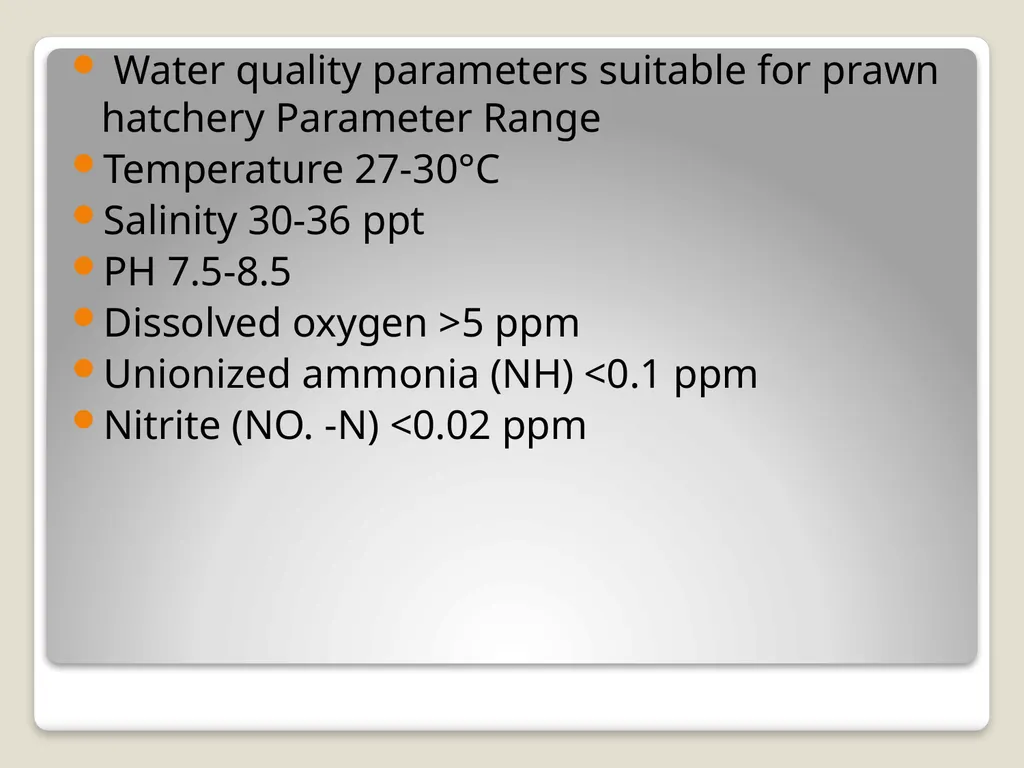
Water quality parameters suitable for prawn hatchery Parameter Range
Temperature 27-30°C
Salinity 30-36 ppt
PH 7.5-8.5
Dissolved oxygen >5 ppm
Unionized ammonia (NH) <0.1 ppm
Nitrite (NO. -N) <0.02 ppm<br>
Temperature 27-30°C
Salinity 30-36 ppt
PH 7.5-8.5
Dissolved oxygen >5 ppm
Unionized ammonia (NH) <0.1 ppm
Nitrite (NO. -N) <0.02 ppm<br>
05
Spawner and Broodstock Source
The source of spawners and broodstock should be identified before putting up a hatchery.
Proximity to the source will minimize stress and expenditure in the transport of spawners and brood stock.<br>
The source of spawners and broodstock should be identified before putting up a hatchery.
Proximity to the source will minimize stress and expenditure in the transport of spawners and brood stock.<br>
06
Availability of Electric Power
The hatchery should be located in areas where there is a reliable source of electric power. This is needed to run equipment and other life support systems in the hatchery.
Accessibility
Good roads near the hatchery will facilitate procurement of materials necessary for operations.
Handling stress and transport expenses will be minimized during spawners procurement and disposal of fry if the market is near.
Air transportation should be available when the market is far.
Freshwater Supply
Freshwater should be available in the hatchery because it is necessary for washing and rinsing of materials and tanks.<br>
The hatchery should be located in areas where there is a reliable source of electric power. This is needed to run equipment and other life support systems in the hatchery.
Accessibility
Good roads near the hatchery will facilitate procurement of materials necessary for operations.
Handling stress and transport expenses will be minimized during spawners procurement and disposal of fry if the market is near.
Air transportation should be available when the market is far.
Freshwater Supply
Freshwater should be available in the hatchery because it is necessary for washing and rinsing of materials and tanks.<br>
07
LIFE CYCLE
Familiarization with the biology of the species to be cultured is very important for hatchery management because it affects the program of daily activities.
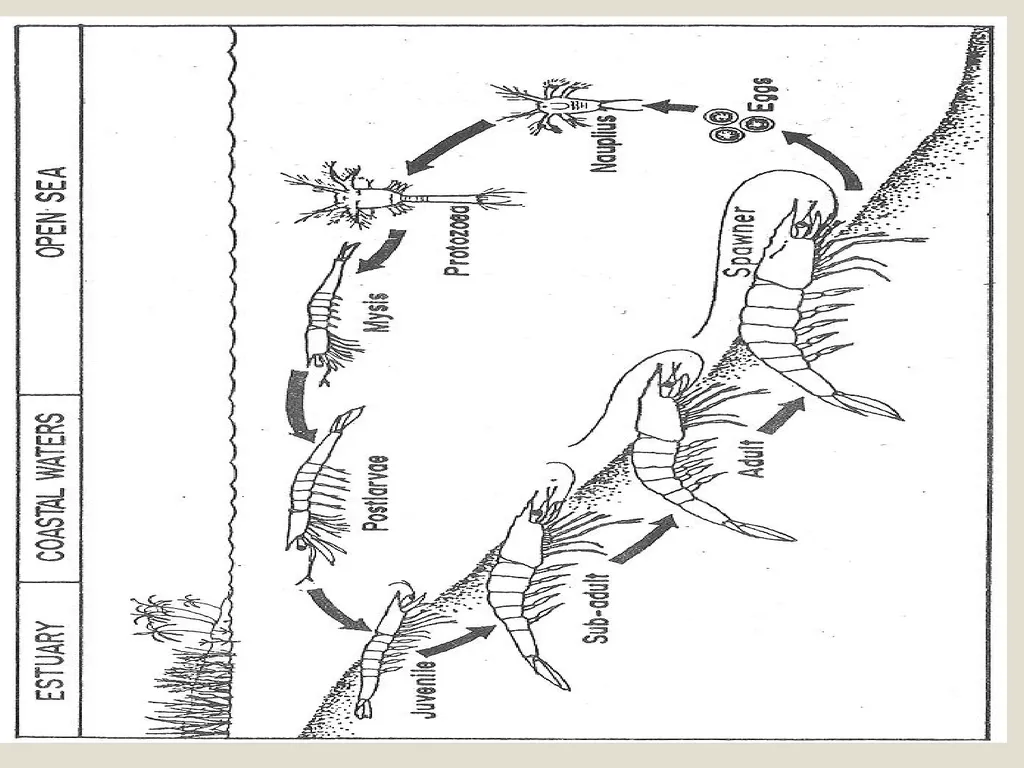
The life cycle of the giant tiger prawn, Penaeus monodon, in its natural habitat is
shown in. The eggs are demersal and tend to sink while larvae are planktonic.
Prawn larva thrives mainly offshore and undergoes three main stages: nauplius,
protozoea, and mysis.
At the postlarval and juvenile stages, the prawn migrates towards the estuary. As it grows, it starts moving to the shallow coastal waters. The adult prawn inhabits the open sea.
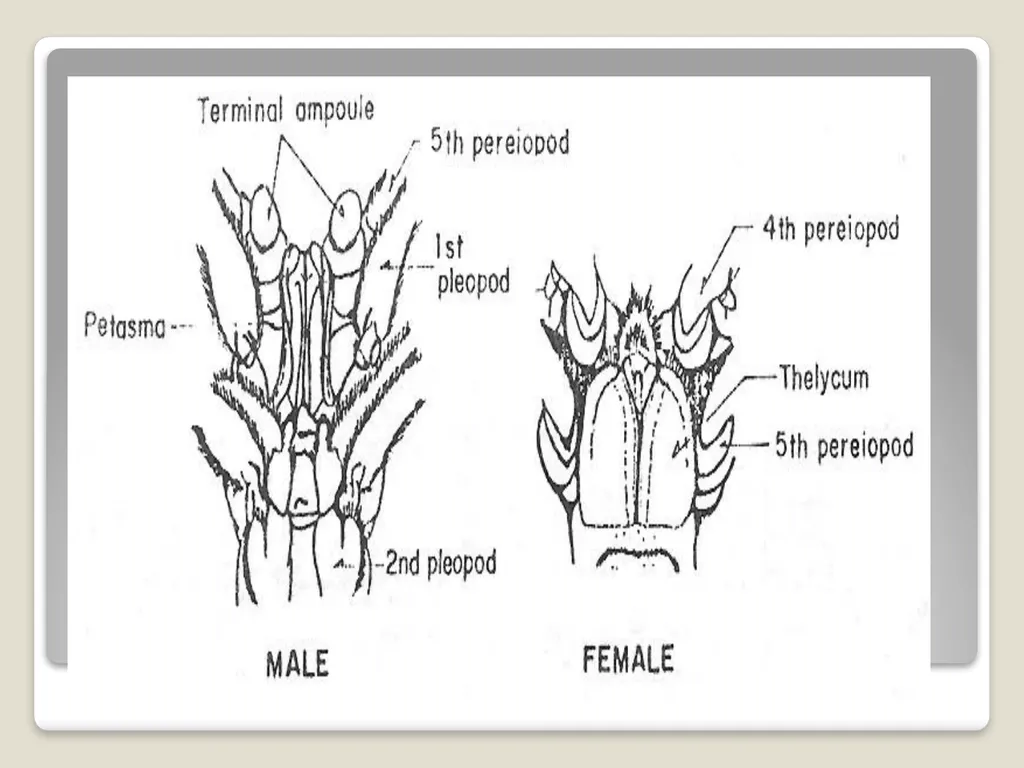
Sexes are separate and can be easily distinguished through the external genitalia located at the ventral side .
the thelycum in females and petasma in males. During mating, the male deposits the spermatophore inside the thelycum of the female.
Mating can only occur between newly molted females and hard-shelled males
. Spawning takes place throughout the year.
The eggs are fertilized in the water after the female simultaneously extrudes the eggs and the spermatophore.
The number of eggs released by a single spawner varies from 248 000 to 811 000.<br>
Familiarization with the biology of the species to be cultured is very important for hatchery management because it affects the program of daily activities.
The life cycle of the giant tiger prawn, Penaeus monodon, in its natural habitat is
shown in. The eggs are demersal and tend to sink while larvae are planktonic.
Prawn larva thrives mainly offshore and undergoes three main stages: nauplius,
protozoea, and mysis.
At the postlarval and juvenile stages, the prawn migrates towards the estuary. As it grows, it starts moving to the shallow coastal waters. The adult prawn inhabits the open sea.
Sexes are separate and can be easily distinguished through the external genitalia located at the ventral side .
the thelycum in females and petasma in males. During mating, the male deposits the spermatophore inside the thelycum of the female.
Mating can only occur between newly molted females and hard-shelled males
. Spawning takes place throughout the year.
The eggs are fertilized in the water after the female simultaneously extrudes the eggs and the spermatophore.
The number of eggs released by a single spawner varies from 248 000 to 811 000.<br>
08
Eggs:
The eggs are small, spherical, and vary from 0.25 to 0.27 mm in diameter
.The developing nauplius almost fills up the entire space inside the egg.
At 28-30°C, the eggs hatch 12-17 h after spawning.
Nauplius Stage:
The nauplius stage is the stage after eggs have hatched.
The prawn nauplius is very tiny, measuring from 0.30 to 0.58 mm in total length .
It swims intermittently upward using its appendages in a "bat-like" manner.
It is attracted to light; and, in aerated tanks, it will concentrate in the most lighted areas if aeration is stopped.
The nauplius molts through each of six substages for a total of about 1.5-2
days.
The substages differ from each other mainly on the furcal spine formula. The latter indicates the number of spines at each side of the furca .<br>
The eggs are small, spherical, and vary from 0.25 to 0.27 mm in diameter
.The developing nauplius almost fills up the entire space inside the egg.
At 28-30°C, the eggs hatch 12-17 h after spawning.
Nauplius Stage:
The nauplius stage is the stage after eggs have hatched.
The prawn nauplius is very tiny, measuring from 0.30 to 0.58 mm in total length .
It swims intermittently upward using its appendages in a "bat-like" manner.
It is attracted to light; and, in aerated tanks, it will concentrate in the most lighted areas if aeration is stopped.
The nauplius molts through each of six substages for a total of about 1.5-2
days.
The substages differ from each other mainly on the furcal spine formula. The latter indicates the number of spines at each side of the furca .<br>
09
Protozoea Stage:
The protozoea can easily be distinguished from the nauplius stage.
Its body is more elongated and measures from 0.96 to 3.30 mm in total length .
It consists of the carapace, thorax, and abdomen. The protozoea can also be distinguished by its
movement;
it swims vertically and diagonally forward towards the water surface.<br>
The protozoea can easily be distinguished from the nauplius stage.
Its body is more elongated and measures from 0.96 to 3.30 mm in total length .
It consists of the carapace, thorax, and abdomen. The protozoea can also be distinguished by its
movement;
it swims vertically and diagonally forward towards the water surface.<br>
10
The proto zoea undergoes three sub stages .
The paired eyes of protozoea I (ZI) can be observed as two dark spots in the upper portion of the carapace when examined under the microscope.
These eyes become stalked at protozoea II
(ZII). At protozoea III (ZIII), the dorsal median spine at the sixth abdominal segment first appears.
Observations on the increase in size from ZI to ZIII during the actual rearing activity can also help in the visual identification of the sub stages.<br>
The paired eyes of protozoea I (ZI) can be observed as two dark spots in the upper portion of the carapace when examined under the microscope.
These eyes become stalked at protozoea II
(ZII). At protozoea III (ZIII), the dorsal median spine at the sixth abdominal segment first appears.
Observations on the increase in size from ZI to ZIII during the actual rearing activity can also help in the visual identification of the sub stages.<br>
11
Mysis Stage
The mysis is shrimp-like with the head pointing. Its body measures from 3.28 to 4.87 mm in total length .
The telson and uropods are developed.
The mysis swims in quick darts accomplished by bending the abdomen backwards.
For mysis substages, the most prominent change is the development of pleopods.
The pleopods appear as buds at mysis I (MI) which protrude at mysis II (MII), and finally become segmented at mysis III (MIII).<br>
The mysis is shrimp-like with the head pointing. Its body measures from 3.28 to 4.87 mm in total length .
The telson and uropods are developed.
The mysis swims in quick darts accomplished by bending the abdomen backwards.
For mysis substages, the most prominent change is the development of pleopods.
The pleopods appear as buds at mysis I (MI) which protrude at mysis II (MII), and finally become segmented at mysis III (MIII).<br>
12
Postlarval Stage
The postlarva resembles an adult prawn .
At postlarva 1 PL1), the rostrum is straight and exceeds the tip of the eye.
It usually has one dorsal rostral spine without any ventral spine.
Plumose hairs are present on the swimming legs.
The number of days from this stage corresponds to the age of postlarva (e.g., PL2, means second day after they have molted to postlarval stage).<br>
The postlarva resembles an adult prawn .
At postlarva 1 PL1), the rostrum is straight and exceeds the tip of the eye.
It usually has one dorsal rostral spine without any ventral spine.
Plumose hairs are present on the swimming legs.
The number of days from this stage corresponds to the age of postlarva (e.g., PL2, means second day after they have molted to postlarval stage).<br>
13
HATCHERY DESIGN AND PLANNING
Size
The size of a prawn hatchery depends on two factors: financial capability and
target production.
For every million PL15-20, a total effective tank volume of 80-100 t
for culturing larvae and postlarvae is required.
This is based on the following assumptions:
a) survival rate is 30-40% until harvest (PL15-20); and b) stocking densities are 50 000 to 80 000 nauplii/t.
This computation assumes that the larval tanks are also used as nursery tanks.<br>
Size
The size of a prawn hatchery depends on two factors: financial capability and
target production.
For every million PL15-20, a total effective tank volume of 80-100 t
for culturing larvae and postlarvae is required.
This is based on the following assumptions:
a) survival rate is 30-40% until harvest (PL15-20); and b) stocking densities are 50 000 to 80 000 nauplii/t.
This computation assumes that the larval tanks are also used as nursery tanks.<br>
14
Facilities and Equipment
Larval and Postlarval Tanks. Containers used for culturing larvae and postlarvae may be of rubberized canvas, marine plywood, fiberglass, or concrete.
These can either be circular, oval, or rectangular, depending on the operator‘s preference or financial capability.
However, rounded corners are preferable due to
more effective water circulation.
The capacity of each tank may be from 1-20 t but
10-12-t tanks are more economical and practical. Depth should only be about 1 m because tanks which are too deep are difficult to manage.<br>
Larval and Postlarval Tanks. Containers used for culturing larvae and postlarvae may be of rubberized canvas, marine plywood, fiberglass, or concrete.
These can either be circular, oval, or rectangular, depending on the operator‘s preference or financial capability.
However, rounded corners are preferable due to
more effective water circulation.
The capacity of each tank may be from 1-20 t but
10-12-t tanks are more economical and practical. Depth should only be about 1 m because tanks which are too deep are difficult to manage.<br>
15
Algal Tanks.
Minute plants (phytoplankton) are needed as food for the early
life stages of prawn.
Daily procurement of algae directly from laboratories is expensive and impractical.
Thus, a hatchery must have tanks where these food organisms can be cultured in large quantities.
Algal tanks must be shallow (ideally 0.5-m deep) to allow sufficient light penetration.
A shed, not necessarily enclosed with walls, must be provided with
transparent roofing to prevent contamination and dilution of the culture by rain while allowing light to pass through.
Algal tanks must also be provided with screen covers during the night to prevent insects from getting into the culture.
The number and volume of algal tanks to be constructed depend on the daily
algal requirement.
This is usually 10-20% of the total volume of larval tanks if diatoms such as Chaetoceros or Skeletonema are to be cultured.
Additional algal tanks are needed if Tetraselmis, a species of green algae, or other slow-growing species are to be cultured.<br>
Minute plants (phytoplankton) are needed as food for the early
life stages of prawn.
Daily procurement of algae directly from laboratories is expensive and impractical.
Thus, a hatchery must have tanks where these food organisms can be cultured in large quantities.
Algal tanks must be shallow (ideally 0.5-m deep) to allow sufficient light penetration.
A shed, not necessarily enclosed with walls, must be provided with
transparent roofing to prevent contamination and dilution of the culture by rain while allowing light to pass through.
Algal tanks must also be provided with screen covers during the night to prevent insects from getting into the culture.
The number and volume of algal tanks to be constructed depend on the daily
algal requirement.
This is usually 10-20% of the total volume of larval tanks if diatoms such as Chaetoceros or Skeletonema are to be cultured.
Additional algal tanks are needed if Tetraselmis, a species of green algae, or other slow-growing species are to be cultured.<br>
16
Spawning Tanks.
Although spawners are usually placed in the larval tanks prior to spawning, it is advantageous to have smaller tanks with volumes ranging from 0.25to 1 t where egg washing is done.
Tapered bottoms are preferable since these allow homogeneous aeration necessary for hatching.
Artemia Hatching Tanks.
Artemia or brine shrimp is a protein-rich live food organism given to prawn larvae starting at the mysis stage.
Artemia is available in cyst form which has to be hydrated and incubated in tanks for at least 18-24 h.
These tanks should preferably be of transparent material with a conical bottom so as to
facilitate hatching of cysts and separation of cyst shells from the Artemia nauplii.
Reservoir.
A reservoir or storage tank is necessary for chlorination and holding of filtered and treated water for daily use.
This must have a total capacity of at least 50% of total larval tank volume.
However, it is more convenient to have two storage tanks so that one may be cleaned and dried while the other is in use.
An elevated storage tank that can distribute seawater to other tanks by gravity flow is
advantageous.<br>
Although spawners are usually placed in the larval tanks prior to spawning, it is advantageous to have smaller tanks with volumes ranging from 0.25to 1 t where egg washing is done.
Tapered bottoms are preferable since these allow homogeneous aeration necessary for hatching.
Artemia Hatching Tanks.
Artemia or brine shrimp is a protein-rich live food organism given to prawn larvae starting at the mysis stage.
Artemia is available in cyst form which has to be hydrated and incubated in tanks for at least 18-24 h.
These tanks should preferably be of transparent material with a conical bottom so as to
facilitate hatching of cysts and separation of cyst shells from the Artemia nauplii.
Reservoir.
A reservoir or storage tank is necessary for chlorination and holding of filtered and treated water for daily use.
This must have a total capacity of at least 50% of total larval tank volume.
However, it is more convenient to have two storage tanks so that one may be cleaned and dried while the other is in use.
An elevated storage tank that can distribute seawater to other tanks by gravity flow is
advantageous.<br>
17
Aeration System.
Aeration is necessary in hatchery operations to keep food particles and algal cells in suspension and to maintain sufficient dissolved oxygen levels.
Generally, aeration is supplied by a rotary blower . Since a rotary
blower supplies a large volume of low pressure air, the depth of larval or algal tanks should not exceed 2 m.
Another source of aeration is an air compressor but this tends to emit oil and grease which may pollute the water in the tanks.
It is also advantageous, especially for large hatcheries, to install several units of lower capacity blowers (instead of one unit of high capacity) so that some units can be put off when not in use.
Hatcheries with very small capacities may also use aquarium aerators.
Continuous aeration is essential during operations.
A stand-by generator will be very useful during power interruptions.<br>
Aeration is necessary in hatchery operations to keep food particles and algal cells in suspension and to maintain sufficient dissolved oxygen levels.
Generally, aeration is supplied by a rotary blower . Since a rotary
blower supplies a large volume of low pressure air, the depth of larval or algal tanks should not exceed 2 m.
Another source of aeration is an air compressor but this tends to emit oil and grease which may pollute the water in the tanks.
It is also advantageous, especially for large hatcheries, to install several units of lower capacity blowers (instead of one unit of high capacity) so that some units can be put off when not in use.
Hatcheries with very small capacities may also use aquarium aerators.
Continuous aeration is essential during operations.
A stand-by generator will be very useful during power interruptions.<br>
18
Seawater System.
Seawater may be pumped directly from the sea or through a sump pit . Water may be pre filtered through the sand in the sea bed
or directly pumped to the hatchery. Commonly used prefiltration systems are ….<br>
Seawater may be pumped directly from the sea or through a sump pit . Water may be pre filtered through the sand in the sea bed
or directly pumped to the hatchery. Commonly used prefiltration systems are ….<br>
19
Before the water is stored in a reservoir, it is passed through a sand filter which is usually elevated.
The sand filter is made of graded gravel and sand which screen out particulate matter .
Pumps.
Water direct from the sea or from the reservoir is transferred to the larval tanks by either centrifugal or submersible pumps.
The type and size of pump depends on the total volume of water required per day and the maximum pumping time. An engineer should be consulted regarding pump capacity requirements.<br>
The sand filter is made of graded gravel and sand which screen out particulate matter .
Pumps.
Water direct from the sea or from the reservoir is transferred to the larval tanks by either centrifugal or submersible pumps.
The type and size of pump depends on the total volume of water required per day and the maximum pumping time. An engineer should be consulted regarding pump capacity requirements.<br>
20
Layout
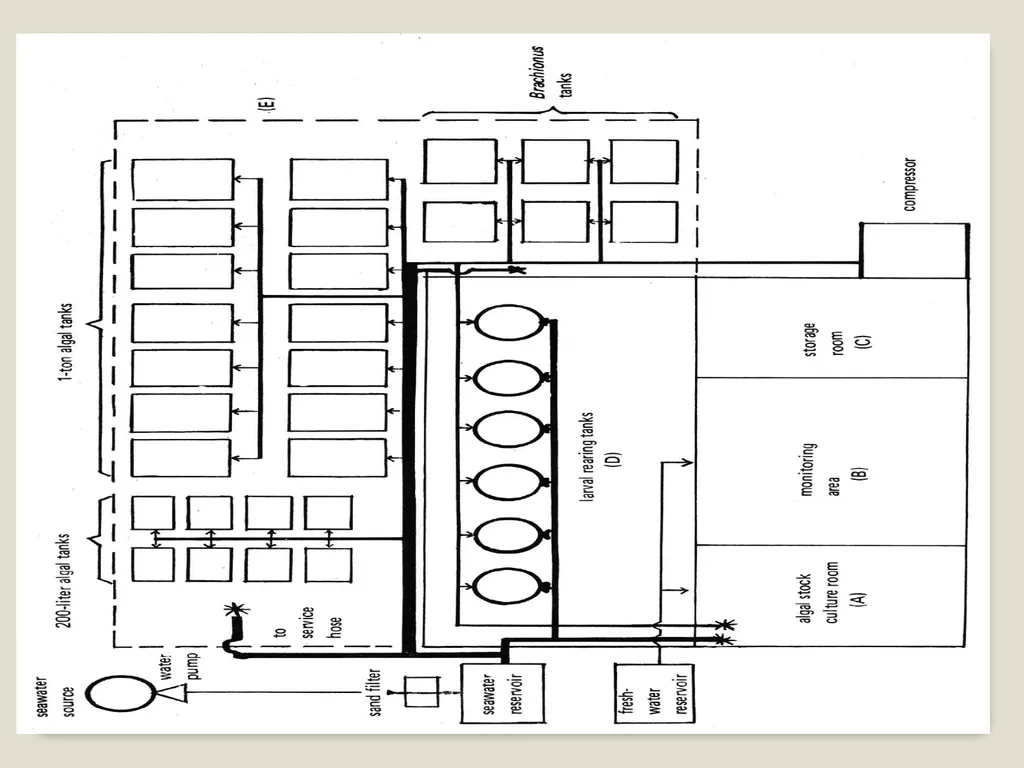
A sample layout of a shrimp hatchery is shown in…
The algal tanks are constructed near the larval tanks for ease in feeding. If rectangular tanks are to be constructed, two tanks may share a common side but these should not be too long for the middle portion of the tank to be unreachable.
There should also be sufficient space around the tanks for easier management<br>
A sample layout of a shrimp hatchery is shown in…
The algal tanks are constructed near the larval tanks for ease in feeding. If rectangular tanks are to be constructed, two tanks may share a common side but these should not be too long for the middle portion of the tank to be unreachable.
There should also be sufficient space around the tanks for easier management<br>
21
Other Equipment and Accessories:
Refractometer (A) and hydrometer(B) - for determining salinity of rearing water.
A refractometer measures salinity directly. If
a hydrometer is used, determine the
temperature of the water and refer to density
of water at this temperature before converting
the measured reading to salinity.
Thermometer. This is used to get temperature readings, especially before water change.<br>
Refractometer (A) and hydrometer(B) - for determining salinity of rearing water.
A refractometer measures salinity directly. If
a hydrometer is used, determine the
temperature of the water and refer to density
of water at this temperature before converting
the measured reading to salinity.
Thermometer. This is used to get temperature readings, especially before water change.<br>
22
Chlorine test kit - for
determining residual chlorine concentration in the water, so that the amount of thiosulfate to
be added during neutralization can be computed.
Microscope - for counting algal cells; also helpful in detecting abnormalities and diseases of the larvae at an early stage.<br>
determining residual chlorine concentration in the water, so that the amount of thiosulfate to
be added during neutralization can be computed.
Microscope - for counting algal cells; also helpful in detecting abnormalities and diseases of the larvae at an early stage.<br>
23
Hemacytometer - for determining the
number of algal cells in a given volume.<br>
number of algal cells in a given volume.<br>
24
HATCHERY OPERATIONS
Mortality during hatchery operations is often times caused by poor
management, poor quality of nauplii, unfavorable environmental conditions, diseases, and deficient or poor nutrition.
The following section describes standard methods of management used in the hatchery.
Disease prevention is emphasized through proper preparation, water treatment, and management.
shows the daily activities involved during the entire hatchery run.
These activities will be described in detail in the following sections.
Natural Food Production
Production of phytoplankton or algae for feeding has to be synchronized with the hatchery operations so that diatoms or other natural food are available as soon as the larvae molt to the first feeding stage (ZI).
The most commonly used algal food are Skeletonema, Chaetoceros, and Tetraselmis .<br>
Mortality during hatchery operations is often times caused by poor
management, poor quality of nauplii, unfavorable environmental conditions, diseases, and deficient or poor nutrition.
The following section describes standard methods of management used in the hatchery.
Disease prevention is emphasized through proper preparation, water treatment, and management.
shows the daily activities involved during the entire hatchery run.
These activities will be described in detail in the following sections.
Natural Food Production
Production of phytoplankton or algae for feeding has to be synchronized with the hatchery operations so that diatoms or other natural food are available as soon as the larvae molt to the first feeding stage (ZI).
The most commonly used algal food are Skeletonema, Chaetoceros, and Tetraselmis .<br>
25
Preparation of Spawning, Larval, and Nursery Tanks
To prevent disease outbreak, the hatchery should be totally dried after several production runs.
Tanks and facilities in the hatchery must also be cleaned well prior to a hatchery run.
New tanks need to be filled with fresh- or seawater for at least a week to avoid mortalities due to toxic effects of chemicals used during construction of the tanks.<br>
To prevent disease outbreak, the hatchery should be totally dried after several production runs.
Tanks and facilities in the hatchery must also be cleaned well prior to a hatchery run.
New tanks need to be filled with fresh- or seawater for at least a week to avoid mortalities due to toxic effects of chemicals used during construction of the tanks.<br>
26
Selection and Stocking of Spawners:
Nauplii to be reared to the fry stage can come from either
a) broodstock - wild or pond-reared immature females induced to mature by unilateral eyestalk ablation; or
b) wild spawners - female prawns caught from the sea with developed
ovaries. The details on how to maintain and handle brood stock as nauplii source are described by Primavera (1983).
The number of spawners needed for a hatchery run is dependent on the nauplii requirement. For every million nauplii, about 4-5 wild spawners or 7-8 female broodstock are needed.
Spawners procured as nauplii source must be carefully selected to obtain high
fertilization and hatching rates of eggs.
Stage of maturity should not be used as the sole basis for selection.
Spawners must also be disease-free.
To ensure development of the eggs, females should be mated to ensure release of sperm cells necessary for fertilization.<br>
Nauplii to be reared to the fry stage can come from either
a) broodstock - wild or pond-reared immature females induced to mature by unilateral eyestalk ablation; or
b) wild spawners - female prawns caught from the sea with developed
ovaries. The details on how to maintain and handle brood stock as nauplii source are described by Primavera (1983).
The number of spawners needed for a hatchery run is dependent on the nauplii requirement. For every million nauplii, about 4-5 wild spawners or 7-8 female broodstock are needed.
Spawners procured as nauplii source must be carefully selected to obtain high
fertilization and hatching rates of eggs.
Stage of maturity should not be used as the sole basis for selection.
Spawners must also be disease-free.
To ensure development of the eggs, females should be mated to ensure release of sperm cells necessary for fertilization.<br>
27
Stocking of Nauplii
During stocking and throughout the culture period, animals must not be exposed to abrupt changes in environmental conditions. The animals must be given time to gradually adapt to new conditions to avoid stress and mortalities.<br>
During stocking and throughout the culture period, animals must not be exposed to abrupt changes in environmental conditions. The animals must be given time to gradually adapt to new conditions to avoid stress and mortalities.<br>
28
Feeding
Nauplii subsist on the yolk stored in their bodies. Since they do not require food, larvae start to feed at the first protozoeal substage.
Diatoms such as Skeletonema or Chaetoceros can be used for feeding the protozoea.
Instead of diatoms, larvae at the second protozoeal substage may be fed Tetraselmis.
Artificial diets, called microparticulates because of their small particle size, such as MBD or other commercially available diets can also be used as food during these substages.
At the mysis stage, some animal protein must be present in the diet.
The most commonly used protein source are newly hatched Artermia nauplii and microparticulate diets which contain about 45-50% protein.
When the animals reach the postlarval stage, egg custard, trash fish, mussel
meat, or ground dried Acetes (small shrimp or "alamang") can be given to supplement
the Artemia nauplii diet.
Trash fish or mussel meat may be given either raw or . Cooked trash fish is rubbed against a net to separate the muscle fibers while mussel meat is chopped or blended with water before feeding.<br>
Nauplii subsist on the yolk stored in their bodies. Since they do not require food, larvae start to feed at the first protozoeal substage.
Diatoms such as Skeletonema or Chaetoceros can be used for feeding the protozoea.
Instead of diatoms, larvae at the second protozoeal substage may be fed Tetraselmis.
Artificial diets, called microparticulates because of their small particle size, such as MBD or other commercially available diets can also be used as food during these substages.
At the mysis stage, some animal protein must be present in the diet.
The most commonly used protein source are newly hatched Artermia nauplii and microparticulate diets which contain about 45-50% protein.
When the animals reach the postlarval stage, egg custard, trash fish, mussel
meat, or ground dried Acetes (small shrimp or "alamang") can be given to supplement
the Artemia nauplii diet.
Trash fish or mussel meat may be given either raw or . Cooked trash fish is rubbed against a net to separate the muscle fibers while mussel meat is chopped or blended with water before feeding.<br>
29
Water Management and Treatment
The quality of the rearing water in larval tanks deteriorates after sometime due to the accumulation of feces, and decomposition of uneaten food and dead larvae.
Regular water replacement dilutes the concentration of toxic metabolites in the tank.
The resulting water temperature and salinity after water change must not differ by
more than 1°C or 2 ppt, respectively.<br>
The quality of the rearing water in larval tanks deteriorates after sometime due to the accumulation of feces, and decomposition of uneaten food and dead larvae.
Regular water replacement dilutes the concentration of toxic metabolites in the tank.
The resulting water temperature and salinity after water change must not differ by
more than 1°C or 2 ppt, respectively.<br>
30
Harvest, Transfer, Packing, and Transport
Proper procedures must be observed for harvest, packing, and transport to ensure high survival of prawn fry.
The procedure followed during transfer of postlarvae (PL1 or PL6) to nursery tanks is similar to the fry harvesting method
The number of fry loaded per bag will depend or the size and age of fry, travel time, distance, and means of transportation.
During extended transport periods, water temperature must be reduced to decrease molting and metabolic rates and the incidence of cannibalism among prawn fry. However, there is no need to lower water temperature in transport bags when transporting at night or during cool weather.<br>
Proper procedures must be observed for harvest, packing, and transport to ensure high survival of prawn fry.
The procedure followed during transfer of postlarvae (PL1 or PL6) to nursery tanks is similar to the fry harvesting method
The number of fry loaded per bag will depend or the size and age of fry, travel time, distance, and means of transportation.
During extended transport periods, water temperature must be reduced to decrease molting and metabolic rates and the incidence of cannibalism among prawn fry. However, there is no need to lower water temperature in transport bags when transporting at night or during cool weather.<br>
31
DISEASES
Disease-causing microorganisms are always present in the water. These may
harm the larvae especially when the latter are exposed to stressful conditions such as inadequate nutrition, overcrowding, poor water quality, and sudden changes in
temperature, salinity, and other physico-chemical parameters.
General indications are incomplete molting, empty digestive tract, deformed extremities, reddening of the body, and sluggish movement.
To avoid mass mortality of the larvae, disease prevention measures which have been described respective books.presents more detailed practices for disease prevention in prawn hatcheries.
Information on common diseases, their manifestations and prevention and control should bi implemeted.<br>
Disease-causing microorganisms are always present in the water. These may
harm the larvae especially when the latter are exposed to stressful conditions such as inadequate nutrition, overcrowding, poor water quality, and sudden changes in
temperature, salinity, and other physico-chemical parameters.
General indications are incomplete molting, empty digestive tract, deformed extremities, reddening of the body, and sluggish movement.
To avoid mass mortality of the larvae, disease prevention measures which have been described respective books.presents more detailed practices for disease prevention in prawn hatcheries.
Information on common diseases, their manifestations and prevention and control should bi implemeted.<br>