
Florida Constitutional Law: Cases in Context
PT
Published · 80 slides · 0 views
1 / 1










Description
Florida Constitutional Law: Cases in Context Second Edition, 2025 Jon L. Mills, Mary E. Adkins, Timothy E. McLendon Floridas Constitutions 1838 Anticipating Statehood in 1845 1861 Confederate Constitution 1865 Post Civil War
Related Topics
Share
Embed code
Download this presentation From Below
"Florida Constitutional Law: Cases in Context" is the property of its rightful owner. Permission is granted to download and print the materials on this website for personal, non-commercial use only, and to display it on your personal computer provided you do not modify the materials and that you retain all copyright notices contained in the materials. By downloading content from our website, you accept the terms of this agreement.
Presentation Transcript
01
Florida Constitutional Law:
Cases in Context
Second Edition, 2025
Jon L. Mills, Mary E. Adkins, Timothy E. McLendon<br>
02
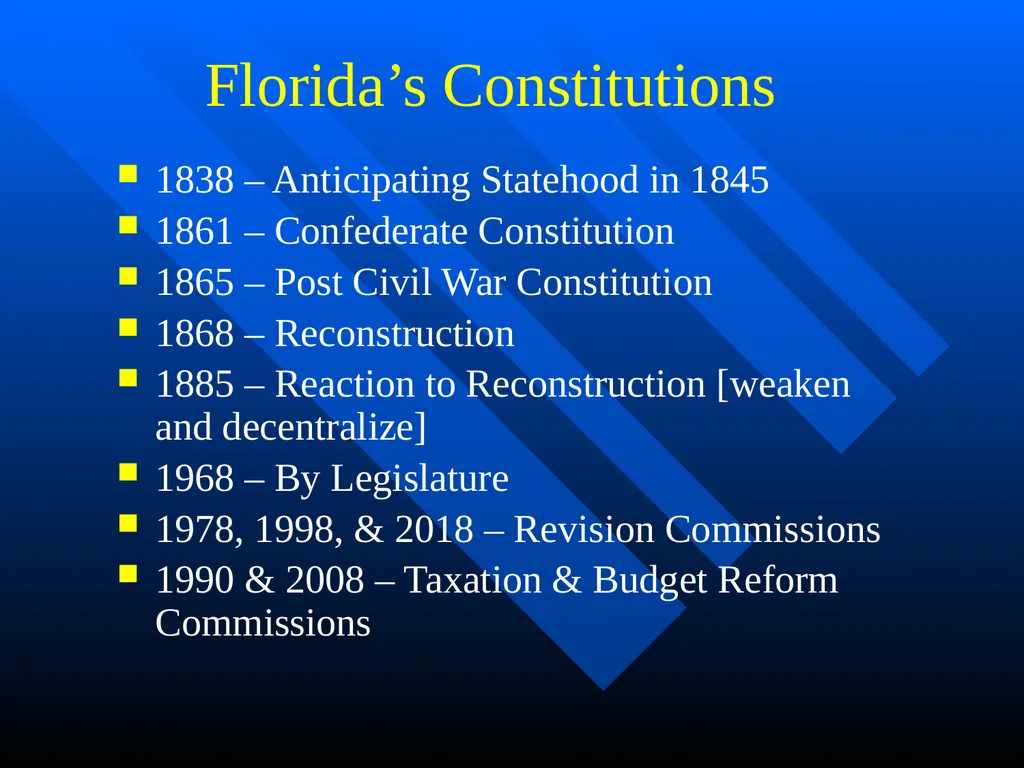
Florida’s Constitutions 1838 – Anticipating Statehood in 1845
1861 – Confederate Constitution
1865 – Post Civil War Constitution
1868 – Reconstruction
1885 – Reaction to Reconstruction [weaken and decentralize]
1968 – By Legislature
1978, 1998, & 2018 – Revision Commissions
1990 & 2008 – Taxation & Budget Reform Commissions<br>
1861 – Confederate Constitution
1865 – Post Civil War Constitution
1868 – Reconstruction
1885 – Reaction to Reconstruction [weaken and decentralize]
1968 – By Legislature
1978, 1998, & 2018 – Revision Commissions
1990 & 2008 – Taxation & Budget Reform Commissions<br>
03
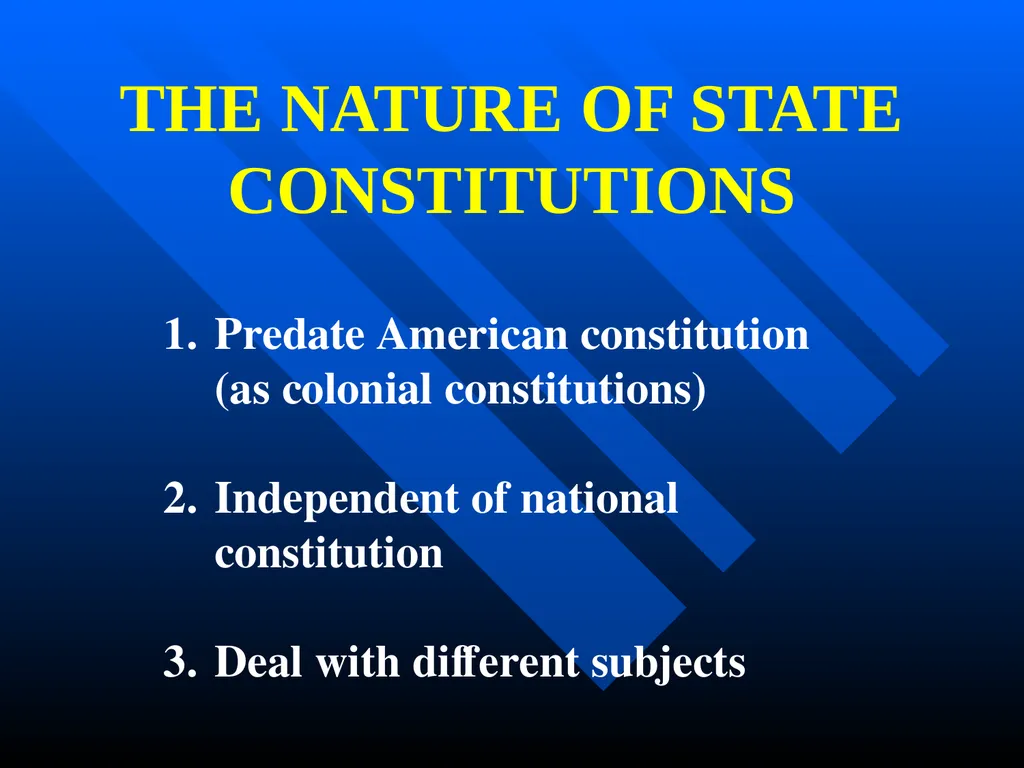
THE NATURE OF STATE CONSTITUTIONS Predate American constitution (as colonial constitutions)
Independent of national constitution
Deal with different subjects<br>
Independent of national constitution
Deal with different subjects<br>
04
STATE CONSTITUTIONS & HUMAN RIGHTS Constitutionality of state actions
State bill of rights vs. Federal bill of rights<br>
State bill of rights vs. Federal bill of rights<br>
05
STATE SUPREME COURTS
& THE US SUPREME COURT State basis for decision
Federal basis for decision<br>
& THE US SUPREME COURT State basis for decision
Federal basis for decision<br>
06
Michigan v. Long (US 1983) 1. State supreme court-what was the question it answered?
2. US Supreme Court
What is the core issue?
What is the requirement and test for state courts?
Do you agree with the dissent’s position that the court has overreached?<br>
2. US Supreme Court
What is the core issue?
What is the requirement and test for state courts?
Do you agree with the dissent’s position that the court has overreached?<br>
07
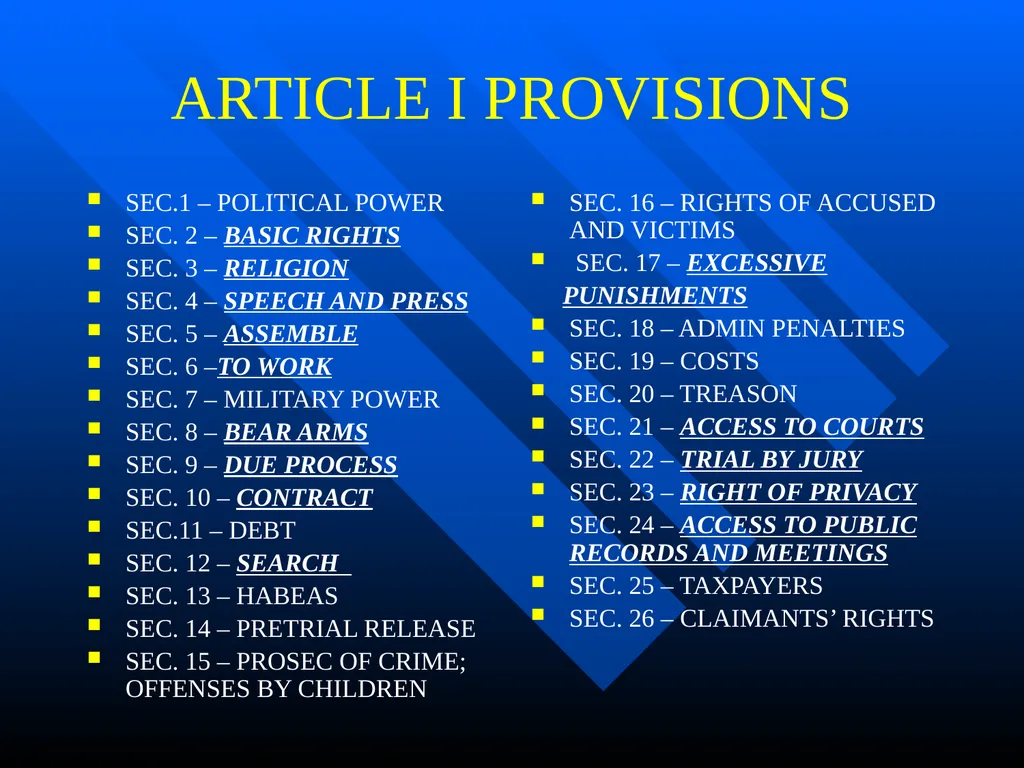
ARTICLE I PROVISIONS SEC.1 – POLITICAL POWER
SEC. 2 – BASIC RIGHTS
SEC. 3 – RELIGION
SEC. 4 – SPEECH AND PRESS
SEC. 5 – ASSEMBLE
SEC. 6 –TO WORK
SEC. 7 – MILITARY POWER
SEC. 8 – BEAR ARMS
SEC. 9 – DUE PROCESS
SEC. 10 – CONTRACT
SEC.11 – DEBT
SEC. 12 – SEARCH
SEC. 13 – HABEAS
SEC. 14 – PRETRIAL RELEASE
SEC. 15 – PROSEC OF CRIME; OFFENSES BY CHILDREN SEC. 16 – RIGHTS OF ACCUSED AND VICTIMS
SEC. 17 – EXCESSIVE
PUNISHMENTS
SEC. 18 – ADMIN PENALTIES
SEC. 19 – COSTS
SEC. 20 – TREASON
SEC. 21 – ACCESS TO COURTS
SEC. 22 – TRIAL BY JURY
SEC. 23 – RIGHT OF PRIVACY
SEC. 24 – ACCESS TO PUBLIC RECORDS AND MEETINGS
SEC. 25 – TAXPAYERS
SEC. 26 – CLAIMANTS’ RIGHTS<br>
SEC. 2 – BASIC RIGHTS
SEC. 3 – RELIGION
SEC. 4 – SPEECH AND PRESS
SEC. 5 – ASSEMBLE
SEC. 6 –TO WORK
SEC. 7 – MILITARY POWER
SEC. 8 – BEAR ARMS
SEC. 9 – DUE PROCESS
SEC. 10 – CONTRACT
SEC.11 – DEBT
SEC. 12 – SEARCH
SEC. 13 – HABEAS
SEC. 14 – PRETRIAL RELEASE
SEC. 15 – PROSEC OF CRIME; OFFENSES BY CHILDREN SEC. 16 – RIGHTS OF ACCUSED AND VICTIMS
SEC. 17 – EXCESSIVE
PUNISHMENTS
SEC. 18 – ADMIN PENALTIES
SEC. 19 – COSTS
SEC. 20 – TREASON
SEC. 21 – ACCESS TO COURTS
SEC. 22 – TRIAL BY JURY
SEC. 23 – RIGHT OF PRIVACY
SEC. 24 – ACCESS TO PUBLIC RECORDS AND MEETINGS
SEC. 25 – TAXPAYERS
SEC. 26 – CLAIMANTS’ RIGHTS<br>
08
ARTICLE I Declaration of rights
Comparisons and relationship to
federal rights<br>
Comparisons and relationship to
federal rights<br>
09
Florida’s Privacy Provision Section 23. Right to Privacy--Every natural person has the right to be let alone and free from governmental intrusion into the person’s private life except as otherwise provided herein. This section shall not be construed to limit the public’s right of access to public records and meetings as provided by law.<br>
10
In re TW, A Minor (1989) Privacy – nature of the right
Nature of governmental action or interest in impairment
Comparison to federal right
What is the majority decision?<br>
Nature of governmental action or interest in impairment
Comparison to federal right
What is the majority decision?<br>
11
PARENTAL NOTICE OF ABORTION Article X, § 22 Parental Notice of termination of a minor’s pregnancy. – The Legislature shall not limit or deny the privacy right guaranteed to a minor under the United States Constitution as interpreted by the United States Supreme Court. Notwithstanding a minor’s right of privacy provided in Section 23 of Article I, the Legislature is authorized to require by general law for notification to a parent or guardian of a minor before the termination of the minor’s pregnancy. The Legislature shall provide exceptions to such requirement for notification and shall create a process for judicial waiver of the notification. [Adopted 2004.]<br>
12
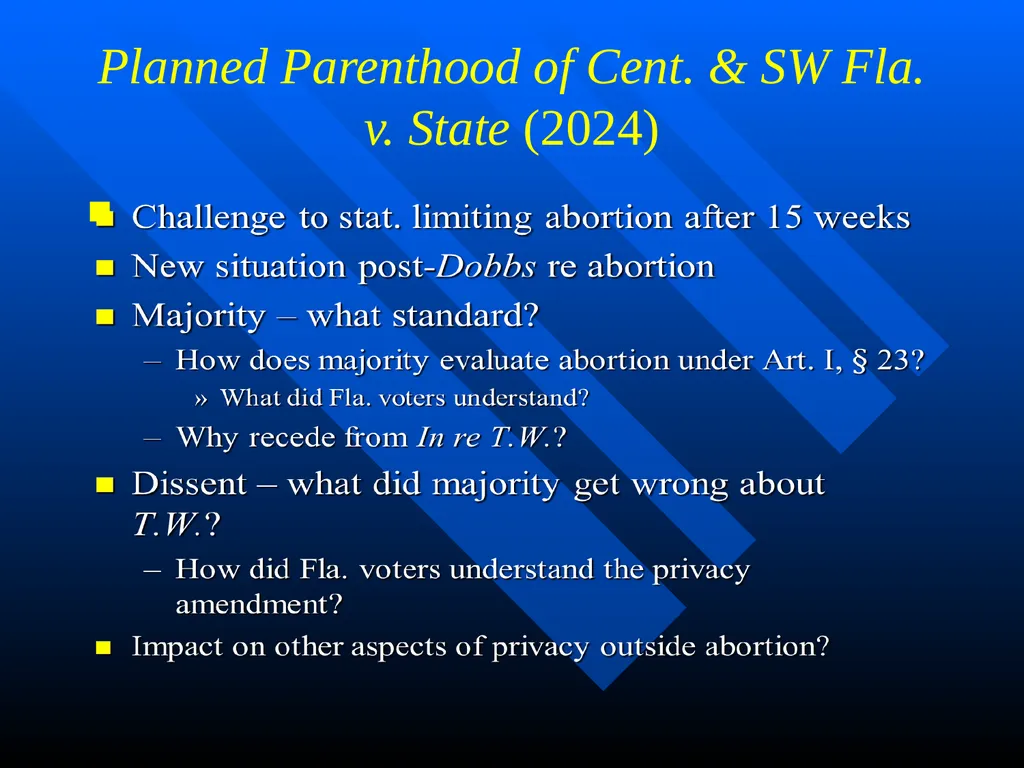
Planned Parenthood of Cent. & SW Fla. v. State (2024)<br>
13
In re Guardianship of Schiavo (2d DCA 2005) What is the decision the court must make?
(Kennedy Hosp. v. Bludworth)
What is the basis of the court’s decision?<br>
(Kennedy Hosp. v. Bludworth)
What is the basis of the court’s decision?<br>
14
In re Guardianship of Schiavo (2d DCA 2005) What is the decision the court must make?
-whether to sustain or withhold life support.
What is the basis of the court’s decision?
-that the trial court followed the law based on clear & convincing evidence as to what Ms. Schiavo would want.<br>
-whether to sustain or withhold life support.
What is the basis of the court’s decision?
-that the trial court followed the law based on clear & convincing evidence as to what Ms. Schiavo would want.<br>
15
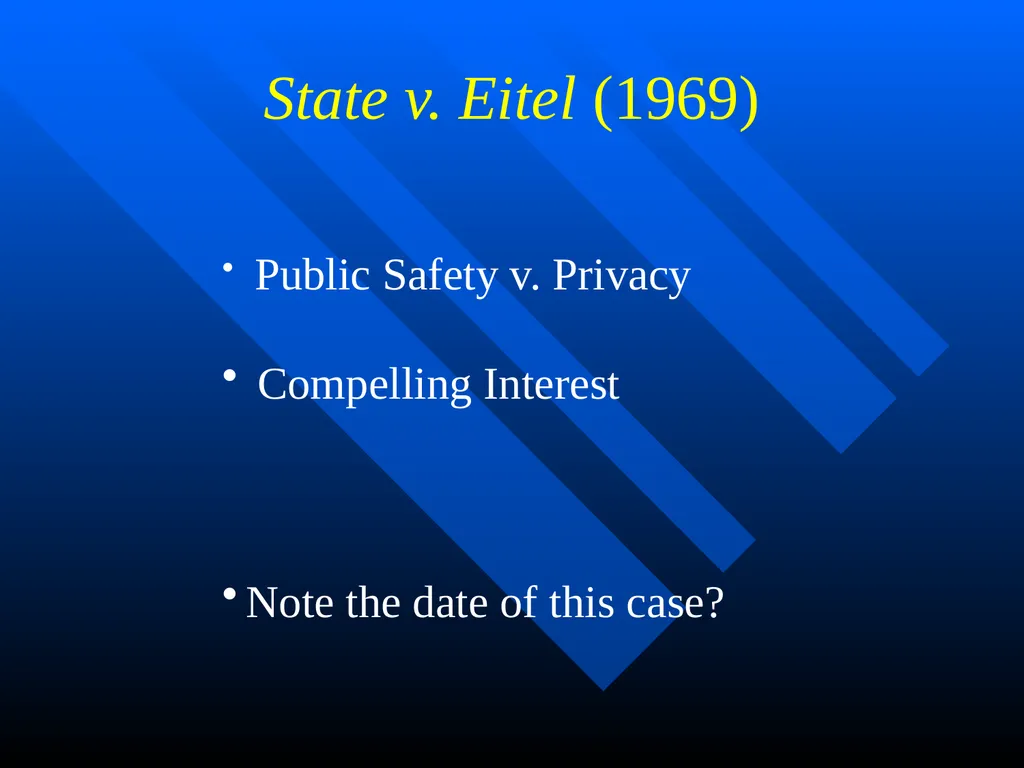
State v. Eitel (1969) Public Safety v. Privacy
Compelling Interest
Note the date of this case?<br>
Compelling Interest
Note the date of this case?<br>
16
Florida Board of Bar Examiners re: Applicant (1983) How were applicant’s privacy rights implicated?
What is the duty of the Bar (State)?
Does the Bar use the least intrusive means to meet its duty?<br>
What is the duty of the Bar (State)?
Does the Bar use the least intrusive means to meet its duty?<br>
17
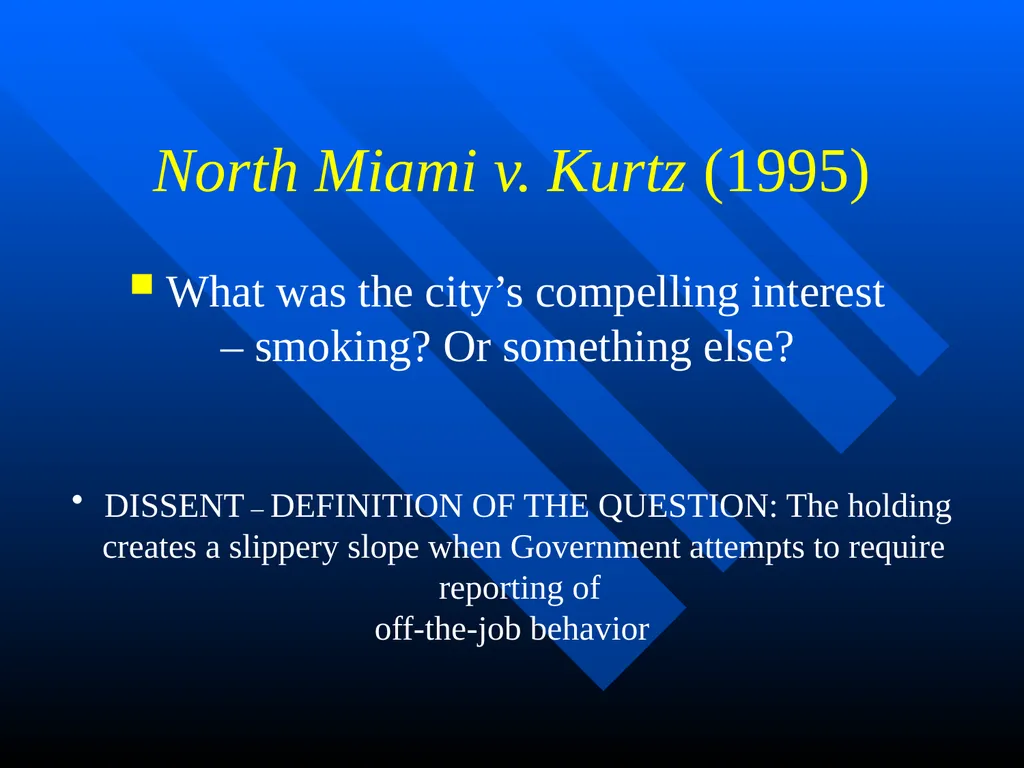
North Miami v. Kurtz (1995) What was the city’s compelling interest – smoking? Or something else? DISSENT – DEFINITION OF THE QUESTION: The holding creates a slippery slope when Government attempts to require reporting of
off-the-job behavior<br>
off-the-job behavior<br>
18
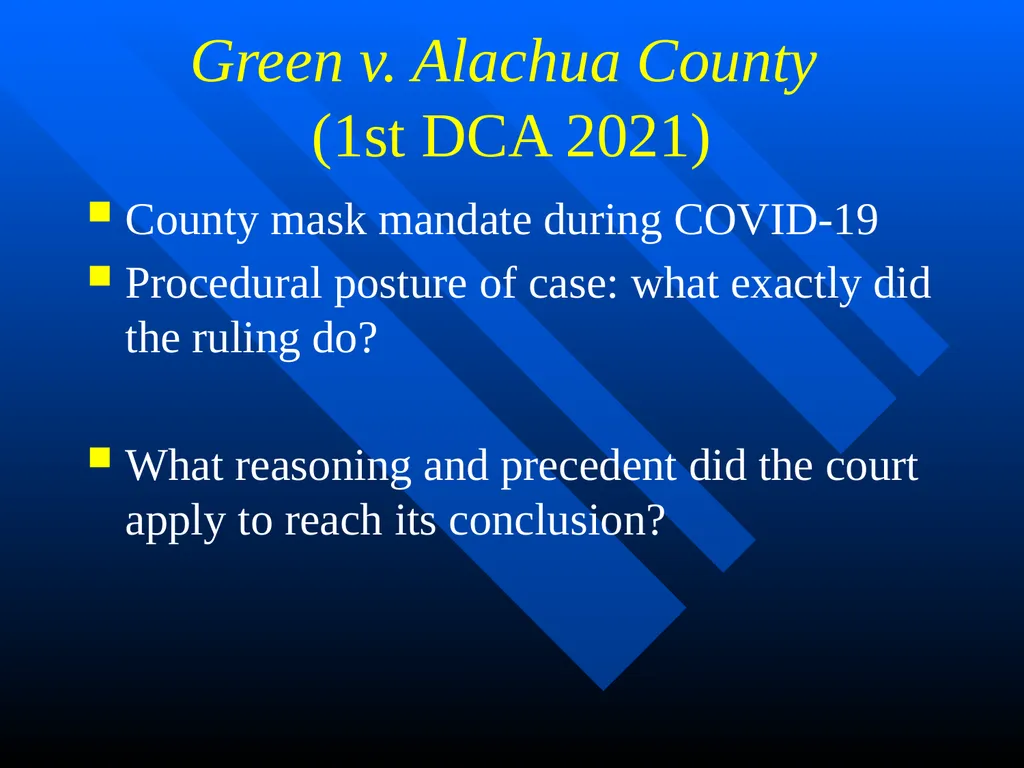
Green v. Alachua County
(1st DCA 2021) County mask mandate during COVID-19
Procedural posture of case: what exactly did the ruling do?
What reasoning and precedent did the court apply to reach its conclusion?<br>
Procedural posture of case: what exactly did the ruling do?
What reasoning and precedent did the court apply to reach its conclusion?<br>
19
Green v. Alachua County
(1st DCA 2021) County mask mandate during COVID-19
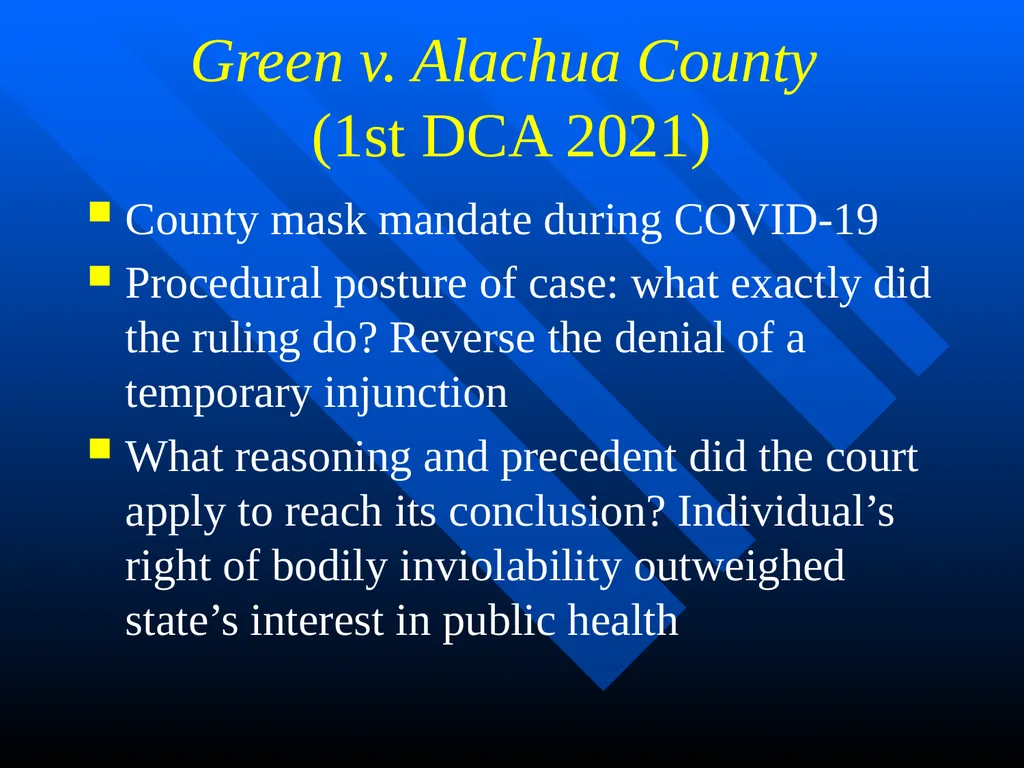
Procedural posture of case: what exactly did the ruling do? Reverse the denial of a temporary injunction
What reasoning and precedent did the court apply to reach its conclusion? Individual’s right of bodily inviolability outweighed state’s interest in public health<br>
Procedural posture of case: what exactly did the ruling do? Reverse the denial of a temporary injunction
What reasoning and precedent did the court apply to reach its conclusion? Individual’s right of bodily inviolability outweighed state’s interest in public health<br>
20
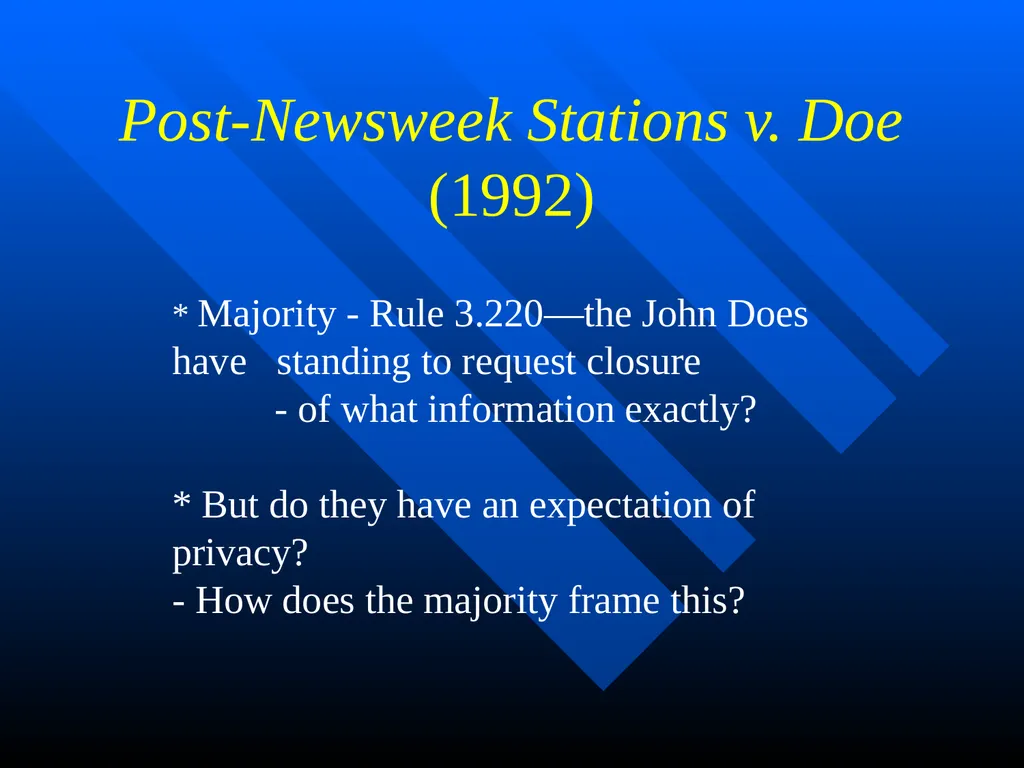
Post-Newsweek Stations v. Doe (1992) * Majority - Rule 3.220—the John Does have standing to request closure
- of what information exactly?
* But do they have an expectation of privacy?
- How does the majority frame this?<br>
- of what information exactly?
* But do they have an expectation of privacy?
- How does the majority frame this?<br>
21
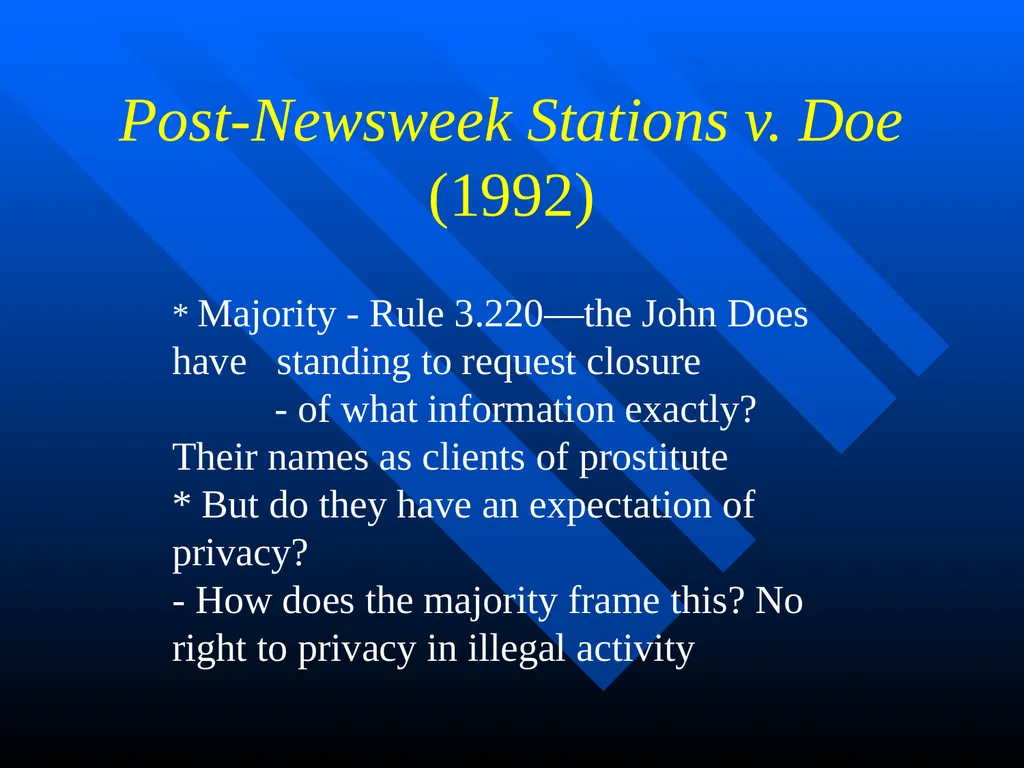
Post-Newsweek Stations v. Doe (1992) * Majority - Rule 3.220—the John Does have standing to request closure
- of what information exactly?
Their names as clients of prostitute
* But do they have an expectation of privacy?
- How does the majority frame this? No right to privacy in illegal activity<br>
- of what information exactly?
Their names as clients of prostitute
* But do they have an expectation of privacy?
- How does the majority frame this? No right to privacy in illegal activity<br>
22
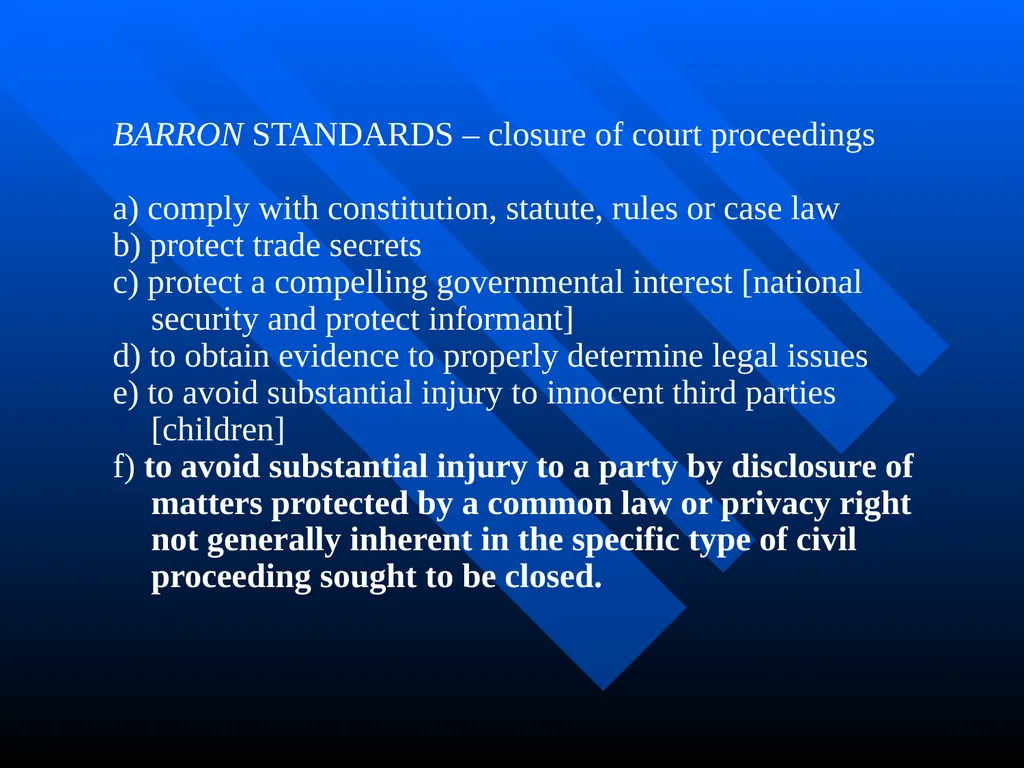
BARRON STANDARDS – closure of court proceedings
a) comply with constitution, statute, rules or case law
b) protect trade secrets
c) protect a compelling governmental interest [national security and protect informant]
d) to obtain evidence to properly determine legal issues
e) to avoid substantial injury to innocent third parties [children]
f) to avoid substantial injury to a party by disclosure of matters protected by a common law or privacy right not generally inherent in the specific type of civil proceeding sought to be closed.<br>
a) comply with constitution, statute, rules or case law
b) protect trade secrets
c) protect a compelling governmental interest [national security and protect informant]
d) to obtain evidence to properly determine legal issues
e) to avoid substantial injury to innocent third parties [children]
f) to avoid substantial injury to a party by disclosure of matters protected by a common law or privacy right not generally inherent in the specific type of civil proceeding sought to be closed.<br>
23
Define the Does’ Privacy Interest Kogan dissenting - definition of the interest in their name [based only on an investigation] when not actually charged<br>
24
State v. Rolling (Fla. Cir. Ct. 1994) Standards for photo disclosure [medium of disclosure]
Public records definition
Right to privacy for relatives
The test and balancing<br>
Public records definition
Right to privacy for relatives
The test and balancing<br>
25
Krischer v. McIver (1997) ASSISTED SUICIDE – DEFINE
- Dying from an existing disease
- Physician [or other] hastens death by an affirmative act
What are the State Interests?<br>
- Dying from an existing disease
- Physician [or other] hastens death by an affirmative act
What are the State Interests?<br>
26
Krischer v. McIver (1997) ASSISTED SUICIDE – DEFINE
- Dying from an existing disease
- Physician [or other] hastens death by an affirmative act
What are the State Interests? Preserving life, preventing suicide, integrity of med. profession
DISSENT – end-of-life decisions implicate autonomy & privacy interests<br>
- Dying from an existing disease
- Physician [or other] hastens death by an affirmative act
What are the State Interests? Preserving life, preventing suicide, integrity of med. profession
DISSENT – end-of-life decisions implicate autonomy & privacy interests<br>
27
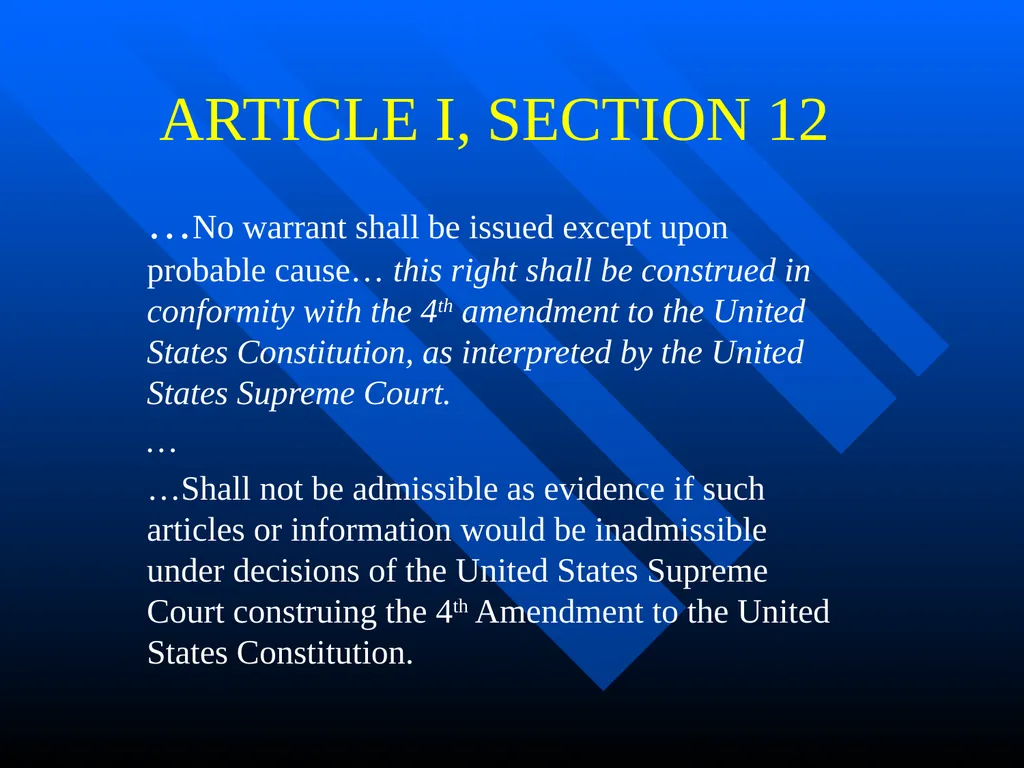
ARTICLE I, SECTION 12 …No warrant shall be issued except upon probable cause… this right shall be construed in conformity with the 4th amendment to the United States Constitution, as interpreted by the United States Supreme Court.
…
…Shall not be admissible as evidence if such articles or information would be inadmissible under decisions of the United States Supreme Court construing the 4th Amendment to the United States Constitution.<br>
…
…Shall not be admissible as evidence if such articles or information would be inadmissible under decisions of the United States Supreme Court construing the 4th Amendment to the United States Constitution.<br>
28
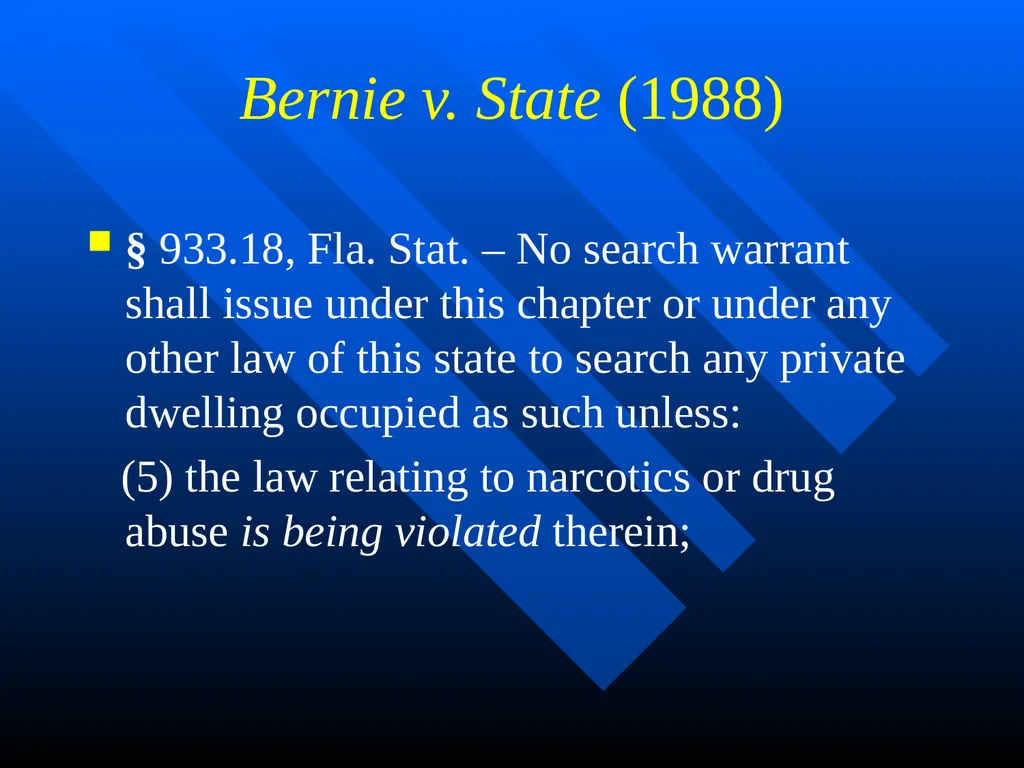
Bernie v. State (1988) § 933.18, Fla. Stat. – No search warrant shall issue under this chapter or under any other law of this state to search any private dwelling occupied as such unless:
(5) the law relating to narcotics or drug abuse is being violated therein;<br>
(5) the law relating to narcotics or drug abuse is being violated therein;<br>
29
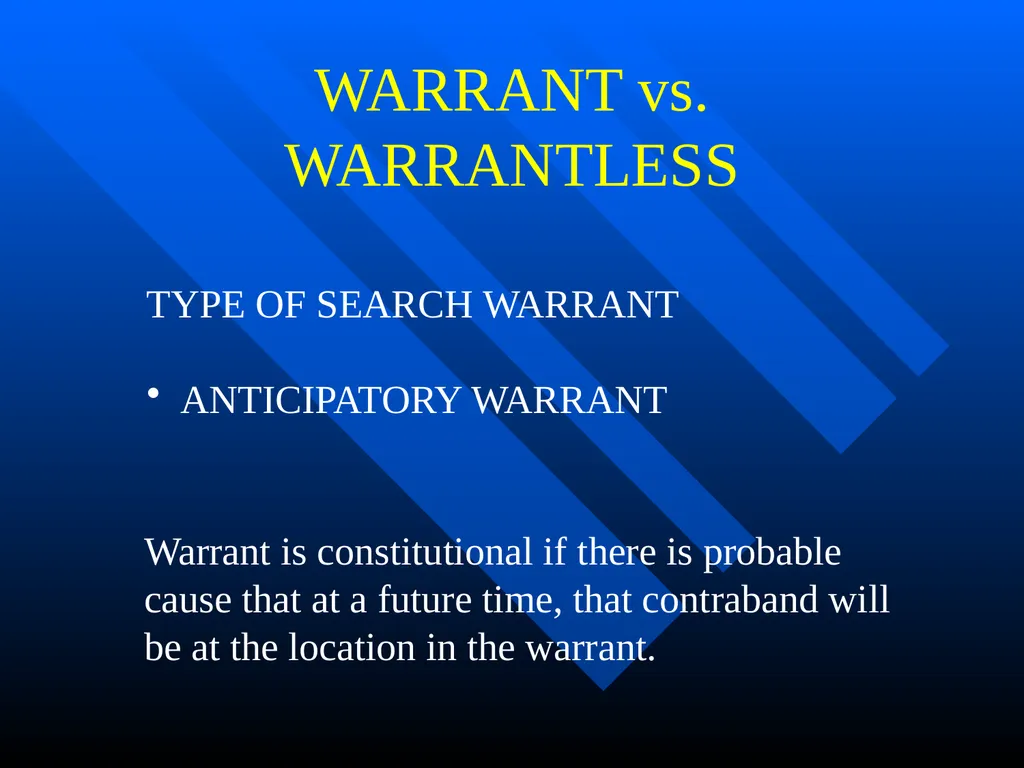
TYPE OF SEARCH WARRANT
ANTICIPATORY WARRANT Warrant is constitutional if there is probable cause that at a future time, that contraband will be at the location in the warrant. WARRANT vs. WARRANTLESS<br>
ANTICIPATORY WARRANT Warrant is constitutional if there is probable cause that at a future time, that contraband will be at the location in the warrant. WARRANT vs. WARRANTLESS<br>
30
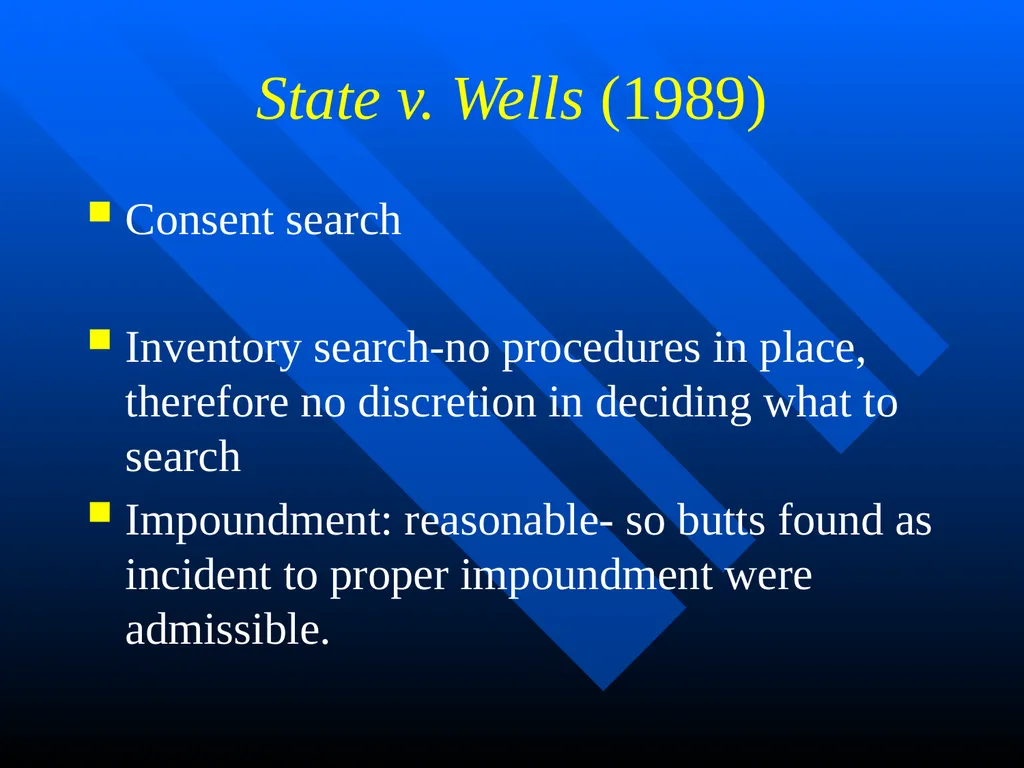
State v. Wells (1989) Consent search
Inventory search-no procedures in place, therefore no discretion in deciding what to search
Impoundment: reasonable- so butts found as incident to proper impoundment were admissible.<br>
Inventory search-no procedures in place, therefore no discretion in deciding what to search
Impoundment: reasonable- so butts found as incident to proper impoundment were admissible.<br>
31
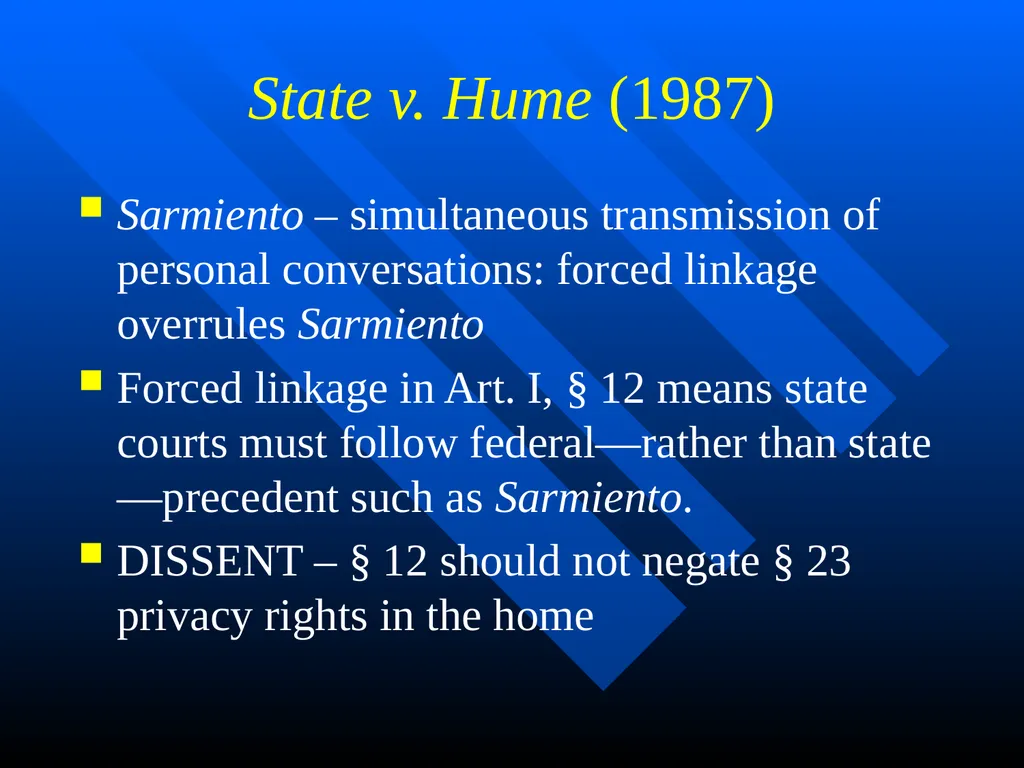
State v. Hume (1987) Sarmiento – simultaneous transmission of personal conversations: forced linkage overrules Sarmiento
Forced linkage in Art. I, § 12 means state courts must follow federal—rather than state—precedent such as Sarmiento.
DISSENT – § 12 should not negate § 23 privacy rights in the home<br>
Forced linkage in Art. I, § 12 means state courts must follow federal—rather than state—precedent such as Sarmiento.
DISSENT – § 12 should not negate § 23 privacy rights in the home<br>
32
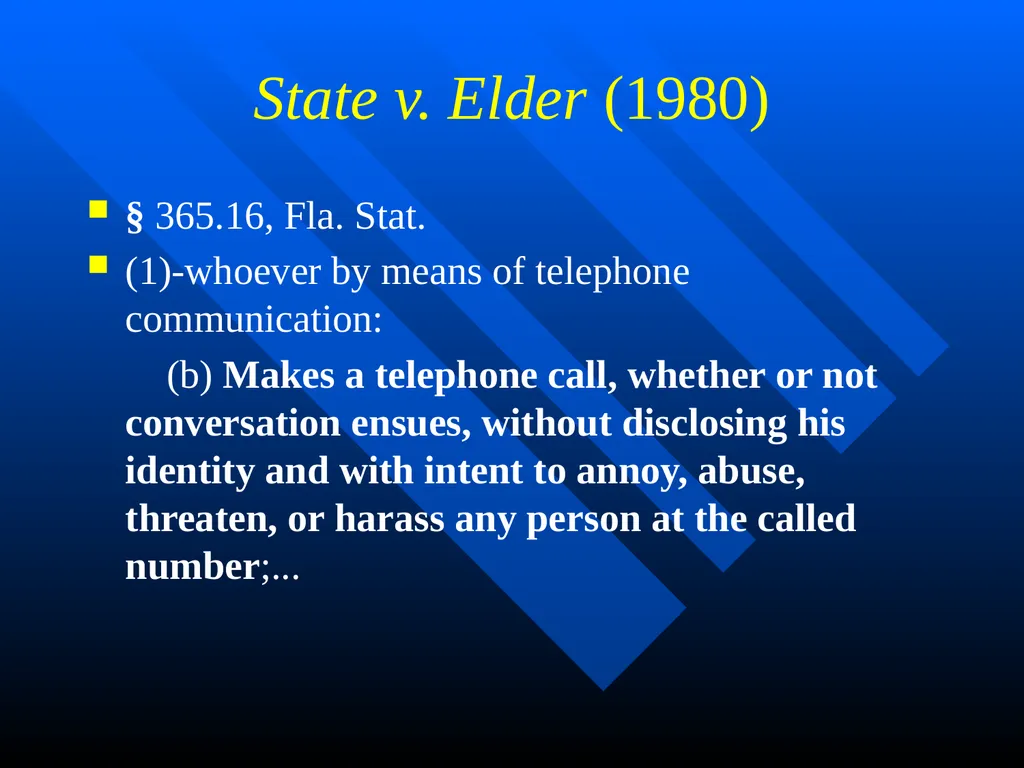
State v. Elder (1980) § 365.16, Fla. Stat.
(1)-whoever by means of telephone communication:
(b) Makes a telephone call, whether or not conversation ensues, without disclosing his identity and with intent to annoy, abuse, threaten, or harass any person at the called number;...<br>
(1)-whoever by means of telephone communication:
(b) Makes a telephone call, whether or not conversation ensues, without disclosing his identity and with intent to annoy, abuse, threaten, or harass any person at the called number;...<br>
33
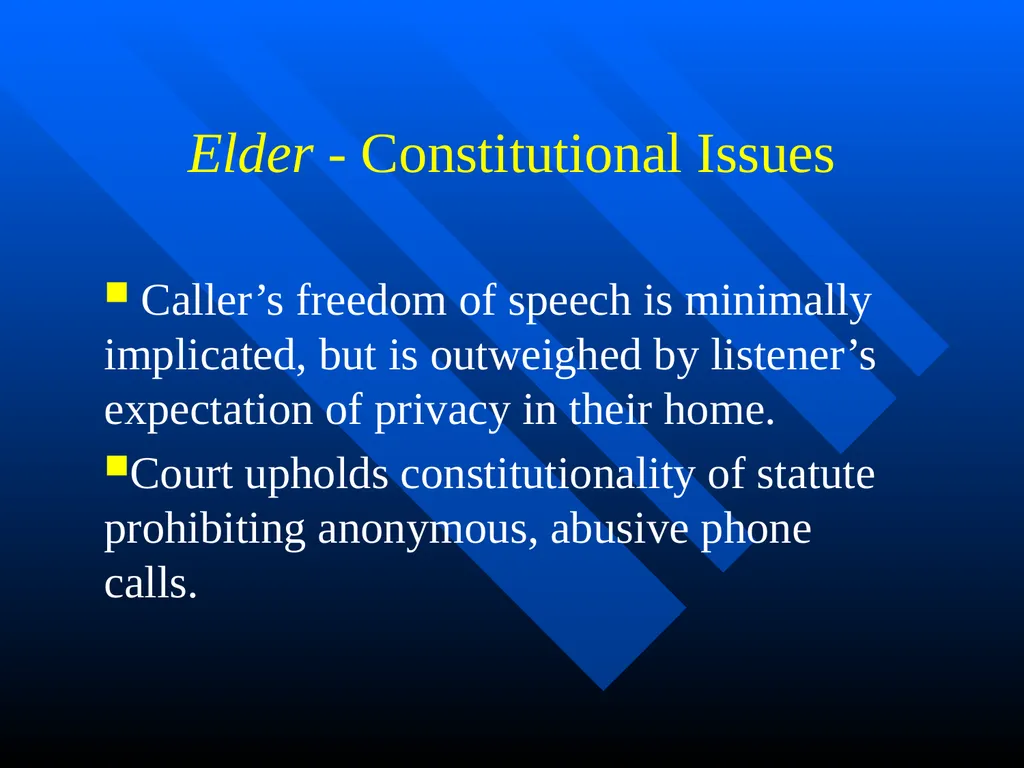
Elder - Constitutional Issues Caller’s freedom of speech is minimally implicated, but is outweighed by listener’s expectation of privacy in their home.
Court upholds constitutionality of statute prohibiting anonymous, abusive phone calls.<br>
Court upholds constitutionality of statute prohibiting anonymous, abusive phone calls.<br>
34
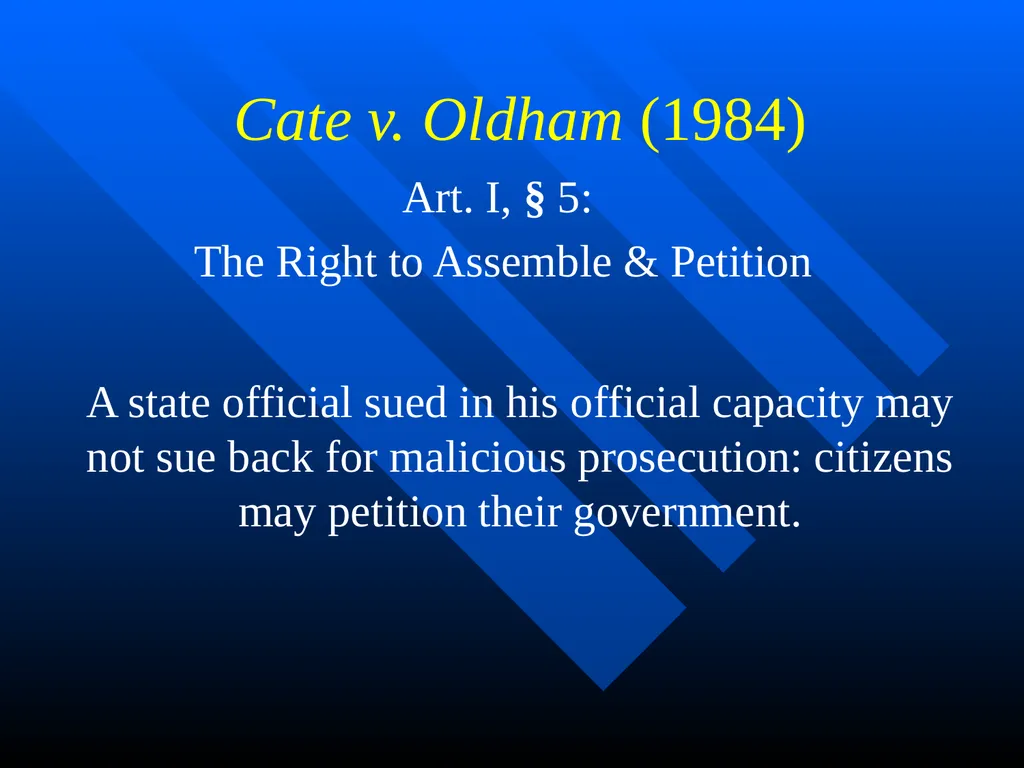
Cate v. Oldham (1984) Art. I, § 5:
The Right to Assemble & Petition A state official sued in his official capacity may not sue back for malicious prosecution: citizens may petition their government.<br>
The Right to Assemble & Petition A state official sued in his official capacity may not sue back for malicious prosecution: citizens may petition their government.<br>
35
RIGHT TO WORK SECTION 6. Right to work – the right of persons to work shall not be denied or abridged on account of membership or non-membership in any labor union or labor organization. The right of employees, by or through a labor organization, to bargain collectively shall not be denied or abridged. Public employees shall not have the right to strike.<br>
36
Hillsborough Governmental Employees v. Hillsborough Aviation Auth. (1988) ARTICLE I, § 6-RIGHT TO WORK
§ 447.309(3), Fla. Stat.
UNCONSTITUTIONALITY – As-applied vs. Facially unconstitutional
Statute cannot be applied to allow civil service board rules to overrule ratified collective bargaining agreement. Constitution protects right to collectively bargain.<br>
§ 447.309(3), Fla. Stat.
UNCONSTITUTIONALITY – As-applied vs. Facially unconstitutional
Statute cannot be applied to allow civil service board rules to overrule ratified collective bargaining agreement. Constitution protects right to collectively bargain.<br>
37
United Teachers of Dade v. School District (3d DCA 2011) District refuses to allow non-union teacher to have representation
UTD would not represent Beightol because he was not a member of UTD
§ 447.501, Fla. Stat. - Public employee relations
Does UTD commit an unfair labor practice? (Yes, because UTD withheld right from non-union member.) Is it unfair coercion?<br>
UTD would not represent Beightol because he was not a member of UTD
§ 447.501, Fla. Stat. - Public employee relations
Does UTD commit an unfair labor practice? (Yes, because UTD withheld right from non-union member.) Is it unfair coercion?<br>
38
Section 8 – Right to Bear Arms (a) The right of the people to keep and bear arms in defense of themselves and of the lawful authority of the state shall not be infringed, except that the manner of bearing arms may be regulated by law.
(b) There shall be a mandatory period of three days, excluding weekends and legal holidays, between the purchase and delivery at retail of any handgun. For the purposes of this section , “purchase” means the transfer of money or other valuable consideration to the retailer, and “handgun” means a firearm capable of being carried and used by one hand, such as a pistol or revolver. Holders of a concealed weapon permit as prescribed in Florida law shall not be subject to the provisions of this paragraph.
(c ) The legislature shall enact legislation implementing subsection (b) of this section no later than December 31, 1991, which shall provide that anyone violating the provisions of subsection (b) shall be guilty of a felony.
(d) This provision shall not apply to a trade-in of another handgun.<br>
(b) There shall be a mandatory period of three days, excluding weekends and legal holidays, between the purchase and delivery at retail of any handgun. For the purposes of this section , “purchase” means the transfer of money or other valuable consideration to the retailer, and “handgun” means a firearm capable of being carried and used by one hand, such as a pistol or revolver. Holders of a concealed weapon permit as prescribed in Florida law shall not be subject to the provisions of this paragraph.
(c ) The legislature shall enact legislation implementing subsection (b) of this section no later than December 31, 1991, which shall provide that anyone violating the provisions of subsection (b) shall be guilty of a felony.
(d) This provision shall not apply to a trade-in of another handgun.<br>
39
Section 8 – Right to Bear Arms (a) The right of the people to keep and bear arms in defense of themselves and of the lawful authority of the state shall not be infringed, except that the manner of bearing arms may be regulated by law.<br>
40
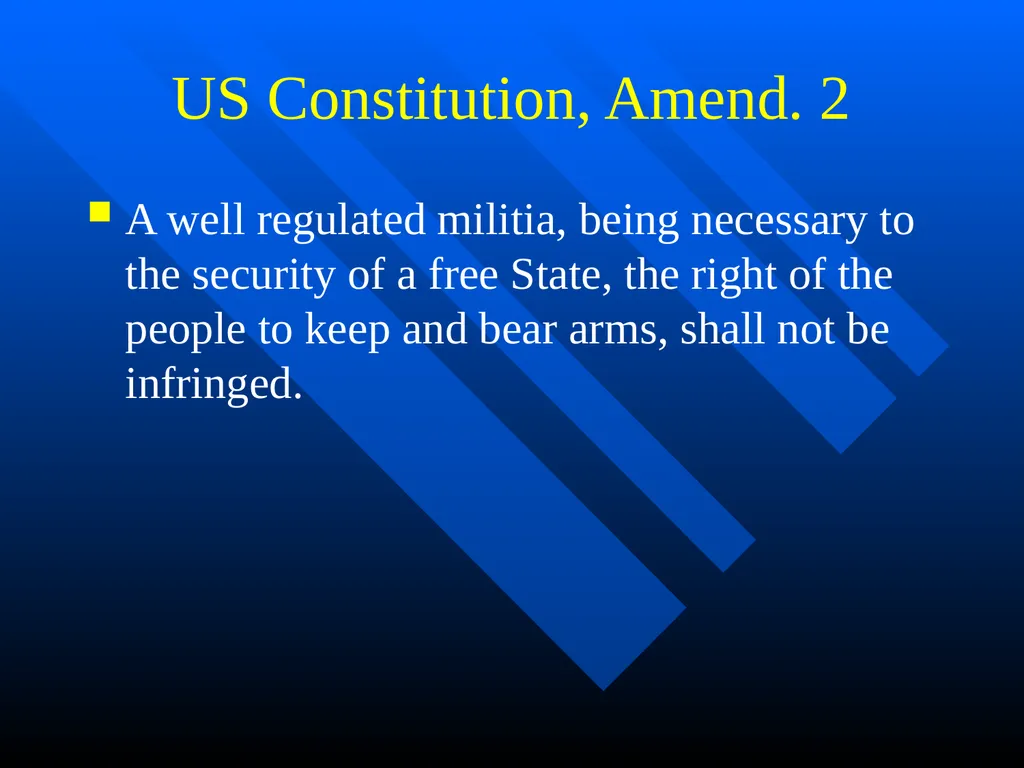
US Constitution, Amend. 2 A well regulated militia, being necessary to the security of a free State, the right of the people to keep and bear arms, shall not be infringed.<br>
41
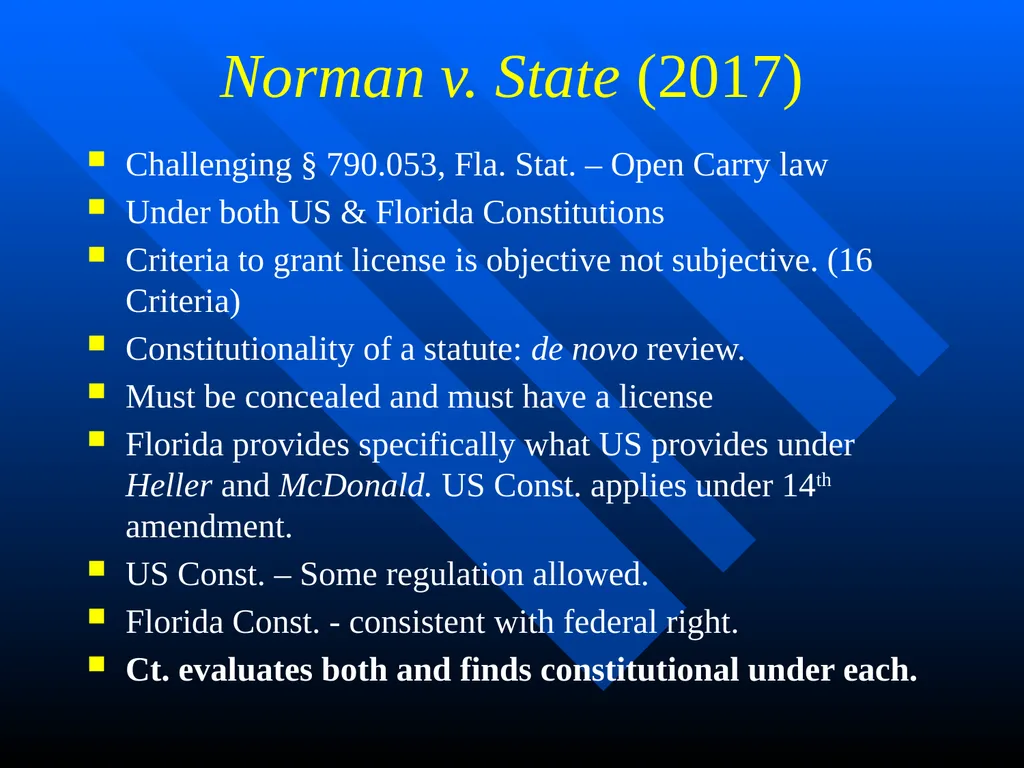
Norman v. State (2017) Challenging § 790.053, Fla. Stat. – Open Carry law
Under both US & Florida Constitutions
Criteria to grant license is objective not subjective. (16 Criteria)
Constitutionality of a statute: de novo review.
Must be concealed and must have a license
Florida provides specifically what US provides under Heller and McDonald. US Const. applies under 14th amendment.
US Const. – Some regulation allowed.
Florida Const. - consistent with federal right.
Ct. evaluates both and finds constitutional under each.<br>
Under both US & Florida Constitutions
Criteria to grant license is objective not subjective. (16 Criteria)
Constitutionality of a statute: de novo review.
Must be concealed and must have a license
Florida provides specifically what US provides under Heller and McDonald. US Const. applies under 14th amendment.
US Const. – Some regulation allowed.
Florida Const. - consistent with federal right.
Ct. evaluates both and finds constitutional under each.<br>
42
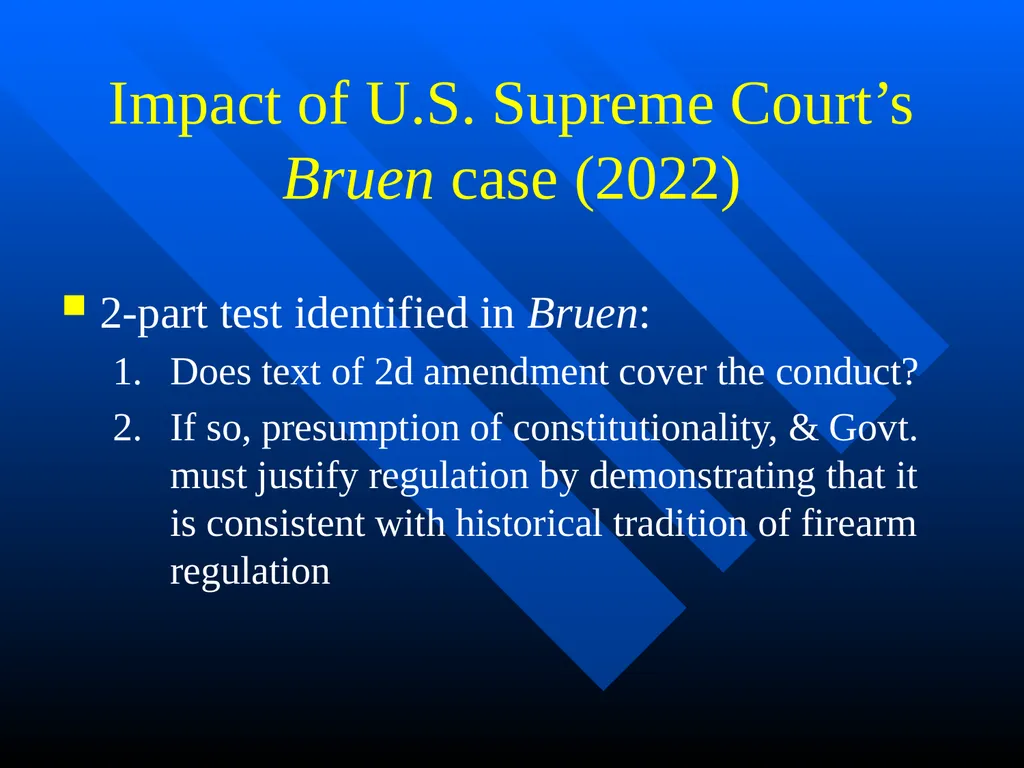
Impact of U.S. Supreme Court’s Bruen case (2022) 2-part test identified in Bruen:
Does text of 2d amendment cover the conduct?
If so, presumption of constitutionality, & Govt. must justify regulation by demonstrating that it is consistent with historical tradition of firearm regulation<br>
Does text of 2d amendment cover the conduct?
If so, presumption of constitutionality, & Govt. must justify regulation by demonstrating that it is consistent with historical tradition of firearm regulation<br>
43
What is the impact of Bruen on Fla. Const.? Recent caselaw
Edenfield v. State (Fla. 1st DCA 2023) – right of felons to possess firearms
Applies Bruen
Does not mention Fla. Constitution
Burns v. State (Fla. 4th DCA 2023) – does not mention Bruen
open carry to protect property
does mention Fla. Const. & purpose of self-defense
McDaniels v. State (1st DCA 2025) – relied on Bruen to strike down Florida’s ban on open carry of firearms.
Noted that no claim made under Fla. Const.
Explained that Bruen had rejected the 2-step framework used in Norman<br>
Edenfield v. State (Fla. 1st DCA 2023) – right of felons to possess firearms
Applies Bruen
Does not mention Fla. Constitution
Burns v. State (Fla. 4th DCA 2023) – does not mention Bruen
open carry to protect property
does mention Fla. Const. & purpose of self-defense
McDaniels v. State (1st DCA 2025) – relied on Bruen to strike down Florida’s ban on open carry of firearms.
Noted that no claim made under Fla. Const.
Explained that Bruen had rejected the 2-step framework used in Norman<br>
44
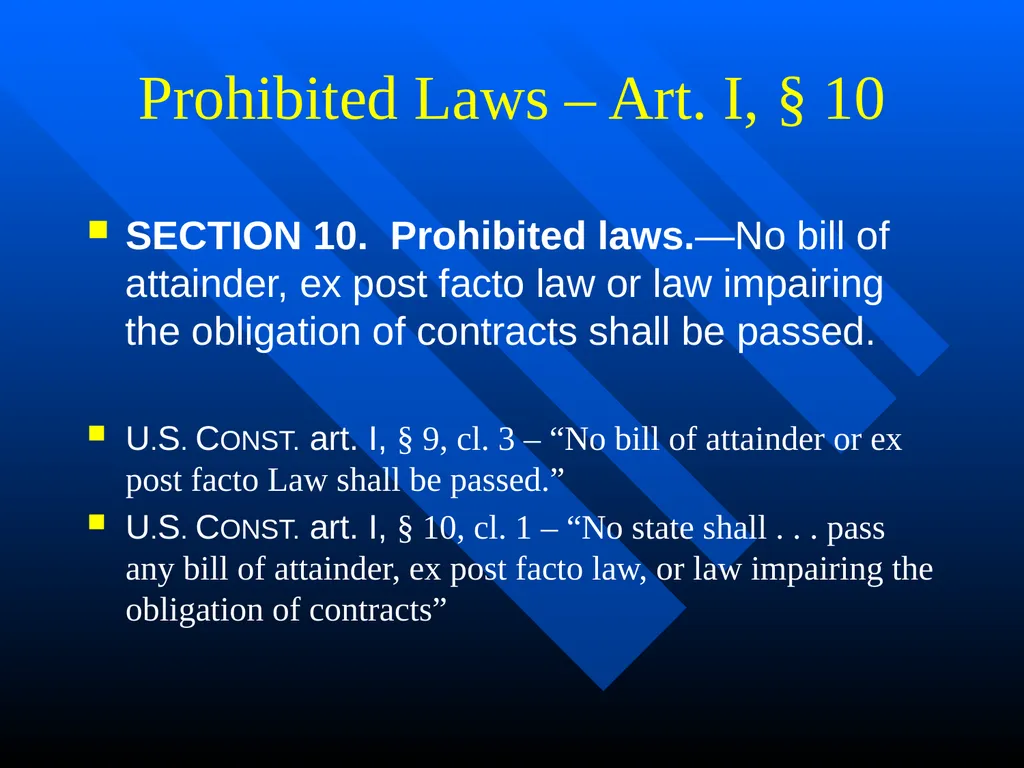
Prohibited Laws – Art. I, § 10 SECTION 10. Prohibited laws.—No bill of attainder, ex post facto law or law impairing the obligation of contracts shall be passed.
U.S. Const. art. I, § 9, cl. 3 – “No bill of attainder or ex post facto Law shall be passed.”
U.S. Const. art. I, § 10, cl. 1 – “No state shall . . . pass any bill of attainder, ex post facto law, or law impairing the obligation of contracts”<br>
U.S. Const. art. I, § 9, cl. 3 – “No bill of attainder or ex post facto Law shall be passed.”
U.S. Const. art. I, § 10, cl. 1 – “No state shall . . . pass any bill of attainder, ex post facto law, or law impairing the obligation of contracts”<br>
45
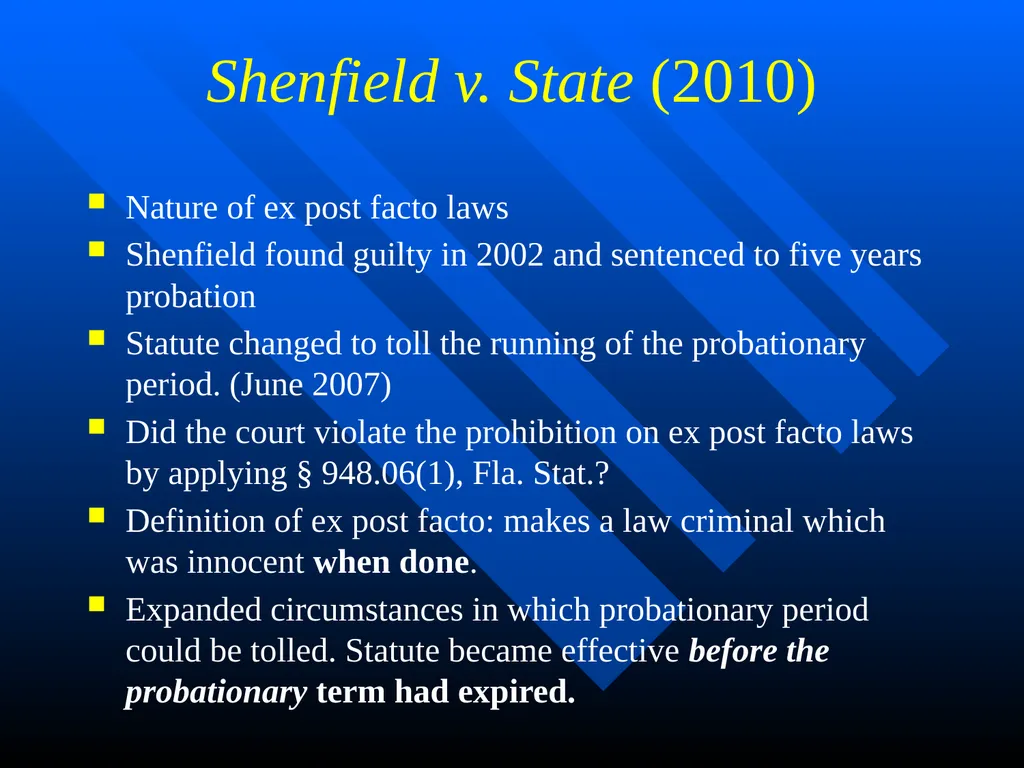
Shenfield v. State (2010) Nature of ex post facto laws
Shenfield found guilty in 2002 and sentenced to five years probation
Statute changed to toll the running of the probationary period. (June 2007)
Did the court violate the prohibition on ex post facto laws by applying § 948.06(1), Fla. Stat.?
Definition of ex post facto: makes a law criminal which was innocent when done.
Expanded circumstances in which probationary period could be tolled. Statute became effective before the probationary term had expired.<br>
Shenfield found guilty in 2002 and sentenced to five years probation
Statute changed to toll the running of the probationary period. (June 2007)
Did the court violate the prohibition on ex post facto laws by applying § 948.06(1), Fla. Stat.?
Definition of ex post facto: makes a law criminal which was innocent when done.
Expanded circumstances in which probationary period could be tolled. Statute became effective before the probationary term had expired.<br>
46
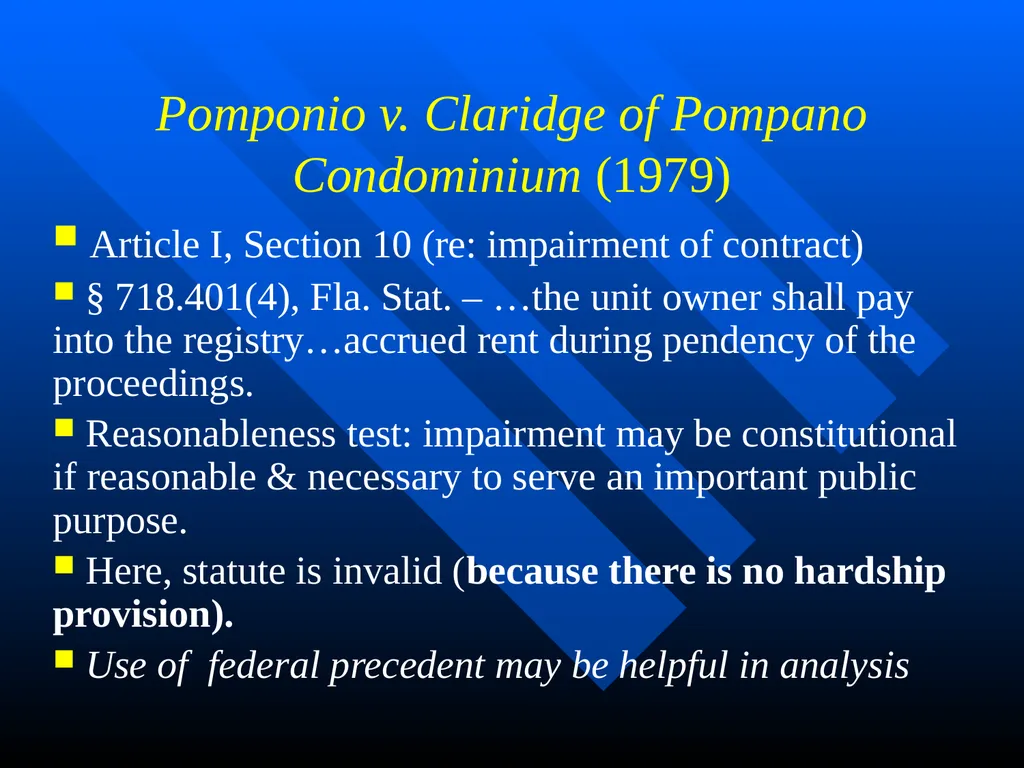
Pomponio v. Claridge of Pompano Condominium (1979) Article I, Section 10 (re: impairment of contract)
§ 718.401(4), Fla. Stat. – …the unit owner shall pay into the registry…accrued rent during pendency of the proceedings.
Reasonableness test: impairment may be constitutional if reasonable & necessary to serve an important public purpose.
Here, statute is invalid (because there is no hardship provision).
Use of federal precedent may be helpful in analysis<br>
§ 718.401(4), Fla. Stat. – …the unit owner shall pay into the registry…accrued rent during pendency of the proceedings.
Reasonableness test: impairment may be constitutional if reasonable & necessary to serve an important public purpose.
Here, statute is invalid (because there is no hardship provision).
Use of federal precedent may be helpful in analysis<br>
47
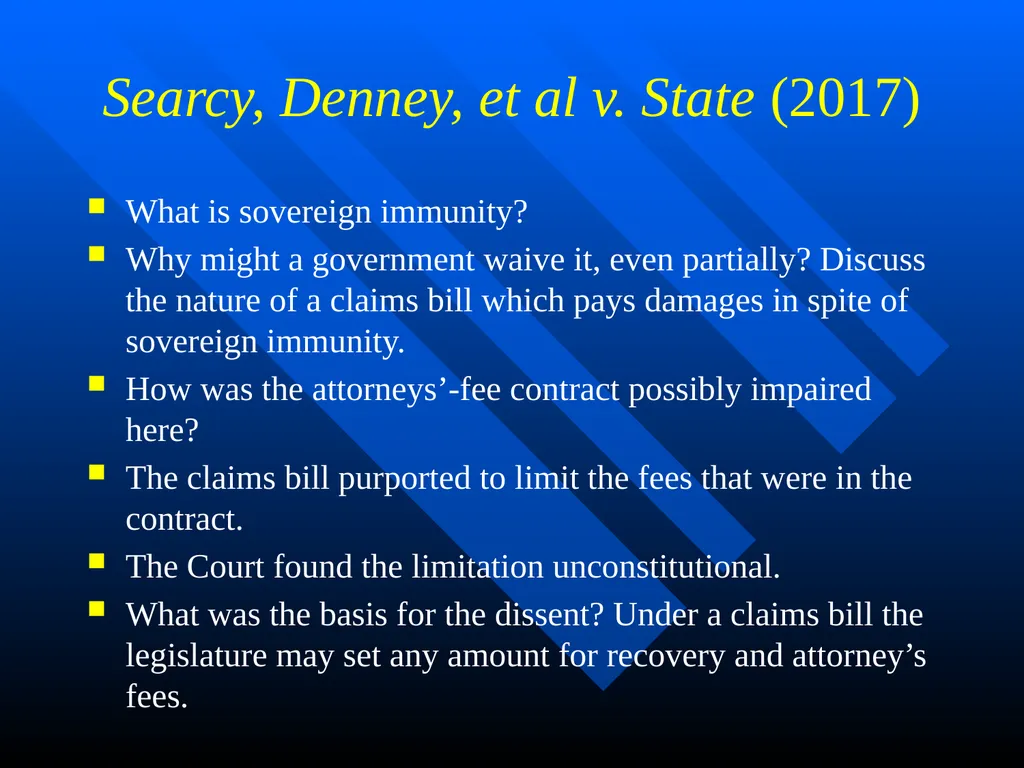
Searcy, Denney, et al v. State (2017) What is sovereign immunity?
Why might a government waive it, even partially? Discuss the nature of a claims bill which pays damages in spite of sovereign immunity.
How was the attorneys’-fee contract possibly impaired here?
The claims bill purported to limit the fees that were in the contract.
The Court found the limitation unconstitutional.
What was the basis for the dissent? Under a claims bill the legislature may set any amount for recovery and attorney’s fees.<br>
Why might a government waive it, even partially? Discuss the nature of a claims bill which pays damages in spite of sovereign immunity.
How was the attorneys’-fee contract possibly impaired here?
The claims bill purported to limit the fees that were in the contract.
The Court found the limitation unconstitutional.
What was the basis for the dissent? Under a claims bill the legislature may set any amount for recovery and attorney’s fees.<br>
48
Art. I, § 21 – Access to courts. The courts shall be open to every person for redress of any injury, and justice shall be administered without sale, denial or delay<br>
49
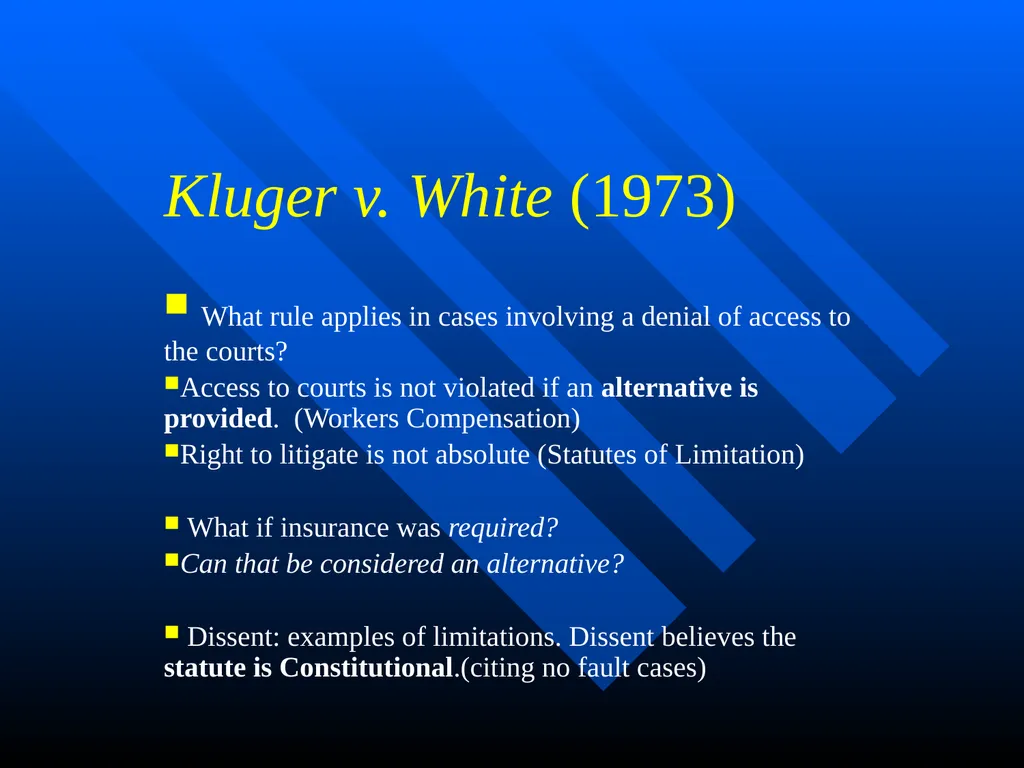
Kluger v. White (1973) What rule applies in cases involving a denial of access to the courts?
Access to courts is not violated if an alternative is provided. (Workers Compensation)
Right to litigate is not absolute (Statutes of Limitation)
What if insurance was required?
Can that be considered an alternative?
Dissent: examples of limitations. Dissent believes the statute is Constitutional.(citing no fault cases)<br>
Access to courts is not violated if an alternative is provided. (Workers Compensation)
Right to litigate is not absolute (Statutes of Limitation)
What if insurance was required?
Can that be considered an alternative?
Dissent: examples of limitations. Dissent believes the statute is Constitutional.(citing no fault cases)<br>
50
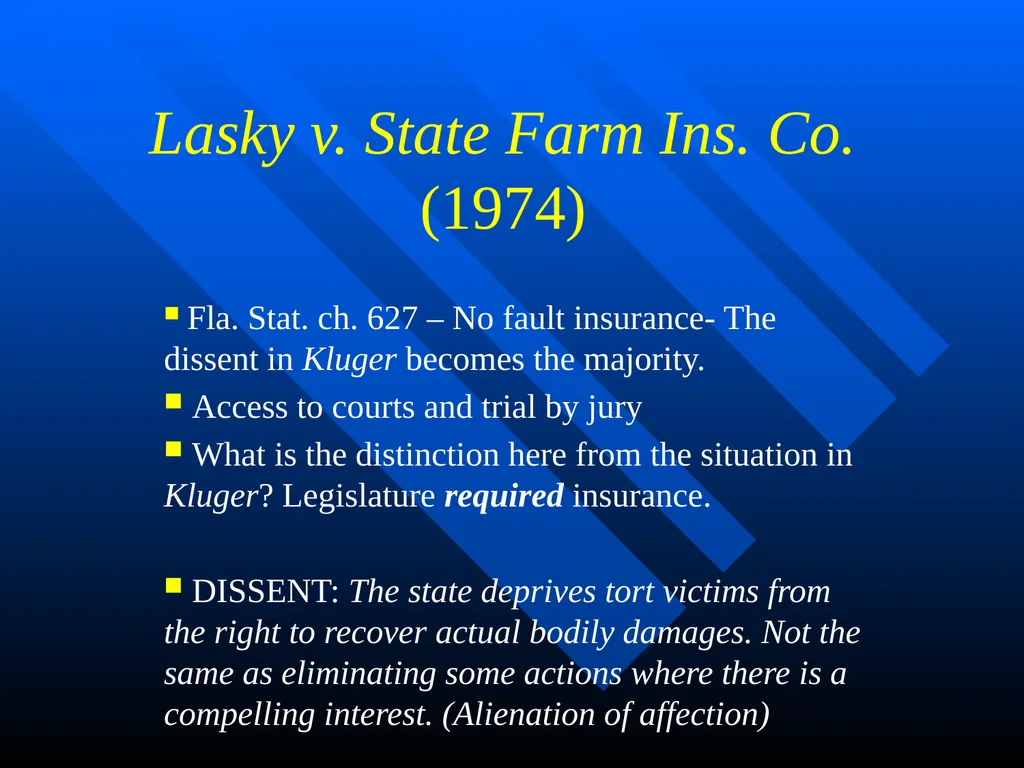
Lasky v. State Farm Ins. Co. (1974) Fla. Stat. ch. 627 – No fault insurance- The dissent in Kluger becomes the majority.
Access to courts and trial by jury
What is the distinction here from the situation in Kluger? Legislature required insurance.
DISSENT: The state deprives tort victims from the right to recover actual bodily damages. Not the same as eliminating some actions where there is a compelling interest. (Alienation of affection)<br>
Access to courts and trial by jury
What is the distinction here from the situation in Kluger? Legislature required insurance.
DISSENT: The state deprives tort victims from the right to recover actual bodily damages. Not the same as eliminating some actions where there is a compelling interest. (Alienation of affection)<br>
51
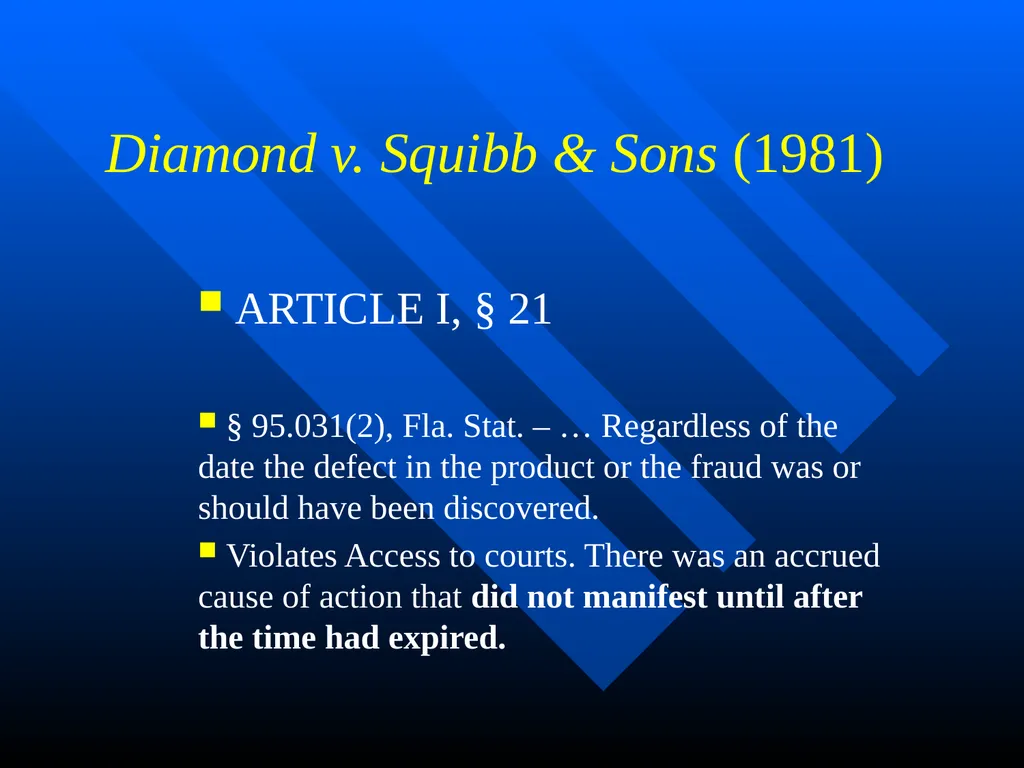
Diamond v. Squibb & Sons (1981) ARTICLE I, § 21
§ 95.031(2), Fla. Stat. – … Regardless of the date the defect in the product or the fraud was or should have been discovered.
Violates Access to courts. There was an accrued cause of action that did not manifest until after the time had expired.<br>
§ 95.031(2), Fla. Stat. – … Regardless of the date the defect in the product or the fraud was or should have been discovered.
Violates Access to courts. There was an accrued cause of action that did not manifest until after the time had expired.<br>
52
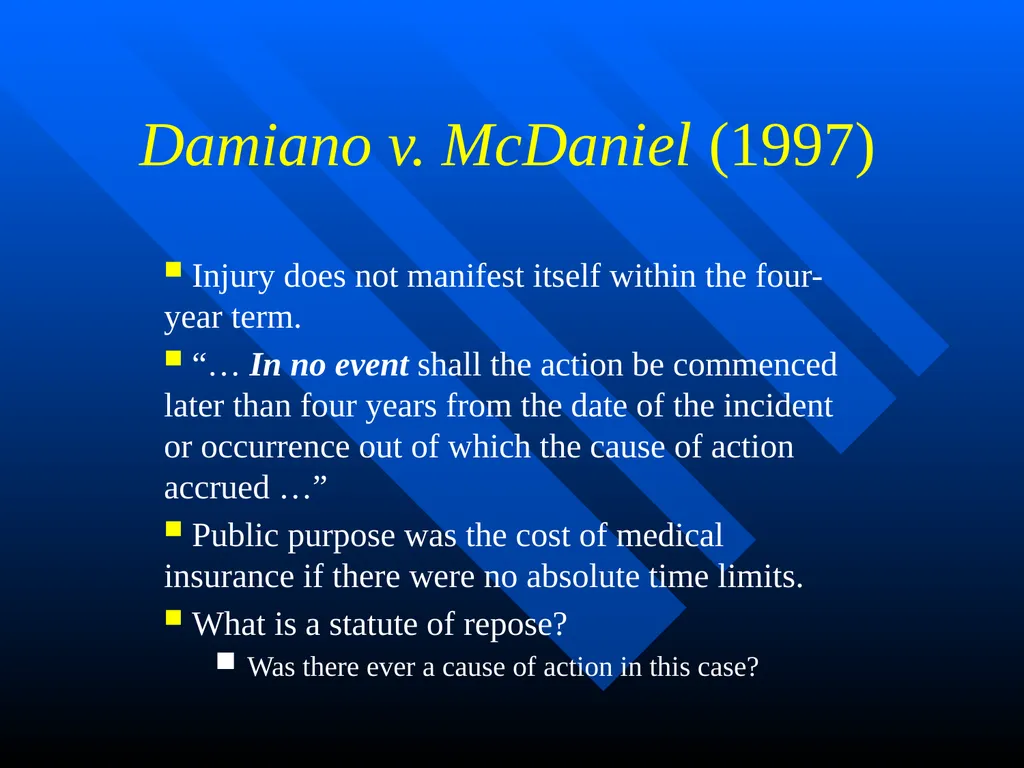
Damiano v. McDaniel (1997) Injury does not manifest itself within the four-year term.
“… In no event shall the action be commenced later than four years from the date of the incident or occurrence out of which the cause of action accrued …”
Public purpose was the cost of medical insurance if there were no absolute time limits.
What is a statute of repose?
Was there ever a cause of action in this case?<br>
“… In no event shall the action be commenced later than four years from the date of the incident or occurrence out of which the cause of action accrued …”
Public purpose was the cost of medical insurance if there were no absolute time limits.
What is a statute of repose?
Was there ever a cause of action in this case?<br>
53
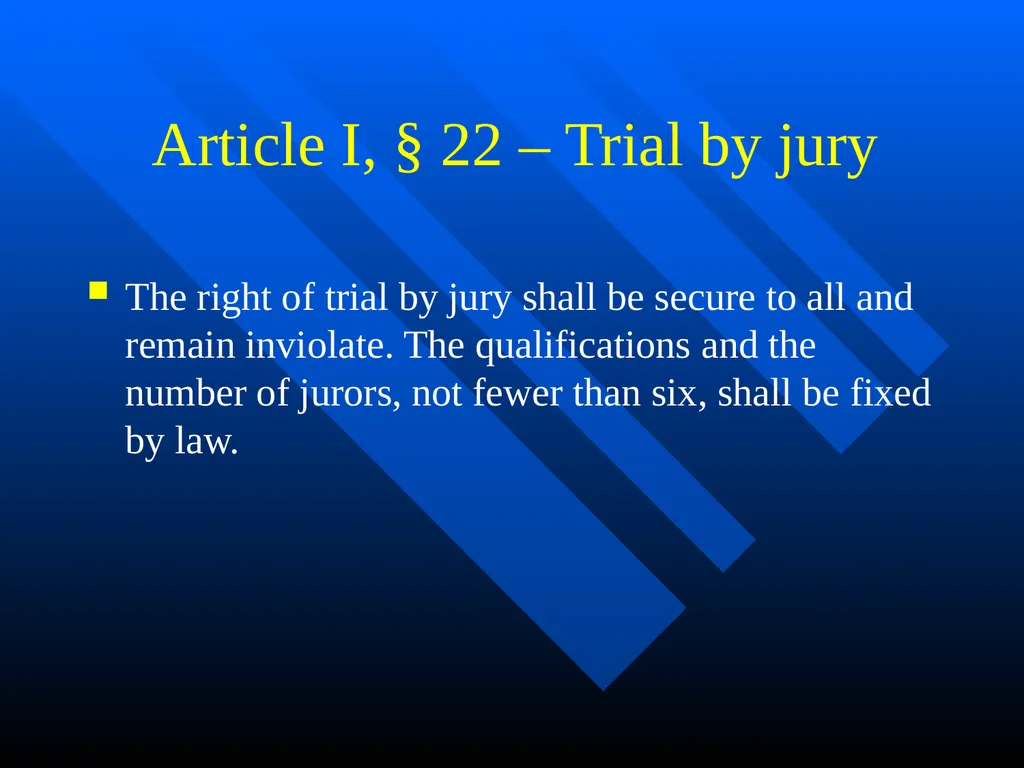
Article I, § 22 – Trial by jury The right of trial by jury shall be secure to all and remain inviolate. The qualifications and the number of jurors, not fewer than six, shall be fixed by law.<br>
54
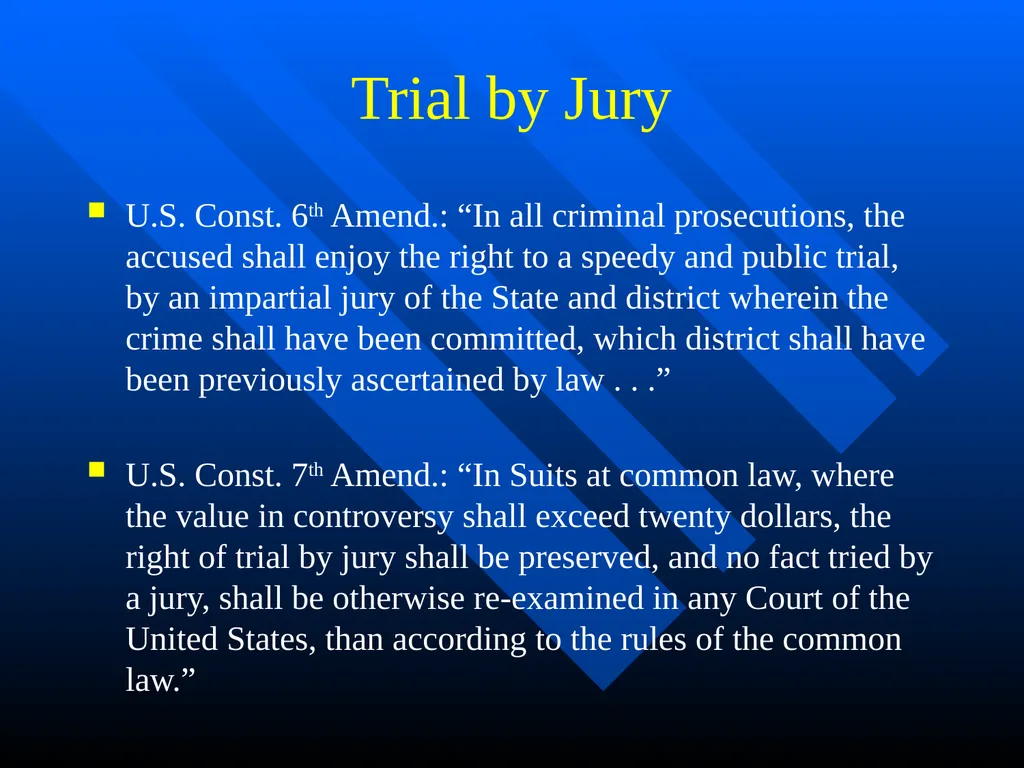
Trial by Jury U.S. Const. 6th Amend.: “In all criminal prosecutions, the accused shall enjoy the right to a speedy and public trial, by an impartial jury of the State and district wherein the crime shall have been committed, which district shall have been previously ascertained by law . . .”
U.S. Const. 7th Amend.: “In Suits at common law, where the value in controversy shall exceed twenty dollars, the right of trial by jury shall be preserved, and no fact tried by a jury, shall be otherwise re-examined in any Court of the United States, than according to the rules of the common law.”<br>
U.S. Const. 7th Amend.: “In Suits at common law, where the value in controversy shall exceed twenty dollars, the right of trial by jury shall be preserved, and no fact tried by a jury, shall be otherwise re-examined in any Court of the United States, than according to the rules of the common law.”<br>
55
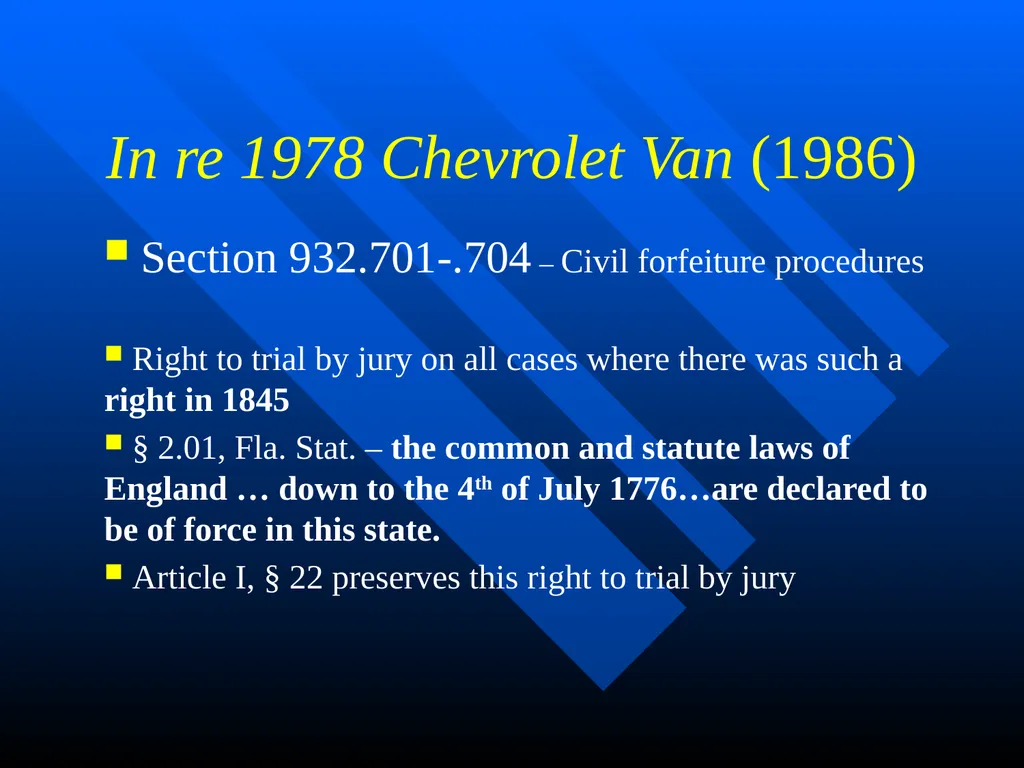
In re 1978 Chevrolet Van (1986) Section 932.701-.704 – Civil forfeiture procedures
Right to trial by jury on all cases where there was such a right in 1845
§ 2.01, Fla. Stat. – the common and statute laws of England … down to the 4th of July 1776…are declared to be of force in this state.
Article I, § 22 preserves this right to trial by jury<br>
Right to trial by jury on all cases where there was such a right in 1845
§ 2.01, Fla. Stat. – the common and statute laws of England … down to the 4th of July 1776…are declared to be of force in this state.
Article I, § 22 preserves this right to trial by jury<br>
56
Broward County v. La Rosa (1987) Local human rights ordinance
Created agency capable of awarding actual damages
Quasi-judicial in nature – what limits on authority?
Separation of Powers – The legislature cannot create or authorize administrative agencies to perform judicial functions.
Can create “quasi-judicial” functions
Cannot eliminate trial by jury for unliquidated damages.<br>
Created agency capable of awarding actual damages
Quasi-judicial in nature – what limits on authority?
Separation of Powers – The legislature cannot create or authorize administrative agencies to perform judicial functions.
Can create “quasi-judicial” functions
Cannot eliminate trial by jury for unliquidated damages.<br>
57
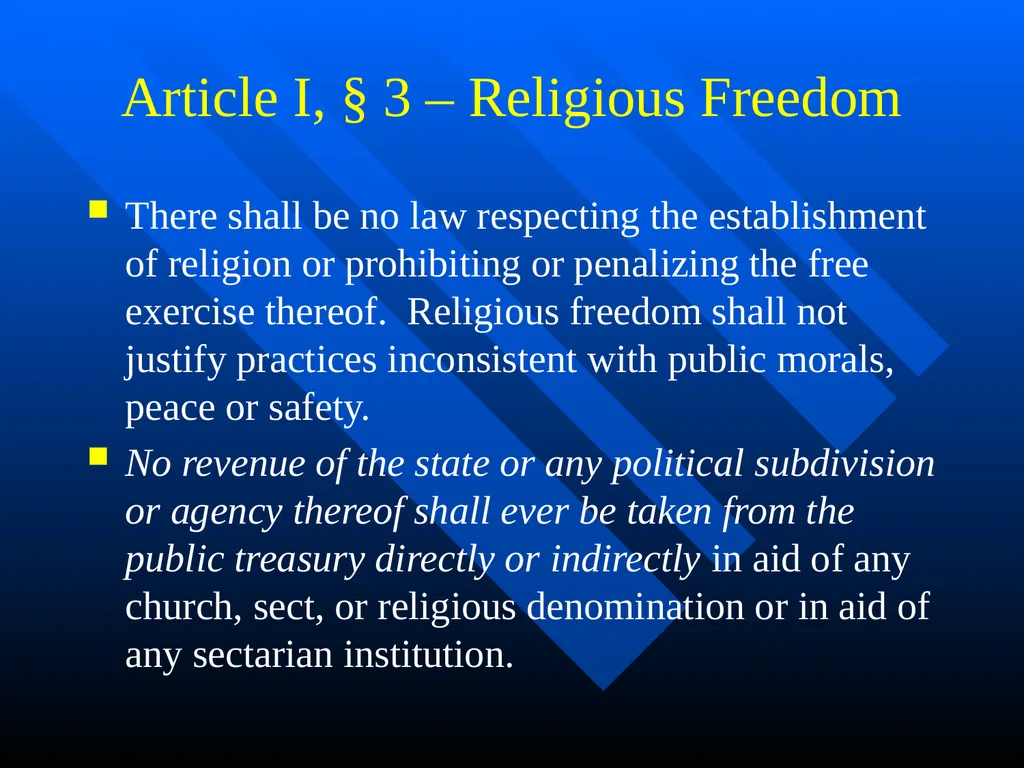
Article I, § 3 – Religious Freedom There shall be no law respecting the establishment of religion or prohibiting or penalizing the free exercise thereof. Religious freedom shall not justify practices inconsistent with public morals, peace or safety.
No revenue of the state or any political subdivision or agency thereof shall ever be taken from the public treasury directly or indirectly in aid of any church, sect, or religious denomination or in aid of any sectarian institution.<br>
No revenue of the state or any political subdivision or agency thereof shall ever be taken from the public treasury directly or indirectly in aid of any church, sect, or religious denomination or in aid of any sectarian institution.<br>
58
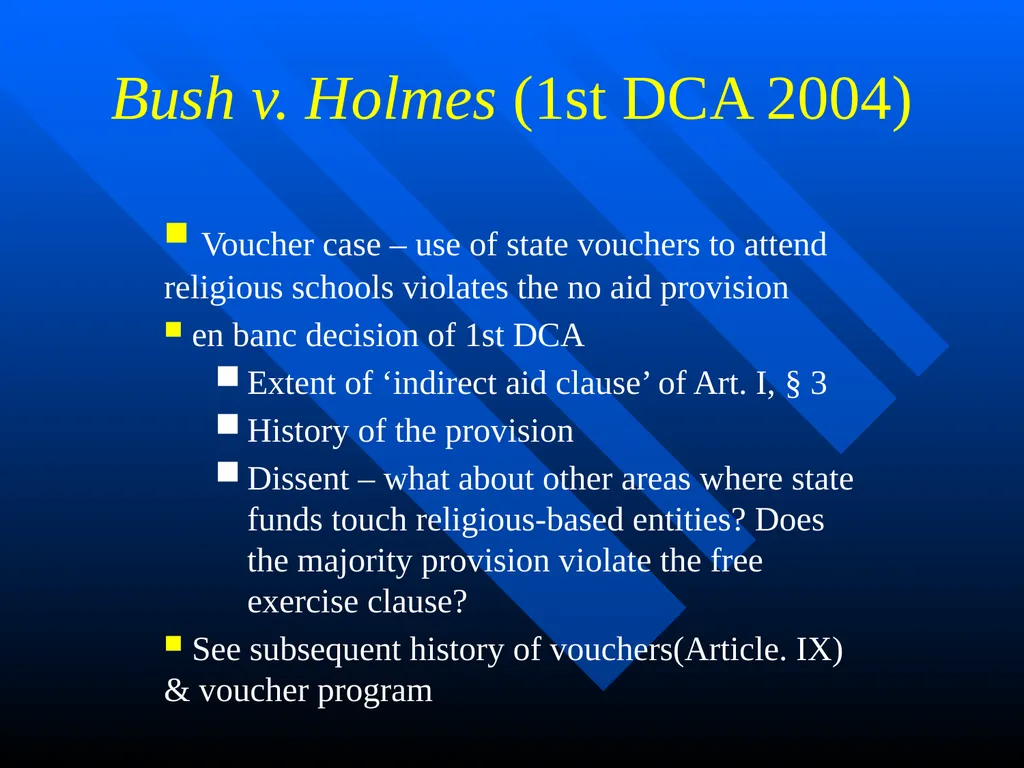
Bush v. Holmes (1st DCA 2004) Voucher case – use of state vouchers to attend religious schools violates the no aid provision
en banc decision of 1st DCA
Extent of ‘indirect aid clause’ of Art. I, § 3
History of the provision
Dissent – what about other areas where state funds touch religious-based entities? Does the majority provision violate the free exercise clause?
See subsequent history of vouchers(Article. IX) & voucher program<br>
en banc decision of 1st DCA
Extent of ‘indirect aid clause’ of Art. I, § 3
History of the provision
Dissent – what about other areas where state funds touch religious-based entities? Does the majority provision violate the free exercise clause?
See subsequent history of vouchers(Article. IX) & voucher program<br>
59
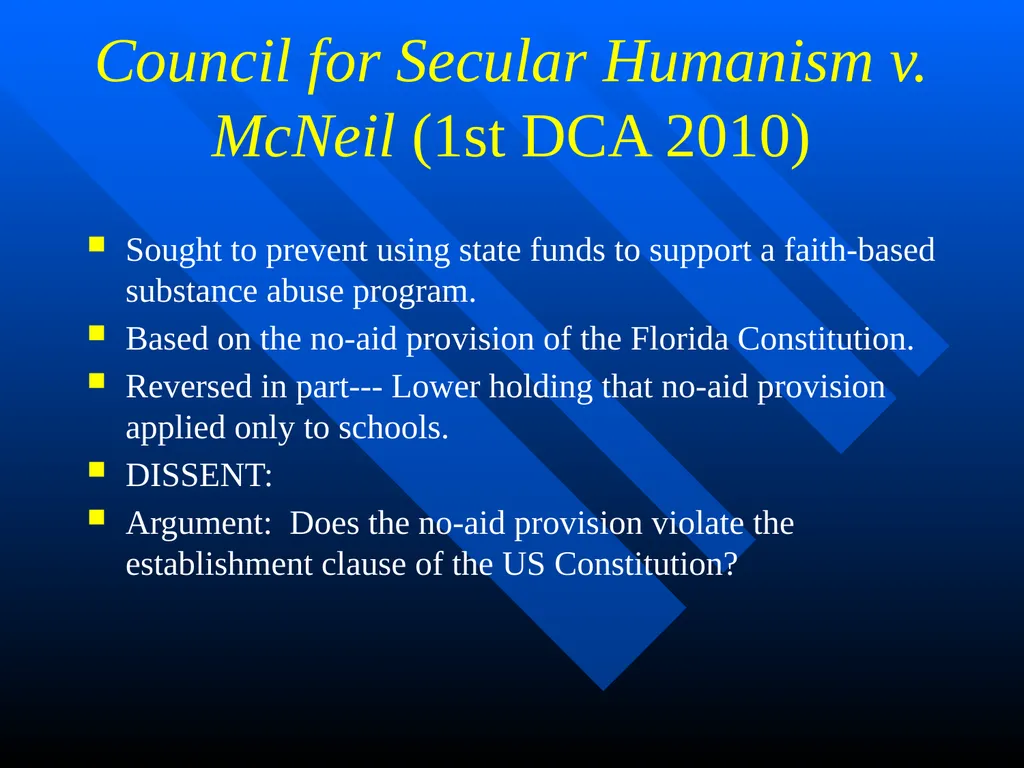
Council for Secular Humanism v. McNeil (1st DCA 2010) Sought to prevent using state funds to support a faith-based substance abuse program.
Based on the no-aid provision of the Florida Constitution.
Reversed in part--- Lower holding that no-aid provision applied only to schools.
DISSENT:
Argument: Does the no-aid provision violate the establishment clause of the US Constitution?<br>
Based on the no-aid provision of the Florida Constitution.
Reversed in part--- Lower holding that no-aid provision applied only to schools.
DISSENT:
Argument: Does the no-aid provision violate the establishment clause of the US Constitution?<br>
60
Espinoza v. Montana Department of Revenue (US 2020) Under US Constitution’s Establishment Clause, it is permissible for religious organizations to benefit from neutral government programs.
1. Free exercise clause applied to the states through the 14th Amendment protects against laws that provide disability based on religious status. Protects against unequal treatment.
Review of religion clause subject to strict scrutiny (172)
Utilizing the no-aid provision to prevent tax credit funds from being used by students to attend religious schools violated the Free Exercise Clause of the First Amendment.<br>
1. Free exercise clause applied to the states through the 14th Amendment protects against laws that provide disability based on religious status. Protects against unequal treatment.
Review of religion clause subject to strict scrutiny (172)
Utilizing the no-aid provision to prevent tax credit funds from being used by students to attend religious schools violated the Free Exercise Clause of the First Amendment.<br>
61
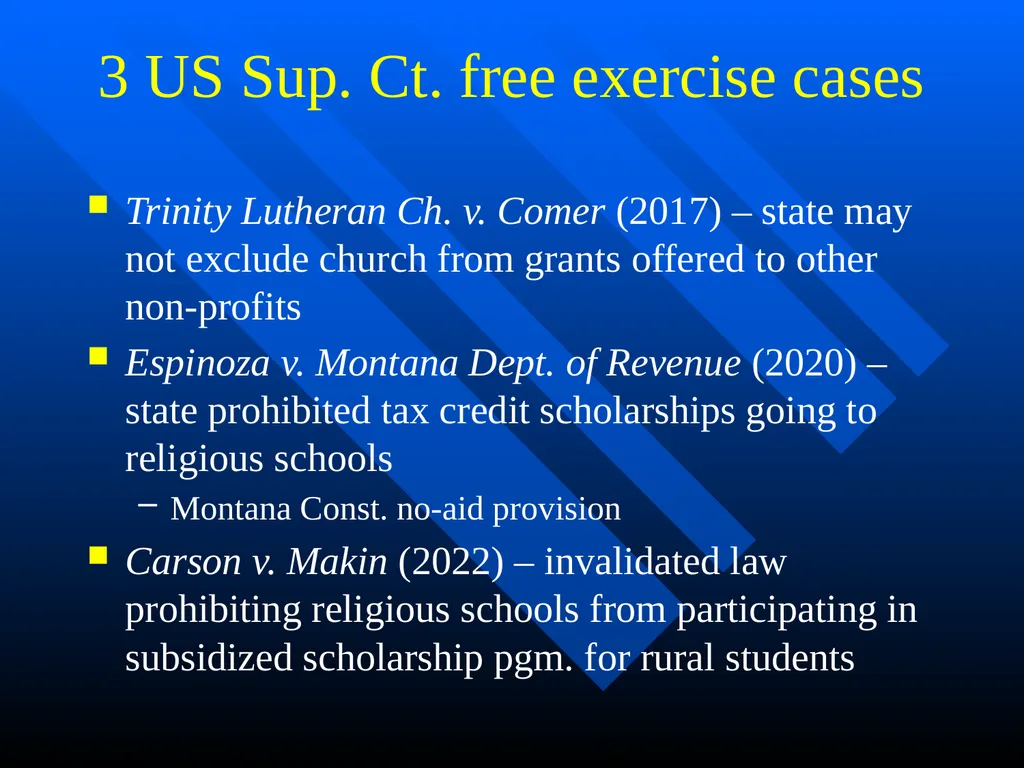
3 US Sup. Ct. free exercise cases Trinity Lutheran Ch. v. Comer (2017) – state may not exclude church from grants offered to other non-profits
Espinoza v. Montana Dept. of Revenue (2020) – state prohibited tax credit scholarships going to religious schools
Montana Const. no-aid provision
Carson v. Makin (2022) – invalidated law prohibiting religious schools from participating in subsidized scholarship pgm. for rural students<br>
Espinoza v. Montana Dept. of Revenue (2020) – state prohibited tax credit scholarships going to religious schools
Montana Const. no-aid provision
Carson v. Makin (2022) – invalidated law prohibiting religious schools from participating in subsidized scholarship pgm. for rural students<br>
62
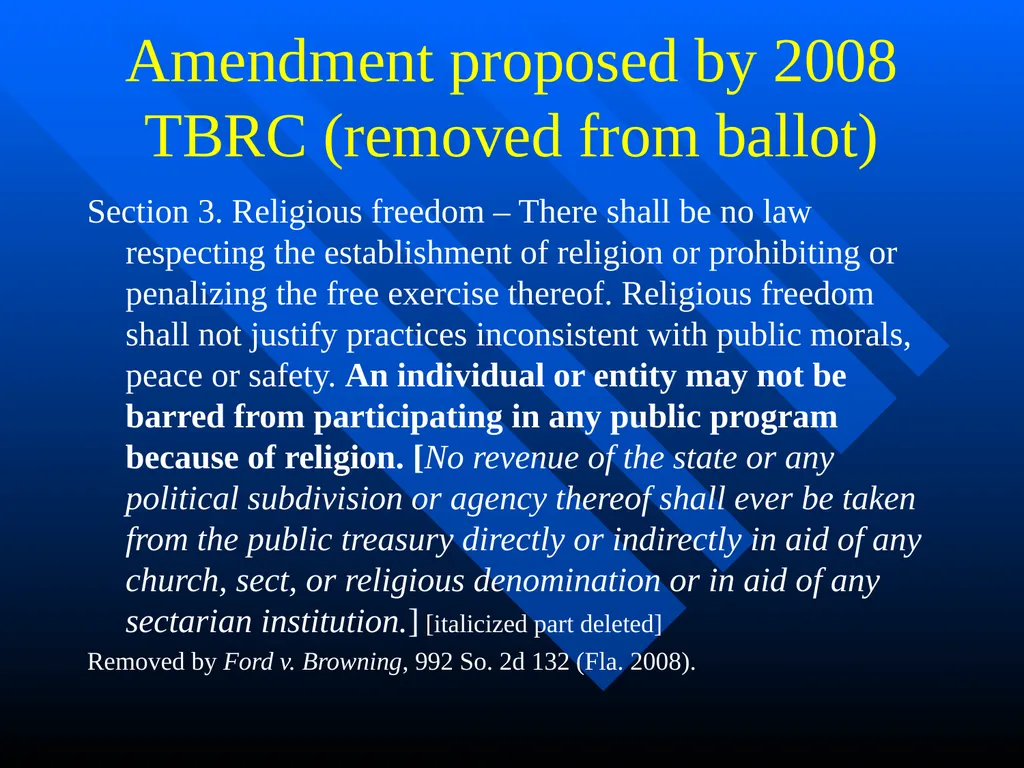
Amendment proposed by 2008 TBRC (removed from ballot) Section 3. Religious freedom – There shall be no law respecting the establishment of religion or prohibiting or penalizing the free exercise thereof. Religious freedom shall not justify practices inconsistent with public morals, peace or safety. An individual or entity may not be barred from participating in any public program because of religion. [No revenue of the state or any political subdivision or agency thereof shall ever be taken from the public treasury directly or indirectly in aid of any church, sect, or religious denomination or in aid of any sectarian institution.] [italicized part deleted]
Removed by Ford v. Browning, 992 So. 2d 132 (Fla. 2008).<br>
Removed by Ford v. Browning, 992 So. 2d 132 (Fla. 2008).<br>
63
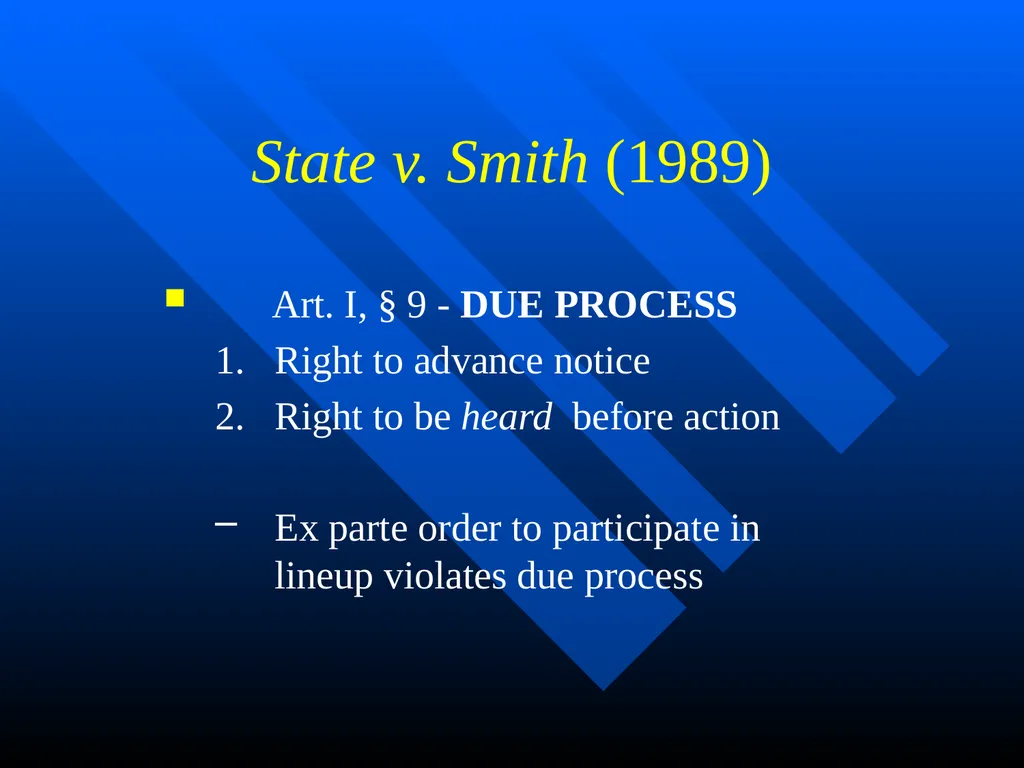
State v. Smith (1989) Art. I, § 9 - DUE PROCESS
Right to advance notice
Right to be heard before action
Ex parte order to participate in lineup violates due process<br>
Right to advance notice
Right to be heard before action
Ex parte order to participate in lineup violates due process<br>
64
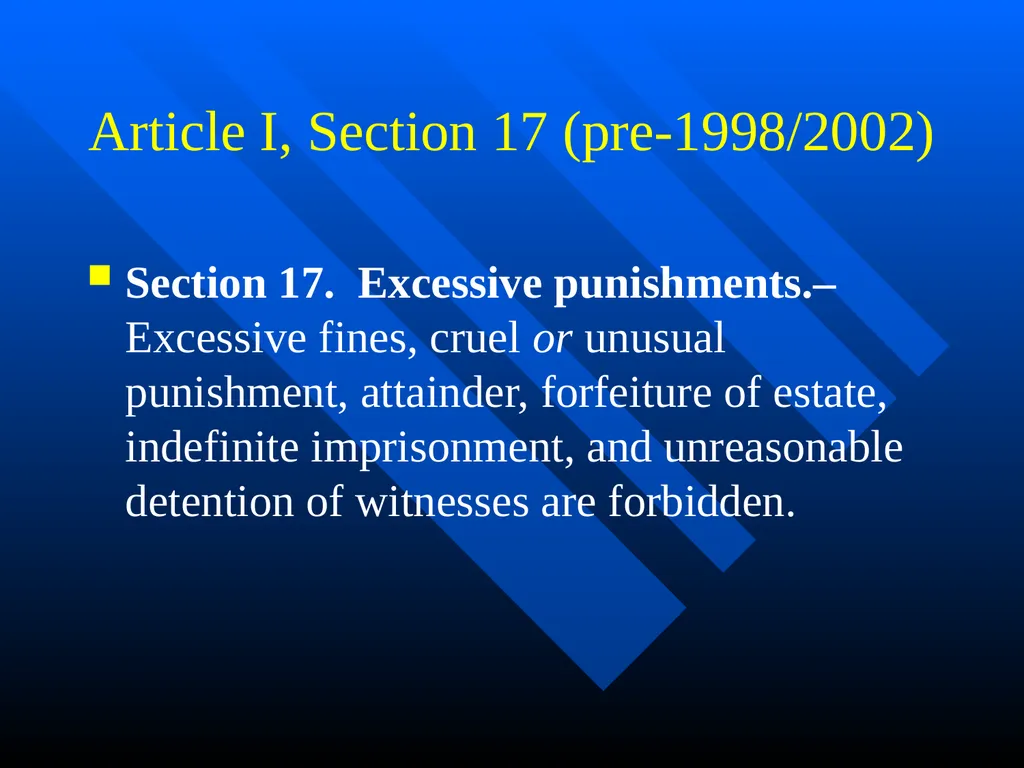
Article I, Section 17 (pre-1998/2002) Section 17. Excessive punishments.– Excessive fines, cruel or unusual punishment, attainder, forfeiture of estate, indefinite imprisonment, and unreasonable detention of witnesses are forbidden.<br>
65
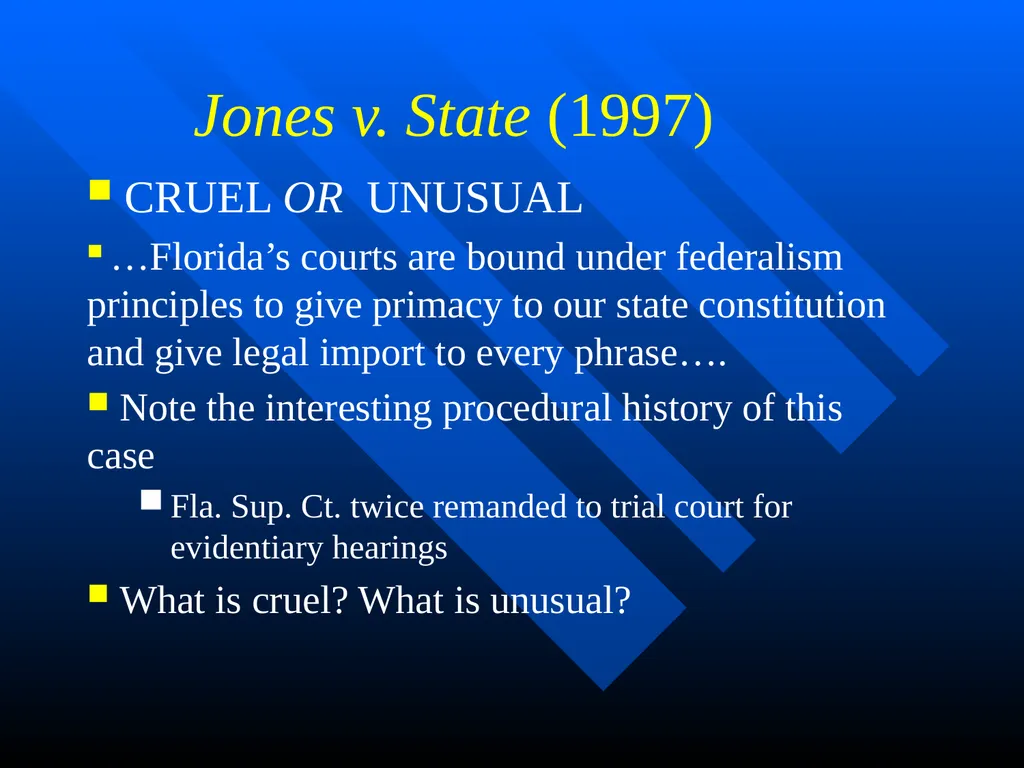
Jones v. State (1997) CRUEL OR UNUSUAL
…Florida’s courts are bound under federalism principles to give primacy to our state constitution and give legal import to every phrase….
Note the interesting procedural history of this case
Fla. Sup. Ct. twice remanded to trial court for evidentiary hearings
What is cruel? What is unusual?<br>
…Florida’s courts are bound under federalism principles to give primacy to our state constitution and give legal import to every phrase….
Note the interesting procedural history of this case
Fla. Sup. Ct. twice remanded to trial court for evidentiary hearings
What is cruel? What is unusual?<br>
66
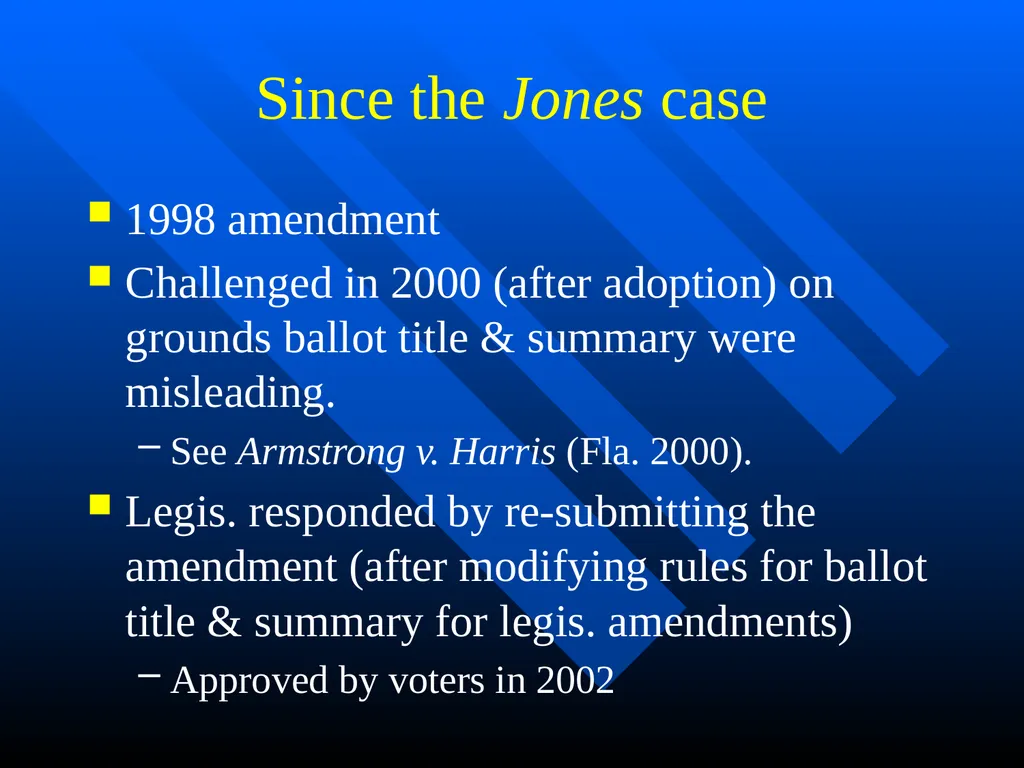
Since the Jones case 1998 amendment
Challenged in 2000 (after adoption) on grounds ballot title & summary were misleading.
See Armstrong v. Harris (Fla. 2000).
Legis. responded by re-submitting the amendment (after modifying rules for ballot title & summary for legis. amendments)
Approved by voters in 2002<br>
Challenged in 2000 (after adoption) on grounds ballot title & summary were misleading.
See Armstrong v. Harris (Fla. 2000).
Legis. responded by re-submitting the amendment (after modifying rules for ballot title & summary for legis. amendments)
Approved by voters in 2002<br>
67
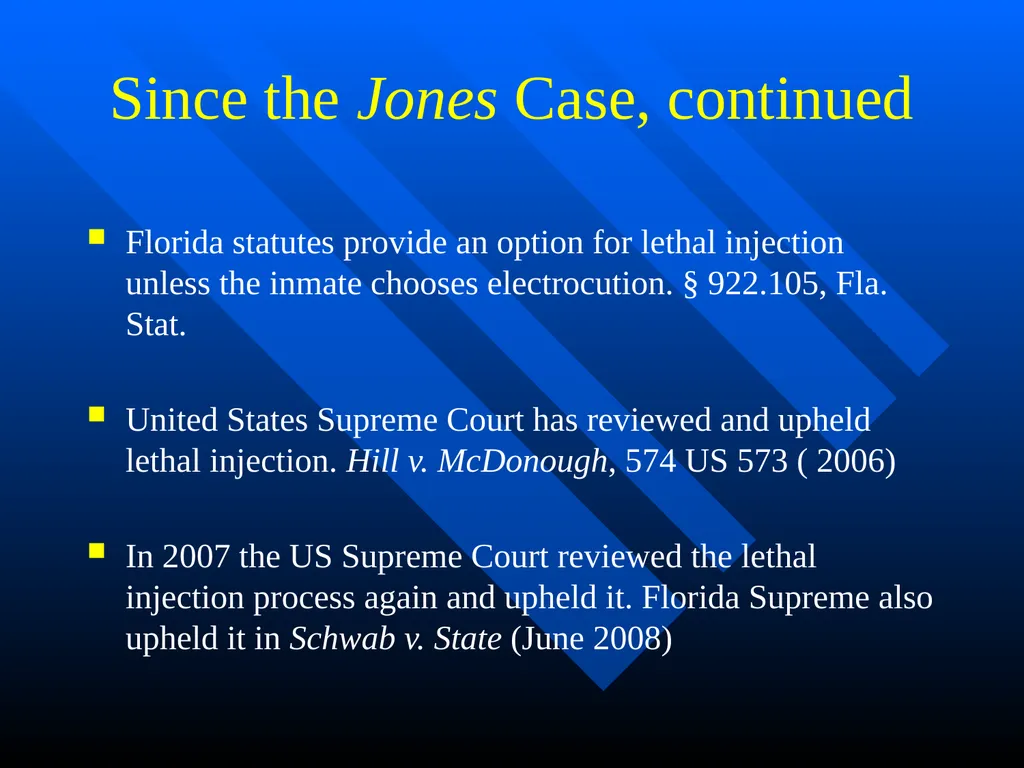
Since the Jones Case, continued Florida statutes provide an option for lethal injection unless the inmate chooses electrocution. § 922.105, Fla. Stat.
United States Supreme Court has reviewed and upheld lethal injection. Hill v. McDonough, 574 US 573 ( 2006)
In 2007 the US Supreme Court reviewed the lethal injection process again and upheld it. Florida Supreme also upheld it in Schwab v. State (June 2008)<br>
United States Supreme Court has reviewed and upheld lethal injection. Hill v. McDonough, 574 US 573 ( 2006)
In 2007 the US Supreme Court reviewed the lethal injection process again and upheld it. Florida Supreme also upheld it in Schwab v. State (June 2008)<br>
68
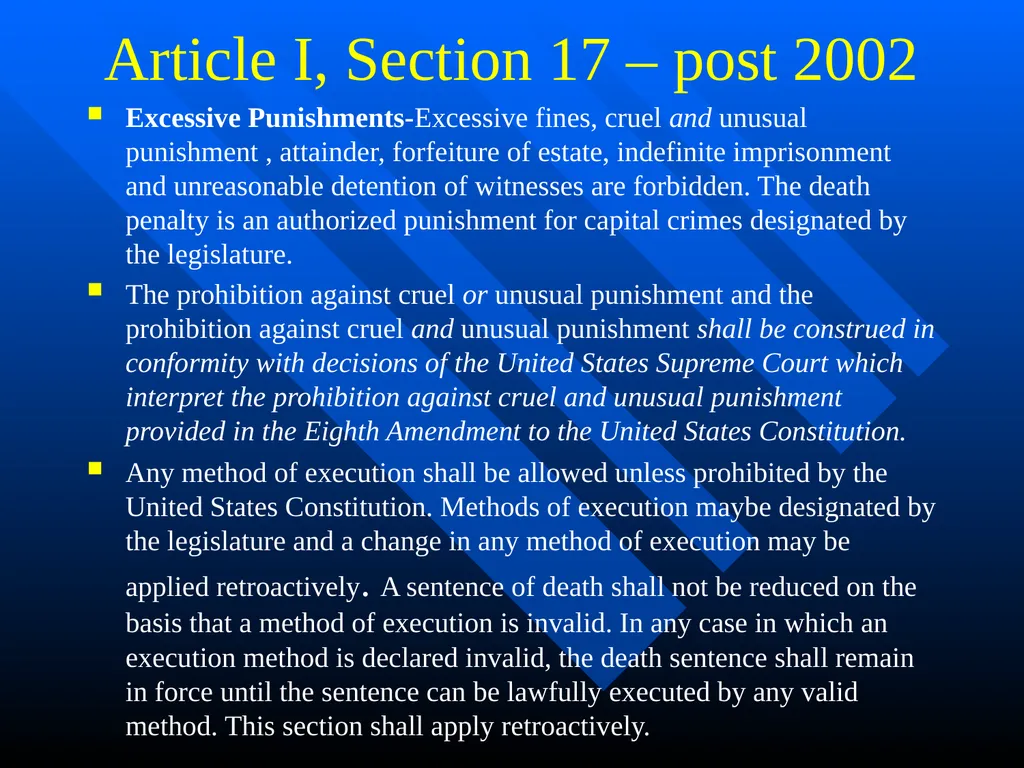
Article I, Section 17 – post 2002 Excessive Punishments-Excessive fines, cruel and unusual punishment , attainder, forfeiture of estate, indefinite imprisonment and unreasonable detention of witnesses are forbidden. The death penalty is an authorized punishment for capital crimes designated by the legislature.
The prohibition against cruel or unusual punishment and the prohibition against cruel and unusual punishment shall be construed in conformity with decisions of the United States Supreme Court which interpret the prohibition against cruel and unusual punishment provided in the Eighth Amendment to the United States Constitution.
Any method of execution shall be allowed unless prohibited by the United States Constitution. Methods of execution maybe designated by the legislature and a change in any method of execution may be applied retroactively. A sentence of death shall not be reduced on the basis that a method of execution is invalid. In any case in which an execution method is declared invalid, the death sentence shall remain in force until the sentence can be lawfully executed by any valid method. This section shall apply retroactively.<br>
The prohibition against cruel or unusual punishment and the prohibition against cruel and unusual punishment shall be construed in conformity with decisions of the United States Supreme Court which interpret the prohibition against cruel and unusual punishment provided in the Eighth Amendment to the United States Constitution.
Any method of execution shall be allowed unless prohibited by the United States Constitution. Methods of execution maybe designated by the legislature and a change in any method of execution may be applied retroactively. A sentence of death shall not be reduced on the basis that a method of execution is invalid. In any case in which an execution method is declared invalid, the death sentence shall remain in force until the sentence can be lawfully executed by any valid method. This section shall apply retroactively.<br>
69
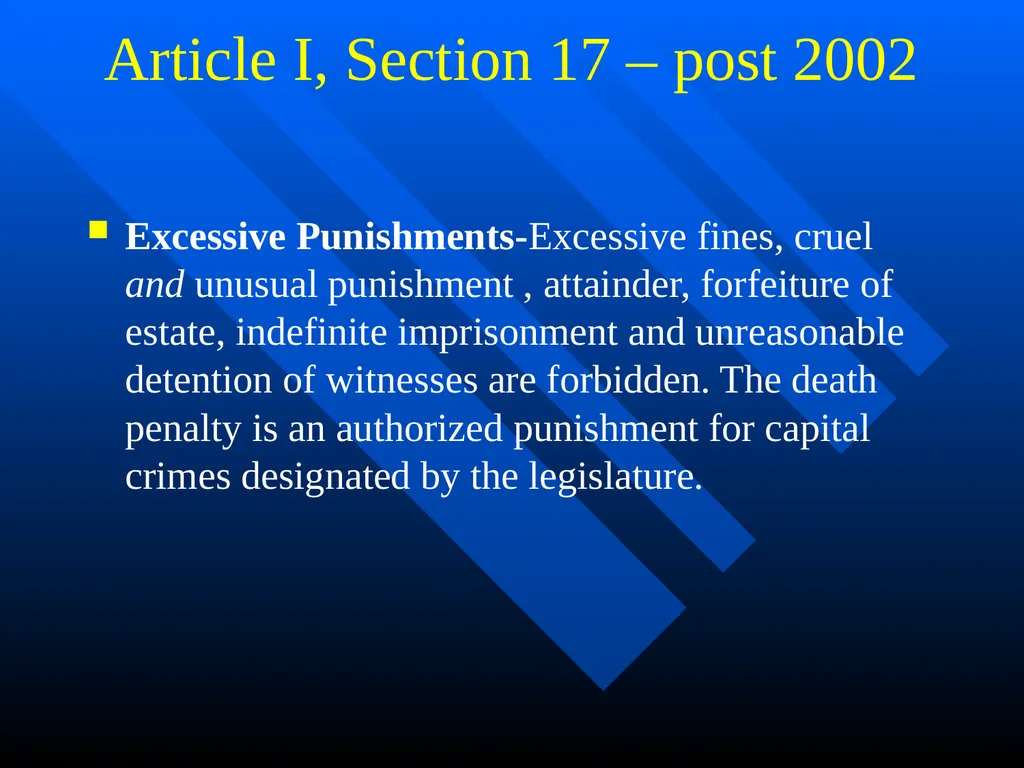
Article I, Section 17 – post 2002 Excessive Punishments-Excessive fines, cruel and unusual punishment , attainder, forfeiture of estate, indefinite imprisonment and unreasonable detention of witnesses are forbidden. The death penalty is an authorized punishment for capital crimes designated by the legislature.<br>
70
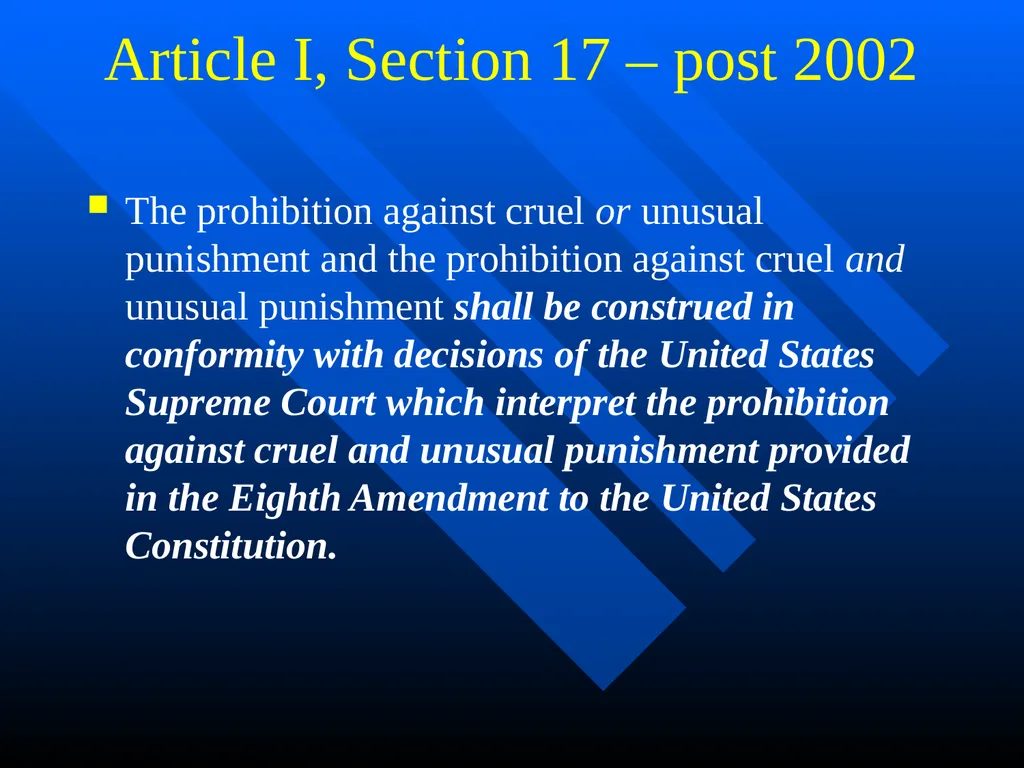
Article I, Section 17 – post 2002 The prohibition against cruel or unusual punishment and the prohibition against cruel and unusual punishment shall be construed in conformity with decisions of the United States Supreme Court which interpret the prohibition against cruel and unusual punishment provided in the Eighth Amendment to the United States Constitution.<br>
71
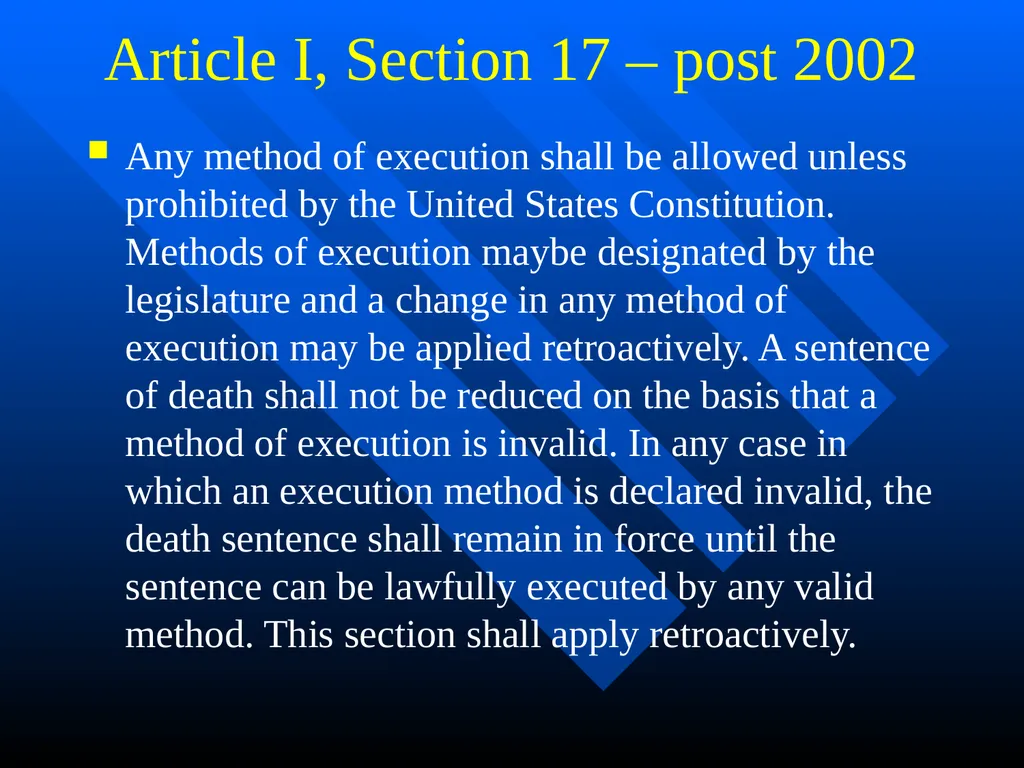
Article I, Section 17 – post 2002 Any method of execution shall be allowed unless prohibited by the United States Constitution. Methods of execution maybe designated by the legislature and a change in any method of execution may be applied retroactively. A sentence of death shall not be reduced on the basis that a method of execution is invalid. In any case in which an execution method is declared invalid, the death sentence shall remain in force until the sentence can be lawfully executed by any valid method. This section shall apply retroactively.<br>
72
Valle v. State (2011) Constitutionality of Lethal Injection Procedures.
Does it violate 8th Amendment?
1. Drug and procedure
2. Governor’s discretion
3. Length of time on death row
All held not to violate constitutional standards.<br>
Does it violate 8th Amendment?
1. Drug and procedure
2. Governor’s discretion
3. Length of time on death row
All held not to violate constitutional standards.<br>
73
Lawrence v. State (2020) How does the majority get from reasoning that proportionality review of a death sentence is not required to holding that it is not allowed?
What role does stare decisis play in this opinion?<br>
What role does stare decisis play in this opinion?<br>
74
Campus Communications v. Earnhardt (5th DCA 2002) ARTICLE I, § 24(c) …the Legislature, however, may provide by general law passed by a two-thirds vote of each house for the exemption of records from the requirements of subsection (a) … provided that such law shall state with specificity the public necessity justifying the exemption and shall be no broader than necessary to accomplish the stated purpose of the law.<br>
75
Campus Communications v. Earnhardt – retroactivity of the statute ISSUES:
Legislative intent
Constitutionally permissible
Is it remedial?
Does it abrogate a vested right?<br>
Legislative intent
Constitutionally permissible
Is it remedial?
Does it abrogate a vested right?<br>
76
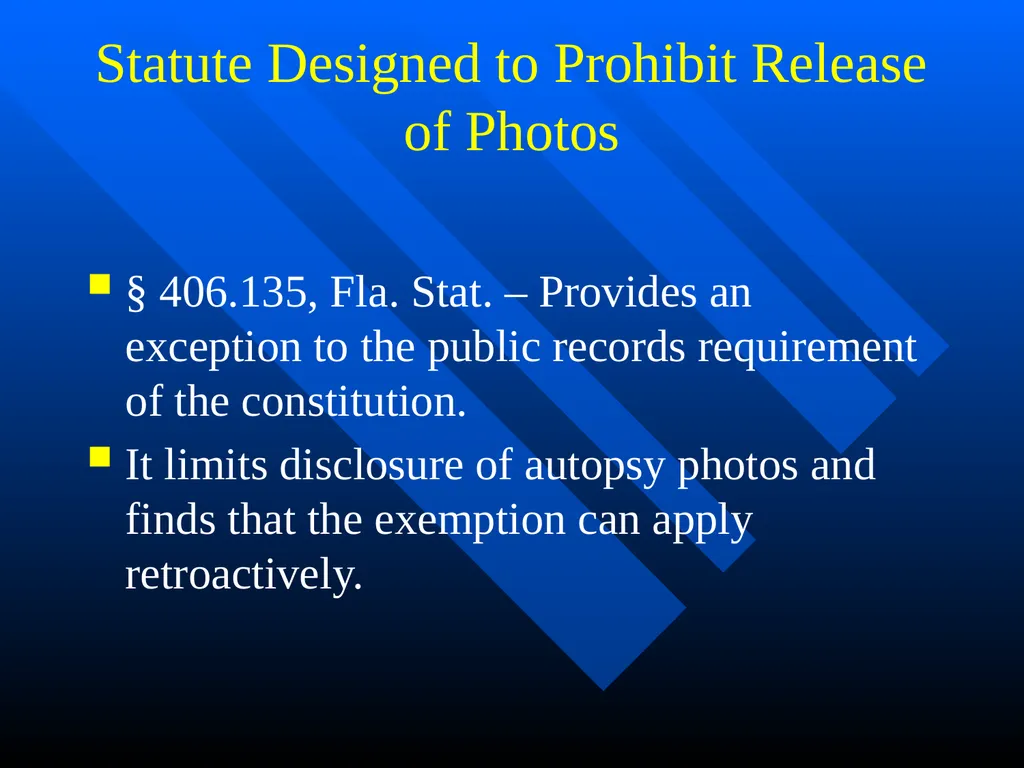
Statute Designed to Prohibit Release of Photos § 406.135, Fla. Stat. – Provides an exception to the public records requirement of the constitution.
It limits disclosure of autopsy photos and finds that the exemption can apply retroactively.<br>
It limits disclosure of autopsy photos and finds that the exemption can apply retroactively.<br>
77
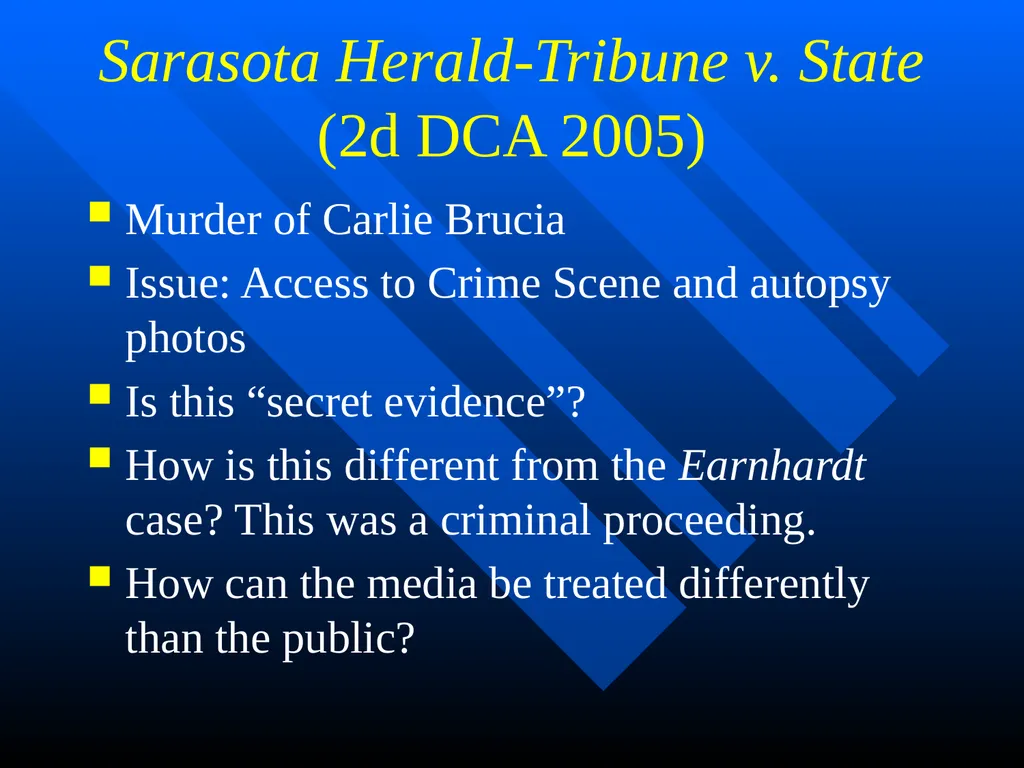
Sarasota Herald-Tribune v. State (2d DCA 2005) Murder of Carlie Brucia
Issue: Access to Crime Scene and autopsy photos
Is this “secret evidence”?
How is this different from the Earnhardt case? This was a criminal proceeding.
How can the media be treated differently than the public?<br>
Issue: Access to Crime Scene and autopsy photos
Is this “secret evidence”?
How is this different from the Earnhardt case? This was a criminal proceeding.
How can the media be treated differently than the public?<br>
78
Sarasota Citizens v. City of Sarasota (2010) Does sunshine law apply to local government?
What communications are covered by sunshine law requirements?
Why are communications with the informal group not a violation?
How is it possible to “cure” a Sunshine violation?<br>
What communications are covered by sunshine law requirements?
Why are communications with the informal group not a violation?
How is it possible to “cure” a Sunshine violation?<br>
79
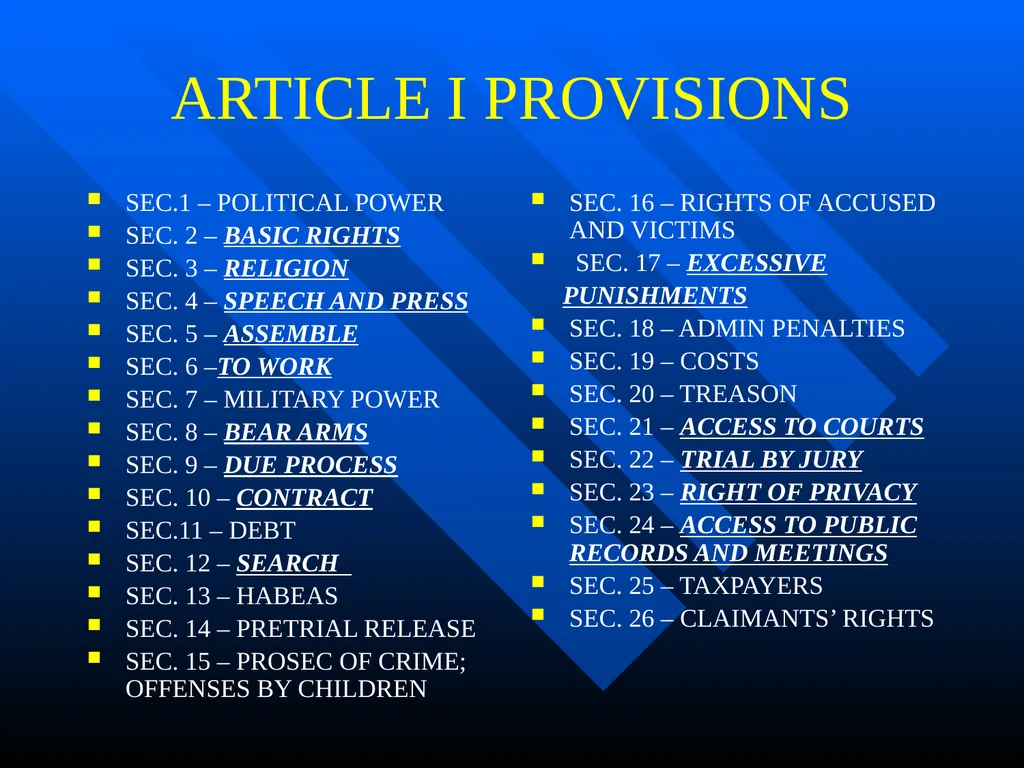
ARTICLE I PROVISIONS SEC.1 – POLITICAL POWER
SEC. 2 – BASIC RIGHTS
SEC. 3 – RELIGION
SEC. 4 – SPEECH AND PRESS
SEC. 5 – ASSEMBLE
SEC. 6 –TO WORK
SEC. 7 – MILITARY POWER
SEC. 8 – BEAR ARMS
SEC. 9 – DUE PROCESS
SEC. 10 – CONTRACT
SEC.11 – DEBT
SEC. 12 – SEARCH
SEC. 13 – HABEAS
SEC. 14 – PRETRIAL RELEASE
SEC. 15 – PROSEC OF CRIME; OFFENSES BY CHILDREN SEC. 16 – RIGHTS OF ACCUSED AND VICTIMS
SEC. 17 – EXCESSIVE
PUNISHMENTS
SEC. 18 – ADMIN PENALTIES
SEC. 19 – COSTS
SEC. 20 – TREASON
SEC. 21 – ACCESS TO COURTS
SEC. 22 – TRIAL BY JURY
SEC. 23 – RIGHT OF PRIVACY
SEC. 24 – ACCESS TO PUBLIC RECORDS AND MEETINGS
SEC. 25 – TAXPAYERS
SEC. 26 – CLAIMANTS’ RIGHTS<br>
SEC. 2 – BASIC RIGHTS
SEC. 3 – RELIGION
SEC. 4 – SPEECH AND PRESS
SEC. 5 – ASSEMBLE
SEC. 6 –TO WORK
SEC. 7 – MILITARY POWER
SEC. 8 – BEAR ARMS
SEC. 9 – DUE PROCESS
SEC. 10 – CONTRACT
SEC.11 – DEBT
SEC. 12 – SEARCH
SEC. 13 – HABEAS
SEC. 14 – PRETRIAL RELEASE
SEC. 15 – PROSEC OF CRIME; OFFENSES BY CHILDREN SEC. 16 – RIGHTS OF ACCUSED AND VICTIMS
SEC. 17 – EXCESSIVE
PUNISHMENTS
SEC. 18 – ADMIN PENALTIES
SEC. 19 – COSTS
SEC. 20 – TREASON
SEC. 21 – ACCESS TO COURTS
SEC. 22 – TRIAL BY JURY
SEC. 23 – RIGHT OF PRIVACY
SEC. 24 – ACCESS TO PUBLIC RECORDS AND MEETINGS
SEC. 25 – TAXPAYERS
SEC. 26 – CLAIMANTS’ RIGHTS<br>
80
To request the full slide deck, please email proof of adoption to kerri.hughes@cap-press.com<br>