04
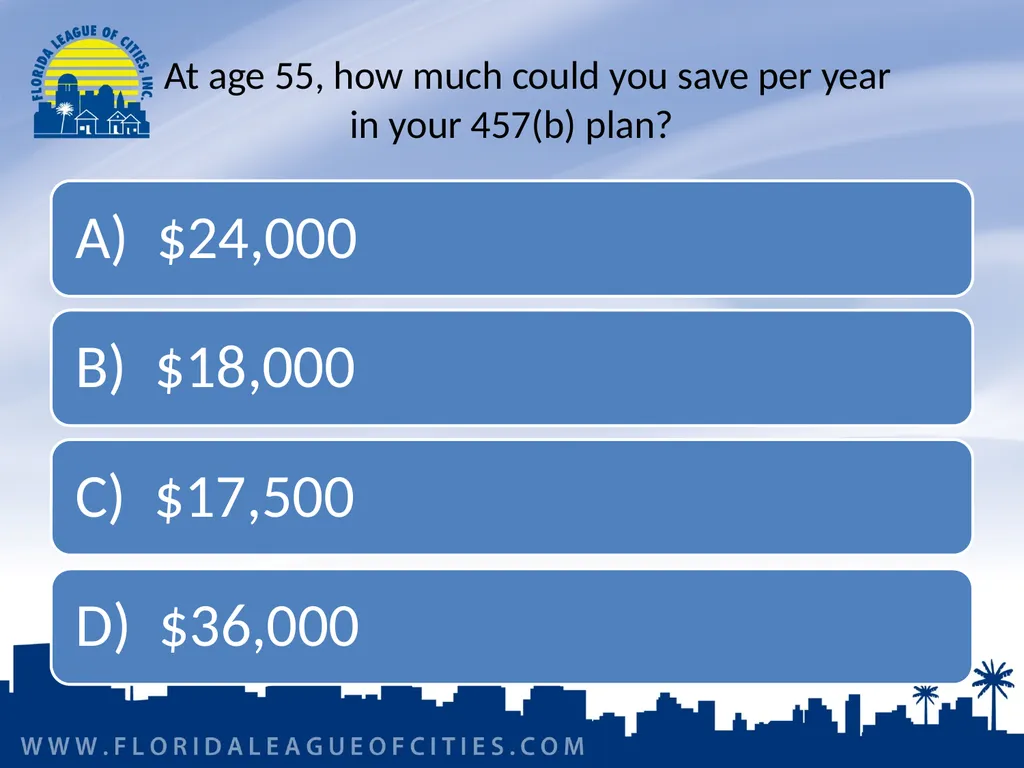
At age 55, how much could you save per year �in your 457(b) plan?<br>
05
At what age do Required Minimum Distributions start?<br>
06
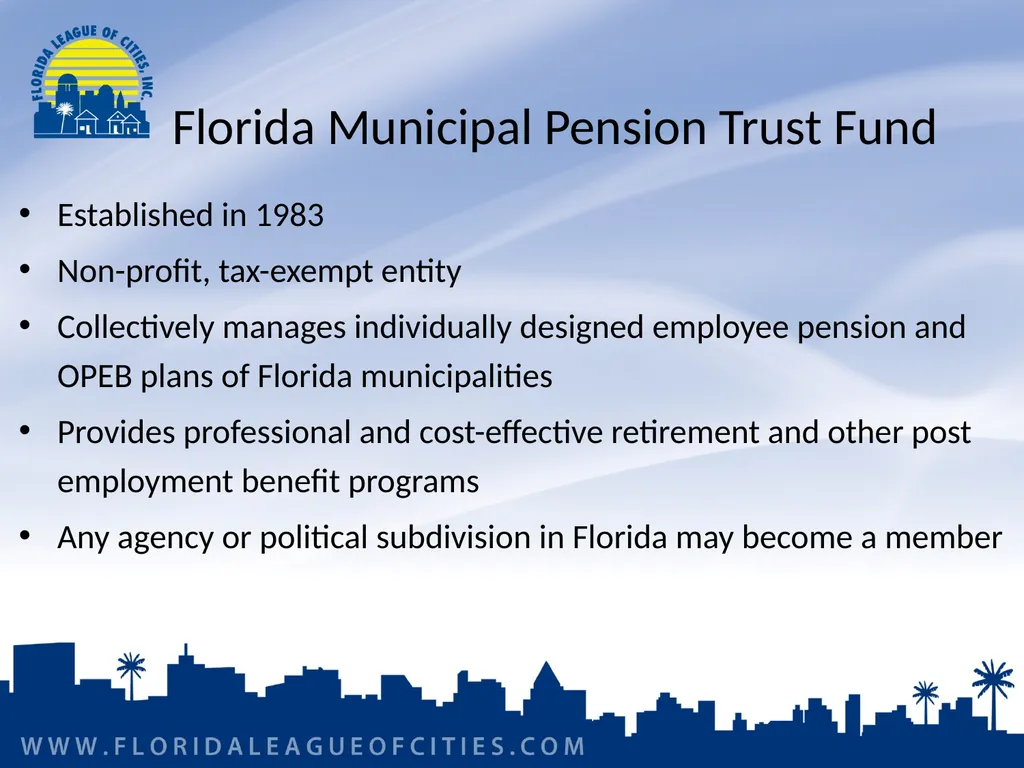
Florida Municipal Pension Trust Fund Established in 1983
Non-profit, tax-exempt entity
Collectively manages individually designed employee pension and OPEB plans of Florida municipalities
Provides professional and cost-effective retirement and other post employment benefit programs
Any agency or political subdivision in Florida may become a member 7<br>
07
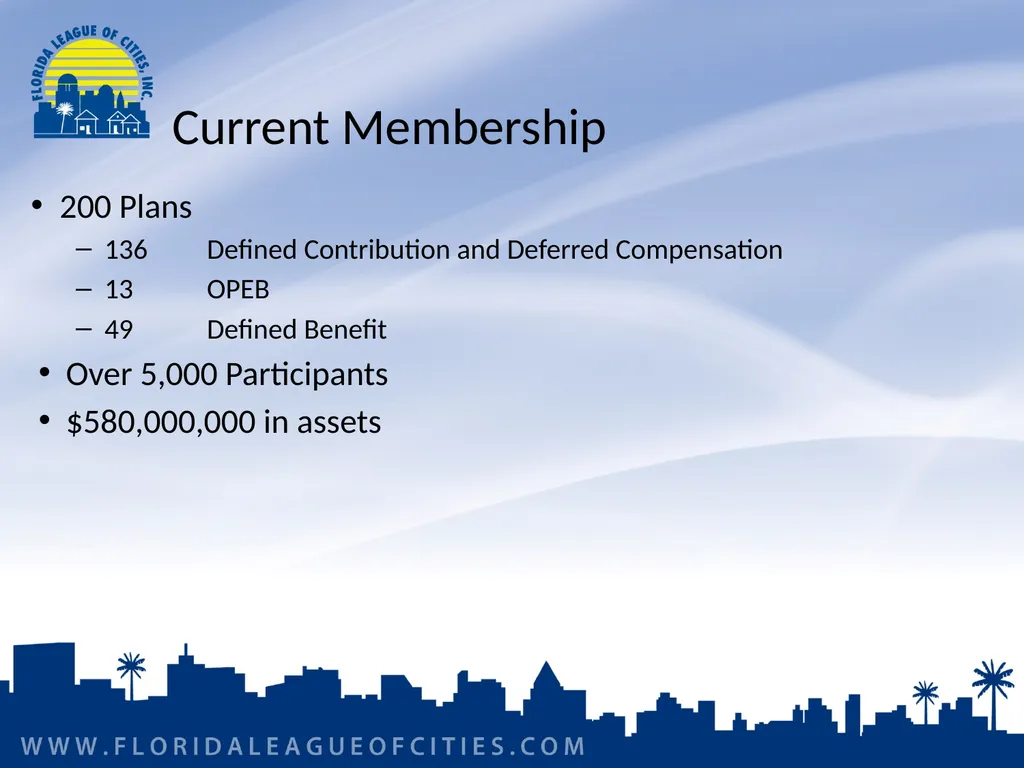
Current Membership 200 Plans
136 Defined Contribution and Deferred Compensation
13 OPEB
49 Defined Benefit
Over 5,000 Participants
$580,000,000 in assets 8<br>
08
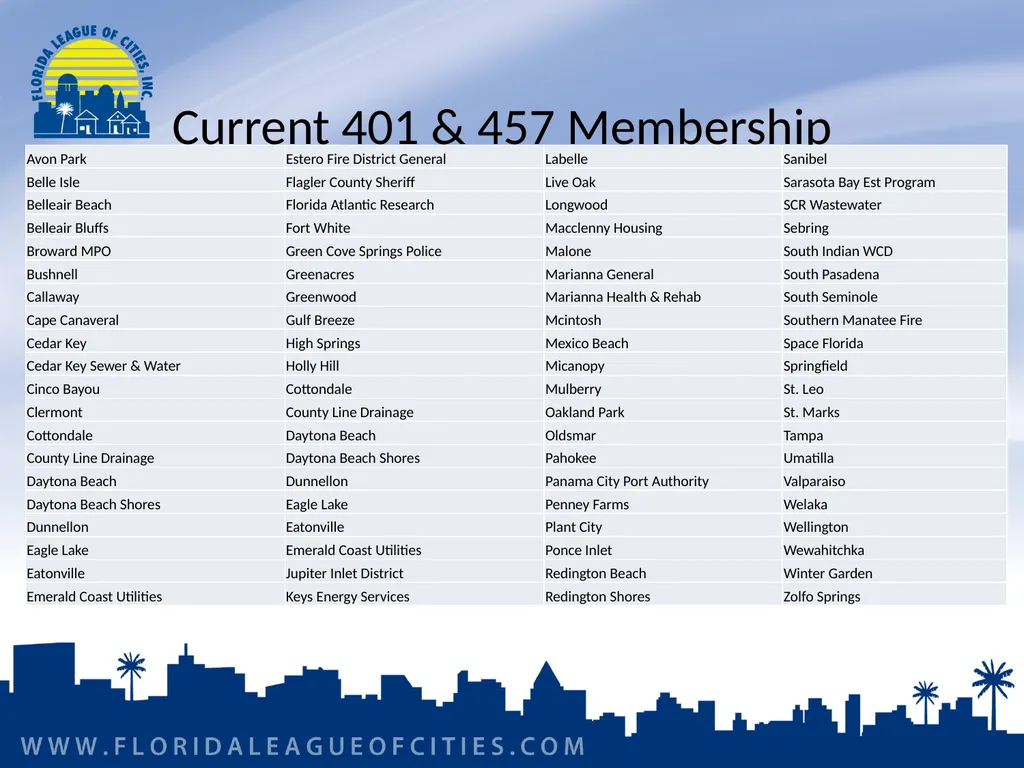
Current 401 & 457 Membership 9<br>
09
Administered by the Florida League of Cities, a not for profit corporation that is the official organization of municipal governments in Florida.
Multiple Layers of Oversight
Local Government Membership
Extensive Governmental Plan Knowledge
Economies of Scale
Enhanced Member Service
Lower Costs Advantages of the FMPTF 10<br>
10
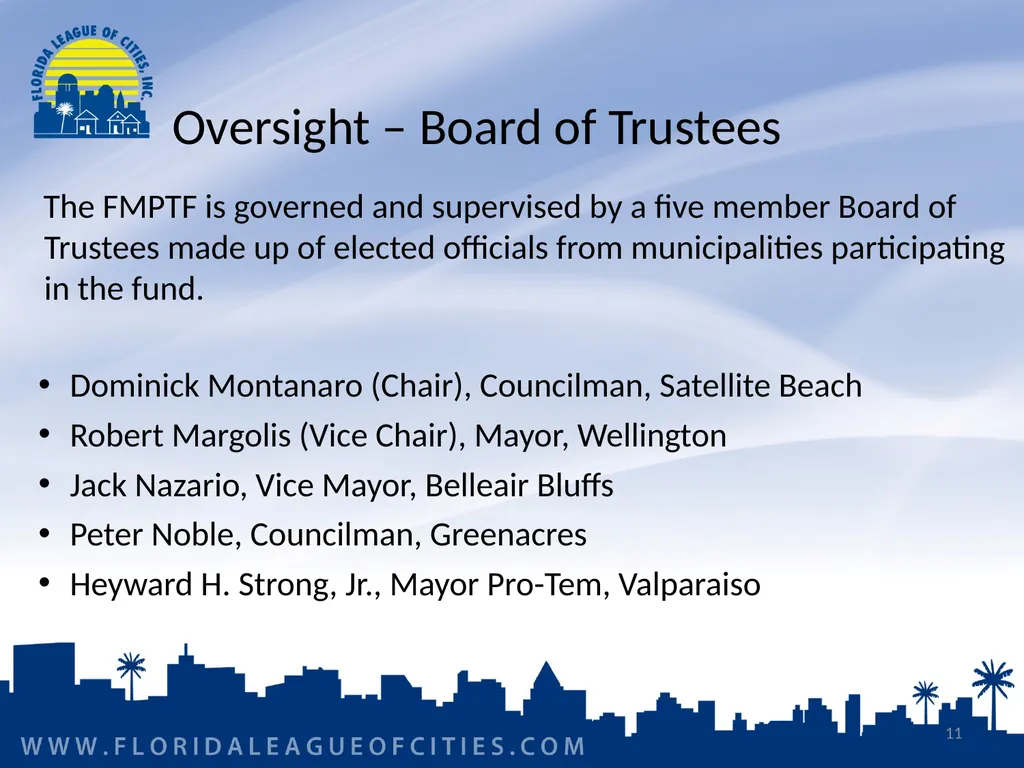
Oversight – Board of Trustees The FMPTF is governed and supervised by a five member Board of Trustees made up of elected officials from municipalities participating in the fund.
Dominick Montanaro (Chair), Councilman, Satellite Beach
Robert Margolis (Vice Chair), Mayor, Wellington
Jack Nazario, Vice Mayor, Belleair Bluffs
Peter Noble, Councilman, Greenacres
Heyward H. Strong, Jr., Mayor Pro-Tem, Valparaiso 11<br>
11
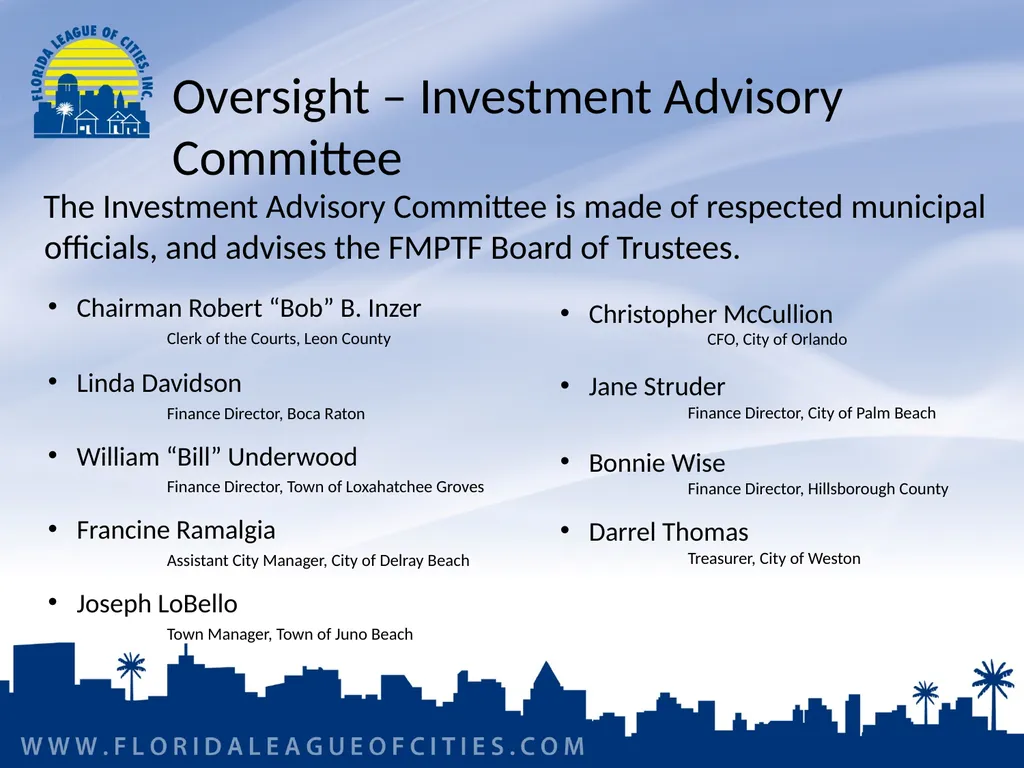
Oversight – Investment Advisory Committee The Investment Advisory Committee is made of respected municipal officials, and advises the FMPTF Board of Trustees. Christopher McCullion
CFO, City of Orlando
Jane Struder
Finance Director, City of Palm Beach
Bonnie Wise
Finance Director, Hillsborough County
Darrel Thomas
Treasurer, City of Weston Chairman Robert “Bob” B. Inzer
Clerk of the Courts, Leon County
Linda Davidson
Finance Director, Boca Raton
William “Bill” Underwood
Finance Director, Town of Loxahatchee Groves
Francine Ramalgia
Assistant City Manager, City of Delray Beach
Joseph LoBello
Town Manager, Town of Juno Beach 12<br>
12
Oversight – Asset Consulting Group Asset Consulting Group has over 40 years of investment consulting experience.
Conflict-free oversight
Quarterly monitoring reports posted on FLCretirement.com
Detailed analysis of each fund’s performance 13<br>
13
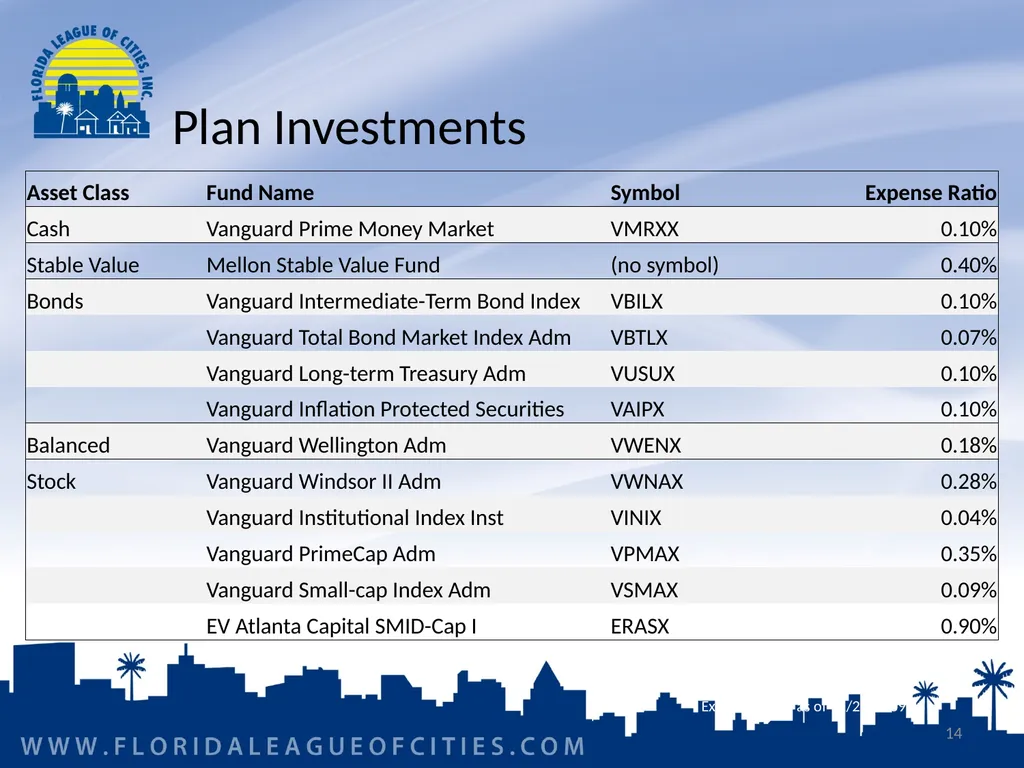
Expense ratios as of 12/28/2009 Plan Investments 14<br>
14
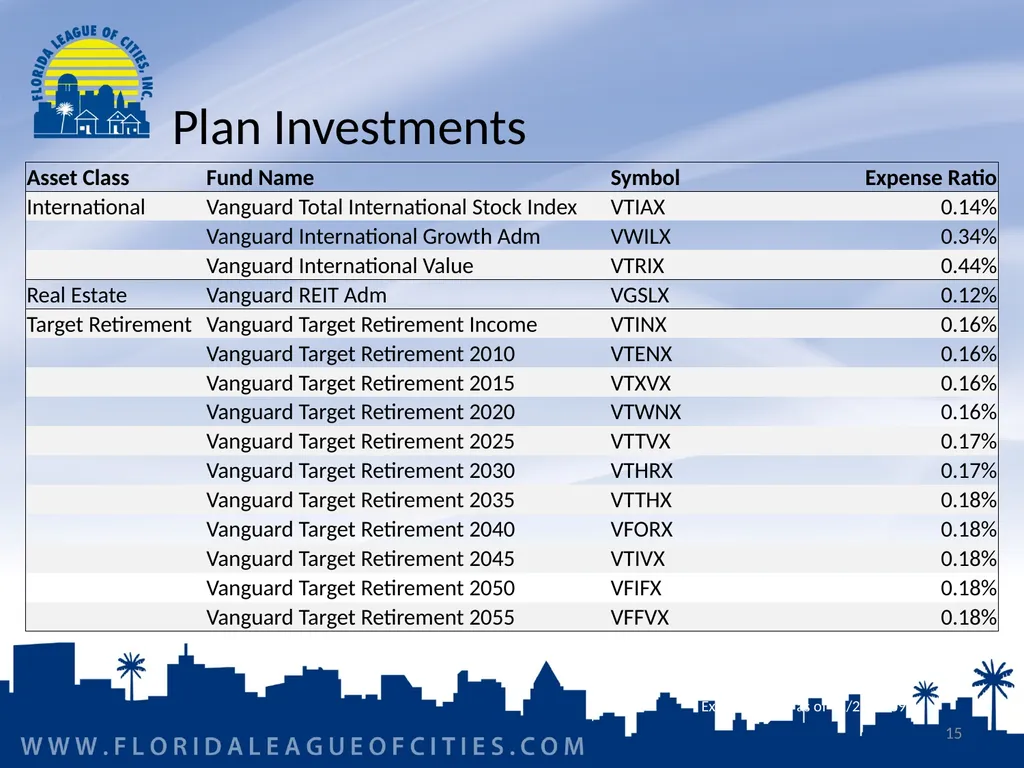
Expense ratios as of 12/28/2009 Plan Investments 15<br>
15
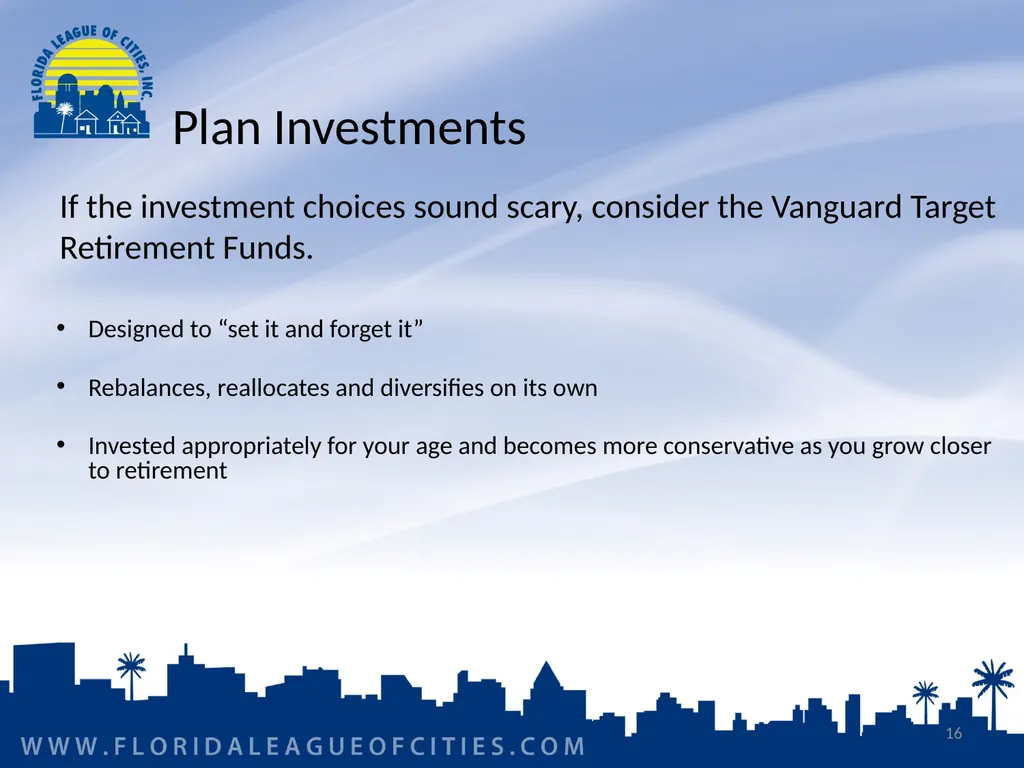
Plan Investments If the investment choices sound scary, consider the Vanguard Target Retirement Funds.
Designed to “set it and forget it”
Rebalances, reallocates and diversifies on its own
Invested appropriately for your age and becomes more conservative as you grow closer to retirement 16<br>
16
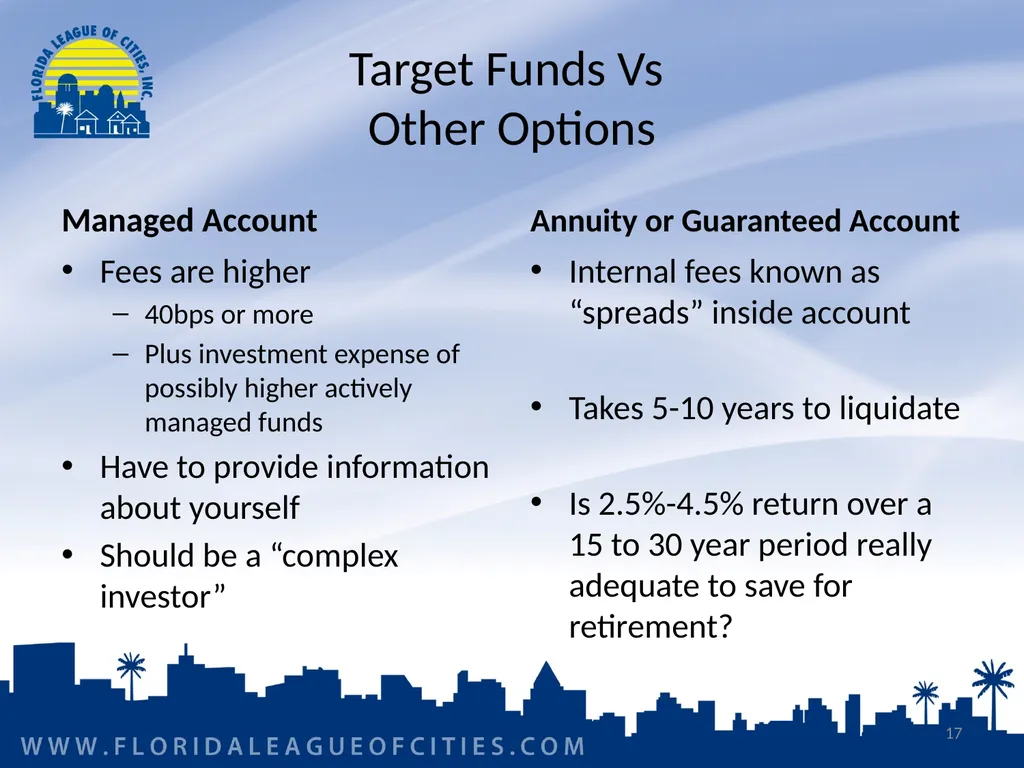
Target Funds Vs �Other Options Managed Account Fees are higher
40bps or more
Plus investment expense of possibly higher actively managed funds
Have to provide information about yourself
Should be a “complex investor” Annuity or Guaranteed Account Internal fees known as “spreads” inside account
Takes 5-10 years to liquidate
Is 2.5%-4.5% return over a 15 to 30 year period really adequate to save for retirement? 17<br>
17
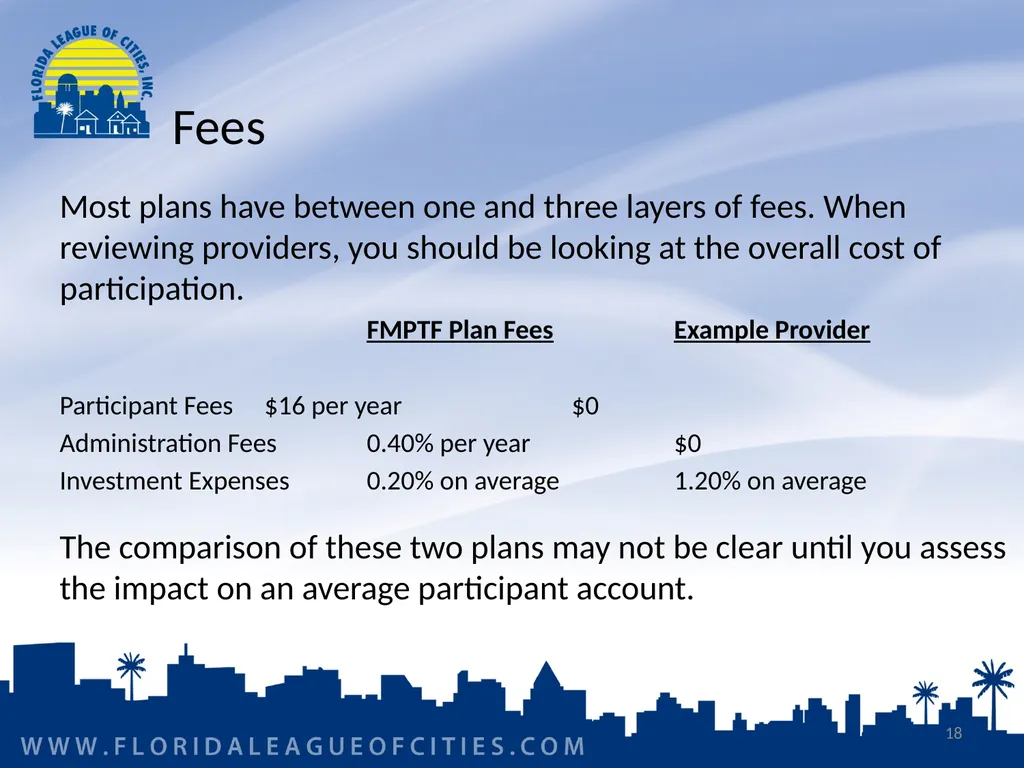
Fees Most plans have between one and three layers of fees. When reviewing providers, you should be looking at the overall cost of participation.
FMPTF Plan Fees Example Provider
Participant Fees $16 per year $0
Administration Fees 0.40% per year $0
Investment Expenses 0.20% on average 1.20% on average
The comparison of these two plans may not be clear until you assess the impact on an average participant account. 18<br>
18
Now review the impact of the quarterly fees on various participant account balances:
FMPTF Plan Fees Example 1 Example 2
Participant Fees $16 per year $0 $0
Administration Fees 0.40% per year $0 0.0% per year
Investment Expenses 0.17% per year* 1.20% per year 2.00% per year
FMPTF Fees Example 1 Fees Example 2 Fees
$1,000 balance $22 $12 $20
$5,000 balance $45 $60 $100
$10,000 balance $73 $120 $200
$25,000 balance $159 $300 $500
$100,000 balance $586 $1,200 $2,000
$250,000 balance $1,441 $3,000 $5,000
* Vanguard Funds Fees 19<br>
19
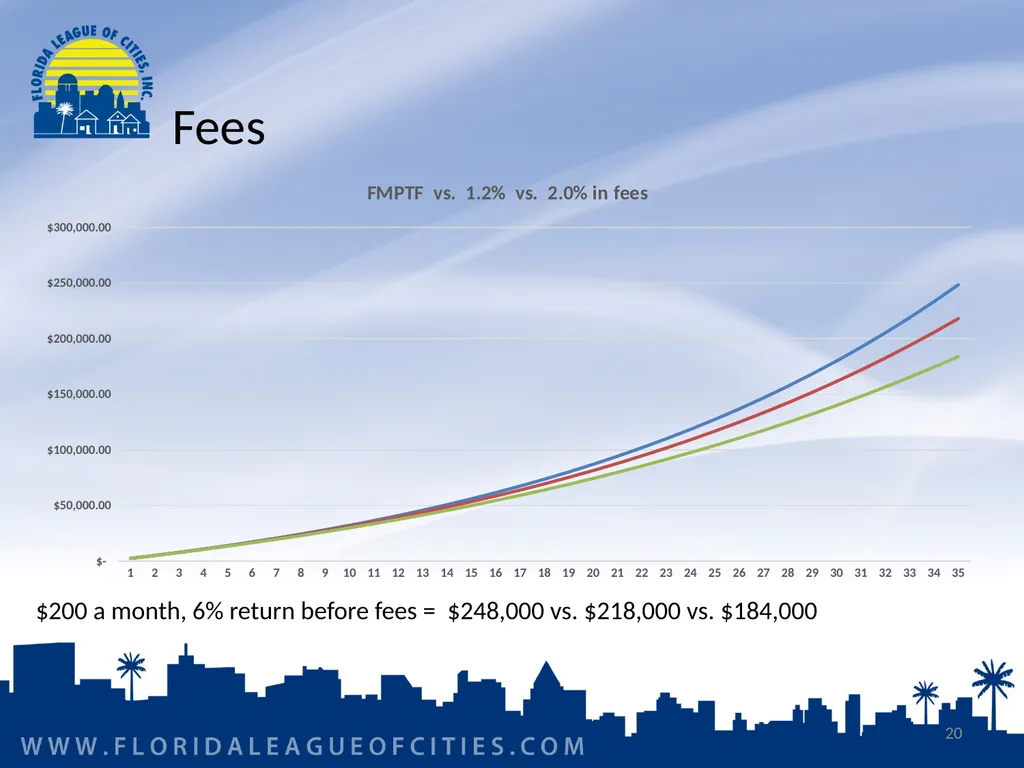
$200 a month, 6% return before fees = $248,000 vs. $218,000 vs. $184,000 Fees 20<br>
20
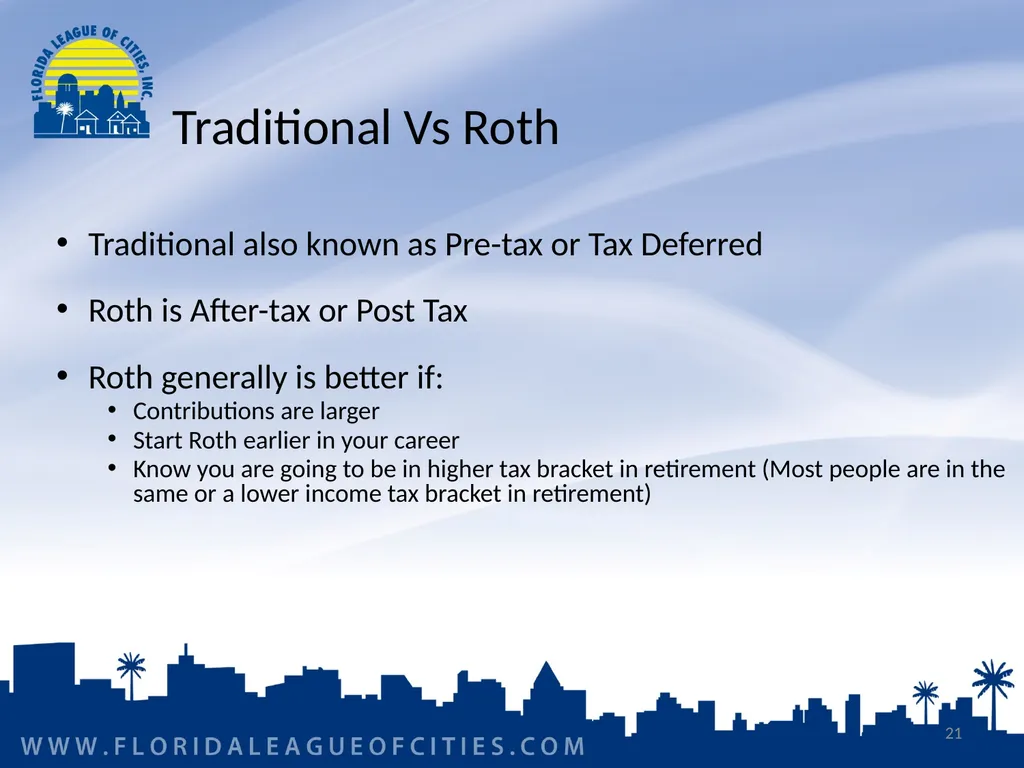
Traditional Vs Roth Traditional also known as Pre-tax or Tax Deferred
Roth is After-tax or Post Tax
Roth generally is better if:
Contributions are larger
Start Roth earlier in your career
Know you are going to be in higher tax bracket in retirement (Most people are in the same or a lower income tax bracket in retirement) 21<br>
21
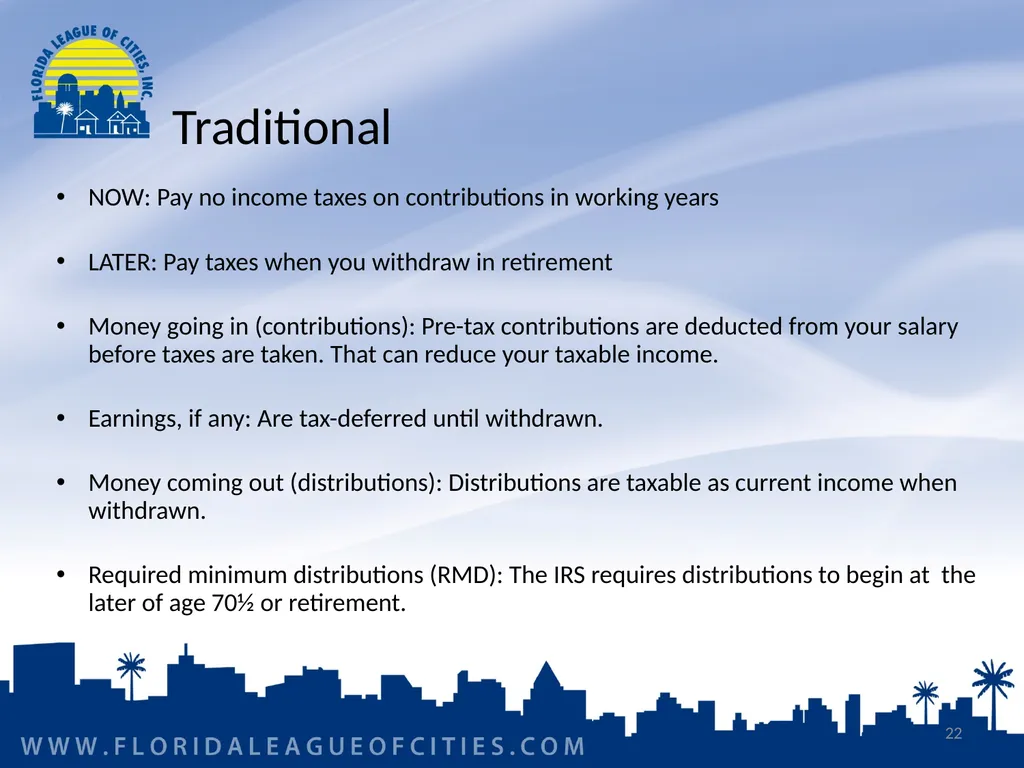
Traditional NOW: Pay no income taxes on contributions in working years
LATER: Pay taxes when you withdraw in retirement
Money going in (contributions): Pre-tax contributions are deducted from your salary before taxes are taken. That can reduce your taxable income.
Earnings, if any: Are tax-deferred until withdrawn.
Money coming out (distributions): Distributions are taxable as current income when withdrawn.
Required minimum distributions (RMD): The IRS requires distributions to begin at the later of age 70½ or retirement. 22<br>
22
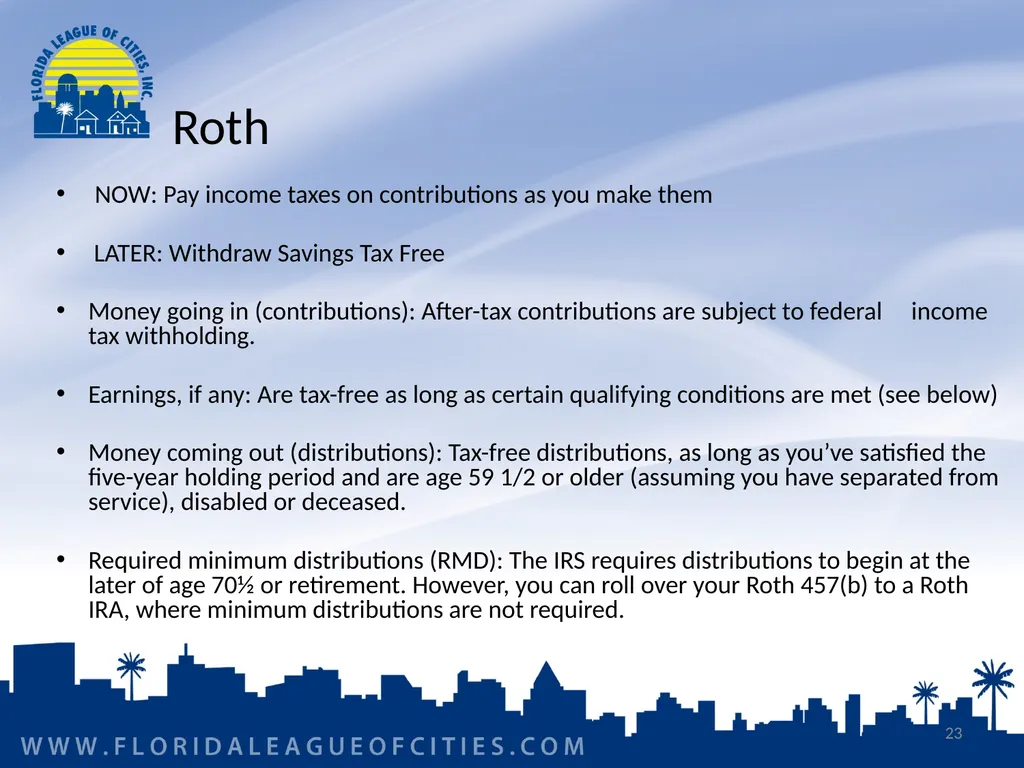
Roth NOW: Pay income taxes on contributions as you make them
LATER: Withdraw Savings Tax Free
Money going in (contributions): After-tax contributions are subject to federal income tax withholding.
Earnings, if any: Are tax-free as long as certain qualifying conditions are met (see below)
Money coming out (distributions): Tax-free distributions, as long as you’ve satisfied the five-year holding period and are age 59 1/2 or older (assuming you have separated from service), disabled or deceased.
Required minimum distributions (RMD): The IRS requires distributions to begin at the later of age 70½ or retirement. However, you can roll over your Roth 457(b) to a Roth IRA, where minimum distributions are not required. 23<br>
23
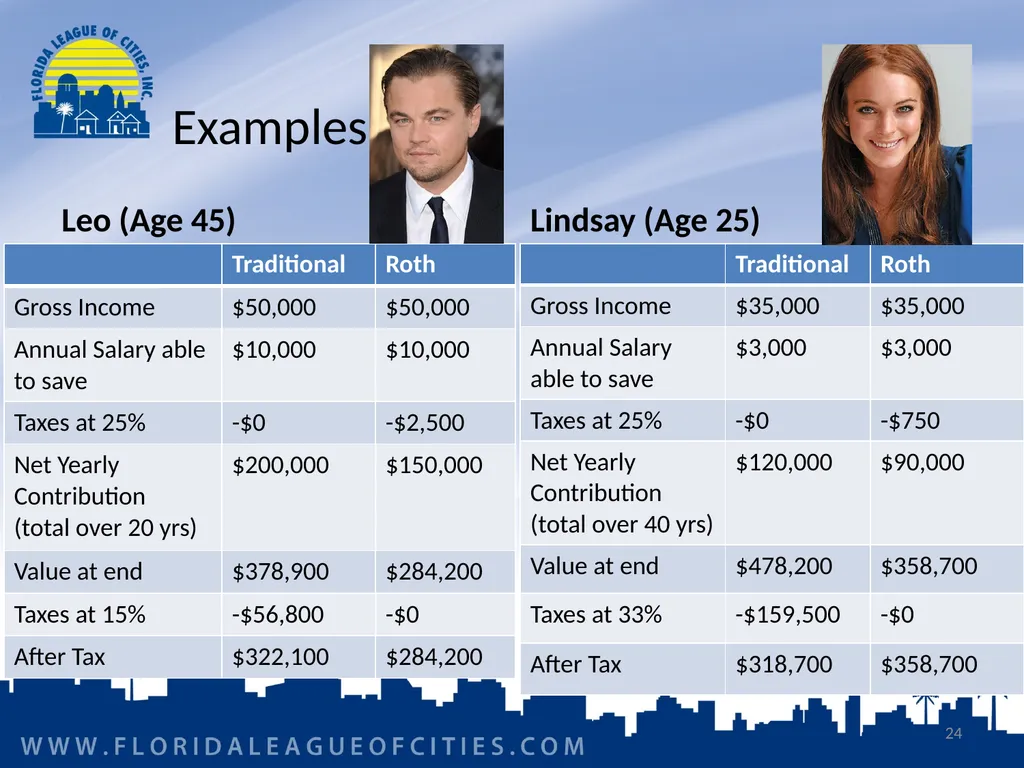
Examples Leo (Age 45) Lindsay (Age 25) 24<br>
24
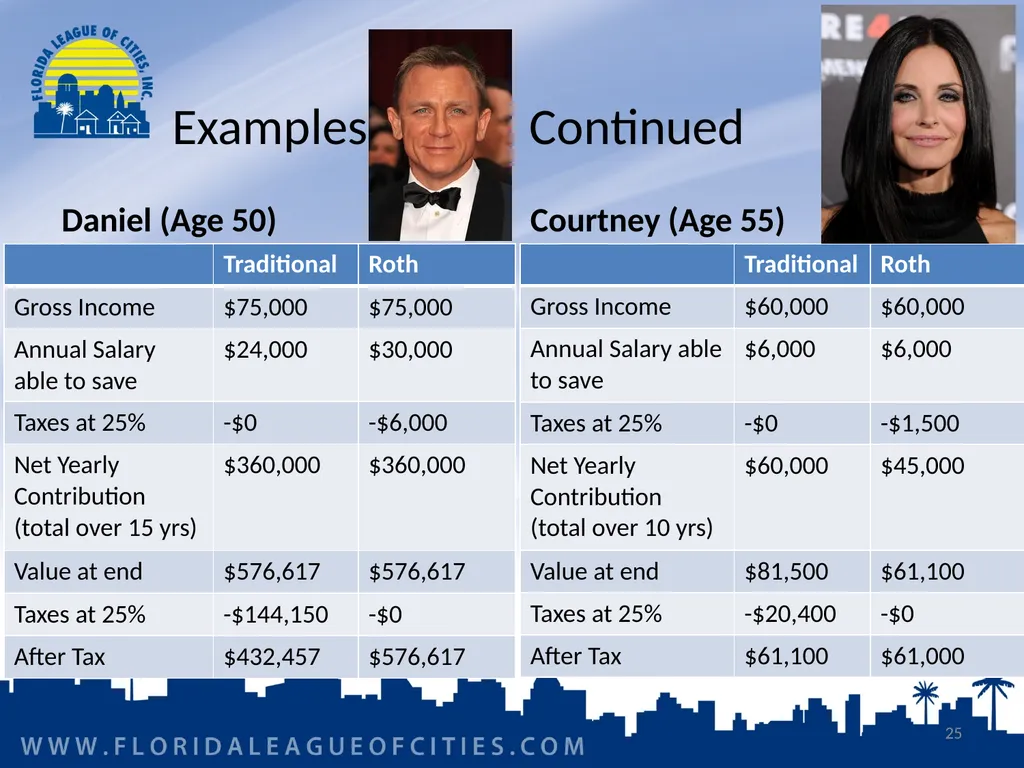
Examples Continued Daniel (Age 50) Courtney (Age 55) 25<br>
25
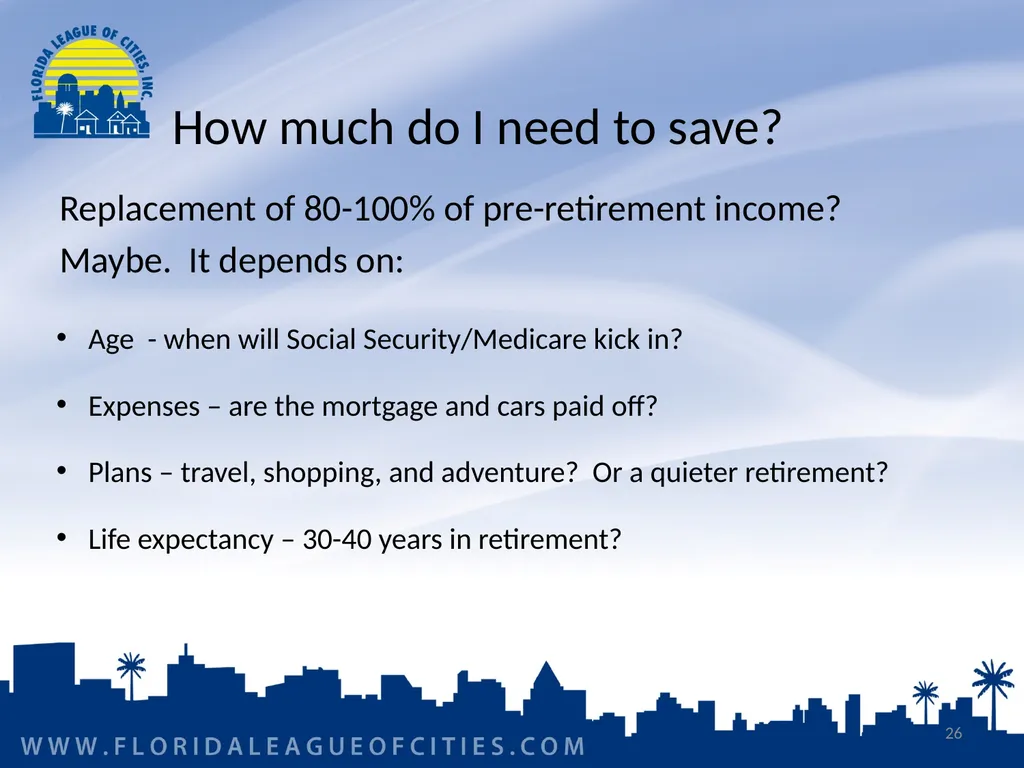
How much do I need to save? Replacement of 80-100% of pre-retirement income?
Maybe. It depends on:
Age - when will Social Security/Medicare kick in?
Expenses – are the mortgage and cars paid off?
Plans – travel, shopping, and adventure? Or a quieter retirement?
Life expectancy – 30-40 years in retirement? 26<br>
26
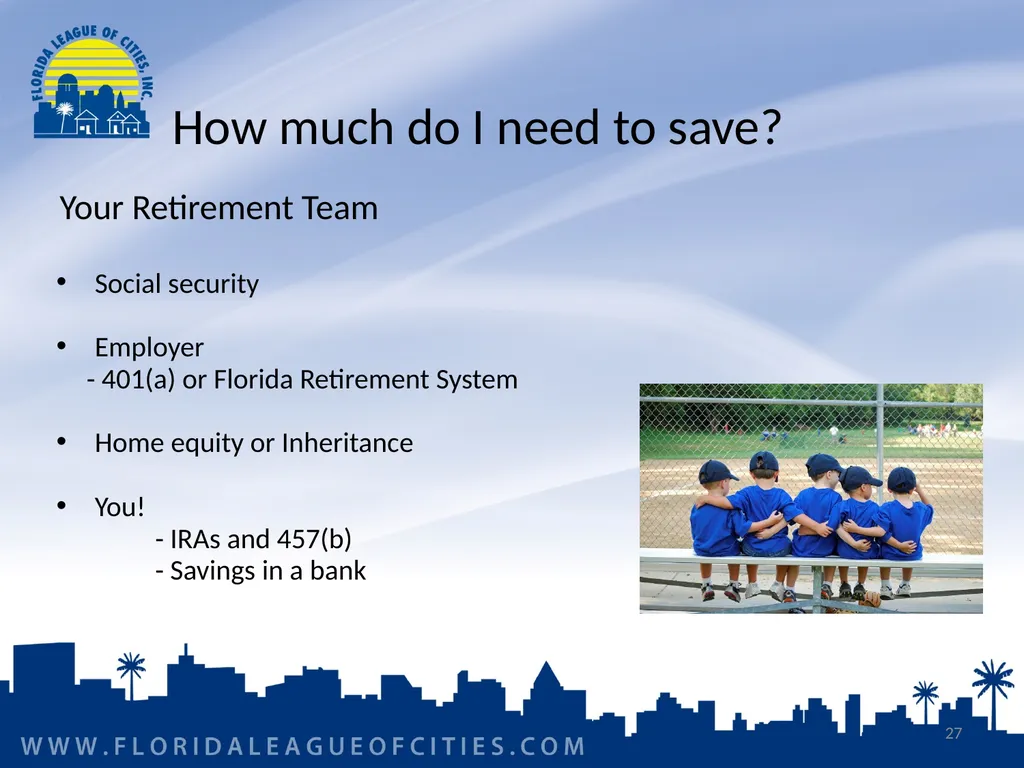
How much do I need to save? Your Retirement Team
Social security
Employer
- 401(a) or Florida Retirement System
Home equity or Inheritance
You!
- IRAs and 457(b)
- Savings in a bank 27<br>
27
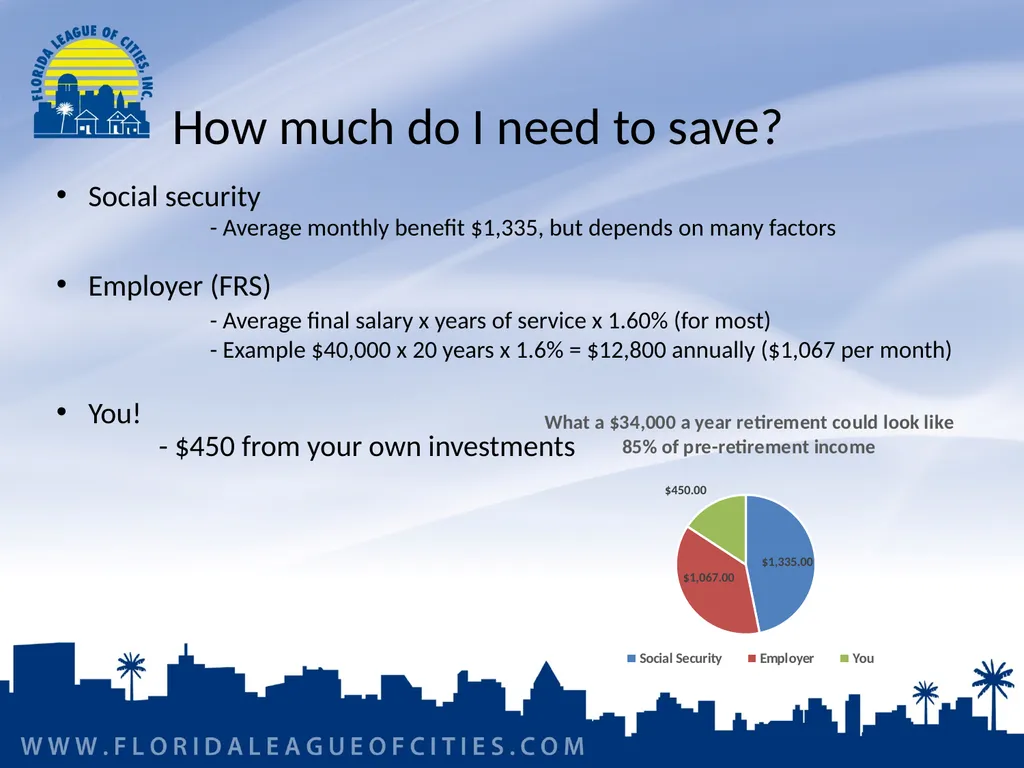
How much do I need to save? Social security
- Average monthly benefit $1,335, but depends on many factors
Employer (FRS)
- Average final salary x years of service x 1.60% (for most)
- Example $40,000 x 20 years x 1.6% = $12,800 annually ($1,067 per month)
You!
- $450 from your own investments<br>
28
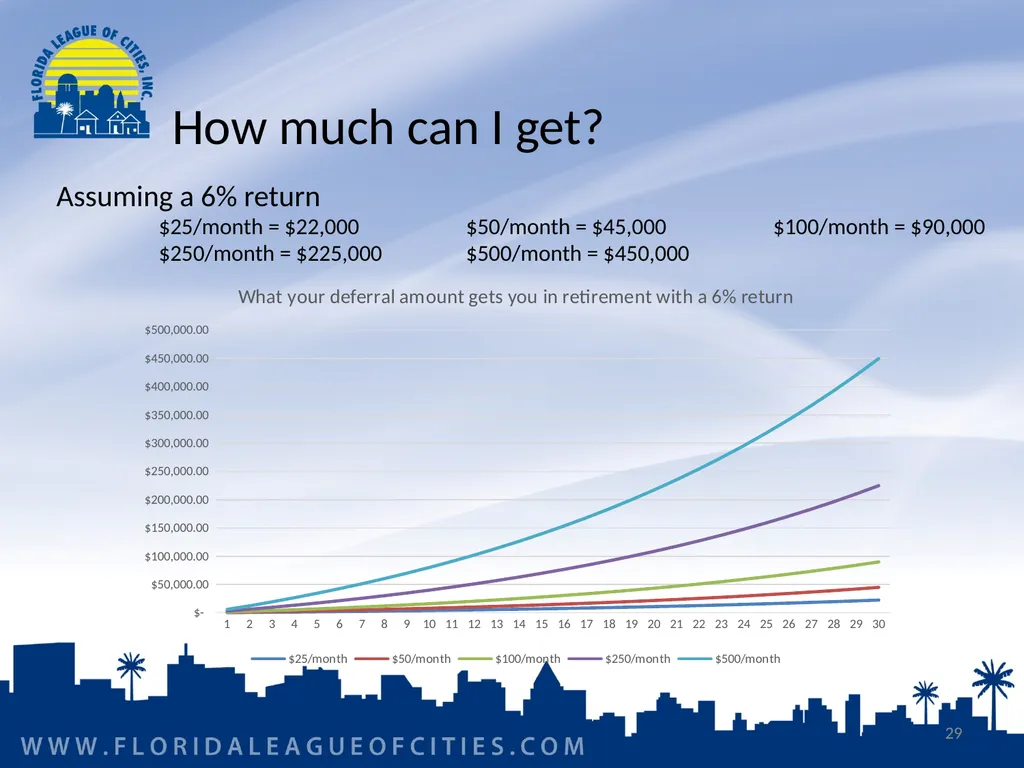
How much can I get? Assuming a 6% return
$25/month = $22,000 $50/month = $45,000 $100/month = $90,000
$250/month = $225,000 $500/month = $450,000 29<br>
29
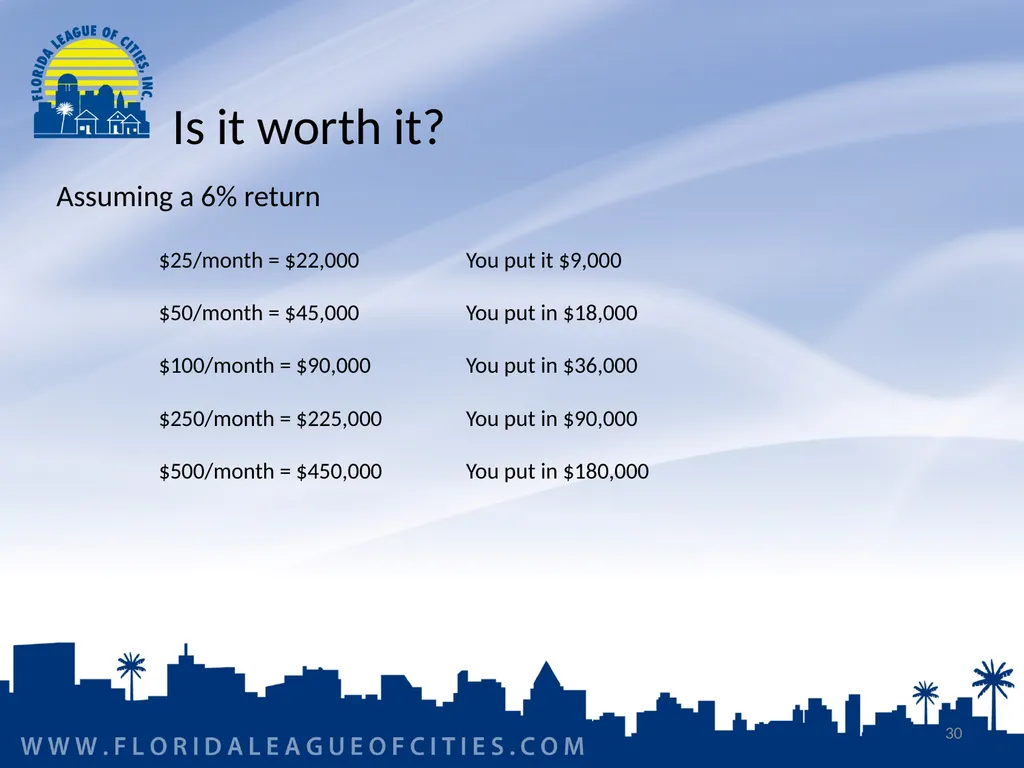
Is it worth it? Assuming a 6% return
$25/month = $22,000 You put it $9,000
$50/month = $45,000 You put in $18,000
$100/month = $90,000 You put in $36,000
$250/month = $225,000 You put in $90,000
$500/month = $450,000 You put in $180,000 30<br>
30
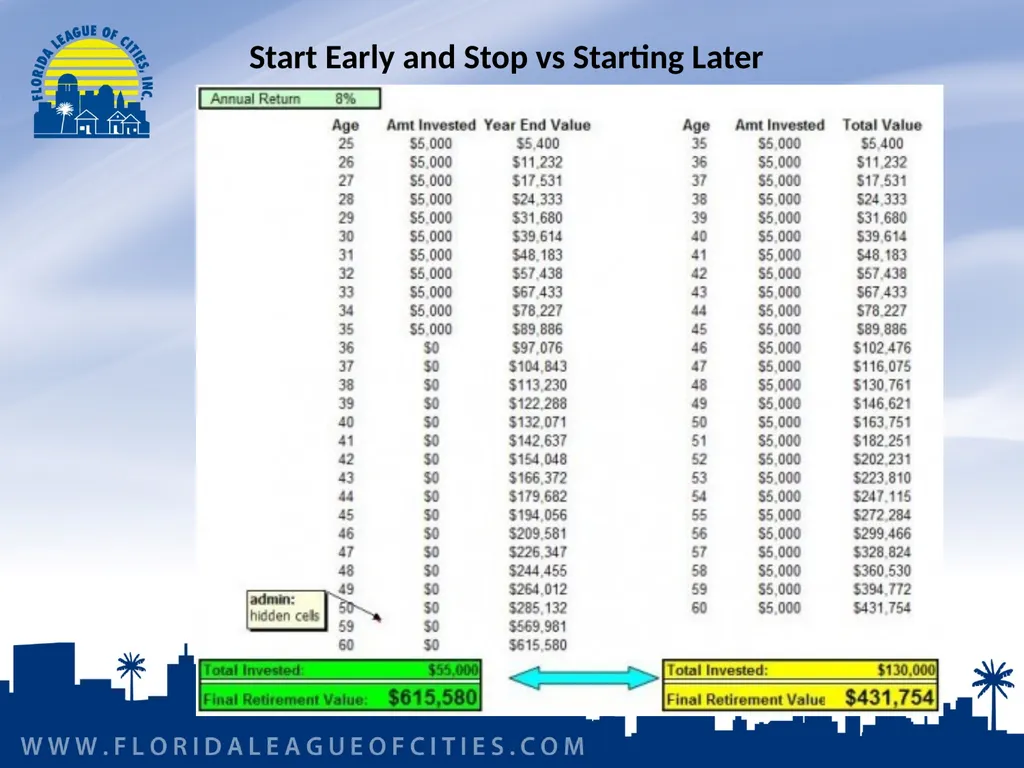
Start Early and Stop vs Starting Later<br>
31
Rodney Walton
Account Representative
813-340-7545
rwalton@flcities.com
www.flcretirement.com Contact 32<br>